
Synergistic Mechanisms of Blockchain Adoption and Government Subsidies in Contract Farming Supply Chain Systems: A Multi-Stage Stackelberg Game Approach
Abstract
1. Introduction
- (1)
- Is there an optimal efficiency frontier for government subsidies?
- (2)
- How do market environment factors and cost factors impact the decisions and profits of supply chain members?
- (3)
- How should differentiated subsidy strategies be designed for different dominance models, and does a free-riding dilemma exist within the supply chain?
- (4)
- Can government subsidies overcome investment inertia, and through what mechanism can a Pareto improvement in both profits and social welfare be achieved?
2. Literature Review
2.1. Research on Contract Farming Supply Chains
2.2. Research on the Application of Blockchain Technology in Supply Chains
2.3. Related Research on Government Subsidies
2.4. Research Gaps
3. Model Description and Basic Assumptions
3.1. Model Description
3.2. Basic Assumptions
4. Construction of the Game Model and Solution of the Equilibrium Strategy
4.1. An Order-Based Agricultural Supply Chain That Introduces Blockchain Technology Without Government Subsidies
4.2. An Order-Based Agricultural Supply Chain That Introduces Blockchain Technology Under Government Subsidies
5. Theoretical Analysis of the Equilibrium Results
5.1. Analysis of the Influence Mechanism of Key Parameters and the Effectiveness of Subsidies
5.2. Balanced Comparison of Different Models
6. Numerical Analysis
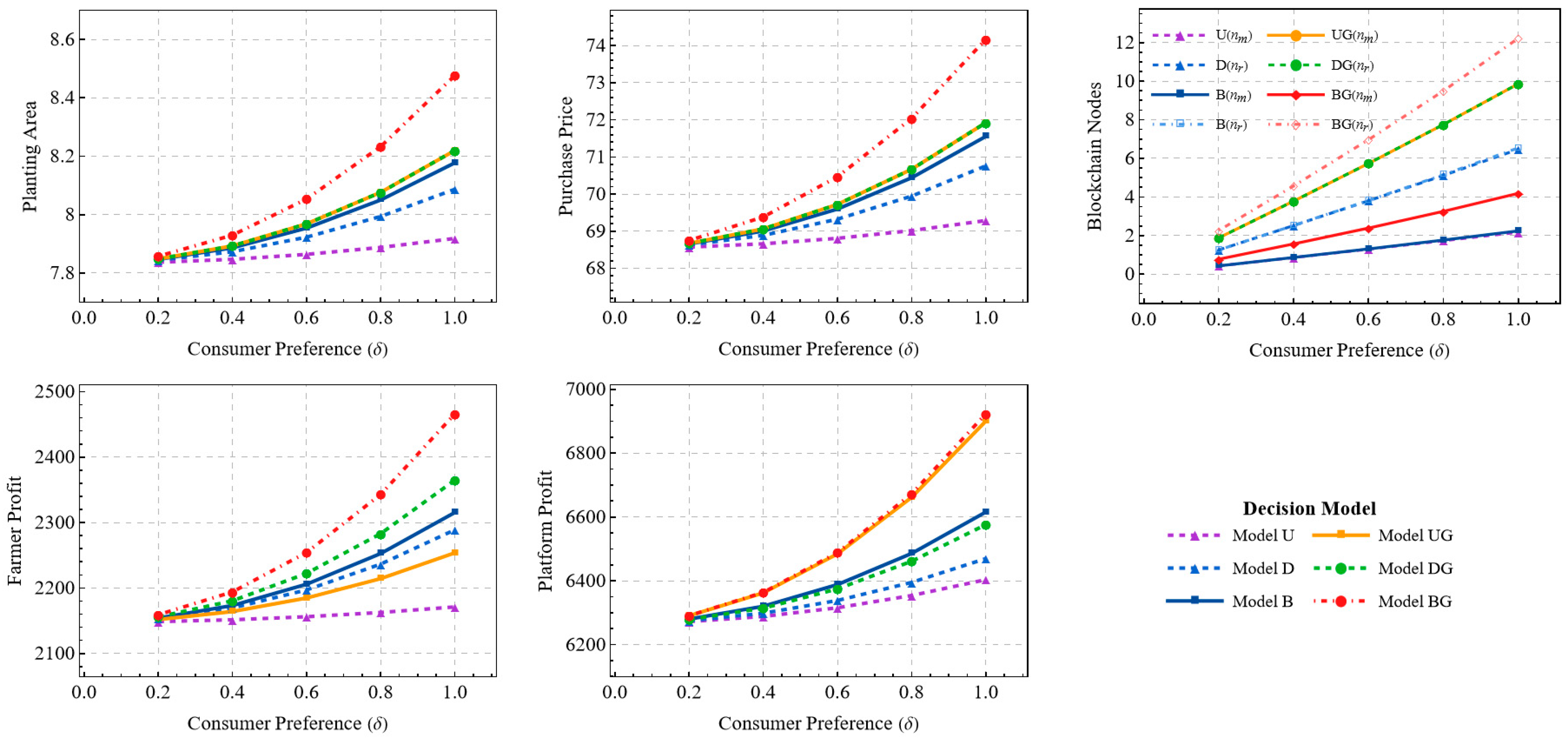
6.1. Decision Robustness Analysis Driven by Market Heterogeneity
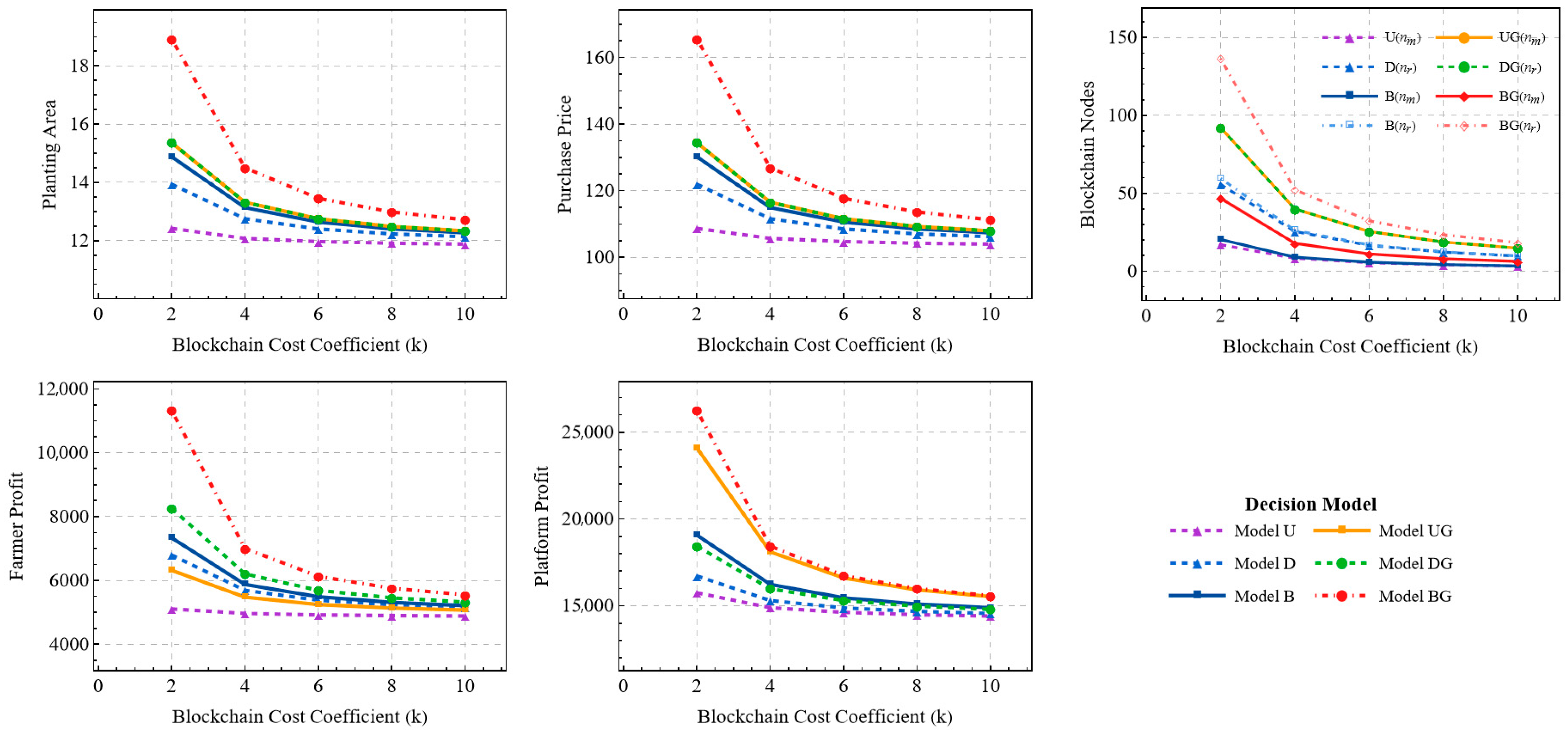
6.2. Transmission Effects and Boundary Analysis of Cost Factors
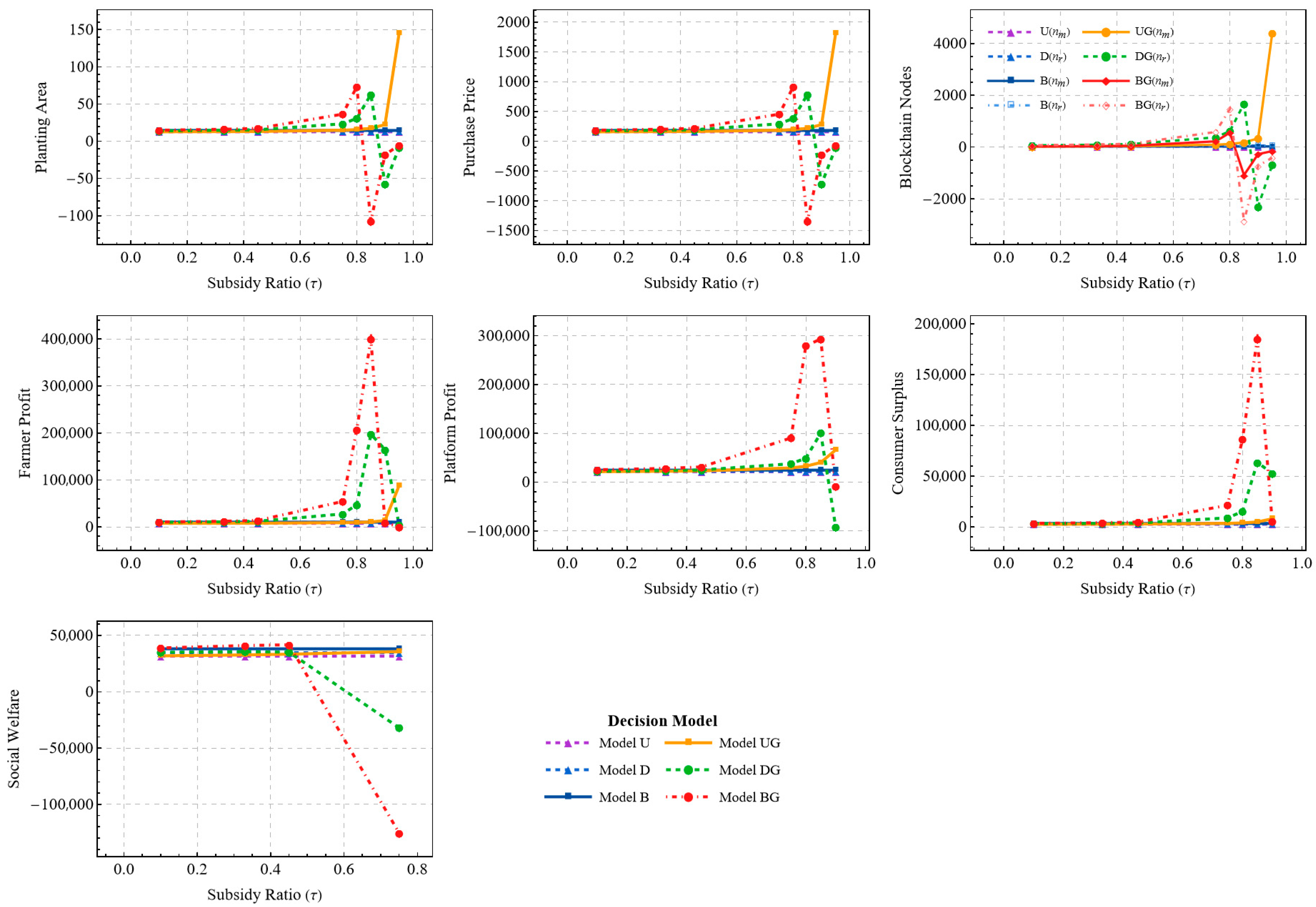
6.3. Nonlinear Characteristics of Subsidy Incentives and Asymmetric Spillover Effects
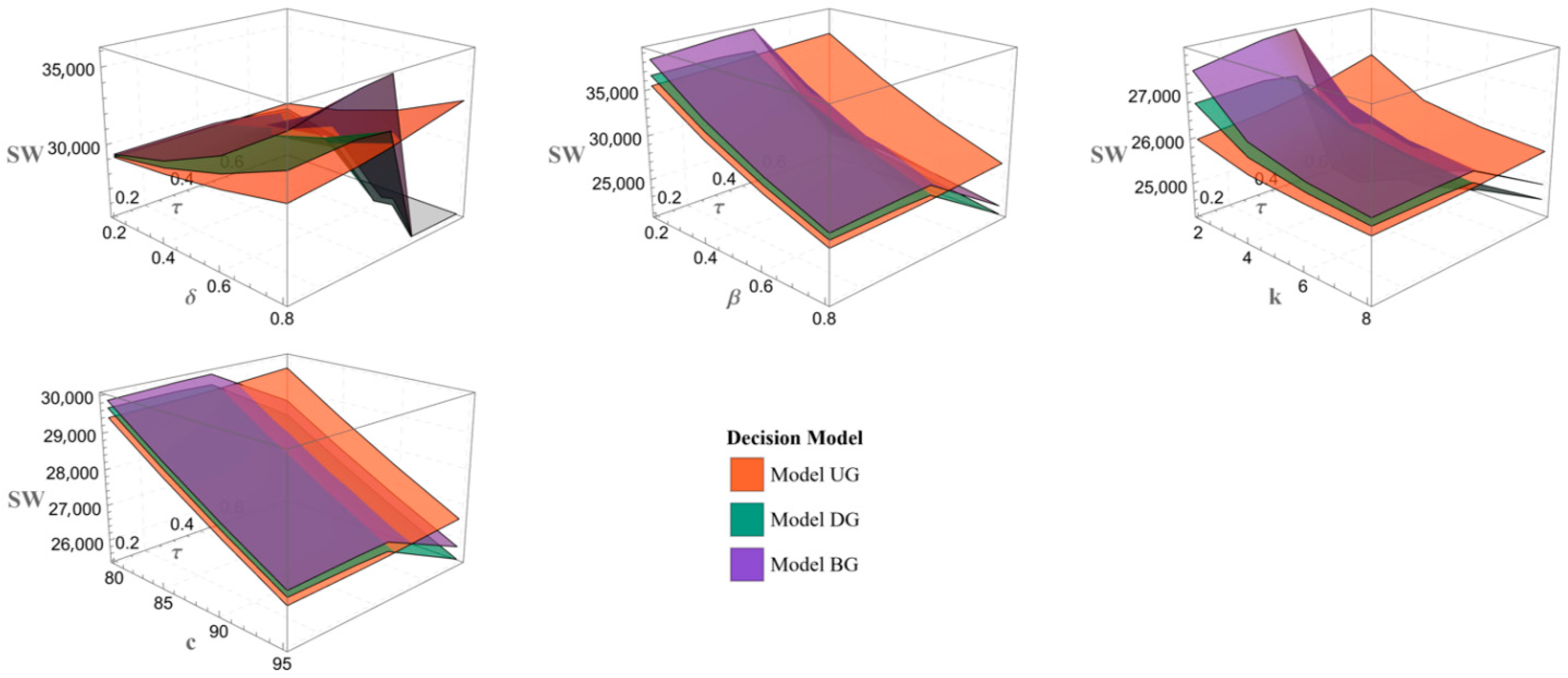
6.4. Strategic Selection Analysis Based on Social Welfare Maximization
6.5. Welfare Gradient and Sensitivity Analysis Under Multifactor Interactions
7. Conclusions
7.1. Main Conclusions
- (1)
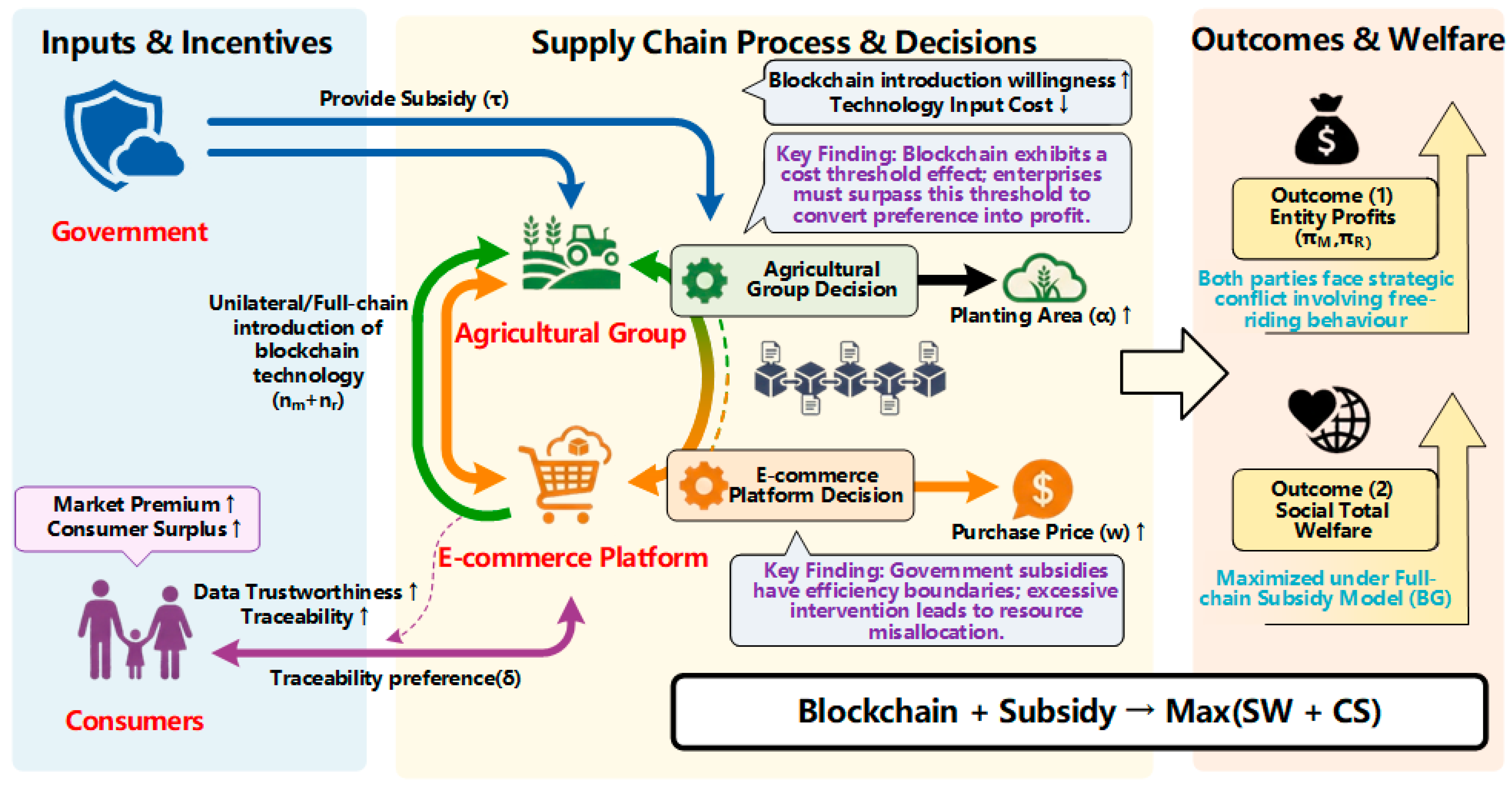
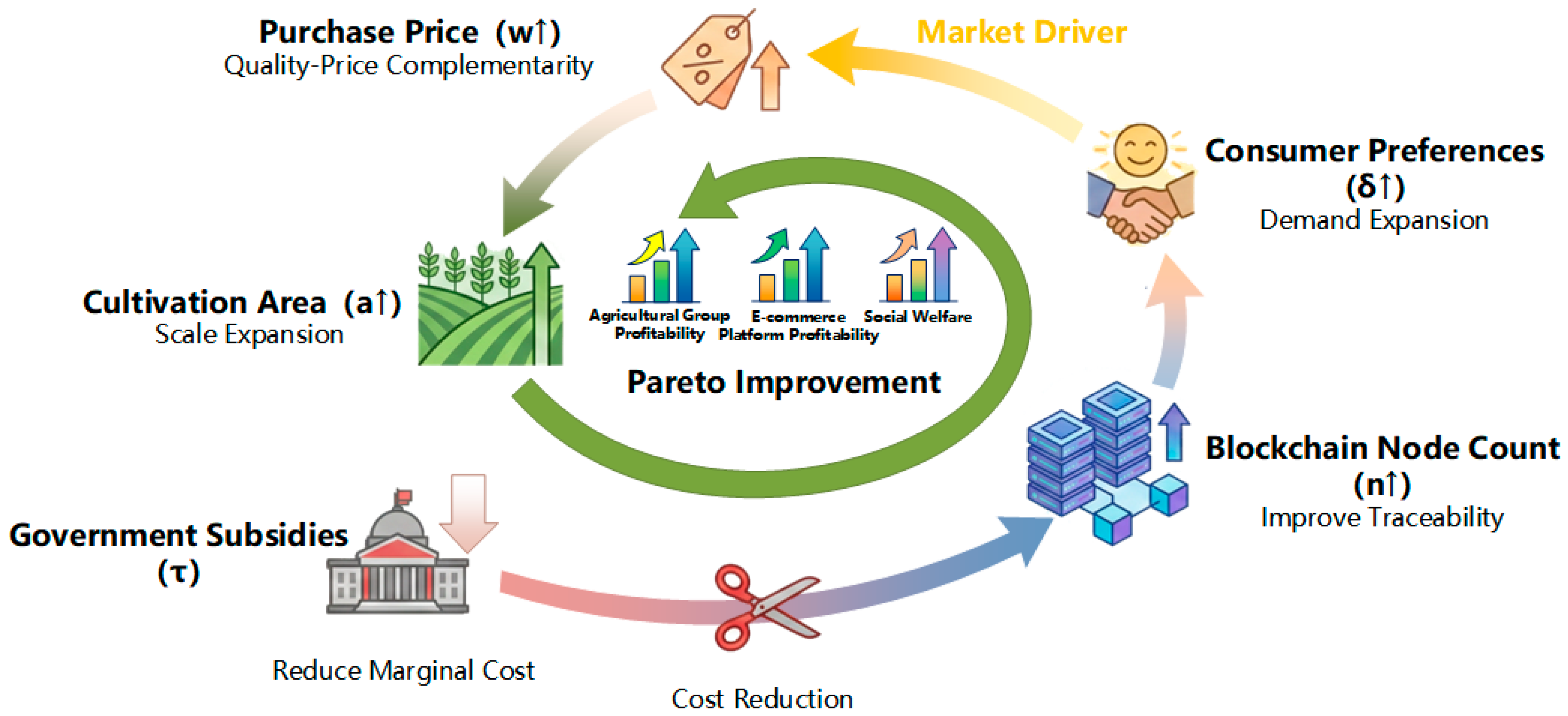
- The market environment is a prerequisite for determining whether blockchain technology can be successfully implemented. The results of this study reveal that consumer traceability preference has a significant positive driving effect, capable of incentivizing the supply side to increase node investment and expand the planting scale through the demand expansion–price transmission mechanism. However, price sensitivity constitutes a strong inhibitory factor, leading to a low-level equilibrium characterized by a simultaneous decline in both quantity and price. More critically, only when the cost-effectiveness of blockchain technology exceeds a specific threshold can market preference translate into actual profit growth for enterprises; otherwise, firms fall into the dilemma of increased revenue without increased profit.
- (2)
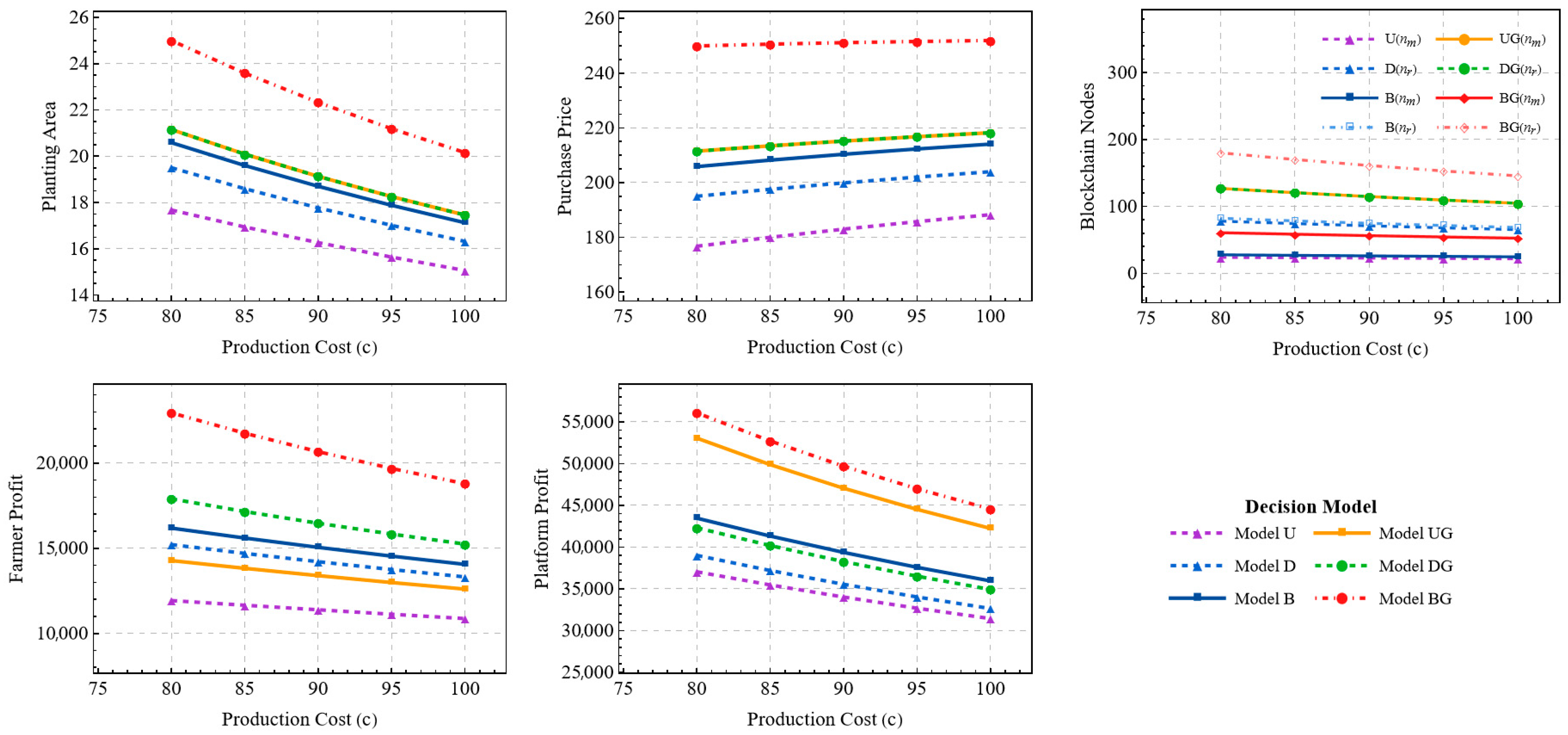
- Cost transmission is asymmetric. The research reveals distinct transmission mechanisms for technology costs versus production costs. An increase in blockchain technology costs forces entities to cut their investment and contract supply. In contrast, an increase in agricultural production costs, while reducing profits and planting area, triggers a rigid cost-pass-through mechanism that forces procurement prices to rise passively. There is an essential difference between this cost-push price increase and demand-pull value appreciation. The former harms the long-term competitiveness of the supply chain, whereas the latter is key to achieving sustainable development.
- (3)
- Government subsidies are not merely financial transfers but external levers for breaking low-level Nash equilibria. The research confirms that an optimal subsidy strategy can achieve Pareto improvement in the supply chain. Within the effective range, subsidies can significantly stimulate a technology crowding-in effect, prompting both the agricultural group and the e-commerce platform to simultaneously increase node investment, procurement prices, and the planting area, ultimately achieving dual growth in corporate profits and total social welfare. In particular, Model BG, by leveraging the dual dividends of eliminating information silos and reducing marginal costs, can maximize social welfare in most scenarios.
- (4)
- Subsidy strategies involve structural differences and a boxed pigs game dilemma. Owing to its disadvantaged position in the value chain and distance from the end market, the agricultural group requires the highest subsidy ratio to overcome investment inertia. In contrast, the e-commerce platform, leveraging its market proximity advantage, requires the lowest subsidy ratio. However, the study revealed intense strategic conflicts between supply chain entities. The e-commerce platform prefers Model UG because upstream blockchain investment generates product-level traceability premiums that directly expand market demand, from which the platform benefits through higher sales volume, while bearing no technology investment cost itself. Symmetrically, the agricultural group prefers Model DG to capture downstream-driven demand expansion without incurring blockchain expenditure. This mutual free-riding motivation creates a strategic mismatch that, without external coordination, can easily trap the supply chain in a prisoner’s dilemma of investment inaction.
- (5)
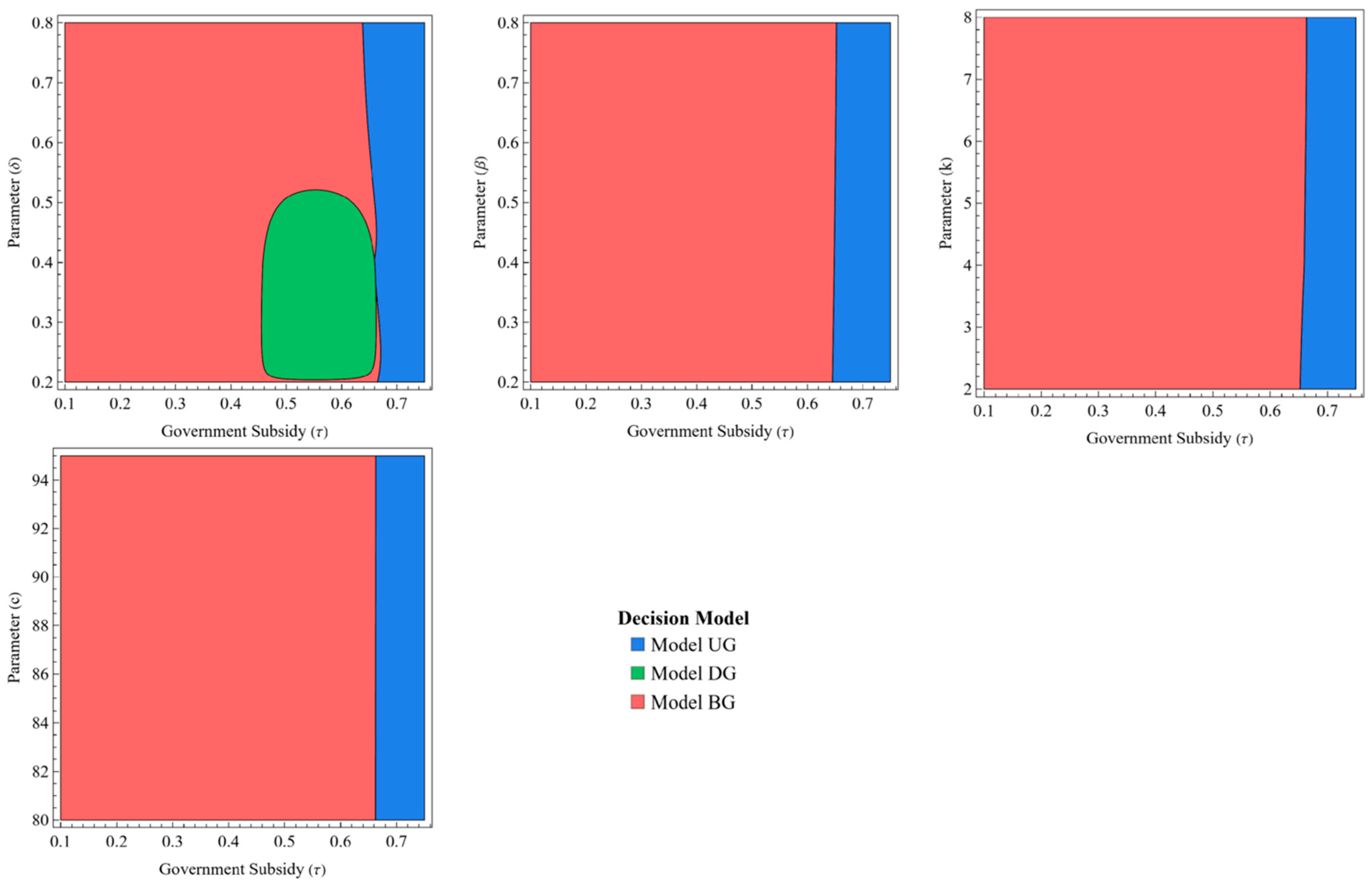
- Boundaries of policy effectiveness and dynamic evolution. Social welfare does not increase indefinitely with subsidies. The research defines the efficiency boundary of subsidies; excessive subsidies lead to resource misallocation and, consequently, harm social welfare. Furthermore, the strategy for maximizing social welfare is context-dependent. In mature markets characterized by low subsidies + high preference, Model BG is the optimal choice. In nascent markets characterized by high subsidies + high sensitivity, Model UG becomes the best choice because of its cost-efficiency advantage.
- (6)
- Several findings merit particular attention due to their counterintuitive nature. First, unilateral subsidies generate asymmetric spillover effects where the non-subsidized party may benefit more than the subsidized party. For instance, under Model UG, the profit growth rate of the non-subsidized e-commerce platform (36.50%) exceeds that of the subsidized agricultural group (16.83%). This “subsidizing one, benefiting the other more” phenomenon arises because the upstream traceability investment creates a market-wide premium from which the downstream party captures disproportionate value through its proximity to consumers. Second, the optimal subsidy ratio for the full-chain model () is lower than that for the upstream-only model (), despite the full-chain model requiring investment from both parties. This counterintuitive ranking occurs because the trust dividend generated by end-to-end traceability partially substitutes for fiscal incentives, reducing the government’s required subsidy intensity. Third, under optimal subsidies, subsidizing either the upstream or downstream party alone achieves identical planting areas and procurement prices (, ), revealing a policy equivalence that grants policymakers significant operational flexibility.
7.2. Managerial and Policy Implications
- (1)
- (2)
- Recommendations for supply chain entities:
7.3. Research Limitations and Future Directions
Author Contributions
Funding
Institutional Review Board Statement
Informed Consent Statement
Data Availability Statement
Conflicts of Interest
Appendix A
Appendix B
Appendix C

| Key Indicators | Remarks | Remarks | ||||
|---|---|---|---|---|---|---|
| + | − | Always holds | − | −/+ | The negative effect of c requires satisfying . | |
| + | − | Always holds | − | + | Always holds | |
| + | − | Always holds | − | − | Always holds | |
| + | − | Always holds | − | −/+ | The negative effect of c requires satisfying . | |
| +/− | −/+ | The positive effect of and the negative effect of require satisfying . | − | − | Always holds | |
| + | − | Always holds | − | − | Always holds | |
| + | − | Always holds | − | + | Always holds | |
| + | − | Always holds | − | − | Always holds | |
| + | −/+ | The negative effect of requires satisfying . | − | −/+ | The negative effect of c requires satisfying . | |
| +/− | −/+ | The positive effect of and the negative effect of require satisfying | − | − | Always holds | |
| + | − | Always holds | − | − | Always holds | |
| + | − | Always holds | − | + | Always holds | |
| + | − | Always holds | − | − | Always holds | |
| +/− | −/+ | The positive effect of and the negative effect of require satisfying | − | −/+ | The negative effect of c requires satisfying . | |
| + | − | Always holds | − | − | Always holds | |
| + | − | Always holds | − | − | Always holds | |
| + | − | Always holds | − | + | Always holds | |
| + | − | Always holds | − | − | Always holds | |
| +/− | −/+ | The positive effect of and the negative effect of require satisfying | − | −/+ | The negative effect of c requires satisfying . | |
| + | − | Always holds | − | − | Always holds | |
| + | − | Always holds | − | −/+ | The negative effect of c requires satisfying . | |
| + | − | Always holds | − | − | Always holds | |
| + | − | Always holds | − | + | Always holds | |
| + | − | Always holds | − | − | Always holds | |
| +/− | −/+ | The positive effect of and the negative effect of require satisfying | − | −/+ | The negative effect of c requires satisfying . | |
| +/− | −/+ | The positive effect of δ and the negative effect ofβ require satisfying | − | − | Always holds |
| Key Indicators | UG vs. U | DG vs. D |
|---|---|---|
References
- Khandelwal, C.; Singhal, M.; Gaurav, G.; Dangayach, G.S.; Meena, M.L. Agriculture Supply Chain Management: A Review (2010–2020). Mater. Today Proc. 2021, 47, 3144–3153. [Google Scholar] [CrossRef]
- Chen, J.; Chen, Y.J. The Impact of Contract Farming on Agricultural Product Supply in Developing Economies. Prod. Oper. Manag. 2021, 30, 2395–2419. [Google Scholar] [CrossRef]
- Meemken, E.-M.; Bellemare, M.F. Smallholder farmers and contract farming in developing countries. Proc. Natl. Acad. Sci. USA 2019, 117, 259–264. [Google Scholar] [CrossRef]
- Francois, G.; Fabrice, V.; Didier, M. Traceability of fruits and vegetables. Phytochemistry 2020, 173, 112291. [Google Scholar] [CrossRef]
- Li, X.; Du, J.; Li, W.; Shahzad, F. Green ambitions: A comprehensive model for enhanced traceability in agricultural product supply chain to ensure quality and safety. J. Clean. Prod. 2023, 420, 138397. [Google Scholar] [CrossRef]
- Azzi, R.; Chamoun, R.K.; Sokhn, M. The power of a blockchain-based supply chain. Comput. Ind. Eng. 2019, 135, 582–592. [Google Scholar] [CrossRef]
- Park, A.; Li, H. The Effect of Blockchain Technology on Supply Chain Sustainability Performances. Sustainability 2021, 13, 1726. [Google Scholar] [CrossRef]
- Sajja, G.S.; Rane, K.P.; Phasinam, K.; Kassanuk, T.; Okoronkwo, E.; Prabhu, P. Towards applicability of blockchain in agriculture sector. Mater. Today Proc. 2023, 80, 3705–3708. [Google Scholar] [CrossRef]
- Vázquez Meléndez, E.I.; Smith, B.; Bergey, P. Food provenance assurance and willingness to pay for blockchain data security: A case of Australian consumers. J. Retail. Consum. Serv. 2025, 82, 104080. [Google Scholar] [CrossRef]
- Jang, J.; Kang, J. Blockchain meets luxury: The role of NFT authentication in luxury retail platforms. J. Retail. Consum. Serv. 2025, 84, 104262. [Google Scholar] [CrossRef]
- Yi, Y.; Feng, Y.; Li, Y.; Li, C. Reselling or consignment? Blockchain adoption and sales model choices under consumer reference quality effects. J. Retail. Consum. Serv. 2026, 88, 104499. [Google Scholar] [CrossRef]
- Kshetri, N. Blockchain’s roles in meeting key supply chain management objectives. Int. J. Inf. Manag. 2018, 39, 80–89. [Google Scholar] [CrossRef]
- Dutta, P.; Choi, T.-M.; Somani, S.; Butala, R. Blockchain technology in supply chain operations: Applications, challenges and research opportunities. Transp. Res. Part E Logist. Transp. Rev. 2020, 142, 102067. [Google Scholar] [CrossRef]
- Duong, C.D.; Vu, T.N.; Ngo, T.V.N.; Chu, T.V.; Pham, L.H.T. Who can you trust? The curvilinear effects of producer-retailer trust (im)balance in organic food consumption—The moderation role of trust in blockchain technology. J. Retail. Consum. Serv. 2024, 81, 104039. [Google Scholar] [CrossRef]
- Liu, H.; Ma, R.; He, G.; Lamrabet, A.; Fu, S. The impact of blockchain technology on the online purchase behavior of green agricultural products. J. Retail. Consum. Serv. 2023, 74, 103387. [Google Scholar] [CrossRef]
- Song, L.; Luo, Y.; Chang, Z.; Jin, C.; Nicolas, M. Blockchain Adoption in Agricultural Supply Chain for Better Sustainability: A Game Theory Perspective. Sustainability 2022, 14, 1470. [Google Scholar] [CrossRef]
- Wu, Z.; Zhu, J. Optimal strategies for contract farming supply chain with government subsidies under e-commerce assistance to farmers. PLoS ONE 2024, 19, e0311490. [Google Scholar] [CrossRef]
- Wang, D.; Tian, X.; Guo, M. Pricing decision and channel selection of fresh agricultural products dual-channel supply chain based on blockchain. PLoS ONE 2024, 19, e0297484. [Google Scholar] [CrossRef]
- Liu, Z.-Y.; Guo, P.-T. Supply Chain Decision Model Based on Blockchain: A Case Study of Fresh Food E-Commerce Supply Chain Performance Improvement. Discret. Dyn. Nat. Soc. 2021, 2021, 5795547. [Google Scholar] [CrossRef]
- Shi, L.; Pang, T.; Peng, H.; Feng, X. Green production of contract-farming supply chain with agricultural insurance and government subsidy. Ann. Oper. Res. 2025. [Google Scholar] [CrossRef]
- Li, Y.; Cao, W. Green and Efficient Technology Investment Strategies for a Contract Farming Supply Chain Under the CVaR Criterion. Sustainability 2025, 17, 7600. [Google Scholar] [CrossRef]
- Li, J.; Huang, S.; Fu, H.; Dan, B. Weather risk hedging mechanism for contract farming supply chain with weather-dependent yield. Comput. Ind. Eng. 2024, 191, 110157. [Google Scholar] [CrossRef]
- Pamucar, D.; Liao, C.; Lu, Q.; Lin, L. Coordinating a three-level contract farming supply chain with option contracts considering risk-averse farmer and retailer. PLoS ONE 2023, 18, e0279115. [Google Scholar] [CrossRef]
- Ye, F.; Lin, Q.; Li, Y. Coordination for contract farming supply chain with stochastic yield and demand under CVaR criterion. Oper. Res. 2017, 20, 369–397. [Google Scholar] [CrossRef]
- Shi, Y.; Wang, F. Revenue and Risk Sharing Mechanism Design in Agriculture Supply Chains Considering the Participation of Agricultural Cooperatives. Systems 2023, 11, 423. [Google Scholar] [CrossRef]
- Liao, C.; Lu, Q. Digital technology adoption strategies for a contract farming supply chain under CVaR criterion. Manag. Decis. Econ. 2024, 45, 1435–1453. [Google Scholar] [CrossRef]
- Fu, S.; He, G.; Wang, Q.; Huo, B.; Ding, Y. Power use, cooperative behavior and alliance performance: Evidence from contract farming supply chains in China. Ind. Manag. Data Syst. 2022, 123, 794–820. [Google Scholar] [CrossRef]
- Hong, X.; He, Y.; Zhou, P.; Chen, J. Demand information sharing in a contract farming supply chain. Eur. J. Oper. Res. 2023, 309, 560–577. [Google Scholar] [CrossRef]
- Li, Z.; He, J.; Xue, Q. Modeling Blockchain Investment in Data-Intensive Supply Chains: A Game-Theoretic Analysis of Power Structures. Systems 2025, 13, 1029. [Google Scholar] [CrossRef]
- Mukucha, P.; Chari, F. Supply chain resilience: The role of supplier development in the form of contract farming in fast-food outlets in Zimbabwe. Contin. Resil. Rev. 2022, 4, 280–299. [Google Scholar] [CrossRef]
- Nguyen, H.K.; Chiong, R.; Chica, M.; Middleton, R.; Thi Kim Pham, D. Contract Farming in the Mekong Delta’s Rice Supply Chain: Insights from an Agent-Based Modeling Study. J. Artif. Soc. Soc. Simul. 2019, 22, 4008. [Google Scholar] [CrossRef]
- Nematollahi, M.; Guitouni, A.; Heydari, J.; Gerbrandt, E.M. Win–win contract farming in dual-channel agribusiness supply chains under yield, quality, and price uncertainty. Int. J. Prod. Econ. 2025, 286, 109635. [Google Scholar] [CrossRef]
- Xing, G.; Zhong, Y.; Zhou, Y.-W.; Cao, B. Distributionally robust production and pricing for risk-averse contract-farming supply chains with uncertain demand and yield. Transp. Res. Part E Logist. Transp. Rev. 2025, 198, 104074. [Google Scholar] [CrossRef]
- Zhou, F.; Zhou, X.; Peng, Y.; Xu, B.; Xiong, W.-z.; Peng, X.-m. Government subsidy research on the application of IoT technology in contract-farming supply chain. PLoS ONE 2025, 20, e0327816. [Google Scholar] [CrossRef]
- Song, F.; Wu, M.; Liu, R. The Impact of Supply Chain Structure Diversification on High-Quality Development: A Moderating Perspective of Digital Supply Chains. J. Theor. Appl. Electron. Commer. Res. 2025, 20, 301. [Google Scholar] [CrossRef]
- Bulgakov, A.L.; Aleshina, A.V.; Smirnov, S.D.; Demidov, A.D.; Milyutin, M.A.; Xin, Y. Scalability and Security in Blockchain Networks: Evaluation of Sharding Algorithms and Prospects for Decentralized Data Storage. Mathematics 2024, 12, 3860. [Google Scholar] [CrossRef]
- Ma, C.-m. Impacts of demand disruption and government subsidy on closed-loop supply chain management: A model based approach. Environ. Technol. Innov. 2022, 27, 102425. [Google Scholar] [CrossRef]
- Rejeb, A.; Rejeb, K.; Molavi, H.; Keogh, J.G. A Data-Driven Topic Modeling Analysis of Blockchain in Food Supply Chain Traceability. Information 2025, 16, 1096. [Google Scholar] [CrossRef]
- Boison, D.K.; Doumbia, M.O.; Antwi-Boampong, A.; Loglo, F.S.; Malcalm, E. Block chain ready port terminal operations using distributed ledger. Asian J. Shipp. Logist. 2025, 41, 177–186. [Google Scholar] [CrossRef]
- Aldosari, R.B.; Kalmey, F.M.; Alanazi, A.T.; A’Aqoulah, A.A. The benefits and challenges of blockchain in healthcare supply chain management in KSA: A systematic review. J. Taibah Univ. Med. Sci. 2025, 20, 612–621. [Google Scholar] [CrossRef]
- Karacigan, A.; Caglayan, S.; Tezel, A.; Ozorhon, B. Strategic Roadmap to Achieve Successful Implementation of Blockchain Technology in Construction Contract Management. J. Constr. Eng. Manag. 2025, 151, 04025056. [Google Scholar] [CrossRef]
- Muneeb, S.M.; Jalil, S.A.; Asim, Z. A Sustainable Supply Chain-Centric Framework for Blockchain-Driven Financial Optimization using QFD and BWM. Process Integr. Optim. Sustain. 2025. [Google Scholar] [CrossRef]
- Uvet, H.; Park, A.; Dickens, J.; Oh, J.; Hazen, B. How blockchain technology utilization influences corporate social responsibility through supply chain transparency and the role of supplier risk. Int. J. Logist. Manag. 2025, 36, 1195–1221. [Google Scholar] [CrossRef]
- Shahzad, K.; Zhang, Q.; Zafar, A.U.; Ashfaq, M.; Rehman, S.U. The role of blockchain-enabled traceability, task technology fit, and user self-efficacy in mobile food delivery applications. J. Retail. Consum. Serv. 2023, 73, 103331. [Google Scholar] [CrossRef]
- Tokkozhina, U.; Martins, A.L.; Ferreira, J.C. Use of Blockchain Technology to Manage the Supply Chains: Comparison of Perspectives between Technology Providers and Early Industry Adopters. J. Theor. Appl. Electron. Commer. Res. 2022, 17, 1616–1632. [Google Scholar] [CrossRef]
- Kang, Y.; Shi, X.; Yue, X.; Zhang, W.; Liu, S.S. Enhancing Traceability in Wine Supply Chains through Blockchain: A Stackelberg Game-Theoretical Analysis. J. Theor. Appl. Electron. Commer. Res. 2023, 18, 2142–2162. [Google Scholar] [CrossRef]
- Shi, L.; Pang, T.; Peng, H.; Feng, X. Green technology outsourcing for agricultural supply chains with government subsidies. J. Clean. Prod. 2024, 436, 140674. [Google Scholar] [CrossRef]
- Wang, Y.; Shi, S.; Xu, H.; Zhao, Y.; Gu, F. Government economic subsidies or credit risk mitigation: Incentive contracts and resilience assessment in low-carbon agricultural supply chains. Expert Syst. Appl. 2026, 299, 130329. [Google Scholar] [CrossRef]
- Fang, D.; Zhang, X. The Protective Effect of Digital Financial Inclusion on Agricultural Supply Chain during the COVID-19 Pandemic: Evidence from China. J. Theor. Appl. Electron. Commer. Res. 2021, 16, 3202–3217. [Google Scholar] [CrossRef]
- Lee, D.-H.; Park, E.-H. Decision Making in a Closed-Loop Supply Chain with a Waste Management Program: Manufacturers’ Take-Back Activity and Governmental Subsidies for Remanufacturing. Processes 2023, 11, 3132. [Google Scholar] [CrossRef]
- Jian, M.; Sun, F.; Hayrutdinov, S. Analysis of Government Differential Weight Subsidy in an Emerging Coastal Industry Supply Chain. J. Coast. Res. 2019, 94, 169. [Google Scholar] [CrossRef]
- Lee, J.S.; Chung, B.D. Effects of government subsidy programs on job creation for sustainable supply chain management. Socio-Econ. Plan. Sci. 2022, 82, 101261. [Google Scholar] [CrossRef]
- Yi, S.; Wen, G. Game model of transnational green supply chain management considering government subsidies. Ann. Oper. Res. 2023, 355, 2071–2092. [Google Scholar] [CrossRef]
- Xu, Y.; Tian, Y.; Pang, C.; Tang, H. Manufacturer vs. Retailer: A Comparative Analysis of Different Government Subsidy Strategies in a Dual-Channel Supply Chain Considering Green Quality and Channel Preferences. Mathematics 2024, 12, 1433. [Google Scholar] [CrossRef]
- National Bureau of Statistics of China. China Statistical Yearbook 2024; China Statistics Press: Beijing, China, 2024. Available online: https://www.stats.gov.cn/sj/ndsj/2024/indexeh.htm (accessed on 25 December 2025).





| Symbol | Explanation |
|---|---|
| Procurement price per unit of agricultural product | |
| Retail price per unit of agricultural product | |
| Maximum willingness-to-pay of consumers | |
| Planting area of agricultural products | |
| Production cost coefficient per unit area of agricultural products | |
| Random yield per unit area of agricultural products | |
| Mean of random yield per unit area of agricultural products | |
| Standard deviation of random yield per unit area of agricultural products | |
| Blockchain technology cost coefficient | |
| Consumer preference coefficient for blockchain-traced products | |
| Government subsidy ratio | |
| Consumer surplus | |
| Total social welfare | |
| Profit of supply chain entity i under model j | |
| Consumer sensitivity coefficient to agricultural product price | |
| Number of blockchain nodes introduced by supply chain entity i | |
| Total cost of blockchain technology introduction by supply chain entity i | |
| Government expenditure to incentivize supply chain entity i to adopt blockchain technology | |
| Supply chain entity: agricultural group or e-commerce platform | |
| Decision model |
| U | D | B | |
|---|---|---|---|
| UG | DG | BG | |
|---|---|---|---|
| Comparison Dimensions | ||||||||
|---|---|---|---|---|---|---|---|---|
| ) | 16.83% | 16.83% | 367.34% | 16.83% | 36.50% | 36.50% | 12.55% | |
| ) | 7.28% | 7.28% | 60.12% | 15.09% | 7.28% | 15.09% | 2.68% | |
| ) | 19.61% | 19.61% | 117.47% | 117.47% | 37.44% | 26.93% | 43.06% | 9.52% |
Disclaimer/Publisher’s Note: The statements, opinions and data contained in all publications are solely those of the individual author(s) and contributor(s) and not of MDPI and/or the editor(s). MDPI and/or the editor(s) disclaim responsibility for any injury to people or property resulting from any ideas, methods, instructions or products referred to in the content. |
© 2026 by the authors. Licensee MDPI, Basel, Switzerland. This article is an open access article distributed under the terms and conditions of the Creative Commons Attribution (CC BY) license.
Share and Cite
Xia, H.; Zhao, J.; Liu, P.; Zhang, Y. Synergistic Mechanisms of Blockchain Adoption and Government Subsidies in Contract Farming Supply Chain Systems: A Multi-Stage Stackelberg Game Approach. Systems 2026, 14, 208. https://doi.org/10.3390/systems14020208
Xia H, Zhao J, Liu P, Zhang Y. Synergistic Mechanisms of Blockchain Adoption and Government Subsidies in Contract Farming Supply Chain Systems: A Multi-Stage Stackelberg Game Approach. Systems. 2026; 14(2):208. https://doi.org/10.3390/systems14020208
Chicago/Turabian StyleXia, Hui, Jianxing Zhao, Pei Liu, and Yulin Zhang. 2026. "Synergistic Mechanisms of Blockchain Adoption and Government Subsidies in Contract Farming Supply Chain Systems: A Multi-Stage Stackelberg Game Approach" Systems 14, no. 2: 208. https://doi.org/10.3390/systems14020208
APA StyleXia, H., Zhao, J., Liu, P., & Zhang, Y. (2026). Synergistic Mechanisms of Blockchain Adoption and Government Subsidies in Contract Farming Supply Chain Systems: A Multi-Stage Stackelberg Game Approach. Systems, 14(2), 208. https://doi.org/10.3390/systems14020208