3.3.3. Sufficiency Analysis
Using Boolean minimization based on counterfactual analysis, three types of solutions were generated: complex, intermediate, and parsimonious [
12]. Conditions appearing in both the intermediate and parsimonious solutions were identified as core conditions, whereas those appearing only in the intermediate solution were treated as peripheral [
77]. Due to the varying proportions of cases with high degrees of membership in the results, different frequency thresholds are used for other outcome variables in this study. Variables with fewer cases and high scores require lower frequency cutoffs to ensure the analysis captures relevant configurations without being limited by overly high thresholds [
78,
79].
Antecedent Configuration with High-Value Co-Creation as the Outcome Variable
Following prior studies, the frequency threshold was set at 6, the consistency threshold at 0.85, and the PRI consistency at 0.75 [
47]. The fsQCA results are reported following [
77] (see
Table 10). The overall solution consistency for high-value co-creation was 0.9246, with all configurations exceeding 0.93, indicating strong explanatory power. Overall coverage reached 0.5825, accounting for approximately 58.3% of high co-creation cases.
As shown in
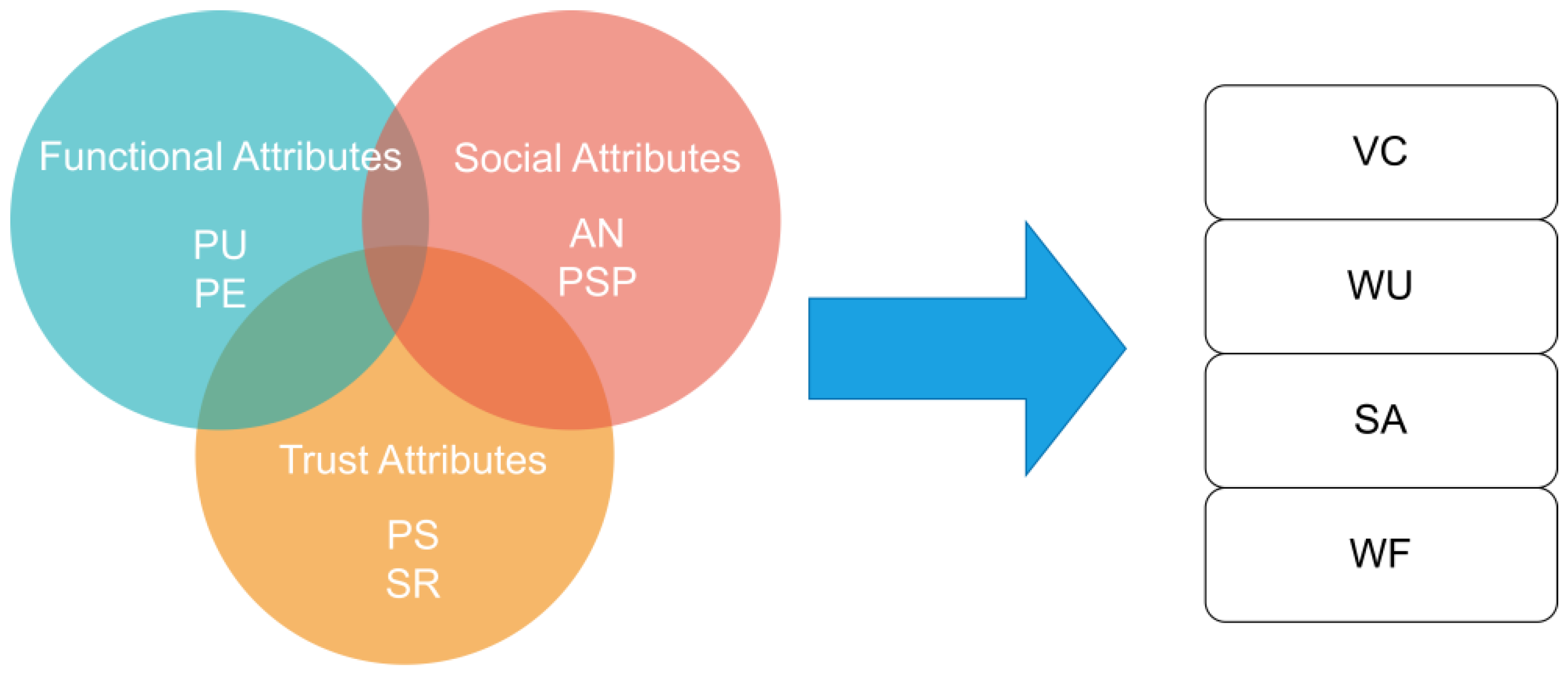
Table 10, fsQCA has identified three configuration paths to achieve a high willingness to co-create customer value. The results show that perceived usefulness (PU) is the core condition in all three paths, indicating that functional value is the fundamental prerequisite for driving customers into collaborative relationships. Meanwhile, perceived social presence (PSP) is the core condition in Path 1 and Path 2, while service recovery capability (SR) is the key condition in Path 1 and Path 3. Based on this, two dominant configuration patterns can be summarized.
- (1)
Function-relationship driven value co-creation (VC1a, VC1b)
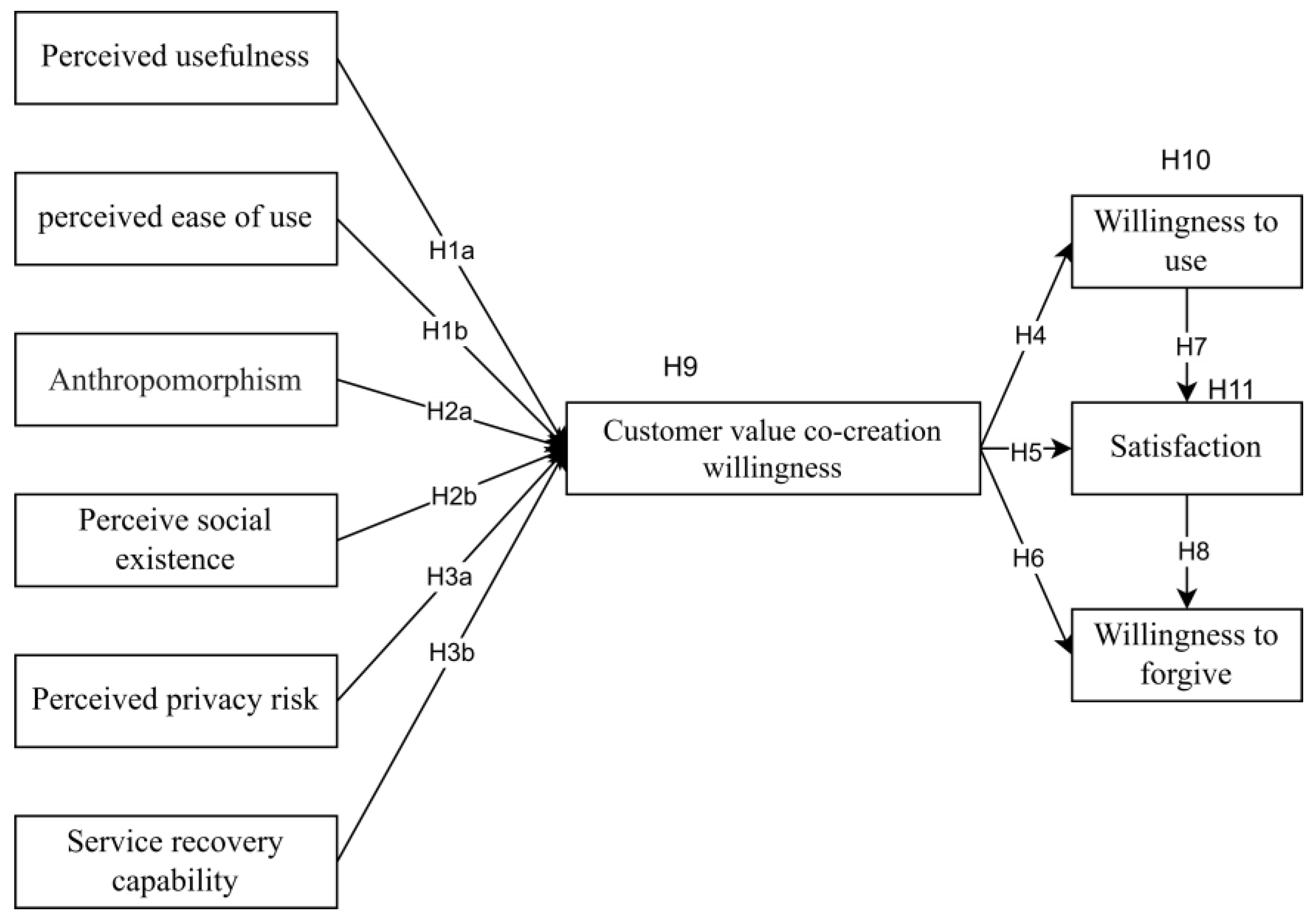
Both VC1a and VC1b jointly present “PU + PSP” as the core condition, indicating that, in a typical situation, customers’ willingness to co-create value primarily stems from the synergy between functional value and social interaction. PU provides a rational basis for value co-creation. At the same time, PSP reduces the psychological distance in human–machine collaboration by enhancing a sense of interaction reality and companionship, making it easier for customers to assume the collaborative role. This discovery echoes the positive impact of PSP on the willingness to co-create value as mentioned in the previous SEM. However, fsQCA further points out that PSP does not work alone; it must be combined with PU to form a core condition to activate the willingness to co-create truly. On this basis, the two sub-paths reveal different situational supplementation mechanisms: In the VC1a path, anthropomorphism (AN) and service recovery capability (SR) exist as marginal conditions. anthropomorphism features and error correction guarantees can further enhance customers’ emotional security, but they are not necessary conditions for the formation of co-creation willingness. In the VC1b path, perceived ease of use (PE), anthropomorphism (AN), and perceived risk (PS) exist as marginal conditions, indicating that even if customers are aware of particular risks, as long as the functional value and social interaction sense are clear, their willingness to co-create can still be activated. This result provides a key supplement to the SEM finding that “PS has no significant impact on the willingness to co-create value”: risk perception does not generally inhibit the willingness to co-create. Still, it is absorbed as a background factor when the “function-relationship” mechanism is stable.
- (2)
Function-Reliability driven Value Co-creation (VC2)
The VC2 path exists with PU + SR as the core condition, while perceived ease of use (PE), anthropomorphism (AN), and perceived risk (PS) only function as marginal conditions. In situations lacking a strong sense of social interaction, customers may still actively participate in value co-creation based on their trust in the stability of system functions and the repairability of problems. In this mode, PU ensures that the robot has the instrumental value for continuous cooperation. At the same time, the core existence of SR indicates that whether customers are willing to engage in collaboration largely depends on their judgment of whether system errors can be fixed. When customers believe that robots can effectively remedy deviations, the psychological threshold for their participation in co-creation will be significantly reduced. It is worth noting that although PS has not become a core condition on this path, it remains a marginal condition, further indicating that the risk has not been ignored but has been incorporated into a reliability assessment framework. This once again shows that perceived risk is not a direct inhibitory factor in the value co-creation stage, but rather a situational condition that depends on whether the reliability mechanism is sufficient.
A Factorial Configuration with High Willingness to Use as the Outcome Variable
In this study, the frequency threshold was set at 6. The consistency threshold and PRI consistency were set at 0.85 and 0.75, respectively [
47]. Configuration analysis was conducted using fsQCA, with results presented following [
77] (see
Table 11). The overall solution consistency for high usage intention reached 0.882, with all configuration paths exceeding 0.89, indicating strong explanatory power. The overall coverage was 0.6217, accounting for approximately 62.2% of high-intention cases. fsQCA identified five effective configurational paths.
From the fsQCA results with high usage intention, it can be seen that the consensus solution identifies five configuration paths (WU1a, WU1b, WU2a, WU2b, WU3). The results show that the path presents a significant differentiation in the core condition structure. Both WU1a and WU1b take perceived ease of use (PE) and anthropomorphism (AN) as the core conditions. Both WU2a and WU2b take perceived social presence (PSP), anthropomorphism (AN), and service resilience (SR) as their core conditions. WU3, on the other hand, takes PE and PSP as its sole core conditions. Based on this, three types of patterns for the formation of usage intentions can be summarized.
- (1)
Low-threshold affinity-driven type (WU1a, WU1b)
Both WU1a and WU1b take perceived ease of use (PE) and anthropomorphism (AN) as the core conditions, while in the path of WU1b, perceived social existence (PSP) is regarded as the marginal non-existence condition. This indicates that in the initial adoption stage, a strong willingness to use can form in situations that do not rely on intense social interaction experiences. From the perspective of the Technology Acceptance Model (TAM), PE, as a cognitive assessment dimension, plays a key role in reducing users’ operational costs and cognitive burdens. When users perceive the system as easy to use, their willingness to act significantly increases. Meanwhile, anthropomorphic features, as heuristic cues, can enhance users’ emotional connection and interactive affinity, thereby reducing users’ psychological resistance to technology. The combination of the two forms a low-threshold, easily triggered path to usage intention. It is worth noting that in this mode, perceived usefulness (PU), privacy risk (PS), and SR exert only marginal contextual influence, indicating that cognitive convenience and affinity cues are sufficient to stimulate willingness to use. In contrast, the marginal effects of other conditions are relatively weak. This result is consistent with the significant main effect of PE and AN on the intention to use in SEM, verifying the key role of these two variables in reducing psychological friction and enhancing perceived value.
- (2)
Interactivity–Trust Guarantee-driven Type (WU2a, WU2b)
Both WU2a and WU2b take perceived social presence (PSP), anthropomorphism (AN), and service recovery capability (SR) as core conditions, while perceived ease of use (PE) in the WU2b path is an edge non-existence condition. This indicates that, in some scenarios, the high willingness to use mainly stems from a sense of interactive response and trust guarantee mechanisms rather than operational convenience. PSP enhances users’ perception that the system provides genuine, immediate interaction feedback, thereby reducing feelings of isolation. AN provides social cues for emotional connection, and SR offers error-correction guarantees when obstacles or incorrect feedback arise during interaction, thereby enhancing users’ belief in the system’s stability. In the SEM results, PSP, AN, and SR all showed significant positive effects on willingness to use, consistent with the model’s core conditions. This indicates that, in interactive situations, the willingness to use no longer depends on ease of use but instead on processes of social cognition and trust-building. Furthermore, the marginal presence of PU or PS across different paths indicates that this mechanism still has contextual flexibility when instrumental value reinforcement or risk awareness is present.
- (3)
Low-friction interactive type (WU3)
WU3 takes PE and PSP as its sole core conditions and can still achieve a high willingness to use it even in the absence of AN, PU, and PS. This path indicates that even in the absence of strong anthropomorphism cues and clear functional value, when users perceive that the basic interaction process is smooth and that there is a sense of social response, a high willingness to use can still form. A smooth operation process and perceptible interactive responses jointly reduce users’ psychological friction, enabling them to more easily enter a positive usage cycle and thereby enhancing their behavioral willingness. This mechanism is consistent with the interactive flow experience theory: low cognitive load and positive interactive feedback can directly stimulate the willingness to use.
Antecedent Configuration with High Satisfaction as the Outcome Variable
In this study, the frequency threshold was set at 6, while the consistency and PRI thresholds were set at 0.85 and 0.70, respectively [
80]. As shown in
Table 12, the overall solution consistency for high user satisfaction reached 0.867, with all configuration paths exceeding 0.88. The overall coverage was 0.557, indicating good explanatory power. fsQCA identified three configurational paths leading to high user satisfaction with service robots.
From the high-satisfaction fsQCA results, it can be known that the consensus solution has identified three effective configuration paths (SA1, SA2a, SA2b) for achieving high satisfaction. Different paths show clear differentiation in the core condition structure, indicating that a single factor does not linearly drive customer satisfaction but rather stems from the synergistic effects of multidimensional perceptual elements across different situations. Overall, these configuration results not only reveal multiple mechanisms for the formation of high satisfaction, but also further complement and deepen the net effect relationship revealed by SEM in the previous text. Based on the combined characteristics of core conditions, the formation mechanisms of high satisfaction can be classified into two typical models.
- (1)
Function-Safety-driven Satisfaction (SA1)
The SA1 path takes perceived usefulness (PU), perceived risk (PS), and service recovery capability (SR) as core conditions, while anthropomorphism (AN) is only an edge existence condition. This configuration indicates that in the process of high satisfaction formation, when customers can clearly perceive the instrumental value of the robot in terms of task completion efficiency and problem-solving ability, and at the same time pay attention to potential risks, satisfaction is mainly based on the coexistence of rational assessment and risk control. From a mechanism perspective, PU, as a core condition, reflects the fundamental position of functional performance in satisfaction evaluation. The core existence of SR further indicates that when uncertainties or potential faults arise in the service process, the ability to promptly and effectively restore services is a key guarantee for maintaining, or even enhancing, satisfaction. It is worth noting that PS does not act as an inhibitory factor in this path but participates in the configuration as one of the core conditions. This indicates that risk perception does not necessarily weaken satisfaction, and its effect depends heavily on whether it is “absorbed” and “offset” by the corresponding remedial and control mechanisms. This discovery forms an essential supplement to the SEM results. Although in SEM, the net effect of perceived risk on value co-creation and satisfaction is negative and not significant, the fsQCA results show that in the context of “high functional value + strong remediation ability”, risk perception does not block the formation of satisfaction, but instead becomes an integral part of customers’ rational weighing. This indicates that perceived risk is not a universal inhibitory variable but rather a context-activating condition that only plays a role in specific configurations.
- (2)
Efficiency—Interactive Experience-driven Satisfaction (SA2a, SA2b)
The core condition structures of the SA2a and SA2b paths are highly consistent, both taking perceived usefulness (PU), perceived ease of use (PE), and perceived social presence (PSP) as core conditions, indicating that in another type of context, high satisfaction mainly stems from an efficient, smooth, and interactive usage experience. In this mode, PU provides a clear functional value foundation, while PE reduces cognitive and operational costs during use. At the same time, PSP enhances the overall experience quality through interactive responses and a sense of companionship. The coexistence of these three elements constitutes the “experience backbone” of high satisfaction, enabling users to form continuous positive evaluations during the service process. On this basis, the combination of different edge conditions further reveals the situational flexibility of this model: in the SA2a path, anthropomorphism (AN) and perceived risk (PS) are regarded as edge existence conditions, indicating that when high efficiency and strong interactive experience have been met, moderate anthropomorphism cues can enhance emotional experience, while risk perception does not significantly weaken satisfaction. In the SA2b path, anthropomorphism (AN) and service recovery capability (SR) are considered edge conditions, indicating that when the usage process itself is smooth, the remediation mechanism plays a more “implicit guarantee” role than an explicit trigger. This pattern is highly consistent with the SEM results, which show a significant positive impact of PU, PE, and PSP on satisfaction. However, fsQCA further indicates that these variables do not act in isolation but must work together, thereby revealing the interaction logic that linear models cannot capture.
Antecedent Configuration with High Willingness to Forgive as the Outcome Variable
In this study, the frequency threshold was set at 3, retaining 75% of cases, while the consistency and PRI thresholds were set at 0.85 and 0.60, respectively [
80]. As shown in
Table 13, the overall solution consistency for high forgiveness willingness reached 0.86, with all configuration paths exceeding 0.87. The overall coverage was 0.534, indicating good explanatory power. fsQCA identified three configurational paths leading to high willingness to forgive service robots.
From the fsQCA results on high forgiveness willingness, the consensus solution identifies three effective configuration paths (WF1a, WF1b, WF2) for achieving it. Different paths show clear differentiation in the core condition structure, indicating that customers’ forgiving responses to service robot mistakes or service deviations do not stem from a single psychological factor, but are based on the interaction of multiple mechanisms such as functional rationality, interactive cognition, and risk assessment. Based on the combined characteristics of core conditions, the formation mechanism of a high willingness to forgive can be classified into two typical models.
- (1)
Functional Rational-controllability-driven forgiveness (WF1a, WF1b)
WF1a and WF1b jointly take perceived usefulness (PU), perceived ease of use (PE), and service recovery capability (SR) as core conditions, indicating that in a certain situation, customers’ willingness to forgive is mainly based on the assessment of the functional value, operational controllability, and error correction ability of the robot. PU ensures the tool value foundation of robots throughout the service process, PE reduces the cost of reuse after service failure, and SR, as a core condition, directly determines whether service failure is repairable. The coexistence of the three makes customers more inclined to attribute service failures to technical contingencies or situational deviations rather than systemic flaws, thereby significantly enhancing their willingness to forgive. On this basis, two sub-paths further reveal the contextual differences of edge conditions: In the WF1a path, perceived social presence (PSP) and anthropomorphism (AN) serve as marginal presence conditions, indicating that when the functional and controllable mechanisms have been fully satisfied, the sense of interactive response and humanized cues can further buffer negative emotions, but they are not necessary prerequisites for the formation of forgiveness. In the WF1b path, anthropomorphism (AN) and perceived risk (PS) serve as marginal existence conditions, indicating that even when customers are aware of potential risks, their trust in the system’s functionality and remediation capabilities remains sufficient to support forgiveness judgments.
This result is highly consistent with the SEM conclusion that PU, PE, and SR have a significant positive impact on user experience. It also explains why the net effect of PS on the willingness to forgive is not significant in SEM—in a situation dominated by functional rationality, risk perception does not become a decisive factor.
- (2)
Interactivity–Trust Integrated Forgiveness (WF2)
The WF2 path takes perceived usefulness (PU), perceived social presence (PSP), perceived risk (PS), and service recovery capability (SR) as core conditions, and anthropomorphism (AN) as marginal presence conditions. Compared with the WF1 model, this path embodies a forgiveness formation mechanism that is more relationship-oriented and integrates trust. In this model, forgiveness is not merely based on functional rational judgment, but is established on the customer’s comprehensive assessment of the robot’s social response ability and the boundary of risk responsibility. The core existence of PSP indicates that when customers form a willingness to forgive, they will significantly pay attention to whether the robot shows a sense of presence and interactive responsiveness. The continuous core role of SR ensures that, even when risks are clearly perceived, the system can still take responsibility and correct mistakes. Particularly crucial is that perceived risk (PS) exists as a core condition in this path. This discovery does not contradict the SEM results but reveals its deeper situational mechanism. In the forgiveness judgment, dominated by relational assessment, customers do not ignore risks; instead, they incorporate them into a manageable, remediable trust framework. Anthropomorphism (AN) plays only a marginal role in this path, suggesting that emotional cues are more reinforcing than the core triggering mechanism in the formation of forgiveness.