
Article

Risk Assessment of Coal Mine Ventilation System Based on Fuzzy Polymorphic Bayes: A Case Study of H Coal Mine

by
Jin Zhao
,
Juan Shi
* and
Jinhui Yang
School of Management, Tianjin University of Technology, Tianjin 300384, China
*
Author to whom correspondence should be addressed.
Systems 2026, 14(1), 99; https://doi.org/10.3390/systems14010099
Submission received: 3 December 2025 / Revised: 4 January 2026 / Accepted: 13 January 2026 / Published: 16 January 2026
(This article belongs to the Special Issue Advances in Reliability Engineering for Complex Systems)

Abstract

Coal mine ventilation systems face coupled and systemic risks characterized by structural interconnection and disaster chain propagation. In order to accurately quantify and evaluate this overall system risk, this study presents a new method of risk assessment of the coal mine ventilation system based on fuzzy polymorphic Bayesian networks. This method effectively addresses the shortcomings of traditional assessment approaches in the probabilistic quantification of risk. A Bayesian network with 44 nodes was established from five dimensions: ventilation power, ventilation network, ventilation facilities, human and management factors, and work environment. The risk states were divided into multiple states based on the As Low As Reasonably Practicable (ALARP) metric. The probabilities of evaluation-type root nodes were calculated using fuzzy evaluation, and the subjective bias was corrected by introducing a reliability coefficient. The concept of distance compensation is proposed to flexibly calculate the probabilities of quantitative-type root nodes. Through the verification of the ventilation system of H Coal Mine in Shanxi, China, it is concluded that the high risk of the ventilation system is 18%, and the high-risk probability of the ventilation system caused by the external air leakage of the mine is the largest. The evaluation results are consistent with real-world conditions. The results can provide a reference for improving the safety of the ventilation systems.

1. Introduction

As a major energy consumer, China is characterized by an unbalanced resource endowment often described as “coal-rich but oil-poor and gas-poor,” with coal accounting for approximately half of the country’s total energy consumption [1]. The coal industry is widely recognized as a high-risk industry, and miners are among the least safe occupations [2]. Despite successfully lowering the coal mine fatality rate per million tons from 5.71 in 2000 to 0.043 in 2022 [3,4,5], China continues to face serious hazards from mine disaster accidents, which constitute grave threats to miners’ lives and formidable challenges to corporate production safety [6,7]. During the coal mining process, the ventilation system, as an essential facility for ensuring the safety of miners, plays a crucial role. A coal mine ventilation system can not only effectively remove harmful gases in the mine, but also maintain the fresh air and oxygen content of the air in the mine to ensure the health and safety of workers. A ventilation system is a necessary means to ensure the quality of underground air and improve the underground working environment [8], and is the most direct, economical, and effective way to prevent coal mine disasters such as gas, dust, and fire [9]. However, with the increase in the depth of coal mining and the complexity of the operating environment, the risk of the ventilation system is increasing day by day, and the system presents a complex characteristic of the coupling of risk factors [10,11]. Therefore, the research focuses on the ventilation system of coal mines and explores a new method of ventilation system risk assessment, which is of great practical significance to ensure the safety of coal mine production and the system.
As early as the middle and later periods of the 19th century, scholars had already begun to explore the overall risk assessment and control of coal mine ventilation systems. In 1873, French engineer Murgue first proposed the concept of “equivalent area holes” to measure the difficulty of ventilation. Due to its vividness, intuitiveness, and simplicity in calculation, this indicator has been used ever since [12]. In the 1980s, Petrov et al. proposed the concept of reliability evaluation for mine ventilation systems and established an evaluation model based on the production conditions of the mines [13]. In 1983, Huang et al. [14] first established an evaluation model based on two dimensions: safety reliability and economic rationality of the ventilation system. Their multi-dimensional and multi-index evaluation idea provided a paradigm for future exploration of ventilation system assessment. Subsequently, Ding et al. [15] constructed a reliability evaluation index system for the ventilation system from three aspects: “human-machine-environment” based on the accident causation theory. Karacan made clear the risk of the ventilation system through the monitoring and prediction of coal mine gas, and established and designed a ventilation system according to the geological characteristics of the mine [16]. Ihsan et al. used mathematical modeling to analyze the ventilation resistance and scientifically assess the risk status of the ventilation system [17]. Currently, scholars have conducted extensive research on the evaluation of ventilation systems from two aspects: evaluation indicators and evaluation methods. The weight determination methods for evaluation indicators that have been successfully applied include the analytic hierarchy process [18,19], the Delphi method [20], the entropy weight method [21], and the coefficient of variation method [22], which are subjective and objective weighting methods. The evaluation methods include the cloud model [23,24], the extension theory [25], the variable weight theory [26], and the Technique for Order Preference by Similarity to an Ideal Solution (TOPSIS) [27], which are mathematical methods. However, the above methods still have room for improvement. For evaluation indicators, the method of determining weights based on expert experience is susceptible to subjective influence, and combinatorial weighting also faces the problem of selecting the weighting coefficient [28]. In terms of evaluation methods, from a micro perspective, all types of evaluation methods have certain limitations. For instance, the cloud model method requires strict adherence to the normal distribution, and the calculation of the weight vector in the extension theory is complex. From a macro perspective, these evaluation methods often conduct overall evaluations from a global viewpoint, and the resulting results are general and static.
Recently, methods such as neural networks have provided new ideas for overcoming the above limitations. Jing et al. combined the HFACS framework with the Apriori association rule algorithm to conduct data mining on coal mine ventilation system accidents and identify their risks, providing a foundation for constructing a data-driven risk network [29]. Xu et al. further integrated the IoT monitoring data and proposed an intelligent ventilation system comprehensive evaluation model based on probabilistic neural networks and fuzzy membership functions, achieving the dynamic quantitative assessment of the safety status of the ventilation system [8]. These methods provide significant support for the transformation of risk identification from a static to a dynamic, and from a qualitative to a quantitative approach. It is worth noting that in the field of dynamic risk assessment, research based on time-series probabilistic models such as Hidden Markov Models (HMMs) provides a framework for depicting the continuous evolution of system states. For instance, there are studies that have constructed a system framework focusing on the reliability of the learning process by combining the Baum–Welch algorithm, which enables state prediction using incomplete data and enhances the interpretability and resilience of the system [30]. However, the current research still lacks clarity in depicting the risk status and fails to offer a multi-level representation of the risk status. The evaluation of the mine ventilation system should be based on the concept of “combining daily assessment with accident assessment” [31], which should not only satisfy the perception and monitoring of daily ventilation system risks, but also effectively screen the influence of changes in the underground environment and factors on the ventilation system, and predict potential risks in time.
In order to solve the above problems, this study proposes a risk assessment method for coal mine ventilation systems based on fuzzy polymorphic Bayes, which aims to achieve a multi-state assessment of ventilation system risks and determine sensitive indicators. This manuscript focuses on dividing the risk of the ventilation system into multiple states. By establishing a fuzzy multi-state Bayesian network, the index of the root node is divided into evaluation type and quantitative type, respectively, the node states are divided according to the As Low As Reasonably Practicable (ALARP), the subjectivity of fuzzy evaluation is corrected by integrating reliability coefficient, and the distance compensation method is proposed to flexibly determine the probability of quantitative node. In terms of dynamics, this method can dynamically update the node status based on the newly added data, thereby optimizing the evaluation results. Compared with the fixed-structure neural network classification model adopted by Xu et al. [8], the fuzzy polymorphic Bayesian network constructed in this study is more systematic in the design of the dynamic mechanism. It not only adjusts the node status but also enhances the risk evolution process of the ventilation system through the optimization of the topological structure. In order to improve the accuracy and practicability of risk assessment, the risk probability of the ventilation system is evaluated dynamically by means of the real-time analysis ability of a Bayesian network. These research results help to accurately identify and eliminate the key risk factors in the coal mine ventilation system. It has reference value for reducing the risks of the coal mine ventilation system, ensuring the safe production of coal mining enterprises, and safeguarding the lives of miners.

2. Materials and Methods

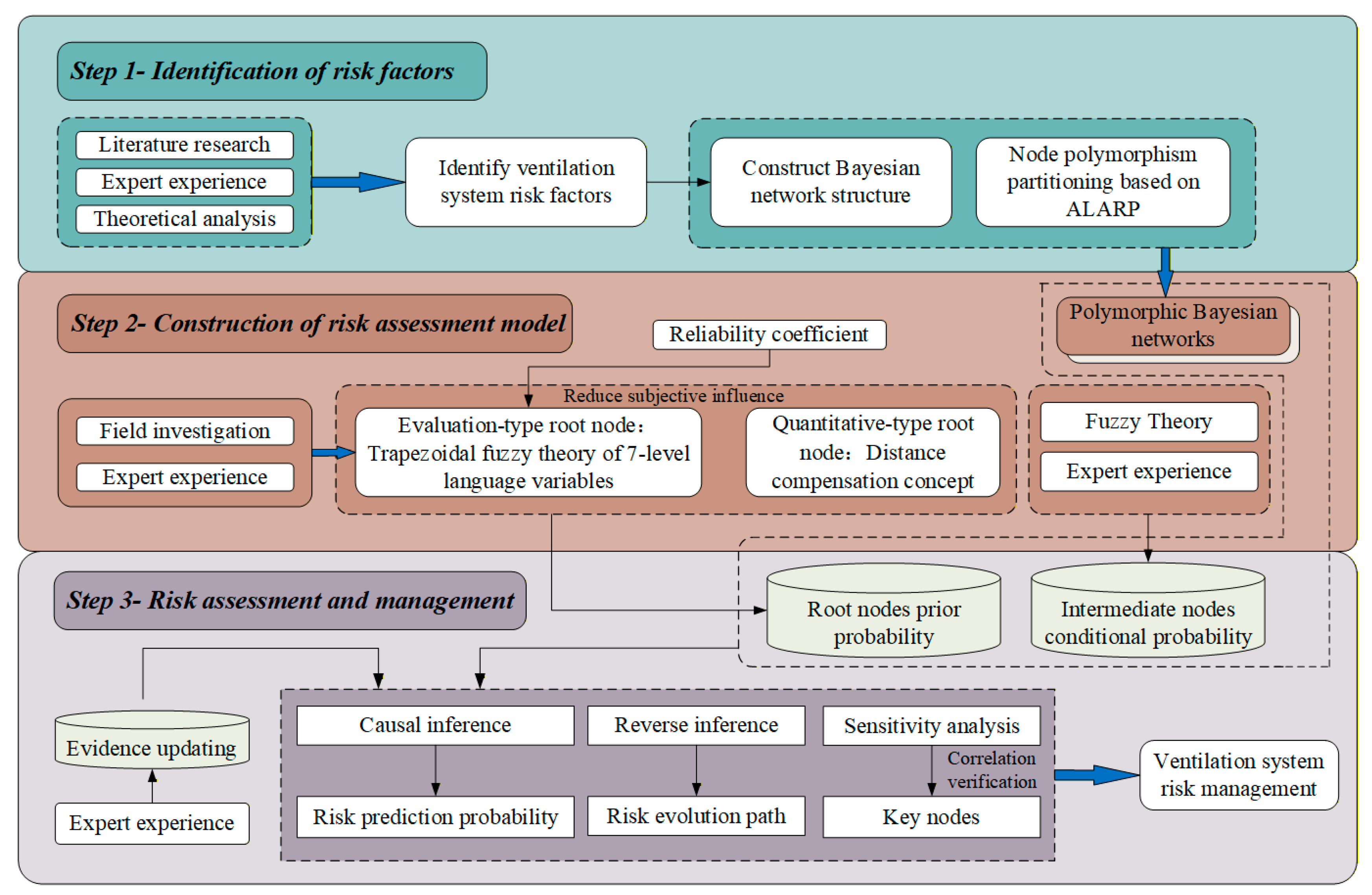
The analysis process of this study is shown in Figure 1. The first step is to identify risk indicators. The second step is to construct a Bayesian network structure and use fuzzy theory to determine the probability of risk indicators. The third step is risk assessment.

2.1. Risk Assessment Index and Bayesian Network Structure Were Established

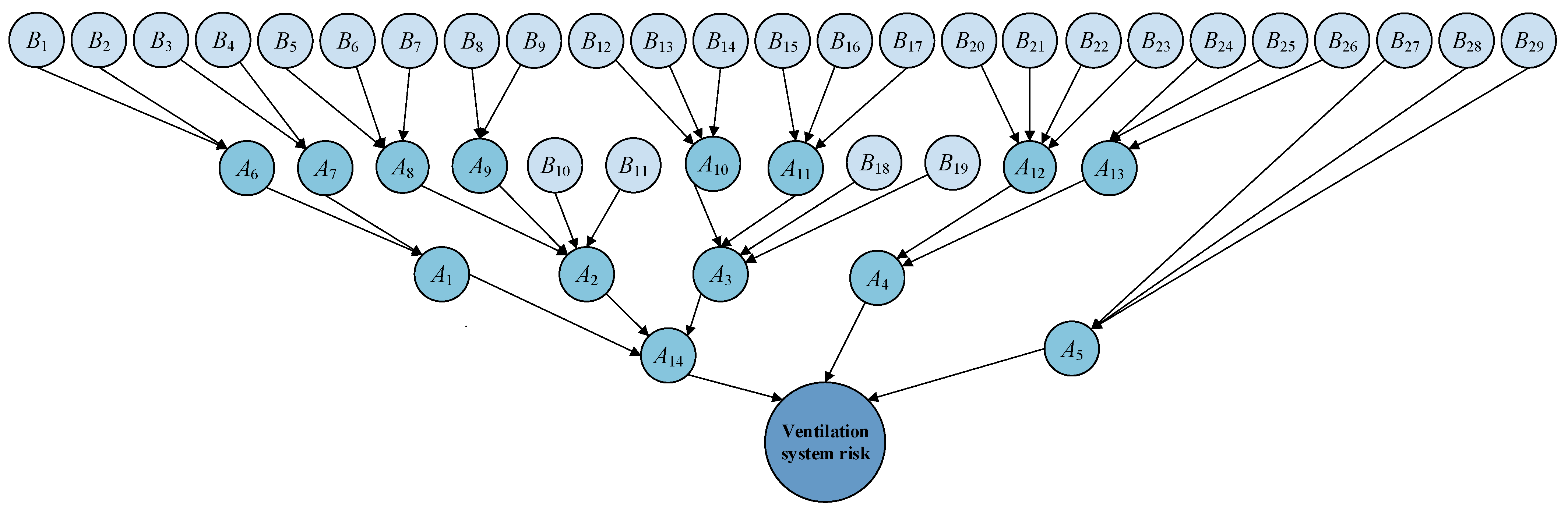
A coal mine ventilation system is a complex system that is easily affected by many factors. Traditional assessment methods often struggle to adequately capture the multi-state characteristics of risks within such systems. To ensure comprehensive coverage of the entire coal mine ventilation system, the indicator system was developed through a three-step process. First, an initial set of indicators was constructed based on the four dimensions of “Human–Machine–Environment–Management”, incorporating relevant indicators from the Technical Specification for Ventilation Systems in Metal and Nonmetal Underground Mines. Second, this preliminary system was expanded by drawing on existing indicator systems for ventilation risk assessment documented in prior studies. Finally, the system was refined through field interviews with frontline workers and consultations with domain experts, allowing for the addition of omitted indicators and removal of redundant ones. This process resulted in a final set of 42 risk indicators, organized across five dimensions: ventilation power, ventilation network, ventilation facilities, human and management factors, and working environment [11,23]. Since both risk indicators and Bayesian networks are established based on causal relationships, each risk indicator is taken as a node of the Bayesian network [32]. Considering the specificity of the Bayesian network topology, the 42 risk indicators are divided into root nodes and intermediate nodes, and the root nodes have 29 items such as the efficiency of main fan, denoted as B1, B2, …, B29, and the intermediate nodes have 13 items such as the ventilation power, denoted as A1, A2, …, A13, as shown in Table 1.
To effectively assess the risks in coal mine ventilation systems and accurately simulate their uncertainties, the evaluation index system is mapped into a Bayesian network structure. In this structure, node A4 corresponds to indicators within the human and management dimension, node A5 represents the environmental dimension, while nodes A1, A2, and A3 pertain to the machine dimension. To integrate both the tangible and abstract indicators associated with the machine dimension, an intermediate node A14 is added on the intermediate nodes A1, A2, and A3 to construct the Bayesian network structure, as shown in Figure 2.
In Bayesian networks, nodes represent variables and arcs represent nodal causality [19]. Let the variables of the Bayesian network be K   =   k 1 , k 2 , , k n , where P h k i is the set of parent nodes of variable k i ; in this case, the joint probability distribution P K of K is
P K = i = 1 n P k i | P h k i
When the evidence is updated to F , the posterior probability P ( K | F ) of the variable is
P K | F = P K , F K P K , F

2.2. Nodes Polymorphism Partitioning Based on ALARP

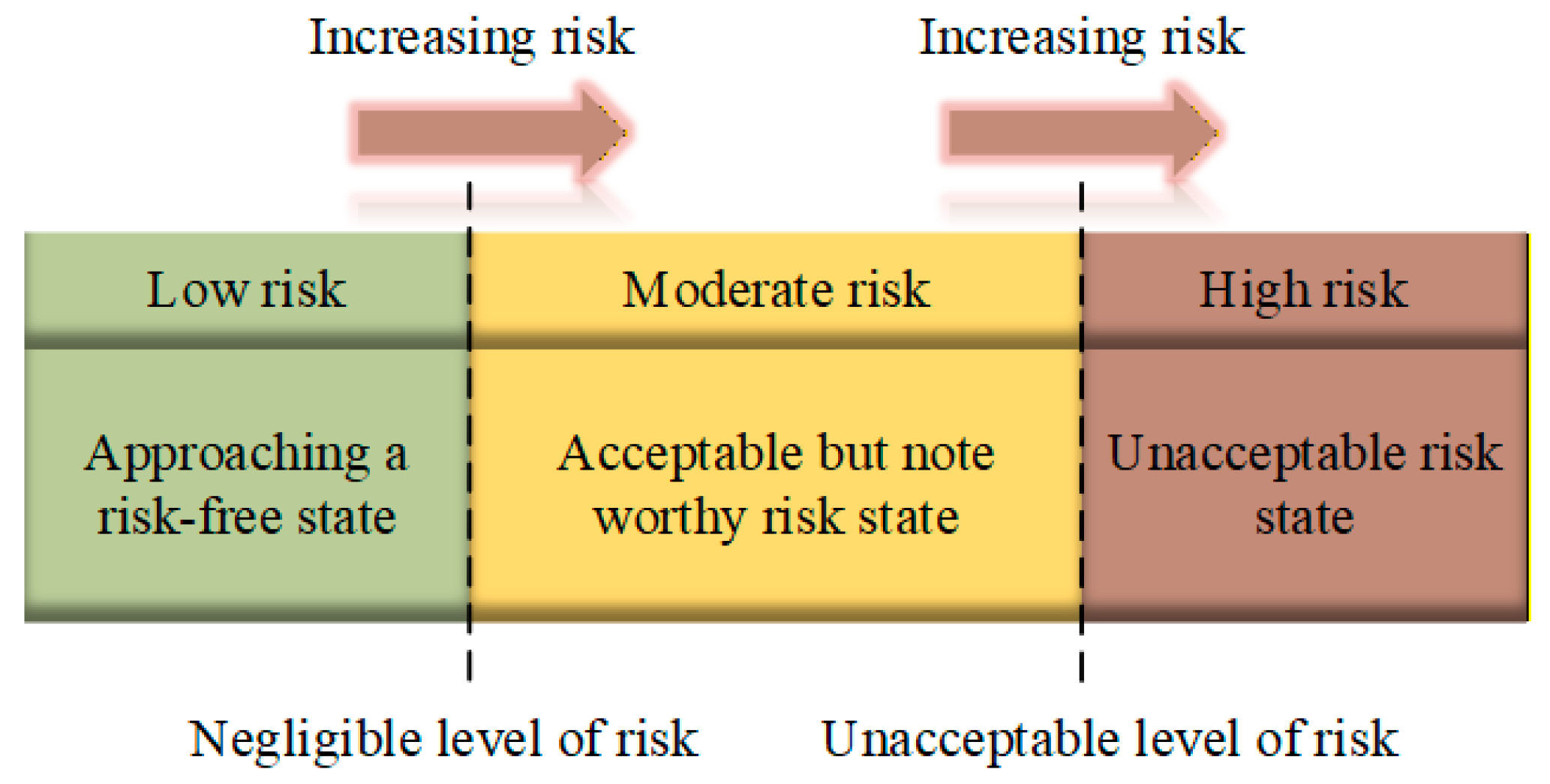
The core of risk management lies in minimizing risks within the feasible limits. When the risk state is As Low As Reasonably Practicable (ALARP), the risk state is divided into the negligible zone, the lowest reasonably practicable zone, and the unacceptable zone by setting the negligible risk level and the unacceptable level. Based on this, this study sets all nodes to have three risk states: “High”, “Moderate”, and “Low”. Among them, “High” means that the risk is unacceptable, “Moderate” means that the risk exists but is acceptable, and “Low” means that the risk is negligible [33]. The disadvantage of hard division of risk status into “yes” and “no” is improved [34]. The principle of node division is shown in Figure 3.

2.3. Determine the Root Node Parameters

The prior probability of the root node is the basis of Bayesian network inference [35]. Among the 29 risk indicators in this model, as the root node of the Bayesian network, there are nodes that can directly determine the prior probability based on the measured data of coal mines, such as the equivalent orifice and the resistance rate of return air flow, etc. Such risk indicators are defined as quantitative-type root nodes, while the other root nodes that require expert evaluation to determine the prior probability are defined as evaluation-type root nodes. The classification process of the root node needs to be analyzed in combination with the characteristics of the indicators and the availability of data. In the quantitative-type root node, the risk index is calculated by the average calculation of multiple individuals or historical experience, such as the average annual training duration of miners and the pass rate of the reverse ventilation system, etc. Although the average value of multiple individuals and historical experience can reflect the characteristics of the mine as a whole, the risk that may arise from the extreme value in the sample is ignored, and the influence of such risk should be reasonably considered for strict risk assessment. Based on expert experience, there are 18 evaluation-type root nodes: B2, B3, B4, B9, B10, B11, B12, B13, B14, B15, B16, B18, B19, B20, B21, B22, B26, and B29. Quantitative-type root nodes include as follows: B1, B5, B6, B7, B8, B17, B23, B24, B25, B27, and B28, a total of 11 items. The evaluation-type root nodes and the quantitative-type root nodes are calculated by using different prior probability calculation methods.

2.3.1. Evaluation-Type Root Nodes Prior Probability Based on Fuzzy Evaluation and Reliability Coefficient

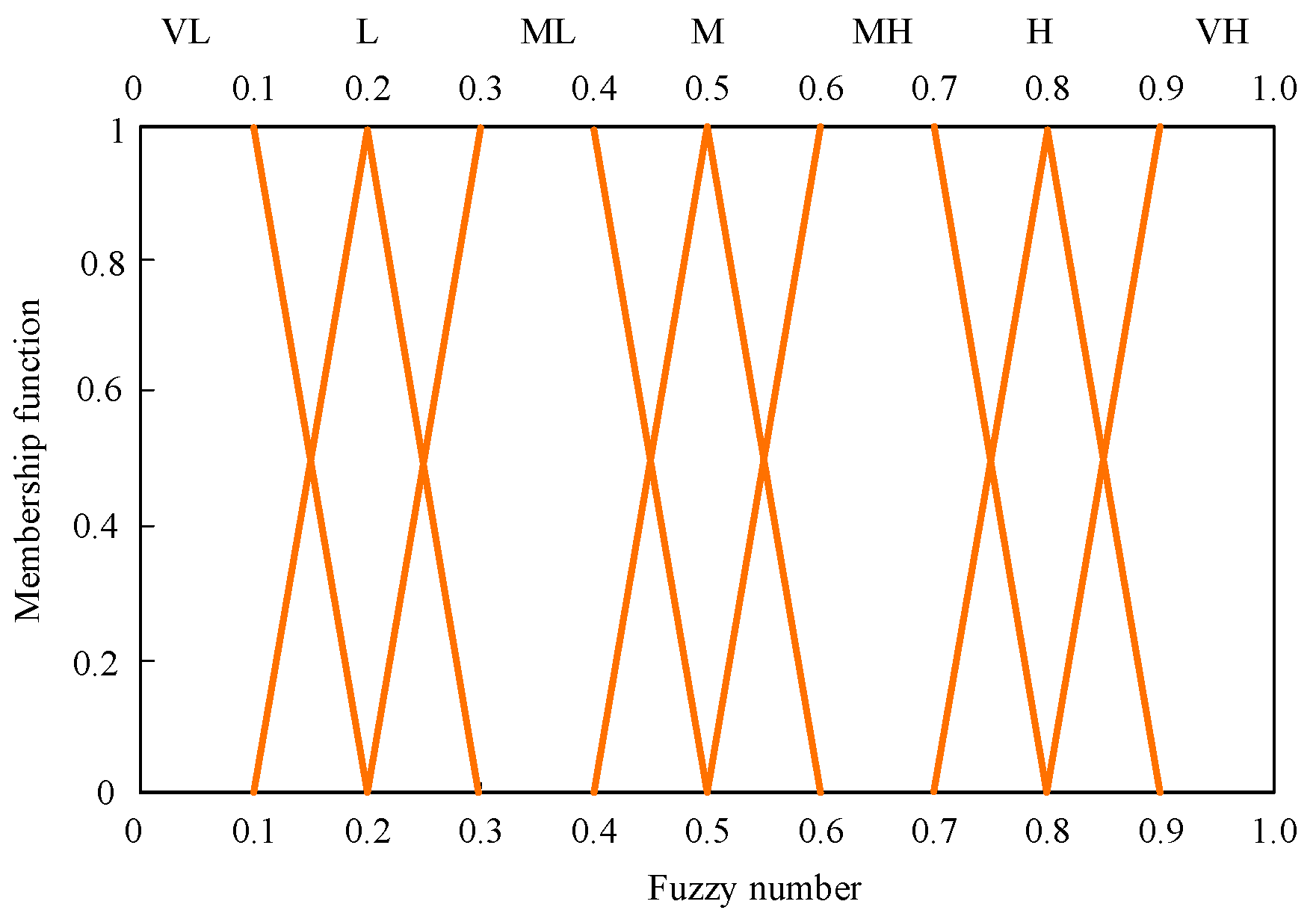
Since the basic conditions of the coal mine evaluated by the model are different and the problems evaluated are uncertain, the root node probability of the Bayesian network is calculated by fusion fuzzy evaluation and reliability test. Usually, the number of expert judgment intervals ranges from 5 to 9 [36]. Therefore, this paper adopts the 7-level language probability description form and trapezoidal fuzzy number to calculate the prior probability of the evaluation-type root node. The fuzzy interval and membership function corresponding to the language are shown in Table 2 and Figure 4.
Assume that the number of experts invited to participate in the fuzzy evaluation is e . Considering that the experts involved in fuzzy evaluation were different in terms of work experience [37], knowledge background, and professional experience, in order to improve the evaluation accuracy, the reliability coefficient of evaluators was introduced from the four dimensions of expert degree, working years, professional title, and evaluation confidence by referring to the expert authority index value table proposed by He et al. [38] to correct the subjective influence of experts, as shown in Table 3.
In Table 3, the reliability of the four dimensions, degree, years of working, the title of a professional post, and judging confidence, is divided into four levels. Within the same level, all dimensions share an identical reliability coefficient. That is, in each row, the coefficient is the same for every dimension. The expert’s reliability coefficient is calculated as the sum of the four dimension coefficients.
Let D f be the sum of the four dimensions’ reliability coefficients for the f -th expert. The reliability coefficient of each expert is then normalized to obtain the reliability weight D f for the f -th expert as follows:
D f = D f 1 e D f
Set “a”, “b”, “c”, and “d” as the four values in the fuzzy interval corresponding to the language variable of a certain level. For example, let a fij be the “a” value i 29 ,   j 3 corresponding to the language variable of the j -th risk stating of the i evaluated root node by the f expert. Then, after synthesizing the opinions of experts and the reliability coefficient, the “a” value of the j -th risk stating of the i evaluated root node is as follows:
a ij = f = 1 e D f a fij  
The four values of a ij , b ij , c ij and d ij are calculated successively, and a ij , b ij , c ij and   d ij are defuzzified by using the center of gravity method, and then the middle quantity C ij can be calculated [36]:
C ij = ( c ij + d ij ) 2 c ij   d ij ( a ij + b ij ) 2 + a ij   b ij 3 c ij + d ij a ij b ij
Since the Bayesian network strictly requires that the sum of each risk state probability of nodes is 1, therefore, the intermediate quantity is normalized according to Formula (3), and the prior probability of the j -th risk state of the i -th evaluation-type root node is C ij .

2.3.2. Quantitative-Type Root Node Probability Based on Distance Compensation

The concept of distance compensation is widely employed in the field of surveying and mapping, aiming to enhance the accuracy of measurement results by correcting errors arising from variations in measured distances from the starting point to the target. In order to comprehensively account for the influence of extreme values in the computational samples of quantitative-type root nodes on the ventilation system, this study draws inspiration from this concept to propose a flexible distance compensation method for the computation of prior probabilities. First, the value range of quantitative-type root nodes is divided into three intervals, as shown in Table 4.
Secondly, combined with previous research and expert experience [11,23], the value range of each quantitative-type root node is divided, respectively, as shown in Table 5. Taking the quantitative-root node B24 as an example for demonstration, Hoebbel’s research provides a theoretical basis, indicating that the mining skills and risk perception ability of miners tend to mature and stabilize within the 6 to 10-year working-age range [39]. Therefore, based on the specific situation of H Coal Mine and incorporating the concept of distance compensation, the risk status of the B24 node is comprehensively classified into three levels: high, moderate, and low risk, by considering both personnel growth patterns and on-site risk distribution characteristics. Specifically, the distance compensation method adjusts the membership degree of a given work-year value to each risk level based on its deviation from the central tendency of the sample data. The value ranges of all other quantitative-type root nodes follow this same classification logic.
Set the value of the quantitative-type root node i as φ , taking φ in the range of φ 3 , φ 4 as an example, that is, if φ is in the “Low” risk state, then the prior probability P Low of the “Low” risk state of risk index i is
P Low = φ φ 3 φ 4 φ 3
If the distance compensation is midway between the prior probability of “Moderate” risk state and “High” risk state of the quantitative-type root node i is set as P Moderate and P High respectively, then
P Moderate = | 1 φ φ 2 |
P High = | 1 φ φ 1 |
Then, the prior probabilities P Moderate and P High of “Moderate” risk state and “High” risk state of the quantitative-type root node i are
P Moderate = 1 P Low   P Moderate P Moderate + P High
P High = 1 P Low   P H i g h P Moderate + P High

2.4. Intermediate Node Probability

Set the node set of the Bayesian network as K , there are 44 nodes in this model, then K = k 1 , k 2 , , k 44 . If there are l i states of node variable k i , the value of l i is 3. Suppose the number of parent nodes of the node variable k i is n i , and there are m i value state combinations of the parent nodes of the node variable k i , then the m i value is
m i = 9 , n i = 2 27 , n i = 3 81 , n i = 4
In this study, a total of 14 intermediate nodes are included. The conditional probability tables for these intermediate nodes were derived with reference to Equations (3)–(5). Set H ij as the probability of the j -th risk state of the i -th intermediate node i 14 , j 3 . The same panel of experts mentioned above was invited to perform a fuzzy evaluation to elicit the conditional probability tables for the intermediate nodes.

2.5. Analysis of Risk Assessment Results

2.5.1. Causal Inference

Using Bayesian network forward reasoning, the probability of occurrence of each risk state is calculated, and the risk of the ventilation system is evaluated and predicted in probability form.
Let the probability of risk occurrence for the specified node as P I , where I s denotes the s -th risk state of the node s 3 , and T u represents the u -th root node of the node ( u     9 ) . Let t v be the v -th risk state of the root node v 3 , P T u = t v be the joint probability of the root node, and P I = I s | T u = t v be the conditional probability table for forward propagation from the specified node. Then, causal inference is expressed as
P I = I s = P T u = t v   P I = I s | T u = t v

2.5.2. Reverse Inference

Reverse inference calculates the posterior probability of the root node of the specified node by artificially setting the risk state of the specified node according to the conditional probability table. Through reverse inference, the occurrence probability of each node is obtained, and then the risk induction path is obtained, which provides a basis for risk prevention and control [40]. The posterior probability of the u -th root node of the specified node is
P T u = t v | I = I s = P T u = t v P I = I s | T u = t v P I = I s

2.5.3. Sensitivity Analysis

The sensitivity of a node is an important index to measure its impact on a given node, and an important basis for risk assessment and prevention and control [41]. Set Q T u as the sensitivity of the u -th root node u 30 to the specified node, then Q T u is
Q T u = m a x P I = I s | T u = t v m i n P I = I s | T u = t v 2 P I = I s
All nodes in this study represent either physical or abstract elements within the coal mine ventilation system, and correlations among these nodes are possible. If a correlation is present between two highly sensitive nodes, it may lead to instability or distortion in their sensitivity measures, making it difficult to distinguish their independent contributions to the ventilation system. Therefore, further examination is necessary to exclude correlations among highly sensitive nodes. Considering the data types used in the research, the fuzzy comprehensive evaluation method was adopted, relying on the practical experience of frontline workers and expert knowledge to verify the correlations among highly sensitive nodes.
Let Y 1 and Y 2 denote the two highly sensitive nodes whose correlation is to be verified, represented as ( Y 1 , Y 2 ) ; a panel of e experts participates in the correlation evaluation. With reference to Table 3 and Formula (3), the reliability weight of the f -th expert is denoted as D f . Let a fi represent the “ a ” value corresponding to the linguistic variable assigned by the f -th expert to the correlation of ( Y 1 , Y 2 ) . The combined a value for the correlation of ( Y 1 , Y 2 ) , integrating all expert opinions and their reliability coefficients, is then given by
a Y 1 , Y 2 = f = 1 e D f a fi  
The four values of a Y 1 , Y 2 , b Y 1 , Y 2 , c Y 1 , Y 2 , and d Y 1 , Y 2 are calculated successively, and a Y 1 , Y 2 , b Y 1 , Y 2 , c Y 1 , Y 2 , and d ij are defuzzified by using the center of gravity method. It can be calculated that the value Z Y 1 , Y 2 of the correlation between ( Y 1 , Y 2 ) is
Z Y 1 , Y 2 = ( c Y 1 , Y 2 + d Y 1 , Y 2 ) 2 c Y 1 , Y 2   d Y 1 , Y 2 ( a Y 1 , Y 2 + b Y 1 , Y 2 ) 2 + a Y 1 , Y 2   b Y 1 , Y 2 3 c Y 1 , Y 2 + d Y 1 , Y 2 a Y 1 , Y 2 b i Y 1 , Y 2
Compare Z Y 1 , Y 2 with the 7 thresholds. If Z Y 1 , Y 2 is higher than 0.50, it indicates that the correlation is moderate and should be given special attention.

3. Case Study

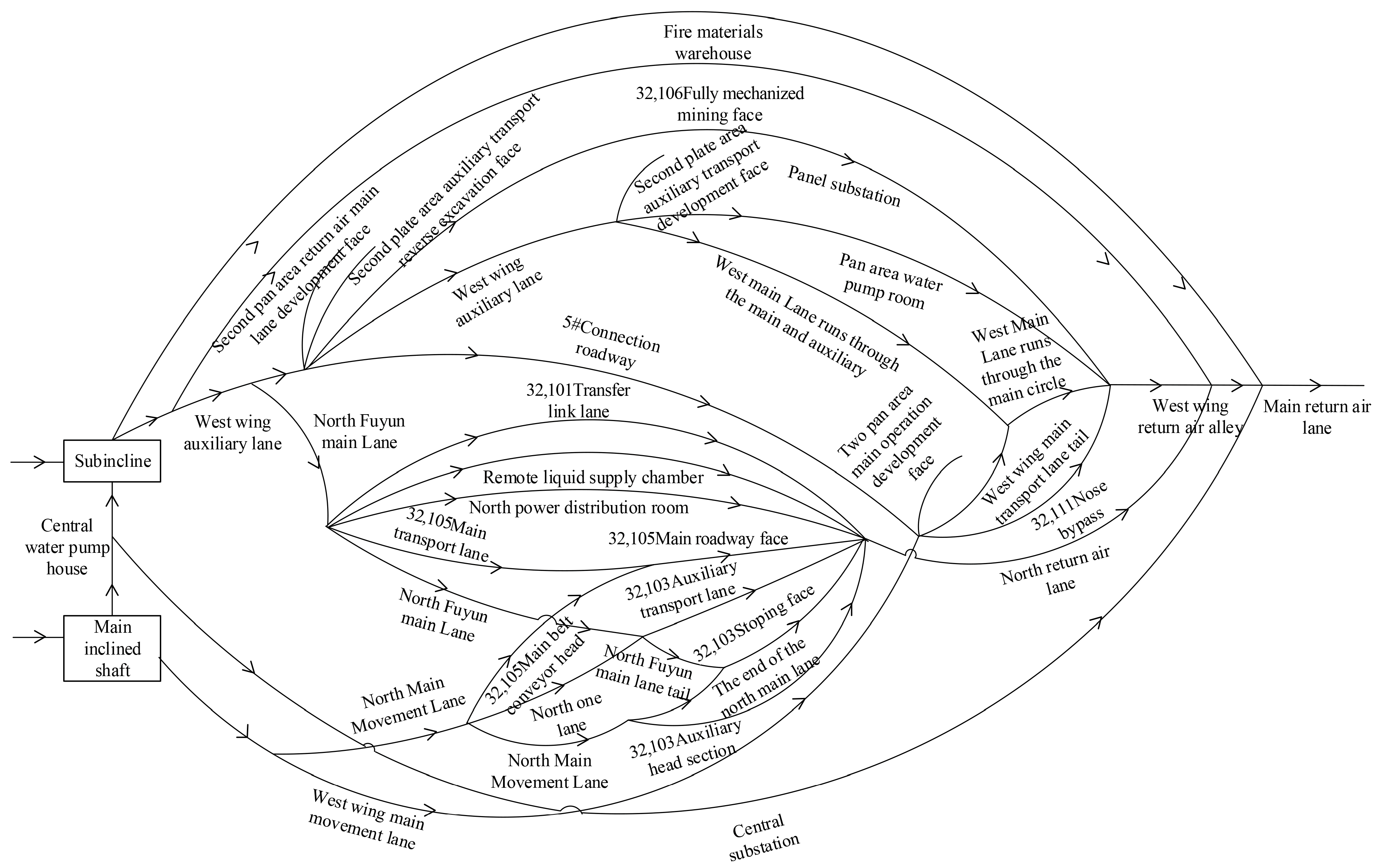
H Coal Mine is located in Xiangning County, Shanxi Province, China, situated in the Loess Plateau Gully Region. The mine field area is 25.2245 km2, with an annual production capacity of 1.20 Mt/a. Its production capacity is approximately equal to the average production capacity of coal mines in the northern regions of China [42]. The coal mine exhibits the compound hazard characteristics prevalent in Chinese coal mines: it is classified as low gas, yet the mined coal seam has a spontaneous combustion tendency, classified as Class II, and poses a coal dust explosion risk. This hazard combination pattern, characterized by low gas levels accompanied by fire and dust explosion risks, is prevalent in the majority of coal mines across China and constitutes a primary focus of the current coal mine safety prevention and control system [43,44]. The ventilation system operates in a central parallel mode, which is the mainstream ventilation method in the coal mining industry. The main working face of H Coal Mine is located at an elevation of +565 to +594 m, with the ground surface elevation ranging from +784 to +900 m, resulting in a minimum burial depth of 190 m. The ventilation volume is 720 m3/min, the return air volume is 1082 m3/min, the pressure at the main haulage roadway is 96,576 Pa, the pressure at the auxiliary haulage roadway is 96,290 Pa, yielding a pressure difference of 286 Pa, and the air leakage volume is 362 m3/s. These key parameters all fall within the typical industry range and can effectively reflect the general characteristics of ventilation systems in medium-scale coal mines. The ventilation system of H Coal Mine is shown in Figure 5. To address the limitations of traditional assessment methods in quantifying risk probabilities, a risk assessment was conducted using the ventilation system of this mine to verify the effectiveness of the proposed model, providing reference and guidance for safety diagnostics of ventilation systems in similar coal mines.

3.1. Root Node Prior Probability

3.1.1. Evaluation-Type Root Node

In total, 10 experts were invited as evaluators to evaluate the prior probability of the evaluation-type root nodes, and the reliability weights of each expert were calculated according to Table 3, as shown in Table 6.
According to the language variables in Table 2, the evaluator evaluates the prior probabilities of 18 evaluation-type root nodes, calculates the fuzzy probabilities of each node state according to Equation (4), and performs defuzzy processing according to Equation (5) to obtain the prior probabilities of evaluation-type root nodes as shown in Table 7, where the bold numbers are the prior probabilities of each risk stating of evaluation-type root nodes.

3.1.2. Quantitative-Type Root Node

The measured values of 11 quantitative-type root nodes, including the efficiency of the main fan, were obtained by consulting the latest ventilation resistance report of H Coal Mine and field investigation. The range of state values was divided according to Table 4 and Table 5, and the prior probabilities of quantitative-type root nodes were obtained according to Equations (6)–(10) based on the distance compensation method, as shown in Table 8.

3.2. Intermediate Node Conditional Probability

The conditional probability of the intermediate node is determined by 10 evaluation experts through judgment and calculation based on the logical relationship of the risk indicators. Limited by space, the conditional probability table is given with three nodes, “B8”, “B9”, and “A9” as examples, as shown in Table 9.

3.3. Risk Assessment Results

3.3.1. Forward Inference

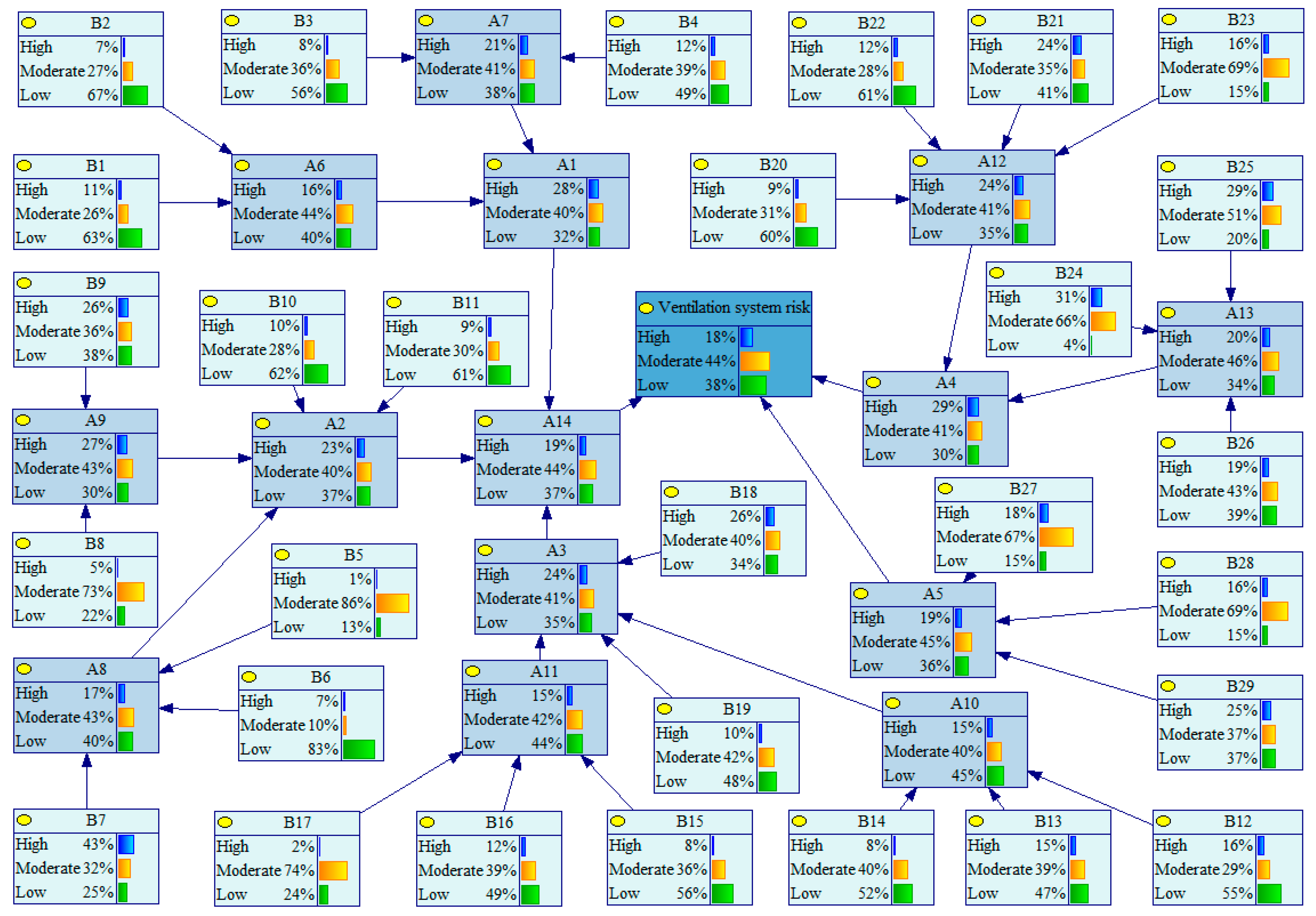
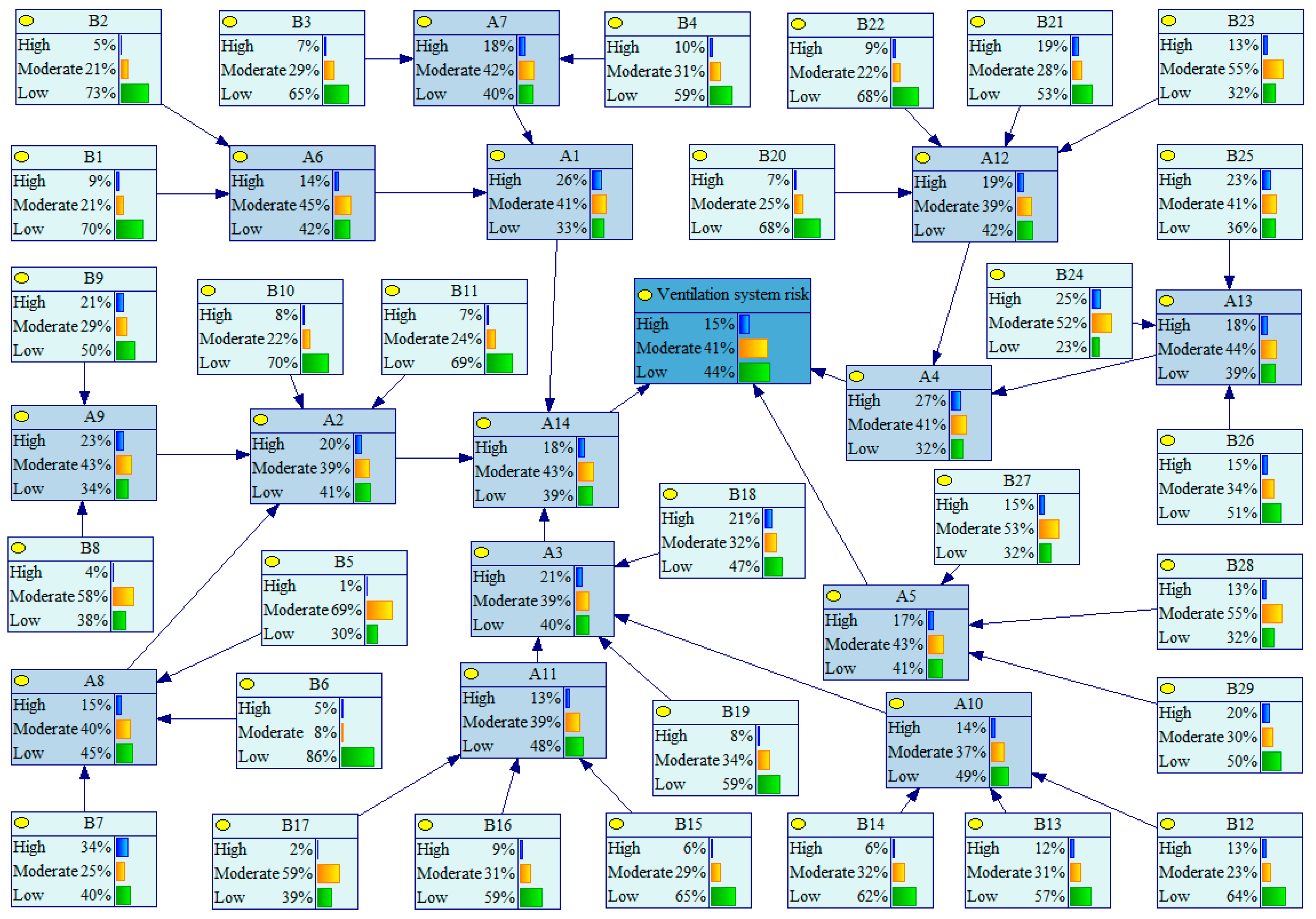
Knowing the risk probability of the ventilation system in the advanced stage is conducive to the relevant personnel to take timely measures to prevent and control the occurrence of accidents [45,46]. The Bayesian network structure and parameters of the ventilation system risk assessment were imported into GeNIe software (version 2.3) for inference calculation, and the inference model of the ventilation system of H Coal Mine was obtained, as shown in Figure 6. In Figure 6, the color of the middle node is darker than that of the root node, and the color of the ventilation system risk node is the darkest.
As can be seen from Figure 6, the probability of high risk is 43% for the surface leakage rate (B7), 31% for the average length of service of miners (B24), and 29% for the average annual training duration of miners (B25). From the perspective of the prior probability of the root node, the risk of these three indices is higher. From the perspective of intermediate node conditional probability, the high-risk probability of human and management factors (A4) is 29%, the high-risk probability of ventilation power (A1) is 28%, and the high-risk probability of ventilation resistance (A9) is 27%. According to causal reasoning, the probability of low risk in the ventilation system of H Coal Mine is 38%, and the probability of high risk is as high as 18%. According to the research by Lin et al. [47], an accident probability of the coal mine ventilation system exceeding 0.05 is considered to be of high risk. In this study, the probability of high risk is 18%, and the probability of moderate risk is 44%. This indicates that the ventilation system of H Coal Mine has significant risks, and further risk analysis is necessary.
Based on the above in-depth risk analysis, the potential threats of key risk factors such as the surface leakage rate (B7), average length of service of miners (B24), and average annual training duration of miners (B25) are accurately identified. Therefore, the high-risk evolution path and causes should be further analyzed, and special measures should be formulated to solve various problems of the ventilation system [48].

3.3.2. Diagnostic Inference

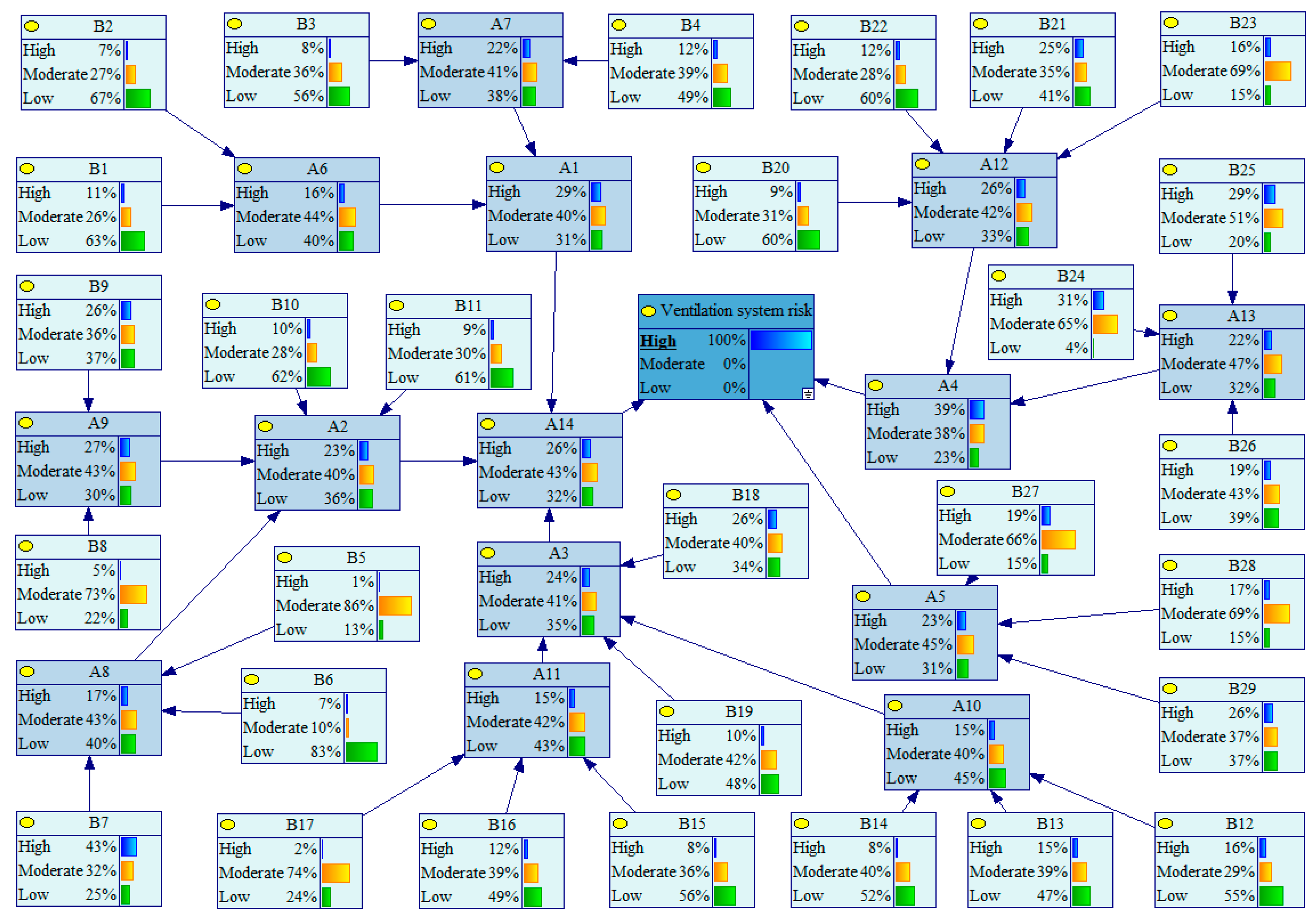
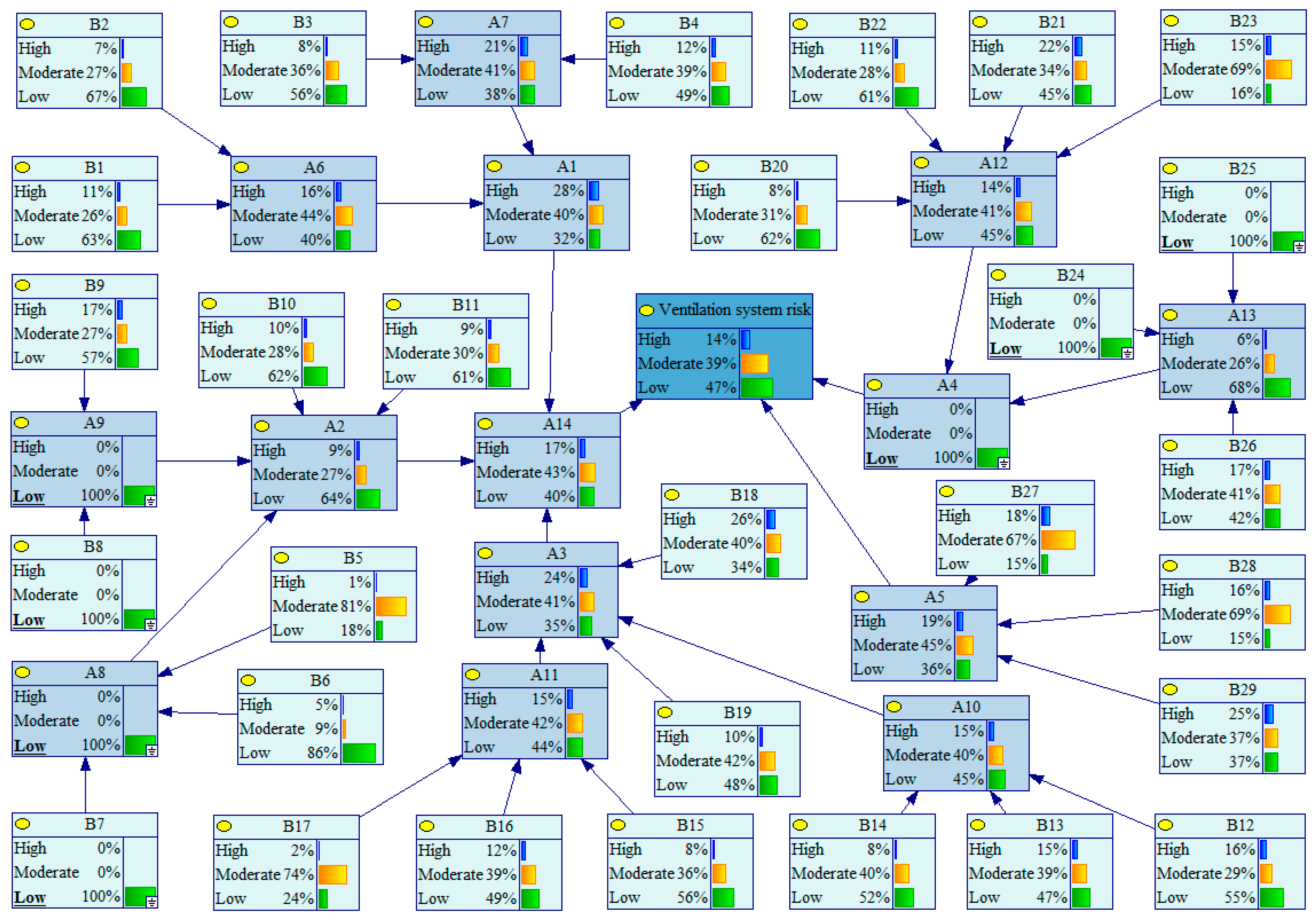
In the Bayesian network model, the “High” state probability of the “ventilation system risk” node is set to 100%, which means that the ventilation system must have a high risk. By setting the “ventilation system risk” node state, the occurrence probability of other network nodes is obtained, and the risk evolution path is determined according to the probability, indicating the direction of risk management. Refer to Formula (16) and conduct diagnostic reasoning through GeNIe software, and the reasoning results are shown in Figure 7.
As can be seen from Figure 7, the probability of the surface leakage rate (B7) is the highest in the posterior probability, which is 43%. In addition, the probability of the roadway maintenance (B18), the air duct is too long (B9), and the average length of service of miners (B24) is all about 30%.
After diagnostic reasoning, the node with the highest probability of a high state among the parent nodes is identified with the specified node as the child node, and then the parent node as the child node, and so on, to identify the main induced path. According to the results of diagnostic reasoning, the main risk evolution path of high risk in five risk indicators, namely ventilation power (A1), ventilation network (A2), ventilation facilities (A3), human and management factors (A4), and working environment (A5), was identified. The evolution path is shown in Table 10.
The formation of a high-risk coal mine ventilation system is a complex process with multiple factors and links [49,50]. From the local ventilator safety equipment being insufficient to the design and maintenance of the ventilation network, as well as to the effective management of various ventilation facilities, the completeness of personnel emergency response, and the direct conditions of the working environment, each link is closely linked and mutual cause and effect. In order to effectively reduce the high risk of coal mine ventilation system, comprehensive and systematic measures must be taken: strengthen the daily maintenance of local ventilator safety equipment, optimize the ventilation network design to reduce ventilation resistance, improve the quality of roadway maintenance to ensure the effectiveness of various ventilation facilities, improve the emergency response mechanism to improve management and personnel response capabilities, and ensure that the face air supply and demand ratio is reasonable to create a good working environment. Through the implementation of this series of comprehensive measures, the safety and reliability of the coal mine ventilation system can be significantly improved, laying a solid foundation for coal mine safety production.

3.3.3. Risk Factor Sensitivity Analysis

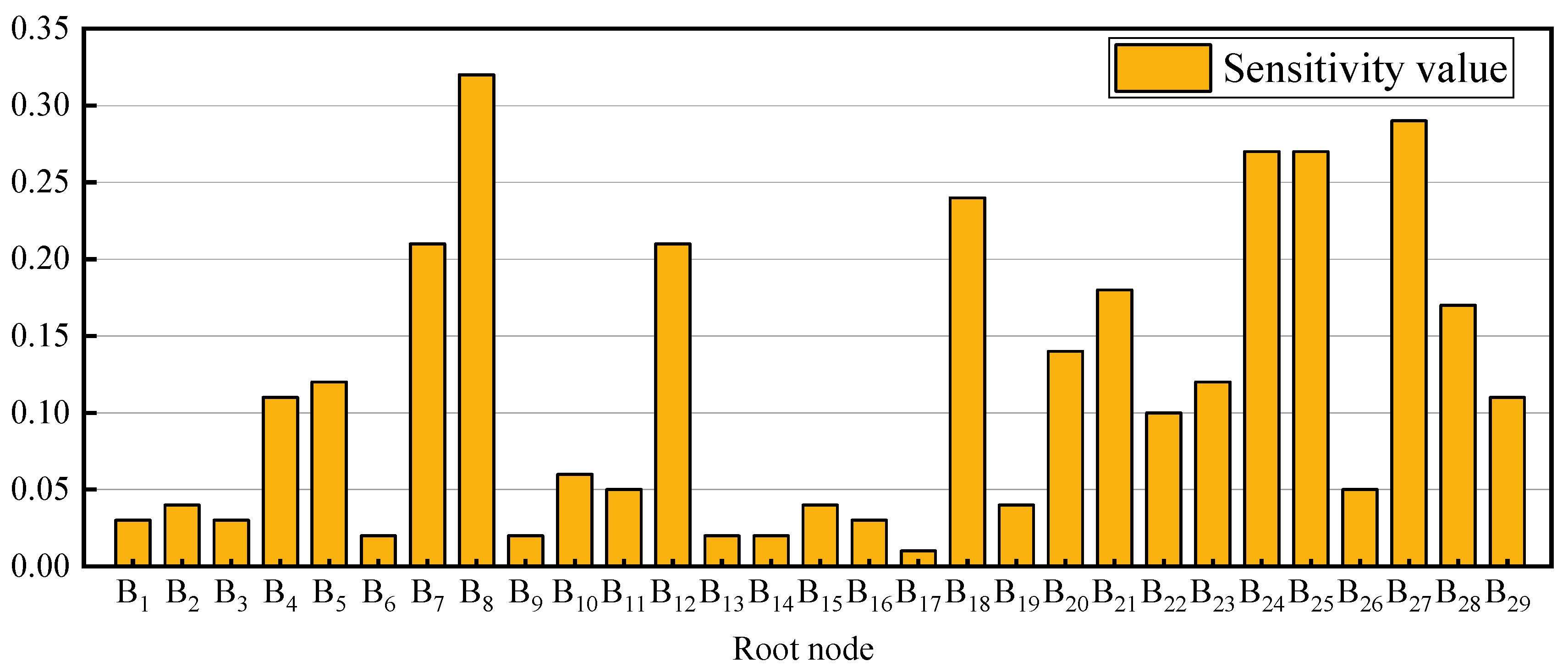
Sensitivity analysis is a method of calculating the contribution of each node to the target node [51]. Parameters with high sensitivity have more significant effects on inference results. The coal mine ventilation system is set as the target node, and the sensitivity of each node in the Bayesian network is calculated. The sensitivity of the root node is shown in Figure 8.
The coal mine ventilation system is a complex production system. To prevent the sensitivity values of highly sensitive nodes from being disturbed due to the correlations among various highly sensitive nodes, based on the method proposed in Section 2.5.3, the correlations among all highly sensitive nodes are calculated. First, 10 experts judge the correlations between any two nodes among the seven highly sensitive nodes and provide corresponding language variables, as shown in Table 11.
Based on Formulas (15) and (16), the correlation values between high-sensitivity nodes were calculated. The calculation results are shown in Table 12.

3.4. Result Test

According to the latest evaluation documents related to ventilation resistance measurement in H Coal Mine, the resistance of the return air section of the two selected ventilation resistance measurement routes is more than 40%, and the resistance of the return air section is relatively large, under the condition that the resistance measurement error is less than 3%. The depth of the back-up mining face 32,103 is shallow, the roof crack causes the surface crack, and the working face is adjacent to other coal mine faces, and the roof crack channel forms a leak channel between the adjacent coal mine lanes. The return air of a 32,106 fully mechanized mining face is 823 m3/min, but the actual air demand is 993 m3/min. Air leakage occurs frequently in many air lanes with loose air sealing. The existing problems in the ventilation system of H Coal Mine are basically consistent with the high-risk nodes of Bayesian networks diagnostic inference and the highly sensitive nodes of sensitivity analysis, which indicates that the inference results are more accurate, and the model can be used to evaluate and predict the risk of the ventilation system.
The prior probabilities of the “High” state and “Moderate” state of each root node of the Bayesian network are reduced by 20%, respectively, to achieve the simulation of proper control of each risk index. At this time, causal reasoning is carried out, as shown in Figure 9.
When the prior probability of root node risk is reduced by 20%, the probability of high-risk events occurring in the ventilation system of H Coal Mine decreases from 18% to 15%, and the probability of negligible ventilation system risks increases from 38% to 44%, indicating that the control of risk factors can effectively improve the reliability and safety of the ventilation system. In addition, when the mine environment and other factors change, the risk assessment model of the ventilation system can assess the probability of the three risk states of the ventilation system, and determine whether the impact of the change in risk indicators on the ventilation system is within the acceptable range, providing a reference for safe production.

3.5. Risk Management Strategy

3.5.1. Specific Strategies

From the above results, it can be seen that the surface leakage rate (B7) is closely related to the ventilation index (A8) and the ventilation network (A2). High air leakage rate not only directly reduces the effective air volume in the mine but may also deteriorate key ventilation indices and disrupt the stability of the ventilation network, which in turn compromises the overall efficiency and reliability of the entire ventilation system. The resistance ratio of the return air section (B8) is an important component of ventilation resistance (A9). The high resistance ratio of the return air section means that the ventilation system consumes a large amount of energy in this section, which may lead to a decrease in the efficiency of the ventilator, and then affect the air volume distribution and ventilation effect of the whole ventilation system. The average length of service of miners (B24) and annual training duration of miners (B25) are closely related to human and management factors (A4). Long-serving employees may have extensive experience, but they may also be less receptive to new technologies and norms. Adequate training hours help to enhance the professional skills and emergency response capabilities of the staff, thereby enhancing the quality of the operation and maintenance of the ventilation system. However, if not managed properly, even if employees are experienced or well-trained, risks can increase due to poor implementation of systems or delayed emergency response. The human and management factors (A4), as a comprehensive factor, covers many aspects such as staff quality, management system, and emergency response. It directly affects the daily operation, maintenance, and emergency handling capacity of the ventilation system, and is the key to reducing the risk of the ventilation system.
Therefore, (1) strengthen the monitoring and maintenance of the ventilation system: regularly measure the air leakage rate outside the mine and the resistance ratio of the return air section, promptly repair any air leakage points, and clean the return air roadway to ensure efficient operation. (2) Optimize the ventilation network design: through reasonable layout of the ventilation network, reduce unnecessary curves and resistance points, reduce ventilation resistance, and improve ventilation efficiency. (3) Strengthen staff training and management: develop a comprehensive training plan to ensure that every employee can receive adequate training in ventilation system operation, maintenance, and emergency treatment. At the same time, establish a sound safety management system and emergency response mechanism, strengthen on-site management, and ensure that all systems are effectively implemented. (4) Introduce advanced technology and equipment: actively introduce and apply advanced ventilation technology and equipment, improve the automation and intelligence level of the ventilation system, and reduce human error and safety risks. (5) Strengthen risk assessment and provide early warnings: establish a ventilation system risk assessment mechanism, regularly conduct a comprehensive assessment of the ventilation system, and discover and eliminate potential hazards in a timely manner. At the same time, a risk early warning system should be established to ensure rapid response and effective disposal of risks when they occur.

3.5.2. Verification of Strategy Effectiveness

In order to verify whether the aforementioned strategies can effectively reduce the risk of the ventilation system of H Coal Mine, in the Bayesian network, the “Low” states of nodes B7, B8, B24, B25, A4, A8, and A9 were set to 100%, and the simulation was conducted for the situations after applying corresponding strategies to these nodes. The risk of the ventilation system of H Coal Mine was recorded. The results are shown in Figure 10.
As shown in Figure 10, after implementing various control strategies, the high-risk probability of the ventilation system of H Coal Mine was 14%, a decrease of 4 percentage points compared to before. This proves that the proposed risk management strategies can reduce the overall risk level of the system, and the intervention measures targeted at key nodes (B7, B24, B25, etc.) are actually effective.

4. Discussion

In this study, ALARP is applied to the description of the risk state of the coal mine ventilation system, and the risk state is divided into three states: “High”, “Moderate”, and “Low”. Combining the fuzzy theory, maximum likelihood estimation, and Bayesian network, a probabilistic method for predicting the risk of the ventilation system is proposed, and H Coal Mine in China is taken as an example for verification. In this method, the evaluation and quantitative-type root nodes are distinguished, the state of each node is divided, the reliability coefficient is introduced, and the distance compensation method is proposed, which can correct the subjective influence and improve the accuracy of risk assessment.
However, there are still some limitations in this study. First, although the ALARP provides a theoretical framework for risk state classification, its practical application requires consideration of the specific risk characteristics of the mine. This principle is more applicable to low-gas mines where the accident consequences are relatively clear, and the risks are somewhat controllable. For high-risk mines such as those with coal and gas outbursts, it is necessary to adjust and optimize the applicable thresholds of ALARP. Second, although this study proposed the method of the evaluator’s judgment accuracy to correct the judgment results when experts make judgments based on experience, the subjectivity of expert judgment cannot be completely avoided. Third, the ventilation system is affected by a variety of uncertain factors, such as changes in geological conditions, which are difficult to fully reflect in the model, increasing the difficulty of prediction. Finally, ventilation systems in different coal mines are unique, and existing prediction models may not be able to fully adapt to all coal mines [52,53]. Furthermore, the current Bayesian network framework limits its capability to depict the dynamic evolution of risks over time, which is crucial for capturing the real-time operational variability across diverse mining environments. Future research will comprehensively consider the impact of coal mine characteristics and uncertain factors, and enhance the model’s capacity to process complex data and uncertainties by integrating big data analytics such as machine learning [54,55,56]. By enabling continuous learning from real-time data to achieve dynamic risk assessment, the accuracy of risk assessment can be further improved. To address these limitations, future research efforts will explore the integration path of machine learning and Bayesian networks. By using ensemble learning algorithms, they will mine multi-modal data to optimize node weights, reduce subjective dependence, and further enhance the objectivity, adaptability, and prediction accuracy of the model.

5. Conclusions

Based on the actual situation of China’s coal mine, this study proposed a ventilation system risk assessment method based on fuzzy polymorphism, evaluated the ventilation system risk of China’s H Coal Mine, and verified the effectiveness of the method. Firstly, through field investigation and theoretical analysis, the risk index system of the ventilation system is determined, and the risk factors are divided into three states of “High”, “Moderate”, and “Low” by ALARP, so that the Bayesian network is more realistic. Secondly, the evaluation root node probability is calculated by fuzzy evaluation, a reliability coefficient is introduced to correct the subjective influence, a distance compensation concept is proposed to flexibly calculate the quantitative-type root node probability, and maximum likelihood estimation is adopted to determine the intermediate node probability, which avoids the limitation of a single method to determine the conditional probability. Finally, the risk assessment method of the ventilation system is put forward, and the risk assessment of the ventilation system is realized through a Bayesian network. The high risk of the ventilation system in H Coal Mine is 18% according to causal reasoning. Through diagnostic reasoning, the main risk pathways for the ventilation power, the ventilation network, the various ventilation facilities, the human and management factors, and the working environment were derived in turn. The sensitivity analysis shows that the resistance ratio of the return air section (B8), average length of service (B24), annual training duration (B25), and other nodes have higher sensitivity values. By the prevention and control of risk nodes and the risk evolution path, the probability of high-risk events in the ventilation system of H Coal Mine decreased from 18% to 15%. The probability of negligible ventilation system risk increased from 38% to 44%, indicating that the control of risk factors can effectively improve the reliability and safety of the ventilation system.
From the perspective of theoretical application, this study divides node states by ALARP, expands the state of each node of the Bayesian network, builds a multi-state Bayesian network, explores a new method of Bayesian network application, and broadens the new idea of risk assessment from the perspective of probability. From the perspective of practical application, this study, based on the actual situation of H Coal Mine in China, has developed a set of operational methods for assessing the risks of the coal mine ventilation system, achieving quantitative assessment of the probability of risk occurrence, risk path analysis, and identification of key sensitive factors. This method helps managers identify the key areas for improvement and the underlying causes, and it holds significant reference value for the formulation of prevention and control measures.

Author Contributions

Conceptualization, J.Z. and J.Y.; methodology, J.Y. and J.Z.; software, J.Z.; validation, J.Z. and J.S.; formal analysis, J.Z.; investigation, J.Y.; resources, J.S.; data curation, J.Z.; writing—original draft preparation, J.Y. and J.Z.; writing—review and editing, J.Y. and J.Z.; visualization, J.Z.; supervision, J.Z. and J.S.; project administration, J.Z.; funding acquisition, J.S. All authors have read and agreed to the published version of the manuscript.

Funding

This study was supported by the Humanities and Social Sciences Project of Ministry of Education in China (Grant No. 23YJAZH123) and the Natural Science Foundation Project of Tianjin (Grant No. 24JCYBJC00810).

Informed Consent Statement

Informed consent was obtained from all subjects involved in the study.

Data Availability Statement

Data are available from the authors upon reasonable request.

Acknowledgments

The authors express their sincere gratitude to the editors and reviewers whose constructive and invaluable comments and suggestions played a decisive role in improving the quality of this article.

Conflicts of Interest

The authors declare no conflicts of interest.

References

  1. Wang, Y.; Fu, G.; Lyu, Q.; Wu, J.; Wu, Y.; Han, M.; Lu, Y.; Xie, X. Accident case-driven study on the causal modeling and prevention strategies of coal-mine gas-explosion accidents: A systematic analysis of coal-mine accidents in China. Resour. Pol. 2024, 88, 104425. [Google Scholar]
  2. Zhang, J.; Fu, J.; Hao, H.; Fu, G.; Nie, F.; Zhang, W. Root causes of coal mine accidents: Characteristics of safety culture deficiencies based on accident statistics. Process Saf. Environ. Prot. 2020, 136, 78–91. [Google Scholar] [CrossRef]
  3. Liu, R.; Cheng, W.; Yu, Y.; Xu, Q.; Jiang, A.; Lv, T. An impacting factors analysis of miners’ unsafe acts based on HFACS-CM and SEM. Process Saf. Environ. Prot. 2019, 122, 221–231. [Google Scholar] [CrossRef]
  4. Wang, Y.; Fu, G.; Lyu, Q.; Wu, Y.; Jia, Q.; Yang, X.; Li, X. Reform and development of coal mine safety in China: An analysis from government supervision, technical equipment, and miner education. Resour. Pol. 2022, 77, 102777. [Google Scholar] [CrossRef]
  5. Kang, L. The Impact of the Chinese Coal Economy on Coal Mine Deaths from 1992 to 2021. Min. Metall. Explor. 2024, 41, 207–218. [Google Scholar] [CrossRef]
  6. Li, S.; You, M.; Li, D.; Liu, J. Identifying coal mine safety production risk factors by employing text mining and Bayesian network techniques. Process Saf. Environ. Prot. 2022, 162, 1067–1081. [Google Scholar] [CrossRef]
  7. Niu, L.; Zhao, J.; Yang, J. Risk Assessment of Unsafe Acts in Coal Mine Gas Explosion Accidents Based on HFACS-GE and Bayesian Networks. Processes 2023, 11, 554. [Google Scholar] [CrossRef]
  8. Xu, X.; Wang, K.; Zhang, Q.; Yao, Y. A comprehensive evaluation of intelligent coal mine ventilation systems in the internet of things. Hum.-Centric Comput. Inf. Sci. 2023, 13, 46. [Google Scholar]
  9. Zhai, M.; Bai, H.; Wu, L.; Wu, G.; Yan, X.; Ma, D. A reinforcement method of floor grouting in high-water pressure working face of coal mines: A case study in Luxi coal mine, North China. Environ. Earth Sci. 2022, 81, 28. [Google Scholar] [CrossRef]
  10. Wei, L.; Zhou, F.; Cheng, J.; Luo, X.; Li, X. Classification of structural complexity for mine ventilation networks. Complexity 2015, 21, 21–34. [Google Scholar] [CrossRef]
  11. Bi, Q.; Li, Y.; Shen, C. Screening of evaluation index and construction of evaluation index system for mine ventilation system. Sustainability 2021, 13, 11810. [Google Scholar] [CrossRef]
  12. Hartman, H.L.; Mutmansky, J.M.; Ramani, R.V.; Wang, Y. Mine Ventilation and Air Conditioning; John Wiley & Sons: Hoboken, NJ, USA, 1997. [Google Scholar]
  13. Petrov, N.N.; Butorina, O.S. Reliability analysis of ventilation systems. Sov. Min. Sci. 1986, 22, 491–496. [Google Scholar] [CrossRef]
  14. Huang, Y.; Zhao, Y. The evaluation method of mine ventilation system. Saf. Coal Mines 1983, 9, 24–31. [Google Scholar]
  15. Ding, H.; Huang, X. AHP-FCE based reliability assessment of coal mine ventilation system. J. Nat. Disasters 2013, 22, 153–159. [Google Scholar]
  16. Karacan, C.Ö. Predicting methane emissions and developing reduction strategies for a Central Appalachian Basin, USA, longwall mine through analysis and modeling of geology and degasification system performance. Int. J. Coal Geol. 2023, 270, 104234. [Google Scholar] [CrossRef]
  17. Ihsan, A.; Widodo, N.P.; Cheng, J.; Wang, E.-Y. Ventilation on demand in underground mines using neuro-fuzzy models: Modeling and laboratory-scale experimental validation. Eng. Appl. Artif. Intell. 2024, 133, 108048. [Google Scholar] [CrossRef]
  18. Liu, R.; Cheng, W.; Yu, Y.; Xu, Q. Human factors analysis of major coal mine accidents in China based on the HFACS-CM model and AHP method. Int. J. Ind. Ergon. 2018, 68, 270–279. [Google Scholar] [CrossRef]
  19. Li, M.; Wang, H.; Wang, D.; Shao, Z.; He, S. Risk assessment of gas explosion in coal mines based on fuzzy AHP and bayesian network. Process Saf. Environ. Prot. 2020, 135, 207–218. [Google Scholar] [CrossRef]
  20. Vidal, L.-A.; Marle, F.; Bocquet, J.-C. Using a Delphi process and the Analytic Hierarchy Process (AHP) to evaluate the complexity of projects. Expert Syst. Appl. 2011, 38, 5388–5405. [Google Scholar] [CrossRef]
  21. Liang, X.; Liang, W.; Zhang, L.; Guo, X. Risk assessment for long-distance gas pipelines in coal mine gobs based on structure entropy weight method and multi-step backward cloud transformation algorithm based on sampling with replacement. J. Clean. Prod. 2019, 227, 218–228. [Google Scholar] [CrossRef]
  22. Jalilibal, Z.; Amiri, A.; Castagliola, P.; Khoo, M.B. Monitoring the coefficient of variation: A literature review. Comput. Ind. Eng. 2021, 161, 107600. [Google Scholar] [CrossRef]
  23. Yan, F.; Li, Z.; Dong, L.; Huang, R.; Cao, R.; Ge, J.; Xu, K. Cloud model-clustering analysis based evaluation for ventilation system of underground metal mine in alpine region. J. Cent. South Univ. 2021, 28, 796–815. [Google Scholar]
  24. Cui, C.-Q.; Wang, B.; Zhao, Y.-X.; Zhang, Y.-J.; Xue, L.-M. Risk management for mine closure: A cloud model and hybrid semi-quantitative decision method. Int. J. Miner. Metall. Mater. 2020, 27, 1021–1035. [Google Scholar] [CrossRef]
  25. Wang, W.; Wang, H.; Zhang, B.; Wang, S.; Xing, W. Coal and gas outburst prediction model based on extension theory and its application. Process Saf. Environ. Prot. 2021, 154, 329–337. [Google Scholar] [CrossRef]
  26. Chen, Y.; Xie, S.; Tian, Z. Risk assessment of buried gas pipelines based on improved cloud-variable weight theory. Reliab. Eng. Syst. Saf. 2022, 221, 108374. [Google Scholar] [CrossRef]
  27. Yang, Y.; Zheng, X.; Sun, Z. Coal resource security assessment in China: A study using entropy-weight-based TOPSIS and BP neural network. Sustainability 2020, 12, 2294. [Google Scholar]
  28. Liu, L.; Liu, J.; Zhou, Q. Mine ventilation system reliability evaluation based on a Markov chain. Sci. Rep. 2022, 12, 17115. [Google Scholar] [CrossRef]
  29. Jing, M.; Zhang, G.; Yang, D.; Qin, H. Research on Risk Identification of Coal Mine Ventilation Systems Based on HFACS and Apriori Algorithm. Adv. Civ. Eng. 2025, 2025, 9579500. [Google Scholar] [CrossRef]
  30. Vairo, T.; Pettinato, M.; Reverberi, A.P.; Milazzo, M.F.; Fabiano, B. An approach towards the implementation of a reliable resilience model based on machine learning. Process Saf. Environ. Prot. 2023, 172, 632–641. [Google Scholar]
  31. Duan, J.; Mao, S.; Xie, P.; Lang, J.; Li, A.; Tong, J.; Qin, M.; Xu, J.; Shen, Z. Key emergency response technologies for abrupt air pollution accidents in China. J. Environ. Sci. 2023, 123, 235–254. [Google Scholar] [CrossRef]
  32. Ma, Y.; Zhang, M.; Wang, M. Analysis of accident risk factors in chemical industry based on ISM-BN. Proc. Inst. Mech. Eng. Part O J. Risk Reliab. 2023, 238, 1209–1223. [Google Scholar]
  33. Hurst, J.; McIntyre, J.; Tamauchi, Y.; Kinuhata, H.; Kodama, T. A summary of the ‘ALARP’ principle and associated thinking. J. Nucl. Sci. Technol. 2019, 56, 241–253. [Google Scholar]
  34. Langdalen, H.; Abrahamsen, E.B.; Selvik, J.T. On the importance of systems thinking when using the ALARP principle for risk management. Reliab. Eng. Syst. Saf. 2020, 204, 107222. [Google Scholar] [CrossRef]
  35. Li, Z.; Wang, X.; Gong, S.; Sun, N.; Tong, R. Risk assessment of unsafe behavior in university laboratories using the HFACS-UL and a fuzzy Bayesian network. J. Saf. Res. 2022, 82, 13–27. [Google Scholar] [CrossRef]
  36. Guo, X.; Ji, J.; Khan, F.; Ding, L.; Yang, Y. Fuzzy Bayesian network based on an improved similarity aggregation method for risk assessment of storage tank accident. Process Saf. Environ. Prot. 2021, 149, 817–830. [Google Scholar] [CrossRef]
  37. Yang, J.; Zhao, J.; Shao, L. Risk Assessment of Coal Mine Gas Explosion Based on Fault Tree Analysis and Fuzzy Polymorphic Bayesian Network: A Case Study of Wangzhuang Coal Mine. Processes 2023, 11, 2619. [Google Scholar] [CrossRef]
  38. He, F.; Yan, X.; Zhou, Y. Method to Determine Index Weight Based on S Curve. Comput. Sci. 2015, 42, 216–219+227. [Google Scholar]
  39. Hoebbel, C.L.; Haas, E.J.; Ryan, M.E. Exploring worker experience as a predictor of routine and non-routine safety performance outcomes in the mining industry. Min. Metall. Explor. 2022, 39, 485–494. [Google Scholar] [PubMed]
  40. Bai, Y.; Wu, J.; Ren, Q.; Jiang, Y.; Cai, J. A BN-based risk assessment model of natural gas pipelines integrating knowledge graph and DEMATEL. Process Saf. Environ. Prot. 2023, 171, 640–654. [Google Scholar]
  41. Bai, Y.; Wu, J.; Sun, Y.; Cai, J.; Cao, J.; Pang, L. BN & CFD-based quantitative risk assessment of the natural gas explosion in utility tunnels. J. Loss Prev. Process Indust. 2022, 80, 104883. [Google Scholar]
  42. Liu, X.; Li, L.; Yang, Y. Development status of coal mining in China. J. South. Afr. Inst. Min. Metall. 2023, 123, 19–28. [Google Scholar]
  43. Zhang, J.; Xu, K.; Reniers, G.; You, G. Statistical analysis the characteristics of extraordinarily severe coal mine accidents (ESCMAs) in China from 1950 to 2018. Process Saf. Environ. Prot. 2020, 133, 332–340. [Google Scholar]
  44. Zhu, Y.; Wang, D.; Shao, Z.; Xu, C.; Zhu, X.; Qi, X.; Liu, F. A statistical analysis of coalmine fires and explosions in China. Process Saf. Environ. Prot. 2019, 121, 357–366. [Google Scholar]
  45. Yu, K.; Zhou, L.; Jin, W.; Chen, Y. Prediction of coal mine risk based on BN-ELM: Gas risk early warning including human factors. Resour. Pol. 2024, 98, 105295. [Google Scholar]
  46. Li, M.; Wang, D.; Shan, H. Risk assessment of mine ignition sources using fuzzy Bayesian network. Process Saf. Environ. Prot. 2019, 125, 297–306. [Google Scholar] [CrossRef]
  47. Lin, Z.; Li, M.; He, S.; Shi, S.; Tian, X.; Wang, D. Risk assessment of gas explosion in coal mines based on game theory and Bayesian network. J. China Coal Soc. 2024, 49, 3484–3497. [Google Scholar]
  48. Shi, S.; Jiang, B.; Meng, X. Assessment of gas and dust explosion in coal mines by means of fuzzy fault tree analysis. Int. J. Min. Sci. Technol. 2018, 28, 991–998. [Google Scholar] [CrossRef]
  49. Cheng, J.; Yang, S. Data mining applications in evaluating mine ventilation system. Saf. Sci. 2012, 50, 918–922. [Google Scholar] [CrossRef]
  50. Mohib, A.M.; Deif, A.M. Supply chain multi-state risk assessment using universal generating function. Prod. Plan. Control 2020, 31, 699–708. [Google Scholar]
  51. Abrishami, S.; Khakzad, N.; Hosseini, S.M. A data-based comparison of BN-HRA models in assessing human error probability: An offshore evacuation case study. Reliab. Eng. Syst. Saf. 2020, 202, 107043. [Google Scholar]
  52. Yang, J.; Wei, J.; Zhao, J. Risk assessment of miners’ unsafe acts in intelligent coal mines and conventional coal mines based on HFACS and ISM-BN model. Cogn. Technol. Work 2025, 1–13. [Google Scholar] [CrossRef]
  53. Niu, L.; Zhao, J.; Yang, J. An Impacting Factors Analysis of Unsafe Acts in Coal Mine Gas Explosion Accidents Based on HFACS-ISM-BN. Processes 2023, 11, 1055. [Google Scholar] [CrossRef]
  54. You, M.; Li, S.; Li, D.; Xu, S. Applications of artificial intelligence for coal mine gas risk assessment. Saf. Sci. 2021, 143, 105420. [Google Scholar] [CrossRef]
  55. Hegde, J.; Rokseth, B. Applications of machine learning methods for engineering risk assessment—A review. Saf. Sci. 2020, 122, 104492. [Google Scholar]
  56. Kruppa, J.; Ziegler, A.; König, I.R. Risk estimation and risk prediction using machine-learning methods. Hum. Genet. 2012, 131, 1639–1654. [Google Scholar] [CrossRef] [PubMed]
Figure 1. Risk assessment process of ventilation system.
Systems 14 00099 g001
Figure 2. Bayesian network structure.
Systems 14 00099 g002
Figure 3. Node state division.
Systems 14 00099 g003
Figure 4. Membership function of language variable.
Systems 14 00099 g004
Figure 5. The ventilation network diagram of H Coal Mine.
Systems 14 00099 g005
Figure 6. Bayesian network for risk assessment of H Coal Mine ventilation system.
Systems 14 00099 g006
Figure 7. Backward reasoning for risk assessment of H Coal Mine ventilation system.
Systems 14 00099 g007
Figure 8. Sensitivity analysis results.
Systems 14 00099 g008
Figure 9. Bayesian network for risk assessment of the ventilation system in H Coal Mine under specific conditions.
Systems 14 00099 g009
Figure 10. Verification results of strategy effectiveness.
Systems 14 00099 g010
Table 1. Risk evaluation index system of coal mine ventilation system.
Intermediate NodeRoot NodeIntermediate NodeRoot Node
Ventilation power (A1)Main
fan (A6)
Efficiency of the main fan (B1)Ventilation facilities (A3)Disaster
prevention facilities (A11)
Reliability of the monitoring system (B15)
Stability of the main fan (B2)Operational condition of disaster prevention equipment (B16)
Auxiliary fan (A7)Unplanned stoppage of an auxiliary fan (B3)Compliance rate of the air reversal system (B17)
Safety devices for auxiliary fans (B4)/Roadway maintenance (B18)
Ventilation network (A2)Ventilation
Index (A8)
Effective air rate (B5)Condition of electromechanical facilities (B19)
Equivalent orifice (B6)Human and management factors (A4)Management factor (A12)Adequacy of management systems (B20)
Surface leakage rate (B7)Adequacy of emergency measures (B21)
Ventilation
Resistance (A9)
Resistance ratio of return air section (B8)Safety input (B22)
Air duct is too long (B9)Licensed employment rate (B23)
/Ventilation network structure is reasonable (B10)Human factor (A13)Average length of service (B24)
Ventilation method rationality (B11)Annual training duration (B25)
Ventilation facilities (A3)Ventilation structures (A10)Airtightness of airflow-blocking structures (B12)Three violations (B26) (violation of commands, violation of operations, violation of labor discipline)
Responsiveness of airflow-regulating structures (B13)Working environment (A5)Air supply–demand ratio at working face (B27)
Reliability of airflow-passing structures (B14)Air quality qualification rate (B28)
Stability of coal seam (B29)
Table 2. Language variables and fuzzy intervals.
Language VariableShort for Language VariableFuzzy Interval
Very highVH(0.8, 0.9, 1, 1)
HighH(0.7, 0.8, 0.8, 0.9)
Relatively highMH(0.5, 0.6, 0.7, 0.8)
ModerateM(0.4, 0.5, 0.5, 0.6)
Relatively lowML(0.2, 0.3, 0.4, 0.5)
LowL(0.1, 0.2, 0.2, 0.3)
Very lowVL(0, 0, 0.1, 0.2)
Table 3. The accuracy of the evaluators’ judgment.
DegreeThe Title of a Professional PostYears of WorkingJudging ConfidenceScore
DoctorateProfessor>30Very high0.250
MasterAssociate professor15~30High0.225
BaccalaureateLecturer5~15Relatively high0.200
ElseAssistant<5Moderate0.175
Table 4. Quantitative-type root node risk state value range division.
StatsState and Range
StateHighModerateLow
Range φ 1 , φ 2 φ 2 , φ 3 φ 3 , φ 4
Table 5. Value range of risk status of quantitative-type root node.
Quantitative-Type Root Node φ 1 φ 2 φ 3 φ 4
Efficiency of the main fan/% (B1)05585100
Effective air rate/% (B5)08595100
Equivalent orifice/m2 (B6)01.2524
Surface leakage rate/% (B7)153.31.70
Resistance ratio of return air section/% (B8)10040300
Compliance rate of the air reversal system/% (B17)08598100
Licensed employment rate/% (B23)07090100
Average length of service/year (B24)04720
Annual training duration/hour (B25)04582200
Air supply-demand ratio at the working face/% (B27)200 and 0140120100
Air quality qualification rate/% (B28)07090100
Table 6. Evaluator weight.
Expert NumberDegreeYears of WorkingProfessional RelevanceJudging Confidence D f
1Doctorate40Very highVery high0.111
2Doctorate38Very highHigh0.109
3Doctorate3Relatively highVery high0.097
4Master6ModerateVery high0.095
5Master3ModerateHigh0.089
6Baccalaureate14Relatively highVery high0.095
7Master12HighVery high0.100
8Baccalaureate9Relatively highVery high0.095
9Doctorate13HighHigh0.106
10Doctorate7HighVery high0.103
Table 7. Evaluation-type root node prior probability.
Evaluation-Type Root NodeNode State and Probability
HighModerateLow
B2(0.010, 0.021, 0.110, 0.210) 0.066(0.221, 0.321, 0.411, 0.511) 0.265(0.800, 0.900, 1.000, 1.000) 0.669
B3(0.030, 0.050, 0.140, 0.240) 0.082(0.410, 0.510, 0.519, 0.619) 0.360(0.692, 0.792, 0.812, 0.901) 0.558
B4(0.091, 0.173, 0.201, 0.301) 0.124(0.469, 0.569, 0.638, 0.738) 0.389(0.651, 0.751, 0.760, 0.860) 0.487
B9(0.333, 0.433, 0.452, 0.552) 0.260(0.481, 0.581, 0.661, 0.761) 0.365(0.503, 0.603, 0.673, 0.773) 0.375
B10(0.041, 0.071, 0.152, 0.252) 0.100(0.219, 0.319, 0.410, 0.510) 0.277(0.710, 0.810, 0.850, 0.920) 0.623
B11(0.032, 0.053, 0.143, 0.243) 0.091(0.260, 0.360, 0.430, 0.530) 0.298(0.700, 0.800, 0.831, 0.910) 0.611
B12(0.110, 0.210, 0.219, 0.319) 0.157(0.260, 0.360, 0.430, 0.530) 0.290(0.651, 0.751, 0.760, 0.860) 0.553
B13(0.128, 0.228, 0.256, 0.356) 0.147(0.501, 0.601, 0.670, 0.770) 0.387(0.660, 0.760, 0.778, 0.870) 0.466
B14(0.041, 0.071, 0.152, 0.252) 0.077(0.501, 0.601, 0.670, 0.770) 0.403(0.710, 0.810, 0.850, 0.920) 0.520
B15(0.031, 0.061, 0.131, 0.231) 0.080(0.410, 0.510, 0.519, 0.619) 0.357(0.703, 0.803, 0.834, 0.912) 0.563
B16(0.082, 0.132, 0.213, 0.313) 0.119(0.491, 0.591, 0.650, 0.750) 0.394(0.651, 0.751, 0.790, 0.880) 0.487
B18(0.290, 0.390, 0.431, 0.531) 0.258(0.513, 0.613, 0.661, 0.761) 0.400(0.429, 0.529, 0.558, 0.658) 0.342
B19(0.060, 0.110, 0.170, 0.270) 0.096(0.553, 0.653, 0.712, 0.812) 0.421(0.671, 0.771, 0.800, 0.890) 0.483
B20(0.031, 0.063, 0.131, 0.231) 0.086(0.300, 0.400, 0.450, 0.550) 0.311(0.720, 0.820, 0.841, 0.920) 0.603
B21(0.250, 0.350, 0.410, 0.510) 0.241(0.429, 0.529, 0.558, 0.658) 0.345(0.513, 0.613, 0.693, 0.793) 0.414
B22(0.072, 0.144, 0.172, 0.272) 0.117(0.260, 0.360, 0.430, 0.530) 0.278(0.750, 0.850, 0.900, 0.950) 0.605
B26(0.179, 0.279, 0.298, 0.398) 0.185(0.528, 0.628, 0.697, 0.797) 0.426(0.480, 0.580, 0.630, 0.730) 0.389
B29(0.290, 0.390, 0.400, 0.500) 0.251(0.459, 0.559, 0.619, 0.719) 0.374(0.460, 0.560, 0.621, 0.721) 0.375
Table 8. Quantitative-type root node prior probability.
Quantitative-Type Root NodeMeasured ValueNode State and Probability
HighModerateLow
B194.460.1090.2600.631
B593.900.0080.8630.129
B63.660.0670.1030.830
B78.300.4270.3190.254
B8430.0500.7290.221
B1792.400.0200.7400.240
B2391.500.1620.6880.150
B247.500.3060.6560.038
B25105.600.2920.5080.200
B271170.1840.6660.150
B2891.500.1620.6880.150
Table 9. The conditional probability of node A9.
Parent NodeB8HighModerateLow
B9HighModerateLowHighModerateLowHighModerateLow
Child node (A9)High0.5340.4340.3710.4810.2590.1660.3710.1660.072
Moderate0.3330.4330.3700.3730.4700.5430.3900.5430.325
Low0.1330.1330.2590.1460.2710.2910.2390.2910.603
Table 10. Risk evolution path summary.
SortRisk FactorsRisk Evolution Path
1Ventilation power (A1)Safety devices for auxiliary fans (B4) are insufficient → auxiliary fan (A7) is high risk → ventilation power (A1) is high risk.
2Ventilation network (A2)The air duct is too long (B9) → ventilation resistance (A9) is too large → ventilation network (A2) is high risk.
3Ventilation facilities (A3)Roadway maintenance (B18) is poor → ventilation facilities (A3) are high risk.
4Human and management factors (A4)Adequacy of emergency measures (B21) is incomplete → management factor (A12) is high risk → human and management factors (A4) are high risk.
5Working environment (A5)Air supply–demand ratio at the working face (B27) is insufficient → working environment (A5) is high risk.
Table 11. Language variables of correlation among highly sensitive nodes.
Expert Number12345678910
B7 and B8MLMLLMLMMLMLMLMLL
B7 and B12MLLLLMLLLMLMLML
B7 and B18LMLLMMLMLLMLLML
B7 and B24VLVLVLVLVLLVLVLVLVL
B7 and B25VLVLVLVLVLVLVLVLVLVL
B7 and B27LMLLMLMLMLLMLMML
B8 and B12LMLLMMLMLMLMLLML
B8 and B18MLMLLMLMMLMLMLMLML
B8 and B24VLVLVLVLVLVLVLVLVLVL
B8 and B25VLVLVLVLVLVLVLVLVLVL
B8 and B27LMLLMLLMLLMLMLL
B12 and B18MLMLMLMLMMLMLMLMLML
B12 and B24VLVLLLLVLVLVLVLVL
B12 and B25VLVLVLVLLVLLVLVLVL
B12 and B27LLLMLLVLLVLLL
B18 and B24VLLLLLVLVLVLLL
B18 and B25VLVLLVLLVLVLVLLVL
B18 and B27VLVLVLLVLLVLVLVLL
B24 and B25MLMLLMLLMLMLLMML
B24 and B27VLVLVLLVLVLVLVLVLVL
B25 and B27VLVLVLVLVLVLLVLVLVL
Table 12. Correlation values of high-sensitivity nodes.
Combination of NodesCorrelation ValueCombination of NodesCorrelation ValueCombination of NodesCorrelation Value
B7 and B80.219B8 and B180.231B12 and B270.148
B7 and B120.192B8 and B240.078B18 and B240.132
B7 and B180.192B8 and B250.078B18 and B250.11
B7 and B240.089B8 and B270.192B18 and B270.11
B7 and B250.078B12 and B180.243B24 and B250.207
B7 and B270.203B12 and B240.109B24 and B270.089
B8 and B120.204B12 and B250.1B25 and B270.089
Disclaimer/Publisher’s Note: The statements, opinions and data contained in all publications are solely those of the individual author(s) and contributor(s) and not of MDPI and/or the editor(s). MDPI and/or the editor(s) disclaim responsibility for any injury to people or property resulting from any ideas, methods, instructions or products referred to in the content.