
Article

Digital Governance in Rural China and Social Participation Deprivation Among Rural Households: The Mediating Role of Public Service Access and the Moderating Effect of Digital Exclusion
1
Nanxun Innovation Institute, Zhejiang University of Water Resources and Electric Power, Hangzhou 310018, China
2
School of Economics, China Jiliang University, Hangzhou 310018, China
*
Author to whom correspondence should be addressed.
Systems 2026, 14(1), 96; https://doi.org/10.3390/systems14010096
Submission received: 25 November 2025 / Revised: 6 January 2026 / Accepted: 9 January 2026 / Published: 16 January 2026
(This article belongs to the Section Systems Practice in Social Science)

Abstract

Promoting social participation is a core objective of digital inclusive development. Drawing on rural household survey data from five provinces in China and the Digital Governance Index developed by Peking University, this study systematically examines the impact of digital governance on rural households’ social participation deprivation. The benchmark regression results show that the effect of digital governance on rural households’ social participation deprivation follows an inverted U-shape, characterized by an initial increase followed by a subsequent decline. A series of robustness and endogeneity tests confirms the stability of these findings. Further heterogeneity analyses reveal pronounced regional differences. In the western region, the impact of digital governance on farmers’ social participation deprivation follows a U-shaped pattern, with deprivation initially decreasing and then increasing as digital governance deepens. By contrast, in the central and eastern regions, the inflection point of the inverted U-shaped relationship shifts further to the right relative to the full sample. Furthermore, digital governance exerts a significantly stronger mitigating effect on social participation deprivation among households experiencing higher levels of deprivation. Mechanism analysis shows that digital governance reduces farmers’ social participation deprivation by enhancing their perceived access to public services and improving their psychological well-being. However, moderation analysis shows that household-level digital exclusion and relative poverty significantly weaken these beneficial effects.

1. Introduction

Social participation is an essential topic in international academic research. At the individual level, it is a core competence of personal development [1]. Active participation in social activities not only strengthens social ties and facilitates the accumulation of social capital, but also enhances individual well-being. At the societal level, social participation constitutes a crucial component of the social governance system and plays a key role in advancing the modernization of national governance capacity [2]. The 20th National Congress of China Community Party proposed the concept of building a community of social governance in which all members share responsibility, contributes, and benefits, highlighting the central role of social participation in fostering a harmonious society. However, the overall level of social participation in China remains relatively low. Existing studies indicate that many individuals face difficulties in achieving meaningful engagement, which is a primary reason for the insufficiency of social participation [3]. These findings suggest that future social governance efforts should prioritize the development of effective support mechanisms to strengthen individuals’ willingness to participate and ensure that they obtain tangible benefits from participation.
At present, the Chinese government is undergoing a comprehensive reform driven by digital transformation. In June 2022, the State Council of China issued the Guiding Opinions on Strengthening the Construction of Digital Government, which explicitly proposed “building a new form of digital and intelligent government operations.” In rural areas, digital rural development, as the intersection of the Network Power strategy, the Digital China and Rural Revitalization strategy, has received significant national attention [4]. In 2019, the State Council issued the Outline of Digital Rural Development Strategy, emphasizing the fundamental role of informatization in enhancing rural governance. In 2022, the Cyberspace Administration of China, together with the Ministry of Agriculture and Rural Affairs and other relevant departments, jointly issued the Action Plan for Digital Rural Development (2022–2025). This plan aims to expand the coverage of “Internet + government services” in rural areas and deepen the application of “Internet + education” and “Internet + healthcare.” Rural digital governance can be conceptualized as a modern governance arrangement in which digital technologies such as the internet and big data are embedded into traditional rural governance structures and processes, with the objective of enhancing the inclusiveness of public service provision and enabling rural households’ participation in the governance of rural public affairs [5]. From a digital governance perspective, rural digital governance is not merely the application of digital technologies to rural affairs, but rather an institutionalized mode of governance. In this model, digital technologies and platforms are embedded within existing administrative structures and public service systems. By redefining the modes of access to public services, the channels of information dissemination, and the organization of governance interactions, digital governance reshapes the pathways through which citizens participate. In rural contexts, where farmers’ participation opportunities are highly dependent on institutional arrangements, digital governance therefore plays a structurally important role in reducing social participation deprivation. Its core objective is to strengthen government administrative efficiency and improve public service delivery [6]. In terms of governance content, digital governance includes the development of multi-level governance platforms, including public communication platforms (e.g., WeChat groups, QQ groups, Weibo) and specialized digital governance platforms (e.g., government websites, mini-programs, and mobile applications) [7]. In addition, digital governance facilitates the digital provision of public services such as healthcare, education, and cultural resources [8]. Given these advancements, rural digital governance has a profound influence on rural residents’ social participation. However, existing studies have primarily focused on its impact on farmers’ common prosperity, material deprivation, and income poverty [9,10,11]. In contrast, systematic research on how rural digital governance alleviates social participation deprivation remains limited.
Academic discourse on the connotation of social participation primarily converges on two main perspectives [12]. The first perspective, based on the context of activities, defines social participation as interpersonal interactions occurring outside the household, particularly within community-based social engagements [13]. These activities include socializing, leisure pursuits, community involvement, and work-related gatherings [14].
The second perspective classifies social participation according to the degree of resource sharing, encompassing social interaction, leisure and entertainment, outdoor activities, voluntary service, and civic engagement [15,16]. Beyond these two dominant approaches, scholars have proposed additional typologies. Some categorize social participation into economic, political, leisure, and religious forms [17,18], while others distinguish between formal and informal social participation [19].
Social participation is shaped by determinants operating at multiple levels. At the individual and household levels, key influencing factors include the expressive capacity of social capital [20], socioeconomic status [14], and financial literacy [17,21]. Moreover, social exclusion [22,23] and adaptability [18] significantly influence participation levels. At the community and institutional levels, community interaction [24], community infrastructure [25], and social pension insurance [12] play crucial roles in fostering social participation.
Digital technology is widely recognized as a crucial tool for promoting social participation. Existing research suggests that digital technologies not only enhance social connections [26] and expand access to public services [27], but also increase overall social participation [28,29]. For instance, He et al. (2020) [19] found that the use of tablets, intelligent computers, and social media facilitated formal social participation among older adults. Similarly, Notley et al. (2024) [23] argued that smart TVs promote digital inclusion in immigrant families by fostering intergenerational social and cultural engagement. However, existing studies have focused primarily on individual-level digital access and the use of digital tools, while paying relatively limited attention to digital governance as a government-led institutional arrangement. Unlike general digital technology adoption, digital governance emphasizes the digital integration and platform-based delivery of public services, as well as the reconfiguration of governance interactions, which may generate distinct and more structural effects on social participation.
In contrast to these studies, a growing body of research has begun to systematically examine the “dark side” of digital governance, particularly the structural inequalities associated with the digital divide. Van Dijk (2020) [30] conceptualizes the digital divide along three interrelated dimensions—innovation, (in)equality, and social participation—and argues that the adoption of information and communication technologies (ICTs) does not automatically translate into social progress. Instead, the diffusion of ICTs is frequently accompanied by a highly uneven distribution of access opportunities and usage capabilities. As digital technologies become increasingly embedded in governance systems and broader social structures, they may reinforce existing patterns of social stratification through capability thresholds, institutional biases, and asymmetric resource allocation. These mechanisms can marginalize disadvantaged groups within digital society and public governance. Empirical evidence further suggests that the persistent digital divide has failed to narrow social disparities and may instead reinforce or even exacerbate existing economic and social hierarchies, thereby intensifying inequality and producing enduring exclusionary effects for vulnerable populations [31].
In rural contexts, the digital divide significantly constrains households’ participation in formal financial instruments—such as commercial insurance—by suppressing income growth, weakening social interactions, and limiting access to financial information channels [32]. Research focusing on specific groups and causal mechanisms further reveals the multifaceted social consequences of digital exclusion. Among older adults, disparities in digital competence have increasingly become a critical dividing line shaping both the depth and scope of social participation [33]. At the farmer level, the digital divide deepens multidimensional relative poverty by undermining social network embeddedness and inhibiting entrepreneurial activity [34]. Moreover, restricted access to information and diminished bargaining power substantially increases transaction costs for farmers—particularly those in mountainous regions—making it difficult for them to equitably share in the dividends of digital development [35]. Studies of rural elderly populations similarly find that digital exclusion significantly suppresses social participation, with both the “usage gap” and the “knowledge gap” exerting stable and adverse effects [36].
Notably, some rural residents—due to the combined effects of low income and intensified digital exclusion—face particularly severe constraints on social participation. In this context, greater scholarly attention is needed to examine the formation mechanisms of social participation deprivation and to identify effective pathways for its mitigation [37]. According to rational action theory, individuals engage in social participation primarily to maximize personal utility, and access to community facilities and pension insurance can effectively encourage participation [25]. However, from a digital governance theory perspective, existing studies have largely overlooked how rural digital governance alleviate social participation deprivation by reshaping farmers’ access to public welfare services and psychological well-being. In particular, there remains a lack of systematic investigation into how the effectiveness of rural digital governance in mitigating social participation deprivation is constrained by structural conditions such as household digital exclusion and income poverty.
In summary, previous studies offer valuable insights into the relationship between rural digital governance and farmers’ social participation deprivation. However, as China continues to advance digital village development, further empirical evidence is needed to assess whether digital governance, as a key digital intervention, can effectively mitigate rural residents’ social participation deprivation. Additionally, although digital exclusion and relative poverty are recognized as major contributors to digital deprivation, their moderating effects on the relationship between digital governance and social participation deprivation remain insufficiently explored.
This study examines the relationship between rural digital governance and farmers’ social participation deprivation, and makes three main contributions. First, it addresses the limited attention paid in the existing literature to the impact of digital governance on farmers’ social participation deprivation [38]. Second, by conceptualizing rural digital governance from the perspectives of public service provision and psychological welfare acquisition, this study deepens the understanding of how digital governance influences social participation deprivation and expands the theoretical and empirical foundation of research on rural digital inclusion. Third, this study further investigates the moderating roles of digital exclusion and income poverty in this relationship, with particular attention to their heterogeneous effects across different demographic groups.
The remainder of this article is structured as follows. Section 2 develops the theoretical framework on how rural digital governance influences farmers’ social participation deprivation and formulates the corresponding research hypotheses. Section 3 introduces the data sources, variable definitions, descriptive statistics, and econometric modeling. Section 4 reports the regression results and robustness tests. Section 5 further explores the underlying mechanisms, including the mediating effects of access to public service and psychological welfare, as well as the moderating effects of digital exclusion and relative poverty. Finally, Section 6 concludes with a summary of the main findings and policy implications.

2. Theoretical Framework and Research Hypotheses

2.1. Theoretical Framework

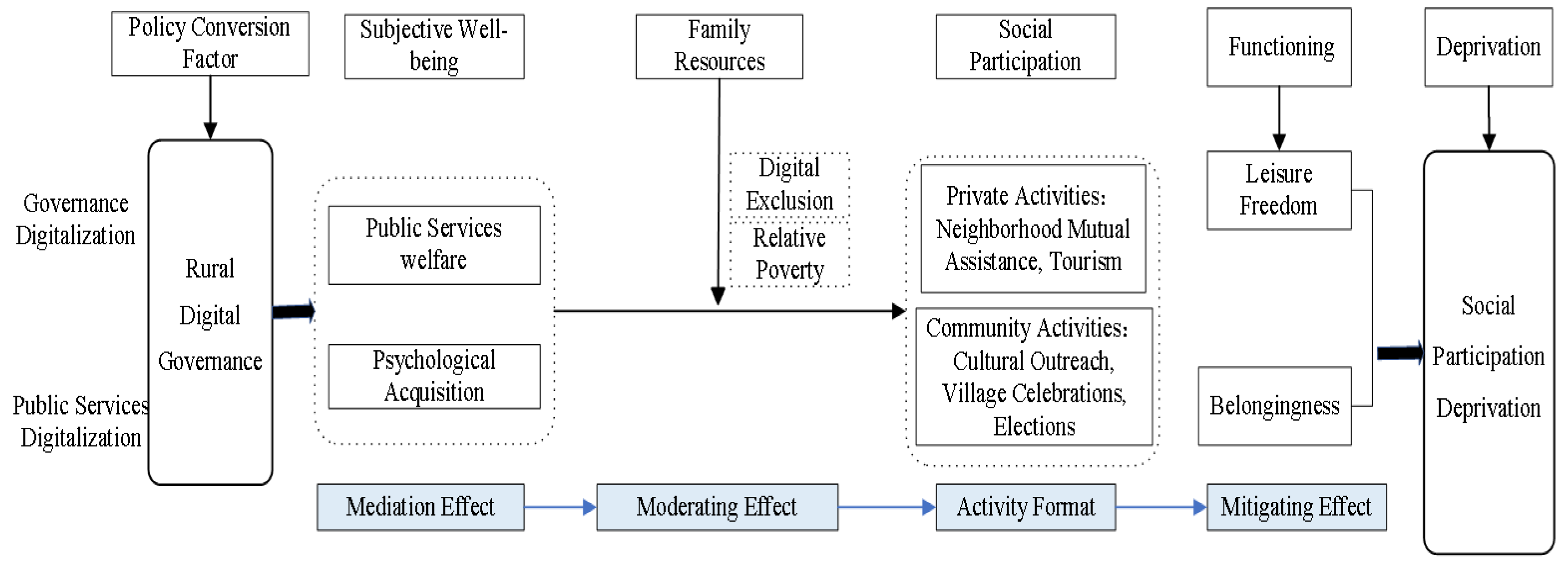
This study is theoretically grounded in the capability approach, drawing on the normative framework proposed by Sen (1999) [39]. Following Suppa (2021) [38], social participation is defined as engagement in abstract activities within a specific social context, manifested through concrete forms of social interactions. Social participation deprivation occurs when individuals are involuntarily excluded from such activities—specifically, when their level of participation falls below a critical threshold. By contrast, voluntarily low levels of participation driven by personal preferences are not considered indicative of social participation deprivation. Within the capability framework, functionings refer to the actual states of being and activities that individuals achieve, such as social engagement. In contrast, capabilities denote the set of feasible functionings available to individuals. The realization of these functionings depends on conversion factors, including personal, social, and environmental conditions, which shape individuals’ ability to convert available resources into meaningful activities.
In the context of rural China, digital governance has emerged as a key social policy for rural revitalization, driven by the advancement of digital village initiatives. This study examines how digital governance may alleviate social participation deprivation by improving farmers’ access to public services and enhancing their psychological engagement. Additionally, it explicitly considers the constraints imposed by household-level resource limitations, particularly digital exclusion and relative poverty. By integrating these mediating and moderating mechanisms, the study analyzes how digital governance shapes rural households’ social participation deprivation under varying institutional and household conditions. The proposed theoretical framework is illustrated in Figure 1.
Importantly, from the perspective of the capability approach, rural digital governance functions as a critical social conversion factor that shapes rural households’ ability to transform public service provision into effective social participation, thereby reducing social participation deprivation. This perspective provides the theoretical foundation for the subsequent hypothesis development and, at the same time, distinguishes the present study from the existing related literature.

2.2. Research Hypotheses

2.2.1. Digital Governance and Farmers’ Social Participation Deprivation

Existing studies have primarily examined the nonlinear relationship between the rural digital economy and income inequality, which is most commonly characterized by an inverted U-shaped pattern. In the early stage of digital rural development, digital technology and infrastructure in rural China lagged significantly behind those in urban areas, limiting rural residents’ access to digital economic benefits. As a result, the expansion of the digital economy initially widened the urban–rural income gap. However, with the diffusion and deeper integration of digital technologies, rural residents gradually begin to benefit from digital economy development, leading to a subsequent narrowing of income disparities. Consequently, the relationship between the digital economy and the urban–rural income gap follows an inverted U-shaped trajectory [40]. A similar pattern has been observed within rural areas, where the impact of the digital economy on income inequality among farmers also exhibits an inverted U-shaped relationship [41].
The Kuznets Curve proposed by Kuznets (1955) [42] has provided critical theoretical insights for understanding the dynamic evolution of inequality during the process of economic and social transformation, and also laid a theoretical foundation for analyzing the nonlinear impact of rural digital governance on rural households’ social participation deprivation. Digital governance is a key component of China’s digital rural development, encompassing both the digitization of governance mechanisms and the digitalization of public services, including healthcare, culture, education, and tourism. The relationship between digital governance and rural social participation deprivation is unlikely to follow a simple linear pattern. Instead, it may initially intensify deprivation before subsequently alleviating it as digital governance capacity improves. In rural China, significant disparities exist in the level of digital governance across regions. For example, the surveyed areas in Guizhou Province and Yunnan Province exhibit relatively low levels of digital governance, whereas rural areas in Zhejiang Province display more advanced digital governance. At the early stages of digital governance development, digital platforms tend to be underdeveloped, and the governance processes may become formalized in ways that result in “digital suspension”, whereby digital algorithms and platforms fail to realize their informational and communicative functions. Additionally, the digital usage divide, stemming from limited digital literacy and insufficient access to digital devices among rural residents, may further restrict their social participation, thereby exacerbating social participation deprivation.
With advancements in digital technology and governance, the optimization of digital algorithms enables governments to align public service decisions with individual needs better. Simultaneously, the continuous improvement of digital platforms transcends physical barriers to public participation [36], thereby facilitating greater engagement in social activities among rural residents. Moreover, as farmers receive digital education and training, their digital literacy improves, and the digital usage gap gradually narrows. Together, these developments promote broader social participation and ultimately reduce social participation deprivation. Accordingly, this study proposes the following research hypothesis:
H1. 
The impact of digital governance on farmers’ social participation deprivation follows an inverted U-shaped pattern.

2.2.2. Mediating Effects of Access to Public Services and Psychological Well-Being

Rational action theory suggests that individuals engage in social participation primarily to maximize personal utility [3]. For rural residents, both access to public services and psychological well-being are closely related to the social involvement. Access to public services includes institutional benefits such as medical insurance, pension insurance, and medical assistance [25], as well as community welfare provisions, including public activity facilities and community safety. Psychological well-being, by contrast, refers to subjective perception, including self-confidence in daily life and perceived social status. Digital governance influences farmers’ social participation deprivation primarily through two pathways: enhancing public service welfare and improving psychological well-being. Public service access, as a structural variable deeply embedded in institutional arrangements and governance processes, is more likely to exhibit stage-specific turning points in the way it is influenced by digital governance. In the early stage of weak digital governance capacity, information asymmetry tends to intensify, and governance transparency remains limited, which may hinder farmers’ access to public services [43]. Under such conditions, barriers to public participation emerge, limiting access to institutional public services such as medical and pension insurance. Additionally, farmers’ perceptions of community security and the utilization of public facilities may deteriorate, thereby reinforcing social participation deprivation. As digital governance capacity continues to improve and surpasses a certain threshold, platform-based channel effects gradually emerge, mitigating geographical constraints on rural residents’ access to public services [8]. Digital governance facilitates the optimization of public resource allocation, enhances service accessibility, and streamlines public service processes. Moreover, by promoting cross-departmental and cross-functional coordination, digital governance improves the overall quality and efficiency of rural public service provision [44]. At more advanced stages of digital governance, community security management and public facilities utilization are further strengthened, leading to a more positive perception of public service welfare among farmers.
Beyond public service welfare, digital governance also promotes social participation by enhancing farmers’ psychological welfare. The expansion of digital governance contributes to better rural governance outcomes and strengthens social trust among rural residents. In particular, the development of flat, interactive digital governance platforms facilitates more efficient information exchange between local governments and farmers [45], increasing satisfaction with grassroots organizations and public services and, in turn, reinforcing social trust [46]. In addition, the long-tail effect of digital finance enables relatively disadvantaged rural households to access financial services that were previously difficult to obtain. Improved financial inclusion not only enhances perceived social identity and status but also contributes to better mental well-being and stronger confidence in the future [47]. Ultimately, these improvements in psychological welfare increase farmers’ motivation to engage in social activities, thereby mitigating social participation deprivation.
Based on the above analysis, this study proposes the following hypotheses:
H2. 
Rural digital governance alleviates farmers’ social participation deprivation by improving their access to public services.
H3. 
Rural digital governance alleviates farmers’ social participation deprivation by enhancing farmers’ psychological gains.

2.2.3. Moderating Effects of Household Digital Exclusion and Relative Poverty

From a multilevel perspective, county-level digital governance constitutes the macro-institutional context, whereas household digital capabilities and economic conditions shape farmers’ effective responsiveness to this governance environment. It is therefore necessary to further examine the moderating role of household-level factors in the relationship between digital governance and farmers’ social participation deprivation.
Digital exclusion serves as a critical moderator of the impact of rural digital governance on farmers’ social participation deprivation. According to Resources and Appropriation Theory (RAT), limited financial resources and educational attainment constrain farmers’ access to essential digital devices and internet connectivity, thereby restricting their ability to obtain information and engage in social activities [48]. Digital exclusion encompasses not only the lack of digital devices (e.g., computers and smartphones) [49], but also insufficient technical skills to use these technologies effectively [50]. In this study, we focus specifically on usage exclusion, referring to farmers’ failure to integrate into digital governance platforms, access public service information, and participate in social governance due to inadequate digital access—particularly limited access to computers, mobile phones, and internet connectivity.
Digital exclusion prevents farmers from accessing digital platforms and, consequently, from obtaining key resources for social participation, such as government policy information and public services. This constraint not only limits farmers’ opportunities to engage in public affairs but also exacerbates their social participation deprivation. When farmers are unable to access information through digital platforms, they may gradually become disconnected from mainstream social activities, falling into information silos and social isolation. Although digital governance platforms are designed to expand participation opportunities, economically disadvantaged households often fail to overcome the technical and resource thresholds required for digital engagement. As a result, these households are less able to benefit from digital governance initiatives, which may instead reinforce existing patterns of social exclusion. Therefore, the effectiveness of digital governance in alleviating social participation deprivation depends on households’ digital access. In particular, digital exclusion significantly weakens the mitigating effect of rural digital governance on farmers’ social participation deprivation.
From the perspective of social exclusion theory, social exclusion extends beyond individuals’ inability to participate in social activities due to economic deprivation. It also encompasses exclusion from public social services resulting from insufficient resources [51]. Existing research indicates that low socioeconomic status, inadequate income, and material deprivation exacerbate social participation deprivation [14,38]. Against the backdrop of rural digital governance, relatively poor farmers often face low levels of digital literacy, along with inadequate educational and technical support, which constrain their capacity for digital access. These households typically lack essential digital devices (e.g., computers and smartphones) and reliable internet connectivity, preventing them from integrating into digital platforms and thereby limiting their access to public services and opportunities for social governance participation. As an external mechanism intended to facilitate farmers’ social participation, rural digital governance is therefore substantially constrained by households’ economic resources. Relatively poor households typically located in resource-scarce rural areas, where digital governance capacity and the distribution of digital resources often vary, resulting in limited access to equal opportunities and resources within digital governance. In addition, group identity and social exclusion interactively influence social participation. Social exclusion undermines individuals’ sense of group identity and diminishes their motivation to engage in social activities [22]. Relatively poor farmers are often marginalized due to limited economic and social resources, which in turn weakens their social identity and trust in digital governance platforms. This lack of identity and participation motivation further exacerbates their social participation deprivation.
Based on this analysis, the following hypotheses are proposed:
H4. 
Household digital exclusion negatively moderates the effect of digital governance on alleviating farmers’ social participation deprivation.
H5. 
Household relative poverty negatively moderates the effect of digital governance on alleviating farmers’ social participation deprivation.

3. Materials and Methods

3.1. Data Sources

To examine the impact of rural digital governance on rural households’ social participation, this study integrates primary household survey data collected firsthand with secondary county-level digital governance data. The household survey data were collected in July 2020 across five Chinese provinces using a stratified sampling approach. Provinces were first selected based on per capita GDP, representing the eastern, central, and western regions. Within each selected province, five typical counties (or districts) were chosen based on criteria such as economic development, and agricultural structure. Several villages were then randomly selected within each county (or district) based on the distribution of administrative villages. Within each village, farmers were randomly surveyed to ensure both regional representativeness and individual randomness. This sampling procedure yielded 666 valid samples, which were subsequently matched with county-level digital governance data. Of these, 187 samples were drawn from Zhejiang Province in the eastern coastal region, 224 from the central region (107 from Hubei and 117 from Jiangxi), and 255 from the western region (125 from Guizhou and 130 from Yunnan). To measure county-level digital governance, this study employs the County Digital Governance Index (2018–2020), jointly published by Peking University’s New Rural Development Research Institute and Ali Research Institute.

3.2. Variables

3.2.1. Dependent Variables

This study employs the farmer’s social participation deprivation index as the dependent variable. Following Suppa (2021) [38], social participation covers various social activities, including cultural, artistic, and sports activities, as well as neighborhood mutual aid and volunteer work. Individuals who are unable to engage in these activities are considered to experience social participation deprivation. Based on this definition and the survey data, this study examines social participation deprivation from five dimensions. The first two dimensions capture private social participation, reflecting individuals’ pursuit of leisure and freedom, while the remaining three dimensions capture community activities, reflecting their pursuit of social belonging and identity. In the baseline regression model, this study measures farmers’ social participation deprivation using the equal-weight dual cutoff counting method proposed by Alkire and Foster (2011) [52], commonly referred to as the Alkire-Foster method. In addition, for the robustness regression analysis, this study adopts a counting-based method to construct an alternative measure of social participation deprivation.
Building on this framework, the frequency of contact with village cadres is introduced as a quantitative behavioral indicator (coded as 1 = rarely, 2 = moderately, and 3 = frequently) to capture variation in engagement intensity. To assess the construct validity of social participation deprivation, this study first examines its association with the frequency of contact with village cadres. Spearman’s rank correlation analysis reveals a significant negative correlation between the deprivation score and contact frequency (r = −0.219, p < 0.001), indicating that higher levels of interaction are associated with lower levels of social participation deprivation. Further group-based comparisons demonstrate significant differences in the distribution of deprivation scores across contact-frequency groups. Specifically, the Kruskal–Wallis H test indicates that deprivation scores differ significantly among the rarely, moderately, and frequently contacting groups (χ2 (2) = 30.39, p < 0.001; χ2 (2) = 31.99, p < 0.001 after correction for ties). To further assess the effect of contact frequency on deprivation levels, a Mann–Whitney U test was conducted between the rarely contacting and frequently contacting groups. The results show that the rarely contacting group exhibits significantly higher social participation deprivation scores (Median = 0.6, Mean = 0.481) than the frequently contacting group (Median = 0.4, Mean = 0.323) (z = 5.42, p < 0.001). Taken together, the results from the Spearman correlation analysis, Kruskal–Wallis test, and Mann–Whitney U test demonstrate strong consistency between the deprivation index and the behavioral frequency indicator. These findings provide convergent evidence that measurements derived from different sources reinforce one another, thereby supporting the construct validity of the social participation deprivation measure.
Overall, although the primary measure relies on dichotomous event indicators, the incorporation of a quantifiable behavioral frequency dimension and cross-validation with subjective assessments enhances the convergent validity of the index under conditions of data constraints.

3.2.2. Independent Variables

Digital governance refers to the digitization of governance tools and public services, including medical care, culture, education, and tourism. To measure the level of digital governance, this study calculates the mean of the Rural Governance Digitization Index and the Rural Life Digitization Index. The Digital Rural Governance Index comprises two dimensions: the number of Alipay-based government service usages and the proportion of towns equipped with digital governance platforms. This index captures not only the accessibility of rural digital governance but also the extent to which farmers utilize digital governance services after gaining access to these platforms [7]. The Digital Rural Life Index consists of three sub-indices: the Digital Consumption Index, the Digital Culture–Tourism–Health–Education Index, and the Digital Life Service Index. The Digital Consumption Index includes indicators such as online consumption per 100 million yuan of total retail sales of consumer goods and e-commerce sales per 100 million yuan of GDP. The Digital Culture–Tourism–Health–Education Index measures the usage frequency and average duration of entertainment and educational applications, as well as the number of scenic sites and user reviews on online travel platforms, and the number of registered physicians on online medical platforms. The Digital Life Service Index captures per capita online life-service consumption orders and total online life-service consumption expenditure. To mitigate potential endogenous concerns, this study employs the County Digital Governance Index and the Digital Rural Life Index for the period 2018–2020, applying a logarithmic transformation to each index before calculating their mean. As a robustness check, we further estimate models using the average values for the 2019–2020 period. The original index was normalized using the logarithmic power function method [53]. In the base year 2018, each indicator ranged from 0 to 100, whereas in 2019 and 2020, values could exceed 100 or fall below 0, reflecting dynamic changes in digital governance and rural digital life over time [54].

3.2.3. Mediator Variables and Moderating Variables

To examine the mechanism through which digital governance influences farmers’ social participation deprivation, this study adopts two analytical perspectives: public service welfare and psychological welfare. Public service welfare is operationalized using institutional welfare and community welfare indicators [25]. Institutional welfare is measured by farmers’ subjective perceptions of pension and medical insurance, while community welfare is captured through evaluations of community security, cultural and recreational facilities, and the sanitary toilet construction. Psychological welfare is measured using farmers’ subjective assessments of their self-confidence in daily life and their perceived social status within the village. In terms of moderating variables, digital exclusion is measured by farmers’ inability to afford computers, mobile phones, or Internet access due to economic constraints. Relative poverty is defined using a threshold of 60% of the sample’s median per capita household income (10,500 Yuan/Person·Year). Households with a per capita income below this standard are coded as 1, while those above it are coded as 0.

3.2.4. Control Variables

Building on existing studies [38,55], this study controls for a comprehensive set of variables at both the household and county levels. Household-level controls include the household head’s age, educational attainment, and health status, as well as household arable land area, loans, social capital, livelihood risk, participation in technical training, and trust in community leaders. At the county level, controls include industrial structure, human capital, and healthcare quality. Descriptive statistics for all variables are reported in Table 1.

3.3. Estimation Strategy

To test Hypothesis H1, which examines the effect of rural digital governance on farmers’ social participation deprivation, this study constructs a linear regression model:
D e p r i v a t i o n _ S P i = β 0 + β 1 D i g i t a l _ g o v i + β 2 D i g i t a l _ g o v i 2 + β n C V i + ϵ i
In Equation (1), D e p r i v a t i o n _ S P i represent the level of social participation deprivation of ith rural household. D i g i t a l _ g o v e r n a n c e i and D i g i t a l _ g o v i 2 denote the level of rural digital governance of the county where the ith rural household is located and its square term. C V i denotes a vector of control variables, and ϵ i is the random error terms. The coefficients β 1 , β 2 , and β n capture the effects of the explanatory and control variables.
To test Hypotheses H2 and H3, which explore the mechanism through which rural digital governance affects farmers’ social participation deprivation, the following mediation models are estimated:
M e d i = α 0 + α 1 D i g i t a l _ g o v i + α 2 D i g i t a l _ g o v i 2 + α n C V i + ϵ i
D e p r i v a t i o n _ S P i = δ 0 + δ 1 M e d i + δ 2 D i g i t a l _ g o v i + δ 3 D i g i t a l _ g o v i 2 + δ n C V i + ϵ i
Equations (2) and (3) constitute mediation models grounded in the nonlinear theoretical framework [56,57]. M e d i represents the mediating variables, including public service access and psychological gains of household i. The coefficient α 1 denotes the effect of county-level digital governance on the mediators, while δ 1 captures the effect of the reflects on of farmers’ social participation deprivation after controlling for the key explanatory variables. The coefficient δ 2 represents the direct effect of digital governance on social participation deprivation after accounting for the mediators. According to the classic approach proposed by Baron and Kenny (1986) [58], mediation is supported if the coefficients β 1 , β 2 , α 1 , α 2 , δ 1 , δ 2 , and δ 3 are statistically significant, and if the magnitudes or significance levels of δ 2 and δ 3 are reduced relative to those of β 1 and β 2 , respectively.
To test Hypothesis H4, which examines the moderating effects of digital exclusion and relative poverty, this study extends Equation (1) by incorporating interaction terms between digital governance and these two factors, yielding the following moderation model:
D e p r i v a t i o n _ S P i = θ 0 + θ 1 D i g i t a l _ g o v i + θ 2 M o d i + θ 3 M o d i × D i g i t a l _ g o v i + θ n C V i + ϵ i
In Equation (4),   M o d i denotes the moderating variables, including digital exclusion ( D E i ) and relative poverty ( R P i ) experienced by household i. The interaction term M o d i × D i g i t a l _ g o v i captures the moderating effect of digital exclusion and relative poverty on the relationship between digital governance and social participation deprivation. All other variables are defined as in Equation (1). A statistically significant coefficient θ 3 indicates the presence of a moderation effect.

4. Result

4.1. Benchmark Regression Results

Table 2, columns (1) to (3), report the regression results from models without control variable, with household-level variables, and with both household- and county-level variables, respectively. Results in column (3) showed that both the digital governance and its quadratic term are statistically significant at the 5% level. The coefficient of the linear term is positive, while that of the quadratic term is negative, suggesting an inverted U-shaped relationship between digital governance and farmers’ social participation deprivation. To verify the robustness of this nonlinear relationship, the study employs the inverted U-shaped test proposed by Lind et al., (2010) [59]. The results, shown in Table 3, satisfy all three conditions: (1) the linear and quadratic terms are statistically significant and carry opposite signs. (2) the slopes at the lower and upper bounds of the core explanatory variable are of opposite signs. (3) the estimated inflection point lies within the sample range. These findings confirm that digital governance exhibits an inverted U-shaped effect on farmers ‘social participation deprivation, thereby supporting hypothesis H1. Specifically, in regions with relatively low levels of digital governance levels—such as Taijiang County in Guizhou Province and Dayao County in Yunnan Province, which together accounting for approximately 6.91% of the sample—insufficient digital infrastructure and limited governance capacity fail to generate positive digital dividends. Instead, given the limited digital capabilities of farmers in the sample, social participation deprivation may be exacerbated. Conversely, once digital governance exceeds the estimated inflection point, further improvements in governance effectiveness significantly alleviate farmers’ social participation deprivation.
This conclusion is consistent with previous research. For instance, Van and Van (2014) highlight that the impact of information technology development on different social groups may exhibit nonlinear characteristics [60]. In particular, while digital technologies may promote social integration in the early stages, they can also exclude certain groups as technological barriers increase beyond a critical threshold. These findings underscore the importance for policymakers, particularly in the context of digital village construction, to address short-term adaptation challenges during the initial stages of digital governance. These challenges include the digital divide, barriers to technology access, and insufficient financial support. Proactively addressing these issues can help optimize policy implementation and enhance the inclusiveness of digital governance.

4.2. Robustness Tests

Robustness results are reported in columns (4) to (9) of Table 2. To ensure the reliability of the results, this study conducts a series of robustness tests, including (1) replacing key variables, (2) trimming the sample tails, (3) restricting the sample region, and (4) altering the estimation method. First, regarding variable replacement, column (4) reports the results obtained by substituting the core explanatory variable with the average rural digital index for the period 2019–2020. The coefficients of both the linear and quadratic terms remain statistically significant with opposite signs, and the estimated inflection point of the inverted U-shaped relationship is 4.465, which is consistent with the baseline results. Column (5) presents the estimates using the total digital governance score as an alternative explanatory variable, while column (6) reports the results when both the explanatory and dependent variables are replaced. Second, to mitigate the potential influence of outliers, column (7) reports the estimation results after trimming the top and bottom 5% of the sample. Third, to account for regional variations, column (8) reports the results after excluding observations from Jiangxi Province, whose level of digital governance is close to the sample mean. Finally, to address potential heteroscedasticity and autocorrelation, column (9) reports the estimates obtained using the Feasible Generalized Least Squares (FGLS) method. Across all specifications, the coefficients of digital governance and its quadratic term remain statistically significant and carry opposite signs, confirming the inverted U-shaped relationship identified in the baseline regression.

4.3. Endogeneity Tests

4.3.1. Instrumental Variable (IV) Regression

To address potential endogeneity issues arising from reverse causality and omitted variables bias, this study follows Li et al. (2024) [57] and employs the lagged digital rural governance index and its square term as instrumental variables (IVs). The two-stage least squares (2SLS) estimation results are reported in column (10) of Table 2. The first-stage results indicate that the instrumental variables are positively and statistically significantly correlated with the current level of digital rural governance at the 1% significance level, satisfying the relevance condition. Furthermore, the weak instrumental test reveals that the Cragg-Donald Wald F statistic equals 76.44, which exceeds the Stock-Yogo critical value for weak identification at the 10% level. This confirms that the instruments are sufficiently strong and that concerns about weak instrument are unlikely.

4.3.2. Propensity Score Matching (PSM) Test

As an additional strategy to mitigate potential endogeneity, this study adopts Propensity Score Matching (PSM) as a quasi-natural experimental approach. Given the absence of direct survey indicators capturing farmers’ participation in digital governance, this study constructs a proxy treatment variable based on the interaction between household-level digital technology access and the county-level digital governance index.
Specifically, households are classified as having digital technology access if they own a computer or tablet or have internet connectivity; otherwise, they are categorized as lacking digital access. Counties with a digital governance index above the sample mean are categorized as high-level digital governance areas, while those below the mean are classified as low-level areas. Accordingly, households with digital access residing in high-governance counties constitute the treatment group. All other households, including those with digital access in low-governance counties, and those without access in either high- or low-governance counties, are classified as the control group.
We control for comprehensive set of household-level and county-level and apply PSM to correct for potential selection bias. After matching, the covariate means between the treatment and control groups show no significant differences (p > 0.10), and all standardized mean differences fall below 10%, indicating substantially improved sample comparability. This supports a credible estimation of the Average Treatment Effect on the Treated (ATT).
The balance test results are reported in Table 4. Rubin’s B equals 12.2, which is well below the conventional threshold of 25, and Rubin’s R is 1.28, falling within the acceptable range. These statistics confirm the effectiveness of the matching process. Overall, the constructed treatment variable provides a valid proxy for identifying farmers’ participation in digital governance.
Table 5 reports the Average Treatment Effects on the Treated (ATT) estimated using three alternative matching algorithms, all of which are statistically significant at the 1% level. These results provide strong evidence of a robust causal relationship between participation in digital governance and reductions in farmers’ social participation deprivation. Specifically, farmers with digital access residing in counties with high levels of digital governance experience a 0.101-unit reduction in social participation deprivation relative to their matched counterparts in the control group.
Table 6 presents the regression results based on the matched sample. After correcting for potential selection bias, the relationship between digital governance and social participation deprivation continues to exhibit a U-shaped pattern, further reinforcing the robustness of the main findings.

5. Further Analysis

5.1. County-Level Contextual Heterogeneity: Digital Governance Environments

Digital governance is not implemented within a homogeneous institutional environment; rather, its performance depends critically on county-level governance capacity, institutional integration, and the foundations of public service provision. Marked disparities exist across counties in the sophistication of digital infrastructure, the effectiveness of governance coordination mechanisms, and the degree of public service digitalization. These differences may give rise to divergent—and even opposing—effects of digital governance on rural households’ social participation deprivation. Accordingly, digital governance should be conceptualized as a county-level institutional context, within which its heterogeneous effects can be systematically examined across varying governance environments. Building on this perspective, the study classifies sample counties into distinct contextual groups based on their levels of digital governance. A grouped regression approach is then employed to examine heterogeneity in the effects of digital governance on rural households’ social participation deprivation across different governance contexts.

Digital Governance Contexts: High vs. Low Governance Counties

Given the pronounced disparities in the development of rural digital governance across Chinese counties, the mechanisms through which digital governance affects rural households’ social participation deprivation are likely to exhibit substantial contextual heterogeneity. To identify such differences, this study classifies the sample counties into two groups—a low digital governance context and a high digital governance context—based on county-level digital governance index scores. This classification allows for a comparative examination of how digital governance operates under distinct institutional environments.
Specifically, the low digital governance context primarily comprises the surveyed counties in Guizhou and Yunnan Provinces, with an average digital governance index of approximately 4.635. In contrast, the high digital governance context includes counties in Hubei, Jiangxi, and Zhejiang Provinces, where the average digital governance index is about 4.903. Columns (1) and (2) of Table 7 report the estimation results for these two governance contexts, respectively. The regression results indicate that, in the low digital governance context, digital governance and rural households’ social participation deprivation exhibit a significant U-shaped relationship, with an inflection point at 4.420. Approximately 82.96% of households lie to the right of this inflection point. This suggests that in counties with relatively weak digital governance foundations, most rural households are positioned on the upward-sloping segment of the U-shaped curve, implying that further improvements in digital governance may, paradoxically, exacerbate social participation deprivation.
A plausible mechanism underlying this pattern is as follows. At the early stage of digital governance development, the inclusive provision of basic digital public services reduces information acquisition costs, enabling rural households—particularly those with lower educational attainment or advanced age—to engage initially in public affairs and social governance. This process helps lower barriers to social participation. However, as digital governance deepens, the requirements for digital skills, institutional adaptability, and sustained participation capacity increase. Rural households with limited digital literacy and constrained adaptive capacities may struggle to adjust to increasingly complex governance systems. As a result, technological thresholds are transformed into new mechanisms of exclusion, thereby intensifying social participation deprivation.
By contrast, in the high digital governance context, digital governance and social participation deprivation display a significant inverted U-shaped relationship, with an inflection point at 4.809 (as reported in Table 8). Approximately 61.13% of households are located to the right of this inflection point. This finding implies that in most counties in central and eastern China, continued improvements in digital governance are generally associated with reductions in social participation deprivation. This pattern may be explained by the fact that in regions with well-established digital governance foundations, digital technologies extend beyond basic information transmission functions. Through deeper institutional integration and more coordinated public service provision, digital governance enhances the inclusiveness of the governance system. On the one hand, digital platforms lower institutional and transaction costs for rural households to participate in public affairs. On the other hand, complementary public services and governance mechanisms are relatively mature, enabling rural households to sustain participation in social and economic activities within a high-level digital environment, thereby effectively mitigating social participation deprivation.
Overall, the grouped regression results demonstrate that the effects of digital governance on rural households’ social participation deprivation are strongly context-dependent. In low digital governance contexts, capacity constraints and technological thresholds may amplify the exclusionary effects of digital governance. In contrast, in high digital governance contexts, the synergistic effects of institutional integration and public service provision help unlock the inclusive potential of digital governance. From the perspective of county-level governance environments, these findings provide crucial contextual evidence for understanding the underlying mechanisms through which digital governance shapes rural households’ social participation deprivation.

5.2. Household- and Outcome-Level Heterogeneity

5.2.1. Household Heterogeneity by Income Level

To examine differences in the effects of rural digital governance on social participation deprivation across income groups, this study divides rural households into low-income and high-income groups based on average household income. Columns (3) and (4) of Table 7 report the regression results, which indicate that an inverted U-shaped relationship between digital governance and social participation deprivation for both groups, with notable differences in the locations of the inflection points. Specifically, the inflection point for the low-income group is slightly higher than that for the high-income group, suggesting that low-income households may require more time and more favorable conditions to adapt to new technologies and policy arrangements during the process of digital governance before experiencing improvements in social participation.
This difference may be attributable to the constraints faced by low-income farmers, including lower education attainment, weaker digital skills, and limited access to the internet. These disadvantages make it more difficult and time-consuming for low-income farmers to adapt to new technologies and policies initiatives during the initial stages of digital governance. Nevertheless, digital governance effectively alleviates social participation deprivation in approximately 90% of counties, regardless of whether farmers belong to the high-income or low-income group. This finding suggests that the impact of digital governance on farmers’ social participation deprivation varies only modestly across income levels. This finding reveals that although rural households across different income groups differ in the speed and conditions required to adapt to digital governance, digital governance is generally effective in alleviating social participation deprivation among rural households. Moreover, the moderating role of income differences in this process appears to be relatively limited.
Table 8. U-shaped results from heterogeneity perspective.
VariablesWest RegionCentral-Eastern RegionLow-Income GroupHigh-Income Group
Inflection Point4.4204.8094.5064.444
Whether the inflection point is in the sample
interval
YESYESYESYES
Left endpoint slope−0.6440.4180.2490.201
Slope of right endpoint0.756−0.715−0.343−0.366
U-shaped resultsU-shapedinverted
U-shaped
inverted
U-shaped
inverted
U-shaped

5.2.2. Heterogeneity by Social Participation Deprivation Level

To examine the heterogeneous effects of rural digital governance across rural households with different levels of social participation deprivation, this study employs a quantile regression model, estimating conditional quantiles ranging from 0.2 to 0.9. The results in Table 9 reveal substantial heterogeneity across the distribution of social participation deprivation.
At lower quantiles (0.2–0.4), neither digital governance nor its quadratic term exhibits a statistically significant effect on farmers’ social participation deprivation. In contrast, for quantiles at and above 0.5, digital governance displays a statistically significant inverted U-shaped relationship with social participation deprivation, with the effect initially increasing and subsequently decreasing. Moreover, as the quantile increases from 0.5 to 0.9, the estimated inflection point rises gradually from 4.465 to 4.621. These findings suggest that digital governance exerts a more pronounced mitigating effect among farmers experiencing higher levels of social participation deprivation, underscoring its potential role in alleviating social participation deprivation among more vulnerable groups.

5.3. Mechanism Analysis: Public Service and Psychological Pathways

5.3.1. Public Service Access as a Nonlinear Mediator

To examine the mechanisms through which digital governance influences farmers’ social participation deprivation, this study employs a stepwise regression approach. The corresponding results are presented in Table 10. Column (1) reports the baseline regression results. Column (2) reveals a U-shaped relationship between digital governance and public service acquisition, indicating that the effect initially decreases and then increases as digital governance improves. In column (3), the coefficients on digital governance and its quadratic term are smaller in magnitude than those in the baseline regression, indicating that public service acquisition partially mediates the inverted U-shaped effect of digital governance on farmers’ social participation deprivation. These findings provide empirical support for hypothesis H2. Column (4) shows that digital governance has a statistically significant positive impact on farmers’ psychological acquisition. Column (5) further indicates that, after controlling for psychological acquisition, the coefficients of digital governance and its quadratic term decline relative to the baseline results. This pattern suggests that improvements in farmers’ psychological well-being constitute another important channel through which digital governance alleviates social participation deprivation, thereby supporting Hypothesis H3.

5.3.2. Psychological Well-Being as an Empowerment Channel

These results highlight that digital technology functions not only as a physical enabler but also enhances farmers’ social identity and sense of belonging at the psychological level. By strengthening these psychological attributes, digital governance increases farmers’ motivation to participate in society, thereby reducing social participation deprivation. This conclusion carries important policy implications. In promoting digital governance, governments should place greater emphasis on improving the accessibility and equity of public services to prevent farmers from falling into “digital marginalization” due to technological barriers or unequal resource distribution. Ensuring that farmers can both access tangible public service benefits and experience improvements in psychological well-being can help foster more active and sustained social.

5.4. Moderating Mechanisms at the Household Level

Building on the preceding county-level heterogeneity analysis, this study demonstrates that the effect of digital governance on rural households’ social participation deprivation varies significantly across governance contexts. However, even within the same digital governance environment, rural households may respond differently to digital governance. Such variation is primarily driven by disparities in household-level digital capabilities and economic resources. Accordingly, this study further examines the moderating roles of digital exclusion and relative poverty in the relationship between digital governance and rural households’ social participation deprivation from a household-level perspective. This approach enables the construction of a dual-layer heterogeneity framework that integrates county-level governance contexts with household-level characteristics. Digital exclusion and household poverty are critical household-level factors influencing the farmers’ social participation deprivation [60,61]. Household poverty further diminishes individuals’ ability to leverage digital resources to enhance social participation [62]. Building on this perspective, this study investigates whether county-level digital governance can alleviate farmers’ social participation deprivation and examines how digital exclusion and poverty moderate this relationship.

5.4.1. Moderating Role of Household Digital Exclusion

Table 11 presents the estimates from the moderating effect model. Column (1) shows that the interaction term between household digital exclusion and the digital governance index is positive and statistically significant. The robustness checks reported in columns (2) and (3) confirm the stability of this result. These findings indicate that household digital exclusion significantly weakens the relationship between rural digital governance and reduced social participation deprivation, thereby supporting hypothesis H4. Specifically, households experiencing higher levels of digital exclusion benefit less from improvements in rural digital governance in terms of reducing social participation deprivation. A plausible explanation is that digital exclusion—manifested in limited internet access and insufficient digital devices—restricts the farmers’ ability to share in digital dividends. As a result, even when rural digital governance improves, these households are unable to utilize digital resources to engage in social activities.
This result suggests that rural households facing high levels of digital exclusion encounter substantial difficulties in accessing and utilizing the information resources, participatory channels, and institutional opportunities generated by digital governance, even as county-level digital governance continues to advance. As a result, these households are less able to effectively engage in village public affairs, social organizations, or digital public services, and the extent to which their social participation deprivation can be alleviated is therefore significantly constrained. From a mechanistic perspective, the institutional supply and platform expansion promoted by digital governance do not automatically translate into enhanced participation capacity for all rural households. Deficits in digital skills, limited access to digital devices, and exclusion from effective digital use constitute key barriers that prevent digitally excluded households from crossing the institutional thresholds of digital governance, thereby substantially weakening its inclusive effects at the micro level.

5.4.2. Moderating Role of Household Relative Poverty

Furthermore, the results reported in Column (4) of Table 11 indicate that the interaction term between household income poverty and the digital governance index is significantly positive. This finding is further corroborated by the robustness checks presented in Columns (5)–(6), thereby providing strong support for Research Hypothesis H5. These results suggest that, as digital governance environments improve, relatively poor households are substantially less able than non-poor households to translate such improvements into enhanced opportunities for social participation.
A plausible explanation is that income poverty constrains rural households’ ability to invest in digital devices, internet access, and sustained digital use, while simultaneously limiting their capacity to bear the time, energy, and opportunity costs associated with social participation. Under these conditions, the institutional participation channels created through digital governance tend to be disproportionately accessible to households with stronger resource endowments. By contrast, poor households face a practical dilemma of “institutional accessibility without capability realizability”. Overall, this finding underscores the pronounced conditionality of digital governance in alleviating social participation deprivation and highlights that its effectiveness is fundamentally shaped by household-level economic resource constraints.
These findings have important policy implications. Rural digital governance initiatives should consider household-level factors, with particular attention to households affected by digital exclusion and relative poverty. Targeted and differentiated support measures are needed to enhance the inclusiveness of digital governance and to strengthen its effectiveness in reducing farmers’ social participation deprivation.

6. Conclusions and Suggestions

Against the backdrop of rural revitalization, the impact of digital governance on rural households’ social participation warrants in-depth examination. Using rural survey data and the Peking University Digital Governance Index, this study systematically examines the impact of digital governance on rural social participation deprivation and its underlying mechanisms. The results reveal an inverted U-shaped relationship between digital governance and the farmers’ social participation deprivation, with an estimated inflection point at 4.395. Notably, only 6.91% of the farmers reside in areas where digital governance levels fall below this threshold. Endogeneity and robustness tests confirm the reliability of these findings. The heterogeneity analysis reveals substantial regional variation in the effects of digital governance. Under conditions of weak digital governance, digital rural governance may fail to alleviate—and may even exacerbate—rural households’ social participation deprivation. By contrast, in contexts characterized by strong digital governance capacity, digital rural governance is better able to realize its potential to mitigate social participation deprivation. Moreover, digital rural governance exerts a significant inhibitory effect on households experiencing higher levels of deprivation, thereby expanding their opportunities for social participation. Across rural households with different income levels, however, the marginal effects of digital rural governance on social participation deprivation remain relatively modest. Mediation analysis indicates that digital governance alleviates social participation deprivation by enhancing farmers’ access to public service benefits and psychological well-being. In addition, moderation analysis shows that household digital exclusion and relative poverty weaken the mitigating effect of digital governance.
From a digital governance perspective, the findings of this study deepen our understanding of the inclusiveness of rural digital governance and its functional boundaries. On the one hand, rural digital governance significantly alleviates farmers’ social participation deprivation by improving access to public services and enhancing psychological well-being, thereby demonstrating its inclusive potential in rural contexts. On the other hand, household-level shortages of digital tools and income poverty substantially weaken the mitigating effect of digital governance on social participation deprivation, indicating that the realization of inclusiveness in digital governance depends critically on individual and household resource endowments. Taken together, these results reveal that rural digital governance produces differentiated governance outcomes under varying resource constraints.
This study makes several theoretical contributions to the literature on digital governance, and capability-based analyses of social deprivation. Grounded in the practice of rural governance in the digital era, this study further consolidates the theoretical applicability of the capability approach in research on digital governance and social deprivation. Specifically, it conceptualizes rural digital governance as a core component of the social environment within the capability framework. It elucidates the mediating mechanisms through which digital governance alleviates farmers’ social participation deprivation by enhancing access to public services and improving psychological well-being. In doing so, this study provides empirical support for the localized application of the capability approach in the context of rural digital governance. Moreover, this study demonstrates that the effect of rural digital governance on alleviating farmers’ social participation deprivation is significantly moderated by household-level digital exclusion and relative poverty. This finding not only responds to ongoing scholarly debates regarding the boundaries and conditional effectiveness of digital governance, but also advances a nuanced theoretical perspective on how digital technologies empower vulnerable groups, and mitigate social deprivation under heterogeneous resource constraints.
These findings yield important policy implications for promoting inclusive rural digital governance. First, the empirical results indicate that digital countryside construction does not automatically alleviate farmers’ social participation deprivation; rather, its effectiveness is highly contingent upon the county-level digital governance environment. In regions with relatively low levels of digital governance, the digitalization process may even exacerbate participation exclusion for certain groups. This suggests that if digital governance initiatives overlook infrastructure accessibility, they are unlikely to achieve broad and inclusive farmer participation. Accordingly, greater policy attention should be devoted to narrowing regional disparities in digital infrastructure, particularly by strengthening the construction of digital infrastructure in underdeveloped and geographically disadvantaged areas, such as mountainous regions in western China.
Moreover, the findings demonstrate that household digital exclusion and relative poverty significantly weaken the capacity of digital governance to mitigate social participation deprivation. To enhance the social inclusiveness of digital governance, policies should prioritize the precise matching of technological supply with household needs and provide targeted, practical digital skills training for digitally excluded and relatively poor farmers. Improving these groups’ digital literacy and application capabilities is essential for enabling their effective integration into digital governance processes and, consequently, for expanding their opportunities for social participation.
Second, the mediation analysis reveals that perceived public service welfare and psychological well-being constitute key channels through which rural digital governance alleviates farmers’ social participation deprivation. This implies that digital governance platforms should be further optimized to better address both material service provision and psychological empowerment. Specifically, enhancing the functionality, usability, and responsiveness of digital public service platforms in ways that improve farmers’ sense of welfare acquisition and social recognition can significantly strengthen the effectiveness of digital governance in reducing social participation deprivation.
This study has several limitations. First, the reliance on cross-sectional data constrains the ability to make strong causal inferences regarding the relationship between digital governance and rural households’ social participation deprivation and captures only the short-term effects of digital rural development. Future research could construct multi-period panel datasets to more systematically examine the long-term and dynamic impacts of rural digital governance. Second, the measurement of social participation deprivation in this study is limited to selected core dimensions and does not encompass other vital forms of participation, such as volunteer services and charitable activities. Subsequent studies should expand the dimensional scope and refine the measurement framework to more comprehensively capture the mechanisms through which digital governance influences social participation deprivation. Third, the geographical coverage of the sample is limited. Although the data encompass rural households from five provinces spanning eastern, central, and western China, they do not include rural areas in Northeast or Northwest China. Future research should therefore broaden the sampling framework, with particular emphasis on incorporating data from urban–rural fringe areas and ethnic minority villages, to capture regional heterogeneity in rural digital governance better.

Author Contributions

Conceptualization, M.Z. and Z.H.; methodology, M.Z.; software, M.Z.; validation, Z.H.; formal analysis, Z.H.; investigation, M.Z.; resources, Z.H.; data curation, M.Z.; writing—original draft preparation, M.Z. and Z.H.; writing—review and editing, Z.H. and M.Z.; visualization, M.Z.; supervision, Z.H.; funding acquisition, M.Z. and Z.H. All authors have read and agreed to the published version of the manuscript.

Funding

This research was funded by the Nanxun Scholars Program of ZJWEU (RC2023010855), the Humanities and Social Sciences Foundation of the Ministry of Education of China (Grant No. 22YJAZH153), the Research Project of Soft Science in Zhejiang Province (Grant No. 2024C35091), the Research Project of the Belt and Road Regional Standardization Research Center of China Jiliang University (Grant No. BRZK07B), and the Fundamental Research Funds for the Provincial Universities of Zhejiang (Grant No. 2023YW79).

Data Availability Statement

The data presented in this study are available on request from the corresponding author due to the need to protect the privacy of rural households involved in the research. The County Digital Governance Index can be obtained from: https://opendata.pku.edu.cn/file.xhtml?fileId=12781&datasetVersionId=1020 (accessed on 20 July 2022).

Conflicts of Interest

The authors declare no conflicts of interest.

References

  1. Nussbaum, M.C. Women and Human Development: The Capabilities Approach; Cambridge University Press: Cambridge, UK, 2000. [Google Scholar]
  2. Li, Y. Exploration of social participation in social governance: A case study of social participation in Hangzhou city. Theory Res. 2017, 2, 144–146. [Google Scholar]
  3. Chen, Y.H.; Yang, H.K. Study on the inadequate social participation and its formative mechanisms from the perspective of rational choice. Nankai J. (Philos. Lit. Soc. Sci. Ed.) 2024, 3, 75–89. [Google Scholar]
  4. Li, L.L.; Zeng, Y.W.; Guo, H.D. Digital countryside construction: Underlying logic, practical errors and optimization path. China Rural. Econ. 2023, 1, 77–92. [Google Scholar]
  5. Zhang, Y.; Feng, M.W.; Yi, F.J. Study on the effectiveness and mechanism of Rural Digital Governance on villagers’ waste classification. World Agric. 2023, 11, 78–90. [Google Scholar] [CrossRef]
  6. Zhang, L.L.; Song, L. Digital governance and urban economic resilience. Econ. Perspect. 2024, 10, 109–127. [Google Scholar]
  7. Zhang, Y.; Zhang, B.; Yi, F.J. Rural digital governance and rural collective action. China Rural. Surv. 2024, 6, 98–121. [Google Scholar]
  8. Zhang, Y.; Yi, F.J. The impact of rural digital governance on happiness. J. Nanjing Agric. Univ. (Soc. Sci. Ed.) 2023, 5, 152–164. [Google Scholar]
  9. Wang, X.H.; Li, X.L.; Liu, W. The warmth of digital technology: The common prosperity effect of rural digital governance. Inq. Econ. Issues 2024, 8, 18–37. [Google Scholar]
  10. Li, Y.; Huang, Y. Social security, digital literacy, and relative poverty in China. Financ. Res. Lett. 2025, 71, 106446. [Google Scholar] [CrossRef]
  11. González-Relaño, R.; Lucendo-Monedero, A.L.; Ivaldi, E. Household and individual digitisation and deprivation: A comparative analysis between Italian and Spanish regions. Soc. Indic. Res. 2024, 3, 899–925. [Google Scholar] [CrossRef]
  12. Kong, Z.Y.; Yan, X.M. Can “care for the elderly” promote “worthiness”—Impact of social pension insurance on the social participation of rural elderly. J. Shanxi Univ. Financ. Econ. 2023, 11, 1–16. [Google Scholar]
  13. Aroogh, M.D.; Shahboulaghi, F.M. Social participation of older adults: A concept analysis. Int. J. Community Based Nurs. Midwifery 2020, 1, 55–72. [Google Scholar] [CrossRef]
  14. Liu, Y. The relationship and heterogeneity of family participation and social participation among older adults: From an intersectionality perspective. BMC Geriatr. 2024, 1, 94. [Google Scholar] [CrossRef] [PubMed]
  15. Levasseur, M.; Richard, L.; Gauvin, L.; Raymond, E. Inventory and analysis of definitions of social participation found in the aging literature: Proposed taxonomy of social activities. Soc. Sci. Med. 2010, 12, 2141–2149. [Google Scholar] [CrossRef] [PubMed]
  16. Zhou, Y.; Ma, M.; Sun, S. Association between social participation patterns and social adaptation among retired Tibetan immigrants: The mediating effect of institutional capital. Front. Public Health 2024, 12, 1488356. [Google Scholar] [CrossRef]
  17. Wei, J.R.; Jiang, M.J. How can financial literacy improve the level of social participation of the elderly? J. Appl. Stat. Manag. 2023, 6, 1074–1086. [Google Scholar]
  18. Zhang, W.J.; Xue, S.R. Vulnerability analysis of social participation for the elderly in rural China: An empirical study based on the class 2020 data. Popul. Econ. 2024, 2, 61–74. [Google Scholar]
  19. He, T.; Huang, C.; Li, M.; Li, M.; Zhou, Y.; Li, S. Social participation of the elderly in China: The roles of conventional media, digital access and social media engagement. Telemat. Inf. 2020, 48, 101347. [Google Scholar] [CrossRef]
  20. Luong, T.; Barbour, N.; Maness, M. Analyzing the relationships between frequency of leisure activity participation and social capital. Transp. Res. Rec. 2024, 1, 410–425. [Google Scholar] [CrossRef]
  21. Hu, R.; Jiao, M.J. New media literacy and social participation of urban and rural residents. Fujian Trib. 2022, 5, 178–187. [Google Scholar]
  22. Xu, G.; Ma, Y.; Zhu, Y. Social participation of migrant population under the background of social integration in China—Based on group identity and social exclusion perspectives. Cities 2024, 147, 104850. [Google Scholar] [CrossRef]
  23. Notley, T.; Karanfil, G.; Aziz, A. The smart TV in low-income migrant households: Enabling digital inclusion through social and cultural media participation. Media Cult. Soc. 2024, 8, 1638–1656. [Google Scholar] [CrossRef]
  24. Koga, C.; Takemura, K.; Shin, Y.; Fukushima, S.; Uchida, Y.; Yoshimura, Y. Assessing the social atmosphere: A multilevel analysis of social connection and participation. Cities 2024, 154, 105408. [Google Scholar] [CrossRef]
  25. Wang, M.Y.; Peng, H.M.; Zhu, H.J. The relationship between gaining welfare and social participation of the elderly: Based on the database of China’s appropriate universal social welfare. J. Soc. Sci. 2018, 9, 101–109. [Google Scholar]
  26. Gaber, S.N.; Nygård, L.; Brorsson, A.; Kottorp, A.; Charlesworth, G.; Wallcook, S.; Malinowsky, C. Social participation in relation to technology use and social deprivation: A mixed methods study among older people with and without dementia. Int. J. Environ. Res. Public Health 2020, 11, 4022. [Google Scholar] [CrossRef] [PubMed]
  27. Fischl, C.; Lindelöf, N.; Lindgren, H.; Nilsson, I. Older adults’ perceptions of contexts surrounding their social participation in a digitalized society—An exploration in rural communities in Northern Sweden. Eur. J. Ageing 2020, 17, 281–290. [Google Scholar] [CrossRef] [PubMed]
  28. Deng, H.; Vu, K.Q.; Franco, J.R.; Shepler, L.J.; Abouzeid, C.A.; Hamner, J.W.; Mercier, H.W.; Taylor, J.A.; Kazis, L.E.; Slavin, M.D. Digital interventions for social participation in adults with long-term physical conditions: A systematic review. J. Med. Syst. 2023, 1, 26. [Google Scholar] [CrossRef]
  29. Park, Y.; Chang, S.J. The impact of ageism experiences on social participation among community-dwelling older adults: Exploring the moderating role of digital literacy. Geriatr. Nurs. 2024, 59, 372–378. [Google Scholar] [CrossRef] [PubMed]
  30. Van Dijk, J. The Digital Divide; Polity Press: Cambridge, UK, 2020. [Google Scholar]
  31. Gao, H.; Yang-Heim, G.Y.A. Digital stratification: Comparing digital literacy practices among aboriginal and mainstream children in Australian homes. Br. J. Sociol. Educ. 2025, 46, 489–507. [Google Scholar] [CrossRef]
  32. Liu, X.Y.; Zhan, Z. The digital divide and commercial insurance participastion of rural households. Soc. Secur. Stud. 2023, 5, 67–81. [Google Scholar]
  33. Kuang, Y.L.; Meng, C.Y. Digital stratification of elderly population in western rural areas from the perspective of digital inclusiveness: Indicator construction, feature profiling, and policy respons. J. Xi’an Univ. Financ. Econ. 2025, 2, 118–128. [Google Scholar] [CrossRef]
  34. Zhang, Z.Q. The impact of digital divide on multidimensional relative poverty of rural households—Empirical research based on CFPS data. Reform. Econ. Syst. 2025, 3, 164–173. [Google Scholar]
  35. Qian, Z.Y.; Li, Y.H. Why digital divide exacerbates inequality of agricultural product sales income for mountainous farming household. J. S. China Agric. Univ. (Soc. Sci. Ed.) 2024, 6, 23–35. [Google Scholar]
  36. Cui, Y.P.; He, S.S. Impact of digital divide on social participation of rural older adults. J. S. China Agric. Univ. (Soc. Sci. Ed.) 2024, 3, 48–60. [Google Scholar]
  37. Grilli, G.; D’Agostino, A.; Potsi, A. Social participation and safety deprivation of children in Italy: PIIGS countries in perspective. Child. Indic. Res. 2018, 11, 159–184. [Google Scholar] [CrossRef]
  38. Suppa, N. Walls of glass. Measuring deprivation in social participation. J. Econ. Inequal. 2021, 19, 385–411. [Google Scholar] [CrossRef]
  39. Sen, A. Commodities and Capabilities; Oxford University Press: Oxford, UK, 1999. [Google Scholar]
  40. Zhong, W.; Yan, Z.Q.; Zheng, M.G. Impact of development of digital economy on narrowing urban-rural income gap: Mechanism and effect. Agric. Econ. Manag. 2024, 1, 89–100. [Google Scholar]
  41. Tian, L.; Han, W.J.; Tian, W.L. Research on the mechanism of digital economy affecting intra-rural income gap—Analyses based on the digital dividend and the digital divide. Inq. Econ. Issues 2024, 5, 21–34. [Google Scholar]
  42. Kuznets, S. Economic growth and income inequality. Am. Econ. Rev. 1955, 1, 1–28. [Google Scholar]
  43. Wang, X.L.; Xing, Y.D. Digital governance and the perceived balance of basic public services: A mechanism analysis and empirical test. J. Northwest Univ. (Philos. Soc. Sci. Ed.) 2025, 1, 106–116. [Google Scholar]
  44. Zhou, X.L. Research on the mechanism and path of digital empowerment for high-quality development of rural public services. Dongyue Trib. 2024, 12, 136–143. [Google Scholar]
  45. Zhang, Y. A study on the mechanism of the impact of farmers’ digital governance participation on their political trust level. J Guizhou Norm. Univ. (Soc. Sci.) 2024, 6, 77–89. [Google Scholar]
  46. Geng, X.H.; Wu, C. Research on relationship between digital village and social trust of Chinese rural residents. Acta Agric. Jiangxi 2023, 8, 237–246. [Google Scholar]
  47. Duan, Z.M.; Yuan, F.J. Empirical research on the development of digital finance to alleviate multidimensional relative poverty in rural areas. J. Manag. 2024, 1, 120–140. [Google Scholar]
  48. Allmann, K.; Radu, R. Digital footprints as barriers to accessing e-government services. Global Policy 2023, 1, 84–94. [Google Scholar] [CrossRef]
  49. Ueno, A.; Dennis, C.; Dafoulas, G.A. Digital exclusion and relative digital deprivation: Exploring factors and moderators of internet non-use in the UK. Technol. Forecast. Soc. Change 2023, 197, 122935. [Google Scholar] [CrossRef]
  50. Greer, B.; Robotham, D.; Simblett, S.; Curtis, H.; Griffiths, H.; Wykes, T. Digital exclusion among mental health service users: Qualitative investigation. J. Med. Internet Res. 2019, 1, e11696. [Google Scholar] [CrossRef] [PubMed]
  51. Gordon, D.; Adelman, L.; Ashworth, K.; Bradshaw, J.; Levitas, R.; Middleton, S.; Pantazis, C.; Patsios, D.; Payne, S.; Townsend, P.; et al. Poverty and Social Exclusion in Britain; Joseph Rowntree Foundation: York, UK, 2001. [Google Scholar]
  52. Alkire, S.; Foster, J. Understandings and misunderstandings of multidimensional poverty measurement. J. Econ. Inequal. 2011, 9, 289–314. [Google Scholar] [CrossRef]
  53. Zhao, J.J.; Wei, J.; Liu, T.J. The impacts of digital village development on farmer entrepreneurship and their mechanisms. China Rural. Econ. 2023, 5, 61–80. [Google Scholar]
  54. Tian, L.C.; Zhang, W.W. How does digital infrastructure affect rural household entrepreneurship. Chin. J. Popul. Resour. Environ. 2024, 8, 166–178. [Google Scholar]
  55. Jang, E.; Park, D.B. Factors influencing the community capacity of rural residents in South Korea. Rural. Soc. 2022, 2, 87–100. [Google Scholar] [CrossRef]
  56. Hayes, A.F.; Preacher, K.J. Quantifying and testing indirect effects in simple mediation models when the constituent paths are nonlinear. Multivar. Behav. Res. 2010, 4, 627–660. [Google Scholar] [CrossRef] [PubMed]
  57. Li, J.; Hu, J.L.; Wang, X. Carbon emission reduction effects and mechanisms of digital economy development from a global perspective. China Popul. Resour. Environ. 2024, 34, 3–12. [Google Scholar]
  58. Baron, R.M.; Kenny, D.A. The moderator-mediator variable distinction in social psychological research: Conceptual, strategic, and statistical considerations. J. Pers. Soc. Psychol. 1986, 6, 1173–1182. [Google Scholar] [CrossRef]
  59. Lind, J.T.; Mehlum, H. With or without U? The appropriate test for a U-shaped relationship. Oxf. Bull. Econ. Stat. 2010, 1, 109–118. [Google Scholar] [CrossRef]
  60. Van Deursen, A.J.; Van Dijk, J.A. The digital divide shifts to differences in usage. New Media Soc. 2014, 3, 507–526. [Google Scholar] [CrossRef]
  61. Di Maggio, P.; Hargittai, E. From the Digital Divide to Digital Inequality: Studying Internet Use as Penetration Increases; Work Paper 15; Princeton University, Woodrow Wilson School, Center for Arts and Cultural Policy Studies: Princeton, NJ, USA, 2001. [Google Scholar]
  62. Helsper, E.J. A corresponding fields model for the links between social and digital exclusion. Commun. Theory 2012, 22, 403–426. [Google Scholar] [CrossRef]
Figure 1. Theoretical framework of the study.
Systems 14 00096 g001
Table 1. Variable measures and descriptive statistics.
VariableDimensionsMeanSD
Social participation deprivationThe Alkire-Foster method is applied to construct the social participation deprivation index based on five indicators. As a robustness check, a scoring-based approach is also employed. The indicators are defined as follows: (1) participation in cultural activities—whether the respondent participated in cultural activities in rural areas over the past year (unable to afford = 1, otherwise = 0); (2) participation in village celebrations—whether the respondent participated in village-organized celebrations during the Spring Festival (no = 1, yes = 0); (3) travel frequency—whether the respondent traveled at least once in the past year (unaffordable = 1, otherwise = 0); (4) mutual assistance among neighbors—whether the respondent can provide or receive help from your neighbors in daily life (unable to afford = 1, otherwise = 0); (5) participation in village elections—whether the respondent voted in village elections (no = 1, yes = 0)0.4060.268
Digital governanceThe logarithm of the sum of the Rural Governance Digitalization Index and the Life Digitalization Index (secondary data)4.8120.295
Public Services welfareEvaluation of endowment insurance, medical insurance, community security, community cultural and recreational facilities, and sanitary toilets, with a score range of 5 to 2517.8753.423
psychological acquisitionEvaluation of life confidence and social status in the village, with a score range of 2 to 107.0691.407
Digital exclusionInability to afford a mobile phone, computer, or Internet access, with a score range of 0 to 30.4280.807
Household head’s ageHousehold head’s age: Above 50 years = 1; Between 18 and 50 years = 00.5270.499
Physical conditionSubjective evaluation of household head health, with a score range of 1 to 53.8130.942
Human capitalYears of education of the head of household7.3683.264
Natural capitalCultivated land per capita of a household, Mu per person1.2024.400
Financial capitalLogarithm of household income per capita9.4771.973
Social capitalNumber of intensive households per capita3.1425.407
Village committee workEvaluation of fair handling of affairs by village committees, with a score range of 1 to 53.6130.853
County industrial structureValue added of secondary industry/GDP, % 0.3920.100
County human capitalPupils in general secondary schools/resident population, %0.0570.017
County medical levelHealth care facility beds/resident population, %0.0060.002
Table 2. Results of benchmark regression, robustness checks, and endogeneity test.
Variables(1)(2)(3)(4)(5)(6)(7)(8)(9)(10)
Digital
governance
2.260 ***
(0.786)
1.357 *
(0.796)
1.846 **
(0.825)
1.277 *
(0.744)
9.231 **
(4.125)
6.383 *
(3.721)
2.387 ***
(0.926)
1.859 **
(0.919)
1.890 *
(1.041)
0.989 *
(0.579)
DG square−0.251 ***
(0.084)
−0.151 *
(0.085)
−0.206 **
(0.089)
−0.143 *
(0.080)
−1.030 **
(0.443)
−0.713 *
(0.398)
−0.265 ***
(0.099)
−0.206 **
(0.099)
−0.211 *
(0.109)
−0.099 *
(0.054)
Age——−0.046 **
(0.021)
−0.042 *
(0.021)
−0.043 **
(0.021)
−0.208 *
(0.106)
−0.213 **
(0.107)
−0.042 **
(0.021)
−0.040 *
(0.023)
−0.043 ***
(0.021)
−0.047 **
(0.022)
Physical——0.002
(0.012)
0.001
(0.012)
0.002
(0.012)
0.003
(0.059)
0.008
(0.059)
0.002
(0.012)
0.007
(0.013)
0.006
(0.011)
0.009
(0.012)
Human
capital
——−0.008 **
(0.003)
−0.008 **
(0.003)
−0.008 **
(0.003)
−0.039 **
(0.016)
−0.041 **
(0.017)
−0.008 **
(0.003)
−0.007 *
(0.004)
−0.007 ***
(0.003)
−0.008 **
(0.003)
Natural
capital
——−0.004
(0.003)
−0.003
(0.002)
−0.003
(0.002)
−0.017
(0.011)
−0.015
(0.011)
−0.018 **
(0.007)
−0.002
(0.003)
−0.004
(0.003)
−0.004 *
(0.002)
Financial
capital
——−0.026 **
(0.010)
−0.033 ***
(0.010)
−0.034 ***
(0.010)
−0.164 ***
(0.050)
−0.171 ***
(0.049)
−0.031 **
(0.013)
−0.039 ***
(0.010)
−0.036 ***
(0.010)
−0.043 ***
(0.012)
Social capital——−0.003
(0.002)
−0.002
(0.002)
−0.002
(0.002)
−0.008
(0.009)
−0.009
(0.009)
−0.002
(0.002)
−0.002
(0.002)
−0.001
(0.003)
−0.001
(0.002)
Village
committee
——−0.050 ***
(0.012)
−0.048 ***
(0.011)
−0.048 ***
(0.011)
−0.239 ***
(0.057)
−0.238 ***
(0.057)
−0.048 ***
(0.011)
−0.042 ***
(0.013)
−0.044 ***
(0.011)
−0.043 ***
(0.012)
Industrial structure————0.552 ***
(0.121)
0.532 ***
(0.121)
2.761 ***
(0.605)
2.662 ***
(0.604)
0.518 ***
(0.125)
0.695 ***
(0.131)
0.452 ***
(0.119)
0.307 *
(0.163)
Medical level————5.926
(4.991)
5.973
(5.032)
29.631
(24.953)
29.866
(25.160)
6.227
(5.054)
6.346
(5.872)
8.853 *
(4.782)
2.557
(5.889)
Human
capital
————0.254
(0.658)
0.361
(0.680)
1.269
(3.289)
1.807
(3.399)
0.141
(0.668)
0.826
(1.001)
−0.285
(0.686)
0.303
(0.665)
Constant−4.643 **
(1.836)
2.091
(1.868)
−3.383 *
(1.936)
−2.096
(1.758)
−16.916 *
(9.681)
−10.478
(8.788)
−4.621 **
(2.184)
−3.469
(2.177)
−3.443
(2.509)
−1.629
(1.491)
N666666666666666666666666666666
R20.0180.0910.1230.1200.1230.1200.1250.1520.1260.719
Note: *, ** and *** are significant at 10%, 5% and 1% levels, respectively. Standard error is in brackets.
Table 3. Test for U-shaped results.
VariablesWithout Controlled VariablesAdding Control Variables
Inflection Point4.5024.395
Whether the inflection point is in the sample intervalYESYES
Left endpoint slope0.2440.192
Slope of right endpoint−0.364−0.308
U-shaped resultsinverted U-shapedinverted U-shaped
Table 4. Balance test results for matching variables.
MatchingPseudo–R2Mean Bias (%)B ValueR Value
Unmatched0.10619.837.9 *0.07 *
Matched0.0032.312.21.28
Note: If B > 25% and R falls outside the range [0.5, 2], mark as *.
Table 5. Treatment effects under different matching methods.
Matching MethodTreatment GroupReference GroupATT
Nearest-neighbor matching (n = 10)0.3420.446−0.104 *** (0.027)
kernel matching (Bwidth = 0.10)0.3420.457−0.115 *** (0.025)
Radius matching (Caliper = 0.10)0.3460.430−0.084 *** (0.027)
Mean value0.3430.4440.101
Note: *** Indicating a significance level of 1%.
Table 6. Regression estimation results after psm matching.
Variablesn = 10Bwidth = 0.10Caliper = 0.10
Digital governance1.702 *1.857 **2.182 **
(0.886)(1.981)(0.0887)
DG square−0.191 **−0.208 **−0.243 **
(0.095)(0.094)(0.095)
Constant−3.054−3.439 ***−4.199 *
(2.082)(2.044)(2.060)
Control variablesYesYesYes
Observations645657634
R-squared0.1010.1030.111
Note: *, ** and *** are significant at 10%, 5% and 1% levels respectively. Standard error is in brackets.
Table 7. Heterogeneity results of social participation deprivation.
Variables(1) West Region(2) Central-Eastern Region(3) Low-Income Group(4) High-Income Group
Digital governance−7.037 *** (2.398)8.224 * (4.585)2.289 * (1.389)2.080 ** (1.047)
DG square0.796 *** (0.267)−0.855 * (0.466)−0.254 * (0.151)−0.234 ** (0.112)
Age0.002 (0.038)−0.065 ** (0.027)−0.071 ** (0.032)0.002 (0.029)
Physical−0.011 (0.019)0.012 (0.016)0.015 (0.017)−0.026 (0.016)
Human capital−0.001 (0.005)−0.010 ** (0.005)−0.011 ** (0.005)−0.003 (0.005)
Natural capital−0.001 (0.001)−0.000 (0.004)−0.011 (0.022)−0.002 (0.002)
Financial capital−0.035 *** (0.013)−0.024 (0.016)−0.032 ** (0.015)−0.071 ** (0.019)
Social capital−0.003 (0.002)−0.003 (0.003)−0.001 (0.004)−0.002 (0.002)
Village committee−0.043 * (0.023)−0.049 *** (0.015)−0.073 *** (0.016)−0.024 (0.016)
Industrial structure1.039 *** (0.171)0.606 *** (0.213)0.373 ** (0.173)0.622 *** (0.179)
Medical level10.473 (8.831)−3.186 (22.899)15.329 *** (6.401)−16.115 * (8.545)
Human capital3.449 *** (1.213)−1.204 (0.862)0.031 (1.001)0.199 (0.864)
Constant15.760 *** (5.309)−19.011 * (11.403)−4.317 (3.196)−3.383 (2.493)
N255411323343
R20.1740.1370.1420.159
Note: *, ** and *** are significant at 10%, 5% and 1% levels respectively. Standard error is in brackets.
Table 9. Results of quantile regression.
VariablesP (0.2)P (0.3)P (0.4)P (0.5)P (0.6)P (0.7)P (0.8)P (0.9)
Digital
governance
−0.053
(1.604)
1.367
(1.621)
2.326
(1.489)
3.233 ***
(1.227)
3.744 ***
(0.985)
4.288 ***
(1.090)
2.714 **
(1.178)
2.218 **
(1.066)
DG Square0.003
(0.173)
−0.156
(0.175)
−0.256
(0.160)
−0.362 ***
(0.132)
−0.418 ***
(0.106)
−0.475 ***
(0.117)
−0.299 **
(0.127)
−0.243 **
(0.115)
Individual ControlControlControlControlControlControlControlControl
Family ControlControlControlControlControlControlControlControl
CountyControlControlControlControlControlControlControlControl
Constant0.631
(3.769)
−2.295
(3.808)
−4.492
(3.499)
−6.426 **
(2.883)
−7.668 ***
(2.314)
−8.610 ***
(2.561)
−5.165 *
(2.768)
−4.028
(2.505)
N666666666666666666666666
Pseudo R20.0910.0820.0710.0740.0840.0260.0290.068
Note: *, ** and *** are significant at 10%, 5% and 1% levels respectively. Standard error is in brackets.
Table 10. Results of the mediating effect model.
Variables(1)(2)(3)(4)(5)
SPDPublic
Services Welfare
SPDPsychological AcquisitionSPD
Digital governance1.846 **
(0.825)
−9.073 **
(3.987)
1.672 **
(0.826)
0.235 **
(0.099)
1.768 **
(0.811)
DG square−0.206 **
(0.089)
0.936 **
(0.432)
−0.188 **
(0.089)
——−0.196 **
(0.087)
Public services welfare————−0.019 **
(0.008)
————
Psychological acquisition————————−0.062 ***
(0.014)
Age−0.042 *
(0.021)
−0.042 *
(0.021)
−0.042 *
(0.021)
0.102 *
(0.058)
−0.035 *
(0.021)
Physical0.001
(0.012)
0.001
(0.012)
0.001
(0.012)
−0.039
(0.033)
0.003
(0.012)
Human capital−0.008 **
(0.003)
−0.008 **
(0.003)
−0.008 **
(0.003)
0.038 ***
(0.010)
−0.006 *
(0.003)
Natural capital−0.003
(0.002)
−0.003
(0.002)
−0.003
(0.002)
−0.012 **
(0.005)
−0.004 *
(0.002)
Financial capital−0.033 ***
(0.010)
−0.033 ***
(0.010)
−0.030 ***
(0.010)
0.102 ***
(0.029)
−0.027 ***
(0.010)
Social capital−0.002
(0.002)
−0.002
(0.002)
−0.001
(0.002)
−0.013 ***
(0.005)
−0.001
(0.002)
Village committee−0.048 ***
(0.011)
−0.048 ***
(0.011)
−0.031 ***
(0.014)
0.238 ***
(0.038)
−0.033 ***
(0.012)
Industrial structure0.552 ***
(0.121)
0.552 ***
(0.121)
0.553 ***
(0.119)
−0.431
(0.299)
0.524 ***
(0.119)
Medical level5.926
(4.991)
5.926
(4.991)
5.915
(5.058)
−42.667 **
(16.922)
3.410
(5.055)
Human capital_c0.254
(0.658)
0.254
(0.658)
0.311
(0.666)
−3.019 *
(1.870)
0.054
(0.646)
Constant−3.383 *
(1.936)
−3.383 *
(1.936)
−2.918
(1.938)
0.540
(0.591)
−3.132 *
(1.900)
N666666666666666
R20.1230.2740.1320.2220.148
Note: *, ** and *** are significant at 10%, 5% and 1% levels respectively. Standard error is in brackets.
Table 11. Results of moderating effects.
Variables(1)(2)(3)(4)(5)(6)
SPDReplaced
Dependent Variable
Replaced
Explanatory Variables
SPDReplaced
Dependent Variable
Replaced
Explanatory Variables
Digital
governance
−0.078 *
(0.044)
−0.384 *
(0.222)
−0.067 *
(0.040)
−0.094 **
(0.043)
−0.468 **
(0.219)
−0.080 **
(0.039)
Digital
exclusion
−0.512 **
(0.231)
−2.559 **
(1.154)
−0.532 **
(0.223)
——————
Cross term0.124 **
(0.049)
0.622 **
(0.245)
0.129 ***
(0.047)
——————
Income
poverty
——————−0.692 *
(0.400)
−3.459 *
(1.999)
−0.680 *
(0.355)
Cross term——————0.143 *
(0.084)
0.715 *
(0.419)
0.140 *
(0.074)
Age−0.045 **
(0.021)
−0.223 **
(0.104)
−0.044 **
(0.021)
−0.043 **
(0.021)
−0.216 **
(0.058)
−0.044 **
(0.021)
Physical0.003
(0.011)
0.013
(0.055)
0.002
(0.011)
0.003
(0.011)
0.014
(0.058)
0.003
(0.012)
Human
capital
−0.006 *
(0.003)
−0.029 *
(0.016)
−0.006 *
(0.003)
−0.008 **
(0.003)
−0.041 **
(0.0166)
−0.008 **
(0.003)
Natural
capital
−0.003
(0.002)
−0.014
(0.012)
−0.003
(0.002)
−0.003
(0.002)
−0.016
(0.012)
−0.003
(0.002)
Financial
capital
−0.026 ***
(0.010)
−0.131 ***
(0.050)
−0.026 ***
(0.010)
−0.040 ***
(0.011)
−0.199 ***
(0.057)
−0.040 ***
(0.011)
Social capital−0.002(0.002)−0.011
(0.009)
−0.002
(0.002)
−0.002
(0.002)
−0.008
(0.010)
−0.002
(0.002)
Village
committee
−0.047 ***
(0.011)
−0.235 ***
(0.055)
−0.047 ***
(0.011)
−0.050 ***
(0.011)
−0.250 ***
(0.057)
−0.049 ***
(0.011)
Industrial structure0.474 ***
(0.119)
2.370 ***
(0.594)
0.479 ***
(0.119)
0.540 ***
(0.111)
2.700 ***
(0.605)
0.530 ***
(0.121)
Medical level5.657
(4.753)
28.283
(23.766)
5.534
(4.752)
8.154
(4.914)
40.769 *
(24.568)
7.829
(4.923)
Human
capital_c
0.298
(0.626)
1.492
(3.132)
0.351
(0.628)
0.015
(0.647)
0.074
(3.234)
0.029
(0.648)
Constant0.999 ***
(0.241)
4.995 ***
(1.206)
0.949 ***
(0.226)
1.247 ***
(0.246)
6.233 ***
(1.228)
1.191 ***
(0.231)
N666666666666666666
R20.1700.1700.1720.1200.1200.120
Note: *, ** and *** are significant at 10%, 5% and 1% levels respectively. Standard error is in brackets.
Disclaimer/Publisher’s Note: The statements, opinions and data contained in all publications are solely those of the individual author(s) and contributor(s) and not of MDPI and/or the editor(s). MDPI and/or the editor(s) disclaim responsibility for any injury to people or property resulting from any ideas, methods, instructions or products referred to in the content.