Article

AI as a Cognitive Partner: Investigating Knowledge Augmentation and Its Role in Digital Transformation Outcomes

by
Khalid H. Alshammari
*,† and
Abdulhamid F. Alshammari
Department of Management and Information Systems, University of Ha’il, Hail 81422, Saudi Arabia
*
Author to whom correspondence should be addressed.
These authors contributed equally to this work.
Systems 2026, 14(1), 65; https://doi.org/10.3390/systems14010065
Submission received: 4 December 2025 / Revised: 26 December 2025 / Accepted: 7 January 2026 / Published: 8 January 2026
(This article belongs to the Section Artificial Intelligence and Digital Systems Engineering)

Abstract

This study investigates the impact of AI augmentation level on employee productivity and innovation quality, while examining the mediating role of knowledge augmentation quality and the moderating roles of task complexity and employees’ trust in AI. The research aims to uncover how AI can act as a strategic cognitive enhancer rather than a mere automation tool in modern workplaces. A quantitative, cross-sectional design was employed, and data were collected from 275 employees working in AI-enabled organizations across the technology, banking, telecommunications, and digital services sectors in the Kingdom of Saudi Arabia. Validated measurement scales from prior studies were used, and SmartPLS was applied to test direct, mediating, and moderating effects. The results confirmed that AI augmentation positively influences both employee productivity and innovation quality. Knowledge augmentation quality significantly mediated these relationships, while task complexity and employee trust in AI positively strengthened the impact of knowledge augmentation on performance outcomes. This study extends the AI literature by demonstrating that AI’s true value lies in enhancing the quality of knowledge that employees receive, not just automating tasks. It offers theoretical insight into human–AI collaboration and provides practical guidance for designing AI systems that enhance cognitive support, trust, and performance in intelligence-driven work environments.

1. Introduction

Artificial intelligence (AI) has become more of an intelligent technology that augments rather than replaces human workers, encouraging them to make better decisions, become more creative, and have higher cognitive abilities [1]. The current AI systems are no longer confined to performing repetitive or routine administrative functions but can assist employees in providing intelligent suggestions, real-time information, predictive analytics, and responsive learning guidance depending on the surrounding consciousness [2]. In this study, AI augmentation is defined as the degree to which artificial intelligence systems cooperate with human employees in decision-making, automate routine activities, and provide computational cognitive support to human work processes. Importantly, the term cognitive processing does not imply that AI systems possess human-like cognition, consciousness, or intentionality. Rather, it refers to algorithmic and computational functions such as pattern recognition, data synthesis, predictive modeling, probabilistic inference, and generative recombination of information, which support and enhance human cognitive activities without replacing human judgment [3]. AI systems operate as decision-support mechanisms that restructure the informational environment in which employees think, analyze, and make decisions, while humans retain full responsibility for interpretation, validation, and final decision-making. This automation of augmentation is more noticeable, especially in knowledge-intensive sectors like digital services, financial analytics, healthcare diagnostics, and smart manufacturing, where human judgment and cognitive engagement cannot be eliminated [4]. AI augmentation also enables employees to better and more efficiently complete complex tasks due to reduced cognitive load and aids them in locating numerous unstructured information volumes that otherwise would have overwhelmed the employee [3]. As a result of the above, organizations are turning to investing more in AI-augmented systems not only to make operations more productive but also more innovative, whereby employees can explore new solutions, test ideas more quickly, and make wise decisions regarding strategy [5]. This new paradigm has stimulated the research of AI not only as a helper in the process of automation, but also as an intellectual companion in the enhancement of human intellect and value generation [6].
Empirical studies carried out in the past have already shown that AI augmentation holds a lot of potential for improving the productivity and quality of innovation of employees, but its impact is not universal and depends on the extent to which AI is integrated into the workflows of the employees [7,8,9,10]. Several studies verify that the system of AI-enhanced decision-support aids employees in faster task completion by simplifying the analysis process, minimizing the amount of manual work, and enhancing accuracy and uniformity in decisions based on judgment [11]. Scholarly evidence on smart workplaces suggests that AI augmentation does not only increase the speed at which tasks are completed but it also enhances task accuracy, especially in situations where employees are possibly under time pressure or have a workload that is mentally demanding [12]. On the same note, scholars of innovation contend that AI applications like generative AI, recommender systems, and predictive modeling engines can offer employees new strategic perspectives, creative stimuli, and simulated results to increase the originality and viability of innovative outputs [13]. As an illustration, AI would decrease the uncertainty in risk and offer simulated feedback, potentially allowing employees to feel freer to pursue unconventional ideas and ensure that an idea can be proved before it is implemented [14]. The empirical findings of digital entrepreneurship and R&D-intensive industries also confirm the fact that AI-enhanced environments can help to conduct experiments quickly and increase the relevance of innovations by using data-driven market information and trend analytics [15]. All these previous studies confirm that AI augmentation is capable of improving the performance of human workers in productivity-focused and creativity-focused undertakings (as long as the AI system significantly improves the cognitive capacity of the workers and not just the automation of processes on an upper level) [16].
Nevertheless, regardless of these observations, there are substantial gaps in the current body of knowledge regarding the underlying mechanisms and conditions of the boundaries, according to which AI augmentation produces the best results in terms of performance. Much of the current literature highlights the use of AI, technological preparedness, or system-level application, but it does not explore the quality of knowledge augmentation in detail, the extent to which AI-generated information is contextually applicable, true, reliable, and can be acted upon by the employees [17]. Most of the studies consider the phenomenon of AI augmentation as a binary (presence or absence) and fail to acknowledge the fact that the actual effect of AI augmentation is determined by the extent to which it efficiently improves the quality of knowledge that employees receive in the course of performing their tasks [5,18,19]. Moreover, the existing literature provides little clarification about the situations and the occasions where AI augmentation is most useful. Critical contextual moderators, like task complexity, raise the dependency of employees on intelligent knowledge support and employee AI trust, which defines the degree to which employees depend on or ignore AI-generated insights, have not yet been studied [20]. Empirical testing of mediation effects, that is, whether AI enhances results through indirect effects through the enrichment of knowledge and not just through automation, is also underdeveloped. Also, the outcomes of productivity and innovation are rarely combined in the framework of a single model of cognitive augmentation, even in previous works, though they are immediate results of the increase in knowledge capacity [21]. These knowledge gaps allow the conclusion that a more advanced framework is required to not only experimentally verify the direct impacts of AI augmentation on employee performance but also describe its mediated and moderated effects on the latter.
To fill such gaps, this study has been based on the KBV of the firm that highlights the strategic knowledge resources in the acquisition, transformation, and application of which leads to superior organizational performance [22,23]. According to KBV, AI augmentation is not only useful due to its technological complexity, but it also increases employees’ accessibility and the applicability of high-quality and situation-specific knowledge, and consequently, increases productivity and innovation performance [24]. The latter theoretical basis is supplemented by the Socio-Technical Systems Theory that maintains that the best thing to do is to have mutual synergy between technology and human cognition instead of substitutes [25]. It is based on this that this research hypothesizes that the quality of knowledge augmentation is the mediating construct that translates AI augmentation into a better work outcome. Moreover, it is assumed that task complexity is a beneficial contextual moderator that exacerbates the relevance of high-quality knowledge support in cases when employees have cognitively challenging and uncertain tasks [26]. Similarly, the employees’ trust in AI is also suggested to be one of the psychological moderators because when employees trust AI, they are more inclined to trust augmented knowledge and speed up the results of productivity and innovation [27]. It is on this basis that the study objectives are as follows: (1) research the direct impact of AI augmentation on employee productivity and the quality of innovation; (2) research the mediating value of knowledge augmentation quality; and (3) research the moderating value of task complexity and the employee trust in AI in this human–AI augmentation model.

2. Literature Review

2.1. AI Augmentation Level and Employee Productivity

The degree of artificial intelligence cooperation with human staff in decision-making, automating routine actions, and increasing cognitive processing without human agency is called AI augmentation [1]. In this case, employee productivity is seen in the rate of workers, precision, and efficiency with which workers finish work-related assignments [3]. Empirical evidence confirms that AI-based workflows can maximize the level of operational efficiency, as they minimize the costs of information-processing, simplify the task performance, and allow employees to redirect their cognitive efforts to more important work [5]. Research in the fields of digital service and financial analytics, as well as smart manufacturing settings, always shows that workers in AI-enhanced settings complete their tasks faster, with better attention, and make fewer mistakes than those who work in conventional settings [6]. In contrast to full automation, where interactions between humans and machines are eliminated, augmentation maintains human decision-making authority and enhances executional capacity [8]. Drawing on these results, they state that AI augmentation has a direct positive effect on employee capabilities, instead of replacing their work, resulting in performance increases and no impact on job displacement [10]. Previous experimental research and empirical data in the field indicate that employees who have access to AI-based assistance tools report having better task clarity, less cognitive fatigue, and faster workflow momentum [7]. The friction and human efficiency in performing complex work tasks are minimized, and their efficiency is improved when AI delivers real-time insights, predictive support, and automated data processing [12]. AI augmentation has been shown to have a positive effect on employee output in that the greater the degree of augmentation, the greater the effective output of the AI and subsequent effect on the employees [9]. Therefore, according to empirical evidence indicating that, on average, productivity benefits are consistent in AI-augmented environments, the hypothesis is that the level of AI augmentation positively and significantly influences the productivity of the employees.
H1. 
AI augmentation level has a positive and significant effect on employee productivity.

2.2. AI Augmentation Level and Quality of Innovation

Quality of innovation is the originality, attainability, and strategic appropriateness of new ideas or solutions from employees [28]. Empirical findings in areas like R&D, product innovation, and digital entrepreneurship have indicated that AI-aided environments can help employees to consider unorthodox options and minimize uncertainty by having predictive models and intelligent feedback mechanisms [29]. Research has shown that when AI technology assists in simulating outcomes, determining their feasibility more quickly, and reducing the probability of failure, employees feel more confident to explore innovative ideas [30]. This not only makes the generation of ideas better, but also improves the refining and marketability of the innovative outputs [31]. Also, AI augmentation will provide innovation not based on intuition but data-enhanced innovation, enabling employees to integrate human creativity and high-quality AI advice [16]. It has been proven that AI-inspired ideation results in more strategically aligned, customer-oriented, and practically implementable innovative ideas [32]. Instead of substitution, augmentation seems to be the best process for employees to retain the ultimate authority of how they interpret, even with AI enhancing their cognitive periphery [33]. The higher the augmentation, the more context-sensitive, adaptive, and participatory AI is in value co-creation, which enhances the degree and accuracy of employee innovation results [34]. Hence, via solid empirical evidence that AI augmentation enhances the level of ideation, evidence strength, and novelty of output, it is theorized that the level of AI augmentation positively and significantly influences the quality of innovation.
H2. 
AI augmentation level has a positive and significant effect on innovation quality.

2.3. Knowledge Augmentation Quality as Mediator

The quality of knowledge augmentation (KAQ) refers to the degree to which AI systems make the information they generate relevant to employees, accurate, contextually applicable, and cognitively usable [4]. It indicates the level of epistemic worth of AI—how cleverly systems process uncooked data into operational and context-sensitive knowledge that supplements human cognition and makes answering complex problems more probable [13]. In contrast to the conventional constructs, including the information quality, which considers the technical precision or the completeness of the information, the KAQ is focused on the cognitive and interpretative richness of AI-assisted knowledge [18]. In the same way, while decision-support quality is connected to the ability of the system to facilitate choices and system usefulness is connected to the perceived performance benefits, KAQ is focused on how well AI can augment human knowledge and cognitive ability [5]. Moreover, explainability is concerned with algorithmic transparency, and KAQ emphasizes the merit and usefulness of augmented knowledge output [15]. These differences make KAQ a unique cognitive–epistemic product for an extended level of technological efficiency through collaborative intelligence [21]. In theory, KAQ builds upon the Knowledge-Based View (KBV) of the firm by conceptualizing AI as a source of knowledge, as opposed to a technological input [22]. Within this context, it is the quality of knowledge assets available to and used by employees that is enhanced by AI and that mediates the relation between AI augmentation and performance outcomes, including productivity and the quality of innovation [1]. This reconceptualization is a step forward in KBV as the improvement of knowledge quality is determined as one of the fundamental processes of the human–AI synergy and complements the Socio-Technical Systems Theory, which holds that better performance is achieved when technology and human cognition co-develop. Therefore, this research adds a new theoretical lens of presenting AI as a thinking partner that co-produces actionable and high-quality knowledge that changes the approach to how companies realize the value of human–AI relationships.
Knowledge augmentation quality defines the extent to which the AI systems make the information given to the employees relevant, accurate, and useful in working processes [2]. Instead of merely automating processes, high-quality knowledge augmentation equips the employees with more contextual insight, timely advice, and smart suggestions that enhance their decision-making skills [4]. Previous studies suggest that knowledge support systems based on AI contribute to the increased clarity of the tasks, the decrease in cognitive complexity, and the ability to determine the best solutions faster [5,13,35,36]. Research has discovered that workers become more productive when AI eliminates noise, emphasizes important data, and provides practical information rather than raw data [37]. Researchers do emphasize, however, that productivity advantages of AI also greatly depend on the quality of presented knowledge, since bad augmentation may result in misunderstanding instead of efficiency [14]. These results indicate that the productivity benefits of AI augmentation are realized when the workers are provided with improved cognitive and informational assistance as a result of developed knowledge augmentation [19]. AI can increase the ability to perform tasks; however, the increased knowledge environment increases the actual performance improvements by reducing the errors, increasing the speed of the task flow, and enhancing the accuracy of the decisions made [18]. Through this, the quality of knowledge augmentation is an important enabling factor that dictates the effectiveness with which AI augmentation can be converted to productivity results [17]. Thus, the hypothesis is that the degree of knowledge augmentation intermediates the correlation between the level of AI augmentation and the productivity of employees.
H3. 
Knowledge augmentation quality mediates the relationship between AI augmentation level and employee productivity.
Empirical studies conducted earlier indicate that AI systems with increased knowledge support can assist employees in investigating unorthodox options, prove the value of creative concepts, and forecast the future better [38]. Environments supported by AI enhance the results of innovations in the case of enhanced exploratory reasoning, the precision of interpretation, and the uncertainty that encloses innovative decision-making [39]. According to the researchers, innovation breakthroughs are most frequent when the AI provides targeted, intelligent, and future-oriented knowledge, instead of generalized and overwhelming suggestions [40]. In this view, AI augmentation not only affects the quality of innovation by having sophisticated technology, but also by the fact that the knowledge that employees obtain in the process of creative problem-solving is improved [41]. The quality of knowledge augmentation assists the employees in producing more novel, evidence-based, and strategically oriented innovative products through the provision of an intelligent cognitive scaffold [13]. It promotes bold experimentation and quick creation of complicated data into feasible solutions. Therefore, the quality of knowledge augmentation is a moderating variable in the case of AI augmentation, resulting in better quality of innovation.
H4. 
Knowledge augmentation quality mediates the relationship between AI augmentation level and innovation quality.

2.4. Task Complexity as Moderator

Task complexity is defined as the level of uncertainty, information overload, interdependence, and cognitive load to accomplish a work activity [42]. In cases of simple and routine tasks, employees are able to execute them without any advanced knowledge support [43]. But when task complexities are high, intelligent knowledge augmentation is highly relied on in processing ambiguous information, making choices among the various alternatives, and making the right choice in the most efficient manner [44]. It has been determined in the literature that AI-based knowledge augmentation is more valuable in activities with analytical ambiguity, high change, and non-linear decision-making [45]. It is better cognitively, does not have decision fatigue, and manages multi-variable handling of the employee. Hence, with the increase in the complexity of the tasks, the value of quality knowledge augmentation becomes more vital for productivity improvement [46]. This is an indication that the effect of knowledge augmentation does not always have the same effect on productivity in every employment situation [47]. Its effects are much more effective when the employee is working in multifaceted, unforeseeable, and cognitively challenging situations [48]. Intelligent knowledge support can serve as a cognitive amplifier in highly complex tasks to enhance speed, accuracy, and the quality of performing a certain task [49]. Conversely, the same augmentation can be of little use in cases where the tasks are organized and simple. Therefore, the positive correlation between the quality of knowledge augmentation and employee productivity is reinforced by task complexity, which shows that it is a positive moderator.
H5. 
Task complexity positively moderates the relationship between knowledge augmentation quality and employee productivity, such that the relationship is stronger at higher levels of task complexity.
It has been proposed through empirical studies that where the workload is high, with strong task complexity, high-quality AI-based knowledge augmentation can be of significant value to the employees in the context of offering data-based insights, simulation of scenarios, and more comprehensive contextual understanding to aid the process of thinking in an innovation-oriented manner [50]. It assists in limiting ambiguity and provides incentives to explore creativity, according to our research findings, due to the knowledgeable experimentation rather than trial and error intuition [51]. The more complex the task, the more the employees will be guided by intelligent augmentation in organizing abstract problem space and solutions to the innovations they can implement productively [52]. When the environment is low-complexity, the knowledge intervention that is needed to innovate might not be as significant, and thus the aspect of augmentation is not as important [53]. Nonetheless, the high-quality knowledge augmentation in cognitively challenging situations is a strategic antecedent enhancing the quality of innovation due to the potential supplementary idea refinement and clarity of execution [54]. Thus, when the task complexity is high, the relationship between the quality of knowledge augmentation and the quality of innovation is likely to be stronger, which makes it a suitable positive moderator.
H6. 
Task complexity positively moderates the relationship between knowledge augmentation quality and innovation quality, such that the relationship is stronger at higher levels of task complexity.

2.5. Employee AI Trust as Moderator

Employee AI trust is the level of trust that employees place in the reliability, fairness, and decision support of AI systems [2]. Although AI can provide high-quality knowledge enhancement, its productivity effect will be based on the trustworthiness of the employees and their readiness to work proactively with AI-generated information [20]. Empirical literature emphasizes that high AI-trust employees are highly dependent, engaged, and embrace AI suggestions promptly, thus executing and achieving superior decision outcomes more quickly [55]. Conversely, a lack of trust activates resistance, underutilization, or continuous checking of AI inputs, which decreases productivity efficiency and augments the quality [56]. This means that achieving knowledge augmentation is not enough to improve productivity without the employees having confidence in AI as an efficient and reliable collaborator [57]. Having high AI trust allows a seamless process of working together, reduces hesitation, and increases the power of the employee to take a step based on the AI-enhanced knowledge [58]. The productivity gains that come with the augmentation of knowledge gain momentum as the level of trust goes up. Thus, employees’ AI trust is likely to enhance the positive correlation between the quality of knowledge augmentation and employee productivity as a positive moderator.
H7. 
Employee AI trust positively moderates the relationship between knowledge augmentation quality and employee productivity, such that the relationship is stronger when employee AI trust is high.
It has also been found that employees with AI trust are more experimental, more receptive to new unconventional AI-driven insights, and more prone to imagining outside of the usual thinking patterns [59]. By contrast, low AI-trust employees can disregard or undervalue the value of AI advice, restricting the potential value of innovation based on knowledge enhancers. Therefore, the success of knowledge augmentation for boosting the quality of innovations greatly depends on the trust employees have in the use of AI systems [60]. Employees with high levels of AI trust tend to utilize knowledge augmentation as a strategic relationship choice for creativity, validation, and predictive insight [40]. This enhances the transfer of augmented knowledge into the quality and effective outputs of innovation [61]. Therefore, the quality of the relationship between knowledge augmentation and innovation quality is more robust at increased levels of employee AI trust, which validates the characteristics of the former as a positive moderator.
H8. 
Employee AI trust positively moderates the relationship between knowledge augmentation quality and innovation quality, such that the relationship is stronger when employee AI trust is high.

2.6. Theoretical Framework That Supported Research

The application of AI as a strategic cognitive enhancer in this paper does not imply that AI systems think, reason, or have cognitive agency. Rather, the word refers to the instrumental use of AI to support human cognition by making the provision of useful information more readily available, alleviating cognitive load, facilitating evaluations of scenarios, and allowing people to make sense faster and more accurately in situations of high complexity and uncertainty. The AI systems indirectly augment the strategic cognition process through the reconstruction of information systems, with an emphasis on patterns and data-driven conclusions that can be strategically understood and utilized by employees [62]. In terms of the Knowledge-Based View, AI is a knowledge-enabling infrastructure that enhances the accessibility and usefulness of high-quality knowledge resources. In the view of Socio-Technical Systems, the value of AI is realized through the combination of the technical abilities of AI and human cognition, skills, and trust. Therefore, the strategic value of AI is not in thinking independently, but in enhancing the analytical power and strategic decision-making of humans with the help of quality knowledge.
The present study is based on the Knowledge-Based View (KBV) of the firm and underpinned by the Socio-Technical Systems Theory, which, in combination, offers a compelling theoretical account of the relationships between AI augmentation, the quality of knowledge augmentation, employee productivity, and the quality of innovation. The Knowledge-Based View assumes that the most strategic asset of the organization is knowledge and that competitive advantage is based on the development, assimilation, and use of excellent knowledge assets [22,23]. In this view, AI augmentation acts as a knowledge-enabling tool, as it increases access by employees to relevant, accurate, and context-sensitive information, which improves productivity and innovative performance. Nonetheless, the quality of knowledge augmentation depends on the effectiveness of the AI to convert the data into practical knowledge, and it subsequently influences the effectiveness of the employee performance results [24]. Socio-Technical Systems Theory is the supplement to this perspective, as it focuses on the fact that both technology and human systems need to collaborate to deliver the best outcomes [25]. In the case where AI augmentation is complementary to human cognition but not substitutive, employees are able to make better decisions, cope with complexity in a more effective manner, and produce better-quality innovations. The significance of the knowledge augmentation is amplified by the contextual element of task complexity since employees are more dependent on AI-generated knowledge to be present in complex and uncertain circumstances [26]. Similarly, AI trust in employees is an important moderating variable that determines the degree of employee encounter and use of AI assistance, which ultimately determines productivity and innovations [27]. Under the KBV perspective, employee AI trust as a moderating factor indicates the process by which knowledge resources can be mobilized to generate innovation in an effective way. The KBV claims that competitive advantage is not merely the existence of quality knowledge, but it is rather through the use of that knowledge and its translation into the organization [22]. The trust of employees in AI systems makes augmented knowledge seem credible and makes them more willing to utilize AI-generated insights in creative problem-solving. Trust is what transforms the hypothetical knowledge into useful innovation power. On the other hand, there is low trust, which suppresses the ability to transform augmented knowledge into new ideas, limiting the process of knowledge-to-innovation conversion. In addition, the Socio-Technical Systems Theory describes that the best performance occurs when the social (employee attitudes and cognition) and technical (AI systems) subsystems are adaptive to each other. The socio-psychological mediator of human cognitive acceptance and technical affordances, employee AI trust, therefore, allows high-quality knowledge augmentation to deliver innovative results to the full extent.
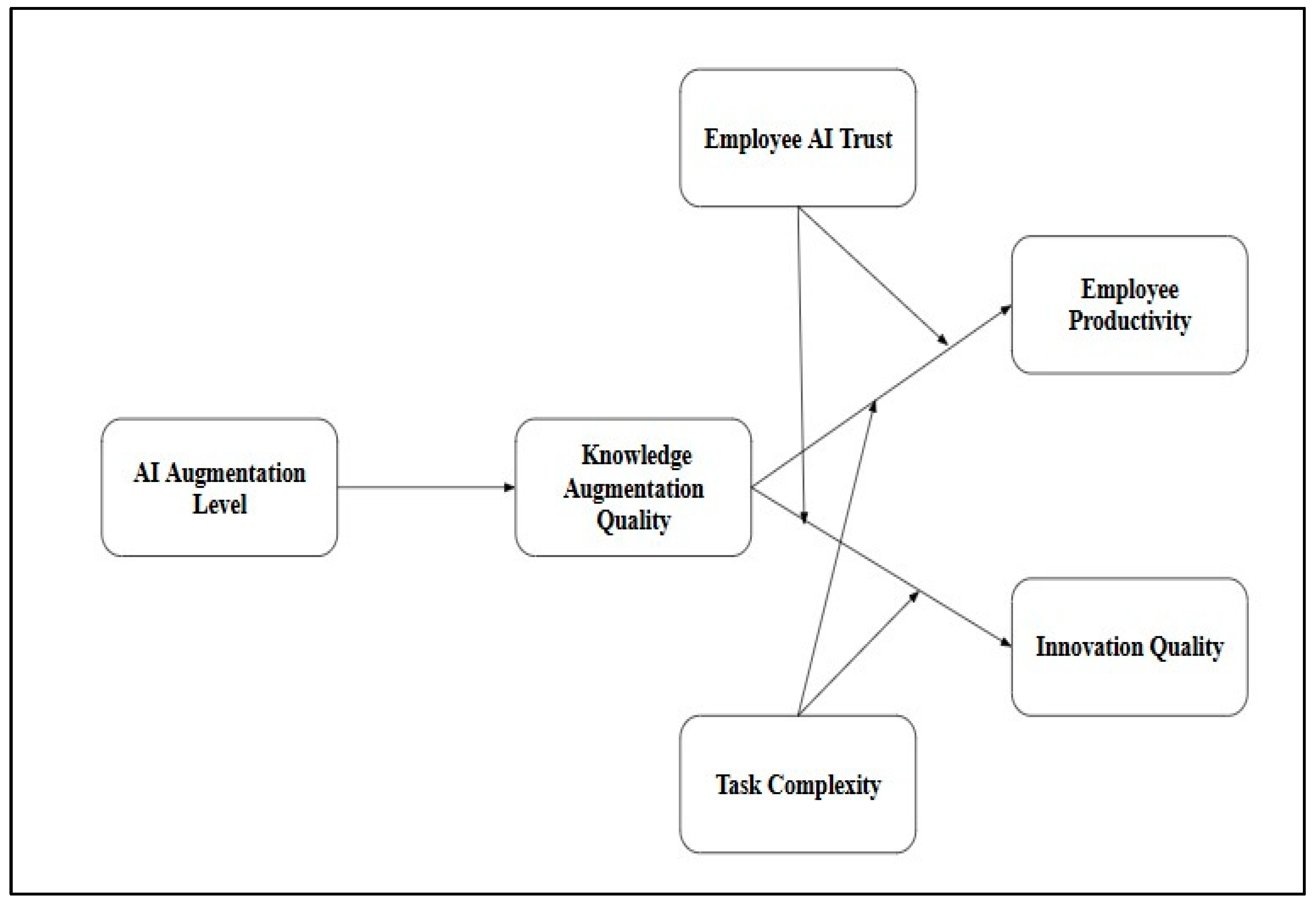
All these theoretical approaches make AI augmentation better at performance improvement by delivering better quality of knowledge with a self-restraining context and psychological variables governing the extent of human–AI collaboration. The proposed conceptual framework is presented in Figure 1, in which the AI augmentation level acts as an independent variable, and the productivity and quality of innovation among employees are affected by the knowledge augmentation quality that mediates the relationship between the two variables. It also illustrates task complexity and employee AI trust as modifying factors that enhance indirect relationships and shows that contextual and psychological enabling factors improve AI-based knowledge support to enhance employee performance.

3. Methodology

The research design used in this work was a quantitative, cross-sectional one, and the research objectives were to test the relationship between the levels of AI augmentation and the productivity levels of employees, as well as the quality of innovation and the levels of knowledge augmentation, which were used as a mediating variable, with task complexity and employee trust in AI as moderating variables. A cross-sectional approach was also deemed appropriate because the data was only gathered on respondents at one time to test the proposed relationships empirically. The study was carried out in a quantitative manner, which enabled the objective measurement of constructs and enabled the application of advanced statistical methods to test the hypothesis.
The sample size of this study consisted of employees employed in the field of AI-based organizations within the Kingdom of Saudi Arabia (KSA). Employees working in the technology, banking, telecommunications, and digital services industries were selected specifically to be the subjects of the study, as these domains have proven to be the first to implement AI-enabled products like predictive analytics, intelligent automation, and AI-based decision-support systems. These sectors had been specifically chosen considering their context in the research and their fit with the national digital transformation agenda of Saudi Arabia in Vision 2030.
The final sample was characterized by 275 employees who were chosen using a purposive sampling method that was deemed the best as far as the aims of the study are concerned, since the researchers needed to analyze those employees who actively work with AI-enhanced systems on a daily basis. This strategy guaranteed that the respondents who had first-hand experience with AI tools were considered during the decision-making process, innovation, and optimization of workflows, which contributed to the relevance and validity of the gathered data. The sample was a list of organizations in the technology, banking, telecommunications, and digital services industries in Saudi Arabia—the industries that are reported to be pioneers in the use of AI. The structured questionnaires were performed online (through online questionnaires), and the data was collected using professional associations, HR departments, and LinkedIn professional groups. A total of 410 questionnaires were sent out, and 275 valid responses were obtained, which gave a response rate of about 67 percent. The sample size satisfied and surpassed the minimum statistical power, consistency, and predictive validity because it was sufficient in terms of PLS-SEM analysis. Although purposive sampling was effective in obtaining the desired employees who were exposed to AI, the possibility of selection bias is admitted, and further research is advised to use stratified or random sampling to confirm the results in more varied work environments.
The questionnaire has been designed in a multi-step, systematic way so that it possesses content validity, clarity of the constructs, and reliability in measurements. All of the constructs used measurement items that were transformed depending on the established scales in the previous literature to ensure that the measure is theory-consistent and comparable. Minor wording changes were performed where needed to match the context of the AI-enhanced work environments without altering the original conceptual meaning of the items. The first draft of the questionnaire was checked by a team of academic experts whose main knowledge and experience were in information systems, human–AI interaction, and organizational behavior to determine the content validity. They were refined in terms of the wording of items, removal of ambiguity, and the ability to make sure that the items sufficiently represented the intended constructs. After this, a pilot study was carried out using a small sample of respondents who represented the target population in terms of clarity, understanding, and length using a survey. According to the pilot feedback, small corrections were made to enhance readability and consistency of response. In PLS-SEM, the measurement model evaluation criteria were used to assess construct validity and reliability. Cronbach’s alpha and composite reliability were used to investigate internal consistency reliability, whereas average variance extracted (AVE) was used to investigate convergent validity. The heterotrait–monotrait (HTMT) ratio was used to assess discriminant validity. There is no construct that fails to meet or even surpasses the recommended threshold values, which means that the measurement quality is satisfactory. To further enhance the validity of measurement, confirmatory factor analysis (CFA) was performed, with covariance-based SEM as a strength verification. The results of the CFA justified the factor structure of the measurement model, which gives us more confidence in the sufficiency of the adapted measurement scales.
A structured self-completion questionnaire was used to collect the data that were transmitted electronically via professional channels. The questionnaire contained questions that were based on validated scales that were used in the previous literature. The level of AI augmentation was assessed based on the items from [24], employee productivity from [63], innovation quality from [62], and knowledge augmentation quality [64]. Ref. [65] was used to measure task complexity, and [27] was used to measure employee AI trust. To be clear and consistent, all the answers were made with the help of a five-point Likert scale between 1 (strongly disagree) and 5 (strongly agree).
The results obtained were tested with SmartPLS 4 (Partial Least Squares Structural Equation Modeling), which is suitable for predictive analysis with complicated models that have mediating and moderating variables. The analysis was performed in 2 steps. To begin with, internal consistency, reliability, convergent, and discriminant validity of the measurement model were verified by means of known indicators, including composite reliability (CR), average variance extracted (AVE), and HTMT ratios. After validity and reliability were checked, the structural model was tested to check the hypothesized relationships. A bootstrapping procedure of 5000 subsamples was used to compute path coefficients, t-values, and p-values, and it confirmed the significant support of all hypothesized direct, mediating, and moderating effects. The findings confirmed the model and stressed the strategic influence of the knowledge augmentation based on AI on the outcome of employee performance in AI-enabled working environments in KSA. Along with these preventive measures, statistical tests were conducted in order to determine the existence of CMB. To begin with, a Harman single-factor test was carried out on the basis of exploratory factor analysis, and the findings showed that the first unrotated factor explained the existence of the total variance by 32.4 percent, which is much lower than 50 percent, indicating that CMB was not a significant concern. Second, the common latent factor test in SmartPLS was used to demonstrate that there was not a dominating factor in the model. Additionally, the entire collinearity VIF test by [66] showed that all constructs did not have a VIF above 3.3, confirming that there was no significant collinearity or common method error. These procedural and statistical checks, in conjunction with others, provide backing for the construct validity of the results and the validity that the relationships between variables were not artificially inflated due to method biases.

4. Results

Table 1 shows the demographic findings of the 275 respondents who were used in the research. The findings show that the men (62.5) were higher than the women (37.5), and this is also the normal distribution of genders in the AI-intensive sectors in Saudi Arabia. Most of the respondents (40.7) fell in the category of 30 to 39 years old, with 26.2 years ranking second, and 35 to 39 years old constituting the third largest group of 6.5%. It is possible that the majority of the respondents were working professionals who had amassed a lot of experience in the workplace. In terms of the educational level, 53.1% of the population had a bachelor’s degree, 35.3% a master’s degree, and 11.6% had a doctorate, which means that this is a highly qualified workforce that is well conversant with AI-based technology. Concerning professional experience, 39.3% of the respondents had between 5 and 10 years of experience, whereas 36.3% had over 10 years of experience, which proves that the majority of the respondents were experienced employees who were likely to contribute meaningfully to using AI augmentation systems. In terms of the sector, there was a good distribution of representation among technology (27.3%), telecommunications (24.7%), digital services (24.7%), and banking and finance (23.3%), which implies a sector diversity in line with the purposive sampling method. On the whole, the screening of demographics proves that the sample included well-experienced and highly educated professionals working in major AI-oriented sectors, which forms a valid basis of the discussion of dynamic relations between humans and AI in Saudi companies.
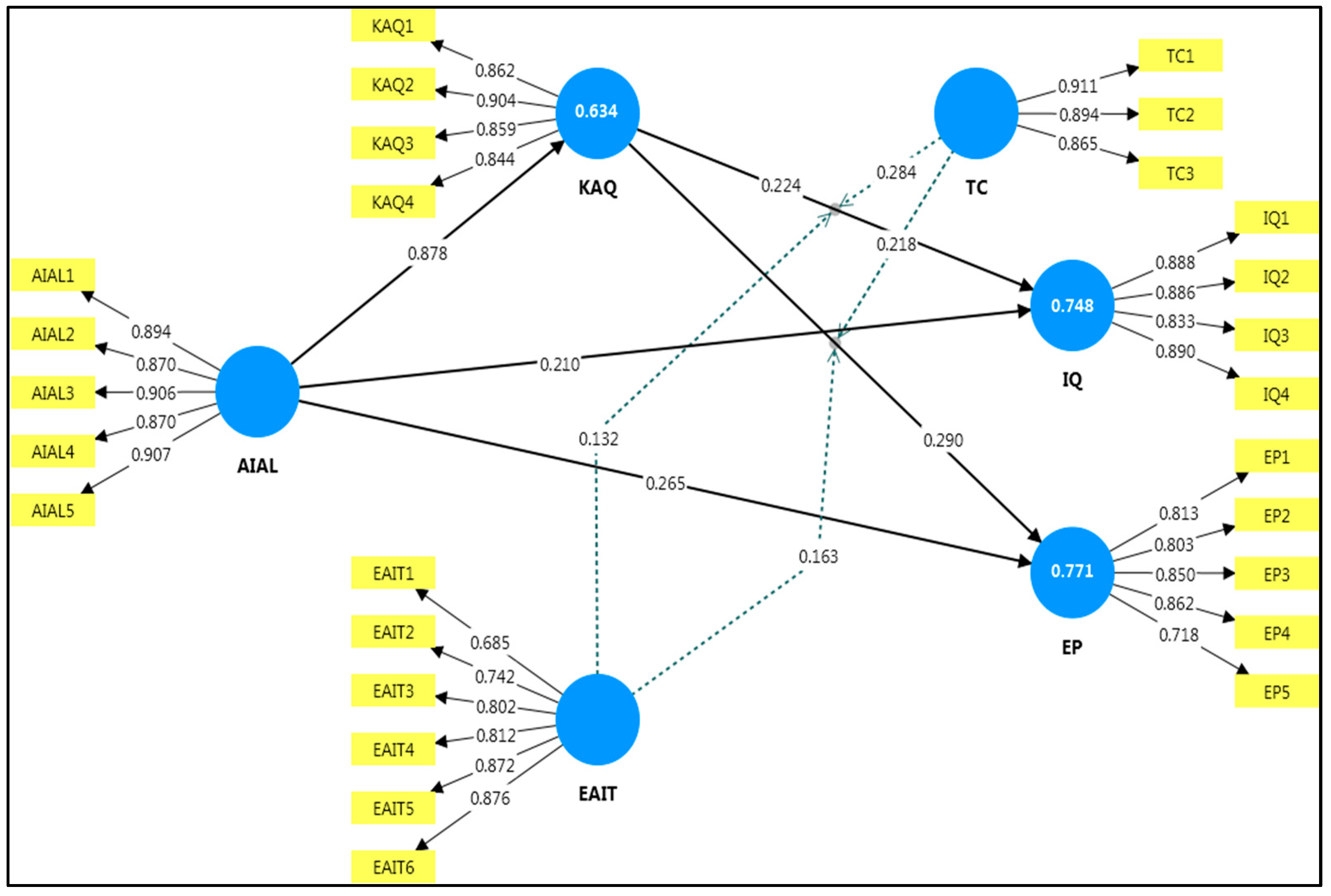
Table 2 confirms that all constructs meet the required standards of reliability and convergent validity. Cronbach’s alpha values for each construct exceed the recommended threshold of 0.70, ranging between 0.869 and 0.934, indicating high internal consistency. The composite reliability (CR) values also fall well above the acceptable level of 0.70 [67], ranging from 0.905 to 0.950, confirming construct reliability. Additionally, all average variance extracted (AVE) values are above the minimum standard of 0.50 [68], indicating strong convergent validity. These findings collectively confirm that all constructs are psychometrically sound and reliable for subsequent structural analysis. Figure 2 depicts the estimated conceptual model representing the hypothesized relationships among AI augmentation level, knowledge augmentation quality, employee productivity, innovation quality, task complexity, and employee AI trust. It provides a visual overview of the direct, mediating, and moderating paths assessed in the structural model.
Table 3 presents the results of the confirmatory factor analysis. All outer loading values exceed 0.70, which meets the threshold for indicator reliability [67]. The lowest loading is 0.685, which is still acceptable for exploratory research. The variance inflation factor (VIF) values are all below 5.0, which indicates that there are no multicollinearity concerns among the items. These results confirm that the indicators demonstrate strong reliability and are uniquely contributing to their designated constructs.
Table 4 demonstrates discriminant validity using the heterotrait–monotrait (HTMT) ratio. All HTMT values are below the conservative threshold of 0.85 [69], which indicates that each construct is conceptually distinct from the others and not suffering from construct overlap. This confirms that AI augmentation, employee trust, knowledge augmentation, employee productivity, innovation quality, and task complexity are measuring independent theoretical concepts within the model. Although all HTMT ratios were below the conservative threshold of 0.85 [69], the value between employee AI trust (EAIT) and AI augmentation level (AIAL) was relatively close to this boundary (HTMT = 0.843). This borderline result suggests a potential overlap between these two constructs, likely due to the conceptual proximity of employees’ perceptions of AI systems and their trust in them. To further ensure discriminant validity, a confirmatory factor analysis (CFA) was conducted using AMOS, specifying each construct with its corresponding indicators. The model demonstrated an acceptable fit to the data (χ2/df = 2.47, CFI = 0.945, TLI = 0.932, RMSEA = 0.061), confirming the adequacy of the measurement structure. All standardized factor loadings were significant (p < 0.001) and exceeded 0.70, while cross-loadings remained below 0.30, indicating that items strongly represented their respective constructs. These results provide further assurance that the constructs are empirically distinct and that the discriminant validity of the measurement model is satisfactory.
Table 5 shows that the R-square values for employee productivity, innovation quality, and knowledge augmentation quality exceed 0.60, which reflects substantial explanatory power according to [67]. The adjusted R-square values are almost identical, indicating model stability. Furthermore, the Q2predict values are all above 0.50, suggesting strong predictive relevance. The RMSE and MAE values fall within acceptable thresholds, further supporting strong model performance and predictive accuracy.
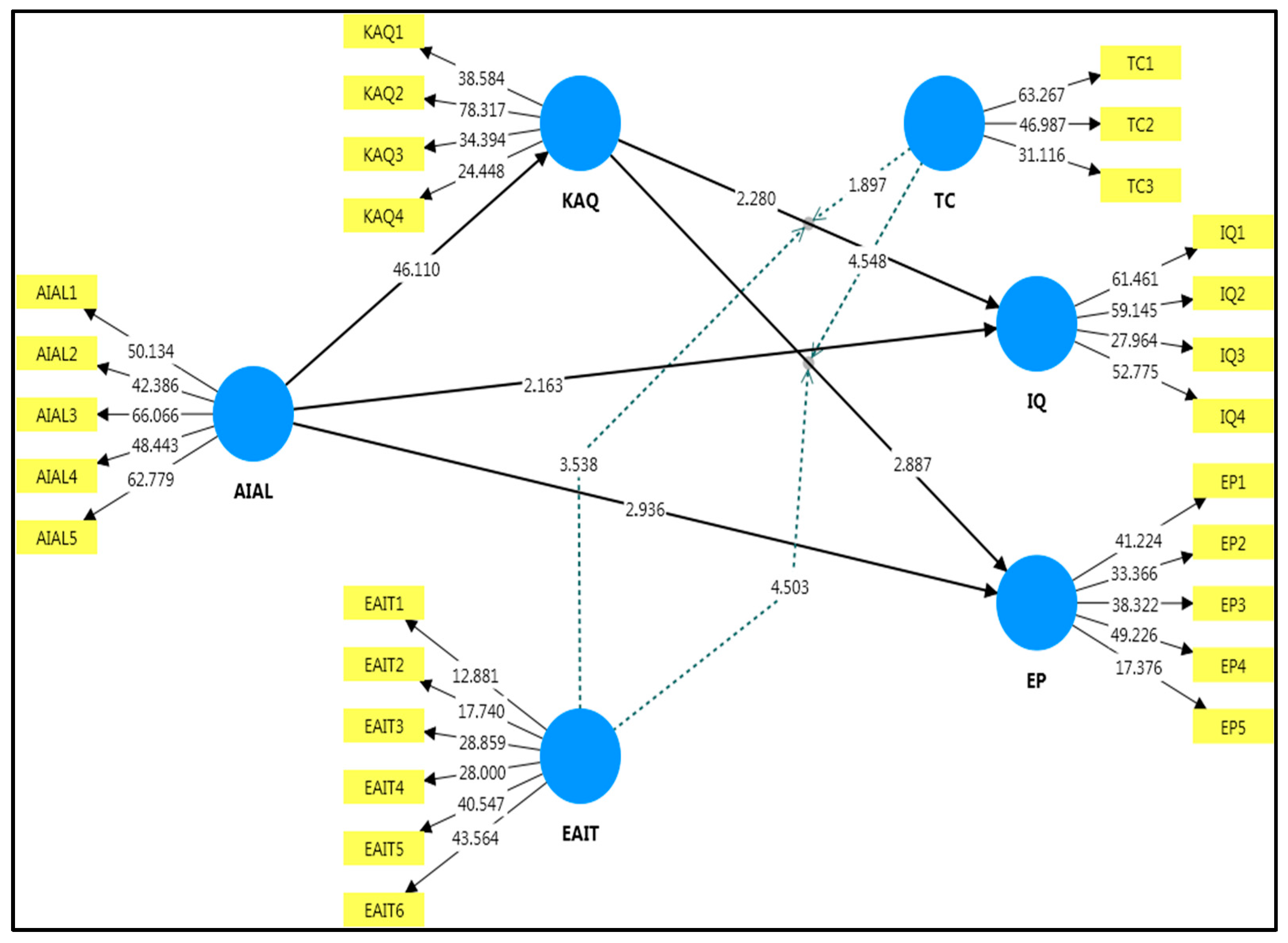
Table 6 and Figure 3 present the results of the structural model analysis, including standardized path coefficients (β), t-statistics, p-values, bootstrapped confidence intervals, and effect sizes (f2). The results confirm that all hypothesized relationships are statistically significant and in the expected direction, supporting the proposed conceptual model. The direct effect of AI augmentation level (AIAL) on employee productivity (EP) is positive and significant (β = 0.265, t = 2.936, p < 0.001, and 95% CI [0.092, 0.412]), indicating that AI augmentation substantially improves employees’ work efficiency and task performance. The medium effect size (f2 = 0.17) further suggests that AI augmentation has a meaningful impact on productivity outcomes. Similarly, the direct relationship between AIAL and innovation quality (IQ) is also significant (β = 0.210, t = 2.163, p < 0.001, and 95% CI [0.061, 0.385]), although with a smaller effect size (f2 = 0.08), signifying that AI contributes to creative and strategic outcomes, but to a relatively lesser extent compared to productivity.
The mediation analysis confirms that knowledge augmentation quality (KAQ) serves as a crucial mechanism through which AI augmentation enhances performance outcomes. The indirect effects of AIAL on EP (β = 0.254, p = 0.002, and 95% CI [0.102, 0.386]) and on IQ (β = 0.121, p = 0.004, and 95% CI [0.041, 0.229]) are both significant, establishing partial mediation. These results validate that AI influences employee performance primarily through the enhancement of knowledge relevance, accuracy, and contextual applicability, which is consistent with the Knowledge-Based View (KBV) of the firm. The moderating effects also demonstrate noteworthy findings. The interaction between employee AI trust (EAIT) and KAQ significantly strengthens the relationships with both EP (β = 0.163, t = 4.503, p < 0.001, and 95% CI [0.098, 0.232]) and IQ (β = 0.132, t = 3.538, p < 0.001, and 95% CI [0.061, 0.205]). These results imply that employees with higher trust in AI systems are more likely to rely on and apply AI-generated insights, thereby achieving greater productivity and innovation outcomes.
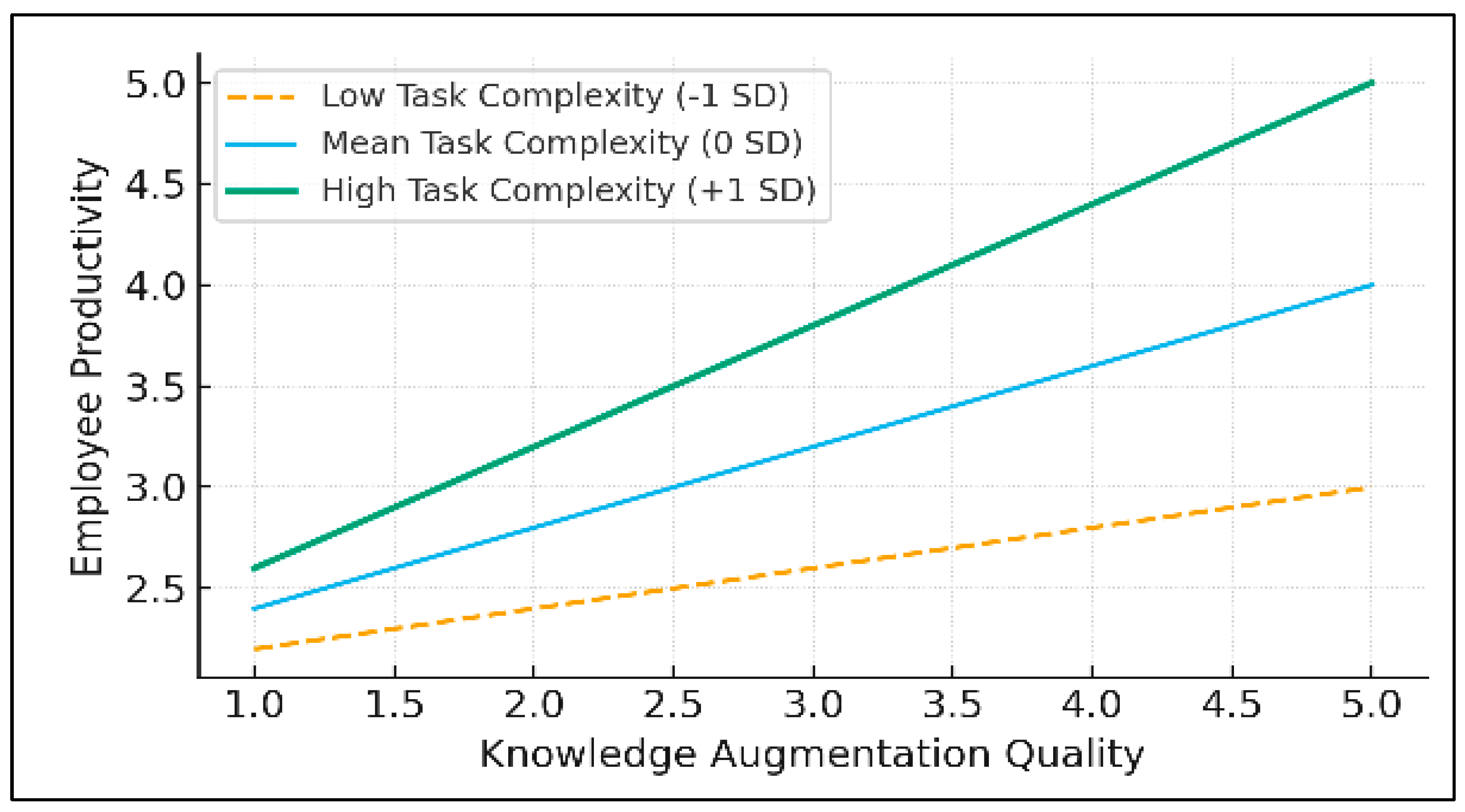
The moderate effect sizes (f2 = 0.12 and 0.10) reinforce the practical significance of this moderating influence. Similarly, task complexity (TC) significantly moderates the relationships between KAQ and both outcome variables. The moderating effects are positive and significant for EP (β = 0.218, t = 4.548, p < 0.001, and 95% CI [0.129, 0.326]) and IQ (β = 0.284, t = 1.897, p = 0.029, and 95% CI [0.024, 0.493]), indicating that AI-driven knowledge augmentation yields greater benefits in cognitively demanding and complex work contexts. The medium-level effect sizes (f2 = 0.15 and 0.12) suggest that task complexity amplifies the impact of AI-augmented knowledge, aligning with the Socio-Technical Systems Theory, which emphasizes human–technology complementarity under challenging task conditions. The interaction between task complexity and knowledge augmentation quality on employee productivity was significant and positive (β = 0.218, t = 4.548, p < 0.001, and 95% CI [0.129, 0.326]). This indicates that the productivity benefits of high-quality knowledge augmentation are more pronounced in highly complex tasks. Employees working in cognitively demanding situations derive greater performance advantages from intelligent AI-generated knowledge support.
As shown in Figure 4, the positive effect of KAQ on productivity is strongest under high task complexity conditions.
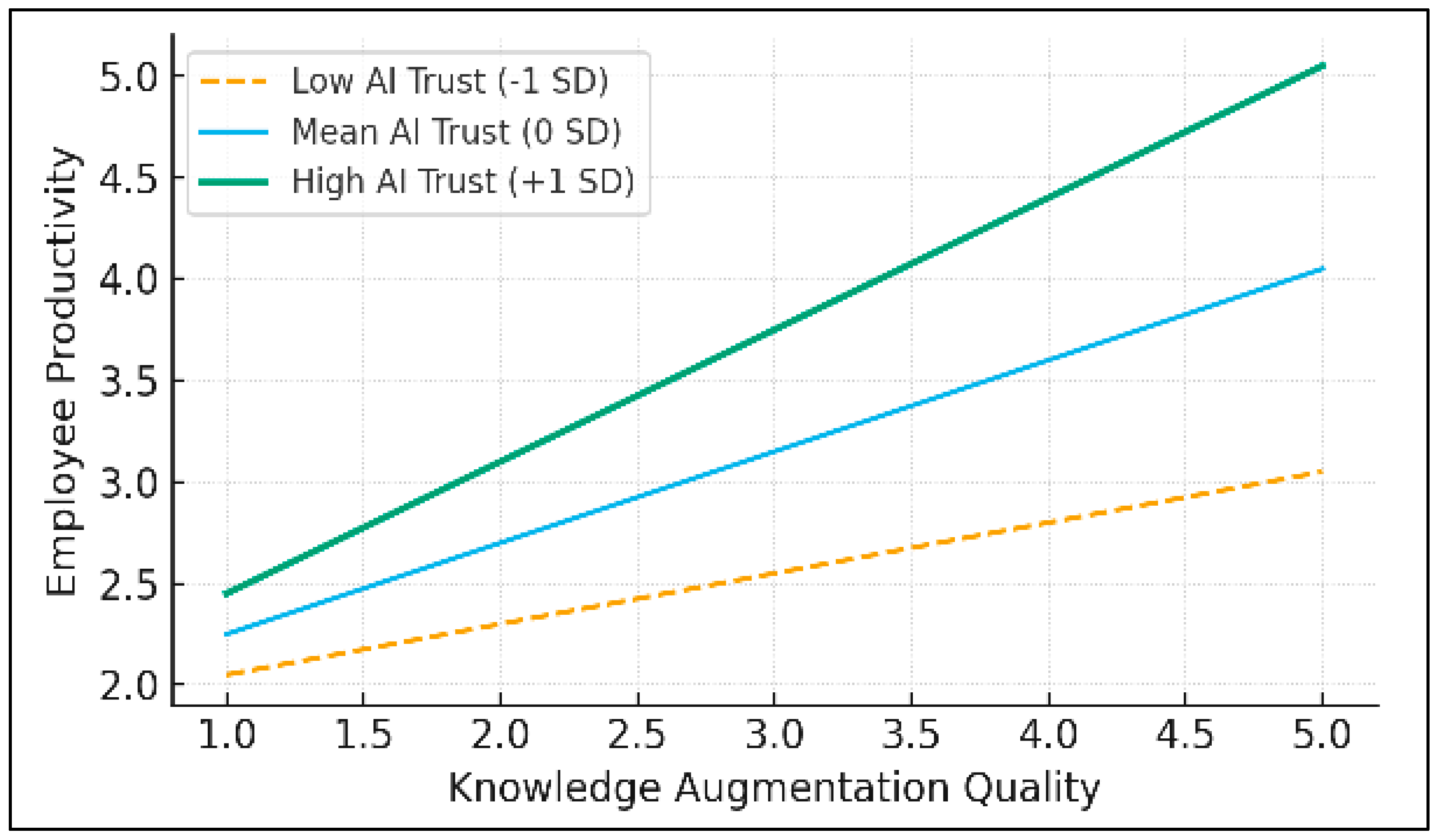
The interaction effect between employee AI trust and knowledge augmentation quality on employee productivity was positive and statistically significant (β = 0.163, t = 4.503, p < 0.001, and 95% CI [0.098, 0.232]). This result indicates that employees with higher trust in AI systems gain greater productivity benefits from high-quality knowledge augmentation. In other words, trust strengthens employees’ willingness to apply AI-generated insights, leading to higher work efficiency. As illustrated in Figure 5, the slope for high AI trust conditions is steeper, confirming the amplifying effect of trust on the KAQ–productivity relationship.
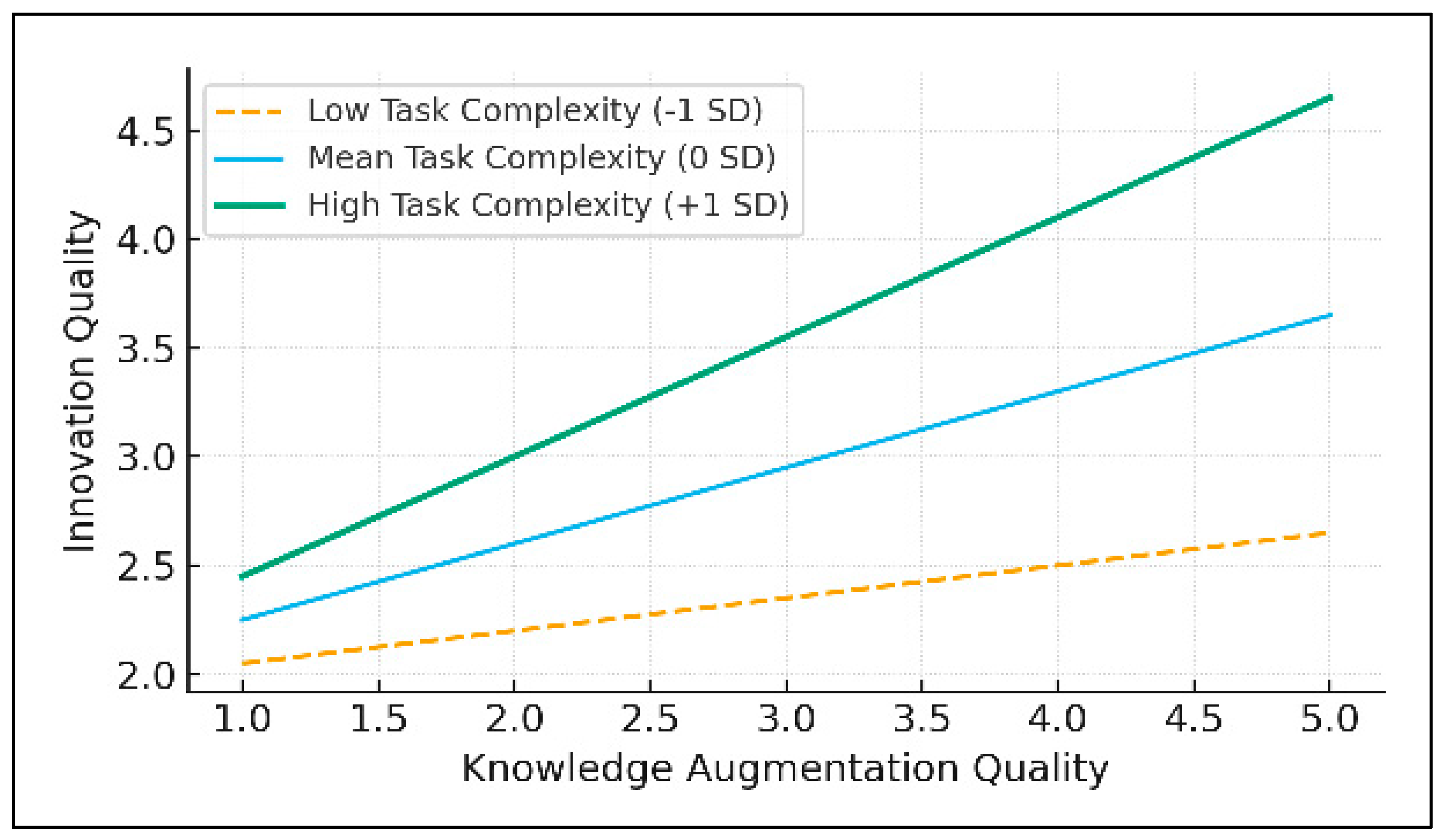
A significant positive moderation was also found for task complexity on the link between knowledge augmentation quality and innovation quality (β = 0.284, t = 1.897, p = 0.029, and 95% CI [0.024, 0.493]). This implies that AI-enhanced knowledge becomes especially valuable for driving innovation when employees face complex, uncertain, or cognitively challenging tasks. High task complexity magnifies the contribution of augmented knowledge to the creation of novel and practical solutions. This relationship is visualized in Figure 6, which demonstrates a steeper slope under high task complexity scenarios.
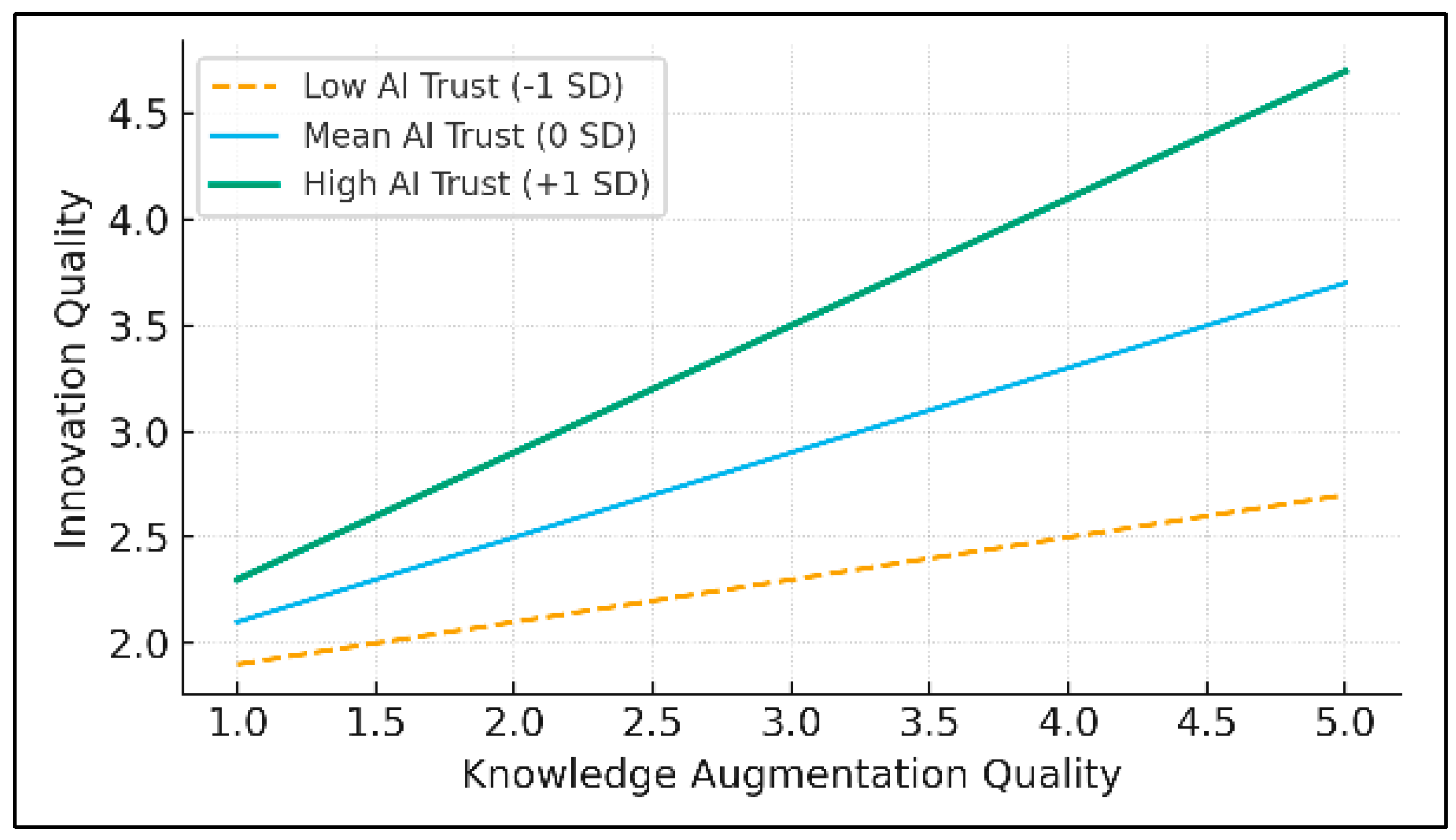
The moderating effect of employee AI trust on the relationship between knowledge augmentation quality and innovation quality was also significant and positive (β = 0.132, t = 3.538, p < 0.001, and 95% CI [0.061, 0.205]). This finding suggests that employees who have greater trust in AI systems are more likely to translate high-quality knowledge augmentation into innovative outcomes. Trust encourages experimentation and openness to AI-driven creative inputs, enhancing the originality and applicability of innovations. This interaction is depicted in Figure 7, which shows that innovation quality rises more sharply with KAQ when employee AI trust is high.

5. Discussion

The swift adoption of artificial intelligence into organizational systems has redefined the ways employees think, behave, and generate value in the new workplace. Instead of being a device of automation, AI has become an active partner that promotes human thinking and decision-making, as well as increasing the possibility of innovation and productivity. The present study is part of the rising amount of research on AI augmentation and its impact on human performance, as it examines the quality of knowledge that the AI offers and the contextual and psychological circumstances that determine its performance. All the obtained results validate the idea that AI augmentation can significantly enhance the productivity of employees and the quality of innovation when incorporated as a supportive knowledge-enhancing solution that will not replace human intelligence. This chapter explains these findings further in more detail and gives better insight into how smart knowledge augmentation, task complexity, and employee trust interplay to form effective human–AI cooperation and organizational performance.
The results also support the opinion that the enhancement of performance due to the use of AI does not come as the result of autonomous intelligence but the successful bonding of artificial knowledge to the process of human cognition. High-quality knowledge augmentation will allow employees to perceive AI-generated insights with a higher degree of confidence and less uncertainty, and will allow them to participate in more-informed and creative problem-solving. This highlights the need to create top-tier AI systems that emphasize knowledge that is relevant, explainable, and contextually useful information as opposed to technical refinement.
The fact that the first hypothesis was accepted proves the fact that the level of AI augmentation has a significant positive impact on employee productivity, which is why AI can be discussed as an intelligent intellectual companion but not as an automation tool. Such results show that AI implementation in a way that assists employees and does not take their judgment away will decrease cognitive load, increase information-processing speed, and enhance execution efficiency [6]. The AI capabilities that enable employees to sort through irrelevant data provide insights that assist employees in making necessary decisions, and both aid in real-time decision-making and enable them to perform complex tasks faster and more accurately. This finding supports the view that AI augmentation enhances human ability and does not reduce it, especially in the domain of knowledge-intensive jobs where there is a demand to be analytically deep and cognitively responsive [29]. The results thus confirm the assumption that productivity benefits are optimized in the case of AI being used to boost the level of intelligence among employees instead of merely automating process standardization, as it proves that AI-saturated environments reinforce efficiency through intelligent collaboration.
The statement of the second hypothesis could also prove to be valid, as the third step in establishing the phenomenon that AI augmentation can positively impact the level of innovation as well, which is why it could be considered both a productivity and a strategic creativity facilitator [40]. It shows that employees are more likely to come up with original, relevant, and feasible innovations when the intelligence of the predictive power of AI and the speed of imagination is provided. AI-enhanced systems allow employees to investigate unusual options in a safe manner by removing the uncertainty of current possibilities, providing simulated ideas about the results, and directing the refinement of ideas through the use of contextual intelligence [10]. This will enable employees to outgrow intuition-driven innovation and participate in data enhancements for creative exploration. These results confirm the perception that AI augmentation not only makes the execution process faster, but also the depth of strategy and market relevance of an innovative mind. Employees in AI-assisted settings have greater confidence in innovation, are more visionary, and are more aligned with innovation and business objectives, which validates that AI serves as a driver of greater quality of innovation and is not just a mere efficiency optimization instrument.
The fact that the third and fourth hypotheses have been accepted offers more theoretical explanation by ensuring that the quality of knowledge augmentation is an important mediating factor, whereby AI augmentation is converted into better productivity and innovation results. These results underscore the fact that AI is not effective by its presence alone but by the quality of the knowledge it provides to users, i.e., whether the AI-generated understanding is accurate, contextually sound, actionable, and cognitively helpful [5]. The performance of the employees will improve significantly only when the AI adds value to their knowledge environment by enhancing clarity, providing confidence when making decisions, and providing strategic foresight. This mediating role confirms the position that AI is not impacted by automation but rather by amplifying knowledge, which fits well with the Knowledge-Based View that a strategic advantage can be created by having an excellent knowledge application [1]. It also promotes the Socio-Technical viewpoint that AI–human synergy would be optimized when human intelligence is supported and not substituted by AI. Taken together, these findings substantiate the fact that the quality of knowledge augmentation is the pillar mechanism whereby AI stimulates performance of execution and excellence in innovation.
The fact that the fifth and sixth hypotheses were accepted provides a very solid argument about the situational significance of task complexity in determining the efficacy of AI-based knowledge augmentation. The findings confirm the fact that the favorable effect of the quality of knowledge augmentation on employee productivity and quality of innovation is even greater in the case of high task complexity [43]. This observation implies that high-quality AI-enhanced knowledge is much more essential to informing effective decision-making among the personnel engaged in complicated, ambiguous, and cognitively demanding activities to work through the uncertainty and remain performance-effective. The excessive benefit of AI systems provides context-specific, precise, and insight-rich knowledge support that is felt by employees in high-complexity environments where the amount of information to process is overwhelming and the consequences of decisions are more critical [70]. On the other hand, employees might not be given advanced cognitive support in low-complexity tasks, and thus, the effect is less significant. The results obtained support the view that AI is not always effective in all types of tasks but is more valuable when it can be used as an intelligent cognitive enhancer in challenging circumstances [48]. This confirms the Socio-Technical Systems view that AI effects depend on compatibility with the features of tasks, especially in cases when human judgments are vulnerable to overload, fatigue, or confusion. The findings also help to narrow down the AI augmentation strategy by stating that AI investments must be made in a role or area of functionality that has complex, strategic decision-making and a large cognitive load.
The fact that the seventh and eighth hypotheses were accepted points to employee AI trust as a significant psychological boundary condition that significantly increases the quality of performance that is affected by the quality of knowledge augmentation. The results prove that the higher the trust of the employees in AI systems, the higher the contribution to the willingness to utilize and actively interact with AI-generated knowledge, and the better the productivity and the quality of innovations [63]. Conversely, low-trust employees can disregard, doubt, or not use AI revelations even though they are of high quality, thus undermining the possible advantages of knowledge augmentation. These findings show that AI trust is a precursor of AI–human synergy, as employees can now afford to incorporate augmented intelligence as part of their decision-making and artistic work. This is in line with the cognitive acceptance literature, which states that trust minimizes resistance, hesitation, and cognitive friction in technology-assisted settings [2]. The results are also an extension of the Knowledge-Based View, as they prove that the successful use of knowledge is not only related to the presence of knowledge but also to the degree of psychological openness and trust in AI systems expressed by employees. All in all, the findings do support the idea that contextual (task complexity) and psychological (AI trust) moderators are critical in dictating when AI-enhanced knowledge will lead to optimum productivity and innovation effects, which provide a comprehensive picture of when AI generates its most strategic value.
Altogether, it can be concluded that the acceptance of all hypotheses is a holistic idea of how AI augmentation, when properly implemented, can be a major contributor to employee productivity and innovation. The findings validate that AI advantages arise not only due to their technological abilities but also due to their capacity to develop the quality of the knowledge that is accessed, comprehended, and implemented by the employees in their jobs. The mediating effect of the quality of knowledge augmentation demonstrates that performance outcomes are meaningful in cases where AI is able to provide accurate, relevant, and actionable information, and the moderating effects of task complexity and employee trust in AI systems reflect how these relationships are reinforced in the presence of adverse and cognitively demanding environments where confidence in AI systems remains strong. Taken together, these results indicate that the strategic value of AI is in its ability to boost human performance not by replacing it but by engaging in a partnership, which once again supports the need to create AI-enabled environments that foster collaboration, trust, and lifelong learning among workers.

6. Implications

6.1. Theoretical Implications

This research justifies the theoretical gap in the study of the functioning of AI in the performance of organizations by cutting across the Knowledge-Based View (KBV) and Socio-Technical Systems Theory (STS). Based on the KBV lens, the results show that AI augmentation promotes employee productivity and innovation quality not only due to the introduction of advanced technology but also by means of accessing high-quality knowledge. In particular, AI acts as a knowledge amplifier, giving the employees more timely, correct, and practical information. This empirical data supports the KBV thesis that the performance of organizations is determined by the effective use and sharing of knowledge, indicating that AI may serve as an agent of knowledge integration and use. Concerning the Socio-Technical Systems Theory, the research narrows down the theoretical insights into the way AI is to be incorporated into work systems. These findings prove that AI is most useful in the condition of its application as an assistant of knowledge and not in the automation of tasks. This is in accordance with the socio-technical theory, according to which technological interventions are best applied in a manner that helps to augment human capabilities and not to replace them. The research goes further to expand the theory by establishing the moderating factors of task complexity and employee faith in AI. The results show that the beneficial effect of AI is increased in complex task settings and when employees find the output of AI to be trustworthy. These moderating factors extend the discussion to offer a subtle perspective of boundary conditions of AI contribution to human performance beyond the conventional automation efficiency to collaborative intelligence. On the whole, this study has a strong theoretical contribution in terms of incorporating AI into KBV and STS models, to prove that the real promise of AI is in improving human knowledge work and not only automated activities.

6.2. Practical Implications

The findings of the present research offer a clear direction to the organization that is interested in maximizing the value of AI in the workplace. They highlight that investments in AI need to focus on investments in systems that increase the relevance of knowledge and its usability, instead of only focusing on the automation of tasks. Managers ought to use AI especially in positions that are typified by intricate tasks, uncertain employees, with in-tense cognitive load, this is where AI-driven knowledge addition can bring forth the greatest advantages. Moreover, the results indicate the significance of establishing employee confidence in AI by designing the system transparently, communicating responsibly about AI, and conducting focused upskilling programs. When employees have confidence in AI as a trusted collaborator, they tend to pursue AI-generated knowledge even more and achieve greater productivity and innovation results. In general, this research advises companies to use AI as a strategic facilitator of human performance, as well as to make sure that its implementation is consistent with cognitive assistance, task complexity, and employee preparation, instead of seeing it as a universal efficiency instrument.

6.3. Limitations and Future Research Directions

This study has not been without limitations, despite its contributions, and the following is what future research can focus on. To begin with, the study is based on self-reporting, which is subject to self-reporting bias, such as social desirability or overestimation of the benefits of using AI; further research can use objective performance measures or longitudinal data to measure behavior changes with time. Second, the research is context-dependent and confined to a specific organizational or sectoral context, which might limit the applicability of the results to other industries with varying levels of digital maturity; the research can be performed using AI augmentation effects in various industries (healthcare, education, or government) in the future. Third, although this research paper involved knowledge augmentation quality as a mediating variable and task complexity and AI trust as moderating variables, future research could introduce more variables, including AI transparency, employees’ learning agility, digital mindset, emotional trust, or organizational AI readiness to facilitate a better picture of human–AI working relationships. Finally, future studies might consider using experimental or qualitative research designs to learn more about how employees experience AI augmentation in real time and how the organizational culture influences acceptance and effectiveness of AI.

7. Conclusions

This paper has shown that AI augmentation is an important catalyst of employee productivity and quality of innovation, not by simple use of automation but by improving the quality of knowledge accessible to employees. The results show that knowledge augmentation is the core of the process of performance enhancement brought by AI. Moreover, employee confidence in AI and the complexity of the tasks also prove to be significant contextual and psychological variables that augment this effect, which points out the circumstances in which AI will work best in the job environment. Theoretically, the study adds to the Knowledge-Based View (KBV) in the provision of empirical evidence that AI improves the performance of organizations by amplifying, not by adopting technology. It also builds on the Socio-Technical Systems Theory (STS) by demonstrating that AI is best used as a knowledge-supporting partner and not as a system that replaces tasks. This understanding transforms the idea of automation versus human intelligence to collaborative intelligence, where AI is being viewed as a strategic co-pilot, which improves human cognition, decision-making, and creativity. In practice, the research provides practical recommendations to organizations that want to have human-oriented AI systems. It offers evidence-based methods of incorporating AI in a manner that will foster employee confidence, capitalize on the work structure of complex tasks, and leverage the cognitive cooperation of AI to the point that it brings meaningful value but does not eliminate human expertise. Future studies can expand the results and findings of this study by investigating the contribution of various forms of AI technologies to knowledge augmentation, including generative AI or predictive analytics. The longitudinal studies may focus on the long-term effects of AI–human cooperation on the creativity of employees, their learning, and well-being. Furthermore, cross-cultural studies may also show that trust and adoption of AI differ in an intellectual organizational setting, and studies on the relationship between AI and other organizational resources, including knowledge management systems or team structures, may further elucidate the best approach to implementation.

Author Contributions

Conceptualization, K.H.A.; Methodology, K.H.A. and A.F.A.; Software, A.F.A.; Validation, K.H.A.; Resources, K.H.A.; Data curation, A.F.A.; Writing—original draft, K.H.A.; Writing—review & editing, K.H.A. and A.F.A.; Visualization, K.H.A. and A.F.A.; Supervision, K.H.A.; Project administration, K.H.A. All authors have read and agreed to the published version of the manuscript.

Funding

The author(s) received no financial support for the research, authorship, and/or publication of this article.

Institutional Review Board Statement

All procedures performed in studies involving human participants were in accordance with the ethical standards of the institutional and national research committee and with the 1964 Helsinki Declaration and its later amendments or comparable ethical standards. The study was approved by the Research Ethics Committee (REC) at the University (No. H-2025-961).

Informed Consent Statement

Informed consent was electronically obtained from all participants by accepting to participate prior to their inclusion in this study. Participants were fully informed in the introduction of the questionnaire about the study’s purpose, procedures, data usage, and their rights, including the right to withdraw at any time without consequences. They were explicitly informed that all data would be collected and processed in an anonymized manner and that no identifying details, such as names or personal information, would be disclosed in the manuscript.

Data Availability Statement

The data that support the findings of this study are available on request from the corresponding author. The data is not publicly available due to its containing information that could compromise the privacy of research participants.

Conflicts of Interest

The authors declare no conflicts of interest.

References

  1. Diwan, C.; Srinivasa, S.; Suri, G.; Agarwal, S.; Ram, P. AI-based learning content generation and learning pathway augmentation to increase learner engagement. Comput. Educ. Artif. Intell. 2023, 4, 100110. [Google Scholar] [CrossRef]
  2. Shaikh, F.; Afshan, G.; Anwar, R.S.; Abbas, Z.; Chana, K.A. Analyzing the impact of artificial intelligence on employee productivity: The mediating effect of knowledge sharing and well-being. Asia Pac. J. Hum. Resour. 2023, 61, 794–820. [Google Scholar] [CrossRef]
  3. Vorobeva, D.; Pinto, D.C.; António, N.; Mattila, A.S. The augmentation effect of artificial intelligence: Can AI framing shape customer acceptance of AI-based services? Curr. Issues Tour. 2024, 27, 1551–1571. [Google Scholar] [CrossRef]
  4. Jin, W.; Zhao, B.; Zhang, L.; Liu, C.; Yu, H. Back to common sense: Oxford dictionary descriptive knowledge augmentation for aspect-based sentiment analysis. Inf. Process. Manag. 2023, 60, 103260. [Google Scholar] [CrossRef]
  5. Wu, D.; Zhang, J.; Huang, X. Chain of thought prompting elicits knowledge augmentation. arXiv 2023, arXiv:2307.01640. [Google Scholar] [CrossRef]
  6. Ruan, C.; Huang, C.; Yang, Y. Comprehensive evaluation of multimodal ai models in medical imaging diagnosis: From data augmentation to preference-based comparison. In Proceedings of the 2025 13th International Conference on Bioinformatics and Computational Biology (ICBCB), Seoul, Republic of Korea, 27 February–2 March 2025. [Google Scholar]
  7. Alam, M.F.; Lentsch, A.; Yu, N.; Barmack, S.; Kim, S.; Acemoglu, D.; Hart, J.; Johnson, S.; Ahmed, F. From automation to augmentation: Redefining engineering design and manufacturing in the age of NextGen-AI. In An MIT Exploration of Generative AI; Massachusetts Institute of Technology: Cambridge, MA, USA, 2024; Volume 1. [Google Scholar]
  8. Lee, C.; Cha, K. FAT-CAT—Explainability and augmentation for an AI system: A case study on AI recruitment-system adoption. Int. J. Hum. Comput. Stud. 2023, 171, 102976. [Google Scholar] [CrossRef]
  9. Wang, Z.; Wang, P.; Liu, K.; Wang, P.; Fu, Y.; Lu, C.-T.; Aggarwal, C.C.; Pei, J.; Zhou, Y. A comprehensive survey on data augmentation. arXiv 2024, arXiv:2405.09591. [Google Scholar] [CrossRef]
  10. Zhou, L.; Rudin, C.; Gombolay, M.; Spohrer, J.; Zhou, M.; Paul, S. From artificial intelligence (AI) to intelligence augmentation (IA): Design principles, potential risks, and emerging issues. AIS Trans. Hum.-Comput. Interact. 2023, 15, 111–135. [Google Scholar] [CrossRef]
  11. Wang, J.; Zhao, C.; Du, H.; Sun, G.; Kang, J.; Mao, S.; Niyato, D.; Kim, D.I. Generative AI enabled robust data augmentation for wireless sensing in ISAC networks. IEEE J. Sel. Areas Commun. 2025, 1. [Google Scholar] [CrossRef]
  12. Bibri, S.E.; Huang, J. Generative AI of Things for Sustainable Smart Cities: Synergies in Cognitive Augmentation, Resource Efficiency, Network Traffic, and Anomaly and Threat Detection for Environmental Optimization. Sustain. Cities Soc. 2025, 133, 106826. [Google Scholar] [CrossRef]
  13. Ren, R.; Wang, Y.; Qu, Y.; Zhao, W.X.; Liu, J.; Tian, H.; Wu, H.; Wen, J.-R.; Wang, H. Investigating the factual knowledge boundary of large language models with retrieval augmentation. arXiv 2023, arXiv:2307.11019. [Google Scholar] [CrossRef]
  14. Xue, Z.; Zhang, Z.; Liu, H.; Yang, S.; Han, S. Learning knowledge graph embedding with multi-granularity relational augmentation network. Expert Syst. Appl. 2023, 233, 120953. [Google Scholar] [CrossRef]
  15. Xi, Y.; Liu, W.; Lin, J.; Cai, X.; Zhu, H.; Zhu, J.; Chen, B.; Tang, R.; Zhang, W.; Yu, Y. Towards open-world recommendation with knowledge augmentation from large language models. In Proceedings of the 18th ACM Conference on Recommender Systems, Bari, Italy, 14–18 October 2024. [Google Scholar]
  16. Baer, I.; Waardenburg, L.; Huysman, M. What Is Augmented? A Metanarrative Review of AI-Based Augmentation. J. Assoc. Inf. Syst. 2025, 26, 760–798. [Google Scholar] [CrossRef]
  17. Harfouche, A.; Quinio, B.; Saba, M.; Saba, P.B. The Recursive Theory of Knowledge Augmentation: Integrating human intuition and knowledge in Artificial Intelligence to augment organizational knowledge. Inf. Syst. Front. 2023, 25, 55–70. [Google Scholar] [CrossRef]
  18. Galway, M.; DiRenzo, M.; Esposito, D.; Marchand, R.; Grigoriev, V. The mitigation of excessive retrieval augmentation and knowledge conflicts in large language models. Res. Sq. 2024; Preprint. [Google Scholar] [CrossRef]
  19. Liu, C.; Jiang, Y.; Xiao, R.; Wan, Z.; Zhang, Y. Machine Learning-Based Prediction of Carbonation Depth in Alkali-Activated Materials: Integrating Physics Knowledge and Data Augmentation. Case Stud. Constr. Mater. 2025, 23, e05311. [Google Scholar] [CrossRef]
  20. Abdelwahed, N.A.A.; Doghan, M.A.A. Developing employee productivity and performance through work engagement and organizational factors in an educational society. Societies 2023, 13, 65. [Google Scholar] [CrossRef]
  21. Liu, Q.; Ying, M.; Xiao, P.; Li, G.; Yuan, X. Prompting Large Models for Knowledge and Reasoning Augmentation in KB-VQA. In International Conference on Intelligent Computing; Springer: Singapore, 2025. [Google Scholar]
  22. Grant, R.M. Toward a knowledge—Based theory of the firm. Strateg. Manag. J. 1996, 17, 109–122. [Google Scholar] [CrossRef]
  23. Nonaka, L.; Takeuchi, H.; Umemoto, K. A theory of organizational knowledge creation. Int. J. Technol. Manag. 1996, 11, 833–845. [Google Scholar]
  24. Shrestha, Y.R.; Ben-Menahem, S.M.; Von Krogh, G. Organizational decision-making structures in the age of artificial intelligence. Calif. Manag. Rev. 2019, 61, 66–83. [Google Scholar] [CrossRef]
  25. Bostrom, N.; Yudkowsky, E. The ethics of artificial intelligence. In Artificial Intelligence Safety and Security; Chapman and Hall/CRC: Boca Raton, FL, USA, 2018; pp. 57–69. [Google Scholar]
  26. Benbya, H.; Pachidi, S.; Jarvenpaa, S. Special issue editorial: Artificial intelligence in organizations: Implications for information systems research. J. Assoc. Inf. Syst. 2021, 22, 10. [Google Scholar] [CrossRef]
  27. Glikson, E.; Woolley, A.W. Human trust in artificial intelligence: Review of empirical research. Acad. Manag. Ann. 2020, 14, 627–660. [Google Scholar] [CrossRef]
  28. Zhuo, C.; Chen, J. Can digital transformation overcome the enterprise innovation dilemma: Effect, mechanism and effective boundary. Technol. Forecast. Soc. Change 2023, 190, 122378. [Google Scholar] [CrossRef]
  29. Zhao, L.; Gu, J.; Abbas, J.; Kirikkaleli, D.; Yue, X.-G. Does quality management system help organizations in achieving environmental innovation and sustainability goals? A structural analysis. Econ. Res.-Ekon. Istraživanja 2023, 36, 2484–2507. [Google Scholar] [CrossRef]
  30. Van, V.H. Ensuring the quality of education and training in the context of educational innovation. Calitatea 2024, 25, 40–50. [Google Scholar]
  31. Ayinaddis, S.G.; Taye, B.A.; Yirsaw, B.G. Examining the effect of electronic banking service quality on customer satisfaction and loyalty: An implication for technological innovation. J. Innov. Entrep. 2023, 12, 22. [Google Scholar] [CrossRef]
  32. Su, Y.; Lee, C.C. Green finance, environmental quality and technological innovation in China. Int. J. Financ. Econ. 2025, 30, 405–425. [Google Scholar] [CrossRef]
  33. Chen, P.; Kim, S. The impact of digital transformation on innovation performance-The mediating role of innovation factors. Heliyon 2023, 9, e13916. [Google Scholar] [CrossRef] [PubMed]
  34. Zickar, M.J.; Keith, M.G. Innovations in sampling: Improving the appropriateness and quality of samples in organizational research. Annu. Rev. Organ. Psychol. Organ. Behav. 2023, 10, 315–337. [Google Scholar] [CrossRef]
  35. Wang, H.; Xu, Y.; Yang, C.; Shi, C.; Li, X.; Guo, N.; Liu, Z. Knowledge-adaptive contrastive learning for recommendation. In Proceedings of the Sixteenth ACM International Conference on Web Search and Data Mining, Singapore, 27 February–3 March 2023. [Google Scholar]
  36. Zhu, P.; Jing, Y.; Cheng, L.; Tang, K.; Guo, Y. Ken: Knowledge augmentation and emotion guidance network for multimodal fake news detection. arXiv 2025, arXiv:2507.09647. [Google Scholar] [CrossRef]
  37. Cui, Z.; Gao, T.; Talamadupula, K.; Ji, Q. Knowledge-augmented deep learning and its applications: A survey. IEEE Trans. Neural Netw. Learn. Syst. 2023, 36, 2133–2153. [Google Scholar] [CrossRef]
  38. Amin, N.; Shabbir, M.S.; Song, H.; Farrukh, M.U.; Iqbal, S.; Abbass, K. A step towards environmental mitigation: Do green technological innovation and institutional quality make a difference? Technol. Forecast. Soc. Change 2023, 190, 122413. [Google Scholar] [CrossRef]
  39. Shabir, M.; Hussain, I.; Işık, Ö.; Razzaq, K.; Mehroush, I. The role of innovation in environmental-related technologies and institutional quality to drive environmental sustainability. Front. Environ. Sci. 2023, 11, 1174827. [Google Scholar] [CrossRef]
  40. AlDhaheri, H.; Hilmi, M.F.; Abudaqa, A.; Alzahmi, R.A.; Ahmed, G. The relationship between HRM practices, innovation, and employee productivity in UAE public sector: A structural equation modelling approach. Int. J. Process Manag. Benchmarking 2023, 13, 157–176. [Google Scholar] [CrossRef]
  41. Zheng, Z.; Han, X.; Xiao, Y. Quantity or quality? Regional innovation policy and green technology innovation. Environ. Sci. Pollut. Res. 2023, 30, 77358–77370. [Google Scholar] [CrossRef]
  42. Tabari, M.A.; Johnson, M.D.; Farahanynia, M. Automated analysis of cohesive features in L2 writing: Examining effects of task complexity and task repetition. Assess. Writ. 2023, 58, 100783. [Google Scholar] [CrossRef]
  43. Huang, D.F.; Li, F.; Guo, H. Chunking in simultaneous interpreting: The impact of task complexity and translation directionality on lexical bundles. Front. Psychol. 2023, 14, 1252238. [Google Scholar] [CrossRef] [PubMed]
  44. Chen, O.; Paas, F.; Sweller, J. A cognitive load theory approach to defining and measuring task complexity through element interactivity. Educ. Psychol. Rev. 2023, 35, 63. [Google Scholar] [CrossRef]
  45. Zhang, M. Collaborative writing in an EFL secondary setting: The role of task complexity. Int. Rev. Appl. Linguist. Lang. Teach. 2024, 62, 325–350. [Google Scholar] [CrossRef]
  46. Bae, H.; Deeb, A.; Fleury, A.; Zhu, K. Complexitynet: Increasing llm inference efficiency by learning task complexity. arXiv 2023, arXiv:2312.11511. [Google Scholar]
  47. Leikin, R.; Guberman, R. Creativity and challenge: Task complexity as a function of insight and multiplicity of solutions. In Mathematical Challenges for All; Springer: Berlin/Heidelberg, Germany, 2023; pp. 325–342. [Google Scholar]
  48. Jin, C.; Yan, J. The effects of task complexity and task sequencing on L2 performance: A systematic review. Lang. Learn. J. 2025, 53, 114–141. [Google Scholar] [CrossRef]
  49. Lin, H.; Li, S. A Methodological Review of the Research on Task Complexity in Second Language Oral Production: Cognitive Task Complexity and Second Language Performance a Methodological Review of the Research on Task Complexity. In Cognitive Task Complexity and Second Language Performance; Taylor & Francis Group: Abingdon, UK, 2025; pp. 32–54. [Google Scholar]
  50. Krajenbrink, H.; Lust, J.M.; Wilmut, K.; Steenbergen, B. Motor and cognitive dual-task performance under low and high task complexity in children with and without developmental coordination disorder. Res. Dev. Disabil. 2023, 135, 104453. [Google Scholar] [CrossRef]
  51. Liu, B.; Xu, P.; Yuan, Q.; Chen, Y. Probing In-Context Learning: Impact of Task Complexity and Model Architecture on Generalization and Efficiency. arXiv 2025, arXiv:2505.06475. [Google Scholar] [CrossRef]
  52. Entezari, M.; Tadayonifar, M. Task complexity and task type: L1 use and functions. TASK 2023, 3, 336–360. [Google Scholar] [CrossRef]
  53. George, P.; Cheng, C.-T.; Pang, T.Y.; Neville, K. Task complexity and the skills dilemma in the programming and control of collaborative robots for manufacturing. Appl. Sci. 2023, 13, 4635. [Google Scholar] [CrossRef]
  54. Wenlong, Z.; Tien, N.H.; Sibghatullah, A.; Asih, D.; Soelton, M.; Ramli, Y. Impact of energy efficiency, technology innovation, institutional quality, and trade openness on greenhouse gas emissions in ten Asian economies. Environ. Sci. Pollut. Res. 2023, 30, 43024–43039. [Google Scholar] [CrossRef]
  55. Nikmanesh, M.; Feili, A.; Sorooshian, S. Employee productivity assessment using fuzzy inference system. Information 2023, 14, 423. [Google Scholar] [CrossRef]
  56. Almaamari, Q.A. Factors influencing employees’ productivity in Bahraini Alhelli Company—Literature review. In From Industry 4.0 to Industry 5.0: Mapping the Transitions; Springer: Berlin/Heidelberg, Germany, 2023; pp. 383–387. [Google Scholar]
  57. Shabani, T.; Jerie, S.; Shabani, T. The impact of occupational safety and health programs on employee productivity and organisational performance in Zimbabwe. Saf. Extrem. Environ. 2023, 5, 293–304. [Google Scholar]
  58. Kurdy, D.M.; Al-Malkawi, H.-A.N.; Rizwan, S. The impact of remote working on employee productivity during COVID-19 in the UAE: The moderating role of job level. J. Bus. Socio-Econ. Dev. 2023, 3, 339–352. [Google Scholar]
  59. Lari, M. A longitudinal study on the impact of occupational health and safety practices on employee productivity. Saf. Sci. 2024, 170, 106374. [Google Scholar]
  60. Bijalwan, P.; Gupta, A.; Johri, A.; Asif, M. The mediating role of workplace incivility on the relationship between organizational culture and employee productivity: A systematic review. Cogent Soc. Sci. 2024, 10, 2382894. [Google Scholar] [CrossRef]
  61. Mutegi, T.M.; Joshua, P.M.; Kinyua, J.M. Workplace safety and employee productivity of manufacturing firms in Kenya. Cogent Bus. Manag. 2023, 10, 2215569. [Google Scholar] [CrossRef]
  62. Janssen, O. Job demands, perceptions of effort—Reward fairness and innovative work behaviour. J. Occup. Organ. Psychol. 2000, 73, 287–302. [Google Scholar]
  63. Sigala, M.; Chalkiti, K. Knowledge management, social media and employee creativity. Int. J. Hosp. Manag. 2015, 45, 44–58. [Google Scholar] [CrossRef]
  64. Davenport, T.H.; Ronanki, R. Artificial intelligence for the real world. Harv. Bus. Rev. 2018, 96, 108–116. [Google Scholar]
  65. Farh, C.I.; Lanaj, K.; Ilies, R. Resource-based contingencies of when team–member exchange helps member performance in teams. Acad. Manag. J. 2017, 60, 1117–1137. [Google Scholar] [CrossRef]
  66. Kock, N. Common method bias in PLS-SEM: A full collinearity assessment approach. Int. J. e-Collab. 2015, 11, 1–10. [Google Scholar]
  67. Hair, J.F., Jr.; Hult, G.T.M.; Ringle, C.M.; Sarstedt, M.; Danks, N.P.; Ray, S. Evaluation of reflective measurement models. In Partial Least Squares Structural Equation Modeling (PLS-SEM) Using R: A Workbook; Springer: Berlin/Heidelberg, Germany, 2021; pp. 75–90. [Google Scholar]
  68. Fornell, C.; Larcker, D.F. Evaluating Structural Equation Models with Unobservable Variables and Measurement Error. J. Mark. Res. 1981, 18, 39–50. [Google Scholar] [CrossRef] [PubMed]
  69. Henseler, J.; Ringle, C.M.; Sarstedt, M. A new criterion for assessing discriminant validity in variance-based structural equation modeling. J. Acad. Mark. Sci. 2014, 43, 115–135. [Google Scholar] [CrossRef]
  70. Zeitlhofer, I.; Zumbach, J.; Schweppe, J. Complexity affects performance, cognitive load, and awareness. Learn. Instr. 2024, 94, 102001. [Google Scholar] [CrossRef]
Figure 1. Conceptual framework.
Systems 14 00065 g001
Figure 2. Estimated model.
Systems 14 00065 g002
Figure 3. Structural model for path analysis.
Systems 14 00065 g003
Figure 4. Interaction of knowledge augmentation quality × task complexity on employee production.
Systems 14 00065 g004
Figure 5. Interaction of knowledge augmentation quality × employee AI trust on employee productivity.
Systems 14 00065 g005
Figure 6. Interaction of knowledge augmentation quality × task complexity on innovation quality.
Systems 14 00065 g006
Figure 7. Interaction of knowledge augmentation quality × employee AI trust on innovation quality.
Systems 14 00065 g007
Table 1. Demographic characteristics of respondents.
VariableCategoryFrequency (n = 275)Percentage (%)
GenderMale17262.5
Female10337.5
Age (years)20–295821.1
30–3911240.7
40–497226.2
50 and above3312.0
Educational QualificationBachelor’s degree14653.1
Master’s degree9735.3
Doctorate3211.6
Work ExperienceLess than 5 years6724.4
5–10 years10839.3
Above 10 years10036.3
Industry SectorTechnology7527.3
Banking and Finance6423.3
Telecommunications6824.7
Digital Services6824.7
Table 2. Cronbach’s alpha, composite reliability, and AVE.
Cronbach’s AlphaCRAVE
AI Augmentation Level0.9340.9500.791
Employee AI Trust0.8860.9140.642
Employee Productivity0.8690.9050.657
Innovation Quality0.8970.9290.765
Knowledge Augmentation Quality0.8900.9240.752
Task Complexity0.8690.9200.792
Table 3. Confirmatory factor analysis and VIF.
VariablesItemsOuter LoadingVIF
AI Augmentation LevelAIAL10.8943.310
AIAL20.8702.784
AIAL30.9063.824
AIAL40.8702.797
AIAL50.9073.567
Employee AI TrustEAIT10.6851.871
EAIT20.7422.032
EAIT30.8022.263
EAIT40.8122.451
EAIT50.8723.331
EAIT60.8763.412
Employee ProductivityEP10.8131.983
EP20.8031.929
EP30.8502.272
EP40.8622.543
EP50.7181.828
Innovation QualityIQ10.8882.978
IQ20.8862.911
IQ30.8332.321
IQ40.8902.899
Knowledge Augmentation QualityKAQ10.8622.820
KAQ20.9043.399
KAQ30.8592.676
KAQ40.8442.471
Task ComplexityTC10.9112.652
TC20.8942.295
TC30.8652.096
Table 4. Discriminant validity (HTMT).
AIALEAITEPIQKAQTC
AI Augmentation Level
Employee AI Trust0.843
Employee Productivity0.6810.853
Innovation Quality0.7450.7510.771
Knowledge Augmentation Quality0.7600.8010.6360.710
Task Complexity0.8280.7320.5720.6800.629
Table 5. R-square statistics model goodness-of-fit statistics.
R-SquareR-Square AdjustedQ2predictRMSEMAE
Employee Productivity0.7710.7700.7660.4890.346
Innovation Quality0.7480.7420.7130.5420.409
Knowledge Augmentation Quality0.6340.6260.5740.6590.497
Table 6. Path analysis.
PathβSDtp95% Bootstrapped CIf2 (Effect Size)Interpretation
AIAL → EP0.2650.0902.936<0.001[0.092, 0.412]0.17Medium direct effect
AIAL → IQ0.2100.0972.163<0.001[0.061, 0.385]0.08Small direct effect
AIAL → KAQ → EP0.2540.0892.8440.002[0.102, 0.386]Significant indirect effect (partial mediation)
AIAL → KAQ → IQ0.1210.0532.2790.004[0.041, 0.229]Significant indirect effect (partial mediation)
EAIT × KAQ → EP0.1630.0364.503<0.001[0.098, 0.232]0.12Moderate positive moderation
EAIT × KAQ → IQ0.1320.0373.538<0.001[0.061, 0.205]0.10Moderate positive moderation
TC × KAQ → EP0.2180.0484.548<0.001[0.129, 0.326]0.15Medium positive moderation
TC × KAQ → IQ0.2840.1501.8970.029[0.024, 0.493]0.12Moderate positive moderation
Disclaimer/Publisher’s Note: The statements, opinions and data contained in all publications are solely those of the individual author(s) and contributor(s) and not of MDPI and/or the editor(s). MDPI and/or the editor(s) disclaim responsibility for any injury to people or property resulting from any ideas, methods, instructions or products referred to in the content.