


Stress-Testing Food Security in a Socio-Ecological System: Qatar’s Adaptive Responses to Sequential Shocks

Abstract
1. Introduction
2. Theoretical Framework
2.1. Conceptualizing Resilience Capacities
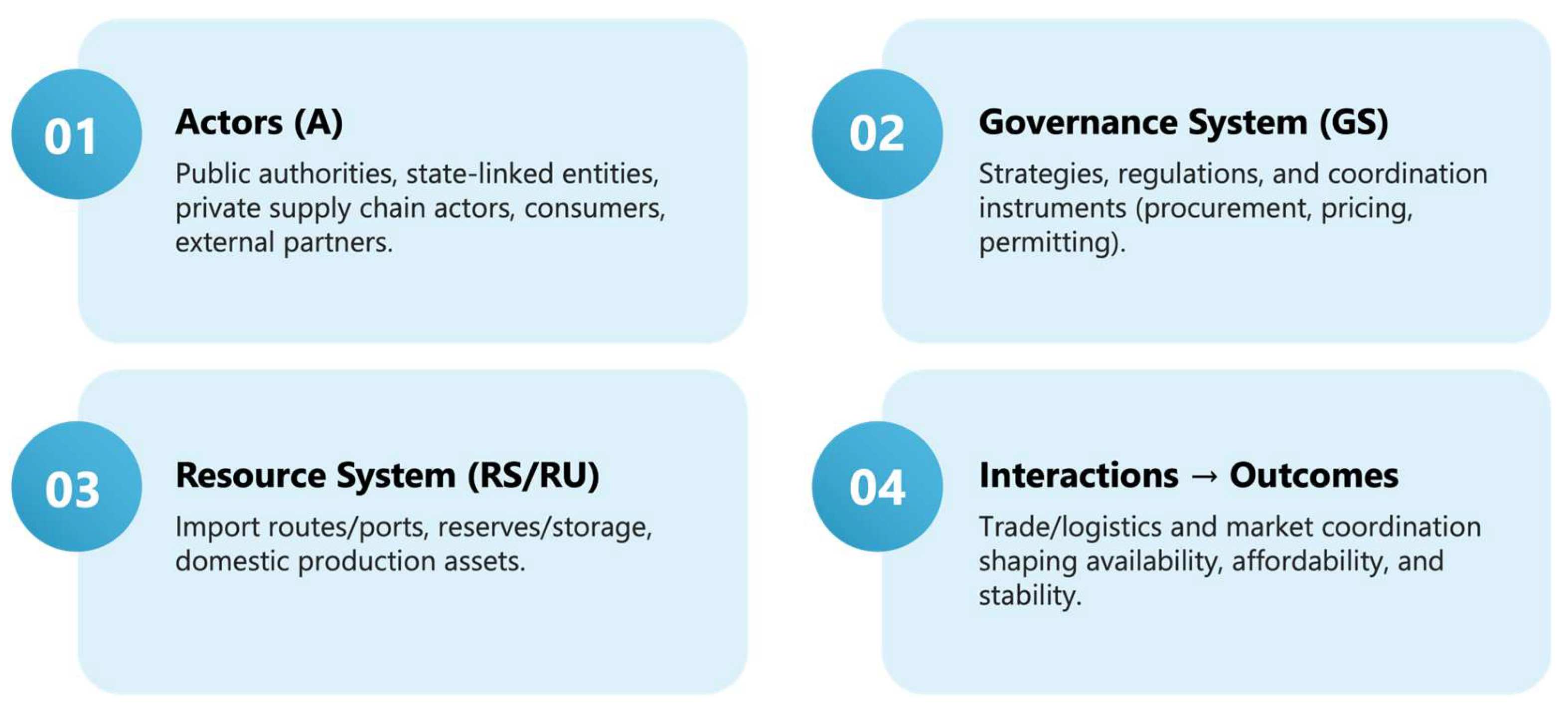
2.2. Operationalizing the SES Framework in This Case Study
3. Methodology
4. Results
4.1. The Qatar Blockade 2017–2021
4.2. The COVID-19 Pandemic: Global and Qatar Responses
4.3. The War in Ukraine: Global and Qatar Responses
5. Discussion
5.1. Capacities—from Absorptive to Adaptive Capacity
5.2. Adaptive Governance and the Rentier State
5.3. Socio-Ecological Tradeoffs and the Challenges of Transformation
5.4. Theoretical Contributions
5.5. Implications for Debates on Global Food Resilience and Security
6. Conclusions
Author Contributions
Funding
Institutional Review Board Statement
Informed Consent Statement
Data Availability Statement
Conflicts of Interest
References
- Clapp, J.; Moseley, W.G.; Burlingame, B.; Termine, P. Viewpoint: The case for a six-dimensional food security framework. Food Policy 2022, 106, 102164. [Google Scholar] [CrossRef]
- Laborde, D.; Martin, W.; Swinnen, J.; Vos, R. COVID-19 risks to global food security. Science 2020, 369, 500–502. [Google Scholar] [CrossRef] [PubMed]
- Ben Hassen, T.; El Bilali, H. Impacts of the Russia-Ukraine War on Global Food Security: Towards More Sustainable and Resilient Food Systems? Foods 2022, 11, 2301. [Google Scholar] [CrossRef] [PubMed]
- Brouwer, I.D.; McDermott, J.; Ruben, R. Food systems everywhere: Improving relevance in practice. Glob. Food Secur. 2020, 26, 100398. [Google Scholar] [CrossRef]
- Folke, C. Resilience: The emergence of a perspective for social-ecological systems analyses. Glob. Environ. Change 2006, 16, 253–267. [Google Scholar] [CrossRef]
- Ostrom, E. A general framework for analyzing sustainability of social-ecological systems. Science 2009, 325, 419–422. [Google Scholar] [CrossRef]
- Ingram, J.; Ericksen, P.; Liverman, D. Food Security and Global Environmental Change; Routledge: London, UK, 2010. [Google Scholar]
- Ericksen, P.J. Conceptualizing Food Systems for Global Environmental Change Research. Glob. Environ. Change 2008, 18, 234–245. [Google Scholar] [CrossRef]
- HLPE. Nutrition and Food Systems (HLPE Report 12); Food and Agriculture Organization of the United Nations: Rome, Italy, 2017. [Google Scholar]
- Walker, B.; Holling, C.S.; Carpenter, S.R.; Kinzig, A. Resilience, adaptability and transformability in social–ecological systems. Ecol. Soc. 2004, 9, 5. [Google Scholar] [CrossRef]
- Tendall, D.M. Food System Resilience: Defining the Concept. Glob. Food Secur. 2015, 6, 17–23. [Google Scholar] [CrossRef]
- Al-Saidi, M.; Elagib, N.A. Towards Understanding the Integrative Approach of the Water–Energy–Food Nexus. Sci. Total Environ. 2017, 574, 1131–1139. [Google Scholar] [CrossRef]
- Allan, J.A. Virtual Water—The Water, Food and Trade Nexus: Useful Concept or Misleading Metaphor? Water Int. 2003, 28, 106–113. [Google Scholar] [CrossRef]
- Hoekstra, A.Y.; Mekonnen, M.M. The Water Footprint of Humanity. Proc. Natl. Acad. Sci. USA 2012, 109, 3232–3237. [Google Scholar] [CrossRef] [PubMed]
- Woertz, E. Oil for Food: The Global Food Crisis and the Middle East; OUP Oxford: Oxford, UK, 2013. [Google Scholar]
- Mohamed, A.; Salmon, C.; Faizi, B.; Tok, M.E. From crisis to resilience: Food security policy development in Qatar. Front. Sustain. Food Syst. 2025, 9, 1446264. [Google Scholar] [CrossRef]
- Henderson, C. The power of food security. Globalizations 2022, 1–13. [Google Scholar] [CrossRef]
- Seyam, M.A. Assessing the Qatari Food Security Situation During The 2017 Crisis: Potentials, Achievements, and Challenges. Tajseer J. 2023, 5, 85–104. [Google Scholar] [CrossRef]
- Hassna, B.; Mahmood, F.; Namany, S.; Elomri, A.; Al-Ansari, T. Optimizing Qatar’s Food Import Resilience: A Multi-Objective Framework Integrating Water Requirement Variability for Key Crops. Sustainability 2025, 17, 2025. [Google Scholar] [CrossRef]
- Helal, B.; Ali, M.; Ali, T.; Odeleye, I.P.; Mortula, M.; Gawai, R. The Impact of Land Use on Water Resources in the Gulf Cooperation Council Region. Land 2024, 13, 925. [Google Scholar] [CrossRef]
- Moussa, L.G.; Mohan, M.; Pitumpe Arachchige, P.S.; Rathnasekara, H.; Abdullah, M.; Jaffar, A.; Montenegro, J.F.; Kale, A.; Heng, J.; King, S.A.L.; et al. Impact of water availability on food security in GCC: Systematic literature review-based policy recommendations for a sustainable future. Environ. Dev. 2025, 54, 101122. [Google Scholar] [CrossRef]
- Shannak, S.D.; Jovanovic, R.; Sanfilippo, A.; Namany, S.; Kafi, A.; Al-Ansari, T. Evaluating the energy-water-food nexus in Qatar: Balancing crop imports and local production. Energy Nexus 2025, 20, 100568. [Google Scholar] [CrossRef]
- Abedrabboh, O.; Koç, M.; Biçer, Y. Modelling and analysis of a renewable energy-driven climate-controlled sustainable greenhouse for hot and arid climates. Energy Convers. Manag. 2022, 273, 116412. [Google Scholar] [CrossRef]
- Karanisa, T.; Achour, Y.; Ouammi, A.; Sayadi, S. Smart greenhouses as the path towards precision agriculture in the food-energy and water nexus: Case study of Qatar. Environ. Syst. Decis. 2022, 42, 521–546. [Google Scholar] [CrossRef]
- Kaitibie, S.; Irungu, P.; Ng’ombe, J.N.; Missiame, A. Managing Food Imports for Food Security in Qatar. Economies 2022, 10, 168. [Google Scholar] [CrossRef]
- Berkes, F.; Folke, C. (Eds.) Linking Social and Ecological Systems: Management Practices and Social Mechanisms for Building Resilience; Cambridge University Press: Cambridge, UK, 1998. [Google Scholar]
- Biggs, R.; de Vos, A.; Preiser, H.; Clements Maciejewski, K.; Schlüters, M. (Eds.) The Routledge Handbook of Research Methods for Social-Ecological Systems; Routledge: New York, NY, USA, 2021. [Google Scholar]
- Folke, C.; Carpenter, S.R.; Walker, B.; Scheffer, M.; Chapin, F.S., III; Rockström, J. Resilience thinking: Integrating resilience, adaptability and transformability. Ecol. Soc. 2010, 15, 20. [Google Scholar] [CrossRef]
- Olsson, P.; Gunderson, L.; Carpenter, S.; Ryan, P.; Lebel, L.; Folke, C.; Holling, C.S. Shooting the Rapids: Navigating Transitions to Adaptive Governance of Social-Ecological Systems. Ecol. Soc. 2005, 11, 18. [Google Scholar] [CrossRef]
- Folke, C.; Hahn, T.; Olsson, P.; Norberg, J. Adaptive governance of social-ecological systems. Annu. Rev. Environ. Resour. 2005, 30, 441–473. [Google Scholar] [CrossRef]
- Wright, S. Conceptualising Qatar’s Political Economy as a Developmental State. In Contemporary Qatar: Examining State and Society; Zweiri, M., Al Qawasmi, F., Eds.; Springer: Singapore, 2021; pp. 153–170. [Google Scholar]
- McGinnis, M.D.; Ostrom, E. Social-ecological system framework: Initial changes and continuing challenges. Ecol. Soc. 2014, 19, 30. [Google Scholar] [CrossRef]
- Zurek, M.; Ingram, J.; Sanderson Bellamy, A.; Goold, C.; Lyon, C.; Alexander, P.; Barnes, A.; Bebber, D.P.; Breeze, T.D.; Bruce, A.; et al. Food System Resilience: Concepts, Issues, and Challenges. Annu. Rev. Environ. Resour. 2022, 47, 511–534. [Google Scholar] [CrossRef]
- Beach, D.; Pedersen, R.B. Selecting appropriate cases when tracing causal mechanisms. Sociol. Methods Res. 2018, 47, 837–871. [Google Scholar] [CrossRef]
- Gengler, J.; Al-Khelaifi, B. Crisis, State Legitimacy, and Political Participation in a Non-Democracy. Middle East J. 2019, 73, 397–416. [Google Scholar] [CrossRef]
- Bailey, R.; Wellesley, L. Chokepoints and Vulnerabilities in Global Food Trade; Chatham House (The Royal Institute of International Affairs): London, UK, 2017. [Google Scholar]
- Wellesley, L. How Qatar’s Food System Has Adapted to the Blockade. Available online: https://www.chathamhouse.org/2019/11/how-qatars-food-system-has-adapted-blockade (accessed on 15 May 2025).
- Ministry of Transport. New Port Project, AlJaber Engineering Sign Contract to Establish Food Security Facility. Available online: https://www.mot.gov.qa/en/news/new-port-project-aljaber-engineering-sign-contract-establish-food-security-facility (accessed on 10 November 2025).
- Hussein, H.; Lambert, L.A. A Rentier State under Blockade: Qatar’s Water-Energy-Food Predicament from Energy Abundance and Food Insecurity to a Silent Water Crisis. Water 2020, 12, 1051. [Google Scholar] [CrossRef]
- Sergie, M. Qatar crisis: First batch of dairy cows airlifted to sidestep Saudi-led blockade. The Independent, 12 July 2017. [Google Scholar]
- Ministry of Municipality and Environment (MME). Qatar National Food Security Strategy 2018–2023. Ministry of Municipality and Environment: Doha, Qatar, 2020. Available online: https://faolex.fao.org/docs/pdf/qat219196E.pdf (accessed on 15 May 2025).
- GCO. Prime Minister launches the National Food Security Strategy 2030. Available online: https://www.gco.gov.qa/en/media-centre/top-news/prime-minister-launches-the-national-food-security-strategy-2030/ (accessed on 15 May 2025).
- QNA. Expo 2023 Doha: Qatar Makes Noticeable Progress in Self-Sufficiency from Agricultural Products—Report. Available online: https://qna.org.qa/en/News-Area/Special-News/2023-9/28/0050-expo-2023-doha-qatar-makes-noticeable-progress-in-self-sufficiency-from-agricultural-products---report (accessed on 15 May 2025).
- Amhamed, A.; Genidi, N.; Abotaleb, A.; Sodiq, A.; Abdullatif, Y.; Hushari, M.; Al-Kuwari, M. Food security strategy to enhance food self-sufficiency and overcome international food supply chain crisis: The state of Qatar as a case study. Green Technol. Resil. Sustain. 2023, 3, 3. [Google Scholar] [CrossRef]
- Abusin, S.A.; Mandikiana, B.W. Towards sustainable food production systems in Qatar: Assessment of the viability of aquaponics. Glob. Food Secur. 2020, 25, 100349. [Google Scholar] [CrossRef]
- El Taki, K. Sanctions and Stigma: Regional and Global Ordering in the Gulf Crisis. Middle East Crit. 2024, 1–24. [Google Scholar] [CrossRef]
- Stephens, E.C.; Martin, G.; van Wijk, M.; Timsina, J.; Snow, V. Editorial: Impacts of COVID-19 on agricultural and food systems worldwide and on progress to the sustainable development goals. Agric. Syst. 2020, 183, 102873. [Google Scholar] [CrossRef]
- IATA. Air Freight Monthly Analysis—November 2020; International Air Transport Association (IATA): Geneva, Switzerland, 2020. [Google Scholar]
- The Boeing Company. World Air Cargo Forecast 2020–2039; The Boeing Company: Seattle, WA, USA, 2020. [Google Scholar]
- Ahn, S.; Steinbach, S. The impact of COVID-19 trade measures on agricultural and food trade. Appl. Econ. Perspect. Policy 2022, 22, 911–927. [Google Scholar] [CrossRef]
- World Trade Organization (WTO). COVID-19: Measures Affecting Trade in Goods. Available online: https://www.wto.org/english/tratop_e/covid19_e/trade_related_goods_measure_e.htm (accessed on 15 May 2025).
- Ministry for Primary Industries. Fit for a Better World: 2021 Progress Update; Ministry for Primary Industries (MPI): Wellington, New Zealand, 2021.
- Ben Hassen, T.; El Bilali, H.; Al-Maadeed, M. Agri-food markets in Qatar: Drivers, trends, and policy responses. Sustainability 2020, 12, 3643. [Google Scholar] [CrossRef]
- Ataullah, S. National Strategy Ensures Food Supply During Pandemic. The Peninsula: Doha, Qatar, 2020; Available online: https://thepeninsulaqatar.com/article/06/05/2020/National-Strategy-ensures-food-supply-during-pandemic (accessed on 14 December 2025).
- ESCWA. Arab Food Security Monitoring Framework; ESCWA: Beirut, Lebanon, 2021. [Google Scholar]
- Velazquez-Gonzalez, R.S.; Garcia-Garcia, A.L.; Ventura-Zapata, E.; Barceinas-Sanchez, J.D.O.; Sosa-Savedra, J.C. A review on hydroponics and the technologies associated for medium-and small-scale operations. Agriculture 2022, 12, 646. [Google Scholar] [CrossRef]
- Karanisa, T.; Amato, A.; Richer, R.; Abdul Majid, S.; Skelhorn, C.; Sayadi, S. Agricultural production in Qatar’s hot arid climate. Sustainability 2021, 13, 4059. [Google Scholar] [CrossRef]
- PSA. Qatar Voluntary National Review 2021; PSA: Santa Ana, CA, USA, 2021. [Google Scholar]
- Qatar Chamber. Report on E-Commerce in the State of Qatar “Challenges & Solutions”; Qatar Chamber: Doha, Qatar, 2021. [Google Scholar]
- Council of the European Union. Co-Chairs’ Statement of the 27th GCC–EU Joint Council and Ministerial Meeting. Available online: https://www.consilium.europa.eu/en/press/press-releases/2023/10/10/co-chairs-statement-of-the-27th-gcc-eu-joint-council-and-ministerial-meeting/ (accessed on 15 May 2025).
- Mazzoni, A. Why Qatar’s Food Security Efforts Are Paying Dividends. Hamad Bin Khalifa University (HBKU) Newsroom. 10 January 2022. Available online: https://www.hbku.edu.qa/en/news/QEERI-SUST-WQFSEAPD (accessed on 10 October 2025).
- Gulf Times. Qatar Charity Delivers Food Aid to COVID-Hit Expatriate Families. Available online: https://www.gulf-times.com/story/683863/qatar-charity-delivers-food-aid-to-covid-hit-expatriate-families? (accessed on 5 June 2025).
- Qatar Charity. Qatar Charity Distributes Food Parcels to Asian Expatriate Families. Available online: https://www.qcharity.org/en/qa/news/details/18242-qatar-charity-distributes? (accessed on 5 June 2025).
- FAO. FAO Food Price Index Posts Significant Leap in March. Available online: https://www.fao.org/newsroom/detail/fao-food-price-index-posts-significant-leap-in-march/en (accessed on 15 May 2025).
- UNCTAD. War in Ukraine Raises Global Shipping Costs, Stifles Trade. Available online: https://unctad.org/news/war-ukraine-raises-global-shipping-costs-stifles-trade (accessed on 15 May 2025).
- World Bank Group. Commodity Markets Outlook: The Impact of the War in Ukraine on Commodity Markets; World Bank: Washington, DC, USA, 2022; Available online: https://documents.worldbank.org/en/publication/documents-reports/documentdetail/099610004272227936/idu059cfcd0005a1204a7e0b1be022f2c82808fb? (accessed on 15 June 2025).
- UNCTAD. The War in Ukraine and Its Effects on Maritime Trade Logistics; UNCTAD: Geneva, Switzerland, 2022. [Google Scholar]
- Kuhla, K.; Puma, M.J.; Otto, C. International cooperation was key to stabilize wheat prices after the Russian Invasion of Ukraine. Commun. Earth Environ. 2024, 5, 481. [Google Scholar] [CrossRef]
- Leal Filho, W.; Fedoruk, M.; Paulino Pires Eustachio, J.H.; Barbir, J.; Lisovska, T.; Lingos, A.; Baars, C. How the War in Ukraine Affects Food Security. Foods 2023, 12, 3996. [Google Scholar] [CrossRef]
- FAO. Impact of the Ukraine-Russia Conflict on Global Food Security and Related Matters Under the Mandate of the Food and Agriculture Organization of the United Nation (FAO). Available online: https://openknowledge.fao.org/server/api/core/bitstreams/dc893b4f-7675-49ea-aff2-b2d9fa1cb123/content (accessed on 15 May 2025).
- World Integrated Trade Solution. Qatar Crude Sunflower-Seed and Safflower Oil and Frac Imports by Country in 2022. Available online: https://wits.worldbank.org/trade/comtrade/en/country/QAT/year/2022/tradeflow/Imports/partner/ALL/product/151211 (accessed on 15 May 2025).
- Baffes, J.; Koh, W.C. Fertilizer Prices Expected to Remain Higher for Longer. Available online: https://blogs.worldbank.org/en/opendata/fertilizer-prices-expected-remain-higher-longer (accessed on 15 May 2025).
- MOFA. Qatar Contributes $20 Million for Humanitarian Program to Help African Countries. Available online: https://mofa.gov.qa/en/qatar/latest-articles/latest-news/details/1444/05/02/qatar-contributes-$20-million-for-humanitarian-program-to-help-african-countries (accessed on 15 March 2025).
- WFP. Bulk Carrier Sets Off from Ukraine with Grain for WFP in First Since Start of War. Available online: https://www.wfp.org/stories/bulk-carrier-sets-ukraine-grain-wfp-first-start-war (accessed on 5 June 2025).
- Barbosa, G.L.; Gadelha, F.D.; Kublik, N.; Proctor, A.; Reichelm, L.; Weissinger, E.; Wohlleb, G.M.; Halden, R.U. Comparison of Land, Water, and Energy Requirements of Lettuce Grown Using Hydroponic vs. Conventional Agricultural Methods. Int. J. Env. Res. Public Health 2015, 12, 6879–6891. [Google Scholar] [CrossRef]
- IEA. Water Desalination Using Renewable Energy; IEA-ETSAP: Paris, France; IRENA: Masdar City, United Arab Emirates, 2013. [Google Scholar]
- World Bank. The Role of Desalination in an Increasingly Water-Scarce World; World Bank: Washington, DC, USA, 2019. [Google Scholar]
- Chapagain, A.K.; Hoekstra, A.Y. Virtual Water Flows Between Nations in Relation to Trade in Livestock and Livestock Products; UNESCO-IHE Institute for Water Education: Delft, The Netherlands, 2003. [Google Scholar]
- Hoekstra, A.Y. The hidden water resource use behind meat and dairy. Anim. Front. 2012, 2, 3–8. [Google Scholar] [CrossRef]
- Mekonnen, M.M.; Hoekstra, A.Y. The Green, Blue and Grey Water Footprint of Farm Animals and Animal Products. Volume 1: Main Report; UNESCO-IHE Institute for Water Education: Delft, The Netherlands, 2010. [Google Scholar]
- Lambert, L.A.; Hashim, H.B. A century of Saudi-Qatari food insecurity: Paradigmatic shifts in the geopolitics, economics and sustainability of Gulf states animal agriculture. Arab World Geogr. 2017, 20, 261–281. [Google Scholar]
- Committee on World Food Security. Time to Act Together: Coordinating Policy Responses to the Global Food Security Crisis; Food and Agriculture Organization of the United Nations (FAO): Rome, Italy, 2022. [Google Scholar]
- FAO; IFAD; UNICEF; WFP; WHO. The State of Food Security and Nutrition in the World 2024: Financing to End Hunger, Food Insecurity and Malnutrition in All Its Forms. Available online: https://openknowledge.fao.org/handle/20.500.14283/cd1254en (accessed on 15 May 2025).
- OECD. Trade Dimensions of Food Security; Organisation for Economic Co-operation Development (OECD) Publishing: Paris, France, 2015. [Google Scholar]
- OECD. Risks and Resilience in Global Trade: Key Trends in 2023–2024; OECD Publishing: Paris, France, 2024; ISBN 978-92-64-59178-3. [Google Scholar]
- UAE. UAE National Pathway for Food Systems Transformation; UN Food Systems Summit Hub: Addis Ababa, Ethiopia, 2021. [Google Scholar]
- FAO. The Importance of Ukraine and the Russian Federation For Global Agricultural Markets and the Risks Associated with the Current Conflict. Available online: https://openknowledge.fao.org/server/api/core/bitstreams/4fce6098-a3ba-4742-b8f4-685454a5d409/content? (accessed on 15 May 2025).
- World Bank. Second Joint Statement by the Heads of FAO, IMF, WBG, WFP, and WTO on the Global Food Security and Nutrition Crisis. World Bank, Statement. 21 September 2022. Available online: https://www.worldbank.org/en/news/statement/2022/09/21/second-joint-statement-by-the-heads-of-fao-imf-wbg-wfp-and-wto-on-the-global-food-security-and-nutrition-crisis (accessed on 10 October 2025).

| Challenge/Exposure | Response |
|---|---|
| Route disruption and import-flow shock | Rerouted imports via sea/air and alternative pathways; early emergency support (incl. Turkey/Iran). |
| Import dependence and concentration risk | Diversified suppliers and routes; reduced single-route reliance. |
| Perishables risk (notably dairy) | Rapid domestic dairy scale-up (livestock support and farms/processing expansion). |
| Buffering and distribution capacity | Expanded strategic reserves and distribution; pledged investment to strengthen reserve/production infrastructure. |
| Need for institutional coordination | Implemented NFSS priorities (reserves, diversification, selective local production). |
| Upstream access and procurement risk | Upstream positioning via sovereign-linked channels (e.g., Hassad Food). |
| Sustainability and WEF tradeoffs | Expanded/considered agri-tech options (CEA, hydroponics/vertical farming, aquaponics) with tradeoffs assessed later. |
| Challenge/Exposure | Response |
|---|---|
| Higher prices and landed import costs for key staples/inputs (grains/oils; fertilizers; freight/insurance) | Absorbed higher costs using fiscal space; adjusted procurement and supplier mix. |
| More costly/disrupted trade interactions (shipping disruption, rerouting, sanctions-related frictions) | Intensified supplier diversification; used/expanded Hamad Port Strategic Food Security Facilities (storage/logistics). |
| Input-cost pass-through risk (fertilizer/energy) affecting domestic buffers | Leveraged sovereign-linked upstream procurement/investment/trading linkages (incl. Hassad) while maintaining selective domestic buffers under NFSS. |
| Spillovers to vulnerable regions | Provided humanitarian assistance and supported multilateral food-security operations (MOFA/WFP reporting). |
| Shock Episode | Main Disruption Type | Key Response Actions | Dominant Capacity Pattern |
|---|---|---|---|
| 2017 Blockade | Route closure/logistics shock | Rapid rerouting and supplier substitution; emergency dairy continuity actions | Mainly absorptive, with early adaptive steps |
| COVID-19 | Multi-node global logistics disruption | Digitized logistics; e-commerce scaling; selective CEA support | Mainly adaptive (reconfiguration/learning). |
| Russia–Ukraine War (2022–) | Global price and fertilizer/input-cost shock | Fiscal buffering; procurement diversification; reserves/logistics capacity; upstream positioning (Hassad) and selective local buffers | Portfolio mix (absorptive and adaptive); transformative signals limited/conditional |
| Shock/Theme | Capacity | Examples |
|---|---|---|
| 2017 Blockade | Absorptive | Rerouted imports; emergency dairy continuity actions |
| COVID-19 | Adaptive | CEA support; logistics digitization; e-commerce scaling |
| Russia–Ukraine War | Absorptive and adaptive (portfolio) | Reserves and storage/logistics capacity; supplier/procurement diversification; upstream linkages; selective local buffers |
| Adaptive governance (cross-cutting) | Adaptive governance and state capacity | Rapid capital deployment; coordination; PPP facilitation; NFSS; sovereign-linked tools |
| Socio-ecological tradeoffs (cross-cutting) | Early transformative | Manage WEF tradeoffs (CEA, desalination/cooling, renewables, reuse) |
Disclaimer/Publisher’s Note: The statements, opinions and data contained in all publications are solely those of the individual author(s) and contributor(s) and not of MDPI and/or the editor(s). MDPI and/or the editor(s) disclaim responsibility for any injury to people or property resulting from any ideas, methods, instructions or products referred to in the content. |
© 2025 by the authors. Licensee MDPI, Basel, Switzerland. This article is an open access article distributed under the terms and conditions of the Creative Commons Attribution (CC BY) license.
Share and Cite
Al-Dobashi, H.; Wright, S. Stress-Testing Food Security in a Socio-Ecological System: Qatar’s Adaptive Responses to Sequential Shocks. Systems 2026, 14, 46. https://doi.org/10.3390/systems14010046
Al-Dobashi H, Wright S. Stress-Testing Food Security in a Socio-Ecological System: Qatar’s Adaptive Responses to Sequential Shocks. Systems. 2026; 14(1):46. https://doi.org/10.3390/systems14010046
Chicago/Turabian StyleAl-Dobashi, Hussein, and Steven Wright. 2026. "Stress-Testing Food Security in a Socio-Ecological System: Qatar’s Adaptive Responses to Sequential Shocks" Systems 14, no. 1: 46. https://doi.org/10.3390/systems14010046
APA StyleAl-Dobashi, H., & Wright, S. (2026). Stress-Testing Food Security in a Socio-Ecological System: Qatar’s Adaptive Responses to Sequential Shocks. Systems, 14(1), 46. https://doi.org/10.3390/systems14010046

