Article

Toward a Sustainable Paradigm: Redefining Corporate Purpose in the EU Context

by
Claudiu George Bocean
1,* and
Anca Antoaneta Vărzaru
2
1
Department of Management, Marketing and Business Administration, Faculty of Economics and Business Administration, University of Craiova, 13 AI Cuza Street, 200585 Craiova, Romania
2
Department of Economics, Accounting and International Business, Faculty of Economics and Business Administration, University of Craiova, 13 AI Cuza Street, 200585 Craiova, Romania
*
Author to whom correspondence should be addressed.
Systems 2026, 14(1), 39; https://doi.org/10.3390/systems14010039 (registering DOI)
Submission received: 29 November 2025 / Revised: 25 December 2025 / Accepted: 29 December 2025 / Published: 30 December 2025
(This article belongs to the Special Issue Systems Analysis of Enterprise Sustainability: Second Edition)

Abstract

Recent societal transformations have intensified debates on corporate purpose, yet empirical evidence linking these debates to measurable sustainability outcomes remains fragmented. This study advances the literature by conceptualizing corporate purpose as a country-level sustainability orientation and empirically examining how European Union (EU) member states align with distinct corporate purpose models. Using cluster analysis and artificial neural networks applied to data from the Candriam Sovereign Sustainability Report and the Sustainable Development Report, this study identifies three dominant national-level corporate purpose models—traditional, goal-based, and duty-based. The findings reveal a systematic shift toward a sustainability-oriented corporate purpose model, in which social, human, and natural capital play a more decisive role than economic capital alone. Moreover, countries aligned with the duty-based model exhibit significantly higher Sustainable Development Goal (SDG) index scores, providing novel empirical evidence that national sustainability orientations are closely associated with progress toward the SDGs. By linking corporate purpose models to macro-level sustainability outcomes, this research offers a new quantitative framework for understanding how institutional and policy contexts shape contemporary interpretations of corporate purpose and their relevance for sustainable development.

1. Introduction

Corporate managers and political actors are increasingly recognizing the need to reform traditional organizational models, thereby transforming their roles in the economy. These reforms aim to promote business practices that are not only ethical but also sustainable, reflecting a broader shift in the purpose and rationale of corporations. This change is driven by the need to address complex economic, social, political, human, and environmental challenges in a rapidly digitizing, socially dynamic society [1,2,3,4].
Recent societal shifts have exposed the limitations of the traditional corporate purpose, which mainly aimed to maximize shareholder value and profits. This limited perspective has been widely criticized for neglecting major global issues like corruption, human rights abuses, growing inequality, and the climate crisis [5,6,7,8,9,10,11]. For example, the 2019 Business Roundtable’s updated definition of corporate purpose, which includes stakeholder interests, reflects increasing expectations for corporate responsibility [8]. These changes highlight the urgent need to broaden the concept of organizational purpose to encompass broader societal responsibilities beyond just shareholder interests.
Stakeholder theory has emerged as a prominent framework in this debate, advocating alignment of shareholder interests with those of employees, customers, communities, and the environment [12,13,14]. However, many existing theoretical frameworks remain rooted in neoliberal assumptions, limiting their ability to respond to the evolving notion of corporate purpose fully. This creates tension between traditional corporate models and the growing demand for a more stakeholder-focused approach.
While some organizations and leaders have started to adopt a broader corporate purpose focused on social responsibility and sustainability, progress remains gradual and complex. Companies such as Unilever and Patagonia illustrate this shift by incorporating ethical considerations into their business practices [15,16]. Nevertheless, moving toward a stakeholder-oriented approach will necessitate major shifts in corporate culture and reforms to current economic and legal frameworks. These reforms might include amending corporate laws, setting explicit ethical standards, and fostering a sustainable and fair business environment [17].
This paper contributes to ongoing discussions by analyzing corporate purpose from a theoretical perspective and empirically examining ESG (Environmental, Social, and Governance) indicators across EU countries. Its main aim is to assess how EU organizations align with social, human, and environmental goals. This study investigates how companies emphasize ethical practices, social responsibility, and sustainability over just profit. It also seeks to categorize EU countries into groups based on their primary corporate purpose models, with each prioritizing one of the four capital types: economic, human, social, or natural. Further, the research explores the relationship between these purpose models and SDG index scores to assess how various approaches align with the global sustainability objectives.
This study is motivated by the growing global debate over the role of business in society and the evolving understanding of corporate purpose. Traditional models centered on shareholder value maximization have been increasingly criticized for their limited ability to address broader societal challenges, including environmental degradation, social inequality, and human rights concerns. In response, contemporary debates point toward a more comprehensive conception of corporate purpose that integrates ethical considerations, social responsibility, and sustainability. Within the European Union, these principles are increasingly embedded in public policies, regulatory frameworks, and national sustainability agendas, shaping the institutional context in which corporate activity takes place.
This study adopts a country-level perspective to investigate how EU member states align with different corporate purpose models using aggregated sustainability indicators. Instead of directly analyzing individual firms’ decisions, it focuses on national sustainability orientations as reflections of broader institutional, policy, and societal contexts. By examining the link between country-level corporate purpose models and SDG index scores, the research offers insights into how national sustainability approaches relate to different ideas of corporate purpose and support progress toward the SDGs.
The findings have implications, primarily at the policy and institutional levels. Policymakers may use the results to understand better how national frameworks and sustainability priorities align with different corporate purpose models, thereby informing the design of EU- and country-level policies that promote ethical, socially responsible, and sustainable economic systems. More broadly, this research contributes to the ongoing debate on corporate purpose by providing a macro-level, quantitative foundation that can support future firm-level and qualitative investigations into how corporate purpose is articulated and implemented in practice.
The remainder of this paper is structured as follows. Section 2 reviews the relevant literature on the relationship between business and society, the concept of corporate purpose, and the main corporate purpose models, and then formulates the research hypotheses. Section 3 presents the research design, data sources, selected variables, and the methodological approach, including cluster analysis and artificial neural networks. Section 4 reports and discusses the empirical results from the cluster and ANN analyses. Section 5 provides a comprehensive discussion of the findings, highlighting their theoretical and empirical implications. Finally, Section 6 concludes the paper by summarizing the main results, noting the study’s limitations, and outlining directions for future research.

2. Literature Review and Hypotheses Development

2.1. The Relationship Between Business and Society

Debates about the relationship between business and society have increasingly focused on how organizations reconcile economic objectives with social and ethical responsibilities [18]. Early perspectives rooted in shareholder primacy emphasize profit maximization as the core function of the firm [1]. In contrast, stakeholder-oriented approaches argue that organizations must account for the interests of broader societal groups [5,19]. Despite these differences, a growing body of research highlights the potential compatibility between economic performance and social responsibility, as evidenced by studies on ethical business practices, corporate social responsibility, and long-term organizational success [20,21,22,23,24].
Since the mid-twentieth century, managerial thinking has progressively broadened the notion of corporate success beyond purely financial outcomes to include social and ethical dimensions [22,25,26]. Contemporary scholarship recognizes that business–society relations involve complex, interdependent interactions that cannot be reduced to simple trade-offs between economic and moral goals [27,28]. This shift has laid the conceptual groundwork for the emergence of corporate purpose as a framework that integrates organizational objectives with societal expectations.
In this context, three main theoretical perspectives, dualism, pluralism, and convergence, provide foundational insights into corporate purpose theory [29]. The dualist approach treats economic and ethical goals as separate and potentially at odds [17,20,30,31]. The pluralist perspective supports the coexistence of financial and moral aims with minimal regulatory oversight [32]. The convergence model holds that ethical behavior and economic success can reinforce each other, enhancing reputation, stakeholder trust, and long-term competitiveness [29,33,34]. These viewpoints shape modern corporate purpose frameworks by illustrating how firms balance and integrate economic, social, and ethical priorities.

2.2. The Concept of Corporate Purpose

An organization’s purpose reflects its core purpose and clearly explains the value it delivers to stakeholders. This understanding helps align stakeholder interests with the organization’s goals and direction, strengthening the connection between the company and its community.
However, the concept of corporate purpose remains unclear and difficult to measure. Several definitions highlight its social dimension. Bartlett and Ghoshal [35] (p. 88) describe purpose as “the moral response statement of a company to its broadly defined responsibilities.” Similarly, Thakor and Quinn [36] (p. 2) define purpose as “something perceived as producing a social benefit beyond the tangible financial rewards shared by principal and agent.” These definitions emphasize the importance of making a positive social impact that extends beyond simple profit maximization [13]. However, a deeper understanding of the relationship between purpose and profit reveals additional layers.
To clarify this concept, Henderson and Van den Steen [12] (p. 326) define corporate purpose as “a concrete goal or objective for the firm that goes beyond profit maximization.” This definition emphasizes the tangible nature of organizational goals, which extend beyond financial gain [10]. Although not explicitly pro-social, it recognizes the socially beneficial aspects of corporate purpose. Rather than focusing solely on profit generation, it highlights the organization’s broader contribution to society [37]. In essence, “purpose” is the goal of providing profitable solutions to societal and environmental challenges [38,39]. This view aligns corporate purpose with the improvement of the well-being of shareholders, society, and the environment [9].
Incorporating “purpose” into corporate goals signifies a shift in how economic activity is viewed, emphasizing its role in promoting social, human, and environmental well-being. This expanded perspective encourages organizations to aim for objectives beyond merely generating profit, fostering strategies that benefit shareholders, society, and the environment. Consequently, “purpose” embodies a comprehensive approach to corporate aims, underscoring a company’s positive impact on social, human, and environmental issues [9,12,38,39,40]. This development marks a notable change in economic thought, advocating for a more holistic understanding of the societal role of corporations.
In 1994, Bartlett and Ghoshal highlighted the importance of corporate purpose in strategic management [35]. Other scholars contended that top managers should establish a clear purpose embraced by all stakeholders, rather than developing a strategy solely around that purpose [13,41,42,43]. This difference emphasizes the continued need for research on how purpose impacts strategic management and organizational outcomes.
Spence and Rushing [44] (p. 10) emphasize that “the secret ingredient of extraordinary companies is purpose.” This implies that organizations should have a clearly defined purpose embedded throughout their operations to achieve exceptional results. Companies driven by purpose tend to grow more rapidly and outperform market expectations, highlighting that a strong sense of purpose can be crucial for long- term success [45]. Additionally, research indicates a link between corporate purpose and financial performance. Kantar Consulting [46] reports that companies with transparent and authentic purposes experience faster stock price increases, fueled by higher investor confidence and increased consumer engagement with purpose-driven brands.
The importance of purpose is increasingly recognized by policymakers, practitioners, and academics, who see it as vital to strategy, employee motivation, and overall corporate performance [12,47]. Despite this growing attention, empirical research continues to face difficulties in defining and implementing corporate purpose [10]. As purpose becomes more critical to organizational success, researchers and practitioners need to develop innovative approaches to help organizations clearly articulate and effectively communicate their purpose [13].
Data analysis of U.S. public and private companies by Gartenberg and Serafeim [10] revealed that employees at public companies tend to have a weaker sense of corporate purpose than those at private firms, especially among junior staff [10]. These findings highlight the importance of owner commitment in shaping employees’ perceptions of purpose [48,49,50]. Greater owner involvement is often associated with a clearer sense of purpose among employees [51], underscoring the role of investor engagement in shaping organizational culture. Similarly, Kohll [52] finds that employees in purpose-driven organizations generally feel more connected to their work and better understand how they contribute to the company’s goals.
Given today’s challenges, such as climate change, social inequality, and ethical issues in business, the focus on corporate social responsibility (CSR) has grown significantly. The concept of corporate purpose has expanded beyond profits to include sustainability, ethics, and social impact. This shift is backed by extensive research indicating how businesses can address societal problems. For instance, Porter and Kramer [53] argue that companies should create shared value by aligning strategies with societal needs, fostering both economic and social progress.
Empirical studies support the connection between corporate purpose and societal concerns. Serafeim and Prat [13] show that firms with strong sustainability practices often perform better financially, highlighting the link between responsible conduct and economic success. Theoretical models from Carroll and Shabana [22] and Freeman [6] clarify how CSR initiatives can reduce social inequalities and support environmental sustainability. These frameworks suggest that embedding ethics into core strategies enhances reputation and stakeholder trust.
Recent research has further developed this understanding of corporate purpose. Mayer [9] calls for a fundamental rethink, proposing that companies prioritize profitably solving societal and environmental issues. Henderson [54] introduces ‘reimagining capitalism,’ advocating that companies can profit while acting for the common good. Edmans [55] demonstrates how firms can ‘grow the pie’ by creating shared value for shareholders and stakeholders, supporting a purpose-driven approach with duty-based elements.
Empirical data also highlights the financial benefits of a well-defined purpose. Gartenberg et al. [13] found that purpose-driven companies tend to outperform in accounting and stock markets, challenging the notion that profit maximization alone yields optimal results. This evolution in corporate purpose reflects a move away from solely profit-focused goals toward integrating social values and responsibilities. Today, corporate purpose is regarded as a mission that transcends financial goals, seeking to enhance societal well-being and sustainability [11].

2.3. Models of Corporate Purpose

In recent decades, the dominant corporate purpose in management has been maximizing shareholder value, becoming the standard globally, especially for publicly traded companies [14]. However, there has been a shift over the past decade toward pursuing multiple objectives, balancing profit with social goals like poverty alleviation and environmental protection. These aims require a commitment to avoid intentionally harming stakeholders and to address any damages caused [56]. Despite growing expectations for integrating financial and social goals, this approach has not yet become universal. Organizations face difficulties because stakeholders hold diverse views on corporate purpose. While some endorse aligning financial and social objectives, many operate in environments where these goals are seen as conflicting or incompatible [57,58]. Consequently, companies often compromise, with meeting one stakeholder group’s expectations sometimes conflicting with those of others [59]. Research indicates that the pressure to balance these objectives can confuse within organizations, leading to either prioritizing efficiency and survival at the expense of social goals or sacrificing efficiency to pursue social and environmental aims [60,61,62,63]. Companies aiming for multiple purposes encounter unique challenges as they move away from practices rooted in the dominant economic narrative of recent decades. Understanding these challenges and finding solutions is vital. The institutional framework significantly influences how firms manage financial and social trade-offs, with governance structures helping to alleviate internal tensions within a broader context [64,65].
Recent debates have focused on the long-term goal of profit maximization and the potential to incorporate other essential objectives alongside the creation of sustained economic value [2]. Critics highlight the limitations of using profit maximization as the sole corporate aim, pointing out that it often neglects the legitimate interests of stakeholders beyond shareholders [5]. Within this dominant economic framework, organizations are typically perceived as entities that transform inputs—such as financial, human, natural, and technological resources—into outputs —such as products or services —that are subsequently converted into financial gains. In this view, the entrepreneur is considered primarily dedicated to maximizing profits or market value [2,66]. Driven by neoliberal ideas, this model has become the prevailing paradigm, prioritizing the enhancement of shareholder value.
However, profit, once seen as the primary goal of a company, is now increasingly viewed as a way to achieve a deeper purpose. This shift has led to the rise in the goal-based purpose model, which focuses on organizational goals that reflect each company’s unique values and mission.
The goal-based purpose model highlights a specific focus tailored to each organization. This purpose is usually expressed through mission statements, corporate vision, and strategic intent, forming the foundation of organizational identity [67,68,69]. In this approach, corporate purpose is not viewed as a one-size-fits-all idea but rather as something that must be tailored to reflect each organization’s unique traits and values [70]. Companies adopting this model understand the importance of expressing their uniqueness in how they define and pursue their purposes, fostering a strong sense of organizational identity and relevance in a constantly changing world [45]. While economic goals remain important, this model also encourages organizations to consider social, human, and environmental objectives.
Various voices from academia and business contend that a company’s true purpose goes beyond merely pursuing profits or increasing market value [2,5,71,72]. They argue that long-term success hinges on upholding core values and serving humanity, rather than a narrow focus on financial gains [72]. This view promotes a nuanced, balanced approach to corporate purpose, integrating ethical and social considerations into decision-making processes. The goal-based purpose model is rooted in a broad framework of societal values and expectations [47,73,74,75] and represents a higher moral aim linked to ethical responsibilities. These core values shape an organization’s identity and guide its decisions and actions [76]. Some researchers believe purpose should also include normative contributions to public welfare [45,47,77,78,79,80].
Conversely, the duty-based purpose model introduces a moral contract between companies and their stakeholders. It extends beyond profit motives to create value that considers social, human, and environmental impacts. Ghoshal et al. [65] describe this model as a step toward a new moral commitment in organizational-stakeholder relationships, emphasizing that responsibility to the community and environment is as crucial as profit. According to Bartlett and Ghoshal [35] and Ghoshal [81], this approach promotes a more optimistic and responsible view of an organization’s societal role, rejecting negative assumptions about human nature. It advocates for companies to actively address social and environmental issues, measuring success not only by profit but also by their positive societal and environmental impacts.
Adopting a duty-based purpose encourages organizations to accept their broader societal responsibilities and their role within local communities. This approach surpasses economic goals, aligning with strong moral and ethical principles. It fosters an organizational identity rooted in social responsibility and sustainability [43,82,83].
Table 1 provides a clear comparison of the traditional, goal-oriented, and duty-based corporate purpose models, emphasizing their similarities and differences.
Taken together, the three corporate purpose models differ fundamentally in how they prioritize and integrate various forms of capital. The traditional corporate purpose model places primary emphasis on economic capital, treating social, human, and natural capital primarily as instrumental inputs subordinate to profit maximization. The goal-based purpose model adopts a more balanced approach, recognizing the relevance of human and social capital alongside economic capital, provided they support organizational identity, strategic objectives, and long-term competitiveness. In contrast, the duty-based purpose model explicitly prioritizes social, human, and natural capital as core objectives of corporate activity, with economic capital understood as an outcome of fulfilling broader societal and environmental responsibilities. This conceptual distinction provides the theoretical foundation for the empirical analysis conducted at the country level, where national sustainability orientations reflect differing emphases on these forms of capital.
Organizations across European Union countries tend to align with one of three main perspectives on corporate purpose. This empirical study aims to identify which model is most prevalent at the national level within the EU. Using cluster analysis, the study groups countries based on the CANDRIAM sustainability orientation ranking and their scores across four types of capital: economic, social, human, and natural. Drawing on data from the CANDRIAM Sovereign Sustainability Report 2022 [84] and the Sustainable Development Report 2023 [85], the study formulates two hypotheses:
Hypothesis H1: 
EU countries can be grouped into homogeneous clusters corresponding to the three purpose perspectives: traditional purpose, goal-based purpose, and duty-based purpose, based on their Candriam Scores.
Hypothesis H2: 
Countries in the cluster associated with the duty-based purpose have a higher SDG index score compared to others.
Furthermore, to deepen understanding of the mechanisms linking corporate purpose orientations to sustainable development outcomes, this study employs a predictive analysis using artificial neural networks (ANN) to assess the relative influence of different forms of capital. Prior research emphasizes that, beyond economic and natural resources, social capital—expressed through institutional trust, social cohesion, and the quality of stakeholder relationships—plays a critical role in shaping collective action and long-term development trajectories [9,11]. At the macro level, substantial social capital enhances institutional effectiveness, supports policy implementation, and facilitates cooperation between public and private actors, all of which are essential for advancing sustainability objectives [27,28].
Existing studies further suggest that societies with higher levels of trust and social connectedness are better positioned to align economic activity with social and environmental goals, thereby achieving superior sustainability performance [5,22]. In this context, social capital serves as a key transmission mechanism through which ethical orientations, stakeholder engagement, and institutional frameworks translate into measurable progress toward the Sustainable Development Goals [9,11]. Building on this theoretical foundation, the following hypothesis is formulated:
Hypothesis H3: 
Social capital plays the most significant role in predicting a country’s SDG index score.

3. Research Methodology

3.1. Research Design

This study adopts a macro-level quantitative design to examine corporate purpose models across European Union (EU) countries. The analytical framework builds on the observation that corporate purpose is increasingly moving away from Milton Friedman’s traditional profit-maximization model [1,86] toward broader approaches that incorporate social, human, and natural capital alongside economic capital. The goal-based purpose model emphasizes alignment between economic performance and organizational mission, vision, and strategic intent [45,67,87], while the duty-based purpose model extends this logic by framing social, human, and environmental responsibilities as core objectives of economic activity [9].
To empirically examine these changes, the research utilizes cluster analysis and artificial neural networks (ANN). Cluster analysis helps to classify EU countries into homogeneous groups based on their sustainability-related capital profiles, highlighting different national corporate purpose orientations [88]. Following this, ANN is used to analyze the non-linear relationships between various forms of capital and sustainability results. This combined quantitative method enables the study to uncover structural patterns and predictive mechanisms that influence corporate purpose and sustainable development at the macroeconomic scale [89].
The research process involves defining objectives, choosing standardized sustainability indicators from the CANDRIAM Sovereign Sustainability Report 2022 [84] and the Sustainable Development Report 2023 [85], conducting cluster and ANN analyses, and interpreting the findings within a consistent theoretical framework.

3.2. Selected Variables

The main explanatory variable is the Candriam Score (CS), derived from the CANDRIAM Sovereign Sustainability Report 2022 [84]. This composite index assesses national sustainability performance across four dimensions: natural capital (NC), social capital (SC), human capital (HC), and economic capital (EC). Each dimension is based on multiple indicators covering policy frameworks, institutional quality, environmental protection, social cohesion, education, labor market conditions, and economic stability. Although Candriam does not publicly share exact weighting coefficients, the score offers a balanced, multi-dimensional evaluation intended to enable cross-country comparisons.
The SDG Index Score (SDGi), derived from the Sustainable Development Report 2025 [85], functions as the dependent variable and gauges each country’s overall achievement of the United Nations Sustainable Development Goals. The score is standardized on a 0–100 scale and combines performance across all 17 SDGs using a consistent methodology. Like many composite indices, both the Candriam Score and SDG Index have limitations related to indicator choices, aggregation methods, and reliance on secondary data. These limitations are considered when analyzing the results.
Table 2 shows research variables.
Data consistency was verified by cross-checking values against previous report editions. Outlier detection using box plots and z-scores revealed no significant anomalies, and normality tests (Shapiro–Wilk and Q–Q plots) indicated only minor deviations that did not require transformation.
Table 3 presents descriptive statistics for these variables, offering insights into their distributions and central tendencies.

3.3. Research Methods

Cluster analysis was used to group EU countries based on their scores for natural, social, human, and economic capital. The squared Euclidean distance metric and average linkage method were employed, as expressed in Equation (1) [88]:
D i j = k = 1 p ( X i k X j k ) 2
where
  • D i j represents the distance between countries i and j,
  • X i k , X j k are the variable values for countries i and j,
  • p is the number of analyzed variables.
Cluster analysis has shown to be a valuable tool for grouping countries according to their capital profiles. This approach helps simplify complex differences and clearly identifies groups of countries with similar or different strategies. In studies of corporate purposes, cluster analysis offers a straightforward way to examine variations in national strategy.
To examine predictive relationships, an Artificial Neural Network (ANN) based on a Multilayer Perceptron (MLP) architecture was used [89]. The ANN model is expressed as:
Y i = f ( i = 1 n w i X i + b )
where
  • Y i —outputs,
  • w i —weights,
  • X i —inputs,
  • b—bias,
  • f—activation function.
The model uses one hidden layer, with the number of hidden nodes determined empirically through iterative testing to minimize prediction error. The dataset was randomly split into training (70%) and testing (30%) samples to ensure model generalizability. A backpropagation algorithm with gradient descent optimization was applied, and model performance was evaluated using sum-of-squares error during both training and testing.
This model facilitates the identification of complex relationships among various forms of capital—natural, social, human, and economic—and sustainability orientation. Using a multilayer perceptron (MLP), we analyzed how these factors are interconnected and their impact on the SDG index score, which reflects sustainability orientation across EU nations. The MLP provided a comprehensive view of how these capitals interact and influence one another. This more profound insight into the relationships among variables enables more solid conclusions regarding trends and shifts in corporate purpose.
By integrating cluster analysis with ANN, the methodology offers both descriptive and predictive insights. Cluster analysis reveals patterns of corporate purpose at the national level, while ANN models complex, non-linear relationships between various types of capital and sustainability results, enhancing the robustness and explanatory capability of the empirical study.

4. Results

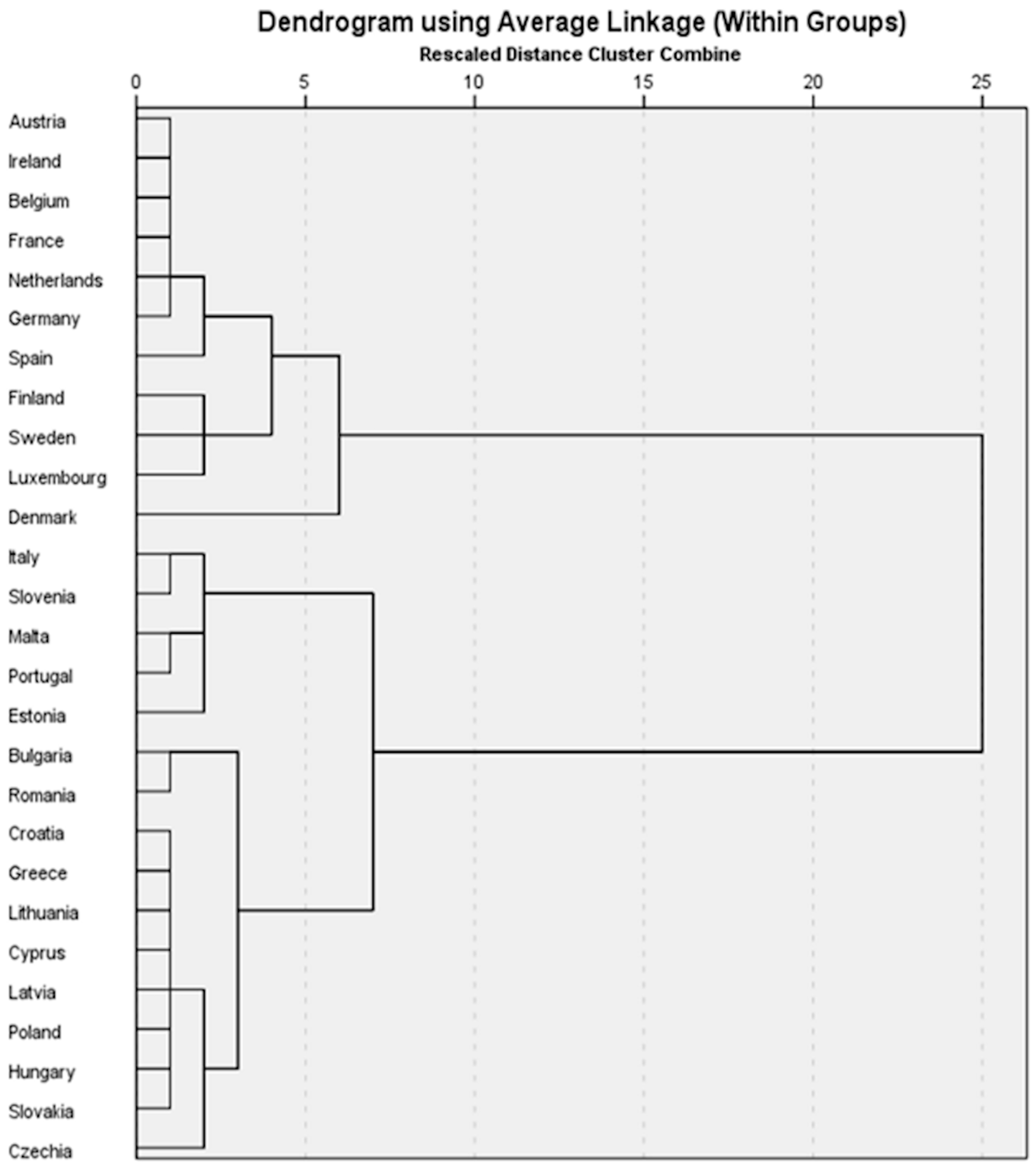
Cluster analysis used to test hypothesis H1 confirmed that EU countries can be grouped by the Candriam Score and scores for the four types of capital. Figure 1 shows the dendrogram of the three clusters formed using the average linkage method and squared Euclidean distance (Figure 1).
The results support hypothesis H1, indicating that EU countries can be classified into three distinct clusters, each associated with a specific perspective of corporate purpose: traditional, goal-based, and duty-based.
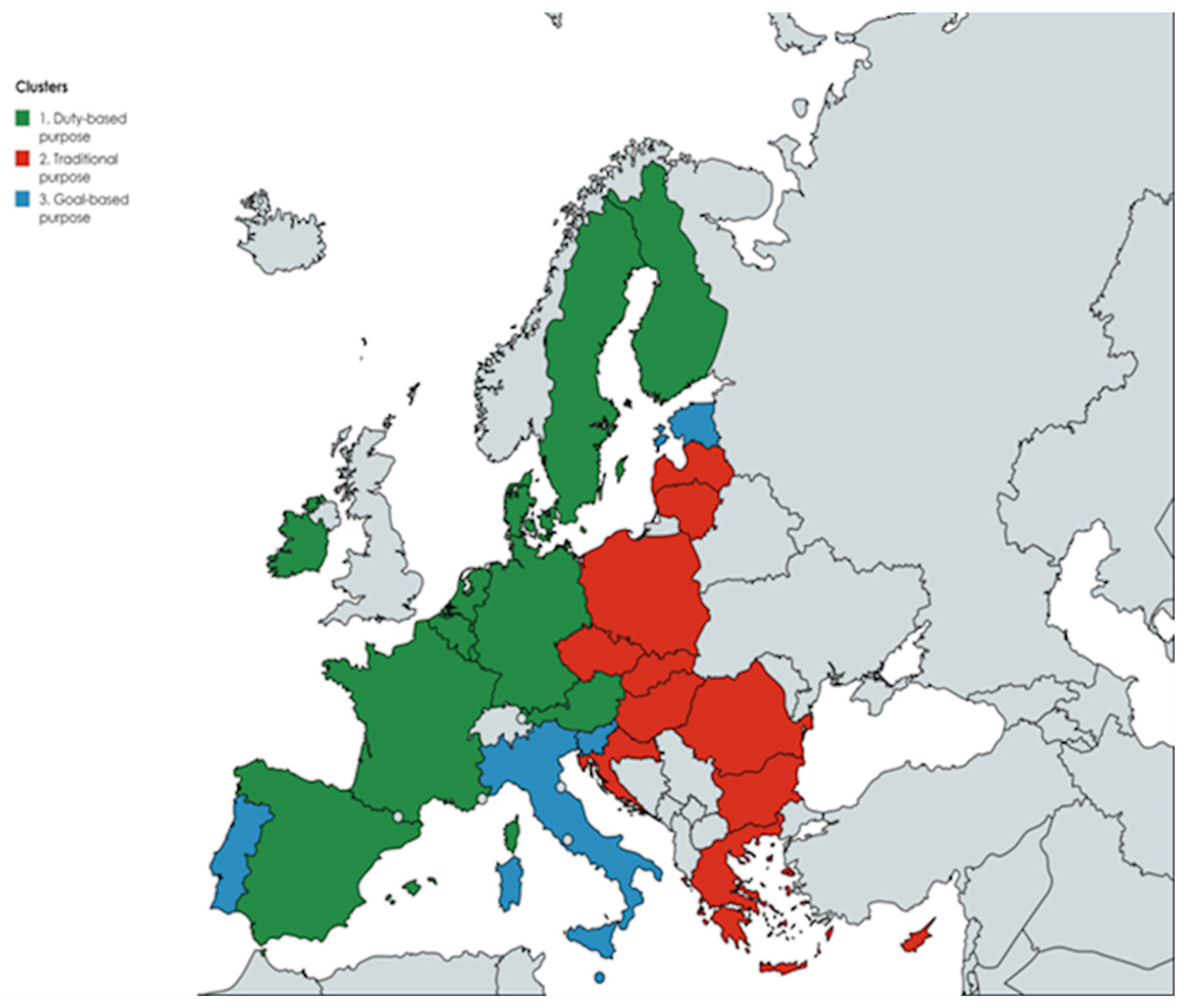
The cluster analysis in Table 4 identifies three distinct groups of EU countries, each with a particular configuration of economic, social, human, and natural capital, corresponding to traditional, goal-based, and duty-based corporate purpose models. These clusters show systematic differences not only in their capital profiles but also in their performance on the SDG Index.
Cluster 1 (Duty-based purpose) comprises primarily Northern and Western European countries and shows the highest average values across all four forms of capital. With a mean SDG Index score of 82.11—significantly above the EU average of 80.16—this cluster demonstrates the most substantial alignment with sustainable development outcomes. Countries in this group consistently combine high levels of social and human capital with strong environmental performance and solid economic foundations. The relatively balanced and elevated capital structure suggests that sustainability-oriented institutional frameworks and societal norms play a central role in translating national sustainability priorities into measurable progress on the SDGs.
Cluster 2 (Traditional purpose) is characterized by substantially lower average scores across all capital dimensions, particularly social and human capital. Although some countries within this cluster achieve moderate SDG Index values, the cluster mean (78.22) remains below the EU average. This pattern indicates that a development model centered primarily on economic considerations, without a corresponding emphasis on social cohesion, institutional trust, and human development, is less effective in supporting comprehensive sustainable development. The weaker SDG performance of this cluster highlights the limitations of traditional purpose orientations when confronted with complex, multidimensional sustainability challenges.
Cluster 3 (Goal-based purpose) occupies an intermediate position between the other two clusters. Countries in this group exhibit moderate but relatively balanced levels of capital, particularly social and human capital, and achieve an average SDG Index score of 79.40. This suggests that while goal-based purpose orientations partially integrate sustainability considerations into national development strategies, they may lack the institutional depth and societal embeddedness observed in the duty-based cluster. As a result, their sustainability outcomes, although close to the EU average, remain less consistent and robust.
Figure 2 presents the three clusters in a graphical display.
Overall, the cluster analysis provides clear empirical evidence that countries aligned with a duty-based corporate purpose model achieve superior SDG performance, supporting Hypothesis H2. The results indicate that macro-level sustainable development is more strongly associated with integrated, socially embedded capital structures than with economic capital alone. These findings reinforce the argument that corporate purpose orientations emphasizing social responsibility and long-term societal value creation are better suited to addressing the sustainability objectives pursued within the EU.
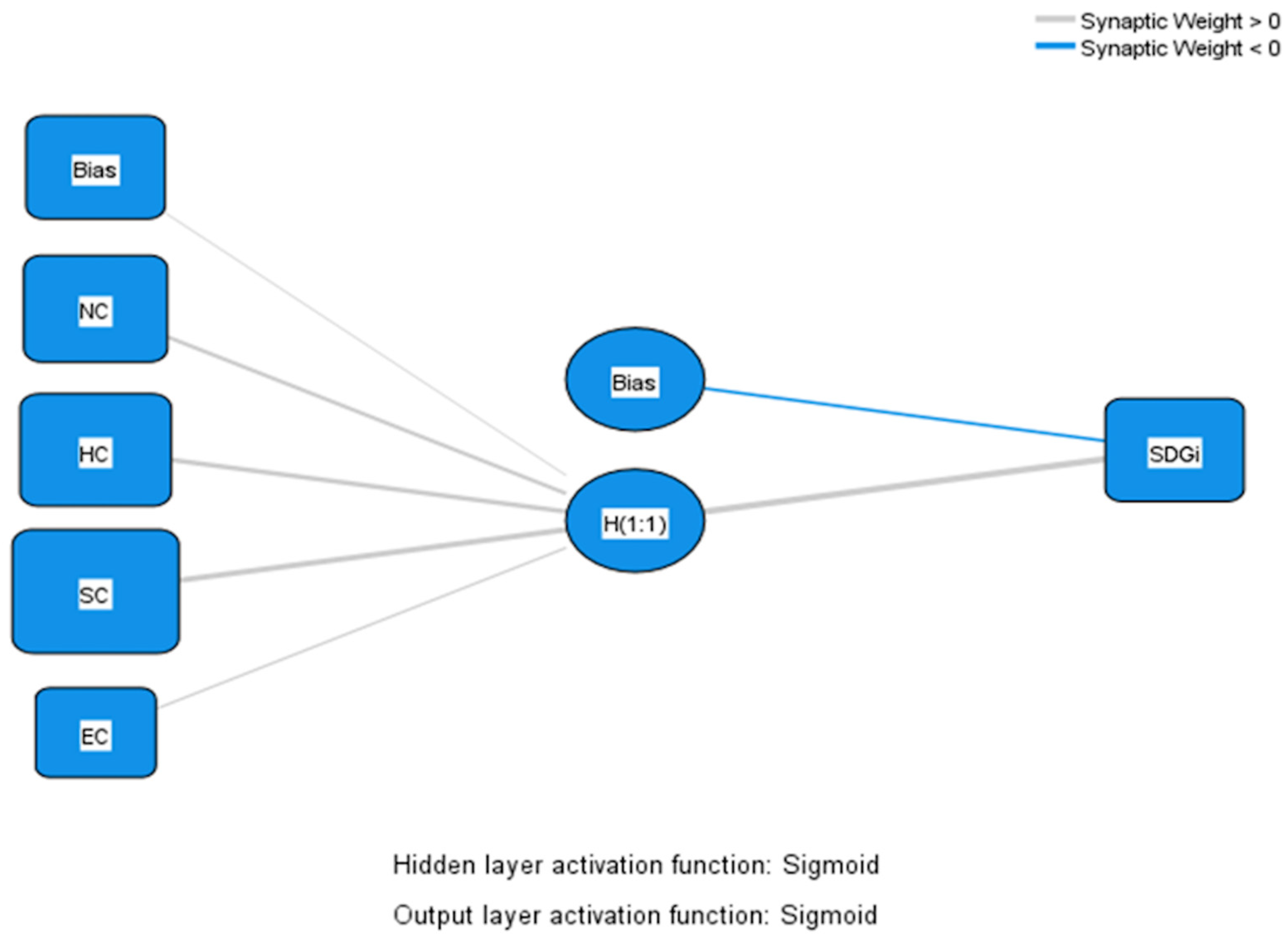
For hypothesis H3, we used an MLP within the ANN framework. The input variables were scores for economic, social, human, and natural capital, and the output variable was each country’s SDG index score, the hidden layer captured orientation toward sustainability and prioritization of societal obligations. Figure 3 shows the relationships in the MLP model.
The sum of squared errors was 0.367 during the training phase and 0.238 during the testing phase. The predictive values, along with the absolute and normalized importance of the input variables, are shown in Table 5.
The Multilayer Perceptron (MLP) results in Table 5 provide essential insights into the relative importance of different forms of capital in predicting a country’s SDG index score. While social capital (SC) is the most influential predictor, with a normalized importance of 100%, this result reflects more than a purely statistical outcome. It carries significant substantive implications for the EU context.
At the macro level, social capital captures institutional trust, social cohesion, quality of governance, and the strength of stakeholder relationships. In EU countries, these factors enable coordination among public institutions, firms, and civil society, facilitating the effective implementation of sustainability-oriented policies. High levels of social capital enhance collective action, reduce transaction costs, and support long-term policy continuity, all of which are essential for progress across multiple SDGs simultaneously.
Human capital (HC) and natural capital (NC) also show substantial predictive power, with normalized importance values of 72.4% and 58.6%, respectively. These results highlight the complementary role of education, skills, and environmental stewardship in supporting sustainable development. Well-developed human capital enables innovation and adaptation, while strong management of natural capital underpins long-term ecological resilience—both crucial components of sustainability-oriented growth strategies within the EU.
By contrast, the relatively low importance of economic capital (16.9%) may appear counterintuitive from a traditional growth-oriented lens. However, this finding suggests that economic resources alone are insufficient to drive sustainable development outcomes in advanced institutional settings such as the EU. In contexts where baseline economic capacity is already relatively high, variations in SDG performance are more strongly influenced by how effectively societies mobilize social trust, institutional quality, and human capabilities rather than by additional economic capital accumulation. This result underscores a key implication of the sustainability-focused corporate purpose model: economic capital increasingly functions as an outcome of effective social, human, and environmental governance rather than as its primary driver.
Overall, the ANN results strongly support Hypothesis H3, demonstrating that social capital plays a central enabling role in advancing sustainable development at the macro level, while also revealing the conditional and context-dependent role of economic capital within the EU.

5. Discussion

The results of this study provide clear empirical evidence that corporate purpose orientations across European Union (EU) countries are heterogeneous and structured into three distinct clusters.
The identification of three clusters confirms Hypothesis H1 and shows that EU countries are at different stages of transformation in redefining corporate purpose. Cluster 1, associated with a duty- based purpose model, is characterized by consistently high levels across all forms of capital—social, human, natural, and economic—and the highest overall country scores. This configuration suggests that ethical and societal responsibilities are not adopted at the expense of economic performance but coexist with strong economic outcomes. These findings reinforce arguments that duty-based corporate purpose models can support long-term sustainability and societal value creation beyond profit maximization [5,6,7,8,9,10,11]. Prior research provides empirical support for this interpretation, showing that organizations that embrace duty-based principles tend to demonstrate a stronger sustainability orientation and broader societal impact [31].
In contrast, Cluster 2 reflects a traditional corporate purpose orientation, in which economic capital remains dominant, and other forms of capital are comparatively underdeveloped. Countries in this cluster display the lowest average scores across capital dimensions and weaker SDG performance. The persistence of this model suggests that, despite growing discourse on sustainability, profit maximization and shareholder value remain deeply embedded in specific national contexts [1,2,3,4]. Historical institutional legacies, lower levels of social trust, and less- developed sustainability governance frameworks may explain the resilience of this approach. While the traditional model emphasizes economic efficiency as a pathway to societal welfare [1], the empirical results indicate that this logic alone is insufficient to address contemporary sustainability challenges, particularly in contexts marked by rising social inequalities [90].
Cluster 3 represents an intermediate, goal-based purpose model, characterized by average values across all capital categories. This cluster illustrates a transitional stage in which corporate purpose is increasingly linked to organizational identity and strategic intent, yet ethical and societal commitments remain partially instrumental rather than fully internalized. Prior research has described this model as an essential step toward broader responsibility, but one that does not yet fully integrate moral obligations into corporate decision- making [35,45,67,68,69,70]. The presence of this cluster highlights the gradual and uneven nature of corporate purpose transformation across the EU, reflecting different stages of institutional development and societal expectations. The EU average, which combines elements from all three clusters, further underscores the diversity of corporate purpose orientations within the Union.
Confirming Hypothesis H2 provides additional insight into the relationship between corporate purpose and sustainable development. Countries aligned with the duty-based purpose model achieve significantly higher SDG index scores than those in the other clusters. This finding suggests that embedding ethical, social, and environmental responsibilities into corporate purpose is associated with more substantial national-level commitment to the Sustainable Development Goals. These results are consistent with earlier studies identifying a positive link between sustainability-oriented corporate practices and improved SDG performance [9,10,11,45]. At the macro level, this relationship aligns with evidence that firms with strong sustainability orientations contribute more effectively to national progress toward sustainable development objectives [91].
A central contribution of this study is the analysis of Hypothesis H3, which examines the relative importance of different forms of capital in predicting SDG performance. The MLP neural network results reveal that social capital exerts the most decisive influence on SDG index scores, followed by human capital and natural capital. In contrast, economic capital plays a comparatively limited role. This finding underscores the importance of social cohesion, institutional trust, and community engagement in enabling sustainable development. Social capital appears to function as a key enabler, facilitating coordination, collective action, and the practical implementation of sustainability policies [9,11].
These results build on previous research highlighting the importance of social impact for sustainability outcomes. Evidence from studies on European B Corps shows that organizations prioritizing social value creation tend to achieve superior sustainability performance [92]. At the same time, the findings diverge from those of van der Waal et al. [93], who identified economic capital as the dominant driver of sustainable development in their analysis of OECD countries. Differences in methodological approaches, indicator selection, and geographical focus may explain this divergence. The EU context, characterized by stronger social policy frameworks and sustainability regulations, may amplify the role of social capital relative to purely economic factors.
The emphasis on social capital in this study also contrasts with perspectives that emphasize a balanced interaction among social, environmental, and economic dimensions. While Sinkovics et al. [94] acknowledge the importance of social factors, they argue for a more integrated and symmetrical relationship among all forms of capital in promoting corporate sustainability. The present findings suggest that, within the EU, social capital may play a more pronounced catalytic role, enhancing the effectiveness of investments in human and natural capital and shaping sustainability outcomes more decisively than economic capital alone.
Despite these positive associations, the results also reveal essential challenges and contradictions. While duty-based corporate purpose models are linked to stronger sustainability performance, implementation is not uniform across cultural and regulatory contexts. In environments where profit-oriented logics have historically dominated corporate governance, ethical commitments may be adopted superficially, undermining their intended impact [34]. Moreover, stakeholder-oriented approaches may generate internal tensions, as competing stakeholder interests complicate managerial decision-making and limit the feasibility of universally beneficial outcomes [95,96,97].
Regulatory heterogeneity across EU member states further shapes the consistency with which corporate purpose models are adopted. In countries with well-established sustainability and corporate social responsibility regulations, organizations are better equipped to operationalize duty-based approaches. Conversely, in less regulated contexts, firms may struggle to align internal processes with expanding societal expectations, leading to fragmented or uneven implementation. These differences highlight the importance of institutional capacity in shaping how corporate purpose is translated into practice [31].
Another key implication concerns the evolving definition of corporate success. As sustainability indicators gain prominence alongside financial metrics, managers increasingly face ethical dilemmas in balancing short-term economic performance with long-term social and environmental value creation. In profit-driven corporate cultures, pressures to deliver immediate financial results may conflict with broader ethical commitments, potentially compromising the integrity of duty-based models [5]. Addressing these tensions requires not only regulatory support but also leadership commitment and organizational cultures that internalize sustainability as a core value rather than a compliance requirement.
Overall, the findings suggest that corporate purpose in the EU is evolving toward a sustainability-oriented paradigm, prioritizing social, human, and natural capital. In contrast, economic capital increasingly emerges as an outcome rather than the primary objective. This shift challenges traditional assumptions about profit maximization. It supports a more integrated view of value creation, in which economic success is contingent upon responsible management of social and environmental resources [9].
This transformation reflects broader societal expectations regarding fairness, sustainability, and collective well-being. Organizations can no longer operate independently of the social and environmental systems in which they are embedded. Instead, they are increasingly expected to act as agents of change, contributing actively to sustainable development. By placing social cohesion, environmental stewardship, and human development at the center of corporate purpose, firms enhance their capacity to respond to complex societal challenges and to support a more sustainable and equitable economic model.

5.1. Theoretical Implications

This study advances the academic literature on corporate purpose by providing macro-level empirical evidence on the relationship between corporate purpose orientations and sustainable development outcomes. By linking ESG-related capital indicators to SDG index scores, the research offers a structured framework for understanding how different configurations of corporate purpose translate into national sustainability performance. This approach helps bridge the gap between normative theories of corporate purpose and empirical assessments of sustainability at the country level.
The findings support the view that corporate purpose is undergoing a substantive transformation in response to contemporary societal challenges, including environmental degradation, social inequality, and technological disruption. Rather than reinforcing a purely economic logic, the results indicate a shift toward a duty-based corporate purpose model that integrates social, human, and natural capital alongside economic capital. This evolution reflects changing societal expectations regarding the role of business and aligns with emerging perspectives that conceptualize corporations as embedded actors within broader social and ecological systems.
From a theoretical standpoint, the study challenges capital-centric models that prioritize economic capital as the primary driver of sustainable development. The empirical evidence suggests that social capital, supported by human and natural capital, plays a more decisive role in shaping sustainability outcomes within the EU context. This finding calls for a reconsideration of dominant theoretical assumptions regarding value creation and supports a more relational and multidimensional understanding of corporate purpose.
Moreover, the results highlight the importance of viewing corporate purpose not as a static organizational attribute but as a dynamic construct shaped by institutional, cultural, and regulatory contexts. The identification of transitional goal-based models alongside duty-based and traditional models underscores the incremental nature of corporate purpose transformation. Building on these insights, the study proposes a sustainability-oriented corporate purpose framework centered on social, human, and natural capital, with economic performance emerging as a consequential outcome rather than a primary objective. This perspective provides a conceptual foundation for future research examining how corporate purpose influences long-term development trajectories and societal well-being.

5.2. Empirical Implications

The empirical findings of this study offer relevant insights for policymakers, corporate leaders, investors, and other stakeholders shaping sustainable economic systems across the EU. By empirically validating distinct corporate purpose models at the country level, the analysis shows that approaches to corporate responsibility and sustainability vary significantly across member states, reflecting differences in institutional maturity, regulatory frameworks, and societal expectations.
For policymakers, classifying EU countries into clusters based on corporate purpose orientations provides a valuable basis for designing differentiated, targeted policy interventions. Rather than adopting a uniform regulatory approach, national and EU-level authorities can tailor sustainability policies to the specific characteristics and development stages of each cluster. Stronger regulatory frameworks, mandatory ESG and SDG reporting requirements, and incentive mechanisms—such as tax benefits, preferential financing, or public recognition—can encourage companies to adopt broader corporate purposes that integrate social, human, and environmental objectives into core business strategies.
From a managerial perspective, the findings highlight emerging best practices associated with sustainability-oriented corporate purpose models. Corporate leaders can use these insights to reassess strategic priorities, moving beyond short-term profit maximization toward long-term value creation that balances economic performance with social and environmental responsibility. Integrating ESG criteria into strategic planning, setting measurable sustainability targets, and ensuring transparent communication with stakeholders are essential steps for enhancing organizational legitimacy, resilience, and competitiveness.
The results also underscore the importance of active stakeholder engagement. Companies are encouraged to systematically incorporate the perspectives of employees, customers, communities, and environmental stakeholders into decision-making processes. Such engagement not only supports ethical governance but also strengthens social capital, identified in the findings as a key driver of sustainable development. Investments in sustainable technologies, responsible supply chain management, and circular economy practices further reinforce this transition.
Beyond corporate and policy domains, the study supports a broader societal shift toward more sustainable and equitable economic models. Investors play a crucial role by prioritizing ESG-oriented firms and expanding sustainable and impact investment instruments. Civil society organizations contribute by holding corporations accountable, promoting transparency, and raising public awareness of responsible consumption and production patterns. Finally, academic institutions are encouraged to advance interdisciplinary research on corporate purpose, sustainability, and societal impact, fostering innovative solutions to complex global challenges.
Together, these empirical implications emphasize that redefining corporate purpose is not solely a managerial or regulatory concern but a collective endeavor involving multiple actors. Aligning corporate purpose with ethical, social, and environmental objectives represents a critical pathway toward achieving sustainable development and strengthening the long-term resilience of European economies.

5.3. Limitations and Further Research

While this study offers valuable insights into corporate purpose orientations within the European Union, several limitations should be considered. Firstly, the analysis is conducted strictly at the country level, relying on aggregated sustainability indicators from sources like the CANDRIAM Sovereign Sustainability Report and the Sustainable Development Report. Consequently, firm-level dynamics, including heterogeneity in corporate strategies, internal governance, and decision-making processes, are not directly captured by the dataset. Additionally, the effects of globalization, multinational ownership, and the geographic location of headquarters cannot be explicitly addressed within this scope.
Secondly, although the selected data sources provide a solid, comparable framework for assessing national sustainability orientations, their aggregated nature may limit the ability to generalize findings to individual firms or sectors. The cross-sectional design further limits the ability to observe changes over time in corporate purpose and sustainability performance. Future research could benefit from longitudinal data to explore how national sustainability profiles and corporate purpose models evolve.
Furthermore, focusing solely on EU member states may mean the results do not directly apply to non-EU contexts, where institutional, cultural, and regulatory frameworks differ significantly. Extending the analysis to other regions would offer broader comparative insights and test the external validity of the proposed corporate purpose models.
Building on this macro-level foundation, future research should incorporate micro-level and mixed-methods approaches to understand corporate purpose in practice better. For instance, analyzing corporate sustainability reports, mission statements, and integrated reports could shed light on how firms articulate and implement their purpose. These analyses would clarify the micro-level narrative and connect national sustainability orientations with firm behavior.
Finally, future studies could investigate organizational, cultural, and industry-specific challenges in adopting sustainability-oriented purpose models and evaluate their economic, social, and environmental impacts at both the managerial and macroeconomic levels. Such research would deepen understanding of how corporate purpose can effectively promote sustainable development in a complex, globalized economy.

6. Conclusions

The findings emphasize how corporate purpose is transforming within contemporary capitalism. As societal expectations change, companies face increasing pressure to go beyond purely financial goals and also prioritize ethical and social responsibilities. Sustainability, social responsibility, and environmental impact now form crucial parts of corporate strategy, partly due to growing awareness of climate issues and the adverse ecological effects of certain business practices. Organizations implementing sustainable strategies not only address environmental concerns but also gain competitive advantages by appealing to eco-conscious consumers and building strong relationships with communities and regulators. Furthermore, rising social inequality has made corporate social responsibility more vital, encouraging businesses to play a more active role in social welfare and reducing disparities. Research indicates that long-term corporate success relies on engaging a broad spectrum of stakeholders, including employees, customers, communities, and the environment. Merely maximizing profit is no longer enough; companies must adopt a holistic view that includes social, human, and environmental objectives. Those that successfully integrate these elements will lead the way toward a more sustainable and fairer capitalism, setting an example for others.

Author Contributions

Conceptualization, C.G.B. and A.A.V.; methodology, C.G.B. and A.A.V.; software, C.G.B. and A.A.V.; validation, C.G.B. and A.A.V.; formal analysis, C.G.B. and A.A.V.; investigation, C.G.B. and A.A.V.; resources, C.G.B. and A.A.V.; data curation, C.G.B. and A.A.V.; writing—original draft preparation, C.G.B. and A.A.V.; writing—review and editing, C.G.B. and A.A.V.; visualization, C.G.B.; supervision, A.A.V.; project administration, C.G.B. All authors have read and agreed to the published version of the manuscript.

Funding

This research received no external funding.

Data Availability Statement

Data is available in a publicly accessible repository. The data presented in this study are openly available: CANDRIAM Sovereign Sustainability Report 2022 at https://esginvesting-cdn-1.s3.eu-west-2.amazonaws.com/wp-content/uploads/2022/11/22111434/CANDRIAM-Sovereign-Sustainability-Report-2022.pdf, accessed 21 November 2025, and Sustainable Development Report 2025 at https://dashboards.sdgindex.org/static/downloads/files/SDR2025-data.xlsx, accessed on 21 November 2025.

Conflicts of Interest

The author declares no conflicts of interest.

Abbreviations

The following abbreviations are used in this manuscript:
ANNArtificial neural networks
CSCandriam Score
NCNatural Capital
HCHuman Capital
SCSocial Capital
ECEconomic Capital
SDGiSDG Index Score

References

  1. Friedman, M. The Social Responsibility of Business Is to Increase Its Profits. The New York Times Magazine, 13 September 1970. Available online: https://www.nytimes.com/1970/09/13/archives/a-friedman-doctrine-the-social-responsibility-of-business-is-to.html (accessed on 14 November 2025).
  2. Jordi, C.L. Rethinking the Firm’s Mission and Purpose. Eur. Manag. Rev. 2010, 7, 195–204. [Google Scholar] [CrossRef]
  3. Smith, N.C.; Ronnegard, D. Shareholder Primacy, Corporate Social Responsibility, and the Role of Business Schools. J. Bus. Ethics 2016, 134, 463–478. [Google Scholar] [CrossRef]
  4. McBride, C. Whose Company Is It Anyway? The Benefits of Unprotected Capitalism and Unruly Shareholders; Institute for Economic Affairs: London, UK, 2019. [Google Scholar]
  5. Freeman, R.E.; Reed, D.L. Stockholders and Stakeholders: A New Perspective on Corporate Governance. Calif. Manag. Rev. 1983, 25, 88–106. [Google Scholar] [CrossRef]
  6. Freeman, R.E. Strategic Management: A Stakeholder Approach; Cambridge University Press: New York, NY, USA, 2010. [Google Scholar]
  7. Freeman, R.E.; Harrison, J.S.; Wicks, A.C.; Parmar, B.L.; De Colle, S. Stakeholder Theory: The State of the Art; Cambridge University Press: New York, NY, USA, 2010. [Google Scholar]
  8. Harrison, J.S.; Phillips, R.A.; Freeman, R.E. On the 2019 Business Roundtable Statement on the Purpose of a Corporation. J. Manag. 2020, 46, 1223–1237. [Google Scholar] [CrossRef]
  9. Mayer, C. The Future of the Corporation and the Economics of Purpose. J. Manag. Stud. 2021, 58, 887–901. [Google Scholar] [CrossRef]
  10. Gartenberg, C.; Serafeim, G. Corporate Purpose in Public and Private Firms. Manag. Sci. 2023, 69, 5087–5111. [Google Scholar] [CrossRef]
  11. Morrison, A.D.; Mota, R. A Theory of Organizational Purpose. Acad. Manag. Rev. 2023, 48, 203–219. [Google Scholar] [CrossRef]
  12. Henderson, R.; Van den Steen, E. Why Do Firms Have Purpose? The Firm’s Role as a Carrier of Identity and Reputation. Am. Econ. Rev. 2015, 105, 326–330. [Google Scholar] [CrossRef]
  13. Gartenberg, C.M.; Prat, A.; Serafeim, G. Corporate Purpose and Financial Performance. Organ. Sci. 2019, 30, 1–18. [Google Scholar] [CrossRef]
  14. Henderson, R. Innovation in the 21st Century: Architectural Change, Purpose, and the Challenges of Our Time. Manag. Sci. 2020, 67, 5479–5488. [Google Scholar] [CrossRef]
  15. Unilever. Unilever’s Sustainable Living Plan. Available online: https://www.unilever.com/sustainable-living/ (accessed on 14 November 2025).
  16. Patagonia. Patagonia’s Mission and Values. Available online: https://www.patagonia.com/company-info/ (accessed on 14 November 2025).
  17. Smith, W.K.; Besharov, M.L. Bowing before Dual Gods: How Structured Flexibility Sustains Organizational Hybridity. Adm. Sci. Q. 2019, 64, 1–44. [Google Scholar] [CrossRef]
  18. Scherer, A.G.; Palazzo, G. The New Political Role of Business in a Globalized World: A Review of New Perspectives on CSR and Its Implications for the Firm, Governance, and Democracy. J. Manag. Stud. 2011, 48, 899–931. [Google Scholar] [CrossRef]
  19. Reich, R. Supercapitalism: The Transformation of Business, Democracy, and Everyday Life; Vintage Books: New York, NY, USA, 2008. [Google Scholar]
  20. Karnani, A. Doing Well by Doing Good: The Grand Illusion. Calif. Manag. Rev. 2011, 53, 69–86. [Google Scholar] [CrossRef]
  21. Kreps, T.A.; Monin, B. Doing Well by Doing Good? Ambivalent Moral Framing in Organizations. Res. Organ. Behav. 2011, 31, 99–123. [Google Scholar] [CrossRef]
  22. Carroll, A.B.; Shabana, K.M. The Business Case for Corporate Social Responsibility: A Review of Concepts, Research and Practice. Int. J. Manag. Rev. 2010, 12, 85–105. [Google Scholar] [CrossRef]
  23. Schreck, P. Reviewing the Business Case for Corporate Social Responsibility: New Evidence and Analysis. J. Bus. Ethics 2011, 103, 167–188. [Google Scholar] [CrossRef]
  24. Ulrich, P. Integrative Economic Ethics: Foundations of a Civilized Market Economy; Cambridge University Press: Cambridge, MA, USA, 2008. [Google Scholar]
  25. Vogel, D. The Market for Virtue: The Potential and Limits of Corporate Social Responsibility; Brookings Institution Press: Washington, DC, USA, 2005. [Google Scholar]
  26. Abend, G. The Moral Background: An Inquiry into the History of Business Ethics; Princeton University Press: Princeton, NJ, USA, 2014. [Google Scholar]
  27. Sunny, F.A.; Jeronen, E.; Lan, J. Influential Theories of Economics in Shaping Sustainable Development Concepts. Adm. Sci. 2025, 15, 6. [Google Scholar] [CrossRef]
  28. McWilliams, A.S.; Siegel, D. Corporate Social Responsibility: A Theory of the Firm Perspective. Acad. Manag. Rev. 2001, 26, 117–127. [Google Scholar] [CrossRef]
  29. Lynn, A. Why ‘Doing Well by Doing Good’ Went Wrong: Getting Beyond ‘Good Ethics Pays’ Claims in Managerial Thinking. Acad. Manag. Rev. 2021, 46, 512–533. [Google Scholar] [CrossRef]
  30. Matten, D.; Crane, A. Corporate Citizenship: Towards an Extended Theoretical Conceptualization. Acad. Manag. Rev. 2005, 30, 166–179. [Google Scholar] [CrossRef]
  31. Scherer, A.G.; Palazzo, G. Toward a Political Conception of Corporate Responsibility: Business and Society Seen through a Habermasian Perspective. Acad. Manag. Rev. 2007, 32, 1096–1120. [Google Scholar] [CrossRef]
  32. Endörfer, R.; Larue, L. What’s the Point of Efficiency? On Heath’s Market Failures Approach. Bus. Ethics Q. 2024, 34, 35–59. [Google Scholar] [CrossRef]
  33. Tempels, T.; Blok, V.; Verweij, M. Understanding Political Responsibility in Corporate Citizenship: Towards a Shared Responsibility for the Common Good. J. Glob. Ethics 2017, 13, 90–108. [Google Scholar] [CrossRef]
  34. Gond, J.; Palazzo, G.; Basu, K. Reconsidering Instrumental Corporate Social Responsibility through the Mafia Metaphor. Bus. Ethics Q. 2009, 19, 57–85. [Google Scholar] [CrossRef]
  35. Bartlett, C.A.; Ghoshal, S. Changing the Role of Top Management: Beyond Strategy to Purpose. Harv. Bus. Rev. 1994, 72, 79–88. [Google Scholar]
  36. Thakor, A.V.; Quinn, R.E. The Economics of Higher Purpose; ECGI–Finance Working Paper 395; Olin Business School, Washington University: St. Louis, MO, USA, 2013. [Google Scholar]
  37. Lee, C.-W.; Fu, M.-W. Conceptualizing Sustainable Business Models Aligning with Corporate Responsibility. Sustainability 2024, 16, 5015. [Google Scholar] [CrossRef]
  38. Jimenez, D.; Franco, I.B.; Smith, T. A Review of Corporate Purpose: An Approach to Actioning the Sustainable Development Goals (SDGs). Sustainability 2021, 13, 3899. [Google Scholar] [CrossRef]
  39. Mayer, C. Ownership, Agency, and Trusteeship. Oxf. Rev. Econ. Policy 2020, 36, 223–240. [Google Scholar] [CrossRef]
  40. Brosch, N. Corporate Purpose: From a ‘Tower of Babel’ Phenomenon towards Construct Clarity. J. Bus. Econ. 2023, 93, 567–595. [Google Scholar] [CrossRef]
  41. Rabetino, R.; Kohtamäki, M.; Foss, N.J.; Rahman, N.; Huikkola, T. Microfoundations for Business Model Innovation: Exploring the Interplay Between Individuals, Practices, and Organizational Design. J. Prod. Innov. Manag. 2025, 42, 704–736. [Google Scholar] [CrossRef]
  42. Palmié, M.; Rüegger, S.; Parida, V. Microfoundations in the Strategic Management of Technology and Innovation: Definitions, Systematic Literature Review, Integrative Framework, and Research Agenda. J. Bus. Res. 2023, 154, 113351. [Google Scholar] [CrossRef]
  43. Blader, S.; Gartenberg, C.; Prat, A. The Contingent Effect of Management Practices; Working Paper; University of Pennsylvania: Philadelphia, PA, USA, 2016. [Google Scholar] [CrossRef]
  44. Spence, R.; Rushing, H. It’s Not What You Sell, It’s What You Stand for: Why Every Extraordinary Business Is Driven by Purpose; Penguin: New York, NY, USA, 2009. [Google Scholar]
  45. George, G.; Haas, M.R.; McGahan, A.M.; Schillebeeckx, S.J.D.; Tracey, P. Purpose in the For-Profit Firm: A Review and Framework for Management Research. J. Manag. 2023, 49, 1841–1869. [Google Scholar] [CrossRef]
  46. Kantar Consulting. Purpose 2020: The Journey Towards Purpose-Led Growth. Available online: https://www.kantar.com/Inspiration/Brands/The-Journey-Towards-Purpose-Led-Growth (accessed on 18 November 2025).
  47. Hollensbe, E.; Wookey, C.; Hickey, L.; George, G.; Nichols, C.V. Organizations with Purpose. Acad. Manag. J. 2014, 57, 1227–1234. [Google Scholar] [CrossRef]
  48. Silvestre, W.; Begnini, S.; Abreu, I. The Paradox of Trust: How Leadership, Commitment, and Inertia Shape Sustainability Behavior in the Workplace. Adm. Sci. 2025, 15, 254. [Google Scholar] [CrossRef]
  49. Gilje, E.P.; Taillard, J.P. Do Private Firms Invest Differently than Public Firms? Taking Cues from the Natural Gas Industry. J. Financ. 2016, 71, 1733–1778. [Google Scholar] [CrossRef]
  50. Feldman, N.E.; Kawano, L.; Patel, E.; Rao, N.; Stevens, M.; Edgerton, J. The Long and the Short of It: Do Public and Private Firms Invest Differently? Working Paper 2018. [Google Scholar] [CrossRef]
  51. Doidge, C.; Kahle, K.M.; Karolyi, G.A.; Stulz, R.M. Eclipse of the Public Corporation or Eclipse of the Public Markets? J. Appl. Corp. Financ. 2018, 30, 8–16. [Google Scholar] [CrossRef]
  52. Kohll, A. What Employees Really Want at Work. Forbes, 10 July 2018. Available online: https://www.forbes.com/sites/alankohll/2018/07/10/what-employees-really-want-at-work/ (accessed on 14 November 2025).
  53. Porter, M.E.; Kramer, M.R. Creating Shared Value: How to Reinvent Capitalism and Unleash a Wave of Innovation and Growth. Harv. Bus. Rev. 2011, 89, 62–77. [Google Scholar]
  54. Henderson, R. Reimagining Capitalism in a World on Fire; Public Affairs: New York, NY, USA, 2020. [Google Scholar]
  55. Edmans, A. Grow the Pie: How Great Companies Deliver Both Purpose and Profit; Cambridge University Press: Cambridge, UK, 2020. [Google Scholar]
  56. Campbell, J.L. Why Would Corporations Behave in Socially Responsible Ways? An Institutional Theory of Corporate Social Responsibility. Acad. Manag. Rev. 2007, 32, 946–967. [Google Scholar] [CrossRef]
  57. Freeman, R.E.; Martin, K.E.; Parmar, B.L. The Power of AND: Responsible Business Without Trade-Offs; Columbia Business School Publishing: New York, NY, USA, 2020. [Google Scholar]
  58. Pache, A.C.; Santos, F. When Worlds Keep on Colliding: Exploring the Consequences of Organizational Responses to Conflicting Institutional Demands. Acad. Manag. Rev. 2021, 46, 640–659. [Google Scholar] [CrossRef]
  59. Oino, I.; Yekini, S. Meeting Stakeholder Needs: Who Should Managers Pay Close Attention To? Evidence from Listed Chinese Manufacturing Companies. Sustainability 2024, 16, 3806. [Google Scholar] [CrossRef]
  60. Mutua, K.; Powell-Turner, J.; Spiers, M.; Callaghan, J. An In-Depth Analysis of Barriers to Corporate Sustainability. Adm. Sci. 2025, 15, 161. [Google Scholar] [CrossRef]
  61. Hahn, T.; Pinkse, J.; Preuss, L.; Figge, F. Tensions in Corporate Sustainability: Towards an Integrative Framework. J. Bus. Ethics 2015, 127, 297–316. [Google Scholar] [CrossRef]
  62. Battilana, J. Cracking the Organizational Challenge of Pursuing Joint Social and Financial Goals: Social Enterprise as a Laboratory to Understand Hybrid Organizing. M@N@Gement 2018, 21, 1278–1305. [Google Scholar] [CrossRef]
  63. Battilana, J.; Obloj, T.; Pache, A.-C.; Sengul, M. Beyond Shareholder Value Maximization: Accounting for Financial/Social Trade-Offs in Dual-Purpose Companies. Acad. Manag. Rev. 2022, 47, 237–258. [Google Scholar] [CrossRef]
  64. Greenwood, R.; Raynard, M.; Kodeih, F.; Micelotta, E.; Lounsbury, M. Institutional Complexity and Organizational Responses. Acad. Manag. Ann. 2011, 5, 317–371. [Google Scholar] [CrossRef]
  65. Ghoshal, S.; Bartlett, C.; Moran, P. A New Manifesto for Management. MIT Sloan Manag. Rev. 1999, 40, 9–20. [Google Scholar]
  66. Williamson, O.; Winter, S.G. (Eds.) The Nature of the Firm; Oxford University Press: Oxford, UK, 1991. [Google Scholar]
  67. Aljebrini, A.; Dogruyol, K.; Ahmaro, I.Y.Y. How Strategic Planning Enhances ESG: Evidence from Mission Statements. Sustainability 2025, 17, 595. [Google Scholar] [CrossRef]
  68. Ribeiro, M.F.; Costa, C.G.d.; Ramos, F.R. Exploring Purpose-Driven Leadership: Theoretical Foundations, Mechanisms, and Impacts in Organizational Context. Adm. Sci. 2024, 14, 148. [Google Scholar] [CrossRef]
  69. Bock, A.J.; Warglien, M.; George, G. A Simulation-Based Approach to Business Model Design and Organizational Change. Innov. Organ. Manag. 2021, 23, 17–43. [Google Scholar] [CrossRef]
  70. Gast, A.; Illanes, P.; Probst, N.; Schaninger, B.; Simpson, B. Purpose: Shifting from Why to How; McKinsey & Company: New York, NY, USA, 2020. [Google Scholar]
  71. Arrow, K.J. Rationality of Self and Others in an Economic System. J. Bus. 1986, 4, S385–S399. [Google Scholar] [CrossRef]
  72. George, W. Authentic Leadership; Jossey-Bass: San Francisco, CA, USA, 2003. [Google Scholar]
  73. Dacin, M.T.; Dacin, P.A.; Tracey, P. Social Entrepreneurship: A Critique and Future Directions. Organ. Sci. 2011, 22, 1203–1213. [Google Scholar] [CrossRef]
  74. Hoffman, A.J. Finding Purpose: Environmental Stewardship as a Personal Calling; Routledge: New York, NY, USA, 2017. [Google Scholar]
  75. Kraatz, M.S.; Block, E.S. Institutional Pluralism Revisited. In The Sage Handbook of Organizational Institutionalism, 2nd ed.; Greenwood, R., Oliver, C., Lawrence, T.B., Meyer, R.E., Eds.; Sage Publications Ltd.: London, UK, 2017; pp. 532–557. [Google Scholar] [CrossRef]
  76. Horwath, R.; Drucker, P. Discovering Purpose: Developing Mission, Vision & Values; Strategic Thinking Institute: Chicago, IL, USA, 2005. [Google Scholar]
  77. Zervoudi, E.K.; Moschos, N.; Christopoulos, A.G. From the Corporate Social Responsibility (CSR) and the Environmental, Social and Governance (ESG) Criteria to the Greenwashing Phenomenon: A Comprehensive Literature Review About the Causes, Consequences and Solutions of the Phenomenon with Specific Case Studies. Sustainability 2025, 17, 2222. [Google Scholar] [CrossRef]
  78. Nemčok, M.; Im, Z.J.; Grasso, M.; Bonomi Bezzo, F. Public Opinion and the Welfare State: Sources, Processes, and Consequences. J. Eur. Public. Policy 2025, 1–25. [Google Scholar] [CrossRef]
  79. Mumtaz, Z.; Kühner, S. Towards a Theorization of the Global Community Welfare Regime: Depicting Four Ideal Types of the Community’s Role in Welfare Provision. J. Eur. Soc. Policy 2025, 35, 189–209. [Google Scholar] [CrossRef]
  80. Zhong, W.; Su, C.; Peng, J.; Yang, Z. Trust in Inter-Organizational Relationships: A Meta-Analytic Integration. J. Manag. 2017, 43, 1050–1075. [Google Scholar] [CrossRef]
  81. Ghoshal, S. Bad Management Theories Are Destroying Good Management Practices. Acad. Manag. Learn. Educ. 2005, 4, 75–91. [Google Scholar] [CrossRef]
  82. Merrill, R.K.; Schillebeeckx, S.J.D.; Blakstad, S. Sustainable Digital Finance in Asia: Creating Environmental Impact Through Bank Transformation; Sustainable Digital Finance Alliance; UN Environment: Geneva, Switzerland, 2019; Available online: https://www.dbs.com/iwov-resources/images/sustainability/reports/Sustainable%20Digital%20Finance%20in%20Asia_FINAL_22.pdf (accessed on 16 November 2025).
  83. Schillebeeckx, S.J.D.; Kautonen, T.; Hakala, H. To Buy Green or Not to Buy Green: Do Structural Dependencies Block Ecological Responsiveness? J. Manag. 2021, 48, 472–501. [Google Scholar] [CrossRef]
  84. Sourov, K.; Van Hyfte, W. Sovereign Sustainability Report 2022: The Age of the Grey Swan; Candriam: Luxembourg, 2022; Available online: https://www.candriam.com/siteassets/medias/publications/brochure/research-papers/sustainability-in-the-age-of-the-grey-swan/2022_11_sovereign_report_en_web.pdf (accessed on 21 November 2025).
  85. Sachs, J.D.; Lafortune, G.; Fuller, G.; Iablonovski, G. Financing Sustainable Development to 2030 and Mid-Century. Sustainable Development Report 2025; SDSN: Paris, France; Dublin University Press: Dublin, Ireland, 2025. [Google Scholar] [CrossRef]
  86. Friedman, M. Capitalism and Freedom; University of Chicago Press: Chicago, IL, USA, 1962. [Google Scholar]
  87. Rudeloff, C.; Michalski, P. How Corporate Brands Communicate Their Higher Purpose on Social Media: Evidence from Top Global Brands on Twitter. Corp. Reput. Rev. 2024, 27, 202–215. [Google Scholar] [CrossRef]
  88. Everitt, B.S.; Landau, S.; Leese, M.; Stahl, D. Cluster Analysis; John Wiley & Sons Ltd.: Chichester, UK, 2011. [Google Scholar]
  89. Bishop, C.M. Neural Networks for Pattern Recognition; Oxford University Press: London, UK, 1995. [Google Scholar]
  90. Stiglitz, J.E. The Price of Inequality: How Today’s Divided Society Endangers Our Future; W.W. Norton & Company: New York, NY, USA, 2012. [Google Scholar]
  91. Schaltegger, S.; Hörisch, J.; Freeman, E. Business Cases for Sustainability: A Stakeholder Theory Perspective. Organ. Environ. 2019, 32, 191–212. [Google Scholar] [CrossRef]
  92. Stubbs, W. Sustainable Entrepreneurship and B Corps. Bus. Strat. Environ. 2017, 26, 331–344. [Google Scholar] [CrossRef]
  93. van der Waal, J.W.H.; Thijssens, T.; Maas, K. The Innovative Contribution of Multinational Enterprises to the Sustainable Development Goals. J. Clean. Prod. 2021, 285, 125319. [Google Scholar] [CrossRef]
  94. Sinkovics, N.; Sinkovics, R.R.; Archie-Acheampong, J. The Business Responsibility Matrix: A Diagnostic Tool to Aid the Design of Better Interventions for Achieving the SDGs. Multinatl. Bus. Rev. 2021, 29, 1–20. [Google Scholar] [CrossRef]
  95. AlHares, A. Ethical Leadership and Its Impact on Corporate Sustainability and Financial Performance: The Role of Alignment with the Sustainable Development Goals. Sustainability 2025, 17, 6682. [Google Scholar] [CrossRef]
  96. Bebchuk, L.; Tallarita, R. The Illusory Promise of Stakeholder Governance. Working Paper, April. Available online: https://corpgov.law.harvard.edu/2020/03/02/the-illusory-promise-of-stakeholder-governance/ (accessed on 15 November 2025).
  97. Eccles, R.G.; Ioannou, I.; Serafeim, G. The Impact of Corporate Sustainability on Organizational Processes and Performance. Manag. Sci. 2014, 60, 2835–2857. [Google Scholar] [CrossRef]
Figure 1. Dendrogram. Source: authors’ design using SPSS v.27.
Systems 14 00039 g001
Figure 2. The distribution of countries across clusters. Source: developed by the authors based on collected data using MapChart; available online: https://www.mapchart.net/ (accessed on 18 November 2025).
Systems 14 00039 g002
Figure 3. MLP model. Source: authors’ design using SPSS v.27.
Systems 14 00039 g003
Table 1. Distinctions and Similarities Among Corporate Purpose Models.
IssueTraditional ModelGoal-Based Purpose ModelDuty-Based Purpose Model
Core FocusProfit maximization and economic efficiency.Aligning corporate purpose with mission statements, vision, and strategic goals.Ethical and moral responsibilities, including social, human, and environmental impacts.
Primary ObjectiveIncrease shareholder value and financial returns.Achieve specific organizational goals and reflect a unique corporate identity.Contribute positively to society and address broader social, environmental, and ethical issues.
Approach to ProfitProfit is the main goal; other considerations are secondary.Profit is a means to fulfill the broader purpose, including but not limited to financial goals.Profit is one of many goals, with a focus on overall impact and responsibility beyond financial gain.
Stakeholder ConsiderationLimited focus on stakeholders beyond shareholders; often perceived as a zero-sum game.Stakeholders are considered in the context of achieving organizational goals and balancing various interests.Emphasizes responsibility to all stakeholders, including communities and the environment.
Ethical and Social DimensionsMinimal integration of ethical or social dimensions; focus on economic outcomes.Incorporates ethical considerations, but primarily through the lens of achieving organizational objectives.Central to the purpose are ethical behavior and societal contributions.
Impact EvaluationSuccess is measured by financial performance and shareholder returns.Success is evaluated based on the achievement of organizational goals and the alignment with stated purposes.Success is measured by the positive impact on society and the environment, as well as financial performance.
Source: developed by the authors based on [1,2,5,35,43,45,47,52,53,54,55,56,57,58,59,60,61,62,63,64,65,66,67,68,69,70,71,72,73,74,75,76,77,78,79,80,81,82,83].
Table 2. Research variables.
VariableDatasetsMeasuresData Sources
CSCandriam ScoreAggregate score (0 to 100)[84]
NCNatural CapitalScore (not rebased from 0 to 100)[84]
HCHuman CapitalScore (not rebased from 0 to 100)[84]
SCSocial CapitalScore (not rebased from 0 to 100)[84]
ECEconomic CapitalScore (not rebased from 0 to 100)[84]
SDGiSDG Index ScoreAggregate score (0 to 100)[85]
Source: developed by the authors based on [84,85].
Table 3. Descriptive statistics.
VariableNMin.Max.MeanStd. DeviationSkewnessKurtosis
CS2744.26100.0070.264416.006290.098−1.254
NC2730.7598.0060.899320.082700.182−1.262
HC2721.2498.0056.672620.184280.234−0.908
SC2725.2399.0058.271921.398490.251−1.079
EC2721.69100.0056.081921.809320.210−1.143
SDGi2772.5086.8080.16303.29453−0.0930.456
Source: authors’ design using SPSS v.27.
Table 4. Clusters.
Table 4. Clusters.
CountryCSNCHCSCECSDGiCluster
Austria82.6577.6972.7376.0470.2582.31 (duty-based purpose)
Belgium80.9873.6968.0272.0770.4579.51 (duty-based purpose)
Denmark100.0098.0098.0099.00100.0085.71 (duty-based purpose)
Finland94.6892.7985.2192.7987.1186.81 (duty-based purpose)
France84.0081.4872.2470.5675.6082.01 (duty-based purpose)
Germany85.0679.1181.6674.8580.8183.41 (duty-based purpose)
Ireland83.8479.6570.4374.6268.7580.11 (duty-based purpose)
Luxembourg92.1485.6985.6992.1476.4877.61 (duty-based purpose)
Netherlands82.1673.1278.0580.5274.7779.41 (duty-based purpose)
Spain81.0474.5659.1664.8377.8080.41 (duty-based purpose)
Sweden87.5286.6477.8983.1485.7786.01 (duty-based purpose)
Cluster 1 mean86.7382.0477.1980.0578.8982.11
Bulgaria48.0430.7528.3427.3829.3074.62 (traditional purpose)
Croatia56.8940.9638.1240.9640.3981.52 (traditional purpose)
Cyprus57.4441.9339.0640.7844.2372.52 (traditional purpose)
Greece55.9839.1934.1538.0740.8778.42 (traditional purpose)
Hungary54.5546.9138.1934.9137.0979.42 (traditional purpose)
Latvia51.4539.6237.0438.5933.4480.72 (traditional purpose)
Lithuania56.2845.0239.4043.3437.1476.82 (traditional purpose)
Poland50.9438.2138.2133.6232.6081.82 (traditional purpose)
Romania44.2630.9821.2425.2321.6977.52 (traditional purpose)
Slovakia54.4845.7643.5837.5926.1579.12 (traditional purpose)
Czechia60.9048.7249.9448.1135.3281.92 (traditional purpose)
Cluster 2 mean53.7540.7337.0237.1434.3878.22
Estonia75.6956.0158.2865.0947.6881.73 (goal-based purpose)
Italy67.1456.4050.3647.0054.3878.83 (goal-based purpose)
Malta70.1861.0656.1456.1460.3575.53 (goal-based purpose)
Portugal72.7465.4757.4661.1058.1980.03 (goal-based purpose)
Slovenia66.1154.8751.5754.8747.6081.03 (goal-based purpose)
Cluster 3 mean70.3758.7654.7656.8453.6479.40
UE mean70.2660.9056.6758.2756.0880.16
Source: authors’ design using SPSS v.27.
Table 5. MLP model predictors.
PredictorPredictedImportanceNormalized
Importance
Hidden Layer 1Output Layer
H (1:1)SDGi
Input Layer(Bias)0.082
NC0.449 0.23658.6%
HC0.485 0.29272.4%
SC0.645 0.404100.0%
EC0.146 0.06816.9%
Hidden Layer 1(Bias) −0.342
H (1:1) 0.905
Source: authors’ construction using SPSS v.27.
Disclaimer/Publisher’s Note: The statements, opinions and data contained in all publications are solely those of the individual author(s) and contributor(s) and not of MDPI and/or the editor(s). MDPI and/or the editor(s) disclaim responsibility for any injury to people or property resulting from any ideas, methods, instructions or products referred to in the content.