Article

Is Homeownership Beneficial for Rural-to-Urban Migrants’ Access to Public Health Services? Exploring Housing Disparities Within Urban Health Systems

1
Department of Sociology, School of Philosophy, Zhongnan University of Economics and Law, Wuhan 430073, China
2
School of Journalism and Culture Communication, Zhongnan University of Economics and Law, Wuhan 430073, China
*
Author to whom correspondence should be addressed.
Systems 2026, 14(1), 40; https://doi.org/10.3390/systems14010040 (registering DOI)
Submission received: 27 November 2025 / Revised: 22 December 2025 / Accepted: 30 December 2025 / Published: 30 December 2025

Abstract

In the context of China’s accelerated urbanization process, the increasing number of rural-to-urban migrants has become an integral part of urban economic development. Ensuring stable housing for the floating population is essential to facilitating their integration into urban society and promoting the realization of their health rights. Drawing on data from a large-scale survey of Chinese internal migrants, this study empirically analyzes how homeownership influences health services accessibility in rural-to-urban migrants. The findings indicated that homeowners exhibited approximately 18.4% higher odds ratio of accessing public health services compared to renters. This result remained robust after addressing potential reverse causality using instrumental variable approaches and correcting for self-selection bias through propensity score weighting methods. Meanwhile, the mediating effect decomposition showed that migrants’ perception of acculturation and community participation played parallel mediating roles in the relationship between homeownership and health services accessibility. Furthermore, the heterogeneity analysis revealed that the positive impact of homeownership on health services accessibility was more pronounced among individuals with lower household income and shorter migration duration. Our research underscores the importance of securing stable housing for rural-to-urban migrants as a key determinant in advancing the equitable development of urban health systems.

1. Introduction

Public health services are government-provided public goods that aim to ensure the fundamental health rights of individuals without competition or exclusivity, serving as a crucial prerequisite for promoting health equity and achieving the objective of universal healthcare coverage [1]. Given the accelerating pace of globalization, the utilization of public health services by migrants, who are often regarded as a socially vulnerable group, has emerged as a prominent concern among researchers and policymakers worldwide [2,3,4,5]. Extensive research has demonstrated that migrants are more prone to encountering economic disadvantages [6], linguistic barriers [7], and challenges in acclimating to an unfamiliar environment compared to native residents [8], which may have detrimental consequences for healthcare attainment [9,10]. In addition, due to the migratory nature of these individuals, it is indeed difficult to accurately assess their timely healthcare needs, resulting in a mismatch between the allocation of public health resources and the local demographic structure [11]. Accordingly, these unfavorable conditions could marginalize migrants in their new locations, potentially exacerbating the health burden on the host society and undermining social cohesion between migrants and native residents [12]. Therefore, it is imperative to conduct a more detailed analysis of the current status and influential factors associated with migrants’ access to public health services to effectively safeguard their health rights and interests.
As a populous country with an extensive territory, China is currently grappling with the challenges of demographic transformation and developmental imbalances caused by large-scale population mobility. However, unlike Western countries that are mainly concerned with international migrants, China’s primary concern is the internal movement of people from rural to urban areas. According to data from the 7th National Population Census, by the end of 2020, the number of Chinese migrants reached an astounding figure of 376 million, constituting approximately 26.63% of the total population [13]. Domestic migrants choose to relocate from their hometowns in pursuit of better employment and living standards in more developed urban areas. Throughout this process, the urban-rural disparities inevitably add some obstacles to the equal enjoyment of public health services for the migrants. In the existing literature, scholars often co-opt Andersen’s behavioral model to analyze the possible constraints of health services accessibility among Chinese internal migrants. Consistent with Andersen’s theoretical framework [14], it has been found that migrants’ access to public health services was associated with predisposing demographic factors (e.g., age and gender), enabling factors (e.g., financing and insurance), and need factors (e.g., perceived health status) [1,15,16,17]. Among these factors, housing tenure is a frequently overlooked but highly significant determinant. Evidence shows that since 2012, the homeownership rate among Chinese urban residents has been maintained above 80%, whereas the homeownership rate of rural-to-urban migrants is only around 20% [18]. This underscores the necessity of paying greater attention to the housing status of the migrant population. Actually, in the Chinese context, housing tenure not only reflects economic capability but is also widely regarded as a crucial milestone for obtaining urban residency status, enabling individuals to access the same benefits as local residents within urban health systems [19]. In this sense, housing extends beyond a basic shelter need and has emerged as a pivotal determinant affecting migrants’ efficient utilization of public health services. In addition, it is worth noting that the potential impact of housing on health services accessibility necessitates certain mediating mechanisms to exert more substantial effects. For instance, prior research identified that homesteads could impact rural migrants’ social integration, which in turn indirectly influences their health-related quality of life [20]. In light of this, we assume that incorporating the integration characteristics of rural-to-urban migrants into the analytical framework is essential for further clarifying the transmission mechanism by which homeownership affects migrants’ access to public health services.
Based on data from a large-scale questionnaire survey, this study aims to conduct an empirical analysis of how homeownership influences health services accessibility in Chinese rural-to-urban migrants. Our study may make the following marginal contributions. On one hand, we employ a rigorous empirical approach to address issues such as reverse causality and self-selection bias, thereby enhancing the accuracy and effectiveness of our estimation results. On the other hand, we examine inequalities in urban health systems through the lens of housing disparities, which offers meaningful insights for advancing health equity across diverse social groups. The remainder of this paper is structured as follows. First, we review the literature on homeownership and access to public health services, from which the research hypotheses are derived. Second, we outline the research design, including the materials, operationalization of variables, and analytical approaches. Third, we present the baseline analysis results, along with a series of robustness checks and mechanism tests. Finally, we discuss the empirical findings and propose policy recommendations to guide more effective health promotion strategies for rural-to-urban migrants in the context of China’s rapid urbanization.

2. Literature Review and Research Hypotheses

2.1. Homeownership and Migrants’ Access to Public Health Services

Housing is a fundamental aspect of urban life for rural-to-urban migrants, and housing tenure status can significantly affect their health-related quality of life [21]. From an institutional perspective, institutional discrimination embedded in urban housing policies could result in unequal rights among different resident groups [22]. In Chinese cities, access to essential public services—such as children’s school enrollment and public healthcare benefits—is often contingent upon property ownership [23]. Consequently, homeowners have been shown to enjoy institutional advantages over renters in accessing public health services [24]. In addition, residential stability associated with homeownership also serves as a critical mechanism for utilizing local public health services. Specifically, owning property is widely regarded as an indicator of long-term settlement intentions. Since renters often face frequent relocations, this high level of residential mobility directly contributes to the challenges in incorporating migrants into urban health systems. Upon acquiring homeownership, migrant individuals are more likely to establish stable and long-term residence in the host society, thereby enhancing their access to public health services that require sustained and continuous monitoring, such as chronic disease management and follow-up care [25]. Furthermore, from the perspective of social stratification, homeownership may possess symbolic implications associated with a higher socioeconomic status. On one hand, owner-occupied housing is typically located in communities with well-established public service facilities, thereby improving geographical access to healthcare services [26]. On the other hand, those who are able to purchase property generally possess a higher economic status, which has been consistently shown to be positively correlated with the utilization of healthcare services [27]. Based on the above analysis, we propose the following hypothesis:
H1: 
Homeownership positively impacts Chinese migrants’ access to public health services.

2.2. Migrants’ Urban Integration as a Mediation Mechanism

The significance of housing tenure for rural-to-urban migrants extends beyond its role as a mere residential arrangement; it also serves as a crucial facilitator of their integration into urban society. To be specific, urban integration involves an exchange of intercultural memories and cognitions among diverse ethnic groups [28]. Conceptually, it entails at least two-fold implications: first, it underscores the convergence of inter-group psychological perceptions, wherein migrant groups tend to align with natives in terms of their self-identity and emotions regarding the residential community; second, it involves fostering harmonious interaction among different groups by means of mutual trust and respect in communal life. In essence, urban integration actually depicts the process by which migrants gradually integrate into the localized social structure, incorporating both subjective perception of acculturation and objective participation behaviors. In the following, we will discuss how homeownership influences health services accessibility through these two interrelated dimensions of urban integration.

2.2.1. The Mediating Role of Migrants’ Perception of Acculturation

Acculturation refers to the process by which migrants perceive, interpret, and adapt to the cultural norms of the host society as they engage with a new living environment [29]. Existing literature has highlighted that individuals experiencing frequent residential mobility are often exposed to housing instability. This transient and insecure living condition can lead to heightened levels of anxiety and psychological distress. In contrast, homeownership has been shown to strengthen migrants’ sense of security and improve their psychological resilience [30,31]. Additionally, purchasing a house not only signifies economic achievement but also embodies the realization of the aspiration for a “stable home” [32]. When individuals own their housing in a city, they are more likely to perceive the destination as their new hometown [24]. More importantly, homeownership actually represents a critical step in transitioning from being perceived as outsiders to becoming integrated locals, thereby reshaping their sense of self-identity [33,34]. In a nutshell, we assume that self-owned housing could facilitate migrants’ psychological acculturation by enhancing feelings of security, fostering a sense of belonging, and reshaping self-identity.
Meanwhile, the level of acculturation may also influence migrants’ utilization of public health services. When individuals psychologically identify with their host community and perceive themselves as integral members of the local society, this sense of belonging fosters greater proactivity in accessing available health resources [35]. Furthermore, compared to local residents, the floating population is more likely to exhibit distrust toward the healthcare institutions in the destination, particularly during the initial period of migration. This distrust may arise from prior experiences of discrimination, cultural misunderstandings, or a lack of familiarity with the functioning of the local health system. Indeed, such distrust represents a significant barrier contributing to delayed medical consultations among migrants [36,37]. Following this line of reasoning, a high level of acculturation can significantly enhance migrants’ trust in the local health system and medical personnel, thereby reducing their psychological barriers to accessing public health services [38]. Based on the aforementioned analysis, we propose:
H2: 
The perception of acculturation mediates the relationship between homeownership and Chinese migrants’ access to public health services.

2.2.2. The Mediating Role of Migrants’ Community Participation

Community participation reflects an individual’s engagement and concern regarding public affairs within the local community. In examining the factors contributing to intergroup bias, Allport proposed the influential Intergroup Contact Hypothesis, which posits that the optimal conditions for meaningful interaction between migrants and host communities include equal status, shared objectives, and opportunities for cooperative engagement [39]. That is to say, the reduction in intergroup prejudice can only be achieved when migrants actively participate in social interactions with local networks. Actually, there has been evidence that the high residential mobility of renters often results in recurrent disruptions to their local networks, which would impede the formation of enduring community ties [30]. In contrast, the stability associated with owner-occupied housing may create favorable conditions for the accumulation of social capital [23]. Thus, it is evident that homeownership could facilitate migrants’ behavioral integration by increasing residential stability and expanding the local social networks.
Moreover, there is compelling evidence of a robust association between community participation and health-related outcomes. Specifically, community participation behavior may foster a heightened sense of social connectedness [40], thereby improving access to community-based health services and supporting the maintenance of a positive emotional state during personal health challenges. Additionally, migrants’ participation in various civic activities may also help them gain more emotional support and health-related information from local residents, leading to their active utilization of basic public health services (e.g., establishment of health records) [41]. Furthermore, another plausible explanation pertains to the linguistic barriers that migrants encounter. To be specific, difficulties in effective communication not only hindered the acquisition of essential healthcare information but also adversely affected medical consultation experiences and adherence to clinical recommendations [35,36]. In this regard, higher levels of behavioral integration can facilitate the acquisition of local linguistic competencies and mitigate language-related communication challenges, which is beneficial for the utilization of local health services [42]. Based on the above analysis, we posit that homeownership may indirectly influence the level of health services accessibility through the mediating pathway of community participation behavior. Accordingly, the following hypothesis is put forward:
H3: 
The level of community participation mediates the relationship between homeownership and Chinese migrants’ access to public health services.
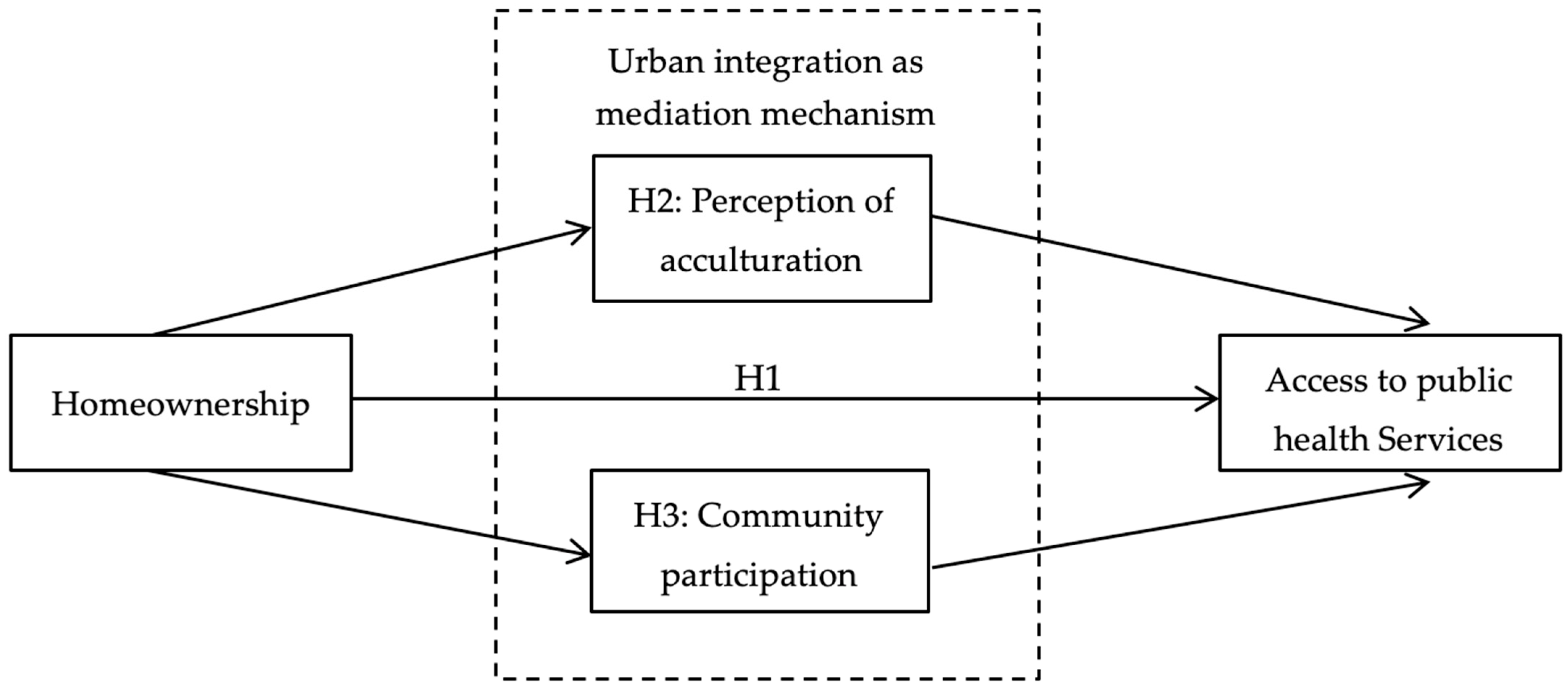
In summary, to examine the influencing mechanism of homeownership on migrants’ access to health services, we propose a parallel mediation model (see Figure 1).

3. Materials and Methods

3.1. Data

This study was based on the 2017 China Migrants Dynamic Survey (CMDS), which was organized by the National Health Commission and coordinated by the China Population and Development Research Center. As of now, the CMDS team has only publicly released survey data before 2018. Considering data availability and the appropriateness of indicators, we used the 2017 CMDS dataset, which contained the required information on housing conditions of Chinese migrants and their utilization of public health services. The 2017 CMDS was a large-scale nationwide questionnaire survey, encompassing 351 cities and 1290 counties/districts across 32 province-level units in China [43]. To be specific, it employed a multi-stage stratified sampling method and probability proportionate to size (PPS) technique to collect sociodemographic information on internal migrants and family members, as well as data on their employment and living conditions, urban integration, health status, marriage and family planning services management. The surveyed respondents generally met the following pre-defined criteria: (a) 15 years old or above; (b) having left their originally registered residence district and lived in the survey site for more than one month; (c) not a registered person in the local district. Given that this study focused on rural-to-urban migrants encountering challenges in urban integration, individuals with rural household registration were extracted from the database. After excluding observations with missing data on key variables (e.g., family income), a final sample of 132,115 valid cases was retained for subsequent empirical analysis.

3.2. Variables

The explained variable involved the accessibility of public health services. The questionnaire consisted of three questions regarding public health services. The first relevant question was “Do you know about the National Basic Public Health Services Program?”, with possible answers being “Yes = 1 and No = 0”. The second relevant question was “Have you established a resident health record in the local place?”, with optional responses being “No, I have never heard of it = 1; No, but I am aware of it = 2; Yes, I have established a health record = 3”. The third relevant question pertained to the receipt of health education services within the place of residence during the past year. There were the following nine health education items: Occupational disease prevention and treatment; Sexually transmitted diseases/AIDS prevention and treatment; Reproductive health and contraception; Tuberculosis prevention and control; Smoking cessation initiatives; Mental health support; Chronic disease prevention and treatment; Maternal and child health promotion practices; Self-evacuation measures in the event of public emergencies. If the respondent had received one type of health education service, the corresponding item was assigned a value of 1; otherwise, it was assigned a value of 0. Based on the three questions, this study constructed a binary dependent variable using relatively stringent standards: if respondents were aware of the National Basic Public Health Service Program, had established health records in the inflow area, and had received at least one community-based health education service within the past year, the sample was coded as 1, indicating a high level of health services accessibility; otherwise, it was coded as 0, indicating a low level of health services accessibility.
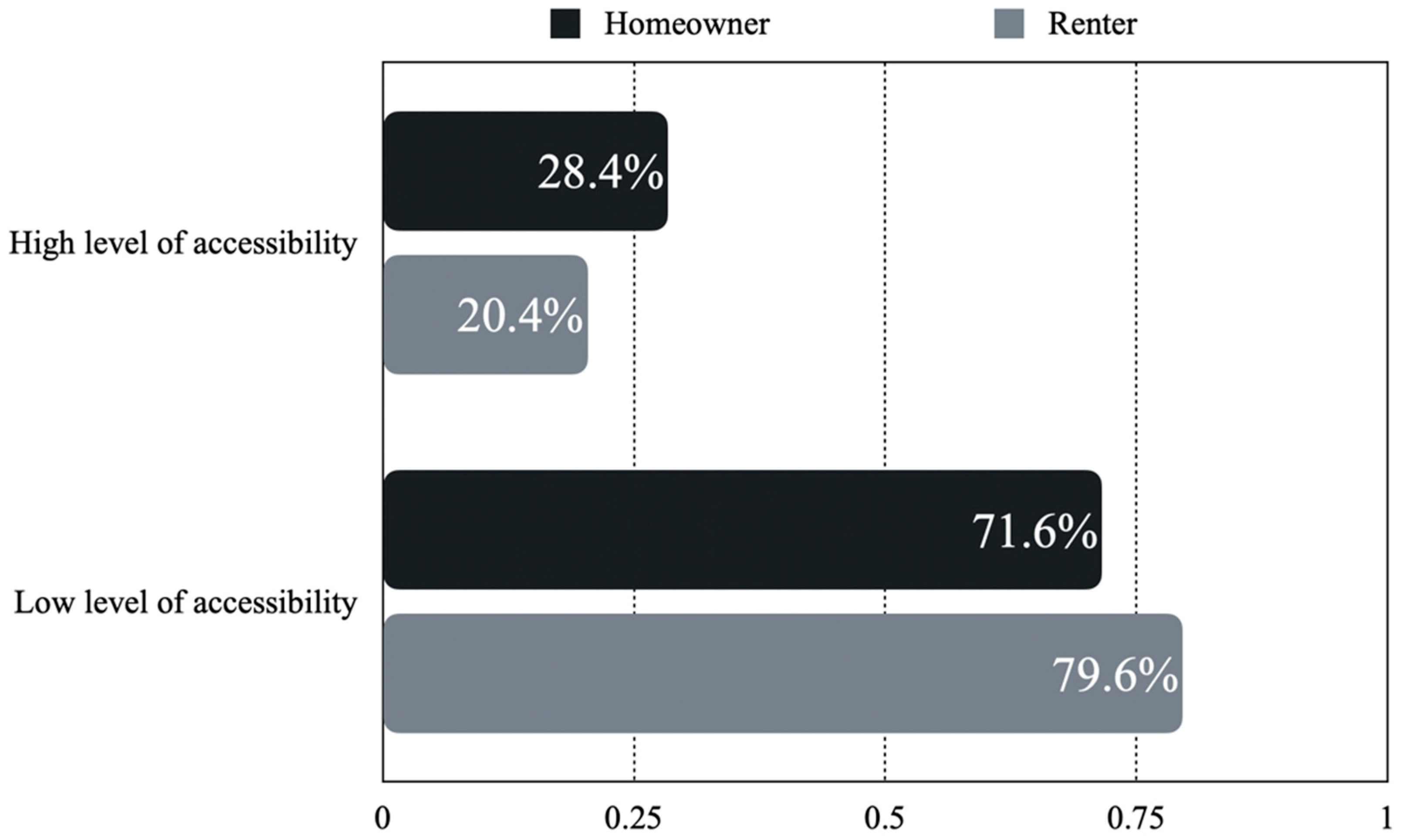
The core explanatory variable in this study was homeownership status among Chinese rural-to-urban migrants. Consistent with the relevant literature [21], individuals who have purchased a dwelling in their current place of residence—whether with or without a mortgage—were coded as homeowners. In contrast, those residing in accommodations rented from private landlords or business entities were classified as renters. As shown in the descriptive statistics presented in Table 1, a total of 27,453 individuals, or 20.8% of the sample, owned housing, while 104,662 individuals, accounting for 79.2%, resided in rented accommodations. To provide a more intuitive illustration of the relationship between homeownership and access to health services, we continued to draw a bar chart (see Figure 2). Among homeowners, 28.4% had a high level of accessibility, compared to 20.4% among renters. In the meantime, the proportion of individuals experiencing low accessibility to health services was higher in the renter group than in the homeowner group. The preliminary analysis suggested that, on one hand, the proportion of migrants with high accessibility to health services remained relatively low (below 30%). On the other hand, compared to renters, those who owned housing appeared more likely to access public health services. Given this disparity, it is necessary to enhance the equity of urban health systems by improving health service accessibility for the floating population, particularly for individuals residing in rented accommodations.
Urban integration functioned as the mediating mechanism in our study, measured through two dimensions: subjective perception of acculturation and objective community participation. The survey investigated respondents’ perception of acculturation based on an 8-item Likert scale: (1) I like the place I live now; (2) I am concerned about changes in my current residence; (3) I would like to blend in with the locals and become one of them; (4) I feel that the local people are willing to accept me as one of them; (5) I feel that locals look down on outsiders (reverse coding); (6) It is important for me to follow the customs of my hometown (reverse coding); (7) There is a big difference between my hygiene habits and those of local citizens (reverse coding); (8) I feel like I’m already a local person. The available options were as follows: strongly disagree = 1, disagree = 2, agree = 3, strongly agree = 4. The Cronbach’s alpha coefficient value was 0.735, indicating a satisfactory level of internal consistency reliability. We then added the scores for each of the eight items to generate a composite index ranging from 8 to 32, with the larger value reflecting a higher level of acculturation.
Community participation served as an additional mediating variable. This concept generally reflects individuals’ concern for community affairs and their dedication to civic activities [40]. In our analysis, community participation was operationalized as the richness and frequency of participation in civic activities. The questionnaire included a query regarding the respondents’ involvement in various social organizations over the past year, i.e., trade unions, volunteer associations, alumni associations, fellow citizens’ associations, hometown chambers of commerce, and other civic groups. For each type of activity, the answer “Yes” was coded as 1, otherwise it was coded as 0. By summing the scores across these six types of civic activities, an index of community engagement richness ranging from 0 to 6 was obtained. As for the frequency of community participation, the questionnaire also included a question regarding the frequency of respondents’ civic activities (e.g., charitable donation, unpaid blood donation, volunteer work) over the past year, with response options being “never = 1, occasionally = 2, sometimes = 3, often = 4”. For the convenience of analysis, we used the principal component analysis method to convert these two variables into a common factor. The cumulative variance contribution rate was 65.2%, indicating that the extracted common factor retained the majority of the original indicators’ information. Then, the Min-Max standardization method was employed to transform the factor value into a continuous variable ranging from 0 to 100, enabling a standardized measurement of migrants’ community participation level.
In the statistical analysis, we incorporated a series of control variables related to sociodemographic and migration characteristics. Specifically, sociodemographic factors encompassed gender, age, ethnicity, educational attainment, marital status, occupational status, and monthly family income. In accordance with Andersen’s framework [14], health-related needs are important determinants influencing health-seeking behaviors. As such, we controlled for two pertinent factors: health insurance and self-reported health status. With respect to migration characteristics, this study included migration distance and migration time (i.e., duration of local residence). In addition, given regional variations in the implementation of public health services, provincial-level dummy variables were included to control for regional effects. Table 1 displays the descriptive statistics of the research variables.

3.3. Analytical Procedure

Our empirical analysis was carried out in four sequential steps, as outlined below. First, a baseline analysis was performed using a binary logit regression model to preliminarily assess the magnitude and direction of the effect of homeownership on health services accessibility. Second, robustness checks were implemented to validate the baseline regression results: (1) the instrumental variable method was applied to address potential reverse causality; (2) the propensity score matching (PSM) and inverse probability weighting (IPW) methods were adopted to correct for self-selection bias; (3) the robustness of inference to replacement (RIR) was utilized to examine omitted variable bias. Third, the Karlson-Holm-Breen (KHB) method was employed to decompose and quantify the mediating effects of subjective acculturation and objective community participation. Lastly, we conducted additional subgroup analyses to examine the heterogeneity of homeownership’s effects across diverse social groups.

4. Research Results

4.1. Baseline Analysis Using Binary Logit Regression Model

Table 2 presents the results regarding the effect of homeownership on migrants’ health services accessibility, based on the binary logit regression model. A nested modeling approach was employed: Model 1 included only the core independent variable; Model 2 added sociodemographic and migration-related characteristics; and Model 3 further incorporated two mediating variables. From Model 1 to Model 3, the Pseudo R2 value steadily increased, and the Wald chi-square statistic remained statistically significant at the 1% level, indicating that the analytical variables demonstrated satisfactory explanatory power. More importantly, homeownership and health services accessibility maintained a positively significant correlation in all models. For instance, the estimation results from Model 2 indicate that, after controlling for other variables, homeowners had an approximately 18.4% higher odds ratio of accessing public health services than renters (exp (0.169) − 1, p < 0.01). This finding provided initial support for Hypothesis 1. Moreover, it could be seen from Model 3 that after accounting for urban integration factors, the effect size of homeownership diminished significantly, indicating that the positive influence of housing tenure on access to health services might be partially mediated by the urban integration process. In the following text, we will adopt a mediation effect decomposition approach to rigorously examine the mediating mechanism.
Regarding control variables, the results presented in Table 2 show that most of them exert a statistically significant influence on migrants’ access to public health services. Specifically, compared with the reference group, women, younger individuals, ethnic minorities, those with higher educational attainment, and married persons exhibited a greater likelihood of accessing better health services. Additionally, shorter migration distances and longer durations of residence in the destination region were linked to greater familiarity with the local environment, thereby enhancing health services accessibility. However, these control variables may be subject to endogeneity concerns, and thus a detailed interpretation of their estimated effects is not the focus of this study.

4.2. Robustness Assessment of Baseline Analysis Results

4.2.1. Check of Reverse Causality

The baseline analysis suggests that homeownership positively impacts migrants’ access to public health services. Theoretically, individuals who enjoy improved public services at their destination may simultaneously develop a higher intention to purchase local housing. To address the potential issue of reverse causality, we use the provincial homeownership rate of migrants as an instrumental variable (IV), which satisfies both the relevance and exogeneity criteria. First, the provincial homeownership rate reflects the aggregate distribution of housing ownership within a given province and is strongly associated with the housing status of individual migrants, fulfilling the relevance condition. Second, the provincial-level homeownership rate is unlikely to directly influence individuals’ health-seeking behaviors, thereby supporting the exogeneity assumption.
The IV-Probit model, which is suitable for binary dependent variables, was employed to examine potential reverse causality. As presented in Table 3, the endogeneity test parameter athrho was significantly different from zero. Meanwhile, the Wald test result rejected the null hypothesis of exogenous explanatory variables, indicating the presence of endogeneity issues in the baseline regression. In other words, the use of the IV-Probit model could yield more reliable and consistent estimates. The provincial homeownership rate was found to exert a statistically significant influence on individuals’ homeownership status at the 1% level, satisfying the relevance condition required for a valid instrumental variable. More importantly, after accounting for potential endogeneity, migrants’ homeownership continued to demonstrate a positive effect on health services accessibility. As a result, the conclusion that homeownership is beneficial for migrants’ access to public health services is reasonably well supported.

4.2.2. Correction of Self-Selection Bias

In addition to the potential for reverse causality, this study may also be subject to self-selection bias, as the likelihood of being a homeowner could result from migrants’ self-selection based on their socio-demographic or mobility characteristics. To address this concern, we adopt the counterfactual framework proposed by Rosenbaum and Rubin [44], utilizing observable covariates (i.e., the control variables in Model 2 of Table 2) to estimate the propensity score (PS), which represents the probability of homeownership among the floating population. Then, based on the propensity score estimates, we employed two methods to correct for self-selection bias. The first approach was to utilize the propensity score matching (PSM) technique to construct comparable treatment group (homeowners) and control group (renters) in order to ease self-selection bias. Using the matched samples, the average difference in health services accessibility between the treatment and control groups was computed to estimate the average treatment effect on the treated (ATT). It should be noted that because health services accessibility is not a continuous variable, only the direction and significance of the ATT estimation effect need to be focused upon.
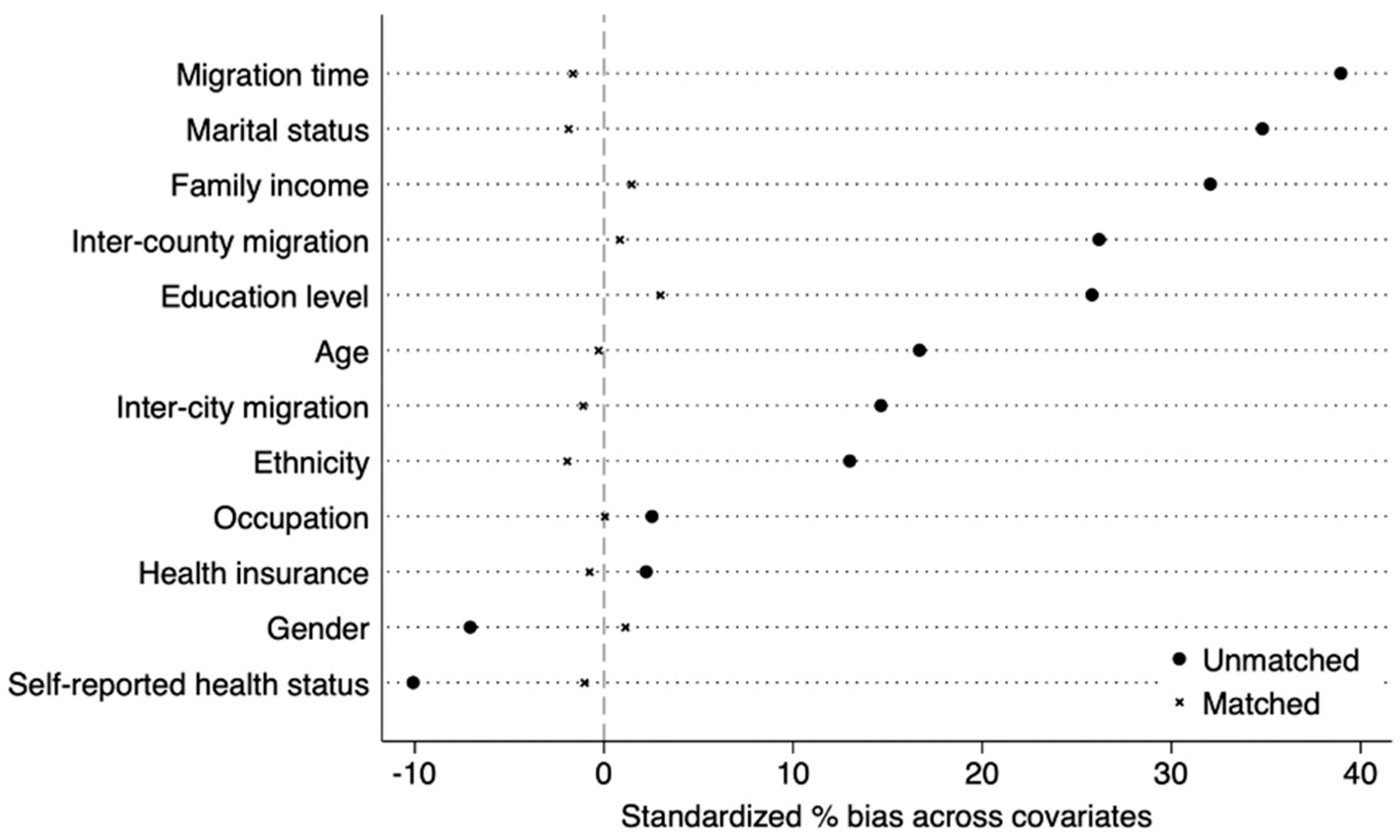
Figure 3 illustrates the balance of covariates between the treatment and control groups before and after one-to-five nearest neighbor matching. As can be observed from Figure 3, notable imbalances between the two groups were apparent prior to matching, and these disparities were considerably diminished following the matching process. Table 4 describes the ATT estimates after propensity score matching using the three matching strategies. Although the ATT values varied slightly across the different methods, all estimates consistently indicated that homeownership positively affected migrants’ access to public health services, consistent with the baseline analysis.
Subsequently, we continued to consider propensity scores as sample weights and applied them in weighted logit regression analysis to reduce self-selection bias. These propensity score–based weights operated in a manner analogous to sampling weights, allowing for seamless integration into conventional regression models. Specifically, we applied the inverse probability weighting (IPW) method to estimate the following three effect measures:
(1)
Average treatment effect (ATE)
Treatment group (homeowner): weight = 1/PS
Control group (renter): weight = 1/(1 − PS)
(2)
Average treatment effect on the treated (ATT)
Treatment group (homeowner): weight = 1
Control group (renter): weight = PS/(1 − PS)
(3)
Average treatment effect on the untreated (ATU)
Treatment group (homeowner): weight = (1 − PS)/PS
Control group (renter): weight = 1
Table 5 presents the impacts of homeownership on access to public health services across the full sample, homeowners (treatment group), and renters (control group). We found that the average treatment effect (ATE), average treatment effect on the treated (ATT), and average treatment effect on the untreated (ATU) were all statistically significant at the 1% level. Furthermore, in comparison with the baseline regression results of Model 2 in Table 2, the estimated effect of homeownership has increased to some extent, indicating that after correcting for self-selection bias, the health benefits associated with homeownership became more evident. To sum up, the PSM and IPW estimation results suggested that homeownership had a non-negligible positive effect on health services accessibility, reinforcing the findings of the baseline analysis.

4.2.3. Test of Omitted Variable Bias

In the baseline regression model, we have controlled for sociodemographic and migration characteristics, along with regional variables related to migrants’ access to public health services. Based on this, the PSM and IPW methods were employed to correct for self-selection bias. Yet, all the aforementioned methods were implemented by relying on observable variables, disregarding the potential interference of unobservable variables. According to Oster’s viewpoint, the estimation bias caused by omitted variables poses a significant challenge to the inference of causal effects [45].
To assess the degree to which the conclusions of the baseline model are influenced by omitted variables, we harness the robustness of inference to replacement (RIR) with dichotomous outcomes in a logit regression model. The RIR estimation is based on the calculation of the fragility index, which can be expressed as the expected number of replaced treatment cases with positive outcomes multiplied by the observed probability of negative outcomes in the control group. By conceptualizing robustness in terms of how many of the treatment cases would have to be replaced to change the inference, the RIR method can quantify the robustness of the inference in terms of the experiences of people expressed as potential outcomes. Additionally, the RIR is essentially non-parametric since it is applicable irrespective of the functional form that relates the covariate to the outcome or to the treatment. Therefore, it is also compatible with traditional regression analysis [46].
Specifically, the konfound command within the Stata 18.0 software was employed to compute the RIR and fragility index. The findings indicate that, in order to nullify the inference suggesting that the impact of the housing factor differs from 0 (at a significance level of 0.05), one would need to transfer 527 treatment success cases, i.e., homeowners with a high level of health services accessibility, to treatment failure with low level of health services accessibility (fragility index = 527). This is equivalent to replacing 628 (12.404%) treatment success cases with data points for which the probability of failure in the control group (83.964%) applies (RIR = 628). Thus, the effect of homeownership becomes insignificant only when the existence of omitted variables alters the homeowners’ high level of accessibility status by more than 10%. Given that the proportion of a high level of accessibility among rural-to-urban migrants was generally lower than 30% (see Figure 2), the aforementioned counterfactual scenario is unlikely to occur. This suggests that the inclusion of observed controls in this study was sufficient for statistical inference. As a result, the omitted variables do not undermine the core analytical conclusions of this study.

4.3. Mechanism Analysis Results

As indicated in Model 3 of Table 2, after the introduction of acculturation and community participation, the effect size of the core independent variable substantially decreased, suggesting a potential mediating role of these two factors. Nevertheless, when interpreting results from nested nonlinear probability models (e.g., logit regression model), direct comparisons of coefficient changes—commonly applied in nested linear models—were not statistically appropriate. In light of this, we employed the Karlson-Holm-Breen (KHB) method designed to address the issue of coefficient comparison in nonlinear probabilistic models [47].
Table 6 demonstrates the estimated results of mediating effect decomposition based on the KHB method. It could be seen that, in the relationship between homeownership and access to public health services, 70.1% of the total effect was mediated through acculturation and community participation. In addition, subjective acculturation seemed to exert a stronger mediating effect than objective community participation. In conclusion, homeownership not only directly enhances migrants’ access to public health services but also exerts significant indirect effects through the abovementioned two mediating pathways, thereby supporting Hypotheses H2 and H3.

4.4. Heterogeneity Analysis Results

The aforementioned analyses treated rural-to-urban migrants as a whole, focusing on the average effect of homeownership on health services accessibility, without accounting for potential heterogeneity problems. In light of this, we further conducted group comparisons according to four dimensions: gender, age, family income, and migration time. Consistent with the operationalization schemes adopted in relevant literature [19,38,48], gender was categorized into male and female subgroups; age was classified according to birth year as “birth before 1990” and “birth after 1990”; household income was divided into “high-income” and “low-income” subgroups based on the mean value; and migration time was categorized as “less than five years” and “five years or more”.
Table 7 displays the results of multiple group comparisons. The seemingly unrelated estimation (SUE) method was employed to assess the significance of the coefficient differences across relevant regression models. The findings indicate that the effect of homeownership did not significantly differ across gender and age subgroups, suggesting that demographic characteristics might not contribute to the heterogeneity of the effects. However, compared to the reference group, the impact of homeownership on health services accessibility was more pronounced among individuals from low-income households and those who had resided in urban areas for less than five years. Overall, the effect values of homeownership were consistently positive across all subgroups. In other words, homeownership could significantly enhance migrants’ access to public health services, particularly among low-income and vulnerable groups lacking local life experience, thereby contributing to the improved operational efficiency of urban health systems.

5. Discussion

To date, the health effects of housing for domestic migrants have been underexplored. Drawing upon data from the China Migrants Dynamic Survey (CMDS) conducted in 2017, the current study reveals that homeownership can significantly improve health services accessibility among rural-to-urban migrants, which underscores the critical role of housing stability in advancing equity within urban health systems [26,27]. Although previous research argued that the financial pressure associated with housing loans could adversely affect urban migrants’ health status [49], our analysis did not fully support this viewpoint. One possible explanation is that migrants are primarily motivated by the desire to access localized public welfare benefits, which drives their willingness to bear the financial burden. Therefore, although homeownership may entail certain health-related costs in the short term, the enhanced accessibility to health services resulting from residential stability constitutes a significant mechanism for safeguarding the health rights of the migrant population.
In the meantime, we found that urban integration served as an important mediating mechanism linking homeownership to health services accessibility. In our analysis, urban integration was categorized into two dimensions, i.e., subjective acculturation and objective community participation. The findings confirm that homeownership could increase the level of migrants’ acculturation to the local community, which would be beneficial for encouraging greater attention to personal health and more active utilization of local public health services [33,34,35]. In addition to the subjective perception of acculturation, community participation behaviors also played a mediating role that facilitated migrants’ use of public health services. On the one hand, self-owned housing enables migrants to develop robust local social networks, moving beyond the confines of kinship- or village-based networks. Such expanded social networks further broaden the channels for acquiring health-related information and resources [23]. On the other hand, frequent engagement in community activities enhances, to a certain extent, the familiarity of the floating population with local dialects and cultures, thereby objectively improving their capacity to access and utilize public resources [42].
Empirical analysis further examined the heterogeneous influence of homeownership. We found that the positive impact of homeownership was significantly more pronounced among individuals with lower household income, indicating a socioeconomic gradient in health services accessibility. Indeed, high-income groups often exhibit more demanding expectations regarding healthcare services, which may result in relatively lower utilization of primary public health services [50]. In contrast, owing to their constrained capacity to afford premium healthcare, low-income groups tend to hold free and universal services in higher esteem, often regarding them as reliable channels for maintaining their health [51]. As such, the greater demand for primary healthcare services by low-income migrants might strengthen the promotional influence of housing tenure on access to public health services. Additionally, in comparison with individuals who have lived locally for a longer period, those who have lived for less than five years may obtain more health benefits from stable housing. This result seemed to challenge the linear assumption that the longer the migration time, the better the social adaptation and the higher the utilization level of public health services [52]. Nevertheless, this novel insight can be supported by relevant research. For example, there has been evidence that the positive impacts of homeownership on establishing health records and participating in health education were significantly more prominent among short-term migrants [19]. This phenomenon actually signifies the different roles that housing tenure plays at different stages of migration. To be specific, newcomers tend to be at the peak of adaptation pressure. Thus, acquiring their own housing can rapidly provide essential psychological security. In contrast, those with a longer duration of residence are more likely to have attained a higher level of psychological and behavioral adaptation. As the degree of adaptation progresses, their health conditions tend to stabilize, and the demand for primary healthcare services may decrease [48]. Hence, in the later phase of migration, although homeownership still exerts a positive influence, its effect size is not as pronounced as in the early phase.

6. Conclusions, Implications, and Study Limitations

6.1. Conclusions

Driven by multiple factors such as urbanization, industrialization, and the transformation of the economic structure, internal migration in China has demonstrated remarkable features of expansion and a younger population. To guarantee that the large-scale floating population and local residents can equally access public health services, the Chinese government has implemented the equalization policy of basic public health services. This policy is committed to comprehensively safeguarding migrants’ health rights and interests. Nevertheless, as a socially vulnerable group, the floating population still faces the practical challenges of inadequate urban integration and unequal utilization of public health services. In the present article, from the perspective of residential discrimination, we quantitatively examined the relationship between migrants’ homeownership, urban integration, and their access to public health services.
The main research findings were presented as follows. Firstly, homeownership has shown a substantial positive influence on the level of health services accessibility for rural-to-urban migrants. After adjusting for the reverse causality issue using IV-Probit models and correcting the self-selection bias through the propensity score weighting approach, this conclusion remained robust. Secondly, mechanism analysis revealed that the promotional effect of homeownership on health services accessibility could be transmitted via the urban integration process: on one hand, homeownership could elevate migrants’ level of acculturation and contribute to strengthening their local identity, which facilitated their understanding and active usage of public health services; on the other hand, homeownership might also promote their active engagement in public activities and broaden their social network, thereby improving the efficiency of health information dissemination and increasing the likelihood of using public health services. Thirdly, heterogeneity analysis further pointed out that the effect of homeownership on health services accessibility was more pronounced in those with lower household income and shorter migration durations. This finding indicated that family economic status and migration time moderated the direct pathway through which homeownership influenced migrants’ health services accessibility.

6.2. Theoretical and Practical Implications

From an academic standpoint, the aforementioned findings hold theoretical significance for advancing health equity among diverse groups in urban areas. Firstly, our study underscores the critical role of housing tenure in shaping urban migrants’ healthy life chances, especially under a rapid urbanization context. To be precise, we harnessed empirical data to validate the inter-relationships among housing tenure, urban integration (i.e., subjective acculturation and objective community participation), and health services accessibility. This approach enables the establishment of a novel conceptual framework that enhances the understanding of potential housing discrimination within urban health systems. Secondly, the existing relevant research focuses on the adverse impact of the economic pressure stemming from home-purchase on an individual’s health status. Unlike the viewpoints of existing studies, this article emphasizes the potential role of housing tenure in narrowing the disparity in the accessibility of health services among different individuals. Thirdly, previous research has primarily focused on the fact that migrants with lower socioeconomic status may encounter health services dilemmas due to their unfamiliarity with public policies and limited ability to obtain health resources. However, the existing literature has overlooked the positive aspects of unfavorable living circumstances. We found that homeownership could enhance the accessibility of public health services for migrants from lower socioeconomic backgrounds more significantly. This finding indicates the potential to mitigate health inequalities across social classes by facilitating housing acquisition for rural-to-urban migrants.
Based on the above empirical analysis results, the following policy recommendations are put forward. To begin with, considering that homeowners’ accessibility to public health services is significantly higher than that of renters, relevant government departments need to assist renters in comprehending urban health policies and facilitate equitable development of public health practices. Then, this study demonstrates that acculturation and community participation can exert a substantial influence on health services accessibility. As such, it is imperative to proactively establish an institutional environment conducive to the migrants’ urban integration, effectively eliminating the inter-group prejudice arising from the self-identity and sociocultural differences. Last but not least, considering the inherent heterogeneity in the effects of homeownership, policymakers should formulate targeted housing policies to support migrants with low household incomes and short residence durations. Meanwhile, against the backdrop of current fluctuations in housing prices, special attention should be paid to migrants with a relatively weak ability to withstand credit risks. They should not be encouraged to blindly increase leverage for house purchases to avoid being trapped in an inescapable economic predicament during this period. These policy interventions not only contribute to enhancing disadvantaged migrants’ psychological security, sense of belonging, and self-identity as new citizens, but also help expand their social interaction channels and overcome communication barriers when utilizing public health services.

6.3. Study Limitations

There remain certain limitations in this study. First, due to the constraint of data availability, we utilized survey data from 2017. Although this dataset features a large sample size and national representativeness, it is difficult to promptly assess recent changes in housing and public health policy. Second, despite the application of statistical methods such as IV-Probit and propensity score weighting to mitigate potential endogeneity issues, the cross-sectional dataset employed still faced challenges in strictly identifying causal relationships between variables. Thus, it is necessary to adopt a longitudinal research design to test the robustness of the research findings. Third, this study investigated the parallel mediating roles of subjective acculturation and objective community participation; however, it did not conduct an in-depth exploration of the more complex interaction between psychological and behavioral adaptation processes. In future research, we will endeavor to enhance the validity of our findings by integrating longitudinal data and qualitative interview materials. This approach will enable us to more precisely elucidate the underlying mechanisms that link homeownership and migrants’ access to public health services.

Author Contributions

Research design, methodology, and manuscript writing, P.X.; Literature review and manuscript editing, Q.T.; Literature review, manuscript preparation, and writing, Y.H. All authors have read and agreed to the published version of the manuscript.

Funding

This study was supported by the Humanities and Social Sciences Fund of the Ministry of Education of the People’s Republic of China (Grant number: 22YJCZH204).

Institutional Review Board Statement

Following Chapter III Ethical Review–Article 32 of the Implementation of Ethical Review Measures for Human-Related Life Science and Medical Research issued by Chinese government, this study was exempt from ethical review and approval because it used anonymized information data for research purposes, which do not pose any harm to human subjects and do not involve the use of sensitive personal information or commercial interests.

Informed Consent Statement

Informed consent to participate in this study was provided by the survey participants.

Data Availability Statement

The dataset underpinning the conclusions of this study was obtained from the following official website: https://www.ncmi.cn/phda/dataDetails.do?id=CSTR:A0006.11.A000T.201906.000225 (accessed on 25 May 2024).

Conflicts of Interest

The authors declare no conflicts of interest.

References

  1. Song, Y.; Liu, J.; Yan, S.; Ma, M.; Tarimo, C.S.; Chen, Y.; Lai, Y.; Guo, X.; Wu, J.; Ye, B. Factors influencing health service utilization among 19,869 China’s migrant population: An empirical study based on the Andersen behavioral model. Front. Public Health 2025, 13, 1456839. [Google Scholar] [CrossRef]
  2. Gawde, N.C.; Sivakami, M.; Babu, B.V. Utilization of maternal health services among internal migrants in Mumbai, India. J. Biosoc. Sci. 2016, 48, 767–796. [Google Scholar] [CrossRef]
  3. Kusuma, Y.S.; Babu, B.V. Migration and health: A systematic review on health and health care of internal migrants in India. Int. J. Health Plan. Manag. 2018, 33, 775–793. [Google Scholar] [CrossRef]
  4. Kohlenberger, J.; Buber-Ennser, I.; Rengs, B.; Leitner, S.; Landesmann, M. Barriers to health care access and service utilization of refugees in Austria: Evidence from a cross-sectional survey. Health Policy 2019, 123, 833–839. [Google Scholar] [CrossRef]
  5. De Freitas, C.; Massag, J.; Amorim, M.; Fraga, S. Involvement in maternal care by migrants and ethnic minorities: A narrative review. Public Health Rev. 2020, 41, 5. [Google Scholar] [CrossRef] [PubMed]
  6. Brown, H.; Breislin, E. Comparing health service usage of migrant groups in Australia: Evidence from the household income and labour dynamics survey of Australia. J. Migr. Health 2024, 10, 100277. [Google Scholar] [CrossRef] [PubMed]
  7. Puthoopparambil, S.J.; Phelan, M.; MacFarlane, A. Migrant health and language barriers: Uncovering macro level influences on the implementation of trained interpreters in healthcare settings. Health Policy 2021, 125, 1085–1091. [Google Scholar] [CrossRef] [PubMed]
  8. Sheikh, M.; Anderson, J.R. Acculturation patterns and education of refugees and asylum seekers: A systematic literature review. Learn. Individ. Differ. 2018, 67, 22–32. [Google Scholar] [CrossRef]
  9. Östergren, O.; Rehnberg, J.; Lundberg, O.; Miething, A. Disruption and selection: The income gradient in mortality among natives and migrants in Sweden. Eur. J. Public Health 2023, 33, 372–377. [Google Scholar] [CrossRef]
  10. Ginsburg, C.; Collinson, M.A.; Gómez-Olivé, F.X.; Gross, M.; Harawa, S.; Lurie, M.N.; Mukondwa, K.; Pheiffer, C.F.; Tollman, S.; Wang, R.; et al. Internal migration and health in South Africa: Determinants of healthcare utilisation in a young adult cohort. BMC Public Health 2021, 21, 554. [Google Scholar] [CrossRef]
  11. Meng, Q. Strengthening public health systems in China. Lancet Public Health 2022, 7, e987–e988. [Google Scholar] [CrossRef] [PubMed]
  12. Walsh, S.D.; Tuval-Mashiach, R. Ethiopian emerging adult immigrants in Israel: Coping with discrimination and racism. Youth Soc. 2012, 44, 49–75. [Google Scholar] [CrossRef]
  13. National Bureau of Statistics. The Primary Data of the 7th National Population Census. Available online: https://www.stats.gov.cn/sj/zxfb/202302/t20230203_1901080.html (accessed on 25 April 2025).
  14. Andersen, R.M. National health surveys and the behavioral model of health services use. Med. Care 2008, 46, 647–653. [Google Scholar] [CrossRef]
  15. Suo, Z.; Shao, L.; Lang, Y. A study on the factors influencing the utilization of public health services by China’s migrant population based on the Shapley value method. BMC Public Health 2023, 23, 2328. [Google Scholar] [CrossRef]
  16. Chen, Y.; Huang, F.; Zhou, Q. Equality of public health service and family doctor contract service utilisation among migrants in China. Soc. Sci. Med. 2023, 333, 116148. [Google Scholar] [CrossRef]
  17. Meng, X. Does a Different Household Registration Affect Migrants’ Access to Basic Public Health Services in China? Int. J. Environ. Res. Public Health 2019, 16, 4615. [Google Scholar] [CrossRef]
  18. Yan, Z. Housing crowding and sleep health in urban China: A mediation analysis of psychosocial pathways using nationally representative data. Soc. Sci. Med. 2025, 384, 118523. [Google Scholar] [CrossRef]
  19. Wang, Z.; Wu, Q.; Ming, J. The Relationship Between Homeownership and the Utilization of Local Public Health Services Among Rural Migrants in China: A Nationwide Cross-Sectional Study. Front. Public Health 2020, 8, 589038. [Google Scholar] [CrossRef]
  20. Wu, Y.; Xu, M.; Li, S.; Wang, H.; Dong, Q. The land of homesickness: The impact of homesteads on the social integration of rural migrants. PLoS ONE 2024, 19, e0307605. [Google Scholar] [CrossRef] [PubMed]
  21. Wang, Y. Housing cost burden, homeownership, and self-rated health among migrant workers in Chinese cities: The confounding effect of residence duration. Cities 2023, 133, 104128. [Google Scholar] [CrossRef] [PubMed]
  22. Jia, F.; Liu, X.; Wang, Y. Social integration as a mediator of the association between housing tenure and health inequalities among China’s migrants: A housing discrimination perspective. SSM-Popul. Health 2024, 25, 101614. [Google Scholar] [CrossRef]
  23. Liu, W.; Liu, L. Housing tenure and type choices of urban migrants in China. J. Geogr. Sci. 2023, 33, 1832–1850. [Google Scholar] [CrossRef]
  24. Lin, S.; Wu, F.; Li, Z. Beyond neighbouring: Migrants’ place attachment to their host cities in China. Popul. Space Place 2021, 27, e2374. [Google Scholar] [CrossRef]
  25. Xu, X.; Zhang, Q.; You, H.; Wu, Q. Awareness, Utilization and Health Outcomes of National Essential Public Health Service Among Migrants in China. Front. Public Health 2022, 10, 936275. [Google Scholar] [CrossRef] [PubMed]
  26. Lyu, J.; Feng, B.; Kim, H.; Marwah, G. Evaluating Chinese migrant workers’ housing conditions by diarrhea disease prevalence. J. Public Health Policy 2025, 46, 518–532. [Google Scholar] [CrossRef]
  27. Zhou, M.; Guo, W. Self-rated Health and Objective Health Status Among Rural-to-Urban Migrants in China: A Healthy Housing Perspective. Popul. Res. Policy Rev. 2023, 42, 2. [Google Scholar] [CrossRef]
  28. Park, R.E. Human Migration and the Marginal Man. Am. J. Sociol. 1928, 33, 881–893. [Google Scholar] [CrossRef]
  29. Xie, S.; Hou, H.; Sun, Y.; Huang, X.; Wei, L. Acculturation of rural–urban migrants in China: Strategies and determinants. Int. J. Intercult. Relat. 2024, 101, 101991. [Google Scholar] [CrossRef]
  30. Zhou, M.; Guo, W. Housing characteristics and health in urban China: A comparative study of rural migrants and urban locals. Popul. Space Place 2023, 29, e2600. [Google Scholar] [CrossRef]
  31. Fong, E.; Yuan, Y.; Gan, Y. Homeownership and happiness in urban China. J. Hous. Built Environ. 2021, 36, 153–170. [Google Scholar] [CrossRef]
  32. Huang, L.; Said, R.; Goh, H.C.; Cao, Y. The Residential Environment and Health and Well-Being of Chinese Migrant Populations: A systematic review. Int. J. Environ. Res. Public Health 2023, 20, 2968. [Google Scholar] [CrossRef]
  33. Lin, S.; Wu, F.; Li, Z. Social integration of migrants across Chinese neighbourhoods. Geoforum 2020, 112, 118–128. [Google Scholar] [CrossRef]
  34. Ma, N.; Sun, W.; Wang, Z. Host identity and consumption behavior: Evidence from rural–urban migrants in China. Sustainability 2022, 14, 12462. [Google Scholar] [CrossRef]
  35. Peng, B.; Ling, L. Health service behaviors of migrants: A conceptual framework. Front. Public Health 2023, 11, 1043135. [Google Scholar] [CrossRef]
  36. Metersky, K.; Guruge, S.; Wang, L.; Al-Hamad, A.; Yasin, Y.M.; Catallo, C.; Yang, L.; Salma, J.; Zhuang, Z.C.; Chahine, M.; et al. Transnational Healthcare Practices Among Migrants: A concept analysis. J. Adv. Nurs. 2025, 81, 3647–3673. [Google Scholar] [CrossRef]
  37. Markkula, N.; Cabieses, B.; Lehti, V.; Uphoff, E.; Astorga, S.; Stutzin, F. Use of health services among international migrant children—A systematic review. Glob. Health 2018, 14, 52. [Google Scholar] [CrossRef]
  38. Dong, E.; Yan, Y.; Ji, S.; Li, J.; Wang, T.; Shi, J.; Xu, T.; Gao, W.; Liu, Y.; Zhang, S. The influences of acculturation strategies on physician trust among internal migrants in Shanghai, China: A cross-sectional study in 2021. Front. Public Health 2025, 13, 1506520. [Google Scholar] [CrossRef]
  39. Pettigrew, T.F. Intergroup contact theory. Annu. Rev. Psychol. 1998, 49, 65–85. [Google Scholar] [CrossRef]
  40. Silke, C.; Brady, B.; Dolan, P.; Boylan, C. Social values and civic behaviour among youth in Ireland: The influence of social contexts. Ir. J. Sociol. 2020, 28, 44–64. [Google Scholar] [CrossRef]
  41. Jing, Z.; Wang, Y.; Ding, L.; Tang, X.; Feng, Y.; Zhou, C. Effect of social integration on the establishment of health records among elderly migrants in China: A nationwide cross-sectional study. BMJ Open 2019, 9, e034255. [Google Scholar] [CrossRef]
  42. Zhao, Q.; Xu, S.; Aziz, N.; He, J.; Wang, Y. Dialect culture and the utilization of public health service by rural migrants: Insights from China. Front. Public Health 2022, 10, 985343. [Google Scholar] [CrossRef]
  43. Zhang, S.F.; Luo, W.; Wang, Z.L.; Chen, J.; Zhou, F.; Sun, J.W.; Wang, J.Y.; Zhang, J.C.; Zhou, W. A dataset on the dynamic monitoring of health and family planning of China’s internal migrants: A multi-wave large-scale, national cross-sectional survey from 2009 to 2018. Chin. Med. Sci. J. 2023, 38, 235–241. [Google Scholar] [CrossRef] [PubMed]
  44. Rosenbaum, P.R.; Rubin, D.B. The central role of the propensity score in observational studies for causal effects. Biometrika 1983, 70, 41–55. [Google Scholar] [CrossRef]
  45. Oster, E. Unobservable selection and coefficient stability: Theory and evidence. J. Bus. Econ. Stat. 2019, 37, 187–204. [Google Scholar] [CrossRef]
  46. Frank, K.A.; Lin, Q.; Maroulis, S.; Mueller, A.S.; Xu, R.; Rosenberg, J.M.; Hayter, C.S.; Mahmoud, R.A.; Kolak, M.; Dietz, T.; et al. Hypothetical case replacement can be used to quantify the robustness of trial results. J. Clin. Epidemiol. 2021, 134, 150–159. [Google Scholar] [CrossRef]
  47. Breen, R.; Karlson, K.B.; Holm, A. Total, Direct, and Indirect Effects in Logit and Probit Models. Sociol. Methods Res. 2013, 42, 164–191. [Google Scholar] [CrossRef]
  48. Zhao, Q.; Wu, G.; Wang, H.; Aziz, N. How does choice of residential community affect the social integration of rural migrants: Insights from China. BMC Psychol. 2024, 12, 119. [Google Scholar] [CrossRef]
  49. Jia, F.; Liu, X.; Wang, Y.; Ma, M. The effect of housing tenure on health status of migrant populations in China: Are health service utilization and social integration mediating factors? Arch. Public Health 2023, 81, 200. [Google Scholar] [CrossRef]
  50. Xu, H.; Yang, H.; Wang, H.; Li, X. The Association of Residence Permits on Utilization of Health Care Services by Migrant Workers in China. Int. J. Environ. Res. Public Health 2021, 18, 9623. [Google Scholar] [CrossRef]
  51. Pabbla, A.; Duijster, D.; Aartman, I.H.A.; Agyemang, C. Predictors of oral healthcare utilization and satisfaction among Indian migrants and the host population in the Netherlands. BMC Oral Health 2024, 24, 1228. [Google Scholar] [CrossRef]
  52. Wang, J.; Zhu, J.; Wang, X.; Che, Y.; Bai, Y.; Liu, J. Sociodemographic disparities in the establishment of health records among 0.5 million migrants from 2014 to 2017 in China: A nationwide cross-sectional study. Int. J. Equity Health 2021, 20, 250. [Google Scholar] [CrossRef] [PubMed]
Figure 1. Conceptual framework for the present study.
Systems 14 00040 g001
Figure 2. The distribution characteristics of homeownership and health services accessibility.
Systems 14 00040 g002
Figure 3. The balancing distribution of observable variables before and after matching.
Systems 14 00040 g003
Table 1. Summary statistics for the research variables.
VariablesCodingHomeowner (N = 27,453)Renter (N = 104,662)t-Test
Results
MeanStandard DeviationMeanStandard Deviation
Health services accessibilityhigh level = 1, low level = 00.2840.4510.2040.403p < 0.01
Gendermale = 1, female = 00.4920.5000.5270.499p < 0.01
Agescaled in years37.68510.82535.89310.676p < 0.01
Ethnicityethnic Han = 1, ethnic minority = 00.9290.2570.8920.310p < 0.01
Education levelcollege or above = 1, high school or below = 00.1810.3850.0930.290p < 0.01
Marital statusmarried = 1, unmarried = 00.9110.2850.7890.408p < 0.01
Occupationemployer or self-employment = 1, employee or other status = 00.3560.4790.3440.475p < 0.01
Family incomemonthly income scaled in Yuan8041.2706696.5256408.5104549.026p < 0.01
Health insurancehave = 1, not have = 00.9300.2550.9240.265p < 0.01
Self-reported health statushealthy = 1, unhealthy = 00.7910.4070.8310.375p < 0.01
Migration distance
(reference group: inter-province)
inter-city within the province0.3700.4830.3010.459p < 0.01
inter-county within the city0.2570.4370.1520.359p < 0.01
Migration timescaled in years8.2566.6415.8205.840p < 0.01
Acculturationrange: 4 to 3225.9073.19824.2873.236p < 0.01
Community participationrange: 0 to 10015.69217.04112.22615.357p < 0.01
Notes: To examine differences between homeowners and renters, we performed grouped descriptive statistics on both the explained and control variables and reported the statistical significance of differences using independent-samples t test.
Table 2. Binary logit regression analysis on the determinants of health services accessibility.
Model 1Model 2Model 3
Core explanatory variable
Homeownership (renter = 0)0.436 ***
(0.015)
0.169 ***
(0.018)
0.052 ***
(0.018)
Control variables
Gender (female = 0) −0.146 ***
(0.014)
−0.214 ***
(0.015)
Age −0.003 ***
(0.001)
−0.0005
(0.0008)
Ethnicity (minority = 0) −0.094 ***
(0.025)
−0.113 ***
(0.025)
Education level (high school or below = 0) 0.263 ***
(0.023)
0.059 **
(0.024)
Marital status (unmarried = 0) 0.333 ***
(0.022)
0.373 ***
(0.023)
Occupation (employee or other status = 0) 0.003
(0.016)
0.004
(0.016)
Family income (logarithmic) 0.019
(0.013)
−0.064 ***
(0.014)
Health insurance (not have = 0) 0.461 ***
(0.031)
0.392 ***
(0.031)
Self-reported health status (unhealthy = 0) 0.258 ***
(0.019)
0.203 ***
(0.020)
Migration distance (inter-province = 0)
Inter-city within the province 0.110 ***
(0.018)
0.059 ***
(0.018)
Inter-county within the city 0.165 ***
(0.022)
0.060 ***
(0.023)
Migration time 0.023 ***
(0.001)
0.016 ***
(0.001)
Mediating mechanism variables
Acculturation 0.080 ***
(0.002)
Community participation 0.022 ***
(0.001)
Provincial dummy variablesuncontrolledcontrolledcontrolled
Log pseudolikelihood−69,324.396−63,745.342−61,682.212
Pseudo R20.0060.0860.115
Wald chi-square test796.760 ***10,041.220 ***13,561.310 ***
Notes: The robust standard errors of the regression coefficients were presented in parentheses; Model 2 and 3 included provincial dummy variables to control the regional effects; ** denotes p < 0.05, *** denotes p < 0.01.
Table 3. IV-Probit analysis on the determinants of health services accessibility.
First-Stage Regression
DV: Homeownership
Second-Stage Regression
DV: Health Services Accessibility
Homeownership0.956 ***
(0.029)
Provincial homeownership rate0.923 ***
(0.008)
Other variablesControlledControlled
Error correlation testathrho value = —0.329; p < 0.01
Wald test of exogeneitychi-square value = 666.070; p < 0.01
Notes: The standard error of the regression coefficient is presented in parentheses; DV = Dependent Variable; *** denotes p < 0.01.
Table 4. Results of Propensity Score Matching Estimations.
Matching MethodsTreatment GroupControl GroupATT
Nearest neighbor matching (1:1)0.2840.2410.043 ***
(t value = 10.270)
Nearest neighbor matching (1:5)0.2840.2380.046 ***
(t value = 13.280)
Local linear regression matching0.2840.2310.053 ***
(t value = 12.200)
Notes: *** denotes p < 0.01.
Table 5. Binary logit regression analysis using propensity score weighting.
Weighting ApproachesHomeownership’s Effect EstimationRobust Standard Error95% Confidence Interval
ATE0.241 ***0.028[0.185, 0.297]
ATT0.198 ***0.020[0.160, 0.237]
ATU0.250 ***0.034[0.182, 0.317]
Notes: *** denotes p < 0.01.
Table 6. The mediating effect decomposition results based on the KHB method.
Effect ValueStandard ErrorContribution Ratio
Total effect0.174 ***0.018100%
Direct effect0.052 ***0.01829.9%
Indirect Path (a): Acculturation0.074 ***0.00342.5%
Indirect Path (b): Community participation0.048 ***0.00327.6%
Sum of indirect effect0.122 ***0.004Path (a) + Path (b) = 70.1%
Notes: The settings of control variables in the mediation analysis model are consistent with those in Table 2; *** denotes p < 0.01.
Table 7. Group comparisons of the effect of homeownership on health services accessibility.
Grouping (a): Gender Grouping (b): Age
MaleFemaleBirth Before 1990Birth After 1990
Homeownership0.151 ***
(0.025)
0.185 ***
(0.025)
0.160 ***
(0.019)
0.187 ***
(0.043)
Other variablesControlledControlledControlledControlled
Pseudo R20.0860.0840.0850.087
Sample size68,70563,410101,65230,463
Coefficient difference testChi-square value = 0.880
p > 0.1
Chi-square value = 0.330
p > 0.1
Grouping (c): Family IncomeGrouping (d): Migration Time
Low IncomeHigh IncomeLess Than Five YearsFive Years or More
Homeownership0.229 ***
(0.026)
0.133 ***
(0.024)
0.285 ***
(0.028)
0.101 ***
(0.023)
Other variablesControlledControlledControlledControlled
Pseudo R20.0840.0890.0830.086
Sample size65,86466,25166,56465,551
Coefficient difference testChi-square value = 7.070
p < 0.01
Chi-square value = 25.450
p < 0.01
Notes: The settings of other variables are the same as those in Table 2; *** denotes p < 0.01.
Disclaimer/Publisher’s Note: The statements, opinions and data contained in all publications are solely those of the individual author(s) and contributor(s) and not of MDPI and/or the editor(s). MDPI and/or the editor(s) disclaim responsibility for any injury to people or property resulting from any ideas, methods, instructions or products referred to in the content.