
How Does Participation in Technical Standard Setting Affect Firms’ Patient Capital Investment? Evidence from Enterprises Engaged in ICT Standardization

Abstract
1. Introduction
2. Theoretical Analysis and Model Construction
2.1. Participation in Technical Standard Setting and Corporate Patience Capital Investment
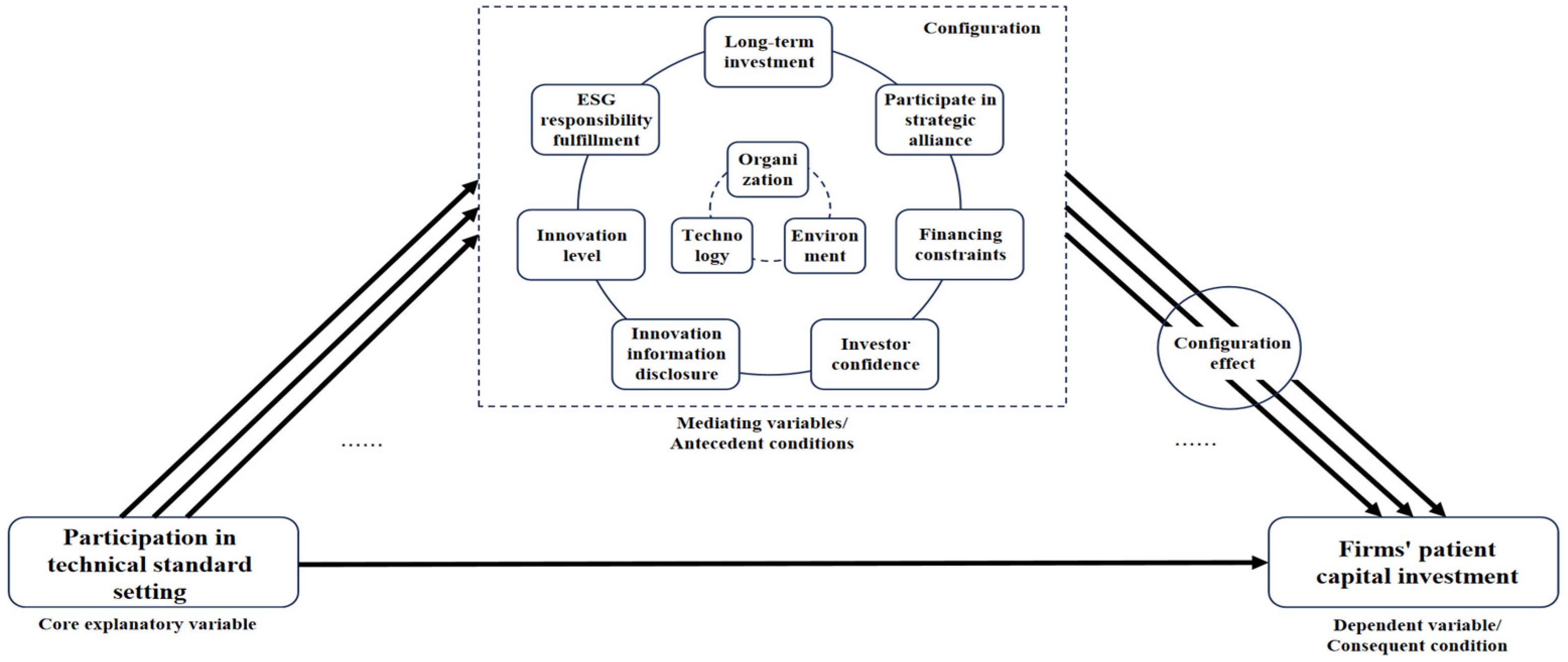
2.2. Complex Mechanisms of Participation in Technical Standard Setting on Corporate Patient Capital Investment from a Configuration Perspective
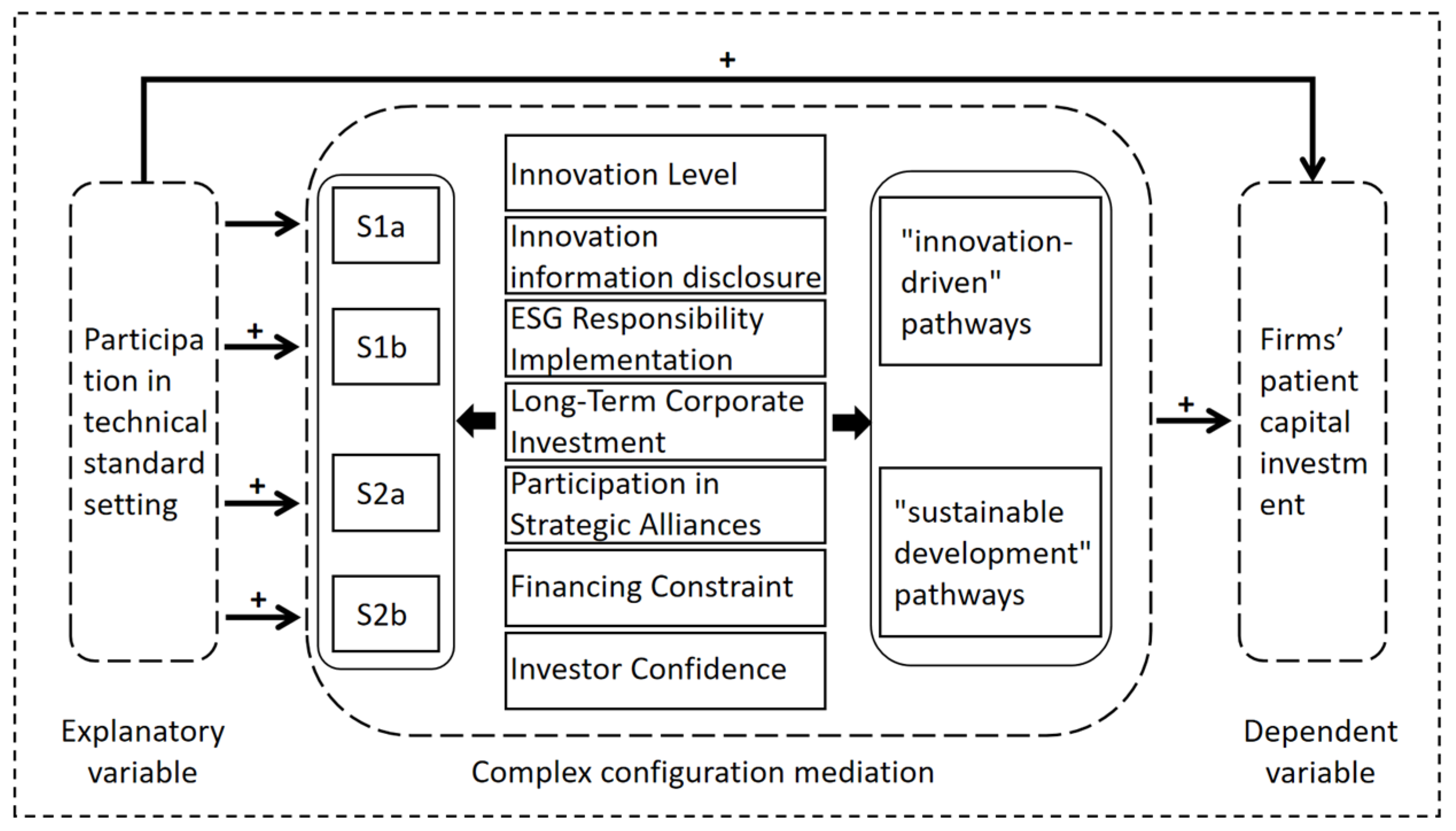
2.3. Complex Intermediary Model Based on the TOE Framework
3. Research Design
3.1. Research Methodology
3.1.1. Fuzzy Set Qualitative Comparative Analysis
3.1.2. Complex Mediation Model
3.2. Sample Selection and Data Sources
3.3. Variable Definitions
3.3.1. Dependent Variable: Patient Capital Investment (Patient)
3.3.2. Core Explanatory Variable: Participation in Technical Standard Setting (Standard)
3.3.3. Mediating Variables
3.3.4. Control Variables
4. Empirical Research
4.1. Descriptive Statistics
4.2. Benchmark Regression Analysis
4.3. Mechanism Analysis
4.3.1. Configuration Analysis of Factors Influencing Corporate Investment in Patience Capital
- (1)
- Necessity Analysis
- (2)
- Adequacy Analysis
- (3)
- Robustness Test
4.3.2. Analysis of the Complex Effects of Participating in Technical Standard Development on Patience Capital Investment in Enterprises
5. Further Analysis
5.1. Panel Data Regression Analysis
5.2. Linear Mechanism Analysis Based on Panel Data
6. Discussion
- (1)
- The failure of configuration S1a to demonstrate significant mediating effects may stem from the inability of technical standard participation to effectively induce or activate this particular strategic configuration. Theoretically, S1a’s core characteristics involve coexisting high innovation levels with non-elevated investor confidence, with marginal conditions including non-elevated innovation disclosure. This configuration depicts a strategic state where firms possess robust innovation capabilities yet maintain cautious market communication and fail to secure short-term investor favor. Participation in technical standard setting, as a high-level open innovation activity, exhibits logical mismatches with S1a’s constitutive conditions: First, potential conflict with firms’ low innovation disclosure. Engaging in standard-setting processes often requires firms to disclose partial technical information and share knowledge to build consensus and influence within alliances. This openness contradicts the deliberate low-profile, non-excessive disclosure strategy inherent in S1a. Consequently, firms actively involved in standard-setting may naturally gravitate toward the more open and transparent communication strategy of the S1b configuration—high innovation information disclosure. Second, the potential to correct low investor confidence. The identity of a technical standard-setter is typically perceived as a signal of a company’s technological strength and market leadership. This positive signal enhances the company’s visibility, legitimacy, and reputation in capital markets, potentially alleviating or correcting low investor confidence. In other words, participation in technical standard-setting activities itself may tend to shift companies from the low-confidence scenario associated with configuration S1a toward the high-confidence scenario represented by configuration S2b.
- (2)
- The mediation mechanism analysis reveals that the impact of participating in technical standard setting on a firm’s patient capital investment is not a single direct process. Instead, it is achieved through a complex mechanism of shaping and activating heterogeneous strategic configurations within the firm. Specifically, configurations S1b, S2a, and S2b are all confirmed to play significant mediating roles in this relationship, but their underlying mechanisms and path characteristics exhibit systematic differences.
- (3)
- The analytical results of linear mechanisms versus complex intermediary mechanisms reveal both significant differences and inherent complementarity, offering profound insights into the intricate dynamics between corporate behavior and capital markets. Linear regression results indicate that participation in technical standard setting exerts significant direct effects only on three variables: innovation level, innovation disclosure, and ESG responsibility fulfillment. Conversely, in the complex intermediary analysis, variables such as corporate long-term investment and financing constraints—which were insignificant in linear tests—emerge as key elements constituting effective configurations. This divergence suggests that in the real world, firms attract patient capital not through the isolated influence of a single factor, but by synergistically configuring multiple factors to achieve strategic objectives. Long-term corporate investment, which demonstrated limited direct influence in the linear model, emerged as a core condition in configurations S2a and S2b. This indicates that while it cannot function as an intermediary alone, it becomes indispensable when forming specific strategic combinations with other conditions.
7. Conclusions and Policy Recommendations
7.1. Conclusions
7.2. Policy Recommendations
Author Contributions
Funding
Institutional Review Board Statement
Informed Consent Statement
Data Availability Statement
Conflicts of Interest
References
- Dafe, F.; Upadhyaya, R. Varieties of capitalism and patient capital in developing and emerging economies: Evidence from Kenya. Socio-Econ. Rev. 2024, mwae074. [Google Scholar] [CrossRef]
- Deeg, R.; Hardie, I. What is patient capital and who supplies it? Socio-Econ. Rev. 2016, 14, 627–645. [Google Scholar] [CrossRef]
- Lin, J.Y.; Wang, Y. The new structural economics: Patient capital as a comparative advantage. J. Infrastruct. Policy Dev. 2017, 1, 4–23. [Google Scholar] [CrossRef]
- Kaplan, S.B. Globalizing Patient Capital: The Political Economy of Chinese Finance in the Americas; Cambridge University Press: Cambridge, UK, 2021. [Google Scholar]
- Cremers, M.; Pareek, A. Patient Capital Outperformance: The Investment Skill of High Active Share Managers Who Trade Infrequently. J. Financ. Econ. 2016, 122, 288–306. [Google Scholar] [CrossRef]
- Jiang, H.; Liu, W.; Zhao, S.; Chen, Y. Technology standardization, competitive behavior, and enterprises’ performance of innovation: A conceptual model. Libr. Hi Tech. 2020, 38, 251–269. [Google Scholar] [CrossRef]
- Zhang, M.; Wang, Y.; Zhao, Q. Does participating in the standards-setting process promote innovation? Evidence from China. China Econ. Rev. 2020, 63, 101532. [Google Scholar] [CrossRef]
- Schmidt, J.; Steingress, W. No double standards: Quantifying the impact of standard harmonization on trade. J. Int. Econ. 2022, 137, 103619. [Google Scholar] [CrossRef]
- Wu, Y.; de Vries, H.J. Effects of participation in standardization on firm performance from a network perspective: Evidence from China. Technol. Forecast. Soc. Change 2022, 175, 121376. [Google Scholar] [CrossRef]
- Wakke, P.; Blind, K.; Ramel, F. The impact of participation within formal standardization on firm performance. J. Product. Anal. 2016, 45, 317–330. [Google Scholar] [CrossRef]
- Paik, J.H.; Kim, M.K.; Park, J.H. The antecedents and consequences of technology standardizations in Korean IT small and medium-sized enterprises. Inf. Technol. Manag. 2017, 18, 293–304. [Google Scholar] [CrossRef]
- Du, Y.; Hao, G.; Zhu, H. How Does Participation in AI Standardisation Affect the Sustainable Development of Strategic Emerging Enterprises Under the Background of Uncertainty? Evidence from China. Sustainability 2025, 17, 7817. [Google Scholar] [CrossRef]
- Zheng, Y.; Abdullah, M.; Md Rahin, N. Environmental, Social, and Governance (ESG) Performance and New Quality Productivity in China: The Mediating Role of Patient Capital. Sage Open 2025, 15, 21582440251394582. [Google Scholar] [CrossRef]
- Trudeau, D. Integrating social equity in sustainable development practice: Institutional commitments and patient capital. Sustain. Cities Soc. 2018, 41, 601–610. [Google Scholar] [CrossRef]
- McCarthy, M.A.; Sorsa, V.P.; van der Zwan, N. Investment preferences and patient capital: Financing, governance, and regulation in pension fund capitalism. Socio-Econ. Rev. 2016, 14, 751–769. [Google Scholar] [CrossRef]
- Thatcher, M.; Vlandas, T. Overseas state outsiders as new sources of patient capital: Government policies to welcome Sovereign Wealth Fund investment in France and Germany. Socio-Econ. Rev. 2016, 14, 647–668. [Google Scholar] [CrossRef]
- Li, H.; Lu, M. Implementation of the New Environmental Protection Law, Patient Capital, and Corporate Sustainable Development. Financ. Res. Lett. 2025, 86, 108365. [Google Scholar] [CrossRef]
- Chan, K.; Covrig, V.; Ng, L. What determines the domestic bias and foreign bias? Evidence from mutual fund equity allocations worldwide. J. Financ. 2005, 60, 1495–1534. [Google Scholar] [CrossRef]
- Bushee, B.J.; Carter, M.E.; Gerakos, J. Institutional investor preferences for corporate governance mechanisms. J. Manag. Account. Res. 2014, 26, 123–149. [Google Scholar] [CrossRef]
- Bernile, G.; Kumar, A.; Sulaeman, J. Home away from home: Geography of information and local investors. Rev. Financ. Stud. 2015, 28, 2009–2049. [Google Scholar] [CrossRef]
- Kuchler, T.; Li, Y.; Peng, L.; Stroebel, J.; Zhou, D. Social proximity to capital: Implications for investors and firms. Rev. Financ. Stud. 2022, 35, 2743–2789. [Google Scholar] [CrossRef]
- Wang, Z.; Ma, J.; Yao, Y.; Wu, N. Executive environmental concerns, patient capital, and corporate green innovation performance. Int. Rev. Financ. Anal. 2025, 108, 104702. [Google Scholar] [CrossRef]
- Wernerfelt, B. A resource-based view of the firm. Strateg. Manag. J. 1984, 5, 171–180. [Google Scholar] [CrossRef]
- Das, T.K.; Teng, B.S. A resource-based theory of strategic alliances. J. Manag. 2000, 26, 31–61. [Google Scholar] [CrossRef]
- Liu, X.L.; Chang, X.Z. Building a market-oriented innovation ecosystem for core technologies. Stud. Sci. Sci. 2024, 42, 614. [Google Scholar]
- Bernanke, B.S. Irreversibility, Uncertainty and Cyclical Investment. Q. J. Econ. 1983, 98, 85–106. [Google Scholar] [CrossRef]
- Warner, A.G.; Fairbank, J.F.; Steensma, H.K. Managing uncertainty in a formal standards-based industry: A real options perspective on acquisition timing. J. Manag. 2006, 32, 279–298. [Google Scholar] [CrossRef]
- Czajkowski, M.; Sobolewski, M. How much do switching costs and local network effects contribute to consumer lock-in in mobile telephony? Telecommun. Policy 2016, 40, 855–869. [Google Scholar] [CrossRef]
- Spence, M. Job Market Signaling. In Uncertainty in Economics; Elsevier: Amsterdam, The Netherlands, 1978; pp. 281–306. [Google Scholar]
- Gamarra, Y.L.; Friedl, G. Declared essential patents and average total R&D expenditures per patent family. Telecommun. Policy 2023, 47, 102575. [Google Scholar] [CrossRef]
- Tornatzky, L.G.; Fleischer, M. The Processes of Technological Innovation; Lexington Books: Lexington, MA, USA, 1990; pp. 152–154. [Google Scholar]
- Glücksman, S. Entrepreneurial experiences from venture capital funding: Exploring two-sided information asymmetry. Ventur. Cap. 2020, 22, 331–354. [Google Scholar] [CrossRef]
- Sun, H.; Liu, L.; Li, P. How technical standards transform ESG performance into competitive advantage: Evidence from China. Appl. Econ. 2025, 1–15. [Google Scholar] [CrossRef]
- Riillo, C.A.; Jakobs, K. Too many or too few Standards Setters? Evidence from the Performance of Firms engaged in Standardization. J. Technol. Transf. 2023, 48, 2106–2131. [Google Scholar] [CrossRef]
- Wen, J.; Qualls, W.J.; Zeng, D. Standardization alliance networks, standard-setting influence, and new product outcomes. J. Prod. Innov. Manag. 2020, 37, 138–157. [Google Scholar] [CrossRef]
- Deng, X.; Li, Q.C.; Mateut, S. Participation in setting technology standards and the implied cost of equity. Res. Policy 2022, 51, 104497. [Google Scholar] [CrossRef]
- Aggarwal, N.; Dai, Q.; Walden, E.A. The More, the Merrier? How the Number of Partners in a Standard-Setting Initiative Affects Shareholder’s Risk and Return. MIS Q. 2011, 35, 445–462. [Google Scholar] [CrossRef]
- Fiss, P.C. A set-theoretic approach to organizational configurations. Acad. Manag. Rev. 2007, 32, 1180–1198. [Google Scholar] [CrossRef]
- Du, Y.Z.; Jia, L.D. Configuration perspective and qualitative comparative analysis (QCA): A new way of management research. Manag. World 2017, 6, 155–167. [Google Scholar]
- Thomann, E.; Maggetti, M. Designing research with qualitative comparative analysis (QCA): Approaches, challenges, and tools. Sociol. Methods Res. 2020, 49, 356–386. [Google Scholar] [CrossRef]
- Ragin, C.C. The Comparative Method: Moving Beyond Qualitative and Quantitative Strategies; University of California Press: Oakland, CA, USA, 2014. [Google Scholar]
- Rihoux, B.; Ragin, C.C. (Eds.) Configurational Comparative Methods: Qualitative Comparative Analysis (QCA) and Related Techniques; SAGE: Thousand Oaks, CA, USA, 2009; Volume 51. [Google Scholar]
- Ragin, C.C. Redesigning Social Inquiry: Fuzzy Sets and Beyond; University of Chicago Press: Chicago, IL, USA, 2009. [Google Scholar]
- Misangyi, V.F.; Greckhamer, T.; Furnari, S.; Fiss, P.C.; Crilly, D.; Aguilera, R. Embracing causal complexity: The emergence of a neo-configurational perspective. J. Manag. 2017, 43, 255–282. [Google Scholar] [CrossRef]
- Du, Y.; Liu, Q.; Kim, P.H.; Meuer, J. Studying complex causal processes in technological innovation and entrepreneurship with set-theoretic mediation models. Technovation 2024, 134, 103015. [Google Scholar] [CrossRef]
- Du, Y.Z.; Sun, N.; Liu, Q.C. Developing and analyzing complex mediation models using mixed methods: An illustration of doing business promoting innovation vitality, synergizing new quality productive forces and employment-first. J. Manag. World 2024, 40, 217–237. [Google Scholar]
- Wang, X.; Cheng, Y.; Li, B. To inhibit or to promote: How does patient capital affect firm new quality productivity in China? Financ. Res. Lett. 2025, 86, 108787. [Google Scholar] [CrossRef]
- Liu, J.; Xu, H. Institutional Investors: Are They Long-Term or Short-Term Investors. J. Financ. Res. 2012, 9, 141–154. [Google Scholar]
- Du, Y.; Liu, Q.; Cheng, J. What kind of ecosystem for doing business will contribute to city-level high entrepreneurial activity? A research based on institutional configurations. J. Manag. World 2020, 36, 141–155. [Google Scholar]
- Phillips, P.C.; Moon, H.R. Linear regression limit theory for nonstationary panel data. Econometrica 1999, 67, 1057–1111. [Google Scholar] [CrossRef]



| Comparative Dimension | Linear Regression Analysis | Configurational Analysis (Exemplified by fsQCA) |
|---|---|---|
| Philosophical Foundation | Reductionism: Decomposes the whole into independent parts to examine the “net effect” of single variables. | Holism/Configurational View: Treats cases as complex combinations of conditions, emphasizing synergistic effects of the whole. |
| Causal Logic | Linear, Additive, Symmetric: Assumes linear and additive causality; factors leading to a high outcome are often the inverse of those leading to a low outcome (symmetry). | Conjunctural, Equifinal, Asymmetric: Emphasizes multiple concurrent conditions leading to an outcome; the same outcome can be achieved by different condition combinations (equifinality); paths leading to the presence and absence of an outcome can be entirely different (asymmetry). |
| Key Strengths | Excels at quantifying the independent impact of single factors, making predictions, and statistical inference. Mature method with broad generalizability. | Excels at handling causal complexity, identifying multiple equifinal paths, and revealing interaction and synergy among variables. Closer to complex real-world decision-making contexts. |
| Key Limitations | Struggles to effectively capture complex interaction effects and non-linear relationships. The assumption of causal symmetry may not hold in reality. Sensitive to multicollinearity. | Difficulty in conducting statistical significance tests and probabilistic generalization. Interpretation relies more on theoretical framing and researcher’s deep engagement. The calibration process involves a degree of subjectivity. |
| Variable Type | Variable Name | Code | Measurement Method |
|---|---|---|---|
| Dependent Variable | Patient Capital Investment | Patient | Long-term Institutional Investor Shareholding Ratio |
| Explanatory Variable | Participate in technical standard setting | Standard | Number of times participating in national standard setting |
| Mediating Variables | Innovation Level | Inno | Total Patent Applications |
| Innovation information disclosure | Innoshow | Percentage of innovation keywords relative to total annual report words multiplied by 100 | |
| ESG Responsibility Implementation | ESG | Huazheng ESG Rating | |
| Long-Term Corporate Investment | LI | (Capital Expenditures + R&D Expenditures)/Total Assets | |
| Participation in Strategic Alliances | SA | Logarithm of the number of strategic alliances the enterprise participated in during the current year plus 1 | |
| Financing Constraint | RY | FC Index | |
| Investor Confidence | Faith | Principal component analysis was applied to five indicators: corporate revenue growth rate, earnings per share growth rate, institutional investor shareholding ratio, annual average turnover rate, and price-to-book ratio. | |
| Control Variables | Debt-to-Asset Ratio | Lev | Total liabilities at period end/Total assets at period end |
| Return on Assets | Roa | Net profit/Total assets at period-end | |
| Operating Revenue Growth Rate | Growth | (Current Year—Previous Year Operating Revenue)/Previous Year Operating Revenue | |
| Book-to-market ratio | MB | Total Assets at Period-End/Total Market Value of Individual Stocks at Period-End | |
| Largest Shareholder Holding Ratio | LargestHold | Largest Shareholder’s Shareholding Ratio as a Percentage of Total Shares | |
| Executive Shareholding Ratio | ManageHold | Percentage of Total Shares Held by Executives | |
| Board Independence | BoardInd | Proportion of Independent Directors | |
| Dual Role | Dual | 1 if the Chairman and CEO are the same person; otherwise, 0 | |
| Auditor from Big Four firms | Big4 | Auditor is from one of the Big Four firms: 1, otherwise 0 |
| Variable | Obs | Mean | Std. Dev. | Min | Median | Max |
|---|---|---|---|---|---|---|
| Patient | 211 | 0.022 | 0.028 | 0.000 | 0.011 | 0.123 |
| Standard | 211 | 2.384 | 2.586 | 1.000 | 1.000 | 16.000 |
| Lev | 211 | 0.463 | 0.239 | 0.112 | 0.424 | 0.939 |
| Roa | 211 | 0.004 | 0.068 | −0.313 | 0.014 | 0.108 |
| Growth | 199 | 0.020 | 0.278 | −0.680 | 0.009 | 1.236 |
| MB | 178 | 0.577 | 0.235 | 0.112 | 0.555 | 1.114 |
| LargestHold | 211 | 29.624 | 13.656 | 8.120 | 26.240 | 65.300 |
| ManageHold | 178 | 0.103 | 0.150 | 0.000 | 0.008 | 0.589 |
| BoardInd | 211 | 38.163 | 5.813 | 33.330 | 36.360 | 60.000 |
| Dual | 210 | 0.329 | 0.471 | 0.000 | 0.000 | 1.000 |
| Big4 | 178 | 0.112 | 0.317 | 0.000 | 0.000 | 1.000 |
| (1) | (2) | (3) | (4) | |
|---|---|---|---|---|
| Variables | Patient | Patient | Patient 2 | Patient |
| Standard | 0.003 *** | 0.003 *** | 0.003 *** | 0.003 *** |
| (3.583) | (3.167) | (3.128) | (3.167) | |
| Lev | −0.004 | −0.009 | −0.004 | |
| (−0.330) | (−0.608) | (−0.330) | ||
| Roa | 0.018 | 0.008 | 0.018 | |
| (0.500) | (0.180) | (0.500) | ||
| Growth | 0.003 | 0.007 | 0.003 | |
| (0.345) | (0.714) | (0.345) | ||
| MB | −0.015 | −0.013 | −0.015 | |
| (−1.502) | (−1.054) | (−1.502) | ||
| Largest Hold | −0.000 | −0.000 | −0.000 | |
| (−1.277) | (−0.797) | (−1.277) | ||
| Manage Hold | −0.031 * | −0.030 | −0.031 * | |
| (−1.732) | (−1.373) | (−1.732) | ||
| Board Ind | −0.000 | −0.000 | −0.000 | |
| (−0.174) | (−0.282) | (−0.174) | ||
| Dual | 0.000 | 0.003 | 0.000 | |
| (0.008) | (0.454) | (0.008) | ||
| Big4 | 0.023 *** | 0.026 *** | 0.023 *** | |
| (3.023) | (2.896) | (3.023) | ||
| Constant | 0.016 *** | 0.036 ** | 0.039 * | 0.036 ** |
| (6.219) | (2.189) | (1.957) | (2.189) | |
| Observations | 211 | 175 | 175 | 175 |
| R-squared | 0.058 | 0.179 | 0.151 | 0.179 |
| Condition Variable | High Patience Capital Investment | Non-High-Patience Capital Investment | ||
|---|---|---|---|---|
| Consistency | Coverage | Consistency | Coverage | |
| High innovation level | 0.684 | 0.778 | 0.519 | 0.575 |
| Non-high innovation level | 0.626 | 0.572 | 0.800 | 0.711 |
| High innovation information disclosure | 0.623 | 0.700 | 0.538 | 0.588 |
| Non-high-tech innovation information disclosure | 0.633 | 0.585 | 0.725 | 0.652 |
| High ESG Responsibility Performance | 0.709 | 0.751 | 0.501 | 0.516 |
| Non-High ESG Responsibility Performance | 0.543 | 0.528 | 0.758 | 0.717 |
| High-tech enterprises’ long-term investments | 0.604 | 0.744 | 0.489 | 0.586 |
| Non-high-risk enterprises’ long-term investments | 0.664 | 0.572 | 0.787 | 0.659 |
| High Participation in Strategic Alliances | 0.818 | 0.637 | 0.842 | 0.638 |
| Non-High-Participation Strategic Alliance | 0.535 | 0.776 | 0.521 | 0.736 |
| High Financing Constraints | 0.602 | 0.696 | 0.527 | 0.593 |
| Non-high financing constraints | 0.648 | 0.584 | 0.730 | 0.641 |
| High Investor Confidence | 0.538 | 0.563 | 0.743 | 0.756 |
| Non-high investor confidence | 0.766 | 0.754 | 0.570 | 0.545 |
| Condition Variables | Corporate High-Patience Capital Investment | Corporate Non-High-Patience Capital Investment | |||||
|---|---|---|---|---|---|---|---|
| S1a | S1b | S2a | S2b | N1a | N1b | N1c | |
| Innovation Level | |||||||
| Innovative Information Disclosure | ● | ||||||
| ESG Responsibility Implementation | |||||||
| Long-Term Investments | |||||||
| Participate in Strategic Alliances | |||||||
| Financing Constraints | |||||||
| Investor Confidence | |||||||
| Consistency | 0.918 | 0.932 | 0.948 | 0.936 | 0.922 | 0.923 | 0.917 |
| Original Coverage | 0.268 | 0.261 | 0.242 | 0.237 | 0.392 | 0.360 | 0.404 |
| Unique Coverage | 0.079 | 0.042 | 0.044 | 0.031 | 0.042 | 0.010 | 0.055 |
| Overall consistency | 0.932 | 0.916 | |||||
| Overall Coverage | 0.443 | 0.457 | |||||
| Condition Variable | Adjust PRI Consistency Threshold to 0.75 | Adjusted Case Frequency to 2 | ||
|---|---|---|---|---|
| S1 | S2 | S3 | S1 | |
| Innovation Level | ||||
| Innovation Disclosure | ||||
| ESG Responsibility Implementation | ||||
| Long-Term Corporate Investment | ||||
| Participation in Strategic Alliances | ||||
| Financing Constraints | ||||
| Investor Confidence | ||||
| Consistency | 0.948 | 0.932 | 0.936 | 0.932 |
| Original Coverage | 0.242 | 0.261 | 0.237 | 0.261 |
| Unique Coverage | 0.059 | 0.060 | 0.031 | 0.261 |
| Overall consistency | 0.939 | 0.932 | ||
| Overall Coverage | 0.364 | 0.261 | ||
| (1) | (2) | (3) | (4) | |
|---|---|---|---|---|
| Variables | S1a | S1b | S2a | S2b |
| Standard | 0.004 | 0.018 *** | 0.009 *** | 0.013 *** |
| (1.217) | (4.704) | (2.889) | (5.024) | |
| Controls | YES | YES | YES | YES |
| Observations | 175 | 175 | 175 | 175 |
| R-squared | 0.264 | 0.177 | 0.146 | 0.192 |
| (1) | (2) | (3) | (4) | |
|---|---|---|---|---|
| Variables | Patient | Patient | Patient | Patient |
| Standard | 0.002 *** | 0.002 *** | 0.001 | 0.002 * |
| (2.992) | (2.650) | (1.588) | (1.884) | |
| S1a | 0.038 ** | |||
| (1.998) | ||||
| S1b | 0.070 *** | |||
| (4.512) | ||||
| S2a | 0.044 ** | |||
| (2.151) | ||||
| S2b | 0.073 *** | |||
| (3.128) | ||||
| Controls | YES | YES | YES | YES |
| Observations | 175 | 175 | 175 | 175 |
| R-squared | 0.264 | 0.177 | 0.146 | 0.192 |
| (1) | (2) | (3) | (4) | |
|---|---|---|---|---|
| Variables | Patient | Patient | Patient | Patient |
| Standard | 0.001 *** | 0.001 *** | 0.001 *** | 0.001 ** |
| (4.941) | (4.570) | (3.607) | (2.400) | |
| Lev | 0.006 | 0.010 ** | 0.010 * | |
| (1.243) | (2.109) | (1.841) | ||
| Roa | 0.035 *** | 0.053 *** | 0.053 *** | |
| (2.745) | (3.952) | (3.251) | ||
| Growth | −0.001 | 0.001 | 0.001 | |
| (−0.418) | (0.323) | (0.342) | ||
| MB | −0.014 *** | −0.013 *** | −0.013 ** | |
| (−4.030) | (−3.519) | (−2.310) | ||
| Largest Hold | −0.000 ** | −0.000 *** | −0.000 ** | |
| (−2.482) | (−2.591) | (−2.021) | ||
| Manage Hold | −0.019 *** | −0.016 ** | −0.016 ** | |
| (−2.813) | (−2.386) | (−2.185) | ||
| Board Ind | 0.000 | −0.000 | −0.000 | |
| (0.304) | (−0.389) | (−0.318) | ||
| Dual | 0.003 | 0.003 | 0.003 | |
| (1.323) | (1.560) | (1.261) | ||
| Big4 | 0.008 *** | 0.008 *** | 0.008 ** | |
| (3.050) | (3.002) | (2.135) | ||
| Constant | 0.013 *** | 0.020 *** | 0.022 *** | 0.022 *** |
| (14.088) | (3.296) | (3.431) | (2.658) | |
| Ind | NO | NO | YES | YES |
| Year | NO | NO | YES | YES |
| Observations | 1247 | 982 | 966 | 966 |
| R-squared | 0.019 | 0.081 | 0.188 | 0.188 |
| (1) | (2) | (3) | (4) | |
|---|---|---|---|---|
| Variables | Patient 2 | Patient | Patient | Patient |
| Standard | 0.001 ** | 0.001 * | 0.001 ** | |
| (2.100) | (1.805) | (2.442) | ||
| L_Standard | 0.001 ** | |||
| (2.435) | ||||
| Controls | YES | YES | YES | YES |
| Firm | NO | YES | NO | NO |
| Ind | YES | YES | YES | YES |
| Year | YES | YES | YES | YES |
| Observations | 966 | 679 | 682 | 632 |
| R-squared | 0.167 | 0.701 | 0.188 | 0.172 |
| (1) | (2) | (3) | (4) | (5) | (6) | (7) | |
|---|---|---|---|---|---|---|---|
| Variables | Inno | Innoshow | ESG | LI | SA | RY | Faith |
| Standard | 74.536 *** | 0.000 *** | 0.307 *** | 0.001 | −0.005 | 0.005 | −0.037 ** |
| (2.737) | (2.915) | (4.013) | (1.469) | (−0.306) | (1.089) | (−2.282) | |
| Controls | YES | YES | YES | YES | YES | YES | YES |
| Ind | YES | YES | YES | YES | YES | YES | YES |
| Year | YES | YES | YES | YES | YES | YES | YES |
| Observations | 966 | 966 | 951 | 959 | 512 | 966 | 966 |
| R-squared | 0.365 | 0.248 | 0.206 | 0.196 | 0.189 | 0.230 | 0.465 |
Disclaimer/Publisher’s Note: The statements, opinions and data contained in all publications are solely those of the individual author(s) and contributor(s) and not of MDPI and/or the editor(s). MDPI and/or the editor(s) disclaim responsibility for any injury to people or property resulting from any ideas, methods, instructions or products referred to in the content. |
© 2025 by the authors. Licensee MDPI, Basel, Switzerland. This article is an open access article distributed under the terms and conditions of the Creative Commons Attribution (CC BY) license.
Share and Cite
Du, Y.; Zhu, H. How Does Participation in Technical Standard Setting Affect Firms’ Patient Capital Investment? Evidence from Enterprises Engaged in ICT Standardization. Systems 2026, 14, 33. https://doi.org/10.3390/systems14010033
Du Y, Zhu H. How Does Participation in Technical Standard Setting Affect Firms’ Patient Capital Investment? Evidence from Enterprises Engaged in ICT Standardization. Systems. 2026; 14(1):33. https://doi.org/10.3390/systems14010033
Chicago/Turabian StyleDu, Yijian, and Honghui Zhu. 2026. "How Does Participation in Technical Standard Setting Affect Firms’ Patient Capital Investment? Evidence from Enterprises Engaged in ICT Standardization" Systems 14, no. 1: 33. https://doi.org/10.3390/systems14010033
APA StyleDu, Y., & Zhu, H. (2026). How Does Participation in Technical Standard Setting Affect Firms’ Patient Capital Investment? Evidence from Enterprises Engaged in ICT Standardization. Systems, 14(1), 33. https://doi.org/10.3390/systems14010033