
Article

How Does Participation in Technical Standard Setting Affect Firms’ Patient Capital Investment? Evidence from Enterprises Engaged in ICT Standardization

School of Economics and Management, Shihezi University, Shihezi 832000, China
*
Author to whom correspondence should be addressed.
Systems 2026, 14(1), 33; https://doi.org/10.3390/systems14010033
Submission received: 26 November 2025 / Revised: 18 December 2025 / Accepted: 25 December 2025 / Published: 26 December 2025

Abstract

Against the backdrop of pursuing technological self-reliance and strength, examining how participation in technical standard setting influences corporate patient capital investment holds significant importance. This study constructs a complex mediation model based on the Technology-Organization-Environment (TOE) framework. It employs a sample of 211 listed enterprises involved in China’s Information and Communication Technology (ICT) standardization. Utilizing both their cross-sectional data from 2023 and panel data spanning 2003 to 2024, it empirically tests the impact of participation in technical standard setting on corporate patient capital investment and its underlying mechanisms. Findings reveal: First, participation in technical standard setting exerts a significant and robust direct positive effect on corporate patient capital investment. Second, this influence operates primarily through multiple heterogeneous configurational pathways. Configurational analysis identifies four pathways leading to higher patient capital investment, categorized into “innovation-driven” and “sustainable development-driven” types. Further mediation tests reveal that three of these pathways mediate the relationship between participation in technical standard setting and patient capital investment. Third, comparative analysis of linear and complex mediation mechanisms reveals that participation in technical standard setting primarily exerts direct effects through independent pathways influencing innovation levels, innovation information disclosure, and ESG responsibility fulfillment. Variables such as long-term corporate investment and financing constraints—which are insignificant in linear models—emerge as critical components within specific configuration scenarios. These findings enrich the literature on the economic consequences of participating in technical standard setting and the determinants of patient capital investment, providing theoretical foundations and practical references for optimizing corporate strategic allocation and formulating relevant government policies.

1. Introduction

Amidst the deepening development of the new round of technological revolution and industrial transformation, technical standards have emerged as a core element in global industrial competition and innovation ecosystem construction. Guided by innovation-driven development strategies, corporate participation in technical standard setting not only concerns the contest for technological discourse power but also serves as a vital pathway for achieving technological breakthroughs and industrial upgrading. Against this backdrop, patient capital—a strategic investment approach emphasizing long-term value and tolerating short-term fluctuations [1]—plays an irreplaceable role in supporting enterprises’ sustained R&D and innovation activities. The essence of patient capital extends beyond mere investment horizon. From a comparative political economy perspective, it is characterized by a commitment to long-term value that resists exit under short-term pressure, with its identification hinging on investment duration, alignment with management beyond short-term goals, and a low propensity for withdrawal [2]. This form of capital, often seen as investing in long-term “relational” partnerships to share in future growth, is typically supplied by banks and institutional investors [3]. It exhibits traits such as extended investment cycles and a high tolerance for risk, enabling it to provide stable funding through economic cycles [4]. Notably, a patient investment strategy is not only sustainable but can also yield superior returns, particularly during periods of systemic market stress [5]. However, academic research lacks systematic theoretical and empirical investigations into whether and how participation in technical standard setting influences corporate patient capital investment.
Existing research relevant to this paper primarily covers two aspects. On one hand, regarding the economic consequences of participating in technical standard setting, studies indicate that such participation significantly promotes corporate innovation activities and quality [6]. Specifically, it enhances patent quantity and quality by improving R&D efficiency, alleviating financing constraints, and fostering collaborative innovation [7]. Concurrently, standard setting exerts a sustained driving effect on corporate export growth by facilitating trade through reduced adaptation costs [8]. Moreover, standard-setting enhances corporate productivity and operational performance [9,10,11], while fostering sustainable development through digital innovation and dynamic capability enhancement [12]. On the other hand, regarding the determinants of corporate investment in patient capital, improving the information environment is a core pathway. Practicing ESG responsibilities can optimize the information environment and risk-sharing [13], attracting patient capital. Institutions and the environment are equally critical factors [14]. Existing research indicates that financial [15,16] and environmental regulations [17], stock market development and familiarity variables [18], among others, can guide institutional investor holdings. Furthermore, corporate characteristics and strategic behaviors such as governance levels [19], geographic distance [20], social interactions [21], and executive environmental concerns [22] also contribute to enhancing patient capital.
Although scholars have extensively studied participation in technical standard-setting and corporate patient capital separately, the intrinsic link between the two remains systematically unexplored. Existing literature often focuses on single mechanisms or linear pathways, lacking in-depth examination of the synergistic effects of multiple factors and causal complexities. Therefore, this paper constructs a complex mediation model based on the Technology-Organization-Environment (TOE) framework to address the following core questions: Does participation in technical standard-setting influence corporate investments in patient capital? Is this influence mediated through a combination of pathways involving innovation levels, ESG responsibility fulfillment, and financing constraints? Do these pathways exhibit equivalence or asymmetry?
The contributions of this study are threefold: First, it theoretically and empirically demonstrates the direct impact of participation in technical standard-setting on firms’ patient capital investment. Second, by introducing a configurational perspective and complex mediation model, it identifies two efficient strategic pathways—“innovation-driven” and “sustainable development-driven”—deepening our understanding of multiple concurrent causal mechanisms. Third, by contrasting linear and complex mediation mechanisms, it offers complementary methodological perspectives, providing more systematic reference points for policy formulation and corporate strategic choices.
The remainder of the paper is structured as follows: Section 2 presents the theoretical analysis and constructs the complex mediation model based on the TOE framework. Section 3 describes the research design, including data sources, variable measurement, and empirical methodologies encompassing both linear regression and configurational analysis. Section 4 reports the empirical results, including linear regression findings, robustness tests, and mechanism analysis involving configurational pathways and complex mediation effects. Section 5 provides further analysis using panel data regression and examines linear mediation mechanisms. Section 6 discusses the findings and their implications, and Section 7 concludes with research conclusions and policy recommendations.

2. Theoretical Analysis and Model Construction

2.1. Participation in Technical Standard Setting and Corporate Patience Capital Investment

As a strategic investment focused on long-term value creation and capable of withstanding short-term volatility and uncertainty [1], patience capital is significantly influenced by firms’ expectations of future returns, risk assessments, and resource lock-in capabilities. Participation in technical standard setting, as a high-level open innovation and strategic positioning activity, can positively influence firms’ investment decisions through multiple theoretical mechanisms.
First, based on the Resource-Based View (RBV) [23], participating in technical standard development is a key pathway for enterprises to build and strengthen their core competitiveness. Technical standards are essentially industry-recognized technical specifications and knowledge systems. By deeply engaging in their development process, enterprises gain priority access to forward-looking technical information, insights into future industry evolution, and integration into innovation alliance networks comprising peers, research institutions, and users [24]. This process not only enhances enterprises’ dynamic capabilities to identify and seize future technological opportunities but also enables strategic alignment of internal R&D resources with external technological trajectories. To transform these potential informational and network advantages into sustainable competitive edge, enterprises have strong incentives to increase investment in long-cycle R&D activities such as fundamental research and applied development [25]. This ensures their sustained leadership in technology domains governed by standards. Thus, participation in technical standard-setting shapes strategic resource endowments, thereby inducing demand for patient capital.
Second, real options theory offers another crucial perspective for understanding this impact [26]. When companies invest resources in long-cycle, high-uncertainty R&D projects, it can be viewed as purchasing a growth option. Joining a technical standards consortium to participate in standard-setting is equivalent to acquiring a call option on future technological developments at a relatively low initial cost [27], significantly reducing decision-making risks when facing technological path uncertainty. Once a company’s core technology is incorporated into standards, the technological reserves built through its prior patient capital investments in related fields can achieve rapid value growth through the network and lock-in effects of standards [28]. The realization of this option value strongly incentivizes companies to make more adventurous, patient R&D investments upfront, transforming uncertainty into future strategic gains.
Finally, from a signaling theory perspective [29], active participation in technical standard-setting sends a powerful signal to external stakeholders about a company’s technological capabilities and long-term commitment. This behavior not only enhances the firm’s reputational capital and technological legitimacy but also helps alleviate financing constraints caused by information asymmetry. External investors tend to allocate resources toward firms with influence in standard-setting [30], perceiving them as more reliable and possessing greater long-term growth potential. This external recognition and support provides essential resource guarantees and legitimacy endorsement for sustained patient capital investment, thereby creating a virtuous cycle.

2.2. Complex Mechanisms of Participation in Technical Standard Setting on Corporate Patient Capital Investment from a Configuration Perspective

Based on the above theoretical analysis, the driving force of participating in technical standard setting for corporate patient capital investment is not a simple, linear causal relationship. Instead, it constitutes a multi-level, multi-path configurational influence mechanism embedded within complex internal and external corporate systems. Therefore, this paper employs the TOE framework [31] to explore in depth how participation in technical standard setting translates into substantive growth in corporate patient capital through the synergy and alignment of numerous variables across three dimensions: technology, organization, and environment.
At the technological level, this study selects innovation level and innovation information disclosure as conditional mediating variables. Participation in technical standard setting directly enhances a firm’s technological innovation potential [12], manifesting as substantial growth in innovation level. However, merely possessing technological innovation achievements is insufficient to automatically translate into long-term investor trust. Firms must proactively disclose innovation information to transform their internal technological capabilities and future potential into externally observable, interpretable positive signals. When high-level innovation achievements coincide with high-quality information disclosure, they form a powerful signal combination demonstrating both capability and transparency. This combination effectively mitigates information asymmetry, conveying compelling evidence of long-term value to patient capital [32], thereby mediating the relationship between participation in technical standard setting and corporate investment in patient capital.
At the organizational level, this paper selects ESG responsibility fulfillment, corporate long-term investment, and participation in strategic alliances as conditional mediating variables. First, participation in technical standard setting drives outstanding ESG responsibility fulfillment [33], demonstrating the company’s long-termist values that transcend short-term financial performance and pursue sustainable development. This aligns closely with the investment philosophy of patient capital, establishing a foundation for value recognition. Second, long-term investments centered on technical standards demonstrate a firm commitment to future growth [34], signaling to the market the company’s resolve to share risks and align interests with long-term investors. Finally, active participation in strategic alliances not only expands the enterprise’s resource boundaries and resilience against risks but also highlights its strategic vision of building a long-term ecosystem through open innovation [35]. The internal consistency formed by these three elements collectively constructs a credible long-term value narrative. This reinforces the enterprise’s organizational identity as an ideal vehicle for patient capital, serving as a key organizational safeguard that attracts patient capital inflows through participation in technical standard setting.
At the environmental level, this paper selects financing constraints and investor confidence as conditional mediating variables. Participation in technical standard-setting directly improves a company’s external financing environment by enhancing its technological reputation and strategic standing, thereby reducing financing constraints [36]. This clears resource barriers for patient capital entry. Simultaneously, the positive signals from the technological and organizational levels ultimately converge and project onto market perception, manifesting as heightened investor confidence. Investors’ optimistic expectations regarding a firm’s future profit growth and governance capabilities exert a strong pull on capital inflows [37]. The combined effects of alleviating financing constraints and attracting investor confidence create a favorable external environment for the inflow of patient capital.

2.3. Complex Intermediary Model Based on the TOE Framework

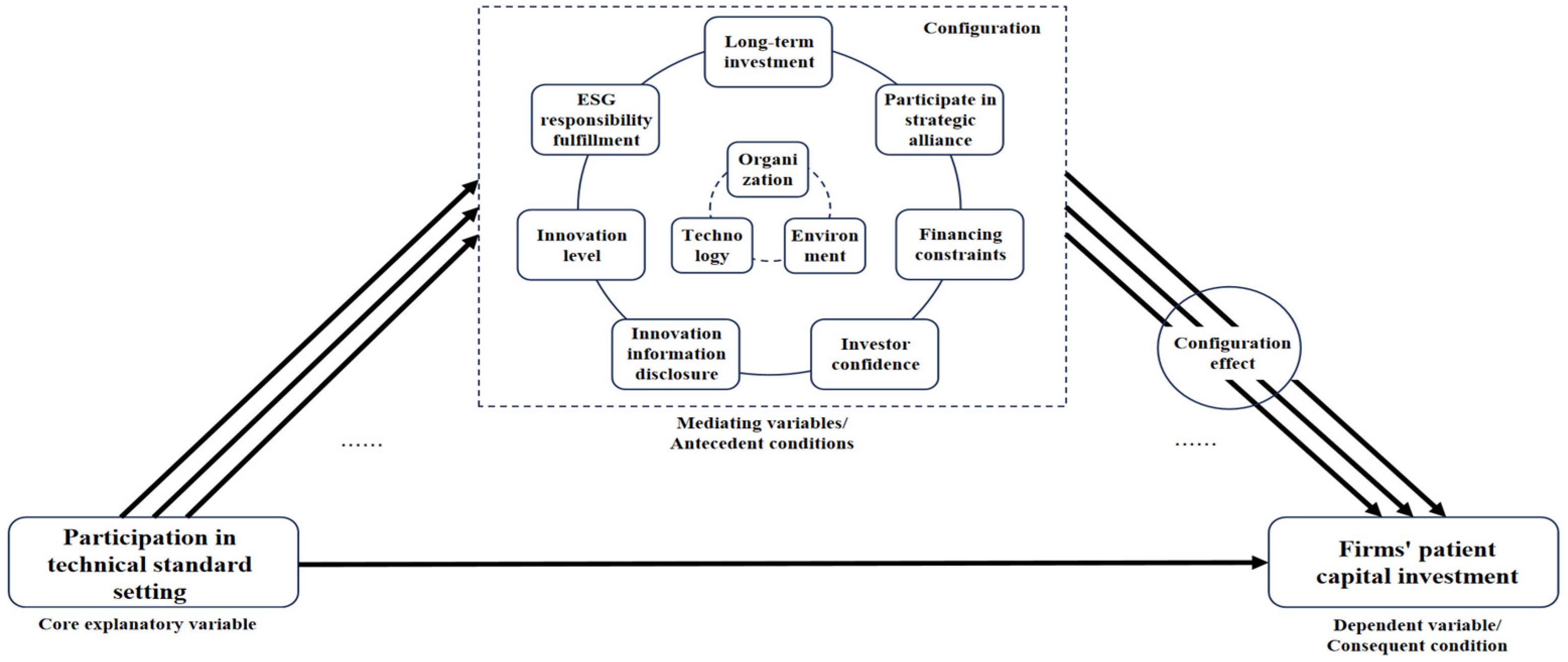
In summary, this paper constructs a complex intermediary model based on the TOE framework, integrating linear and configurational perspectives. It delves into whether participation in technical standard-setting directly influences firms’ investment in patient capital, and how such participation indirectly drives patient capital investment through a configurational pathway comprising variables such as innovation levels, ESG responsibility fulfillment, and financing constraints.
The theoretical framework of this study is illustrated in Figure 1. Specifically, this paper will first empirically examine the linear direct effect of participation in technical standard setting on firms’ patient capital investment. Subsequently, it will proceed in two sequential steps to test the complex mediating mechanism.
In the first step, a comprehensive QCA—including necessity analysis, sufficiency analysis, and robustness tests—will be conducted to investigate the factors influencing firms’ patient capital investment. Various variables selected based on the TOE framework will be treated as antecedent conditions, while firms’ patient capital investment will be regarded as the consequent condition. This step aims to empirically identify the configurations that lead to high levels of patient capital investment.
In the second step, the configuration results derived from the first step will be transformed into mediating variables for regression analysis. This transformation will be achieved by determining each case’s set membership in all relevant conditions included in the configuration, as well as its set membership within the configuration itself. Finally, with participation in technical standard setting as the core explanatory variable and firms’ patient capital investment as the dependent variable, a mediation mechanism test will be performed.

3. Research Design

3.1. Research Methodology

3.1.1. Fuzzy Set Qualitative Comparative Analysis

Fuzzy Set Qualitative Comparative Analysis (fsQCA) is a configurational comparison method grounded in set theory and Boolean algebra, designed to address causal complexity in social science research [38]. Unlike traditional regression methods emphasizing the independent net effects of variables, fsQCA treats cases as configurations of conditional variables, highlighting the joint influence of interdependent and concurrent conditions on outcomes. By calibrating variables into set membership scores, it simultaneously addresses categorical and degree-based issues, enabling precise analysis of partial membership relationships [39]. Furthermore, fsQCA identifies multiple equivalent pathways leading to a given outcome and reveals causal asymmetry—where the configuration of causes producing an outcome may differ entirely from that preventing it [40]. Demonstrating strong applicability across small-to-large sample studies, it is widely used in strategic management, organizational behavior, and policy analysis, providing methodological support for understanding multiple concurrent causality and systemic complexity.
The comparison between linear regression and configuration analysis methods is shown in Table 1. Compared with traditional linear regression methods, fsQCA offers distinct advantages for addressing the research questions in this study [41]. Linear regression focuses on the independent net effects of individual variables, assuming variable independence, linearity, and symmetrical relationships—an atomistic perspective aimed at isolating unique “net effects” [42]. However, this study centers on “multiple conjunctural causality” and “causal complexity” inherent in organizational phenomena. Corporate patient capital investment is likely the result of the joint, interdependent effects of multiple internal and external factors (such as innovation level, ESG fulfillment, financing constraints, etc.), forming various causal combinations (configurations) where the theoretical number of combinations can reach up to 2n [41]. Moreover, there may exist multiple equivalent driving pathways (causal equifinality) to the same outcome [43]. In such a context, linear regression struggles to capture the synergistic interplay and configurational effects among factors [42] and cannot identify the different antecedent configurations leading to the same outcome. Furthermore, regression analysis typically assumes symmetry in causality (i.e., factors leading to high and low outcomes are mirror images), whereas the configurational perspective fundamentally embraces causal asymmetry—the configurations leading to the presence of an outcome may be entirely different from those leading to its absence [43]. Additionally, the role of a specific condition can be asymmetric across different configurations, being core in one path but peripheral or even absent in another [44]. Therefore, choosing fsQCA over traditional regression is precisely to move beyond “net-effect thinking” and adopt a holistic, configurational perspective to systematically examine how the synergistic interplay of multiple factors jointly influences corporate patient capital investment.

3.1.2. Complex Mediation Model

The Complex Mediation Model is a novel analytical framework developed by integrating the configurational perspective and theories of causal complexity into traditional linear mediation models [45]. By combining Qualitative Comparative Analysis (QCA) with regression analysis, this model aims to uncover complex mechanisms—such as antecedent variables influencing outcome variables through mediators, or explanatory variables affecting outcomes via antecedents—under conditions of multivariate interdependence, multiple concurrent pathways, and equivalence [46]. Unlike traditional mediation models that focus solely on the average effect of a single variable, the complex mediation model first uses QCA to identify multiple antecedent configurations that lead to the emergence of mediating or outcome variables. These configurations are then incorporated into the regression model as independent or mediating variables to test their respective effects. This model not only handles systemic emergence and non-linear relationships but also reveals the heterogeneity of mediating mechanisms across different configuration pathways. It is applicable to studying the mechanisms of various complex management issues, driving the transformation of mediation analysis from a reductionist to a holistic paradigm.

3.2. Sample Selection and Data Sources

The information and communications technology (ICT) industry is characterized by the principle that “standards precede industrial development.” Therefore, this study selects listed companies in the ICT industry that participate in national standard formulation as research samples. Data screening and processing were conducted as follows: (1) National standards for the ICT industry were retrieved based on International Standard Classification codes 31 (Electronics), 33 (Telecommunications, Audio and Video Engineering), and 35 (Information Technology, Office Machinery). Samples with missing key data were excluded to obtain national standard data. (2) The standard data were further converted into corporate participation data, yielding information on corporate involvement in national standard formulation. (3) Listed company data was obtained by excluding ST, *ST, or PT-designated listed companies. (4) Variables were matched using company names and stock codes, with manual verification of matching results.
Considering the lagged effects, this paper uses 2023 as the observation year for the explanatory variable and 2024 as the observation year for the remaining variables. Data on corporate participation in technical standard development are sourced from the China National Knowledge Infrastructure (CNKI) Standard Data Repository, while all other data originate from the Chinese Research Data Services Platform (CNRDS) database and the China Stock Market & Accounting Research Database (CSMAR).

3.3. Variable Definitions

3.3.1. Dependent Variable: Patient Capital Investment (Patient)

Following existing research [17,47], the proportion of shares held by long-term institutional investors serves as a proxy for patient capital. Specifically, the average turnover rate per period is calculated based on institutional investors’ portfolio holdings. All institutional investors are ranked by turnover rate and divided into three groups, with the lowest turnover group designated as long-term institutional investors [48]. The proportion of shares held by long-term institutional investors is measured as the ratio of shares held annually by each company to its total shares outstanding during that period.
It is noteworthy that, considering data availability and operational feasibility, the measurement of patient capital in this study is confined to the financial dimension. However, the actual connotation of patient capital encompasses multidimensional strategic attributes that go beyond mere investment horizon. First, in the strategic dimension, the core characteristics of patient capital are long-term value orientation and tolerance for short-term fluctuations. Its investment decisions are based not only on financial returns but also on non-financial indicators such as a firm’s technological innovation capability and business model sustainability, aiming to accompany enterprises across growth cycles and capture patient premiums. Second, in the value dimension, some patient capital carries explicit social and impact investment attributes, targeting both financial returns and measurable social and environmental benefits—for instance, investing in fields such as clean energy and inclusive healthcare that generate positive externalities. Finally, in the behavioral dimension, patient capital acts as a stabilizer, resisting short-term speculative pressures in the market by maintaining long-term positions, thereby providing a stable governance environment for firms to engage in long-term R&D and innovation activities.

3.3.2. Core Explanatory Variable: Participation in Technical Standard Setting (Standard)

Following existing research [12], participation in technical standard setting is measured by the number of times a company participates in national standard formulation.

3.3.3. Mediating Variables

Based on the TOE framework and theoretical analysis, this study selected seven variables: innovation level (Inno), innovation information disclosure (Innoshow), ESG responsibility fulfillment (ESG), corporate long-term investment (LI), participation in strategic alliances (SA), financing constraints (RY), and investor confidence (Faith).

3.3.4. Control Variables

This study selected a series of control variables, including debt-to-asset ratio (Lev), return on assets (Roa), revenue growth rate (Growth), book-to-market ratio (MB), largest shareholder ownership ratio (LargestHold), executive ownership ratio (ManageHold), board independence (BoardInd), dual role (Dual), and whether the auditor is from the Big Four (Big4).
The variable codes and measurement methods are shown in Table 2.

4. Empirical Research

4.1. Descriptive Statistics

Descriptive statistics are presented in Table 3. The mean of the dependent variable (patient capital investment) is 0.022, with a median of 0.011, maximum value of 0.123, and standard deviation of 0.028. This indicates significant variation in patient capital investment levels across firms, with a right-skewed distribution—meaning most sample firms exhibit lower investment levels. The core explanatory variable, participation in technical standard setting, had a mean of 2.384, a median of 1.000, a standard deviation of 2.586, and a maximum value of 16.000. This reflects significant heterogeneity in the sample firms’ involvement in standard setting, with a minority being active participants while the majority exhibited limited engagement.

4.2. Benchmark Regression Analysis

Table 4 illustrates the impact of participating in technical standard development on firms’ investment in patient capital. The benchmark regression in Column (1) indicates that, without controlling variables, the coefficient for participating in technical standard setting is 0.003 and significant at the 1% level. After introducing multidimensional control variables including financial characteristics, corporate governance, and audit quality in Column (2), the coefficient for Standard remains stable and still significant at the 1% level. This suggests that the relationship is not confounded by variables such as corporate leverage, profitability, growth potential, or governance structure. Furthermore, Column (3) replaces the dependent variable with the proportion of long-term institutional investor holdings relative to total outstanding shares, while Column (4) applies 1% trimmed tailing to the continuous variable to exclude extreme values. Both results show Standard’s coefficient remains at 0.003 and maintains 1% significance, further demonstrating the robustness of the conclusion.

4.3. Mechanism Analysis

4.3.1. Configuration Analysis of Factors Influencing Corporate Investment in Patience Capital

(1)
Necessity Analysis
The necessity condition analysis is shown in Table 5. The consistency of necessity for each individual condition variable is less than 0.9, indicating that there are no necessary conditions that generate high/non-high patient capital investment by enterprises.
(2)
Adequacy Analysis
Referencing prior research [49], this study sets the case frequency threshold to 1, the raw consistency threshold to 0.8, and the PRI consistency threshold to 0.70. The sufficiency analysis of condition configurations is shown in Table 6, yielding four configurations (S1a, S1b, S2a, S2b) associated with high corporate patient capital investment and three configurations (N1a, N1b, N1c) not associated with high corporate patient capital investment.
The configurational analysis reveals that multiple, distinct pathways can lead to high patient capital investment, which can be broadly categorized into two primary types: “innovation-driven” and “sustainable development-driven”.
“Innovation-driven” Pathways (S1a, S1b): These share the core conditions of high innovation levels coupled with non-high investor confidence. They demonstrate that firms with strong innovation capabilities can still attract patient capital despite low market confidence, albeit through different strategic approaches. S1a represents a restrained compensation strategy, where firms compensate for low innovation disclosure and low long-term investment by strengthening ESG responsibility fulfillment and actively participating in strategic alliances to signal long-term value. In contrast, S1b embodies an overt persuasion strategy. Facing similar adverse conditions, it adopts a proactive stance characterized by high innovation disclosure and substantial long-term corporate investment, aiming to directly persuade the market with transparency and tangible commitments.
“Sustainable development-driven” Pathways (S2a, S2b): These are grounded in the robust core foundation of high ESG responsibility fulfillment, high corporate long-term investment, and non-high financing constraints. These pathways emphasize building a solid intrinsic value base for attracting patient capital when financial conditions are relatively favorable. S2a exhibits an internally generated value framework. Its core conditions alone provide sufficient attraction for patient capital, showing tolerance for peripheral factors like non-high investor confidence and non-high innovation disclosure, indicating capital sources insensitive to transient market sentiment. S2b represents a more ideal value resonance form. Building on the same robust intrinsic foundation, it further integrates all positive peripheral conditions—high innovation disclosure, high participation in strategic alliances, and high investor confidence—achieving highly effective synergy between internal strengths and external recognition to attract patient capital.
Furthermore, analysis of configurations leading to non-high patient capital investment (N1a, N1b, N1c) reveals a core constraining combination often involving high investor confidence, low ESG responsibility fulfillment, and low corporate long-term investment. This suggests that even with short-term market favor, firms lacking sustainable governance commitments and long-term investment planning struggle to attract patient capital focused on long-term value.
Among the “innovation-driven” and “sustainable development-driven” pathways leading to high patient capital investment, Lead Intelligent Equipment Co., Ltd. (Wuxi, China, Stock Code: 300450) and BOE Technology Group Co., Ltd. (Beijing, China, A-share, Stock Code: 000725) are typical representatives of the “innovation-driven” type. The former adopts a restrained ESG and strategic alliance compensation strategy to attract capital under high innovation levels; the latter implements an overt persuasion strategy through high innovation information disclosure and substantial long-term corporate investment. In contrast, China Southern Power Grid Energy Storage Co., Ltd. (Wenshan, China, Stock Code: 600995) and Sangfor Technologies Inc. (Shenzhen, China, Stock Code: 300454) represent the “sustainable development-driven” pathway. Both share the core foundation of high ESG responsibility fulfillment, high corporate long-term investment, and non-high financing constraints. The difference lies in that the former achieves intrinsic value generation and is insensitive to short-term market sentiment, while the latter forms value resonance with the market through high transparency. These positive cases jointly confirm that attracting patient capital does not rely on a single advantage, but rather the outcome of the synergistic effect of core conditions such as innovation, ESG, and long-term investment through different configurations. On the contrary, enterprises falling into the configurations for non-high patient capital investment demonstrate a distinct pattern. Taking Goertek Intelligent Technology Co., Ltd. (Weifang, China, Stock Code: 300793) and Tianmai Technology Co., Ltd. (Zhengzhou, China, Stock Code: 300807) as examples, their public data are highly consistent with such configurations. They may gain certain market attention due to track themes, but their ESG ratings rank in the lower-middle reaches of the industry. Meanwhile, their financial data during the same period show a significant decline or negative net profit and tight cash flow from operating activities, which collectively point to the characteristics of non-high ESG responsibility fulfillment and non-high corporate long-term investment. These cases indicate that a disconnect between short-term market confidence and a weak long-term value foundation makes it difficult to attract patient capital.
(3)
Robustness Test
Referencing existing research [49], this study conducted robustness tests on the configurations yielding high corporate patient capital investment by raising the PRI consistency threshold and increasing the case frequency. Results are shown in Table 7. The findings indicate that configurations generated after raising the PRI consistency threshold and case frequency are all clear subsets of the original configurations, thus confirming the robustness of the configuration analysis results.

4.3.2. Analysis of the Complex Effects of Participating in Technical Standard Development on Patience Capital Investment in Enterprises

To delve deeper into the impact mechanism of participating in technical standard setting on firms’ patient capital investment, particularly to examine the mediating roles played by the four previously identified strategic configurations, this study employs a comprehensive analysis combining benchmark regression, configuration effects, and Bootstrap mediation tests.
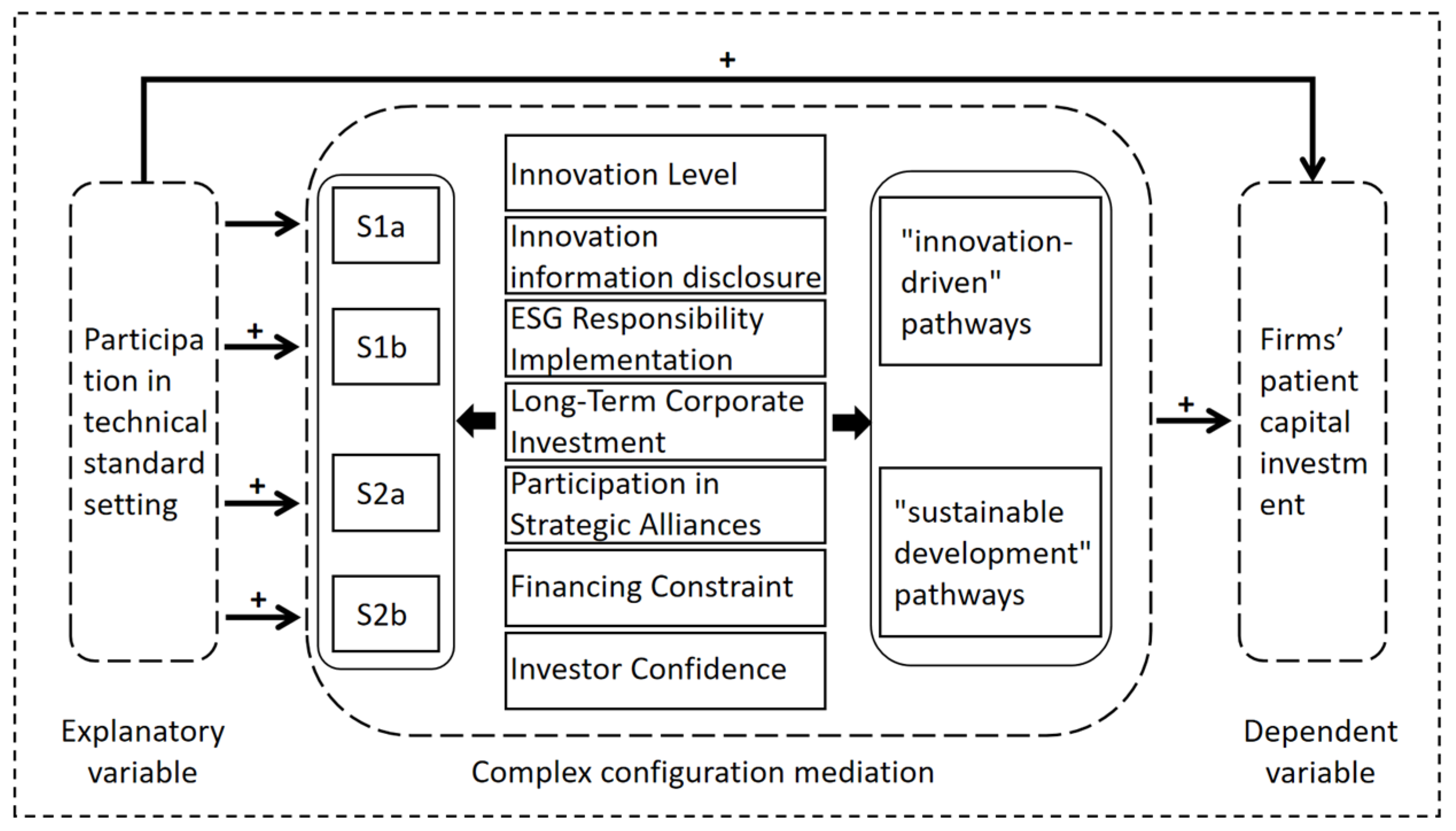
The preceding analysis indicates that participation in technical standard setting exerts a statistically significant positive impact on corporate patient capital investment at the 1% level. Furthermore, different influencing factors generate four distinct configurations affecting corporate patient capital investment. The regression results in Table 8 reveal that the impact of participation in technical standard setting varies across these four strategic configurations. Specifically, Standard has no statistically significant effect on configuration S1a, but exerts significant positive effects on configurations S1b, S2a, and S2b, with coefficients of 0.018, 0.009, and 0.013, respectively, all significant at the 1% level. This finding indicates that corporate participation in technical standard setting primarily tends to induce the formation of three specific, efficient resource configurations—S1b, S2a, and S2b—rather than significantly promoting the formation of configuration S1a.
The mediation analysis results further clarified the specific mediating effects of each configuration. Table 9 shows the direct impact of each strategic configuration on patient capital investment after controlling for participation in technical standard setting. The results indicate that configurations S1b and S2b exert extremely strong direct driving effects on the patient, with coefficients of 0.070 and 0.073, respectively, both significant at the 1% level. Configurations S1a and S2a also demonstrate significant positive effects, with coefficients of 0.038 and 0.044, significant at the 5% level. Further testing of S1a’s mediating effect via 5000 bootstrap resamples revealed an indirect effect of 0.00016 with a 95% confidence interval [−0.00006, 0.00054] encompassing zero. This indicates that configuration S1a may not be the primary conduit through which participation in technical standard setting influences corporate patient capital investment, suggesting its formation likely depends more on other internal and external factors.
In summary, this paper presents the empirical results in Figure 2.

5. Further Analysis

5.1. Panel Data Regression Analysis

Building upon the preceding research, this study further employs a panel data model covering the period from 2003 to 2024. Compared to cross-sectional regression, panel data regression effectively controls for unobservable individual heterogeneity and time trends [50], thereby more accurately identifying the causal relationship between participation in technical standard setting and firms’ investment in patient capital. This approach addresses potential estimation biases inherent in cross-sectional regression.
Table 10 presents the panel data regression results. After sequentially incorporating control variables, industry-year fixed effects, and firm-level clustering, the coefficient for participation in technical standard setting remains significantly positive at the 1% or 5% level. The coefficient values are smaller compared to the cross-sectional regression results. A possible reason is that the panel model, by controlling for unobservable factors at the individual and time levels, separates out some of the spurious correlations driven by these factors, thereby yielding a more robust estimate of the net effect. This finding indicates that the positive promotion of patient capital investment by participation in technical standard setting is not driven by certain constant firm characteristics or macroeconomic fluctuations but rather represents a persistent and robust causal relationship. Furthermore, with the inclusion of fixed effects, the model’s explanatory power significantly increased from 0.081 to 0.188, suggesting that industry characteristics and annual macroeconomic conditions are important dimensions influencing firms’ patient capital investment.
In summary, the panel data regression analysis not only enhances the rigor and reliability of the research conclusions from a methodological perspective but also confirms the long-term positive impact of technical standard-setting activities on corporate patient capital investment over time. This demonstrates that participation in technical standard-setting plays a crucial strategic role in attracting long-term capital for enterprises.
This paper further conducts robustness tests on the panel data regression by replacing the dependent variable measurement method, incorporating individual fixed effects, and shortening the time window. Table 11 shows that after replacing the dependent variable with the proportion of long-term institutional investor holdings relative to total company shares outstanding, the coefficient of the explanatory variable remains significantly positive at the 5% level. Although the significance decreased after incorporating individual fixed effects due to lower intra-firm variability within the sample period, the coefficient remained statistically significant at the 10% level. Given the significant operational volatility during the COVID-19 pandemic, which impacted firms’ patience capital investments, the results were re-examined after excluding the 2020–2022 sample years. The coefficient of the explanatory variable remained statistically significant at the 5% level. In summary, the research findings are considered robust.
Furthermore, to address potential endogeneity concerns, particularly the possibility of reverse causality whereby firms with a stronger inherent capacity for long-term investment might be more likely to engage in standard-setting, we employ a lagged explanatory variable approach. Specifically, we re-estimate the model using the one-period lagged value of Standard. This method mitigates reverse causality, as current investment is unlikely to influence past standardization activities, while past activities can plausibly affect current investment decisions. As presented in column (4) of Table 11, the coefficient on the lagged Standard remains positive and statistically significant at the 5% level. This result, robust to accounting for the temporal sequence, provides stronger support for the causal inference that participation in technical standard-setting fosters subsequent patient capital investment.

5.2. Linear Mechanism Analysis Based on Panel Data

After employing a complex mediation model for analysis, this paper further utilizes a panel data model to conduct linear tests on potential mediation mechanisms. Linear mechanism analysis facilitates more robust identification of the independent impact pathways of participation in technical standard setting on various mediating variables while controlling for individual and time fixed effects. The results are presented in Table 12.
Specifically, participation in technical standard setting significantly enhances firms’ innovation levels and innovation disclosure, with coefficients significant at the 1% level. This indicates that standard-setting activities not only directly promote substantive innovation outputs but also incentivize firms to demonstrate their technological capabilities through more transparent disclosure. Simultaneously, participation in technical standard-setting exerts a significant positive influence on corporate ESG responsibility fulfillment. This suggests that engaging in standard-setting helps drive improvements in environmental, social, and governance performance, thereby shaping a responsible long-term corporate citizenship image. However, participation in technical standard-setting exerts a significant negative impact on investor confidence. This outcome may stem from the fact that such participation, as a long-term and specialized strategic activity, may not be fully understood by ordinary investors in the short term. It may even be undervalued by the market due to high R&D investment and uncertainty. Furthermore, the effects of participation in technical standard-setting on firms’ long-term investment, participation in strategic alliances, and financing constraints did not pass the significance test, indicating that these variables are not core mediating channels within the linear panel data framework.
Overall, the linear mechanism test using panel data indicates that the promotion of patient capital investment by participation in technical standard setting is primarily achieved through three core pathways: strengthening the foundation for innovation, enhancing information transparency, and solidifying the basis for accountability.

6. Discussion

(1)
The failure of configuration S1a to demonstrate significant mediating effects may stem from the inability of technical standard participation to effectively induce or activate this particular strategic configuration. Theoretically, S1a’s core characteristics involve coexisting high innovation levels with non-elevated investor confidence, with marginal conditions including non-elevated innovation disclosure. This configuration depicts a strategic state where firms possess robust innovation capabilities yet maintain cautious market communication and fail to secure short-term investor favor. Participation in technical standard setting, as a high-level open innovation activity, exhibits logical mismatches with S1a’s constitutive conditions: First, potential conflict with firms’ low innovation disclosure. Engaging in standard-setting processes often requires firms to disclose partial technical information and share knowledge to build consensus and influence within alliances. This openness contradicts the deliberate low-profile, non-excessive disclosure strategy inherent in S1a. Consequently, firms actively involved in standard-setting may naturally gravitate toward the more open and transparent communication strategy of the S1b configuration—high innovation information disclosure. Second, the potential to correct low investor confidence. The identity of a technical standard-setter is typically perceived as a signal of a company’s technological strength and market leadership. This positive signal enhances the company’s visibility, legitimacy, and reputation in capital markets, potentially alleviating or correcting low investor confidence. In other words, participation in technical standard-setting activities itself may tend to shift companies from the low-confidence scenario associated with configuration S1a toward the high-confidence scenario represented by configuration S2b.
(2)
The mediation mechanism analysis reveals that the impact of participating in technical standard setting on a firm’s patient capital investment is not a single direct process. Instead, it is achieved through a complex mechanism of shaping and activating heterogeneous strategic configurations within the firm. Specifically, configurations S1b, S2a, and S2b are all confirmed to play significant mediating roles in this relationship, but their underlying mechanisms and path characteristics exhibit systematic differences.
First, the mediating pathway of configuration S1b manifests as an innovation signal amplification mechanism. Empirical results reveal that participation in technical standard setting significantly and positively influences the formation of configuration S1b, while S1b itself exerts a strong direct driving effect on patient capital investment. This pathway indicates that standard-setting activities prompt firms not only to maintain high innovation levels but also to adopt high-transparency innovation disclosure strategies, complemented by strong ESG responsibility fulfillment and substantial long-term investments. This combination generates a powerful signaling effect, clearly and comprehensively demonstrating the firm’s technological capabilities and long-term commitment to capital markets. This effectively mitigates information asymmetry that could undermine investor confidence, thereby creating conditions for patient capital to enter. Thus, S1b serves as an intermediary whose core function lies in transforming the influence gained through technical standard participation into a robust signal combination about future growth potential that is recognizable and trustworthy to capital markets.
Second, the intermediary pathway of configuration S2a manifests as an intrinsic value foundation mechanism. Empirical results indicate that participation in technical standard-setting also significantly drives the emergence of S2a configuration. Centered on high ESG responsibility fulfillment, high corporate long-term investment, and non-high financing constraints, this configuration builds a robust intrinsic value foundation independent of short-term market sentiment. Once formed, this configuration inherently exerts powerful attraction to patient capital. This pathway demonstrates that participation in technical standard-setting systematically strengthens a company’s long-term value foundation by guiding the establishment of robust ESG governance structures, implementing forward-looking physical investments, and thereby improving financing conditions. The intermediary role of configuration S2a lies in transforming a company’s external standardized participation into a sustainable, long-term oriented, and financially sound operational model—precisely the type of high-quality investment target sought by patient capital.
Finally, the intermediary pathway of Configuration S2b represents a synergistic amplification mechanism. Empirical evidence demonstrates that participation in standard-setting significantly promotes the formation of S2b. Configuration S2b incorporates numerous positive factors, including the robust core of S2a and the open communication of S1b, while further integrating high investor confidence. This creates powerful synergies: the robust intrinsic value built through standard-setting is fully demonstrated via comprehensive information disclosure and strategic alliances, forming a positive feedback loop with external market confidence. Statistically, the mediating effect of S2b configuration demonstrated the largest coefficient and highest significance level in both testing phases, indicating robust mediation. This configuration path achieves seamless alignment between internal corporate strengths and external market recognition, providing multiple safeguards and promising prospects for patient capital inflows.
(3)
The analytical results of linear mechanisms versus complex intermediary mechanisms reveal both significant differences and inherent complementarity, offering profound insights into the intricate dynamics between corporate behavior and capital markets. Linear regression results indicate that participation in technical standard setting exerts significant direct effects only on three variables: innovation level, innovation disclosure, and ESG responsibility fulfillment. Conversely, in the complex intermediary analysis, variables such as corporate long-term investment and financing constraints—which were insignificant in linear tests—emerge as key elements constituting effective configurations. This divergence suggests that in the real world, firms attract patient capital not through the isolated influence of a single factor, but by synergistically configuring multiple factors to achieve strategic objectives. Long-term corporate investment, which demonstrated limited direct influence in the linear model, emerged as a core condition in configurations S2a and S2b. This indicates that while it cannot function as an intermediary alone, it becomes indispensable when forming specific strategic combinations with other conditions.
The analytical results from both methodologies provide valuable cross-validation on core drivers. The three pathways validated by linear testing—innovation foundation, information transparency, and responsibility foundation—align precisely with the core characteristics of configurations S1b, S2a, and S2b. This cross-methodological confirmation underscores the central role of innovation and responsibility in bridging technological standard-setting and patient capital. However, complex mediation analysis further reveals multiple concurrent causal relationships and asymmetries between factors that linear models cannot capture. Linear analysis indicates that technical standard setting significantly reduces investor confidence. Yet Configuration S2b demonstrates that when firms establish comprehensive strategic systems incorporating high ESG and long-term investment criteria, elevated investor confidence becomes a marginal condition that positively influences this configuration. This highlights how identical factors yield divergent outcomes under different strategic configurations, underscoring the critical importance of context dependency.
This methodological contrast offers crucial insights for understanding corporate strategy: linear analysis effectively identifies the primary direct pathways of technical standard-setting, while complex mediation analysis reveals how firms creatively combine these influences with other strategic elements to form diverse equivalent pathways for attracting patient capital. Combining both approaches not only confirms the foundational role of participating in technical standard-setting but also demonstrates the rich possibilities for strategic responses at the corporate level, collectively constructing a more comprehensive and realistic theoretical framework.
This study acknowledges several limitations that offer avenues for future work. First, due to data availability and operational constraints, both the dependent and independent variables are measured narrowly. Patient capital is proxied primarily by long-term institutional shareholding—a financial metric that overlooks its broader strategic, behavioral, and impact-investing dimensions. Similarly, participation in technical standard setting is captured only by the frequency of involvement in national standards, which does not reflect the heterogeneity of firms’ roles (e.g., leadership, technical influence, or the significance of standards contributed). Future research could adopt multi-dimensional indicators—such as patent citations in standards, committee leadership positions, or standard essentiality—to better capture the depth and quality of participation. Second, the sample is confined to Chinese ICT firms and national standards, which limits the generalizability of findings across geographies and sectors. Moreover, focusing solely on national standards excludes the potential influence of international standards bodies (e.g., ISO, IEC) whose adoption may involve different dynamics and strategic implications. Future studies could expand the scope to cross-country panels and incorporate multi-level standard-setting activities (national, industry, international) to examine how institutional and sectoral contexts moderate the relationship between standardization and patient capital.

7. Conclusions and Policy Recommendations

7.1. Conclusions

Based on empirical analysis and theoretical discussion throughout this paper, the following research conclusions are drawn:
First, participation in technical standard setting exerts a significant and robust direct promotional effect on firms’ patient capital investment. Both cross-sectional and panel data regression results consistently indicate a significant positive correlation between the frequency of a firm’s participation in national standard setting and the proportion of long-term institutional investor holdings. This relationship remains valid even after controlling for financial characteristics, corporate governance structures, and macroeconomic environment factors. This finding confirms that standard-setting, as a strategic open innovation activity, directly enhances a firm’s ability to attract patient capital through the resource-based view, real options theory, and signaling mechanisms, thereby providing resource support for long-term value creation.
Second, the impact of technical standard participation on patient capital investment manifests through multiple heterogeneous configuration pathways, revealing pronounced causal complexity and equivalence. Configuration analysis identifies four pathways leading to high patient capital investment, categorized into “innovation-driven” (S1a, S1b) and “sustainable development-driven” (S2a, S2b) types. Further mediation analysis confirms that participation in technical standard-setting significantly drives the formation of three high-efficiency strategic configurations—S1b, S2a, and S2b—and indirectly promotes patient capital investment through these configurations. Specifically, the S1b pathway relies on high innovation levels and high information disclosure to enhance signaling effects; the S2a pathway builds intrinsic value through high ESG responsibility fulfillment and high long-term investment; while the S2b pathway achieves value resonance through the synergy of multiple factors, reflecting the diversity and flexibility of corporate strategic allocation.
Third, the findings from linear and complex intermediary models complement each other while revealing distinct differences, collectively illuminating the multi-layered mechanisms through which technical standard-setting influences patient capital. Linear regression indicates that participation in technical standard-setting primarily exerts direct effects through independent pathways on innovation levels, innovation information disclosure, and ESG responsibility fulfillment. Conversely, the complex intermediary model further reveals that variables such as corporate long-term investment and financing constraints—which are insignificant in the linear model—become critical components under specific configurations. This contrast highlights the complementary nature of single-variable analysis and configuration analysis in explaining complex real-world phenomena. While the linear model identifies core causal pathways, configuration analysis reveals multi-factor concurrent synergies, equivalent, and asymmetric causal patterns, providing a more comprehensive theoretical framework for understanding how firms attract patient capital through strategic combinations.

7.2. Policy Recommendations

Based on the above findings, this paper proposes the following policy implications:
First, government departments should strengthen institutional support and policy guidance for corporate participation in technical standard-setting by designing differentiated strategies tailored to enterprises with varying resource endowments. Specifically, for large enterprises with strong innovation capabilities, policies should encourage their leading roles in international standard-setting and provide cross-border collaboration support. For small and medium-sized enterprises (SMEs) and specialized “little giants” with distinct technological advantages, dedicated standard incubation funds, streamlined participation mechanisms, and lightweight alliance platforms should be established to lower their entry thresholds. This will help enterprises of different scales and stages to choose appropriate participation strategies based on their own resource conditions, thereby using standard activities as a signal to enhance their appeal to long-term capital.
Second, regulatory authorities and exchanges should jointly improve corporate disclosure and performance evaluation systems, guiding enterprises to construct explicit decision scenarios and adopt diversified strategic configurations to attract patient capital. On the basis of existing ESG disclosure frameworks, a multi-level innovation and long-term investment information disclosure guideline can be designed, allowing enterprises to selectively disclose according to their own strategic positioning—whether “innovation-driven” or “sustainability-driven.” Furthermore, a long-term value assessment toolkit based on configuration thinking can be developed to help investors identify enterprises that achieve high patient capital investment through different effective combinations of conditions, thereby facilitating capital allocation that matches enterprise strategy.
Third, while channeling financial resources toward the real economy, emphasis should be placed on cultivating professional investors capable of recognizing enterprises’ strategic configurations and optimizing supporting financial infrastructures to create concrete financing scenarios. Institutional investors with long-term attributes, such as pension and insurance funds, can be guided to establish evaluation frameworks that focus not only on a single financial indicator but also on the synergy of enterprise configuration conditions—such as the combination of innovation level, ESG fulfillment, and long-term investment. Additionally, differentiated financial products, such as standard patent pledge financing and consortium-based innovation loans, should be developed to alleviate financing constraints for enterprises adopting different strategic configurations. This will provide a favorable financial ecosystem for enterprises to achieve patient capital attraction through tailored strategic paths.

Author Contributions

Conceptualization, Y.D.; methodology, Y.D.; software, H.Z.; validation, Y.D. and H.Z.; formal analysis, Y.D.; investigation, H.Z.; resources, H.Z.; data curation, Y.D.; writing—original draft preparation, Y.D.; writing—review and editing, Y.D. and H.Z.; visualization, Y.D.; supervision, H.Z.; project administration, H.Z.; funding acquisition, H.Z. All authors have read and agreed to the published version of the manuscript.

Funding

This research was funded by the National Social Science Fund General Project (grant number: 23BGL115).

Institutional Review Board Statement

Not applicable.

Informed Consent Statement

Not applicable.

Data Availability Statement

The data used to support the findings of this study are available from the corresponding author upon request.

Conflicts of Interest

The authors declare no conflicts of interest.

References

  1. Dafe, F.; Upadhyaya, R. Varieties of capitalism and patient capital in developing and emerging economies: Evidence from Kenya. Socio-Econ. Rev. 2024, mwae074. [Google Scholar] [CrossRef]
  2. Deeg, R.; Hardie, I. What is patient capital and who supplies it? Socio-Econ. Rev. 2016, 14, 627–645. [Google Scholar] [CrossRef]
  3. Lin, J.Y.; Wang, Y. The new structural economics: Patient capital as a comparative advantage. J. Infrastruct. Policy Dev. 2017, 1, 4–23. [Google Scholar] [CrossRef]
  4. Kaplan, S.B. Globalizing Patient Capital: The Political Economy of Chinese Finance in the Americas; Cambridge University Press: Cambridge, UK, 2021. [Google Scholar]
  5. Cremers, M.; Pareek, A. Patient Capital Outperformance: The Investment Skill of High Active Share Managers Who Trade Infrequently. J. Financ. Econ. 2016, 122, 288–306. [Google Scholar] [CrossRef]
  6. Jiang, H.; Liu, W.; Zhao, S.; Chen, Y. Technology standardization, competitive behavior, and enterprises’ performance of innovation: A conceptual model. Libr. Hi Tech. 2020, 38, 251–269. [Google Scholar] [CrossRef]
  7. Zhang, M.; Wang, Y.; Zhao, Q. Does participating in the standards-setting process promote innovation? Evidence from China. China Econ. Rev. 2020, 63, 101532. [Google Scholar] [CrossRef]
  8. Schmidt, J.; Steingress, W. No double standards: Quantifying the impact of standard harmonization on trade. J. Int. Econ. 2022, 137, 103619. [Google Scholar] [CrossRef]
  9. Wu, Y.; de Vries, H.J. Effects of participation in standardization on firm performance from a network perspective: Evidence from China. Technol. Forecast. Soc. Change 2022, 175, 121376. [Google Scholar] [CrossRef]
  10. Wakke, P.; Blind, K.; Ramel, F. The impact of participation within formal standardization on firm performance. J. Product. Anal. 2016, 45, 317–330. [Google Scholar] [CrossRef]
  11. Paik, J.H.; Kim, M.K.; Park, J.H. The antecedents and consequences of technology standardizations in Korean IT small and medium-sized enterprises. Inf. Technol. Manag. 2017, 18, 293–304. [Google Scholar] [CrossRef]
  12. Du, Y.; Hao, G.; Zhu, H. How Does Participation in AI Standardisation Affect the Sustainable Development of Strategic Emerging Enterprises Under the Background of Uncertainty? Evidence from China. Sustainability 2025, 17, 7817. [Google Scholar] [CrossRef]
  13. Zheng, Y.; Abdullah, M.; Md Rahin, N. Environmental, Social, and Governance (ESG) Performance and New Quality Productivity in China: The Mediating Role of Patient Capital. Sage Open 2025, 15, 21582440251394582. [Google Scholar] [CrossRef]
  14. Trudeau, D. Integrating social equity in sustainable development practice: Institutional commitments and patient capital. Sustain. Cities Soc. 2018, 41, 601–610. [Google Scholar] [CrossRef]
  15. McCarthy, M.A.; Sorsa, V.P.; van der Zwan, N. Investment preferences and patient capital: Financing, governance, and regulation in pension fund capitalism. Socio-Econ. Rev. 2016, 14, 751–769. [Google Scholar] [CrossRef]
  16. Thatcher, M.; Vlandas, T. Overseas state outsiders as new sources of patient capital: Government policies to welcome Sovereign Wealth Fund investment in France and Germany. Socio-Econ. Rev. 2016, 14, 647–668. [Google Scholar] [CrossRef]
  17. Li, H.; Lu, M. Implementation of the New Environmental Protection Law, Patient Capital, and Corporate Sustainable Development. Financ. Res. Lett. 2025, 86, 108365. [Google Scholar] [CrossRef]
  18. Chan, K.; Covrig, V.; Ng, L. What determines the domestic bias and foreign bias? Evidence from mutual fund equity allocations worldwide. J. Financ. 2005, 60, 1495–1534. [Google Scholar] [CrossRef]
  19. Bushee, B.J.; Carter, M.E.; Gerakos, J. Institutional investor preferences for corporate governance mechanisms. J. Manag. Account. Res. 2014, 26, 123–149. [Google Scholar] [CrossRef]
  20. Bernile, G.; Kumar, A.; Sulaeman, J. Home away from home: Geography of information and local investors. Rev. Financ. Stud. 2015, 28, 2009–2049. [Google Scholar] [CrossRef]
  21. Kuchler, T.; Li, Y.; Peng, L.; Stroebel, J.; Zhou, D. Social proximity to capital: Implications for investors and firms. Rev. Financ. Stud. 2022, 35, 2743–2789. [Google Scholar] [CrossRef]
  22. Wang, Z.; Ma, J.; Yao, Y.; Wu, N. Executive environmental concerns, patient capital, and corporate green innovation performance. Int. Rev. Financ. Anal. 2025, 108, 104702. [Google Scholar] [CrossRef]
  23. Wernerfelt, B. A resource-based view of the firm. Strateg. Manag. J. 1984, 5, 171–180. [Google Scholar] [CrossRef]
  24. Das, T.K.; Teng, B.S. A resource-based theory of strategic alliances. J. Manag. 2000, 26, 31–61. [Google Scholar] [CrossRef]
  25. Liu, X.L.; Chang, X.Z. Building a market-oriented innovation ecosystem for core technologies. Stud. Sci. Sci. 2024, 42, 614. [Google Scholar]
  26. Bernanke, B.S. Irreversibility, Uncertainty and Cyclical Investment. Q. J. Econ. 1983, 98, 85–106. [Google Scholar] [CrossRef]
  27. Warner, A.G.; Fairbank, J.F.; Steensma, H.K. Managing uncertainty in a formal standards-based industry: A real options perspective on acquisition timing. J. Manag. 2006, 32, 279–298. [Google Scholar] [CrossRef]
  28. Czajkowski, M.; Sobolewski, M. How much do switching costs and local network effects contribute to consumer lock-in in mobile telephony? Telecommun. Policy 2016, 40, 855–869. [Google Scholar] [CrossRef]
  29. Spence, M. Job Market Signaling. In Uncertainty in Economics; Elsevier: Amsterdam, The Netherlands, 1978; pp. 281–306. [Google Scholar]
  30. Gamarra, Y.L.; Friedl, G. Declared essential patents and average total R&D expenditures per patent family. Telecommun. Policy 2023, 47, 102575. [Google Scholar] [CrossRef]
  31. Tornatzky, L.G.; Fleischer, M. The Processes of Technological Innovation; Lexington Books: Lexington, MA, USA, 1990; pp. 152–154. [Google Scholar]
  32. Glücksman, S. Entrepreneurial experiences from venture capital funding: Exploring two-sided information asymmetry. Ventur. Cap. 2020, 22, 331–354. [Google Scholar] [CrossRef]
  33. Sun, H.; Liu, L.; Li, P. How technical standards transform ESG performance into competitive advantage: Evidence from China. Appl. Econ. 2025, 1–15. [Google Scholar] [CrossRef]
  34. Riillo, C.A.; Jakobs, K. Too many or too few Standards Setters? Evidence from the Performance of Firms engaged in Standardization. J. Technol. Transf. 2023, 48, 2106–2131. [Google Scholar] [CrossRef]
  35. Wen, J.; Qualls, W.J.; Zeng, D. Standardization alliance networks, standard-setting influence, and new product outcomes. J. Prod. Innov. Manag. 2020, 37, 138–157. [Google Scholar] [CrossRef]
  36. Deng, X.; Li, Q.C.; Mateut, S. Participation in setting technology standards and the implied cost of equity. Res. Policy 2022, 51, 104497. [Google Scholar] [CrossRef]
  37. Aggarwal, N.; Dai, Q.; Walden, E.A. The More, the Merrier? How the Number of Partners in a Standard-Setting Initiative Affects Shareholder’s Risk and Return. MIS Q. 2011, 35, 445–462. [Google Scholar] [CrossRef]
  38. Fiss, P.C. A set-theoretic approach to organizational configurations. Acad. Manag. Rev. 2007, 32, 1180–1198. [Google Scholar] [CrossRef]
  39. Du, Y.Z.; Jia, L.D. Configuration perspective and qualitative comparative analysis (QCA): A new way of management research. Manag. World 2017, 6, 155–167. [Google Scholar]
  40. Thomann, E.; Maggetti, M. Designing research with qualitative comparative analysis (QCA): Approaches, challenges, and tools. Sociol. Methods Res. 2020, 49, 356–386. [Google Scholar] [CrossRef]
  41. Ragin, C.C. The Comparative Method: Moving Beyond Qualitative and Quantitative Strategies; University of California Press: Oakland, CA, USA, 2014. [Google Scholar]
  42. Rihoux, B.; Ragin, C.C. (Eds.) Configurational Comparative Methods: Qualitative Comparative Analysis (QCA) and Related Techniques; SAGE: Thousand Oaks, CA, USA, 2009; Volume 51. [Google Scholar]
  43. Ragin, C.C. Redesigning Social Inquiry: Fuzzy Sets and Beyond; University of Chicago Press: Chicago, IL, USA, 2009. [Google Scholar]
  44. Misangyi, V.F.; Greckhamer, T.; Furnari, S.; Fiss, P.C.; Crilly, D.; Aguilera, R. Embracing causal complexity: The emergence of a neo-configurational perspective. J. Manag. 2017, 43, 255–282. [Google Scholar] [CrossRef]
  45. Du, Y.; Liu, Q.; Kim, P.H.; Meuer, J. Studying complex causal processes in technological innovation and entrepreneurship with set-theoretic mediation models. Technovation 2024, 134, 103015. [Google Scholar] [CrossRef]
  46. Du, Y.Z.; Sun, N.; Liu, Q.C. Developing and analyzing complex mediation models using mixed methods: An illustration of doing business promoting innovation vitality, synergizing new quality productive forces and employment-first. J. Manag. World 2024, 40, 217–237. [Google Scholar]
  47. Wang, X.; Cheng, Y.; Li, B. To inhibit or to promote: How does patient capital affect firm new quality productivity in China? Financ. Res. Lett. 2025, 86, 108787. [Google Scholar] [CrossRef]
  48. Liu, J.; Xu, H. Institutional Investors: Are They Long-Term or Short-Term Investors. J. Financ. Res. 2012, 9, 141–154. [Google Scholar]
  49. Du, Y.; Liu, Q.; Cheng, J. What kind of ecosystem for doing business will contribute to city-level high entrepreneurial activity? A research based on institutional configurations. J. Manag. World 2020, 36, 141–155. [Google Scholar]
  50. Phillips, P.C.; Moon, H.R. Linear regression limit theory for nonstationary panel data. Econometrica 1999, 67, 1057–1111. [Google Scholar] [CrossRef]
Figure 1. Theoretical framework.
Systems 14 00033 g001
Figure 2. Empirical results.
Systems 14 00033 g002
Table 1. Methodological Comparison between Linear Regression and Configurational Analysis.
Comparative
Dimension
Linear Regression AnalysisConfigurational Analysis
(Exemplified by fsQCA)
Philosophical FoundationReductionism: Decomposes the whole into independent parts to examine the “net effect” of single variables.Holism/Configurational View: Treats cases as complex combinations of conditions, emphasizing synergistic effects of the whole.
Causal LogicLinear, Additive, Symmetric: Assumes linear and additive causality; factors leading to a high outcome are often the inverse of those leading to a low outcome (symmetry).Conjunctural, Equifinal, Asymmetric: Emphasizes multiple concurrent conditions leading to an outcome; the same outcome can be achieved by different condition combinations (equifinality); paths leading to the presence and absence of an outcome can be entirely different (asymmetry).
Key StrengthsExcels at quantifying the independent impact of single factors, making predictions, and statistical inference. Mature method with broad generalizability.Excels at handling causal complexity, identifying multiple equifinal paths, and revealing interaction and synergy among variables. Closer to complex real-world decision-making contexts.
Key LimitationsStruggles to effectively capture complex interaction effects and non-linear relationships. The assumption of causal symmetry may not hold in reality. Sensitive to multicollinearity.Difficulty in conducting statistical significance tests and probabilistic generalization. Interpretation relies more on theoretical framing and researcher’s deep engagement. The calibration process involves a degree of subjectivity.
Table 2. Variable Codes and Measurement Methods.
Variable TypeVariable NameCodeMeasurement Method
Dependent VariablePatient Capital InvestmentPatientLong-term Institutional Investor Shareholding Ratio
Explanatory VariableParticipate in technical standard settingStandardNumber of times participating in national standard setting
Mediating VariablesInnovation LevelInnoTotal Patent Applications
Innovation information disclosureInnoshowPercentage of innovation keywords relative to total annual report words multiplied by 100
ESG Responsibility ImplementationESGHuazheng ESG Rating
Long-Term Corporate InvestmentLI(Capital Expenditures + R&D Expenditures)/Total Assets
Participation in Strategic AlliancesSALogarithm of the number of strategic alliances the enterprise participated in during the current year plus 1
Financing ConstraintRYFC Index
Investor ConfidenceFaithPrincipal component analysis was applied to five indicators: corporate revenue growth rate, earnings per share growth rate, institutional investor shareholding ratio, annual average turnover rate, and price-to-book ratio.
Control VariablesDebt-to-Asset RatioLevTotal liabilities at period end/Total assets at period end
Return on AssetsRoaNet profit/Total assets at period-end
Operating Revenue Growth RateGrowth(Current Year—Previous Year Operating Revenue)/Previous Year Operating Revenue
Book-to-market ratioMBTotal Assets at Period-End/Total Market Value of Individual Stocks at Period-End
Largest Shareholder Holding RatioLargestHoldLargest Shareholder’s Shareholding Ratio as a Percentage of Total Shares
Executive Shareholding RatioManageHoldPercentage of Total Shares Held by Executives
Board IndependenceBoardIndProportion of Independent Directors
Dual RoleDual1 if the Chairman and CEO are the same person; otherwise, 0
Auditor from Big Four firmsBig4Auditor is from one of the Big Four firms: 1, otherwise 0
Table 3. Descriptive statistical results.
VariableObsMeanStd. Dev.MinMedianMax
Patient2110.0220.0280.0000.0110.123
Standard2112.3842.5861.0001.00016.000
Lev2110.4630.2390.1120.4240.939
Roa2110.0040.068−0.3130.0140.108
Growth1990.0200.278−0.6800.0091.236
MB1780.5770.2350.1120.5551.114
LargestHold21129.62413.6568.12026.24065.300
ManageHold1780.1030.1500.0000.0080.589
BoardInd21138.1635.81333.33036.36060.000
Dual2100.3290.4710.0000.0001.000
Big41780.1120.3170.0000.0001.000
Table 4. Benchmark Regression Results.
(1)(2)(3)(4)
VariablesPatientPatientPatient 2Patient
Standard0.003 ***0.003 ***0.003 ***0.003 ***
(3.583)(3.167)(3.128)(3.167)
Lev −0.004−0.009−0.004
(−0.330)(−0.608)(−0.330)
Roa 0.0180.0080.018
(0.500)(0.180)(0.500)
Growth 0.0030.0070.003
(0.345)(0.714)(0.345)
MB −0.015−0.013−0.015
(−1.502)(−1.054)(−1.502)
Largest Hold −0.000−0.000−0.000
(−1.277)(−0.797)(−1.277)
Manage Hold −0.031 *−0.030−0.031 *
(−1.732)(−1.373)(−1.732)
Board Ind −0.000−0.000−0.000
(−0.174)(−0.282)(−0.174)
Dual 0.0000.0030.000
(0.008)(0.454)(0.008)
Big4 0.023 ***0.026 ***0.023 ***
(3.023)(2.896)(3.023)
Constant0.016 ***0.036 **0.039 *0.036 **
(6.219)(2.189)(1.957)(2.189)
Observations211175175175
R-squared0.0580.1790.1510.179
Note: (1) *, p < 0.1; **, p < 0.05; ***, p < 0.01. (2) Numbers in parentheses are t-values.
Table 5. Necessity Condition Analysis.
Condition
Variable
High Patience Capital InvestmentNon-High-Patience Capital Investment
ConsistencyCoverageConsistencyCoverage
High innovation level0.6840.7780.5190.575
Non-high innovation level0.6260.5720.8000.711
High innovation information disclosure0.6230.7000.5380.588
Non-high-tech innovation information disclosure0.6330.5850.7250.652
High ESG Responsibility Performance0.7090.7510.5010.516
Non-High ESG Responsibility Performance0.5430.5280.7580.717
High-tech enterprises’ long-term investments0.6040.7440.4890.586
Non-high-risk enterprises’ long-term investments0.6640.5720.7870.659
High Participation in Strategic Alliances0.8180.6370.8420.638
Non-High-Participation Strategic Alliance0.5350.7760.5210.736
High Financing Constraints0.6020.6960.5270.593
Non-high financing constraints0.6480.5840.7300.641
High Investor Confidence0.5380.5630.7430.756
Non-high investor confidence0.7660.7540.5700.545
Table 6. Configuration Analysis Results.
Condition VariablesCorporate High-Patience Capital InvestmentCorporate Non-High-Patience Capital Investment
S1aS1bS2aS2bN1aN1bN1c
Innovation Level
Innovative Information Disclosure
ESG Responsibility Implementation
Long-Term Investments
Participate in Strategic Alliances
Financing Constraints
Investor Confidence
Consistency0.9180.9320.9480.9360.9220.9230.917
Original Coverage0.2680.2610.2420.2370.3920.3600.404
Unique Coverage0.0790.0420.0440.0310.0420.0100.055
Overall consistency0.9320.916
Overall Coverage0.4430.457
Note: and represents the existence and absence of core conditions; and represents the existence and absence of edge conditions.
Table 7. Robustness Test of Configurational Analysis Results.
Condition VariableAdjust PRI Consistency Threshold to 0.75Adjusted Case Frequency to 2
S1S2S3S1
Innovation Level
Innovation Disclosure
ESG Responsibility Implementation
Long-Term Corporate Investment
Participation in Strategic Alliances
Financing Constraints
Investor Confidence
Consistency0.9480.9320.9360.932
Original Coverage0.2420.2610.2370.261
Unique Coverage0.0590.0600.0310.261
Overall consistency0.9390.932
Overall Coverage0.3640.261
Note: and represents the existence and absence of core conditions; and represents the existence and absence of edge conditions.
Table 8. Analysis Results of the Impact of Participation in Technical Standard Development on Complex Configuration Incorporation.
(1)(2)(3)(4)
VariablesS1aS1bS2aS2b
Standard0.0040.018 ***0.009 ***0.013 ***
(1.217)(4.704)(2.889)(5.024)
ControlsYESYESYESYES
Observations175175175175
R-squared0.2640.1770.1460.192
Note: (1) ***, p < 0.01. (2) Numbers in parentheses are t-values.
Table 9. Test Results for Mediating Mechanisms Incorporating Complex Configurations.
(1)(2)(3)(4)
VariablesPatientPatientPatientPatient
Standard0.002 ***0.002 ***0.0010.002 *
(2.992)(2.650)(1.588)(1.884)
S1a0.038 **
(1.998)
S1b 0.070 ***
(4.512)
S2a 0.044 **
(2.151)
S2b 0.073 ***
(3.128)
ControlsYESYESYESYES
Observations175175175175
R-squared0.2640.1770.1460.192
Note: (1) *, p < 0.1; **, p < 0.05; ***, p < 0.01. (2) Numbers in parentheses are t-values.
Table 10. Panel Data Regression Analysis of the Impact of Participation in Technical Standard Setting on Patience Capital Investment.
(1)(2)(3)(4)
VariablesPatientPatientPatientPatient
Standard0.001 ***0.001 ***0.001 ***0.001 **
(4.941)(4.570)(3.607)(2.400)
Lev 0.0060.010 **0.010 *
(1.243)(2.109)(1.841)
Roa 0.035 ***0.053 ***0.053 ***
(2.745)(3.952)(3.251)
Growth −0.0010.0010.001
(−0.418)(0.323)(0.342)
MB −0.014 ***−0.013 ***−0.013 **
(−4.030)(−3.519)(−2.310)
Largest Hold −0.000 **−0.000 ***−0.000 **
(−2.482)(−2.591)(−2.021)
Manage Hold −0.019 ***−0.016 **−0.016 **
(−2.813)(−2.386)(−2.185)
Board Ind 0.000−0.000−0.000
(0.304)(−0.389)(−0.318)
Dual 0.0030.0030.003
(1.323)(1.560)(1.261)
Big4 0.008 ***0.008 ***0.008 **
(3.050)(3.002)(2.135)
Constant0.013 ***0.020 ***0.022 ***0.022 ***
(14.088)(3.296)(3.431)(2.658)
IndNONOYESYES
YearNONOYESYES
Observations1247982966966
R-squared0.0190.0810.1880.188
Note: (1) *, p < 0.1; **, p < 0.05; ***, p < 0.01. (2) Numbers in parentheses are t-values.
Table 11. Robustness Tests for Panel Data Regression.
(1)(2)(3)(4)
VariablesPatient 2PatientPatientPatient
Standard0.001 **0.001 *0.001 **
(2.100)(1.805)(2.442)
L_Standard 0.001 **
(2.435)
ControlsYESYESYESYES
FirmNOYESNONO
IndYESYESYESYES
YearYESYESYESYES
Observations966679682632
R-squared0.1670.7010.1880.172
Note: (1) *, p < 0.1; **, p < 0.05. (2) Numbers in parentheses are t-values.
Table 12. Results of Linear Mechanism Tests Based on Panel Data.
(1)(2)(3)(4)(5)(6)(7)
VariablesInnoInnoshowESGLISARYFaith
Standard74.536 ***0.000 ***0.307 ***0.001−0.0050.005−0.037 **
(2.737)(2.915)(4.013)(1.469)(−0.306)(1.089)(−2.282)
ControlsYESYESYESYESYESYESYES
IndYESYESYESYESYESYESYES
YearYESYESYESYESYESYESYES
Observations966966951959512966966
R-squared0.3650.2480.2060.1960.1890.2300.465
Note: (1) **, p < 0.05; ***, p < 0.01. (2) Numbers in parentheses are t-values.
Disclaimer/Publisher’s Note: The statements, opinions and data contained in all publications are solely those of the individual author(s) and contributor(s) and not of MDPI and/or the editor(s). MDPI and/or the editor(s) disclaim responsibility for any injury to people or property resulting from any ideas, methods, instructions or products referred to in the content.