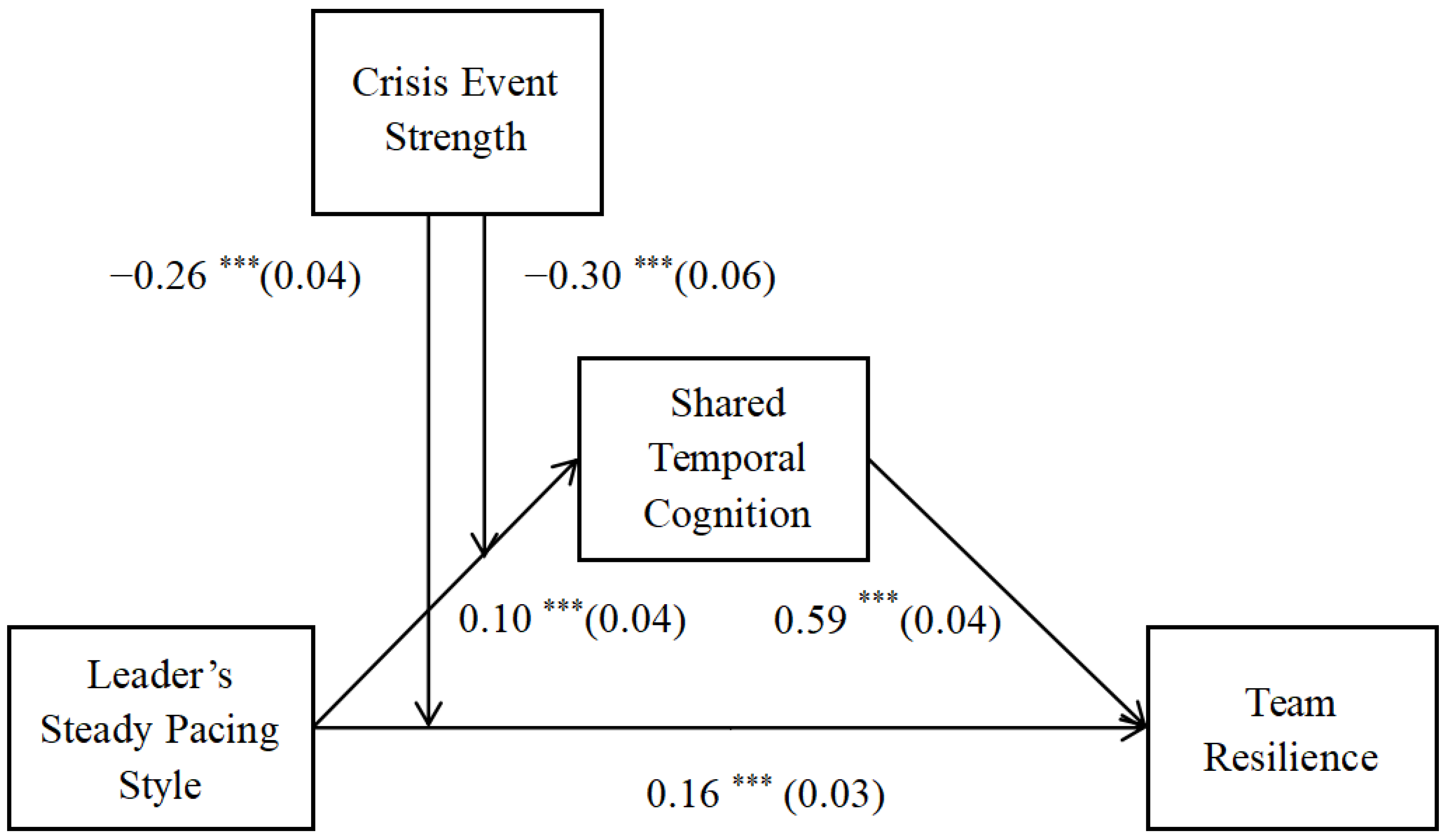
Temporal Coordination Mechanisms and Team Resilience: An Event System Perspective on Leaders’ Pacing Styles

Abstract
1. Introduction
2. Theory and Hypotheses Development
2.1. Event System Theory
2.2. Temporal Coordination Theory: Pacing Style and Team Resilience
2.3. The Mediating Role of Shared Temporal Cognition
2.4. The Moderating Role of Crisis Event Strength
3. Method
3.1. Procedure and Sample
3.2. Measures
3.2.1. Steady Pacing Style
3.2.2. Team Resilience
3.2.3. Shared Temporal Cognition
3.2.4. Crisis Event Strength
3.2.5. Control Variables
3.3. Analytical Strategies
4. Results
4.1. Confirmatory Factor Analyses
4.2. Justification for Data Aggregation
4.3. Descriptive Statistics
4.4. Main Effect
4.5. Mediation Effect of Shared Temporal Cognition
4.6. Moderation Effect of Crisis Event Strength
5. Discussion
5.1. Theoretical Contributions
5.2. Managerial Implications
5.3. Limitations and Future Directions
6. Conclusions
Supplementary Materials
Author Contributions
Funding
Data Availability Statement
Conflicts of Interest
References
- Zhao, H.H.; Deng, H.; Chen, R.P.; Parker, S.K.; Zhang, W. Fast or slow: How temporal work design shapes experienced passage of time and job performance. Acad. Manag. J. 2022, 65, 2014–2033. [Google Scholar] [CrossRef]
- King, D.D.; Newman, A.; Luthans, F. Not if, but when we need resilience in the workplace. J. Organ. Behav. 2015, 37, 782–786. [Google Scholar] [CrossRef]
- Stoverink, A.C.; Kirkman, B.L.; Mistry, S.; Rosen, B. Bouncing back together: Toward a theoretical model of work team resilience. Acad. Manag. Rev. 2020, 45, 395–422. [Google Scholar] [CrossRef]
- Barton, M.A.; Kahn, W.A. Group Resilience: The Place and Meaning of Relational Pauses. Organ. Stud. 2018, 40, 1409–1429. [Google Scholar] [CrossRef]
- West, B.J.; Patera, J.L.; Carsten, M.K. Team level positivity: Investigating positive psychological capacities and team level outcomes. J. Organ. Behav. 2009, 30, 249–267. [Google Scholar] [CrossRef]
- Carmeli, A.; Friedman, Y.; Tishler, A. Cultivating a resilient top management team: The importance of relational connections and strategic decision comprehensiveness. Saf. Sci. 2013, 51, 148–159. [Google Scholar] [CrossRef]
- Zhang, M.; Li, X. Understanding the relationship between coopetition and startups’ resilience: The role of entrepreneurial ecosystem and dynamic exchange capability. J. Bus. Ind. Mark. 2025, 40, 527–542. [Google Scholar] [CrossRef]
- Raetze, S.; Duchek, S.; Maynard, M.T.; Kirkman, B.L. Resilience in Organizations: An Integrative Multilevel Review and Editorial Introduction. Group Organ. Manag. 2021, 46, 607–656. [Google Scholar] [CrossRef]
- Kennedy, D.M.; Landon, L.B.; Maynard, M.T. Extending the Conversation: Employee Resilience at the Team Level. Ind. Organ. Psychol. 2016, 9, 466–475. [Google Scholar] [CrossRef]
- Vera, M.; Rodríguez-Sánchez, A.M.; Salanova, M. May the force be with you: Looking for resources that build team resilience. J. Workplace Behav. Health 2017, 32, 119–138. [Google Scholar] [CrossRef]
- Stephens, J.P.; Heaphy, E.D.; Carmeli, A.; Spreitzer, G.M.; Dutton, J.E. Relationship Quality and Virtuousness. J. Appl. Behav. Sci. 2013, 49, 13–41. [Google Scholar] [CrossRef]
- Chen, Y.; Zhang, Y. Fostering Resilience in New Venture Teams: The Role of Behavioral and Affective Integration. Group Organ. Manag. 2021, 46, 773–816. [Google Scholar] [CrossRef]
- Dimas, I.D.; Rebelo, T.; Lourenço, P.R.; Pessoa, C.I.P. Bouncing Back from Setbacks: On the Mediating Role of Team Resilience in the Relationship Between Transformational Leadership and Team Effectiveness. J. Psychol. 2018, 152, 358–372. [Google Scholar] [CrossRef] [PubMed]
- Morgan, P.B.C.; Fletcher, D.; Sarkar, M. Defining and characterizing team resilience in elite sport. Psychol. Sport Exerc. 2013, 14, 549–559. [Google Scholar] [CrossRef]
- Gevers, J.M.P.; Rutte, C.G.; van Eerde, W. Meeting Deadlines in Work Groups: Implicit and Explicit Mechanisms. Appl. Psychol. 2006, 55, 52–72. [Google Scholar] [CrossRef]
- Bluedorn, A.C. The human organization of time: Temporal realities and experience. J. Manag. Inq. 2002, 11, 358–372. [Google Scholar]
- Li, X.; Zhang, M.; Li, W.; Chen, J. Looking for new possibilities in emerging industries: The impact of strategic sensing capability on high-tech startups’ product innovation. J. Bus. Res. 2025, 189, 115183. [Google Scholar] [CrossRef]
- Marks, M.A.; Mathieu, J.E.; Zaccaro, S.J. A temporally based framework and taxonomy of team processes. Acad. Manag. Rev. 2001, 26, 356–376. [Google Scholar] [CrossRef]
- Morgeson, F.P.; Mitchell, T.R.; Liu, D. Event system theory: An event-oriented approach to the organizational sciences. Acad. Manag. Rev. 2015, 40, 515–537. [Google Scholar] [CrossRef]
- Duchek, S. Growth in the face of crisis: The role of organizational resilience capabilities. In Academy of Management Proceedings; Academy of Management: Briarcliff Manor, NY, USA, 2014; Volume 2014, p. 13487. [Google Scholar]
- Hollenbeck, J.R.; Beersma, B.; Schouten, M.E. Beyond team types and taxonomies: A dimensional scaling conceptualization for team description. Acad. Manag. Rev. 2012, 37, 82–106. [Google Scholar]
- Eisenhardt, K.M. Making fast strategic decisions in high-velocity environments. Acad. Manag. J. 1989, 32, 543–576. [Google Scholar] [CrossRef]
- Hannah, S.T.; Uhl-Bien, M.; Avolio, B.J.; Cavarretta, F.L. A framework for examining leadership in extreme contexts. Leadersh. Q. 2009, 20, 897–919. [Google Scholar] [CrossRef]
- Bucovețchi, O.; Voipan, A.E.; Voipan, D.; Stanciu, R.D. Redefining Organizational Resilience and Success: A Natural Language Analysis of Strategic Domains, Semantics, and AI Opportunities. Systems 2025, 13, 999. [Google Scholar] [CrossRef]
- Vogus, T.J.; Sutcliffe, K.M. Organizational resilience: Towards a theory and research agenda. Manag. Decis. Econ. 2007, 28, 465–477. [Google Scholar]
- Rauch, A.; Hulsink, W. Just one damned thing after another: Towards an event-based perspective of entrepreneurship. Entrep. Theory Pract. 2023, 47, 662–681. [Google Scholar] [CrossRef]
- Morgeson, F.P.; Liu, D.; Cannella, A.A., Jr.; Hillman, A.J.; Seibert, S.E.; Tushman, M.L. This is an eventful era: Exploring event-oriented approaches to organizational research. J. Manag. 2025, 51, 953–966. [Google Scholar] [CrossRef]
- Liu, D.; Morgeson, F.P.; Zhu, J.; Fan, X. Event-oriented organizational behavior research: A multilevel review and agenda for future research. J. Manag. 2023, 49, 2148–2186. [Google Scholar] [CrossRef]
- Roulet, T.J.; Bothello, J. An event-system perspective on disruption: Theorizing the pandemic and other discontinuities through historical and fictional accounts of the plague. Acad. Manag. Rev. 2023, 48, 772–789. [Google Scholar] [CrossRef]
- Gersick, C.J. Time and transition in work teams: Toward a new model of group development. Acad. Manag. J. 1988, 31, 9–41. [Google Scholar] [CrossRef]
- Ancona, D.G.; Chong, C.L. Cycles and synchrony: The temporal role of context in team behavior. In Research on Managing Groups and Teams: Groups in Context; Wageman, R., Ed.; Elsevier Science/JAI Press: Amsterdam, The Netherlands, 1999; Volume 2, pp. 33–48. [Google Scholar]
- Melbin, M.; McGrath, J.E.; Kelley, J.R. Time and Human Interaction: Toward a Social Psychology of Time. Contemp. Sociol. 1987, 16, 860. [Google Scholar] [CrossRef]
- Mohammed, S.; Angell, L.C. Surface- and deep-level diversity in workgroups: Examining the moderating effects of team orientation and team process on relationship conflict. J. Organ. Behav. 2004, 25, 1015–1039. [Google Scholar] [CrossRef]
- Mohammed, S.; Nadkarni, S. Temporal Diversity and Team Performance: The Moderating Role of Team Temporal Leadership. Acad. Manag. J. 2011, 54, 489–508. [Google Scholar] [CrossRef]
- Sadeghi, Y.; Islam, G.; Van Lent, W. Practices of Periodization: Toward a Critical Perspective on Temporal Division in Organizations. Acad. Manag. Rev. 2025, 50, 51–71. [Google Scholar] [CrossRef]
- Gevers, J.; Mohammed, S.; Baytalskaya, N. The Conceptualisation and Measurement of Pacing Styles. Appl. Psychol. 2013, 64, 499–540. [Google Scholar] [CrossRef]
- Shipp, A.J.; Jansen, K.J. The “other” time: A review of the subjective experience of time in organizations. Acad. Manag. Ann. 2021, 15, 299–334. [Google Scholar] [CrossRef]
- Chen, J.; Nadkarni, S. It’s about Time! CEOs’ Temporal Dispositions, Temporal Leadership, and Corporate Entrepreneurship. Adm. Sci. Q. 2017, 62, 31–66. [Google Scholar] [CrossRef]
- Hartmann, S.; Weiss, M.; Newman, A.; Hoegl, M. Resilience in the Workplace: A Multilevel Review and Synthesis. Appl. Psychol. 2019, 69, 913–959. [Google Scholar] [CrossRef]
- Bennett, J.B.; Aden, C.A.; Broome, K.; Mitchell, K.; Rigdon, W.D. Team resilience for young restaurant workers: Research-to-practice adaptation and assessment. J. Occup. Health Psychol. 2010, 15, 223–236. [Google Scholar] [CrossRef]
- Cheng, C.; He, Y.; Yan, L.; Jia, L. The Impact of Organizational Time Management on Enterprise Internationalization Speed. Foreign Econ. Manag. 2022, 44, 35–49. [Google Scholar]
- Ancona, D.G.; Goodman, P.S.; Lawrence, B.S.; Tushman, M.L. Time: A New Research Lens. Acad. Manag. Rev. 2001, 26, 645–663. [Google Scholar] [CrossRef]
- Standifer, R.L. The emergence of temporal coordination within multiteam systems. In Multiteam Systems; Routledge: Oxford, UK, 2012; pp. 395–427. [Google Scholar]
- Zeschke, M.; Zacher, H. Is it bad because it is boring? Effects of idle time on employee outcomes. Eur. J. Work. Organ. Psychol. 2023, 32, 886–901. [Google Scholar] [CrossRef]
- Dille, T.; Hernes, T.; Vaagaasar, A.L. Stuck in temporal translation? Challenges of discrepant temporal structures in interorganizational project collaboration. Organ. Stud. 2023, 44, 867–888. [Google Scholar] [CrossRef]
- Hilbolling, S.; Deken, F.; Berends, H.; Tuertscher, P. Process-based temporal coordination in multiparty collaboration. Strateg. Organ. 2022, 20, 135–163. [Google Scholar] [CrossRef]
- Mohammed, S.; Nadkarni, S. Are we all on the same temporal page? The moderating effects of temporal team cognition on the polychronicity diversity–team performance relationship. J. Appl. Psychol. 2014, 99, 404. [Google Scholar] [CrossRef] [PubMed]
- Lifshitz-Assaf, H.; Lebovitz, S.; Zalmanson, L. Minimal and adaptive coordination: How hackathons’ projects accelerate innovation without killing it. Acad. Manag. J. 2021, 64, 684–715. [Google Scholar] [CrossRef]
- Hsieh, Y.Y.; Vergne, J.P. The future of the web? The coordination and early-stage growth of decentralized platforms. Strateg. Manag. J. 2023, 44, 829–857. [Google Scholar] [CrossRef]
- Massey, A.P.; Montoya-Weiss, M.M.; Hung, Y.T. Because time matters: Temporal coordination in global virtual project teams. J. Manag. Inf. Syst. 2003, 19, 129–155. [Google Scholar] [CrossRef]
- Maruping, L.M.; Venkatesh, V.; Thatcher, S.M.B.; Patel, P.C. Folding Under Pressure or Rising to the Occasion? Perceived Time Pressure and the Moderating Role of Team Temporal Leadership. Acad. Manag. J. 2015, 58, 1313–1333. [Google Scholar] [CrossRef]
- Gevers, J.; Eerde, W.V.; Rutte, C.G. How project teams achieve coordinated action: A model of shared cognitions on time. Res. Manag. Groups Teams 2004, 6, 67–85. [Google Scholar]
- Santos, C.M.; Passos, A.M.; Uitdewilligen, S.; Nübold, A. Shared temporal cognitions as substitute for temporal leadership: An analysis of their effects on temporal conflict and team performance. Leadersh. Q. 2016, 27, 574–587. [Google Scholar] [CrossRef]
- Abrantes, A.C.M.; Passos, A.M.; Cunha, M.P.E.; Santos, C.M. Bringing team improvisation to team adaptation: The combined role of shared temporal cognitions and team learning behaviors fostering team performance. J. Bus. Res. 2018, 84, 59–71. [Google Scholar] [CrossRef]
- Patriotta, G.; Gruber, D.A. Newsmaking and sensemaking: Navigating temporal transitions between planned and unexpected events. Organ. Sci. 2015, 26, 1574–1592. [Google Scholar] [CrossRef]
- Weick, K.E.; Sutcliffe, K.M. Managing the Unexpected: Resilient Performance in an Age of Uncertainty; John Wiley & Sons: Hoboken, NJ, USA, 2011; Volume 8. [Google Scholar]
- Lengnick-Hall, C.A.; Beck, T.E. Adaptive fit versus robust transformation: How organizations respond to environmental change. J. Manag. 2005, 31, 738–757. [Google Scholar] [CrossRef]
- Podsakoff, P.M.; MacKenzie, S.B.; Lee, J.Y.; Podsakoff, N.P. Common method biases in behavioral research: A critical review of the literature and recommended remedies. J. Appl. Psychol. 2003, 88, 879. [Google Scholar] [CrossRef] [PubMed]
- Turner, S.F.; Cardinal, L.B.; Burton, R.M. Research design for mixed methods. Organ. Res. Methods 2017, 20, 243–267. [Google Scholar] [CrossRef]
- Brislin, R.W. Back-translation for cross-cultural research. J. Cross-Cult. Psychol. 1970, 1, 185–216. [Google Scholar] [CrossRef]
- Morgeson, F.P.; DeRue, D.S. Event criticality, urgency, and duration: Understanding how events disrupt teams and influence team leader intervention. Leadersh. Q. 2006, 17, 271–287. [Google Scholar] [CrossRef]
- Stewart, G.L. Team structure, work context, and the relationship between knowledge sharing and team performance. J. Appl. Psychol. 2006, 91, 211–219. [Google Scholar]
- Han, S.J.; Harms, P.D.; Le, H. Team diversity and team outcomes: A meta-analytic review of team demography. J. Organ. Behav. 2014, 35, S53–S74. [Google Scholar]
- Hülsheger, U.R.; Anderson, N.; Salgado, J.F. Team-level predictors of innovation at work: A comprehensive meta-analysis spanning three decades of research. J. Appl. Psychol. 2009, 94, 1128–1145. [Google Scholar] [CrossRef]
- Van Dijk, H.; Kluver, J.D. Diversity 2.0: The role of network diversity in the acceptance of innovative ideas in the Dutch IT sector. Organ. Stud. 2012, 33, 1355–1376. [Google Scholar]
- Blau, P.M. Inequality and Heterogeneity: A Primitive Theory of Social Structure; Free Press: New York, NY, USA, 1977; Volume 7, pp. 677–683. [Google Scholar]
- Beck, T.E. Developing a model of crisis management: The importance of a crisis management team. J. Manag. 1999, 25, 707–726. [Google Scholar]
- Mobley, W.H. Turnover and withdrawal processes: An empirical investigation of an organizational gravity model. J. Appl. Psychol. 1977, 62, 326–334. [Google Scholar]
- LeBreton, J.M.; Burgess, J.R.D.; Kaiser, R.B.; Atchley, E.K.; James, L.R. The restriction of variance hypothesis and interrater reliability and agreement: Are ratings from multiple sources really dissimilar? Organ. Res. Methods 2003, 6, 80–128. [Google Scholar] [CrossRef]
- Bliese, P.D. Within-group agreement, non-independence, and reliability: Implications for data aggregation and analysis. In Multilevel Theory, Research, and Methods in Organizations: Foundations, Extensions, and New Directions; Klein, K.J., Kozlowski, S.W.J., Eds.; Jossey-Bass/Wiley: Hoboken, NJ, USA, 2000; pp. 349–381. [Google Scholar]
- LeBreton, J.M.; Senter, J.L. Answers to 20 questions about interrater reliability and interrater agreement. Organ. Res. Methods 2008, 11, 815–852. [Google Scholar] [CrossRef]
- James, L.R.; Demaree, R.G.; Wolf, G. An assessment of within-group interrater agreement. J. Appl. Psychol. 1993, 78, 306–309. [Google Scholar] [CrossRef]
- Preacher, K.J.; Selig, J.P. Advantages of Monte Carlo confidence intervals for indirect effects. Commun. Methods Meas. 2012, 6, 77–98. [Google Scholar] [CrossRef]
- R Development Core Team. R: A Language and Environment for Statistical Computing; R Foundation for Statistical Computing: Vienna, Austria, 2021. [Google Scholar]
- Cohen, J.; Cohen, P.; West, S.G.; Aiken, L.S. Applied Multiple Regression/Correlation Analysis for the Behavioral Sciences, 3rd ed.; Lawrence Erlbaum Associates: Mahwah, NJ, USA, 2003. [Google Scholar]
- Bagozzi, R.P.; Yi, Y.; Phillips, L.W. Assessing construct validity in organizational research. Adm. Sci. Q. 1991, 36, 421–458. [Google Scholar] [CrossRef]
- Conte, J.M.; Landy, F.J.; Mathieu, J.E. Time urgency: Conceptual and construct development. J. Appl. Psychol. 1995, 80, 178–185. [Google Scholar] [CrossRef]
- Hernes, T.; Blagoev, B.; Kunisch, S.; Schultz, M. From bouncing back to bouncing forward: A temporal trajectory model of organizational resilience. Acad. Manag. Rev. 2025, 50, 72–92. [Google Scholar] [CrossRef]
- Boin, A.; ’t Hart, P.; McConnell, A. Conclusions: The politics of crisis exploitation. In Governing After Crisis: The Politics of Investigation, Accountability and Learning; Cambridge University Press: Cambridge, UK, 2008; pp. 285–316. [Google Scholar]
- Farh, J.-L.; Lee, C.; Farh, C.I.C. Task conflict and team creativity: A question of how much and when. J. Appl. Psychol. 2010, 95, 1173–1180. [Google Scholar] [CrossRef]
- Gevers, J.M.; van Eerde, W.; Rutte, C.G. Team self-regulation and meeting deadlines in project teams: Antecedents and effects of temporal consensus. Eur. J. Work. Organ. Psychol. 2009, 18, 295–321. [Google Scholar] [CrossRef]
- Duan, C.; Zhang, M.J.; Liu, X.; Ling, C.-D.; Xie, X.-Y. Investigating the curvilinear relationship between temporal leadership and team creativity: The moderation of knowledge complexity and the mediation of team creative process engagement. J. Organ. Behav. 2023, 44, 717–738. [Google Scholar] [CrossRef]
- Pérez-Nordtvedt, L.; Harrison, D.A. From Time Wrinkling to Time Razing Disruptions: Understanding Temporal Resilience. Acad. Manag. Rev. 2025, 50, 20–50. [Google Scholar] [CrossRef]
- Li, X.; Ding, T.; Wang, C.; Yu, X. Tolerance or reflection? How do co-founders’ responses to failure help entrepreneurs recover from failure. Chin. Manag. Stud. 2025, 1–23. [Google Scholar] [CrossRef]
- Xiong, W.; Zhou, Y.; Wei, Y.; Ma, X. Identification of Risk Nodes and Resilience Influencing Factors in the Integrated Circuit Industrial Chain–Supply Chain: An Agent-Based Modeling Approach. Systems 2025, 13, 956. [Google Scholar] [CrossRef]
- Earley, P.C.; Mosakowski, E. Creating hybrid team cultures: An empirical test of transnational team functioning. Acad. Manag. J. 2000, 43, 26–46. [Google Scholar] [CrossRef]

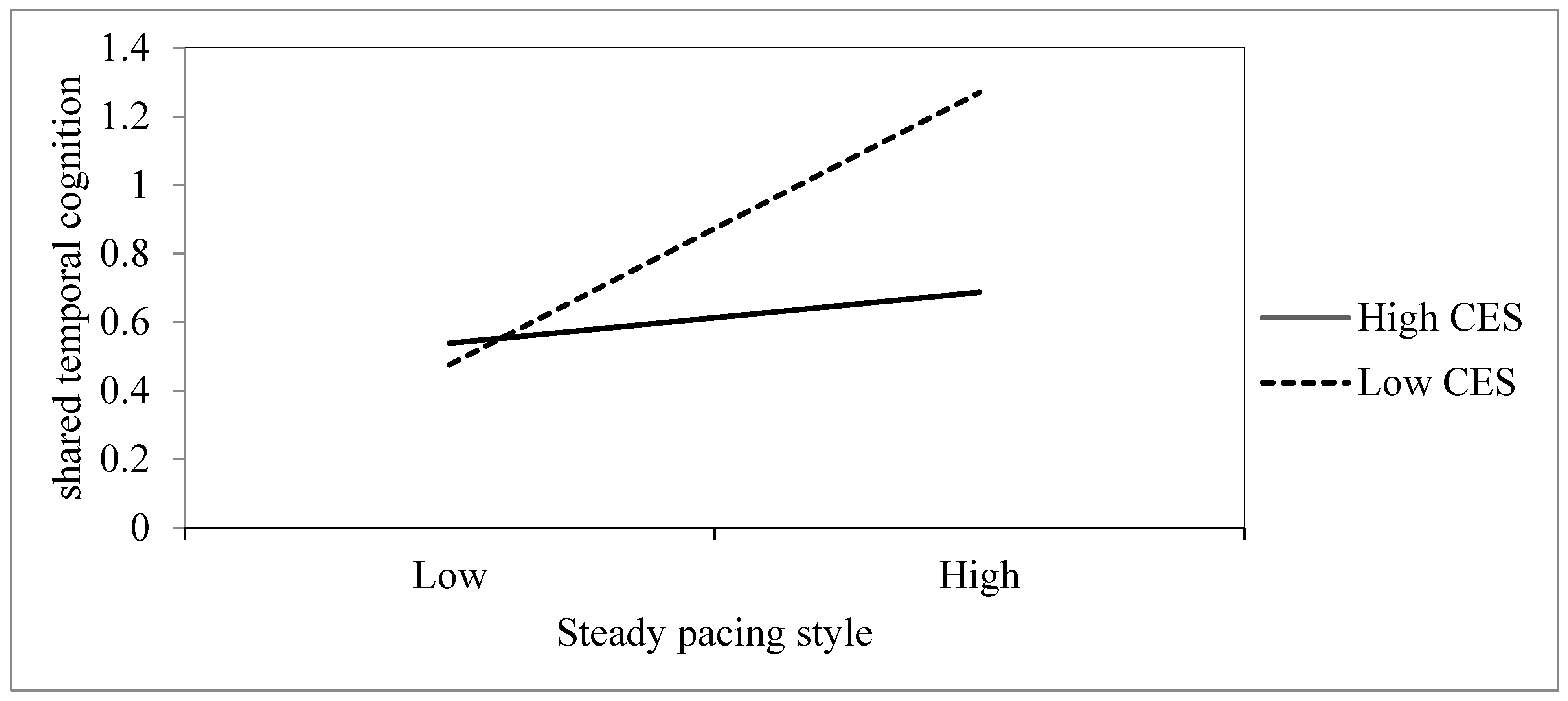

| Model | Factor | χ2/df | RMESA | CFI | TLI |
|---|---|---|---|---|---|
| Four-factor model | SPS; TR; STC; CES | 1.38 | 0.03 | 0.99 | 0.99 |
| Three-factor model | SPS + STC; TR; CES | 7.63 | 0.13 | 0.64 | 0.60 |
| Two-factor model | SPS + CES; STC + TR | 11.25 | 0.16 | 0.43 | 0.37 |
| One-factor model | SPS + TR + STC + CES | 16.56 | 0.20 | 0.50 | 0.40 |
| Variable | Mean | SD | 1 | 2 | 3 | 4 | 5 | 6 | 7 | 8 | 9 | 10 |
|---|---|---|---|---|---|---|---|---|---|---|---|---|
| 1. Team size | 5.02 | 1.21 | ||||||||||
| 2. Post Tenure | 3.05 | 1.56 | 0.07 | |||||||||
| 3. Age diversity | 0.46 | 0.24 | 0.07 | −0.14 ** | ||||||||
| 4. Gender diversity | 0.41 | 0.12 | 0.23 ** | 0.04 | 0.05 | |||||||
| 5. Crisis type | 0.64 | 0.48 | −0.06 | 0.04 | −0.08 | −0.02 | ||||||
| 6. Deadline pacing | 3.82 | 0.77 | −0.17 ** | 0.09 | −0.07 | −0.05 | 0.06 | |||||
| 7. U−shape pacing | 4.36 | 0.69 | −0.14 ** | 0.02 | −0.01 | 0.10 | 0.05 | 0.18 ** | ||||
| 8. Steady pacing | 3.77 | 0.84 | 0.02 | −0.09 | −0.00 | −0.04 | −0.05 | −0.43 ** | 0.02 | |||
| 9. Shared | 3.70 | 0.73 | 0.18 | −0.05 | 0.10 | 0.06 | −0.01 | −0.28 ** | 0.08 | 0.11 * | ||
| 10. Crisis | 3.19 | 0.80 | 0.00 | −0.09 | 0.11 * | −0.05 | −0.02 | −0.23 ** | −0.09 | 0.36 ** | 0.24 ** | |
| 11. Team resilience | 3.75 | 0.70 | 0.22 ** | 0.03 | −0.04 | 0.09 | −0.05 | −0.17 ** | 0.15 ** | 0.17 ** | 0.06 ** | −0.04 |
| Path | Coefficient | SE | LLCI (95%) | ULCI (95%) |
|---|---|---|---|---|
| Total effect: SPS → TR | 0.14 | 0.04 | 0.06 | 0.22 |
| Direct effect | 0.08 | 0.03 | 0.02 | 0.15 |
| M: SPS → STC → TR | 0.06 | 0.03 | 0.01 | 0.11 |
| Moderating Role | Path: Steady Pacing Style → Shared Temporal Cognition → Team Resilience | ||
|---|---|---|---|
| Indirect Effect | LLCI (95%) | ULCI (95%) | |
| Low crisis event strength | 0.13 | 0.06 | 0.20 |
| High crisis event strength | 0.05 | −0.00 | 0.11 |
| Moderated mediation effect | −0.18 | −0.24 | −0.11 |
Disclaimer/Publisher’s Note: The statements, opinions and data contained in all publications are solely those of the individual author(s) and contributor(s) and not of MDPI and/or the editor(s). MDPI and/or the editor(s) disclaim responsibility for any injury to people or property resulting from any ideas, methods, instructions or products referred to in the content. |
© 2025 by the authors. Licensee MDPI, Basel, Switzerland. This article is an open access article distributed under the terms and conditions of the Creative Commons Attribution (CC BY) license.
Share and Cite
Yao, K.; Yan, X.; Li, C. Temporal Coordination Mechanisms and Team Resilience: An Event System Perspective on Leaders’ Pacing Styles. Systems 2026, 14, 13. https://doi.org/10.3390/systems14010013
Yao K, Yan X, Li C. Temporal Coordination Mechanisms and Team Resilience: An Event System Perspective on Leaders’ Pacing Styles. Systems. 2026; 14(1):13. https://doi.org/10.3390/systems14010013
Chicago/Turabian StyleYao, Kai, Xinyue Yan, and Chen Li. 2026. "Temporal Coordination Mechanisms and Team Resilience: An Event System Perspective on Leaders’ Pacing Styles" Systems 14, no. 1: 13. https://doi.org/10.3390/systems14010013
APA StyleYao, K., Yan, X., & Li, C. (2026). Temporal Coordination Mechanisms and Team Resilience: An Event System Perspective on Leaders’ Pacing Styles. Systems, 14(1), 13. https://doi.org/10.3390/systems14010013