
Exploring the Roles of Age and Gender in User Satisfaction and Usage of AI-Driven Chatbots in Digital Health Services: A Multigroup Analysis


Abstract
1. Introduction
2. Literature Review
2.1. Importance and Challenges in Digital Health Services
2.2. AI-Driven Tools in Saudi Arabia and Vision 2030
2.3. User Satisfaction with AI-Driven Chatbots
2.4. Role of Age in Chatbot Usage
2.5. Role of Gender in Chatbot Usage and Satisfaction
2.6. Gaps in Literature
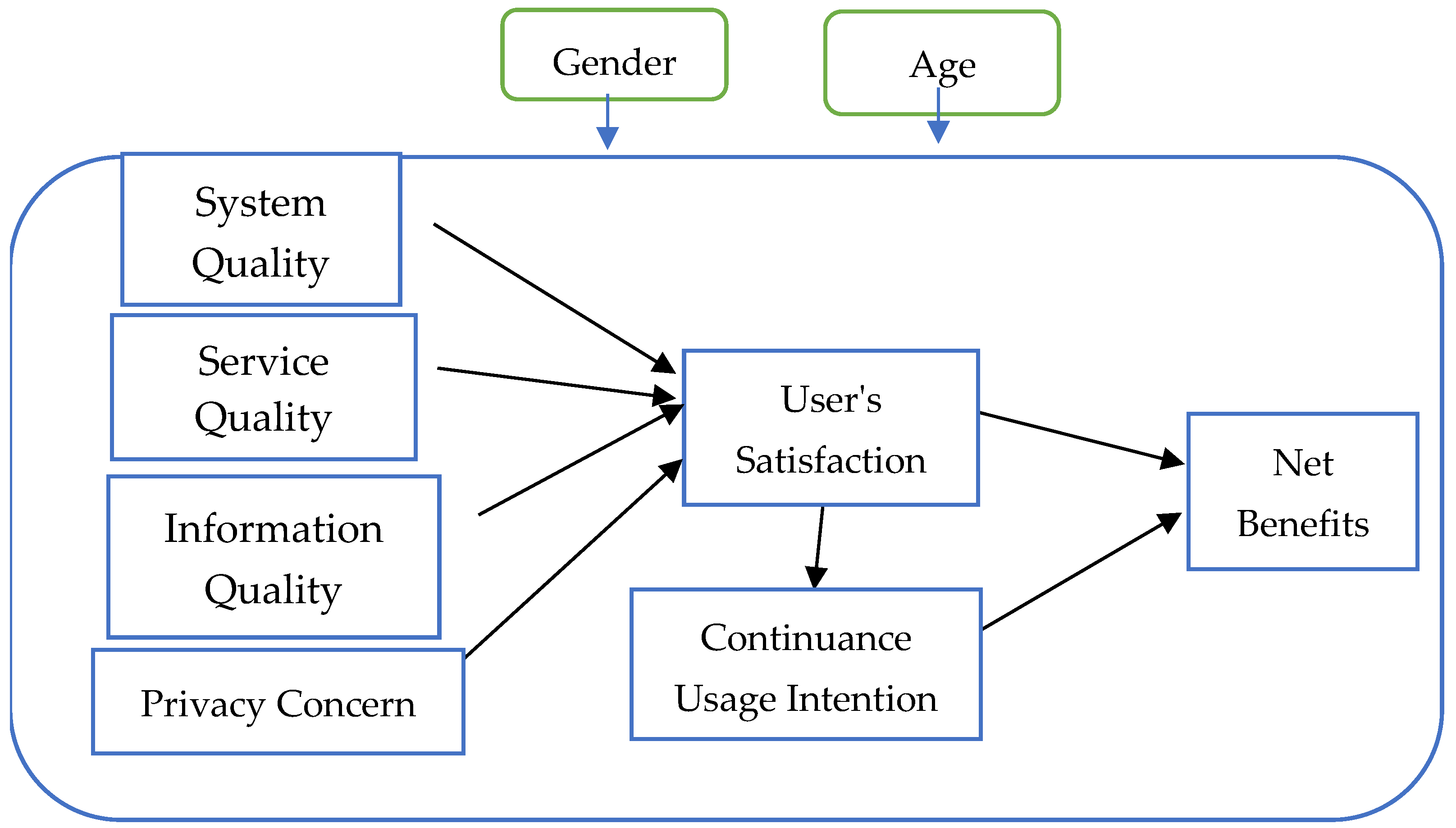
3. Conceptual Framework
3.1. System Quality
3.2. Information Quality
3.3. Service Quality
3.4. Privacy Concerns
3.5. User Satisfaction
3.6. Continuance Usage Intention (CUI)
3.7. Gender and Age Effects
4. Methodology
4.1. Measurement Development
4.2. Data Collection
4.3. Data Analysis
5. Results
5.1. Reliability and Validity Evaluation
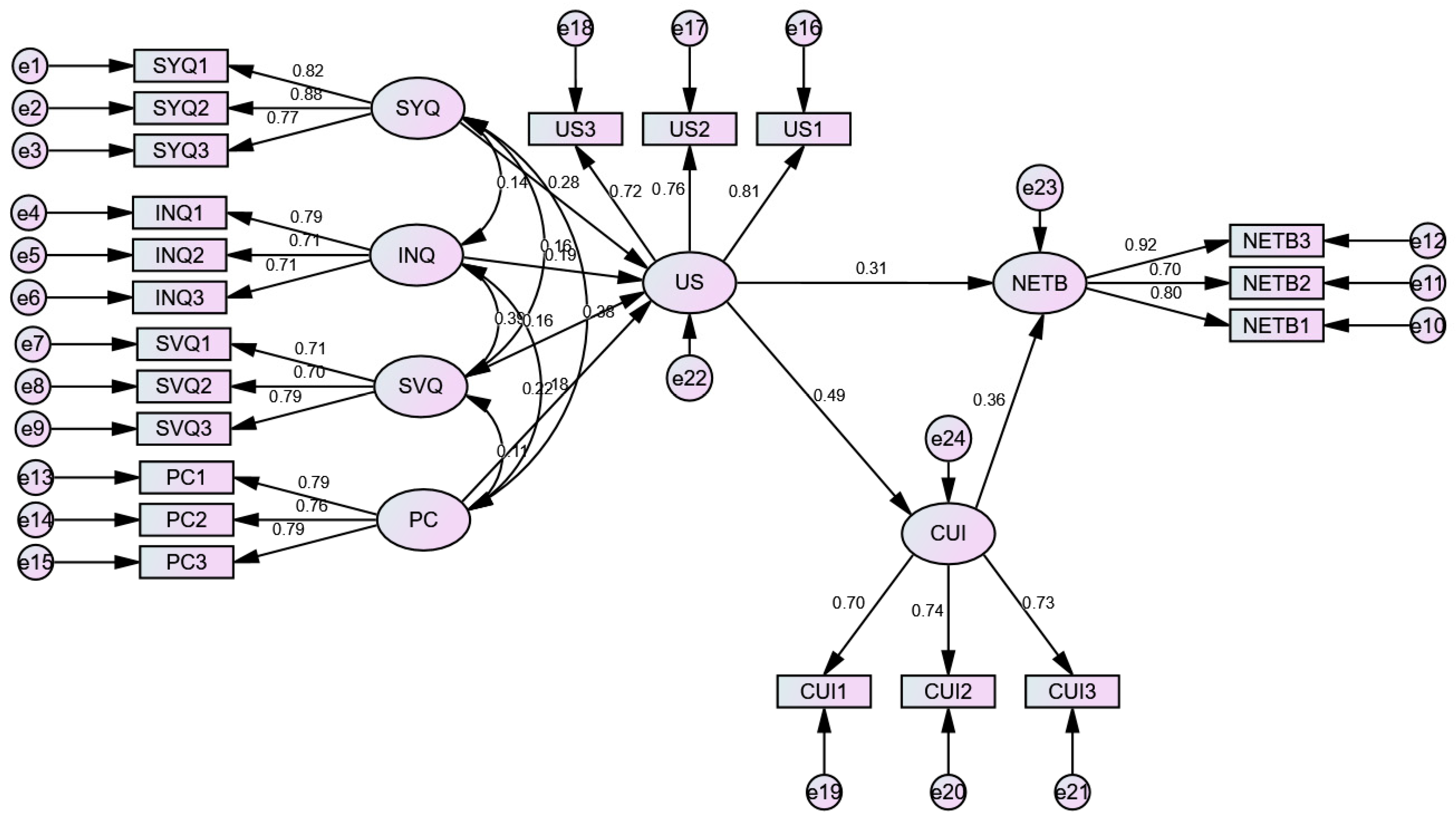
5.2. Structure Model Evaluation
5.3. Multi-Group Analysis
5.3.1. Gender and US
5.3.2. Age and User Satisfaction
6. Discussion
6.1. The Moderating Role of Age and Gender on Chatbot Adoption
6.2. Alignment with Existing Research
6.3. Positioning Within Theoretical Frameworks
6.4. Implications for Digital Health Practice
7. Conclusions
8. Research Limitations and Future Work
Author Contributions
Funding
Institutional Review Board Statement
Informed Consent Statement
Data Availability Statement
Acknowledgments
Conflicts of Interest
References
- Paliwal, S.; Bharti, V.; Mishra, A.K. Ai chatbots: Transforming the digital world. In Recent Trends and Advances in Artificial Intelligence and Internet of Things; Springer International Publishing: Cham, Switzerland, 2019; pp. 455–482. [Google Scholar]
- Ashfaq, M.; Yun, J.; Yu, S.; Loureiro, S.M.C. I, Chatbot: Modeling the determinants of users’ satisfaction and continuance intention of AI-powered service agents. Telemat. Inform. 2020, 54, 101473. [Google Scholar] [CrossRef]
- Prahalad, C.K.; Ramaswamy, V. Co-creating unique value with customers. Strategy Leadersh. 2004, 32, 4–9. [Google Scholar] [CrossRef]
- Castro, D.; New, J. The promise of artificial intelligence. Cent. Data Innov. 2016, 115, 32–35. [Google Scholar]
- Cheng, Y.; Jiang, H. How do AI-driven chatbots impact user experience? Examining gratifications, perceived privacy risk, satisfaction, loyalty, and continued use. J. Broadcast. Electron. Media 2020, 64, 592–614. [Google Scholar] [CrossRef]
- Shah, H.; Warwick, K.; Vallverdú, J.; Wu, D. Can machines talk? Comparison of Eliza with modern dialogue systems. Comput. Hum. Behav. 2016, 58, 278–295. [Google Scholar] [CrossRef]
- Sheehan, B.; Jin, H.S.; Gottlieb, U. Customer service chatbots: Anthropomorphism and adoption. J. Bus. Res. 2020, 115, 14–24. [Google Scholar] [CrossRef]
- Says, G. Percent of Customer Service Operations Will Use Virtual Customer Assistants by 2020. Gartner Newsroom. 2018. Available online: https://www.gartner.com/en/newsroom/press-releases/2018-02-19-gartner-says-25-percent-of-customer-service-operations-will-use-virtual-customer-assistants-by-2020. (accessed on 3 April 2024).
- Elsner, N. KAYAK mobile travel report: Chatbots in the UK. Dostupno 2017, 23, 2020. [Google Scholar]
- Zhang, B.; Zhu, Y.; Deng, J.; Zheng, W.; Liu, Y.; Wang, C.; Zeng, R. “I am here to assist your tourism”: Predicting continuance intention to use ai-based chatbots for tourism. does gender really matter? Int. J. Hum.–Comput. Interact. 2023, 39, 1887–1903. [Google Scholar] [CrossRef]
- Barrett, C. Pew internet and American life project. In Encyclopedia of Behavioral Medicine; Springer: Berlin/Heidelberg, Germany, 2020; pp. 1656–1658. [Google Scholar]
- George, A.H.; George, A.S. From Pulse to Prescription: Exploring the Rise of AI in Medicine and Its Implications. Partn. Univers. Int. Innov. J. 2023, 1, 38–54. [Google Scholar]
- Parveen, A.; Kannan, G. Healthcare transformed: A comprehensive survey of artificial intelligence trends in healthcare industries. In Digital Healthcare in Asia and Gulf Region for Healthy Aging and More Inclusive Societies; Volume 4 in Information Technologies in Healthcare Industry; Academic Press: Cambridge, MA, USA, 2024; pp. 395–424. [Google Scholar]
- Terblanche, N.; Kidd, M. Adoption factors and moderating effects of age and gender that influence the intention to use a non-directive reflective coaching chatbot. Sage Open 2022, 12, 21582440221096136. [Google Scholar] [CrossRef]
- Laranjo, L.; Dunn, A.G.; Tong, H.L.; Kocaballi, A.B.; Chen, J.; Bashir, R.; Surian, D.; Gallego, B.; Magrabi, F.; Lau, A.Y.S.; et al. Conversational agents in healthcare: A systematic review. J. Am. Med. Inform. Assoc. 2018, 25, 1248–1258. [Google Scholar] [CrossRef] [PubMed]
- Zhang, J.; Oh, Y.J.; Lange, P.; Yu, Z.; Fukuoka, Y. Artificial intelligence chatbot behavior change model for designing artificial intelligence chatbots to promote physical activity and a healthy diet. J. Med. Internet Res. 2020, 22, e22845. [Google Scholar] [CrossRef] [PubMed]
- Xue, J.; Zhang, B.; Zhao, Y.; Zhang, Q.; Zheng, C.; Jiang, J.; Li, H.; Liu, N.; Li, Z.; Fu, W.; et al. Evaluation of the current state of Chatbots for digital health: Scoping review. J. Med. Internet Res. 2023, 25, e47217. [Google Scholar] [CrossRef] [PubMed]
- Alghareeb, M.; Albesher, A.; Asif, A. Studying Users’ Perceptions of COVID-19 Mobile Applications in Saudi Arabia. Sustainability 2023, 15, 956. [Google Scholar] [CrossRef]
- Asiri, A.A.; Al-Qahtani, F.S.; Al-Saleh, M.M.; Alhayyani, R.M.; Alfaya, F.A.; Alfaifi, S.H.; Al-Badour, H.M. Impact of electronic health services on patient satisfaction in primary health care centers in Southwestern Saudi Arabia. J. Fam. Med. Prim. Care 2024, 13, 85–92. [Google Scholar] [CrossRef]
- Mani, Z.A.; Goniewicz, K. Transforming healthcare in Saudi Arabia: A comprehensive evaluation of vision 2030’s impact. Sustainability 2024, 16, 3277. [Google Scholar] [CrossRef]
- Housawi, A.A.; Lytras, M.D. A strategic framework for digital transformation in healthcare: Insights from the Saudi Commission for Health Specialties. In Digital Transformation in Healthcare in Post-COVID-19 Times; Elsevier: Amsterdam, The Netherlands, 2023; pp. 173–192. [Google Scholar]
- Muafa, A.M.; Al-Obadi, S.H.; Al-Saleem, N.A.I.; Taweili, A.A.; Al-Amri, A.G. The Impact of Artificial Intelligence Applications on the Digital Transformation of Healthcare Delivery in Riyadh, Saudi Arabia (Opportunities and Challenges in Alignment with Vision 2030). Acad. J. Res. Sci. Publ. 2024, 5, 61–102. [Google Scholar] [CrossRef]
- Alatawi, A.; Ahmed, S.; Niessen, L.; Khan, J. Systematic review and meta-analysis of public hospital efficiency studies in Gulf region and selected countries in similar settings. Cost Eff. Resour. Alloc. 2019, 17, 17. [Google Scholar] [CrossRef]
- Memish, Z.A.; Altuwaijri, M.M.; Almoeen, A.H.; Enani, S.M. The Saudi Data & Artificial Intelligence Authority (SDAIA) vision: Leading the kingdom’s journey toward global leadership. J. Epidemiol. Glob. Health 2021, 11, 140–142. [Google Scholar]
- Gelderman, M. The relation between user satisfaction, usage of information systems and performance. Inf. Manag. 1998, 34, 11–18. [Google Scholar] [CrossRef]
- Leclercq, A. The perceptual evaluation of information systems using the construct of user satisfaction: Case study of a large French group. ACM SIGMIS Database Database Adv. Inf. Syst. 2007, 38, 27–60. [Google Scholar] [CrossRef]
- Liu, W.; Hu, J.; Lv, F.; Tang, Z. A new method for long-term temperature compensation of structural health monitoring by ultrasonic guided wave. Measurement 2025, 252, 117310. [Google Scholar] [CrossRef]
- Wang, M.-C.; Lin, Y.-T.; Huang, C.-Y.; Huang, C.-Y.; Yeh, P.-K. Empirical Assessment of User Satisfaction with American and Chinese AI Chatbots. Int. J. 2023, 10, 3199–3211. [Google Scholar] [CrossRef]
- Xu, A.; Liu, Z.; Guo, Y.; Sinha, V.; Akkiraju, R. A new chatbot for customer service on social media. In Proceedings of the 2017 CHI Conference on Human Factors in Computing Systems, Denver, CO, USA, 6–11 May 2017; pp. 3506–3510. [Google Scholar]
- Reinkemeier, F.; Gnewuch, U. Match or mismatch? How matching personality and gender between voice assistants and users affects trust in voice commerce. In Proceedings of the 55th Hawaii International Conference on System Sciences, Virtual Event, 4–7 January 2022. [Google Scholar]
- McFarland, D.J. The Role of Age and Efficacy on Technology Acceptance: Implications for E-Learning. In Proceedings of the WebNet 2001—World Conference on the WWW and Internet, Orlando, FL, USA, 23–27 October 2001. [Google Scholar]
- Ma, Q.; Chan, A.H.; Teh, P.-L. Insights into older adults’ technology acceptance through meta-analysis. Int. J. Hum.–Comput. Interact. 2021, 37, 1049–1062. [Google Scholar] [CrossRef]
- Cegolon, A.; Jenkins, A. Older adults, cognitively stimulating activities and change in cognitive function. Int. J. Lifelong Educ. 2022, 41, 405–419. [Google Scholar] [CrossRef]
- Liu, L.; Wu, F.; Tong, H.; Hao, C.; Xie, T. The digital divide and active aging in China. Int. J. Environ. Res. Public Health 2021, 18, 12675. [Google Scholar] [CrossRef]
- Meyers-Levy, J.; Maheswaran, D. Exploring differences in males’ and females’ processing strategies. J. Consum. Res. 1991, 18, 63–70. [Google Scholar] [CrossRef]
- Meyers-Levy, J. The influence of sex roles on judgment. J. Consum. Res. 1988, 14, 522–530. [Google Scholar] [CrossRef]
- Petter, S.; DeLone, W.; McLean, E. Measuring information systems success: Models, dimensions, measures, and interrelationships. Eur. J. Inf. Syst. 2008, 17, 236–263. [Google Scholar] [CrossRef]
- DeLone, W. The DeLone McLean Model of Success System Information: A ten-Year Update. J. Manag. Inf. 1992, 19, 9–30. [Google Scholar]
- Al-Hattami, H.M. Validation of the D&M IS success model in the context of accounting information system of the banking sector in the least developed countries. J. Manag. Control 2021, 32, 127–153. [Google Scholar]
- Floropoulos, J.; Spathis, C.; Halvatzis, D.; Tsipouridou, M. Measuring the success of the Greek taxation information system. Int. J. Inf. Manag. 2010, 30, 47–56. [Google Scholar] [CrossRef]
- DeLone, W.H.; McLean, E.R. The DeLone and McLean model of information systems success: A ten-year update. J. Manag. Inf. Syst. 2003, 19, 9–30. [Google Scholar]
- Zaied, A.N.H. An integrated success model for evaluating information system in public sectors. J. Emerg. Trends Comput. Inf. Sci. 2012, 3, 814–825. [Google Scholar]
- Mumtaz, A.; Ting, H.; Ramayah, T.; Chuah, F.; Cheah, J. A review of the methodological misconceptions and guidelines related to the application of structural equation modelling: A Malaysian scenario. J. Appl. Struct. Equ. Model. 2017, 1, 1–13. [Google Scholar]
- Sekaran, U. Research Methods for Business: A Skill Building Approach; John Wiley & Sons: Hoboken, NJ, USA, 2016. [Google Scholar]
- Bell, E.; Bryman, A. The ethics of management research: An exploratory content analysis. Br. J. Manag. 2007, 18, 63–77. [Google Scholar] [CrossRef]
- Arbuckle, J.L. IBM SPSS Amos 22 User’s Guide; Amos Development Corporation: Crawfordville, FL, USA, 2013; Volume 635. [Google Scholar]
- Hair, J.F.; Sarstedt, M.; Ringle, C.M.; Mena, J.A. An assessment of the use of partial least squares structural equation modeling in marketing research. J. Acad. Mark. Sci. 2012, 40, 414–433. [Google Scholar] [CrossRef]
- Reinartz, W.; Haenlein, M.; Henseler, J. An empirical comparison of the efficacy of covariance-based and variance-based SEM. Int. J. Res. Mark. 2009, 26, 332–344. [Google Scholar] [CrossRef]
- Fornell, C.; Larcker, D.F. Evaluating structural equation models with unobservable variables and measurement error. J. Mark. Res. 1981, 18, 39–50. [Google Scholar] [CrossRef]
- Cinganotto, L.; Filippetti, S.; Montanucci, G. The Impact of Artificial Intelligence Systems on Online Italian Language Courses: A Case Study at the University for Foreigners of Perugia. In Proceedings of the Conference Proceedings Bridges Across Cultures, Viterbo, Italy, 20–21 June 2024. [Google Scholar]
- Larsen, A.G.; Følstad, A. The impact of chatbots on public service provision: A qualitative interview study with citizens and public service providers. Gov. Inf. Q. 2024, 41, 101927. [Google Scholar] [CrossRef]



| Constructs | Items |
|---|---|
| System Quality | The conversational AI and virtual assistant system operate efficiently and without errors. The system is easy to use. The system responds quickly to my requests and inquiries. |
| Information Quality | The information provided by the system is accurate. The system offers comprehensive answers to my needs. The information is up-to-date and useful. |
| Service Quality | The system interacts professionally and politely. The system generally meets my needs. The service is consistently available. |
| Net Benefits | The system has saved me time and effort when using government services. The system has helped me complete my tasks more efficiently. Using the system enhances my overall experience with government services. |
| Privacy Concern | I am concerned about the system collecting my data. The system respects my privacy when delivering the service. I trust that my data will not be used for unauthorised purposes. |
| User Satisfaction | I am satisfied with my overall experience with the system. The system meets my expectations. I prefer using the system in the future over traditional methods. |
| Continuance Usage Intention | I regularly use the system to meet my needs. I rely on the system as essential to my interaction with government services. I see myself continuing to use the system in the future. |
| Demographics | Category | Frequency | Percent |
|---|---|---|---|
| Gender | Male | 242 | 45.9 |
| Female | 285 | 54.1 | |
| Age | 18–30 | 122 | 23.1 |
| 31–40 | 191 | 36.2 | |
| 41–50 | 115 | 21.8 | |
| More than 50 | 99 | 18.8 |
| Construct | CR Value | Interpretation |
|---|---|---|
| SYQ | 0.864 | Good reliability. The observed variables reliably measure the construct. |
| INQ | 0.781 | Acceptable reliability, though slightly lower than SYQ. |
| SVQ | 0.778 | Acceptable reliability, indicating consistency in measurement. |
| NETB | 0.849 | Good reliability. This construct is measured consistently by its indicators. |
| PC | 0.821 | Good reliability. This construct is measured well. |
| US | 0.815 | Good reliability. Consistency in measurement is present. |
| CUI | 0.768 | Acceptable reliability, but close to the threshold of 0.70. Further refinement of the indicators might improve it. |
| Construct | AVE Value | Interpretation |
|---|---|---|
| SYQ | 0.679 | Good convergent validity. The construct explains a significant portion of the variance in its indicators. |
| INQ | 0.544 | Acceptable convergent validity, slightly above the threshold. |
| SVQ | 0.540 | Acceptable convergent validity, indicating moderate shared variance. |
| NETB | 0.654 | Good convergent validity, demonstrating strong shared variance. |
| PC | 0.604 | Good convergent validity, explaining a substantial portion of the variance. |
| US | 0.596 | Acceptable convergent validity, close to good reliability. |
| CUI | 0.525 | Acceptable convergent validity, though relatively close to the threshold. |
| SYQ | INQ | SVQ | NETB | PC | US | CUI | |
|---|---|---|---|---|---|---|---|
| SYQ | 0.824 | ||||||
| INQ | 0.137 | 0.737 | |||||
| SVQ | 0.16 | 0.39 | 0.735 | ||||
| NETB | 0.386 | 0.256 | 0.243 | 0.809 | |||
| PC | 0.377 | 0.178 | 0.114 | 0.424 | 0.777 | ||
| US | 0.378 | 0.313 | 0.292 | 0.449 | 0.323 | 0.772 | |
| CUI | 0.334 | 0.217 | 0.158 | 0.519 | 0.441 | 0.454 | 0.724 |
| Path | Unstandardised Estimate | Standardised Estimate | CR Value | p-Value | Interpretation |
|---|---|---|---|---|---|
| US <--- SYQ | 0.293 | 0.276 | 5.297 | *** | Positive and significant effect |
| US <--- INQ | 0.164 | 0.193 | 3.474 | *** | Positive and significant effect |
| US <--- SVQ | 0.238 | 0.161 | 2.917 | 0.004 | Positive and significant effect |
| US <--- PC | 0.238 | 0.220 | 4.132 | *** | Positive and significant effect |
| CUI <--- US | 0.427 | 0.493 | 8.475 | *** | Strong positive and significant effect |
| NETB <--- US | 0.355 | 0.315 | 5.591 | *** | Positive and significant effect |
| NETB <--- CUI | 0.475 | 0.365 | 6.063 | *** | Positive and significant effect |
| Path | Unstandardised Estimate | CR Value | p-Value | Standardised Estimate | Interpretation | |||||
|---|---|---|---|---|---|---|---|---|---|---|
| Male | Female | Male | Female | Male | Female | Male | Female | Male | Female | |
| US <--- SYQ | 0.181 | 0.277 | 1.667 | 4.229 | 0.096 | *** | 0.131 | 0.303 | Positive but non-significant | Positive and significant |
| US <--- INQ | 0.149 | 0.171 | 1.734 | 3.023 | 0.083 | 0.003 | 0.161 | 0.220 | Positive but marginally non-significant | Positive and significant |
| US <--- SVQ | 0.170 | 0.220 | 1.258 | 2.125 | 0.209 | 0.034 | 0.116 | 0.148 | Positive but non-significant | Positive and significant |
| US <--- PC | 0.856 | 0.171 | 2.677 | 2.948 | 0.007 | 0.003 | 0.297 | 0.206 | Positive and significant | Positive and significant |
| CUI<--- US | 0.231 | 0.462 | 3.872 | 5.787 | *** | *** | 0.543 | 0.436 | Strong positive and significant | Strong positive and significant |
| NETB <--- US | 0.097 | 0.401 | 1.523 | 4.941 | 0.128 | *** | 0.165 | 0.370 | Positive but non-significant | Positive and significant |
| NETB <--- CUI | 0.005 | 0.384 | 0.028 | 5.133 | 0.978 | *** | 0.003 | 0.376 | No significant effect | Positive and significant |
| Path | CR Value | Interpretation |
|---|---|---|
| SYQ → US | 0.759 | There is no significant difference between males and females in the effect of SYQ on US. |
| US → NETB | 2.938 | Significant difference. The effect of US on NETB is stronger for females than males. |
| US → CUI | 2.325 | Significant difference. The effect of US on CUI is stronger for females than males. |
| INQ → US | 0.208 | There is no significant difference between males and females in the effect of INQ on US. |
| SVQ → US | 0.291 | There is no significant difference between males and females in the effect of SVQ on US. |
| PC → US | −2.109 | Significant difference. The effect of PC on US is stronger for males than females. |
| CUI → NETB | 2.019 | Significant difference. The effect of CUI on NETB is stronger for females than for males. |
| Path | Unstandardised Estimate | CR Value | p-Value | Standardised Estimate | ||||||||||||
|---|---|---|---|---|---|---|---|---|---|---|---|---|---|---|---|---|
| A | B | C | D | A | B | C | D | A | B | C | D | A | B | C | D | |
| US <--- SYQ | 0.146 | 0.291 | 0.284 | 0.407 | 1.214 | 3.107 | 2.470 | 3.216 | 0.225 | 0.268 | 0.014 | 0.001 | 0.120 | 0.268 | 0.284 | 0.120 |
| US <--- INQ | 0.131 | 0.258 | 0.063 | 0.139 | 1.320 | 2.927 | 0.648 | 1.265 | 0.187 | 0.313 | 0.517 | 0.206 | 0.151 | 0.313 | 0.077 | 0.437 |
| US <--- SVQ | 0.379 | −0.089 | 0.259 | 0.579 | 2.561 | −0.545 | 1.540 | 2.280 | 0.010 | −0.058 | 0.124 | 0.023 | 0.288 | −0.058 | 0.191 | 0.132 |
| US <--- PC | 0.235 | 0.381 | 0.040 | 0.297 | 2.174 | 2.838 | 0.356 | 2.787 | 0.030 | 0.276 | 0.722 | 0.005 | 0.222 | 0.276 | 0.042 | 0.259 |
| CUI <--- US | 0.370 | 0.285 | 0.409 | 0.850 | 4.100 | 4.033 | 3.433 | 5.228 | *** | 0.385 | *** | *** | 0.496 | 0.385 | 0.444 | 0.359 |
| NETB <--- US | 0.259 | 0.607 | −0.042 | 0.428 | 1.958 | 6.058 | −0.337 | 2.419 | 0.050 | 0.547 | 0.736 | 0.016 | 0.214 | 0.547 | −0.038 | 0.682 |
| NETB <--- CUI | 0.702 | 0.298 | 0.859 | 0.165 | 3.482 | 2.340 | 4.533 | 1.229 | *** | 0.199 | *** | 0.219 | 0.431 | 0.199 | 0.727 | 0.402 |
| Path | CR Value | |||||
|---|---|---|---|---|---|---|
| A and B | A and C | A and D | B and C | B and D | C and D | |
| SYQ → US | 0.954 | 0.829 | 1.497 | −0.051 | 0.735 | 0.721 |
| SVQ → US | −2.123 | −0.534 | 0.683 | 1.484 | 2.212 | 1.051 |
| INQ → US | 0.956 | −0.491 | 0.056 | −1.488 | −0.840 | 0.521 |
| PC → US | 0.849 | −1.244 | 0.411 | −1.941 | −0.489 | 1.653 |
| US → NETB | 2.098 | −1.660 | 0.764 | −4.074 | −0.882 | 2.175 |
| US → CUI | −0.741 | 0.263 | 2.583 | 0.896 | 3.188 | 2.188 |
| CUI → NETB | −1.691 | 0.571 | −2.212 | 2.456 | −0.716 | −2.984 |
Disclaimer/Publisher’s Note: The statements, opinions and data contained in all publications are solely those of the individual author(s) and contributor(s) and not of MDPI and/or the editor(s). MDPI and/or the editor(s) disclaim responsibility for any injury to people or property resulting from any ideas, methods, instructions or products referred to in the content. |
© 2026 by the authors. Licensee MDPI, Basel, Switzerland. This article is an open access article distributed under the terms and conditions of the Creative Commons Attribution (CC BY) license.
Share and Cite
Alzahrani, L.; Weerakkody, V. Exploring the Roles of Age and Gender in User Satisfaction and Usage of AI-Driven Chatbots in Digital Health Services: A Multigroup Analysis. Systems 2026, 14, 113. https://doi.org/10.3390/systems14010113
Alzahrani L, Weerakkody V. Exploring the Roles of Age and Gender in User Satisfaction and Usage of AI-Driven Chatbots in Digital Health Services: A Multigroup Analysis. Systems. 2026; 14(1):113. https://doi.org/10.3390/systems14010113
Chicago/Turabian StyleAlzahrani, Latifa, and Vishanth Weerakkody. 2026. "Exploring the Roles of Age and Gender in User Satisfaction and Usage of AI-Driven Chatbots in Digital Health Services: A Multigroup Analysis" Systems 14, no. 1: 113. https://doi.org/10.3390/systems14010113
APA StyleAlzahrani, L., & Weerakkody, V. (2026). Exploring the Roles of Age and Gender in User Satisfaction and Usage of AI-Driven Chatbots in Digital Health Services: A Multigroup Analysis. Systems, 14(1), 113. https://doi.org/10.3390/systems14010113