

Article

Modeling China’s Urban Network Structure: Unraveling the Drivers from a Population Mobility Perspective

by
Haowei Duan
and
Kai Liu
*
College of Geography and Environment, Shandong Normal University, Jinan 250358, China
*
Author to whom correspondence should be addressed.
Systems 2026, 14(1), 109; https://doi.org/10.3390/systems14010109
Submission received: 16 December 2025 / Revised: 16 January 2026 / Accepted: 19 January 2026 / Published: 20 January 2026
(This article belongs to the Special Issue Data-Driven Urban Mobility Modeling)

Abstract

Intercity population flows are playing an increasingly pivotal role in shaping the spatial evolution and structural dynamics of urban networks. Drawing upon Amap Migration Data (2018–2023), this study maps China’s urban networks using social network analysis and identifies their key drivers using a temporal exponential random graph model. The findings reveal three primary insights: First, the overall network exhibits “high connectivity and strong clustering” traits. Enhanced efficiency in intercity resource allocation fosters cross-regional factor flows, resulting in multi-tiered connectivity corridors. Industrial linkages and policy interventions drive the development of a polycentric and clustered configuration. Second, the individual city network exhibits a core–periphery dynamic structure. A diamond-shaped framework dominated by hub cities in the national strategic regions directs factor flows. Development of strategic corridors enables peripheral cities to evolve into secondary hubs by leveraging structural hole advantages, reflecting the continuous interplay between network structure and geo-economic factors. Third, driving factors involve nonlinear interactions within a multi-layered system. Path dependence in topology, gradient potential from nodal attributes, spatial counterbalance between geographic decay laws and multidimensional proximity, and adaptive self-organization are collectively associated with the transition of the urban network toward a multi-tiered synergistic pattern. By revealing the dynamic interplay between network topology and multidimensional driving factors, this study deepens and advances the theoretical connotations of the “Space of Flows” theory, providing an empirical foundation for optimizing regional governance strategies and promoting high-quality coordinated development of Chinese cities.

1. Introduction

Urban network structures are polycentric collaborative systems, in which cities are nodes and factor flows serve as linkages between them. Emerging urban networks are reshaping the global economic landscape, driven by the restructuring of global production networks and the digital technological revolution. Examples include the EU’s spatial development strategy, North America’s urban corridor initiatives, and China’s urban agglomeration developments [1,2,3,4,5]. Under such dynamics, population mobility—a critical proxy for intercity interactions—serves as both a catalyst and an outcome of spatial reorganization. Investigating urban network through population mobility advances the “Space of Flows” theory and guides policies that optimize urban systems and foster coordinated development. This dual perspective bridges global competitiveness and sustainable urbanization by examining how hierarchical connectivity and institutional innovation can reconcile agglomeration economies and spatial equity.
In recent years, scholars have extensively investigated urban network structures, primarily focusing on three dimensions: innovation, economic, and transportation networks. Innovation networks highlight knowledge flows and technological collaboration, often analyzed through data like patents and co-authored publications to understand cities’ roles in innovation chains, with a particular focus on knowledge spillovers and the spatial clustering of high-tech industries [6,7]. Liu et al. (2022) [8] applied social network analysis (SNA) to identify intercity innovation linkages within the Yangtze River Mid-Reaches urban agglomeration, revealing a multi-core radiation pattern centered on Wuhan, Changsha, and Nanchang alongside a pronounced Matthew effect. Similarly, Liu et al. (2023) [9] employed web-scraped data from technology enterprises, integrating SNA with the geographical detector model (GeoDetector) to demonstrate that China’s innovation networks are characterized by polarized innovation capacity, clustered internal collaborations among small- and medium-sized enterprises, and spatial heterogeneity driven by both research and development investments and transportation infrastructure. In contrast, Cao et al. (2024) [10] utilized GeoDetector to identify dual-core dominance accompanied by central collapse—a dumbbell-shaped spatial pattern—in the expanding innovation network of the Chengdu–Chongqing region.
Research on economic networks examines capital and industrial ties between cities using data like corporate branches and trade flows, helping to identify economic hierarchies and the functional specialization [11,12,13,14,15,16]. Empirical evidence from Chen and Zhu (2021) [17] and Yang et al. (2022) [18], based on an analysis of the 2020 China New Economy TOP 500 Enterprises dataset, reveals intensified core–periphery polarization within urban networks. Cities such as Beijing, Hangzhou, and Chengdu function as dominant control hubs due to their competitive advantages in the digital economy, whereas the traditional industrial cities have declining network centrality [19]. Similarly, Zhang et al. (2025) [20] and Yang et al. (2024) [21] applied geographically and temporally weighted regression and quadratic assignment procedure regression on patent collaboration data, revealing a multipolar trend in economic network connectivity, with the Pearl River Delta and Yangtze River Delta regions serving as core growth poles.
Transportation networks can be used to quantify the strength and accessibility of intercity connectivity through analysis of infrastructure and logistics data, clarifying the function of transportation hubs in facilitating regional integration [22,23,24,25,26]. For instance, Wu et al. (2024) [27] analyzed multimodal transport flows (highway, rail, and aviation) in the Yangtze River Economic Belt using the Theil Index, community detection, and Baidu Maps traffic data. Their findings showed significant spatial differentiation characterized by single-core, dual-core, and multi-core patterns of spatial organization. Similarly, Ma et al. (2023) [28] and Wang et al. (2021) [29] applied a coupling model and TOPSIS analysis to high-speed rail networks and economic networks, revealing strong system interdependence and bidirectional synergies promoting balanced regional development.
Despite significant contributions from existing multidimensional frameworks that have been used to analyze urban network structures, critical gaps remain. Population mobility, which is a fundamental channel for factor circulation, critically shapes the formation and evolution of urban networks. However, research on network structures from the perspective of population mobility remains methodologically constrained. Existing studies have predominantly relied on cross-sectional datasets (e.g., census records, statistical yearbooks), which fail to capture real-time dynamics. Shifting the analytical focus from static physical space to people-centred mobility is essential for understanding the true evolution of urban networks [30]. To address these limitations, the current study examined China’s urban network structure during 2018–2023 across 291 cities from the perspective of population mobility. Intercity population flow intensities were quantified by using dynamic granular migration indices sourced from the Amap Big Data Platform [31]. SNA was applied to analyze both macro-scale network topology and nodal centrality patterns, while temporal exponential random graph model (TERGM) was used to identify the multi-scale determinants underlying network evolution.
This study makes three principal contributions. First, it shifts urban network analysis from conventional lenses (e.g., innovation, economy) to population mobility, demonstrating how short-term flows reshape network structures and offering new insights into polycentric urbanization. Second, using large-scale migration data from Amap, we constructed interannual flow matrices that overcome limitations of traditional static datasets (e.g., transportation infrastructure indices, statistical yearbooks). Our methodology facilitates granular identification of multi-tiered intercity linkages, identifying the hierarchical dependencies and ephemeral interactions typically obscured by conventional aggregated statistics. Third, we established the application of TERGM in urban network analysis, integrating endogenous structural dependencies, nodal attributes, exogenous covariates, and temporal autocorrelation into a unified framework. This approach identifies complex interactions among network formation determinants, ranging from path-dependent clustering to policy-induced connectivity shifts, which provides an empirical foundation for optimizing regional governance strategies.

2. Theoretical Framework

From the perspective of the “Space of Flows,” cities are no longer viewed as isolated geographic entities but as dynamic nodes interconnected by various factor flows [19,27]. As the most core proxy indicator of intercity interaction, the intensity and direction of population mobility directly influence the functional hierarchy and spatial organization patterns of the urban network.
The analysis of urban network structure can be conducted through two dimensions: macro-scale network topology and micro-scale nodal position. Macro-scale network topology is reflected in edge count, network density, and efficiency. With the popularization of transportation infrastructure and digital empowerment, the “time-space compression” effect facilitates the deep integration of cross-regional factors, causing the network to exhibit characteristics of “high connectivity” and “strong clustering”. This evolution is accompanied by a transition from fragmented connections toward multi-tiered synergistic patterns. Micro-scale nodal position reflects the power distribution within the network. Core cities secure resources by occupying “structural hole” positions, demonstrating strong radiative influence and intermediary control capacity, while peripheral nodes face the challenges of geographic decay.
The formation of urban network structure is not a linear result of a single factor, but rather a product of the nonlinear coupling of elements such as endogenous structure, nodal attributes, exogenous covariates, and temporal dependencies [11,16,20]. Regarding endogenous structural effects, network evolution exhibits self-organizing characteristics, forming bi-directional and stable flow circuits through reciprocity mechanisms; this endogenous topological logic serves as the foundation for maintaining the dynamic equilibrium of the network structure. In terms of nodal attributes, a city’s resource endowments determine its attraction and radiative influence within the network. The “reception effect” generated by population scale and the “absorption effect” generated by economic development levels collectively constitute the driving gradient of factor mobility. Furthermore, functional complementarity brought by differences in administrative hierarchy further drives cross-hierarchical vertical collaboration. Regarding exogenous covariates, multidimensional proximities—including geographical, institutional, cultural, and natural factors—constitute a spatial hedging mechanism. Geographical distance constrains mobility according to the “distance decay law”, while belonging to the same urban agglomeration, sharing a common dialect, or having similar climatic environments can effectively reduce spatial frictional resistance and promote the formation of connections. In terms of temporal dependencies, urban networks exhibit significant evolutionary inertia. The stability coefficient reveals the structural locking effects of early core cities, while the variability coefficient reflects how emerging hubs achieve a transition from unipolar concentration to polycentric distribution through structural optimization.
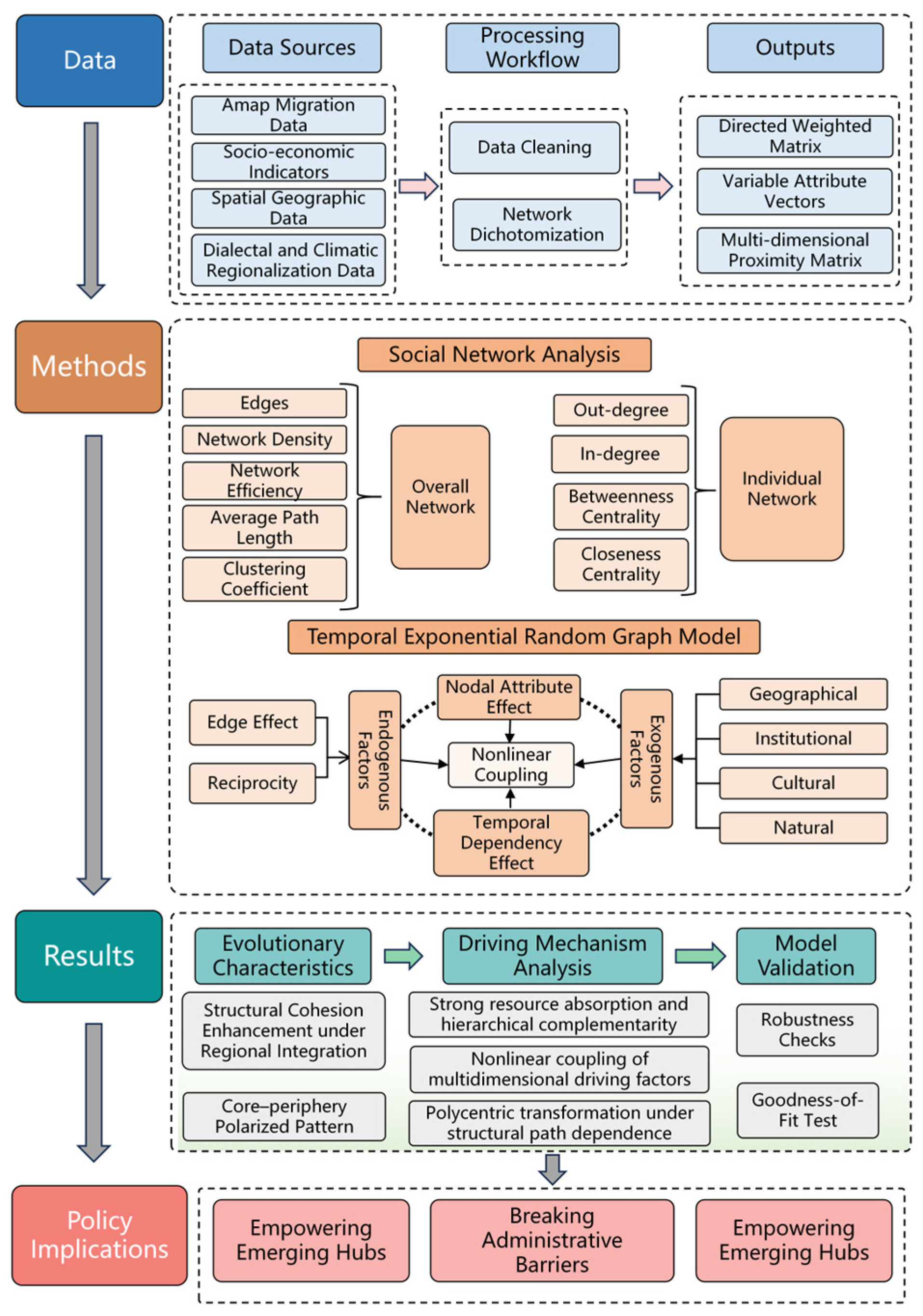
To systematically analyze the aforementioned theoretical logic, this study constructs a research flowchart integrating “Data—Methods—Results—Policy Implications” (Figure 1). The process begins with the collection and standardization of Amap migration big data to construct a directed weighted matrix of urban flows. Subsequently, SNA is applied to quantify macro-scale topological evolution and nodal position distribution, thereby characterizing the static patterns within the “Space of Flows”. Building upon this, the study introduces the TERGM to reveal the dynamic mechanisms driving network evolution through parameter estimation across four dimensions: endogenous, exogenous, attribute, and temporal factors. Finally, by integrating empirical findings with national governance strategies, the research provides a policy basis for promoting the high-quality, polycentric, and coordinated development of Chinese cities.

3. Data and Methods

3.1. Data Sources and Processing

Daily intercity population mobility indices for 367 Chinese cities (2018–2023) were obtained by web crawling the Amap Big Data Platform. The Amap Migration Index is a normalized, dimensionless value derived from location-based service data, representing the relative intensity of population migration between city pairs. This index is designed by the provider to ensure comparability across different city scales and geographic regions, effectively reflecting the magnitude of intercity interactions without being influenced by the absolute population size of the origin or destination. To ensure the structural representativeness of the urban network, daily indices were processed using arithmetic averaging to generate annual flow matrices. This smoothing technique effectively mitigates “noise” resulting from short-term peaks during major holidays or sudden large-scale events. Subsequently, 76 cities with a total annual average migration index below 100 were excluded. This threshold was established for two primary reasons: first, to filter out random noise and extreme fluctuations associated with low-flow nodes, ensuring the structural stability of migration data; and second, to prevent excessive network sparsity that could hinder the convergence and statistical reliability of TERGM estimations. The remaining 291 cities constitute the backbone of the research network. Based on the processed dataset, a directed weighted network matrix W was constructed, where the element W i j represents the flow intensity from city i to city j .
For TERGM compatibility, the network matrix W was dichotomized: ties exceeding the median 2018 mobility value were coded 1 (significant flow) and others 0 (insignificant flow). The selection of the 2018 median as the baseline is primarily based on the following considerations: First, fixing the threshold at the level of the study’s commencement enables the model to capture the actual densification and structural expansion of the urban network over time, ensuring longitudinal comparability throughout the research period. Second, as a robust statistical indicator, the median prevents threshold shifts caused by extreme outliers resulting from massive flows between megacities, thereby avoiding distortion of the network backbone.

3.2. Methods

3.2.1. Social Network Analysis

SNA is a methodological framework for visualizing and quantifying relationships among entities within networks, enabling structural characteristics and evolutionary patterns to be identified [32,33]. We used this framework to analyze urban network structure through both macro-scale network topology and nodal-level structural characteristics. In this study, we chose to establish a directed network framework as the foundation for subsequent analysis. Compared with undirected networks, selecting a directed network structure allows for a more detailed identification of urban roles. Specifically, it can distinguish between a city’s “radiative influence” (quantified by out-degree) and “reception capacity” (quantified by in-degree), thereby more comprehensively characterizing the functional positioning of cities within the network.
The overall network structure denotes the global configuration of all nodes and their interconnections. We calculated five topological metrics to characterize the topological structure of China’s urban network. Edge count quantifies population flows between city pairs, while network density measures the connection intensity among cities. Network efficiency reflects structural efficiency. Average path length indicates the mean geodesic distance between all node pairs, with lower values indicating higher accessibility. The clustering coefficient measures nodal clustering propensity within the network. Table 1 provides the mathematical formulas for these metrics.
The individual network structure shows the relational patterns between a node and its direct neighbors, indicating its structural position and functional role. We used three centrality metrics—degree, betweenness, and closeness centrality—to characterize nodal attributes, complementing the macro-level network analysis. Degree centrality comprises out-degree and in-degree. Out-degree measures the number of edges originating from a node, reflecting its radiative influence capacity. In-degree measures edges terminating at a node, indicating reception capacity and attraction. Betweenness centrality measures a city’s role in connecting disconnected nodes, while closeness centrality reflects overall accessibility based on inverse geodesic distance. Calculation formulas are provided in Table 2.

3.2.2. Temporal Exponential Random Graph Model

We used TERGM to identify the determinants underlying urban network evolution. Compared with Exponential Random Graph Models or Quadratic Assignment Procedure models commonly used in urban network research, the primary advantage of the TERGM lies in its incorporation of temporal autocorrelation. This feature enables the model to quantify the extent to which the current network configuration is “inherited” from its previous state (stability), while simultaneously elucidating how emerging ties are formed through the nonlinear coupling of multi-level determinants (variability). By integrating endogenous, exogenous, and temporal dimensions, this comprehensive modeling strategy provides deeper insights into the dynamic equilibrium mechanisms of complex urban systems than traditional linear regression methods. This model incorporates temporal dependencies to capture dynamic interdependencies across time points [34,35], improving ecological validity in network modeling. Estimation followed a Markov Chain Monte Carlo Maximum Likelihood Estimation (MCMC–MLE) framework, implemented in three phases: parameter estimation, model diagnostics, and goodness-of-fit evaluation. The algorithm converges through iterative simulation to identify determinants of network formation. Computation was performed using the mtergm package in R. The generalized TERGM specification is expressed as:
P Y = y t y t k , , y t 1 , θ = e x p ( θ T h y t , y t 1 , y t k ) c θ , y t k , y t 1
In the equation: P is the probability that the real network y appears in the set of random networks Y; Y is the set of random networks; yt is the population flow network at temporal epoch; θ is the vector of estimable parameters whose significance, directionality, and magnitude jointly determine driving factor impacts on network evolution; θT is the transpose of parameter vector; h(yt,yt−1,…yt−k) is a statistical vector containing endogenous network structures, node attribute variables, and exogenous covariate variables. Among them, k fully captures the temporal dependence of yt to examine whether the current network exhibits stability or variability compared to the previous network; c is a normalization constant to ensure that the probability lies between 0 and 1.
TERGM incorporates four explanatory variable categories: endogenous structural effects, nodal attributes, exogenous covariates, and temporal dependencies [11,36,37].
Endogenous structural effects derive from intrinsic network architecture and topological determinants. Edges and reciprocity (Mutual) are modeled as endogenous structural mechanisms reflecting self-organized dynamics. Edges represent connections formed by unidirectional population flows between cities, while mutual characterizes reciprocal dyadic relationships.
Nodal attributes denote intrinsic urban node characteristics within networks, whose relationships with network formation serve to identify potential determinants underlying urban spatial structures. Following established methods [11,38,39], we used three metrics: permanent resident population (PRP), GDP per capita (GDP pc), and urban hierarchy (UH). PRP and GDP pc data were sourced from the China Urban Statistical Yearbook [40,41,42,43,44,45,46]. The UH classification followed administrative rankings: first-tier (municipalities directly under central government; UH = 3), second-tier (sub-provincial cities and provincial capitals; UH = 2), and third-tier cities (other prefecture-level cities; UH = 1).
Exogenous covariates isolate external systemic influences that are not endogenously related to other predictors yet measurably shape network formation. Drawing on existing studies [47,48,49,50], we incorporated geographical, institutional, cultural, and natural-proximity covariates. Using ArcGIS10.8, geographical proximity was computed as the intercity distance between all city pairs, with the mean distance set as the dichotomization threshold. Pairs exceeding this threshold were coded 1; others 0. Institutional proximity was derived from urban agglomeration membership: cities within the same national agglomeration were coded 1; others 0. Cultural proximity was measured using dialect classifications: same-dialect region: 1; different regions: 0. Natural proximity was defined based on climatic zoning similarity in China: regions within the same climatic zone were assigned a value of 1, while those in distinct zones received a 0 value. Geolocation and administrative boundaries data were sourced from China’s National Fundamental Geographic Information System database (1:4,000,000 maximum resolution scale). Urban agglomeration delineations adhered to 19 nationally approved clusters defined in China’s “14th Five-Year Plan Outline.” The dialectal regionalization aligned with the classification framework outlined in the Language Atlas of China (2nd edition, 2012). Climate zone classification followed the system in the China Climate Zoning Atlas [51].
Temporal dependencies are introduced into the model to capture the longitudinal evolution of network dynamics. By integrating stability and variability indicators, the model can simultaneously account for both the persistence of network structures and the occurrence of structural shifts, thereby significantly improving calibration accuracy and predictive power. Specifically, stability quantifies the retention of existing ties, reflecting a robust network structural backbone; conversely, variability characterizes the formation and dissolution of ties, revealing the short-term adaptive characteristics of population mobility. The inclusion of these parameters within the TERGM framework is dictated by the inherent path dependence of urban networks, wherein the presence or absence of a tie at time t is heavily influenced by its state at time t 1 . Unlike traditional classical time-series methods (such as ARIMA or VAR)—which typically assume independent observations or focus solely on linear trends of isolated values—TERGM effectively handles the complex non-independent characteristics inherent in relational data. Although traditional methods struggle to capture complex endogenous dependencies such as reciprocity and transitivity, the stability and variability parameters enable the model to effectively distinguish between persistent structural legacies and instantaneous population mobility adjustments within a unified probabilistic framework.

4. Results

4.1. Connectivity Pathways and Intensity of Intercity Population Flows in China

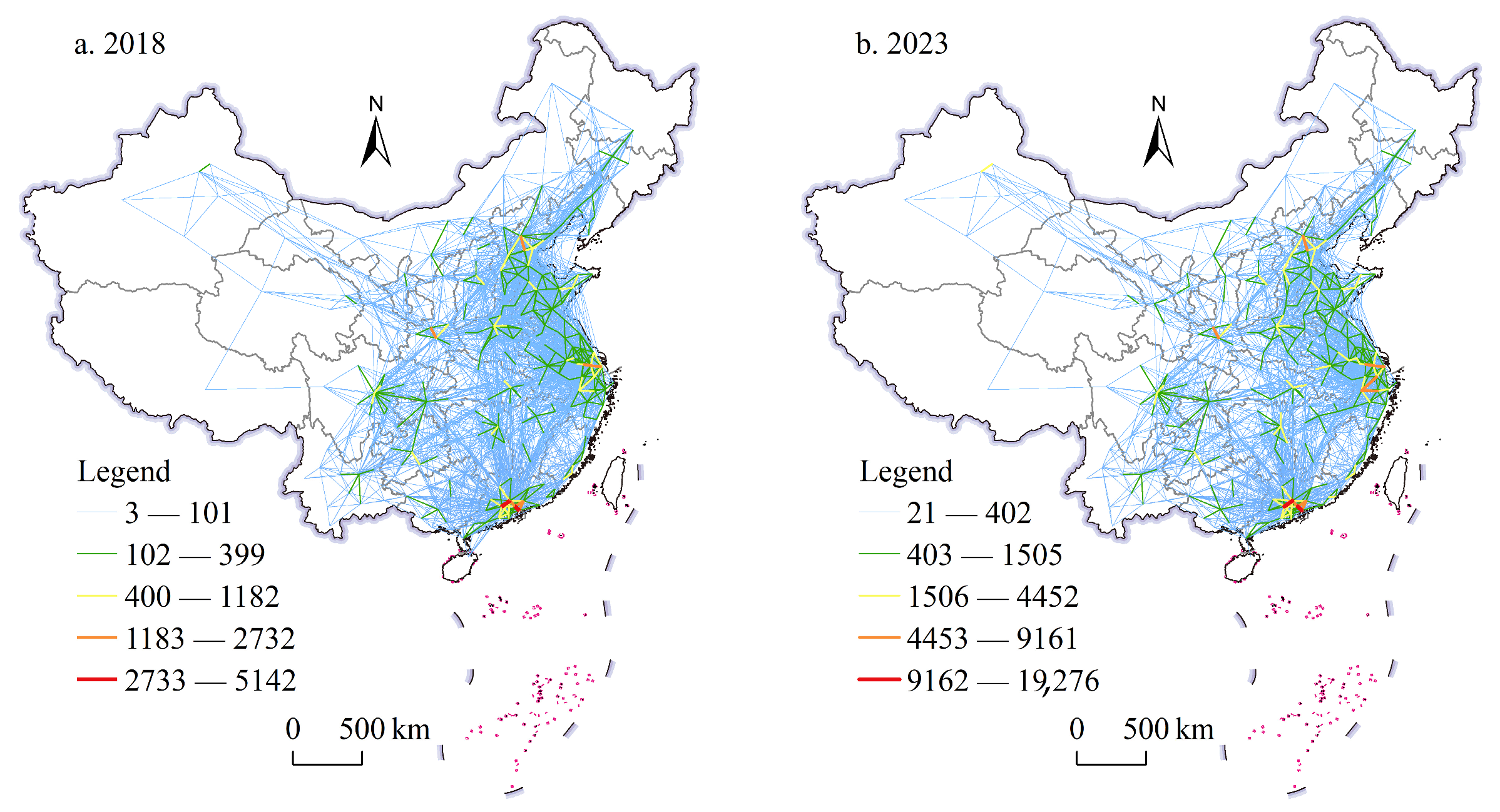
Employing ArcGIS10.8, we delineated population flow connectivity corridors and intensities between cities as the base for analysis. To reduce visual clutter, flow corridors below the annual mean intensity were filtered, with residual flows classified via the Jenks Natural Breaks method [52]. Figure 2 shows the connectivity corridors and intensities at the study period’s commencement (2018) and termination (2023). As the figure shows, China’s population mobility network exhibits a distinct “East-dense and West-sparse” spatial pattern. From 2018 to 2023, the network underwent a significant “densification” process, characterized by a substantial increase in total flow intensity and the gradual evolution of medium-intensity corridors into high-intensity core backbones. Specifically, a robust “diamond-shaped framework” has matured, anchored by the Beijing—Tianjin—Hebei, Yangtze River Delta, Pearl River Delta, and Chengdu—Chongqing urban agglomerations. In the eastern and central regions, the network has evolved from a simple radial pattern centered on large cities into a complex multi-tiered network structure, reflecting deep regional integration. In contrast, connectivity in the western region remains highly concentrated in provincial capitals such as Xi’an and Chengdu. Serving as strategic hubs connecting the western frontier with the eastern heartland, these cities demonstrate the urban network’s active response to the regional coordinated development strategies. Overall, hierarchical differentiation persists, with high-intensity corridors primarily between cities with strong economic determinants and geographical proximity.

4.2. Structural Characteristics of China’s Urban Network

4.2.1. Overall Network

Table 3 displays macro-level metrics from UCINET6.645. Key results show the network edge count increased from 6201 in 2018 to 10,444 in 2023, indicating strengthened intercity connectivity that facilitates resource sharing, technology diffusion, and industrial collaboration, thereby promoting regional economic integration. Network density increased from 0.073 to 0.124, reflecting enhanced structural cohesion as a growing number of cities established functional linkages, thus optimizing the efficiency of information, talent, and technological exchange across regions. Network efficiency declined from 0.922 to 0.862, indicating increased structural redundancy as dyadic interactions replaced unilateral connections, which may potentially hinder cooperative synergies and reduce the efficiency of information transfer. The average path length shortened from 2.861 to 2.392, demonstrating improved topological accessibility that accelerates knowledge spillovers and capital flows; this is largely attributable to advancements in transportation infrastructure. The clustering coefficient remained relatively stable overall, ranging from 0.599 to 0.614, and stayed at a high level, indicating the presence of urban subgroups formed by tripartite closure effects in the urban network. These subgroups have close internal connections, which are largely due to industrial agglomeration and local policies. This clustering structure is conducive to industrial collaboration and technology diffusion, but weak connections between different clustering subgroups may lead to unbalanced regional development.
In summary, China’s urban network shows high connectivity and strong clustering. Increased intercity links, driven by transport and digital infrastructure, enhance economic integration. Concurrently, although highly cohesive subgroups formed through industrial cluster determinants and policy interventions strengthen intra-regional synergies, they may also exacerbate club convergence effects across distinct clusters. This structural duality constrains cross-regional mobility, potentially aggravating persistent disparities in regional development.

4.2.2. Individual Network Analysis

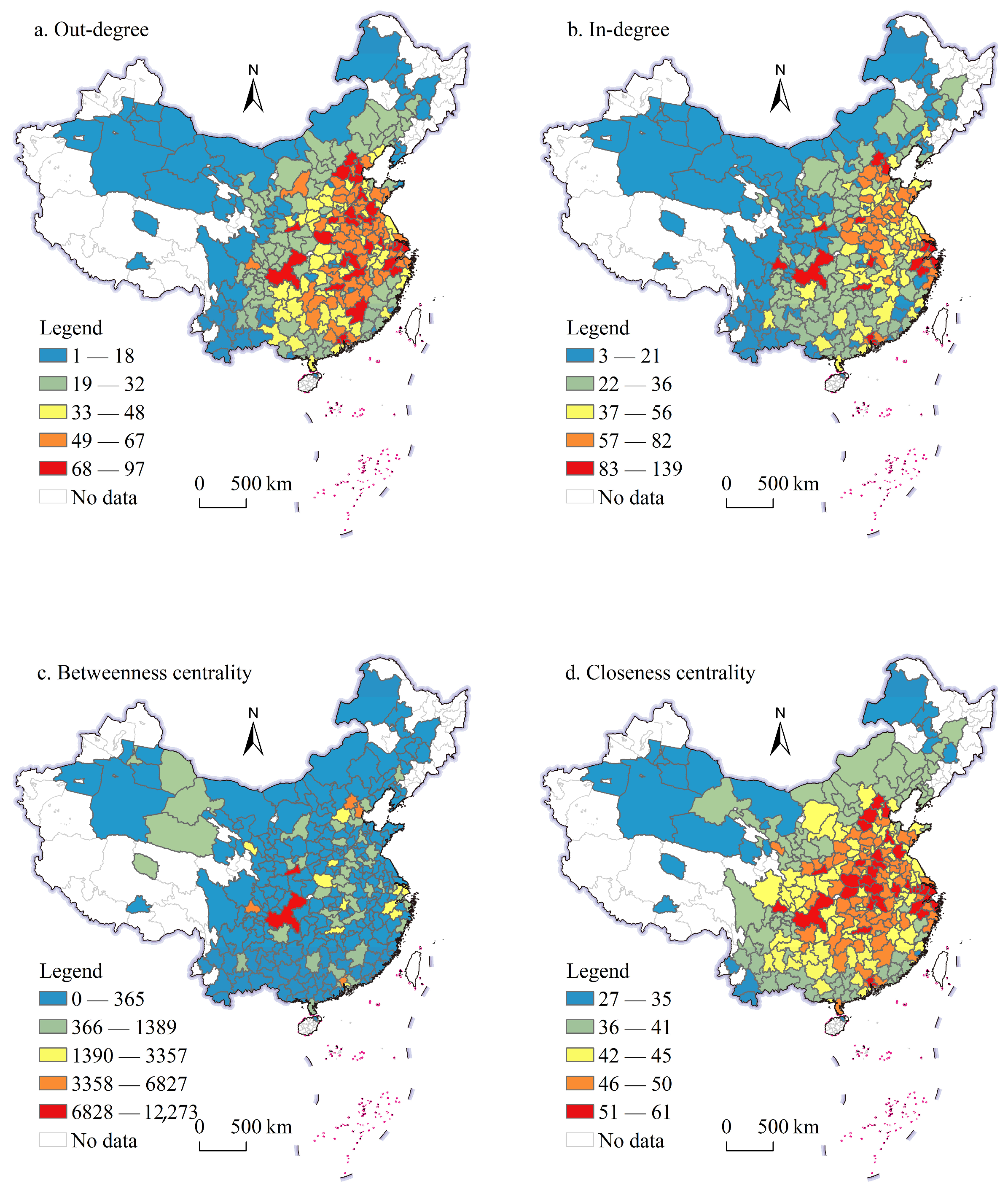
Using UCINET6.645 software, we measured degree, betweenness, and closeness centrality for each city, with spatial distributions mapped in ArcGIS10.8 (Figure 3). Eastern cities demonstrate significant radiative capacities, maintaining consistently elevated out-degree values. Conversely, in-degree centrality shows stronger spatial agglomeration concentrated in the core cities of the Chengdu–Chongqing, Yangtze River Delta, and the Beijing–Tianjin–Hebei urban clusters. In terms of betweenness centrality, hub cities including Beijing, Chongqing, and Guangzhou occupy strategic positions in cross-regional resource allocation due to their status as comprehensive transportation hubs and control over industrial chains. Regarding closeness centrality, the central and eastern regions benefit from dense expressway networks, aviation hubs, and high-speed rail, which maintain cost-efficient interregional interactions. Their closeness centrality significantly surpasses that of the geographically remote western and northeastern regions.
Significant polarization emerges across degree, betweenness, and closeness centrality within China’s urban networks, which establishes a distinct core–periphery hierarchy. A diamond-shaped corridor connecting Beijing, Chongqing, Guangzhou, and Shanghai constitute the core cluster of the Bohai Rim–Yangtze River Delta–Pearl River Delta continuum, while peripheral cities concentrate primarily in remote border provinces. Notably, strategic hubs (e.g., Chengdu, Xi’an) exhibit exceptional betweenness centrality as strategic determinants in the Belt and Road Initiative. Cities in Central China (e.g., Wuhan, Zhengzhou) capitalize on their transitional locations, demonstrating superior closeness centrality and fulfilling strategic bridging roles between eastern and western regions.

4.3. Determinants of China’s Urban Network Structure

4.3.1. Baseline Empirical Results

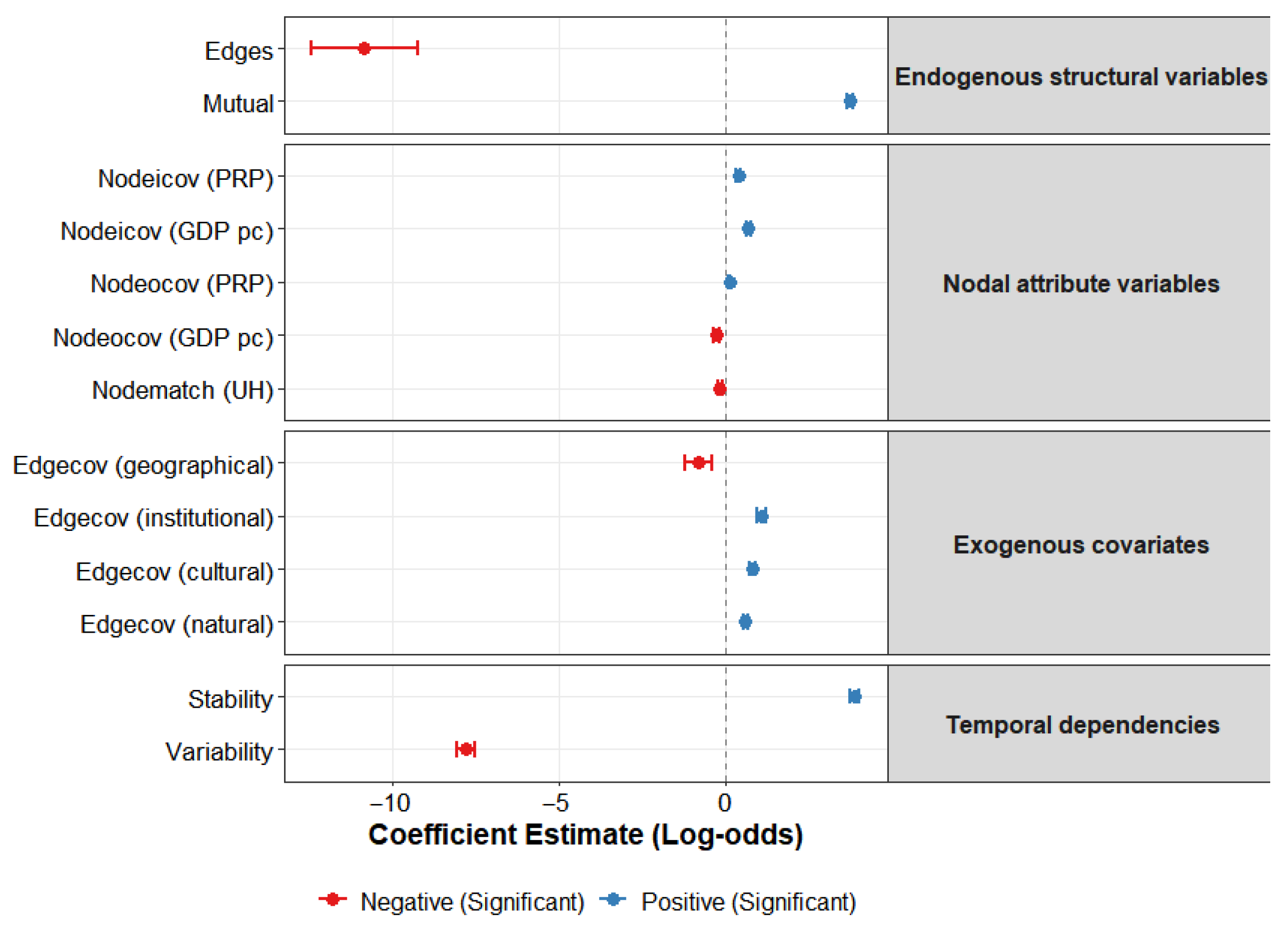
This study employs the TERGM based on MCMC–MLE to identify the key factors and evolutionary mechanisms influencing the formation of China’s urban network. In model construction, the study integrates four categories of core statistics. First, endogenous structural variables, including Edges and Reciprocity (Mutual), are used to capture the baseline probability of network formation and the tendency toward bidirectional flows. Second, nodal attribute variables are incorporated by introducing receiving effects (Nodeicov), sending effects (Nodeocov), and homophily effects (Nodematch) to quantify the differentiated impacts of city population scale (PRP), economic development level (GDP pc), and administrative urban hierarchy (UH). Building upon this, exogenous covariates (Edgecov) based on multidimensional proximities–including geographical, institutional, cultural, and natural factors–are utilized to identify the regulatory role of the external environment. Finally, stability and variability parameters are employed to measure the path dependence and dynamic adjustment characteristics of network evolution. Drawing on the research by Xu et al. (2023) [53], this study adopts a stepwise regression approach. Starting from a baseline model containing endogenous structures (Model 1), it sequentially adds nodal attributes and exogenous covariates (Model 2) followed by temporal dependency variables (Model 3). This approach comprehensively evaluates the contribution of each variable while effectively reducing the risks of collinearity and overfitting, as detailed in Table 4. For implementation, the study utilizes the mtergm package in the R language. By simulating random sequences under the MCMC–MLE framework, it effectively resolves estimation bias caused by the non-independence of network data, ensuring the robustness of driving factor identification. Furthermore, to elucidate key patterns and the relative importance of these determinants, a forest plot of TERGM coefficients (Figure 4) is provided as a visual supplement to the statistical results, clearly displaying the impact magnitude and 95% confidence intervals of each driving factor.
Model 3 shows that the edge parameter (−10.86) significantly inhibits urban network formation, indicating substantial resistance to intercity connections, likely due to geographical distance and policy barriers. The reciprocity coefficient demonstrates positive attenuation, decreasing from 5.56 in Model 1 to 3.74 in Model 3, which signals mutual ties having a weakened capacity to promote network cohesion. This attenuation suggests that the introduction of nodal attributes and exogenous covariates exacerbates power asymmetry and resource imbalances, as exemplified by the unidirectional influence of core cities over peripheral nodes. Consequently, endogenous structural variables not only constrain node interactions but also, when coupled with attribute-based and exogenous factors, are linked to the emergence of an asymmetric, polycentric dependency structure within the urban network.
From the nodal attribute perspective, Nodeicov (PRP)—representing the receiving effect of resident population size—exhibits a positive coefficient of 0.4, which indicates that cities with larger resident populations attract stronger network connections due to their robust infrastructure and mature industrial ecosystems. The independent variable (GDP pc) has a significant positive coefficient, indicating that cities with higher per capita GDP exhibit a significant correlation with a siphoning effect via economic dominance, which is reflected in the concentration of resources and network connections. In contrast, Nodeocov (PRP) shows a modest positive coefficient of 0.12, which reflects how populous cities, constrained by resource saturation and urban maladies (e.g., traffic congestion), are associated with an increased likelihood of outward population spillover and foster new linkages. Conversely, Nodeocov (GDP pc) has a negative coefficient of −0.27, implying that wealthier nodes exhibit diminished outgoing connectivity, potentially suggesting a constraint on network expansion due to resource hoarding tendencies. The significantly negative Nodematch (UH) coefficient for administrative hierarchy homophily underscores how cities that share identical administrative ranks (e.g., provincial capitals) display limited mutual attraction due to overlapping resource portfolios, whereas cross-hierarchical cities form complementary ties through functional differentiation. In the attribute variables, the reception effect and emission effect generated by the permanent population scale node are both beneficial to the urban network. For nodes with a high per capita GDP, their emission effects show a negative correlation, which is negatively correlated with the formation of network ties. In addition, cities with different administrative levels are more likely to form connections.
Controlling for exogenous network covariates, the Edgecov (geographical) coefficient of −0.81 exerts a negative influence on urban network structure, which corroborates the impact of the “distance decay law” [54]. However, the attenuation of this coefficient from Model 2 to Model 3 reveals that innovations in information technology and improvements in transportation infrastructure gradually mitigate traditional geographical constraints. The Edgecov (institutional) coefficient of 1.11 positively contributes to network formation, indicating that cities within the same state-designated urban agglomeration are more likely to collaborate economically, fostering closer inter-node connections. The Edgecov (cultural) coefficient of 0.81 demonstrates a facilitative effect on network structure, aligning with cultural affinity theory: cities that share cultural similarities exhibit reduced disparities in language, customs, and values, thereby promoting population mobility and intercity linkages. The Edgecov (natural) coefficient of 0.61 shows a positive correlation with network formation, suggesting that cities with comparable ecological-climatic conditions often share similarities in living comfort and lifestyle preferences, leading to more frequent population flows. Collectively, the exogenous covariates exhibit multidimensional proximity effects: geographical constraints are weakened by technological innovations, while institutional, cultural, and natural proximities significantly enhance urban network connectivity, with institutional coordination playing the most prominent role.
In terms of temporal dependencies, the stability coefficient of 3.9 reveals path dependence in the network structure, where early-established core nodes persistently occupy structural holes and inhibit fundamental restructuring of the network topology. The variability coefficient of −7.79 signals the network’s evolution into a mature phase, driven by the emergence of regional hubs in central-western China (e.g., Chengdu, Zhengzhou). This has driven a transition from unipolar concentration to a polycentric distributed structure, with node connections exhibiting short-path optimization characteristics. The temporal effects reveal an inherent dynamic equilibrium mechanism within the network, whereby structural optimization is achieved through incremental upgrading of peripheral nodes while maintaining overall stability.
In summary, urban network formation results from an interplay between endogenous structural, nodal attribute, exogenous covariate, and temporal dynamics determinants, each exhibiting differential effects. Endogenous structural determinants include inherent connection resistance and resource disparities, which reconfigure existing network structures. Nodal attributes demonstrate positive network contributions. Population reception and emission effects enhance connectivity. High-GDP nodes attract connections via economic siphoning effects yet exhibit emission constraints that inhibit new linkages, while cross-hierarchical cities are more likely to form complementary linkages. The exogenous covariates reveal geographical distance as a negative structural determinant, whereas the determinants of institutional–cultural–natural proximity strengthen connectivity. Temporally, the network transitions from an initial unipolar concentration to a polycentric distribution, achieving dynamic equilibrium via progressive structural enhancements.

4.3.2. Goodness-of-Fit (GOF) Test

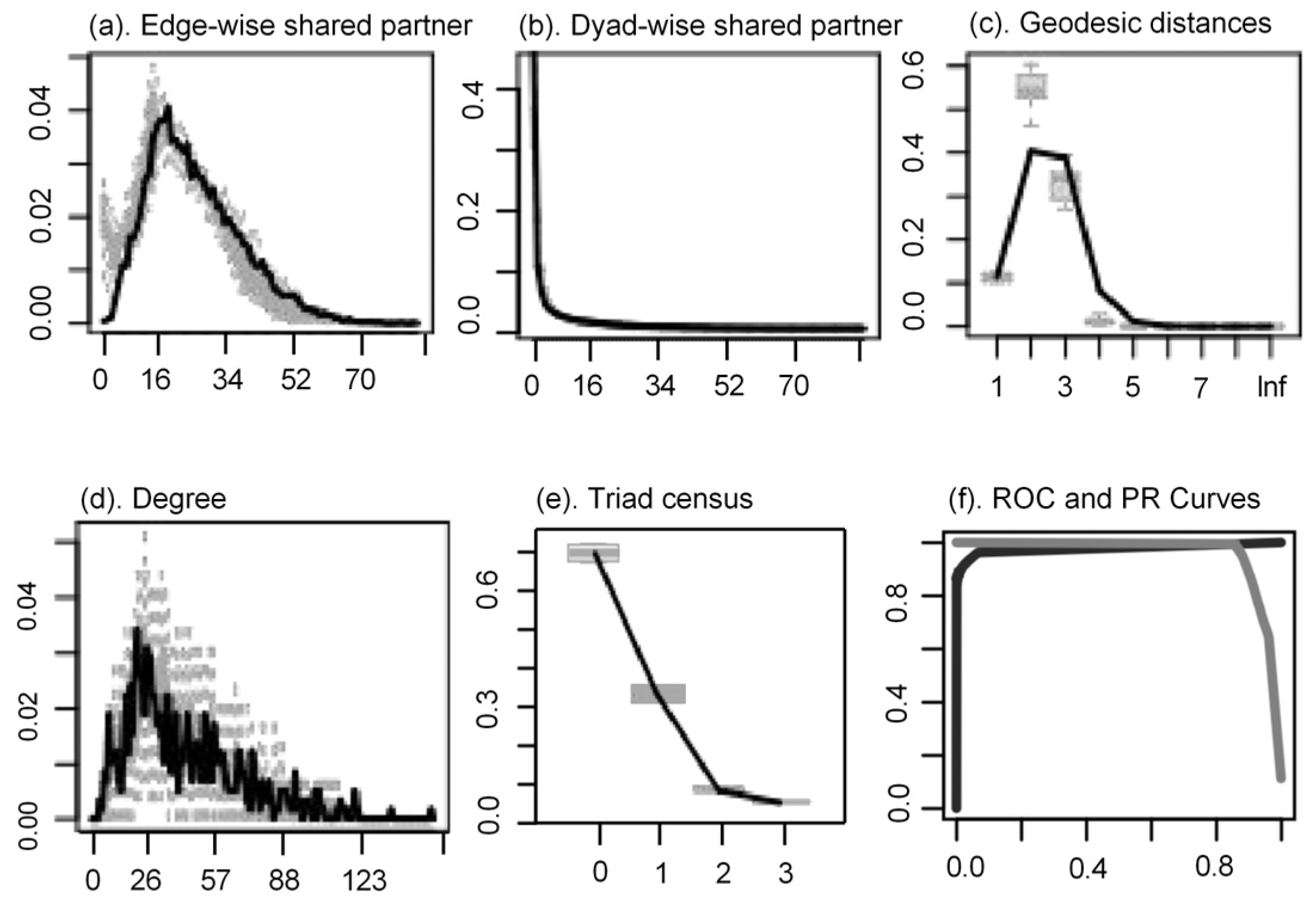
To evaluate model fit, we used the Akaike Information Criterion (AIC) and Bayesian Information Criterion (BIC). Smaller AIC and BIC values indicate better model fit, though BIC imposes stricter penalties under equivalent conditions [55,56]. The results demonstrate that Model 3—which comprehensively integrates temporal, endogenous, and exogenous effects—achieves optimal performance. Following established methodologies [57], we conducted 100 simulation trials based on Model 3 to compare structural discrepancies between simulated and empirical population flow networks. Key metrics comprised shared partner distributions, geodesic distances, node degrees, and triad configurations, as visualized in Figure 5. The results show that key structural metrics of the empirical network lie within the simulated distribution ranges for these parameters, displaying substantial convergence that confirms satisfactory model fit. The bottom-right panel demonstrates robust predictive performance through receiver operating characteristic and precision–recall curves, with higher area under the curve values for both metrics highlighting superior predictive robustness [58,59,60]. Collectively, Model 3 reliably captures the empirical networks’ structure, validating the framework.

4.3.3. Robustness Checks

Building on Model 3, which demonstrated optimal GOF, we conducted robustness tests following established methodologies [61,62] through three approaches. First, we made longitudinal data adjustments by reconstructing a new population mobility network using 2018, 2020, and 2022 data from 291 prefecture-level cities nationwide, yielding empirical results for Model 4. Second, we altered the estimation method by replacing the original MCMC–MLE with Maximum Pseudo-Likelihood Estimation (MPLE), which estimates model parameters by maximizing the conditional likelihood function. While MPLE improves computational efficiency, it may slightly reduce estimation accuracy [63], resulting in Model 5. Third, we replaced the institutional covariate with a provincial adjacency matrix (Model 6). As Table 5 shows, Models 4–6 show consistent coefficient signs and minimal significance differences with Model 3, confirming the robustness of the results across time, method, and covariates.

5. Discussion

The urban network exhibits a co-evolutionary trajectory characterized by densification under “time-space compression” parallel with “club-like” communalization. In terms of overall network evolution, the significant growth in the number of edges and network density during the study period not only validates the “time-space compression” effect induced by improved transportation infrastructure and digital empowerment but also reveals that China’s urban network has transitioned from a stage of loose connectivity to one of deep integration. This finding is highly consistent with the assessment results of urban network expansion trends based on nighttime light data by Zhang et al. (2024) [64] and Xu et al. (2023) [65]. Concurrently, the shortening of the average path length indicates a significant enhancement in inter-city accessibility, further confirming the positive correlation between the improvement of infrastructure, such as rail transit, and both urban sustainable development and the efficiency of factor mobility; this aligns with the conclusions of Liu & Xia (2023) [23], Herrera-Acevedo & Sierra-Porta (2025) [66], and Christensen et al. (2023) [67]. However, it is worth noting that while the network densifies, the clustering coefficient remains at a consistently high level, revealing the existence of tight-knit subgroups with exclusive characteristics within the network [68,69]. Although this structure enhances resource integration efficiency locally, it also reflects a tendency for resource factors to circulate within specific groups, which is unfavorable for balanced flow across the entire region. This phenomenon echoes the “club effect” observed by scholars in economic network research [70]. Examining from the “Space of Flows” theory, the “club effect” is essentially the reconstruction of the “space of places” by factor flows. The space of flows does not completely level geographic boundaries; instead, through a dual “technological−institutional” filtering, it forms exclusive flow circuits. While this structure enhances local synergistic efficiency, it also reinforces the competitive advantages of specific clusters through “mobility barriers”. This finding aligns with the contradiction of the coexistence of macro-scale high connectivity and regional solidification noted in the research by Zhang et al. (2025) [20], reflecting the essence of the heterogeneous expansion of the space of flows.
The dual spatial reconstruction features of “core locking” and “peripheral breakthrough” are reshaping the geo-economic landscape. The spatial distribution of individual networks confirms the simultaneous existence of hierarchical solidification of network power and structural breakthroughs in peripheral areas. On the one hand, the diamond-shaped core zone constituted by Beijing, Shanghai, Guangzhou, and Chongqing encompasses nearly all high-activity nodes. This significant “core-periphery” structural characteristic is consistent with the spatial pattern identified by Dong et al. (2023) [52] based on green innovation networks, effectively confirming the objective existence of hierarchical features in urban networks. The formation of this “diamond-shaped corridor” is driven by multiple mechanisms. First, national strategic coupling has laid the spatial skeleton. The four national growth poles: Beijing−Tianjin−Hebei, the Yangtze River Delta, the Pearl River Delta, and the Chengdu−Chongqing region, have strengthened the “locking” capacity of core nodes over factors through the asymmetric input of policy resources. Second, functional complementarity has broken geographical limitations. The mismatched division of labor among Beijing, Shanghai, Guangzhou−Shenzhen, and Chengdu−Chongqing in politics, finance, innovation, and strategic depth has enabled large-scale cross-regional resource allocation. Finally, infrastructure spillover effects have facilitated “time-space proximity”. The construction of high-speed rail and aviation hubs has reduced geographical friction, building a resilient diamond-shaped steady-state structure and providing a physical carrier for regional coordinated development. On the other hand, the relative sparsity of the network in the western region corroborates the conclusions of Herrera-Acevedo & Sierra-Porta (2025) [66] and Mirzaee & Wang (2020) [71] regarding the polarization effect of transportation networks. However, distinct from the static perspective of traditional theories, this study finds that emerging hubs such as Chengdu and Xi’an are reshaping the western network pattern by occupying “structural hole” advantages. This finding validates the strategic value of “Belt and Road” node cities in reconstructing network hierarchies as proposed by Zhou et al. (2023) [72], indicating that peripheral regions can achieve an identity transition from geographical edges to network hubs through the construction of key corridors, thereby expanding the spatial explanatory dimension of traditional core-periphery theory. This leap in functional capacity reflects a logical reconstruction of “structural power” in the space of flows [28]. Core cities reinforce their dominance over factors through their “structural hole” positions; meanwhile, the rise of hubs like Xi’an and Chengdu confirms that peripheral cities can break through traditional locational constraints by constructing strategic corridors [33]. This reveals the dynamic nature of urban network levels: by seizing key intermediary positions, cities can achieve a step-by-step leap from “geographic peripheries” to “network hubs”.
The non-linear coupling mechanism of multi-dimensional factors serves as the fundamental driving force for network evolution. Different from existing studies that focus on linear attribution of single dimensions, this paper, based on the TERGM, confirms that urban network evolution follows a composite driving logic of “endogenous topology–node potential–multidimensional proximity”. First, unlike studies such as Guo & Qin (2022) [73] that primarily focus on single mechanisms of location or factor mobility, this paper incorporates the endogenous network structure into consideration, revealing the self-organizing role of edges and reciprocity in the dynamic feedback between cities. Second, at the node attribute level, while existing literature often emphasizes the unidirectional role of urban administrative hierarchy or economic scale [74,75,76], this study dissects the complex impact of node heterogeneity on network structure more meticulously by introducing receiver, sender, and homophily effects. Finally, regarding exogenous covariates, this paper is not limited to single transportation or policy impacts but reveals the composite superposition effect of multidimensional proximities such as geography, institutions, and culture. This resonates with the findings on urban network proximity effects by Tang & Chai (2022) [77] and Wei et al. (2022) [78]. This integration of multidimensional perspectives, combined with TERGM’s capture of the dynamic cumulative effects of network evolution, successfully unveils the coupling effects of multi-factors within the urban network [11,79,80], thereby enriching the analytical paradigm of urban network research. This integration of this multidimensional perspective reveals the nonlinear evolutionary logic of “spatial hedging”: namely, the offsetting of geographical obstacles by multidimensional proximities and the transition of reciprocity mechanisms toward “asymmetric dependence”. Driven jointly by power asymmetry and resource hoarding effects, the urban network has evolved into a highly integrated and strictly hierarchical complex system [47,64]. This conclusion deepens the understanding of the heterogeneous expansion of the space of flows and enriches the analytical paradigm of urban networks.
The innovations of this study are primarily reflected in two key aspects: first, by examining a longitudinal big data sequence from 2018 to 2023, this study quantifies the structural stability and evolutionary variability of the urban network in response to macro-environmental disturbances, with this longitudinal perspective enabling the uncovering of the inherent path-dependent characteristics of the population mobility network; second, the substantive innovation lies not only in data integration but also in the application of the TERGM framework to transcend the traditional “independence assumption” regarding network connections. By addressing both exogenous determinants such as geography and institutions and the internal structural dependencies within the network evolution process, this methodology facilitates a clear differentiation between long-term path dependence and instantaneous feedback from factor flows, thereby providing more dynamic and evolutionary empirical support for the “Space of Flows” theory. Despite significant progress, this study has several limitations. First, regarding the data dimension, although this study employed arithmetic averaging to smooth short-term fluctuations, the potential impacts of long-term external shocks during the study period−such as pandemic-related lockdowns in specific regions or major policy adjustments−cannot be entirely eliminated. Future research could attempt to adopt more granular time-series decomposition methods to further isolate the effects of these exogenous shocks. Second, regarding methodological constraints, the data dichotomization for TERGM estimation may exclude meaningful weak-tie information. Thus, future research should apply weighted network models to better capture mobility intensity gradients. Third, in the analysis at the nodal level, this study focuses on utilizing cross-sectional data from the end of the research period to identify the spatial differentiation characteristics and power atlas of cities. While this approach can clearly demonstrate the evolved steady-state pattern, it fails to meticulously characterize the year-by-year dynamic fluctuations in the centrality of each city node during the study period. Future research should focus on the dynamic transition paths of urban functional capacity, thereby providing guidance for formulating differentiated node enhancement strategies for cities at different functional levels.

6. Conclusions and Policy Implications

6.1. Conclusions

Using Amap Big Data Platform data (2018–2023), we applied SNA and TERGM to examine China’s urban network structure and its driving factors, revealing three principal findings:
First, the network exhibits high connectivity and strong clustering characteristics, reflecting a regional economic evolution toward structured interconnection. High connectivity enables efficient circulation of knowledge and capital across broader spatial scales, while strong clustering manifests as high intra-subgroup cohesion, where industrial complementarity and policy determinants form high-density collaboration clusters. Although this structure accelerates local integration, it may create inter-cluster connectivity barriers, necessitating cross-cluster coordination mechanisms.
Second, individual networks display a core–periphery structure, which reflects spatial differentiation shaped by multidimensional network power and geographical-economic determinants. Core regions form a diamond structure anchored by Beijing–Tianjin–Hebei, Yangtze River Delta, Chengdu–Chongqing, and Pearl River Delta hubs. These regions leverage degree-centrality radiation, betweenness-centrality resource control, and closeness-centrality spacetime advantages. Peripheral areas face geographical barrier and diminished resource determinants, occupying passive positions in factor flows. Strategic channels and structural hole advantages enable certain hubs to overcome spatial constraints by forming sub-centers, which demonstrates how the core–periphery structure is dynamically reconstructed through network–spatial interaction determinants.
Third, the driving factor analysis reveals how urban network evolution is characterized by from the coordination of multilevel system determinants, following a pattern of “endogenous evolution–attribute-driven-exogenous regulation–dynamic adaptation” evolutionary framework. Endogenously, topological resistance and demands for resource reconfiguration emerge. The analysis of nodal attributes reveals complementary potential arising from disparities in resource endowment and administrative hierarchy gradients. Exogenously, geographical attenuation laws and multidimensional proximity effects constitute spatial hedging determinants, which shape distance-constrained multi-proximity superposition topologies. Temporally, networks show stage-adaptive transitions. This multidimensional nonlinear dynamic mechanism shapes urban networks’ evolution from agglomeration to complex systems.

6.2. Policy Implications

Considering the structural determinants of China’s urban network structure, policy optimization should prioritize multidimensional proximity effects and dynamic evolution characteristics.
At the nodal level, policy must balance the siphoning effects of core cities and the developmental momentum of peripheral cities. For emerging hub cities such as Chengdu and Xi’an, which possess significant strategic advantages in occupying “structural holes”, national policies should prioritize the deployment of “digital−physical” dual infrastructure. Specifically, constructing cross-regional big data centers and intelligent logistics hubs in these cities can effectively mitigate the geographic decay effects prevalent in the western region, thereby consolidating their functional roles as regional gateways. Regarding core urban agglomerations, there is a need to break down administrative hierarchy determinants, establish cross-hierarchical urban collaboration platforms, and promote technology spillover from high-level cities and resource absorption by lower-level cities.
In terms of exogenous determinants, synergistic mechanisms of institutional proximity should be enhanced. For urban agglomerations such as the Yangtze River Delta and Chengdu−Chongqing, these regions should take the lead in promoting the seamless cross-provincial settlement of social security cards, mutual recognition of business licenses, and cross-regional mobility of professional and technical titles. These measures play a critical role in breaking down invisible administrative barriers that hinder population mobility. Policymakers should leverage bonds of cultural proximity and establish dialect-area cultural tourism corridors and talent exchange networks. For instance, establishing a “Talent Mutual Recognition Green Card” system among cities with cultural proximity would involve providing equivalent subsidies to mobile populations holding valid talent certification issued by partner cities, aiming to enhance the positive moderating effect of regional cultural identity on population mobility by dismantling policy barriers, thereby activating the economic value of regional cultural identity. In terms of determinants of natural condition proximity, there is a need to develop climate-adaptive industrial collaborations, such as establishing ecological compensation mechanisms that promote joint environmental governance among cities in the same climate zone.
Guided by temporal evolution determinants, policymakers should optimize both network stability and structural configuration. First, topological distance in central-western China should be reduced through upgrading the digital infrastructure, while cultivating the role of structural holes in emerging hubs (e.g., Chengdu, Xi’an). Second, core cities should transition from agglomeration to diffusion effects, promoting cross-subgroup knowledge spillover through enclave economies and innovation communities. Third, there is a need to quantify determinants that attenuate geographic resistance. Rapid corridor development within border zones and core urban clusters should be prioritized, transforming geographic resistance factors into spatial development potential via multimodal transport corridors, thereby fostering a polycentric, resilient urban network structure.

Author Contributions

Conceptualization, K.L.; methodology, H.D.; software, H.D.; validation, H.D.; formal analysis, H.D.; investigation, H.D.; resources, K.L.; data curation, H.D.; writing—original draft preparation, H.D.; writing—review and editing, K.L.; visualization, H.D.; supervision, K.L.; project administration, K.L.; funding acquisition, K.L. All authors have read and agreed to the published version of the manuscript.

Funding

This research was funded by the National Natural Science Foundation of China, grant number 72373084; Taishan Scholar Foundation of Shandong Province, grant number tsqn202408139.

Data Availability Statement

The original contributions presented in the study are included in the article, further inquiries can be directed to the corresponding author.

Conflicts of Interest

The authors declare no conflicts of interest.

References

  1. Ma, H.; Li, Y.; Huang, X. Proximity and the evolving knowledge polycentricity of megalopolitan science: Evidence from China’s Guangdong-Hong Kong-Macao Greater Bay Area, 1990–2016. Urban Stud. 2021, 58, 2405–2423. [Google Scholar] [CrossRef]
  2. Paul, J. SCOPE framework for SMEs: A new theoretical lens for success and internationalization. Eur. Manag. J. 2020, 38, 219–230. [Google Scholar] [CrossRef]
  3. Xu, H.; Jiao, M. City size, industrial structure and urbanization quality—A case study of the Yangtze River Delta urban agglomeration in China. Land Use Policy 2021, 111, 105735. [Google Scholar] [CrossRef]
  4. Wu, K.; Wang, Y.; Zhang, H.O.; Liu, Y.; Ye, Y.; Yue, X. The pattern, evolution, and mechanism of venture capital flows in the Guangdong-Hong Kong-Macao Greater Bay Area, China. J. Geogr. Sci. 2022, 32, 2085–2104. [Google Scholar] [CrossRef]
  5. Zheng, X.; Zhang, X.; Fan, D. Research on the Coordinated Development of Innovation Ability and Regional Integration in Guangdong–Hong Kong–Macao Greater Bay Area. Sustainability 2023, 15, 3426. [Google Scholar] [CrossRef]
  6. Shi, Y.; Zhai, W.; Yan, Y.; Wang, X. The Influence of Proximity on the Evolution of Urban Innovation Networks in Nanjing Metropolitan Area, China: A Comparative Analysis of Knowledge and Technological Innovations. ISPRS Int. J. Geo-Inf. 2024, 13, 273. [Google Scholar] [CrossRef]
  7. Zhang, J.; Cai, J.; Zhang, X.; Zhang, W. The Spatiotemporal Organizational Order of Living Circle Units Based on the Law of Walking Time-Distance Distributions. Land 2024, 13, 2105. [Google Scholar] [CrossRef]
  8. Liu, L.; Luo, J.; Xiao, X.; Hu, B.; Qi, S.; Lin, H.; Zu, X. Spatio-Temporal Evolution of Urban Innovation Networks: A Case Study of the Urban Agglomeration in the Middle Reaches of the Yangtze River, China. Land 2022, 11, 597. [Google Scholar] [CrossRef]
  9. Liu, C.; Peng, Z.; Liu, L.; Li, S. Innovation Networks of Science and Technology Firms: Evidence from China. Land 2023, 12, 1283. [Google Scholar] [CrossRef]
  10. Cao, N.; Wen, Y.; Wang, J.; Gao, X.; Sun, P. Identifying shrinking cities from a physical city perspective and influencing factors: A case study of the Chengdu-Chongqing economic circle in China. Appl. Geogr. 2024, 168, 103314. [Google Scholar] [CrossRef]
  11. Hu, S.; Chen, G.; Miao, C. Understanding the structural evolution and driving mechanisms of urban network using firm-level big data and TERGM modeling. Cities 2025, 161, 105869. [Google Scholar] [CrossRef]
  12. Hu, X.; Ma, H. Influence of intra- and inter-city innovation cooperation on urban innovation output in China. Acta Geogr. Sin. 2025, 80, 377–395. (In Chinese) [Google Scholar] [CrossRef]
  13. Shi, S.; Wong, S.K.; Zheng, C. Network capital and urban development: An inter-urban capital flow network analysis. Reg. Stud. 2022, 56, 406–419. [Google Scholar] [CrossRef]
  14. Zhang, J.; Li, F.; Yu, G.; Zhang, X.; Feng, Z. A hybrid data assimilation method for reconstructing airflow path parameters of a multi-zone model. J. Build. Eng. 2024, 95, 110240. [Google Scholar] [CrossRef]
  15. Zhou, Y.; Zheng, W.; Wang, X.; Du, N. Urban economic efficiency under the interactive effect of urban hierarchy and connection networks in China. J. Geogr. Sci. 2024, 34, 2315–2332. [Google Scholar] [CrossRef]
  16. Yan, Y.; Li, K.; Wang, X. Urban Networks in the Yangtze River Delta from the Perspective of Transaction Linkages in Manufacturing Industries: Characteristics, Determinants, and Strategies for Intercity Integration Development. Systems 2023, 11, 401. [Google Scholar] [CrossRef]
  17. Chen, B.; Zhu, H. Has the Digital Economy Changed the Urban Network Structure in China?—Based on the Analysis of China’s Top 500 New Economy Enterprises in 2020. Sustainability 2022, 14, 150. [Google Scholar] [CrossRef]
  18. Yang, L.; Wang, J.; Yang, Y. Spatial evolution and growth mechanism of urban networks in western China: A multi-scale perspective. J. Geogr. Sci. 2022, 32, 517–536. [Google Scholar] [CrossRef]
  19. Yang, W.; Yan, M.; Wang, X.; Shi, J. Study on the Spatial Association Network Structure of Urban Digital Economy and Its Driving Factors in Chinese Cities. Systems 2025, 13, 322. [Google Scholar] [CrossRef]
  20. Zhang, W.; Qian, Y.; Tang, J.; Liu, X. Exploring cooperative and competitive relations in a Chinese intercity innovation network. Appl. Geogr. 2025, 175, 103508. [Google Scholar] [CrossRef]
  21. Yang, X.; Li, H.; Zhang, J.; Niu, S.; Miao, M. Urban economic resilience within the Yangtze River Delta urban agglomeration: Exploring spatially correlated network and spatial heterogeneity. Sustain. Cities Soc. 2024, 103, 105270. [Google Scholar] [CrossRef]
  22. Gu, Y.; Wang, Y. Using weighted multilayer networks to uncover scaling of public transport system. Environ. Plan. B Urban Anal. City Sci. 2022, 49, 1631–1645. [Google Scholar] [CrossRef]
  23. Liu, X.; Xia, H. Networking and sustainable development of urban spatial planning: Influence of rail transit. Sustain. Cities Soc. 2023, 99, 104865. [Google Scholar] [CrossRef]
  24. Sun, W.; Zhang, J.; Shen, H.; Li, G.; Wang, H.; He, F.; Bi, F. Connectivity and centrality: Geovisualization of express networks in China. Environ. Plan. B Urban Anal. City Sci. 2023, 50, 281–283. [Google Scholar] [CrossRef]
  25. Yang, H.; Dijst, M.; Witte, P.; van Ginkel, H.; Wang, J.E. Comparing passenger flow and time schedule data to analyse High-Speed Railways and urban networks in China. Urban Stud. 2019, 56, 1267–1287. [Google Scholar] [CrossRef]
  26. Rakhmangulov, A.; Osintsev, N.; Mishkurov, P. Spatio-Temporal Graphs in Transportation: Challenges, Optimization, and Prospects. Systems 2025, 13, 263. [Google Scholar] [CrossRef]
  27. Wu, H.; Yang, Y.; Li, W. Dynamic spatiotemporal evolution and spatial effect of carbon emissions in urban agglomerations based on nighttime light data. Sustain. Cities Soc. 2024, 113, 105712. [Google Scholar] [CrossRef]
  28. Ma, G.; Hu, J.; Zhang, R. Spatial-Temporal Distribution and Coupling Relationship of High-Speed Railway and Economic Networks in Metropolitan Areas of China. Land 2023, 12, 1193. [Google Scholar] [CrossRef]
  29. Wang, L.; Xue, X.; Zhou, X.; Wang, Z.; Liu, R. Analyzing the topology characteristic and effectiveness of the China city network. Environ. Plan. B Urban Anal. City Sci. 2021, 48, 2554–2573. [Google Scholar] [CrossRef]
  30. Quintana Vigiola, G. Understanding Place in Place-Based Planning: From Space- to People-Centred Approaches. Land 2022, 11, 2000. [Google Scholar] [CrossRef]
  31. Amap Open Platform. Amap Migration Data [Data Set]. Available online: https://trp.autonavi.com/migrate/page.do (accessed on 16 December 2025).
  32. Bai, C.; Zhou, L.; Xia, M.; Feng, C. Analysis of the spatial association network structure of China’s transportation carbon emissions and its driving factors. J. Environ. Manag. 2020, 253, 109765. [Google Scholar] [CrossRef]
  33. Li, Z.; Tang, J.; Feng, T.; Liu, B.; Cao, J.; Yu, T.; Ji, Y. Investigating urban mobility through multi-source public transportation data: A multiplex network perspective. Appl. Geogr. 2024, 169, 103337. [Google Scholar] [CrossRef]
  34. Lee, K.H.; Agarwal, A.; Zhang, A.Y.; Xue, L. Model-based clustering of semiparametric temporal exponential-family random graph models. Stat 2022, 11, e459. [Google Scholar] [CrossRef]
  35. Wang, H.; Lu, X.; Feng, L.; Yuan, Z.; Tang, Y.; Jiang, X. Dynamic change and evolutionary mechanism of city land leasing network—Taking the Yangtze River Delta region in China as an example. Land Use Policy 2023, 132, 106821. [Google Scholar] [CrossRef]
  36. Hamidi, S.; Zandiatashbar, A. Does urban form matter for innovation productivity? A national multi-level study of the association between neighbourhood innovation capacity and urban sprawl. Urban Stud. 2019, 56, 1576–1594. [Google Scholar] [CrossRef]
  37. Wang, G.; Li, J.; Liu, X.; Li, B.; Zhang, Y. Social-ecological network of peri-urban forest in urban expansion: A case study of urban agglomeration in Guanzhong Plain, China. Land Use Policy 2024, 139, 107074. [Google Scholar] [CrossRef]
  38. Cai, H.; Wang, Z.; Zhu, Y. Understanding the structure and determinants of intercity carbon emissions association network in China. J. Clean. Prod. 2022, 352, 131535. [Google Scholar] [CrossRef]
  39. Setayesh, A.; Sourati Hassan Zadeh, Z.; Bahrak, B. Analysis of the global trade network using exponential random graph models. Appl. Netw. Sci. 2022, 7, 38. [Google Scholar] [CrossRef]
  40. National Bureau of Statistics of China. China Urban Statistical Yearbook 2018; China Statistics Press: Beijing, China, 2018. Available online: https://data.cnki.net/ (accessed on 16 December 2025).
  41. National Bureau of Statistics of China. China Urban Statistical Yearbook 2019; China Statistics Press: Beijing, China, 2019. Available online: https://data.cnki.net/ (accessed on 16 December 2025).
  42. National Bureau of Statistics of China. China Urban Statistical Yearbook 2020; China Statistics Press: Beijing, China, 2020. Available online: https://data.cnki.net/ (accessed on 16 December 2025).
  43. National Bureau of Statistics of China. China Urban Statistical Yearbook 2021; China Statistics Press: Beijing, China, 2021. Available online: https://data.cnki.net/ (accessed on 16 December 2025).
  44. National Bureau of Statistics of China. China Urban Statistical Yearbook 2022; China Statistics Press: Beijing, China, 2022. Available online: https://data.cnki.net/ (accessed on 16 December 2025).
  45. National Bureau of Statistics of China. China Urban Statistical Yearbook 2023; China Statistics Press: Beijing, China, 2023. Available online: https://data.cnki.net/ (accessed on 16 December 2025).
  46. National Bureau of Statistics of China. China Urban Statistical Yearbook 2024; China Statistics Press: Beijing, China, 2024. Available online: https://data.cnki.net/ (accessed on 16 December 2025).
  47. Yin, H.; Zhang, Z.; Wan, Y.; Gao, Z.; Guo, Y.; Xiao, R. Sustainable network analysis and coordinated development simulation of urban agglomerations from multiple perspectives. J. Clean. Prod. 2023, 413, 137378. [Google Scholar] [CrossRef]
  48. Cai, Y.; Liu, L.; Li, Z. Modelling and monitoring social network change based on exponential random graph models. J. Appl. Stat. 2024, 51, 1621–1641. [Google Scholar] [CrossRef]
  49. Cui, Y.; Wang, W.; Meng, Y.; Li, Q.; Zeng, H. Impact of structural dependence on the formation of multi-subject collaborative network for comprehensive land consolidation. Land Use Policy 2024, 145, 107284. [Google Scholar] [CrossRef]
  50. Zhao, Z.; Zhao, S.; Shi, K.; Li, Y.; Wang, S. The influence of cultural ties on China’s population flow networks. Cities 2024, 151, 105116. [Google Scholar] [CrossRef]
  51. Zhang, Y. China Climate Zoning Atlas; China Meteorological Press: Beijing, China, 2019. [Google Scholar]
  52. Dong, S.; Ren, G.; Xue, Y.; Liu, K. Urban green innovation’s spatial association networks in China and their mechanisms. Sustain. Cities Soc. 2023, 93, 104536. [Google Scholar] [CrossRef]
  53. Xu, H.; Hu, S.; Li, X. Urban Distribution and Evolution of the Yangtze River Economic Belt from the Perspectives of Urban Area and Night-Time Light. Land 2023, 12, 321. [Google Scholar] [CrossRef]
  54. Zhang, J.; Sun, B.; Wang, C. Interplay between Network Position and Knowledge Production of Cities in China Based on Patent Measurement. Land 2024, 13, 1713. [Google Scholar] [CrossRef]
  55. Xu, J.; Yang, X.; Razzaq, A. Understanding the Role of Humanistic Factors in Trade Network Evolution across the Belt and Road Initiative Countries Using the Exponential Random Graph Model. Complexity 2021, 2021, 1961061. [Google Scholar] [CrossRef]
  56. Zhu, N.; Huang, S. Impact of the tariff concessions of the RCEP agreement on the structure and evolution mechanism of manufacturing trade networks. Soc. Netw. 2023, 74, 78–101. [Google Scholar] [CrossRef]
  57. He, X.; Dong, Y.; Wu, Y.; Jiang, G.; Zheng, Y. Factors affecting evolution of the interprovincial technology patent trade networks in China based on exponential random graph models. Phys. A Stat. Mech. Its Appl. 2019, 514, 443–457. [Google Scholar] [CrossRef]
  58. Pan, A.; Xiao, T.; Dai, L. The structural change and influencing factors of carbon transfer network in global value chains. J. Environ. Manag. 2022, 318, 115558. [Google Scholar] [CrossRef]
  59. Wang, H.; Zhang, X.; Zhang, X.; Liu, R.; Ning, X. Understanding coordinated development through spatial structure and network robustness: A case study of the Beijing-Tianjin-Hebei region. J. Geogr. Sci. 2024, 34, 1007–1036. [Google Scholar] [CrossRef]
  60. Ma, Y.-J.; Jiang, Z.-Q.; Zhou, W.-X. Determinants of the international crop trade dynamics: New insights from a network structure dependence perspective. Empir. Econ. 2025, 69, 77–128. [Google Scholar] [CrossRef]
  61. Wang, X.-Y.; Chen, B.; Song, Y. Dynamic change of international arms trade network structure and its influence mechanism. Int. J. Emerg. Mark. 2025, 20, 660–677. [Google Scholar] [CrossRef]
  62. Wu, G.; Feng, L.; Peres, M.; Dan, J. Do self-organization and relational embeddedness influence free trade agreements network formation? Evidence from an exponential random graph model. J. Int. Trade Econ. Dev. 2020, 29, 995–1017. [Google Scholar] [CrossRef]
  63. Zhang, R.; Li, M.; Zhang, X.; Guo, Y.; Li, Y.; Gao, Q.; Liu, S. Identification of the Spatial Structure of Urban Polycentres Based on the Dual Perspective of Population Distribution and Population Mobility. Land 2024, 13, 1159. [Google Scholar] [CrossRef]
  64. Zhang, R.; Lin, J.; Sun, D. The role of institutions and markets in shaping intercity investment networks in China. Cities 2024, 153, 105221. [Google Scholar] [CrossRef]
  65. Xu, W.; Song, J.; Long, Y.; Mao, R.; Tang, B.; Li, B. Analysis and simulation of the driving mechanism and ecological effects of land cover change in the Weihe River basin, China. J. Environ. Manag. 2023, 344, 118320. [Google Scholar] [CrossRef]
  66. Herrera-Acevedo, D.D.; Sierra-Porta, D. Network structure and urban mobility sustainability: A topological analysis of cities from the urban mobility readiness index. Sustain. Cities Soc. 2025, 119, 106076. [Google Scholar] [CrossRef]
  67. Christensen, P.H.; D’Arcy, S.; Phillimore, J. Processing and Configuring Smart and Sustainable Building Management Practices in a University Building in Australia. Sustainability 2023, 15, 2496. [Google Scholar] [CrossRef]
  68. Pan, J.; Wei, S.; Zhang, R.; Yang, L. Spatial structure characteristics of intercity travel network of Chinese residents: Based on Tencent migration data. Acta Geogr. Sin. 2022, 77, 2494–2513. (In Chinese) [Google Scholar] [CrossRef]
  69. Li, Z.; Yu, K.; Zhong, J.; Yang, J.; Zhang, D.; Zhu, J. Spatial correlation network characteristics and influencing factors of water environmental efficiency in three major urban agglomerations in the Yangtze River Basin, China. Sustain. Cities Soc. 2024, 104, 105311. [Google Scholar] [CrossRef]
  70. Wang, X.-Y.; Chen, B.; Hou, N.; Chi, Z.-P. Evolution of structural properties of the global strategic emerging industries’ trade network and its determinants: An TERGM analysis. Ind. Mark. Manag. 2024, 118, 78–92. [Google Scholar] [CrossRef]
  71. Mirzaee, S.; Wang, Q. Urban mobility and resilience: Exploring Boston’s urban mobility network through twitter data. Appl. Netw. Sci. 2020, 5, 75. [Google Scholar] [CrossRef]
  72. Zhou, Y.; Zheng, W.; Wang, X.; Xiong, Y.; Wang, X. The mechanism behind urban population growth and shrinkage from the perspective of urban network externalities. Chin. Geogr. Sci. 2023, 33, 189–204. [Google Scholar] [CrossRef]
  73. Guo, J.; Qin, Y. Coupling characteristics of coastal ports and urban network systems based on flow space theory: Empirical evidence from China. Habitat Int. 2022, 126, 102624. [Google Scholar] [CrossRef]
  74. Liu, L.; Sun, Y.; Li, W. Characteristics and prediction of urban interaction networks from the perspective of traffic flow and text information flow. Environ. Plan. B Urban Anal. City Sci. 2025, 52, 430–456. [Google Scholar] [CrossRef]
  75. Lu, R.; Yang, Z. Analysis on the structure and economic resilience capacity of China’s regional economic network. Appl. Econ. 2024, 56, 3920–3938. [Google Scholar] [CrossRef]
  76. Ye, K.; Lyu, Y.; Chen, R. Population size spatial distribution adjustment at different urban hierarchies in China. Int. J. Digit. Earth 2023, 16, 4368–4384. [Google Scholar] [CrossRef]
  77. Tang, C.; Chai, J. Spatial-temporal evolution and proximity mechanism of urban networks in China from the multiplicity perspective. Front. Phys. 2022, 10, 879218. [Google Scholar] [CrossRef]
  78. Wei, Y.; Wang, J.; Zhang, S.; Sono, D.; Xiu, C. Urban positionality in the regional urban network: Through the lens of alter-based centrality and national-local perspectives. Habitat Int. 2022, 126, 102617. [Google Scholar] [CrossRef]
  79. Feng, X.; Xu, M.; Li, J.; Gao, Z. Analysis of China’s industrial network structure and its resilience from the sectoral perspective. Habitat Int. 2024, 153, 103192. [Google Scholar] [CrossRef]
  80. Li, R.; Wang, Y.; Zhang, Z.; Lu, Y. Towards Smart and Resilient City Networks: Assessing the Network Structure and Resilience in Chengdu-Chongqing Smart Urban Agglomeration. Systems 2025, 13, 60. [Google Scholar] [CrossRef]
Figure 1. Research flowchart.
Systems 14 00109 g001
Figure 2. Connectivity patterns and intensity of inter-city population flow in China based on the Amap Migration Index. Note: This map was created based on the Standard Map Service (GS (2020)4619) from the Ministry of Natural Resources of China. The base map boundaries remain unaltered.
Systems 14 00109 g002
Figure 3. Individual network results for Chinese cities. Note: This map was created based on the Standard Map Service (GS (2020)4619) from the Ministry of Natural Resources of China. The base map boundaries remain unaltered. The legend values represent normalized centrality scores calculated through social network analysis. Out-degree and in-degree, respectively, reflect the city’s radiative influence and reception capacity. Betweenness centrality measures the node’s control over cross-regional resource flows, while higher values of closeness centrality indicate that the node possesses superior topological accessibility.
Systems 14 00109 g003
Figure 4. Forest plot of TERGM coefficients: Based on Model 3 results.
Systems 14 00109 g004
Figure 5. GOF diagnostic plot. Note: The vertical axes of subplots (ae) represent the frequency (relative probability) of specific network features. Their horizontal axes represent: (a,b) the number of shared partners, (c) the geodesic distance between nodes, (d) node degree, and (e) different triad census configurations. Subplot (f) illustrates predictive performance through the black ROC curve and the gray PR curve. The horizontal axis of this subplot corresponds to the False Positive Rate (FPR) for the ROC curve and the True Positive Rate (TPR) for the PR curve; the vertical axis corresponds to the True Positive Rate (TPR) for the ROC curve and the Positive Predictive Value (PPV, i.e., precision) for the PR curve.
Systems 14 00109 g005
Table 1. Formulas and explanations for metrics related to structural characteristics of the overall network.
IndicatorCalculation FormulaFormula Explanation
Edges m = i = 1 n j = 1 n a i j (1)n is the number of nodes; m represents the number of edges; a i j is an element of the adjacency matrix W, presents the connection from node i to node j ; d i j represents the shortest path distance from node i to node j ; C i is the local clustering coefficient of node i ; defined as the ratio of existing links between neighbors of i to the total possible links among them.
Network density D = m n ( n 1 )
(2)
Network efficiency E = 1 n ( n 1 ) i j 1 d i j (3)
Average path length L = 1 n ( n 1 ) i j d i j (4)
Clustering coefficient C = 1 n i = 1 n C i (5)
Table 2. Formulas and explanations of metrics related to individual network characteristics.
IndicatorCalculation FormulaFormula Explanation
Out-degree C O D i = j = 1 n a i j (6) σ s t denote the total number of shortest paths between nodes s and t ; σ s t ( i ) represents the number of those paths that pass through node i ; n−1 is the number of other nodes; j i d i j is the sum of geodesic distances from node i to all other nodes.
In-degree C I D i = j = 1 n a j i (7)
Betweenness centrality C B i = s i t σ s t ( i ) σ s t (8)
Closeness centrality C C i = n 1 j i d i j (9)
Table 3. Overall network structural metrics.
YearEdgesNetwork DensityNetwork EfficiencyAverage Path LengthClustering Coefficient
201862010.0730.9222.8610.602
201971160.0840.9092.7530.599
202083590.0990.8912.5940.610
202186440.1020.8882.5670.613
202284450.1000.8892.5870.605
202310,4440.1240.8622.3920.614
Table 4. Empirical results of the TERGM for population mobility networks.
Variable NameModel 1Model 2Model 3
Endogenous structural variablesEdges−3.98 ***
(0.02)
−15.60 ***
(0.29)
−10.86 ***
(0.81)
Mutual5.56 ***
(0.03)
5.13 ***
(0.04)
3.74 ***
(0.05)
Nodal
attribute variables
Nodeicov (PRP) 0.42 ***
(0.02)
0.40 ***
(0.03)
Nodeicov (GDP pc) 0.82 ***
(0.02)
0.70 ***
(0.04)
Nodeocov (PRP) 0.10 ***
(0.01)
0.12 ***
(0.02)
Nodeocov (GDP pc) −0.42 ***
(0.03)
−0.27 ***
(0.04)
Nodematch (UH) −0.30 ***
(0.02)
−0.16 ***
(0.04)
Exogenous covariatesEdgecov (geographical) −1.15 ***
(0.04)
−0.81 ***
(0.20)
Edgecov (institutional) 1.47 ***
(0.02)
1.11 ***
(0.07)
Edgecov (cultural) 1.06 ***
(0.01)
0.81 ***
(0.04)
Edgecov (natural) 0.51 ***
(0.02)
0.61 ***
(0.04)
Temporal
dependencies
Stability 3.90 ***
(0.07)
Variability −7.79 ***
(0.14)
Num. obs.253,170253,170168,780
AIC118,558.6087,206.9724,524.18
BIC118,581.6887,333.9424,652.95
Log likelihood−59,277.30−43,592.49−12,250.09
Notes: Robust standard errors are reported in parentheses; *** p < 0.001.
Table 5. Results of robustness checks.
Variable NameModel 3Model 4Model 5Model 6
Endogenous structural variablesEdges−10.86 ***
(0.81)
−8.28 ***
(0.93)
−8.80 ***
(0.81)
−10.36 ***
(0.81)
Mutual3.74 ***
(0.05)
3.65 ***
(0.04)
3.74 ***
(0.05)
3.66 ***
(0.05)
Nodal
attribute variables
Nodeicov (PRP)0.40 ***
(0.03)
0.38 ***
(0.03)
0.40 ***
(0.03)
0.42 ***
(0.03)
Nodeicov (GDP pc)0.70 ***
(0.04)
0.71 ***
(0.04)
0.68 ***
(0.04)
0.70 ***
(0.04)
Nodeocov (PRP)0.12 ***
(0.02)
0.09 ***
(0.02)
0.12 ***
(0.02)
0.15 ***
(0.02)
Nodeocov (GDP pc)−0.27 ***
(0.04)
−0.31 ***
(0.05)
−0.29 ***
(0.04)
−0.26 ***
(0.04)
Nodematch (UH)−0.16 ***
(0.04)
−0.21 ***
(0.05)
−0.17 ***
(0.04)
−0.21 ***
(0.04)
Exogenous covariatesEdgecov (geographical)−0.81 ***
(0.20)
−0.75 **
(0.24)
−0.80 ***
(0.20)
−0.58 **
(0.21)
Edgecov
(institutional)
1.11 ***
(0.07)
1.16 ***
(0.10)
1.12 ***
(0.07)
Edgecov (cultural)0.81 ***
(0.04)
0.86 ***
(0.05)
0.81 ***
(0.04)
0.72 ***
(0.04)
Edgecov (natural)0.61 ***
(0.04)
0.63 ***
(0.05)
0.62 ***
(0.04)
0.61 ***
(0.04)
Edgecov (province) 1.31 ***
(0.05)
Temporal
dependencies
Stability3.90 ***
(0.07)
0.11 **
(0.04)
0.11 **
(0.03)
0.12 ***
(0.03)
Variability−7.79 ***
(0.14)
−7.61 ***
(0.13)
−7.80 ***
(0.14)
−7.80 ***
(0.14)
Num.obs.168,780168,780168,780168,780
AIC24,524.1822,911.9324,594.8424,218.75
BIC24,652.9523,042.4124,689.3524,358.25
Log likelihood−12,250.09−11,442.97−12,261.92−12,096.37
Notes: Robust standard errors are reported in parentheses; *** p < 0.001, ** p < 0.01.
Disclaimer/Publisher’s Note: The statements, opinions and data contained in all publications are solely those of the individual author(s) and contributor(s) and not of MDPI and/or the editor(s). MDPI and/or the editor(s) disclaim responsibility for any injury to people or property resulting from any ideas, methods, instructions or products referred to in the content.