2.2. Research Hypotheses
The core theoretical contribution of this study lies in constructing an integrated transmission framework instead of simply applying a single theory. Conservation of resources theory and situational power theory serve as the foundation for the entire research, while agency theory, signalling theory, and other related theories play pivotal roles in explaining specific mechanisms. Drawing on conservation of resources theory and situational power theory, crises are defined as high-intensity external shocks that suddenly amplify organisational resource scarcity and environmental uncertainty [
33]. Under normal economic conditions, employee satisfaction often exists as a dormant asset. Its potential value for innovation is overshadowed by visible factors, such as routine R&D expenditure and market competitive pressures, which prevent the full realisation of its value. When crises erupt, external resource supply shrinks, supply chains break down, and market demand fluctuates sharply. These changes force corporates to rely much more heavily on internal resources. At this juncture, the implicit psychological resources contained in employee satisfaction, including trust, psychological safety, and organisational commitment, are strongly activated. They then transform into core resilience assets that help enterprises withstand shocks and underpin innovation [
38,
39,
40].
The unique nature of crisis situations provides critical triggering conditions for this ‘activation effect’. On the one hand, the survival pressures brought by crises reinforce the alignment of employee and corporate interests. The organisational identification cultivated by high satisfaction prompts employees to proactively invest additional effort [
41]. Conversely, the failure of conventional management mechanisms during crises elevates informal governance structures rooted in emotion and trust to become the core support sustaining organisational operations [
42,
43]. Research by [
44] confirms that human capital influences organisational performance by affecting social capital, with employee satisfaction serving as the pivotal starting point in this transmission chain.
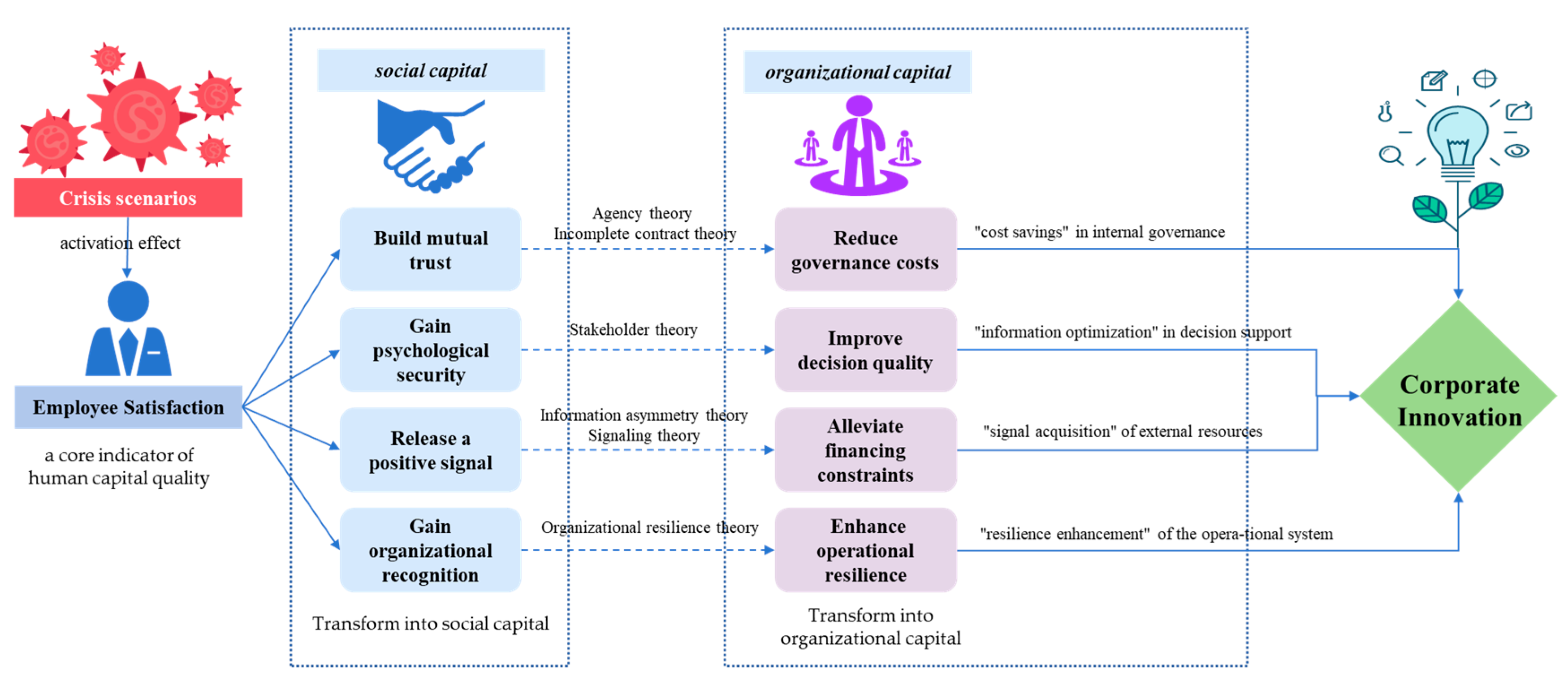
Based on the integrated transmission pathway of ‘human capital-social capital-organisational capital’ [
44,
45], employee satisfaction (a core indicator of human capital quality) is first transformed into internal organisational trust, collaboration, and information sharing (social capital). This subsequently influences organisational capital (governance costs, governance quality, financing capacity, operational resilience) through four complementary pathways, ultimately empowering the allocation and output of innovation resources. These four paths have their own focuses and complement each other. They respectively cover four indispensable dimensions: ‘cost savings’ in internal governance, ‘information optimization’ in decision support, ‘signal acquisition’ of external resources, and ‘resilience enhancement’ of the operational system. Together, they form a complete logic for driving innovation through employee satisfaction during crises. The theoretical framework of this study, illustrated in
Figure 2, aims to elucidate the intrinsic logic by which employee satisfaction drives innovation resilience during crises.
First, the mechanism for reducing governance costs. In crisis situations, the challenges of enterprise governance have significantly intensified. Both the principal-agent theory and the theory of incomplete contracts indicate that crises not only amplify information asymmetry and moral hazard but also exacerbate the incompleteness of contracts. Crises lead to the failure of traditional supervision and formal contracts as conventional governance methods [
33,
39,
46,
47]. This has also been empirically confirmed. Under external shocks, enterprises need to adjust debt contracts to reduce agency costs, indirectly highlighting the limitations of formal governance in crises [
48]. In this context, employee satisfaction builds a key transmission bridge of ‘human capital—social capital—organizational capital’, ultimately achieving a reduction in governance costs.
Employee satisfaction is essentially a form of implicit ‘self-enforcing’ contract [
18], aligning individual objectives with the organisation’s long-term interests by enhancing employees’ organisational identification and intrinsic motivation [
49]. This relational governance mechanism, grounded in emotion and trust, effectively reduces corporate reliance on formal oversight systems. Empirical research by [
39] reveals that organisational trust serves as the pivotal link between culture and psychological safety, with the trust-nurturing atmosphere fostered by high satisfaction significantly curbing opportunistic employee behaviour. Reference [
43] integrated trust into agency theory and incomplete contract theory, confirming that trust mitigates governance challenges arising from moral hazard and contractual incompleteness, thereby conserving oversight costs and conflict resolution resources. This proves particularly valuable in crisis scenarios where contractual incompleteness intensifies.
In crisis scenarios where formal governance is increasingly ineffective, the governance cost savings generated by high employee satisfaction can be reallocated to high-risk, high-return innovation initiatives. This creates the essential resource buffer for enterprises to sustain innovation investment amid adversity. Accordingly, the following research hypothesis is proposed:
Hypothesis 1. In crisis scenarios, employee satisfaction promotes corporate innovation by reducing internal governance costs.
Second, the mechanism for improving decision quality. In crisis situations, the uncertainty of enterprise innovation decisions significantly increases, and the reliance on high-quality and diversified internal information sharply rises [
19]. From the perspectives of stakeholder theory and organisational information processing, employees are the core carriers of frontline knowledge, tacit skills, and market dynamics of the enterprise, and psychological security is the key prerequisite for employees to actively share information and participate in collaboration. Empirical studies related to the conservation of resources theory have confirmed that psychological capital and social capital will influence performance through organisational trust as an intermediary, and this effect is more significant in high-pressure environments. Employee satisfaction is precisely the key precursor for cultivating psychological capital and social capital [
50].
High employee satisfaction can foster a strong organisational trust atmosphere, thereby enhancing employees’ psychological security, laying the foundation for the ‘transformation of human capital to social capital’ [
44]. Under the impact of crisis uncertainty, employees with high satisfaction are more willing to engage in candid hierarchical communication, share tacit knowledge, and participate in cross-departmental collaboration. Domestic empirical research on enterprises also indicates that organisational identification and trust will mediate the relationship between authentic leadership and employee resilience [
51], and this identification and trust is the direct product of high satisfaction, which can significantly optimise the organisational information flow. Psychological security will also prompt employees to actively seek feedback, further enriching the diversity of decision-making information [
52].
In crisis scenarios, the trust network derived from employee satisfaction transforms into high-quality decision-making information, which can help management more accurately identify innovation opportunities and assess technical risks [
33]. Accordingly, the following research hypothesis is proposed:
Hypothesis 2. In crisis scenarios, employee satisfaction promotes corporate innovation by improving decision quality.
Thirdly, the mechanism for alleviating financing constraints. The theory of information asymmetry indicates that the information gap between enterprises and external investors will lead to severe financing constraints for enterprises when investing in intangible assets [
53]. Moreover, as signalling theory indicates, information chaos intensifies within capital markets during crises. Investors exhibit heightened risk aversion, significantly increasing their focus on firms’ ‘soft information’ [
54]. At such junctures, enterprises must convey their long-term resilience through credible signals.
Employee satisfaction, as an intangible asset deeply embedded in organisational culture, has the characteristics of being difficult to imitate and not easily manipulated. It is an effective signal for transmitting the quality of enterprise human capital, the health of the organisation, and the crisis response capabilities. The trust, collaboration, and other social capital cultivated by high employee satisfaction can become important carriers for transmitting the stability of enterprise operations to the market [
55]. And employee satisfaction, as the key antecedent of core dimensions such as employee resilience and collaboration capabilities [
56], can release positive signals of stable enterprise operations to the market. At the same time, the effective utilisation of human capital requires the realisation of value transformation through social capital [
45], and the social capital derived from employee satisfaction can enhance the credibility of these signals and thereby alleviate investors’ concerns. Moreover, the internal harmony embodied by high employee satisfaction can directly reduce financing costs [
32,
39].
Innovation is long-term and requires high levels of capital sustainability. In crisis scenarios, the financing constraints alleviated by employee satisfaction can precisely provide stable external financial guarantees for such innovation activities. Accordingly, the following research hypothesis is proposed:
Hypothesis 3. In crisis scenarios, employee satisfaction promotes corporate innovation by alleviating financing constraints.
Fourthly, the mechanism for enhancing operational resilience. The conservation of resources theory posits that distinctive organisational resources and capabilities constitute the core source of competitive advantage for enterprises [
57]. Employee satisfaction, as a critical social resource, can be directly converted into staff commitment, collaborative efficiency, and proactive problem-solving behaviours, thereby forming a central element of organisational resilience. The latter refers to the capacity to maintain operational continuity and rapidly adapt to environmental changes in the face of crises.
During crises, disrupted production operations and supply chain interruptions become the norm. Yet organisational resilience underpinned by high employee satisfaction enables staff to proactively overcome difficulties and flexibly adapt their working methods [
38]. Reference [
38] emphasises that social capital, as a mechanism, aids human resource practices in adapting to crises, thereby achieving resilience at the employee, organisational, and interface levels. The social capital cultivated through employee satisfaction serves as the core support for this adaptation process. Reference [
58] confirms that employee resilience influences organisational resilience through problem-focused and emotion-focused coping mechanisms, with employee satisfaction being a key antecedent of employee resilience. Empirical research grounded in resource conservation theory [
41] further reveals that employees’ behavioural and situational resilience mediate the relationship between leadership behaviour and organisational resilience, with high satisfaction significantly enhancing both forms of resilience. Additionally, research on incomplete contracts [
59] indicates that fostering innovation requires granting employees autonomy and incentives; the trust and intrinsic motivation derived from employee satisfaction align precisely with this logic. Research [
60] further confirms that fulfilling psychological contracts encourages employees to engage in extra-role behaviours, directly enhancing operational efficiency. Such proactivity not only mitigates the negative impact of crises on productivity but can even improve operational efficiency through process optimisation, thereby safeguarding the stable generation of internal cash flow. As the most flexible financial source for autonomous innovation investment [
61], internal cash flow ensures enterprises can sustain continuous innovation investment even when external resource acquisition becomes challenging. Accordingly, the following research hypothesis is proposed:
Hypothesis 4. In crisis scenarios, employee satisfaction promotes corporate innovation by enhancing operational resilience.