
Cybersecurity in Smart Grids: A Domain-Centric Review


Abstract
1. Introduction
- A NIST seven-domain mapping of recent SG cybersecurity research with a joint trend analysis of domain × method (simulation/theoretical/testbed) and domain × attack type;
- A temporal trend analysis (Section 4.1) that highlights how attention has shifted among domains and methods;
- A limitations-focused synthesis of defenses that summarizes practical constraints and needs by domain (Section 4.2). Our corpus (60 IEEE Xplore papers) is analyzed with consistent labeling and figure annotations to make counts and percentages explicit for reproducibility.
2. Background
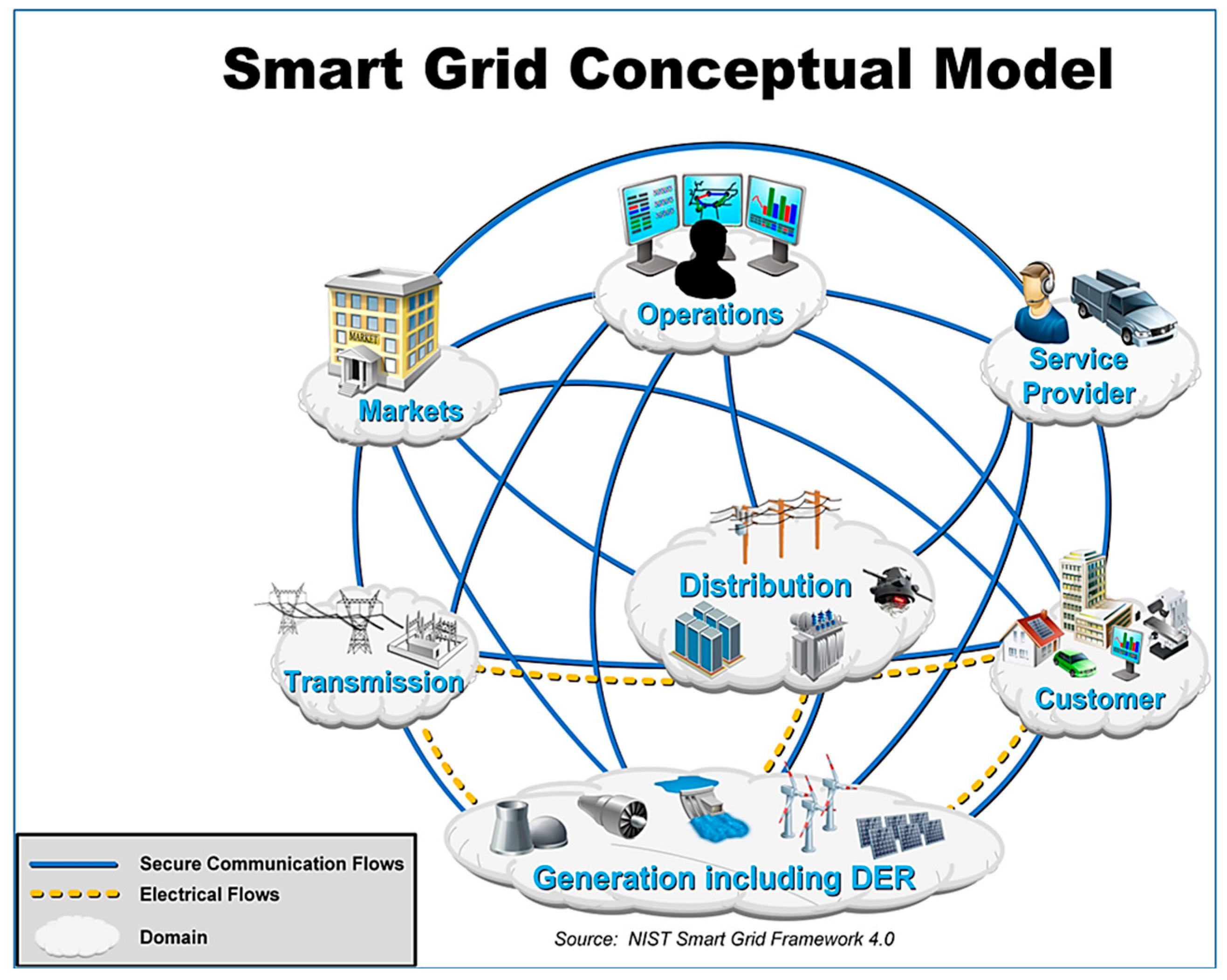
2.1. SG Architecture
2.2. SG Cybersecurity
2.2.1. False Data Injection (FDI) Attacks
2.2.2. Denial of Service (DoS) Attacks
2.2.3. Replay Attacks
2.2.4. Man-in-the-Middle (MITM) Attacks
2.2.5. Malware and Malicious Code Injection
2.2.6. Comparison of Attack Types and Defense Challenges
2.3. Existing Reviews on Domain-Level SG Cybersecurity
- i.
- Categorizing studies clearly to the primary NIST domain(s) impacted;
- ii.
- Mapping the study’s domain with the primary method employed, tools/platforms used, and key cyberattacks covered;
- iii.
- Highlighting domains that are underrepresented and areas where there is an imbalance in methodology (i.e., between empirical support/simulation and theoretical frameworks and models).
3. Methodology of This Review
3.1. Literature Selection
3.2. Metadata Extraction and Classification
- Title and publication year;
- Primary threat(s), classified as False Data Injection (FDI), Denial of Service (DoS), Man-in-the-Middle (MITM), replay attack, Malware and Malicious Code Injection (MCI), insider threat, or general (broad anomaly detection, cryptographic frameworks, etc.);
- AI/ML methods: Yes or No classification;
- Primary approach: Simulation-based (e.g., model-based, data-driven, co-simulation, or testbed), Theoretical (e.g., attack frameworks, resilience strategies, risk models, policy), or Experimental/Testbed (e.g., hardware-in-the-loop, field trial);
- Tool(s)/test platforms: New tools and platforms were recorded as they were encountered during the review process, e.g., MATLAB/Simulink, NS-3, OPAL-RT, and PSCAD/EMTDC, among others;
- NIST domain(s) affected: Customers, Generation/DERs, Transmission, Distribution, Service Providers, Operations, or Markets.
3.3. Domain Classification Criteria
- Customers: Studies of end-user devices and interactions (e.g., smart meters, Home Energy Management Systems, demand response) emphasizing privacy, consumer behavior, or data protection;
- Generation (including DERs): Centralized and distributed sources (e.g., solar, wind, microgrids, VPPs), inverter security, and DER coordination;
- Transmission: High-voltage infrastructure (e.g., SCADA/PMU security, wide-area monitoring, relay protection, substations);
- Distribution: Medium/low-voltage networks (e.g., RTUs, smart transformers, AMI/AMR security, outage management);
- Service Providers: Third-party platforms (e.g., cloud services, billing, data analytics, aggregators), focusing on vendor risk and API/SLA security;
- Operations: Control centers and OT (e.g., SCADA/EMS resilience, state estimation, contingency analysis, situational awareness);
- Markets: Economic layers (e.g., wholesale/retail pricing, bidding platforms, blockchain/DLT for transactions, market manipulation risk).
3.4. Primary Approach Classification Criteria
- Simulation-based: This includes studies that employ simulation tools, whether modeling attacks in platforms like MATLAB/Simulink or NS-3, running co-simulation environments, or using digital-twin frameworks, to evaluate cybersecurity scenarios.
- Theoretical: This includes works that develop and analyze attack frameworks, propose resilience strategies, construct risk-assessment models, or examine policy and standards without direct tool validation.
- Experimental/Testbed: Hardware-in-the-loop (HIL) implementations and real-world field trials that physically validate cybersecurity measures under operational conditions.
3.5. Data Analysis and Considerations
4. Categorization, Results, and Discussion
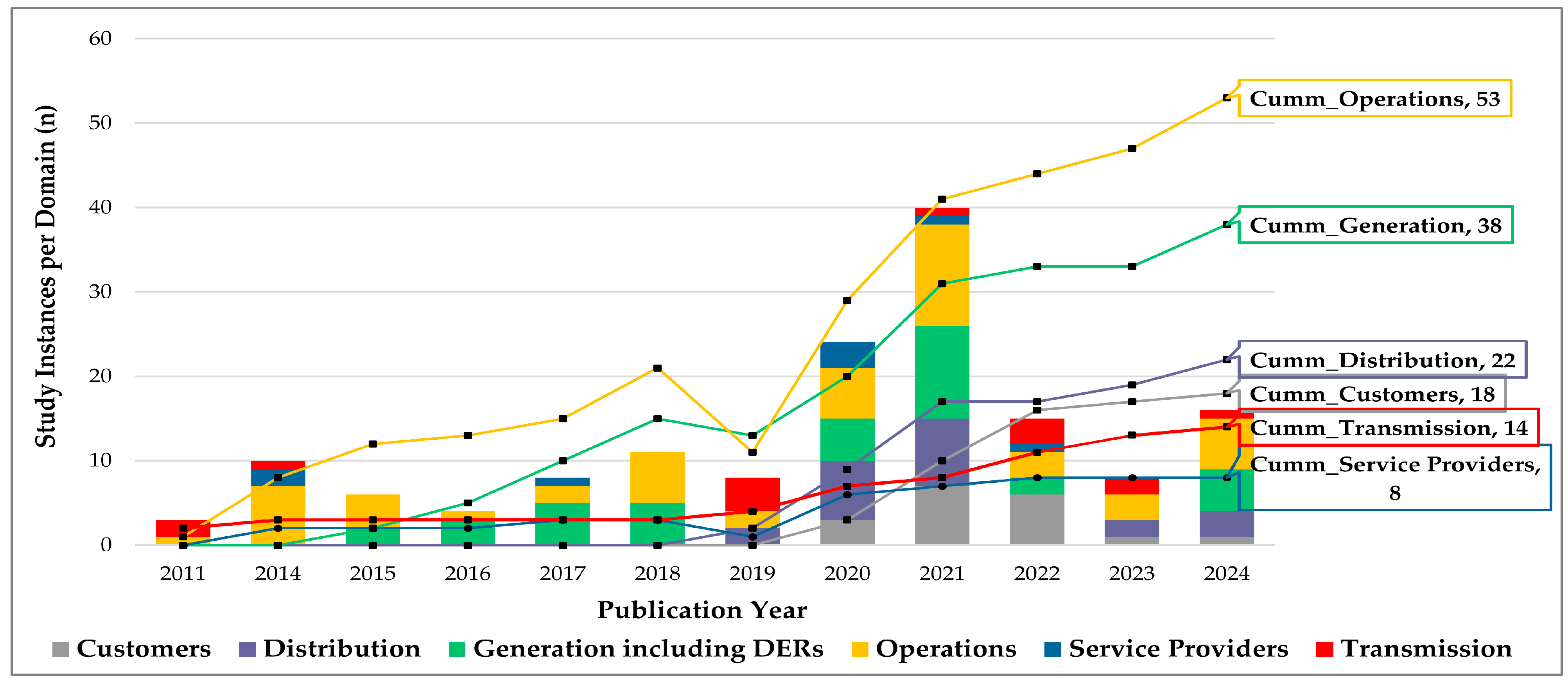
4.1. Domain-Level Temporal Trends
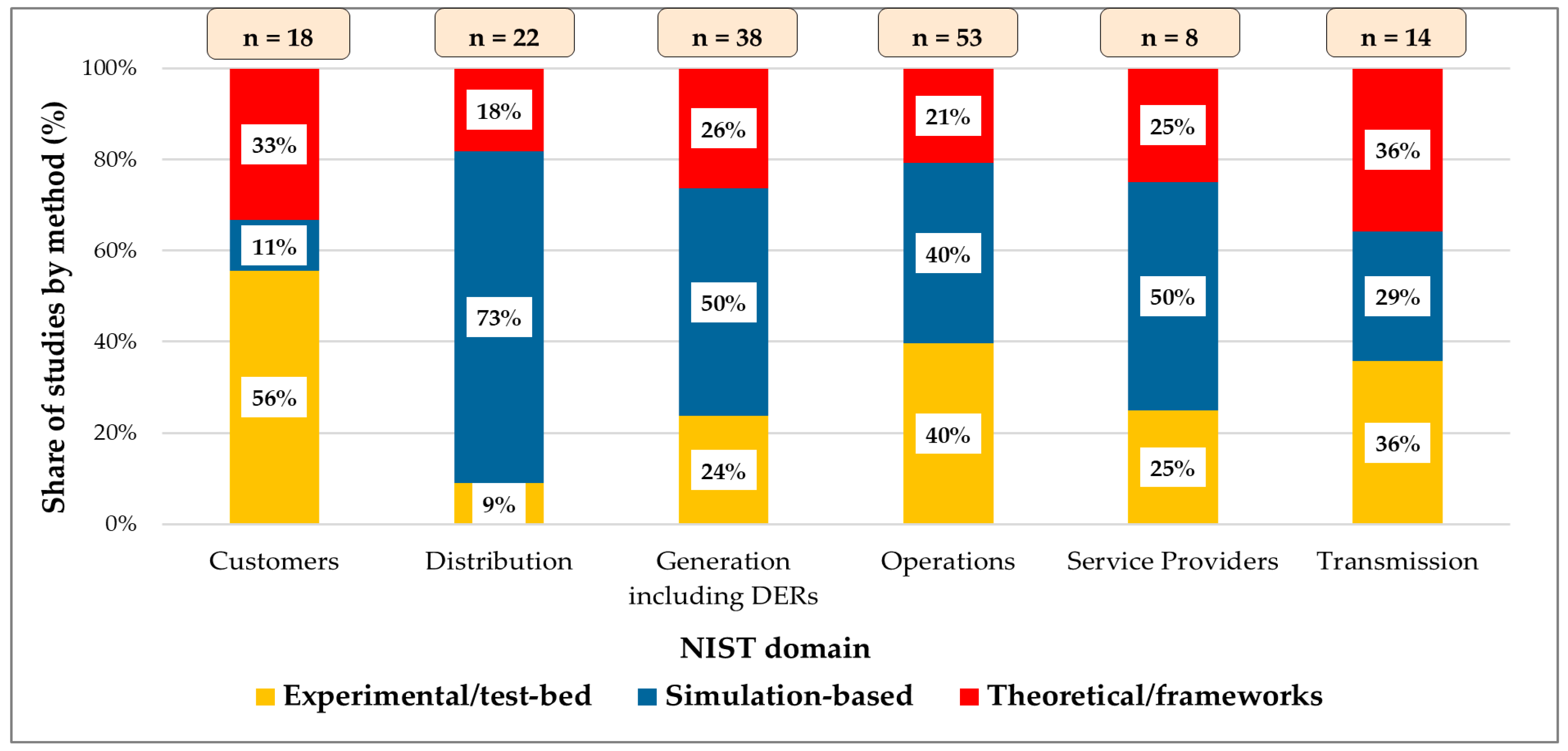
4.2. Methodology Distribution Within Domains
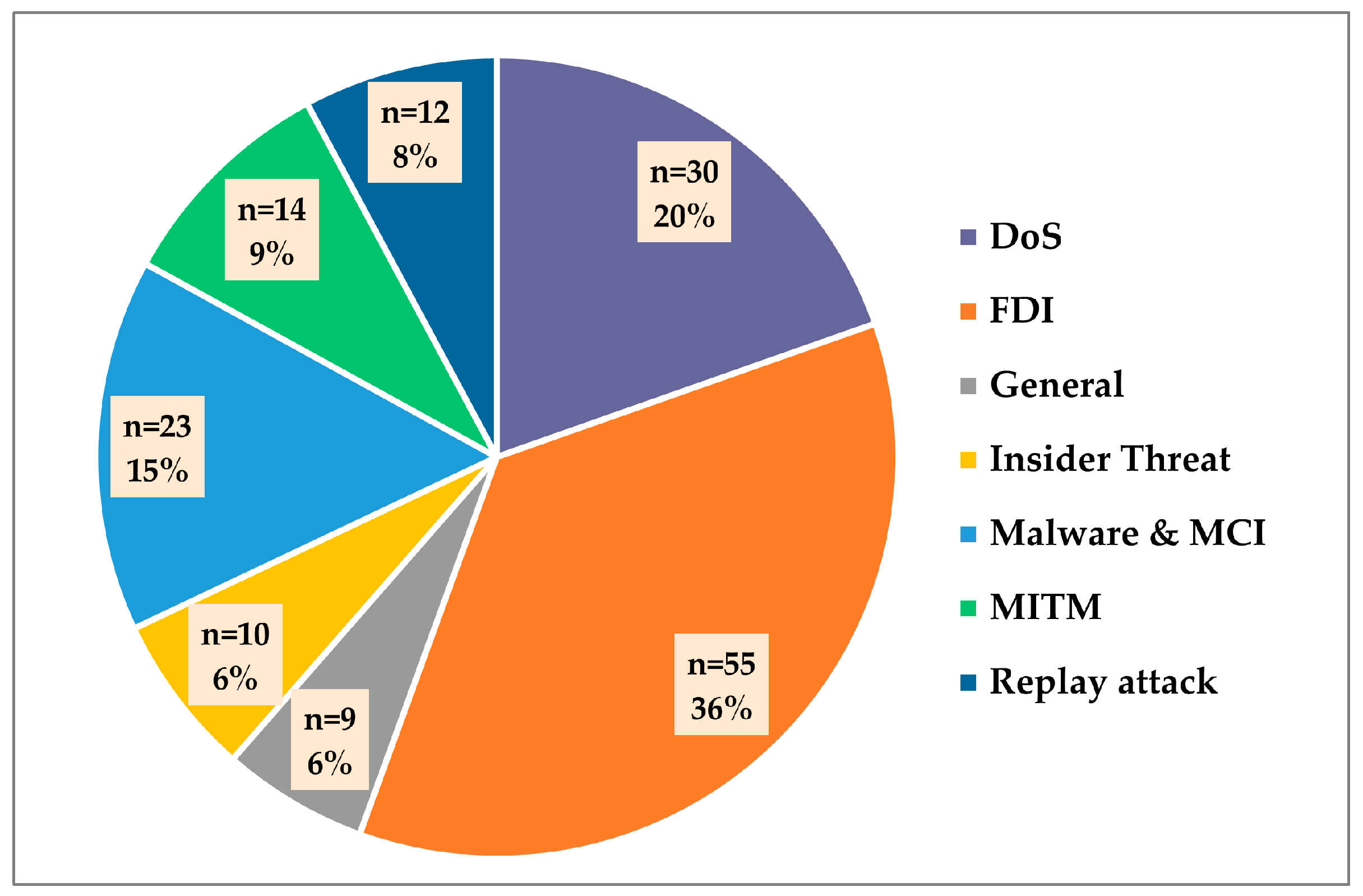
4.3. Cyberattacks on SGs—An Overview
4.4. Tools and Platforms in Simulation-Based Studies
4.5. Domain-Wise Distribution of Attack Types
4.6. Discussions
5. Limitations, Future Work, and Implications
5.1. Limitations
- Limited data sources: It relied on a single database (IEEE Xplore), which may omit relevant studies from other databases.
- Language bias: Only English-language publications were considered.
- Small corpus size: The review covered a set of 60 studies, which may not capture the full breadth of the domains.
- Sampling bias: The recency-weighted, gap-driven sampling strategy (favoring recent, highly cited works) could have introduced temporal and venue biases.
- Scope of review: Finally, this study presents a systematic scoping review and mapping of the literature rather than a quantitative meta-analysis. The aim was to address the broad question, “What types of cyberattacks and defensive methods, including platforms and tools, have been studied across NIST-defined SG domains?” To that end, the landscape of SG cybersecurity is mapped through a descriptive analysis of patterns and trends. We explicitly note that no meta-analysis is performed and that statistical pooling or meta-analytic models are not applied. We did not register a review protocol, apply a formal risk-of-bias tool, or pool effect sizes across studies, primarily because of the heterogeneity in designs, outcomes, and metrics when attempting to map SG cybersecurity at the system level. As a result, our findings should be interpreted as a structured map of where evidence exists (by NIST domain, attack type, and methodology), not as comparative effectiveness estimates of specific defenses. Future work that targets a narrower subset of domains or attack types could support a full meta-analytic synthesis.
5.2. Future Work Directions
- i.
- Increased coverage: Expanding the search to additional databases (e.g., Web of Science, Scopus, ACM Digital Library) and including gray literature to reduce source bias; employing a more robust domain gap-driven search strategy (i.e., dynamically detect underrepresented SG domains during the review process and adjust search queries accordingly) to mitigate bias in coverage.
- ii.
- Socio-technical approaches for DER integration: Adopting a system-of-systems thinking for challenges like high DER penetration can help in anticipating and shaping emergent behaviors in the grid, rather than merely reacting to incidents. For example, treating the SG as a system of systems can enable the use of model-based systems engineering (MBSE) and safety/security analyses (hazard analysis, interface, and dependency mapping, etc.) to capture socio-technical interactions across devices, aggregators, utilities, and markets.
- iii.
- Comprehensive domain component-level mapping: Perform a more domain-specific cybersecurity analysis across the SG, i.e., categorizing attacks by specific SG technologies and components (e.g., AMI, PMUs, SCADA, Distributed Energy Resource Management Systems (DERMSs), inverters, Electric Vehicle supply equipment (EVSE), microgrid controllers, etc.). The authors in [7] similarly, compile cyberattack types, targets, techniques, datasets/simulation tools, and primary NIST functions addressed. However, an NIST domain-level analysis is not performed; hence, future work could address both aspects—the NIST-defined five core concurrent cybersecurity functions (Identify, Protect, Detect, Respond, and Recover), as well as NIST domain classification—to provide a more comprehensive domain component-specific mapping.
- iv.
- AI/ML methods: Analyze the impacts of increasingly adopted AI/ML methods on SG security (e.g., intrusion detection, anomaly analysis, and adaptive defense). This would allow us to evaluate their effectiveness and potential risks, informing future researchers and keeping the review in context with the latest trends.
- v.
- Datasets and testbeds: An updated review of the latest standardized datasets, testbeds, and benchmarks in this field can also aid research, policy-makers, and standardization efforts. The authors in [7,53] present related cybersecurity-oriented testbeds for IoT-based SGs; however, a more robust and updated set of testbeds, their applicability to a NIST cybersecurity function and NIST SG domain, testing platforms, and cyberattack testing capabilities would significantly support domain-level studies and enable repeatable system-of-systems experiments.
- vi.
- Practitioner-oriented reference (attack-countermeasure matrix): Develop a domain-attack–countermeasure matrix tailored for SG operators and other non-technical stakeholders. This matrix could map each SG domain to likely cyberattack types and the tested countermeasures. This could translate the complex nature of technical studies into an accessible format, helping utility personnel quickly identify vulnerabilities and appropriate defenses in their respective domains.
- vii.
- Structured gap analysis: Finally, future studies could map the field’s key limitations and contributions onto defined categories to better identify research gaps. For example, studies could be categorized based on primary limitations (e.g., data availability, model scalability, lack of real-world validation, etc.), as well as classified for unique contributions in an area (e.g., novel detection algorithms, improved system architectures, new datasets, etc.). Such a meta-analysis would highlight common challenges and under-addressed topics, guiding researchers toward the most pressing concerns.
5.3. Implications for Standards and Policy
- i.
- Confirm which attack types have been empirically explored in the literature, and consequently conduct immediate domain-risk assessments for the underrepresented domains, recognizing that research gaps do not necessarily indicate a lower risk.
- ii.
- Identify where evidence is predominantly simulation-based, which would allow, in turn, the identification of areas that can adopt emerging alternatives, as presented in Section 4.6.
- iii.
- Highlight specific domains or attack–method combinations with little or no coverage, e.g., Transmission domain (where domain-specific threat intelligence planning is increasingly being developed) and Customer domain (where FDI and DoS attacks remain under-studied despite high operational exposure).
6. Conclusions
Author Contributions
Funding
Data Availability Statement
Acknowledgments
Conflicts of Interest
Abbreviations
| SG | Smart Grid |
| ICT | Information Communication Technology |
| ICS | Industrial Control System |
| CPPS | Cyber-Physical Power System |
| FDI | False Data Injection |
| DoS | Denial of Service |
| MITM | Man-in-the-Middle |
| MCI | Malicious Code Injection |
References
- Gopstein, A.; Nguyen, C.; O’Fallon, C.; Hastings, N.; Wollman, D.A. NIST Framework and Roadmap for Smart Grid Interoperability Standards, Release 4.0. NIST. 2021. Available online: https://www.nist.gov/publications/nist-framework-and-roadmap-smart-grid-interoperability-standards-release-40 (accessed on 13 April 2025).
- Smart Grid Group. NIST. 2012. Available online: https://www.nist.gov/ctl/smart-connected-systems-division/smart-grid-group (accessed on 13 April 2025).
- International Energy Agency (IEA). Energy and AI—Analysis. 2025. Available online: https://www.iea.org/reports/energy-and-ai (accessed on 13 April 2025).
- American Clean Power (ACP). New Report Finds Urgent Need to Expand Energy Supply to Meet Rapidly Growing Future Demand. 2025. Available online: https://cleanpower.org/news/us-national-power-demand-study (accessed on 13 April 2025).
- Liu, J.; Xiao, Y.; Li, S.; Liang, W.; Chen, C.L.P. Cyber Security and Privacy Issues in Smart Grids. IEEE Commun. Surv. Tutor. 2012, 14, 981–997. [Google Scholar] [CrossRef]
- Abraham, D.; Toftegaard, Ø.; Binu Ben Jose, D.R.; Gebremedhin, A.; Yildirim Yayilgan, S. Consequence simulation of cyber attacks on key smart grid business cases. Front. Energy Res. 2024, 12, 1395954. [Google Scholar] [CrossRef]
- Achaal, B.; Adda, M.; Berger, M.; Ibrahim, H.; Awde, A. Study of smart grid cyber-security, examining architectures, communication networks, cyber-attacks, countermeasure techniques, and challenges. Cybersecurity 2024, 7, 10. [Google Scholar] [CrossRef]
- Cultice, T.; Ionel, D.; Thapliyal, H. Smart home sensor anomaly detection using convolutional autoencoder neural network. In Proceedings of the 2020 IEEE International Symposium on Smart Electronic Systems (iSES) (Formerly iNiS), Chennai, India, 14–16 December 2020; pp. 67–70. Available online: https://ieeexplore.ieee.org/document/9426175 (accessed on 26 April 2025).
- Xie, J.; Rahman, A.; Sun, W. Bayesian GAN-Based False Data Injection Attack Detection in Active Distribution Grids with DERs. IEEE Trans. Smart Grid 2024, 15, 3223–3234. [Google Scholar] [CrossRef]
- Wei, S.; Xu, J.; Wu, Z.; Hu, Q.; Yu, X. A False Data Injection Attack Detection Strategy for Unbalanced Distribution Networks State Estimation. IEEE Trans. Smart Grid 2023, 14, 3992–4006. [Google Scholar] [CrossRef]
- Fernando, N.S.; Acken, J.M.; Bass, R.B. Developing a distributed trust model for distributed energy resources. In Proceedings of the 2021 IEEE Conference on Technologies for Sustainability (SusTech), Irvine, CA, USA, 22–24 April 2021; pp. 1–6. Available online: https://ieeexplore.ieee.org/document/9467436 (accessed on 20 July 2025).
- Sureshkumar, V.; Anandhi, S.; Amin, R.; Selvarajan, N.; Madhumathi, R. Design of Robust Mutual Authentication and Key Establishment Security Protocol for Cloud-Enabled Smart Grid Communication. IEEE Syst. J. 2021, 15, 3565–3572. [Google Scholar] [CrossRef]
- Chen, X.; Hu, S.; Li, Y.; Yue, D.; Dou, C.; Ding, L. Co-Estimation of State and FDI Attacks and Attack Compensation Control for Multi-Area Load Frequency Control Systems Under FDI and DoS Attacks. IEEE Trans. Smart Grid 2022, 13, 2357–2368. [Google Scholar] [CrossRef]
- Zhan, L.; Dehghanian, P.; Mehrani, S. Minimizing the risk of attacks in electric power systems via effective grid reinforcement of counter-threat technologies. In Proceedings of the 2023 IEEE PES GTD International Conference and Exposition (GTD), Istanbul, Turkiye, 22–25 May 2023; pp. 273–277. Available online: https://ieeexplore.ieee.org/document/10261483 (accessed on 27 April 2025).
- Maharjan, M.; Poudel, S.; Mix, S.R.; McDermott, T.E. Cybersecurity Assessment in DER-rich Distribution Operations: Criticality Levels and Impact Analysis. In Proceedings of the 2024 IEEE Power & Energy Society Innovative Smart Grid Technologies Conference (ISGT), Washington, DC, USA, 19–22 February 2024; pp. 1–5. Available online: https://ieeexplore.ieee.org/document/10454167 (accessed on 26 April 2025).
- Karanfil, M.; Rebbah, D.E.; Debbabi, M.; Kassouf, M.; Ghafouri, M.; Youssef, E.-N.S.; Hanna, A. Detection of Microgrid Cyberattacks Using Network and System Management. IEEE Trans. Smart Grid 2023, 14, 2390–2405. [Google Scholar] [CrossRef]
- Google Cloud. TRITON Malware: Attackers Deploy New ICS Attack Framework. Google Cloud Blog. Available online: https://cloud.google.com/blog/topics/threat-intelligence/attackers-deploy-new-ics-attack-framework-triton (accessed on 20 April 2025).
- Recorded Future. China-Linked Group RedEcho Targets the Indian Power Sector Amid Heightened Border Tensions. Available online: https://www.recordedfuture.com/research/redecho-targeting-indian-power-sector (accessed on 20 April 2025).
- IronNet. Cyber Attacks on the Power Grid. Available online: https://www.ironnet.com/blog/cyber-attacks-on-the-power-grid (accessed on 20 April 2025).
- Cyber-Attack Against Ukrainian Critical Infrastructure. CISA. 2021. Available online: https://www.cisa.gov/news-events/ics-alerts/ir-alert-h-16-056-01 (accessed on 20 April 2025).
- Ferah, M.; Joncas, H.; Marquis, M. Cyberattaque: Le Site Web d’Hydro-Québec Paralysé. La Presse. 2023. Available online: https://www.lapresse.ca/actualites/2023-04-13/cyberattaque/le-site-web-d-hydro-quebec-paralyse.php (accessed on 9 October 2025).
- Reda, H.T.; Anwar, A.; Mahmood, A. Comprehensive survey and taxonomies of false data injection attacks in smart grids: Attack models, targets, and impacts. Renew. Sustain. Energy Rev. 2022, 163, 112423. [Google Scholar] [CrossRef]
- Abdelkader, S.; Amissah, J.; Kinga, S.; Mugerwa, G.; Emmanuel, E.; Mansour, D.-E.A.; Bajaj, M.; Blazek, V.; Prokop, L. Securing modern power systems: Implementing comprehensive strategies to enhance resilience and reliability against cyber-attacks. Results Eng. 2024, 23, 102647. [Google Scholar] [CrossRef]
- Rawat, D.B.; Bajracharya, C. Cyber security for smart grid systems: Status, challenges and perspectives. In Proceedings of the SoutheastCon 2015, Fort Lauderdale, FL, USA, 9–12 April 2015; pp. 1–6. Available online: https://ieeexplore.ieee.org/document/7132891 (accessed on 16 April 2025).
- Tuyen, N.D.; Quan, N.S.; Linh, V.B.; Van Tuyen, V.; Fujita, G. A Comprehensive Review of Cybersecurity in Inverter-Based Smart Power System Amid the Boom of Renewable Energy. IEEE Access 2022, 10, 35846–35875. [Google Scholar] [CrossRef]
- Liang, G.; Zhao, J.; Luo, F.; Weller, S.R.; Dong, Z.Y. A Review of False Data Injection Attacks Against Modern Power Systems. IEEE Trans. Smart Grid 2017, 8, 1630–1638. [Google Scholar] [CrossRef]
- Tan, R.; Nguyen, H.H.; Foo, E.Y.; Yau, D.K.; Kalbarczyk, Z.; Iyer, R.K.; Gooi, H.B. Modeling and Mitigating Impact of False Data Injection Attacks on Automatic Generation Control. IEEE Trans. Inf. Forensics Secur. 2017, 12, 1609–1624. [Google Scholar] [CrossRef]
- Tatipatri, N.; Arun, S.L. A Comprehensive Review on Cyber-Attacks in Power Systems: Impact Analysis, Detection, and Cyber Security. IEEE Access 2024, 12, 18147–18167. [Google Scholar] [CrossRef]
- Hasnat, M.A.; Rahnamay-Naeini, M. A data-driven dynamic state estimation for smart grids under DoS attack using state correlations. In Proceedings of the 2019 North American Power Symposium (NAPS), Wichita, KS, USA, 13–15 October 2019; pp. 1–6. Available online: https://ieeexplore.ieee.org/document/9000307 (accessed on 8 April 2025).
- Ge, P.; Chen, B.; Teng, F. Cyber-Resilient Self-Triggered Distributed Control of Networked Microgrids Against Multi-Layer DoS Attacks. IEEE Trans. Smart Grid 2023, 14, 3114–3124. [Google Scholar] [CrossRef]
- Zhang, Y.; Wang, L.; Sun, W.; Green, R.C., II; Alam, M. Distributed Intrusion Detection System in a Multi-Layer Network Architecture of Smart Grids. IEEE Trans. Smart Grid 2011, 2, 796–808. [Google Scholar] [CrossRef]
- Gholami, S.; Saha, S.; Aldeen, M. A cyber attack resilient control for distributed energy resources. In Proceedings of the 2017 IEEE PES Innovative Smart Grid Technologies Conference Europe (ISGT-Europe), Turin, Italy, 26–29 September 2017; pp. 1–6. Available online: https://ieeexplore.ieee.org/document/8260213 (accessed on 8 April 2025).
- Guo, L.; Zhang, J.; Ye, J.; Coshatt, S.J.; Song, W. Data-Driven Cyber-Attack Detection for PV Farms via Time-Frequency Domain Features. IEEE Trans. Smart Grid 2022, 13, 1582–1597. [Google Scholar] [CrossRef]
- Ibrahem, M.I.; Mahmoud, M.M.E.A.; Alsolami, F.; Alasmary, W.; AL-Ghamdi, A.S.A.-M.; Shen, X. Electricity-Theft Detection for Change-and-Transmit Advanced Metering Infrastructure. IEEE Internet Things J. 2022, 9, 25565–25580. [Google Scholar] [CrossRef]
- Hemmati, M.; Palahalli, M.H.; Storti Gajani, G.; Gruosso, G. Impact and vulnerability analysis of IEC 61850 in smart grids using multiple HIL real-time testbeds. IEEE Access 2022, 10, 103275–103285. [Google Scholar] [CrossRef]
- Pedroza, G.; Le Gall, P.; Gaston, C.; Bersey, F. Timed-model-based method for security analysis and testing of smart grid systems. In Proceedings of the 2016 IEEE 19th International Symposium on Real-Time Distributed Computing (ISORC), York, UK, 17–20 May 2016; pp. 35–42. Available online: https://ieeexplore.ieee.org/document/7515609 (accessed on 10 April 2025).
- Zhang, Y.; Wang, L.; Xiang, Y.; Ten, C.-W. Power System Reliability Evaluation with SCADA Cybersecurity Considerations. IEEE Trans. Smart Grid 2015, 6, 1707–1721. [Google Scholar] [CrossRef]
- Azab, M.; Eltoweissy, M. CyPhyMASC: Evolutionary monitoring, analysis, sharing and control platform for SmartGrid defense. In Proceedings of the 2014 IEEE 15th International Conference on Information Reuse and Integration (IEEE IRI 2014), Redwood City, CA, USA, 13–15 August 2014; pp. 639–645. Available online: https://ieeexplore.ieee.org/document/7051950 (accessed on 21 July 2025).
- Xu, S.; Xia, Y.; Shen, H.-L. Analysis of malware-induced cyber attacks in cyber-physical power systems. IEEE Trans. Circuits Syst. II Express Briefs 2020, 67, 3482–3486. [Google Scholar] [CrossRef]
- Poudel, S.; Abouyoussef, M.; Baugh, J.E.; Ismail, M. Attack Design for Maximum Malware Spread Through EVs Commute and Charge in Power-Transportation Systems. IEEE Syst. J. 2024, 18, 1809–1820. [Google Scholar] [CrossRef]
- Liu, D.; Zhang, X.; Tse, C.K. Effect of Malware Spreading on Propagation of Cascading Failure in Cyber-Coupled Power Systems. In Proceedings of the 2018 IEEE International Symposium on Circuits and Systems (ISCAS), Florence, Italy, 27–30 May 2018; pp. 1–4. Available online: https://ieeexplore.ieee.org/document/8351591 (accessed on 27 April 2025).
- Alvee, S.R.B.; Ahn, B.; Ahmad, S.; Kim, K.-T.; Kim, T.; Zeng, J. Device-centric firmware malware detection for smart inverters using deep transfer learning. In Proceedings of the 2022 IEEE Design Methodologies Conference (DMC), Bath, UK, 1–2 September 2022; pp. 1–5. Available online: https://ieeexplore.ieee.org/document/9906538 (accessed on 27 April 2025).
- Li, H.; Pan, H. A defense strategy against false data injection attack in smart grid based on multi-stage game. In Proceedings of the 2024 9th International Conference on Power and Renewable Energy (ICPRE), Guangzhou, China, 20–23 September 2024; pp. 685–691. Available online: https://ieeexplore.ieee.org/document/10768530 (accessed on 12 April 2025).
- Selim, A.; Zhao, J.; Ding, F.; Miao, F.; Park, S.-Y. Adaptive Deep Reinforcement Learning Algorithm for Distribution System Cyber Attack Defense with High Penetration of DERs. IEEE Trans. Smart Grid 2024, 15, 4077–4089. [Google Scholar] [CrossRef]
- Zhou, Q.; Shahidehpour, M.; Alabdulwahab, A.; Abusorrah, A.; Che, L.; Liu, X. Cross-Layer Distributed Control Strategy for Cyber Resilient Microgrids. IEEE Trans. Smart Grid 2021, 12, 3705–3717. [Google Scholar] [CrossRef]
- Kang, B.; Maynard, P.; McLaughlin, K.; Sezer, S.; Andrén, F.; Seitl, C.; Kupzog, F.; Strasser, T. Investigating cyber-physical attacks against IEC 61850 photovoltaic inverter installations. In Proceedings of the 2015 IEEE 20th Conference on Emerging Technologies & Factory Automation (ETFA), Luxembourg, 8–11 September 2015; pp. 1–8. Available online: https://ieeexplore.ieee.org/document/7301457 (accessed on 8 April 2025).
- Kamal, M.; Farajollahi, M.; Nazaripouya, H.; Mohsenian-Rad, H. Cyberattacks Against Event-Based Analysis in Micro-PMUs: Attack Models and Counter Measures. IEEE Trans. Smart Grid 2021, 12, 1577–1588. [Google Scholar] [CrossRef]
- Chavez, A.; Lai, C.; Jacobs, N.; Hossain-McKenzie, S.; Jones, C.B.; Johnson, J.; Summers, A. Hybrid intrusion detection system design for distributed energy resource systems. In Proceedings of the 2019 IEEE CyberPELS (CyberPELS), Knoxville, TN, USA, 29 April–1 May 2019; pp. 1–6. Available online: https://ieeexplore.ieee.org/document/8925064 (accessed on 26 April 2025).
- Ravikumar, G.; Singh, A.; Babu, J.R.; Moataz, A.; Govindarasu, M. D-IDS for Cyber-Physical DER Modbus System—Architecture, Modeling, Testbed-Based Evaluation. In Proceedings of the 2020 Resilience Week (RWS), Salt Lake City, UT, USA, 19–23 October 2020; pp. 153–159. Available online: https://ieeexplore.ieee.org/document/9241259 (accessed on 8 April 2025).
- Karimipour, H.; Dehghantanha, A.; Parizi, R.M.; Choo, K.-K.R.; Leung, H. A Deep and Scalable Unsupervised Machine Learning System for Cyber-Attack Detection in Large-Scale Smart Grids. IEEE Access 2019, 7, 80778–80788. [Google Scholar] [CrossRef]
- Cui, M.; Wang, J.; Chen, B. Flexible Machine Learning-Based Cyberattack Detection Using Spatiotemporal Patterns for Distribution Systems. IEEE Trans. Smart Grid 2020, 11, 1805–1808. [Google Scholar] [CrossRef]
- Akash, A.R.; Ahn, B.; Jenkins, A.; Khot, A.; Silva, L.; Tavares-Vengas, H.; Kim, T. Quantum convolutional neural network-based online malware file detection for smart grid devices. In Proceedings of the 2023 IEEE Design Methodologies Conference (DMC), Miami, FL, USA, 24–26 September 2023; pp. 1–5. Available online: https://ieeexplore.ieee.org/document/10412597 (accessed on 27 April 2025).
- Gunduz, M.Z.; Das, R. A comparison of cyber-security oriented testbeds for IoT-based smart grids. In Proceedings of the 2018 6th International Symposium on Digital Forensic and Security (ISDFS), Antalya, Turkey, 22–25 March 2018; pp. 1–6. Available online: https://ieeexplore.ieee.org/document/8355329 (accessed on 8 April 2025).
- de Carvalho, R.S.; Saleem, D. Recommended Functionalities for Improving Cybersecurity of Distributed Energy Resources. In Proceedings of the 2019 Resilience Week (RWS), San Antonio, TX, USA, 4–7 November 2019; Volume 1, pp. 226–231. Available online: https://ieeexplore.ieee.org/document/8972000 (accessed on 8 April 2025).
- Yohanandhan, R.V.; Elavarasan, R.M.; Manoharan, P.; Mihet-Popa, L. Cyber-Physical Power System (CPPS): A Review on Modeling, Simulation, and Analysis with Cyber Security Applications. IEEE Access 2020, 8, 151019–151064. [Google Scholar] [CrossRef]
- Xia, Y.; Xu, Y.; Mondal, S.; Gupta, A.K. A Transfer Learning-Based Method for Cyber-Attack Tolerance in Distributed Control of Microgrids. IEEE Trans. Smart Grid 2024, 15, 1258–1270. [Google Scholar] [CrossRef]
- Jafarigiv, D.; Sheshyekani, K.; Kassouf, M.; Seyedi, Y.; Karimi, H.; Mahseredjian, J. Countering FDI Attacks on DERs Coordinated Control System Using FMI-Compatible Cosimulation. IEEE Trans. Smart Grid 2021, 12, 1640–1650. [Google Scholar] [CrossRef]
- Takiddin, A.; Ismail, M.; Zafar, U.; Serpedin, E. Deep Autoencoder-Based Anomaly Detection of Electricity Theft Cyberattacks in Smart Grids. IEEE Syst. J. 2022, 16, 4106–4117. [Google Scholar] [CrossRef]
- Liu, Z.; Wang, L. Defense Strategy Against Load Redistribution Attacks on Power Systems Considering Insider Threats. IEEE Trans. Smart Grid 2021, 12, 1529–1540. [Google Scholar] [CrossRef]
- Formby, D.; Jung, S.S.; Walters, S.; Beyah, R. A physical overlay framework for insider threat mitigation of power system devices. In Proceedings of the 2014 IEEE International Conference on Smart Grid Communications (SmartGridComm), Venice, Italy, 3–6 November 2014; pp. 970–975. Available online: https://ieeexplore.ieee.org/document/7007774 (accessed on 27 April 2025).
- Bao, H.; Lu, R.; Li, B.; Deng, R. BLITHE: Behavior Rule-Based Insider Threat Detection for Smart Grid. IEEE Internet Things J. 2016, 3, 190–205. [Google Scholar] [CrossRef]
- Chen, Q.; Zhou, M.; Cai, Z.; Su, S. Compliance Checking Based Detection of Insider Threat in Industrial Control System of Power Utilities. In Proceedings of the 2022 7th Asia Conference on Power and Electrical Engineering (ACPEE), Hangzhou, China, 15–17 April 2022; pp. 1142–1147. Available online: https://ieeexplore.ieee.org/document/9784085 (accessed on 27 April 2025).
- Zhou, Q.; Shahidehpour, M.; Alabdulwahab, A.; Abusorrah, A. A Cyber-Attack Resilient Distributed Control Strategy in Islanded Microgrids. IEEE Trans. Smart Grid 2020, 11, 3690–3701. [Google Scholar] [CrossRef]
- Rekik, M.; Chtourou, Z.; Gransart, C.; Atieh, A. A Cyber-Physical Threat Analysis for Microgrids. In Proceedings of the 2018 15th International Multi-Conference on Systems, Signals & Devices (SSD), Yasmine Hammamet, Tunisia, 19–22 March 2018; pp. 731–737. Available online: https://ieeexplore.ieee.org/document/8570411 (accessed on 22 April 2025).
- Srikantha, P.; Kundur, D. A DER Attack-Mitigation Differential Game for Smart Grid Security Analysis. IEEE Trans. Smart Grid 2016, 7, 1476–1485. [Google Scholar] [CrossRef]
- Ten, C.-W.; Hong, J.; Liu, C.-C. Anomaly Detection for Cybersecurity of the Substations. IEEE Trans. Smart Grid 2011, 2, 865–873. [Google Scholar] [CrossRef]
- Chen, Z.; Zhu, J.; Li, S.; Luo, T. Detection of false data injection attack in automatic generation control system with wind energy based on fuzzy support vector machine. In Proceedings of the IECON 2020 The 46th Annual Conference of the IEEE Industrial Electronics Society, Singapore, 18–21 October 2020; pp. 3523–3528. Available online: https://ieeexplore.ieee.org/document/9255020 (accessed on 21 July 2025).
- Zhuang, P.; Liang, H. False Data Injection Attacks Against State-of-Charge Estimation of Battery Energy Storage Systems in Smart Distribution Networks. IEEE Trans. Smart Grid 2021, 12, 2566–2577. [Google Scholar] [CrossRef]
- Mohamed, A.S.; Arani, M.F.M.; Jahromi, A.A.; Kundur, D. False Data Injection Attacks Against Synchronization Systems in Microgrids. IEEE Trans. Smart Grid 2021, 12, 4471–4483. [Google Scholar] [CrossRef]
- Ravikumar, G.; Hyder, B.; Govindarasu, M. Hardware-in-the-Loop CPS Security Architecture for DER Monitoring and Control Applications. In Proceedings of the 2020 IEEE Texas Power and Energy Conference (TPEC), College Station, TX, USA, 6–7 February 2020; pp. 1–5. Available online: https://ieeexplore.ieee.org/document/9042578 (accessed on 8 April 2025).
- Liu, X.; Shahidehpour, M.; Cao, Y.; Wu, L.; Wei, W.; Liu, X. Microgrid Risk Analysis Considering the Impact of Cyber Attacks on Solar PV and ESS Control Systems. IEEE Trans. Smart Grid 2017, 8, 1330–1339. [Google Scholar] [CrossRef]
- Jhala, K.; Pradhan, P.; Natarajan, B. Perturbation-Based Diagnosis of False Data Injection Attack Using Distributed Energy Resources. IEEE Trans. Smart Grid 2021, 12, 1589–1601. [Google Scholar] [CrossRef]
- Hong, J.; Liu, C.-C. Intelligent Electronic Devices with Collaborative Intrusion Detection Systems. IEEE Trans. Smart Grid 2019, 10, 271–281. [Google Scholar] [CrossRef]
- Park, K.; Ahn, B.; Kim, J.; Won, D.; Noh, Y.; Choi, J.; Kim, T. An Advanced Persistent Threat (APT)-Style Cyberattack Testbed for Distributed Energy Resources (DER). In Proceedings of the 2021 IEEE Design Methodologies Conference (DMC), Bath, UK, 14–15 July 2021; pp. 1–5. Available online: https://ieeexplore.ieee.org/document/9529953 (accessed on 27 April 2025).
- Abir, S.M.A.A.; Anwar, A.; Choi, J.; Kayes, A.S.M. IoT-Enabled Smart Energy Grid: Applications and Challenges. IEEE Access 2021, 9, 50961–50981. [Google Scholar] [CrossRef]
- de Souza, E.; Ardakanian, O.; Nikolaidis, I. A Co-simulation Platform for Evaluating Cyber Security and Control Applications in the Smart Grid. In Proceedings of the ICC 2020—2020 IEEE International Conference on Communications (ICC), Dublin, Ireland, 7–11 June 2020; pp. 1–7. Available online: https://ieeexplore.ieee.org/document/9149212 (accessed on 8 April 2025).
- Guan, Z.; Li, J.; Wu, L.; Zhang, Y.; Wu, J.; Du, X. Achieving Efficient and Secure Data Acquisition for Cloud-Supported Internet of Things in Smart Grid. IEEE Internet Things J. 2017, 4, 1934–1944. [Google Scholar] [CrossRef]
- Ackley, D.; Yang, H. Exploration of Smart Grid Device Cybersecurity Vulnerability Using Shodan. In Proceedings of the 2020 IEEE Power & Energy Society General Meeting (PESGM), Montreal, QC, Canada, 2–6 August 2020; pp. 1–5. Available online: https://ieeexplore.ieee.org/document/9281544 (accessed on 10 April 2025).
- Wen, M.; Chen, S.; Lu, R.; Li, B.; Chen, S. Security and Efficiency Enhanced Revocable Access Control for Fog-Based Smart Grid System. IEEE Access 2019, 7, 137968–137981. [Google Scholar] [CrossRef]
- MathWorks. Power and Control Systems. Available online: https://www.mathworks.com/solutions/energy-production/utilities-energy/power-system-studies.html (accessed on 2 October 2025).
- OPAL-RT Technologies. OPAL-RT Website. Available online: https://www.opal-rt.com/ (accessed on 2 October 2025).
- OpenDSS. Available online: https://www.epri.com/pages/sa/opendss (accessed on 1 October 2025).
- ns-3 Project. ns-3. Available online: https://www.nsnam.org/ (accessed on 1 October 2025).
- PSCAD. PSCAD Website. Available online: https://www.pscad.com/ (accessed on 1 October 2025).
- EMTP. EMTP—Products. Available online: https://www.emtp.com/products/emtp (accessed on 2 October 2025).
- ePHASORSIM. OPAL-RT TECHNOLOGIES, Inc. Available online: https://www.opal-rt.com/software-toolboxes/ephasorsim/ (accessed on 2 October 2025).
- Blanchet, B.; Smyth, B.; Cheval, V.; Sylvestre, M. ProVerif 2.05: Automatic Cryptographic Protocol Verifier—User Manual and Tutorial. Available online: https://bblanche.gitlabpages.inria.fr/proverif// (accessed on 2 October 2025).
- PowerWorld Corporation. The Visual Approach to Electric Power Systems. Available online: https://www.powerworld.com/ (accessed on 2 October 2025).
- Steinbrink, C.; Blank-Babazadeh, M.; El-Ama, A.; Holly, S.; Lüers, B.; Nebel-Wenner, M.; Ramírez Acosta, R.P.; Raub, T.; Schwarz, J.S.; Stark, S.; et al. CPES Testing with mosaik: Co-Simulation Planning, Execution and Analysis. Appl. Sci. 2019, 9, 923. [Google Scholar] [CrossRef]
- Cintuglu, M.H.; Mohammed, O.A.; Akkaya, K.; Uluagac, A.S. A Survey on Smart Grid Cyber-Physical System Testbeds. IEEE Commun. Surv. Tutor. 2017, 19, 446–464. [Google Scholar] [CrossRef]
- Lu, Q.; Li, J.; Peng, Z.; Wu, L.; Ni, M.; Luo, J. Detecting the cyber-physical-social cooperated APTs in high-DER-penetrated smart grids: Threats, current work and challenges. Comput. Netw. 2024, 254, 110776. [Google Scholar] [CrossRef]
- Liu, M.; Teng, F.; Zhang, Z.; Ge, P.; Sun, M.; Deng, R.; Cheng, P.; Chen, J. Enhancing Cyber-Resiliency of DER-Based Smart Grid: A Survey. IEEE Trans. Smart Grid 2024, 15, 4998–5030. [Google Scholar] [CrossRef]
- Krause, T.; Ernst, R.; Klaer, B.; Hacker, I.; Henze, M. Cybersecurity in Power Grids: Challenges and Opportunities. Sensors 2021, 21, 6225. [Google Scholar] [CrossRef]
- Khalid, M. Smart grids and renewable energy systems: Perspectives and grid integration challenges. Energy Strategy Rev. 2024, 51, 101299. [Google Scholar] [CrossRef]
- Smart Grid System Testbed Facility. NIST. Available online: https://www.nist.gov/programs-projects/smart-grid-system-testbed-facility (accessed on 27 November 2025).
- Electric Power Research Institute (EPRI). Information, Communication and Cyber Security. Available online: https://msites.epri.com/der-vpp-ferc2222/Information-Communication-and-Cyber-Security (accessed on 27 November 2025).
- Johnson, C.; Badger, M.; Waltermire, D.; Snyder, J.; Skorupka, C. Guide to Cyber Threat Information Sharing; Report No.: NIST Special Publication (SP) 800-150; National Institute of Standards and Technology: Gaithersburg, MD, USA, 2016; Available online: https://csrc.nist.gov/pubs/sp/800/150/final (accessed on 27 November 2025).



| Incident | Region | Year | Target Domain/Components | Impact |
|---|---|---|---|---|
| BlackEnergy3 malware | Ukraine | 2015 | Distribution (ICSs, grid control centers, SCADA systems) | 225,000+ customers affected; 6+ h blackouts through repeated attacks |
| Industroyer1 malware | Ukraine | 2016 | Distribution (ICSs, substations) | ~400,000 customers affected (~1/5 of the city of Kyiv); 1+ h power outages |
| Triton | Middle East | 2017 | Generation (ICSs, industrial safety systems) | ICS’s safety controllers detected the anomaly, and the facility automatically entered a safe state; potential damage estimation: facility damage, system downtime, loss of life |
| RedEcho advanced persistent threat (APT) | India | 2021 | Transmission (OT/ICS networks, Regional Load Dispatch Centers (RLDCs)) | Total of 10 power sector organizations affected; insufficient public information about the full extent of the impact |
| Industroyer2 malware | Ukraine | 2022 | Distribution (ICSs, high-voltage substations) | Attack detected and mitigated before a blackout occurred; potential outage estimation: 2 million customers |
| Hydro-Québec DoS attack | Canada | 2023 | Service Provider (State-owned electricity provider’s website, customer portal, and mobile applications) | 24 h of website and customer portal shutdown; power grid operations not impacted, and confidential data not compromised |
| Ref. No. | 7-Domain NIST Classification (Y/N/P) 1 | Domain × Methodology (Y/N/P) | Domain × Attack (Y/N/P) | Domain × Tool/Platform (Y/N/P) |
|---|---|---|---|---|
| [53] | P | N | P | P |
| [54] | N | N | P | N |
| [55] | P | P | P | P |
| [31] | P | N | P | P |
| [7] | P | Y | Y | Y |
| Ref. | Year | Primary Areas of Focus | Key Contributions |
|---|---|---|---|
| [53] | 2018 | Evaluation of SG cybersecurity testbeds and important features | Summary of existing security-oriented SG testbeds (testbed platform, covered SG domain, communication protocols, network technology/type/media, main cyberattack testing capabilities); Recommendations for security-oriented testbed implementations. |
| [54] | 2019 | Interconnection challenges of DERs to the grid (IEEE Std. 1547–2018); Cyber vulnerabilities of DERs and impact on grid operations | A condensed set of recommended DER cybersecurity functionalities for improved device-level cybersecurity of a DER; Recommendations based on collaboration between a DER cybersecurity working group, utilities, vendors, manufacturers, and researchers. |
| [55] | 2020 | Modeling, simulation, and analysis methods for SG; Emphasis on Generation, Transmission, and Distribution domains, with in-depth assessment of cyberattacks and impacts on system stability and control | Systematic summary of modeling approaches (interconnection, interaction, and interdependent models) for continuous physical and discrete cyber dynamics; key characteristics and schemes in attack graph modeling for CPPSs; Compilation of simulation and co-simulation software/tools; Comprehensive taxonomy of cyberattack types, detection and mitigation methods, risk analysis, threat modeling, and vulnerability assessments. |
| [31] | 2024 | Generation, Transmission, Distribution, and Customer systems; Distribution-side and communication network cybersecurity (impact analysis, detection methods, IoT-enabled Smart Grid components) | Evaluation of robustness of proposed detection techniques and mitigation strategies; analysis of cryptographic platforms, libraries, verification tools, and algorithms; key management and blockchain applications for secure communication; Compilation of real-world case studies. |
| [7] | 2024 | Comprehensive overview of SG architecture and cybersecurity (across all NIST domains), and cyberattacks on communication networks | Categorization of cybersecurity solutions and research according to the NIST Cybersecurity Framework (identification/detection, protection, recovery); reviews of attacks and categorization based on target points; Classification and analysis of communication technologies based on SG communication networks; Investigation of AI-based strategies and identification of limitations in addressing the different functions of the NIST Cybersecurity Framework. |
| Attack Type | Summary of Common Detection, Mitigation, and Other Strategic Approaches | Citations |
|---|---|---|
| False Data Injection (FDI) | Analytics/ML: Symbolic Dynamic Filtering (SDF); Restricted Boltzmann Machines (RBM); Bayesian GANs (BGANs); Nonlinear Auto-Regressive Exogenous (NARX) models; χ2 (chi-square)/normalized residual Bad Data Detection (BDD); robust state estimation (L1-norm/Least Absolute Deviations (LADs)); CUSUM (Cumulative Sum)/change-point tests; topology/measurement consistency checks Model-based/Statistical methods: Kalman filters; Forecasting-Aided State Estimation (FASE); Sliding Mode Observers (SMOs) Control and resilience: Secure/unknown-input state estimation; randomized setpoint perturbations (watermark variants); Moving Target Defense (MTD); active probing/watermarking Sensing/placement: PMU-aided (dynamic) state estimation; optimal PMU placement | [8,9,10,13,15,32,43,44,46,47,48,49,50,51,56,57,63,64,65,66,67,68,69,70,71,72] |
| Denial of Service (DoS) | Network/communications and scheduling: SDN; deterministic/QoS networking and scheduling; traffic-shaping/rate-limiting; priority queuing; time-sensitive networking (TSN) scheduling; redundant Ethernet (PRP/HSR) Control and resilience: Distributed output feedback; adaptive/triggered control; estimation and compensation; mode-dependent control; edge fallback; adaptive sampling; graceful degradation/islanding strategies; watchdog timers; setpoint caching at edges Analytics/ML: Entropy/flow-feature detection (inter-arrival timing, packet rate variance); DDoS detection for grid comms; cellular DoS CNNs; state estimation under attack; digital-twin-based detection and failover; Sliding Mode Observer (SMO) | [13,28,29,30,32,45,49,56,73] |
| Man-in-the-Middle (MITM) | Authentication: Message authentication (MACs) and digital signatures; IEC 62351 secure profiles Key management/access control: PKI and certificate management for IEDs; Static ARP/DHCP Snooping/Dynamic ARP Inspection to prevent ARP spoofing Network/architecture: Unidirectional gateways (data diodes) for one-way telemetry; ACL/allowlisting in substation switches; SDN-enabled microgrid control System integrity: Firmware integrity for IEDs/inverters | [12,35,36,37,46,64,70,74] |
| Replay Attack | Time synchronization/anti-spoofing: Secure/authenticated time synchronization; GPS-spoofing hardening Analytics/ML: Anomaly detection for PMU and micro-PMU streams Network/protocols: SDN policy control; protocol anti-replay (IEC 62351; DNP3 SA) Control-loop watermarking/probing: Dynamic watermarking; active probing (AGCs) Anti-replay freshness checks: Timestamp-based MAC/sequence checks (DERMS/SCADA) | [12,16,32,33,34,64,75] |
| Malware and MCI | Monitoring/detection: Enterprise SOC with SIEM log correlation; network/endpoint IDS for Industrial Control Systems (ICSs); hardware-counter anomaly analytics; application allowlisting on Human–Machine Interfaces (HMIs)/servers Integrity/configuration: Backup and recovery (offline/immutable backups, restore drills); least privilege/role-based access control (RBAC); privileged access management (PAM); firmware integrity validation; rigorous patch and configuration management; code signing | [8,38,39,40,41,42,52,58] |
| Insider Threat | Controls: Critical Interface Locks (CILs); file signature checking Deception/authentication: Honeypots; two-way authentication protocols | [14,48,59,60,61,62] |
| Common Controls and Methods that Apply Across Attacks | Defense-in-depth; standards and governance (NISTIR 7628; NERC CIP; IEC 62443); network segmentation; compliance checking; zero-trust/allowlisting for ICS flows; asset inventory and passive discovery; vulnerability management and risk-based patching; secure remote access; operator awareness and periodic training | [11,73,76,77,78,79] |
Disclaimer/Publisher’s Note: The statements, opinions and data contained in all publications are solely those of the individual author(s) and contributor(s) and not of MDPI and/or the editor(s). MDPI and/or the editor(s) disclaim responsibility for any injury to people or property resulting from any ideas, methods, instructions or products referred to in the content. |
© 2025 by the authors. Licensee MDPI, Basel, Switzerland. This article is an open access article distributed under the terms and conditions of the Creative Commons Attribution (CC BY) license (https://creativecommons.org/licenses/by/4.0/).
Share and Cite
Angara, S.; Niure Kandel, L.; Dhakal, R. Cybersecurity in Smart Grids: A Domain-Centric Review. Systems 2025, 13, 1119. https://doi.org/10.3390/systems13121119
Angara S, Niure Kandel L, Dhakal R. Cybersecurity in Smart Grids: A Domain-Centric Review. Systems. 2025; 13(12):1119. https://doi.org/10.3390/systems13121119
Chicago/Turabian StyleAngara, Sahithi, Laxima Niure Kandel, and Raju Dhakal. 2025. "Cybersecurity in Smart Grids: A Domain-Centric Review" Systems 13, no. 12: 1119. https://doi.org/10.3390/systems13121119
APA StyleAngara, S., Niure Kandel, L., & Dhakal, R. (2025). Cybersecurity in Smart Grids: A Domain-Centric Review. Systems, 13(12), 1119. https://doi.org/10.3390/systems13121119