
Strategic Architecture of Sustainable System Development for ESG Transformation in Large Multi-Purpose Sports Venues



Abstract
1. Introduction
1.1. Research Motivation
1.2. Research Objectives
2. SSD and ESGI Enterprise Transformation
2.1. From Systems Thinking to Sustainable System Development
2.2. SSD-Based ESGI Goals and Scope
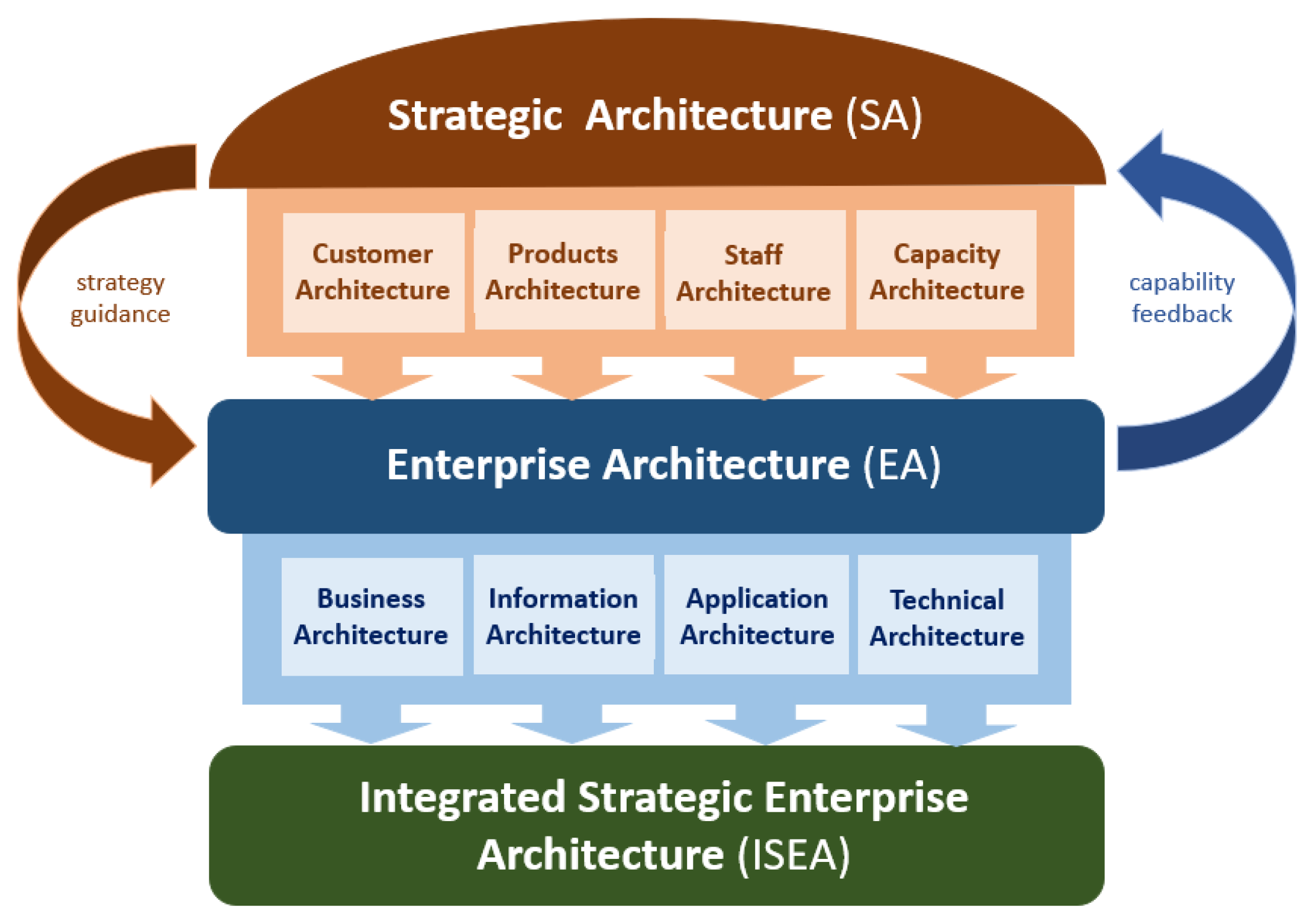
2.3. Strategic Architecture and Enterprise Architecture for Transformation
2.4. Life Cycle Sustainability Assessment (LCSA)
2.5. CRISP-DM Life Cycle Assessment
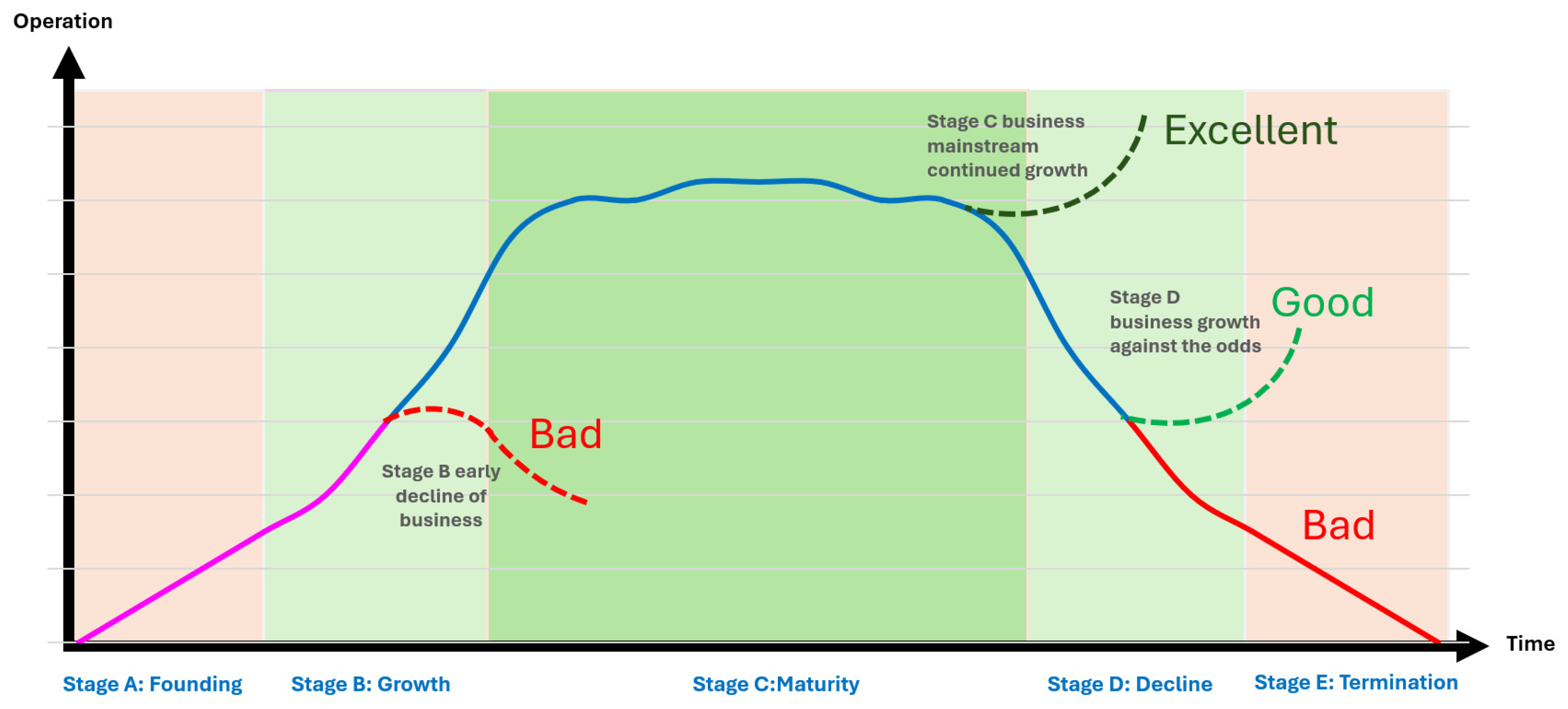
2.6. Dynamic Strategic Management and Business Innovation
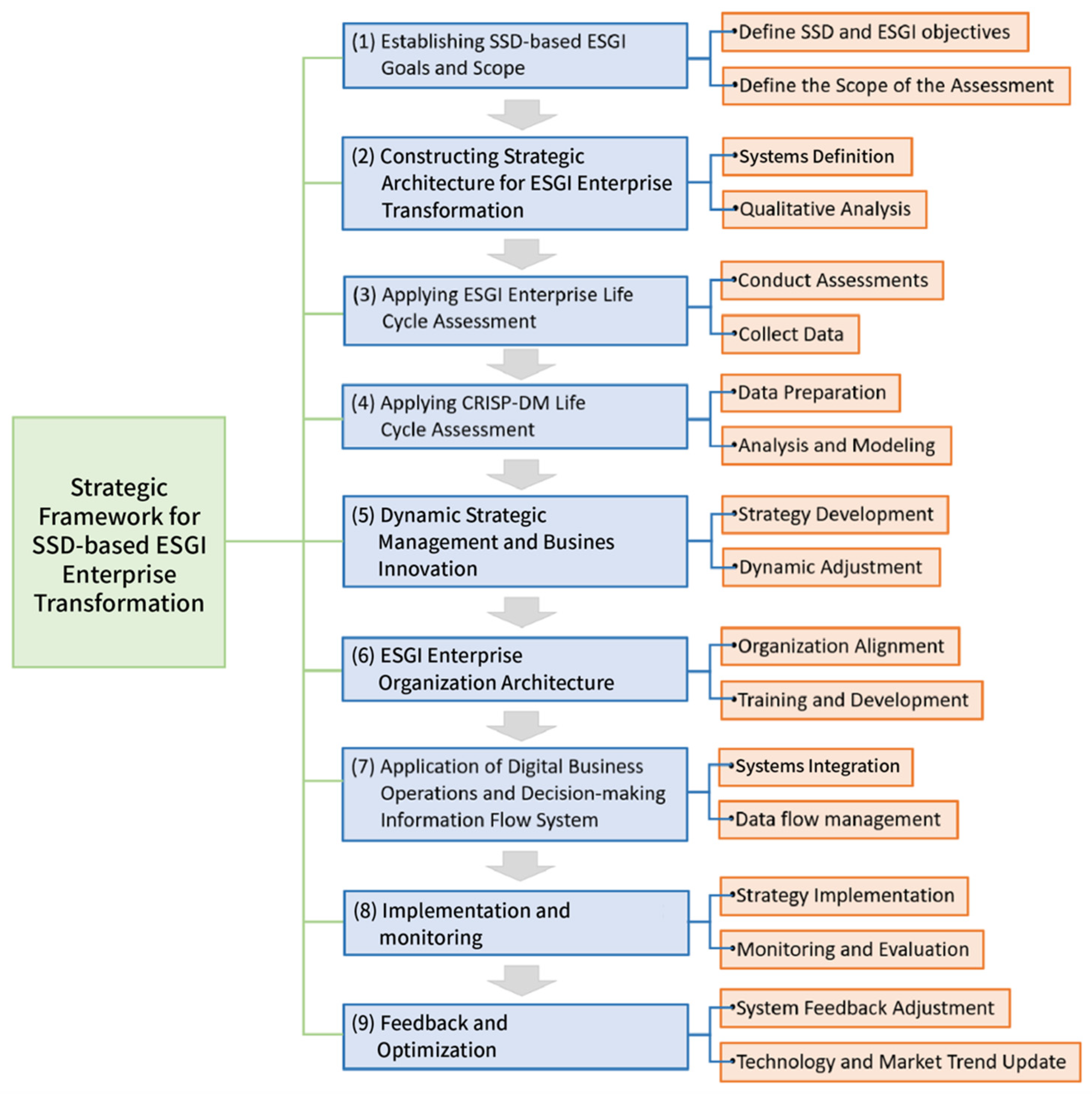
2.7. ESGI Enterprise Transformation Framework
2.8. Digital Business Operations and Decision-Making Information Flow System
3. Research Design
3.1. Research Methods
3.2. Case Selection
3.3. Research Framework
- I.
- Establishing SSD-based ESGI goals and scope
- II.
- Constructing strategic architecture for ESGI enterprise transformation
- III.
- Applying ESGI enterprise life cycle sustainability assessment
- IV.
- Applying cross-industry standard process for data mining
- V.
- Dynamic strategic management and business innovation
- VI.
- ESGI enterprise organization architecture
- VII.
- Application of digital business operations and decision-making information flow system
- VIII.
- Implementation and monitoring of ESGI enterprise transformation
- IX.
- Feedback and optimization of ESGI enterprise transformation
4. Implementation of Strategic Architecture
4.1. Establishing Goals and Scope of ESGI Enterprise Transformation
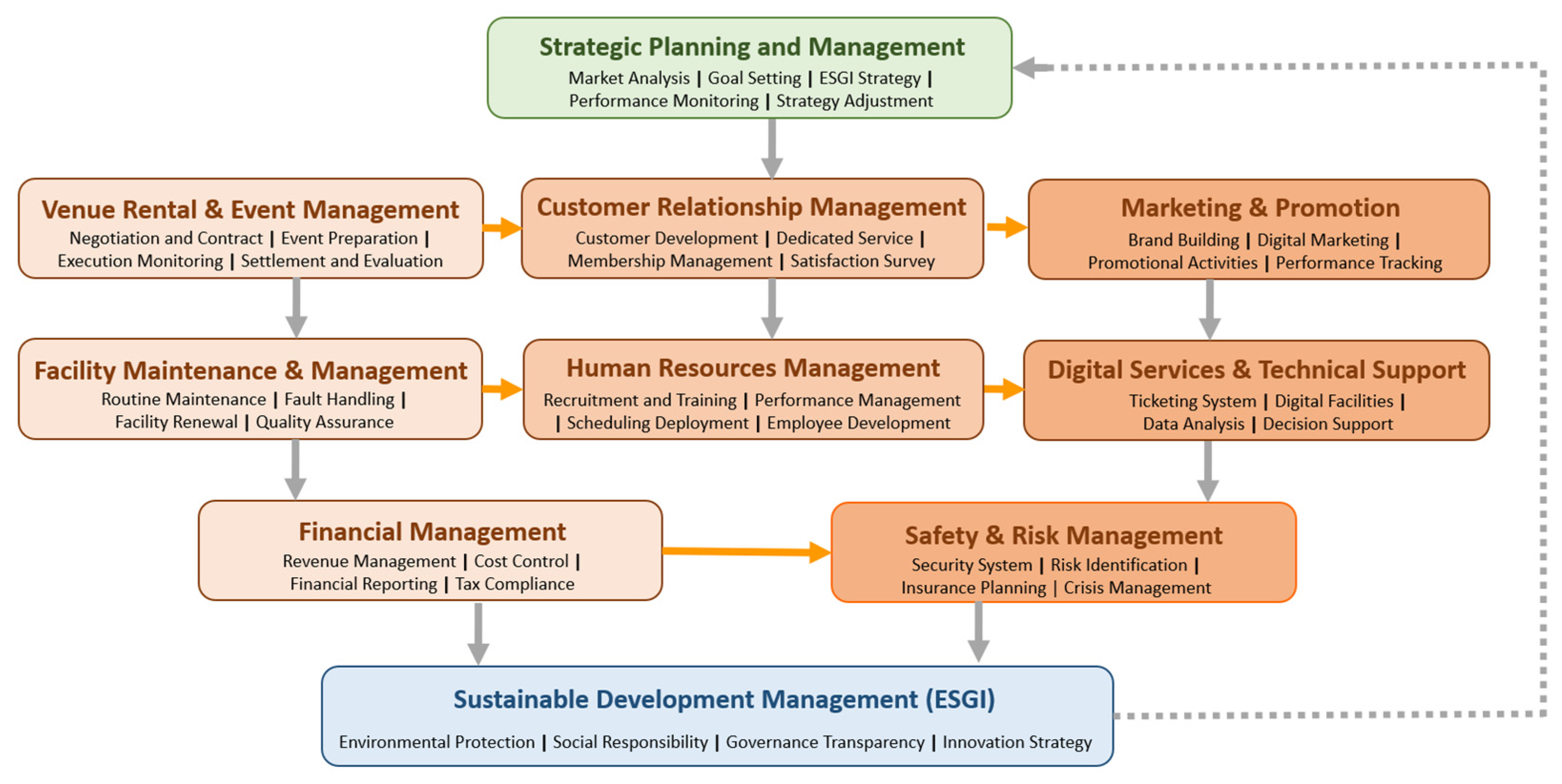
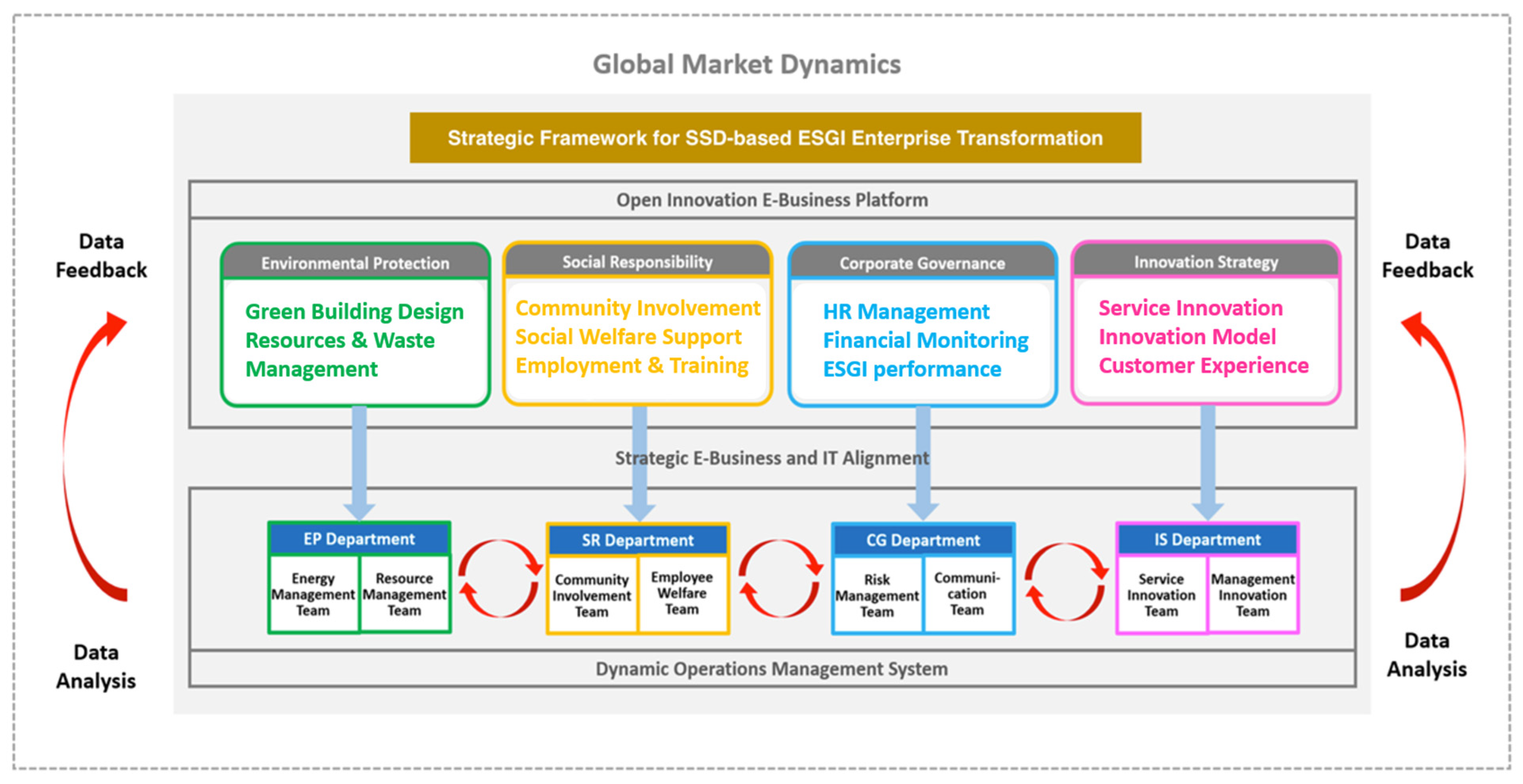
4.2. Constructing Strategic Architecture for Enterprise Transformation
4.3. ESGI Enterprise Life Cycle Sustainability Assessment
4.4. Application of CRISP-DM Life Cycle Assessment
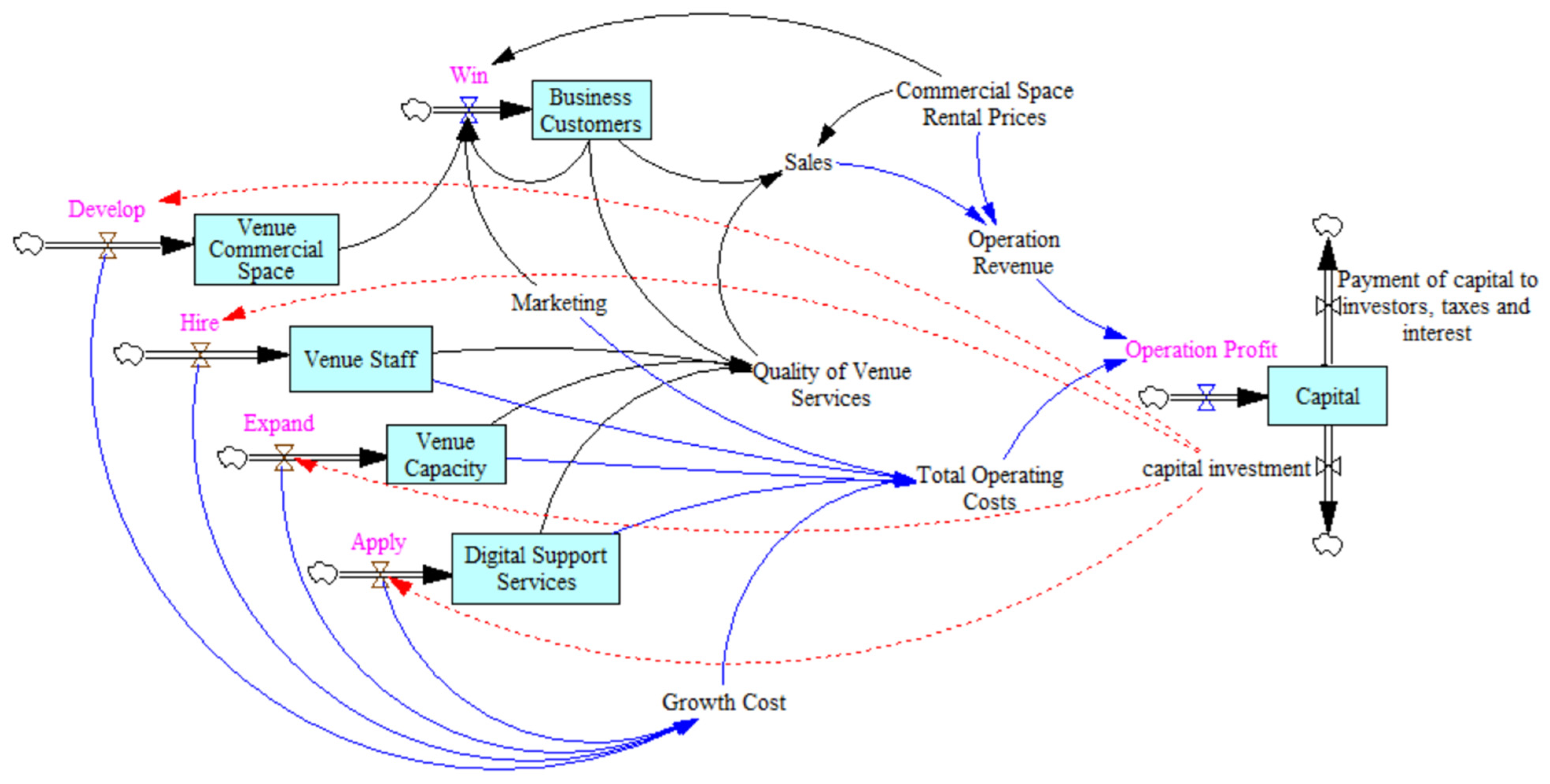
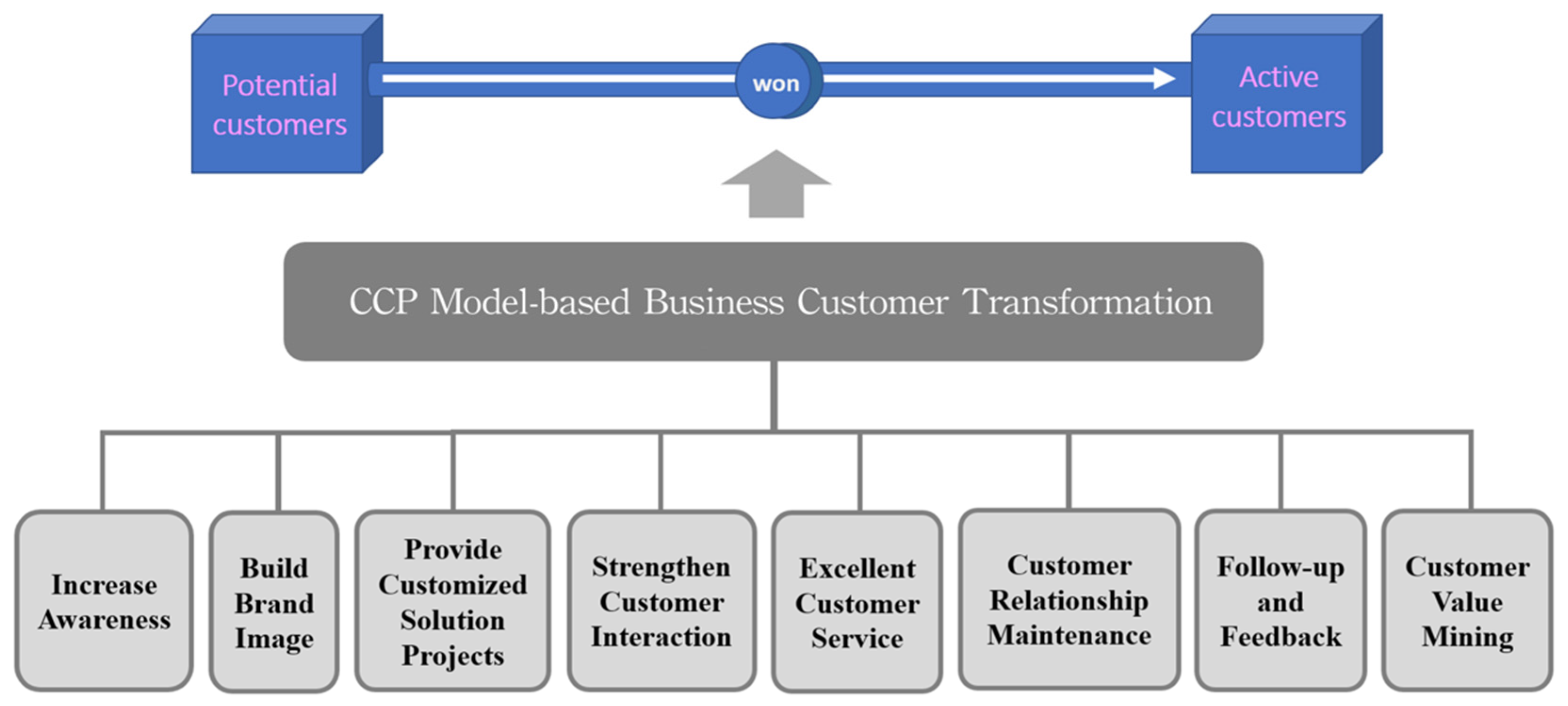
4.5. Dynamic Strategic Management and Business Innovation in Practices
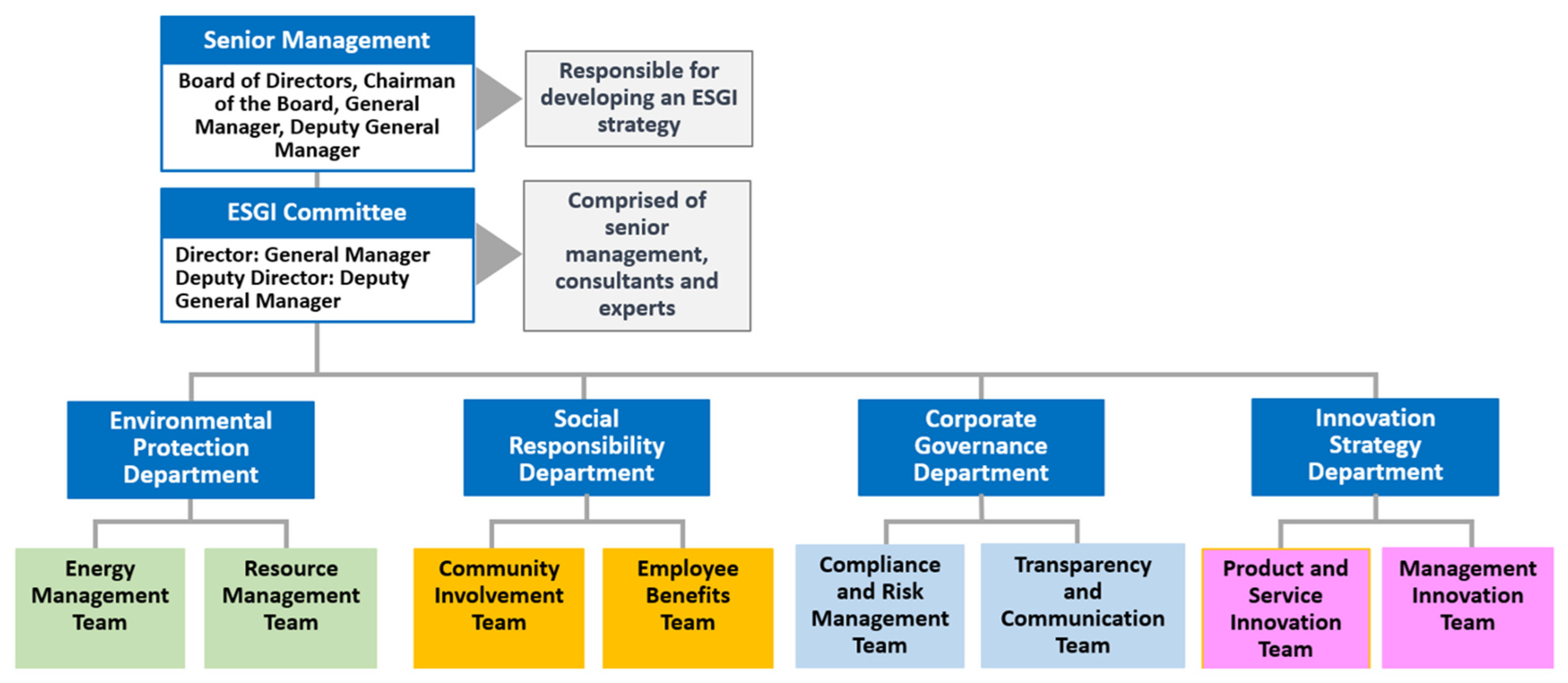
4.6. ESGI Enterprise Organization Architecture
4.7. Application of Digital Business Operations and Decision-Making Information Flow System
4.8. Implementation and Monitoring of ESGI Enterprise Transformation
- (1)
- Strategy implementation:Implement SSD-based ESGI transformation strategies and systems within the venue’s operations, integrate ESGI objectives into daily operations and decision-making processes, and develop specific action plans for each ESGI area, such as energy-saving measures, community involvement programs, governance structure improvements, and the application of innovative technologies. Ensure that the team understands and participates in the ESGI objectives through staff training and incentives, encourage staff to apply these strategies in their daily work, and ensure that sufficient resources (e.g., funding, technology, and human resource) are available to support the implementation of the strategies.
- (2)
- Monitoring and evaluation:Continuously monitor the effectiveness of the implementation through data analysis and numerical results, set key performance indicators (KPIs), and specific performance indicators for each ESGI area, such as reduced carbon emissions, participation in community activities, and specific indicators for governance improvement and innovation strategies. Regularly collect and analyze relevant data, such as energy consumption, employee and customer satisfaction survey results, to assess the effectiveness of the strategy and the progress of its implementation. Based on the monitoring results, make necessary adjustments and improvements to the strategy, to ensure that it continues to move towards the goal.
4.9. Feedback and Optimization of ESGI Enterprise Transformation
- (1)
- System feedback adjustment:Optimization and adjustment based on system feedback. Regularly review the effectiveness of the implementation of each ESGI strategy and make necessary adjustments and improvements using evaluation results and feedback from employees, customers, and communities.
- (2)
- Update of technology and market trends:Adopt the latest sustainable technology and innovative solutions, such as intelligent energy-saving systems and renewable energy utilization. Update strategies to maintain competitiveness in response to market and industry trends, enabling LMPSVs to continuously enhance their sustainability and ensure long-term environmental, social, and economic benefits.By synthesizing and analyzing the above aspects, it is possible to gain in-depth insights that reveal the complexity and dynamics of LMPSVs in the process of implementing the proposed strategic architecture for ESG enterprise transformation. The results of the analysis not only help to understand the actual experiences and challenges of the Kaohsiung Dome during the transformation process, but also provide valuable strategic guidance and practical references for other sports stadiums or similar organizations.
4.10. Integration of Business Processes of LMPSVs with ESGI
5. Performance Evaluation
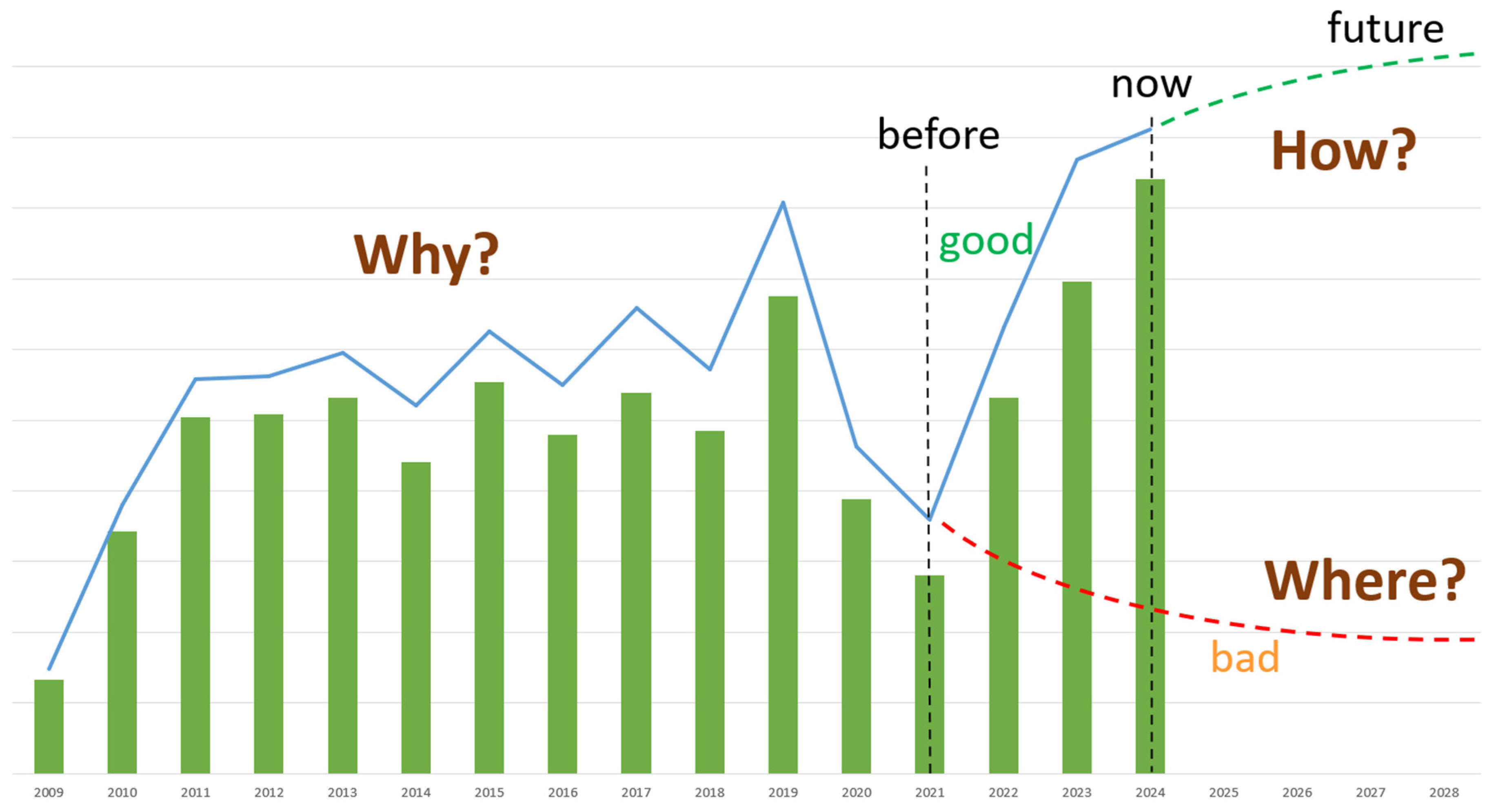
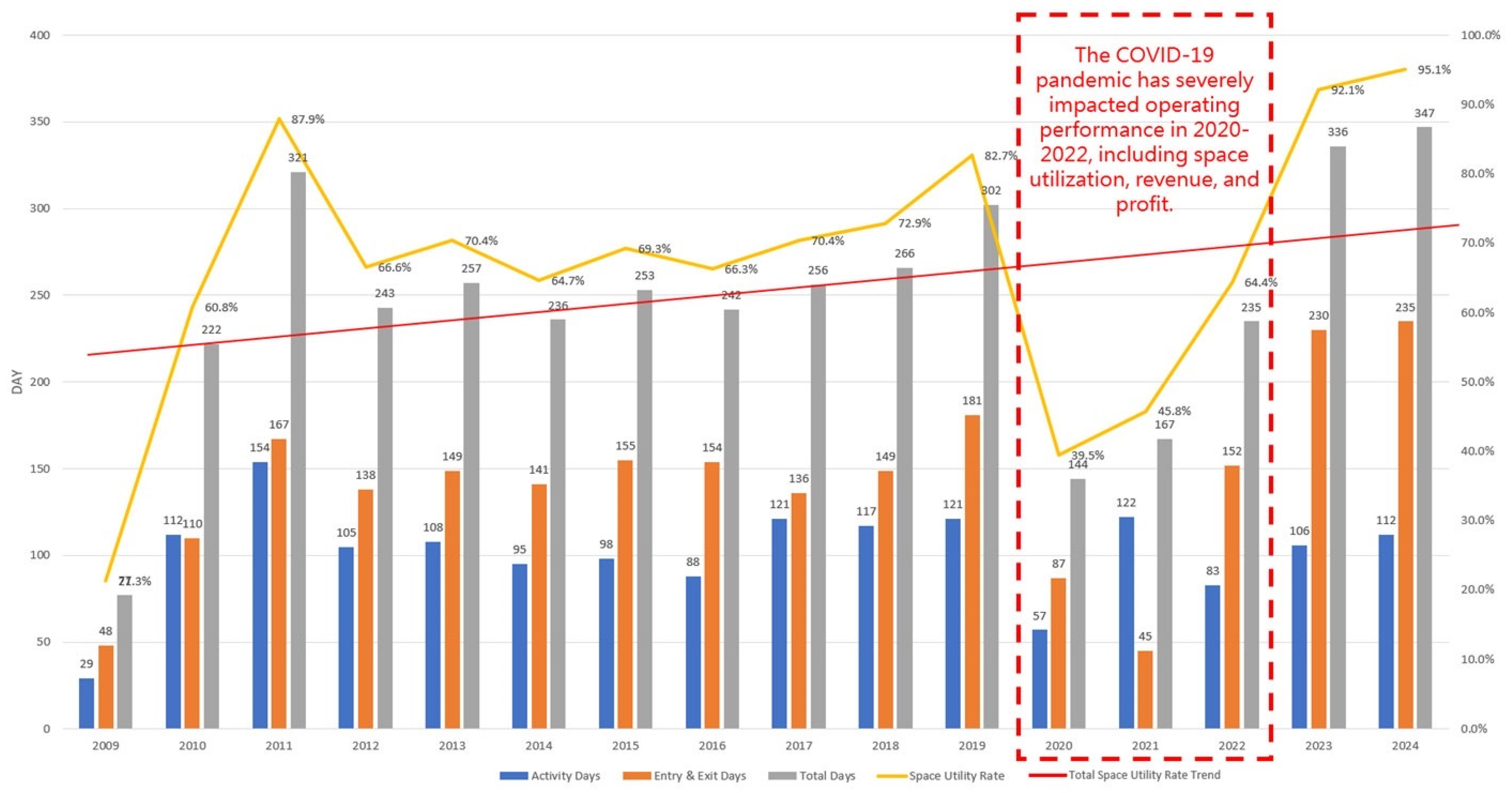
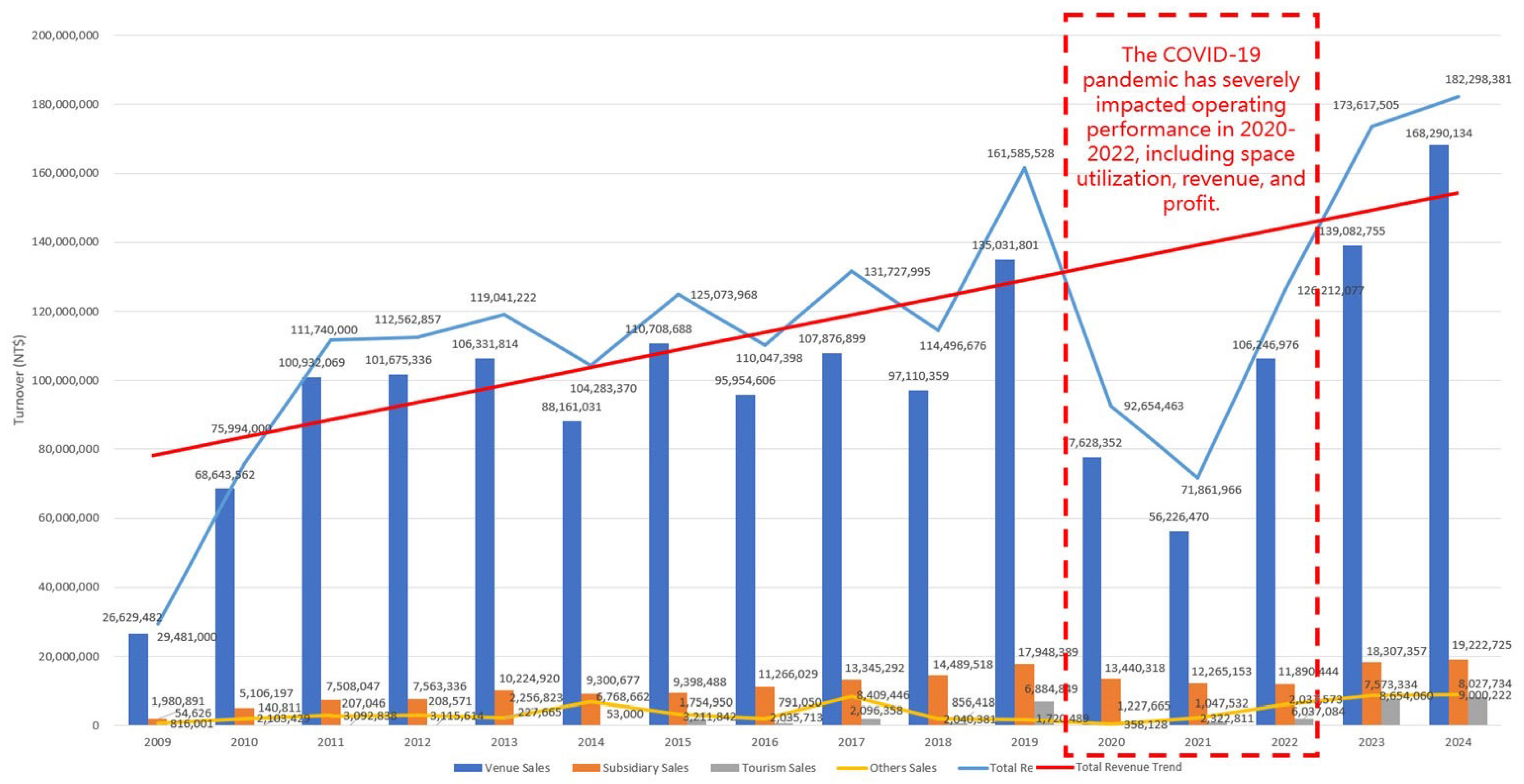
5.1. Kaohsiung Dome Business Performance
5.2. Qualitative Research Methodology of Kaohsiung Dome’s Historical Operational Performance
5.3. A Critical Comparison of the ESG Framework and Traditional Competitive Models for LMPSVs
6. ESG Transformation and Management Implications
7. Conclusions
Author Contributions
Funding
Data Availability Statement
Acknowledgments
Conflicts of Interest
Abbreviations
| ADM | Architecture Development Method |
| BREEAM | Building Research Establishment Environmental Assessment Method |
| CRISP-DM | Cross-Industry Standard Process for Data Mining |
| DFD | Data Flow Diagram |
| DSS | Decision Support System |
| EA | Enterprise Architecture |
| EAM | Enterprise Architecture Management |
| ESGI | Environmental, Social, Governance, Innovation |
| IT | Information Technology |
| KPIs | Key Performance Indicators |
| LCSA | Life Cycle Sustainability Assessment |
| LEED | Leadership in Energy and Environmental Design |
| LMPSVs | Large Multi-Purpose Sports Venues |
| OMS | Operations management system |
| PPP | Public-Private Partnerships |
| SA | Strategic Architecture |
| SD | System Dynamics |
| SDGs | Sustainable Development Goals |
| SSD | Sustainable System Development |
| STAS | Strategic Architecture Development System |
| TOGAF | The Open Group Architecture Framework |
References
- United Nations. Transforming Our World: The 2030 Agenda for Sustainable Development; Department of Economic and Social Affairs, United Nations: New York, NY, USA, 2015; Volume 1, p. 41. [Google Scholar]
- Kellison, T.; Trendafilova, S.; McCullough, B. Considering the social impact of sustainable stadium design. Int. J. Event Manag. Res. 2015, 10, 63–83. [Google Scholar]
- Casper, J.M.; McCullough, B.P.; Pfahl, M.E. Examining environmental fan engagement initiatives through values and norms with intercollegiate sport fans. Sport Manag. Rev. 2020, 23, 348–360. [Google Scholar] [CrossRef]
- Sartore-Baldwin, M.L.; McCullough, B. Equity-based sustainability and ecocentric management: Creating more ecologically just sport organization practices. Sport Manag. Rev. 2018, 21, 391–402. [Google Scholar] [CrossRef]
- Yan, M.J. Handbook of Sustainable System Development for Strategic Management and Business Innovation, 2nd ed.; Vital Wellspring Group: Singapore, 2022; ISBN 978-986-06857-1-8. [Google Scholar]
- Sterman, J. Business Dynamics: Systems Thinking and Modeling for a Complex World; McGraw-Hill Education: Columbus, OH, USA, 2000. [Google Scholar]
- Senge, P. The necessary revolution: How individuals and organisations are working together to create a sustainable world. Manag. Today 2008, 24, 54–57. [Google Scholar]
- Meadows, D.H. Thinking in Systems; Chelsea Green Publishing: White River Junction, VT, USA, 2008. [Google Scholar]
- Swanson, J. Business dynamics—Systems thinking and modeling for a complex world. J. Oper. Res. Soc. 2002, 53, 472–473. [Google Scholar] [CrossRef]
- Hjorth, P.; Bagheri, A. Navigating towards sustainable development: A system dynamics approach. Futures 2006, 38, 74–92. [Google Scholar] [CrossRef]
- Kellert, S.R.; Heerwagen, J.; Mador, M. Biophilic Design: The Theory, Science and Practice of Bringing Buildings to Life; John Wiley & Sons: Hoboken, NJ, USA, 2011. [Google Scholar]
- Agarwal, R.; Chandrasekaran, S.; Sridhar, M. Imagining Construction’s Digital Future; McKinsey & Company: Chicago, IL, USA, 2016; Volume 24, pp. 1–13. [Google Scholar]
- Fried, G.; Kastel, M. Managing Sport Facilities; Human Kinetics: Champaign, IL, USA, 2020. [Google Scholar]
- Arnstein, S.R. A ladder of citizen participation. J. Am. Inst. Plan. 1969, 35, 216–224. [Google Scholar] [CrossRef]
- Hu, K.H.; Chen, F.H.; Tzeng, G.H. Evaluating the improvement of sustainability of sports industry policy based on MADM. Sustainability 2016, 8, 606. [Google Scholar] [CrossRef]
- Cole, R.J. Building environmental assessment methods: Redefining intentions and roles. Build. Res. Inf. 2005, 33, 455–467. [Google Scholar] [CrossRef]
- Morgan, H.; Bush, A.; McGee, D. The contribution of sport to the sustainable development goals: Insights from commonwealth games associations. J. Sport Dev. 2021, 9, 14–29. [Google Scholar]
- Lucas, S.; Pinheiro, M.D.; de la Cruz Del Río-Rama, M. Sustainability Performance in Sport Facilities Management. In Sports Management as an Emerging Economic Activity: Trends and Best Practices; Springer Nature: Cham, Switzerland, 2017; pp. 113–138. [Google Scholar]
- Kuzmina, J.; Lindemane, M. ESG Investing: New challenges and new opportunities. J. Bus. Manag. 2017, 14, 85–98. [Google Scholar]
- Glibo, I.; Misener, L.; Koenigstorfer, J. Strategic sustainable development in international sport organisations: A Delphi study. Sustainability 2022, 14, 9874. [Google Scholar] [CrossRef]
- Hamel, G.; Prahalad, C.K. The core competence of the corporation. Harv. Bus. Rev. 1990, 68, 79–91. [Google Scholar]
- Kiernan, M.J. The new strategic architecture: Learning to compete in the twenty-first century. Acad. Manag. Perspect. 1993, 7, 7–21. [Google Scholar] [CrossRef]
- Sterman, J.D. Interactive web-based simulations for strategy and sustainability: The MIT Sloan learningedge management flight simulators, Part I. Syst. Dyn. Rev. 2014, 30, 89–121. [Google Scholar] [CrossRef]
- Yan, M.R. Project-based competition and policy implications for sustainable developments in building and construction sectors. Sustainability 2015, 7, 15423–15448. [Google Scholar] [CrossRef]
- Yan, M.R. Improving entrepreneurial knowledge and business innovations by simulation-based strategic decision support system. Knowl. Manag. Res. Pract. 2018, 16, 173–182. [Google Scholar] [CrossRef]
- Yan, M.R.; Tran-Danh, N.; Hong, L.Y. Knowledge-based decision support system for improving e-business innovations and dynamic capability of IT project management. Knowl. Manag. Res. Pract. 2019, 17, 125–136. [Google Scholar] [CrossRef]
- Saha, P. Enterprise Architecture for Connected E-Government: Practices and Innovations; Information Science Reference: Hershey, PA, USA, 2012. [Google Scholar]
- Malyzhenkov, P.; Ivanova, M. An Enterprise Architecture-Based Approach to the IT-Business Alignment: An Integration of SAM and TOGAF Framework. In Workshop on Enterprise and Organizational Modeling and Simulation; Springer Nature: Cham, Switzerland, 2017; pp. 159–173. [Google Scholar]
- The Open Group. TOGAF® Standard, version 9.2; Van Haren Publishing: Hertogenbosch, The Netherlands, 2018. Available online: https://www.opengroup.org/togaf (accessed on 1 December 2025).
- Kotter, J.P. Leading change: Why transformation efforts fail. In Museum Management and Marketing; Routledge: Abingdon, UK, 2007; pp. 20–29. [Google Scholar]
- Müller, A.L.; Pfleger, R. Business transformation towards sustainability. Bus. Res. 2014, 7, 313–350. [Google Scholar] [CrossRef]
- ISO 14040; Environmental Management-Life Cycle Assessment-Principles and Framework. International Standard Organization: Vernier, Switzerland, 1997.
- Vandenbroucke, M.; Galle, W.; De Temmerman, N.; Debacker, W.; Paduart, A. Using life cycle assessment to inform decision-making for sustainable buildings. Buildings 2015, 5, 536–559. [Google Scholar] [CrossRef]
- Francis, A.E.; Webb, M.; Desha, C.; Rundle-Thiele, S.; Caldera, S. Environmental sustainability in stadium design and construction: A systematic literature review. Sustainability 2023, 15, 6896. [Google Scholar] [CrossRef]
- Russell-Smith, S.V.; Lepech, M.D. Cradle-to-gate sustainable target value design: Integrating life cycle assessment and construction management for buildings. J. Clean. Prod. 2015, 100, 107–115. [Google Scholar] [CrossRef]
- Tang, S.; Fan, Z.; Zong, X.; Zhang, D.; Liu, M. A Sustainability Evaluation Approach for the Operation Cycle of Stadiums by Integrating Multidimensional Data. 2022. Available online: http://ssrn.com/abstract=4172103 (accessed on 1 December 2025).
- Chapman, P.; Clinton, J.; Kerber, R.; Khabaza, T.; Reinartz, T.; Shearer, C.; Wirth, R. CRISP-DM 1.0: Step-by-Step Data Mining Guide; SPSS Inc: Chicago, IL, USA, 2000; p. 10. [Google Scholar]
- Garcia de Baquedano, G. Data-Driven Decisions in Sports. Master’s Thesis, Luleå University of Technology, Luleå, Sweden, 2023. [Google Scholar]
- Shi, H. Application of artificial intelligence technology in the information management of sports venues. Rev. Ibérica Sist. E Tecnol. Inf. 2015, 16, 150. [Google Scholar]
- Yan, H.; Yan, M.R.; Zhang, Y.; Cong, Z.; Li, J.; Lin, Z. Managing knowledge of dynamic capability for business excellence: A transformative systems approach. Knowl. Manag. Res. Pract. 2025, 1–15. [Google Scholar] [CrossRef]
- Doppelt, B. Leading Change Toward Sustainability: A Change-Management Guide for Business, Government and Civil Society; Routledge: Abingdon, UK, 2017. [Google Scholar]
- Westerman, G.; Bonnet, D.; McAfee, A. Leading Digital: Turning Technology into Business Transformation; Harvard Business Press: Brighton, MA, USA, 2014. [Google Scholar]
- Aldoseri, A.; Al-Khalifa, K.N.; Hamouda, A.M. AI-Powered Innovation in Digital Transformation: Key Pillars and Industry Impact. Sustainability 2024, 16, 1790. [Google Scholar] [CrossRef]
- Ducange, P.; Fazzolari, M.; Petrocchi, M.; Vecchio, M. An effective Decision Support System for social media listening based on cross-source sentiment analysis models. Eng. Appl. Artif. Intell. 2019, 78, 71–85. [Google Scholar] [CrossRef]
- Yin, R.K. Qualitative Research from Start to Finish; Guilford Publications: New York, NY, USA, 2015. [Google Scholar]
- Eisenhardt, K.M.; Graebner, M.E. Theory building from cases: Opportunities and challenges. Acad. Manag. J. 2007, 50, 25–32. [Google Scholar] [CrossRef]
- Edmondson, A.C.; McManus, S.E. Methodological fit in management field research. Acad. Manag. Rev. 2007, 32, 1246–1264. [Google Scholar] [CrossRef]
- Kvale, S.; Brinkmann, S. Interviews: Learning the Craft of Qualitative Research Interviewing; Sage Publications: London, UK, 2009. [Google Scholar]
- DeWalt, K.M.; DeWalt, B.R. Participant Observer: A Guide for Fieldworkers; Rowman Altamira: Lanham, MD, USA, 2011. [Google Scholar]
- Bowen, G.A. Document analysis as a qualitative research method. Qual. Res. J. 2009, 9, 27–40. [Google Scholar] [CrossRef]
- Patton, M.Q. Qualitative Research Evaluation Methods: Integrating Theory and Practice; Sage Publications: London, UK, 2014. [Google Scholar]
- Li, T.T.; Wang, K.; Sueyoshi, T.; Wang, D.D. ESG: Research progress and future prospects. Sustainability 2021, 13, 11663. [Google Scholar] [CrossRef]
- Korhonen, J.J.; Molnar, W.A. Enterprise architecture as capability: Strategic application of competencies to govern enterprise transformation. In Proceedings of the 2014 IEEE 16th Conference on Business Informatics, Geneva, Switzerland, 14–17 July 2014; Volume 1, pp. 175–182. [Google Scholar]
- Simon, D.; Fischbach, K.; Schoder, D. An exploration of enterprise architecture research. Commun. Assoc. Inf. Syst. 2013, 32, 1. [Google Scholar] [CrossRef]
- Hendrickx, H.H. Business architect: A critical role in enterprise transformation. J. Enterp. Transform. 2015, 5, 1–29. [Google Scholar] [CrossRef]
- Kitsios, F.; Kamariotou, M. Business strategy modelling based on enterprise architecture: A state of the art review. Bus. Process Manag. J. 2019, 25, 606–624. [Google Scholar] [CrossRef]
- Yan, M.R.; Hong, L.Y.; Warren, K. Integrated knowledge visualization and the enterprise digital twin system for supporting strategic management decision. Manag. Decis. 2022, 60, 1095–1115. [Google Scholar] [CrossRef]
- Yan, M.R.; Yan, H.; Han, F.M.; Zhang, Y.; Yan, X. Evaluation of Digital Transformation Strategies Through Dynamic Business Modeling and Scenario Analysis. Eval. Rev. 2025; early view. [Google Scholar]
- Jiang, L.; Gu, Y.; Yu, W.; Dai, J. Blockchain-Based Life Cycle Assessment System for ESG Reporting. 2022. Available online: http://ssrn.com/abstract=4121907 (accessed on 1 December 2025).
- Kalbar, P.P.; Das, D. Advancing life cycle sustainability assessment using multiple criteria decision making. In Life Cycle Sustainability Assessment for Decision-Making; Elsevier: Amsterdam, The Netherlands, 2020; pp. 205–224. [Google Scholar]
- Koplyay, T.; Chillingworth, L.; Mitchell, B. Corporate lifecycles: Modelling the dynamics of innovation and its support infrastructure. Technol. Innov. Manag. Rev. 2013, 3, 22–29. [Google Scholar] [CrossRef][Green Version]
- Zanni, S.; Awere, E.; Bonoli, A. Life cycle sustainability assessment: An ongoing journey. Life Cycle Sustain. Assess. Decis.-Mak. 2020, 57–93. [Google Scholar][Green Version]
- Wirth, R.; Hipp, J. CRISP-DM: Towards a standard process model for data mining. In Proceedings of the 4th International Conference on the Practical Application of Knowledge Discovery and Data Mining, Manchester, UK, 11–13 April 2000; Volume 1, pp. 29–39. [Google Scholar][Green Version]
- Warren, K. The dynamics of strategy. Bus. Strategy Rev. 1999, 10, 1–16. [Google Scholar] [CrossRef]
- Gutterman, A.S. Managing Sustainability; Routledge: Abingdon, UK, 2020. [Google Scholar]
- Bocken, N.M.; Geradts, T.H. Barriers and drivers to sustainable business model innovation: Organization design and dynamic capabilities. Long Range Plan. 2020, 53, 101950. [Google Scholar] [CrossRef]
- Warren, K. Strategic Management Dynamics; John Wiley & Sons: Hoboken, NJ, USA, 2008. [Google Scholar]
- Bharadwaj, A.; El Sawy, O.A.; Pavlou, P.A.; Venkatraman, N.V. Digital business strategy: Toward a next generation of insights. MIS Q. 2013, 37, 471–482. [Google Scholar] [CrossRef]
- Yan, M.R.; Hong, L.Y.; Hu, R.R. Benchmarking knowledge management practices and digital empowerment for business excellence in Asia. Knowl. Manag. Res. Pract. 2025, 1–15. [Google Scholar] [CrossRef]
- Yan, M.R.; Shajek, A.; Hartmann, E.A. Digital Work in East Asia. In New Digital Work: Digital Sovereignty at the Workplace; Springer Nature: Cham, Switzerland, 2023; pp. 171–194. [Google Scholar]
- Kurniawan, N.B. Enterprise Architecture design for ensuring strategic business IT alignment (integrating SAMM with TOGAF 9.1). In Proceedings of the 2013 Joint International Conference on Rural Information & Communication Technology and Electric-Vehicle Technology (rICT & ICeV-T), Bandung, Indonesia, 26–28 November 2013; pp. 1–7. [Google Scholar]
- Santarsiero, F. Developing a strategic planning model for developing, monitoring and evaluating digital transformation initiatives: A soft system approach. Meas. Bus. Excell. 2023, 27, 449–459. [Google Scholar] [CrossRef]
- de Oliveira, C.S.; Sanin, C.; Szczerbicki, E. Human Feedback and Knowledge Discovery: Towards Cognitive Systems Optimization. Procedia Comput. Sci. 2020, 176, 3093–3102. [Google Scholar] [CrossRef]
- Madsen, H.L.; Ulhøi, J.P. Sustainable visioning: Re-framing strategic vision to enable a sustainable corporate transformation. J. Clean. Prod. 2021, 288, 125602. [Google Scholar] [CrossRef]
- Kuenkel, P.; Kuenkel, P. Stewarding Sustainability Transformations in Multi-Stakeholder Collaboration: An Emerging Theory and Practice of SDG Implementation; Springer: Berlin/Heidelberg, Germany, 2019; pp. 141–205. [Google Scholar]
- McCullough, B.P.; Orr, M.; Watanabe, N.M. Measuring externalities: The imperative next step to sustainability assessment in sport. J. Sport Manag. 2019, 34, 393–402. [Google Scholar] [CrossRef]
- Cornelissen, S.; Bob, U.; Swart, K. Towards redefining the concept of legacy in relation to sport mega-events: Insights from the 2010 FIFA World Cup. Dev. South. Afr. 2011, 28, 307–318. [Google Scholar] [CrossRef]






| Research Methods | Focus Contents | Main Results |
|---|---|---|
| In-depth interviews | Interviews with venue managers, staff and stakeholders to understand their views, experiences and suggestions on the sustainable transformation of venues. | Identify the key drivers, challenges and opportunities in LMPSV transformation process, as well as the expectations and needs of different stakeholders. |
| Participant observations | The researcher is personally involved in the day-to-day operations and management activities of the venue, observing the organizational culture, workflow and decision-making process. | An in-depth understanding of how LMPSVs operate, their internal dynamics and potential barriers to transformation provides real-world contextual insights for the construction of the framework. |
| Project reports | Analyze the venue’s existing sustainability plan and project reports to assess their fitness with ESGI goals and effectiveness of implementation. | Identify existing practices and room for improvement in the environmental, social, governance and innovation aspects of LMPSVs to inform the design of the elements of the framework. |
| Meeting notes | Analyze the minutes of venue management and staff meetings to capture their discussions and decision-making processes on transformation issues. | Understand the LMPSVs’ internal perceptions, attitudes, and decision-making logic towards transformation, and identify potential resistance and facilitators. |
| Business operation data | To collect and analyze the financial, patronage, energy consumption and other business operation data of the venues to assess their sustainable performance and transformation needs. | Identify bottlenecks and room for optimization in the sustainable development of LMPSV operations, providing a quantitative basis for the design of the elements of the framework and performance evaluation. |
| User feedback documents | Analyze feedback and satisfaction survey data from venue users to understand their evaluations and expectations of the venue’s sustainable practices. | Identify the sustainability performance and needs of LMPSVs in the eyes of the users and provide a user-centered perspective for the design of the elements of the framework. |
Disclaimer/Publisher’s Note: The statements, opinions and data contained in all publications are solely those of the individual author(s) and contributor(s) and not of MDPI and/or the editor(s). MDPI and/or the editor(s) disclaim responsibility for any injury to people or property resulting from any ideas, methods, instructions or products referred to in the content. |
© 2025 by the authors. Licensee MDPI, Basel, Switzerland. This article is an open access article distributed under the terms and conditions of the Creative Commons Attribution (CC BY) license (https://creativecommons.org/licenses/by/4.0/).
Share and Cite
Yan, M.-R.; Chou, C.-H.; Chi, H.-L. Strategic Architecture of Sustainable System Development for ESG Transformation in Large Multi-Purpose Sports Venues. Systems 2025, 13, 1108. https://doi.org/10.3390/systems13121108
Yan M-R, Chou C-H, Chi H-L. Strategic Architecture of Sustainable System Development for ESG Transformation in Large Multi-Purpose Sports Venues. Systems. 2025; 13(12):1108. https://doi.org/10.3390/systems13121108
Chicago/Turabian StyleYan, Min-Ren, Chien-Heng Chou, and Hui-Lan Chi. 2025. "Strategic Architecture of Sustainable System Development for ESG Transformation in Large Multi-Purpose Sports Venues" Systems 13, no. 12: 1108. https://doi.org/10.3390/systems13121108
APA StyleYan, M.-R., Chou, C.-H., & Chi, H.-L. (2025). Strategic Architecture of Sustainable System Development for ESG Transformation in Large Multi-Purpose Sports Venues. Systems, 13(12), 1108. https://doi.org/10.3390/systems13121108