


Empowering Service Designers with Integrated Modelling Tools: A Model-Driven Approach †

 ,
,  ,
,  , and
, and
Abstract
1. Introduction
2. Related Works
2.1. Existing Technological Support
2.2. Correspondences Between Modelling Notations
3. Method
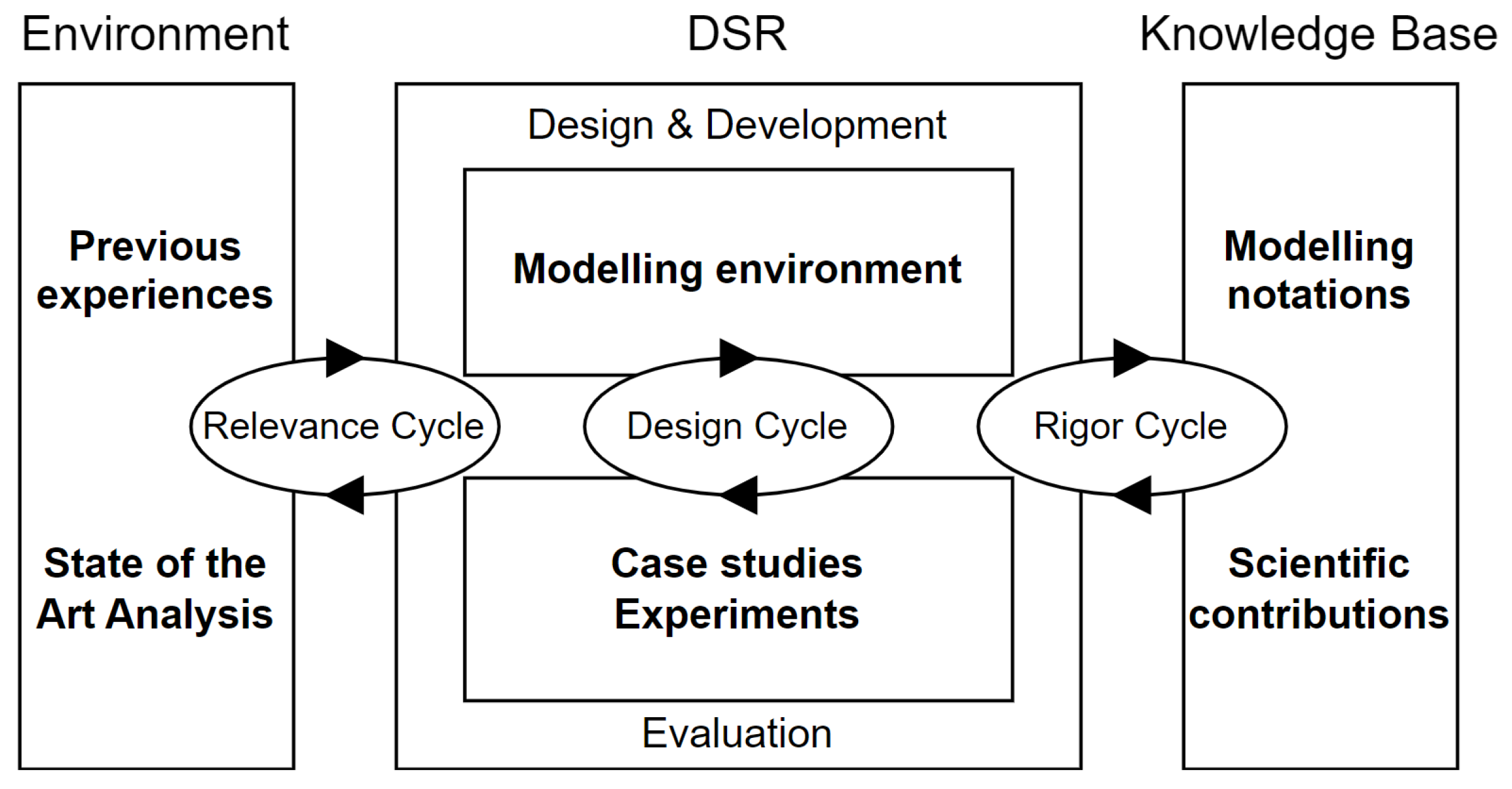
- RQ: To what extent can a modelling environment that integrates multiple business and process modelling notations benefit service designers?
4. Technological Proposal
4.1. Supported Notations
4.2. Correspondence Analysis
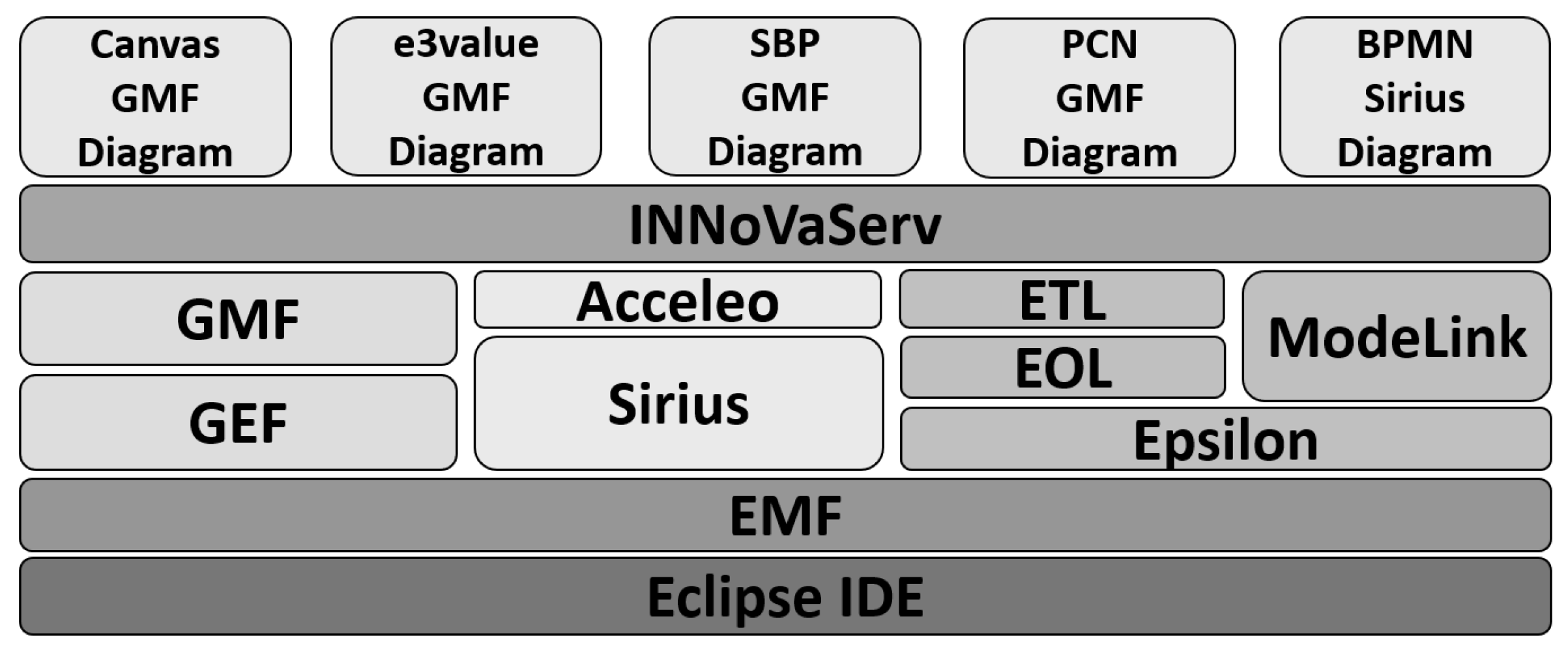
4.3. Architecture of the Solution
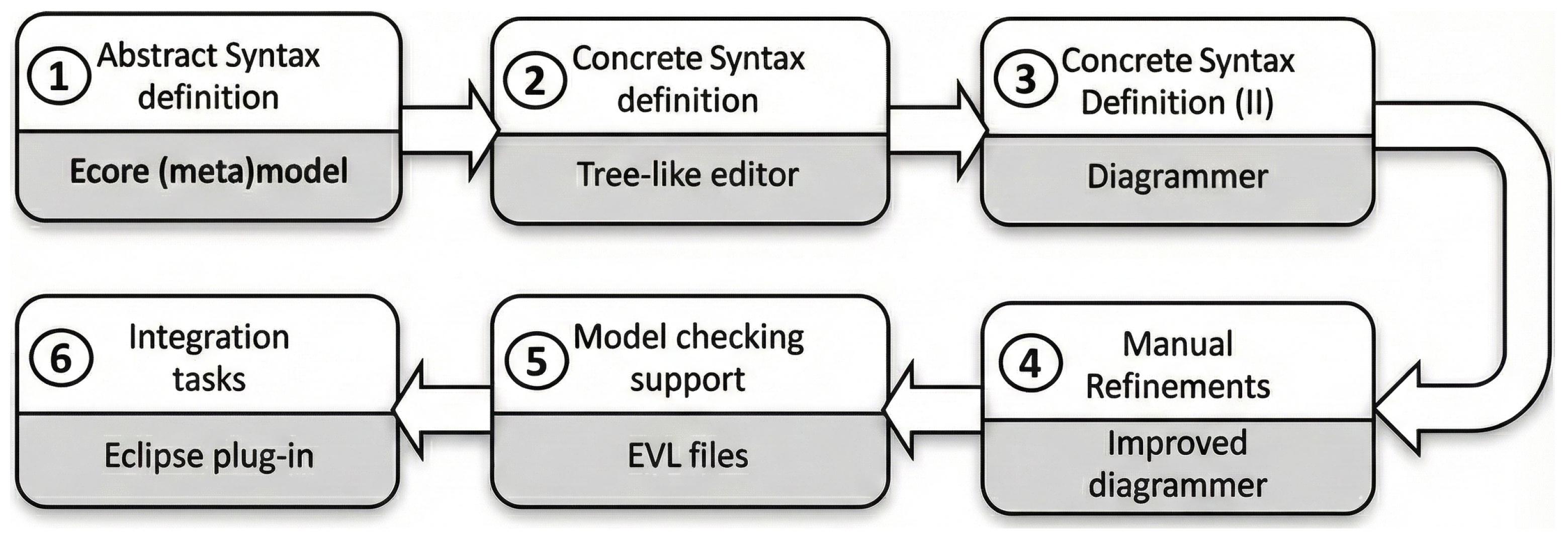
4.4. Development of DSLs
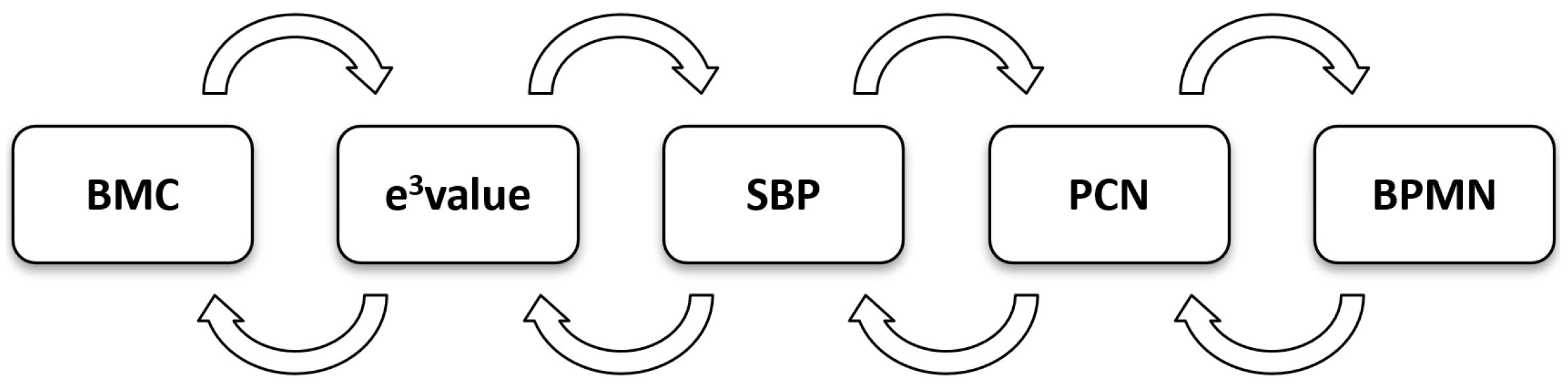
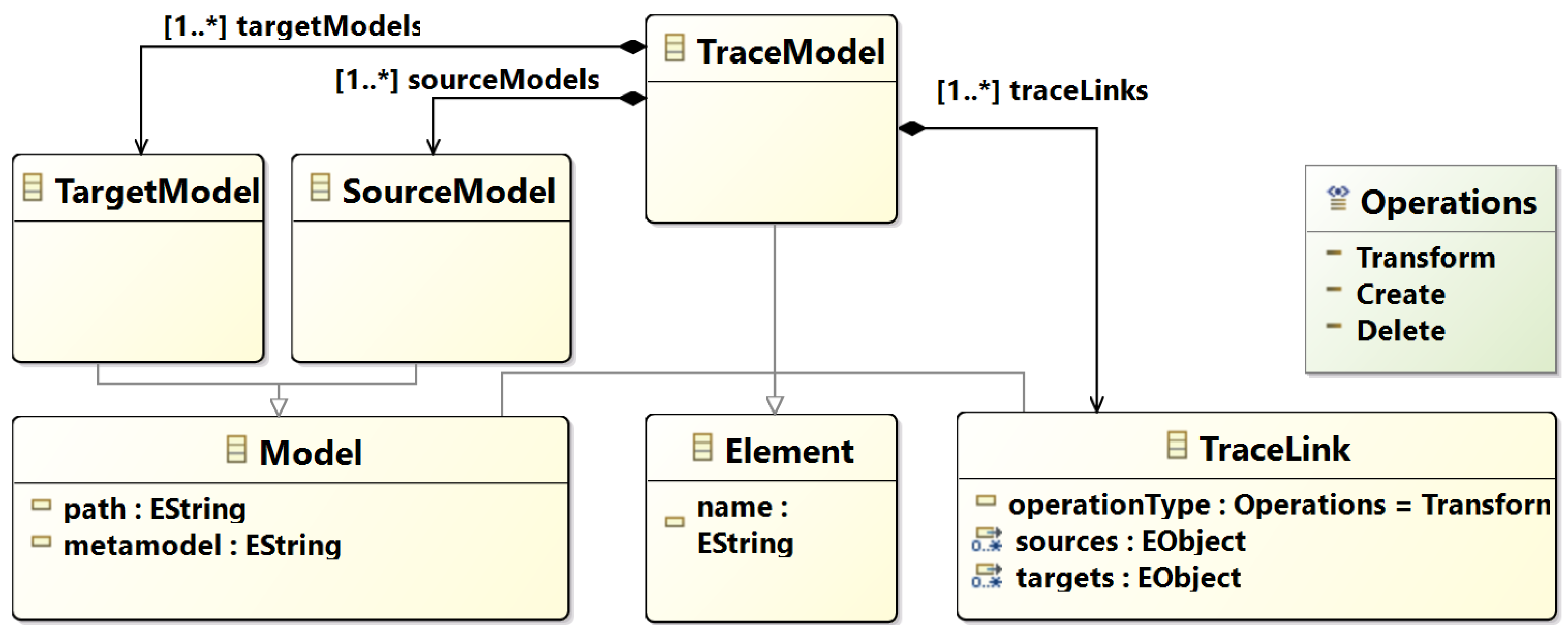
4.5. Bridging the Notations
4.6. Formal Validation of Models
5. Evaluation of the Proposal
5.1. Case Study
- CSQ-1: Was it easy and intuitive to work with all notations supported by INNoVaServ?
- CSQ-2: To what extent do the transformations supported by INNoVaServ reduce the effort required for service design?
- CSQ-3: How close to reality are the models resulting from each transformation supported by INNoVaServ?
- CSQ-4: Is the integration of graphical editors produced by different tools (GMF, Sirius) transparent?
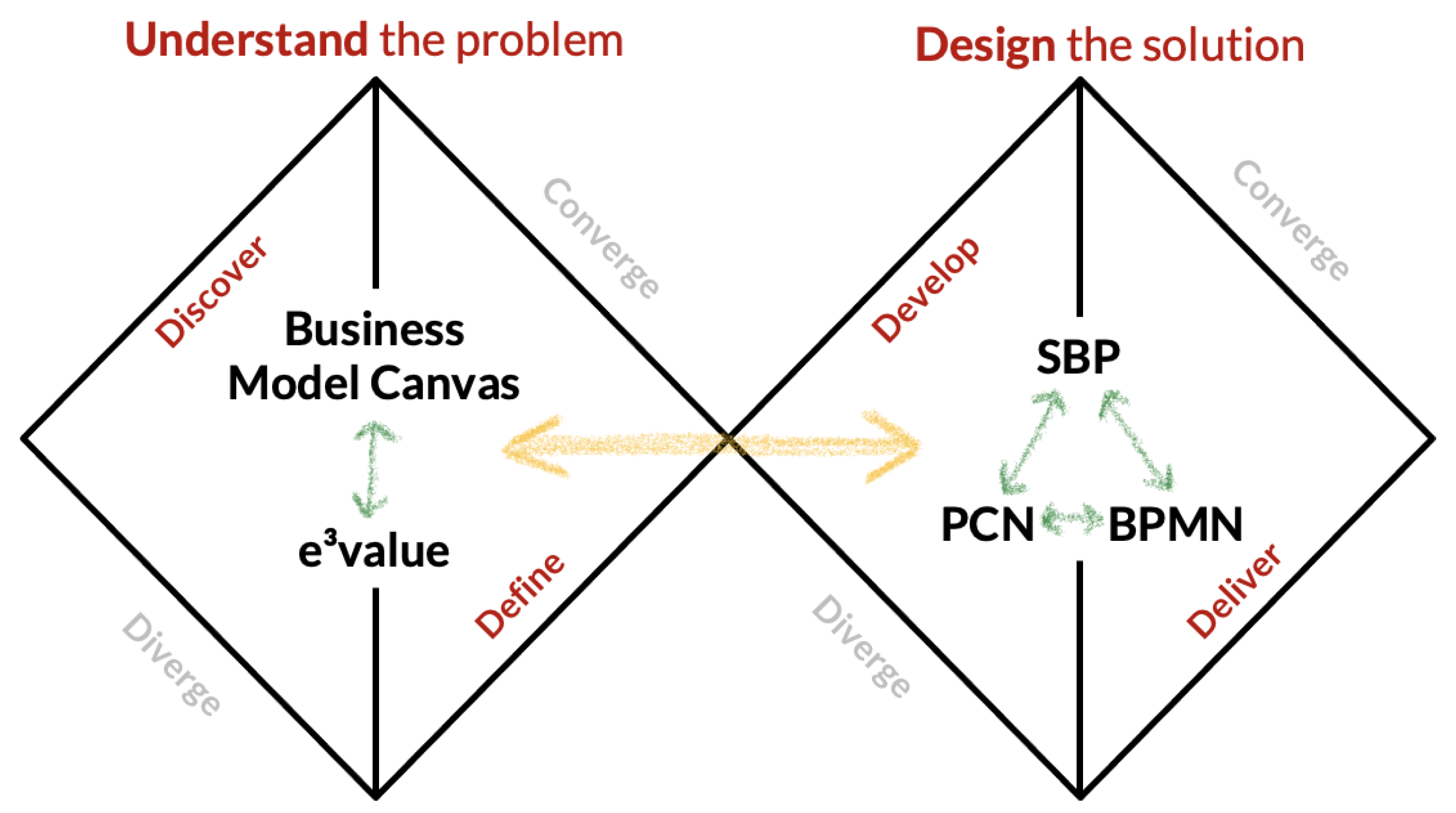
- CSQ-5: Is it possible to implement the double diamond model with INNoVaServ?
- Direct observation of the execution of the case study.
- Models built manually during the development of the service.
- Models generated automatically during the development of the service.
- Trace models generated by the transformations.
5.2. Empirical Study
5.3. Validation Findings
- Given that the validated artefact is a prototype for research tasks, its usability was identified as one of the points for improvement. These problems stem from two main sources. On the one hand, there is inherent complexity in certain modelling notations. Diagrammers for notations with fewer elements, such as BMC, are therefore more usable than those with a large number of elements (see BPMN). The results of both the case study (CSQ-1) and the empirical study (post-questionnaire, question 1) indicate this. Therefore, it is necessary to improve the usability of diagrammers for more complex notations. On the other hand, it was observed that the problem also stems from the complexity of using Eclipse. For this reason, work is already underway on the possibility of transferring the artefact to a web environment, which, in addition to reducing the complexity of use, would allow it to be used from any type of device and make it easier to support collaborative working capabilities. This is a functionality that participants in the empirical study identified as essential in the context of service design, which INNoVaServ does not currently support. Note that this need for collaborative capabilities in modelling environments is consistent with recent research that highlights the growing importance of co-creation and distributed teamwork in model-driven service design platforms [67]. Finally, in order to improve the overall usability of the tool, it would be necessary to standardize the processes for creating new models and diagrams, regardless of the tool used to develop the diagrammer.
- It has been demonstrated that automatic transformations result in considerable time savings when developing each model. However, the amount of time saved varies depending on the transformation involved, ranging from 9.73% to 36.40%. An initial analysis of these differences suggests that this is because some transformations require more user interaction than others. For instance, the transition from PCN to BPMN requires minimal user interaction, yielding significant savings compared to the transition from value to BMC, where every step of the transformation necessitates user interaction. However, analysis of the validation process results reveals two other causes of this discrepancy. On the one hand, during the empirical study, some participants expressed concern that, in certain cases, it is necessary to understand the underlying relationship analysis in order to correctly complete the dialogue boxes that appear during certain transformations, which slows down the transformation process. In this respect, the possibility of including explanatory comments or visual guides in the dialogue boxes with which the user interacts when performing these transformations is being considered. On the other hand, more complex notations, such as BPMN, require a more elaborate graphic layout. Current transformations are unable to achieve this. Consequently, users often have to correct the layout manually, which lengthens the transformation process. Optimising the graphical layout of the generated models is therefore necessary.
- Regarding the completeness of the resulting models from executing the various transformations, there is again a wide range of percentages, from 36.76% in the worst case to 97.71% in the best case. Firstly, it is important to note that the completeness of the output model of a transformation depends on the completeness of the input model. In this sense, the more comprehensive the input model, the more comprehensive the output model can be. Another related factor to consider is the information that the input model can potentially collect compared to the information that the output model can collect. For example, when moving from a BPMN model to a PCN model, a large amount of the information required by the PCN model is already contained in the BPMN model, as both notations have a similar syntax. However, when we move from an SBP model to a PCN model, the SBP is not able to collect all the information needed by the PCN, since the former has a poorer syntax than the latter. In conclusion, when moving from a notation with poorer syntax than the target notation, the percentage of completeness is lower than when the source notation has equal or greater complexity than the target notation.
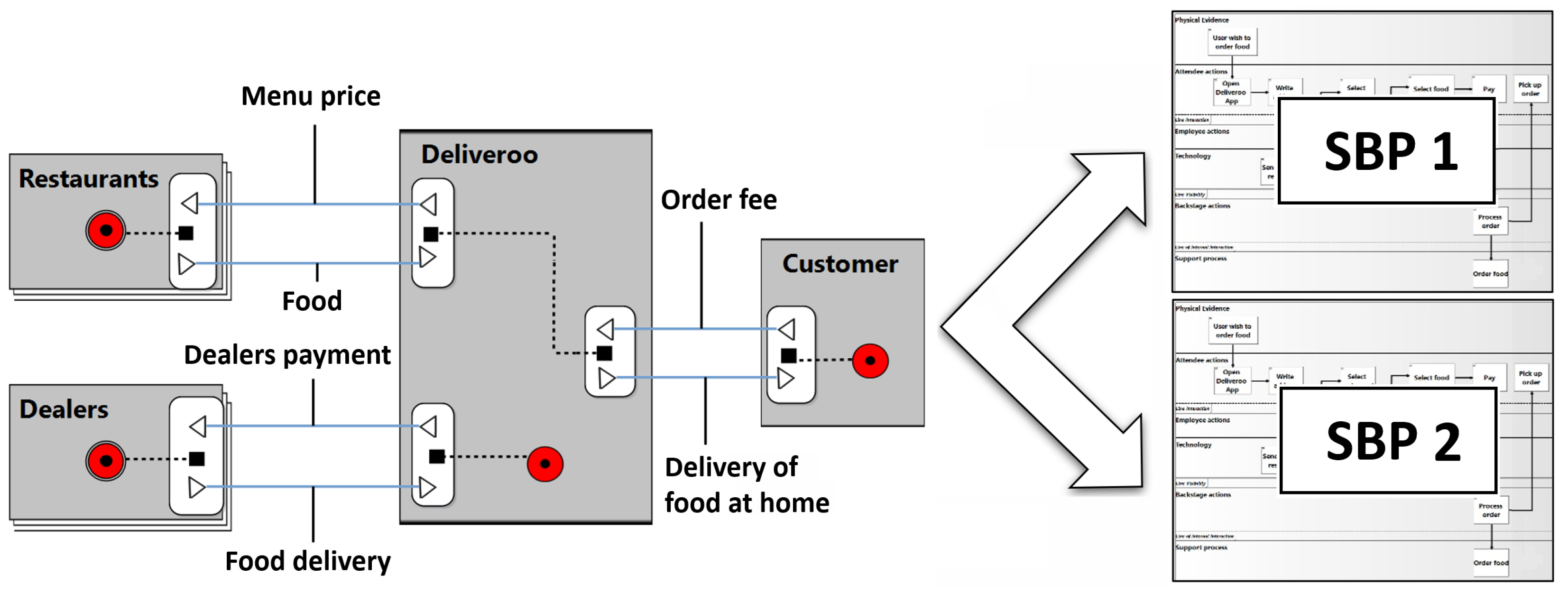
- Related to the previous point, while most of the transformations supported by the tool have been shown to be effective to a greater or lesser extent both in terms of time savings and the completeness of the resulting models, it has not been achieved a high degree of integration between business and process notations. This has proved to be a problem arising from the approach taken in this work, which is limited to estimating the number of process models required to represent a value proposition from an value model, but it does not generate almost any element of these models. As a possible solution to the problems encountered, different approaches to support the generation of BPMN models from value models and vice versa are currently being analysed [68].
6. Threats to Validity
7. Conclusions and Future Work
7.1. Conclusions
7.2. Future Work
Author Contributions
Funding
Institutional Review Board Statement
Informed Consent Statement
Data Availability Statement
Acknowledgments
Conflicts of Interest
Abbreviations
| AI | Artificial Intelligence |
| BMC | Business Model Canvas |
| BPMN | Business Process Model and Notation |
| DSL | Domain-Specific Language |
| DSR | Design Science Research |
| EMF | Eclipse Modeling Framework |
| EOL | Epsilon Object Language |
| ETL | Epsilon Transformation Language |
| EVL | Epsilon Validation Language |
| FDP | Final Degree Project |
| GEF | Graphical Editing Framework |
| GMF | Graphical Modeling Framework |
| ICC | Intraclass Correlation Coefficient |
| IoT | Internet of Things |
| JDK | Java Development Kit |
| MDE | Model-Driven Engineering |
| PCN | Process Chain Network |
| SBP | Service Blueprint |
| UML | Unified Modelling Language |
| 1 | https://www.ideo.com/ (accessed on 9 October 2025). |
| 2 | INNoVaServ can be downloaded from https://data.mendeley.com/datasets/jtdwhbm4gk/1 (accessed on 9 October 2025). |
| 3 | https://www.designcouncil.org.uk/ (accessed on 9 October 2025). |
| 4 | https://www.essi.upc.edu/~xoriol/opexec/ (accessed on 9 October 2025). |
References
- Teece, D.J. Business models, business strategy and innovation. Long Range Plan. 2010, 43, 172–194. [Google Scholar] [CrossRef]
- Osterwalder, A.; Pigneur, Y. Business Model Generation: A Handbook for Visionaries, Game Changers, and Challengers; John Wiley & Sons: Hoboken, NJ, USA, 2010. [Google Scholar]
- Salwin, M.; Jacyna-Gołda, I.; Kraslawski, A.; Waszkiewicz, A.E. The use of business model canvas in the design and classification of product-service systems design methods. Sustainability 2022, 14, 4283. [Google Scholar] [CrossRef]
- Lewis, M. The New New Thing: A Silicon Valley Story; WW Norton & Company: New York, NY, USA, 2000. [Google Scholar]
- Bridgeland, D.M.; Zahavi, R. Business Modeling: A Practical Guide to Realizing Business Value; Morgan Kaufmann: San Francisco, CA, USA, 2008. [Google Scholar]
- Wirtz, B.W.; MÜLLER, W.M.; Langer, P.F. Digital Business Models A Literature-Based Taxonomy And Research Avenues. Int. J. Innov. Manag. 2023, 27, 2330003. [Google Scholar] [CrossRef]
- Möller, F.; Stachon, M.; Azkan, C.; Schoormann, T.; Otto, B. Designing business model taxonomies–synthesis and guidance from information systems research. Electron. Mark. 2022, 32, 701–726. [Google Scholar] [CrossRef]
- Saco, R.M.; Goncalves, A.P. Service design: An appraisal. Des. Manag. Rev. 2008, 19, 10–19. [Google Scholar] [CrossRef]
- Lee, S.H.; Yang, M.; de Weck, O.L.; Lee, C.; Coughlin, J.F.; Klopfer, E.; Ochsendorf, J. Service design in action: Transformation, consideration, and system thinking. Proc. Des. Soc. 2023, 3, 3145–3154. [Google Scholar] [CrossRef]
- Cook, L.S.; Bowen, D.E.; Chase, R.B.; Dasu, S.; Stewart, D.M.; Tansik, D.A. Human issues in service design. J. Oper. Manag. 2002, 20, 159–174. [Google Scholar] [CrossRef]
- Shostack, L. Designing services that deliver. Harv. Bus. Rev. 1984, 84115. [Google Scholar]
- Blaurock, M.; Büttgen, M.; Schepers, J. Designing collaborative intelligence systems for employee-AI service co-production. J. Serv. Res. 2024, 28, 544–562. [Google Scholar] [CrossRef]
- Chin, H.; Marasini, D.P.; Lee, D. Digital transformation trends in service industries. Serv. Bus. 2023, 17, 11–36. [Google Scholar] [CrossRef]
- Mayer, S.; Schwemmle, M. The impact of design thinking and its underlying theoretical mechanisms: A review of the literature. Creat. Innov. Manag. 2025, 34, 78–110. [Google Scholar] [CrossRef]
- Grönroos, C. Business model innovation through the adoption of service logic: Evolving to servification. J. Serv. Theory Pract. 2024, 34, 347–360. [Google Scholar] [CrossRef]
- Chen, X.; Thapa, D. Clarifying the business model construct: A theory-driven integrative literature review through ecosystems and open systems perspectives. Rev. Manag. Sci. 2025, 1–34. [Google Scholar] [CrossRef]
- Gordijn, J. E-business value modelling using the e3-value ontology. In Value Creation from E-Business Models; Elsevier: Amsterdam, The Netherlands, 2004; pp. 98–127. [Google Scholar]
- Chinosi, M.; Trombetta, A. BPMN: An introduction to the standard. Comput. Stand. Interfaces 2012, 34, 124–134. [Google Scholar] [CrossRef]
- Sampson, S.E. Visualizing service operations. J. Serv. Res. 2012, 15, 182–198. [Google Scholar] [CrossRef]
- da Silva, A.; Cardoso, A. Rethinking service blueprint for digital coopetition: A new framework for networked collaboration. J. Infrastruct. Policy Dev. 2024, 8, 7072. [Google Scholar] [CrossRef]
- Gruman, J.A.; Choi, E. Well-being at work: A balanced approach to positive organizational studies. In The Palgrave Handbook of Workplace Well-Being; Springer: Berlin/Heidelberg, Germany, 2021; pp. 169–207. [Google Scholar]
- Uslu, O. Understanding digital wellbeing: Impacts, strategies, and the path to healthier technology practices. Discov. Soc. Sci. Health 2025, 5, 145. [Google Scholar] [CrossRef]
- Götzinger, D.; Miron, E.T.; Staffel, F. OMiLAB: An open collaborative environment for modeling method engineering. In Domain-Specific Conceptual Modeling: Concepts, Methods and Tools; Springer: Cham, Switzerland, 2016; pp. 55–76. [Google Scholar] [CrossRef]
- Yin, L.; Liu, J.; Ding, Z. Modeling and prototyping business processes in AutoPA. In Proceedings of the 2011 Fifth International Conference on Theoretical Aspects of Software Engineering, Xi’an, China, 29–31 August 2011. [Google Scholar]
- Di Ruscio, D.; Kolovos, D.; de Lara, J.; Pierantonio, A.; Tisi, M.; Wimmer, M. Low-code development and model-driven engineering: Two sides of the same coin? Softw. Syst. Model. 2022, 21, 437–446. [Google Scholar] [CrossRef]
- Pérez Blanco, F.J.; Vara, J.M.; Gómez, C.; De Castro, V.; Marcos, E. Leveraging Service Design by bridging business and process modeling. In Proceedings of the 55th Hawaii International Conference on System Sciences, Maui, HI, USA, 4–7 January 2022. [Google Scholar] [CrossRef]
- Pérez Blanco, F.J. INNoVaServ: Un Entorno de Modelado para el Diseño de Servicios. Ph.D. Thesis, Universidad Rey Juan Carlos, Madrid, Spain, 2022. Available online: https://hdl.handle.net/10115/20701 (accessed on 9 October 2025).
- Thomas, B.; Skinner, H. Dissertation to journal article: A systematic approach. Educ. Res. Int. 2012, 2012, 862135. [Google Scholar] [CrossRef]
- American Psychological Association. Publication Manual of the American Psychological Association, 7th ed.; American Psychological Association: Washington, DC, USA, 2020. [Google Scholar]
- Whittle, J.; Hutchinson, J.; Rouncefield, M. The state of practice in model-driven engineering. IEEE Softw. 2013, 31, 79–85. [Google Scholar] [CrossRef]
- Araújo, W.J.D.; Gomes, T.A. Evaluation of business process management systems (BPMS): Analysis of Bizagi and Bonita softwares. RDBCI Rev. Digit. Bibliotecon. Ciênc. Inf. 2023, 20, e022023. [Google Scholar]
- Ramdani, M.; Ferhati, M.S.; Lassel, H.; Kahloul, L.; Choucha, C.E. Optimizing Research Laboratory Workflows in Algeria Through Low-Code BPMN Implementation with BonitaSoft. In Proceedings of the 2025 International Symposium on iNnovative Informatics of Biskra (ISNIB), Biskra, Algeria, 28–30 January 2025; pp. 1–6. [Google Scholar]
- Kang, G.; Cheng, H.; Liu, J.; Wen, Y.; Peng, J. Business Process Modeling for Industrial Internet Application via BPMN Extension. IEEE Trans. Autom. Sci. Eng. 2024, 22, 813–829. [Google Scholar] [CrossRef]
- Kolluri, S. Leveraging SAP Signavio for End-to-End Business Process Transformation: A Framework for Implementation and Usage in Intelligent Enterprises. J. Comput. Sci. Technol. Stud. 2025, 7, 652–661. [Google Scholar] [CrossRef]
- Hendrawan, E.; Meisel, M.; Sari, D.N. Analysis and implementation of computer network systems using software draw.io. Asia Inf. Syst. J. 2023, 2, 9–15. [Google Scholar]
- Janicki, J.; Wójcik, E. Tools for analysis of business processes–a comparative analysis. J. Comput. Sci. Inst. 2021, 20, 165–169. [Google Scholar] [CrossRef]
- Parker, D.J. Microsoft visio 2013 Business Process Diagramming and Validation; Packt Publishing Ltd.: Birmingham, UK, 2013. [Google Scholar]
- Abou-Khalil, W.; Eid, O.; Sokhn, M.; Chamoun, R.K. A canvas-based AI-driven framework supporting SMEs digital transformation roadmap. In Proceedings of the 2025 International Conference on Computer, Information and Telecommunication Systems (CITS), Colmar, France, 16–18 July 2025; pp. 1–8. [Google Scholar]
- Szopinski, D.; Schoormann, T.; John, T.; Knackstedt, R.; Kundisch, D. How Software Can Support Innovating Business Models: A Taxonomy of Functions of Business Model Development Tools. In Proceedings of the 23rd Americas Conference on Information Systems (AMCIS), Boston, MA, USA, 10–12 August 2017. [Google Scholar]
- Lee, L.J. Tools: MIRO Real-Time Board, Visual Collaborations and Tools, Easy Screen Sharing And Presentation. 2019. Available online: https://hdl.handle.net/20.500.11766/10605 (accessed on 9 October 2025).
- Vikström, M.; Tuunanen, T.; Hönigsberg, S. Recombining Operant Resources: Integrating Service Design and Service Engineering to Improve Service Innovation. In Proceedings of the 57th Hawaii International Conference on System Sciences, Hawaii, HI, USA, 3–6 January 2024. [Google Scholar]
- García Lechuga, A.; Cortés Robles, G.; Arredondo Soto, K.C.; Miranda Ackerman, M.A. The integration of the business model canvas and the service blueprinting to assist the conceptual design of new product-service systems. J. Clean. Prod. 2023, 415, 137801. [Google Scholar] [CrossRef]
- Schoormann, T.; Hagen, S.; Brinker, J.; Wildau, S.; Thomas, O.; Knackstedt, R. Towards Aligning Business Models with Business Processes: A Tool-based Approach. In Modellierung; Gesellschaft für Informatik e.V.: Bonn, Germany, 2020; pp. 13–27. [Google Scholar]
- Six, T.; Lederer, M.; Schmidt, W.; Nirschl, M. Business Process Management Bridging Marketing and IT: Transformation Model for Customer Journey Maps and BPMN. In Subject-Oriented Business Process Management. Dynamic Digital Design of Everything—Designing or Being Designed; Springer: Berlin/Heidelberg, Germany, 2022; pp. 95–114. [Google Scholar]
- Lara Machado, P.; van de Ven, M.; Aysolmaz, B.; Athanasopoulou, A.; Ozkan, B.; Turetken, O. Methods that bridge business models and business processes: A synthesis of the literature. Bus. Process Manag. J. 2023, 29, 48–74. [Google Scholar] [CrossRef]
- Kazemzadeh, Y.; Milton, S.; Johnson, L. A Conceptual Comparison of Service Blueprinting and Business Process Modeling Notation (BPMN). Asian Soc. Sci. 2015, 11, 307. [Google Scholar] [CrossRef]
- Kazemzadeh, Y.; Milton, S.; Johnson, L. A Comparison of Concepts in Service Blueprinting and Process Chain Network (PCN). Int. J. Bus. Manag. 2015, 10, 13. [Google Scholar] [CrossRef]
- Kazemzadeh, Y.; Milton, S.K.; Johnson, L.W. Service blueprinting and process-chain-network: An ontological comparison. Int. J. Qual. Res. Serv. 2015, 2, 1–12. [Google Scholar] [CrossRef]
- Kazemzadeh, Y.; Milton, S.K.; Johnson, L. Process chain Network (PCN) and business process modeling notation (BPMN): A comparison of concepts. J. Manag. Strategy 2015, 6, 88–99. [Google Scholar] [CrossRef]
- Fatemi, H.; van Sinderen, M.; Wieringa, R. E3value to BPMN Model Transformation. In Adaptation and Value Creating Collaborative Networks; Springer: Berlin/Heidelberg, Germany, 2011; pp. 333–340. [Google Scholar]
- Hevner, A.; Chatterjee, S. Introduction to design science research. In Design Science Research Cases; Springer: Berlin/Heidelberg, Germany, 2010; pp. 1–8. [Google Scholar]
- Hevner, A.R.; March, S.T.; Park, J.; Ram, S. Design science in information systems research. MIS Q. 2004, 75–105. [Google Scholar] [CrossRef]
- Rhazali, Y.; Hadi, Y.; Mouloudi, A. Model Transformation with ATL into MDA from CIM to PIM Structured through MVC. Procedia Comput. Sci. 2016, 83, 1096–1101. [Google Scholar] [CrossRef]
- Parnas, D.L. On the criteria to be used in decomposing systems into modules. In Pioneers and Their Contributions to Software Engineering; Springer: Berlin/Heidelberg, Germany, 1972; pp. 479–498. [Google Scholar]
- Steinberg, D.; Budinsky, F.; Merks, E.; Paternostro, M. EMF: Eclipse Modeling Framework; Pearson Education: Singapore, 2008. [Google Scholar]
- Gómez-Martínez, E.; Pérez-Blanco, F.; de Lara, J.; Vara, J.M.; Marcos, E. Formal support of process chain networks using model-driven engineering and petri nets. In Proceedings of the 34th ACM/SIGAPP Symposium on Applied Computing; ACM: New York, NY, USA, 2019; pp. 98–100. [Google Scholar]
- Estañol, M.; Marcos, E.; Oriol, X.; Pérez, F.J.; Teniente, E.; Vara, J.M. Validation of service blueprint models by means of formal simulation techniques. In Proceedings of the Service-Oriented Computing: 15th International Conference, ICSOC 2017, Malaga, Spain, 13–16 November 2017; pp. 80–95. [Google Scholar]
- Yin, R.K. Case Study Research: Design and Methods; SAGE: Los Angeles, CA, USA, 1994; Volume 5. [Google Scholar]
- Wohlin, C.; Runeson, P.; Höst, M.; Ohlsson, M.C.; Regnell, B.; Wesslén, A. Experimentation in Software Engineering; Springer Science & Business Media: Berlin/Heidelberg, Germany, 2012. [Google Scholar]
- Jedlitschka, A.; Pfahl, D. Reporting guidelines for controlled experiments in software engineering. In Proceedings of the 2005 International Symposium on Empirical Software Engineering, Noosa Heads, Australia, 17–18 November 2005; p. 10. [Google Scholar]
- Pfleeger, S.L.; Kitchenham, B.A. Principles of survey research: Part 1: Turning lemons into lemonade. ACM SIGSOFT Softw. Eng. Notes 2001, 26, 16–18. [Google Scholar] [CrossRef]
- Wieringa, R.J. Design Science Methodology for Information Systems and Software Engineering; Springer: Berlin/Heidelberg, Germany, 2014. [Google Scholar]
- Matos Claro, S.; Ruiz de la Peña, J.; Lamoth Borrero, L.; Snoeck, M. Technology for Automatic Usability Evaluation Using Model Driven Engineering. In Proceedings of the International Conference on Business Process Modeling, Development and Support, Limassol, Cyprus, 3–4 June 2024; Springer: Berlin/Heidelberg, Germany, 2024; pp. 191–200. [Google Scholar]
- Fisher, R.A. On the’probable error’of a coefficient of correlation deduced from a small sample. Metron 1921, 1, 1–32. [Google Scholar]
- Fleiss, J.L. Design and Analysis of Clinical Experiments; John Wiley & Sons: Hoboken, NJ, USA, 2011. [Google Scholar]
- Bakker, A.B.; Demerouti, E. The job demands-resources model: State of the art. J. Manag. Psychol. 2007, 22, 309–328. [Google Scholar] [CrossRef]
- Choudhury, A.; Malavolta, I.; Ciccozzi, F.; Aslam, K.; Lago, P. The technological landscape of collaborative model-driven software engineering. Softw. Syst. Model. 2025, 24, 1595–1619. [Google Scholar] [CrossRef]
- Hotie, F.; Gordijn, J. Value-based process model design. Bus. Inf. Syst. Eng. 2019, 61, 163–180. [Google Scholar] [CrossRef]
- Cairns, P.A. Experimental methods in human-computer interaction. In Encylopedia of Human-Computer Interaction, 2nd ed.; IGI Global: Hershey, PA, USA, 2016; p. 34. [Google Scholar]
- Kitchenham, B.; Madeyski, L. Recommendations for analysing and meta-analysing small sample size software engineering experiments. Empir. Softw. Eng. 2024, 29, 137. [Google Scholar] [CrossRef]
- Gómez-Macías, C.; Pérez-Blanco, F.J.; Granada, D.; Vara, J.M. Integrating smart contracts into the modeling paradigm to harness the potential of models. Softw. Syst. Model. 2025, 24, 823–842. [Google Scholar] [CrossRef]

| Value | BMC |
|---|---|
| Actor | Key partners |
| Market segment | Key partners |
| Value activity | Key activities, value proposition |
| User need | - |
| Boundary element | - |
| Value interface | - |
| Value port | - |
| Value exchange | - |
| Value object | Cost structure, revenue streams, key resources, key activities, value propositions, customer relationship, communication channels |
| Connection | - |
| Dependency AND | - |
| Dependency OR | - |
| BPMN | PCN | SBP |
|---|---|---|
| Pool | Entity | - |
| Task | Standard task | Task |
| Task + Intermediate Time Event | Action and waiting task | Task |
| Task | Outsourced task | Task |
| Task | Innovative task | Task |
| Intermediate Time Event | Waiting task | Task |
| OR Gate | Decision task | Task |
| Sequence/Message flow | Reference | Dependency |
| Sequence/Message flow | Standard dependency | Dependency |
| Sequence/Message Flow + Intermediate Time Event | Delayed dependency | Dependency |
| - | Monetary and non-monetary gains/losses | - |
| - | Text annotation | - |
| BMC | Value | SBP | PCN | BPMN | |
|---|---|---|---|---|---|
| Manually | 329 | 661 | 342 | 505 | 805 |
| From BMC | - | 490 | - | - | - |
| From value | 297 | - | - | - | - |
| From SBP | - | - | - | 478 | - |
| From PCN | - | - | 296 | - | 512 |
| From BPMN | - | - | - | 430 | - |
| % Saving | 9.73% | 25.87% | 13.45% | 10.10% | 36.40% |
| BMC from Value | Value from BMC | SBP from PCN | PCN from SBP | PCN from BPMN | BPMN from PCN | |
|---|---|---|---|---|---|---|
| Case 1 | 32.00% | 68.97% | 100.00% | 44.64% | 85.71% | 60.24% |
| Case 2 | 38.71% | 76.56% | 100.00% | 45.16% | 93.55% | 75.00% |
| Case 3 | 47.83% | 80.77% | 95.24% | 45.65% | 91.30% | 73.17% |
| Case 4 | 28.13% | 79.41% | 93.33% | 49.18% | 90.16% | 73.53% |
| Case 5 | 37.14% | 72.22% | 100.00% | 40.28% | 87.50% | 55.36% |
| AVG. | 36.76% | 75.59% | 97.71% | 44.98% | 89.65% | 67.46% |
| Question Content | Sum of Responses | |||||
|---|---|---|---|---|---|---|
| Question 1: Business and process modelling notations known | BMC | value | SBP | PCN | BPMN | Other |
| 9 | 4 | 8 | 2 | 9 | 4 | |
| Question 2: Business and process modelling notations used | BMC | value | SBP | PCN | BPMN | Other |
| 8 | 3 | 7 | 1 | 9 | 3 | |
| Question 3: Modelling tools used | Canvanizer | Draw.io | Lucidchart | MS Visio | Bpmn.io | |
| 6 | 8 | 6 | 7 | 6 | ||
| Question 4: Average rating of tools used (1 to 5) | Canvanizer | Draw.io | Lucidchart | MS Visio | Bpmn.io | |
| 4 | 3.12 | 3.5 | 3.57 | 4.16 | ||
| Question 5: Features considered to be the most important | Ease of use | No prior knowledge | Integration of notations | Collaborative work | ||
| 9 | 5 | 6 | 9 | |||
| Question Content | Avg. Rating (1 to 5) | |||||||
|---|---|---|---|---|---|---|---|---|
| Question 1: Ease of use of diagrammers | BMC | value | SBP | PCN | BPMN | |||
| 4.89 | 3.78 | 4.33 | 3 | 2.44 | ||||
| Question 2: Usefulness of transformations | BMC from value | value from BMC | value from SBP | SBP from value | SBP from PCN | PCN from SBP | PCN from BPMN | BPMN from PCN |
| 3.89 | 4.22 | 2 | 2.11 | 3.78 | 4.11 | 3.67 | 4.67 | |
| Question 3: Effort saving by transformations | BMC from value | value from BMC | value from SBP | SBP from value | SBP from PCN | PCN from SBP | PCN from BPMN | BPMN from PCN |
| 4 | 3.22 | 1.11 | 1.56 | 3.44 | 3.33 | 3.33 | 4 | |
| Question 4: Usefulness of the dashboard in service design process | 3.89 | |||||||
| Question 5: Usefulness of model validations in service design process | 2.78 | |||||||
| Question Content | Avg. Rating | |||
|---|---|---|---|---|
| Question 6: Rating of the INNoVaServ learning curve (1 -very steep- to 5 -not steep-) | 2.22 | |||
| Question 7: Rating of the overall usability of INNoVaServ (1 -not at all usable- to 5 -very usable-) | 3.11 | |||
| Question 8: Rating of model integration in a service design project (1 -not at all integrated- to 5 -very integrated-) | 3.78 | |||
| Question 9: Efficiency of INNoVaServ in the design of a service with respect to the use of specific alternatives for each notation (1 -not efficient at all to 5 -very efficient-) | 4.44 | |||
| Question 10: Usefulness of INNoVaServ in the service design process (1 -not at all useful- to 5 -very useful) | 3.78 | |||
| Question 11: INNoVaServ’s outstanding features | Ease of use 3 | No prior knowledge 1 | Integration of notations 9 | Collab. work 0 |
Disclaimer/Publisher’s Note: The statements, opinions and data contained in all publications are solely those of the individual author(s) and contributor(s) and not of MDPI and/or the editor(s). MDPI and/or the editor(s) disclaim responsibility for any injury to people or property resulting from any ideas, methods, instructions or products referred to in the content. |
© 2025 by the authors. Licensee MDPI, Basel, Switzerland. This article is an open access article distributed under the terms and conditions of the Creative Commons Attribution (CC BY) license (https://creativecommons.org/licenses/by/4.0/).
Share and Cite
Pérez-Blanco, F.J.; Vara, J.M.; Gómez-Macías, C.; Granada, D.; Villarrubia, C. Empowering Service Designers with Integrated Modelling Tools: A Model-Driven Approach. Systems 2025, 13, 1107. https://doi.org/10.3390/systems13121107
Pérez-Blanco FJ, Vara JM, Gómez-Macías C, Granada D, Villarrubia C. Empowering Service Designers with Integrated Modelling Tools: A Model-Driven Approach. Systems. 2025; 13(12):1107. https://doi.org/10.3390/systems13121107
Chicago/Turabian StylePérez-Blanco, Francisco Javier, Juan Manuel Vara, Cristian Gómez-Macías, David Granada, and Carlos Villarrubia. 2025. "Empowering Service Designers with Integrated Modelling Tools: A Model-Driven Approach" Systems 13, no. 12: 1107. https://doi.org/10.3390/systems13121107
APA StylePérez-Blanco, F. J., Vara, J. M., Gómez-Macías, C., Granada, D., & Villarrubia, C. (2025). Empowering Service Designers with Integrated Modelling Tools: A Model-Driven Approach. Systems, 13(12), 1107. https://doi.org/10.3390/systems13121107

