


Abstract
China’s rapid urbanization and ecological civilization initiatives have intensified land space governance challenges. This paper introduces a novel integrated framework to investigate the bidirectional interactions among land space conflicts (LSC), urbanization level (UL), and eco-environment level (EL) in Jiangsu Province (2000–2020). Using a combination of landscape risk indices, TOPSIS, coupling coordination, geographic detector, and Tapio decoupling models, we analyze the spatiotemporal dynamics and underlying mechanisms. Key findings show the following: LSC intensity escalated continuously, with the highest levels in Southern Jiangsu. UL grew steadily, while EL exhibited fluctuations. UL-EL coordination significantly improved, with notable spatial clustering. Decoupling analysis indicates a weakening influence of UL on LSC, but with growing pressure from the EL. Importantly, cross-system UL-EL interactions amplified LSC intensity more than internal subsystem effects. Based on coupling–decoupling patterns, cities were classified into five typologies, providing a clear basis for targeted spatial governance strategies. This research provides both a theoretical advancement and practical insights for balancing urbanization and ecological sustainability in rapidly developing regions.
1. Introduction
China is currently navigating a pivotal phase in its economic transformation and societal advancement, where the concurrent implementation of new urbanization initiatives and ecological civilization construction has intensified the complexities of land space governance. Over the past four decades, China has achieved an unprecedented urbanization rate averaging 1% annual growth [1], accompanied by a ninefold expansion of urban built-up areas. This rapid urban expansion, particularly in metropolitan regions, has engendered intensive spatial competition and land structural imbalances [2,3], manifested through conflicts such as the encroachment of urban construction land on prime farmland and the overlapping of ecological conservation zones with urban development areas [4]. The resultant land space conflicts (LSC) manifest through multidimensional challenges including biodiversity degradation, urban ecosystem fragmentation, and agricultural security pressures, collectively imposing significant constraints on regional sustainable development [5,6,7]. The 20th National Congress of the Communist Party of China has outlined a strategic framework emphasizing coordinated regional development and quality-oriented urbanization [8,9]. This paradigm advocates for establishing an optimized territorial spatial system that harmonizes industrial transformation, environmental remediation, and ecological conservation [4,10,11]. Within this context, scholarly investigation into the dynamic interplay between LSC, urbanization level (UL), and eco-environment level (EL) assumes critical importance. Such research provides essential theoretical foundations for space governance optimization, high-quality urban development promotion, and the maintenance of ecological security, ultimately contributing to the realization of sustainable development goals (SDGs) [12,13]. Specifically, this study aligns with SDG 11 (Sustainable Cities and Communities) by addressing the spatial coordination between urbanization and ecological preservation, SDG 15 (Life on Land) through its focus on land use conflicts and ecosystem stability.
LSC manifest in diverse forms, primarily differentiated by stakeholders, locations, and temporal dimensions, with correspondingly diverse measurement approaches. Current conflict identification methodologies fall into four categories: (1) Qualitative analysis employs participatory surveys [14,15] and game theory models [16,17] to elucidate interest competition mechanisms, though lacking spatial visualization capabilities. (2) Spatial overlay analysis enables precise conflict zone identification through geospatial layer superposition [18,19,20,21]. (3) Index system evaluation utilizes composite frameworks for comprehensive assessment [22,23], balancing regional adaptability with subjective limitations. (4) Landscape ecology approaches objectively quantify conflict intensity through landscape pattern indices [1,2,24], yet neglect socioeconomic influences. The drivers of LSC are mainly related to the natural environment, socio-economics and policy regimes. From geographical and statistical perspectives, quantitative models like geographical detector models and regression analyses reveal the relative strength of environmental and socioeconomic drivers [25]. Policy-oriented investigations adopt public administration and political science perspectives to examine how institutional implementation shapes spatial conflicts [26,27,28].
It can be observed that LSC arise from the combined effects of human and natural factors. Consequently, urbanization elements and eco-environment components play distinct roles in driving LSC. Furthermore, an inseparable relationship exists between urbanization level (UL) and eco-environment level (EL). Research methodologies such as the Environmental Kuznets Curve equation [29,30], Granger causality tests [31], and coupling coordination models [32,33], have been employed to investigate the relationship between environmental issues and economic development. Among these, the coupling coordination model has been extensively applied across multiple scales including national [34], watershed [32], provincial [35], and urban agglomeration levels [36]. Scholars typically adopt either single indicators or constructed indicator systems to examine the coupling relationships between UL and EL, with particular emphasis on spatial–temporal evolution patterns and interaction dynamics [35,37,38].
In summary, existing research has achieved substantial progress in measuring LSC, UL, and EL, identifying driving factors of LSC, and exploring the relationship between UL and EL. However, scholarly consensus remains deficient in investigating bidirectional interactions among the three dimensions. Merely analyzing driving factors fails to elucidate the specific interplay between LSC and UL/EL, respectively, while existing management recommendations remain constrained in scope. Furthermore, many studies, both in China and internationally, often focus on either the UL-EL relationship or LSC in isolation, with limited integration of all three systems. The Jiangsu case, as a highly developed and regionally disparate province, offers a compelling microcosm to develop and test an integrated framework that could be adapted to other rapidly developing regions worldwide, contributing to the global discourse on sustainable spatial governance [1,39]. To address these gaps, this paper selects Jiangsu Province as the study area. Building on quantified measurements of LSC, UL, and EL, this paper systematically analyzes coupling coordination relationships between UL and EL. Through combined driver analysis and decoupling evaluation, this paper further investigates interaction mechanisms linking LSC with UL and EL. Based on pairwise interaction outcomes, municipal units in Jiangsu are classified into distinct typologies, enabling targeted spatial governance strategies to mitigate LSC and foster synergistic development between UL and EL.
2. Theoretical Analysis
2.1. Urbanization and Eco-Environment
Urbanization is a complex process driven by multiple factors. It transforms the regional eco-environment through population growth, economic development, and land expansion, but also depends on the support of ecological carrying capacity [40,41,42]. This interdependence results in a dynamic equilibrium between urbanization and eco-environment systems. The eco-environment, in turn, influences urbanization dually [43]: resource constraints limit urban development, while the need for preservation demands coordinated urban planning [39]. Thus, the two systems continuously interact, adapt, and co-evolve, each following its own trajectory while shaping the other’s path [44].
This paper developed UL and EL evaluation systems through systematic literature review and indicator selection processes [41,45,46,47]. High-impact and frequently cited indicators were identified from academic sources and contextualized to Jiangsu Province’s development characteristics. The UL assessment framework integrates 12 indicators across four dimensions: population change, economic growth, social progress, and land use transformation. Correspondingly, the EL evaluation system incorporates 12 indicators structured around three critical aspects: eco-environment pressure mitigation, carrying capacity enhancement, and protection effectiveness, as shown in Table 1.
Table 1.
Evaluation indicator system for UL and EL.
2.2. Impact of Urbanization and Eco-Environment on LSC
LSC encompasses multifaceted connotations that vary across research perspectives [3]. In this study, LSC is characterized by the spatial competition and evolutionary processes of land resources that lead to destabilized landscape patterns, intensified spatial disturbances, and heightened land pressure [1,2,24]. Existing literature reveals that these conflicts are influenced by both urbanization elements (population dynamics, economic activities, social development, and urban construction) and ecological factors (environmental pollution, ecological degradation, and land use transformations) [23]. Regional disparities in baseline conditions and developmental priorities create significant variations in how different urbanization and ecological drivers affect conflict intensity. Furthermore, the elastic relationship between urbanization-ecological conditions and land use conflict dynamics demonstrates spatiotemporal heterogeneity, reflecting differentiated interactions across geographical contexts and temporal phases.
2.3. Analysis Framework
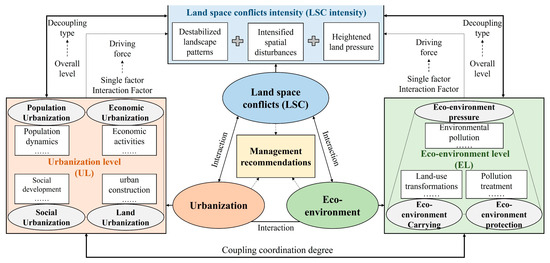
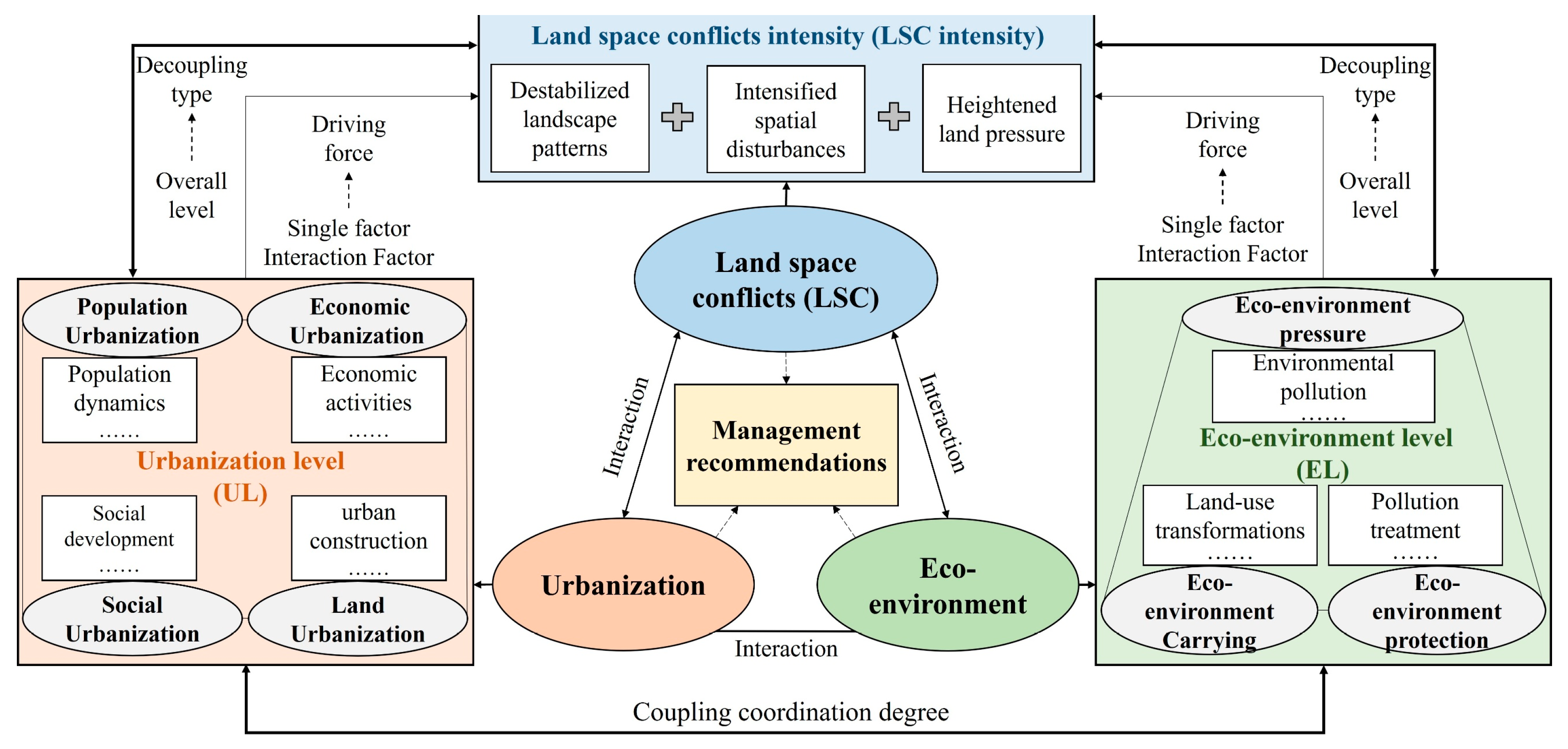
While existing methodologies for identifying LSC have provided valuable insights, they exhibit inherent limitations. Spatial overlay analysis, though precise in delineating conflict zones, often neglects the underlying socio-economic drivers and dynamic interactions between systems. Index system evaluations, while comprehensive, are constrained by subjective weighting and regional adaptability issues. Landscape ecology methods objectively quantify conflict intensity through pattern indices, yet they predominantly focus on structural disturbances while overlooking the functional interplay between urbanization and eco-environmental processes. This paper integrates LSC intensity, coupling coordination, and Tapio decoupling into a dynamic, multi-dimensional framework to address these shortcomings (Figure 1). LSC intensity captures the spatial intensity and structural instability of conflicts from a landscape ecological perspective, complementing purely socioeconomic or overlay-based assessments. Coupling coordination analysis elucidates the synergistic or antagonistic relationships between UL and EL systems, revealing whether conflict intensification stems from imbalanced development between these two subsystems. Decoupling analysis further quantifies the temporal dynamics and directional influence of UL and EL changes on LSC intensity, distinguishing whether conflicts are driven by economic expansion, ecological degradation, or both. The analysis proceeded as follows:
Figure 1.
Analysis framework.
Firstly, a conflict intensity measurement model is constructed according to the connotation of LSC, and according to the evaluation index system of UL and EL, LSC intensity, UL and EL are measured and analyzed for their spatial and temporal evolution characteristics. Secondly, the coupling coordination degree between UL and EL is measured. Subsequently, the interaction between LSC, urbanization and eco-environment is analyzed from two aspects, one is to analyze the single and interactive driving effect of urbanization and eco-environment factors on LSC intensity, and the other is to analyze the decoupling types of LSC intensity with UL and EL, respectively. Finally, based on the interactions among LSC intensity, UL and EL, the cities in Jiangsu Province are categorized into different types, and corresponding management recommendations are proposed.
This framework not only identifies where and how intensely conflicts occur but also explains why they arise from cross-system interactions and how they evolve over time. This enables a more systematic and actionable understanding of conflict mechanisms, facilitating targeted governance strategies that are both spatially explicit and temporally adaptive.
3. Materials and Methods
3.1. Study Area
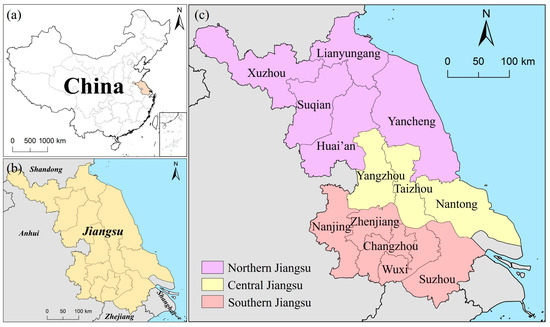
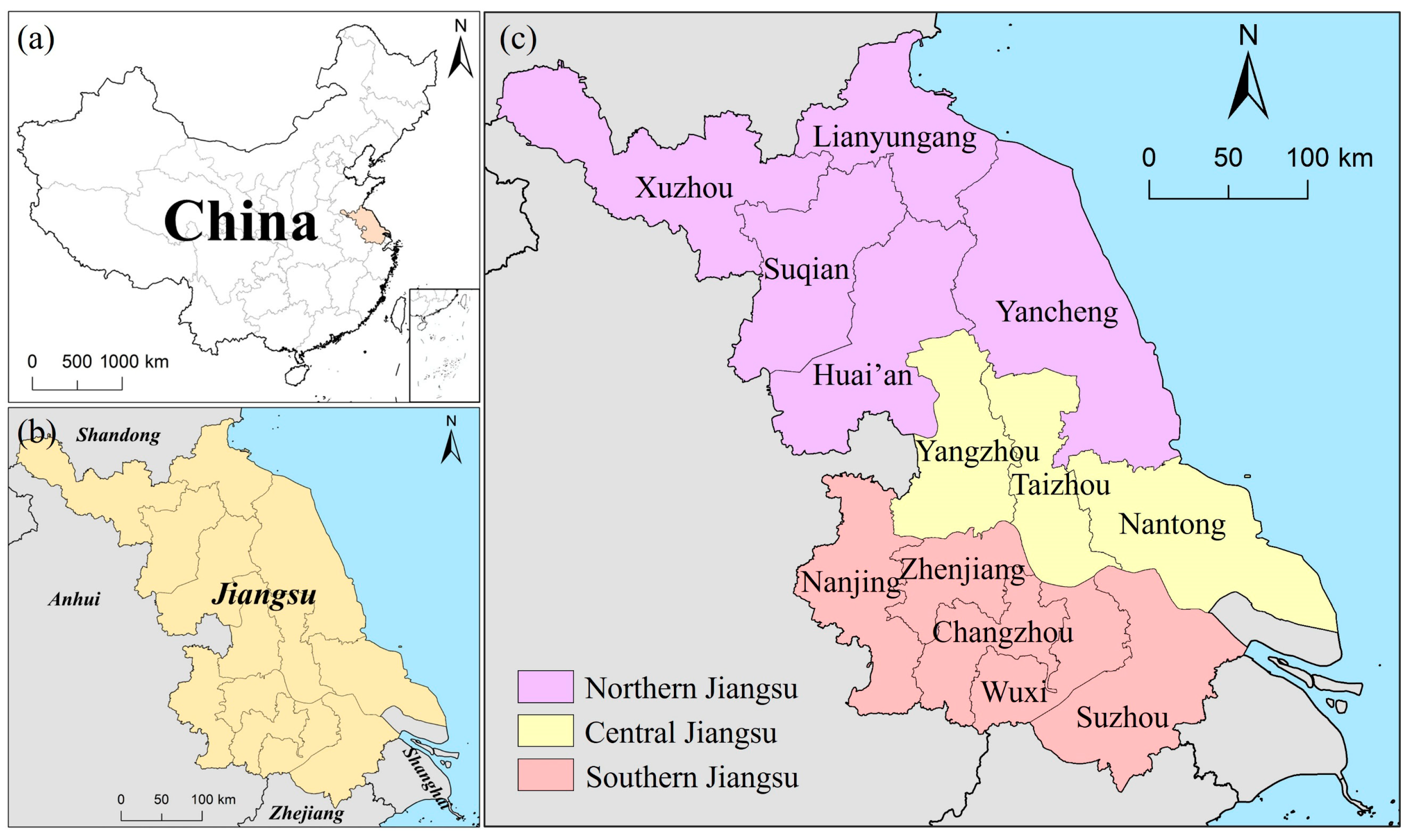
Situated in the eastern coastal region of mainland China, Jiangsu Province administers 13 prefecture-level cities (Figure 2) with a total area of 107,200 km2. As one of China’s most economically developed and highly urbanized provinces, it achieved a per capita GDP of 150,500 yuan and an urbanization rate of 75% in 2023, surpassing the national average by 9.80%. The province’s high-consumption, high-growth development model demonstrates strong dependence on land resources, while simultaneously facing pronounced regional disparities. In 2023, Southern Jiangsu, Central Jiangsu, and Northern Jiangsu exhibited urbanization rates of 82.44%, 71.82%, and 66.11%, respectively, with corresponding per capita GDP figures of 186,300 yuan, 155,800 yuan, and 100,600 yuan. Notably, urban construction land encroachment on cultivated areas in Southern Jiangsu during 2022 approximately equaled the combined total of Central and Northern Jiangsu, while Northern Jiangsu’s crop cultivation area exceeded fivefold that of the southern region [48]. As a microcosm of China’s development patterns, analyzing the evolutionary characteristics of LSC, UL and EL in Jiangsu Province and exploring the interaction among the three can provide decision-making support for promoting its high-quality development, as well as a reference for other regions.
Figure 2.
Study area. ((a,b) Location of Jiangsu Province in China. (c) Prefecture-level cities in Jiangsu Province).
3.2. Data Sources and Pre-Processing
The data used in this paper are mainly land use data and socio-economic data. The land use data are remote sensing monitoring raster data with 30 m resolution for the years 2000, 2005, 2010, 2015 and 2020 from the Resource and Environment Science and Data Center of the Chinese Academy of Sciences (https://www.resdc.cn/) (accessed on 10 January 2024). Socio-economic data were obtained from Jiangsu Statistical Yearbook, statistical yearbooks and statistical bulletins of 13 prefecture-level cities in Jiangsu Province.
3.3. Methods
3.3.1. Measurement Model of LSC
Based on landscape ecological risk theory, this paper selects landscape indicators that can characterize the LSC to construct a model [2,49] and identifies and quantifies the LSC intensity under a 3 km × 3 km grid. This scale, approximately five times the average patch size, optimally captures landscape heterogeneity without the noise of finer grids or the oversimplification of coarser ones. The grid-level LSCI is subsequently aggregated to the municipal level for policy-relevant analysis. The formula is as follows:
where ILSC is LSC intensity, P is external pressure, V is vulnerability, and S is stability.
- (1)
- External pressure (P): The source of risk faced by the land space, which is selected to be expressed by the area-weighted mean fractal dimension index (FRAC_AM), the larger the value is, the greater the pressure of the landscape patches to be disturbed by neighboring patches, which is calculated in Fragstats4.2 [1,24,49].
- (2)
- Vulnerability (V): The characteristics of the land space as a risk carrier, which can reflect its sensitivity to external disturbances, the larger the value the more likely to be damaged under the action of external disturbances. Combined with the existing results, the vulnerability of different types of land space is assigned values (cultivated land-4, woodland-2, grassland-3, water space-5, construction land-1, and unutilized land-6) [2,24], and normalized, with the following formula:
- (3)
- Stability (S): The reflection of different land space types as risk receptors to the risk sources, which is selected to be expressed by patch density (PD), the larger the value, the higher the landscape fragmentation and the worse the stability, which is calculated in Fragstats4.2 [24,49].
3.3.2. Evaluation of UL and EL
Technique for Order Preference by Similarity to Ideal Solution (TOPSIS) is usually used for comprehensive analysis of objects with multiple indicators to measure the relative proximity of the evaluation object to the optimal solution [39,50,51,52], and this paper applied the TOPSIS to judge the relative UL and EL of each city in Jiangsu Province. The final weights for each indicator in the UL and EL evaluation systems are provided in Appendix A, Table A1.
Dimensionless indicator processing:
The entropy method is used to calculate the weights of the indicators:
where ej is the information entropy of the indicator, m is the number of evaluation units, wj is the weight of the indicator, and n is the number of indicators.
Construction of a weighting matrix:
Determination of the ideal and worst solutions:
Calculation of the Euclidean distance from the evaluated object to the ideal and worst solutions:
Calculation of the relative proximity of each evaluation object to the ideal solution:
where Li ranges from 0 to 1; the closer Li is to 1, the closer it is to the optimal level.
3.3.3. Coupling Coordination Degree Model
The coupling coordination degree model is used to evaluate the UL-EL coupling coordination degree. The formula is as follows [53,54,55]:
where Au and Be represent UL and EL, α and β are the weighting coefficients for UL and EL, respectively, with both coefficients set to 0.5. Within the context of sustainable development and ecological civilization construction in China, urbanization and the eco-environment are considered two equally critical and interdependent systems [42]. Their coordinated development is a fundamental goal, and neither should be prioritized over the other in the coupling coordination assessment. This equal-weight approach is widely adopted in prior studies examining the UL-EL relationship at national and regional scales [45,55,56]. D represents the degree of coupling coordination, λ represents the relative development coefficient [45], as shown in Table 2.
Table 2.
Coupling coordination types between UL and EL.
3.3.4. Geographic Detector
The geographic detector is a method to quantitatively detect whether the spatial distribution of dependent variables is similar to the independent variables [41,51,57]. The factor detector uses the q-statistic to measure how well independent variable X explains dependent variable Y. The q-value ranges from 0 to 1, with higher values indicating stronger explanatory power. The formula is as follows:
where h is the category of factor x, Nh and N are the number of samples of class h and the total samples, respectively, δh2 and δ2 are the variance of class h and the whole region, respectively.
The interaction detector identifies the interaction between different factors [58], that is, evaluates whether the combined effect of factors X1 and X2 will increase or decrease the explanatory power of the dependent variable Y, or whether these factors have independent effects on Y.
This paper selects LSC intensity as the detected factor, and 24 indicators in UL and EL evaluation system as the driving factors. And the indicators are discretized, by testing the discretization effect of different classification methods and the number of partition points, comparing the q-statistics, and selecting the method with better classification effect and partition points, so as to obtain the single-factor detection results and the interactive factor detection results (Appendix A, Table A2).
3.3.5. Tapio Decoupling Model
Tapio decoupling model is used to calculate the decoupling coefficient (Dc) between LSC intensity and UL (EL). The formula is as follows [59,60,61]:
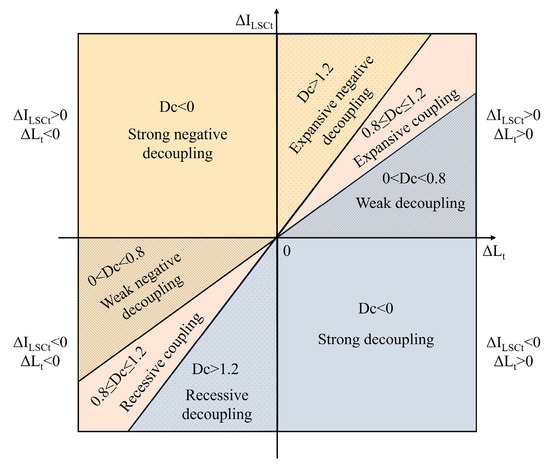
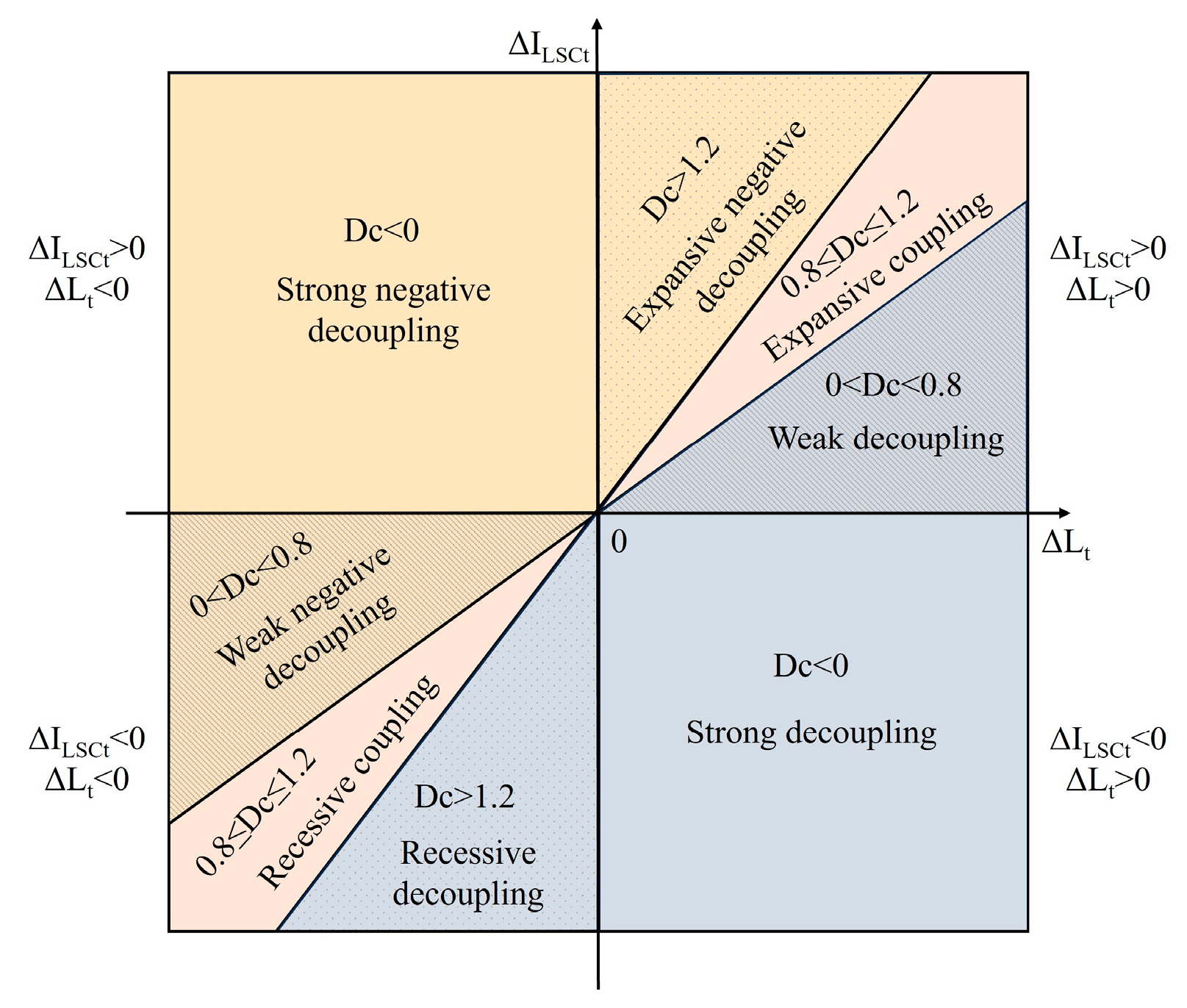
where %ΔILSCt and %ΔLLSCt are the rates of change in LSC intensity and UL (EL) during period t. ILSCm and Lm are the LSC intensity and UL (EL) in the late stage, while ILSCn and Ln are the LSC intensity and UL (EL) in the early stage. The decoupling types between LSC intensity and UL (EL) can be divided into 3 categories and 8 subcategories, as shown in Figure 3. The decoupling state indicates that the improvement of urbanization UL (EL) is not synchronized with the increase in LSC intensity, and the impact of UL (EL) on LSC intensity is not significant. The negative decoupling state indicates that UL (EL) is closely related to LSC intensity, and the impact of UL (EL) on LSC intensity is significant.
Figure 3.
Tapio decoupling types.
4. Results
4.1. Evolutionary Characteristics of LSC Intensity, UL, and EL
4.1.1. Evolutionary Characteristics of LSC Intensity
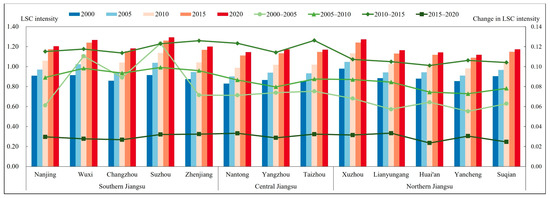
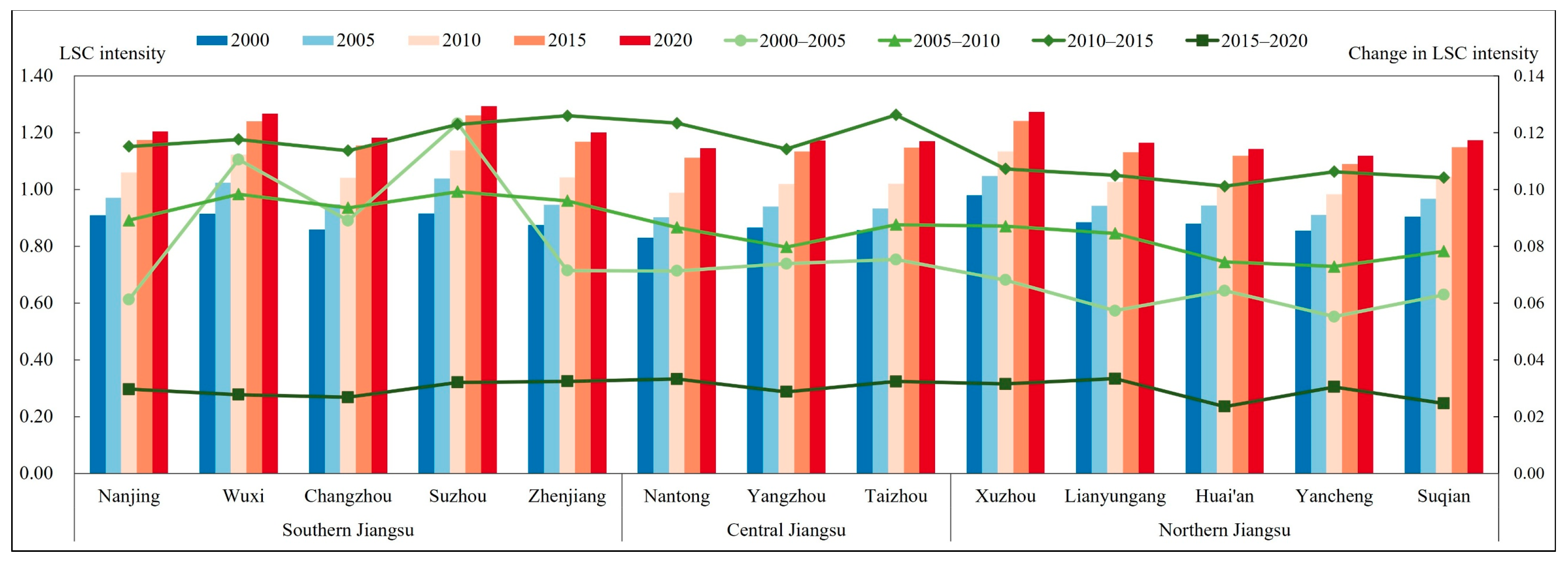
The LSC intensity and its dynamic change values of the municipal units in Jiangsu Province from 2000 to 2020 are shown in Figure 4. Xuzhou exhibited the highest LSC intensity in both 2000 and 2005, while Nantong maintained the lowest values during this period. A significant shift occurred in 2010 when Suzhou surpassed Xuzhou, subsequently retaining the highest intensity through 2015 and 2020. Concurrently, Yancheng displaced Nantong as the region with minimal LSC intensity from 2010 onward. The inter-city disparity in LSC intensity demonstrates an expanding trend, particularly after 2005. Notably, Xuzhou, Suzhou, and Wuxi consistently displayed significantly elevated LSC intensity compared to other cities. By 2020, the LSC intensity of these three cities are all greater than 1.25, indicating that their land space utilization structure is irrational. This persistent elevation highlights the imperative for systematic optimization and strategic adjustments in their land space configurations.
Figure 4.
LSC intensity and its changes in Jiangsu Province from 2000 to 2020.
Regarding temporal dynamics, the LSC intensity demonstrates sustained growth with a distinctive growth rate pattern characterized by initial acceleration followed by subsequent deceleration, suggesting moderated intensification of space conflicts. City units reached peak incremental values (exceeding 0.1) during 2010–2015, followed by a notable decline to minimal increments (<0.04) in 2015–2020. From 2000 to 2020, the changes in the LSC intensity range from 0.2632 to 0.3773, with an overall characterization of Southern Jiangsu > Central Jiangsu > Northern Jiangsu. This spatial gradient corresponds closely with regional disparities in urbanization progression and economic vitality. Notably, Suzhou recorded the most pronounced conflict intensification (0.3773), likely attributable to a combination of factors including accelerated economic expansion, rapid urban sprawl, intensified industrial emissions, and comparatively insufficient ecological conservation measures. Conversely, Yancheng exhibited the minimal growth increment (0.2632), potentially associated with its demographic sparsity, restrained land development intensity, and prioritized preservation of ecologically sensitive wetlands.
4.1.2. Evolutionary Characteristics of UL
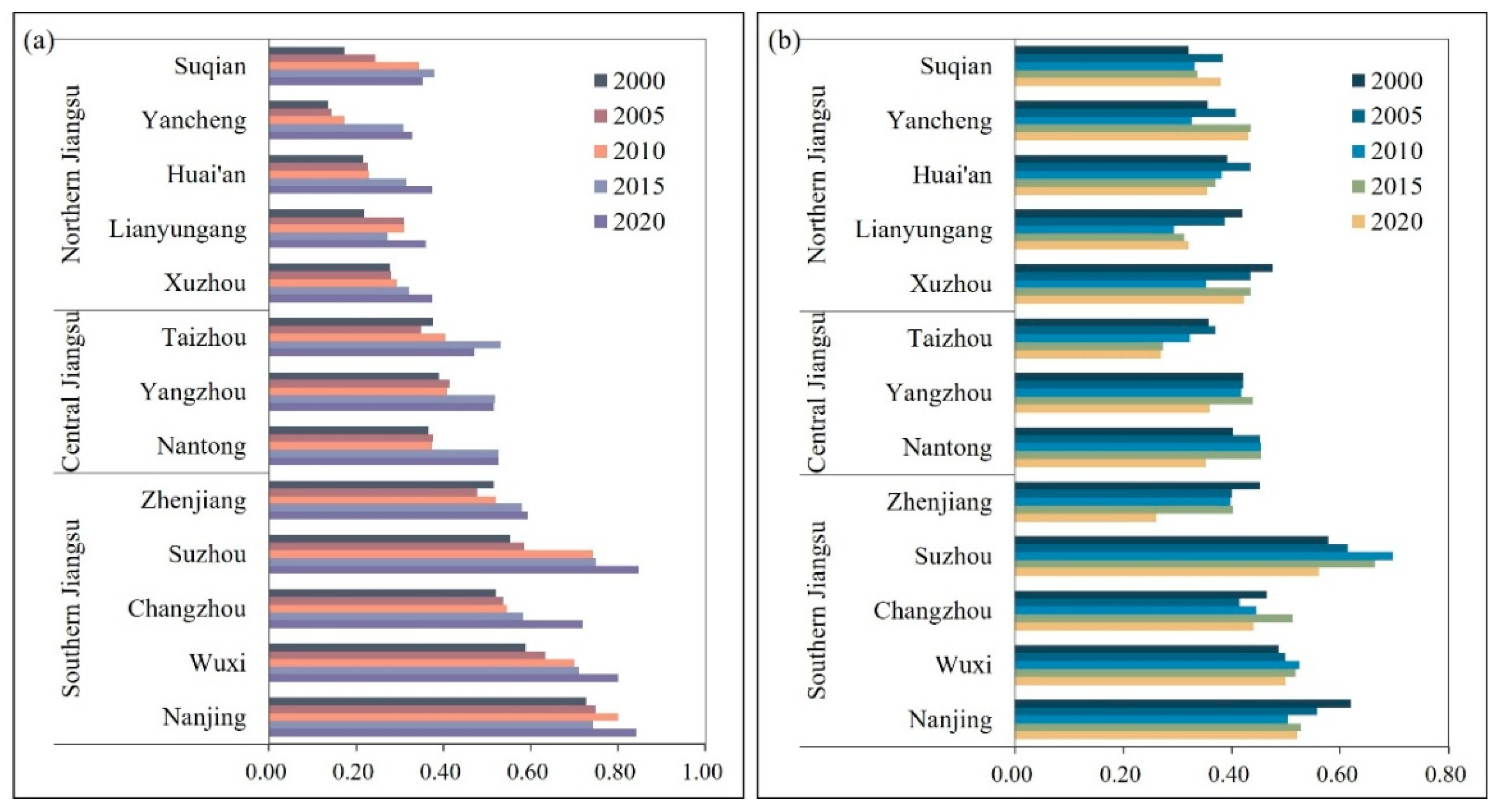
The ULs of cities in Jiangsu Province from 2000 to 2020 are illustrated in Figure 5a. The overall UL in Jiangsu Province exhibited continuous improvement during this period, with narrowing disparities among cities. Specifically, Nanjing recorded the highest UL in 2000, 2005, and 2010, with Yancheng consistently showing the lowest UL during these years. By 2015, Suzhou surpassed Nanjing to claim the top position in UL, while Lianyungang became the city with the lowest UL. In 2020, Suzhou maintained its leading position with the highest UL, whereas Yancheng remained at the lowest position. The UL generally demonstrates a leadership trend dominated by Nanjing, Wuxi, and Suzhou throughout the study period.
Figure 5.
(a) UL and (b) EL in Jiangsu Province from 2000 to 2020.
A comparative analysis of cities reveals that Suzhou experienced the most substantial urbanization growth, with its UL increasing from 0.55 in 2000 to 0.85 in 2020. Since 2004, Suzhou prioritized economic transformation, leading to a notable rise in employment share and output value of secondary and tertiary industries. Consequently, the city ranked first province-wide in these metrics in 2010, 2015, and 2020, while also achieving the highest per capita GDP and urban resident disposable income in 2015 and 2020. Wuxi and Changzhou followed, exhibiting the largest urbanization growth during 2015–2020. This surge aligns with the 2016 Yangtze River Delta Urban Agglomeration Development Plan, which mandated functional integration between the Su-Xi-Chang metropolitan area and Shanghai, thereby enhancing urbanization quality in these cities. Notably, the UL of Nanjing experienced a marked decline between 2010 and 2015, attributable to Suzhou’s accelerated economic urbanization and the widening development gap between the two cities. And the UL of Taizhou saw a significant urbanization decrease from 2015 to 2020, primarily driven by reduced urban population density according to indicator analysis.
4.1.3. Evolutionary Characteristics of EL
The ELs of cities in Jiangsu Province from 2000 to 2020 are illustrated in Figure 5b. The ELs exhibited minor fluctuations with limited magnitude, demonstrating less pronounced inter-city disparities compared to ULs. Specifically, a general decline occurred during 2005–2010 and 2015–2020, while an upward trend prevailed in 2010–2015. In 2000, Nanjing recorded the highest EL (0.62), contrasting with Suqian’s lowest EL (0.32). From 2005 to 2020, Suzhou consistently maintained the highest EL across all measurement years, whereas Taizhou remained at the lowest EL during this period.
A comparative analysis of cities reveals that, while all cities exhibited fluctuating ELs from 2000 to 2020, their overall trends diverged significantly. Yancheng, Suqian, and Wuxi demonstrated increases of 0.07, 0.06, and 0.01, respectively, whereas other cities experienced varying degrees of decline. Notably, Zhenjiang recorded the most substantial reduction, decreasing from 0.45 in 2000 to 0.26 in 2020. This decline was particularly pronounced during 2015–2020, attributable to significant reductions in per capita green space, water resources, and cultivated land during this phase.
4.2. The Interaction Between UL and EL
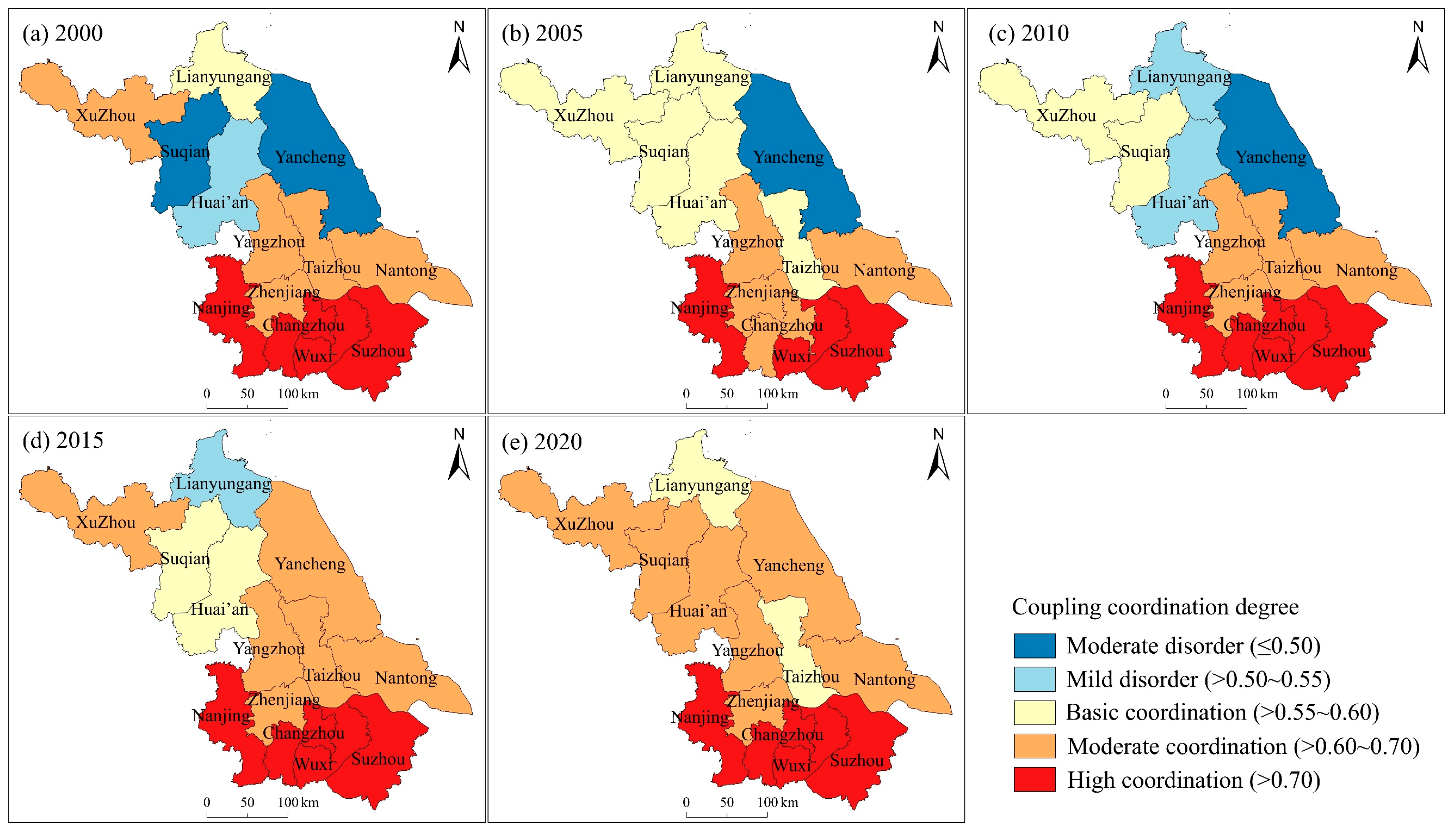
As shown in Figure 6, the coupling coordination degree between UL and EL in Jiangsu Province demonstrated overall improvement from 2000 to 2020, indicating concurrent enhancements in both UL and EL. Nanjing exhibited the highest coupling coordination degree in 2000 and 2005, while Suzhou claimed the top position during 2010–2020. Conversely, Yancheng recorded the lowest degree from 2000 to 2010, succeeded by Lianyungang in 2015 and 2020.
Figure 6.
Coupling coordination between UL and EL in Jiangsu Province in (a) 2000, (b) 2005, (c) 2010, (d) 2015, and (e) 2020.
A comparative analysis of the changes in cities reveals divergent trends in coupling coordination degree across cities from 2000 to 2020. Nanjing, Taizhou, and Zhenjiang experienced minor declines, with Zhenjiang showing the most substantial decrease (−0.07), while Nanjing and Taizhou registered reductions below 0.01. Other cities demonstrated improvements, particularly Yancheng, which achieved the greatest increase (0.14) and progressed from moderate disorder to moderate coordination. Three distinct coordination patterns emerged: (1) Nanjing, Wuxi, and Suzhou maintained high coordination levels throughout the period. (2) Yangzhou, Nantong, and Zhenjiang remained at moderate coordination levels. (3) Dynamic transitions: Changzhou transitioned through high-moderate-high coordination phases, Suqian and Huai’an advanced from moderate/mild disorder to moderate coordination, Xuzhou and Taizhou alternated between moderate and basic coordination, Lianyungang fluctuated through basic coordination–mild disorder–basic coordination phases.
Spatial analysis reveals a distinct “high in the south and low in the north” gradient pattern in the coupling coordination degree between urbanization and eco-environment across Jiangsu Province. Moran’s I of the coupling coordination degree in 2000, 2005, 2010, 2015 and 2020 are 0.55, 0.47, 0.47, 0.59 and 0.52, respectively, which all pass the significance test (p < 0.01). These results demonstrate strong spatial agglomeration characteristics, with the most pronounced agglomeration observed in 2015.
4.3. The Interaction Between LSC Intensity and UL
4.3.1. Analysis of Urbanization Drivers of LSC Intensity
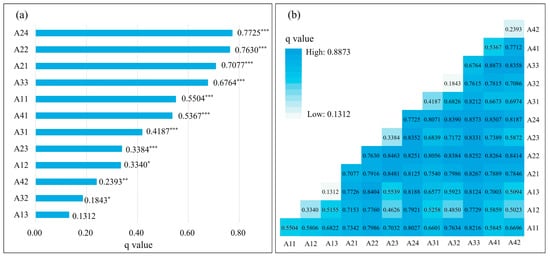
As evidenced by the single-factor detection results (Figure 7a), per capita disposable income of urban residents (A24) demonstrates the strongest explanatory power over LSC intensity, achieving a maximum q value of 0.7725. Subsequent influential factors follow this hierarchy: per capita investment in social fixed assets (A22) and per capita GDP (A21). The urbanization subsystems’ driving effects on LSC intensity exhibit a distinct potency gradient: economic urbanization > social urbanization > land urbanization > population urbanization. This hierarchy reveals that economic urbanization advancement constitutes the primary driver of LSC intensity intensification in Jiangsu Province, where high-yield economic pursuits and efficiency-oriented development strategies exert substantial pressure on land resource utilization patterns.
Figure 7.
Detection of urbanization driving factors on LSC intensity. ((a) Single-factor detection results. (b) Interaction-factor detection results). Note: In (a), “***” indicates a p-value less than 0.01 in the significance test, “**” indicates a p-value less than 0.05, and “*” indicates a p-value less than 0.1.
The factor interaction detection outcomes reveal that over 80% of interaction types demonstrate bifactor enhancement effects (Figure 7b). Among them, the most potent interaction emerges between per capita built-up area and urban registered unemployment rate (A41 ∩ A33), yielding a maximum q value of 0.8873. Significant interactions are also observed for per capita disposable income of urban residents (A24) and per capita fixed-asset investment (A22) with other factors, consistently producing q values exceeding 0.75. From subsystem perspectives, the population urbanization factors, the social urbanization factors and the land urbanization factors all have the strongest interactions with the economic urbanization factor, with q-mean values of 0.7309, 0.7988 and 0.7796, respectively, while their internal factor interactions are the weakest, with q-mean values of 0.4656, 0.5908 and 0.5157. In addition, the internal factor interactions of economic urbanization are relatively strong, with a q-mean value of 0.7541. These findings collectively demonstrate that cross-subsystem factor interactions exert substantially greater driving forces on LSC intensity than intra-subsystem interactions.
4.3.2. Analysis of the Decoupling of LSC Intensity and UL
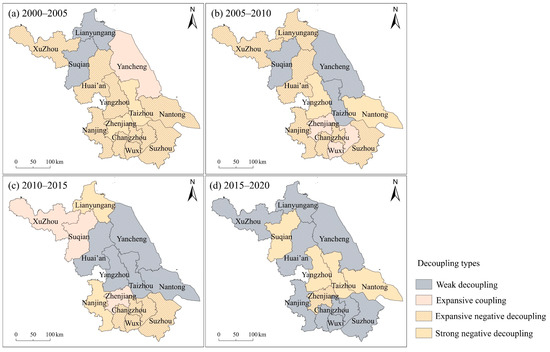
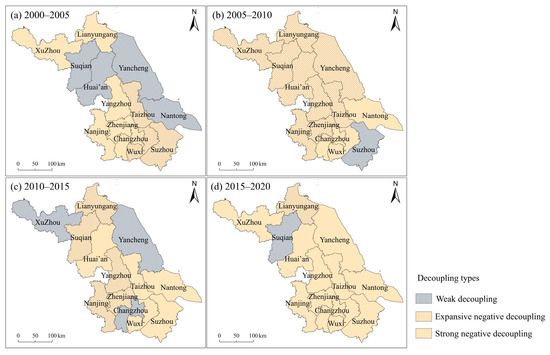
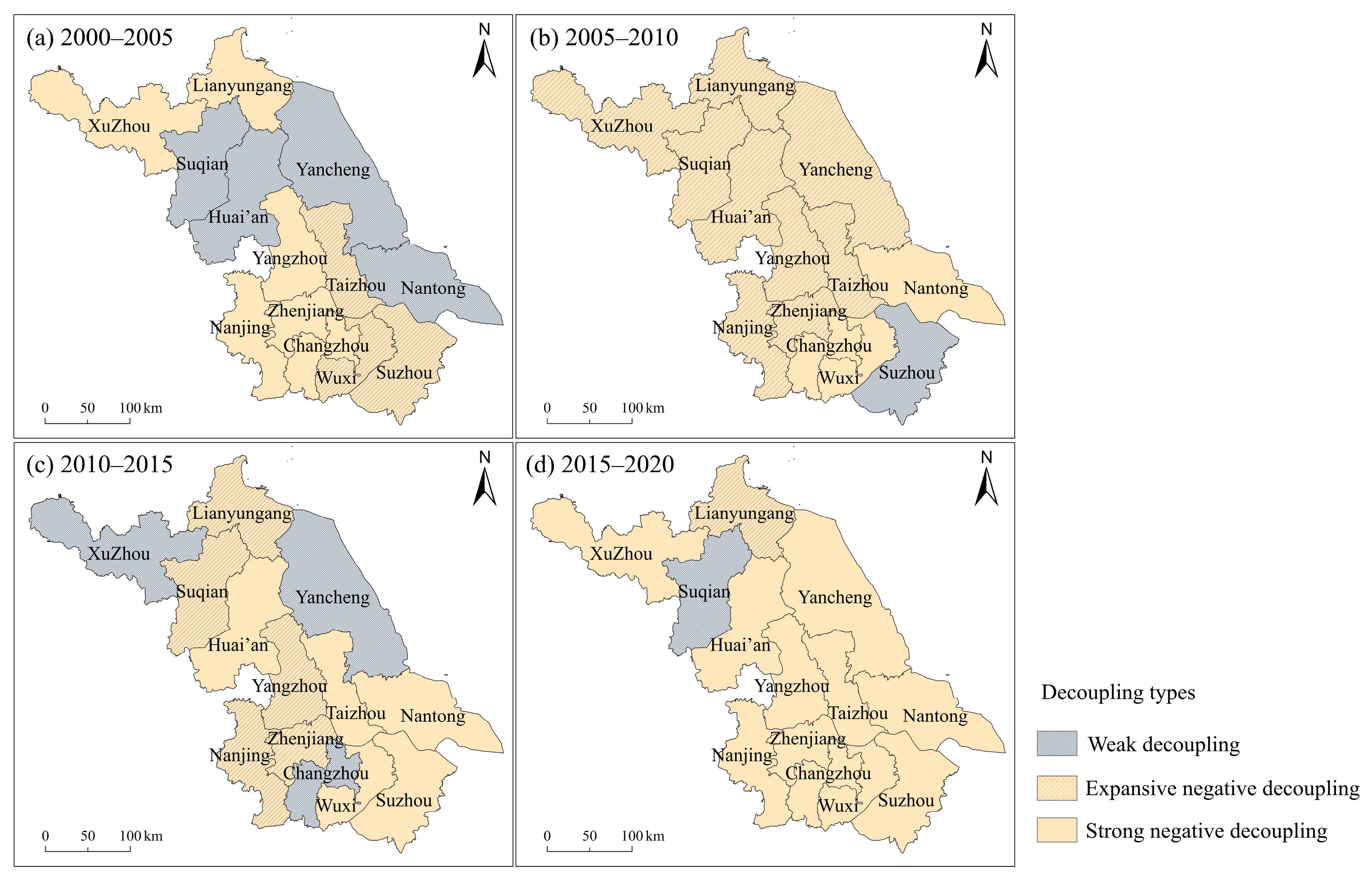
The decoupling analysis reveals distinct LSC intensity–UL dynamics (Appendix A, Table A3): Asynchronous development (weak decoupling) demonstrates limited UL influence on LSC intensity intensification, whereas coordinated progression (negative decoupling) indicates strong LSC intensity–UL interdependencies. As shown in Figure 8, the decoupling type of LSC intensity and UL in Jiangsu Province is dominated by expansion negative decoupling and weak decoupling, with obvious regional differences.
Figure 8.
Decoupling types between LSC intensity and UL in Jiangsu Province. ((a) Decoupling types in 2000–2005. (b) Decoupling types in 2005–2010. (c) Decoupling types in 2010–2015. (d) Decoupling types in 2015–2020).
In Southern Jiangsu, Nanjing, Wuxi, Changzhou, and Suzhou transitioned from expansive negative decoupling to weak decoupling, signaling diminishing urbanization impacts. Contrastingly, Zhenjiang maintained persistent negative decoupling, underscoring sustained urbanization pressures. Central Jiangsu exhibited phased dynamics: Nantong and Yangzhou demonstrated temporary weak decoupling (2010–2015), while Taizhou alternated between types, revealing cyclical urbanization influences. Northern Jiangsu displayed divergent trajectories, Xuzhou, Huai’an, and Yancheng showed progressive impact attenuation, Lianyungang followed parabolic trends, Suqian exhibited intensifying couplings. Temporally, negative decoupling units decreased from 10 to 5, while weak decoupling increased from 2 to 8, quantitatively confirming weakening LSC intensity–UL linkages.
4.4. The Interaction Between LSC Intensity and EL
4.4.1. Analysis of Eco-Environment Drivers of LSC Intensity
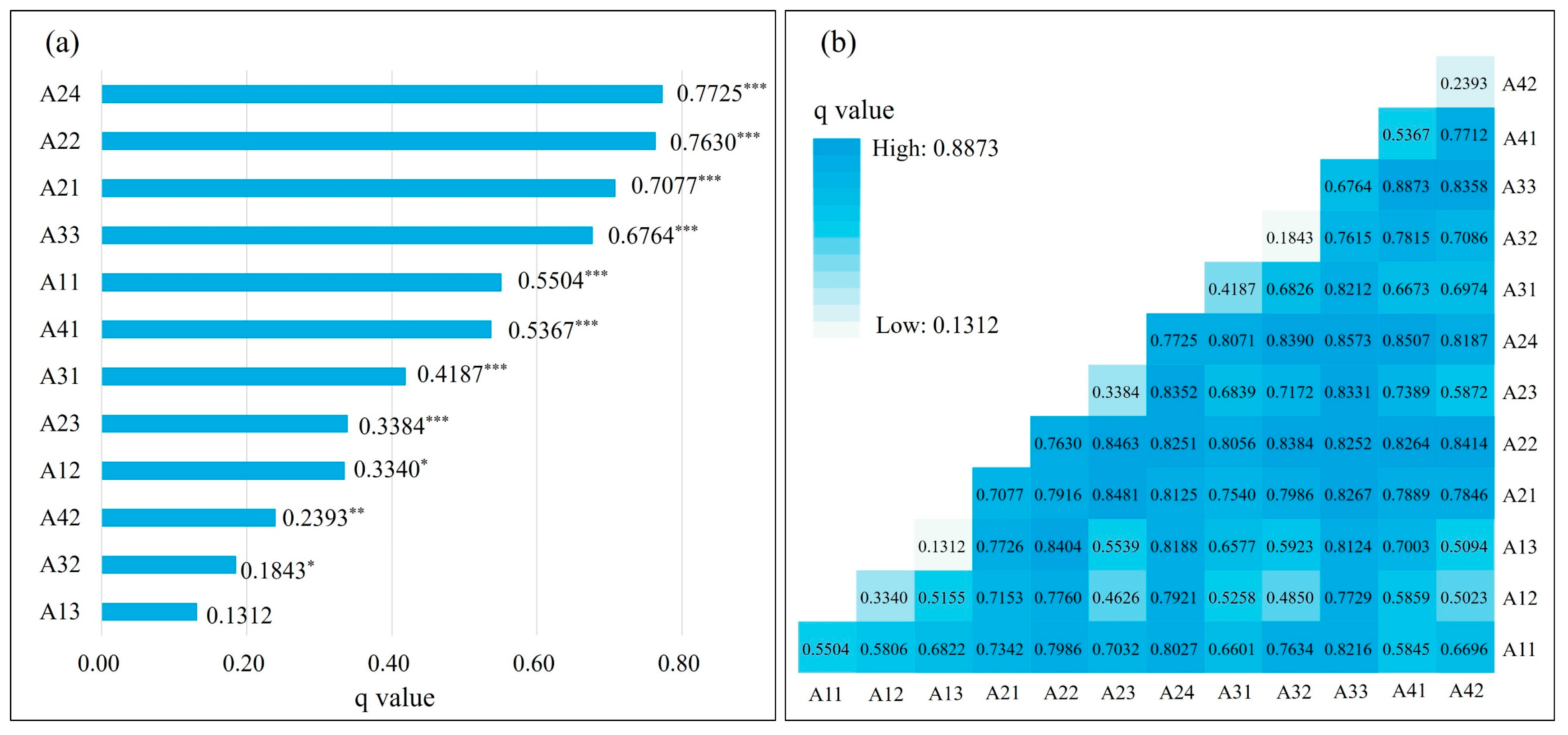
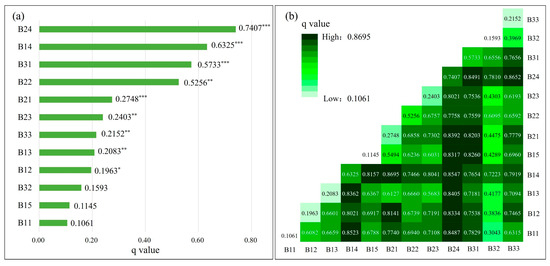
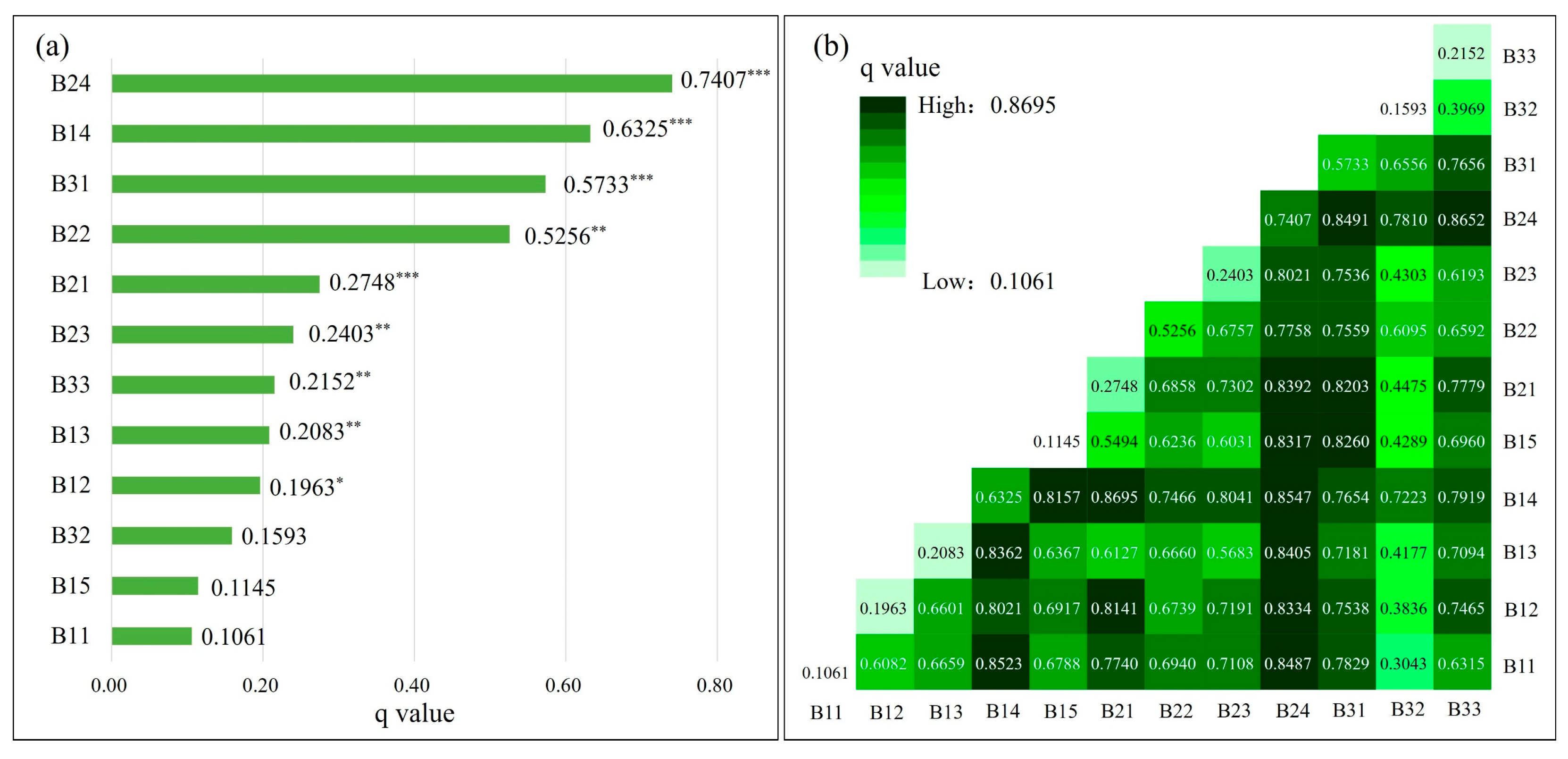
From the results of single-factor detection (Figure 9a), per capita cultivated land (B24) has the greatest driving force on LSC intensity, with a q value of 0.7407, indicating that the reduction in cultivated land leads to spatial imbalance, which in turn exacerbates space conflicts, followed by per capita domestic electricity consumption (B14) and domestic sewage treatment rate (B31), and the above factors belong to the three subsystems, respectively. The drivers in the eco-environment subsystem are, in descending order of strength, eco-environment carrying, eco-environment protection, and eco-environment pressure. In contrast to the urbanization factor, the driving role of the eco-environment factor is weaker.
Figure 9.
Detection of eco-environment driving factors on LSC intensity. ((a) Single-factor detection results. (b) Interaction-factor detection results). Note: In (a), “***” indicates a p-value less than 0.01 in the significance test, “**” indicates a p-value less than 0.05, and “*” indicates a p-value less than 0.1.
The factor interaction analysis reveals that approximately 50% of interaction types exhibit nonlinear enhancement effects, demonstrating superior synergistic amplification between eco-environment factors compared to urbanization-related interactions (Figure 9b). Among them, the strongest synergistic interaction occurs between per capita green space and per capita domestic electricity consumption (B21 ∩ B14), achieving a maximum q value of 0.8695. Significant interactions are also observed for per capita domestic electricity consumption (B14) and per capita cultivated land (B24) with other factors. From subsystem perspectives, both the eco-environment pressure factors and the eco-environment protection factors have the strongest interaction with the eco-environment carrying factors, with q-mean values of 0.7319 and 0.6974, respectively, while the three subsystems’ internal factors have the weakest interactions, with q-mean values of 0.5670, 0.4610, and 0.6290, respectively. These findings collectively demonstrate that the interaction-driven mechanisms of eco-environment factors mirror those observed in urbanization factors, revealing that cross-subsystem interactions between different eco-environment subsystems exert significantly stronger driving forces on LSC intensity than intra-subsystem interactions.
4.4.2. Analysis of the Decoupling of LSC Intensity and EL
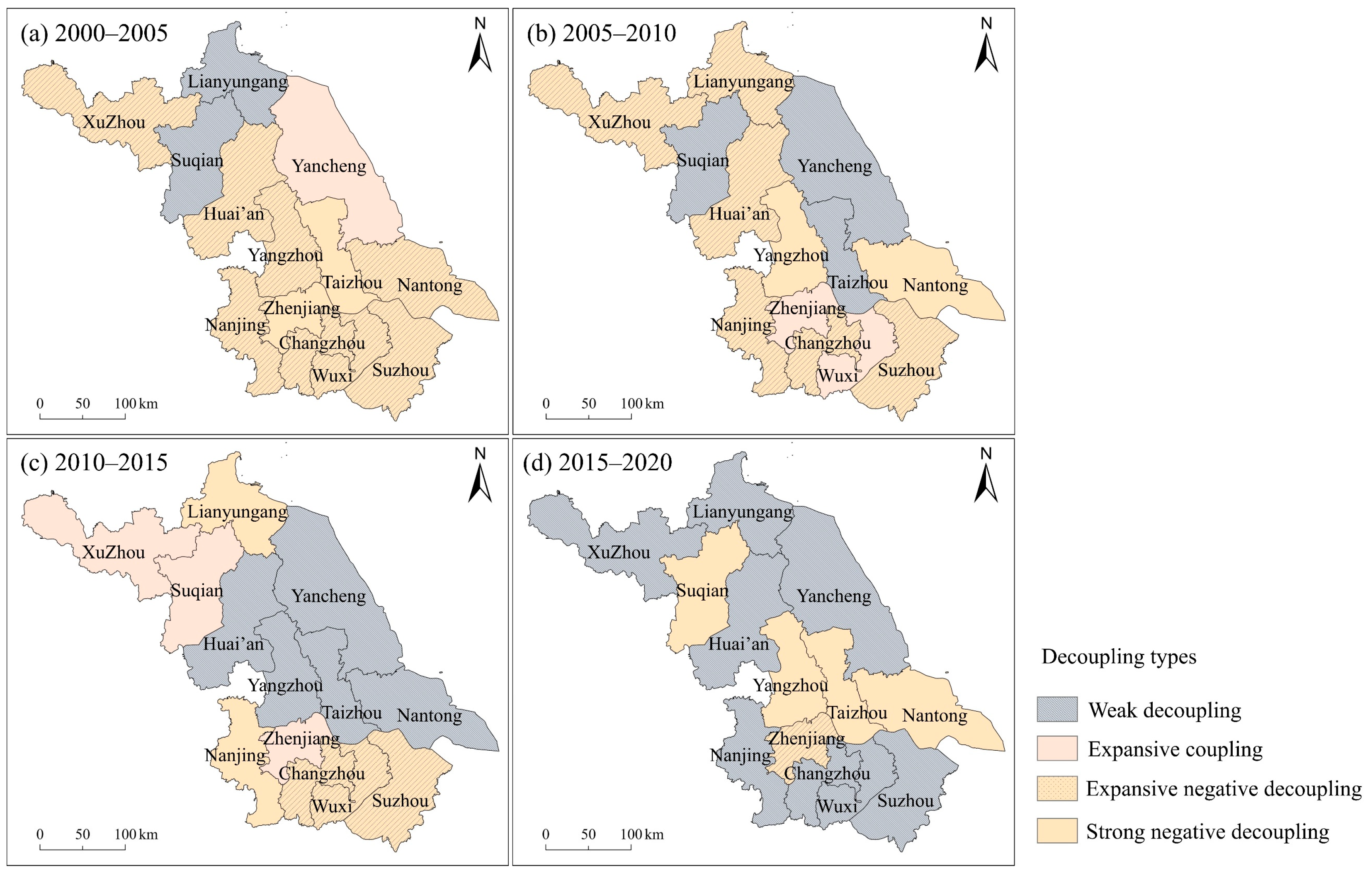
The decoupling analysis reveals distinct LSC intensity–EL dynamics (Appendix A, Table A3). Figure 10 demonstrates that LSC intensity in Jiangsu Province primarily exhibit strong negative decoupling patterns from EL. Six cities including Nanjing, Wuxi, Zhenjiang, Yangzhou, Taizhou, and Lianyungang transitioned between expansive negative decoupling and strong negative decoupling types, with the latter becoming predominant after 2010. This persistent dominance indicates robust correlations between LSC intensity and EL, particularly highlighting how EL degradation intensifies LSC intensity. Xuzhou, Huai’an, and Yancheng oscillated between weak decoupling and strong negative decoupling, while Changzhou, Suzhou, and Nantong cycled through expansive negative decoupling, weak decoupling, and strong negative decoupling types. All these regions converged toward sustained strong negative decoupling between 2015 and 2020, evidencing strengthened EL influences on LSC intensity. Suqian uniquely underwent a three-phase evolution from decoupling to negative decoupling and back to decoupling, reflecting initial intensification followed by gradual mitigation of EL impacts.
Figure 10.
Decoupling type between LSC intensity and EL in Jiangsu Province. ((a) Decoupling types in 2000–2005. (b) Decoupling types in 2005–2010. (c) Decoupling types in 2010–2015. (d) Decoupling types in 2015–2020).
Temporally, negative decoupling units increased from 9 to 12, with 11 strong negative decoupling, while weak decoupling units dwindled from 4 to 1. This progression conclusively validates the growing regulatory dominance of EL on LSC intensity, demonstrating both increased prevalence and amplified effect magnitudes.
4.5. Systematic Analysis Based on “Degree of Coupling Coordination-Type of Decoupling”
To propose management recommendations that better align with development trends, this paper systematically analyzes the performance characteristics of cities in Jiangsu Province from 2015 to 2020 through the coupling coordination patterns between UL and EL, as well as decoupling relationships between LSC intensity with UL and EL, as shown in Table 3.
Table 3.
Coupling coordination types and decoupling types in Jiangsu Province.
In Southern Jiangsu, most cities (Nanjing, Wuxi, Changzhou, Suzhou) showed high coordination with UL leading, where LSC intensity was less sensitive to UL changes but strongly influenced by EL variations. Zhenjiang exhibited moderate coordination, with LSC intensity affected by both UL and EL, though EL remained the dominant driver. Central Jiangsu displays reduced LSC intensity compared to Southern Jiangsu, with minimal inter-city disparities. The area maintains moderate UL-EL coordination accompanied by accelerated UL. Both UL processes and EL changes exert substantial impacts on LSC intensity in this sub-region. Northern Jiangsu manifests heterogeneous characteristics, Xuzhou and Yancheng achieve intermediate coordination levels with EL advancement outpacing UL, showing greater LSC intensity sensitivity to EL changes. Lianyungang and Huai’an exhibit lower coordination levels, where LSC intensity remain predominantly influenced by EL fluctuations. Suqian demonstrates the lowest coordination level despite faster EL, with its LSC intensity being primarily driven by UL changes.
5. Discussion
5.1. Management Recommendations
This study categorizes municipal units in Jiangsu Province into five distinct types and proposes corresponding management recommendations:
- (1)
- H-D-ND (High coordination—Decoupling–Negative decoupling): Nanjing, Wuxi, Changzhou, Suzhou
Short-term strategies: Immediate actions should include the strict enforcement of ecological redline zoning and land use regulations to curb urban encroachment on farmland and ecologically sensitive areas. Concurrently, a targeted horizontal ecological compensation mechanism for farmland preservation and ecological restoration should be launched, funded through municipal budgets and land conveyance revenue, alongside the introduction of market-based instruments like tradable pollution permits and development rights to incentivize emission reduction and intensive land use.
Long-term strategies: The focus should shift to constructing a regionally integrated ecological network that systematically incorporates greenways, blue corridors (water systems), and infrastructure buffers into the built environment. This should be coupled with promoting intensive land use through urban regeneration and brownfield redevelopment. Establishing a long-term, cross-jurisdictional ecological compensation and coordination mechanism within the Yangtze River Delta framework, for instance for Taihu Lake governance, is essential to mitigate LSC systematically.
- (2)
- M-ND-ND (Moderate coordination–Negative decoupling–Negative decoupling): Zhenjiang, Nantong, Yangzhou, Taizhou
Short-term strategies: Efforts should prioritize rapid enhancement of environmental infrastructure, such as wastewater treatment and solid waste recycling, through Public–Private Partnerships (PPPs). Strict Environmental Impact Assessments (EIAs) for new urban expansion projects must be enforced, supplemented by subsidy policies to guide agricultural restructuring and farmland preservation, thereby curbing the amplifying effect of ecological degradation on LSC.
Cities should actively integrate into regional ecological patterns, such as Zhenjiang strengthening industrial–innovation–ecological linkages with Southern Jiangsu, Yangzhou enhancing the protection of the Jianghuai Ecological Grand Corridor and integrating into the Nanjing metropolitan area, Nantong building a river–sea–estuary ecological network, and Taizhou upgrading the Lixia River wetland ecosystem. Long-term goals involve formulating cross-administrative watershed coordination plans and ecological compensation funds, and developing eco-industrial parks supported by tax incentives and green credit to achieve low-consumption, high-efficiency coordinated development.
- (3)
- M-D-ND (Moderate coordination–Decoupling–Negative decoupling): Xuzhou, Yancheng
Short-term strategies: Policy should channel increased financial and technological resources, utilizing central government transfers and provincial matching funds, to upgrade wastewater, solid waste, and pollutant treatment facilities for rapid environmental improvement. Simultaneously, implement policies like subsidies for converting sloping farmland to forests and wetland restoration, and guide orderly urban expansion by linking industrial land quotas to environmental performance assessments based on resource and carrying capacity evaluations.
Long-term strategies: Xuzhou needs deep integration of the “Three Zones and Three Lines” spatial planning framework with rigid–flexible control strategies to balance development and conservation. Yancheng should consolidate its “Ecological Metropolis” status by strategically leveraging coastal and wetland resources, potentially establishing a regional carbon sink trading platform to monetize ecosystem services from forests and wetlands, ultimately forming a land–sea interconnected ecological pattern to fundamentally alleviate LSC.
- (4)
- B-D-ND (Basic coordination–Decoupling–Negative decoupling): Lianyungang, Huai’an
Short-term strategies: Authorities should accelerate the construction of public service and environmental infrastructure using municipal bonds and green funds. Immediate implementation of water-saving incentives and industrial water quota systems is needed to alleviate resource pressure, alongside strict zoning enforcement to prevent urban sprawl into ecologically vulnerable zones.
Long-term strategies: Lianyungang should develop port–logistics–ecology integrated zones based on low-impact design and green port certifications. Huai’an must establish a balanced coordination mechanism between water resource conservation and urban expansion, promoting sponge city construction. Both cities should unlock their significant potential in urbanization and ecological quality by creating an ecological-industry synergy fund to support green manufacturing and eco-tourism start-ups.
- (5)
- B-ND-D (Basic coordination–Negative decoupling–Decoupling): Suqian
Short-term strategies: The primary focus must be on economic urbanization by attracting investment through improved business environments and streamlined land approvals for industrial parks. Concurrently, initiate phased consolidation and composite use models for inefficient urban and rural construction land, and launch ecological restoration projects for critical areas like Lake Hongze, Lake Luoma, and the Grand Canal using central ecological restoration funds to alleviate environmental pressure.
Long-term strategies: Developing a county-level ecological security pattern and integrating blue-green infrastructure into the overall territorial spatial plan is crucial. Establishing a land reserve system to guide urban expansion towards suitable areas and consolidate rural construction land is needed, along with promoting orderly ecological migration from fragile zones, supported by resettlement subsidies and job training programs, to coordinate development and conservation during accelerated urbanization.
5.2. Mechanistic Insights and Theoretical Contributions
This study confirms that economic urbanization is the dominant driver of LSC intensity in Jiangsu, aligning with findings from other fast-growing regions [23,25,57,62]. This reinforces that economic vitality and its land demands are central to LSC. While UL-EL coordination improved in Jiangsu, especially in the south, significant LSC intensity persisted even in highly coordinated cities like Suzhou and Wuxi. This reveals a critical nuance: achieving UL-EL synergy does not automatically resolve land conflicts driven by localized spatial competition, highlighting the need for targeted interventions beyond general coordination policies [25,63]. A key theoretical contribution is the empirical demonstration that cross-subsystem interactions exert stronger influences on LSCI than single factors or within-subsystem effects. Quantified via interaction q-values, this underscores the nonlinear, interconnected nature of conflict drivers, moving beyond conventional focus on individual factors [2,25,62].
5.3. Policy Transfer and Comparative Relevance
While Jiangsu’s developmental trajectory is unique, the patterns and mechanisms uncovered in this study offer valuable insights for other regions facing similar urbanization and environmental challenges. A comparison with other highly urbanized and economically vibrant Chinese provinces like Guangdong and Zhejiang reveals commonalities [64,65,66]. All three regions exhibit intense land competition, ecological pressures from dense populations and industries, and a strategic shift towards high-quality, coordinated development. The identified typologies of cities (e.g., highly coordinated yet high-conflict metropolises, moderately coordinated areas with dual pressure from UL and EL) are likely to find parallels in the Pearl River Delta and the Hangzhou Bay area [64,66,67]. The analytical framework combining coupling coordination and decoupling analysis can thus serve as a template for diagnosing land space issues in these comparable contexts.
Globally, the dominance of economic drivers, tension between cropland loss and urban expansion, and the shifting influence from urbanization to eco-environmental pressure are patterns observable in rapidly developing regions of Southeast Asia, Africa, and Latin America [68,69,70]. Management strategies like ecological redlines and differentiated zoning are adaptable tools [71,72]. This study contributes a validated, quantitative methodology to the global challenge of governing the development-environment-conflict nexus.
5.4. Limitations and Future Work
Nonetheless, this paper has several limitations that present avenues for future research. Firstly, the analysis is primarily conducted at the municipal level, which may overlook the nuanced heterogeneity and conflict dynamics at finer administrative scales such as counties or townships. Future studies should incorporate finer-scale data to unravel the micro-level mechanisms of LSC. Secondly, while the 3 km grid scale for LSC intensity calculation was selected based on landscape ecological principles, its sensitivity to different spatial resolutions (e.g., 1 km or 5 km) was not systematically tested. Future research could incorporate multi-scale analysis to examine the robustness of conflict identification across varying grid sizes. Thirdly, while land use data were employed, the reliance on statistical indicators for UL and EL assessment, coupled with the limited temporal resolution of data, constrains the real-time monitoring capability. Subsequent research could benefit from integrating high-frequency, real-time satellite data (e.g., from Sentinel and Landsat series) to dynamically track environmental changes and urban expansion. Finally, this paper establishes preliminary causal relationships but does not venture into prediction. A promising direction is to develop predictive modeling frameworks using artificial intelligence (e.g., machine learning, deep learning) or spatial econometric models. These approaches could incorporate the identified drivers to simulate future LSC scenarios under various policy interventions, thereby providing a more robust tool for proactive spatial governance and decision-making.
6. Conclusions
This paper develops an integrated framework to unravel the complex interactions among LSC intensity, UL, and EL in Jiangsu Province from 2000 to 2020. The main conclusions are as follows:
- (1)
- This paper provides new evidence on the long-term spatiotemporal dynamics of the UL–EL–LSC intensity system in a rapidly urbanizing region. We document a continuous intensification of LSC intensity, with a distinct south-to-north gradient, alongside steady UL growth and fluctuating EL conditions. The coupling coordination between UL and EL showed significant improvement and strong spatial clustering, evolving from disorder to high coordination in Southern Jiangsu. Decoupling analysis further revealed that urbanization’s driving effect on LSC intensity weakened over time, whereas the pressure from the eco-environment became increasingly prominent.
- (2)
- This paper advances the theoretical framework for analyzing land space governance by integrating coupling coordination and decoupling analysis. We demonstrate that the interactions between factors across the urbanization and eco-environment subsystems exert a stronger influence on LSC intensity than factors within a single subsystem. This underscores the necessity of a cross-system perspective in understanding and managing the complex drivers of LSC intensity.
- (3)
- This paper proposes a practical city typology based on coupling–decoupling patterns, classifying the 13 cities of Jiangsu into five distinct categories: H-D-ND, M-ND-ND, M-D-ND, B-D-ND, and B-ND-D. This typology provides a clear and actionable basis for policymakers to design tailored spatial governance strategies. It enables differentiated management recommendations across regions, focusing on promoting sustainable urbanization, protecting the eco-environment, mitigating LSC, and optimizing territorial spatial layouts. This approach not only supports high-quality development in Jiangsu but also offers a transferable methodology for other rapidly developing regions facing similar land governance challenges.
Author Contributions
X.L. (Xizhao Liu): Conceptualization, Methodology, Formal analysis, Data curation, Writing—original draft, Writing—review and editing, Funding acquisition. Y.C.: Formal analysis, Data curation, Writing—original draft. G.H.: Conceptualization, Writing—review and editing, Funding acquisition. P.L.: Validation, Writing—review and editing, Funding acquisition. J.C.: Validation, Formal analysis, Writing—review and editing. X.L. (Xiaoshun Li): Conceptualization, Writing—review and editing, Funding acquisition. All authors have read and agreed to the published version of the manuscript.
Funding
This research was supported by the National Natural Sciences Foundation of China (No. 72474214), Natural Science Foundation of Hebei Province, China (Nos. D2025203011, G2023203015), and Social Science Foundation of Hebei Province, China (No. HB25GL052).
Data Availability Statement
Data will be made available on request.
Acknowledgments
We thank all the reviewers and editors.
Conflicts of Interest
The authors declare that they have no known competing financial interests or personal relationships that could have appeared to influence the work reported in this paper.
Appendix A
Table A1.
Weights for each indicator in the UL and EL evaluation systems.
Table A2.
Discretization methods and number of partition points for driving factors.
Table A3.
Dc between LSC intensity and UL/EL.
References
- Liu, X.; Li, X.; Zhang, Y.; Wang, Y.; Chen, J.; Geng, Y. Spatiotemporal evolution and relationship between construction land expansion and territorial space conflicts at the county level in Jiangsu Province. Ecol. Indic. 2023, 154, 110662. [Google Scholar] [CrossRef] [Scilit]
- Chen, L.; Zhang, A. Identification of land use conflicts and dynamic response analysis of Natural-Social factors in rapidly urbanizing areas—A case study of urban agglomeration in the middle reaches of Yangtze River. Ecol. Indic. 2024, 161, 112009. [Google Scholar] [CrossRef] [Scilit]
- Han, B.; Jin, X.; Zhao, Q.; Chen, H. Spatiotemporal patterns and mechanisms of land-use conflicts affecting high-quality development in China. Appl. Geogr. 2023, 155, 102972. [Google Scholar] [CrossRef] [Scilit]
- Liu, X.; Li, X.; Li, P.; Geng, Y.; Chen, J.; Hu, G. Delineation of and conflict coordination in municipal territorial space functional zones: A case study of Xuzhou, China. Land 2025, 14, 761. [Google Scholar] [CrossRef] [Scilit]
- Ren, Q.; He, C.; Huang, Q.; Shi, P.; Zhang, D.; Guneralp, B. Impacts of urban expansion on natural habitats in global drylands. Nat. Sustain. 2022, 5, 869–878. [Google Scholar] [CrossRef] [Scilit]
- Chakraborty, S.; Maity, I.; Dadashpoor, H.; Novotnẏ, J.; Banerji, S. Building in or out? Examining urban expansion patterns and land use efficiency across the global sample of 466 cities with million+ inhabitants. Habitat Int. 2022, 120, 102503. [Google Scholar] [CrossRef] [Scilit]
- Li, L.; Huang, X.; Yang, H. Scenario-based urban growth simulation by incorporating ecological-agricultural-urban suitability into a Future Land Use Simulation model. Cities 2023, 137, 104334. [Google Scholar] [CrossRef] [Scilit]
- Zhang, S.; Han, R.; Li, X.; Song, M.; Liu, H. New urbanization promoting the construction of water ecological civilization: Mechanism of influence and spatial effects. Prog. Geogr. 2024, 43, 1–16. [Google Scholar] [CrossRef] [Scilit]
- Deng, Z.; Zong, S.; Su, C.; Chen, Z. Research on coupling coordination development between ecological civilization construction and new urbanization and its driving forces in the Yangtze River Economic Zone. Econ. Geogr. 2019, 39, 78–86. [Google Scholar] [CrossRef]
- Chen, W.; Gu, T.; Xiang, J.; Luo, T.; Zeng, J.; Yuan, Y. Ecological restoration zoning of territorial space in China: An ecosystem health perspective. J. Environ. Manag. 2024, 364, 121731. [Google Scholar] [CrossRef] [Scilit]
- Chen, Y.; Cai, H.; Chen, Y. Spatial correlation and interaction effect intensity between territorial spatial ecological quality and new urbanization level in Nanchang metropolitan area, China. Ecol. Indic. 2023, 156, 111163. [Google Scholar] [CrossRef] [Scilit]
- Patel, U.; Ghaffarianhoseini, A.; Ghaffarianhoseini, A.; Burgess, A. Digital Twin Technology for sustainable urban development: A review of its potential impact on SDG 11 in New Zealand. Cities 2024, 155, 105484. [Google Scholar] [CrossRef] [Scilit]
- Pan, H.; Liu, G.; Muller, J.; Sun, Z.; Yao, Y.; Chang, Y.; Xiong, Z.; Zhang, Y. Comprehensive Assessment of Sustainable Development of Terrestrial Ecosystem Based on SDG 15—A Case Study of Guilin City. Remote Sens. 2025, 17, 63. [Google Scholar] [CrossRef] [Scilit]
- Karimi, A.; Brown, G. Assessing multiple approaches for modelling land-use conflict potential from participatory mapping data. Land Use Policy 2017, 67, 253–267. [Google Scholar] [CrossRef] [Scilit]
- Hjalager, A.-M. Land-use conflicts in coastal tourism and the quest for governance innovations. Land Use Policy 2020, 94, 104566. [Google Scholar] [CrossRef] [Scilit]
- Wang, Y.; Li, P.; Li, W.; Zeng, X.; Xue, B. Mitigation mechanism of land use conflicts based on evolutionary game: A case study of Shenfu New Area. China Land Sci. 2021, 35, 87–97. [Google Scholar] [CrossRef]
- Hui, E.C.M.; Bao, H. The logic behind conflicts in land acquisitions in contemporary China: A framework based upon game theory. Land Use Policy 2013, 30, 373–380. [Google Scholar] [CrossRef] [Scilit]
- Liu, X.; Li, X.; Yang, J.; Fan, H.; Zhang, J.; Zhang, Y. How to resolve the conflicts of urban functional space in planning: A perspective of urban moderate boundary. Ecol. Indic. 2022, 144, 109495. [Google Scholar] [CrossRef] [Scilit]
- Hong, W.; Guo, R.; Wang, W. A diagrammatic method for the identification and resolution of urban spatial conflicts. J. Environ. Manag. 2022, 316, 115297. [Google Scholar] [CrossRef] [Scilit]
- Liu, Y.; Zhang, Y.; Zhang, Y.; Liu, Y.; Wang, H.; Liu, Y. Conflicts between three land management red lines in Wuhan City: Spatial patterns and driving factors. Prog. Geogr. 2018, 37, 1672–1681. [Google Scholar] [CrossRef] [Scilit]
- Yi, D.; Zhao, X.; Guo, X.; Han, Y.; Jiang, Y.; Lai, X.; Huang, X. Study on the spatial characteristics and intensity factors of “three-line conflict” in Jiangxi province. J. Nat. Resour. 2020, 35, 2428–2443. [Google Scholar] [CrossRef] [Scilit]
- Qu, Y.; Wang, S.; Tian, Y.; Jiang, G.; Zhou, T.; Meng, L. Territorial spatial planning for regional high-quality development—An analytical framework for the identification, mediation and transmission of potential land utilization conflicts in the Yellow River Delta. Land Use Policy 2023, 125, 106462. [Google Scholar] [CrossRef] [Scilit]
- Jiang, S.; Meng, J.; Zhu, L. Spatial and temporal analyses of potential land use conflict under the constraints of water resources in the middle reaches of the Heihe River. Land Use Policy 2020, 97, 104773. [Google Scholar] [CrossRef] [Scilit]
- Bao, W.; Yang, Y.; Zou, L. How to reconcile land use conflicts in mega urban agglomeration? A scenario-based study in the Beijing-Tianjin-Hebei region, China. J. Environ. Manag. 2021, 296, 113168. [Google Scholar] [CrossRef] [Scilit]
- Zong, S.; Xu, S.; Huang, J.; Ren, Y.; Song, C. Distribution patterns and driving mechanisms of land use spatial conflicts: Empirical analysis from counties in China. Habitat Int. 2025, 156, 103268. [Google Scholar] [CrossRef] [Scilit]
- Nyuykighanse, N.E.; Yenlajai, B.J.; Fru, C.F.; Kimengsi, J.N. Land use conflicts and planning implications: Insights from Kumbo, Cameroon. J. Geogr. Environ. Earth Sci. Int. 2023, 27, 28–39. [Google Scholar] [CrossRef] [Scilit]
- Jensen, D.; Baird, T.; Blank, G. New landscapes of conflict: Land-use competition at the urban–rural fringe. Landsc. Res. 2018, 44, 418–429. [Google Scholar] [CrossRef] [Scilit]
- Fienitz, M.; Siebert, R. Latent, collaborative, or escalated conflict? Determining causal pathways for land use conflicts. Land Use Policy 2023, 134, 106918. [Google Scholar] [CrossRef] [Scilit]
- Wang, Q.; Wang, X.; Li, R.; Jiang, X. Reinvestigating the environmental Kuznets curve (EKC) of carbon emissions and ecological footprint in 147 countries: A matter of trade protectionism. Humanit. Soc. Sci. Commun. 2024, 11, 160. [Google Scholar] [CrossRef] [Scilit]
- Hunjra, A.I.; Bouri, E.; Azam, M.; Azam, R.I.; Dai, J. Economic growth and environmental sustainability in developing economies. Res. Int. Bus. Financ. 2024, 70, 102341. [Google Scholar] [CrossRef] [Scilit]
- Zhang, X.; Lau, C.K.M.; Li, R.; Wang, Y.; Wanjiru, R.; Seetaram, N. Determinants of carbon emissions cycles in the G7 countries. Technol. Forecast. Soc. Change 2024, 201, 123261. [Google Scholar] [CrossRef] [Scilit]
- Qu, B.; Jiang, E.; Li, J.; Liu, Y.; Liu, C. Coupling coordination relationship of water resources, eco-environment and socio-economy in the water-receiving area of the Lower Yellow River. Ecol. Indic. 2024, 160, 111766. [Google Scholar] [CrossRef] [Scilit]
- Wang, S.; Cui, Z.; Lin, J.; Xie, J.; Su, K. The coupling relationship between urbanization and ecological resilience in the Pearl River Delta. J. Geogr. Sci. 2022, 32, 44–64. [Google Scholar] [CrossRef] [Scilit]
- Song, Q.; Zhou, N.; Liu, T.; Siehr, S.A.; Qi, Y. Investigation of a “coupling model” of coordination between low-carbon development and urbanization in China. Energy Policy 2018, 121, 346–354. [Google Scholar] [CrossRef] [Scilit]
- Zou, C.; Zhu, J.; Lou, K.; Yang, L. Coupling coordination and spatiotemporal heterogeneity between urbanization and ecological environment in Shaanxi Province, China. Ecol. Indic. 2022, 141, 109152. [Google Scholar] [CrossRef] [Scilit]
- Chen, X.; Di, Q.; Jia, W.; Hou, Z. Spatial correlation network of pollution and carbon emission reductions coupled with high-quality economic development in three Chinese urban agglomerations. Sustain. Cities Soc. 2023, 94, 104552. [Google Scholar] [CrossRef] [Scilit]
- Wang, Y.; Liang, H.; Dong, L.; Zhu, Y.; Wang, Y. Harmonizing new-type urbanization and eco-efficiency: Spatial-temporal coupling coordination in the Yangtze River Economic Belt. Environ. Dev. Sustain. 2025. [Google Scholar] [CrossRef] [Scilit]
- Tan, Y.; Zhou, Y.; Zhou, H.; Gao, L.; Shi, L. Analysis of the coordinated development and influencing factors between urban population and environment: A case study of 35 metropolises in China. Sustain. Cities Soc. 2025, 121, 106160. [Google Scholar] [CrossRef] [Scilit]
- Sun, X.; Peng, B.; Elahi, E.; Wan, A. Examining the evolution and influential factors of regional ecological security patterns: A case study of Jiangsu Province, China. Stoch. Environ. Res. Risk Assess. 2025, 39, 999–1013. [Google Scholar] [CrossRef] [Scilit]
- Sha, A.; Zhang, J.; Pan, Y.; Zhang, S. How to recognize and measure the impact of phasing urbanization on eco-environment quality: An empirical case study of 19 urban agglomerations in China. Technol. Forecast. Soc. Change 2025, 210, 123845. [Google Scholar] [CrossRef] [Scilit]
- Wu, X.; Zhang, Y.; Wang, L. Coupling relationship between regional urban development and eco-environment: Inspiration from the old industrial base in Northeast China. Ecol. Indic. 2022, 142, 109259. [Google Scholar] [CrossRef] [Scilit]
- Zhu, S.; Jiang, J.; Xiang, N.; Xu, F. Exploring the interrelationship and coupling coordination between new urbanization and green development in China. Environ. Dev. Sustain. 2024. [Google Scholar] [CrossRef] [Scilit]
- Wang, J.; Shao, Z.; Zhuang, Q.; Dang, C.; Jing, P.; Cai, B.; Wang, S.; Li, J.; Yang, F.; Wang, W.; et al. Multi-scale coupling quantitative assessment of ecological-urban resilience in the Yangtze River Economic Belt. Geo-Spat. Inf. Sci. 2025, 1–21. [Google Scholar] [CrossRef] [Scilit]
- Wu, H.; Jiang, Z.; Zhu, L.; Lin, A.; Zhou, H.; Cen, L. Analyzing multiscale associations and couplings between integrated development and eco-environmental systems: A case study of the central plains urban agglomeration, China. Appl. Geogr. 2024, 171, 103387. [Google Scholar] [CrossRef] [Scilit]
- Yao, X.; Chen, Y.; Zheng, X.; Li, H.; Chen, Y.; Kong, L.; Ou, C. Spatiotemporal characteristics and influential factors of coupling coordination degree of urbanization and ecological environment in the Huaihe River ecological economic belt. Sci. Rep. 2025, 15, 12287. [Google Scholar] [CrossRef] [Scilit]
- He, J.; Wang, S.; Liu, Y.; Ma, H.; Liu, Q. Examining the relationship between urbanization and the eco-environment using a coupling analysis: Case study of Shanghai, China. Ecol. Indic. 2017, 77, 185–193. [Google Scholar] [CrossRef] [Scilit]
- Chen, P.; Shi, X. Dynamic evaluation of China’s ecological civilization construction based on target correlation degree and coupling coordination degree. Environ. Impact Assess. Rev. 2022, 93, 106734. [Google Scholar] [CrossRef] [Scilit]
- Liu, X.; Li, X.; Chen, X.; Zhang, Y.; Li, G.; Shen, C. Coupling measurement and spatial conflict diagnosis between urbanization and ecological environment in Jiangsu Province of China. Trans. Chin. Soc. Agric. Eng. 2023, 39, 238–248. [Google Scholar] [CrossRef]
- Wang, M.; Jiang, Z.; Li, T.; Yang, Y.; Jia, Z. Analysis on absolute conflict and relative conflict of land use in Xining metropolitan area under different scenarios in 2030 by PLUS and PFCI. Cities 2023, 137, 104314. [Google Scholar] [CrossRef] [Scilit]
- Li, X.; Zhou, X.; Zhao, Y.; Zhou, S. Exploring coupling coordination of new urbanization, green innovation and low-carbon development systems in China. J. Clean. Prod. 2025, 495, 145022. [Google Scholar] [CrossRef] [Scilit]
- Xiang, X.; Xiao, Y.; Chen, Y.; Huang, H. Assessment of coupling coordinated degree and driving mechanism of population-resource-environment-economy (PREE) system in Yellow River Basin, China. Sci. Rep. 2024, 14, 31135. [Google Scholar] [CrossRef] [Scilit] [PubMed]
- Jia, Y.; Huang, Y.; Zhou, J.; Sun, J. Construction of Evaluation Indicator System and Analysis for Low-Carbon Economy Development in Chengdu City of China. Systems 2025, 13, 573. [Google Scholar] [CrossRef] [Scilit]
- Wang, J.; Zhou, X. Measurement and synergistic evolution analysis of economic resilience and green economic efficiency: Evidence from five major urban agglomerations, China. Appl. Geogr. 2024, 168, 103302. [Google Scholar] [CrossRef] [Scilit]
- Huang, G.; Liu, S.; Cai, B.; Wang, B. The coupling coordination of social and economic upgrading in China: Evolution, regional disparities and influencing factors. J. Geogr. Sci. 2024, 34, 835–854. [Google Scholar] [CrossRef] [Scilit]
- Liu, Z.; Zhao, J.; Chen, B.; Yao, Y.; Zhao, M. The Spatiotemporal Characteristics and Spatial Linkages of the Coupling Coordination Between Economic Development and Ecological Resilience in the Guizhou Central Urban Agglomeration. Systems 2025, 13, 776. [Google Scholar] [CrossRef] [Scilit]
- Zhang, X.; Fan, H.; Liu, F.; Lv, T.; Sun, L.; Li, Z.; Shang, W.; Xu, G. Coupling coordination between the ecological environment and urbanization in the middle reaches of the Yangtze River urban agglomeration. Urban Clim. 2023, 52, 101698. [Google Scholar] [CrossRef] [Scilit]
- Zhang, B.; Zhai, J.; Zhai, B.; Qu, Y. Understanding the “conflict-coordination” theoretical model of regional land use transitions: Empirical evidence from the interconversion between cropland and rural settlements in the lower yellow river, China. Habitat Int. 2024, 148, 103072. [Google Scholar] [CrossRef] [Scilit]
- He, S.; Zhang, Z.; Yu, S.; Xia, C.; Tung, C.-L. Investigating the effects of urban morphology on vitality of community life circles using machine learning and geospatial approaches. Appl. Geogr. 2024, 167, 103287. [Google Scholar] [CrossRef] [Scilit]
- Liu, M.; Fang, C.; Bai, Y. Exploring the relationship between water–energy consumption and urbanization in China: A urban-rural transformation perspective. Environ. Impact Assess. Rev. 2025, 112, 107834. [Google Scholar] [CrossRef] [Scilit]
- Xu, X.; Zhang, X.; Wu, Q. Testing the existence of waste Kuznets curve hypothesis in 45 emerging economies: Evidence from an e-waste panel data survey. J. Environ. Manag. 2025, 373, 123812. [Google Scholar] [CrossRef] [Scilit]
- Du, X.; Shen, L.; Wong, S.W.; Meng, C.; Yang, Z. Night-time light data based decoupling relationship analysis between economic growth and carbon emission in 289 Chinese cities. Sustain. Cities Soc. 2021, 73, 103119. [Google Scholar] [CrossRef] [Scilit]
- Cui, J.; Kong, X.; Chen, J.; Sun, J.; Zhu, Y. Spatially explicit evaluation and driving factor identification of land use conflict in Yangtze River Economic Belt. Land 2021, 10, 43. [Google Scholar] [CrossRef] [Scilit]
- Abubakari, M.; Twum, K.; Asokwah, G. From conflict to cooperation: The trajectories of large scale land investments on land conflict reversal in Ghana. Land Use Policy 2020, 94, 104543. [Google Scholar] [CrossRef] [Scilit]
- Zhang, S.; Sun, C.; Zhang, Y.; Hu, M.; Shen, X. Exploring the spatiotemporal changes and driving forces of ecosystem services of Zhejiang Coasts, China, under Sustainable Development Goals. Chin. Geogr. Sci. 2024, 34, 647–661. [Google Scholar] [CrossRef] [Scilit]
- Zhang, S.; Zeng, Z.; Tan, J.; Huang, J.; Zhang, R.; Wang, Y. Spatial-temporal response of the regional ecological quality to urban settlement development. Eur. J. Remote Sens. 2024, 57, 2390995. [Google Scholar] [CrossRef] [Scilit]
- Liao, Z.; Zhang, L. Analyzing and predicting the urbanization and ecological resilience coupling and coordination of Guangdong Province. Humanit. Soc. Sci. Commun. 2024, 11, 1322. [Google Scholar] [CrossRef] [Scilit]
- Deng, Y.; Yang, R. Influence mechanism of production-living-ecological space changes in the urbanization process of Guangdong Province, China. Land 2021, 10, 1357. [Google Scholar] [CrossRef] [Scilit]
- Zhang, X.; Wan, W.; Estoque, R. Impacts of urban and cropland expansions on natural habitats in Southeast Asia. Nat. Commun. 2025, 16, 8479. [Google Scholar] [CrossRef] [Scilit]
- Bonilla-Moheno, M.; Aide, T. Beyond deforestation: Land cover transitions in Mexico. Agric. Syst. 2020, 178, 102734. [Google Scholar] [CrossRef] [Scilit]
- Huang, Q.; Liu, Z.; He, C.; Gou, S.; Bai, Y.; Wang, Y.; Shen, M. The occupation of cropland by global urban expansion from 1992 to 2016 and its implications. Environ. Res. Lett. 2020, 15, 084037. [Google Scholar] [CrossRef] [Scilit]
- Yuan, J.; Yang, D.; Liu, N.; Gao, C. A local-scale participatory zoning approach to conflict resolution in protected areas. Landsc. Urban Plan. 2023, 232, 104677. [Google Scholar] [CrossRef] [Scilit]
- Liang, X.; He, J.; Jin, X.; Zhang, X.; Liu, J.; Zhou, Y. A new framework for optimizing ecological conservation redline of China: A case from an environment-development conflict area. Sustain. Dev. 2024, 32, 1616–1633. [Google Scholar] [CrossRef] [Scilit]

Disclaimer/Publisher’s Note: The statements, opinions and data contained in all publications are solely those of the individual author(s) and contributor(s) and not of MDPI and/or the editor(s). MDPI and/or the editor(s) disclaim responsibility for any injury to people or property resulting from any ideas, methods, instructions or products referred to in the content. |
© 2025 by the authors. Licensee MDPI, Basel, Switzerland. This article is an open access article distributed under the terms and conditions of the Creative Commons Attribution (CC BY) license (https://creativecommons.org/licenses/by/4.0/).