
Article

Automatically Detecting Incoherent Written Math Answers of Fourth-Graders

Centro de Investigación Avanzada en Educación, Instituto de Educación, Universidad de Chile, Santiago 8320000, Chile
*
Author to whom correspondence should be addressed.
These authors contributed equally to this work.
Systems 2023, 11(7), 353; https://doi.org/10.3390/systems11070353

Submission received: 17 April 2023 / Revised: 21 June 2023 / Accepted: 4 July 2023 / Published: 10 July 2023
(This article belongs to the Topic Methods for Data Labelling for Intelligent Systems)

Abstract

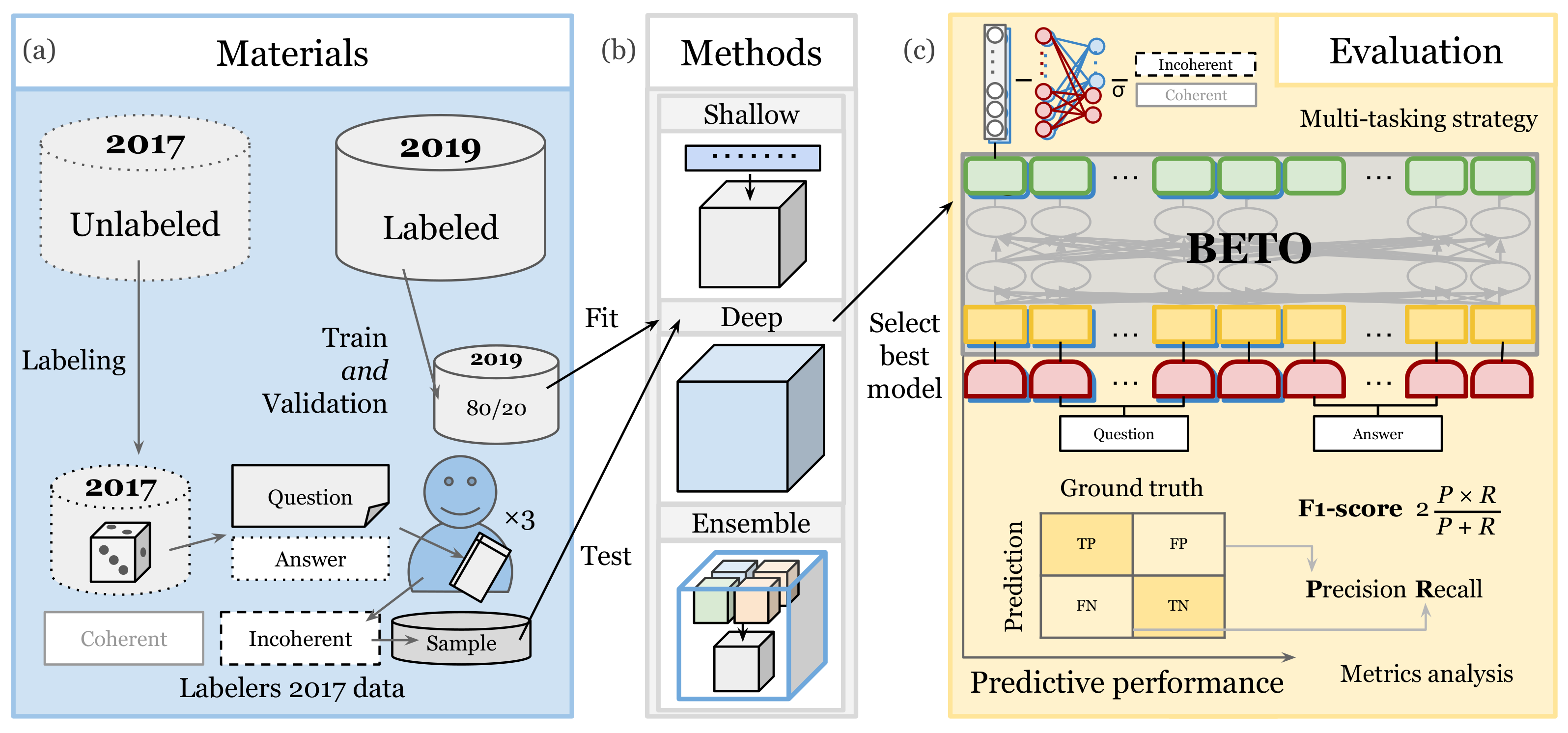
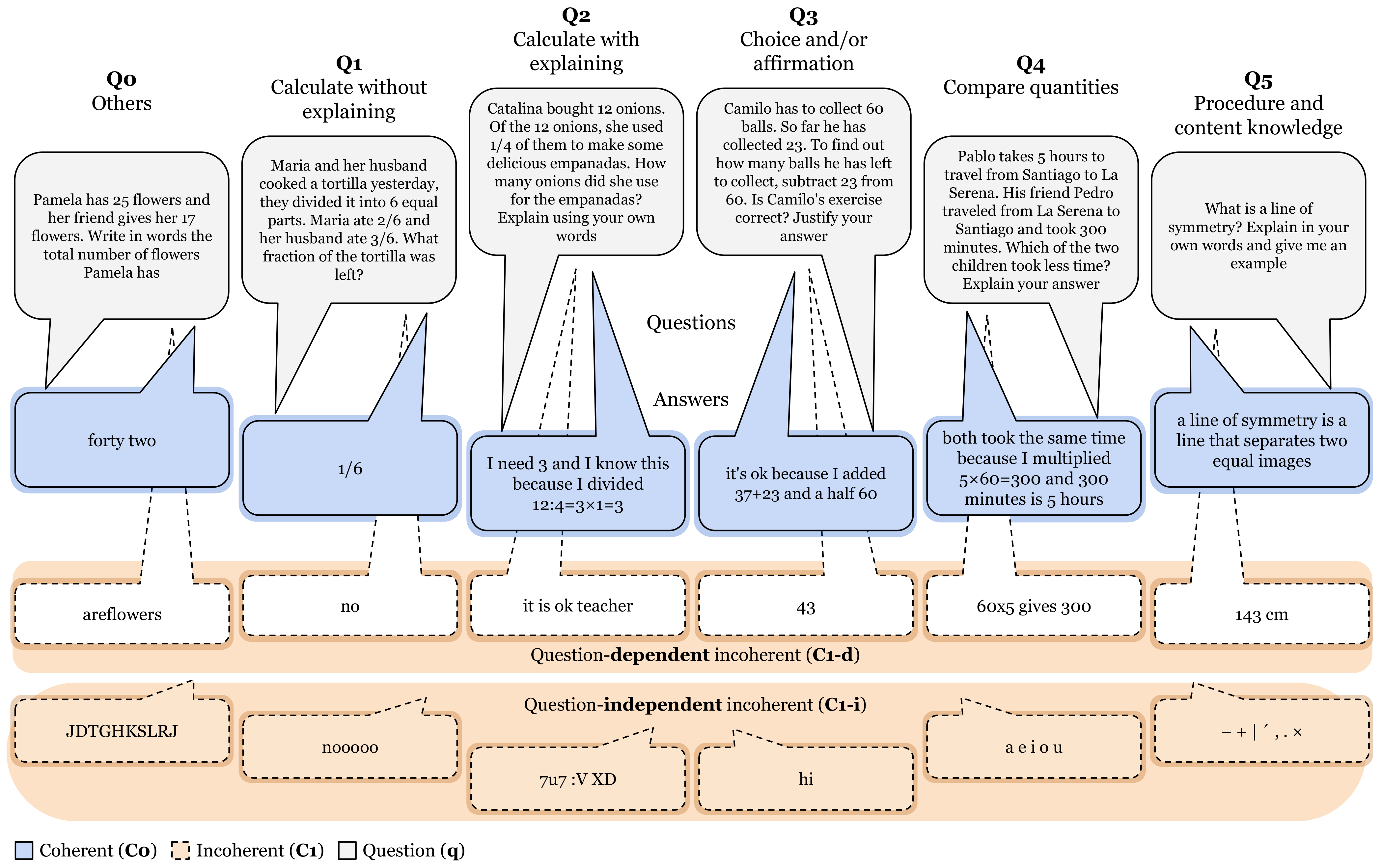
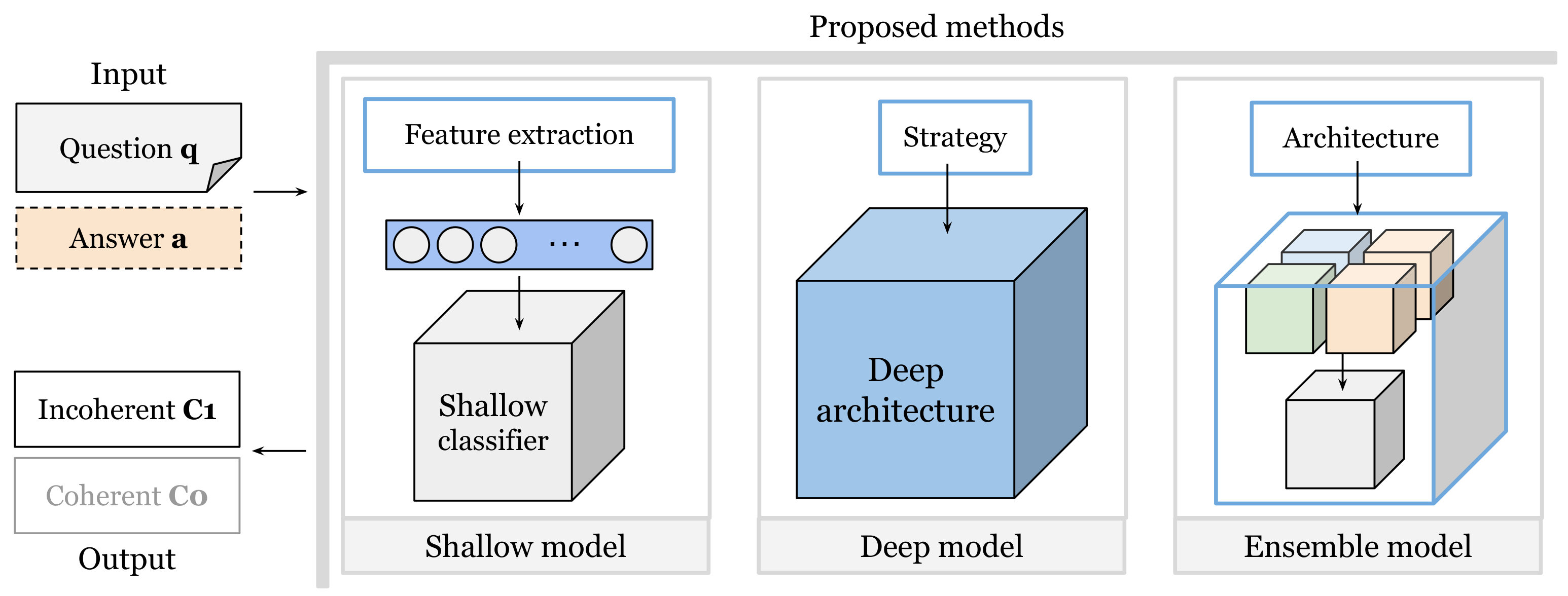
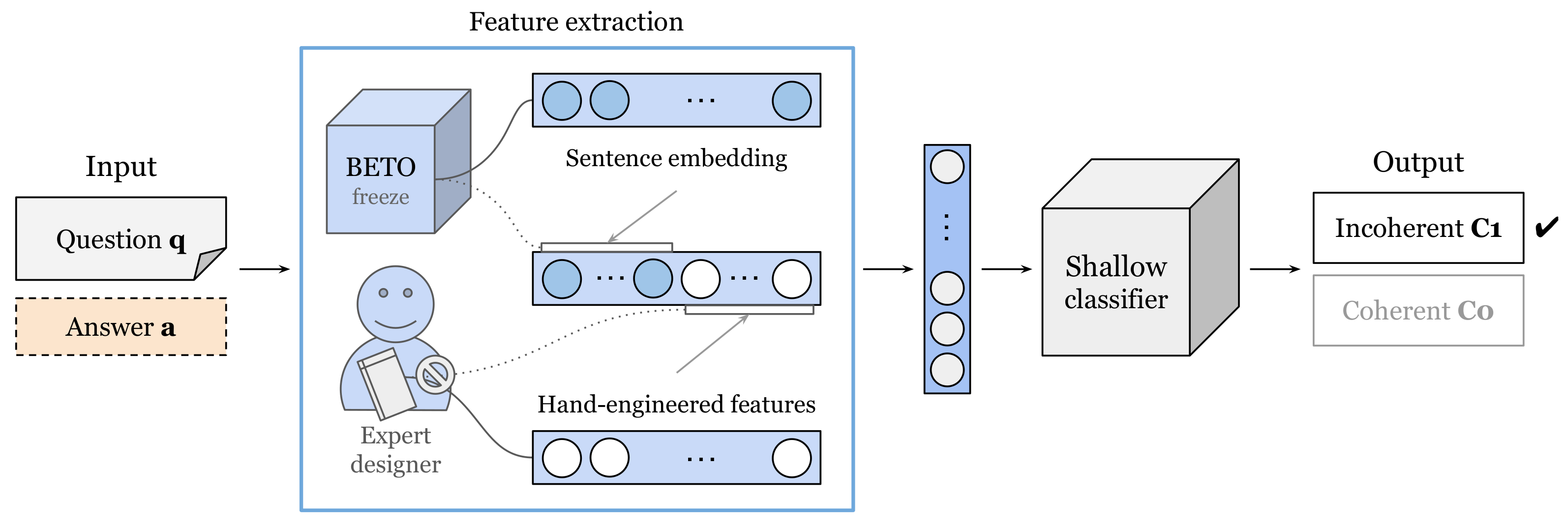
Arguing and communicating are basic skills in the mathematics curriculum. Making arguments in written form facilitates rigorous reasoning. It allows peers to review arguments, and to receive feedback about them. Even though it requires additional cognitive effort in the calculation process, it enhances long-term retention and facilitates deeper understanding. However, developing these competencies in elementary school classrooms is a great challenge. It requires at least two conditions: all students write and all receive immediate feedback. One solution is to use online platforms. However, this is very demanding for the teacher. The teacher must review 30 answers in real time. To facilitate the revision, it is necessary to automatize the detection of incoherent responses. Thus, the teacher can immediately seek to correct them. In this work, we analyzed 14,457 responses to open-ended questions written by 974 fourth graders on the ConectaIdeas online platform. A total of 13% of the answers were incoherent. Using natural language processing and machine learning algorithms, we built an automatic classifier. Then, we tested the classifier on an independent set of written responses to different open-ended questions. We found that the classifier achieved an F1-score = 79.15% for incoherent detection, which is better than baselines using different heuristics.
Keywords: written short answers; incoherent answer detection; natural language processing; arguing and communication; elementary school; mathematics education; online platform; deep learning; open-ended questions written short answers; incoherent answer detection; natural language processing; arguing and communication; elementary school; mathematics education; online platform; deep learning; open-ended questions