Abstract
Telework is presented as a model of work organisation that changes the paradigms of business culture in many organisations, reshaping established management and social systems. The COVID-19 pandemic and the restrictions applied to the mobility and concentration of people have accelerated the implementation of telework, generating an accelerated change in organisational models. Telework dynamics significantly transform many aspects of the business, social and personal environment. The research community has investigated: work performance; the environment; technology; social factors; and work–life balance, among other issues. However, it is necessary to know in greater depth what the most salient aspects related to telework are. To this end, a total of 539 publications from the Web of Science database between 1984 and 2021 were analysed using bibliometric techniques. The results obtained indicate an outstanding interest in this subject in the last two years. The research comes from many different areas of knowledge and mainly focused on issues related to worker–employer–family conflict, work–life balance and flexibility policies. There has been remarkable growth and dispersion in telework research, where, in addition to productivity-based approaches, the field of study has opened up to other issues such as worker health and satisfaction, professional isolation, the role of supervisors or the gender perspective, among others. The contribution of this research is broadening knowledge about the dynamics of telework in organisations and the issues that have been the most considered by the scientific community, so that it can serve as a point of support for future research.
1. Introduction
The emergence of telework in business organisations is inevitably associated with technology and its evolution [1,2,3,4,5]. This organisational dynamic has been in place since the technological breakthrough at the user level, although it did not have a wide impact on organisations and was mainly localised in some productive sectors [6,7]. The unstoppable advance of communication systems, the use of computer networks or collaborative work are presented as tools that enable virtual communities in the work environment. However, the irruption of technology does not make teleworking possible in all productive sectors and even in some positions within sectors considered viable for teleworking dynamics [8]. However, there are many more factors surrounding this phenomenon, which have generated scientific literature from the most diverse areas of knowledge.
In 2002, the European Union drafted the European Framework Agreement on Telework [9], which contains relevant aspects of this business practice. Among them, Article 2 contains the definition of telework: “Telework is a form of organising and/or performing work, using information technology, in the context of an employment contract/relationship, where work, which could also be performed at the employer’s premises, is carried out away from those premises on a regular basis”. The same agreement indicates that teleworking is voluntary for the worker and employer, so if the teleworking option is not contemplated in the employment contract, the worker may reject or accept it, and if the worker requests it, the employer may also accept or reject the proposal. It also includes the conditions under which teleworking will be carried out: data protection; the worker’s private life; computer equipment; health and safety; workload and required performance; prevention of isolation of the worker; adequate training; and the rights of the teleworker. However, telework is a much broader phenomenon than a definition and starting conditions between employers and employees.
The shift from a traditional organisational model to telework presents multiple challenges. Business leaders and managers who develop telework in their organisations, whether voluntarily or as a result of the current pandemic, face numerous challenges in achieving an effective and efficient organisation [10,11,12]. Similarly, teleworkers face a situation where work–home balance [13,14], or social isolation [15,16], among others, are of considerable relevance. Technological progress; the new and improved tools available; and, above all, the COVID-19 pandemic have changed the existing scenario and accelerated a process that was demanded by various sectors [17,18,19].
The first research related to telework appeared in the late 1980s and early 1990s. These early papers address issues related to the new collaborative environment and the emergence of technology [6,20] and the new way of life implied by this organisational model [21,22,23]. Gradually, research on telework has incorporated other issues adjacent to this work dynamic, such as the impact on society and business [24,25,26]; the family and telework [12,13,27,28]; new forms of business organisation [29,30,31]; transport habits and urban planning [32,33]; the psychological impact on teleworkers [34,35]; performance and productivity [11,36]; gender factors [14,37]; and, lastly, with issues related to the COVID-19 pandemic [17,38,39,40].
The global COVID-19 pandemic prompted many companies to ask their employees to work from home. This had and will presumably have a major impact on both employees and employers [41,42]. In addition to this, telework regulations and legal documents in different countries have had to be updated and/or created in view of this new scenario [43]. Documents can be found in the European Union [44], USA [45], Argentina [46], Chile [47], Ireland [48], Mexico [49], Russia [50] and Spain [51].
Telework is positioned as an organisational model that improves productivity, strengthens organisational commitment, improves performance within the organisation [52] and reduces environmental costs [53]. It is also considered to offer proven benefits for teleworkers [54]. The impact of telework on organisations and employees is difficult to qualify; telework dynamics are complex in their implementation and have multiple implications for all concerned [41,55,56]. The consequences of telework for companies and teleworkers have been extensively studied from different areas of knowledge and with different methodologies. This research analysed whether telework is really effective for organisations [52,57] It also addressed what the environment should be like to enhance telework [58]; what health effects telework has [54,59]; what the most appropriate collaborative techniques are [60,61,62]; how it influences family reconciliation [63,64]; what influence gender has on these remote work dynamics [42]; and how it affects transport policies [65].
The new scenario, mainly driven by the COVID-19 pandemic, has led to a boom in telework research. From the last decades of the 20th century to the present day, the main themes have been updated over the years. This research aims, through a bibliometric study, to bring together in a single document a synthesis of telework-related research. To this end, a descriptive analysis of the literature published on this topic was carried out, highlighting the most prolific authors, journals and areas of knowledge, as well as, on the other hand, a longitudinal analysis of the research currents in telework, which provides a map of the most analysed topics and the relationships between them.
This is followed by a description of the methods, materials and software used to carry out this research. Subsequently, the Section 3 includes a quantitative analysis of the documents in the sample, which reveals data on literary production, authors, journals, areas of knowledge and countries with the highest number of published research papers. This is followed by a longitudinal analysis of the sample analysed, describing strategic maps by periods of publication, and the evolution of research on this topic. Finally, the document ends with Section 4.
2. Methods
This research aims to examine which have been the most well-known research topics related to telework. For this purpose, bibliometric techniques were used to organize and link the valuable information contained in the documents [66]. The selected documents that constitute the sample of this research gather the research trends related to telework. The metric analysis carried out in this research on the sample will make it possible, among other things, to determine the links between the research trends and how they evolved over time [67,68]. In this way, useful information is generated for the scientific community, as well as for other stakeholders related to the implementation of telework in organisations.
In addition to the bibliometric analysis, which is the main core of this research, a series of indicators were added in order to contextualize this field of research in relation to the authors, leading journals and related thematic areas. In the following tables, you will find a graph with the scientific production developed in relation to telework, where the number of articles published per year from 1984 to 2021 is counted. In order to detect which thematic areas are linked to the research topic, a list is included with the thematic areas that have addressed telework. Other criteria used to situate the main components of this topic are, on the one hand, a list of the authors who have published the most articles, where the number of citations and the years of scientific production in this field are also included. On the other hand, a list of the journals with the number of articles published is shown, as well as the quartile of Journal Citation Reports (2020). Thus, before presenting the bibliometric analysis in depth, the researchers are positioned by means of a descriptive analysis.
2.1. Materials
The documents collected for the literature review on telework were taken from the Web of Science [69] database. In order to find the most frequently used words in telework research, a preliminary scan was carried out. The filter was set to those documents that contained the words “telework*”, “e-working” or “electronic working” in their title, abstract, author keywords or keywords plus. Based on the criteria of quality, impact and affinity, the search was restricted to: Social Sciences Citation Index (SSCI) and Emerging Sources Citation Index (ESCI). In the initial search for articles on the Web of Science, no restriction was imposed on the year of publication of the documents, nor was it filtered according to the citations received. In this way, all possible publications in the database were collected, including the most recent ones, even if they are not very well known at present, and the oldest ones, which allowed for interesting longitudinal maps to be made out of the most notable topics over time.
The selection of articles was carried out in October 2021, where a total of 601 manuscripts were registered. The first filter discarded 62 items from this sample, after verifying in a joint assessment that the title and abstract of the documents did not correspond to the main topic of this research. Therefore, the sample finally selected for this bibliometric analysis was made up of 539 publications (Supplementary Materials).
In order to carry out a longitudinal analysis of the literature that investigated telework, three periods were organised. The criterion used was the date of publication. The first article in the sample was published in 1984 and the most recent in 2021. However, due to the proliferation of publications since the beginning of this century, compared to earlier periods, the criterion used was an attempt to balance the equivalent number of papers between the three periods. Thus, the first period chosen was from 1984 to 2009, with a total of 185 documents. The second period, from 2010 to 2016, saw 168 publications. Finally, the third period, from 2017 to 2021, saw a total of 186 documents (Table 1).
Table 1.
Periods and number of documents per period.
2.2. Software
The scientific mapping software SciMAT [70] was used for the bibliometric analysis. This software synthesizes most of the tools used in scientific mapping, such as strategic maps and the construction of thematic networks, and also allows for the creation of longitudinal maps, which is one of the main objectives of this work. The information provided by the WoS database was imported into the software used, and we proceeded as follows: the author’s keywords and the keywords from the source represented the basic unit of analysis; for the construction of the thematic networks, co-occurrences were used. To normalize the network, the equivalence index was used as a measure of similarity; finally, the scientific maps of topics and their corresponding networks were based on the simple centre clustering algorithm.
3. Results
3.1. Descriptive Analysis of the Telework-Related Literature
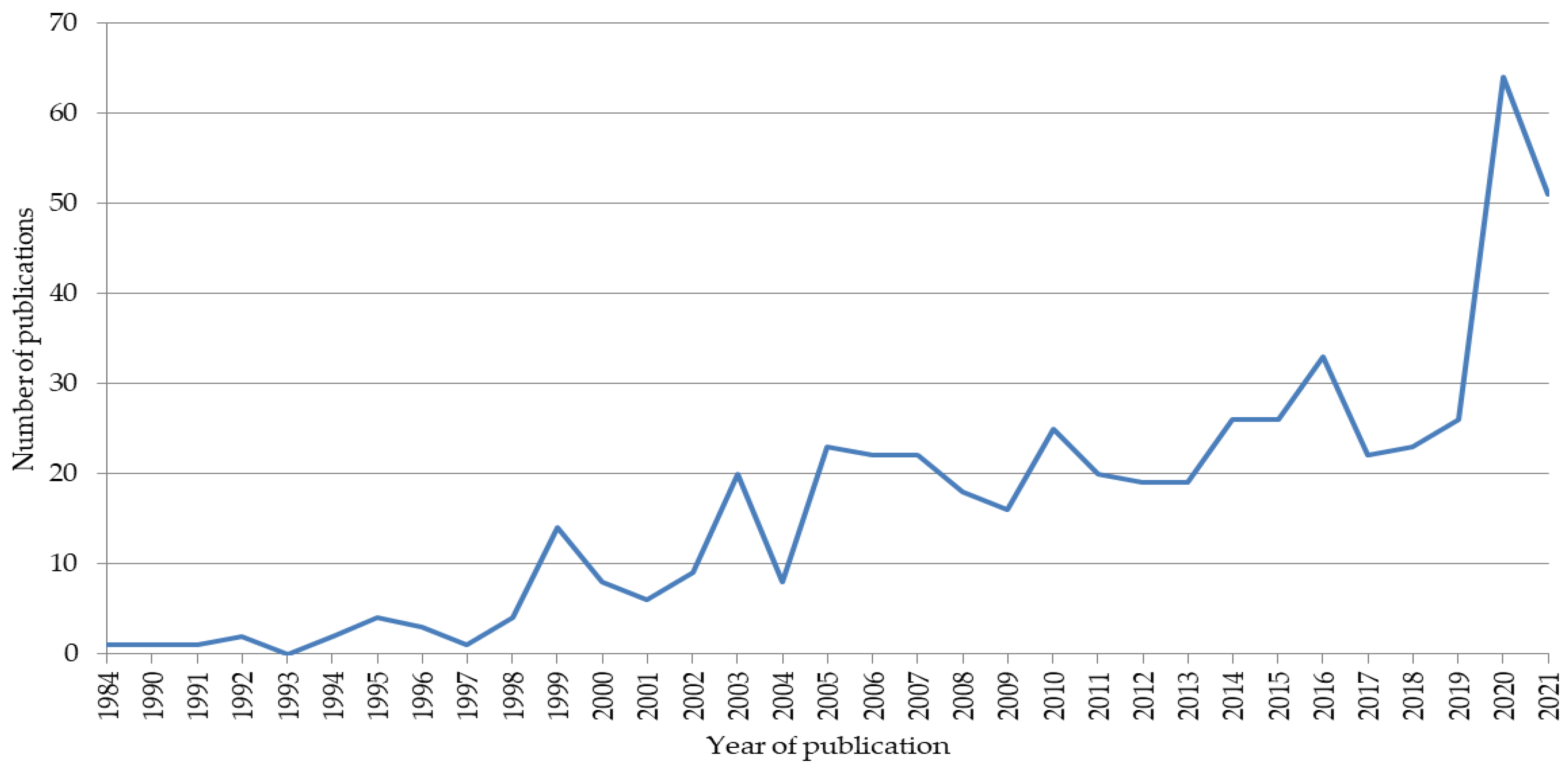
As indicated above, the sample analysed in this research comprises a total of 539 documents. The selected articles from WoS were published between 1984 and 2021. As can be seen in Figure 1, the rate of publications increased gradually from the beginning of the 1990s until 2019. This growth is common in almost any subject area, as the overall number of journals and publications has been increasing markedly in recent years [71,72]. However, in 2020 and 2021, the volume of scientific papers related to telework increased very strongly. In 2020, 64 papers were registered in WoS related to telework, which is more than twice as many as in 2019 (26 papers). In 2021, taking into account that the import of files from the WoS database took place in July of this year, 51 documents were already recorded, so it is foreseeable that the number will exceed one hundred.
Figure 1.
Publications on telework over time (n = 539). Source: Prepared by the authors on the basis of WoS data.
The Web of Science database used for our research offers a classification of publications according to the area of knowledge from which they originate. The areas of knowledge from which telework dynamics were investigated are many (Table 2). Although we mainly found areas focused on business and economics, other disciplines have addressed this issue, such as engineering; psychology; sociology; social sciences; public administration; transportation; computer, information and library science; and women’s studies.
Table 2.
Research areas on telework.
The 539 documents from the WoS database that make up the sample of this research were produced by a total of 1081 authors. The diversity of the areas of knowledge that have dealt with telework has an impact on the presence of authors with greater or lesser scientific production in this field. Table 3 lists the authors with the largest number of telework-related papers. The dates of their first and last publication in this field (included in WoS) and the number of citations received from any database are also added. The following authors stand out in this list: Timothy D. Golden (USA), who has been researching in this area for two decades, showing special interest in professional isolation, conflict between work and family and relationships between co-workers, among other topics; Manuela P. Pérez (Spain), with research on telework, ICT and human resource management, flexibility in organisations and the reconciliation of work and family life; and Pascale Peters (Netherlands) with research on flexible working, work–life balance and strategic human resources management.
Table 3.
Authors who have published four or more articles on telework.
It is worth highlighting the research carried out by Kossek, E.E., in which we found the most cited paper in the sample, “Telecommuting, control, and boundary management: Correlates of policy use and practice, job control, and work-family effectiveness” [73], with 378 citations received. This research addressed the concept of flexibility and work–family conflict and the individual’s psychological perception of this flexibility. Also noteworthy is the manuscript by Lapierre, L.M. and Allen, T.D. Although they were not among the authors with the largest number of papers on this topic, their article, “Work-supportive family, family-supportive supervision, use of organizational benefits, and problem-focused coping: Implications for work-family conflict and employee well-being” [74] has been cited 281 times, where they address the work–family conflict in employees who practice teleworking.
Due to the multidisciplinary approach of telework studies, published research also exposes other points of view and uncovers a wide range of issues related to telework dynamics: job satisfaction [75]; employee relations [76]; virtual management [77] (Cascio, 2000); and worker health and ergonomics [78], among others.
The journals that have published the largest number of telework-related research papers in the research sample are shown in Table 4. The 539 papers analysed were published in a total of 262 journals. Most of the journals dealing with telework are related to Business and economics and human resources. The quartile of each journal according to the Journal Citation Reports (2020) classification is also shown. In the event that a journal is classified in more than one subject area, all the corresponding quartiles are marked. Most of the journals that contributed the most documents to the sample used correspond to the Q1 and Q2 quartiles. The journal with the largest presence in the sample of this research was “New Technology Work and Employment”, with more than 10% of the documents analysed.
Table 4.
Journals that have published on telework. Quartile 2020 and total items.
The documents analysed come from 54 countries. In order to avoid errors in the interpretation of the countries that contributed most to this research topic, only the country of location of the university or institution of the first author of the article is reported. In this way, the countries of origin of the articles are counted more correctly, and cases where several authors from the same country appear in a single article are avoided. In this relation, among the countries with the highest number of articles, we found the USA and England with 113 and 70 documents, respectively, followed by Canada (33 documents), Spain (30 documents), Netherlands (27 documents), Germany (21 documents), Australia (18 documents) and Brazil and Italy with 15 documents, each published in WoS.
3.2. Keyword Stability Analysis between Periods
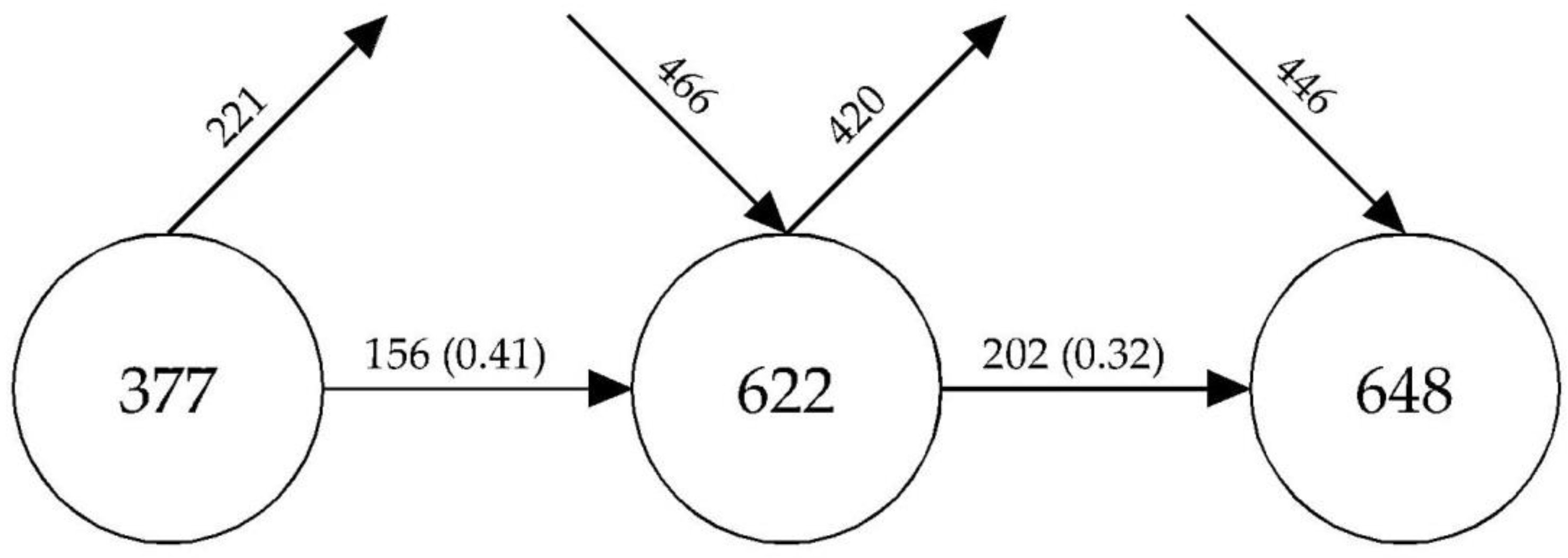
In order to find elements that indicate the state of development of a research field, the use of keywords and how they have evolved over time in the different periods analysed was analysed. To do this, we used the method of Price, D., and Gürsey, S. [79] (Figure 2). It should be noted that despite the fact that the three periods have a similar number of documents, and that the first period (1984–2009) had a much longer temporal length than the other two periods (2010–2016/2017–2021), in the first period, the number of keywords was much lower (377) than the following periods (622/648). This shows that, in the beginning, the research field was relatively undiverse. In addition, the stability index between periods was not relevant either (0.41), which implies that only around 40% of the keywords from the first period were used in the second, and, more significantly, they represented only 25% of the total number of keywords used between 2010 and 2016. Something similar occurred between the second and third periods, where, although the literature handled the same number of keywords, the stability index was exceedingly low (0.32). This means that barely a third of the keywords used in the second period still appeared in the literature in the third period. The latter period was just as turbulent, with 446 new keywords, almost 70% of the total. This provides us with an idea of the breadth of approaches with which telework-related research began in the second decade of this century, showing a growth in new lines of research, characterised by a clear inconsistency of vocabulary [79]. It can, therefore, be concluded that the field of research is growing and can admit a wide margin of development.
Figure 2.
Keywords between periods. Source: Prepared by the authors on the basis of SciMAT data.
3.3. Longitudinal Analysis
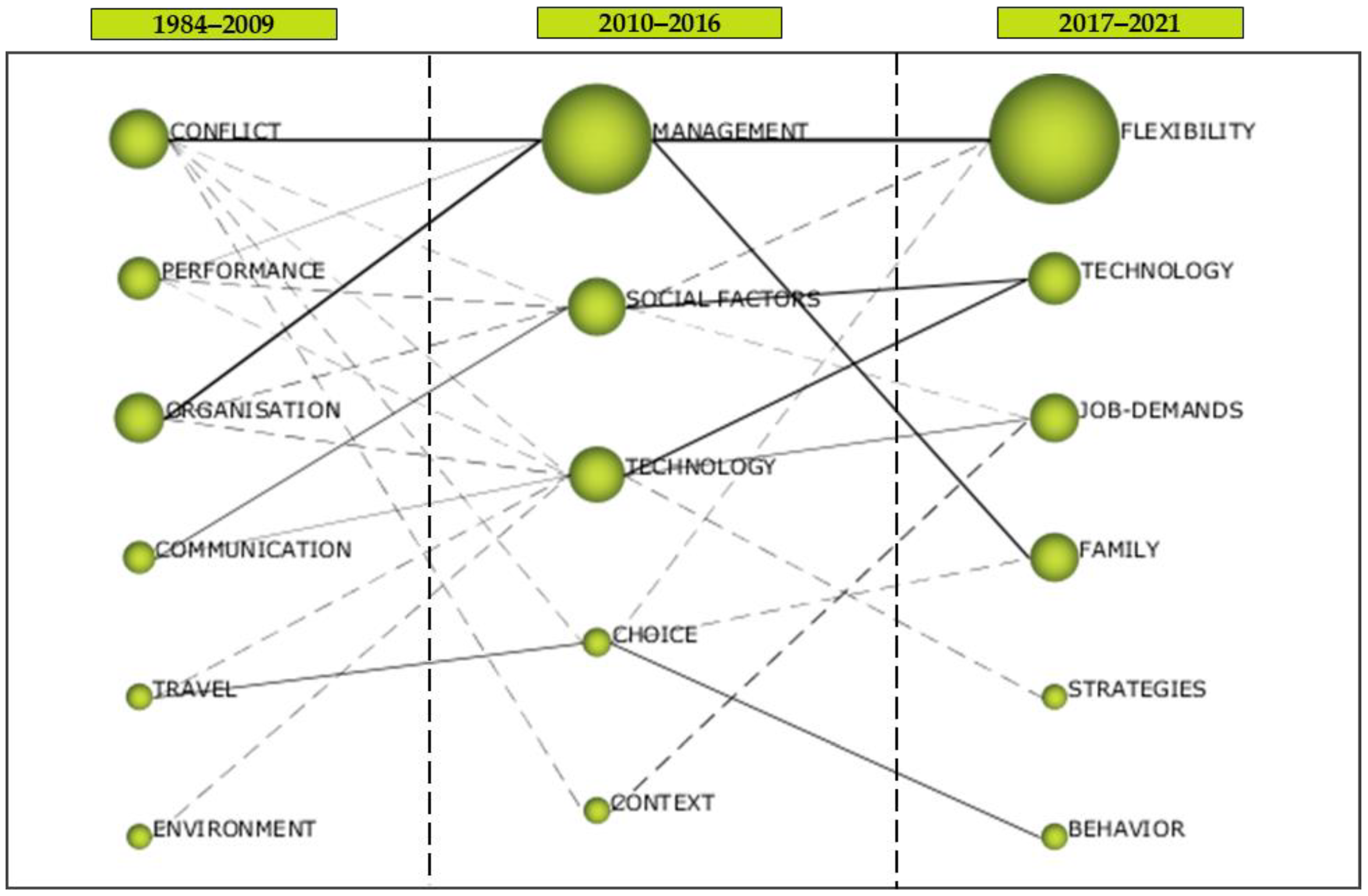
Once the evolution of the keywords is known, we set out to carry out a longitudinal analysis of telework-related research. To do this, we used longitudinal maps (Figure 3). These provided us with different perspectives on how the topics evolved in each of the periods. Firstly, we can see with which topics the first research started (Figure 3—left) and what the current trends are (Figure 3—right). On the other hand, the size of the spheres representing the clusters related to a topic provides an idea of the importance of that cluster. In our case, the size of the spheres represents the number of documents published. Finally, the evolution of the topics is symbolised by the lines connecting the different clusters. Having made this brief explanation of the procedure, we note that, from a longitudinal point of view, it can be observed that the main research contribution both quantitatively (number of documents) and qualitatively (impact of publications) is offered by the clusters related to conflict, management and labour flexibility policies (time axis Conflict–Management–Flexibility).
Figure 3.
Evolution of the themes of the primary documents. Source: Prepared by the authors on the basis of SciMAT data.
As for the first period (1984–2009), it contains a set of six clusters. The most important clusters were Conflict, Performance and Organisation. These three clusters, as we will see later in the analysis of strategy maps, are considered to be driving themes, i.e., they are themes that drove research in the period under analysis. Among them, the cluster with the highest relevance was Conflict, with 26 papers and the highest impact, 2985 citations, but Organisation was the cluster with the highest centrality or external cohesion (level of connections with other themes) (Table 5). The impact of the Conflict cluster in the first period is due to the proliferation of highly cited papers related to this theme. A dozen publications obtained more than 100 citations, focusing, among others, on research related to the management of telework boundaries, employee health and performance, flexible work arrangements or the impact of occupational isolation and the intention to quit. Some of these authors were Kossek, Lautsch and Eaton [73] with 378 citations; De Croon et al. [78] with 214 citations; Hornung, Rousseau and Glaser [80] with 213 citations; and Hill, Ferris and Martinson [26] with 191 citations. On the other hand, the Performance (14 papers and 867 citations) and Organisation (15 papers and 1535 citations) clusters evolved in the second period (2010–2016) alongside Conflict, joining the Management cluster and then Flexibility in the third period.
Table 5.
Quantitative and qualitative factors of the themes and their evolution.
In the case of the second period (2010–2016), there were five clusters: Management, Social Factors, Technology, Choice and Context. The most relevant, both in terms of its centrality and the number of documents (28) and number of citations (2042) was Management. This cluster, which is the result of the evolution of Conflict in the first period, includes topics that converge in the interest of research on the flexibilisation of work, the balance between work and family life, job satisfaction or the impact of telework on burnout and work engagement. The main authors were Kelliher and Anderson [75] with 255 citations; Staats and Gino [81] with 92 citations; Morganson et al. [82] with 83 citations; or Sardeshmukh, Sharma and Golden [83] with 62 citations. Other relevant clusters next to Management were Social Factors (17 papers and 925 citations) and Technology (17 papers and 803 citations).
Finally, the clusters formed in the third period (2017–2021) were Flexibility, Technology, Job-demands, Family, Strategies and Behaviour. The Flexibility cluster leads in both the number of papers (14) and citations (670). It is important to note that, despite the fact that the largest number of documents (214) was registered in this period, the fact that the cluster with the highest centrality and internal density or cohesion (internal strength of all the links between the words describing the topic) only has 14 documents, shows that there is a great dispersion of topics. This implies that these topics are not sufficiently related enough to create clusters with the co-occurrence established for the different periods. The most cited topics in this cluster of this period regarded research interested in the evaluation of telework growth, flexible working policies, stress, job satisfaction of teleworkers, work engagement, teamwork or aspects relating telework to its use in the period of the pandemic (COVID-19) that broke out in 2020. The authors who obtained the highest impact in their publications on topics related to the Flexibility cluster were Felstead and Henseke [84] with 70 citations; Chung and Van Der Horst [85] with 44 citations; Charalampous et al. [86] with 36 citations; Suh and Lee [87] with 30 citations; and Waizenegger et al. [39] with 24 citations.
In conclusion, regarding the evolution of telework-related research, from a longitudinal point of view, the results suggest that, although various clusters have been generated that bring together different perspectives of the study such as communication, analysis of the importance of commuting, the environment, social factors, technology or work demands, among others, the cluster that leads the research trend is the one marked by the longitudinal axis of Conflict–Management–Flexibility. This has brought together the largest number of papers and the highest level of impact.
3.4. Analysis of Strategy Maps by Period
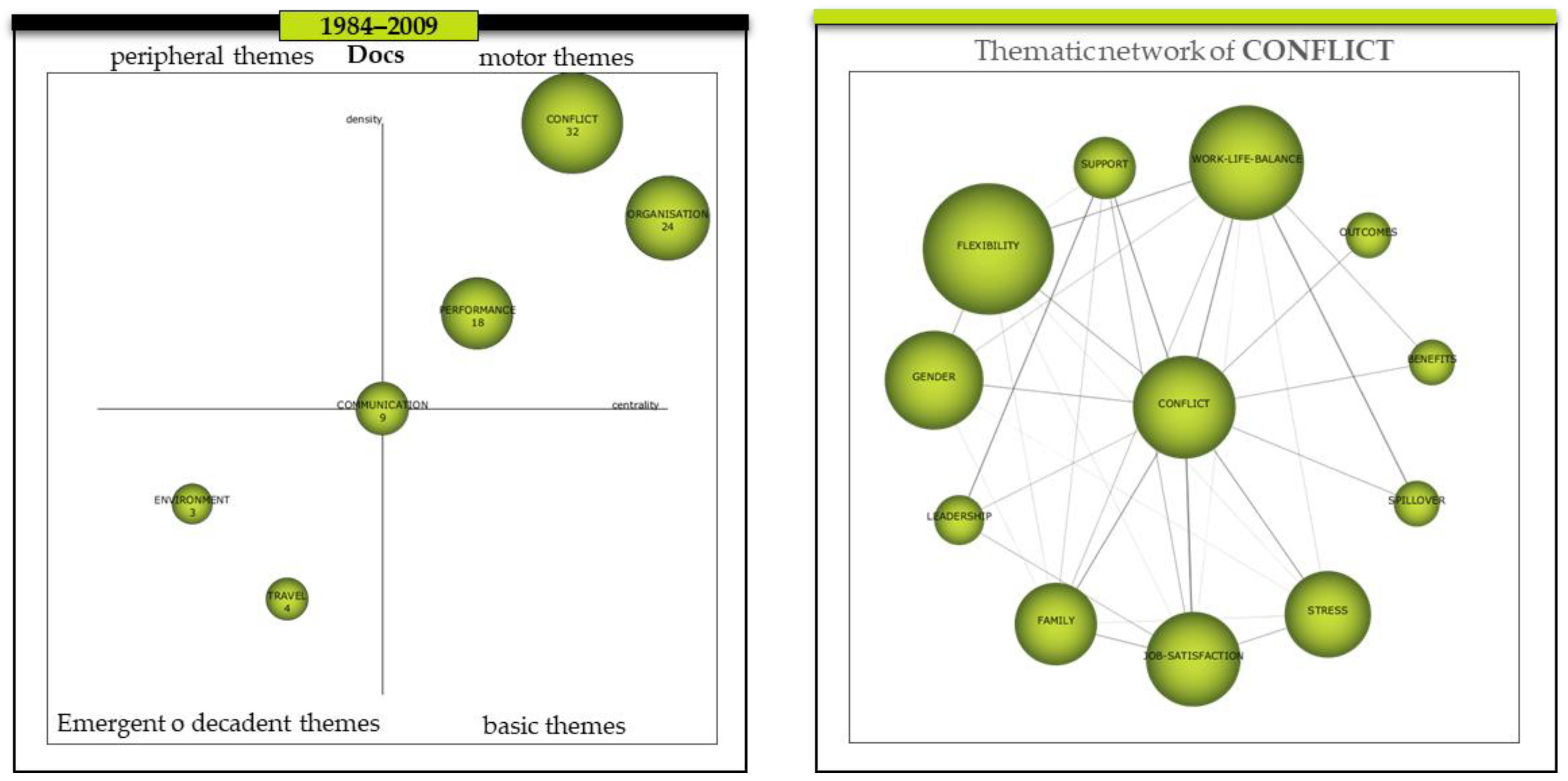
The longitudinal analysis detailed which clusters or themes were the most present in each period and what evolution they underwent. The next step was to detect the importance of each cluster for the objectives of this research. Figure 4—left shows the “Strategic Map” for the period 1984–2009. This figure shows which clusters are the main ones according to their centrality or external cohesion and their density or internal cohesion. Once this strategic map was visualized, the main themes were clearly exposed, which are those located in the upper right-hand corner of the map; these clusters are called “Driving Themes”. Figure 4—right, shows the “Thematic Network” of the driving theme of this period 1984–2009, in this case, the one corresponding to the Conflict cluster. In this thematic network, it can be seen which topics were the most investigated and what relationship there is between them. With this dynamic, two important findings were obtained: on the one hand, we detected which was the main cluster that drove research in a given period, and, on the other hand, with the thematic network, we observed which topics are related to this cluster and what link there is between them.
Figure 4.
Evolution of themes for the period of 1984–2009 and a thematic network of the Conflict cluster. Source: Prepared by the authors on the basis of SciMAT data.
To find the themes that led telework-related research in the period of 1984–2009, we focused on the driving themes of that period. These were Conflict, Organisation and Performance (Figure 4—left). Their centrality and density levels were 31.78/20.25, 32.51/18.35 and 26.08/17.31 (Table 5). These are the highest with respect to the rest of the clusters that were configured in this first period, which means that the research focused mainly on analysing aspects that had to do with the internal network of these three clusters (Table 6). The most prolific themes within these clusters were: Flexibility, Work–life-balance, Conflict and Gender, within the Conflict cluster; Home, Time-use, Management and Organisation, within the Organisation cluster; and Performance, HRM, Workplace and Challenges in the case of the Performance cluster.
Table 6.
Themes that make up the motor clusters, 1984–2009.
As for the rest of the clusters in this period, we found Communication, which is right in the centre of the matrix, where, a priori, it generates some doubts about its role within the research related to telework in this period; however, later, we will see how it is integrated into one of the driving themes of the following period (2010–2016). Its centrality and density were 22.87/15.82. Finally, the Travel and Environment themes fall into the so-called emerging or decadent themes, which, due to their centralities and densities of 5.01/10.42 and 2.48/13.10, it was uncertain whether they would evolve into other categories within the matrix or eventually disappear.
In order to gain a more detailed understanding of the themes that led the research in the first period, the network that integrates the Conflict cluster, the main driving theme, was analysed. To this end, we took into account the weight of the density of the relationships of the existing dyads between the themes that make up this cluster (Table 7). Among the fifteen dyads with the highest level of density in the network, the most important in terms of weight is Conflict/Job-satisfaction (0.19). In addition, Conflict is related to Work–life-balance (0.14), Support (0.13), Family (0.12), Stress (0.11), Gender (0.09), Flexibility (0.09), Spillover (0.09) and Outcomes (0.08). On the other hand, other important dyads were configured, such as Work–life-balance with Spillover (0.15) and Flexibility (0.10); Support with Leadership (0.14) and Job-satisfaction (0.09); Job-satisfaction with Family (0.09); and Flexibility with Gender (0.09).
Table 7.
Thematic network of the Conflict cluster, 1984–2009. List of fifteen strongest relationships.
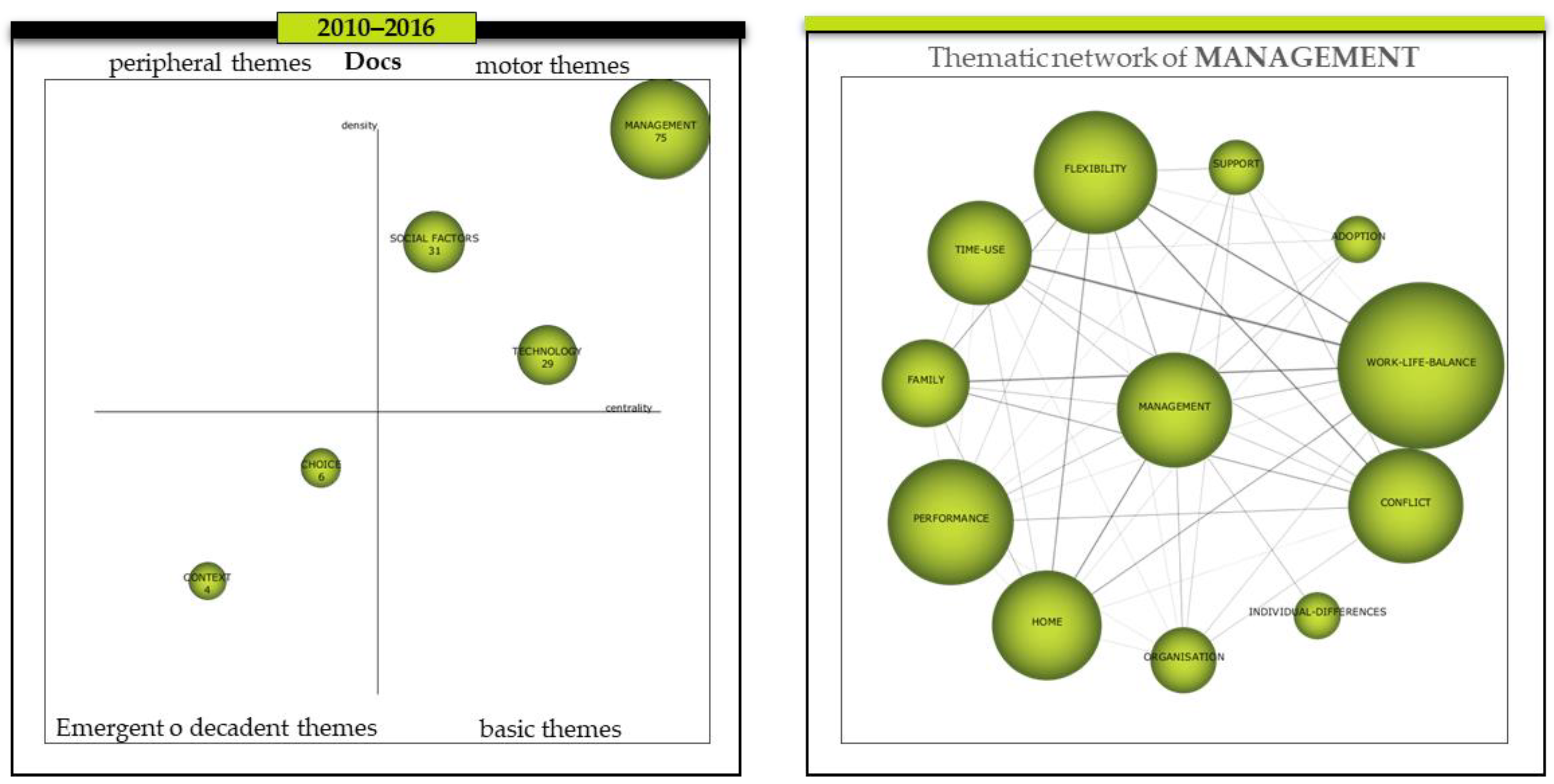
For the period 2010–2016, the driving themes were Management, Social Factors and Technology (Figure 5—left). Their centrality and density levels were 77.94/26.70, 39.90/14.63, and 41.97/8.65, respectively (Table 5).
Figure 5.
Evolution of the themes for the period of 2010–2016 and a thematic network of the Management cluster. Source: Prepared by the authors on the basis of SciMAT data.
In terms of the number of documents (Table 8), the most common themes within these three clusters were Work–life-balance, Performance, Flexibility, and Conflict within the Management cluster. The Management theme, which lends its name to the cluster, is in fifth place in this ranking. In the Social factor cluster, the most prolific themes were Job-satisfaction, Social factors, Workplace and Employees. Finally, in the Technology cluster, Technology, Boundary-management, Virtual-organisations and Stress were the most popular.
Table 8.
Themes that make up the motor clusters, 2010–2016.
With respect to other clusters in the period, as in the previous period, there were no peripheral or basic themes; in this case, Choice and Context were emerging or decadent themes, lacking low centrality and density (11.56/7.83 and 5.83/7.62, respectively), as well as fewer documents.
Regarding the internal analysis of the thematic network of the Management cluster, as the main driving theme, the most important dyad is the one that relates to the themes of Work–life-balance and Time-use (0.25) (Table 9); in addition, among the main dyads, Work–life-balance is related to Conflict (0.22), Flexibility (0.18), Family (0.17), Home (0.10) and Management (0.08); Flexibility with Conflict (0.17), Home (0.13), Family (0.10) and Management (0.10); Management with Home (0.13) and Organisation (0.07); and, finally, Conflict with Family (0.11), Performance (0.08) and Support (0.07).
Table 9.
Thematic network for the Management cluster, 2010–2016. List of fifteen strongest relationships.
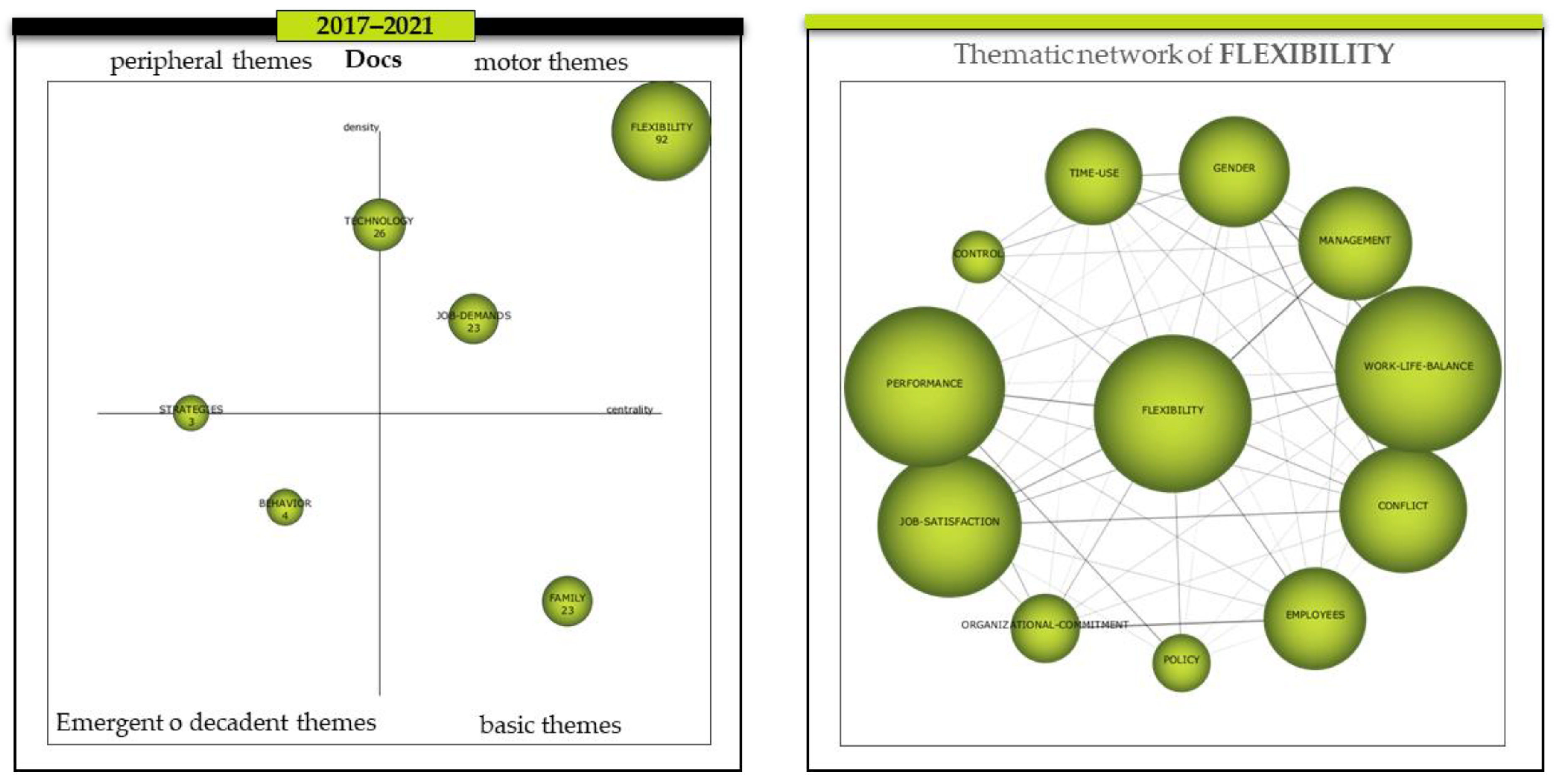
Finally, in the period of 2017–2021, the driving themes were Flexibility and Job-demands; however, Technology, although located at the border of the matrix with the peripheral themes (Figure 6—left) had a higher level of density, documents and impact than Job-demands. Therefore, it can be considered a cluster that led the telework literature in this period. Its centrality and density levels were 83.70/33.18; 37.83/12.71 and 33.42/12.87, respectively (Table 5).
Figure 6.
Evolution of the themes in the period of 2017–2021 and a thematic network of the Flexibility cluster. Source: Prepared by the authors on the basis of SciMAT data.
In terms of the number of documents (Table 10), the most frequently discussed topics within the Flexibility cluster were Work–life-balance, Performance and Flexibility, repeating from the previous period, and in fourth place was Job-satisfaction. In the Job-demand cluster, Job-satisfaction, Stress, Resources and Office were in first place. Finally, in the Technology cluster, the most prolific themes were Technology, Social factors, Communication and Professional-isolation.
Table 10.
Themes that make up the motor clusters, 2017–2021.
As for the other clusters in the period, Family was the basic theme with 40.34/4.01, and Behaviour, with a centrality and density of 7.30/4.44, was the declining or emerging theme. As for Strategies, it is on the borderline between the emerging decadent themes and the peripheral themes. Its centrality and density are 2.54/9.33.
With regard to the internal analysis of the themes of the Flexibility cluster (Table 11), the most important dyad is the one formed by the themes of Performance and Job-satisfaction (0.24); in addition to this relationship, Performance is related to Flexibility (0.16) and Policy (0.12); Employees is related to Organizational-commitment (0.20) and Flexibility (0.11); Flexibility, which lends its name to the cluster, has a significant number of relationships with the most important ones; among them, it is related to Management (0.20), Performance (0.16), Work–life-balance (0.13), Job-satisfaction (0.12), Conflict (0.09) and Policy (0.09); on the other hand, Work–life-balance is related to Gender (0.17) and Conflict (0.14); Job-satisfaction to Conflict (0.14); Conflict to Gender (0.13); and, finally, Gender to Time-use (0.10).
Table 11.
Thematic network for the Flexibility cluster, 2017–2021. List of fifteen strongest relationships.
4. Discussion and Conclusions
The literature analysed related work–life balance with greater job satisfaction and, therefore, higher performance. This evidence, together with the permanent demand from workers, has led to a marked interest in organisations to broaden the alternatives for achieving this objective, thus shaping their work flexibility policies. Teleworking is one of the options that has been of greatest interest and relevance in recent years.
According to the sample analysed, scientific production related to telework began in 1984. It should be borne in mind that telework began to form part of the organisational and political options for flexibility, to the extent that it was made possible by technology. For this reason, since the last decades of the 20th century, and coinciding with the take-off of computer media accessible to companies and users, telework expanded to a greater number of sectors and, consequently, telework-related research also increased. However, the year 2020 marks a milestone in the production of telework literature. Institutions and business organisations, in order to develop their normal activity due to the widespread worldwide confinement caused by COVID-19, were forced to implement telework among their employees as the most advisable and, in many cases, forced option. Since then, interest in the impact of teleworking has skyrocketed, and the number of publications has increased dramatically.
In this research, 539 documents indexed in the Web of Science database related to telework were analysed. The areas of knowledge that were interested in telework research are very varied. The dynamics of telework in an organisation generate myriad adjacent subjects that require analysis. Most of the topics fall under the umbrella of what could be called “business and economics”, although there are also numerous papers oriented towards psychology, engineering, sociology or transportation. Apart from the emergence of numerous articles conceived under the new scenario created by the pandemic, the different aspects related to telework have already been analysed in a significant way since the beginning of the 21st century. Among the 1081 authors who have published on telework in the WoS, the authors with the most studies are Golden, TD; Pérez-Pérez, M; and Peters, P. On the other hand, the articles with the highest impact were published by Kossek, EE [73,74]. As for the most prolific journals, New Technology, Work and Employment stands out, with more than 10% of the articles published on this subject in the sample analysed, which were published between 1998 and 2020.
The results of the keyword stability analysis show that the first period (1984–2009) was not very diverse in terms of the number of keywords used. However, the subsequent periods (2010–2016/2017–2021), in addition to being more prolific, were convulsive from the point of view of the incorporation of new keywords, which provides an idea of the diversity of approaches that telework research faced in the last decade.
From a longitudinal point of view, the results suggest that, from the first period (1984–2009) and up to the present date, the themes that have consistently led telework research have been related to the conflict involved in the impact of telework on the worker, the company and the family; work–life balance; and flexibility policies. In addition to these cross-cutting themes, this period also saw research analysing the importance of teleworker support and the role of supervisors in this task, as well as publications that looked at issues related to health (stress), gender, performance and time management, among others.
In the second period analysed (2010–2016), work–life balance emerges as the most relevant topic, despite the fact that management is the most central theme. Work–life balance is related to conflict, family or flexibility and time management or home. On the other hand, research related to job performance and job satisfaction was published with some vigour. Research related to technological aspects also gained momentum and remains constant to this day. Issues such as worker occupational isolation and boundary management also emerged with interest in this period.
In the third and last period (2017–2021), although research on labour flexibility was the dominant theme, the results suggest a great deal of dispersion in the main dyads formed for research on the topics, with no single main theme, as is the case in other periods. This provides an idea of the level of development of telework research, which is analysed from a multitude of perspectives. In this respect, the strongest link in the leading cluster on this topic (Flexibility) is the one linking research interests between performance and job satisfaction. Other important themes are the organisational commitment of employees, the analysis of work–life balance from a gender perspective, the latter with time management. Finally, issues related to work demands, health, communication or professional isolation emerge with some strength at the production level.
4.1. Future Research
The literature certainly suggests that telework offers opportunities for improving work–life balance, but it is not without negative effects, which may even lead to greater conflict in the work and family environment. This aspect is fundamental to understanding that conflict was, and is, one of the most analysed issues, together with work–life balance. This is due to the impact that teleworking has on the worker, the organisation and the family. There is undoubtedly a need for further research into this relationship, but much more so in the teleworking work environment, where circumstances, constraints and contexts make it particularly different. Further research is needed on the impact of telework on the three actors concerned; (a) the organisation, how it affects interprofessional relations and performance; (b) the teleworker, what impact it has on their emotional and professional state; and (c) the family, an analysis of the fulfilment of expectations with regard to the improvement of work–life balance and the impact of disruptive and extraneous elements on the family environment.
4.2. Limitations
In this work, the authors recognize that the research has certain limitations. On the one hand, using documents exclusively from the Web of Science (WoS) database. On the other hand, the limitation derived from applying filters in the search for published literature. This means that it is likely that certain publications with high impact, as well as authors and journals, did not appear in the sample used. Nevertheless, we believe that the sample is sufficiently significant for the objectives pursued in this research.
4.3. Practical Implications
This research may be of use to administrators, managers and managers of organisations in making decisions about teleworking dynamics. The document will also serve as a guide for researchers who wish to explore this topic, providing them with an analysis of the current research on telework and the most relevant issues of these organisational dynamics.
Supplementary Materials
The following supporting information can be downloaded at: https://www.mdpi.com/article/10.3390/systems10050134/s1.
Author Contributions
Conceptualization, M.R.-F., J.H., A.M.C.-L. and C.D.l.H.-R.; methodology, M.R.-F., J.H., A.M.C.-L. and C.D.l.H.-R.; software, M.R.-F., J.H., A.M.C.-L. and C.D.l.H.-R.; validation, M.R.-F., J.H., A.M.C.-L. and C.D.l.H.-R.; formal analysis, M.R.-F., J.H., A.M.C.-L. and C.D.l.H.-R.; investigation, M.R.-F., J.H., A.M.C.-L. and C.D.l.H.-R.; resources, M.R.-F., J.H., A.M.C.-L. and C.D.l.H.-R.; data curation, M.R.-F., J.H., A.M.C.-L. and C.D.l.H.-R.; writing—original draft preparation, M.R.-F., J.H., A.M.C.-L. and C.D.l.H.-R.; writing—review and editing, M.R.-F., J.H., A.M.C.-L. and C.D.l.H.-R.; visualization, M.R.-F., J.H., A.M.C.-L. and C.D.l.H.-R.; supervision, M.R.-F., J.H., A.M.C.-L. and C.D.l.H.-R.; project administration, M.R.-F., J.H., A.M.C.-L. and C.D.l.H.-R.; funding acquisition, M.R.-F., J.H., A.M.C.-L. and C.D.l.H.-R. All authors have read and agreed to the published version of the manuscript.
Funding
This research received no external funding.
Institutional Review Board Statement
Not applicable.
Informed Consent Statement
Not applicable.
Data Availability Statement
Not applicable.
Acknowledgments
We are very grateful to Universidad de Málaga.
Conflicts of Interest
The authors declare no conflict of interest.
References
- Fritz, M.E.W.; Higa, K.; Narasimhan, S. Telework: Exploring the borderless office. In Proceedings of the Twenty-Seventh Hawaii International Conference on System Sciences, Wailea, HI, USA, 4–7 January 1994; IEEE: Piscataway, NJ, USA, 1994. [Google Scholar]
- Nakamura, K.; Ide, T.; Kiyokane, Y. Roles of multimedia technology in telework. J. Organ. Comput. Electron. Commer. 1996, 6, 385–399. [Google Scholar] [CrossRef]
- Ellison, N.B. Telework and Social Change: How Technology is Reshaping the Boundaries between Home and Work; Greenwood Publishing Group: Westport, CT, USA, 2004. [Google Scholar]
- Golden, T.D. Applying technology to work: Toward a better understanding of telework. Organ. Manag. J. 2009, 6, 241–250. [Google Scholar] [CrossRef]
- Böll, S.; Cecez-Kecmanovic, D.; Campbell, J. Telework and the nature of work: An assessment of different aspects of work and the role of technology. In Proceedings of the European Conference on Information Systems (ECIS), Tel Aviv, Israel, 9–11 June 2014. [Google Scholar]
- Weijers, T.; Meijer, R.; Spoelman, E. Telework remains ‘made to measure’: The large-scale introduction of telework in the Netherlands. Futures 1992, 24, 1048–1055. [Google Scholar] [CrossRef]
- Elldér, E. Who is eligible for telework? Exploring the fast-growing acceptance of and ability to telework in Sweden, 2005–2006 to 2011–2014. Soc. Sci. 2019, 8, 200. [Google Scholar] [CrossRef]
- Milasi, S.; González-Vázquez, I.; Fernández-Macías, E. Telework before the COVID-19 Pandemic: Trends and Drivers of Differences across the EU; OECD Publishing: Paris, France, 2021. [Google Scholar]
- European Union. Framework Agreement on Telework. 2008. Available online: http://erc-online.eu/wp-content/uploads/2015/03/LexUriServ.do_.pdf (accessed on 14 July 2022).
- Sánchez, A.M.; Pérez, M.P.; de Luis Carnicer, P.; Jiménez, M.J.V. Teleworking and workplace flexibility: A study of impact on firm performance. Pers. Rev. 2007, 36, 42–64. [Google Scholar] [CrossRef]
- Golden, T.D.; Veiga, J.F. The impact of superior–subordinate relationships on the commitment, job satisfaction, and performance of virtual workers. Leadersh. Q. 2008, 19, 77–88. [Google Scholar] [CrossRef]
- Golden, T.D.; Veiga, J.F.; Simsek, Z. Telecommuting’s differential impact on work-family conflict: Is there no place like home? J. Appl. Psychol. 2006, 91, 1340–1350. [Google Scholar] [CrossRef]
- Hill, E.J.; Miller, B.C.; Weiner, S.P.; Colihan, J. Influences of the virtual office on aspects of work and work/life balance. Pers. Psychol. 1998, 51, 667–683. [Google Scholar] [CrossRef]
- Hilbrecht, M.; Shaw, S.M.; Johnson, L.C.; Andrey, J. ‘I’m home for the kids’: Contradictory implications for work–life balance of teleworking mothers. Gend. Work. Organ. 2008, 15, 454–476. [Google Scholar] [CrossRef]
- Hislop, D.; Axtell, C.; Collins, A.; Daniels, K.; Glover, J.; Niven, K. Variability in the use of mobile ICTs by homeworkers and its consequences for boundary management and social isolation. Inf. Organ. 2015, 25, 222–232. [Google Scholar] [CrossRef] [Green Version]
- Bennett, J.; Owers, M.; Pitt, M.; Tucker, M. Workplace impact of social networking. Prop. Manag. 2010, 28, 138–148. [Google Scholar] [CrossRef]
- Carillo, K.; Cachat-Rosset, G.; Marsan, J.; Saba, T.; Klarsfeld, A. Adaptación al teletrabajo inducido por epidemias: Perspectivas empíricas de los teletrabajadores en Francia. Rev. Eur. Sist. Inf. 2021, 30, 69–88. [Google Scholar] [CrossRef]
- Belzunegui-Eraso, A.; Erro-Garcés, A. Teleworking in the Context of the Covid-19 Crisis. Sustainability 2020, 12, 3662. [Google Scholar] [CrossRef]
- Moens, E.; Lippens, L.; Sterkens, P.; Weytjens, J.; Baert, S. The COVID-19 Crisis and Telework: A Research Survey on Experiences, Expectations and Hopes. Eur. J. Health Econ. 2021, 23.4, 729–753. Available online: https://ssrn.com/abstract=3596696 (accessed on 25 August 2022). [CrossRef]
- Wellman, B.; Salaff, J.; Dimitrova, D.; Garton, L.; Gulia, M.; Haythornthwaite, C. Las redes informáticas como redes sociales: Trabajo colaborativo, teletrabajo y comunidad virtual. Revisión Anu. Sociol. 1996, 22, 213–238. [Google Scholar] [CrossRef]
- Huws, U.; Robinson, W.B.; Robinson, S. Telework towards the Elusive Office; John Wiley & Sons, Inc.: Hoboken, NJ, USA, 1990. [Google Scholar]
- Di Martino, V.; Wirth, L. Telework: A new way of working and living. Int’l Lab. Rev. 1990, 129, 529. [Google Scholar]
- Kurland, N.B.; Bailey, D.E. Telework: The advantages and challenges of working here, there, anywhere, and anytime. IEEE Eng. Manag. Rev. 2000, 28, 49–60. [Google Scholar]
- Makridakis, S. The forthcoming information revolution: Its impact on society and firms. Futures 1995, 27, 799–821. [Google Scholar] [CrossRef]
- Duxbury, L.; Neufeld, D. An empirical evaluation of the impacts of telecommuting on intra-organizational communication. J. Eng. Technol. Manag. 1999, 16, 1–28. [Google Scholar] [CrossRef]
- Hill, E.J.; Ferris, M.; Märtinson, V. Does it matter where you work? A comparison of how three work venues (traditional office, virtual office, and home office) influence aspects of work and personal/family life. J. Vocat. Behav. 2003, 63, 220–241. [Google Scholar] [CrossRef]
- Hill, E.J.; Hawkins, A.J.; Miller, B.C. Work and family in the virtual office: Perceived influences of mobile telework. Fam. Relat. 1996, 45, 293–301. [Google Scholar] [CrossRef]
- Tietze, S.; Musson, G. Recasting the home-work relationship: A case of mutual adjustment? Organ. Stud. 2005, 26, 1331–1352. [Google Scholar] [CrossRef]
- Fraser, J.; Gold, M. ‘Portfolio workers’: Autonomy and control amongst freelance translators. Work. Employ. Soc. 2001, 15, 679–697. [Google Scholar]
- Brocklehurst, M. Power, identity and new technology homework: Implications fornew forms’ of organizing. Organ. Stud. 2001, 22, 445–466. [Google Scholar] [CrossRef]
- Barsness, Z.I.; Diekmann, K.A.; Seidel, M.D.L. Motivation and opportunity: The role of remote work, demographic dissimilarity, and social network centrality in impression management. Acad. Manag. J. 2005, 48, 401–419. [Google Scholar] [CrossRef]
- Helminen, V.; Ristimäki, M. Relationships between commuting distance, frequency and telework in Finland. J. Transp. Geogr. 2007, 15, 331–342. [Google Scholar] [CrossRef]
- Hislop, D.; Axtell, C. The neglect of spatial mobility in contemporary studies of work: The case of telework. New Technol. Work. Employ. 2007, 22, 34–51. [Google Scholar] [CrossRef]
- Mann, S.; Holdsworth, L. The psychological impact of teleworking: Stress, emotions and health. New Technol. Work. Employ. 2003, 18, 196–211. [Google Scholar] [CrossRef]
- Raghuram, S.; Wiesenfeld, B. Work-nonwork conflict and job stress among virtual workers. Hum. Resour. Manag. 2004, 43, 259–277. [Google Scholar] [CrossRef]
- Baruch, Y. Teleworking: Benefits and pitfalls as perceived by professionals and managers. New Technol. Work. Employ. 2000, 15, 34–49. [Google Scholar] [CrossRef]
- Chung, H.; Van der Horst, M. Flexible working and unpaid overtime in the UK: The role of gender, parental and occupational status. Soc. Indic. Res. 2020, 151, 495–520. [Google Scholar] [CrossRef]
- Tavares, F.; Santos, E.; Diogo, A.; Ratten, V. Teleworking in Portuguese communities during the COVID-19 pandemic. J. Enterp. Communities People Places Glob. Econ. 2020, 15, 334–349. [Google Scholar] [CrossRef]
- Waizenegger, L.; McKenna, B.; Cai, W.; Bendz, T. An affordance perspective of team collaboration and enforced working from home during COVID-19. Eur. J. Inf. Syst. 2020, 29, 429–442. [Google Scholar] [CrossRef]
- Möhring, K.; Naumann, E.; Reifenscheid, M.; Wenz, A.; Rettig, T.; Krieger, U.; Blom, A.G. The COVID-19 pandemic and subjective well-being: Longitudinal evidence on satisfaction with work and family. Eur. Soc. 2021, 23 (Suppl. 1), S601–S617. [Google Scholar] [CrossRef]
- Bolisani, E.; Scarso, E.; Ipsen, C.; Kirchner, K.; Hansen, J.P. Working from home during COVID-19 pandemic: Lessons learned and issues. Manag. Mark. Chall. Knowl. Soc. 2020, 15, 458–476. [Google Scholar] [CrossRef]
- Fan, W.; Moen, P. Working More, Less or the Same During COVID-19? A Mixed Method, Intersectional Analysis of Remote Workers. Work. Occup. 2021, 49, 143–186. [Google Scholar] [CrossRef]
- Willistowerswatson. 2021. Available online: https://www.willistowerswatson.com/en-CH/Insights/2021/05/global-many-countries-introducing-new-regulations-on-teleworking (accessed on 14 December 2021).
- EU. Regulating Telework in a Post-COVID-19, Europe. 2021. Available online: https://euagenda.eu/upload/publications/telework--20post-covid.pdf (accessed on 10 December 2021).
- USA. Guide to Telework and Remote Work in the Federal Goverment, Officce of Personnel Management. 2021. Available online: https://www.telework.gov/guidance-legislation/telework-guidance/telework-guide/guide-to-telework-in-the-federal-government.pdf (accessed on 10 December 2021).
- Argentina. Ley 27555 de Contratos de Teletrabajo. 2021. Available online: https://www.argentina.gob.ar/justicia/derechofacil/leysimple/teletrabajo (accessed on 10 December 2021).
- Chile. Ley 21.220 de Trabajo a Distancia y Teletrabajo. 2020. Available online: https://www.bcn.cl/leychile/navegar?idNorma=1143741 (accessed on 10 December 2021).
- Ireland. National Remote Work Strategy. 2021. Available online: https://www.gov.ie/en/publication/51f84-making-remote-work-national-remote-work-strategy/# (accessed on 10 December 2021).
- Mexico. Enmiendas a la Ley Federal del Trabajo. 2021. Available online: https://dof.gob.mx/nota_detalle.php?codigo=5609683&fecha=11/01/2021 (accessed on 10 December 2021).
- Russia. Amendments to the Labour Code. 2020. Available online: http://publication.pravo.gov.ru/Document/View/0001202012080047 (accessed on 10 December 2021).
- Spain. Real Decreto-ley 28/2020, de 22 de Septiembre, de Trabajo a Distancia. 2020. Available online: https://www.boe.es/diario_boe/txt.php?id=BOE-A-2020-11043 (accessed on 10 December 2021).
- Martin, B.H.; MacDonnell, R. Is telework effective for organizations? A meta-analysis of empirical research on perceptions of telework and organizational outcomes. Manag. Res. Rev. 2012, 35, 602–616. [Google Scholar] [CrossRef]
- Mahler, J. The telework divide: Managerial and personnel challenges of telework. Rev. Public Pers. Adm. 2012, 32, 407–418. [Google Scholar] [CrossRef]
- Tavares, A.I. Telework and health effects review. Int. J. Healthc. 2017, 3, 30–36. [Google Scholar] [CrossRef]
- Wegge, J.; Bipp, T.; Kleinbeck, U. Goal setting via videoconferencing. Eur. J. Work. Organ. Psychol. 2007, 16, 169–194. [Google Scholar] [CrossRef]
- Nakrosiene, A.; Butkeviciene, E. Telework in Lithuania: The concept, benefits and challenges to the employees. FILOSOFIJA-SOCIOLOGIJA 2016, 27, 364–372. [Google Scholar]
- Nakrošienė, A.; Bučiūnienė, I.; Goštautaitė, B. Working from home: Characteristics and outcomes of telework. Int. J. Manpow. 2019, 40, 87–101. [Google Scholar] [CrossRef]
- Venkatesh, V.; Speier, C. Creating an effective training environment for enhancing telework. Int. J. Hum. Comput. Stud. 2000, 52, 991–1005. [Google Scholar] [CrossRef]
- Anderson, A.J.; Kaplan, S.A.; Vega, R.P. The impact of telework on emotional experience: When, and for whom, does telework improve daily affective well-being? Eur. J. Work. Organ. Psychol. 2015, 24, 882–897. [Google Scholar] [CrossRef]
- Bélanger, F.; Allport, C.D. Collaborative technologies in knowledge telework: An exploratory study. Inf. Syst. J. 2008, 18, 101–121. [Google Scholar] [CrossRef]
- Kazekami, S. Mechanisms to improve labor productivity by performing telework. Telecommun. Policy 2020, 44, 101868. [Google Scholar] [CrossRef]
- Mello, J.A. Managing telework programs effectively. Empl. Responsib. Rights J. 2007, 19, 247–261. [Google Scholar] [CrossRef]
- Tremblay, D.G.; Paquet, R.; Najem, E. Telework: A Way to Balance Work and Family or an Increase in Work-Family Conflict? Can. J. Commun. 2006, 31, 493–781. [Google Scholar] [CrossRef]
- Tremblay, D.G. Balancing work and family with telework? Organizational issues and challenges for women and managers. Women Manag. Rev. 2002, 17, 157–170. [Google Scholar] [CrossRef]
- Elldér, E. Telework and daily travel: New evidence from Sweden. J. Transp. Geogr. 2020, 86, 102777. [Google Scholar] [CrossRef]
- Albort-Morant, G.; Ribeiro Soriano, D. A bibliometric analysis of international impact of business incubators. J. Bus. Res. 2016, 69, 1775–1779. [Google Scholar] [CrossRef]
- Chen, G.; Xiao, L. Selecting publication keywords for domain analysis in bibliometrics: A comparison of three methods. J. Informetr. 2016, 10, 212–223. [Google Scholar] [CrossRef]
- Rey-Martí, A.; Ribeiro Soriano, D.; Palacios Marqués, D. A bibliometric analysis of social entrepreneurship. J. Bus. Res. 2016, 69, 1651–1655. [Google Scholar] [CrossRef]
- Web of Science. Fundación Española para la Ciencia y la Tecnología FEYCT. Available online: https://www.recursoscientificos.fecyt.es/ (accessed on 14 December 2021).
- Cobo, M.; López-Herrera, A.; Herrera-Viedma, E.; Herrera, F. SciMAT: A new science mapping analysis software tool. J. Assoc. Inf. Sci. Technol. 2012, 63, 1609–1630. [Google Scholar] [CrossRef]
- Fok, D.; Franses, P.H. Modeling the diffusion of scientific publications. J. Econom. 2007, 139, 376–390. [Google Scholar] [CrossRef]
- Dumas-Mallet, E.; Garenne, A.; Boraud, T.; Gonon, F. Does newspapers coverage influence the citations count of scientific publications? An analysis of biomedical studies. Scientometrics 2020, 123, 413–427. [Google Scholar] [CrossRef]
- Kossek, E.E.; Lautsch, B.A.; Eaton, S.C. Telecommuting, control, and boundary management: Correlates of policy use and practice, job control, and work–family effectiveness. J. Vocat. Behav. 2006, 68, 347–367. [Google Scholar] [CrossRef]
- Lapierre, L.M.; Allen, T.D. Work-supportive family, family-supportive supervision, use of organizational benefits, and problem-focused coping: Implications for work-family conflict and employee well-being. J. Occup. Health Psychol. 2006, 11, 169–181. [Google Scholar] [CrossRef]
- Kelliher, C.; Anderson, D. Doing more with less? Flexible working practices and the intensification of work. Hum. Relat. 2010, 63, 83–106. [Google Scholar] [CrossRef]
- Golden, T.D. The role of relationships in understanding telecommuter satisfaction. J. Organ. Behav. 2006, 27, 319–340. [Google Scholar] [CrossRef]
- Cascio, W.F. Managing a virtual workplace. Acad. Manag. Perspect. 2000, 14, 81–90. [Google Scholar] [CrossRef]
- De Croon, E.; Sluiter, J.; Kuijer, P.P.; Frings-Dresen, M. The effect of office concepts on worker health and performance: A systematic review of the literature. Ergonomics 2005, 48, 119–134. [Google Scholar] [CrossRef] [PubMed]
- Price, D.; Gürsey, S.C.I. Informatics. Río Jan. 1975, 4, 27–40. [Google Scholar]
- Hornung, S.; Rousseau, D.M.; Glaser, J. Creating flexible work arrangements through idiosyncratic deals. J. Appl. Psychol. 2008, 93, 655–664. [Google Scholar] [CrossRef] [PubMed]
- Staats, B.R.; Gino, F. Specialization and variety in repetitive tasks: Evidence from a Japanese bank. Manag. Sci. 2012, 58, 1141–1159. [Google Scholar] [CrossRef] [Green Version]
- Morganson, V.J.; Major, D.A.; Oborn, K.L.; Verive, J.M.; Heelan, M.P. Comparing telework locations and traditional work arrangements: Differences in work-life balance support, job satisfaction, and inclusion. J. Manag. Psychol. 2010, 25, 578–595. [Google Scholar] [CrossRef]
- Sardeshmukh, S.; Sharma, D.; Golden, T.D. Impact of telework on exhaustion and job engagement: A job demands and job resources model. New Technol. Work. Employ. 2012, 27, 193–207. [Google Scholar] [CrossRef]
- Felstead, A.; Henseke, G. Assessing the growth of remote working and its consequences for effort, well-being and work-life balance. New Technol. Work. Employ. 2017, 32, 195–212. [Google Scholar] [CrossRef]
- Chung, H.; Van der Horst, M. Women’s employment patterns after childbirth and the perceived access to and use of flexitime and teleworking. Hum. Relat. 2018, 71, 47–72. [Google Scholar] [CrossRef]
- Charalampous, M.; Grant, C.A.; Tramontano, C.; Michailidis, E. Systematically reviewing remote e-workers’ well-being at work: A multidimensional approach. Eur. J. Work. Organ. Psychol. 2019, 28, 51–73. [Google Scholar] [CrossRef]
- Suh, A.; Lee, J. Understanding teleworkers’ technostress and its influence on job satisfaction. Internet Res. 2017, 27, 140–159. [Google Scholar] [CrossRef]
Publisher’s Note: MDPI stays neutral with regard to jurisdictional claims in published maps and institutional affiliations. |
© 2022 by the authors. Licensee MDPI, Basel, Switzerland. This article is an open access article distributed under the terms and conditions of the Creative Commons Attribution (CC BY) license (https://creativecommons.org/licenses/by/4.0/).