The Senescence-Associated Secretory Phenotype (SASP) in the Challenging Future of Cancer Therapy and Age-Related Diseases


1
Department of Molecular Medicine, Sapienza University of Rome, Laboratory Affiliated to Istituto Pasteur Italia-Fondazione Cenci Bolognetti, 00161 Rome, Italy
2
Center for Life Nano Science, Sapienza, Istituto Italiano di Tecnologia, 00161 Rome, Italy
3
Institute of Molecular Biology and Pathology, National Research Council (CNR), 00185 Rome, Italy
4
IRCCS (Istituto di Ricovero e Cura a Carattere Scientifico) Neuromed, 86077 Pozzilli, Italy
*
Author to whom correspondence should be addressed.
Biology 2020, 9(12), 485; https://doi.org/10.3390/biology9120485
Submission received: 30 November 2020
/
Revised: 18 December 2020
/
Accepted: 19 December 2020
/
Published: 21 December 2020
Simple Summary
A fundamental feature of cellular senescence is the emergence of the Senescence-Associated Secretory Phenotype (SASP), which represents a considerable source of inflammatory and tissue-remodeling cues. The pathophysiological relevance of senescence and SASP has generated a fertile area of research aimed at manipulating the SASP to fight cancer and age-related conditions. This review enlightens the most important mechanisms that regulate the SASP and summarizes the current evidence on the feasibility of intervening on its composition, providing a reading frame of the general potentialities of SASP modulation.
Abstract
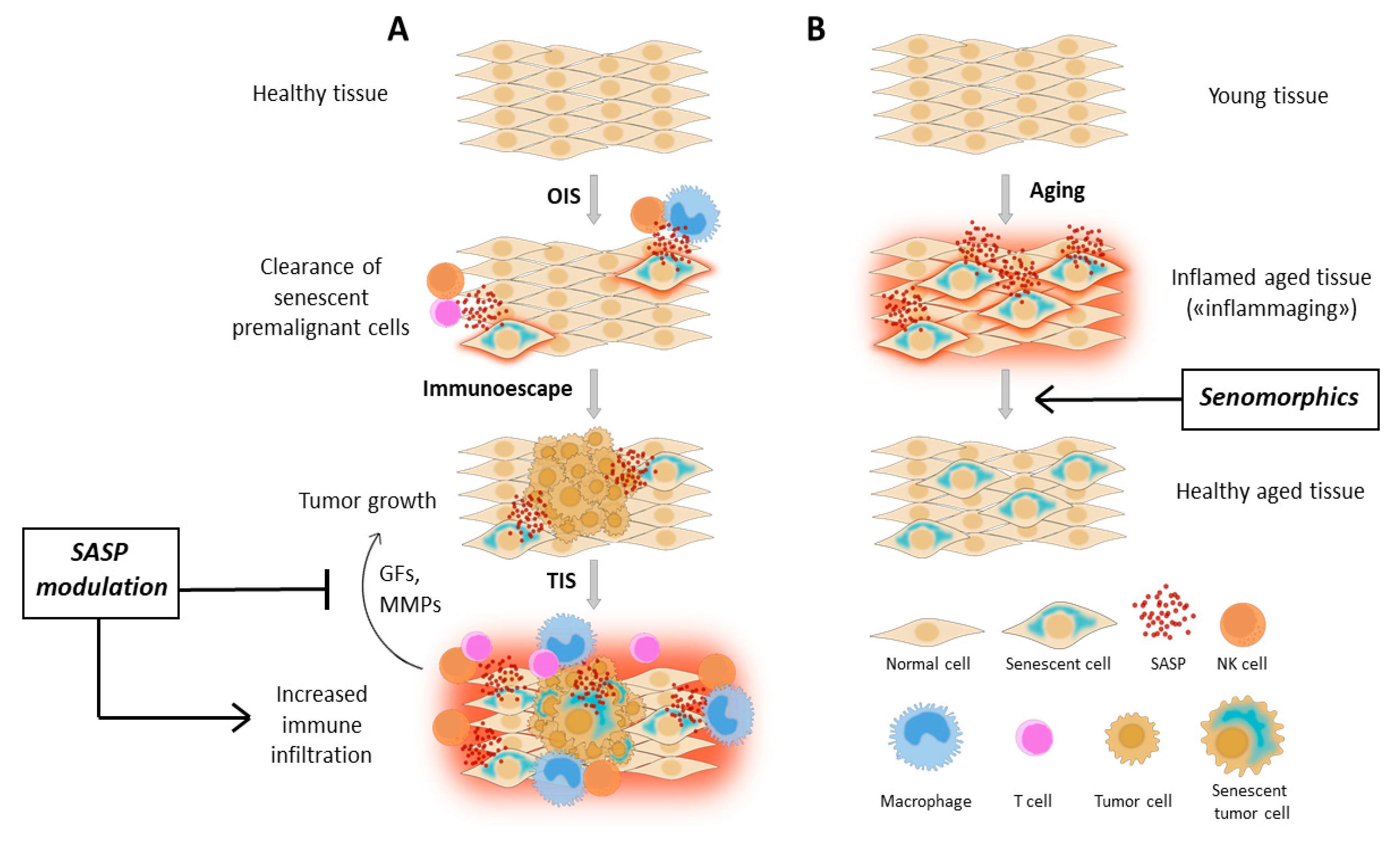
Cellular senescence represents a robust tumor-protecting mechanism that halts the proliferation of stressed or premalignant cells. However, this state of stable proliferative arrest is accompanied by the Senescence-Associated Secretory Phenotype (SASP), which entails the copious secretion of proinflammatory signals in the tissue microenvironment and contributes to age-related conditions, including, paradoxically, cancer. Novel therapeutic strategies aim at eliminating senescent cells with the use of senolytics or abolishing the SASP without killing the senescent cell with the use of the so-called “senomorphics”. In addition, recent works demonstrate the possibility of modifying the composition of the secretome by genetic or pharmacological intervention. The purpose is not to renounce the potent immunostimulatory nature of SASP, but rather learning to modulate it for combating cancer and other age-related diseases. This review describes the main molecular mechanisms regulating the SASP and reports the evidence of the feasibility of abrogating or modulating the SASP, discussing the possible implications of both strategies.
Keywords:
senescence; SASP; inflammation; cancer therapy; age-related disease; senolytic; senomorphic