Article

miRNA Sequencing and Differential Analysis of Testis in 1-Year-Old and 2-Year-Old Kazakh Horses
1
College of Animal Scienc, Xinjiang Agricultural University, Urumqi 830052, China
2
Xinjiang Key Laboratory of Equine Breeding and Exercise Physiology, Urumqi 830052, China
*
Author to whom correspondence should be addressed.
These authors contributed equally to this work.
Biology 2026, 15(9), 715; https://doi.org/10.3390/biology15090715
Submission received: 2 April 2026 / Revised: 28 April 2026 / Accepted: 29 April 2026 / Published: 30 April 2026
(This article belongs to the Section Developmental and Reproductive Biology)

Simple Summary

Reproductive efficiency is a key factor in the conservation and utilization of Kazakh horses, yet the molecular mechanisms underlying testicular development in this breed remain unclear. In this study, we compared the testicular miRNA profiles of pre-pubertal (1-year-old) and post-pubertal (2-year-old) Kazakh horses. A total of 165 differentially expressed miRNAs were identified, many of which are potentially involved in pathways related to lipid metabolism, signal transduction, and spermatogenesis. These findings provide novel insights into miRNA-mediated regulatory networks during equine sexual maturation and offer candidate molecular markers for improving reproductive performance in Kazakh horses.

Abstract

The Kazakh horse represents a significant genetic resource within China’s equine population, characterized by notable resilience and an ability to thrive on coarse forage. Nevertheless, a decline in its numbers has been observed recently, making the improvement of its reproductive performance crucial for the preservation of this breed and the advancement of the related industry. In this study, testicular tissues from 1-year-old (pre-pubertal) and 2-year-old (post-pubertal) Kazakh horses were analyzed. miRNA sequencing was conducted on tissues from these age groups, followed by bioinformatics analyses to elucidate the functions of differentially expressed miRNAs (DEmiRNAs). The reliability of the sequencing data was subsequently verified using RT-qPCR. Analysis revealed 165 differentially expressed miRNAs (DEmiRNAs) in the testicular tissues between the two age groups. Of these, 118 DEmiRNAs (e.g., eca-miR-206 and eca-miR-2483) were significantly up-regulated (p < 0.05), and 47 DEmiRNAs (e.g., eca-miR-196a and eca-miR-211) were significantly down-regulated (p < 0.05). These DEmiRNAs were mainly implicated in biological processes including lipid metabolism and signal transduction. Their predicted target genes are potentially involved in key reproductive processes, notably testicular development and spermatogenesis. This study identifies candidate miRNAs and potential regulatory pathways associated with sexual maturation in Kazakh horses, providing a preliminary molecular basis for future functional validation and improvement of equine reproductive performance.

1. Introduction

As a significant indigenous breed in China, the Kazakh horse has a substantial population and a broad geographical range [1]. It exhibits traits including consistent genetic traits, high adaptability, and the ability to thrive on roughage [2]. Presently, the breed is extensively utilized for milk and meat production, among other purposes [3]. Enhancing the reproductive efficiency of this valuable indigenous breed is vital to advance its conservation and utilization, which in turn underpins the sustainable development of equine genetic resources.
miRNAs are endogenous small RNAs, typically 20–24 nucleotides long, which serve diverse and crucial regulatory functions in cells [4]. Individual miRNAs can have multiple target genes. For instance, research by Guo et al. demonstrated that miR-181 directly inhibits Porcine Reproductive and Respiratory Syndrome Virus (PRRSV) infection in vitro via specific binding to ORF4 and additionally downregulates expression of the PRRSV receptor CD163 in blood monocytes and porcine alveolar macrophages [5]. Conversely, the expression of a single gene can be modulated by multiple miRNAs. For example, Lai et al. reported that miRNAs including miR-21, miR-146a, miR-155, miR-222, and miR-383 collectively target genes in the NF-κB pathway, thereby synergistically regulating the level of inflammation [6].
Numerous studies to date have characterized the miRNA expression profiles in testicular tissues across various developmental stages in multiple species, including cattle [7], sheep [8], and pigs [9]. By examining yak testicular tissues from three critical stages—6 months (juvenile), 18 months (pubertal), and 4 years (adult)—Hu et al. [10] defined stage-specific miRNA expression patterns. Their study identified 1536 miRNAs in total, which included 558 previously known in yaks, 717 evolutionarily conserved miRNAs, and 261 novel predicted miRNAs. A comparison of porcine testicular tissues at 60 and 180 days of age by Luo et al. [11] revealed 129 differentially expressed miRNAs. For seven of these miRNAs, the expression levels of their predicted target genes involved in spermatogenesis were negatively correlated. Through small RNA deep sequencing of testicular tissues from Southdown × Hu sheep F1 hybrids at 0, 3, 6 months, and 1 year old, Xi et al. [12] identified differentially expressed miRNAs. The target genes of these miRNAs, including YAP1, ITGB1, and DOT1L, were significantly enriched in several signaling pathways crucial for reproduction—such as FOXO, Hippo, Wnt, cAMP, and MAPK—implicating them in key processes like testis development, spermatogenesis, and cellular proliferation and differentiation.
However, systematic studies on miRNA-mediated regulatory networks during testicular development and sexual maturation in equines remain very limited. Most available studies focus on adult horses or non-reproductive traits, and there is a lack of comprehensive profiling and functional analysis of miRNAs during the critical transition from pre- to post-puberty in horses. This knowledge gap restricts the understanding of equine reproductive development and the genetic improvement of reproductive efficiency. In horses, sexual maturity is typically reached around 2 years of age. Therefore, 1-year-old individuals represent a pre-pubertal stage characterized by incomplete spermatogenesis, whereas 2-year-old individuals exhibit active spermatogenesis and functional reproductive capacity [13]. To fill this key research gap, this study utilized miRNA sequencing to analyze testicular tissues from Kazakh horses at pre-pubertal (1 year) and post-pubertal (2 years) stages. We identified differentially expressed miRNAs (DEmiRNAs), predicted their target genes, and performed functional enrichment analysis. The objective was to uncover key regulatory mechanisms underlying testicular development, thereby offering scientific insights to inform future breeding, reproductive management, and conservation strategies for equids.

2. Materials and Methods

2.1. Sample Collection

Eight Kazakh horses reared under uniform management conditions in Tacheng, Xinjiang, were utilized in this study. The horses were allocated into two groups based on age: a pre-pubertal group (Group G-1, n = 4; aged 1 year) and a post-pubertal group (Group G-2, n = 4; aged 2 years). This classification was based on established knowledge that horses typically reach sexual maturity at approximately 2 years of age. However, no direct histological or endocrine validation of pubertal status was performed in this study. Tissue samples from the left testis of each animal were surgically excised and promptly preserved in liquid nitrogen for further analysis. All animals were maintained in separate stalls of a common barn, fed with high-quality alfalfa hay and corn grain ad libitum, and allowed free access to clean drinking water.

2.2. miRNA Sequencing

Small RNA library construction was then performed. Small RNA fragments (18–30 nt) were first isolated from the total RNA by size selection on a PAGE gel. These fragments underwent sequential ligation of 3′ and 5′ adapters(Illumina-compatible, NEB, USA). The adapter-ligated RNA was reverse-transcribed into double-stranded cDNA, which was then amplified by PCR with specific primers under the following conditions: 94 °C for 30 s; 12 cycles of 94 °C for 15 s, 62 °C for 30 s, 70 °C for 15 s; and a final extension at 70 °C for 5 min. The PCR amplicons were size-selected again on a PAGE gel to purify fragments of approximately 140 bp, which were eluted into EB buffer(10 mM Tris-HCl, pH 8.5). The quality and concentration of the final libraries were evaluated using an Agilent 2100 Bioanalyzer (Agilent Technologies, Santa Clara, CA, USA) and an ABI StepOnePlus Real-Time PCR System (Applied Biosystems, Foster City, CA, USA). Libraries passing quality control were used for sequencing. Library construction and sequencing were conducted by Guangzhou Gidio Biotechnology Co., Ltd. (Guangzhou, China).

2.3. Data Quality Control

To reduce the interference from low-quality data, raw reads were processed using the fastp software (v0.23.2) [14,15]. The filtering criteria for read removal were as follows: (1) reads containing adapter sequences; (2) reads in which ambiguous bases (N) constituted more than 10% of the sequence; (3) reads containing polyA sequences were identified and removed to avoid potential bias from polyadenylated fragments; and (4) low-quality reads where more than 50% of the bases had a Phred quality score (Q) ≤20. After filtering, small RNA reads within the expected size range were retained. The remaining reads passing all filtering steps were defined as high-quality reads. Subsequently, redundant sequences were collapsed, and unique sequences were retained as clean tags for downstream analyses.

2.4. Analysis of Inter-Sample Correlations

Based on miRNA expression data, Principal Component Analysis (PCA) was conducted utilizing R software (v4.3.1)). This dimensionality reduction technique was used to examine the distances between samples, thereby evaluating the divergence in expression profiles between Groups G-1 and G-2 and the intra-group homogeneity. Correlation analysis was performed to assess the relationships in miRNA expression across samples. The calculated correlation coefficients were then visualized to illustrate the pairwise correlations between samples.

2.5. Analysis of DEmiRNAs

DEmiRNAs were identified using the edgeR package (v3.42.4) in R. miRNAs with an absolute log2 fold change (|log2FC|) ≥ 1 and a p-value < 0.05 were considered significantly differentially expressed. No multiple testing correction was applied at this stage.

2.6. Functional Enrichment Analysis of DEmiRNAs

Enrichment analysis of KEGG pathways was conducted employing the KOBAS (v3.0) tool. The clusterProfiler package (v4.8.1) in R(v4.3.1) was utilized for the graphical representation of significantly enriched GO terms and KEGG pathways. A p-value of <0.05 was defined as the cutoff for statistical significance, and p-values were adjusted using the false discovery rate (FDR), with FDR <0.05 considered significant.

2.7. Target Gene Prediction

The target genes of differentially expressed miRNAs (DEmiRNAs) were predicted using two widely used algorithms: Miranda (v3.3a) and TargetScan (v7.0). For Miranda, the parameters were set as follows: a score threshold ≥140, energy threshold ≤−10 kcal/mol, strict 5′ seed pairing, gap-open penalty of −4.0, and gap-extend penalty of −9.0. TargetScan predicted target genes based on sequence complementarity between the 2–8 nt seed region at the 5′ end of miRNAs and the 3′-UTR of target transcripts. To improve prediction reliability, only the intersection of the results obtained from both methods was retained as high-confidence candidate target genes.

2.8. RT-qPCR Validation

For validation of the selected miRNAs, total RNA was reverse-transcribed to generate cDNA. Details regarding the primers used for RT-qPCR are available (see Supplementary Table S1). Quantitative RT-qPCR was conducted using a CFX Connect Real-Time PCR System (Bio-Rad, Hercules, CA, USA), with triplicate measurements for each sample. The relative expression levels of miRNAs were normalized to U6 small nuclear RNA (U6) as an internal reference and calculated using the 2−ΔΔCt method.

3. Results and Analysis

3.1. miRNA Sequencing Data of Kazakh Horse Testicular Tissue

A total of eight small RNA libraries were constructed and subjected to quality control analysis. As shown in Table 1, the number of clean reads for each sample ranged from 10,985,906 to 15,724,179. Among these, the proportion of high-quality reads ranged from 96.60% to 97.87%, indicating overall high sequencing quality. The proportion of polyA reads was extremely low (0.0008–0.0022%), suggesting minimal contamination by polyadenylated sequences. After further filtering and processing, the proportion of clean tags ranged from 83.42% to 87.99%, which were used for subsequent analyses.

3.2. Correlation Analysis Among Testicular Tissue Samples of Kazakh Horses

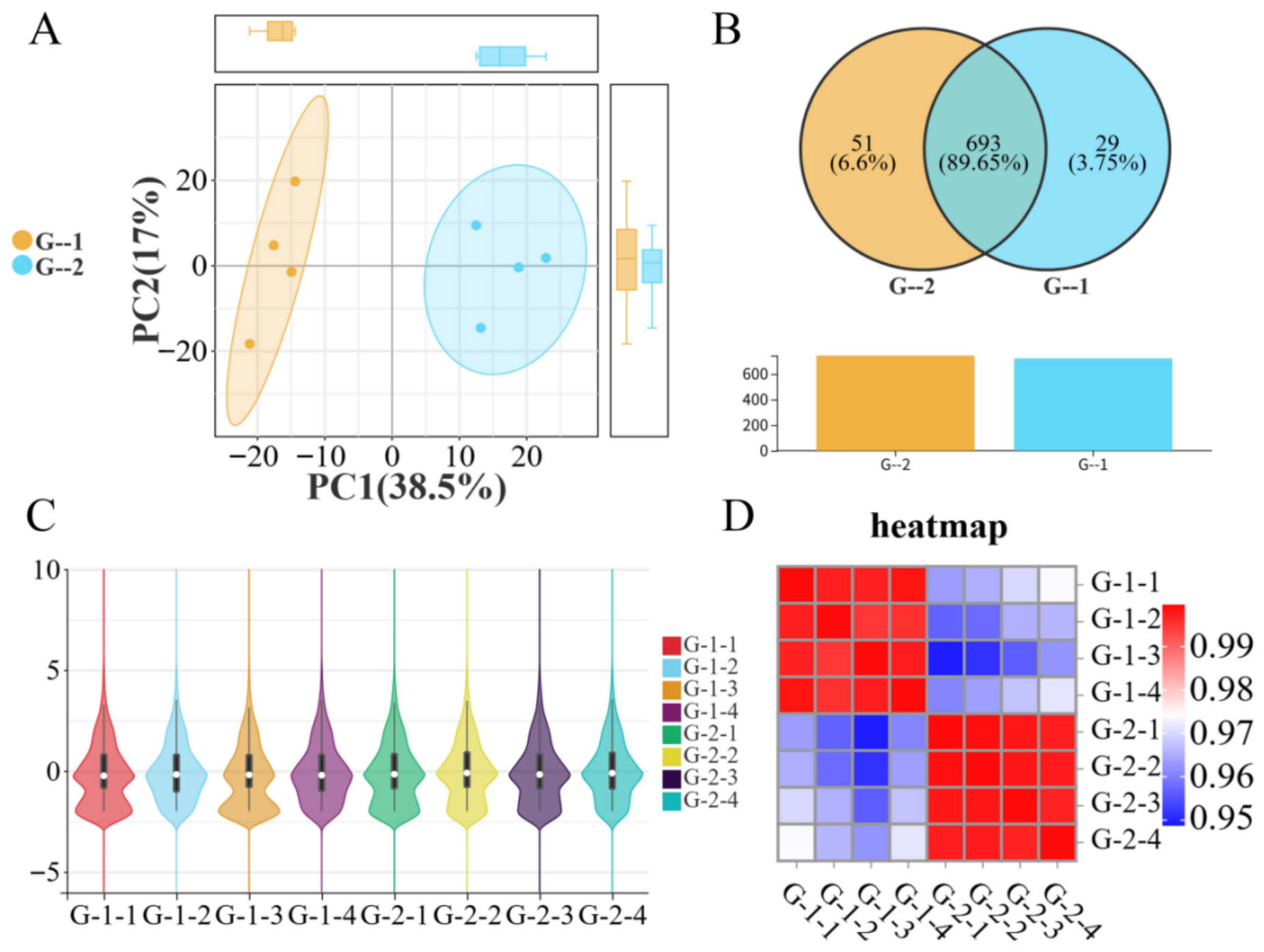
Results from the correlation analysis of testicular tissues from 1- and 2-year-old Kazakh horses are shown in Figure 1. Principal component analysis (PCA) revealed that PC1 (the first principal component) explained 38.5% of the variance, and PC2 (the second principal component) explained 17% (Figure 1A). The tight intra-group clustering and clear separation between Group G-1 and Group G-2 indicate distinct expression profiles between the two age groups. Figure 1B shows that 722 and 744 miRNAs were detected in Group G-1 and Group G-2, respectively. Among these, 693 miRNAs, such as eca-miR-127, eca-miR-363, and eca-miR-379, were common to both groups (see Supplementary Table S4). The results presented in Figure 1C,D demonstrate high pairwise correlations among samples within each group, reflecting minimal individual variation and overall consistency in expression levels. A similarly stable correlation trend was observed between the groups.

3.3. Differential Expression Analysis in Testicular Tissues of Kazakh Horses

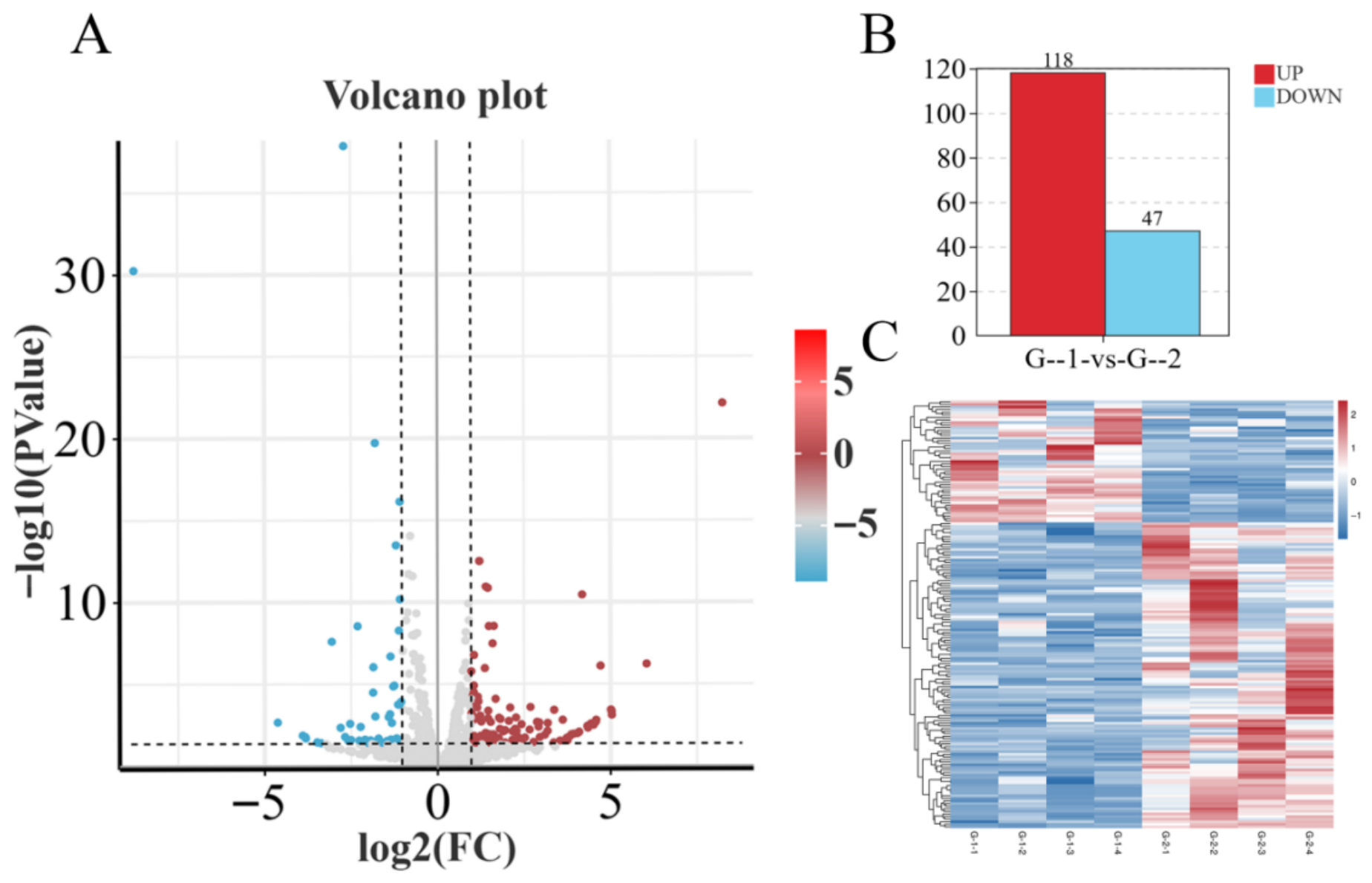
Differential expression analysis using the edgeR package (v3.42.4) revealed 165 significant DEmiRNAs, such as eca-miR-1248, eca-miR-1264, and eca-miR-1912, between Groups G-1 and G-2 (Figure 2A,B). Of these, 118 DEmiRNAs (e.g., eca-miR-206 and eca-miR-2483) were up-regulated, and 47 DEmiRNAs (e.g., eca-miR-196a and eca-miR-211) were down-regulated (p < 0.05). Cluster analysis demonstrated high reproducibility among biological replicates and clear distinctions between Group G-1 and Group G-2 (Figure 3C) (see Supplementary Table S2).

3.4. Results of GO Annotation and KEGG Enrichment Analysis for Differentially Expressed miRNAs in Kazakh Horse Testicular Tissue

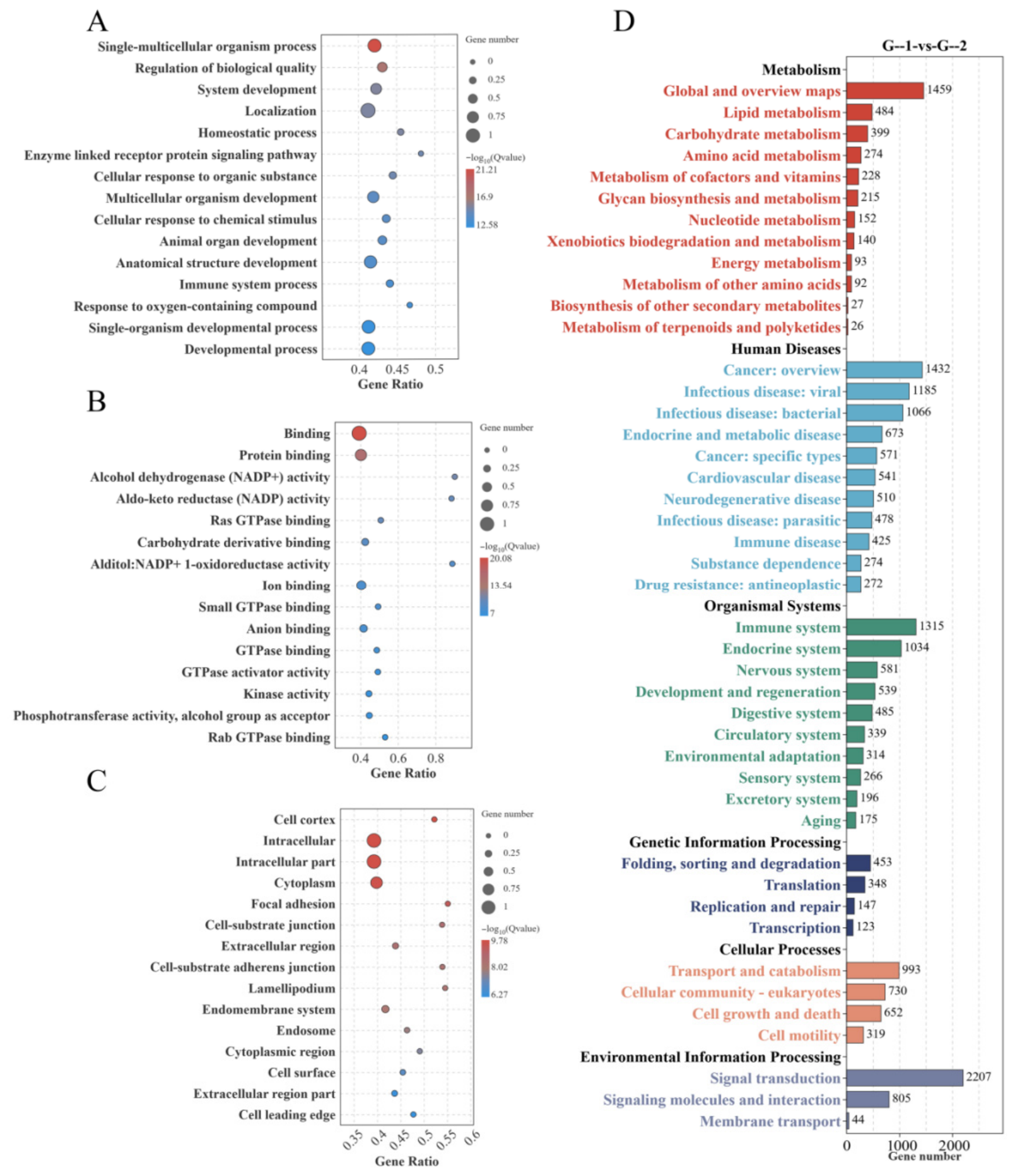
GO annotation of the DEmiRNAs in Groups G-1 and G-2 revealed that these miRNAs were predominantly enriched in several functional categories (Figure 3A–C). These included biological processes (BP) such as single-multicellular organism process and regulation of biological quality, cellular components (CC) like intracellular part and cytoplasm, and molecular functions (MF) encompassing binding and protein binding. KEGG pathway enrichment analysis demonstrated that the DEmiRNAs were significantly associated with pathways including lipid metabolism and signal transduction (Figure 3D) (see Supplementary Table S3).

3.5. Prediction Results of miRNA Target Genes

Based on the above target gene prediction method, a total of 85,262 miRNA-target gene pairs were obtained, covering 165 DEmiRNAs and 6336 unique target genes corresponding to 15,154 target transcripts, and the average number of target genes regulated by each miRNA was 516.7; the average binding free energy of all predicted pairs was −22.14 kcal/mol with a median of −21.30 kcal/mol, among which 52,448 pairs accounting for 61.5% of the total had binding free energy ≤−20 kcal/mol, and the average binding score was 0.919 with a median of 0.837, which proved that the predicted results had high stability and reliability. Combined with the same differential significance criteria of DEmiRNAs as used in this manuscript, 2017 high-confidence miRNA–target gene pairs were finally screened out, providing a solid data support for the subsequent exploration of the regulatory role of miRNAs in testicular development and maturation of Kazakh horses (see Supplementary Table S5).

3.6. Validation Using RT-qPCR

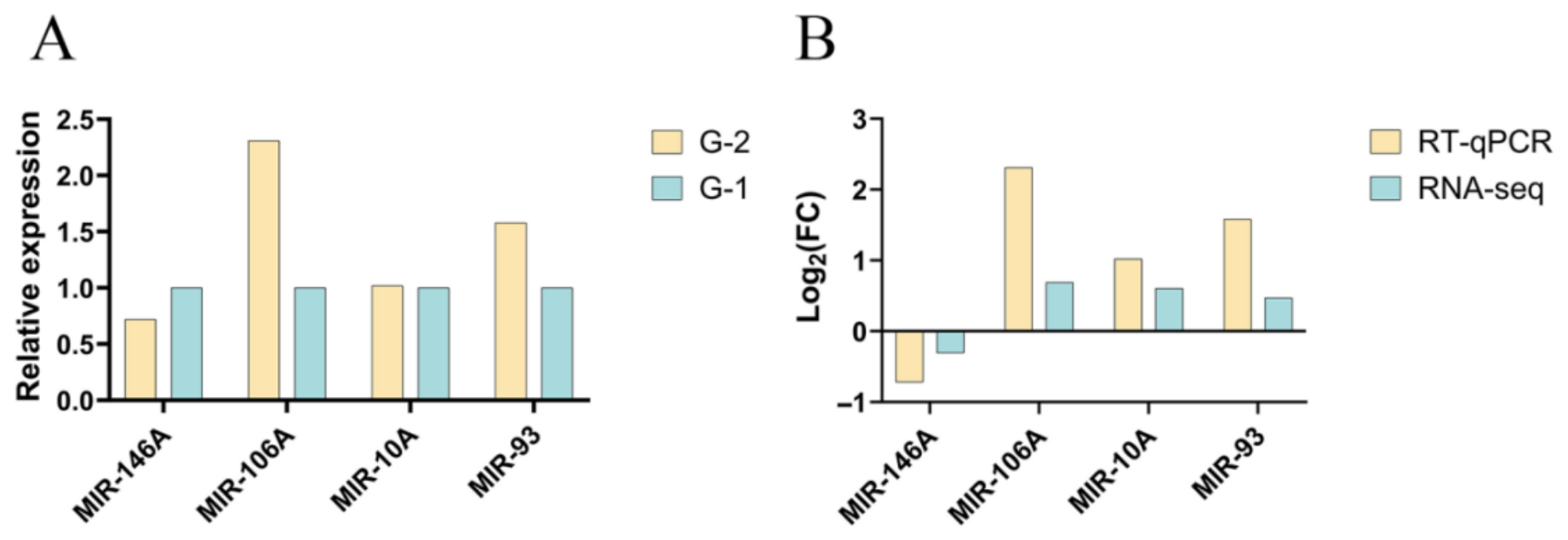
To validate the accuracy of the miRNA sequencing results, four DEmiRNAs were randomly selected for verification via RT-qPCR. As shown in Figure 4, miR-146A was down-regulated, whereas miR-106A, miR-10A, and miR-93 were up-regulated. The expression trends of all tested miRNAs were consistent between the RT-qPCR and RNA-seq analyses, confirming the reliability of the sequencing data and supporting their use for further investigation.

4. Discussion

Testicular development and spermatogenesis are core processes of male equine sexual maturation, which are precisely regulated by post-transcriptional factors such as miRNAs. Our study identified 165 DEmiRNAs between pre-pubertal and post-pubertal Kazakh horse testes, suggesting that miRNA-mediated post-transcriptional regulation may be involved in testicular functional maturation. Liu et al. [16] revealed the mRNA expression characteristics of Mongolian horse testes at different sexual maturity stages by single-cell RNA sequencing and found that cell structure-related genes were dominant in immature testes, while spermatogenesis-related genes were highly active in mature testes. our results show a generally consistent trend: the target genes of DEmiRNAs screened in this study were significantly enriched in pathways related to cell proliferation, differentiation and reproductive function, indicating that miRNAs and mRNAs form a synergistic regulatory network to drive equine testicular maturation. Different from the mRNA-level transcription analysis, this study supplements the miRNA regulatory profile during equine testicular development, which fills the research gap of miRNA regulation in horse puberty and provides a new molecular perspective for revealing the mechanism of equine reproductive development.
miR-6537-y and its target gene APOE were identified from the high-confidence miRNA-target gene pairs predicted in this study, and they were selected for further discussion due to their potential regulatory roles in testicular development. APOE, a predicted target gene of miR-6537-y, is a multifunctional protein with expression detected in multiple tissues, among them the testis [17]. Schleicher et al. [18] localized APOE within mouse testes via immunohistochemistry, revealing prominent expression in Leydig cells and a diffuse distribution in the seminiferous tubules. Their experiments demonstrated that Leydig cells are capable of synthesizing and secreting APOE, suggesting a role in local sterol transport. In the process of testosterone biosynthesis, APOE may act as a sterol transporter within the testis, facilitating the delivery of cholesterol for hormone synthesis [19]. Additionally, APOE has been reported to contribute to maintaining cholesterol metabolic homeostasis and testicular structural integrity [20]. Studies in APOE-deficient mice further suggest that loss of APOE function may impair testicular development and spermatogenesis, as indicated by reduced testosterone levels, altered vascular structure, and decreased sperm production [21,22]. In this study, miR-6537-y was significantly up-regulated in post-pubertal testes, suggesting a potential inhibitory effect on its predicted target gene APOE. This regulatory relationship may reflect a dynamic adjustment of cholesterol metabolism and testosterone synthesis during testicular maturation. Compared with previous studies that mainly focused on APOE protein function, our findings provide preliminary evidence at the miRNA-mediated post-transcriptional regulatory level.
In our study, MAPK1 was identified as a predicted target gene of several DEmiRNAs, including eca-miR-196a, miR-345-x, and miR-735-y, suggesting that miRNA-mediated regulation may influence MAPK signaling during testicular maturation. MAPK1 is a known component of the MAPK signaling pathway, which is involved in cell proliferation, differentiation, and spermatogenesis [23,24,25,26,27]. Research by Yamashita et al. [28] involving mice with Leydig cell-specific ablation of MEK1 and MEK2 revealed a decrease in Leydig cell numbers and reduced expression of key Leydig cell markers, along with diminished testosterone levels, indicating the importance of MAPK signaling in testicular function. In addition, MAPK signaling has been reported to regulate the proliferation and differentiation of spermatogonial cells in multiple species [29,30,31]. In this study, the identified miRNAs showed significant expression differences between the two age groups, suggesting that they may regulate the expression of MAPK1 and may be related to differences in testicular maturation between one-year-old and two-year-old Kazakh horses. It should be noted that the target gene is only bioinformatically predicted and lacks functional experimental validation, and the above speculation requires further verification. These findings are generally consistent with previous studies demonstrating the importance of MAPK signaling in spermatogenesis. However, our study suggests that this pathway may be regulated at the miRNA level in equine testes.
The equilibrium between spermatogonial proliferation and apoptosis is important for maintaining normal spermatogenesis, and its disruption can impair testicular function [32]. STK4, a predicted target of miRNAs including eca-miR-350, miR-4301-z, and miR-452-x is a pro-apoptotic kinase involved in regulating apoptotic signaling pathways [33,34]. Previous studies have shown that disruption of STK4 function can impair apoptosis regulation and affect spermatogenesis. For example, mutations in STK4 have been reported to disrupt apoptotic processes [35], and STK4 deficiency in animal models has been associated with infertility, abnormal sperm development, and dysregulated cell proliferation and apoptosis [36]. In this study, the differential expression of miRNAs targeting STK4 suggests that miRNA-mediated regulation may contribute to maintaining the balance between germ cell proliferation and apoptosis during testicular maturation in Kazakh horses. However, these regulatory relationships are based on bioinformatic prediction and require further experimental validation.
Although our findings are generally consistent with previous transcriptomic studies, some differences in specific miRNA expression patterns and regulatory relationships were observed. These discrepancies may be attributed to species-specific genetic backgrounds, differences in developmental stage selection, and methodological variations such as bulk RNA sequencing versus single-cell RNA sequencing. These factors may collectively contribute to the observed diversity in regulatory mechanisms.
While this study provides insights into miRNA expression during testicular development, several limitations should be acknowledged. First, the classification of animals into pre-pubertal and post-pubertal groups was based solely on age, without direct histological or endocrine validation of testicular maturity. Although this approach is consistent with established knowledge of equine sexual development, it may not fully capture individual variation in pubertal timing. Second, the relatively small sample size (n = 4 per group) limits the statistical power and does not support definitive mechanistic conclusions. Third, the analysis is largely correlative, and the regulatory relationships between miRNAs and their predicted target genes require further functional validation.

5. Conclusions

miRNA sequencing analysis of pre- and post-pubertal Kazakh horse testes identified 165 differentially expressed miRNAs, including key up-regulated miRNAs (e.g., eca-miR-206 and eca-miR-2483) and down-regulated miRNAs (e.g., eca-miR-196a and eca-miR-211). Target gene prediction suggested that these miRNAs may regulate genes such as APOE, MAPK1, and STK4, which are involved in lipid metabolism, signal transduction, and spermatogenesis. These findings suggest that miRNA-mediated regulatory networks may be associated with the transition from pre-pubertal to post-pubertal stages in Kazakh horses. However, these regulatory relationships remain putative and require further experimental validation. Overall, this study provides a basis for understanding equine testicular development and offers candidate targets for future functional and breeding-related studies.

Supplementary Materials

The following supporting information can be downloaded at: https://www.mdpi.com/article/10.3390/biology15090715/s1, Table S1: Primers used for RT-qPCR validation; Table S2: Differentially expressed miRNAs; Table S3: GO and KEGG enrichment analysis results; Table S4: Shared and unique miRNAs between groups; Table S5: High-confidence miRNA–target gene pairs.

Author Contributions

Y.Z. (Yuhe Zhou): Investigation, Formal analysis, Writing—Original Draft. L.W.: Investigation, Formal analysis, Validation, Writing—Original Draft. W.R.: Data Curation, Visualization, Writing—Review and Editing. M.W.: Data Curation, Software, Writing—Review and Editing. M.M.: Software, Validation, Writing—Review and Editing. J.W.: Formal analysis, Software, Validation, Writing—Review and Editing. J.M.: Data Curation, Visualization, Writing—Review and Editing. X.Y.: Conceptualization, Methodology, Supervision, Writing—Review and Editing. Y.Z. (Yaqi Zeng): Methodology, Funding acquisition, Supervision, Writing—Review and Editing. All authors have read and agreed to the published version of the manuscript.

Funding

1. Funding Number: ZYYD 2025 JD 02, Project Name: Central Guided Local Science and Technology Development Fund Project—“Research on the Regulation Mechanism of Horse Breeding and Athletic Performance (Funder: Wanlu Ren)”; 2. 2025 Xinjiang Uyghur Autonomous Region “Sky Lake Talent” Young Doctor Introduction Program (Funder: Wanlu Ren); 3. Funding Number: XJMFY 202405, Open Project of Xinjiang Horse Breeding and Physiological Key Laboratory “Exploring the Development Mechanism of Testicles in Male Horses of Different Ages Based on Whole Transcriptionome Sequencing (Funder: Wanlu Ren)”; 4. Funding Number: 202510758003 X, National-level Entrepreneurship Training Project “Seeing the Future Through Breeding—Horse Reproduction Service Technology” (Funder: Liuxiang Wen). 5. 2025 Xinjiang Agricultural University College Students’ Innovation Project “Exploring the Development Mechanism of Testicles in Male Horses of Different Ages Based on Whole Transcriptionome Sequencing” (Funder: Mingyue Wen).

Institutional Review Board Statement

The experimental procedures and protocol of this study were approved by the Animal Ethics Review Committee of Xinjiang Agricultural University (Approval No. 2025001 and date of approval: 24 February 2025).

Informed Consent Statement

Not applicable.

Data Availability Statement

The data presented in this study are openly available in BioProject (reference number: PRJNA1377007).

Acknowledgments

We extend our gratitude to Guangzhou Genedenovo Biotechnology Co., Ltd. For their support in the sequencing (http://www.genedenovo.com/ (accessed on 30 April 2025)).

Conflicts of Interest

All authors declare that they have no conflict of interest.

References

  1. Ren, W.; Wang, J.; Zeng, Y.; Wang, T.; Meng, J.; Yao, X. Differential age-related transcriptomic analysis of ovarian granulosa cells in Kazakh horses. Front. Endocrinol. 2024, 15, 1346260. [Google Scholar] [CrossRef]
  2. Yu, X.; Fang, C.; Liu, L.; Zhao, X.; Liu, W.; Cao, H.; Lv, S. Transcriptome study underling difference of milk yield during peak lactation of Kazakh horse. J. Equine Vet. Sci. 2021, 102, 103424. [Google Scholar] [CrossRef]
  3. Ren, W.; Wang, J.; Zeng, Y.; Wang, T.; Sun, Z.; Meng, J.; Yao, X. Investigating age-related differences in muscles of Kazakh horse through transcriptome analysis. Gene 2024, 919, 148483. [Google Scholar] [CrossRef] [PubMed]
  4. Gan, M.; Liu, L.; Zhang, S.; Guo, Z.; Tan, Y.; Luo, J.; Yang, Q.; Pan, H.; Li, X.; Wang, J.; et al. Expression characteristics of microRNA in pig umbilical venous blood and umbilical arterial blood. Animals 2021, 11, 1563. [Google Scholar] [CrossRef]
  5. Guo, X.-k.; Zhang, Q.; Gao, L.; Li, N.; Chen, X.-x.; Feng, W.-h. Increasing expression of microRNA 181 inhibits porcine reproductive and respiratory syndrome virus replication and has implications for controlling virus infection. J. Virol. 2013, 87, 1159–1171. [Google Scholar] [CrossRef] [PubMed]
  6. Lai, Y.-C.; Fujikawa, T.; Maemura, T.; Ando, T.; Kitahara, G.; Endo, Y.; Yamato, O.; Koiwa, M.; Kubota, C.; Miura, N. Inflammation-related microRNA expression level in the bovine milk is affected by mastitis. PLoS ONE 2017, 12, e0177182. [Google Scholar] [CrossRef] [PubMed]
  7. Gao, Y.; Li, S.; Lai, Z.; Zhou, Z.; Wu, F.; Huang, Y.; Lan, X.; Lei, C.; Chen, H.; Dang, R. Analysis of long non-coding RNA and mRNA expression profiling in immature and mature bovine (Bos taurus) testes. Front. Genet. 2019, 10, 646. [Google Scholar] [CrossRef]
  8. Wu, J.; Zhu, H.; Song, W.; Li, M.; Liu, C.; Li, N.; Tang, F.; Mu, H.; Liao, M.; Li, X.; et al. Identification of conservative microRNAs in Saanen dairy goat testis through deep sequencing. Reprod. Domest. Anim. 2014, 49, 32–40. [Google Scholar] [CrossRef]
  9. Zhang, B.; Yan, Z.; Gao, Y.; Li, J.; Wang, Z.; Wang, P.; Yang, Q.; Huang, X.; Gun, S. Integrated analysis of miRNA and mRNA expression profiles in testes of Landrace and Hezuo boars. Front. Vet. Sci. 2022, 9, 942669. [Google Scholar] [CrossRef]
  10. Hu, L.; Wang, X.; Guo, S.; Cao, M.; Kang, Y.; Ding, Z.; Pei, J.; Ge, Q.; Ma, Y.; Guo, X. Whole-transcriptome sequencing analysis to identify key circRNAs, miRNAs, and mRNAs in the development of yak testes. BMC Genom. 2024, 25, 824. [Google Scholar] [CrossRef]
  11. Luo, L.; Ye, L.; Liu, G.; Shao, G.; Zheng, R.; Ren, Z.; Zuo, B.; Xu, D.; Lei, M.; Jiang, S.; et al. Microarray-based approach identifies differentially expressed microRNAs in porcine sexually immature and mature testes. PLoS ONE 2010, 5, e11744. [Google Scholar] [CrossRef]
  12. Xi, B.; An, X.; Yue, Y.; Shen, H.; Han, G.; Yang, Y.; Zhao, S. Identification and profiling of microRNAs during sheep’s testicular development. Front. Vet. Sci. 2025, 12, 1538990. [Google Scholar] [CrossRef] [PubMed]
  13. Naden, J.; Amann, R.P.; Squires, E.L. Testicular growth, hormone concentrations, seminal characteristics and sexual behaviour in stallions. Reproduction 1990, 88, 167–176. [Google Scholar] [CrossRef]
  14. Chen, S.; Zhou, Y.; Chen, Y.; Gu, J. fastp: An ultra-fast all-in-one FASTQ preprocessor. Bioinformatics 2018, 34, i884–i890. [Google Scholar] [CrossRef]
  15. Lu, Z.; Wen, M.; Yao, X.; Meng, J.; Wang, J.; Zeng, Y.; Li, L.; Ren, W. Differential analysis of testicular LncRNA in Kazakh horses of different ages. Int. J. Biol. Macromol. 2025, 321, 146228. [Google Scholar] [CrossRef]
  16. Liu, Y.; Du, M.; Li, X.; Zhang, L.; Zhao, B.; Wang, N.; Dugarjaviin, M. Single-cell transcriptome sequencing reveals molecular expression differences and marker genes in testes during the sexual maturation of mongolian horses. Animals 2024, 14, 1258. [Google Scholar] [CrossRef] [PubMed]
  17. Tréguier, Y.; Bull-Maurer, A.; Roingeard, P. Apolipoprotein E, a crucial cellular protein in the lifecycle of hepatitis viruses. Int. J. Mol. Sci. 2022, 23, 3676. [Google Scholar] [CrossRef]
  18. Schleicher, R.L.; Zheng, M.; Zhang, M. Immunocytochemical localization and endogenous synthesis of apolipoprotein E in testicular Leydig cells. Biol. Reprod. 1993, 48, 313–324. [Google Scholar] [CrossRef]
  19. Shatwan, I.M.; Winther, K.H.; Ellahi, B.; Elwood, P.; Ben-Shlomo, Y.; Givens, I.; Rayman, M.P.; Lovegrove, J.A.; Vimaleswaran, K.S. Association of apolipoprotein E gene polymorphisms with blood lipids and their interaction with dietary factors. Lipids Health Dis. 2018, 17, 98. [Google Scholar] [CrossRef]
  20. Ravenhill, S.M.; Evans, A.H.; Crewther, S.G. Escalating bi-directional feedback loops between proinflammatory microglia and mitochondria in ageing and post-diagnosis of Parkinson’s disease. Antioxidants 2023, 12, 1117. [Google Scholar] [CrossRef] [PubMed]
  21. Steinfeld, K.; Beyer, D.; Mühlfeld, C.; Mietens, A.; Eichner, G.; Altinkilic, B.; Kampschulte, M.; Jiang, Q.; Krombach, G.A.; Linn, T.; et al. Low testosterone in ApoE/LDL receptor double-knockout mice is associated with rarefied testicular capillaries together with fewer and smaller Leydig cells. Sci. Rep. 2018, 8, 5424. [Google Scholar] [CrossRef] [PubMed]
  22. Langheinrich, A.C.; Paradowska, A.; Kilinski, R.; Kampschulte, M.; Steinfeld, K.; Altinkilic, B.; Steger, K.; Stieger, P.; Bergmann, M.; Weidner, W. Mixed testicular atrophy related to atherosclerosis: First lessons from the ApoE−/−/LDL receptor−/− double knockout mouse model. Int. J. Androl. 2012, 35, 562–571. [Google Scholar] [CrossRef]
  23. Tian, J.; Xue, B.; Hu, J.; Li, J.; Cheng, X.; Hu, J.; Li, F.; Chen, Y.; Li, B. Exogenous substances regulate silkworm fat body protein synthesis through MAPK and PI3K/Akt signaling pathways. Chemosphere 2017, 171, 202–207. [Google Scholar] [CrossRef]
  24. Yue, J.; López, J.M. Understanding MAPK signaling pathways in apoptosis. Int. J. Mol. Sci. 2020, 21, 2346. [Google Scholar] [CrossRef]
  25. Jing, J.; Ding, N.; Wang, D.; Ge, X.; Ma, J.; Ma, R.; Huang, X.; Jueraitetibaike, K.; Liang, K.; Wang, S.; et al. Oxidized-LDL inhibits testosterone biosynthesis by affecting mitochondrial function and the p38 MAPK/COX-2 signaling pathway in Leydig cells. Cell Death Dis. 2020, 11, 626. [Google Scholar] [CrossRef]
  26. Zhang, H.; Liu, Y.; Xu, K.; Mao, K.; Han, W.; Xu, F.; Wan, W.; Sun, Y. AMPH-1 as a critical tumor suppressor that inhibits osteosarcoma progression. Cancer Manag. Res. 2019, 11, 9913–9919. [Google Scholar] [CrossRef] [PubMed]
  27. Ishaq, Y.; Ikram, A.; Alzahrani, B.; Khurshid, S. The Role of miRNAs, circRNAs and Their Interactions in Development and Progression of Hepatocellular Carcinoma: An Insilico Approach. Genes 2022, 14, 13. [Google Scholar] [CrossRef]
  28. Yamashita, S.; Tai, P.; Charron, J.; Ko, C.; Ascoli, M. The Leydig cell MEK/ERK pathway is critical for maintaining a functional population of adult Leydig cells and for fertility. Mol. Endocrinol. 2011, 25, 1211–1222. [Google Scholar] [CrossRef]
  29. Meng, X.; Lindahl, M.; Hyvönen, M.E.; Parvinen, M.; de Rooij, D.G.; Hess, M.W.; Raatikainen-Ahokas, A.; Sainio, K.; Rauvala, H.; Lakso, M.; et al. Regulation of cell fate decision of undifferentiated spermatogonia by GDNF. Science 2000, 287, 1489–1493. [Google Scholar] [CrossRef]
  30. Morimoto, H.; Iwata, K.; Ogonuki, N.; Inoue, K.; Atsuo, O.; Kanatsu-Shinohara, M.; Morimoto, T.; Yabe-Nishimura, C.; Shinohara, T. ROS are required for mouse spermatogonial stem cell self-renewal. Cell Stem Cell 2013, 12, 774–786. [Google Scholar] [CrossRef] [PubMed]
  31. Sahare, M.; Otomo, A.; Komatsu, K.; Minami, N.; Yamada, M.; Imai, H. The role of signaling pathways on proliferation and self-renewal of cultured bovine primitive germ cells. Reprod. Med. Biol. 2015, 14, 17–25. [Google Scholar] [CrossRef]
  32. Wang, E.H.; Yu, Z.L.; Bu, Y.J.; Xu, P.W.; Xi, J.Y.; Liang, H.Y. Grape seed proanthocyanidin extract alleviates high-fat diet induced testicular toxicity in rats. RSC Adv. 2019, 9, 11842–11850. [Google Scholar] [CrossRef] [PubMed]
  33. Shimazaki, M.; Wittayarat, M.; Sambuu, R.; Sugita, A.; Kawaguchi, M.; Hirata, M.; Tanihara, F.; Takagi, M.; Taniguchi, M.; Otoi, T.; et al. Disruption of cell proliferation and apoptosis balance in the testes of crossbred cattle-yaks affects spermatogenic cell fate and sterility. Reprod. Domest. Anim. 2022, 57, 999–1006. [Google Scholar] [CrossRef]
  34. Lin, C.; Hsu, T.; Chiou, P.; Hsiao, M.; Wang, W.; Chen, Y.; Lin, J.; Wang, J.; Lin, P.; Lin, F.; et al. Downregulation of STK4 promotes colon cancer invasion/migration through blocking β-catenin degradation. Mol. Oncol. 2020, 14, 2574–2588. [Google Scholar] [CrossRef] [PubMed]
  35. Abolnezhadian, F.; Iranparast, S.; Ahmadpour, F. Identical twins with a mutation in the STK4 gene showing clinical manifestations of the mutation at different ages: A case report. Iran. J. Immunol. 2020, 17, 333–340. [Google Scholar]
  36. Meng, C.; Tian, G.; Xu, C.; Li, X.; Zhang, Y.; Wang, Y.; Qin, J.; Fok, E.K.L.; Hinton, B.T.; Mak, K.K.-L.; et al. Hippo kinases MST1 and MST2 control the differentiation of the epididymal initial segment via the MEK-ERK pathway. Cell Death Differ. 2020, 27, 2797–2809. [Google Scholar] [CrossRef] [PubMed]
Figure 1. Inter-sample correlation analysis between Group G-1 vs. Group G-2. (A) PCA scatter plot between Group G-1 vs. Group G-2 samples; (B) Venn diagram between Group G-1 vs. Group G-2; (C) violin plot between Group G-1 vs. Group G-2 samples; (D) correlation heatmap between Group G-1 vs. Group G-2.
Biology 15 00715 g001
Figure 2. Differential Expression Analysis of the G-1 vs. G-2 Groups. (A) Volcano plot of differentially expressed miRNAs between Group G-1 vs. Group G-2. (B) Bar chart showing the number of differentially expressed miRNAs between Group G-1 vs. Group G-2. (C) Heatmap of differentially expressed miRNAs between Group G-1 vs. Group G-2.
Biology 15 00715 g002
Figure 3. GO and KEGG enrichment analysis for the G-1 vs. G-2 groups. (A) Diagram of GO annotation entries for Biological Process (BP) between Group G-1 vs. Group G-2. (B) Diagram of GO annotation entries for Molecular Function (MF) between Group G-1 vs. Group G-2. (C) Diagram of GO annotation entries for Cellular Component (CC) between Group G-1 vs. Group G-2. (D) KEGG enrichment analysis diagram between Group G-1 vs. Group G-2.
Biology 15 00715 g003
Figure 4. RT-qPCR validation. (A) Differential miRNA expression in Group G-1 vs. Group G-2 detected by RT-qPCR. (B) Comparison of Log2 fold change (Log2FC) of DEmiRNAs measured by RNA-seq and RT-qPCR.
Biology 15 00715 g004
Table 1. Overall detection of miRNA sequencing data.
SampleClean_ReadsHigh_QualitypolyAClean_Tags
G-1-110,185,392 (100%)9,909,222 (97.2886%)84 (0.0008%)8,918,393 (87.5606%)
G-1-215,724,179 (100%)15,204,,732 (96.6965%)217 (0.0014%)13,250,115 (84.2659%)
G-1-311,966,079 (100%)11,559,130 (96.5991%)172 (0.0015%)10,337,437 (86.3895%)
G-1-414,691,054 (100%)14,377,864 (97.8682%)159 (0.0011%)12,926,605 (87.9896%)
G-2-111,497,853 (100%)11,106,655 (96.5976%)174 (0.0016%)9,876,716 (85.9005%)
G-2-210,989,506 (100%)10,624,537 (96.6789%)233 (0.0022%)9,218,960 (83.8888%)
G-2-311,606,989 (100%)11,219,529 (96.6618%)186 (0.0017%)9,684,736 (83.4388%)
G-2-413,226,692 (100%)12,814,437 (96.8832%)230 (0.0018%)11,033,589 (83.4191%)
Disclaimer/Publisher’s Note: The statements, opinions and data contained in all publications are solely those of the individual author(s) and contributor(s) and not of MDPI and/or the editor(s). MDPI and/or the editor(s) disclaim responsibility for any injury to people or property resulting from any ideas, methods, instructions or products referred to in the content.