Gingival Creep Failure: A Viscoelastic Theory of Recession in Thin Periodontal Phenotypes



Simple Summary
Abstract
1. Introduction
Definitions and Scope
2. Background
2.1. Gingival Soft Tissue as a Viscoelastic Material
2.2. Mechanobiology of Creep
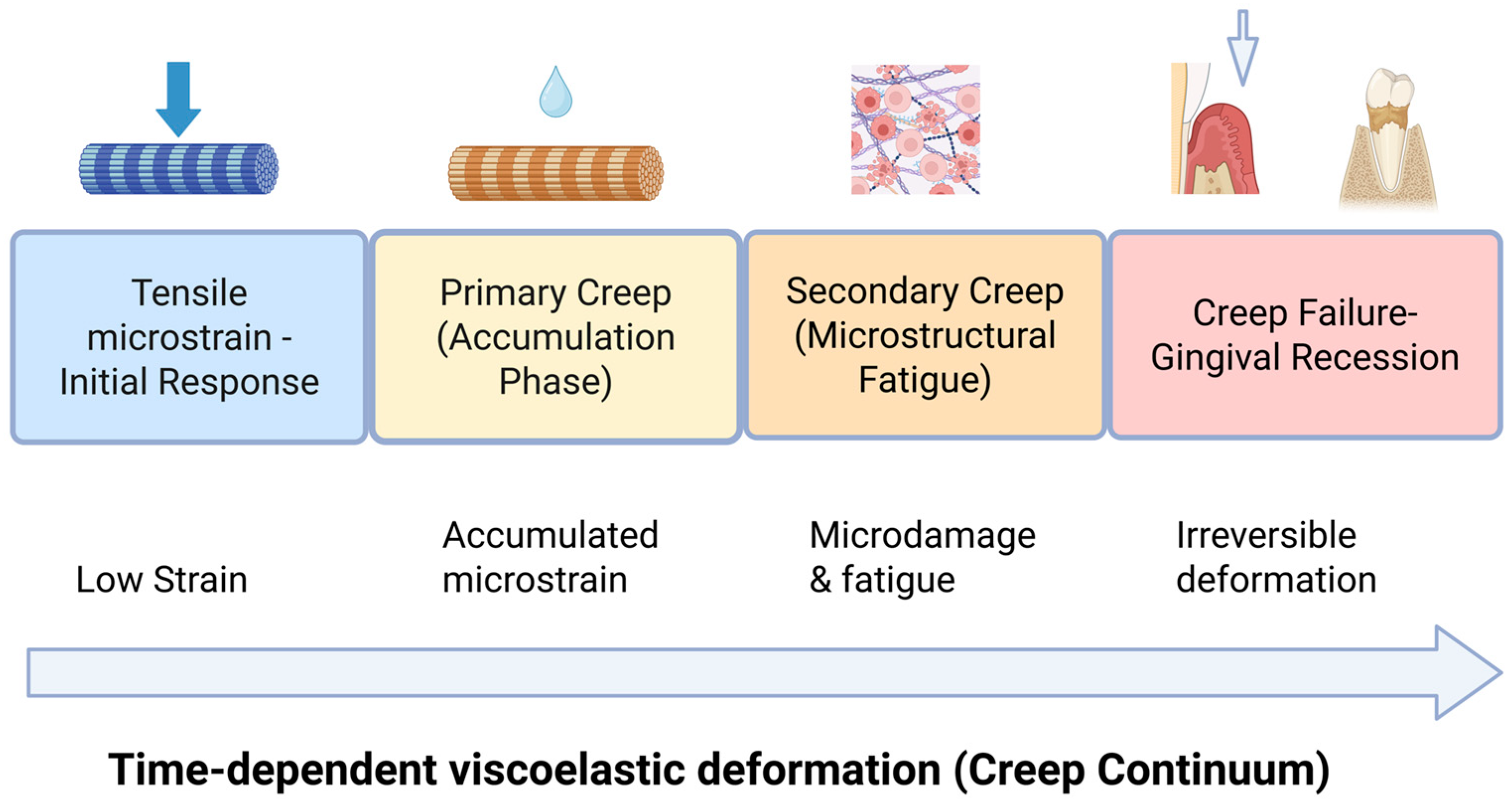
Primary creep—slow, nonlinear deformation as collagen uncrimps.
Secondary creep—accelerated deformation once microdamage accumulates.
2.3. Thin Periodontal Phenotype as a High-Creep State
3. The Gingival Creep Failure Theory
3.1. Sustained Tensile Microstrain Drives Creep Accumulation
3.2. Microstructural Fatigue as the Determinant of Irreversible Margin Displacement
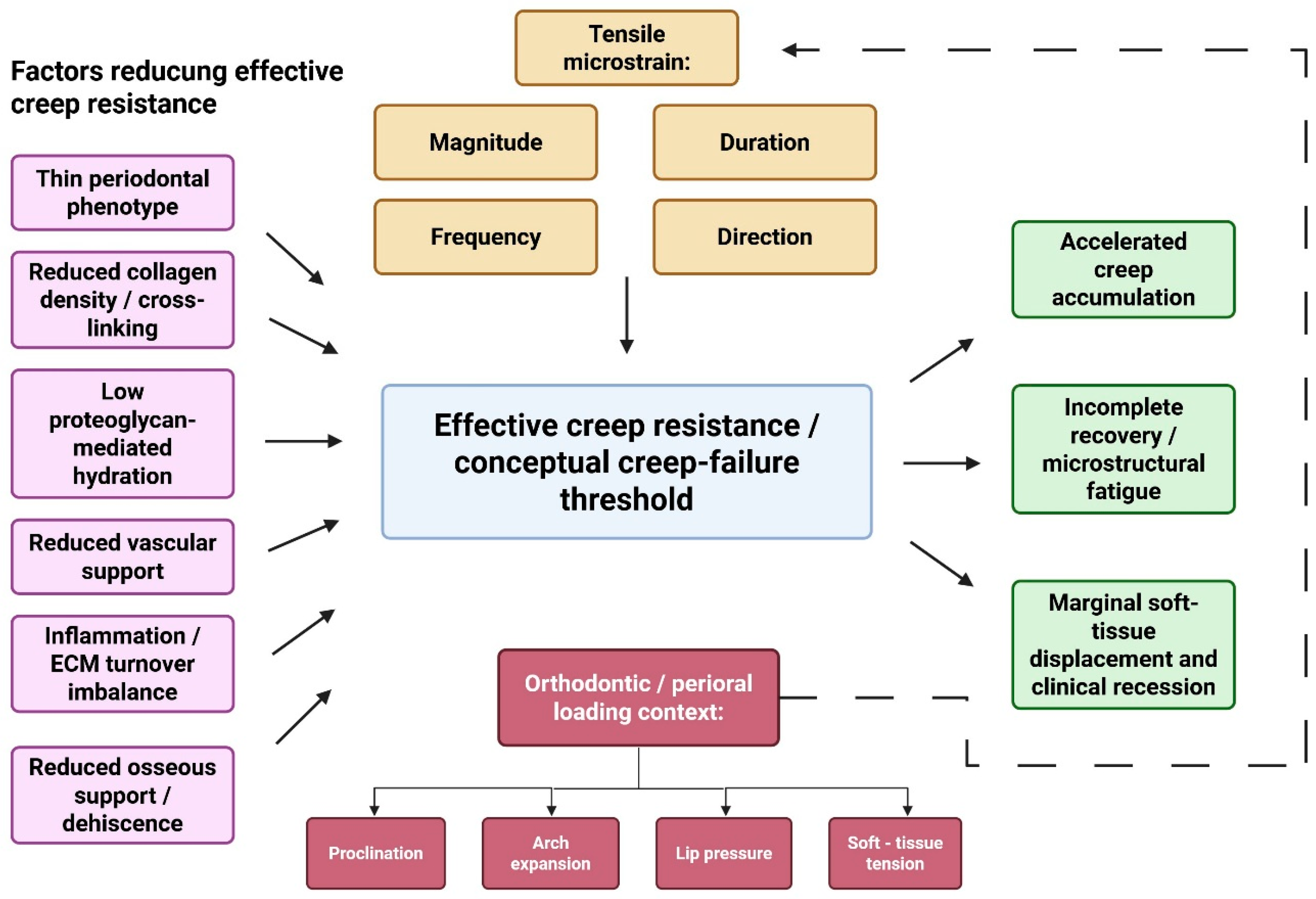
3.3. Creep Failure Threshold Is Phenotype-Dependent
3.4. Integration with Bone and Phenotype Biology
3.5. Clinical Meaning of the Model
4. Discussion
4.1. Direct Evidence Relevant to the Model
4.2. Indirect Supporting Evidence from Comparable Tissues
4.3. Speculative Mechanistic Extensions
4.4. Testable Predictions and Translational Roadmap
4.5. Clinical Implications
4.6. Future Directions
4.7. Limitations and Boundaries
5. Conclusions
Author Contributions
Funding
Institutional Review Board Statement
Informed Consent Statement
Data Availability Statement
Conflicts of Interest
References
- Younes, F.; Eghbali, A.; Raes, M.; De Bruyckere, T.; Cosyn, J.; De Bruyn, H. Relationship between Buccal Bone and Gingival Thickness Revisited Using Non-Invasive Registration Methods. Clin. Oral Implant. Res. 2016, 27, 523–528. [Google Scholar] [CrossRef]
- Claffey, N.; Shanley, D. Relationship of Gingival Thickness and Bleeding to Loss of Probing Attachment in Shallow Sites Following Nonsurgical Periodontal Therapy. J. Clin. Periodontol. 1986, 13, 654–657. [Google Scholar] [CrossRef]
- Cadenas De Llano-Pérula, M.; Castro, A.B.; Danneels, M.; Schelfhout, A.; Teughels, W.; Willems, G. Risk Factors for Gingival Recessions after Orthodontic Treatment: A Systematic Review. Eur. J. Orthod. 2023, 45, 528–544. [Google Scholar] [CrossRef]
- Puxkandl, R.; Zizak, I.; Paris, O.; Keckes, J.; Tesch, W.; Bernstorff, S.; Purslow, P.; Fratzl, P. Viscoelastic Properties of Collagen: Synchrotron Radiation Investigations and Structural Model. Philos. Trans. R. Soc. Lond. B 2002, 357, 191–197. [Google Scholar] [CrossRef]
- Fung, Y.-C. Biomechanics; Springer: New York, NY, USA, 1993. [Google Scholar]
- Bonifasi-Lista, C.; Lakez, S.P.; Small, M.S.; Weiss, J.A. Viscoelastic Properties of the Human Medial Collateral Ligament under Longitudinal, Transverse and Shear Loading. J. Orthop. Res. 2005, 23, 67–76. [Google Scholar] [CrossRef]
- Lakes, R. Viscoelastic Materials, 1st ed.; Cambridge University Press: Cambridge, UK, 2009. [Google Scholar]
- Thornton, G.M.; Schwab, T.D.; Oxland, T.R. Fatigue Is More Damaging than Creep in Ligament Revealed by Modulus Reduction and Residual Strength. Ann. Biomed. Eng. 2007, 35, 1713–1721. [Google Scholar] [CrossRef]
- Goktas, S.; Dmytryk, J.J.; McFetridge, P.S. Biomechanical Behavior of Oral Soft Tissues. J. Periodontol. 2011, 82, 1178–1186. [Google Scholar] [CrossRef] [PubMed]
- Lacoste-Ferré, M.-H.; Demont, P.; Dandurand, J.; Dantras, E.; Duran, D.; Lacabanne, C. Dynamic Mechanical Properties of Oral Mucosa: Comparison with Polymeric Soft Denture Liners. J. Mech. Behav. Biomed. Mater. 2011, 4, 269–274. [Google Scholar] [CrossRef] [PubMed]
- Silver, F.H.; Freeman, J.W.; Seehra, G.P. Collagen Self-Assembly and the Development of Tendon Mechanical Properties. J. Biomech. 2003, 36, 1529–1553. [Google Scholar] [CrossRef] [PubMed]
- Alimohamad, H.; Habijanac, T.; Larjava, H.; Häkkinen, L. Colocalization of the Collagen-Binding Proteoglycans Decorin, Biglycan, Fibromodulin and Lumican with Different Cells in Human Gingiva. J. Periodontal Res. 2005, 40, 73–86. [Google Scholar] [CrossRef]
- Kähäri, V.M.; Larjava, H.; Uitto, J. Differential Regulation of Extracellular Matrix Proteoglycan (PG) Gene Expression. Transforming Growth Factor-Beta 1 up-Regulates Biglycan (PGI), and Versican (Large Fibroblast PG) but down-Regulates Decorin (PGII) mRNA Levels in Human Fibroblasts in Culture. J. Biol. Chem. 1991, 266, 10608–10615. [Google Scholar]
- Provenzano, P. Collagen Fibril Morphology and Organization: Implications for Force Transmission in Ligament and Tendon. Matrix Biol. 2006, 25, 71–84. [Google Scholar] [CrossRef]
- Gupta, H.S.; Seto, J.; Krauss, S.; Boesecke, P.; Screen, H.R.C. In Situ Multi-Level Analysis of Viscoelastic Deformation Mechanisms in Tendon Collagen. J. Struct. Biol. 2010, 169, 183–191. [Google Scholar] [CrossRef] [PubMed]
- Nam, S.; Hu, K.H.; Butte, M.J.; Chaudhuri, O. Strain-Enhanced Stress Relaxation Impacts Nonlinear Elasticity in Collagen Gels. Proc. Natl. Acad. Sci. USA 2016, 113, 5492–5497. [Google Scholar] [CrossRef] [PubMed]
- Legerlotz, K.; Riley, G.P.; Screen, H.R.C. GAG Depletion Increases the Stress-Relaxation Response of Tendon Fascicles, but Does Not Influence Recovery. Acta Biomater. 2013, 9, 6860–6866. [Google Scholar] [CrossRef]
- Li, Y.; Fessel, G.; Georgiadis, M.; Snedeker, J.G. Advanced Glycation End-Products Diminish Tendon Collagen Fiber Sliding. Matrix Biol. 2013, 32, 169–177. [Google Scholar] [CrossRef]
- Zitnay, J.L.; Jung, G.S.; Lin, A.H.; Qin, Z.; Li, Y.; Yu, S.M.; Buehler, M.J.; Weiss, J.A. Accumulation of Collagen Molecular Unfolding Is the Mechanism of Cyclic Fatigue Damage and Failure in Collagenous Tissues. Sci. Adv. 2020, 6, eaba2795. [Google Scholar] [CrossRef]
- Zitnay, J.L.; Lin, A.H.; Weiss, J.A. Tendons Exhibit Greater Resistance to Tissue and Molecular-Level Damage with Increasing Strain Rate during Cyclic Fatigue. Acta Biomater. 2021, 134, 435–442. [Google Scholar] [CrossRef] [PubMed]
- Duenwald, S.E.; Vanderby, R.; Lakes, R.S. Stress Relaxation and Recovery in Tendon and Ligament: Experiment and Modeling. Biorheology 2010, 47, 1–14. [Google Scholar] [CrossRef]
- Hurschler, C.; Loitz-Ramage, B.; Vanderby, R. A Structurally Based Stress-Stretch Relationship for Tendon and Ligament. J. Biomech. Eng. 1997, 119, 392–399. [Google Scholar] [CrossRef]
- Van Driel, W.D.; Van Leeuwen, E.J.; Von Den Hoff, J.W.; Maltha, J.C.; Kuijpers-Jagtman, A.M. Time-Dependent Mechanical Behaviour of the Periodontal Ligament. Proc. Inst. Mech. Eng. H 2000, 214, 497–504. [Google Scholar] [CrossRef]
- Grant, M.; Wilson, J.; Rock, P.; Chapple, I. Induction of Cytokines, MMP9, TIMPs, RANKL and OPG during Orthodontic Tooth Movement. Eur. J. Orthod. 2013, 35, 644–651. [Google Scholar] [CrossRef]
- Ingman, T.; Apajalahti, S.; Mäntylä, P.; Savolainen, P.; Sorsa, T. Matrix Metalloproteinase-1 and -8 in Gingival Crevicular Fluid during Orthodontic Tooth Movement: A Pilot Study during 1 Month of Follow-up after Fixed Appliance Activation. Eur. J. Orthod. 2005, 27, 202–207. [Google Scholar] [CrossRef] [PubMed]
- Hoffman, B.D.; Grashoff, C.; Schwartz, M.A. Dynamic Molecular Processes Mediate Cellular Mechanotransduction. Nature 2011, 475, 316–323. [Google Scholar] [CrossRef] [PubMed]
- Wei, L.; Chen, Q.; Zheng, Y.; Nan, L.; Liao, N.; Mo, S. Potential Role of Integrin A5β1/Focal Adhesion Kinase (FAK) and Actin Cytoskeleton in the Mechanotransduction and Response of Human Gingival Fibroblasts Cultured on a 3-Dimension Lactide-Co-Glycolide (3D PLGA) Scaffold. Med. Sci. Monit. 2020, 26, e921626. [Google Scholar] [CrossRef]
- Nakamura, K.; Yamamoto, T.; Ema, R.; Nakai, K.; Sato, Y.; Yamamoto, K.; Adachi, K.; Oseko, F.; Yamamoto, Y.; Kanamura, N. Effects of Mechanical Stress on Human Oral Mucosa-Derived Cells. Oral Dis. 2021, 27, 1184–1192. [Google Scholar] [CrossRef] [PubMed]
- Belgardt, E.; Steinberg, T.; Husari, A.; Dieterle, M.P.; Hülter-Hassler, D.; Jung, B.; Tomakidi, P. Force-Responsive Zyxin Modulation in Periodontal Ligament Cells Is Regulated by YAP Rather than TAZ. Cell. Signal. 2020, 72, 109662. [Google Scholar] [CrossRef]
- Guo, F.; Carter, D.E.; Leask, A. Mechanical Tension Increases CCN2/CTGF Expression and Proliferation in Gingival Fibroblasts via a TGFβ-Dependent Mechanism. PLoS ONE 2011, 6, e19756. [Google Scholar] [CrossRef]
- Lisboa, R.A.; Andrade, M.V.; Cunha-Melo, J.R. Toll-like Receptor Activation and Mechanical Force Stimulation Promote the Secretion of Matrix Metalloproteinases 1, 3 and 10 of Human Periodontal Fibroblasts via P38, JNK and NF-kB. Arch. Oral Biol. 2013, 58, 731–739. [Google Scholar] [CrossRef]
- Ritter, N.; Mussig, E.; Steinberg, T.; Kohl, A.; Komposch, G.; Tomakidi, P. Elevated Expression of Genes Assigned to NF-kappaB and Apoptotic Pathways in Human Periodontal Ligament Fibroblasts Following Mechanical Stretch. Cell Tissue Res. 2007, 328, 537–548. [Google Scholar] [CrossRef]
- Yamaguchi, K.; Nanda, R.S.; Kawata, T. Effect of Orthodontic Forces on Blood Flow in Human Gingiva. Angle Orthod. 1991, 61, 193–203; discussion 203–204. [Google Scholar] [CrossRef]
- Jacobs, C.; Walter, C.; Ziebart, T.; Grimm, S.; Meila, D.; Krieger, E.; Wehrbein, H. Induction of IL-6 and MMP-8 in Human Periodontal Fibroblasts by Static Tensile Strain. Clin. Oral Investig. 2014, 18, 901–908. [Google Scholar] [CrossRef]
- Lee, T.-Y.; Lee, K.-J.; Baik, H.-S. Expression of IL-1beta, MMP-9 and TIMP-1 on the Pressure Side of Gingiva under Orthodontic Loading. Angle Orthod. 2009, 79, 733–739. [Google Scholar] [CrossRef] [PubMed]
- Redlich, M.; Reichenberg, E.; Harari, D.; Zaks, B.; Shoshan, S.; Palmon, A. The Effect of Mechanical Force on mRNA Levels of Collagenase, Collagen Type I, and Tissue Inhibitors of Metalloproteinases in Gingivae of Dogs. J. Dent. Res. 2001, 80, 2080–2084. [Google Scholar] [CrossRef]
- Bolcato-Bellemin, A.L.; Elkaim, R.; Abehsera, A.; Fausser, J.L.; Haikel, Y.; Tenenbaum, H. Expression of mRNAs Encoding for Alpha and Beta Integrin Subunits, MMPs, and TIMPs in Stretched Human Periodontal Ligament and Gingival Fibroblasts. J. Dent. Res. 2000, 79, 1712–1716. [Google Scholar] [CrossRef]
- Grünheid, T.; Zentner, A. Extracellular Matrix Synthesis, Proliferation and Death in Mechanically Stimulated Human Gingival Fibroblasts in Vitro. Clin. Oral Investig. 2005, 9, 124–130. [Google Scholar] [CrossRef] [PubMed]
- Joss-Vassalli, I.; Grebenstein, C.; Topouzelis, N.; Sculean, A.; Katsaros, C. Orthodontic Therapy and Gingival Recession: A Systematic Review. Orthod. Craniofac. Res. 2010, 13, 127–141. [Google Scholar] [CrossRef] [PubMed]
- Gül, İ.; Çolak, R.; Cicek, O. Evaluation of the Effect of Periodontal Health and Orthodontic Treatment on Gingival Recession: A Cross-Sectional Study. BMC Oral Health 2025, 25, 1069. [Google Scholar] [CrossRef]
- Choi, J.J.E.; Zwirner, J.; Ramani, R.S.; Ma, S.; Hussaini, H.M.; Waddell, J.N.; Hammer, N. Mechanical Properties of Human Oral Mucosa Tissues Are Site Dependent: A Combined Biomechanical, Histological and Ultrastructural Approach. Clin. Exp. Dent. Res. 2020, 6, 602–611. [Google Scholar] [CrossRef]
- Malpartida-Carrillo, V.; Tinedo-Lopez, P.L.; Guerrero, M.E.; Amaya-Pajares, S.P.; Özcan, M.; Rösing, C.K. Periodontal Phenotype: A Review of Historical and Current Classifications Evaluating Different Methods and Characteristics. J. Esthet. Restor. Dent. 2021, 33, 432–445. [Google Scholar] [CrossRef]
- De Rouck, T.; Eghbali, R.; Collys, K.; De Bruyn, H.; Cosyn, J. The Gingival Biotype Revisited: Transparency of the Periodontal Probe through the Gingival Margin as a Method to Discriminate Thin from Thick Gingiva. J. Clin. Periodontol. 2009, 36, 428–433. [Google Scholar] [CrossRef]
- Kalajzic, Z.; Peluso, E.B.; Utreja, A.; Dyment, N.; Nihara, J.; Xu, M.; Chen, J.; Uribe, F.; Wadhwa, S. Effect of Cyclical Forces on the Periodontal Ligament and Alveolar Bone Remodeling during Orthodontic Tooth Movement. Angle Orthod. 2014, 84, 297–303. [Google Scholar] [CrossRef]
- Screen, H.R.C.; Shelton, J.C.; Bader, D.L.; Lee, D.A. Cyclic Tensile Strain Upregulates Collagen Synthesis in Isolated Tendon Fascicles. Biochem. Biophys. Res. Commun. 2005, 336, 424–429. [Google Scholar] [CrossRef] [PubMed]
- Komatsu, K. Mechanical Strength and Viscoelastic Response of the Periodontal Ligament in Relation to Structure. J. Dent. Biomech. 2010, 2010, 502318. [Google Scholar] [CrossRef] [PubMed]
- Melsen, B. Tissue Reaction to Orthodontic Tooth Movement—A New Paradigm. Eur. J. Orthod. 2001, 23, 671–681. [Google Scholar] [CrossRef]
- Cortellini, P.; Bissada, N.F. Mucogingival Conditions in the Natural Dentition: Narrative Review, Case Definitions, and Diagnostic Considerations. J. Periodontol. 2018, 89, S204–S213. [Google Scholar] [CrossRef] [PubMed]
- Häkkinen, L.; Strassburger, S.; Kähäri, V.-M.; Scott, P.G.; Eichstetter, I.; Iozzo, R.V.; Larjava, H. A Role for Decorin in the Structural Organization of Periodontal Ligament. Lab. Investig. 2000, 80, 1869–1880. [Google Scholar] [CrossRef]
- Aronson, D. Cross-Linking of Glycated Collagen in the Pathogenesis of Arterial and Myocardial Stiffening of Aging and Diabetes. J. Hypertens. 2003, 21, 3–12. [Google Scholar] [CrossRef]
- Bagis, N.; Kolsuz, M.E.; Kursun, S.; Orhan, K. Comparison of Intraoral Radiography and Cone-Beam Computed Tomography for the Detection of Periodontal Defects: An in Vitro Study. BMC Oral Health 2015, 15, 64. [Google Scholar] [CrossRef]
- De Faria Vasconcelos, K.; Evangelista, K.; Rodrigues, C.; Estrela, C.; De Sousa, T.; Silva, M. Detection of Periodontal Bone Loss Using Cone Beam CT and Intraoral Radiography. Dentomaxillofac. Radiol. 2012, 41, 64–69. [Google Scholar] [CrossRef]
- Marschner, F.; Lechte, C.; Kanzow, P.; Hraský, V.; Pfister, W. Systematic Review and Meta-Analysis on Prevalence and Risk Factors for Gingival Recession. J. Dent. 2025, 155, 105645. [Google Scholar] [CrossRef]
- Susin, C.; Haas, A.N.; Oppermann, R.V.; Haugejorden, O.; Albandar, J.M. Gingival Recession: Epidemiology and Risk Indicators in a Representative Urban Brazilian Population. J. Periodontol. 2004, 75, 1377–1386. [Google Scholar] [CrossRef]
- Toker, H.; Ozdemir, H. Gingival Recession: Epidemiology and Risk Indicators in a University Dental Hospital in Turkey. Int. J. Dent. Hyg. 2009, 7, 115–120. [Google Scholar] [CrossRef]
- Zhang, W.; Song, F.; Windsor, L.J. Cigarette Smoke Condensate Affects the Collagen-Degrading Ability of Human Gingival Fibroblasts. J. Periodontal Res. 2009, 44, 704–713. [Google Scholar] [CrossRef]
- Zhou, J.; Olson, B.L.; Windsor, L.J. Nicotine Increases the Collagen-Degrading Ability of Human Gingival Fibroblasts. J. Periodontal Res. 2007, 42, 228–235. [Google Scholar] [CrossRef]
- Tipton, D.A.; Dabbous, M.K. Effects of Nicotine on Proliferation and Extracellular Matrix Production of Human Gingival Fibroblasts in Vitro. J. Periodontol. 1995, 66, 1056–1064. [Google Scholar] [CrossRef] [PubMed]
- Kao, R.T.; Curtis, D.A.; Kim, D.M.; Lin, G.; Wang, C.; Cobb, C.M.; Hsu, Y.; Kan, J.; Velasquez, D.; Avila-Ortiz, G.; et al. American Academy of Periodontology Best Evidence Consensus Statement on Modifying Periodontal Phenotype in Preparation for Orthodontic and Restorative Treatment. J. Periodontol. 2020, 91, 289–298. [Google Scholar] [CrossRef]
- Chen, J.; Lv, J.; Zhang, F.; Zhang, W.; Wang, Y.; Xu, Y.; Pan, Y.; Li, Q. Efficacy of Periodontal Soft Tissue Augmentation Prior to Orthodontic Treatment on Preventing Gingival Recession: Study Protocol for a Randomised Controlled Trial. BMJ Open 2022, 12, e058942. [Google Scholar] [CrossRef] [PubMed]
- Kuc, A.E.; Kotuła, J.; Sybilski, K.; Saternus, S.; Małachowski, J.; Kuc, N.; Hajduk, G.; Lis, J.; Kawala, B.; Sarul, M.; et al. Tension-Dominant Orthodontic Loading and Buccal Periodontal Phenotype Preservation: An Integrative Mechanobiological Model Supported by FEM and a Proof-of-Concept CBCT. J. Funct. Biomater. 2026, 17, 47. [Google Scholar] [CrossRef]
- Kuc, A.E.; Sulewska, M.; Sybilski, K.; Kotuła, J.; Hajduk, G.; Saternus, S.; Małachowski, J.; Bar, J.; Lis, J.; Kawala, B.; et al. Mechanobiological Regulation of Alveolar Bone Remodeling: A Finite Element Study and Molecular Pathway Interpretation. Biomolecules 2026, 16, 150. [Google Scholar] [CrossRef] [PubMed]
- Natali, A.N.; Pavan, P.G.; Scarpa, C. Numerical Analysis of Tooth Mobility: Formulation of a Non-Linear Constitutive Law for the Periodontal Ligament. Dent. Mater. 2004, 20, 623–629. [Google Scholar] [CrossRef] [PubMed]
- Su, M.-Z.; Chang, H.-H.; Chiang, Y.-C.; Cheng, J.-H.; Fuh, L.-J.; Wang, C.-Y.; Lin, C.-P. Modeling Viscoelastic Behavior of Periodontal Ligament with Nonlinear Finite Element Analysis. J. Dent. Sci. 2013, 8, 121–128. [Google Scholar] [CrossRef]



| Type of Evidence | Model/System | Loading/Context | Main Observation | Relevance to Gingival Creep Failure Theory | Refs. |
|---|---|---|---|---|---|
| In vivo periodontal/gingival loading | Dog gingiva and rat orthodontic tooth movement models | Sustained orthodontic loading (hours to weeks) | Orthodontic force increased gingival MMP-1 activity and altered Col-I/TIMP expression in dog gingiva; pressure-side gingiva in rats showed increased IL-1β, MMP-9, and TIMP-1 expression under orthodontic loading | Supports localized in vivo inflammatory and matrix remodeling responses in periodontal/gingival tissues under mechanical loading | [35,36] |
| Clinical biomarker evidence | Human gingival crevicular fluid during orthodontic tooth movement | Orthodontic force in vivo (clinical) | Force-associated increases in IL-1β, IL-8, TNFα, MMP-9, TIMP-1/2, and MMP-8 in GCF | Provides human clinical support linking mechanical loading to inflammatory and matrix remodeling responses in the periodontium | [24,25] |
| Clinical correlation | Thin phenotype/orthodontic recession literature | Human observational data | Recession is more frequent in thin phenotype and in orthodontic settings | Supports phenotype-dependent vulnerability under load | [3,39,40] |
| Periodontal soft tissue mechanics | Oral soft tissues, oral mucosa, PDL | Ex vivo mechanical testing | Nonlinear site- and time-dependent mechanical behavior | Supports plausibility of time-dependent strain accumulation in periodontal soft tissues | [9,10,23] |
| Gingival ECM composition | Human gingiva/human fibroblasts | Tissue characterization and ECM regulation | Gingival matrix contains collagen-associated proteoglycans and regulated PG expression | Supports roles of hydration, fibril spacing, and matrix organization in creep recovery | [12,13] |
| Direct HGF mechanotransduction | HGFs on 3D PLGA scaffold | Applied mechanical force | Integrin α5β1, FAK/p-FAK, COL-1, and stress fibers increase | Shows that gingival fibroblasts actively sense and transduce load | [27] |
| Direct HGF/PDL remodeling response | HGFs and PDL fibroblasts | Continuous stretch | MMP-1, MMP-2, TIMP-1, TIMP-2, and integrin subunits are altered by strain | Links mechanical loading to ECM turnover and cell matrix adhesion | [37] |
| Prolonged HGF remodeling | HGFs | Intermittent stretch over 10 days | Collagens I/III/V, elastin, tenascin, proliferation, and cell death are modified | Supports time-dependent shift from adaptation to remodeling/fatigue | [38] |
| Broader oral soft tissue inflammatory response | Oral mucosa-derived cells, including HGFs | Hydrostatic mechanical stress | Inflammatory cytokine production increases via p38 MAPK | Supports coupling between sustained stress and inflammatory amplification | [28] |
| Periodontal degradative signaling | Human periodontal fibroblasts | Mechanical force + TLR stimulation | MMP-1, MMP-3, and MMP-10 increase via p38/JNK/NF-κB without parallel TIMP increase | Supports degradative bias under chronic/adverse loading conditions | [31] |
| Periodontal cell stress signaling | PDL fibroblasts | Mechanical stretch | NF-κB, IL-1β, and apoptosis-related genes are upregulated | Supports load-induced inflammatory and cell stress programs in the periodontium | [32] |
| Mechanosensitive nuclear signaling in the periodontium | PDL cells | Force-responsive model | YAP-related zyxin modulation is observed | Supports mechanosensitive transcriptional regulation within periodontal tissues | [29] |
| Factor | Biomechanical Mechanism | Effect in Thin Periodontal Phenotype | Predicted Clinical Manifestation | Key Supporting Evidence |
|---|---|---|---|---|
| Collagen fiber density and organization | Reduced load sharing capacity and accelerated collagen uncrimping and interfibrillar sliding under sustained tensile microstrain | Lower collagen volume fraction and less organized fiber bundles reduce resistance to creep deformation | Earlier onset of irreversible gingival margin displacement under light sustained forces | [1,4,6,8,19] |
| Collagen cross-linking quality | Decreased microstructural stability increases susceptibility to fatigue-related damage during repetitive loading | Reduced cross-link density lowers viscoelastic yield point and accelerates transition from reversible to permanent deformation | Increased susceptibility to recession despite clinically acceptable force magnitude | [4,5,18,19] |
| Proteoglycan content and hydration | Impaired fluid-mediated load distribution and delayed recovery due to altered ECM hydration | Reduced proteoglycan content limits lubrication and shock absorption, promoting strain accumulation | Progressive apical migration of gingival margin under chronic tensile load | [14,15,17,21] |
| Vascular support and tissue perfusion | Reduced metabolic support limits ECM turnover and repair of microdamage | Lower microvascular density accelerates accumulation of fatigue-related microstructural damage | Reduced capacity for tissue recovery after orthodontic force application | [8,42] |
| Duration of tensile microstrain | Time-dependent viscoelastic creep leads to cumulative strain even under low stress levels | Thin phenotypes reach creep failure threshold earlier under sustained loading | Recession develops during prolonged orthodontic treatment with light forces | [3,19,20,39] |
| Magnitude vs. duration of orthodontic load | Sub-failure cyclic or sustained loading induces cumulative deformation rather than acute failure | Thin phenotype is more sensitive to load duration than peak force magnitude | Gingival recession without radiographic bone dehiscence or excessive force | [2,3,45] |
Disclaimer/Publisher’s Note: The statements, opinions and data contained in all publications are solely those of the individual author(s) and contributor(s) and not of MDPI and/or the editor(s). MDPI and/or the editor(s) disclaim responsibility for any injury to people or property resulting from any ideas, methods, instructions or products referred to in the content. |
© 2026 by the authors. Licensee MDPI, Basel, Switzerland. This article is an open access article distributed under the terms and conditions of the Creative Commons Attribution (CC BY) license.
Share and Cite
Kuc, A.E.; Kuc, N.; Kotuła, J.; Lis, J.; Kawala, B.; Sarul, M. Gingival Creep Failure: A Viscoelastic Theory of Recession in Thin Periodontal Phenotypes. Biology 2026, 15, 685. https://doi.org/10.3390/biology15090685
Kuc AE, Kuc N, Kotuła J, Lis J, Kawala B, Sarul M. Gingival Creep Failure: A Viscoelastic Theory of Recession in Thin Periodontal Phenotypes. Biology. 2026; 15(9):685. https://doi.org/10.3390/biology15090685
Chicago/Turabian StyleKuc, Anna Ewa, Natalia Kuc, Jacek Kotuła, Joanna Lis, Beata Kawala, and Michał Sarul. 2026. "Gingival Creep Failure: A Viscoelastic Theory of Recession in Thin Periodontal Phenotypes" Biology 15, no. 9: 685. https://doi.org/10.3390/biology15090685
APA StyleKuc, A. E., Kuc, N., Kotuła, J., Lis, J., Kawala, B., & Sarul, M. (2026). Gingival Creep Failure: A Viscoelastic Theory of Recession in Thin Periodontal Phenotypes. Biology, 15(9), 685. https://doi.org/10.3390/biology15090685