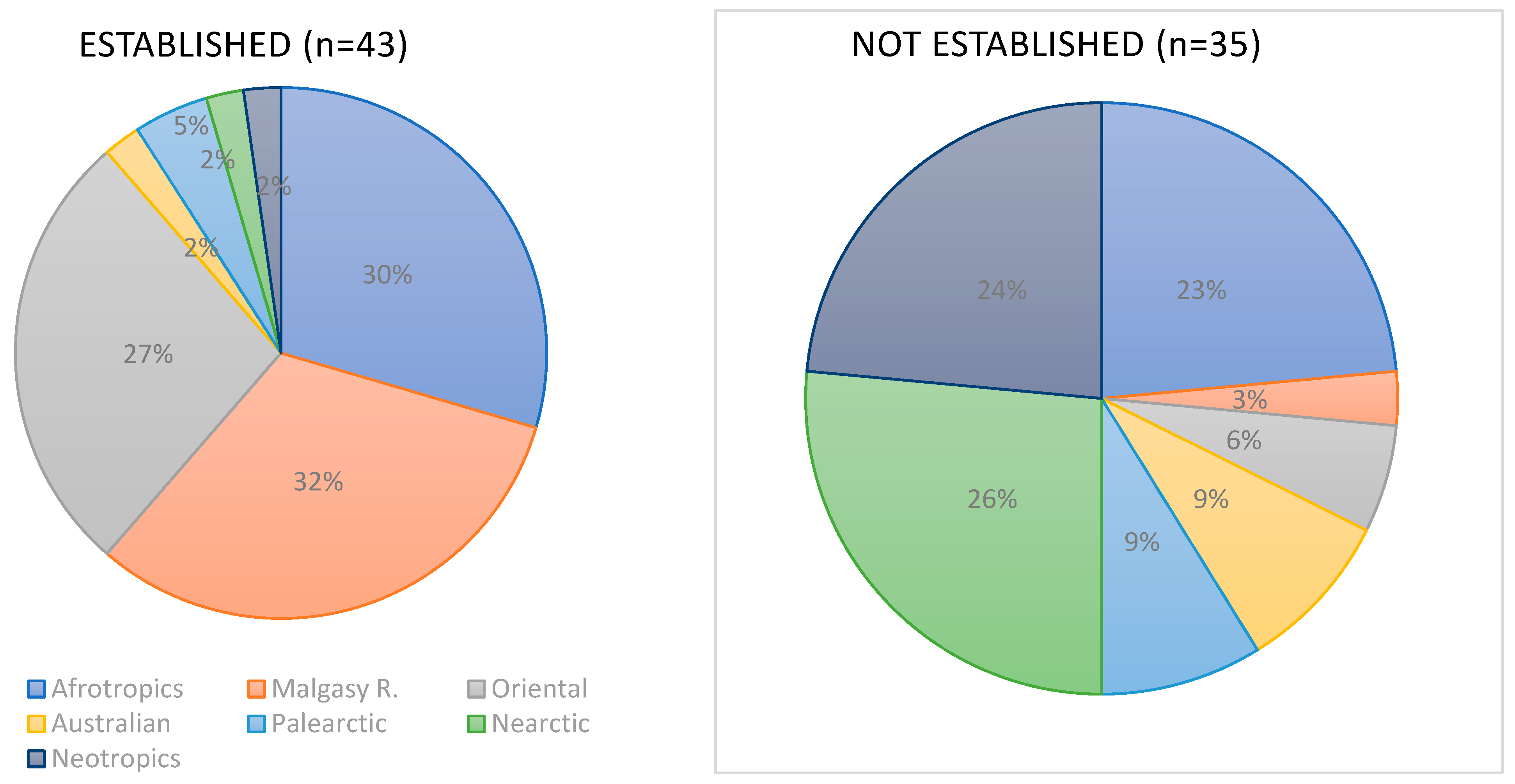
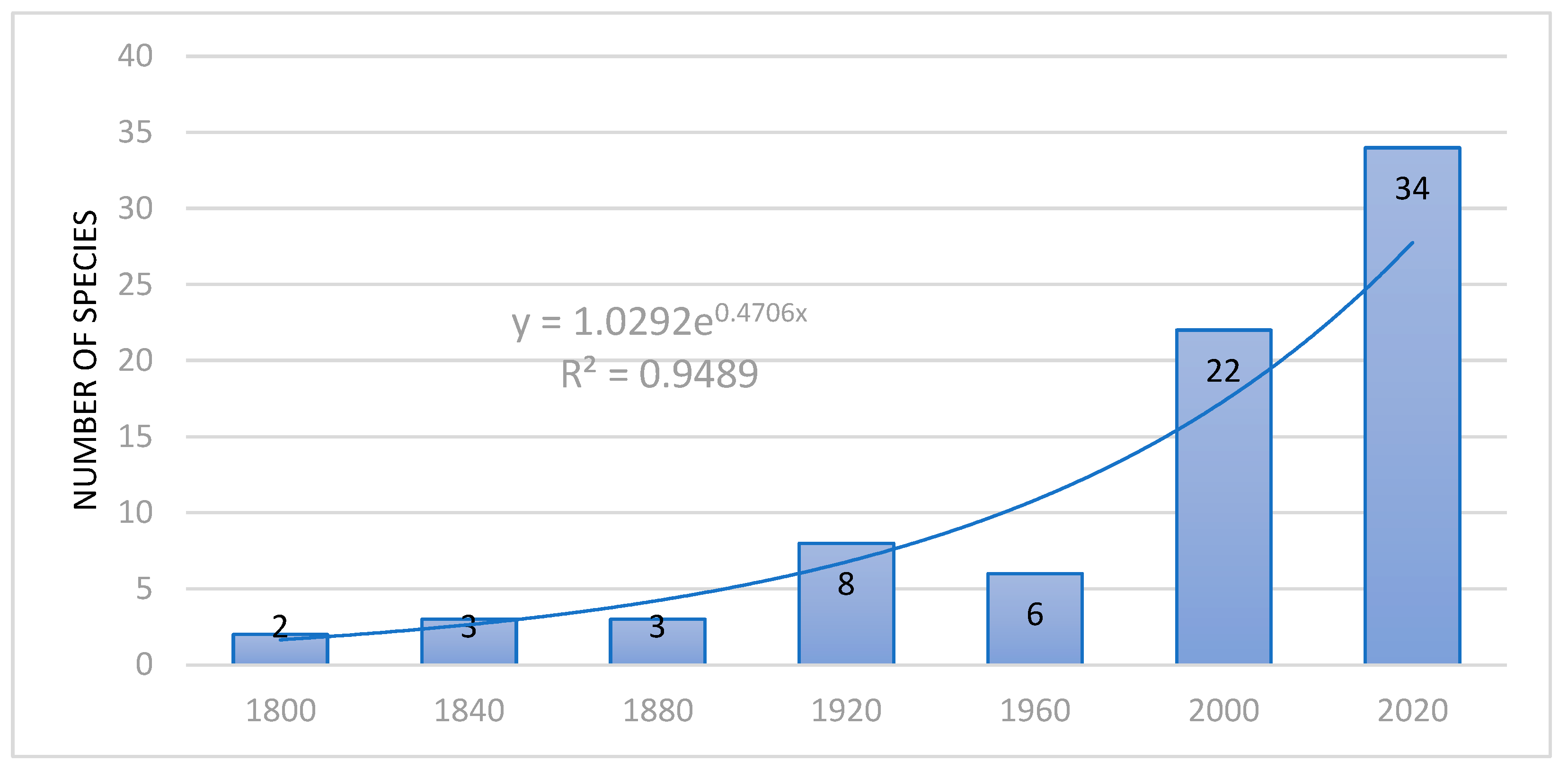
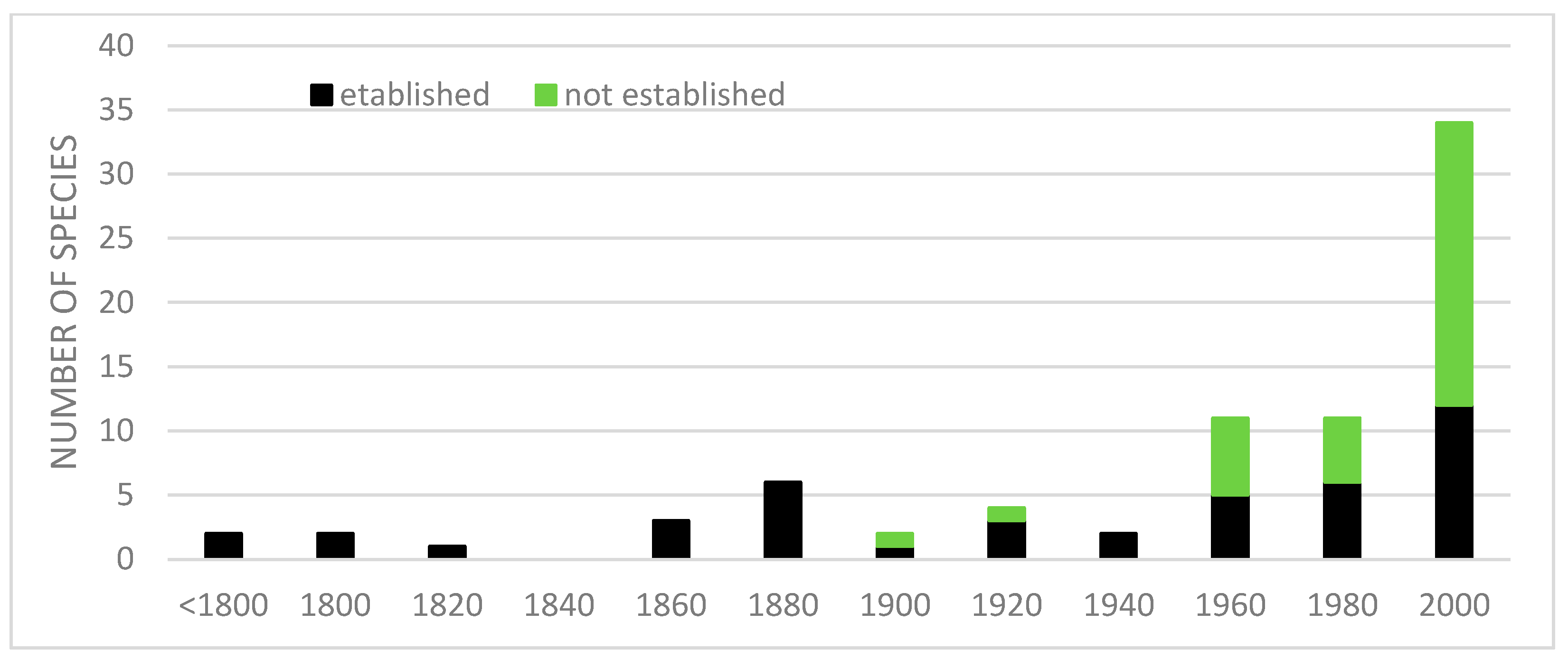
Herping the African Continent: Alien Amphibians and Reptiles in Sub-Saharan Africa


Simple Summary
Abstract
1. Introduction
2. Materials and Methods
- Introduced, but has not developed a viable population;
- Introduced and has developed a viable population, but the population has very restricted range, is unstable and is not expanding;
- Introduced and developed a viable population, but subsequently declined and finally became extinct;
- Introduced, developed viable population and is stable or expanding and may be invasive.
- Unintentional translocation: Transportation of habitat or nursery materials, as accidentally transported contaminants of the horticultural trade, within consignments of wood, in construction materials, e.g., by stowaway, airplanes, or camping vehicles.
- Intentional translocation, e.g., by intentional release from a terrarium.
- Relocation: Done within the species range.
- Repatriation: Natural return to the abandoned areas of former occurrence.
- Reintroduction: Return to the natural range with the help of humans.
3. The Introduced Species
3.1. Species Which Have Developed Viable Populations and Are Expanding/Invasive
3.1.1. African Clawed Frog Xenopus laevis
3.1.2. Guttural Toad Sclerophrys gutturalis
3.1.3. Cane Toad Rhinella marina
3.1.4. Common Slider Trachemys scripta
3.1.5. Brahminy Blind Snake Indotyphlops braminus
3.1.6. Indian Wolf Snake Lycodon aulicus capucinus
3.1.7. Common Agama Agama agama
3.1.8. Green Tree Lizard Calotes versicolor
3.1.9. West Madagascan Clawless Gecko Ebenavia boettgeri
3.1.10. Common Mourning Gecko Lepidodactylus lugubris
3.1.11. Moorish Wall Gecko Tarentola mauritanica
3.1.12. Common Four-Toed Gecko Gehyra mutilata
3.1.13. Day Geckos Phelsuma spp.
- Phelsuma astriata (Seychelles day gecko) from Seychelles has been introduced to Reunion.
- Phelsuma borbonica agalegae (Agalega day gecko) from Mauritius has been introduced to Reunion recently.
- Phelsuma cepediana (blue-tailed day gecko) from Mauritius has been introduced to Rodrigues.
- Phelsuma dubia (dull day gecko) from W and N Madagascar has been introduced in the four major Comoro islands, Zanzibar Island, Mozambique Island (Mozambique), and small coastal areas of Tanzania and Kenya.
- Phelsuma grandis (Madagascar giant day gecko) from N Madagascar has been introduced to Reunion and Mauritius and also to Florida and Hawaii.
- Phelsuma laticauda laticauda (gold dust day gecko) from Madagascar. It has been introduced to the Comoro Islands (Mayotte and Anjouan), the southern Seychelles Islands (Farquhar, Cerf, and Providence), the Mascarene Islands (Réunion and Mauritius), French Polynesia, Hawaii, and Florida.
3.1.14. House Geckos Hemidactylus spp.
- H. mabouia sensu stricte (African house gecko). Native to sub-Saharan Africa (excluding SW, NE, most W Africa and the Malagasy Region). Introduced to various regions of the tropical world, including parts of Africa originally not occupied by the species. At present, it has pantropical distribution.
- H. frenatus (common house gecko). Native to Southeast Asia, spread via ships and cargo. Introduced to Mauritius before 1770 [49]. Introduced also to Comoros, and beyond Africa to Australia, the Americas, and islands globally.
- H. mercatorius, the former H. mabouia (Farquhar half-toed gecko). From Madagascar, Comoros and Aldabra. Introduced successfully to Reunion in 2010, apparently from Mayotte [46]. Introduced also to Seychelles: to Mahe in 1905, but apparently extinct, and again introduced there in 1995 and 2002. Unsuccessful multi-introductions in Platte and Frigate.
- H. parvimaculatus (spotted house gecko). Native to the Oriental Region. It is a part of H. brooksi species complex. Recognized as separate species only in 2010. Populations of H. mabouia species invaded West Africa, Reunion and Mauritius in the mid-1990s. Beyond Africa, it was introduced to Florida (USA) and Hawaii, the Caribbean, South America and Florida. Invasions have resulted in displacement of native geckos in Florida and Curaçao [9].
- H. turcicus (Turkish gecko). It is from the Mediterranean Region. Introduced to many parts of the world, with similar urban settings, e.g., East Africa, South America, the Caribbean, southern USA.
- H. granotii (Granot’s house gecko). Indo-Pacific parthenogenetic species. Introduced to Seychelles, New Zealand, Hawaii, Fiji, the Bahamas, Costa Rica, Guatemala, Colombia, and tropical United States (Hawaii, Florida, Georgia, Texas and California).
3.2. Species Which Have Developed Viable Population but Are Not Expanding/Invasive
3.2.1. Frogs
3.2.2. Turtles
3.2.3. Chameleons
3.2.4. Skinks
3.2.5. Geckos
3.3. Species Which Failed to Develop Viable Populations

| Taxa | All Species in the World | Alien Species in Sub-Saharan Africa | Total No. of the Alien spp. | % Out of All spp. in the World | |||
|---|---|---|---|---|---|---|---|
| Established | Not Established | ||||||
| n | n | % | n | % | n | % | |
| AMPHIBIA | 8973 | 10 | 23.3 | 11 | 31.4 | 21 | 0.23 |
| Caudata | 836 | 0 | 0.0 | 4 | 11.4 | 4 | 0.48 |
| Salamandridae | 147 | 0 | 0.0 | 3 | 8.6 | 3 | 2.04 |
| Ambystomatidae | 32 | 0 | 0.0 | 1 | 2.9 | 1 | 3.13 |
| Anura | 7917 | 10 | 23.3 | 7 | 20.0 | 17 | 0.21 |
| Pipidae | 41 | 1 | 2.3 | 0 | 0.0 | 1 | 2.44 |
| Bufonidae | 666 | 4 | 9.3 | 0 | 0.0 | 4 | 0.60 |
| Rhacophoridae | 462 | 1 | 2.3 | 0 | 0.0 | 1 | 0.22 |
| Hyperoliidae | 236 | 2 | 4.7 | 0 | 0.0 | 2 | 0.85 |
| Ptychadenidae | 63 | 1 | 2.3 | 0 | 0.0 | 1 | 1.59 |
| Pyxicephalidae | 91 | 1 | 2.3 | 0 | 0.0 | 1 | 1.10 |
| Ceratophryidae | 12 | 0 | 0.0 | 1 | 2.9 | 1 | 8.33 |
| Microhylidae | 764 | 0 | 0.0 | 1 | 2.9 | 1 | 0.13 |
| Hylidae | 762 | 0 | 0.0 | 2 | 5.7 | 2 | 0.26 |
| Dendrobatidae | 213 | 0 | 0.0 | 3 | 8.6 | 3 | 1.41 |
| REPTILIA | 12,502 | 33 | 76.7 | 24 | 68.6 | 57 | 0.46 |
| Testudines | 366 | 5 | 11.6 | 4 | 11.4 | 9 | 2.46 |
| Emyidae | 58 | 1 | 2.3 | 1 | 2.9 | 2 | 3.45 |
| Testudinidae | 47 | 3 | 7.0 | 1 | 2.9 | 4 | 8.51 |
| Chelydridae | 5 | 0 | 0.0 | 1 | 2.9 | 1 | 20.00 |
| Trionychidae | 36 | 1 | 2.3 | 0 | 0.0 | 1 | 2.78 |
| Pelomedusidae | 27 | 0 | 0.0 | 1 | 2.9 | 1 | 3.70 |
| Sauria | 7905 | 26 | 60.5 | 7 | 20.0 | 33 | 0.42 |
| Agamidae | 604 | 2 | 4.7 | 1 | 2.9 | 3 | 0.50 |
| Chamaeleonidae | 234 | 1 | 2.3 | 4 | 11.4 | 5 | 2.14 |
| Iguanidae | 45 | 0 | 0.0 | 1 | 2.9 | 1 | 2.22 |
| Gekkonidae | 1713 | 23 | 53.5 | 0 | 0.0 | 23 | 1.34 |
| Scincidae | 1793 | 0 | 0.0 | 1 | 2.9 | 1 | 0.06 |
| Serpentes | 4203 | 2 | 4.7 | 12 | 34.3 | 14 | 0.33 |
| Pythonidae | 40 | 0 | 0.0 | 1 | 2.9 | 1 | 2.50 |
| Boidae | 67 | 0 | 0.0 | 1 | 2.9 | 1 | 1.49 |
| Colubridae | 2167 | 1 | 2.3 | 7 | 20.0 | 8 | 0.37 |
| Lamprophiidae | 93 | 0 | 0.0 | 2 | 5.7 | 2 | 2.15 |
| Viperidae | 406 | 0 | 0.0 | 1 | 2.9 | 1 | 0.25 |
| Typhlopidae | 425 | 1 | 2.3 | 0 | 0.0 | 1 | 0.24 |
| Crocodylia | 27 | 0 | 0.0 | 1 | 2.9 | 1 | 3.70 |
| Crocodylidae | 17 | 0 | 0.0 | 1 | 2.9 | 1 | 5.88 |
| Total | 21,475 | 43 | 100.0 | 35 | 100.0 | 78 | 0.36 |
4. Places of Introduction
5. Places of Origin of Introduced Species
6. Timing of Introduction
7. Pathways of Introduction
7.1. Stowaways
7.2. Pet Trade
7.3. Leading-Edge (Jump) Dispersal
7.4. Cultivation Dispersal
8. Factors Determining Introduction Success
8.1. Behavioral and Morphological Traits
8.2. Propagule Pressure
8.3. Climate and Habitat Overlap
8.4. Presence of Potentially Competing Species
9. Impacts of Introduced Amphibians and Reptiles on Local Fauna
9.1. Competition
9.2. Predation
9.3. Hybridization
9.4. Transmission of New Diseases and Parasites
10. Comparison with Other Regions
11. Management Implications
12. Conclusions
Funding
Institutional Review Board Statement
Informed Consent Statement
Data Availability Statement
Conflicts of Interest
Appendix A
| Scientific Name | Common Name | Family | Natural Range | Inv. | Place and Date of Introduction | Source |
|---|---|---|---|---|---|---|
| AMPHIBIANS | ||||||
| Cynops pyrrhogaster | Japanese fire-bellied newt | Salamandridae | Japan | 3 | South Africa: KwaZulu-Natal, Cape Town, 2016 | [13] |
| Triturus cristatus | Crested newt | Salamandridae | Europe | 3 | South Africa, 2010s | [13] |
| Notophthalmus viridescens | Eastern newt | Salamandridae | E North America | 3 | South Africa: W Cape, 2010s | [13] |
| Ambystoma mexicanum | Axolotl | Ambystomatidae | Mexico | 4 | South Africa: Bloemfontein, 1980s, now extinct | [100] |
| Xenopus laevis | African clawed frog | Pipidae | Africa | 1 | South Africa: W Cape, 1908s | [79] |
| Sclerophrys gutturalis | African common toad | Bufonidae | Southern Africa | 1 | Reunion (1927), Mauritius (1922), South Africa: Cape Town (2000), Kenya: Nairobi (2025) | [74,101,102] |
| Rhinella marina | Cane toad | Bufonidae | Neotropics | 1 | Mauritius, 1922 | [2] |
| Schismaderma carens | African red toad | Bufonidae | S and E Africa | 2 | SA: Cape Town stowaway, 2013 | [13] |
| Duttaphrynus melanostictus | Asian common toad | Bufonidae | SE Asia | 2 | South Africa: W Cape: Tokai, Bellville, 2012; Tomasina (Madagascar), 2015 | [13,103] |
| Chiromantis xerampelina | Gray foam-nest tree frog | Rhacophoridae | S and E Africa | 2 | South Africa: Stellenbosch, Porterville, Victoria West, 2012 | [13] |
| Hyperolius marmoratus | Painted reed frog | Hyperoliidae | Mozambique, Malawi, SA | 2 | South Africa: W Cape: Villiersdorp (1997) and Cape Town (2004) | [50] |
| Hyperolius tuberilinguis | Tinker reed frog | Hyperoliidae | S and E Africa | 2 | South Africa: Cape Town, Bloemfontein, 2009 | [13] |
| Ptychadena mascareniensis | Mascarene grass frog | Ptychadenidae | Madagascar | 2 | Mauritius, Reunion, before 1790; Seychelles, 2010s; | [104,105] |
| Pyxicephalus adspersus | African bull frog | Pyxicephalidae | S Africa | 2 | South Africa: Cape Peninsula: Muizenberg Mountains, 1980s | [79] |
| Ceratophrys ornata | Argentine horned frog | Ceratophryidae | Argentina, Uruguay | 3 | South Africa, c. 2008/2009 | [13] |
| Dyscophus antongilii | Madagascar tomato frog | Microhylidae | Madagascar | 3 | South Africa: Transvaal Snake Park, 1990s | [13] |
| Dendrobates leucomelas | Yellow-banded poison dart frog | Dendrobatidae | N South America | 3 | South Africa: Johannesburg: Montecasino Bird Gardens, 2010s | [13] |
| Dendrobates auratus | Green-and-black poison dart frog | Dendrobatidae | Central America | 3 | South Africa: Johannesburg: Montecasino Bird Gardens; uShaka; Two Oceans, 2010s | [13] |
| Dendrobates tinctorius | Dyeing poison dart frog | Dendrobatidae | N South America | 3 | South Africa: Johannesburg: Montecasino Bird Gardens, 2010s | [13] |
| Litoria albolabris | Wandolleck’s white-lipped tree frog | Hylidae | New Guinea | 3 | South Africa, 2010s | [13] |
| Litoria caerulea | Australian green tree frog | Hylidae | Australia | 3 | South Africa, 2010s | [13] |
| REPTILES | ||||||
| Crocodylus niloticus | Nile crocodile | Crocodylidae | Africa | 3 | South Africa, 1960s | [106] |
| Macrochyles temmincki | Alligator snapper turtle | Chelydridae | USA | 4 | South Africa: George, 2000s, now extinct | [12] |
| Palea steindachneri | Wattle-necked softshell turtle | Trionychidae | China, Laos Vietnam | 2 | Mauritius, 1980s Reunion, SA | [107,108] |
| Trachemys scripta | Common slider | Emydidae | E USA | 1? | South Africa: Pretoria/Johannesburg and Durban areas; Reunion, Mauritius, Seychelles, 1990s; Kenya: Nairobi | [109,110] |
| Emys orbicularis | European pond turtle | Emydidae | Europe | 3 | South Africa (E Cape), 1990s? | [106] |
| Pelusios subniger | East African black mud turtle | Pelomedusidae | E Africa | 4 | Mauritius, Seychelles, 1970s, now extinct | [111] |
| Geochelone platynota | Burmese star tortoise | Testudinidae | SE Asia | 4 | Kenya, now extinct | [106] |
| Astrochelys radiata | Radiated tortoise | Testudinidae | S Madagascar | 2 | Mauritius (Rodrigues, Round Island), Reunion, 1980s; Rodrigues, 2006 | [15,17] |
| Geochelone pardalis | Leopard tortoise | Testudinidae | Africa | 2 | South Africa, 1960s? | [106] |
| Aldabrachelys gigantea | Aldabra giant tortoise | Testudinidae | Seychelles: Aldabra atol | 2 | Rodrigues: François Leguat Reserve Rodrigues, 2006 | [107] |
| Indotyphlops braminus | Brahminy blind snake | Typhlopidae | SE Asia | 1 | Tanzania; Durban, SA: Cape Town, 1920s; Reunion, beg. 19th cen.?; Mauritius; Seychelles; Annobon, 2003 | [72,106,112,113,114,115] |
| Python molurus bivittatus | Burmese python | Pythonidae | SE Asia | 4 | Cape Town, 2000s, now extinct | [12] |
| Boa constrictor | Boa constrictor | Boidae | South America | 4 | South Africa, 2000s, now extinct | [106,109] |
| Lycodon aulicus | Indian wolf snake | Colubridae | India | 1 | Reunion, beg. 19th cen.?; Mauritius (1879) | [116,117] |
| Lampropeltis californiae | Californian king snake | Colubridae | North America | 4 | South Africa, 2000s | [118] |
| Lampropeltis triangullum | Sinaloan king snake | Colubridae | North America | 4 | South Africa, now extinct, 2000s | [118] |
| Lampropeltis alterna | Gray-banded kingsnake | Colubridae | Mexico | 4 | South Africa: Strand, 2000s, now extinct | [12] |
| Pantherophis guttatus | Red corn snake | Colubridae | SE USA | 4 | South Africa: Durban, Johannesburg, Cape Town, 2000s, now extinct | [12] |
| Elaphe obsoleta spiloides | Gray rat snake | Colubridae | E and C USA | 4 | South Africa: Durban, 2000s, now extinct | [12] |
| Elaphe obsoleta quadrivittata | Yellow rat snake | Colubridae | USA | 4 | South Africa: Cape Town, 2000s, now extinct | [12] |
| Pituophis m. melanoleucus | Northern pine snake | Colubridae | SE USA | 4 | South Africa: Durban, 2000s, now extinct | [12] |
| Elaiophis inornatus | Olive snake | Lamprophidae | Africa | 3 | South Africa, 2000s | [12] |
| Baedon capensis | Brown house snake | Lamprophiidae | Southern Africa | 3 | South Africa, 2000s | [12] |
| Crotalus atrox | Western diamond-backed rattlesnake | Viperidae | SW USA, N Mexico | 4 | South Africa: Gauteng, 2000s, now extinct | [12] |
| Furcifer pardalis | Panther chameleon | Chamaeleonidae | Madagascar | 2 | Reunion, before 1830 | [119] |
| Bradypodion pumilum | Cape dwarf chameleon | Chamaeleonidae | Africa | 3 | Namibia, 1990s: Swakopmund and Walvis Bay, also Lüderitz, Windhoek, now extinct | [25,120] |
| Calumma parsonii | Green giant chameleon | Chamaeleonidae | N Madagascar | 3 | Mauritius, 1960s | [20] |
| Chamaeleo quilensis | Flap-necked chameleon | Chamaeleonidae | South Africa: KZN | 3 | South Africa: Free State, before 1978 | [109,121] |
| Bradypodion spp. | Dwarf chameleon | Chamaeleonidae | South Africa: KZN | 3 | South Africa: Free State, 1939 | [106,121] |
| Cryptoblepharus boutoni | Bouton’s snake-eyed skink | Scincidae | Eastern coast of Africa | 3 | South Africa: KZN, 1990s | [106] |
| Iguana iguana | Green iguana | Iguanidae | Neotropics | 4 | South Africa: Gauteng, 2000s, now extinct | [12] |
| Agama agama | Common agama | Agamidae | E Africa | 1 | Reunion, mid. 19th cen.; Comoro Isl., 1997; Madagascar, 2004 | [36,122,123] |
| Pogona vitticeps | Bearded dragon | Agamidae | Australia | 4 | South Africa, 2000s, now extinct | [116] |
| Calotes versicolor | Green tree lizard | Agamidae | Indonesia | 1 | Mascarenes (Rodrigues, Mauritius, Reunion), 1865; Seychelles; Keyna: Nairobi, end of 20th cen., 1920 | [38,124] iNaturalist |
| Gehyra mutilata | Common four-clawed gecko | Gekkonidae | SE Asia | 1? | Reunion, 18th cen.?; Mauritius, Rodrigues, Seychelles | [14,125] |
| Phelsuma laticauda | Gold dust day gecko | Gekkonidae | N Madagascar | 1 | Reunion, 1975; Mauritius, Mayotte, Comoros, Seychelles | [45,126] |
| Phelsuma astriata | Seychelles day gecko | Gekkonidae | Seychelles | 1 | Reunion, before 2003 | [47,127,128] |
| Phelsuma grandis | Madagascar giant day gecko | Gekkonidae | N Madagascar | 1 | Reunion, 1994; Mauritius, 1990s | [75,129] |
| Phelsuma lineata | Lined day gecko | Gekkonidae | Madagascar | 1 | Reunion, 1940 | [47] |
| Phelsuma dubia | Dull day Gecko | Gekkonidae | Madagascar, Seychelles | 2 | Comoros Isl., coast of E Africa; 2000s | [45] |
| Phelsuma borbonica agalegae | Agalega day gecko | Gekkonidae | Agalega Isl. (Mauritius) | 2 | Reunion, 2000s | [45] |
| Phlesuma cepediana | Blue-tailed day gecko | Gekkonidae | Mauritius | 1 | Rodrigues, Madagascar, 2000s | [45] |
| Tarentola mauritanica | Moorish wall gecko | Gekkonidae | Mediterranean Region | 1 | S Western Sahara, 1970s, | [130] |
| Lepidodactylus lugubris | Common mourning gecko | Gekkonidae | Indo-Pacific | 1 | Seychelles, Rodrigues, 1960s | [14] |
| Lygodactylus capensis | Cape dwarf gecko | Gekkonidae | S, E Africa | 2 | Central Africa, 1956; Tanzania: Pemba; South Africa: Free State, before 1978 | [13,121] |
| Chodrdactylus turneri | Turner’s thick-toed gecko | Gekkonidae | South Africa: KZN | 2 | Free State, before 1978 | [99,131,132] |
| Ebenavia boettgeri | West Madagascan clawless gecko | Gekkonidae | E Madagascar | 1? | Mauritius, 1960s | [14] |
| Hemidactylus mercatorius | Farquhar half-toed gecko | Gekkonidae | Madagascar, Seychelles | 1 | Cape Verde (Santo Antao, Sao Vincente), Comoro Islands, Europa Is., Reunion, Mauritius, Rodrigues, Mayotte, 1960? | [14] |
| Hemidactylus mabouia | Tropical house gecko | Gekkonidae | W and C Africa | 1 | Principe, São Tome, 1884; Bazaruto; Free State, before 1978; Simon’s Town, 1962; Gordon’s Bay, 1976; East London, Port Elizabeth, | [30,41,132,133,134] |
| Hemidactylus longicephalus | Long-head half-toed gecko | Gekkonidae | C, W Africa | 1 | Principe, São Tome, 1892 | [135] |
| Hemidactylus flaviviridis | Northern house gecko | Gekkonidae | SE Asia | 1 | Socotra, end of 19th cen.?; only known from Hadiboh town and outskirts | [136] |
| Hemidactylus robustus | Heyden’s gecko | Gekkonidae | SW Asia, Horn of Africa | 1 | Socotra, end of 19th cen. | [137] |
| Hemidactylus homoeolepis | Arabian leaf-toed gecko | Gekkonidae | S Arabian Peninsula | 1 | Socotra, 1990s | [78] |
| Hemidactylus frenatus | Common house gecko | Gekkonidae | India, Sri Lanka | 1 | Reunion (19th cen.), Mauritius, Rodrigues, Seychelles, Comoros, Madagascar, South Africa, Somalia | [14,112] |
| Hemidactylus parvimaculatus | Small spotted house gecko | Gekkonidae | S India, Sri Lanka | 2 | Mauritius, Reunion, Rodrigues, Comoro, end of 19th century; Seychelles | [14,138] |
| Hemiphylodacty-lus typus | Indo-Pacific slender gecko | Gekkonidae | SE Asia | 2 | Reunion, 1960s?; Mauritius, Rodrigues, Comoro Isl. (Moheli) | [14] |
| Afrogecko porphyreus | Marbled leaf-toed gecko | Gekkonidae | South Africa | 2 | South Africa: Cape Town, Port Elizabeth, 2010s | [41] |
References
- Davis, M.A. Invasion Biology; Oxford University Press: Oxford, UK, 2009. [Google Scholar]
- Lever, C. Naturalized Reptiles and Amphibians of the World; Oxford University Press: Oxford, UK, 2003. [Google Scholar]
- Mwebaze, P.; MacLeod, A.; Tomlinson, D.; Barois, H.; Rijpma, J. Economic valuation of the influence of invasive alien species on the national economy of the Seychelles. In Proceedings of the 11th Annual BIOECON Conference Economic Instruments to Enhance the Conservation and Sustainable Use of Biodiversity, Venice, Italy, 21–22 September 2009. [Google Scholar]
- Russell, J.C.; Meyer, J.Y.; Holmes, N.D.; Pagad, S. Invasive alien species on islands: Impacts, distribution, interactions and management. Environ. Conserv. 2017, 44, 359–370. [Google Scholar] [CrossRef] [Scilit]
- Kafutshi, R.K.; Kopij, G. Ecology of Health: Bird-Human Interaction. In Ecology of Avian Zoonotic Diseases–New Challenges; Kopij, G., Ed.; IntechOpen: London, UK, 2025; pp. 7–26. Available online: https://www.intechopen.com/chapters/1202507 (accessed on 10 January 2026).
- Kopij, G. (Ed.) Introductory Chapter: Ecology of Avian Diseases. In Ecology of Avian Zoonotic Diseases–New Challenges; IntechOpen: London, UK, 2025; pp. 1–5. Available online: https://www.intechopen.com/chapters/1219551 (accessed on 10 January 2026).
- Picker, M.D.; Griffiths, C.L. Alien animals in South Africa–composition, introduction history, origins and distribution patterns. Bothalia 2017, 47, a2147. [Google Scholar] [CrossRef] [Scilit]
- Kark, S.; Solarz, W.; Chiron, F.; Clergeau, P.; Shirley, S. Alien Birds, Amphibians and Reptiles of Europe. In The Handbook of Alien Species in Europe; Springer Science, Business Media B.V.: Berlin/Heidelberg, Germany, 2008; pp. 105–118. [Google Scholar]
- Meshaka, W.E., Jr.; Collins, S.L.; Bury, R.B.; McCallum, M.L. Exotic Amphibians and Reptiles of the United States; University Press of Florida: Gainesville, FL, USA, 2022. [Google Scholar]
- Kopij, G. Alien Birds in Sub-Saharan Africa: An Overview. Conservation 2025, 5, 16. [Google Scholar] [CrossRef] [Scilit]
- Kopij, G. Alien Mammals in the Afrotropical Region and Their Impact on Vertebrate Biodiversity: A Review. Diversity 2025, 17, 286. [Google Scholar] [CrossRef] [Scilit]
- Van Wilgen, N. Alien species: Reptiles & amphibians. Quest 2008, 4, 34–38. [Google Scholar]
- Measey, J.; Davies, S.J.; Vimercati, G.; Rebelo, A.; Schmidt, W.; Turner, A. Invasive amphibians in southern Africa: A review of invasion pathways. Bothalia 2017, 47, a2117. [Google Scholar] [CrossRef] [Scilit]
- Vinson, J.; Vinson, J.M. The saurian fauna of the Mascarene Islands. Bull. Maurit. Inst. 1969, 6, 203–320. [Google Scholar]
- Owadally, A.W.; Lambert, M. Herpetology in Mauritius. A history of extinction, future hope for conservation. Br. Herpetol. Soc. Bull. 1988, 23, 11–20. [Google Scholar]
- Cheke, A.S.; Hume, L. Lost Land of the Dodo. In An Ecological History of Mauritius, Réunion & Rodrigues; T. & AD. Poyser: London, UK, 2008. [Google Scholar]
- Griffiths, O.; Andre, A.; Meunier, A. Tortoise Breeding and ‘Re-wilding’ on Rodrigues Island. In Turtles on the Brink in Madagascar: Proceedings of Two Workshops on the Status, Conservation, and Biology of Malagasy Tortoises and Freshwater Turtles; Castellano, C.M., Rhodin, A.C.J., Ogle, M., Mittermeier, R.A., Randriamahazo, H., Hudson, R., Lewis, R.E., Eds.; Chelonian Research Monographs, no. 6; Chelonian Research Foundation: Lunenburg, MA, USA, 2013. [Google Scholar] [CrossRef] [Scilit]
- Kraus, F. Alien Reptiles and Amphibians—A Scientific Compendium and Analysis; Springer: Berlin/Heidelberg, Germany; New York, NY, USA, 2009. [Google Scholar]
- Capinha, C.; Seebens, H.; Cassey, P.; García-Díaz, P.; Lenzner, B.; Mang, T.; Moser, D.; Pyšek, P.; Rödder, D.; Scalera, R.; et al. Diversity, biogeography and the global flows of alien amphibians and reptiles. Divers. Distrib. 2017, 23, 1313–1322. [Google Scholar] [CrossRef] [Scilit]
- Midtgaard, R. RepFocus–A Survey of the Reptiles of the World. Available online: https://www.repfocus.dk/ (accessed on 3 March 2025).
- ANMH (American Museum of Natural History). Amphibian Species of the World 6.2, An Online Reference. Available online: https://amphibiansoftheworld.amnh.org (accessed on 3 March 2025).
- IUCN. The IUCN Red List of Threatened Species. Version 2025-2. Available online: https://www.iucnredlist.org (accessed on 10 January 2025).
- Dodd, C.K., Jr.; Seigel, R.A. Relocation, repatriation, and translocation of amphibians and reptiles: Are they conservation strategies that work? Herpetologica 1991, 47, 336–350. [Google Scholar]
- Measey, G.J.; Rödder, D.; Green, S.L.; Kobayashi, R.; Lillo, F.; Lobos, G.; Rebelo, R.; Thirion, J.-M. Ongoing invasions of the African clawed frog, Xenopus laevis: A global review. Biol. Invasions 2012, 14, 2255–2270. [Google Scholar] [CrossRef] [Scilit]
- Telford, N.S.; Channing, A.; Measey, J. Origin of Invasive Populations of the Guttural Toad (Sclerophrys gutturalis) on Reunion and Mauritius Islands and in Constantia. S. Afr. Herpetol. Conserv. Biol. 2019, 14, 380–392. [Google Scholar]
- Shine, R. Rhinella marina (cane toads). In A Handbook of Global Freshwater Invasive Species; Francis, R., Ed.; Earthscan: London, UK; New York, NY, USA, 2012; p. 299. [Google Scholar]
- Shine, R.; Alford, R.A.; Blennerhasset, R.; Brown, G.P.; DeVore, J.L.; Ducatez, S.; Finnerty, P.; Greenlees, M.; Kaiser, S.W.; McCann, S.; et al. Increased rates of dispersal of free-ranging cane toads (Rhinella marina) during their global invasion. Sci. Rep. 2021, 11, 23574. [Google Scholar] [CrossRef] [Scilit]
- Reshetnikov, A.N.; Zibrova, M.G.; Ayaz, D.; Bhattarai, S.; Borodin, O.V.; Borzée, A.; Brejcha, J.; Çiçek, K.; Dimaki, M.; Doronin, I.V.; et al. Rarely naturalized, but widespread and even invasive: The paradox of a popular pet terrapin expansion in Eurasia. NeoBiota 2023, 81, 91–127. [Google Scholar] [CrossRef] [Scilit]
- Ficetola, G.F.; Rödder, D.; Padoa-Schioppa, E. Trachemys scripta (slider terrapin). In A Handbook of Global Freshwater Invasive Species; Francis, R., Ed.; Earthscan: London, UK; New York, NY, USA, 2012; pp. 331–339. [Google Scholar]
- Brooke, R.K.; Lloyd, P.H.; de Villiers, A.L. Alien and translocated terrestrial vertebrates in South Africa. In The Ecology and Management of Biological Invasions in Southern Africa; Macdonald, I.A.W., Kruger, F.J., Ferrar, A.A., Eds.; Oxford University Press: Cape Town, South Africa, 1986; pp. 63–74. [Google Scholar]
- Nussbaum, R.A. The Brahminy blind snake (Ramphotyphlops braminus) in the Seychelles Archipelago: Distribution, variation, and further evidence for parthenogenesis. Herpetologica 1980, 36, 215–221. [Google Scholar]
- Vogel, G.; Probst, J.-M.; Deso, G.; Hawlitschek, O.; Cole, N.; Florens, V.B.V.; Dubos, N. Checking back two centuries: A key criterion to identify the wolf snake, Lycodon aulicus (Linnaeus, 1758), in the Mascarene Islands. Herpetol. Notes 2021, 14, 309–315. [Google Scholar]
- Yang, J.H.; Yeung, H.Y. An overlooked invader? Integrative analysis reveals the common wolf snake Lycodon capucinus Boie, 1827 is an introduced species to Hong Kong. BioInvasions Rec. 2024, 13, 1067–1079. [Google Scholar] [CrossRef] [Scilit]
- Smith, L.A. Lycodon aulicus capucinus a colubrid snake introduced to Christmas Island, Indian Ocean. Rec. West. Aust. Mus. 1988, 14, 251–252. [Google Scholar]
- Vasconcelos, R.; Rocha, S.J.; Brito, C.; Carranza, S.; Harris, D.J. First report of introduced African Rainbow Lizard Agama agama (Linnaeus, 1758) in the Cape Verde Islands. Herpetozoa 2009, 21, 183–186. [Google Scholar]
- Wagner, P.; Glaw, F.; Glaw, K.; Böhme, W. Studies on African Agama IV: First record of Agama agama (Sauria: Agamidae) from Madagascar and identity of the alien population on Grande Comore Island. Herpetol. Notes 2009, 2, 73–77. [Google Scholar]
- Enge, K.M.; Kryśko, K.L.; Talley, B.L. Distribution and ecology of the introduced African rainbow lizard, Agama agama africana (Sauria: Agamidae), in Florida. Fla. Sci. 2004, 67, 303–310. [Google Scholar]
- Matyot, P. The establishment of the crested tree lizard, Calotes versicolor (Daudin, 1802), in Seychelles. Phelsuma 2004, 12, 35–47. [Google Scholar]
- Das, I.; Charles, J.K.; Edwards, D.S. Calotes versicolor (Squamata: Agamidae)–A new invasive squamate for Borneo. Curr. Herpetol. 2008, 27, 109–112. [Google Scholar]
- Vences, M.; Wanke, S.; Vieites, D.R.; Branch, W.R.; Glaw, F.; Meyer, A. Natural colonization or introduction? Phylogeographical relationships and morphological differentiation of house geckos (Hemidactylus) from Madagascar. Biol. J. Linn. Soc. 2004, 83, 115–130. [Google Scholar] [CrossRef] [Scilit]
- Rebelo, A.D.; Burger, M.; Bates, M.F.; Branch, W.R.; Conradie, W. Range expansion of the common dwarf gecko, Lygodactylus capensis: South Africa’s most successful reptile invader. Herpetol. Notes 2019, 12, 643–650. [Google Scholar]
- Jablonski, D.; Naumov, B.Y.; Pule, A.N. First Record of the Moorish Gecko Tarentola mauritanica (Linnaeus, 1758) (Squamata: Phyllodactylidae) for Bulgaria. Acta Zool. Bulg. 2022, 74, 143–146. [Google Scholar]
- Deso, G.; Renet, J.; Gomez, M.-G.; Prio, P.; Capoulade, F.; Geoffroy, D.; Duguet, R.; Rato, C. Documenting the introduction of the Moorish gecko Tarentola mauritanica (Linnaeus, 1758) (Squamata: Phyllodactylidae) on the Levant and Port-Cros Islands (Hyères Archipelago, Var department, France). Herpetol. Notes 2020, 13, 809–812. [Google Scholar]
- Strachinis, I.; Kalaentzis, K.; Daftsios, T. First record of an introduced population of Moorish Gecko, Tarentola mauritanica (Linnaeus, 1758), on the island of Rhodes. Herpetol. Notes 2025, 18, 165–168. [Google Scholar]
- Glaw, F.; Rösler, H. Taxonomic checklist of the day geckos of the genera Phelsuma Gray,1825 and Rhoptropella Hewitt, 1937 (Squamata: Gekkonidae). Vertebr. Zool. 2015, 65, 247–283. [Google Scholar] [CrossRef] [Scilit]
- Rocha, S.; Trinks, A.; Harris, D.J.; Larson, G.; Cheke, A.S. The global and western Indian Ocean dispersal of house geckos from Asia using historical and mitochondrial DNA perspectives. Front. Ecol. Evol. 2020, 10, 791762. [Google Scholar] [CrossRef] [Scilit]
- Cheke, A.S. Un lézard malgache introduit à La Réunion. Info Nat. 1975, 13, 94–96. [Google Scholar]
- Agarwal, I.; Ceríaco, L.M.P.; Metallinou, M.; Jackman, T.R.; Bauer, A.M. How the African house gecko (Hemidactylus mabouia) conquered the world. R. Soc. Open Sci. 2021, 8, 210749. [Google Scholar] [CrossRef] [Scilit]
- Cheke, A. The timing of arrival of humans and their commensal animals on Western Indian Ocean oceanic islands. Phelsuma 2010, 18, 38–69. [Google Scholar]
- Davies, S.J.; Clusella-Trullas, S.; Hui, C.; McGeoch, M.A. Farm dams facilitate amphibian invasion: Extra-limital range expansion of the painted reed frog in South Africa. Austral Ecol. 2013, 38, 851–863. [Google Scholar] [CrossRef] [Scilit]
- Davies, S.J.; Hill, M.P.; McGeoch, M.A.; Clusella-Trullas, S. Niche shift and resource supplementation facilitate an amphibian range expansion. Divers. Distrib. 2019, 25, 154–165. [Google Scholar] [CrossRef] [Scilit]
- Castellano, C.M.; Rhodin, A.G.J.; Ogle, M.; Mittermeier, R.A.; Randriamahazo, H.; Hudson, R.; Lewis, R.E. (Eds.) Turtles on the Brink in Madagascar: Proceedings of Two Workshops on the Status, Conservation, and Biology of Malagasy Tortoises and Freshwater Turtles; Chelonian Research Monographs, no. 6; Chelonian Research Foundation: Lunenburg, MA, USA, 2013. [Google Scholar]
- Smith, L.L.; Reid, D.; Robert, B.; Joby, M.; CleÂment, S. Status and distribution of the angonoka tortoise (Geochelone yniphora) of western Madagascar. Biol. Conserv. 1999, 91, 23–33. [Google Scholar] [CrossRef] [Scilit]
- Walker, R.; Lewis, R.; Mandimbihasina, A.; Goode, E.; Gibbons, P.; Currylow, A.; Woolaver, L. The conservation of the world’s most threatened tortoise: The ploughshare tortoise (Astrochelys yniphora) of Madagascar. Testudo 2022, 8, 68–75. [Google Scholar]
- Carpenter, A.I.; Rowcliffe, J.M.; Watkinson, A.R. The dynamics of the global trade in chameleons. Biol. Conserv. 2004, 120, 291–301. [Google Scholar] [CrossRef] [Scilit]
- Haacke, W.D. Variation in population size of Bouton’s snake-eyed skink (Reptilia: Scincidae) at Black Rock in northern KwaZulu-Natal, South Africa. Koedoe 2002, 45, a14. [Google Scholar] [CrossRef] [Scilit]
- Van Wilgena, N.J.; Richardsona, D.M.; Baard, E.H.W. Alien reptiles and amphibians in South Africa: Towards a pragmatic management strategy. S. Afr. J. Sci. 2008, 104, 13–20. [Google Scholar]
- AmphibiaWeb. University of California, Berkeley, CA, USA. Available online: https://amphibiaweb.org (accessed on 15 December 2025).
- Uetz, P.; Hellermann, J. The Reptile Database. 2025. Available online: https://reptile-database.reptarium.cz/contactus (accessed on 3 March 2026).
- Cheke, A.S. An ecological history of the Mascarene Islands, with particular reference to extinctions and introductions of land vertebrates. In Studies of Mascarene Island Birds; Diamond, A.W., Ed.; Cambridge University Press: Cambridge, UK, 1987; pp. 5–89. [Google Scholar]
- Kolby, J.E.; Smith, K.M.; Berger, L.; Karesh, W.B.; Preston, A.; Pessier, A.P.; Skerratt, L.F. First evidence of amphibian chytrid fungus (Batrachochytrium dendrobatidis) and ranavirus in Hong Kong amphibian trade. PLoS ONE 2014, 9, e90750. [Google Scholar] [CrossRef] [Scilit]
- Mecke, S. Invasive species: Review risks before eradicating toads. Nature 2014, 511, 534. [Google Scholar] [CrossRef] [Scilit]
- Böhm, M.; Collen, B.; Baillie, J.E.M.; Bowles, P.; Chanson, J.; Cox, N.; Hammerson, G.; Hoffmann, M.; Livingstone, S.R.; Ram, M.; et al. The Conservation Status of the World’s Reptiles. Biol. Conserv. 2013, 157, 372–385. [Google Scholar] [CrossRef] [Scilit]
- Jensen, T.J.; Auliya, M.; Burgess, N.D.; Aust, P.W.; Pertoldi, C.; Strand, J. Exploring the international trade in African snakes not listed on CITES: Highlighting the role of the internet and social media. Biodivers. Conserv. 2019, 28, 1–19. [Google Scholar] [CrossRef] [Scilit]
- Andreone, F.; Carpenter, A.C.; D’Cruze, N.; Dubos, N.; Edmonds, D.; Garcia, G.; Luedtke, J.; Megson, S.; Rabemananjara, F.C.E.; Randrianantoandro, J.C.; et al. Amphibian conservation in Madagascar: Old and novel threats to a peculiar fauna. In Amphibian Biology 2(7). Status of Conservation and Decline of Amphibians; Heatwale, H., Rodel, M.-O., Eds.; Eastern Hemisphere Publisher: London, UK; Chimaira, Frankfurt am Main: Frankfurt, Germany, 2021; pp. 147–186. [Google Scholar]
- Measey, J. Overland movement in African clawed frogs (Xenopus laevis): A systematic review. PeerJ 2016, 4, e2474. [Google Scholar] [CrossRef] [Scilit]
- Reiß, C.; Olsson, L.; Hoßfeld, U. The history of the oldest self-sustaining laboratory animal: 150 years of axolotl research. J. Exp. Zool. Part B Mol. Dev. Evol. 2015, 324, 393–404. [Google Scholar] [CrossRef] [Scilit] [PubMed]
- Davies, S.J.; McGeoch, M.A.; Clusella-Trullas, S. Plasticity of thermal tolerance and metabolism but not water loss in an invasive reed frog. Comp. Biochem. Physiol. Part A Mol. Integr. Physiol. 2015, 189, 11–20. [Google Scholar] [CrossRef] [Scilit] [PubMed]
- Case, T.J.; Bolger, D.T. The role of introduced species in shaping the abundance and distribution of island reptiles. Evol. Ecol. 1991, 5, 272–290. [Google Scholar] [CrossRef] [Scilit]
- Case, T.J.; Bolger, D.T. The role of interspecific competition in the biogeography of island lizards. Trends Ecol. Evol. 1991, 6, 135–139. [Google Scholar] [CrossRef] [Scilit]
- Carranza, S.; Arnold, E.N.; Mateo, J.A.; López-Jurado, L.F. Parallel gigantism and complex colonization patterns in the Cape Verde scincid lizards Mabuya and Macroscincus (Reptilia: Scincidae) revealed by mitochondrial DNA sequences. Proc. R. Soc. Biol. Sci. 2001, 268, 1595–1600. [Google Scholar] [CrossRef] [Scilit]
- Jesus, J.; Brehm, A.; Harris, D.J. Relationships of Tarentola (Reptilia: Gekkonidae) from the Cape Verde Islands estimated from DNA sequence data. Amphib. Reptil. 2002, 23, 47–54. [Google Scholar] [CrossRef] [Scilit]
- Pinho, C.J.; Cardoso, L.; Rocha, S.; Vasconcelos, R. Aliens on Boats? The eastern and western expansion of the African house gecko. Genes 2023, 14, 381. [Google Scholar] [CrossRef] [Scilit]
- Peta, S.T.P. Trophic Interactions of the Guttural Toad (Sclerophrys gutturalis, Power 1927) Along an Invasion Gradient. Ph.D. Dissertation, Stellenbosch University, Stellenbosch, South Africa, 2022. [Google Scholar]
- Sanchez, M.; Probst, J.M. Distribution and habitat of the invasive giant day gecko Phelsuma grandis Gray 1870 (Sauria: Gekkonidae) in Reunion Island, and conservation implication. Phelsuma 2014, 22, 13–28. [Google Scholar]
- De Villiers, F.A.; de Kock, M.; Measey, G.J. Controlling the African clawed frog Xenopus laevis to conserve the Cape platanna Xenopus gilli in South Africa. Conserv. Evid. 2016, 13, 17. [Google Scholar]
- Buckland, S.; Cole, N.C.; Aguirre-Gutiérrez, J.; Gallagher, L.E.; Henshaw, S.M.; Besnard, A.; Tucker, R.M.; Bachraz, V.; Ruhomaun, K.; Harris, S.; et al. Ecological effects of the invasive giant Madagascar day gecko on endemic Mauritian geckos: Applications of binomial-mixture and species distribution models. PLoS ONE 2014, 9, e88798. [Google Scholar] [CrossRef] [Scilit] [PubMed]
- Joger, U. The reptile fauna of the Soqotra Archipelago. Bonn Zool. Monogr. 2000, 46, 337–350. [Google Scholar]
- De Moor, I.J.; Bruton, M.N. Atlas of alien and translocated indigenous aquatic animals in southern Africa. In South African National Scientific Programmes Reports No 144; Foundation for Research Development: Pretoria, South Africa, 1988. [Google Scholar]
- Picker, M.D. Hybridization and habitat selection in Xenopus gilli and Xenopus laevis in the south-western Cape Province. Copeia 1985, 1985, 574–580. [Google Scholar] [CrossRef] [Scilit]
- Hidalgo-Vila, J.; Díaz-Paniagua, C.; Ribas, A.; Florencio, M.; Pérez-Santigosa, N.; Casanova, J.C. Helminth communities of the exotic introduced turtle, Trachemys scripta elegans in southwestern Spain: Transmission from native turtles. Res. Vet. Sci. 2009, 86, 463–465. [Google Scholar] [CrossRef] [Scilit] [PubMed]
- Hidalgo-Vila, J.; Martínez-Silvestre, A.; Pérez-Santigosa, N.; León-Vizcaíno, L.; Díaz-Paniagua, C. High prevalence of diseases in two invasive populations of red-eared sliders (Trachemys scripta elegans) in southwestern Spain. Amphib.-Reptil. 2020, 41, 509–518. [Google Scholar] [CrossRef] [Scilit]
- Cook, C.A. Biodiversity and Systematics of Apicomplexan Parasites Infecting South African Leopard and Hinged Tortoises. Master’s Thesis, University of Johannesburg, Johannesburg, South Africa, 2008. [Google Scholar]
- Crous, H.P. The Diversity and Abundance of Parasites Associated with Xenopus laevis (Daudin, 1803) in Selected Habitats. Ph.D. Thesis, University of the Free State, Bloemfontein, South Africa, 1999. [Google Scholar]
- Filz, K.J.; Bohr, A.; Lötters, S. Abandoned Foreigners: Is the stage set for exotic pet reptiles to invade Central Europe? Biodivers. Conserv. 2017, 27, 417–435. [Google Scholar] [CrossRef] [Scilit]
- Kryśko, K.L.; Burgess, J.P.; Rochford, M.R.; Gillette, C.R.; Cueva, D.; Enge, K.M.; Somma, L.A.; Stabile, J.L.; Smith, D.C.; Wasilewski, J.A.; et al. Verified non-indigenous amphibians and rep tiles in Florida from 1863 through 2010: Outlining the invasion process and identifying invasion pathways and stages. Zootaxa 2011, 3028, 1–64. [Google Scholar] [CrossRef] [Scilit]
- Kryśko, K.L.; Somma, L.A.; Smith, D.C.; Gillette, C.R.; Cueva, D.; Wasilewski, J.A.; Enge, K.M.; Johnson, S.A.; Campbell, T.S.; Edwards, J.R.; et al. New Verified Nonindigenous Amphibians and Reptiles in Florida through 2015, with a Summary of More Than 152 Years of Introductions. Pap. Herpetol. 2016, 32, 110–143. [Google Scholar]
- Powell, R.; Henderson, R.W.; Farmer, M.C.; Breuil, M.; Echternacht, A.C.; Van Buurt, G.; Romagosa, C.M.; Perry, G. Introduced amphibians and reptiles in the Greater Caribbean: Patterns and conservation implications. In Conservation of Caribbean Island Herpetofaunas, Volume 1: Conservation Biology and the Wider Caribbean; Brill: Leiden, The Netherlands, 2011; pp. 63–143. [Google Scholar]
- Borroto-Páez, R.; Bosch, R.A.; Fabres, B.A.; García, O.A. Introduced amphibians and reptiles in the Cuban archipelago. Herpetol. Conserv. Biol. 2015, 10, 985–1012. [Google Scholar]
- Dulloo, M.E.; Kell, S.P.; Jones, C.G. Impact and control of invasive alien species on small islands. Int. For. Rev. 2002, 4, 277–285. [Google Scholar] [CrossRef] [Scilit]
- Mauremootoo, J.R.; Pandoo, S.; Bachraz, V.; Buldawoo, I.; Cole, N.C. Invasive species management in Mauritius: From the reactive to the proactive—The National Invasive Species Management Strategy and its implementation. In Island Invasives: Scaling Up to Meet the Challenge. Proceedings of the International Conference on Island Invasives; IUCN: Gland, Switzerland, 2017; pp. 503–509. [Google Scholar]
- Gopal, S. An overview of invasive species issues and management of invasive species for biodiversity conservation in Mauritius. In Proceedings of the Regional Workshop on Invasive Alien Species and Terrestrial Ecosystem Rehabilitation in Western Indian Ocean Island States, BerBeau Vallon, Seychelles, 13–17 October 2003; Volume 70. Available online: https://www.gisp.org/downloadpubs/Seychelles_IAS_workshop.pdf (accessed on 10 January 2026).
- Rocamora, G. Eradication of invasive animals and other island restoration practices in Seychelles: Achievements, challenges and scaling up perspectives. In Island Invasives: Scaling Up to Meet the Challenge; Proceedings of the International Conference on Island Invasives 2017; Veitch, C.R., Clout, M.N., Martin, A.R., Russell, J.C., West, C.J., Eds.; Occasional Paper SSC no. 62; IUCN Species Survival Commission: Gland, Switzerland, 2019; pp. 588–599. [Google Scholar]
- Rocamora, G.; Henriette, E. Invasive Alien Species in Seychelles: Why and How to Eliminate Them; Inventaires & Biodiversité Series Biotope; Muséum National D’Histoire Naturelle; Island Biodiversity and Conservation Centre, University of Seychelles: Mahe Island, Seychelles, 2015; Available online: https://www.researchgate.net/publication/288480904 (accessed on 10 January 2026).
- Hegan, A.E. Alien herpetofauna pathways, invasions, current management practices and control method ethics: A review of some significant problems in the USA. Herpetol. Bull. 2014, 129, 3–14. [Google Scholar]
- Veitch, C.R.; Clout, M.N.; Martin, A.R.; Russell, J.C.; West, C.J. (Eds.) Island Invasives: Scaling Up to Meet the Challenge; Occasional Paper SSC no. 62; IUCN: Gland, Switzerland, 2019. [Google Scholar]
- Pitt, W.; Vice, D.; Pitzler, M. Challenges of Invasive Reptiles and Amphibians. Proc. Wildl. Damage Manag. Conf. 2005, 84, 112–119. [Google Scholar]
- DIISE. The Database of Island Invasive Species Eradications. Island Conservation, Coastal Conservation Action Laboratory UCSC, IUCN SSC Invasive Species Specialist Group, University of Auckland and Landcare Research New Zealand. 2019. Available online: http://diise.islandconservation.org (accessed on 10 January 2026).
- Spatz, D.R.; Zilliacus, K.M.; Holmes, N.D.; Butchart, S.H.M.; Genovesi, P.; Ceballos, G.; Tershy, B.R.; Croll, D.A. Globally threatened vertebrates on islands with invasive species. Sci. Adv. 2017, 3, e1603080. [Google Scholar] [CrossRef] [Scilit]
- van Rensburg, B.J.; Weyl, O.L.; Davies, S.J.; van Wilgen, N.J.; Spear, D.; Chimimba, C.T.; Peacock, F. Invasive vertebrates of South Africa. In Biological Invasions: Economic and Environmental Costs of Alien Plant, Animal, and Microbe Species; CRC Press: Boca Raton, FL, USA, 2011; pp. 326–378. [Google Scholar]
- Starmühlner, F. Results of the Austrian Hydrobiological Mission 1974, to the Seychelles-Comores- and Mascarene Archipelagoes. Part 1. Preliminary Report. Ann. Naturhistrische Mus. Wien 1979, 82, 621–742. [Google Scholar]
- Baxter-Gilbert, J.; Riley, J.L.; Wagener, C.; Mohanty, N.P.; Measey, J. Shrinking before our isles: The rapid expression of insular dwarfism in two invasive populations of guttural toad (Sclerophrys gutturalis). Biol. Lett. 2020, 16, 20200651. [Google Scholar] [CrossRef] [Scilit]
- Moore, M.; Edmonds, D.; Fidy, J.F.S.N. The New Toad in Town: Distribution of the Asian Toad, Duttaphrynus melanostictus, in the Toamasina Area of Eastern Madagascar Tropical Conservation. Science 2015, 8, 440–455. [Google Scholar] [CrossRef] [Scilit]
- Betting de Lancastel, M.E.M. Statistique de l’île Bourbon. Présenté en Exécution de l’Article 104s28 de l’Ordinnance Royale du 21 Août 1825; La Huppe, Imprimerie du Gouvernement: Saint-Denis, La Réunion, 1827. Available online: https://bibliotheques-numeriques.defense.gouv.fr/document/45f0763c-395e-4544-8d75-58a85fea487b (accessed on 10 January 2026).
- Labisko, J.; Maddock, S.T.; Taylor, M.L.; Chong-Seng, L.; Gower, D.J.; Wynne, F.J.; Wombwell, E.; Morel, C.; French, G.C.A.; Bunbury, N.; et al. Chytrid fungus (Batrachochytrium dendrobatidis) undetected in the two orders of Seychelles amphibians. Herpetol. Rev. 2015, 46, 41–45. [Google Scholar]
- Douglas, R. The reptile and frog invaders. Culna 1997, 52, 25–28. [Google Scholar]
- Iverson, J.B. A Revised Checklist with Distribution Maps of the Turtles of the World; John B. Iverson: Richmond, Indiana, 1992. [Google Scholar]
- King, F.W.; Burke, R.L. (Eds.) Crocodilian, Tuatara, and Turtle Species of the World. A Taxonomic and Geographic Reference; Association of Systematics Collections: Washington, DC, USA, 1989. [Google Scholar]
- Douglas, R. The reptile and frog invaders. Culna 1996, 51, 25–27. [Google Scholar]
- Rhodin, A.G.J.; van Dijk, P.P.; Iverson, J.B.; Shaffer, H.B.; Bour, R. Turtles of the World, 2011 Update: Annotated Checklist of Taxonomy, Synonymy, Distribution and Conservation Status. Chelonian Res. Monogr. 2011, 5. Available online: https://iucn-tftsg.org/wp-content/uploads/file/Accounts/crm_5_000_checklist_v4_2011.pdf (accessed on 10 January 2026).
- Wermuth, H.; Mertens, R. Liste der rezenten Amphibien und Reptilien. Testudines, Crocodylia, Rhynchocephalia. Tierreich 1977, 100, 1–174. [Google Scholar]
- Maillard, L. Notes sur l’île de la Réunion (Bourbon); Édition Dentu: Paris, France, 1862. [Google Scholar]
- Ceríaco, L.M.P.; de Lima, R.F.; Melo, M.; Bell, R.C. (Eds.) Biodiversity of the Gulf of Guinea Oceanic Islands; Springer: Cham, Switzerland, 2022; Available online: https://link.springer.com/book/10.1007/978-3-031-06153-0 (accessed on 20 January 2026).
- Williams, R.; Gower, D.; Labisko, J.; Morel, C.; Bristol, R.; Wilkinson, M.; Maddock, S. Are the Mascarene frog (Ptychadena mascareniensis) and Brahminy blind snake (Indotyphlops braminus) really alien species in the Seychelles? Herpetol. Bull. 2020, 153, 17–21. [Google Scholar] [CrossRef] [Scilit]
- Jesus, J.; Brehm, A.; Harris, J. The herpetofauna of Annobón island, Gulf of Guinea, West Africa. Herpetol. Bull. 2003, 86, 20–22. [Google Scholar]
- Duméril, A.M.C.; Bibron, G.; Duméril, A. Erpétologie Générale ou Histoire Naturelle Complète des Reptiles; Tome 7(1); Edition Roret: Paris, France, 1854. [Google Scholar]
- Daruty de Grandpré, C. Rapport annuel du Secrétaire. 5 Février 1879. Trans. Société R. Arts Sci. Maurice Nouv. 1883, 12, 134–147. [Google Scholar]
- Booth, W.; Smith, C.F.; Eskridge, P.H.; Hoss, S.K.; Mendelson, J.R.; Schuett, G.W. Facultative parthenogenesis discovered in wild vertebrates. Biol. Lett. 2012, 8, 983–985. [Google Scholar] [CrossRef] [Scilit] [PubMed]
- Cuvier, G.B.; Latreille, P.A. Le Règne Animal Distribué, D’après son Organisation, Pour Servir de Base à L’histoire Naturelle des Animaux et D’introduction à L’anatomie Comparé; Nouvelle Edition. Vol. 2: Les Reptiles; Edition Déterville: Paris, France, 1829. [Google Scholar]
- Irish, J. Namibia Biodiversity Database Web Site. Bradypodion pumilum (Gmelin 1789) in Namibia. Available online: https://biodiversity.org.na/taxondisplay.php?nr=2708 (accessed on 20 November 2025).
- Kopij, G.; Bates, M.F. Reptiles and amphibians of Bloemfontein. Kovshaan 1997, 17, 17–23. [Google Scholar]
- Guillermet, C.; Couteyen, S.; Probst, J.-M. Une nouvelle espèce de reptile naturalisée à La Réunion, l’Agame des colons Agama agama (Linnaeus). Bull. Phaethon 1998, 8, 67–69. [Google Scholar]
- Meirte, D. The terrestrial fauna of the Comoros Archipelago. (La faune terrestre de l’archipel des Comores.). Stud. Afrotropical Zool. 2004, 293, 201–220. [Google Scholar]
- Vinson, A. Lettre du Dr. Auguste Vinson datée de 1870 pour L. Bouton sur “Agama versicolor”. Trans. R. Soc. Arts Sci. Maurit. 1870, 5, 31–35. [Google Scholar]
- Bory de Saint-Vincent, J.-B.G.M. Voyage dans les Quatre Principales Îles des Mers D’afrique, Ténériffe, Maurice, Bourbon et Sainte-Hélène; 3 Volumes + Atlas; F. Buisson: Paris, France, 1804; Available online: https://gallica.bnf.fr/ark:/12148/bpt6k1047374.texteImage (accessed on 10 January 2026).
- Moutou, F. Phelsuma laticauda, nouvelle espèce de lézard récemment introduite à La Réunion. Bull. Phaethon 1995, 1, 33–34. [Google Scholar]
- Mozzi, R.; Deso, G.; Probst, J.-M. Un nouveau gecko vert introduit à La Réunion le Phelsuma astriata semicarinata (Cheke, 1982). Bull. Phaethon 2005, 21, 1–4. [Google Scholar]
- Gardner, A.S. Day geckos of the genus Phelsuma in the outer Seychelles. Biol. Soc. Wash. 1988, 8, 101–107. [Google Scholar]
- Probst, J.-M. Animaux de La Réunion. Guide d’Identification des Oiseaux, Mammifères, Reptiles et Amphibiens; Éditions Azalées: Saint-Denis, La Réunion, France, 1997. [Google Scholar]
- Salvador, A.; Peris, S. Contribución al estudio de la fauna herpetológica de Rio-de-Oro-Boi. Estac. Cent. De Ecol. Madr. 1975, 4, 49–60. [Google Scholar]
- Greeff, R. Ueber die Fauna der Guinea-Inseln, S. Thomé und Rolas. Sitzungsberichte Ges. Zur Beförderung Gesammten Naturwissenschaften Marburg 1884, 2, 41–80. [Google Scholar]
- Bauer, A.M.; Lamb, T. Phylogenetic relationships of southern African geckos in the Pachydactylus group (Squamata: Gekkonidae). Afr. J. Herpetol. 2005, 54, 105–129. [Google Scholar] [CrossRef] [Scilit]
- Douglas, R.M. The genera Bradypodion and Chamaeleo in the Orange Free State. J. Herpetol. Assoc. Afr. 1992, 40, 19–20. [Google Scholar]
- Downs, C.T.; Wirminghause, J.O. Terrestrial Vertebrates of the Bazaruto Archipelago, Mozambique: A Biogeographical Perspective. J. Biogeogr. 1997, 24, 591–602. [Google Scholar] [CrossRef] [Scilit]
- Bedriaga, J. Note sur les amphibiens et reptiles recueillis par M. Adolphe Moller aux îles de la Guinée. O Inst. 1892, 39, 498–507, 642–648, 736–742, 814–820, 901–907. [Google Scholar]
- Blanford, W.T. Notes on the lizards collected in Socotra by Prof. I. Bayley Balfour. Proc. Zool. Soc. Lond. 1881, 49, 464–469. [Google Scholar] [CrossRef] [Scilit]
- Boulenger, G.A. Reptiles. In The Natural History of Sokotra and Abd-el-Kuri; Forbes, H.O., Ed.; The Free Public Museum Henry Young & Sons Publ.: Liverpool, UK; R.H. Porter: London, UK, 1903; Available online: https://scispace.com/pdf/the-natural-history-of-sokotra-and-abdel-kuri-being-the-5g41z92e7b.pdf (accessed on 10 January 2026).
- Bauer, A.M. The Terrestrial Reptiles of the Gulf of Guinea Oceanic Islands; Springer: Cham, Switzerland, 2022. [Google Scholar]


| Way of Introduction | Amphibians | Reptiles | Total | |||
|---|---|---|---|---|---|---|
| Est. | Not Est. | Est. | Not Est. | Est. | Not Est. | |
| Pet release | 7 | 5 | 9 | 12 | 16 | 17 |
| Unintentional translocation | 1 | 2 | 1 | 6 | 2 | 8 |
| Intentional introduction | 0 | 0 | 3 | 0 | 3 | 0 |
| Stowaway | 0 | 3 | 20 | 2 | 20 | 5 |
| Biological control | 2 | 0 | 0 | 0 | 2 | 0 |
| Unknown | 0 | 1 | 0 | 4 | 0 | 5 |
| Total | 10 | 11 | 33 | 24 | 43 | 35 |
Disclaimer/Publisher’s Note: The statements, opinions and data contained in all publications are solely those of the individual author(s) and contributor(s) and not of MDPI and/or the editor(s). MDPI and/or the editor(s) disclaim responsibility for any injury to people or property resulting from any ideas, methods, instructions or products referred to in the content. |
© 2026 by the author. Licensee MDPI, Basel, Switzerland. This article is an open access article distributed under the terms and conditions of the Creative Commons Attribution (CC BY) license.
Share and Cite
Kopij, G. Herping the African Continent: Alien Amphibians and Reptiles in Sub-Saharan Africa. Biology 2026, 15, 639. https://doi.org/10.3390/biology15080639
Kopij G. Herping the African Continent: Alien Amphibians and Reptiles in Sub-Saharan Africa. Biology. 2026; 15(8):639. https://doi.org/10.3390/biology15080639
Chicago/Turabian StyleKopij, Grzegorz. 2026. "Herping the African Continent: Alien Amphibians and Reptiles in Sub-Saharan Africa" Biology 15, no. 8: 639. https://doi.org/10.3390/biology15080639
APA StyleKopij, G. (2026). Herping the African Continent: Alien Amphibians and Reptiles in Sub-Saharan Africa. Biology, 15(8), 639. https://doi.org/10.3390/biology15080639