Palmaris Longus in the Anubis Baboon (Papio anubis): A Conservative Single-Tendon Pattern with Rare Distal Bifurcation
 ,
,  ,
,  ,
,
Simple Summary
Abstract
1. Introduction
2. Materials and Methods
2.1. Specimens
2.2. Dissection
2.3. Variant Classification
2.4. Measurements
- (1)
- Antebrachial length (medial epicondyle → ulnar styloid (styloid process));
- (2)
- PL muscle-belly length;
- (3)
- PL tendinous length;
- (4)
- Total PL length (PL_total = belly + tendon);
- (5)
- Tendon width and thickness at the exit of the muscle belly (proximal);
- (6)
- Mid-tendon width;
- (7)
- Tendon width and thickness immediately proximal to the palmar aponeurosis (distal tendon).
- (1)
- Lengths of both distal bands;
- (2)
- Distance from the interstyloid line (between radial and ulnar styloids) to the point of bifurcation.
2.5. Photographic Documentation
2.6. Statistical Analysis
3. Results
3.1. Prevalence and Gross Architecture
3.2. Gross Anatomy and Topography
3.3. Variant Types
- (1)
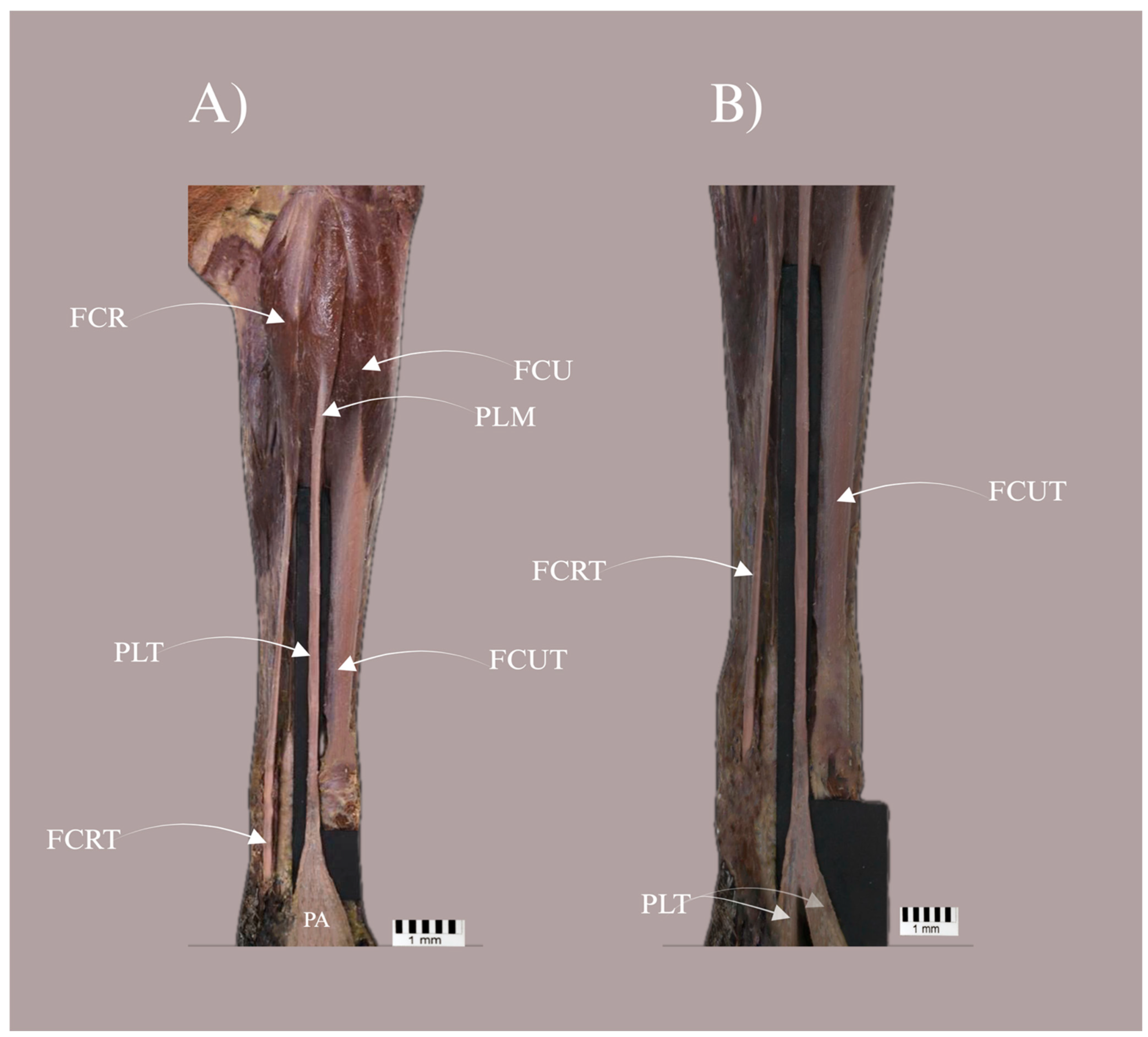
- Type I featured a single tendon inserting into the palmar aponeurosis—Figure 1A.
- (2)
3.4. Between-Type Comparisons of Tendon Geometry
3.5. Length Measures and Size Normalisation
4. Discussion
5. Conclusions
Author Contributions
Funding
Institutional Review Board Statement
Informed Consent Statement
Data Availability Statement
Acknowledgments
Conflicts of Interest
References
- Ankel-Simons, F. Primate Anatomy: An Introduction, 3rd ed.; Elsevier Academic Press: San Diego, CA, USA, 2007. [Google Scholar]
- Aversi-Ferreira, R.A.; Bretas, R.V.; Maior, R.S.; Davaasuren, M.; Paraguassú-Chaves, C.A.; Nishijo, H.; Aversi-Ferreira, T.A. Morphometric and statistical analysis of the palmaris longus muscle in human and non-human primates. Biomed Res. Int. 2014, 2014, 178906. [Google Scholar] [CrossRef] [PubMed]
- Diogo, R.; Richmond, B.G.; Wood, B. Evolution and homologies of primate and modern human hand and forearm muscles, with notes on thumb movements and tool use. J. Hum. Evol. 2012, 63, 64–78. [Google Scholar] [CrossRef] [PubMed]
- Diogo, R.; Wood, B. Comparative Anatomy and Phylogeny of Primate Muscles and Human Evolution; CRC Press: Boca Raton, FL, USA, 2012. [Google Scholar]
- Druelle, F.; Supiot, A.; Meulemans, S.; Schouteden, N.; Molina-Vila, P.; Rimbaud, B.; Aerts, P.; Berillon, G. The quadrupedal walking gait of the olive baboon, Papio anubis: An exploratory study integrating kinematics and EMG. J. Exp. Biol. 2021, 224, jeb242587. [Google Scholar] [CrossRef] [PubMed]
- Patel, B.A.; Wunderlich, R.E. Dynamic pressure patterns in the hands of olive baboons (Papio anubis) during terrestrial locomotion: Implications for cercopithecoid primate hand morphology. Anat. Rec. 2010, 293, 710–718. [Google Scholar] [CrossRef] [PubMed]
- Swindler, D.R.; Wood, C.D. An Atlas of Primate Gross Anatomy; University of Washington Press: Seattle, WA, USA, 1973. [Google Scholar]
- Ioannis, D.; Anastasios, K.; Konstantinos, N.; Lazaros, K.; Georgios, N. Palmaris longus muscle prevalence in different nations and interesting anatomical variations: A review of the literature. J. Clin. Med. Res. 2015, 7, 825–830. [Google Scholar] [CrossRef] [PubMed]
- Olewnik, L.; Wasniewska, A.; Polguj, M.; Podgorski, M.; Labetowicz, P.; Ruzik, K.; Topol, M. Morphological variability of the palmaris longus muscle in human fetuses. Surg. Radiol. Anat. 2018, 40, 1283–1291. [Google Scholar] [CrossRef] [PubMed]
- Olewnik, Ł.; Wysiadecki, G.; Polguj, M.; Podgórski, M.; Jezierski, H.; Topol, M. Anatomical variations of the palmaris longus muscle including its relation to the median nerve—A proposal for a new classification. BMC Musculoskelet. Disord. 2017, 18, 539. [Google Scholar] [CrossRef] [PubMed]
- Pękala, P.A.; Henry, B.M.; Pękala, J.R.; Skinningsrud, B.; Walocha, J.A.; Bonczar, M.; Tomaszewski, K.A. Congenital absence of the palmaris longus muscle: A meta-analysis comparing cadaveric and functional studies. J. Plast. Reconstr. Aesthet. Surg. 2017, 70, 1715–1724. [Google Scholar] [CrossRef] [PubMed]
- Yammine, K. Clinical prevalence of palmaris longus agenesis: A systematic review and meta-analysis. Clin. Anat. 2013, 26, 709–718. [Google Scholar] [CrossRef] [PubMed]
- Standring, S. Gray’s Anatomy: The Anatomical Basis of Clinical Practice; Elsevier Churchill Livingstone: Philadelphia, PA, USA, 2016. [Google Scholar]
- Yammine, K.; Erić, M. Morphometric analysis and surgical adequacy of palmaris longus as a tendon graft: A systematic review of cadaveric studies. Surg. Radiol. Anat. 2020, 42, 259–267. [Google Scholar] [CrossRef] [PubMed]
- Michilsens, F.; Vereecke, E.E.; D’Août, K.; Aerts, P. Functional anatomy of the gibbon forelimb: Adaptations to a brachiating lifestyle. J. Anat. 2009, 215, 335–354. [Google Scholar] [CrossRef] [PubMed]
- Sebastin, S.J.; Lim, A.Y.; Bee, W.H.; Wong, T.C.; Methil, B.V. Does the absence of the palmaris longus affect grip and pinch strength? J. Hand Surg. Br. 2005, 30, 406–408. [Google Scholar] [CrossRef] [PubMed]
- Stecco, C.; Lancerotto, L.; Porzionato, A.; Macchi, V.; Tiengo, C.; Parenti, A.; Sanudo, J.R.; De Caro, R. The palmaris longus muscle and its relations with the antebrachial fascia and the palmar aponeurosis. Clin. Anat. 2009, 22, 221–229. [Google Scholar] [CrossRef] [PubMed]
- Pračková, I.; Páral, V.; Vargová, L.; Vymazalová, K. A detailed anatomical study of the muscles of the forearm and hand in the Anubis baboon (Papio anubis) in comparison with humans. Acta Vet. Brno 2024, 93, 65–76. [Google Scholar] [CrossRef]



| Variable | Type I | Type II |
|---|---|---|
| Antebrachium length (mm) | 264.25 ± 4.99 | 262.95 ± 2.80 |
| Muscle belly length (mm) | 92.82 ± 3.94 | 91.80 ± 2.65 |
| Tendon length (mm) | 163.40 ± 5.63 | 162.32 ± 4.71 |
| Total PL length (mm) | 256.22 ± 9.44 | 254.12 ± 7.26 |
| Mid-tendon width (mm) | 2.91 ± 0.19 | 2.36 ± 0.11 |
| Tendon width (mm) | 23.49 ± 2.48 | 21.00 ± 1.70 |
| Tendon thickness (mm) | 2.70 ± 0.22 | 2.68 ± 0.22 |
| Tendon thickness at belly exit (mm) | 2.38 ± 0.22 | 2.09 ± 0.10 |
| Interstyloid-to-bifurcation distance (mm) | — | 30.78 ± 0.84 |
| Lateral band length (mm) | — | 32.32 ± 4.85 |
| Medial band length (mm) | — | 26.31 ± 3.17 |
| Tendon width at belly exit (mm) | 2.11 ± 0.18 | 1.93 ± 0.07 |
| Type | Medial Band Present (n, %) | Lateral Band Present (n, %) |
|---|---|---|
| I | 0 (0.0%) | 0 (0.0%) |
| II | 6 (100.0%) | 6 (100.0%) |
| Measure | Mean | SD | Median | Min–Max |
|---|---|---|---|---|
| Medial band length (mm) | 26.31 | 3.17 | 27.16 | 22.33–29.42 |
| Lateral band length (mm) | 32.32 | 4.85 | 35.13 | 25.72–36.27 |
| Interstyloid-to-bifurcation (mm) | 30.78 | 0.84 | 30.69 | 29.94–31.92 |
Disclaimer/Publisher’s Note: The statements, opinions and data contained in all publications are solely those of the individual author(s) and contributor(s) and not of MDPI and/or the editor(s). MDPI and/or the editor(s) disclaim responsibility for any injury to people or property resulting from any ideas, methods, instructions or products referred to in the content. |
© 2026 by the authors. Licensee MDPI, Basel, Switzerland. This article is an open access article distributed under the terms and conditions of the Creative Commons Attribution (CC BY) license.
Share and Cite
Landfald, I.C.; Diogo, R.; Ruzik, K.; Cavalcante, J.C.; João Abreu, B.; Ciechanowska, M.; Olewnik, Ł. Palmaris Longus in the Anubis Baboon (Papio anubis): A Conservative Single-Tendon Pattern with Rare Distal Bifurcation. Biology 2026, 15, 562. https://doi.org/10.3390/biology15070562
Landfald IC, Diogo R, Ruzik K, Cavalcante JC, João Abreu B, Ciechanowska M, Olewnik Ł. Palmaris Longus in the Anubis Baboon (Papio anubis): A Conservative Single-Tendon Pattern with Rare Distal Bifurcation. Biology. 2026; 15(7):562. https://doi.org/10.3390/biology15070562
Chicago/Turabian StyleLandfald, Ingrid C., Rui Diogo, Kacper Ruzik, Judney Cley Cavalcante, Bento João Abreu, Magdalena Ciechanowska, and Łukasz Olewnik. 2026. "Palmaris Longus in the Anubis Baboon (Papio anubis): A Conservative Single-Tendon Pattern with Rare Distal Bifurcation" Biology 15, no. 7: 562. https://doi.org/10.3390/biology15070562
APA StyleLandfald, I. C., Diogo, R., Ruzik, K., Cavalcante, J. C., João Abreu, B., Ciechanowska, M., & Olewnik, Ł. (2026). Palmaris Longus in the Anubis Baboon (Papio anubis): A Conservative Single-Tendon Pattern with Rare Distal Bifurcation. Biology, 15(7), 562. https://doi.org/10.3390/biology15070562