Impact of Human Activities and Climate Change on Chinese Forest Musk Deer (Moschus berezovskii)
Simple Summary
Abstract
1. Introduction
2. Materials and Methods
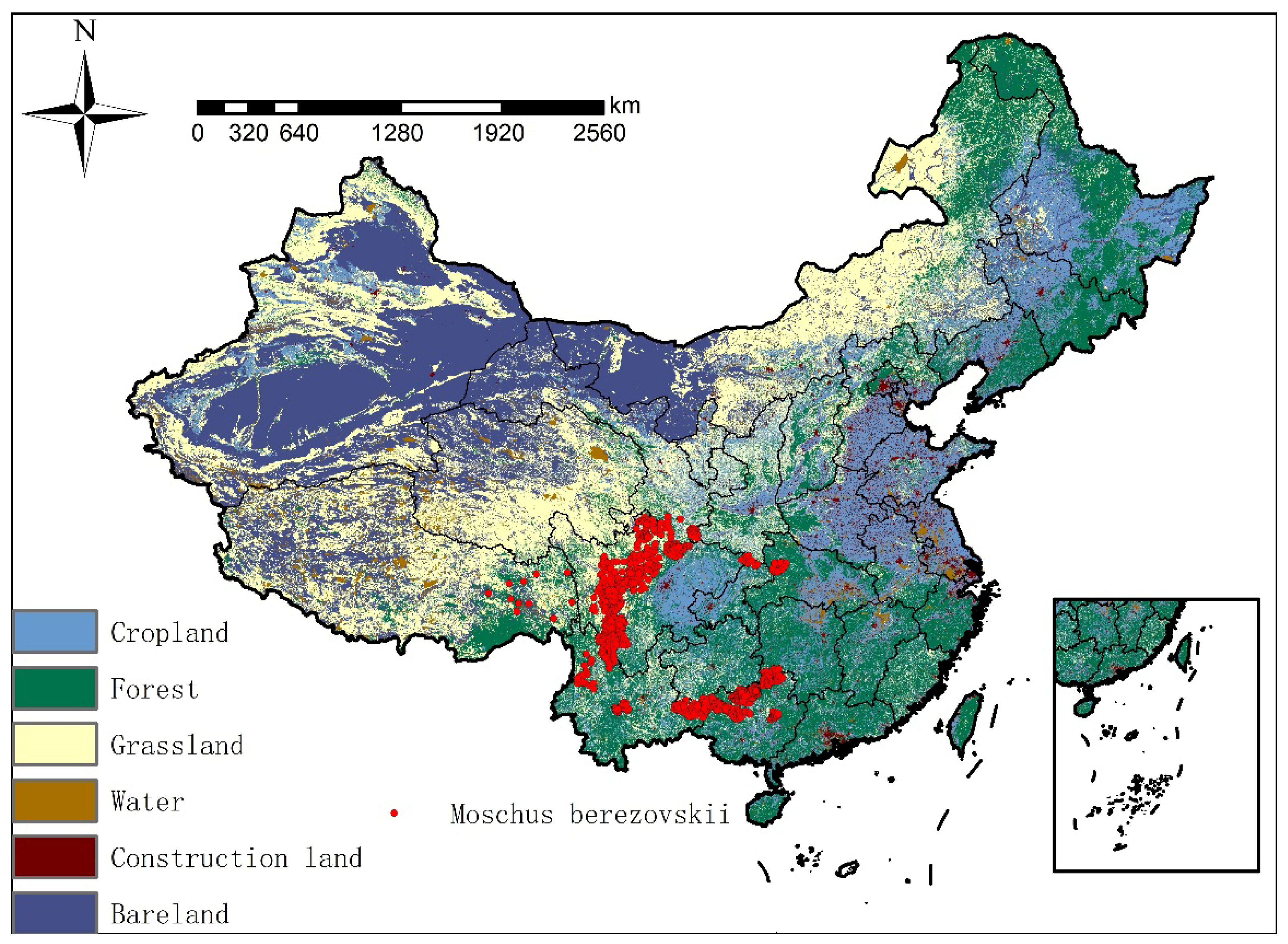
2.1. Occurrence Data
2.2. Environmental Factors
2.3. Data Analysis and Modeling
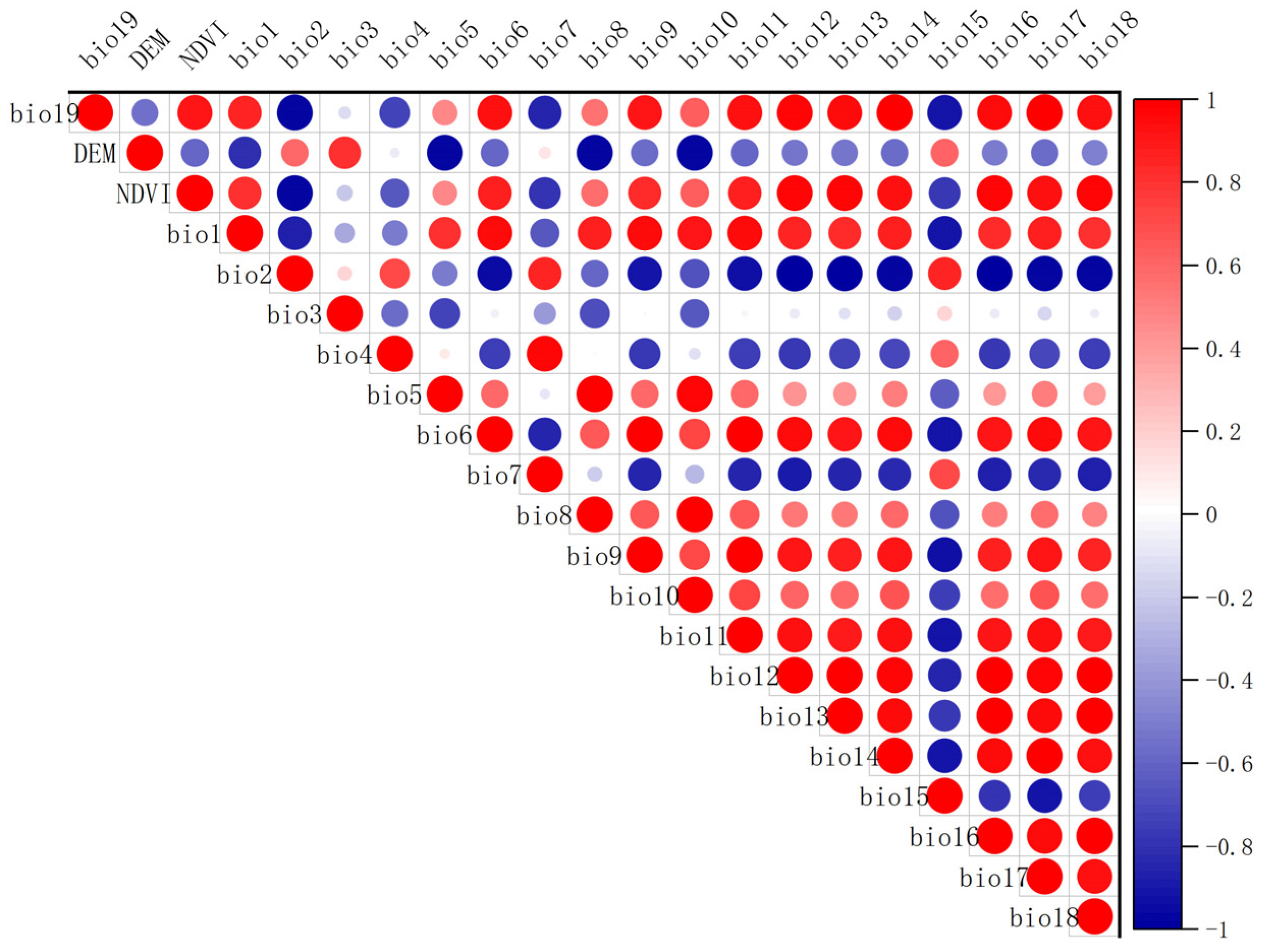
2.3.1. Screening of Forest Musk Deer Occurrence Points and Environmental Factors Using ENMTools
2.3.2. Ecological Suitability for the Forest Musk Deer Using MaxEnt
3. Results
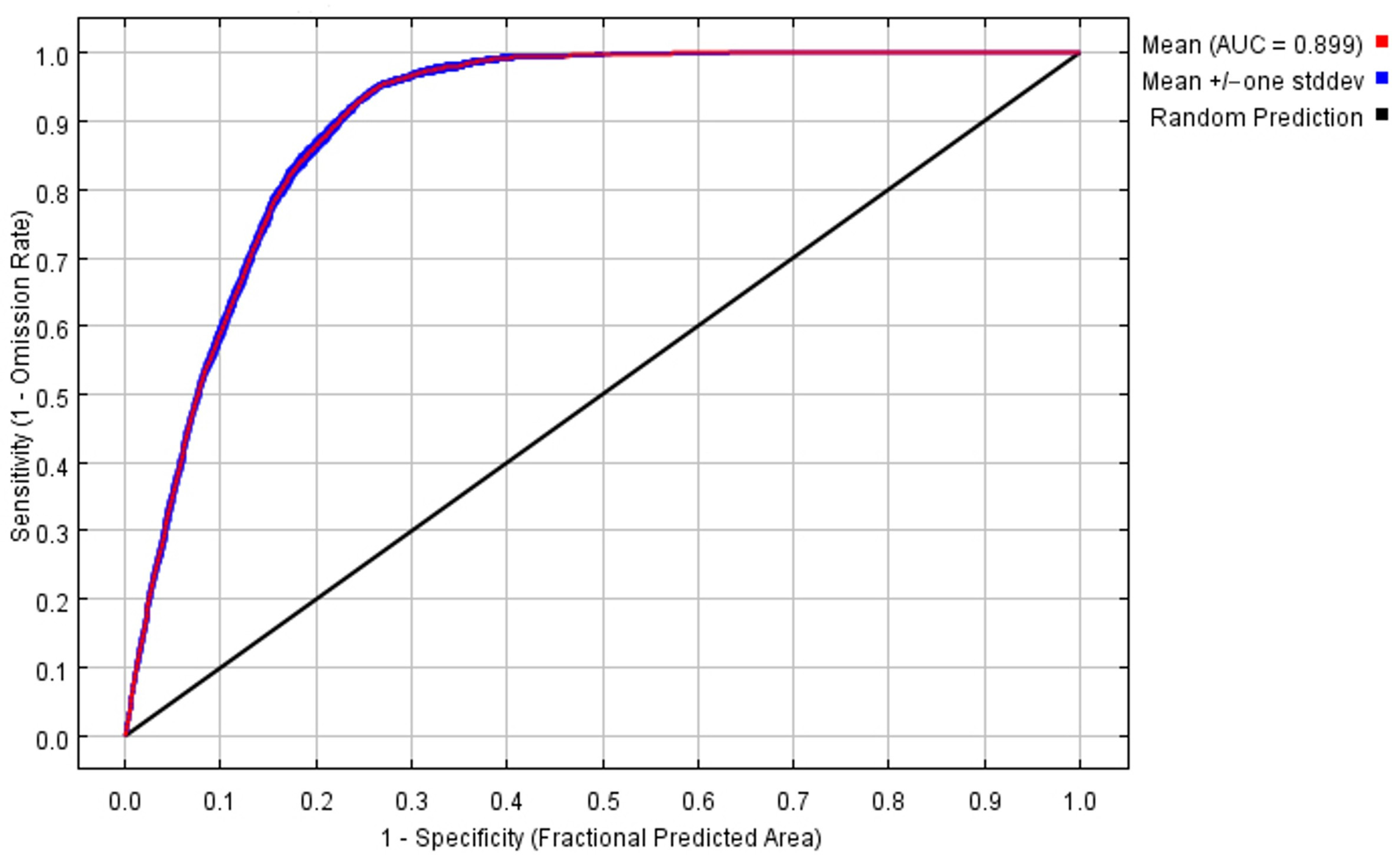
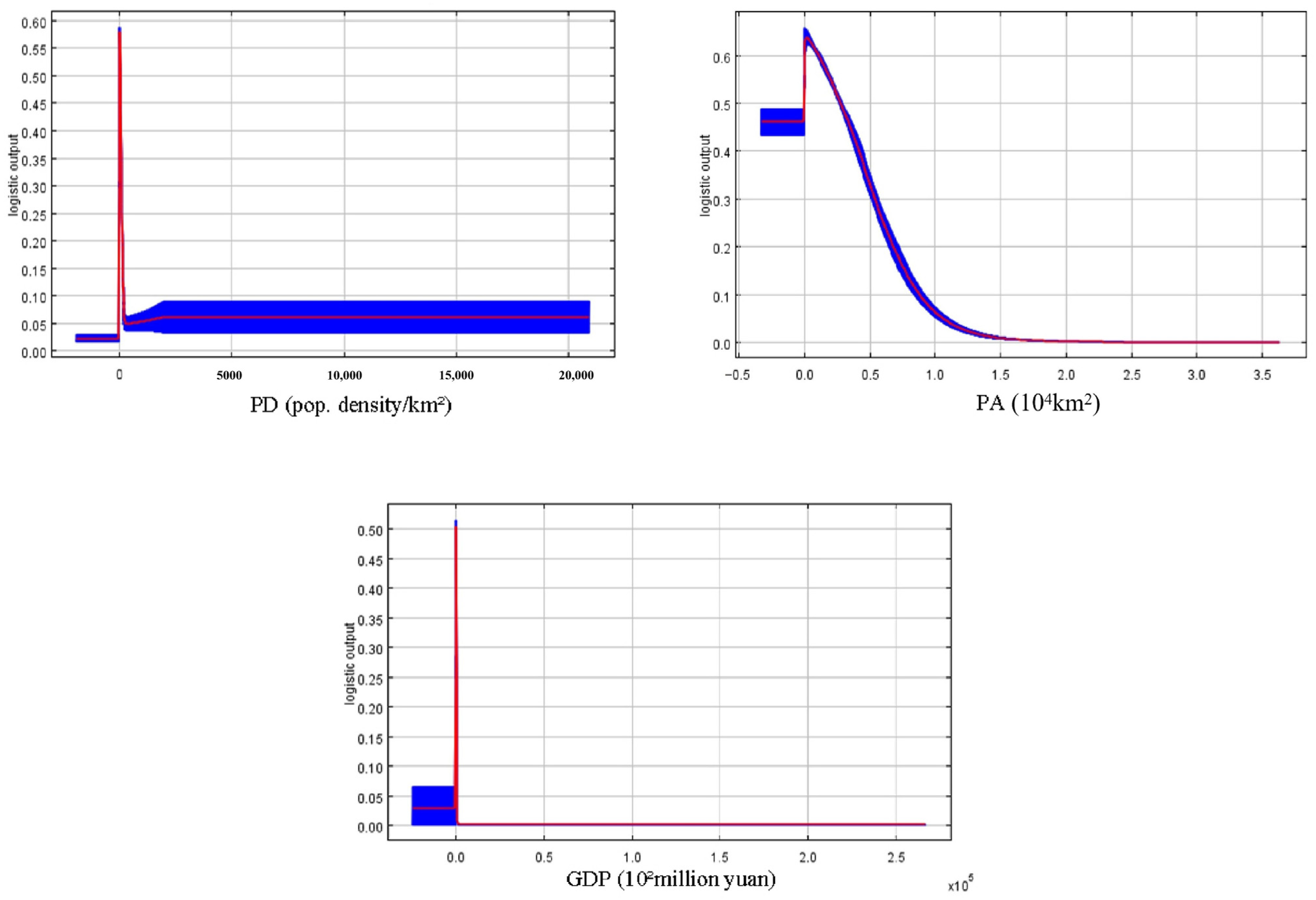
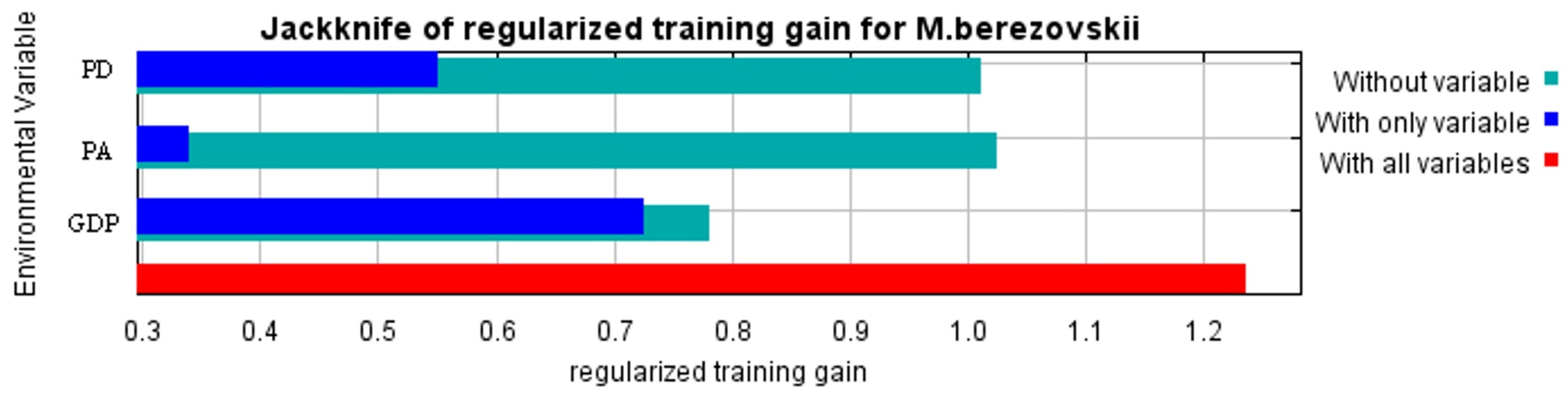
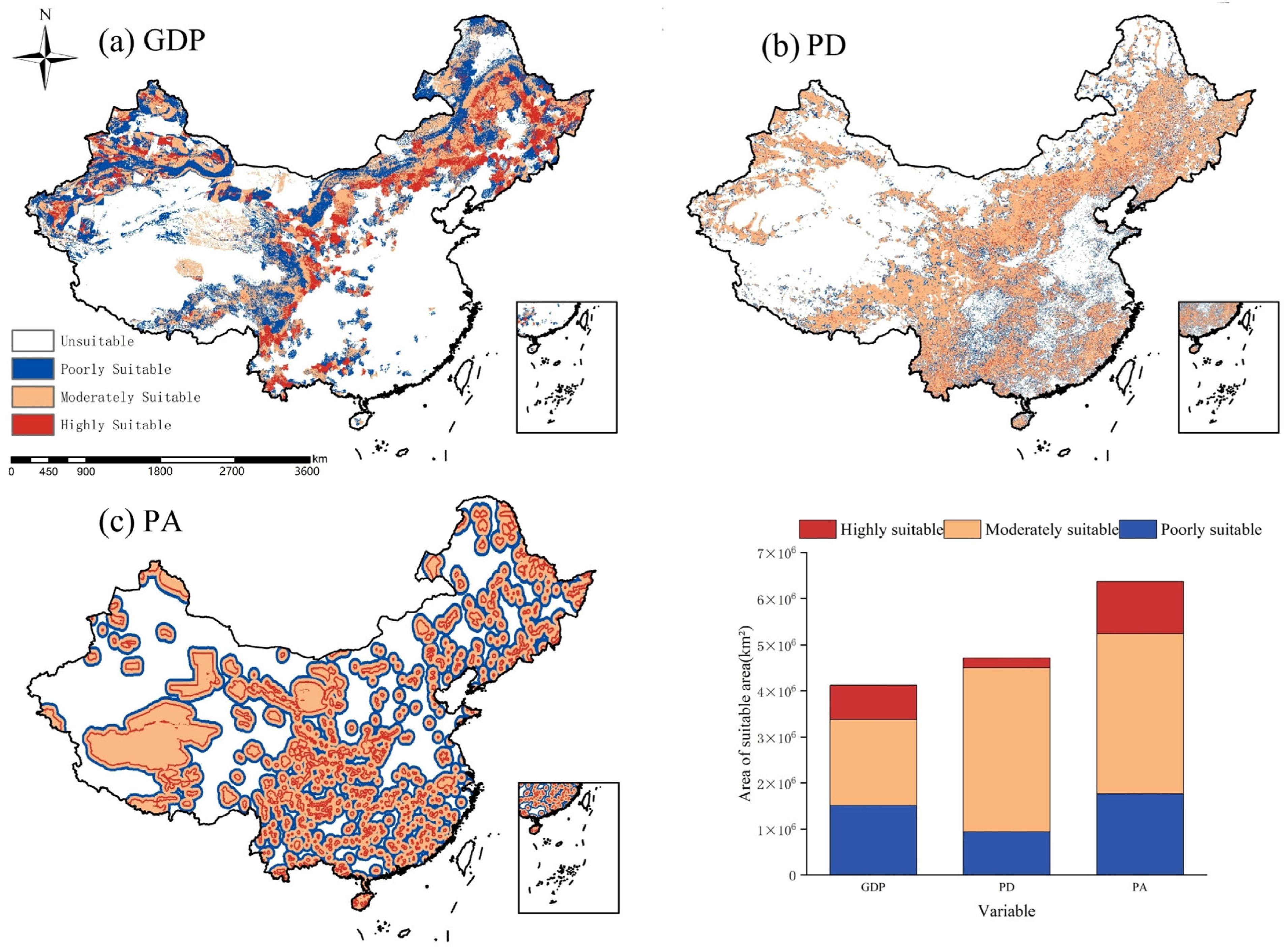
3.1. Suitable Habitat of the Forest Musk Deer
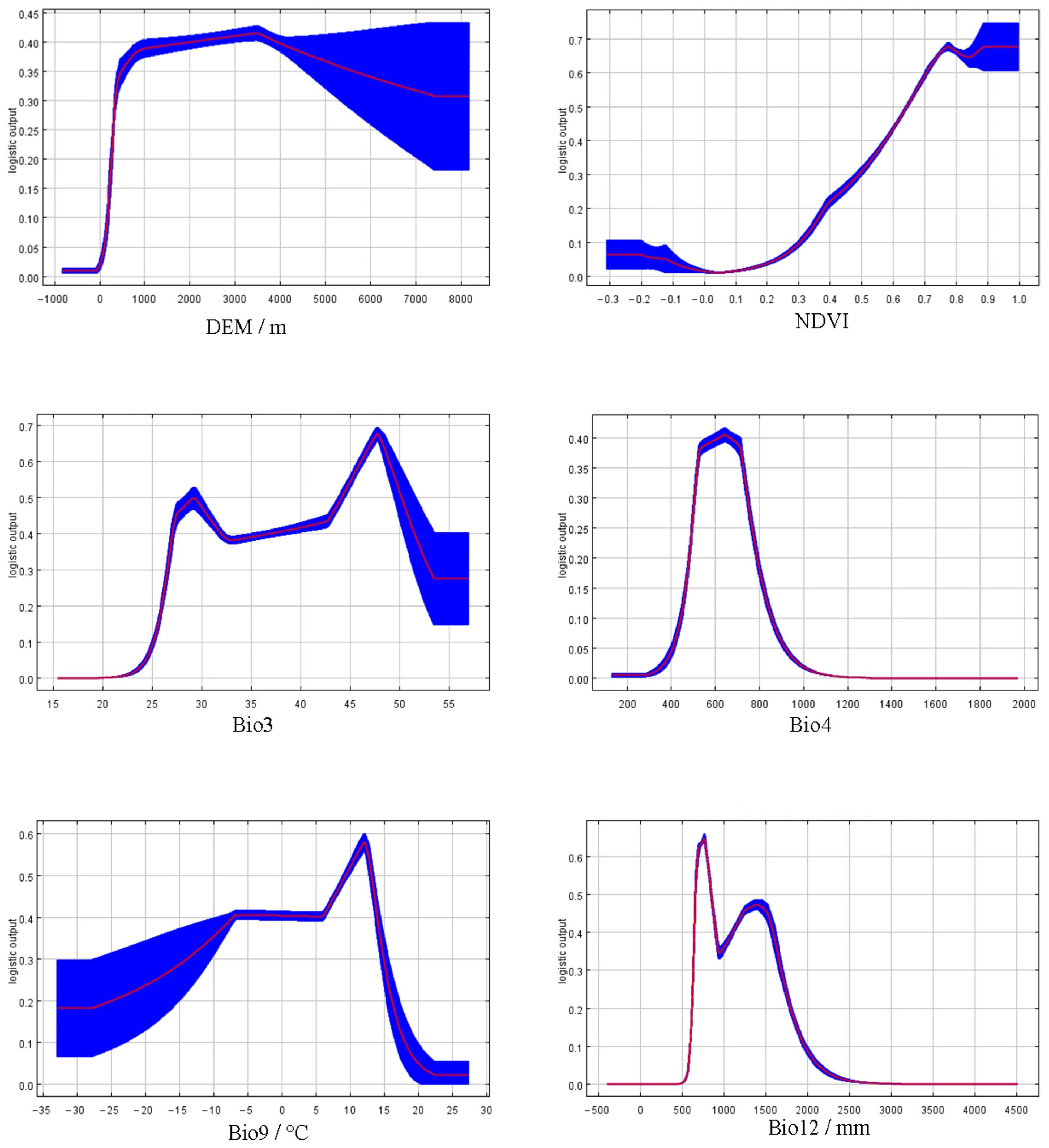
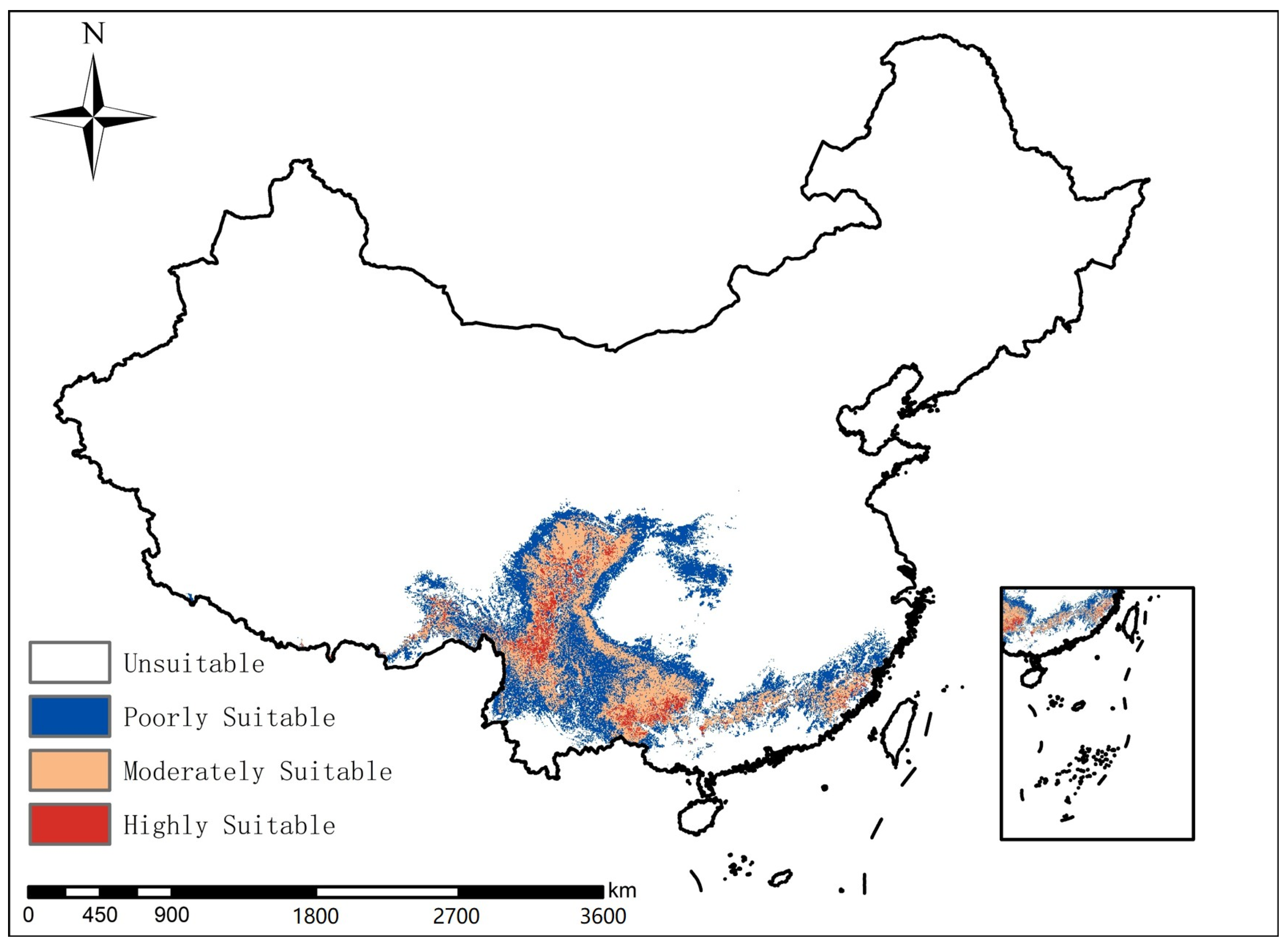
3.2. Suitable Habitat Under Current Climate
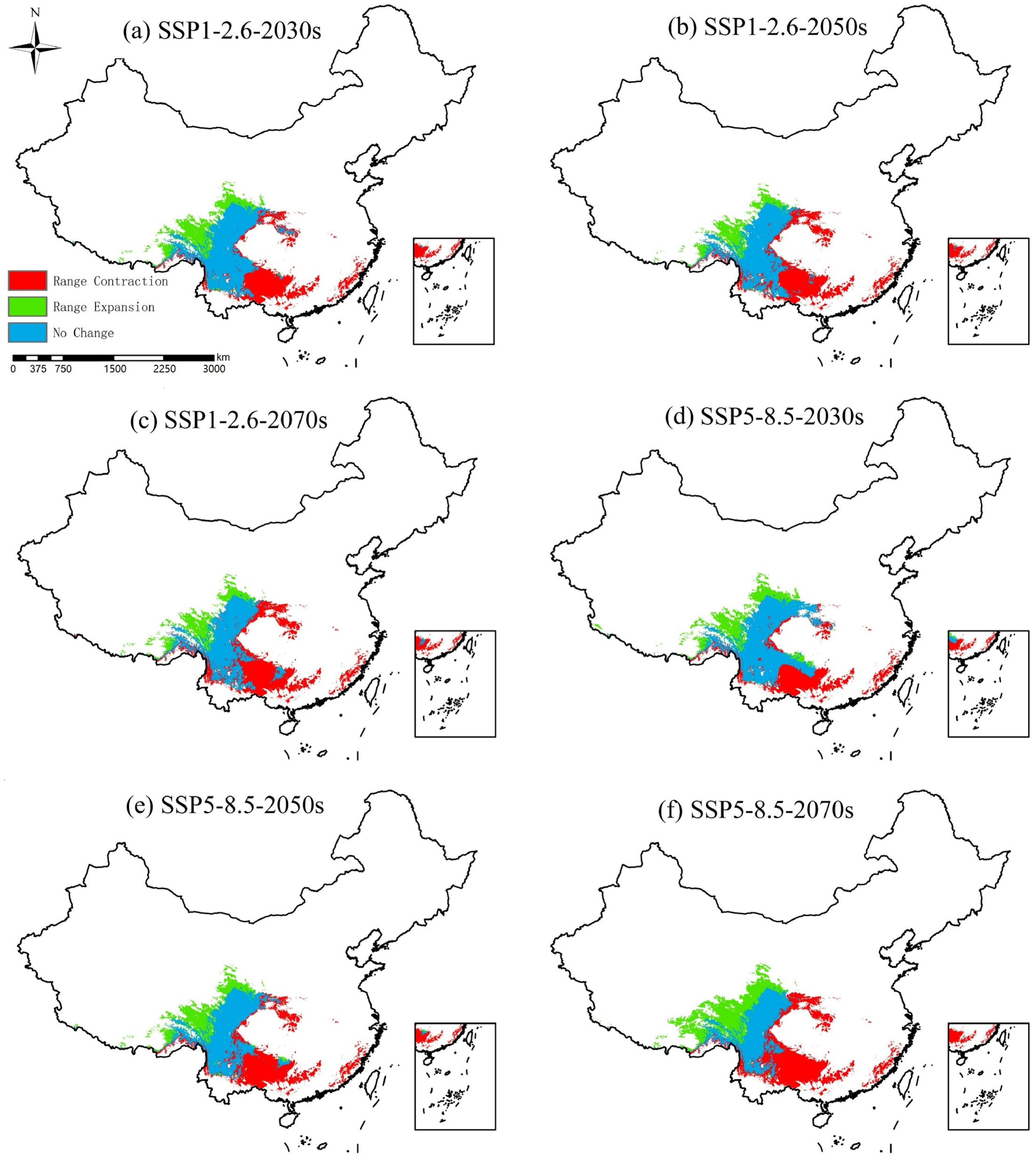
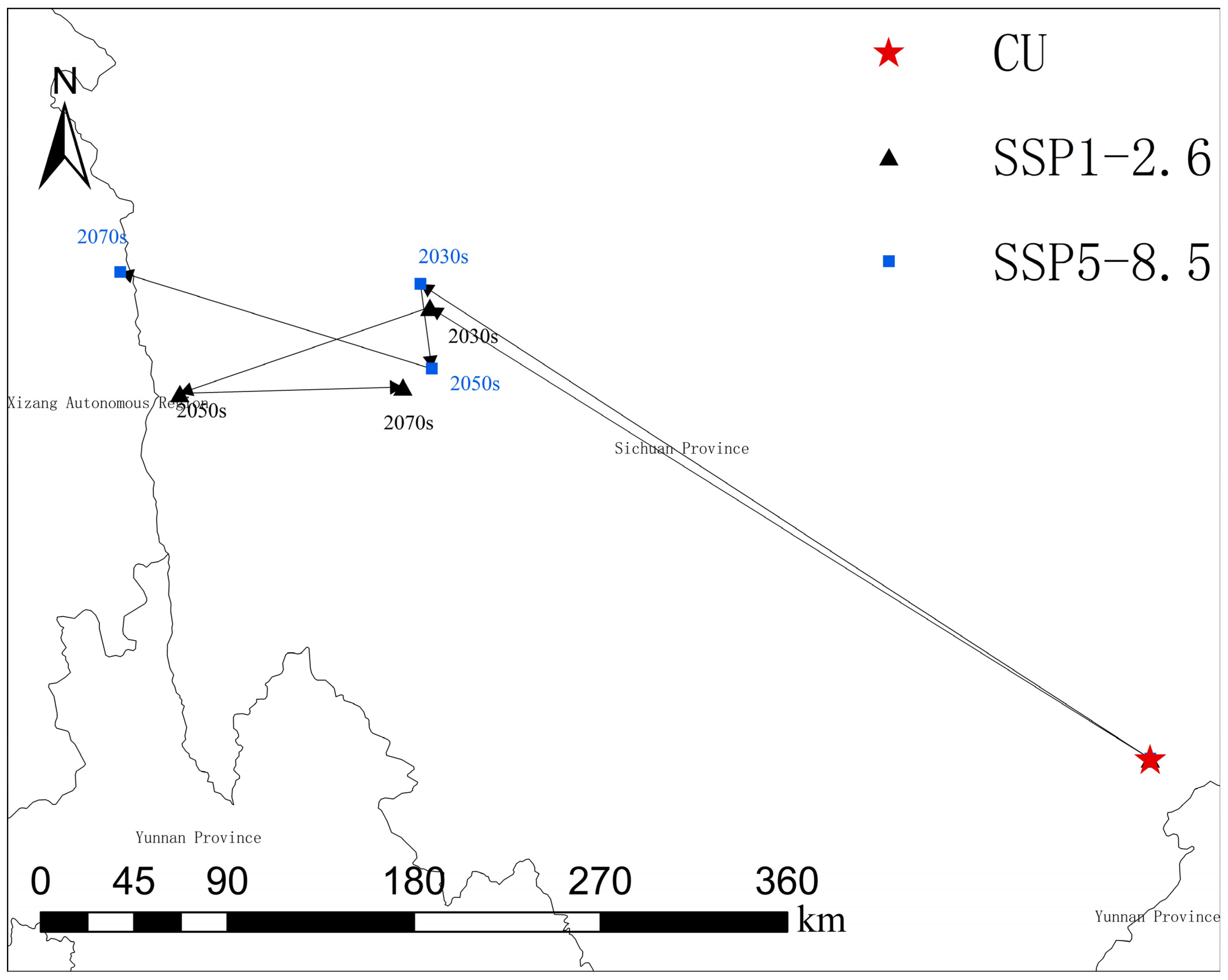
3.3. Suitable Habitat Under Future Climate
4. Discussion
5. Conclusions
Author Contributions
Funding
Institutional Review Board Statement
Informed Consent Statement
Data Availability Statement
Acknowledgments
Conflicts of Interest
References
- Meng, Z.; Dong, J.; Ellis, E.C.; Metternicht, G.; Qin, Y.; Song, X.P.; Löfqvist, S.; Garrett, R.D.; Jia, X.; Xiao, X. Post-2020 biodiversity framework challenged by cropland expansion in protected areas. Nat. Sustain. 2023, 6, 758–768. [Google Scholar] [CrossRef] [Scilit]
- Luby, I.H.; Miller, S.J.; Polasky, S. When and where to protect forests. Nature 2022, 609, 89–93. [Google Scholar] [CrossRef] [Scilit]
- Powers, R.P.; Jetz, W. Global habitat loss and extinction risk of terrestrial vertebrates under future land-use-change scenarios. Nat. Clim. Change 2019, 9, 323–329. [Google Scholar] [CrossRef] [Scilit]
- Chen, I.C.; Hill, J.K.; Ohlemüller, R.; Roy, D.B.; Thomas, C.D. Rapid range shifts of species associated with high levels of climate warming. Science 2011, 333, 1024–1026. [Google Scholar] [CrossRef] [Scilit]
- Chen, I.C.; Shiu, H.J.; Benedick, S.; Holloway, J.D.; Chey, V.K.; Barlow, H.S.; Hill, J.K.; Thomas, C.D. Elevation increases in moth assemblages over 42 years on a tropical mountain. Proc. Natl. Acad. Sci. USA 2009, 106, 1479–1483. [Google Scholar] [CrossRef] [Scilit]
- Pecl, G.T.; Araújo, M.B.; Bell, J.D.; Blanchard, J.; Bonebrake, T.C.; Chen, I.C.; Clark, T.D.; Colwell, R.K.; Danielsen, F.; Evengård, B.; et al. Biodiversity redistribution under climate change: Impacts on ecosystems and human well-being. Science 2017, 355, 9214. [Google Scholar] [CrossRef] [Scilit] [PubMed]
- Li, B.G.; Li, M.; Li, J.H.; Fan, P.F.; Ni, Q.Y.; Lu, J.Q.; Zhou, X.M.; Long, Y.C.; Jiang, Z.G.; Zhang, P.; et al. The primate extinction crisis in China: Immediate challenges and a way forward. Biodivers. Conserv. 2018, 27, 3301–3327. [Google Scholar] [CrossRef] [Scilit]
- Maierdiyali, A.; Wang, Y.; Tao, S.C.; Kong, Y.P.; Wang, H.; Lü, Z. Research status and challenges of road impacts on wildlife in China. Biodivers. Sci. 2022, 30, 22209. [Google Scholar] [CrossRef] [Scilit]
- Li, W.B.; Yang, P.P.; Xia, D.P.; Huffman, M.A.; Li, M.; Li, J.H. Ecotourism disturbance on an endemic endangered primate in the Huangshan Man and the Biosphere Reserve of China: A way to move forward. Biology 2022, 11, 1042. [Google Scholar] [CrossRef] [Scilit]
- Biber, M.F.; Voskamp, A.; Hof, C. Potential effects of future climate change on global reptile distributions and diversity. Glob. Ecol. Biogeogr. 2023, 32, 519–534. [Google Scholar] [CrossRef] [Scilit]
- Li, W.B.; Teng, Y.; Zhang, M.Y.; Shen, Y.; Liu, J.W.; Qi, J.W.; Wang, X.C.; Wu, R.F.; Li, J.H.; Garber, P.A.; et al. Human activity and climate change accelerate the extinction risk to non-human primates in China. Glob. Change Biol. 2024, 30, e17114. [Google Scholar] [CrossRef] [Scilit]
- Zhao, X.; Ren, B.; Li, D.; Garber, P.A.; Zhu, P.; Xiang, Z.; Grueter, C.C.; Liu, Z.; Li, M. Climate change, grazing, and collecting accelerate habitat contraction in an endangered primate. Biol. Conserv. 2019, 231, 88–97. [Google Scholar] [CrossRef] [Scilit]
- Yang, L.; Chen, T.; Shi, K.C.; Zhang, L.; Lwin, N.; Fan, P.F. Effects of climate and land-cover change on the conservation status of gibbons. Conserv. Biol. 2023, 37, e14045. [Google Scholar]
- Zhao, X.; Li, X.; Zhang, Z.; Garber, P.A.; Yu, M.; Qiao, H.; Li, M. Differential response to climate change and human activities in three lineages of Sichuan snub-nosed monkeys (Rhinopithecus roxellana). Divers. Distrib. 2022, 28, 2416–2428. [Google Scholar]
- Gao, X.; Bu, S.; Zheng, X. Integrating species distribution models to estimate the population size of forest musk deer (Moschus berezovskii) in the central Qinling Mountains of Shaanxi. Diversity 2023, 15, 1071. [Google Scholar] [CrossRef] [Scilit]
- Feng, H.; Feng, C.L.; Huang, Y.; Tang, J. Structure of mitochondrial DNA control region and genetic diversity of Moschus berezovskii populations in Shaanxi Province. Genet Mol. Res. 2016, 15. [Google Scholar] [CrossRef] [Scilit] [PubMed]
- Yang, Q.; Meng, X.; Xia, L.; Feng, Z. Conservation status and causes of decline of musk deer (Moschus spp.) in China. Biol. Conserv. 2003, 109, 333–342. [Google Scholar] [CrossRef] [Scilit]
- Cai, Y.H.; Yang, J.D.; Wang, J.M.; Yang, Y.; Fu, W.L.; Zheng, C.L.; Cheng, J.G.; Zeng, Y.T.; Zhang, Y.; Xu, L.; et al. Changes in the population genetic structure of captive forest musk deer (Moschus berezovskii) with the increasing number of generations under closed breeding conditions. Animals 2020, 10, 255. [Google Scholar] [CrossRef] [Scilit]
- Xi, J.; Zhu, Y.D.; He, K.; Yang, Z.S.; Li, D.Y. Habitat selection of wild training Moschus berezovskii individuals in Liziping National Nature Reserve, Sichuan Province. Sichuan For. Sci. Technol. 2023, 44, 51–57. [Google Scholar] [CrossRef]
- Zhang, D.D.; Zhang, Q.X. Winter habitat selection by musk deer in Jiulong Mountain Nature Reserve. Sichuan For. Sci. Technol. 2018, 39, 64–68. [Google Scholar] [CrossRef]
- Gao, X.Y. Spatial Distribution Pattern of Forest Musk Deer (Moschus berezovskii) in the Qinba Mountains of Shaanxi Province Under the Context of Land-Use Change. Master’s Thesis, Northwest A&F University, Xianyang, China, 2023. [Google Scholar]
- Xu, X.L.; Liu, J.Y.; Zhang, S.W.; Li, R.D.; Yan, C.Z.; Wu, S.X. China’s Multi-Period Land Use and Land Cover Remote Sensing Monitoring Dataset (CNLUCC). Resource and Environment Science Data Registration and Publishing System. 2018. Available online: https://www.resdc.cn/DOI/DOI.aspx?DOIID=54 (accessed on 22 July 2024).
- Luo, C.; Xu, W.H.; Zhou, Z.X.; Ouyang, Z.Y.; Zhang, L. Habitat prediction for forest musk deer (Moschus berezovskii) in the Qinling Mountain Range based on a niche model. Acta Ecol. Sin. 2011, 31, 1221–1229. [Google Scholar] [CrossRef]
- Fick, S.E.; Hijmans, R.J. WorldClim 2: New 1-km spatial resolution climate surfaces for global land areas. Int. J. Climatol. 2017, 37, 4302–4315. [Google Scholar]
- Wang, Q.S.; Wen, L.; Su, X.K. Spatial-temporal pattern changes of Tibetan antelope habitats on the Qinghai–Tibetan Plateau under climate change scenarios. Acta Ecol. Sin. 2022, 42, 8985–8993. [Google Scholar] [CrossRef] [Scilit]
- Resource and Environment Science Data Center (RESDC). Resource and Environment Science Data Registration and Publishing System. 2024. Available online: https://www.resdc.cn/Default.aspx (accessed on 22 July 2024).
- Warren, D.L.; Glor, R.E.; Turelli, M. ENMTools: A toolbox for comparative studies of environmental niche models. Ecography 2010, 33, 607–611. [Google Scholar] [CrossRef] [Scilit]
- Graham, M.H. Confronting multicollinearity in ecological multiple regression. Ecology 2003, 84, 2809–2815. [Google Scholar] [CrossRef] [Scilit]
- MaxEnt. Version 3.4.4. Species Distribution Modelling Software. Available online: https://biodiversityinformatics.amnh.org/open_source/maxent/ (accessed on 22 July 2024).
- Swets, J.A. Measuring the accuracy of diagnostic systems. Science 1988, 240, 1285–1293. [Google Scholar] [CrossRef] [Scilit]
- Elith, J.; Kearney, M.; Phillips, S. The art of modelling range-shifting species. Methods Ecol. Evol. 2010, 1, 330–342. [Google Scholar] [CrossRef] [Scilit]
- Román-Palacios, C.; Wiens, J.J. Recent responses to climate change reveal the drivers of species extinction and survival. Proc. Natl. Acad. Sci. USA 2020, 117, 4211–4217. [Google Scholar] [CrossRef] [Scilit]
- Xiang, Y.Z.; Li, S.H.; Yang, Q.; Liu, J.J.; Liu, Y.; Zhao, L.; Lin, H.; Luo, Y.; Ren, J.; Luo, X.Q.; et al. Modeling the Habitat Suitability and Range Shift of Daphniphyllum macropodum in China Under Climate Change Using an Optimized MaxEnt Model. Biology 2025, 14, 1360. [Google Scholar] [CrossRef] [Scilit] [PubMed]
- Phillips, S.J.; Dudík, M. Modeling of species distributions with Maxent: New extensions and a comprehensive evaluation. Ecography 2008, 31, 161–175. [Google Scholar] [CrossRef] [Scilit]
- Yang, C.; Ma, G.; Meng, X.X.; Xu, H.F. Habitat characteristics favored by forest musk deer (Moschus berezovskii) in summer in Liangshan Mountains. Chin. J. Ecol. 2011, 30, 18–23. Available online: https://www.cje.net.cn/EN/Y2011/V30/I01/18 (accessed on 22 July 2024).
- Wang, J.F.; Xu, K.; Yao, S.; Liu, T.; Yu, B.; Huang, X.Q.; Xiao, Z.S.; Xia, D.P. Temporal niche partitioning among sympatric wild and domestic ungulates between warm and cold seasons. Sci. Rep. 2024, 14, 10570. [Google Scholar] [CrossRef] [Scilit]
- Ran, Q.; Hao, Y.B.; Xia, A.Q.; Liu, W.J.; Hu, R.H.; Cui, X.Y.; Xue, K.; Song, X.N.; Xu, C.; Ding, B.Y.; et al. Quantitative Assessment of the Impact of Physical and Anthropogenic Factors on Vegetation Spatial-Temporal Variation in Northern Tibet. Remote Sens. 2019, 11, 1183. [Google Scholar]
- Samejima, Y.; Matsuoka, H. A new viewpoint on antlers reveals the evolutionary history of deer (Cervidae, Mammalia). Sci. Rep. 2020, 10, 8910. [Google Scholar] [PubMed]
- Li, Y.X.; Hai, L.Y.; Luo, P.F.; Zheng, W.S.; Jin, X.L.; Liu, J.C.; Wang, H.Y.; Hu, D.F. Defecation site preferences and spatial ecological segregation of forest musk deer and Siberian roe deer in North China. Animals 2024, 15, 61. [Google Scholar] [CrossRef] [Scilit] [PubMed]
- Bleich, V.C.; Marshal, J.P.; Andrew, N.G. Habitat use by a desert ungulate: Predicting effects of water availability on mountain sheep. J. Arid. Environ. 2010, 74, 638–645. [Google Scholar] [CrossRef] [Scilit]
- Zhao, J.P.; Wang, Q.; Zheng, C.L.; Hu, J.Y.; Wang, R.L.; Jiang, G. Research on the suitable habitat for Moschus berezovskii based on the maximum entropy model (MaxEnt) under a climatic background. Hubei Agric. Sci. 2023, 62, 218–223. [Google Scholar] [CrossRef]
- Jiang, F.; Zhang, J.; Gao, H.; Cai, Z.Y.; Zhou, X.W.; Li, S.Q.; Zhang, T.Z. Musk deer (Moschus spp.) face redistribution to higher elevations and latitudes under climate change in China. Sci. Total Environ. 2020, 704, 135335. [Google Scholar]



| Factor Type | Variables | Description | |
|---|---|---|---|
| Natural factor | Climatic factors | BIO3 | Isothermality (BIO2/BIO7) (×100) |
| BIO4 | Temperature seasonality | ||
| BIO9 | Mean temperature of driest quarter | ||
| BIO12 | Annual precipitation | ||
| BIO14 | Precipitation of driest month | ||
| Topographic factors | DEM | Digital Elevation Model | |
| Natural factor | Vegetation factors | NDVI | Normalized difference vegetation index (%) |
| Human interference factors | Distance to road | Distance to road (m) | |
| PD | Population density | ||
| PA | Protected area | ||
| GDP | Gross domestic product | ||
| Variable | Percent Contribution | Cumulative Percent Contribution |
|---|---|---|
| BIO12 | 43.5 | 43.5 |
| BIO4 | 32.3 | 75.8 |
| DEM | 13.3 | 89.1 |
| BIO3 | 4.8 | 93.9 |
| BIO9 | 3.2 | 97.1 |
| BIO14 | 2.9 | 100 |
| Climate Scenarios | Range Contraction (×104 km2) | Range Expansion (×104 km2) | No Change (×104 km2) |
|---|---|---|---|
| SSP1-2.6-2030s | 58.49 | 20.77 | 50.91 |
| SSP1-2.6-2050s | 55.1 | 21.11 | 54.32 |
| SSP1-2.6-2070s | 59.41 | 20.14 | 50 |
| SSP5-8.5-2030s | 45.35 | 25.29 | 64.05 |
| SSP5-8.5-2050s | 58.87 | 23.52 | 50.53 |
| SSP5-8.5-2070s | 65.73 | 28.85 | 43.69 |
Disclaimer/Publisher’s Note: The statements, opinions and data contained in all publications are solely those of the individual author(s) and contributor(s) and not of MDPI and/or the editor(s). MDPI and/or the editor(s) disclaim responsibility for any injury to people or property resulting from any ideas, methods, instructions or products referred to in the content. |
© 2026 by the authors. Licensee MDPI, Basel, Switzerland. This article is an open access article distributed under the terms and conditions of the Creative Commons Attribution (CC BY) license.
Share and Cite
Xu, D.; Cui, A.-B.; Ming, X.-L.; Fei, Y.-L.; Yang, X.-R.; Li, W.-B. Impact of Human Activities and Climate Change on Chinese Forest Musk Deer (Moschus berezovskii). Biology 2026, 15, 549. https://doi.org/10.3390/biology15070549
Xu D, Cui A-B, Ming X-L, Fei Y-L, Yang X-R, Li W-B. Impact of Human Activities and Climate Change on Chinese Forest Musk Deer (Moschus berezovskii). Biology. 2026; 15(7):549. https://doi.org/10.3390/biology15070549
Chicago/Turabian StyleXu, Du, An-Bang Cui, Xu-Lu Ming, Yu-Lu Fei, Xue-Rui Yang, and Wen-Bo Li. 2026. "Impact of Human Activities and Climate Change on Chinese Forest Musk Deer (Moschus berezovskii)" Biology 15, no. 7: 549. https://doi.org/10.3390/biology15070549
APA StyleXu, D., Cui, A.-B., Ming, X.-L., Fei, Y.-L., Yang, X.-R., & Li, W.-B. (2026). Impact of Human Activities and Climate Change on Chinese Forest Musk Deer (Moschus berezovskii). Biology, 15(7), 549. https://doi.org/10.3390/biology15070549