Article

Absence of Toll-like Receptor 21 (TLR21) Gene in the Genome of Transparent Glass Catfish (Kryptopterus vitreolus)

1
Laboratory of Aquatic Genomics, College of Life Sciences and Oceanography, Shenzhen University, Shenzhen 518057, China
2
Fishes Conservation and Utilization in the Upper Reaches of the Yangtze River Key Laboratory of Sichuan Province, College of Fisheries, Neijiang Normal University, Neijiang 641100, China
3
Center for Aquatic Genomics, BGI Academy of Marine Sciences, Shenzhen 518081, China
*
Authors to whom correspondence should be addressed.
Biology 2026, 15(3), 263; https://doi.org/10.3390/biology15030263
Submission received: 29 December 2025 / Revised: 23 January 2026 / Accepted: 29 January 2026 / Published: 1 February 2026
(This article belongs to the Special Issue Research Advances in Aquatic Omics)

Simple Summary

Transparent fishes, such as the ornamental glass catfish, have evolved unique transparent bodies, but how their immune system adapts for defense against exogenous pathogens remains unclear. This study compared the genomes of the glass catfish and its close relative, the non-transparent North African catfish. We found that the glass catfish has lost an important immune gene called TLR21, which is present in most other fish species. Meanwhile, some of the remaining immune genes in the glass catfish have been expanded to become more complex. Our results showed that the TLR21 protein in the North African catfish can potentially recognize pathogen molecules, but its binding strength varies greatly depending on the molecular sequence from various teleosts. We also discovered that another transparent fish, the X-ray tetra, has lost another TLR gene, TLR1. These interesting findings suggest that transparent fishes may have adjusted their immune defenses during evolution by losing certain immune gene(s) while strengthening others. In summary, this research provides new insights into how transparent fishes adapt to the aquatic environment, and improves our understanding of the immune evolution in fish.

Abstract

This study investigates the genomic basis of immune adaptation in the transparent glass catfish (Kv: Kryptopterus vitreolus), focusing on the loss of the Toll-like receptor 21 (TLR21) gene. Comparative genomic analysis with closely related non-transparent North African catfish (Cg: Clarias gariepinus) revealed 11 TLR genes in the latter, while only 8 TLR genes (KvTLR1, 2, 3, 5, 7, 9, 13, and 20) were retained in the glass catfish, with TLR21 specifically absent. Collinearity analysis confirmed that the genomic region containing TLR21 is conserved across eight siluriform species, with loss exclusively in the glass catfish, supporting its lineage-specific absence. Structural expansion was notable in KvTLR5, KvTLR7, and KvTLR20. Molecular docking indicated that binding stability between CpG oligonucleotides and TLR21 varies significantly, with CpG-B 1681 showing the strongest interaction, which highlights sequence-dependent ligand recognition. Interestingly, absence of the TLR1 gene in another transparent teleost, the X-ray tetra (Pristella maxillaris), suggests that transparent fishes may share an evolutionary trend of lineage-specific TLR gene loss. Together, these findings reveal a distinctive evolutionary trajectory in the innate immune receptor family of transparent fishes and provide new molecular insights into their adaptive immune strategies. These insights will benefit the academic community by improving comparative frameworks for fish innate immunity, and they may inform disease prevention and health management strategies in aquaculture and the ornamental fish trade.

1. Introduction

The immune system of transparent fish may possess unique characteristics due to their distinct physiological changes. For example, their transparent body walls are closely exposed to external pathogens, suggesting potential adaptive evolutionary features in their immune defense mechanisms. However, the composition and function of the immune system in representative glass catfish (Kv: Kryptopterus vitreolus), an economically important transparent fish species, remain unstudied to date, although we have recently reported its chromosome-level genome assembly [1]. Our current research also selects its close relative, non-transparent North African catfish (Cg: Clarias gariepinus) [2], as the study subject. The two species are phylogenetically closely related within the same order Siluriformes, and the immune genes of C. gariepinus have been well annotated [3]. Through comparative genomics and molecular examinations, our current study aims to provide new insights into the immune adaptation mechanisms of the glass catfish and, more broadly, transparent fish species.
Fish immune system usually serves as a critical transitional model between innate and adaptive immunity in vertebrates, relying heavily on pattern recognition receptors for rapid detection of pathogen-associated molecular patterns [4,5]. Among these, the Toll-like receptor (TLR) family has undergone significant gene expansion and functional diversification in fish [6], encompassing diverse subtypes, such as TLR1, 2, 3, 5, 7/8/9, and 21 [7,8]. These receptors recognize conserved molecular structures of bacteria, viruses, fungi, and other pathogens, activating signaling pathways such as NF-κB or interferon regulatory factors to initiate the expression of inflammatory cytokines and antiviral proteins [9]. As the first molecular line of defense against exogenous pathogen invasion in fish, TLRs have become a key focal point for studying immune evolution in vertebrates and host-pathogen interactions [10].
TLR21 is an important member of the TLR family [11], although research on its function has primarily focused on the recognition of pathogen-associated molecular patterns (PAMPs) and its involvement in innate immune responses [12]. Fish TLR21 has been confirmed to recognize unmethylated CpG DNA, a conserved feature of bacterial and viral DNA [13]. Unlike its functional homolog TLR9 in mammals, fish TLR21 can directly recognize CpG DNA in extracellular or endosomal compartments and activate the downstream MyD88-dependent signaling pathway, thereby inducing the production of type I interferons and pro-inflammatory cytokines [14] for immunity. In various fish species (such as common carp and yellowtail amberjack), TLR21 expression is significantly upregulated following bacterial or viral infection [15,16]. TLR21 is often highly expressed in immune-related tissues of fish, such as the spleen, head kidney, and gills [17]. Its protein structure includes a typical leucine-rich repeat (LRR) extracellular domain (for ligand binding), a transmembrane domain, and a Toll/interleukin-1 receptor (TIR) intracellular domain [18]. It is usually localized to endosomal membranes, facilitating contact with internalized pathogenic DNAs [19].
Evolutionarily, TLR21 and TLR9 likely originated from a common ancestral gene [20]. The presence of both TLR9 and TLR21 in zebrafish, which have distinct ligand specificity but act cooperatively in response to CpG-ODNs, illustrates the functional complexity and integration of the teleost TLR system [21]. As an important pattern recognition receptor, fish TLR21 always activates immune signaling pathways by recognizing pathogenic DNAs, playing a central role in defending against bacterial and viral infections [22,23].
Teleost TLR1 typically forms a heterodimer with TLR2 (TLR1/2 complex) to jointly recognize bacterial lipoproteins, lipopeptides, and other pathogen-associated molecules [24]. This complex activates nuclear factor kappa B (NF-κB) through the MyD88-dependent signaling pathway to induce the expression of pro-inflammatory cytokines and antimicrobial peptides, thereby playing a critical defensive role in mucosal barrier tissues such as gills and intestines [25]. Previous studies have shown that its expression is significantly upregulated upon bacterial infection, and loss of its function impairs pathogen clearance, highlighting its essential role in defending against exogenous pathogens (such as Gram-positive bacteria) within the teleost innate immune system [26,27]. In teleost, TLR21 generally shows a broad tissue distribution but is typically enriched in immune-related organs, suggesting a primary role in host defense. For example, in yellow catfish, TLR21 transcripts can be detected across multiple tissues (including spleen, head kidney, trunk kidney, liver, gill, and blood), with the highest expression in the spleen, and its expression profile is described as similar to that of TLR9 [28]. Likewise, in golden pompano, TLR21 is constitutively expressed in a panel of tissues (such as skin, gill, kidney, spleen, liver, and intestine) and it is highly expressed in the spleen and head kidney, further supporting its immunological relevance [29]. Consistent with this expression pattern, teleost TLR21 is also responsive to pathogen challenge and immune stimulation, displaying induction patterns that are both tissue- and stimulus-dependent. In yellow catfish, TLR21 mRNA was upregulated in spleen, head kidney, and other immune-relevant tissues following challenge with killed Aeromonas hydrophila [29]. In golden pompano, TLR21 was markedly upregulated after exposure to bacterial infection (Vibrio alginolyticus) and classical PAMP (pathogen-associated molecular patterns) mimics such as LPS (lipopolysaccharide) and poly (I:C), with clear time-course dynamics in spleen and head kidney [28].
Our present study employs a comparative genomics approach, with focusing on the TLR gene family, to systematically compare the composition of TLR genes between the typical transparent glass catfish and its close relative, North African catfish. By analyzing potential lineage-specific expansions, functional differentiation, or losses within the TLR family of the glass catfish, this research aims to reveal the molecular mechanisms underlying environmental adaptation in its immune system at the pattern recognition receptor level. Furthermore, we seek to provide evidence to elucidate the evolutionary relationship between the unique physiological structure of transparent fish and their immune defense strategies. This study thereby aims to uncover evolutionary signatures of immune adaptation in transparent fishes, which may provide new insights into the adaptive evolution of vertebrate immune gene families and help establish molecular connections between physiological specialization and immune adaptation in teleosts.

2. Materials and Methods

2.1. Fish Species, Genome Data, and Gene Nomenclature

In this study, the transparent glass catfish Kryptopterus vitreolus (Kv) was used as the central species for study. Its closely related non-transparent species, the North African catfish Clarias gariepinus (Cg), was selected for genomics comparison. For collinearity analysis of TLR21, eight Siluriformes species were chosen, including Clarias fuscus (Hong Kong catfish), C. gariepinus (North African catfish), K. vitreolus (glass catfish), Ictalurus furcatus (blue catfish), Pangasianodon hypophthalmus (striped catfish), Pelteobagrus vachelli (Vachelli catfish), Tachysurus fulvidraco (yellow catfish), and Trichomycterus rosablanca (Andean caved catfish). For the collinearity analysis of TLR1, another transparent fish, the X-ray tetra (Pristella maxillaris) was further included, together with six non-transparent teleost species (C. gariepinus, P. fulvidraco, P. hypophthalmus, P. vachelli, I. furcatus, and T. rosablanca).
Chromosome-level reference genome assemblies of the above-mentioned species were downloaded from public databases such as NCBI and/or Ensembl (Table 1), along with their corresponding genome annotation files (GFF/GTF), coding sequences (CDS), and predicted protein datasets.

2.2. Genome-Wide Identification of TLR Genes

To identify TLR genes in the genomes of Kv and Cg, protein sequences of previously reported TLRs (including TLR1, 2, 3, 5, 7, 8, 9, 13, 18, 20, and 21) were first collected from multiple teleost species as the query sequences. BLASTP (v2.2.6; NCBI, Bethesda, MD, USA) [30] and TBLASTN (v2.2.6; Bethesda, MD, USA, NCBI) searches were then performed against the protein and genome databases of Kv and Cg, with an E-value threshold of 1 × 10⁻⁵ [31]. Redundant hits and partially overlapping sequences from the genomes were manually inspected and merged according to their genomic coordinates.
Subsequently, SMART 7 [32], Pfam (EMBL-EBI, Hinxton, Cambridgeshire, UK) [33], and InterPro (v101.0; EMBL-EBI, Hinxton, Cambridgeshire, UK) [34] were employed to predict and confirm the domain architecture of candidate TLR proteins, with particular attention to whether they contained the typical Toll-like receptor domains, namely an extracellular LRR region (a single transmembrane domain) and an intracellular TIR domain. Sequences lacking a TIR domain or with severely incomplete LRR structures were considered as non-canonical or truncated for removal from the final gene list.
For each confirmed TLR gene, its genomic length, CDS length, open reading frame (ORF), predicted amino acid number, and theoretical molecular weight were calculated based on the coding sequence. Genomic positions (chromosome or scaffold IDs and start–end coordinates) were obtained from the genome annotation files or determined by aligning the CDS to the target genome using BLASTN (v2.2.6; NCBI, Bethesda, MD, USA) [35].

2.3. Phylogenetic Analysis and Domain Composition of TLRs in Clarias gariepinus

To analyze the evolutionary relationships within the TLR family of Cg, all identified CgTLR protein sequences (CgTLR1, 2, 3, 5, 7, 8, 9, 13, 18, 20, and 21) were aligned using MAFFT version 5 with default parameters [36]. Regions with poor alignment quality or extensive gaps were manually trimmed to reduce noise for phylogenetic reconstruction.
In a phylogenetic analysis, the bootstrap value is used to evaluate the statistical reliability of branching patterns. A phylogenetic tree was then constructed using IQ-TREE (v3; IQ-TREE team, Vienna, Austria) based on the maximum likelihood (ML) method [37]. The best-fit amino acid substitution model was automatically selected using ModelFinder (implemented in IQ-TREE v3; developed by the IQ-TREE team, Vienna, Austria) [38], and node supports were evaluated with 1000 bootstrap replicates. In this study, the reliability of key evolutionary branches was further validated using Bayesian inference [39].

2.4. Collinearity Analysis of TLR21 in Siluriformes and Other Teleost Species

To examine the conservation and loss patterns of TLR21 in Siluriformes, the genomic region containing TLR21 was first identified in the Cg genome, and ten flanking genes on both sides (including USP5, CD4, CXCR3, CXCR3_2, CXCR3_1, CNFN, PRR19, PAFAH1B3, and CEACAM) were selected to construct a reference syntenic block. This block was then searched in the genomes of eight Siluriformes species (including Clarias fuscus, Cg, Kv, I. furcatus, P. hypophthalmus, P. vachelli, T. fulvidraco, T. rosablanca) using BLASTP (v2.2.6; NCBI, Bethesda, MD, USA) with an E-value < 1 × 10⁻¹⁰ to identify orthologous genes.
The gene order, transcriptional orientation, and intergenic distances within this syntenic block were compared across species, and collinear blocks were identified and visualized using TBtools II (v0.665) [40]. The status (presence or absence) of TLR21 in each species was confirmed by examining both annotated genes and unannotated genomic sequences.
To further characterize the evolutionary pattern of TLR21, its coding sequences were collected from representative species within four teleost orders: Perciformes (yellowfin tuna Thunnus albacares, Southern bluefin tuna Thunnus maccoyii, turbot Scophthalmus maximus), Pleuronectiformes (European flounder Platichthys flesus, European plaice Pleuronectes platessa), Siluriformes (Cg, P. hypophthalmus, I. furcatus), and Cypriniformes (Cyprinus carpio, goldfish Carassius auratus). Their deduced amino acid sequences were aligned, and an ML phylogenetic tree was constructed [37].

2.5. Molecular Docking Analysis of CgTLR21 with CpG ODN Molecules

A three-dimensional (3D) structure of the extracellular LRR region of CgTLR21 was obtained by homology modeling using SWISS-MODEL (2018 version) [41], with structurally related TLR proteins as templates, or by using an available predicted model.
Nine CpG oligodeoxynucleotides (CpG ODNs) commonly used in fish and mammalian studies were selected as the ligands, such as CpG-A 8954, CpG-B 1681, CpG-B 2006, CpG-B 2143, CpG-P 21426, CpG-P 23617. The nine CpG ODN sequences selected for this study have all been experimentally validated in teleosts or crustaceans for their immunomodulatory functions, including activation of TLR9/TLR21 signaling pathways, induction of immune gene expression, and enhancement of antibacterial and antiviral responses [28,42]. An initial 3D structure of each CpG ODN was built by using molecular modeling and energy-minimized under the AMBER force field implemented in Gaussian (2018 version) [43], followed by format conversion for docking. In detail, molecular docking was performed using AutoDock 4.2.6 [44]. A docking grid was defined around the predicted ligand-binding region of the CgTLR21 LRR domain. Multiple docking runs were conducted for each CpG ODN, and molecular docking was performed with 100 independent runs for each ligand. The conformation with the lowest binding energy (kcal/mol) was selected as the representative binding mode. Binding energies were compared among different CpG ODNs to evaluate their relative binding stability with CgTLR21.

2.6. Collinearity Analysis of TLR1 in the X-Ray Tetra

In a trial of genome-wide identification of TLR genes, we observed genomic loss of TLR1 in the genome of the X-ray tetra (Pm: Pristella maxillaris). To further investigate the detailed loss of TLR1 in Pm, we identified the TLR1 locus and its flanking paralogous gene block, including Ics10, f8, Scf16, B-klotho, Ubi-E2, and nar in the reference Cg genome. The corresponding gene block was then searched in the genomes of Kv, P. fulvidraco, P. hypophthalmus, P. vachelli, I. furcatus, T. rosablanca, and Pm using BLAST-based (v2.2.6; NCBI, Bethesda, MD, USA) homology searches to identify orthologous genes [45].

3. Results

3.1. Genomics Comparison of the TLR Gene Family in Glass Catfish and North African Catfish: Lineage-Specific Gene Loss and Structural Expansion

Through genomics comparison, this study reveals significant differences in the TLR gene family between the glass catfish (Kv) and its close relative, the North African catfish (Cg) (see Table 2). Only eight TLR genes, including KvTLR1, 2, 3, 5, 7, 9, 13, and 20, were identified in the glass catfish, with absence of homologs for at least TLR21. Furthermore, the coding sequence lengths and predicted protein molecular weights of some TLR genes (such as KvTLR5, TLR7, and TLR20) in the glass catfish are significantly larger than those of their orthologs in the North African catfish. These findings suggest that the TLR family in transparent fish may have undergone an evolutionary process, characterized by lineage-specific TLR gene loss, coupled with structural domain expansion.
Subsequent genomic analysis identified a total of 11 TLR genes in the North African catfish, including CgTLR1, 2, 3, 5, 7, 8, 9, 13, 18, 20, and 21. These genes exhibit considerable variation in genomic length (ranging from 3199 to 9885 bp) and ORF size (from 2391 to 3201 bp), encoding predicted proteins of 797 to 1067 amino acids with molecular weights ranging from 92.4 to 123.3 kDa (see more details in Table 2). Correspondingly in the genome of the glass catfish, the eight TLR genes (KvTLR1, 2, 3, 5, 7, 9, 13, and 20) also exhibit extensive variation in genomic length (ranging from 2882 to 32,561 bp) and ORF size (ranging from 1569 to 8319 bp; Table 2). Notably, the ORFs of KvTLR5, 7, and 20 are significantly extended, suggesting potential evolutionary events of domain expansion or gene fusion.

3.2. Phylogeny of TLR Proteins in Clarias gariepinus: Distinct Evolutionary Status and Structural Conservation of TLR21

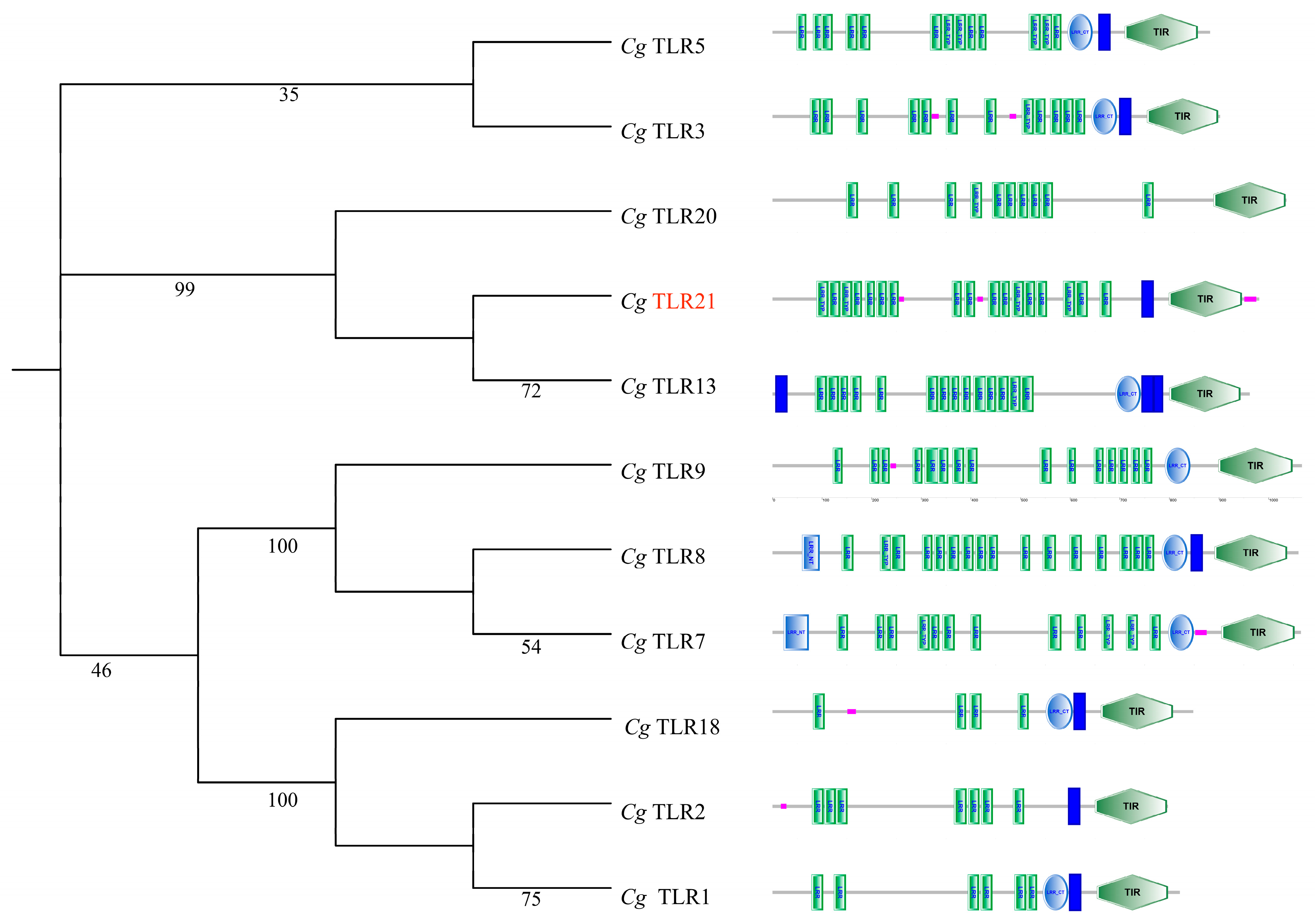
The phylogenetic relationships of various TLR proteins from Cg are summarized in Figure 1, with bootstrap values for the support of each clade. CgTLR21 is placed as a distinct protein, supported by a bootstrap value of 99. Other TLR proteins, such as CgTLR5, 3, 20, 13, 9, 8, 7, 18, 2, and 1, form separate branches, with bootstrap values ranging from 35 to 100. CgTLR21 is highlighted in orange to emphasize its importance for this study.
Additionally, the domain structures of these TLR proteins are displayed next to the phylogenetic tree (Figure 1), revealing conserved LRR and TIR domains across these TLRs, although some variations in domain organization are noted, particularly in those with low bootstrap support. Our results highlight TLR21 as a distinct and well-supported member of the TLR family, but its domain structure is generally consistent with the other TLRs.

3.3. Absence of TLR21 in the Glass Catfish Genome: Validated by Genomic Collinerity

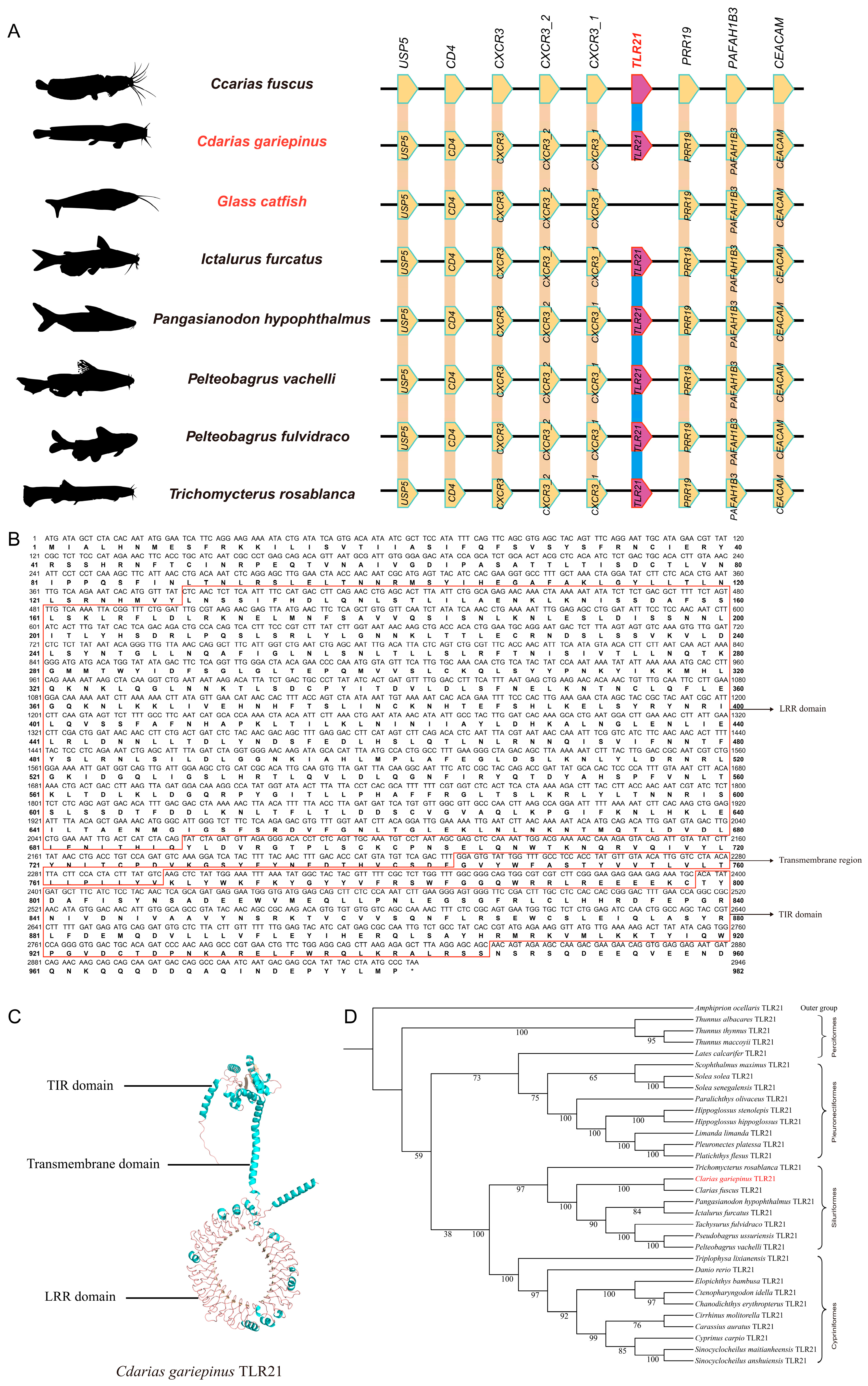
Having identified the TLR gene repertoire in the target genomes, we next examined syntenic conservation to validate the presence or absence of TLR21 at the corresponding locus. We systematically examined ten neighboring genes (including USP5, CD4, CXCR3, CXCR3_2, CXCR3_1, CNFN, TLR21, PRR19, PAFAH1B3, and CEACAM) across eight siluriform species (Figure 2A). Our results demonstrate that the TLR21 gene is consistently present in all examined species except the glass catfish. That is to say, other seven species retain an intact TLR21 gene, while the glass catfish is the only one lacking this gene. The nine neighboring genes as the controls were detected with complete sequences in all the eight species, forming a distinct “present-in-all-absent-in-one” distribution pattern.
The complete coding sequence of the CgTLR21 gene and the domain architecture of its encoded protein are shown in Figure 2B. As expected, this TLR protein contains three characteristic domains, including an extracellular LRR domain and an intracellular TIR domain (Figure 2C).
After the synteny evidence supported the lineage specific loss of TLR21 in the glass catfish, we further conducted phylogenetic analyses to resolve the phylogenetic relationships of TLR21 across teleost species. In the phylogenetic tree (Figure 2D), evolutionary relationships of the TLR21 gene across fish species (without Kv) demonstrate its high conservation. These species in the tree are grouped into four major orders: Perciformes, Pleuronectiformes, Siluriformes, and Cypriniformes. Within these orders, the TLR21 gene exhibits high conservative phylogeny across the examined species (without the glass catfish). The sampled fishes in Perciformes (Thunnus albacares, Thunnus maccoyii and Scophthalmus maximus), as well as those in Pleuronectiformes (representative Platichthys flesus and Pleuronectes platessa), all show similar TLR21 nucleotide sequences. In Siluriformes, Cg forms a branch with other species like Pangasianodon hypophthalmus and Ictalurus furcatus, indicating a high level of the TLR21 gene homology. In Cypriniformes, selected species such as Cyprinus carpio and Carassius auratus also show a high degree of conservation in the TLR21 gene. Overall, the evolution of the TLR21 gene in various fishes is highly conserved, while it is absent in the genome of the transparent glass catfish.

3.4. Binding Stability Differences Between CgTLR21 and Various CpG ODN Molecules for the Influence of Sequence Specificity

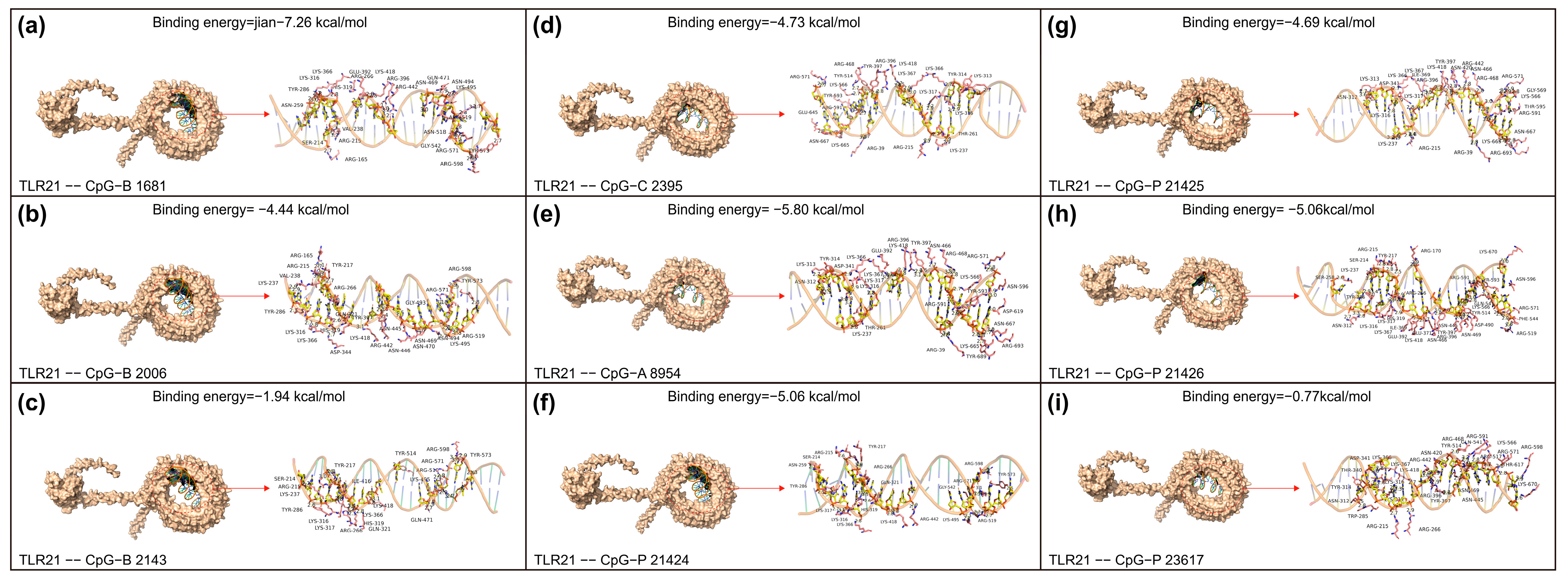
With synteny analyses clarifying the conserved genomic context and the loss pattern, we then performed molecular docking to evaluate potential differences in binding between CgTLR21 and various CpG ODNs. Molecular docking revealed significant differences in binding stability among nine distinct types of CpG ODN with the CgTLR21 receptor (Figure 3). Binding energy data showed a continuous distribution in interaction strength between the ligands and the target receptor. Among them, CpG-B 1681 demonstrated the strongest binding capacity (binding energy: −7.26 kcal/mol), with its absolute value significantly higher than other molecules, suggesting that this complex may form the most stable binding conformation. Meanwhile, CpG-A 8954 (−5.80 kcal/mol) and CpG-P 21,426 (−5.06 kcal/mol) exhibited moderately high binding stability.
Notably, significant differences were also observed within the same type of CpG molecules. For instance, in the CpG-B series, the binding energy difference between no. 1681 and no. 2006 (−4.44 kcal/mol) or no. 2143 (−1.94 kcal/mol) reached 5.32 kcal/mol, indicating that sequence specificity may have a greater impact on binding stability than type differences. Particular attention should be paid to CpG-P 23,617 (−0.77 kcal/mol) and CpG-B 2143 (−1.94 kcal/mol), as their relatively high binding energy suggest potential unfavorable factors in their binding conformations with CgTLR21, such as steric hindrance or electrostatic repulsion [46]. We should note that, in the absence of experimental validation (cell-based activation assays), the docking results would be hypothesis-generating without definitive evidence of functional divergence.

3.5. Absence of TLR1 in Another Transparent Fish: The X-Ray Tetra

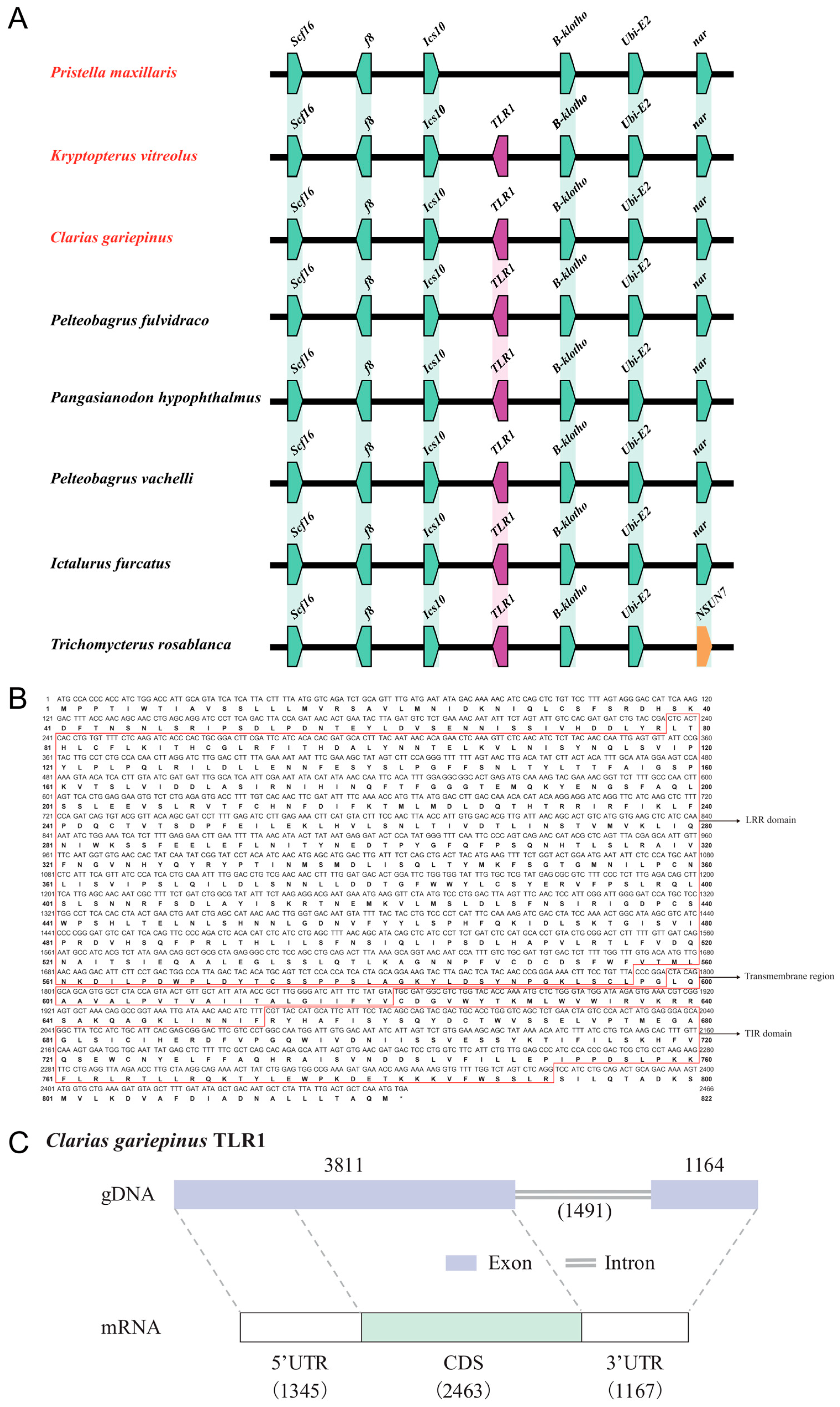
Synteny analysis revealed that the TLR1 locus and its flanking paralogous gene blocks (containing Ics10, f8, Scf16, B-klotho, Ubi-E2, and nar) are highly conserved in order and orientation among six examined fish species, including Cg, Kv, Pelteobagrus fulvidraco, Pangasianodon hypophthalmus, Pelteobagrus vachelli, Ictalurus furcatus, and Trichomycterus rosablanca. However, in the corresponding genomic region of the X-ray tetra (Pm), although the same conserved neighboring gene blocks are present in an identical arrangement, the TLR1 gene is absent within this block (Figure 4A).
The nucleotide sequence of the CgTLR1 gene and its deduced amino acid sequence are provided (Figure 4B). The ORF is approximately 2466 bp in length and encodes a protein of 821 amino acids. The protein sequence can be clearly categorized into the typical structural features, including an N-terminal extracellular domain containing multiple LRRs (responsible for ligand recognition) and a single transmembrane region that anchors the receptor in the cell membrane, as well as a C-terminal intracellular TIR domain that interacts with downstream proteins and mediates signal transduction. The overall structure indicates that CgTLR1 possesses the characteristic features of a transmembrane pattern-recognition receptor, providing a sequence basis for subsequent functional studies.
In Figure 4C, genomic and transcript structures of the CgTLR1 gene are summarized. At the genomic DNA (gDNA) level, the gene consists of two exons (3811 and 1164 bp respectively) and one intron (1491 bp in length); at the mRNA level, the transcript contains a 5′UTR, a coding sequence (CDS), and a 3′UTR, with lengths of 1345, 2463, and 1167 bp, respectively.

4. Discussion

Among all examined species in this study, TLR genes other than TLR21 were ubiquitously present (Table 2) and evolutionarily conserved (Figure 1), demonstrating their essential and non-redundant functions in both immunological and fundamental physiological processes of various siluriform fishes. Our current study, through comparative genomic analysis, has systematically revealed for the first time the unique evolutionary pattern of the TLR gene family in the glass catfish, characterized by “gene number reduction coupled with domain expansion”. That is to say, while consistently detected in seven siluriform species, it was specifically and completely absent in the glass catfish (Figure 2A), which confirms a lineage-specific gene loss event for KvTLR21.
From an evolutionary perspective, the absence of KvTLR21, a key pattern recognition receptor for microbial DNA detection [47], may represent an adaptive reorganization of the immune system during the evolution of the transparent glass catfish. This species may compensate for the loss by upregulating alternative receptors (such as genomic expansion of TLR9) or signaling pathways to maintain its pathogen defense capabilities [48,49]. The predicted binding energy (kcal/mol) from docking is typically a negative value, with a range between −5 and −9 that are generally considered indicative of stable binding. Within this range, any value close to −9 (with a larger absolute magnitude) usually imply stronger predicted binding and formation of a more stable complex [50].
The molecular docking results in this study showed significant sequence-specific differences in the binding stability of CgTLR21 to different CpG ODNs (Figure 3), indicating that even in many species in which this gene is present, its function has become highly specialized. Specifically, the lowest binding energy of CpG-B 1681 suggests a more stable receptor–ligand complex, which may translate into more efficient CpG-DNA recognition and potentially stronger downstream activation of TLR21-mediated innate immune signaling.
By completely losing TLR21, the glass catfish may have fundamentally restructured its pathogen recognition network [51] to reduce the metabolic cost of immunity and adapt to its unique ecological niche. Meanwhile, this study identified absence of the TLR1 gene in another transparent fish species, the X-ray tetra, within a conserved genomic block (Figure 4A). Interestingly, although binding to different ligands, both TLR21 and TLR1 activate the immune system through the same downstream MyD88-dependent signaling pathway [26,27,52,53]. In summary, these observations raise a working hypothesis that the evolution of transparent phenotypes may be associated with lineage-specific loss of certain TLR gene(s); however, alternative explanations, such as neutral gene loss, relaxed selection, or other ecological factors could also produce similar patterns. In the future, broader comparative genomic sampling across more species, tests of selective pressure (dN/dS), and expression and functional validation of key genes will help distinguish among these possibilities. This association may stem from fundamental changes in the immune microenvironment caused by the transparent body wall (such as increased UV exposure and higher rates of direct pathogen contact), thereby driving targeted remodeling of the immune recognition system. A transparent phenotype may increase internal light/UV penetration, which could influence skin and mucosal barrier integrity, microbiome composition, and exposure to environmental stressors and pathogens, thereby potentially imposing distinct selective pressures on innate immune sensing pathways. In this study, we observed lineage-specific loss of different TLR genes in various transparent fishes, such as TLR21 in the glass catfish whereas TLR1 in the X-ray tetra. These interesting findings suggest that transparent fishes may have experienced clade-specific remodeling of TLR repertoires, reflecting potential adaptation to altered ecological conditions.
From an evolutionary standpoint, gene loss is often regarded as an important adaptive evolutionary strategy [54]. The loss of TLR21 in the glass catfish occurred after its divergence from its relative Clarias gariepinus (Figure 2D), and the high conservation of flanking gene synteny (Figure 2A) strongly supports that this was a secondary loss event in evolutionary history. Combined with the significant domain expansion observed in several TLR proteins (such as TLR5, 7, and 20) in this study (Figure 1), and based on the observed differences in the TLR gene copy number and domain composition, it is possible that this normal (non-transparent) reference species exhibits a distinct genomic configuration of the TLR repertoire; however, any functional optimization or increased functional complexity remains a hypothesis in the absence of empirical validation [55]. In our results, KvTLR5, KvTLR7, and KvTLR20 show pronounced sequence/structural expansion, which may reflect functional adaptation to broaden or modify pathogen-recognition capacity in the absence of TLR21.
The lineage-specific evolutionary patterns of immune genes identified in this study extend beyond genomics into ecological and practical dimensions. Ecologically, the loss of key recognition genes such as TLR21 may reflect adaptive responses to the specific habitats of the glass catfish, offering a model for understanding immune remodeling under environmental selection. From a societal perspective, as an important ornamental species, elucidating these immune adaptations can directly inform strategies to improve disease prevention and animal welfare in the aquarium trade, thereby reducing industry losses. Looking forward, the molecular mechanisms revealed here (such as CpG-ODN binding specificity) hold translational potential for predicting species responses to environmental change and emerging pathogens, and they also support rational design of immunostimulants or adjuvants for broader teleost aquaculture, which may contribute to the sustainable development of the fishery industry.

5. Conclusions

Through systematic genomics comparisons, synteny analysis, and molecular docking, this study has, for the first time, confirmed the specific loss of the TLR21 gene in the transparent glass catfish. Our results revealed a unique evolutionary pattern in the TLR family, characterized by simultaneous gene loss (especially KvTLR21) and domain expansion (for TLR5, 7, and 20). Combined with the case of TLR1 loss in another transparent fish species, the X-ray tetra, these results indicate that transparent fish may commonly utilize the loss of specific TLR gene(s) as an important way for adaptive evolution of the immune system, a process likely driven by their unique physiological traits (such as transparency). The practical role of gene loss, such as TLR21 in Kv or TLR1 in Pm, requires further investigation. Future studies may functionally validate these findings by using CRISPR/Cas9-mediated loss-of-function experiments targeting TLR21 and other retained TLRs, as well as by assessing downstream immune responses to CpG ODN stimulation and pathogen challenge. These interesting findings provide a key candidate for improving our understanding of the adaptive evolution of vertebrate immune gene families and lay a theoretical foundation for the in-depth exploration of the molecular links between physiological specialization and immune adaptation in transparent vertebrates, including fish.

Author Contributions

Conceptualization, S.G. and Q.S.; methodology, S.G. and X.Z.; software, S.G. and K.Z.; validation, S.G., J.C. (Jianchao Chen) and Z.W.; formal analysis, S.G. and J.C. (Jieming Chen); investigation, S.G. and Q.S.; resources, Q.S. and C.B.; data curation, S.G., R.Z., and Y.L.; writing—original draft preparation, S.G.; writing—review and editing, Q.S. and C.B.; visualization, S.G.; supervision, Q.S. and C.B.; project administration, S.G.; funding acquisition, Q.S. All authors have read and agreed to the published version of the manuscript.

Funding

This research was financially supported by the Shenzhen Natural Science Foundation (Grant no. JCYJ20241202124511016).

Institutional Review Board Statement

This study was conducted in accordance with the Declaration of Helsinki and approved by the Ethics Committee of Neijiang Normal University (protocol code SK2406; approved on 20 April 2024).

Informed Consent Statement

Not applicable.

Data Availability Statement

The original contributions presented in this study are included in the article. Further inquiries can be directed to the corresponding authors.

Conflicts of Interest

The authors declare no conflicts of interest.

References

  1. Bian, C.; Li, R.H.; Ruan, Z.Q.; Chen, W.T.; Huang, Y.; Liu, L.Y.; Zhou, H.L.; Chong, C.M.; Mu, X.D.; Shi, Q. Chromosome-level genome assembly of the glass catfish (Kryptopterus vitreolus) reveals molecular clues to its transparent phenotype. Zool. Res. 2024, 45, 1027–1036. [Google Scholar] [CrossRef] [PubMed]
  2. Vitule, J.R.S.; Umbria, S.C.; Aranha, J.M.R. Introduction of the African catfish Clarias gariepinus (BURCHELL, 1822) into Southern Brazil. Biol. Invasions 2006, 8, 677–681. [Google Scholar] [CrossRef]
  3. Nguinkal, J.A.; Zoclanclounon, Y.A.B.; Brunner, R.M.; Chen, Y.; Goldammer, T. Haplotype-resolved and near-T2T genome assembly of the African catfish (Clarias gariepinus). Sci. Data 2024, 11, 1095. [Google Scholar] [CrossRef] [PubMed]
  4. Buchmann, K. Evolution of innate immunity: Clues from invertebrates via fish to mammals. Front. Immunol. 2014, 5, 459. [Google Scholar] [CrossRef]
  5. Franchi, L.; McDonald, C.; Kanneganti, T.-D.; Amer, A.; Núñez, G. Nucleotide-binding oligomerization domain-like receptors: Intracellular pattern recognition molecules for pathogen detection and host defense. J. Immunol. 2006, 177, 3507–3513. [Google Scholar] [CrossRef]
  6. Sundaram, A.Y.; Kiron, V.; Dopazo, J.; Fernandes, J.M. Diversification of the expanded teleost-specific toll-like receptor family in Atlantic cod, Gadus morhua. BMC Evol. Biol. 2012, 12, 256. [Google Scholar] [CrossRef]
  7. Liu, G.; Zhang, H.; Zhao, C.; Zhang, H. Evolutionary history of the toll-like receptor gene family across vertebrates. Genome Biol. Evol. 2019, 12, 3615–3634. [Google Scholar] [CrossRef] [PubMed]
  8. Rebl, A.; Goldammer, T.; Seyfert, H.M. Toll-like receptor signaling in bony fish. Vet. Immunol. Immunopathol. 2010, 134, 139–150. [Google Scholar] [CrossRef]
  9. Mogensen, T.H. Pathogen recognition and inflammatory signaling in innate immune defenses. Clin. Microbiol. Rev. 2009, 22, 240–273. [Google Scholar] [CrossRef]
  10. Khan, I.; Maldonado, E.; Silva, L.; Almeida, D.; Johnson, W.E.; O’Brien, S.J.; Zhang, G.; Jarvis, E.D.; Thomas, M.; Antunes, A. The vertebrate TLR supergene family evolved dynamically by gene gain/loss and positive selection revealing a host-pathogen arms race in birds. Diversity 2019, 11, 131. [Google Scholar] [CrossRef]
  11. Li, S.; Wang, G.; Liu, D.; Liu, Q.; Hu, G. Cloning and expression analysis of a Toll-like receptor 21 (TLR21) gene from turbot, Scophthalmus maximus. Dev. Comp. Immunol. 2017, 73, 163–168. [Google Scholar] [CrossRef] [PubMed]
  12. Nie, L.; Cai, S.Y.; Shao, J.Z.; Chen, J. Toll-like receptors, associated biological roles, and signaling networks in non-mammals. Front. Immunol. 2018, 9, 1523. [Google Scholar] [CrossRef]
  13. Yeh, D.W.; Lai, C.Y.; Liu, Y.L.; Lu, C.H.; Tseng, P.H.; Yuh, C.H.; Yu, G.Y.; Liu, S.J.; Leng, C.H.; Chuang, T.H. CpG-oligodeoxynucleotides developed for grouper toll-like receptor (TLR) 21s effectively activate mouse and human TLR9s mediated immune responses. Sci. Rep. 2017, 7, 17297. [Google Scholar] [CrossRef]
  14. Poynter, S.; Lisser, G.; Monjo, A.; DeWitte-Orr, S. Sensors of infection: Viral nucleic acid PRRs in fish. Biology 2015, 4, 460–493. [Google Scholar] [CrossRef]
  15. Reyes-Becerril, M.; Ascencio-Valle, F.; Hirono, I.; Kondo, H.; Jirapongpairoj, W.; Esteban, M.A.; Alamillo, E.; Angulo, C. TLR21’s agonists in combination with Aeromonas antigens synergistically up-regulate functional TLR21 and cytokine gene expression in yellowtail leucocytes. Dev. Comp. Immunol. 2016, 61, 107–115. [Google Scholar] [CrossRef]
  16. Li, H.; Li, T.; Guo, Y.; Li, Y.; Zhang, Y.; Teng, N.; Zhang, F.; Yang, G. Molecular characterization and expression patterns of a non-mammalian toll-like receptor gene (TLR21) in larvae ontogeny of common carp (Cyprinus carpio L.) and upon immune stimulation. BMC Vet. Res. 2018, 14, 153. [Google Scholar] [CrossRef] [PubMed]
  17. Lee, P.T.; Zou, J.; Holland, J.W.; Martin, S.A.M.; Collet, B.; Kanellos, T.; Secombes, C.J. Identification and characterisation of TLR18-21 genes in Atlantic salmon (Salmo salar). Fish Shellfish Immunol. 2014, 41, 549–559. [Google Scholar] [CrossRef] [PubMed]
  18. Priyathilaka, T.T.; Elvitigala, D.A.S.; Whang, I.; Lim, B.S.; Jeong, H.B.; Yeo, S.Y.; Choi, C.Y.; Lee, J. Molecular characterization and transcriptional analysis of non-mammalian type Toll like receptor (TLR21) from rock bream (Oplegnathus fasciatus). Gene 2014, 553, 105–116. [Google Scholar] [CrossRef]
  19. Sun, R.; Yue, F.; Qiu, L.; Zhang, Y.; Wang, L.; Zhou, Z.; Zhang, H.; Yi, Q.; Song, L. The CpG ODNs enriched diets enhance the immuno-protection efficiency and growth rate of Chinese mitten crab, Eriocheir sinensis. Fish Shellfish Immunol. 2013, 35, 154–160. [Google Scholar] [CrossRef]
  20. Temperley, N.D.; Berlin, S.; Paton, I.R.; Griffin, D.K.; Burt, D.W. Evolution of the chicken Toll-like receptor gene family: A story of gene gain and gene loss. BMC Genom. 2008, 9, 62. [Google Scholar] [CrossRef]
  21. Yeh, D.W.; Liu, Y.L.; Lo, Y.C.; Yuh, C.H.; Yu, G.Y.; Lo, J.F.; Luo, Y.; Xiang, R.; Chuang, T.H. Toll-like receptor 9 and 21 have different ligand recognition profiles and cooperatively mediate activity of CpG-oligodeoxynucleotides in zebrafish. Proc. Natl. Acad. Sci. USA 2013, 110, 20711–20716. [Google Scholar] [CrossRef] [PubMed]
  22. Zhang, J.; Kong, X.; Zhou, C.; Li, L.; Nie, G.; Li, X. Toll-like receptor recognition of bacteria in fish: Ligand specificity and signal pathways. Fish Shellfish Immunol. 2014, 41, 380–388. [Google Scholar] [CrossRef]
  23. Ghani, M.U.; Chen, J.; Khosravi, Z.; Wu, Q.; Liu, Y.; Zhou, J.; Zhong, L.; Cui, H. Unveiling the multifaceted role of toll-like receptors in immunity of aquatic animals: Pioneering strategies for disease management. Front. Immunol. 2024, 15, 1378111. [Google Scholar] [CrossRef] [PubMed]
  24. Guo, S.; Gao, W.; Zeng, M.; Liu, F.; Yang, Q.; Chen, L.; Wang, Z.; Jin, Y.; Xiang, P.; Chen, H.; et al. Characterization of TLR1 and expression profiling of TLR signaling pathway related genes in response to Aeromonas hydrophila challenge in hybrid yellow catfish (Pelteobagrus fulvidraco ♀ × P. vachelli ♂). Front. Immunol. 2023, 14, 1163781. [Google Scholar] [CrossRef] [PubMed]
  25. Scheenstra, M.R.; van Harten, R.M.; Veldhuizen, E.J.A.; Haagsman, H.P.; Coorens, M. Cathelicidins modulate TLR-activation and inflammation. Front. Immunol. 2020, 11, 1137. [Google Scholar] [CrossRef]
  26. Yu, J.; Liu, X.; Yang, N.; Wang, B.; Su, B.; Fu, Q.; Zhang, M.; Tan, F.; Li, C. Characterization of toll-like receptor 1 (TLR1) in turbot (Scophthalmus maximus L.). Fish Shellfish Immunol. 2021, 115, 27–34. [Google Scholar] [CrossRef]
  27. Zhang, X.T.; Zhang, G.R.; Shi, Z.C.; Yuan, Y.J.; Zheng, H.; Lin, L.; Wei, K.J.; Ji, W. Expression analysis of nine Toll-like receptors in yellow catfish (Pelteobagrus fulvidraco) responding to Aeromonas hydrophila challenge. Fish Shellfish Immunol. 2017, 63, 384–393. [Google Scholar] [CrossRef]
  28. Lai, C.Y.; Yu, G.Y.; Luo, Y.; Xiang, R.; Chuang, T.H. Immunostimulatory activities of CpG-oligodeoxynucleotides in teleosts: Toll-like receptors 9 and 21. Front. Immunol. 2019, 10, 179. [Google Scholar] [CrossRef]
  29. Gao, S.; Xu, T.; Qiao, R.; Lu, J.; Xu, Y.; Hu, S.; Wei, Y.; Qi, Z. Two non-mammalian toll-like receptors (TLR21 and TLR22) from golden pompano (Trachinotus ovatus): Molecular cloning, gene characterization and expression analysis. Aquac. Rep. 2021, 21, 100912. [Google Scholar] [CrossRef]
  30. Mahram, A.; Herbordt, M.C. NCBI BLASTP on high-performance reconfigurable computing systems. ACM Trans. Reconfigurable Technol. Syst. 2015, 7, 2629691. [Google Scholar] [CrossRef]
  31. Gerts, E.M.; Yu, Y.K.; Agarwala, R.; Schäffer, A.A.; Altschul, S.F. Composition-based statistics and translated nucleotide searches: Improving the TBLASTN module of BLAST. BMC Biol. 2006, 4, 41. [Google Scholar] [CrossRef] [PubMed]
  32. Letunic, I.; Doerks, T.; Bork, P. SMART: Recent updates, new developments and status in 2015. Nucleic Acids Res. 2015, 43, D257–D260. [Google Scholar] [CrossRef] [PubMed]
  33. Mistry, J.; Chuguransky, S.; Williams, L.; Qureshi, M.; Salazar, G.A.; Sonnhammer, E.L.L.; Tosatto, S.C.E.; Paladin, L.; Raj, S.; Richardson, L.J.; et al. Pfam: The protein families database in 2021. Nucleic Acids Res. 2021, 49, D412–D419. [Google Scholar] [CrossRef]
  34. Jones, P.; Binns, D.; Chang, H.Y.; Fraser, M.; Li, W.; McAnulla, C.; McWilliam, H.; Maslen, J.; Mitchell, A.; Nuka, G.; et al. InterProScan 5: Genome-scale protein function classification. Bioinformatics 2014, 30, 1236–1240. [Google Scholar] [CrossRef]
  35. Chen, Y.; Ye, W.; Zhang, Y.; Xu, Y. High speed BLASTN: An accelerated MegaBLAST search tool. Nucleic Acids Res. 2015, 43, 7762–7768. [Google Scholar] [CrossRef]
  36. Katoh, K.; Misawa, K.; Kuma, K.I.; Miyata, T. MAFFT: A novel method for rapid multiple sequence alignment based on fast Fourier transform. Nucleic Acids Res. 2002, 30, 3059–3066. [Google Scholar] [CrossRef] [PubMed]
  37. Nguyen, L.T.; Schmidt, H.A.; Von Haeseler, A.; Minh, B.Q. IQ-TREE: A fast and effective stochastic algorithm for estimating maximum-likelihood phylogenies. Mol. Biol. Evol. 2015, 32, 268–274. [Google Scholar] [CrossRef]
  38. Kalyaanamoorthy, S.; Minh, B.Q.; Wong, T.K.F.; Von Haeseler, A.; Jermiin, L.S. ModelFinder: Fast model selection for accurate phylogenetic estimates. Nat. Methods 2017, 14, 587–589. [Google Scholar] [CrossRef]
  39. van de Schoot, R.; Depaoli, S.; King, R.; Kramer, B.; Märtens, K.; Tadesse, M.G.; Vannucci, M.; Gelman, A.; Veen, D.; Willemsen, J.; et al. Bayesian statistics and modelling. Nat. Rev. Methods Prim. 2021, 1, 1. [Google Scholar] [CrossRef]
  40. Chen, C.; Chen, H.; Zhang, Y.; Thomas, H.R.; Frank, M.H.; He, Y.; Xia, R. TBtools: An integrative toolkit developed for interactive analyses of big biological data. Mol. Plant 2020, 13, 1194–1202. [Google Scholar] [CrossRef]
  41. Waterhouse, A.; Bertoni, M.; Bienert, S.; Studer, G.; Tauriello, G.; Gumienny, R.; Heer, F.T.; De Beer, T.A.P.; Rempfer, C.; Bordoli, L.; et al. SWISS-MODEL: Homology modelling of protein structures and complexes. Nucleic Acids Res. 2018, 46, W296–W303. [Google Scholar] [CrossRef] [PubMed]
  42. Hu, F.; Wang, Y.; Hu, J.; Bao, Z.; Wang, M. Comparative study of the impact of dietary supplementation with different types of CpG oligodeoxynucleotides (CpG ODNs) on enhancing intestinal microbiota diversity, antioxidant capacity, and immune-related gene expression profiles in Pacific white shrimp. Front. Immunol. 2023, 14, 1190590. [Google Scholar] [CrossRef] [PubMed]
  43. Erickson, C.B.; Ankenman, B.E.; Sanchez, S.M. Comparison of Gaussian process modeling software. Eur. J. Oper. Res. 2018, 266, 179–192. [Google Scholar] [CrossRef]
  44. Forli, S.; Huey, R.; Pique, M.E.; Sanner, M.F.; Goodsell, D.S.; Olson, A.J. Computational protein-ligand docking and virtual drug screening with the AutoDock suite. Nat. Protoc. 2016, 11, 905–919. [Google Scholar] [CrossRef]
  45. Ye, J.; McGinnis, S.; Madden, T.L. BLAST: Improvements for better sequence analysis. Nucleic Acids Res. 2006, 34, W6–W9. [Google Scholar] [CrossRef]
  46. Luque, I.; Freire, E. Structural stability of binding sites: Consequences for binding affinity and allosteric effects. Proteins 2000, 41, 63–71. [Google Scholar] [CrossRef]
  47. Brownlie, R.; Zhu, J.; Allan, B.; Mutwiri, G.K.; Babiuk, L.A.; Potter, A.; Griebel, P. Chicken TLR21 acts as a functional homologue to mammalian TLR9 in the recognition of CpG oligodeoxynucleotides. Mol. Immunol. 2009, 46, 3163–3170. [Google Scholar] [CrossRef]
  48. Chuang, Y.C.; Tseng, J.C.; Yang, J.X.; Liu, Y.L.; Yeh, D.W.; Lai, C.Y.; Yu, G.Y.; Hsu, L.C.; Huang, C.M.; Chuang, T.H. Toll-like receptor 21 of chicken and duck recognize a broad array of immunostimulatory cpg-oligodeoxynucleotide sequences. Vaccines 2020, 8, 639. [Google Scholar] [CrossRef]
  49. Iliev, D.B.; Skjæveland, I.; Jørgensen, J.B. CpG oligonucleotides bind TLR9 and RRM-Containing proteins in Atlantic Salmon (Salmo salar). BMC Immunol. 2013, 14, 12. [Google Scholar] [CrossRef]
  50. Madaniyah, L.; Fiddaroini, S.; Hayati, E.K.; Rahman, M.F.; Sabarudin, A. Biosynthesis, characterization, and in-vitro anticancer effect of plant-mediated silver nanoparticles using Acalypha indica Linn: In-silico approach. OpenNano 2025, 21, 100220. [Google Scholar] [CrossRef]
  51. Gao, L.; He, C.; Liu, X.; Su, H.; Gao, X.; Li, Y.; Liu, W. The innate immune-related genes in catfish. Int. J. Mol. Sci. 2012, 13, 14172–14202. [Google Scholar] [CrossRef]
  52. Gao, F.; Dong, J.; Li, J.; Zhu, Z.; Zhang, H.; Sun, C.; Ye, X. TLR21 is involved in the NF-κB and IFN-β pathways in largemouth bass (Micropterus salmoides) and interacts with TRIF but not with the Myd88 adaptor. Fish Shellfish Immunol. 2024, 151, 109734. [Google Scholar] [CrossRef]
  53. Mahapatra, S.; Ganguly, B.; Pani, S.; Jena, N.; Bej, A.; Saha, A.; Samanta, M. Toll-like receptor 21 in Labeo rohita recognizes double-stranded RNA and lipopolysaccharides by engaging the critical motifs in the LRR domain and gets activated against bacterial assaults. Biochem. Biophys. Res. Commun. 2024, 739, 150581. [Google Scholar] [CrossRef] [PubMed]
  54. Helsen, J.; Voordeckers, K.; Vanderwaeren, L.; Santermans, T.; Tsontaki, M.; Verstrepen, K.J.; Jelier, R. Gene loss predictably drives evolutionary adaptation. Mol. Biol. Evol. 2020, 37, 2989–3002. [Google Scholar] [CrossRef] [PubMed]
  55. Monteiro, F.; Nishimura, M.T. Structural, functional, and genomic diversity of plant NLR proteins: An evolved resource for rational engineering of plant immunity. Annu. Rev. Phytopathol. 2018, 56, 243–267. [Google Scholar] [CrossRef] [PubMed]
Figure 1. Phylogenetic tree (left) and domain architecture (right) of TLRs from Clarias gariepinus (Cg). These proteins, encoded by various TLR genes, consist of multiple domains, including a signal peptide, an extracellular LRR region (including LRR-N-terminal, central LRR, and LRR-C-terminal segments), a transmembrane (TM) domain, and a TIR domain. In the right panel, the TM domain is shown in dark blue, low-complexity regions are highlighted in pink, and other domains, such as LRR and TIR, are labeled separately.
Biology 15 00263 g001
Figure 2. Absence of TLR21 in the glass catfish genome: validated by genomic collinearity. (A) Conserved synteny surrounding TLR21 across representative fish genomes, showing adjacent genes and the relative position of TLR21. (B) Nucleotide sequence and deduced amino acid sequence of CgTLR21, with annotated LRR domain, transmembrane region, and TIR domain. (C) Predicted protein structure of CgTLR21, highlighting the LRR, transmembrane, and TIR regions. (D) Phylogenetic analysis of fish TLR21 proteins, showing the four major clades (Perciformes, Pleuronectiformes, Siluriformes, Cypriniformes) with high bootstrap support values. Amphiprion ocellaris (common clownfish) is used as the outgroup. The TLR21 from the glass catfish is not included in this phylogenetic tree due to its absence in the genome, and therefore no corresponding TLR21 branch is present for comparison. “*” indicates a stop codon.
Biology 15 00263 g002
Figure 3. Group docking of CgTLR21 with the common CpG ODNs from representative fishes and mammals. Docking poses are shown as a 3D surface view of the TLR21–CpG complex (left) and the corresponding 2D interaction map (right), with predicted binding energies (kcal/mol) indicated above each panel. (a) TLR21–CpG-B 1681 (−7.26). (b) TLR21–CpG-B 2006 (−4.44). (c) TLR21–CpG-B 2143 (−1.94). (d) TLR21–CpG-C 2395 (−4.73). (e) TLR21–CpG-A 8954 (−5.80). (f) TLR21–CpG-P 21,424 (−5.06). (g) TLR21–CpG-P 21,425 (−4.69). (h) TLR21–CpG-P 21,426 (−5.06). (i) TLR21–CpG-P 23,617 (−0.77).
Biology 15 00263 g003
Figure 4. Absence of TLR1 in another transparent fish, the X-ray tetra (Pristella maxillaris). (A) Conserved synteny (gene neighborhood) of TLR1 across representative teleost genomes, showing the relative position of TLR1 and flanking genes. (B) Nucleotide sequence and deduced amino acid sequence of CgTLR1, with annotated LRR domain, transmembrane region, and TIR domain. (C) Gene structure of CgTLR1, illustrating gDNA and mRNA organization, exon–intron architecture, and the lengths of the 5′ UTR, CDS, and 3′ UTR, respectively. “*” indicates a stop codon.
Biology 15 00263 g004
Table 1. Genetic resources of the downloaded genome assemblies and TLR genes.
Species NameData Acquisition LinkAccession Number
Clarias fuscushttps://figshare.com/articles/dataset/Genome_assembly_and_annotation_information_of_female_i_Clarias_fuscus_i_/26968489, (accessed on 20 July 2024)GCA_046453815.1
C. gariepinushttps://ftp.ncbi.nlm.nih.gov/genomes/all/GCF/024/256/425/GCF_024256425.1_CGAR_prim_01v2/, (accessed on 20 July 2024)GCA_024256425.2
K. vitreolushttps://figshare.com/articles/dataset/_b_A_telomere-to-telomere_chromosome-level_genome_of_glass_catfish_b_b_i_Kryptopterus_vitreolus_i_b_/28333385?file=52098524, (accessed on 20 July 2024)GCA_044706155.1
Ictalurus furcatushttps://ftp.ncbi.nlm.nih.gov/genomes/all/GCF/023/375/685/GCF_023375685.1_Billie_1.0/, (accessed on 20 July 2024)GCA_023375685.2
Pristella maxillarishttps://figshare.com/articles/dataset/The_genome_and_annotation_of_i_Pristella_maxillaris_i_/27901167?file=50813691, (accessed on 20 July 2024)GCA_045781885.1
Pangasianodon hypophthalmushttps://ftp.ncbi.nlm.nih.gov/genomes/all/GCF/027/358/585/GCF_027358585.1_fPanHyp1.pri/, (accessed on 20 July 2024)GCA_027358585.1
Pelteobagrus vachellihttps://www.ncbi.nlm.nih.gov/datasets/genome/GCF_030014155.1/, (accessed on 20 July 2024)GCF_030014155.1
Tachysurus fulvidracohttps://ftp.ncbi.nlm.nih.gov/genomes/all/GCF/022/655/615/GCF_022655615.1_HZAU_PFXX_2.0/, (accessed on 20 July 2024)GCF_003724035.1
Trichomycterus rosablancahttps://ftp.ncbi.nlm.nih.gov/genomes/all/GCF/030/014/385/GCF_030014385.1_fTriRos1.hap1/, (accessed on 20 July 2024)GCA_030014385.1
Table 2. Genome-wide identification of TLR genes in the assembled genome of the glass catfish (Kv) and its relative, the North African catfish (Cg).
Gene
Name
Full Length
(bp) *
ORF
(bp) **
Protein
Accession
Number
Deduced
Protein
(aa)
Molecular
Weight
(kDa)
Genomic Position
CgTLR 164662466XP_053364231.182193.9NC_071111.1: 12160120-12166586
CgTLR 263322394XP_053332572.179792.4NC_071117.1: 29015012-29021344
CgTLR 389182709XP_053336254.1902103.6NC_071119.1: 3523259-3532177
CgTLR 598852469XP_053370797.1822101.1NC_071115.1: 4460271-4470156
CgTLR 739673198XP_053353400.11065122.8NC_071104.1: 1013192-1017159
CgTLR 879513183XP_053353401.11060123.3NC_071104.1: 1004099-1012050
CgTLR 975013204XP_053360697.11067122.6NC_071108.1: 24685621-24693122
CgTLR 1370192973XP_053349846.1990114.1NC_071103.1: 10385652-10392671
CgTLR 1856232547XP_053350949.184897.8NC_071103.1: 18566052-18571675
CgTLR 2031993081XP_053358352.11036117.8NC_071107.1: 35684746-35687945
CgTLR 2130112946XP_053350396.1981113.4NC_071103.1: 13158780-13161791
KvTLR159132487augustus-scaffold_3-processed-gene-19.39-mRNA-182894.7scaffold_3:5864176-5870089
KvTLR296702403augustus-scaffold_22-processed-gene-1.25-mRNA-180092.0scaffold_22:438534-448204
KvTLR354442694maker-scaffold_16-augustus-gene-63.31-mRNA-1897102.0scaffold_16:19107590-19113034
KvTLR530,8557032augustus-scaffold_12-processed-gene-67.15-mRNA-12343264.9scaffold_12:20183769-20214654
KvTLR725,8558322augustus-scaffold_6-processed-gene-88.9-mRNA-12773313.7scaffold_6:26546654-26572509
KvTLR911,6501572augustus-scaffold_1-processed-gene-32.2-mRNA-152359.4scaffold_1:9564569-9576219
KvTLR1328822883augustus-scaffold_27-processed-gene-40.16-mRNA-1960108.4scaffold_27:12131308-12134190
KvTLR2032,5614299augustus-scaffold_29-processed-gene-7.0-mRNA-11432163.5scaffold_29:2071883-2104444
* Full length (bp) refers to the full-length gene sequence including untranslated regions (UTRs), whereas ** ORF (bp) indicates the coding sequence (CDS) only.
Disclaimer/Publisher’s Note: The statements, opinions and data contained in all publications are solely those of the individual author(s) and contributor(s) and not of MDPI and/or the editor(s). MDPI and/or the editor(s) disclaim responsibility for any injury to people or property resulting from any ideas, methods, instructions or products referred to in the content.