Beyond Conventional Transcriptional Regulation Function: FOXP3 as an Integrative Hub for Chromatin Interactions and Protein Complexes in Immune Regulation


Simple Summary
Abstract
1. Introduction
2. FOXP3 Evolution: Conserved Core, Adaptive Structure in Treg Function
3. FOXP3 Structure and Sequence Recognition Preference: Mechanisms in Dimeric/Multimeric Ensembles, DNA Bridging and Chromatin Interactions
3.1. Domain-Swapped Dimers: An Initial Characterized Structure for DNA Binding and Long-Range Chromatin Interactions
3.2. Head-to-Head Dimers: Defining the Physiological Structure and Unique Transcriptional Mechanism of FOXP3
3.3. Multimeric Ensembles: Ultrastable Complexes for Microsatellite Recognition and DNA Bridging
4. FOXP3-Mediated Dynamic Regulation of Treg Identity and Functional Plasticity: Coordination with Multiple Partners
5. Post-Translational Modifications of FOXP3: Regulation of Transcriptional Complexes Stability
6. Discussion
- (1)
- Unlike conventional lineage-defining regulators, FOXP3 itself does not substantially alter chromatin accessibility nor establish new enhancers. Instead, it defines Treg functionality by primarily exploiting the pre-existing epigenetic landscape established in precursor cells during differentiation [125,140].
- (2)
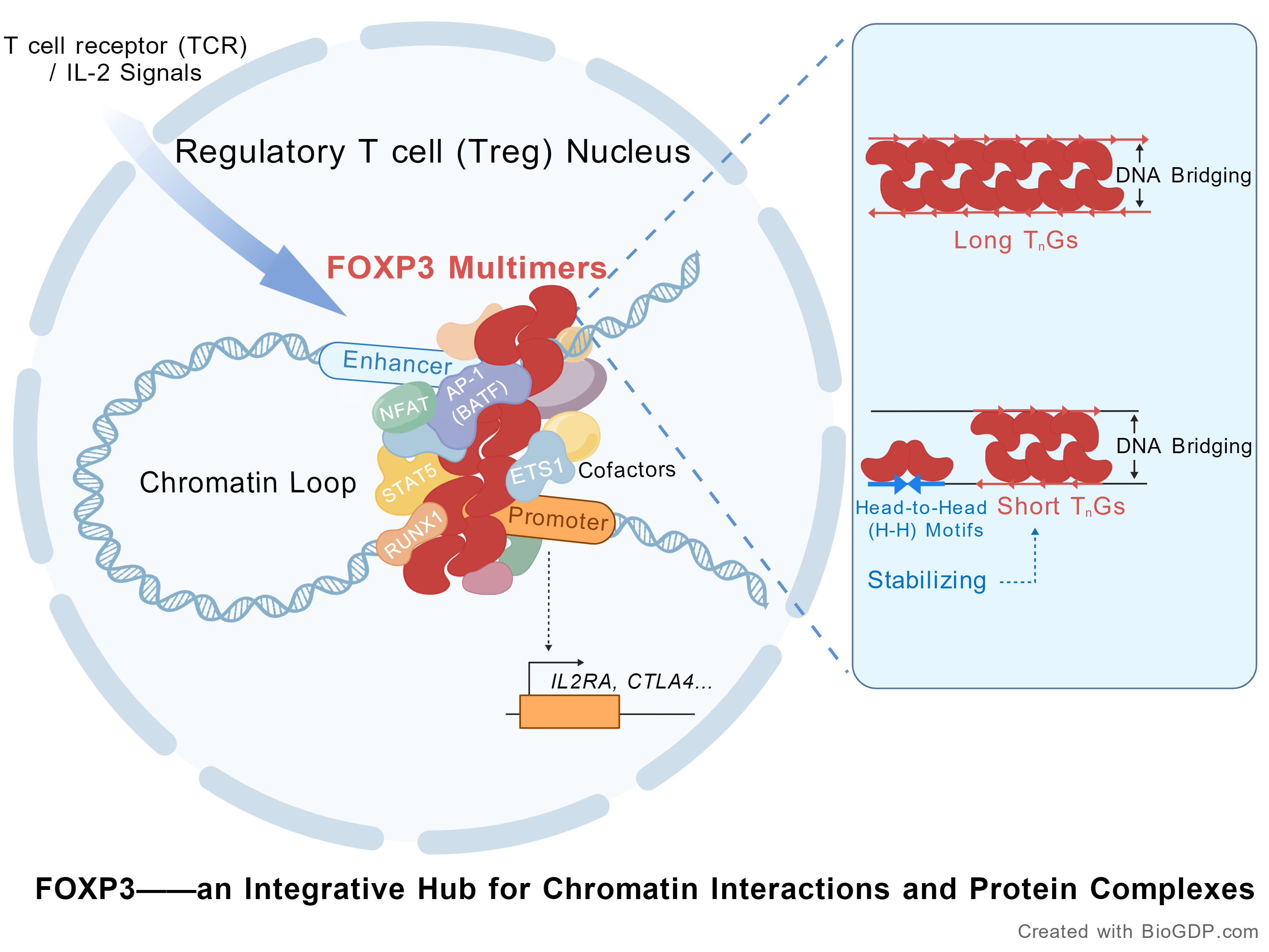
- FOXP3 exhibits unique DNA sequence recognition preferences and can form diverse multimeric structures. Unlike other FOX family members, which typically bind to the canonical FKHM [113], FOXP3 can adopt multiple distinct conformations to accommodate variable TnG sequences or H-H motifs, subsequently forming stable multimers that facilitate DNA bridging and the stabilization of chromatin loops [126,127,132]. Although not a pioneer transcription factor, FOXP3 can utilize nucleosomes to enhance its DNA target recognition. Specifically, nucleosome-mediated local DNA binding between two TnG repeats promotes FOXP3 multimer assembly. This represents a previously unrecognized interaction pattern between nucleosomes and non-pioneer transcription factors [127].
- (3)
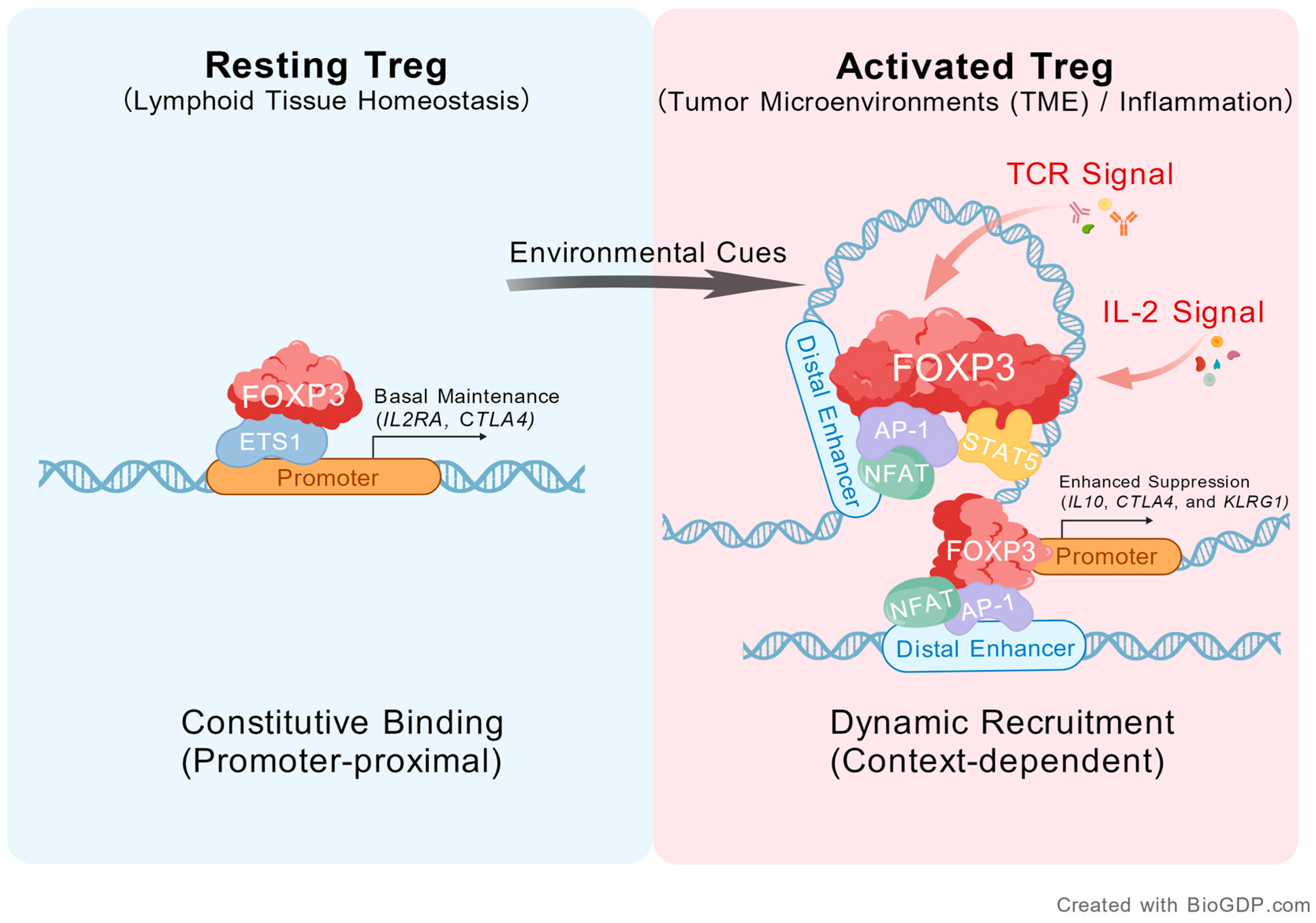
- Many genes previously considered to be regulated by FOXP3 are not its direct targets. In fact, FOXP3 does not have clearly defined direct target genes. Treg-specific transcriptomes are only partially dependent on FOXP3. FOXP3 is neither required nor adequate to determine Treg identity [12,13,32,33,34,35,36,37]. Downstream gene expression arising from FOXP3-chromatin interactions is context-dependent, dictated by environmental cues and the specific cooperative transcription factor interactions [45,134,165]. Consequently, FOXP3 functions primarily as a multimodal interaction hub (rather than a conventional direct-acting transcription factor), integrating environmental signals through interactions with diverse cofactors to dynamically regulate gene expression [37,45,68,133,134,135,163,164,165].
7. Conclusions
Author Contributions
Funding
Institutional Review Board Statement
Informed Consent Statement
Data Availability Statement
Acknowledgments
Conflicts of Interest
Abbreviations
| Tregs | Regulatory T cells |
| IPEX | Immune dysregulation, polyendocrinopathy, enteropathy, X-linked |
| Tconv | Conventional CD4+ T |
| APC | Antigen-presenting cell |
| IL-2R | IL-2 receptor |
| Th | T helper |
| FKH | Forkhead |
| CREs | Cis-regulatory elements |
| CNS | Conserved non-coding sequences |
| TCR | T cell receptor |
| TGF-βR | TGF-β receptor |
| TSDR | Treg-specific demethylated region |
| SCFAs | Short-chain fatty acids |
| HDAC | Histone deacetylase |
| NS- | Negative non-coding sequence |
| NS+ | Positive non-coding sequence |
| FOX | Forkhead box |
| ProR | Proline-rich region |
| ZF | Zinc finger |
| LZ | Leucine zipper |
| FOXP3-FL | Full-length FOXP3 |
| FOXP3-ΔE2 | Exon 2-deficient FOXP3 variant |
| FOXP3-ΔE7 | Exon 7-deficient FOXP3 variant |
| FOXP3-ΔE2ΔE7 | FOXP3 variant lacking both Exon 2 and Exon 7 |
| NES | Nuclear export signal |
| NLS | Nuclear localization signal |
| FKHM | FKH consensus motif |
| H-H | Head-to-head |
| RBR | RUNX1-binding region |
| IR-FKHM | Inverted repeat FKH motifs |
| ChIP-seq | Chromatin immunoprecipitation followed by sequencing |
| CUT&RUN-seq | Cleavage under targets and release using nuclease sequencing |
| STRs | Short tandem repeats |
| DNase-seq | DNase I hypersensitive site sequencing |
| PTMs | Post-translational modifications |
| TME | Tumor microenvironments |
| rTreg | Resting Treg |
| aTreg | Activated Treg |
| tuTreg | Tumor-infiltrating Treg |
| O-GlcNAc | O-linked N-acetylglucosamine |
| PRMTs | Protein arginine methyltransferases |
References
- Josefowicz, S.Z.; Lu, L.-F.; Rudensky, A.Y. Regulatory T Cells: Mechanisms of Differentiation and Function. Annu. Rev. Immunol. 2012, 30, 531–564. [Google Scholar] [CrossRef] [PubMed]
- Sakaguchi, S.; Mikami, N.; Wing, J.B.; Tanaka, A.; Ichiyama, K.; Ohkura, N. Regulatory T Cells and Human Disease. Annu. Rev. Immunol. 2020, 38, 541–566. [Google Scholar] [CrossRef]
- Campbell, C.; Rudensky, A. Roles of Regulatory T Cells in Tissue Pathophysiology and Metabolism. Cell Metab. 2020, 31, 18–25. [Google Scholar] [CrossRef]
- Sakaguchi, S.; Sakaguchi, N.; Asano, M.; Itoh, M.; Toda, M. Immunologic Self-Tolerance Maintained by Activated T Cells Expressing IL-2 Receptor Alpha-Chains (CD25). Breakdown of a Single Mechanism of Self-Tolerance Causes Various Autoimmune Diseases. J. Immunol. 1995, 155, 1151–1164. [Google Scholar] [CrossRef]
- Brunkow, M.E.; Jeffery, E.W.; Hjerrild, K.A.; Paeper, B.; Clark, L.B.; Yasayko, S.-A.; Wilkinson, J.E.; Galas, D.; Ziegler, S.F.; Ramsdell, F. Disruption of a New Forkhead/Winged-Helix Protein, Scurfin, Results in the Fatal Lymphoproliferative Disorder of the Scurfy Mouse. Nat. Genet. 2001, 27, 68–73. [Google Scholar] [CrossRef]
- Bennett, C.L.; Christie, J.; Ramsdell, F.; Brunkow, M.E.; Ferguson, P.J.; Whitesell, L.; Kelly, T.E.; Saulsbury, F.T.; Chance, P.F.; Ochs, H.D. The Immune Dysregulation, Polyendocrinopathy, Enteropathy, X-Linked Syndrome (IPEX) Is Caused by Mutations of FOXP3. Nat. Genet. 2001, 27, 20–21. [Google Scholar] [CrossRef]
- Wildin, R.S.; Ramsdell, F.; Peake, J.; Faravelli, F.; Casanova, J.-L.; Buist, N.; Levy-Lahad, E.; Mazzella, M.; Goulet, O.; Perroni, L.; et al. X-Linked Neonatal Diabetes Mellitus, Enteropathy and Endocrinopathy Syndrome Is the Human Equivalent of Mouse Scurfy. Nat. Genet. 2001, 27, 18–20. [Google Scholar] [CrossRef]
- Hori, S.; Nomura, T.; Sakaguchi, S. Control of Regulatory T Cell Development by the Transcription Factor Foxp3. Science 2003, 299, 1057–1061. [Google Scholar] [CrossRef]
- Khattri, R.; Cox, T.; Yasayko, S.-A.; Ramsdell, F. An Essential Role for Scurfin in CD4 + CD25 + T Regulatory Cells. Nat. Immunol. 2003, 4, 337–342. [Google Scholar] [CrossRef]
- Fontenot, J.; Gavin, M.; Rudensky, A. Foxp3 Programs the Development and Function of CD4 + CD25 + Regulatory T Cells. Nat. Immunol. 2003, 4, 330–336. [Google Scholar] [CrossRef]
- Williams, L.M.; Rudensky, A.Y. Maintenance of the Foxp3-Dependent Developmental Program in Mature Regulatory T Cells Requires Continued Expression of Foxp3. Nat. Immunol. 2007, 8, 277–284. [Google Scholar] [CrossRef] [PubMed]
- Gavin, M.A.; Rasmussen, J.P.; Fontenot, J.D.; Vasta, V.; Manganiello, V.C.; Beavo, J.A.; Rudensky, A.Y. Foxp3-Dependent Programme of Regulatory T-Cell Differentiation. Nature 2007, 445, 771–775. [Google Scholar] [CrossRef]
- Lin, W.; Haribhai, D.; Relland, L.M.; Truong, N.; Carlson, M.R.; Williams, C.B.; Chatila, T.A. Regulatory T Cell Development in the Absence of Functional Foxp3. Nat. Immunol. 2007, 8, 359–368. [Google Scholar] [CrossRef]
- Ramsdell, F.; Ziegler, S.F. FOXP3 and Scurfy: How It All Began. Nat. Rev. Immunol. 2014, 14, 343–349. [Google Scholar] [CrossRef]
- Naddaf, M.; Gibney, E. Medicine Nobel Goes to Scientists Who Revealed Secrets of Immune System ‘Regulation’. Nature 2025, 646, 521–522. [Google Scholar] [CrossRef]
- Lu, L.; Barbi, J.; Pan, F. The Regulation of Immune Tolerance by FOXP3. Nat. Rev. Immunol. 2017, 17, 703–717. [Google Scholar] [CrossRef]
- Vignali, D.A.A.; Collison, L.W.; Workman, C.J. How Regulatory T Cells Work. Nat. Rev. Immunol. 2008, 8, 523–532. [Google Scholar] [CrossRef]
- Wing, K.; Onishi, Y.; Prieto-Martin, P.; Yamaguchi, T.; Miyara, M.; Fehervari, Z.; Nomura, T.; Sakaguchi, S. CTLA-4 Control over Foxp3+ Regulatory T Cell Function. Science 2008, 322, 271–275. [Google Scholar] [CrossRef]
- Tekguc, M.; Wing, J.B.; Osaki, M.; Long, J.; Sakaguchi, S. Treg-Expressed CTLA-4 Depletes CD80/CD86 by Trogocytosis, Releasing Free PD-L1 on Antigen-Presenting Cells. Proc. Natl. Acad. Sci. USA 2021, 118, e2023739118. [Google Scholar] [CrossRef] [PubMed]
- Collison, L.W.; Workman, C.J.; Kuo, T.T.; Boyd, K.; Wang, Y.; Vignali, K.M.; Cross, R.; Sehy, D.; Blumberg, R.S.; Vignali, D.A.A. The Inhibitory Cytokine IL-35 Contributes to Regulatory T-Cell Function. Nature 2007, 450, 566–569. [Google Scholar] [CrossRef] [PubMed]
- Collison, L.W.; Pillai, M.R.; Chaturvedi, V.; Vignali, D.A.A. Regulatory t Cell Suppression Is Potentiated by Target t Cells in a Cell Contact, Il-35- and Il-10-Dependent Manner. J. Immunol. 2009, 182, 6121–6128. [Google Scholar] [CrossRef]
- So, L.; Obata-Ninomiya, K.; Hu, A.; Muir, V.S.; Takamori, A.; Song, J.; Buckner, J.H.; Savan, R.; Ziegler, S.F. Regulatory T Cells Suppress CD4+ Effector T Cell Activation by Controlling Protein Synthesis. J. Exp. Med. 2023, 220, e20221676. [Google Scholar] [CrossRef] [PubMed]
- Sakaguchi, S.; Wing, K.; Miyara, M. Regulatory T Cells—A Brief History and Perspective. Eur. J. Immunol. 2007, 37, S116–S123. [Google Scholar] [CrossRef]
- Chinen, T.; Kannan, A.K.; Levine, A.G.; Fan, X.; Klein, U.; Zheng, Y.; Gasteiger, G.; Feng, Y.; Fontenot, J.D.; Rudensky, A.Y. An Essential Role for IL-2 Receptor in Regulatory T Cell Function. Nat. Immunol. 2016, 17, 1322–1333. [Google Scholar] [CrossRef]
- Dikiy, S.; Rudensky, A.Y. Principles of Regulatory T Cell Function. Immunity 2023, 56, 240–255. [Google Scholar] [CrossRef]
- Potaczek, D.P.; Harb, H.; Michel, S.; Alhamwe, B.A.; Renz, H.; Tost, J. Epigenetics and Allergy: From Basic Mechanisms to Clinical Applications. Epigenomics 2017, 9, 539–571. [Google Scholar] [CrossRef]
- Friedman, M.J.; Lee, H.; Lee, J.-Y.; Oh, S. Transcriptional and Epigenetic Regulation of Context-Dependent Plasticity in T-Helper Lineages. Immune Netw. 2023, 23, e5. [Google Scholar] [CrossRef]
- Saravia, J.; Chapman, N.M.; Chi, H. Helper T Cell Differentiation. Cell. Mol. Immunol. 2019, 16, 634–643. [Google Scholar] [CrossRef] [PubMed]
- Zhi, Y.; Li, M.; Lv, G. Into the Multi-Omics Era: Progress of T Cells Profiling in the Context of Solid Organ Transplantation. Front. Immunol. 2023, 14, 1058296. [Google Scholar] [CrossRef]
- Colamatteo, A.; Carbone, F.; Bruzzaniti, S.; Galgani, M.; Fusco, C.; Maniscalco, G.T.; Di Rella, F.; de Candia, P.; De Rosa, V. Molecular Mechanisms Controlling Foxp3 Expression in Health and Autoimmunity: From Epigenetic to Post-Translational Regulation. Front. Immunol. 2020, 10, 3136. [Google Scholar] [CrossRef]
- Huehn, J.; Beyer, M. Epigenetic and Transcriptional Control of Foxp3+ Regulatory T Cells. Semin. Immunol. 2015, 27, 10–18. [Google Scholar] [CrossRef]
- Sugimoto, N.; Oida, T.; Hirota, K.; Nakamura, K.; Nomura, T.; Uchiyama, T.; Sakaguchi, S. Foxp3-Dependent and -Independent Molecules Specific for CD25 + CD4 + Natural Regulatory T Cells Revealed by DNA Microarray Analysis. Int. Immunol. 2006, 18, 1197–1209. [Google Scholar] [CrossRef]
- Hill, J.A.; Feuerer, M.; Tash, K.; Haxhinasto, S.; Perez, J.; Melamed, R.; Mathis, D.; Benoist, C. Foxp3 Transcription-Factor-Dependent and -Independent Regulation of the Regulatory T Cell Transcriptional Signature. Immunity 2007, 27, 786–800. [Google Scholar] [CrossRef]
- Ohkura, N.; Hamaguchi, M.; Morikawa, H.; Sugimura, K.; Tanaka, A.; Ito, Y.; Osaki, M.; Tanaka, Y.; Yamashita, R.; Nakano, N.; et al. T Cell Receptor Stimulation-Induced Epigenetic Changes and Foxp3 Expression Are Independent and Complementary Events Required for Treg Cell Development. Immunity 2012, 37, 785–799. [Google Scholar] [CrossRef]
- Charbonnier, L.-M.; Cui, Y.; Stephen-Victor, E.; Harb, H.; Lopez, D.; Bleesing, J.J.; Garcia-Lloret, M.I.; Chen, K.; Ozen, A.; Carmeliet, P.; et al. Functional Reprogramming of Regulatory T Cells in the Absence of Foxp3. Nat. Immunol. 2019, 20, 1208–1219. [Google Scholar] [CrossRef]
- Zemmour, D.; Charbonnier, L.-M.; Leon, J.; Six, E.; Keles, S.; Delville, M.; Benamar, M.; Baris, S.; Zuber, J.; Chen, K.; et al. Single-Cell Analysis of FOXP3 Deficiencies in Humans and Mice Unmasks Intrinsic and Extrinsic CD4 + T Cell Perturbations. Nat. Immunol. 2021, 22, 607–619. [Google Scholar] [CrossRef]
- Chowdhary, K.; Léon, J.; Mathis, D.; Benoist, C. An Integrated Transcription Factor Framework for Treg Identity and Diversity. Proc. Natl. Acad. Sci. USA 2024, 121, e2411301121. [Google Scholar] [CrossRef]
- Chen, C.; Rowell, E.A.; Thomas, R.M.; Hancock, W.W.; Wells, A.D. Transcriptional Regulation by Foxp3 Is Associated with Direct Promoter Occupancy and Modulation of Histone Acetylation. J. Biol. Chem. 2006, 281, 36828–36834. [Google Scholar] [CrossRef]
- Li, B.; Samanta, A.; Song, X.; Iacono, K.T.; Bembas, K.; Tao, R.; Basu, S.; Riley, J.L.; Hancock, W.W.; Shen, Y.; et al. FOXP3 Interactions with Histone Acetyltransferase and Class II Histone Deacetylases Are Required for Repression. Proc. Natl. Acad. Sci. USA 2007, 104, 4571–4576. [Google Scholar] [CrossRef]
- Ramirez, R.N.; Chowdhary, K.; Leon, J.; Mathis, D.; Benoist, C. FoxP3 Associates with Enhancer-Promoter Loops to Regulate Treg-Specific Gene Expression. Sci. Immunol. 2022, 7, eabj9836. [Google Scholar]
- Schubert, L.A.; Jeffery, E.; Zhang, Y.; Ramsdell, F.; Ziegler, S.F. Scurfin (FOXP3) Acts as a Repressor of Transcription and Regulates T Cell Activation. J. Biol. Chem. 2001, 276, 37672–37679. [Google Scholar] [CrossRef]
- Wu, Y.; Borde, M.; Heissmeyer, V.; Feuerer, M.; Lapan, A.D.; Stroud, J.C.; Bates, D.L.; Guo, L.; Han, A.; Ziegler, S.F.; et al. FOXP3 Controls Regulatory T Cell Function through Cooperation with NFAT. Cell 2006, 126, 375–387. [Google Scholar] [CrossRef]
- Ono, M.; Yaguchi, H.; Ohkura, N.; Kitabayashi, I.; Nagamura, Y.; Nomura, T.; Miyachi, Y.; Tsukada, T.; Sakaguchi, S. Foxp3 Controls Regulatory T-Cell Function by Interacting with AML1/Runx1. Nature 2007, 446, 685–689. [Google Scholar] [CrossRef]
- Arvey, A.; van der Veeken, J.; Samstein, R.M.; Feng, Y.; Stamatoyannopoulos, J.A.; Rudensky, A.Y. Inflammation-Induced Repression of Chromatin Bound by the Transcription Factor Foxp3 in Regulatory T Cells. Nat. Immunol. 2014, 15, 580–587. [Google Scholar] [CrossRef]
- Kwon, H.-K.; Chen, H.-M.; Mathis, D.; Benoist, C. Different Molecular Complexes That Mediate Transcriptional Induction and Repression by FoxP3. Nat. Immunol. 2017, 18, 1238–1248. [Google Scholar] [CrossRef]
- van der Veeken, J.; Glasner, A.; Zhong, Y.; Hu, W.; Wang, Z.-M.; Bou-Puerto, R.; Charbonnier, L.-M.; Chatila, T.A.; Leslie, C.S.; Rudensky, A.Y. The Transcription Factor Foxp3 Shapes Regulatory T Cell Identity by Tuning the Activity of Trans-Acting Intermediaries. Immunity 2020, 53, 971–984.e5. [Google Scholar] [CrossRef]
- Sakaguchi, S.; Ono, M.; Setoguchi, R.; Yagi, H.; Hori, S.; Fehervari, Z.; Shimizu, J.; Takahashi, T.; Nomura, T. Foxp3 + CD25 + CD4+ Natural Regulatory T Cells in Dominant Self-Tolerance and Autoimmune Disease. Immunol. Rev. 2006, 212, 8–27. [Google Scholar] [CrossRef]
- Zhang, Z.; Chi, H.; Niu, C.; Bøgwald, J.; Dalmo, R.A. Molecular Cloning and Characterization of Foxp3 in Atlantic Salmon (Salmo salar). Fish Shellfish. Immunol. 2011, 30, 902–909. [Google Scholar] [CrossRef]
- Yang, M.; Wei, H.; Zhao, T.; Wang, X.; Zhang, A.; Zhou, H. Characterization of Foxp3 Gene from Grass Carp (Ctenopharyngodon idellus): A Rapamycin-Inducible Transcription Factor in Teleost Immune System. Dev. Comp. Immunol. 2012, 38, 98–107. [Google Scholar] [CrossRef]
- Qu, Y.; Zhao, H.; Han, N.; Zhou, G.; Song, G.; Gao, B.; Tian, S.; Zhang, J.; Zhang, R.; Meng, X.; et al. Ground Tit Genome Reveals Avian Adaptation to Living at High Altitudes in the Tibetan Plateau. Nat. Commun. 2013, 4, 2071. [Google Scholar] [CrossRef]
- Denyer, M.P.; Pinheiro, D.Y.; Garden, O.A.; Shepherd, A.J. Missed, Not Missing: Phylogenomic Evidence for the Existence of Avian FoxP3. PLoS ONE 2016, 11, e0150988. [Google Scholar] [CrossRef]
- Burkhardt, N.B.; Elleder, D.; Schusser, B.; Krchlíková, V.; Göbel, T.W.; Härtle, S.; Kaspers, B. The Discovery of Chicken Foxp3 Demands Redefinition of Avian Regulatory T Cells. J. Immunol. 2022, 208, 1128–1138. [Google Scholar] [CrossRef]
- Rudensky, A.Y. Regulatory T Cells and Foxp3. Immunol. Rev. 2011, 241, 260–268. [Google Scholar] [CrossRef] [PubMed]
- Zheng, Y.; Josefowicz, S.; Chaudhry, A.; Peng, X.P.; Forbush, K.; Rudensky, A.Y. Role of Conserved Non-Coding DNA Elements in the Foxp3 Gene in Regulatory T-Cell Fate. Nature 2010, 463, 808–812. [Google Scholar] [CrossRef]
- Placek, K.; Hu, G.; Cui, K.; Zhang, D.; Ding, Y.; Lee, J.-E.; Jang, Y.; Wang, C.; Konkel, J.E.; Song, J.; et al. MLL4 Prepares the Enhancer Landscape for Foxp3 Induction via Chromatin Looping. Nat. Immunol. 2017, 18, 1035–1045. [Google Scholar] [CrossRef]
- Kitagawa, Y.; Ohkura, N.; Kidani, Y.; Vandenbon, A.; Hirota, K.; Kawakami, R.; Yasuda, K.; Motooka, D.; Nakamura, S.; Kondo, M.; et al. Guidance of Regulatory T Cell Development by Satb1-Dependent Super-Enhancer Establishment. Nat. Immunol. 2017, 18, 173–183. [Google Scholar] [CrossRef]
- Dong, Y.; Yang, C.; Pan, F. Post-Translational Regulations of Foxp3 in Treg Cells and Their Therapeutic Applications. Front. Immunol. 2021, 12, 626172. [Google Scholar] [CrossRef]
- Simeonov, D.R.; Gowen, B.G.; Boontanrart, M.; Roth, T.L.; Gagnon, J.D.; Mumbach, M.R.; Satpathy, A.T.; Lee, Y.; Bray, N.L.; Chan, A.Y.; et al. Discovery of Stimulation-Responsive Immune Enhancers with CRISPR Activation. Nature 2017, 549, 111–115. [Google Scholar] [CrossRef]
- Mowery, C.T.; Freimer, J.W.; Chen, Z.; Casaní-Galdón, S.; Umhoefer, J.M.; Arce, M.M.; Gjoni, K.; Daniel, B.; Sandor, K.; Gowen, B.G.; et al. Systematic Decoding of Cis Gene Regulation Defines Context-Dependent Control of the Multi-Gene Costimulatory Receptor Locus in Human T Cells. Nat. Genet. 2024, 56, 1156–1167. [Google Scholar] [CrossRef]
- Polansky, J.K.; Kretschmer, K.; Freyer, J.; Floess, S.; Garbe, A.; Baron, U.; Olek, S.; Hamann, A.; von Boehmer, H.; Huehn, J. DNA Methylation Controls Foxp3 Gene Expression. Eur. J. Immunol. 2008, 38, 1654–1663. [Google Scholar] [CrossRef]
- Floess, S.; Freyer, J.; Siewert, C.; Baron, U.; Olek, S.; Polansky, J.; Schlawe, K.; Chang, H.-D.; Bopp, T.; Schmitt, E.; et al. Epigenetic Control of the Foxp3 Locus in Regulatory T Cells. PLoS Biol. 2007, 5, e38. [Google Scholar] [CrossRef]
- Deng, G.; Song, X.; Fujimoto, S.; Piccirillo, C.A.; Nagai, Y.; Greene, M.I. Foxp3 Post-Translational Modifications and Treg Suppressive Activity. Front. Immunol. 2019, 10, 2486. [Google Scholar] [CrossRef] [PubMed]
- Feng, Y.; Arvey, A.; Chinen, T.; van der Veeken, J.; Gasteiger, G.; Rudensky, A.Y. Control of the Inheritance of Regulatory T Cell Identity by a Cis Element in the Foxp3 Locus. Cell 2014, 158, 749–763. [Google Scholar] [CrossRef] [PubMed]
- Li, X.; Liang, Y.; LeBlanc, M.; Benner, C.; Zheng, Y. Function of a Foxp3 Cis-Element in Protecting Regulatory T Cell Identity. Cell 2014, 158, 734–748. [Google Scholar] [CrossRef]
- Ogawa, C.; Tone, Y.; Tsuda, M.; Peter, C.; Waldmann, H.; Tone, M. TGF-β-Mediated Foxp3 Gene Expression Is Cooperatively Regulated by Stat5, Creb and AP-1 through CNS2. J. Immunol. 2014, 192, 475–483. [Google Scholar] [CrossRef]
- Dikiy, S.; Li, J.; Bai, L.; Jiang, M.; Janke, L.; Zong, X.; Hao, X.; Hoyos, B.; Wang, Z.-M.; Xu, B.; et al. A Distal Foxp3 Enhancer Enables Interleukin-2 Dependent Thymic Treg Cell Lineage Commitment for Robust Immune Tolerance. Immunity 2021, 54, 931–946.e11. [Google Scholar] [CrossRef]
- Kawakami, R.; Kitagawa, Y.; Chen, K.Y.; Arai, M.; Ohara, D.; Nakamura, Y.; Yasuda, K.; Osaki, M.; Mikami, N.; Lareau, C.A.; et al. Distinct Foxp3 Enhancer Elements Coordinate Development, Maintenance, and Function of Regulatory T Cells. Immunity 2021, 54, 947–961.e8. [Google Scholar] [CrossRef]
- Trujillo-Ochoa, J.L.; Kazemian, M.; Afzali, B. The Role of Transcription Factors in Shaping Regulatory T Cell Identity. Nat. Rev. Immunol. 2023, 23, 842–856. [Google Scholar] [CrossRef] [PubMed]
- Smith, P.M.; Howitt, M.R.; Panikov, N.; Michaud, M.; Gallini, C.A.; Bohlooly-Y, M.; Glickman, J.N.; Garrett, W.S. The Microbial Metabolites, Short Chain Fatty Acids, Regulate Colonic Treg Cell Homeostasis. Science 2013, 341, 1241165. [Google Scholar] [CrossRef]
- Arpaia, N.; Campbell, C.; Fan, X.; Dikiy, S.; van der Veeken, J.; deRoos, P.; Liu, H.; Cross, J.R.; Pfeffer, K.; Coffer, P.J.; et al. Metabolites Produced by Commensal Bacteria Promote Peripheral Regulatory T Cell Generation. Nature 2013, 504, 451–455. [Google Scholar] [CrossRef]
- Furusawa, Y.; Obata, Y.; Fukuda, S.; Endo, T.A.; Nakato, G.; Takahashi, D.; Nakanishi, Y.; Uetake, C.; Kato, K.; Kato, T.; et al. Commensal Microbe-Derived Butyrate Induces the Differentiation of Colonic Regulatory T Cells. Nature 2013, 504, 446–450. [Google Scholar] [CrossRef] [PubMed]
- Hu, M.; Alashkar Alhamwe, B.; Santner-Nanan, B.; Miethe, S.; Harb, H.; Renz, H.; Potaczek, D.P.; Nanan, R.K. Short-Chain Fatty Acids Augment Differentiation and Function of Human Induced Regulatory T Cells. Int. J. Mol. Sci. 2022, 23, 5740. [Google Scholar] [CrossRef] [PubMed]
- Umhoefer, J.M.; Arce, M.M.; Kasinathan, S.; Whalen, S.; Dajani, R.; Subramanya, S.; Goudy, L.; Belk, J.A.; Zhou, R.; Pham, M.T.N.; et al. FOXP3 Expression Depends on Cell-Type-Specific Cis-Regulatory Elements and Transcription Factor Circuitry. Immunity 2025, 59, 129–144.e13. [Google Scholar] [CrossRef] [PubMed]
- Wang, J.; Ioan-Facsinay, A.; van der Voort, E.I.H.; Huizinga, T.W.J.; Toes, R.E.M. Transient Expression of FOXP3 in Human Activated Nonregulatory CD4 + T Cells. Eur. J. Immunol. 2007, 37, 129–138. [Google Scholar] [CrossRef]
- Allan, S.E.; Crome, S.Q.; Crellin, N.K.; Passerini, L.; Steiner, T.S.; Bacchetta, R.; Roncarolo, M.G.; Levings, M.K. Activation-Induced FOXP3 in Human T Effector Cells Does Not Suppress Proliferation or Cytokine Production. Int. Immunol. 2007, 19, 345–354. [Google Scholar] [CrossRef]
- Gavin, M.A.; Torgerson, T.R.; Houston, E.; deRoos, P.; Ho, W.Y.; Stray-Pedersen, A.; Ocheltree, E.L.; Greenberg, P.D.; Ochs, H.D.; Rudensky, A.Y. Single-Cell Analysis of Normal and FOXP3-Mutant Human T Cells: FOXP3 Expression without Regulatory T Cell Development. Proc. Natl. Acad. Sci. USA 2006, 103, 6659–6664. [Google Scholar] [CrossRef]
- Lam, E.W.-F.; Brosens, J.J.; Gomes, A.R.; Koo, C.-Y. Forkhead Box Proteins: Tuning Forks for Transcriptional Harmony. Nat. Rev. Cancer 2013, 13, 482–495. [Google Scholar] [CrossRef]
- Mailer, R.K.W. Alternative Splicing of FOXP3—Virtue and Vice. Front. Immunol. 2018, 9, 530. [Google Scholar] [CrossRef]
- Weinstein, K.N.; Domeier, P.P.; Ziegler, S.F. A Splice of Life: The Discovery, Function, and Clinical Implications of FOXP3 Isoforms in Autoimmune Disease. Int. Immunol. 2025, 37, 83–90. [Google Scholar] [CrossRef]
- Zheng, Y.; Josefowicz, S.Z.; Kas, A.; Chu, T.-T.; Gavin, M.A.; Rudensky, A.Y. Genome-Wide Analysis of Foxp3 Target Genes in Developing and Mature Regulatory T Cells. Nature 2007, 445, 936–940. [Google Scholar] [CrossRef]
- Marson, A.; Kretschmer, K.; Frampton, G.M.; Jacobsen, E.S.; Polansky, J.K.; MacIsaac, K.D.; Levine, S.S.; Fraenkel, E.; von Boehmer, H.; Young, R.A. Foxp3 Occupancy and Regulation of Key Target Genes during T-Cell Stimulation. Nature 2007, 445, 931–935. [Google Scholar] [CrossRef]
- Sadlon, T.J.; Wilkinson, B.G.; Pederson, S.; Brown, C.Y.; Bresatz, S.; Gargett, T.; Melville, E.L.; Peng, K.; D’Andrea, R.J.; Glonek, G.G.; et al. Genome-Wide Identification of Human FOXP3 Target Genes in Natural Regulatory T Cells. J. Immunol. 2010, 185, 1071–1081. [Google Scholar] [CrossRef]
- Baßler, K.; Schmidleithner, L.; Shakiba, M.H.; Elmzzahi, T.; Köhne, M.; Floess, S.; Scholz, R.; Ohkura, N.; Sadlon, T.; Klee, K.; et al. Identification of the Novel FOXP3-Dependent Treg Cell Transcription Factor MEOX1 by High-Dimensional Analysis of Human CD4+ T Cells. Front. Immunol. 2023, 14, 1107397. [Google Scholar] [CrossRef]
- Ziegler, S.F. FOXP3: Of Mice and Men. Annu. Rev. Immunol. 2006, 24, 209–226. [Google Scholar] [CrossRef]
- Allan, S.E.; Passerini, L.; Bacchetta, R.; Crellin, N.; Dai, M.; Orban, P.C.; Ziegler, S.F.; Roncarolo, M.G.; Levings, M.K. The Role of 2 FOXP3 Isoforms in the Generation of Human CD4+ Tregs. J. Clin. Investig. 2005, 115, 3276–3284. [Google Scholar] [CrossRef]
- Smith, E.L.; Finney, H.M.; Nesbitt, A.M.; Ramsdell, F.; Robinson, M.K. Splice Variants of Human FOXP3 Are Functional Inhibitors of Human CD4 + T-Cell Activation. Immunology 2006, 119, 203–211. [Google Scholar] [CrossRef] [PubMed]
- Kaur, G.; Goodall, J.C.; Jarvis, L.B.; Hill Gaston, J.S. Characterisation of Foxp3 Splice Variants in Human CD4+ and CD8+ T Cells—Identification of Foxp3Δ7 in Human Regulatory T Cells. Mol. Immunol. 2010, 48, 321–332. [Google Scholar] [CrossRef]
- Blinova, V.G.; Gladilina, Y.A.; Abramova, A.A.; Eliseeva, D.D.; Vtorushina, V.V.; Shishparenok, A.N.; Zhdanov, D.D. Modulation of Suppressive Activity and Proliferation of Human Regulatory T Cells by Splice-Switching Oligonucleotides Targeting FoxP3 Pre-mRNA. Cells 2024, 13, 77. [Google Scholar] [CrossRef]
- Ichiyama, K.; Yoshida, H.; Wakabayashi, Y.; Chinen, T.; Saeki, K.; Nakaya, M.; Takaesu, G.; Hori, S.; Yoshimura, A.; Kobayashi, T. Foxp3 Inhibits RORgammat -Mediated IL-17A mRNA Transcription through Direct Interaction with RORgammat. J. Biol. Chem. 2008, 283, 17003–17008. [Google Scholar] [CrossRef] [PubMed]
- Du, J.; Huang, C.; Zhou, B.; Ziegler, S.F. Isoform-Specific Inhibition of ROR Alpha-Mediated Transcriptional Activation by Human FOXP3. J. Immunol. 2008, 180, 4785–4792. [Google Scholar] [CrossRef] [PubMed]
- Zhou, L.; Lopes, J.E.; Chong, M.M.W.; Ivanov, I.I.; Min, R.; Victora, G.D.; Shen, Y.; Du, J.; Rubtsov, Y.P.; Rudensky, A.Y.; et al. TGF-β-Induced Foxp3 Inhibits TH17 Cell Differentiation by Antagonizing RORγt Function. Nature 2008, 453, 236–240. [Google Scholar] [CrossRef] [PubMed]
- Du, J.; Wang, Q.; Yang, S.; Chen, S.; Fu, Y.; Spath, S.; Domeier, P.; Hagin, D.; Anover-Sombke, S.; Haouili, M.; et al. FOXP3 Exon 2 Controls Treg Stability and Autoimmunity. Sci. Immunol. 2022, 7, eabo5407. [Google Scholar] [CrossRef] [PubMed]
- Mailer, R.K.W.; Joly, A.-L.; Liu, S.; Elias, S.; Tegner, J.; Andersson, J. IL-1β Promotes Th17 Differentiation by Inducing Alternative Splicing of FOXP3. Sci. Rep. 2015, 5, 14674. [Google Scholar] [CrossRef]
- Li, B.; Samanta, A.; Song, X.; Iacono, K.T.; Brennan, P.; Chatila, T.A.; Roncador, G.; Banham, A.H.; Riley, J.L.; Wang, Q.; et al. FOXP3 Is a Homo-Oligomer and a Component of a Supramolecular Regulatory Complex Disabled in the Human XLAAD/IPEX Autoimmune Disease. Int. Immunol. 2007, 19, 825–835. [Google Scholar] [CrossRef]
- Song, X.; Li, B.; Xiao, Y.; Chen, C.; Wang, Q.; Liu, Y.; Berezov, A.; Xu, C.; Gao, Y.; Li, Z.; et al. Structural and Biological Features of FOXP3 Dimerization Relevant to Regulatory T Cell Function. Cell Rep. 2012, 1, 665–675. [Google Scholar] [CrossRef]
- Joly, A.-L.; Liu, S.; Dahlberg, C.I.M.; Mailer, R.K.W.; Westerberg, L.S.; Andersson, J. Foxp3 Lacking Exons 2 and 7 Is Unable to Confer Suppressive Ability to Regulatory T Cells in Vivo. J. Autoimmun. 2015, 63, 23–30. [Google Scholar] [CrossRef]
- Magg, T.; Mannert, J.; Ellwart, J.W.; Schmid, I.; Albert, M.H. Subcellular Localization of FOXP3 in Human Regulatory and Nonregulatory T Cells. Eur. J. Immunol. 2012, 42, 1627–1638. [Google Scholar] [CrossRef]
- Gambineri, E.; Ciullini Mannurita, S.; Hagin, D.; Vignoli, M.; Anover-Sombke, S.; DeBoer, S.; Segundo, G.R.S.; Allenspach, E.J.; Favre, C.; Ochs, H.D.; et al. Clinical, Immunological, and Molecular Heterogeneity of 173 Patients with the Phenotype of Immune Dysregulation, Polyendocrinopathy, Enteropathy, X-Linked (IPEX) Syndrome. Front. Immunol. 2018, 9, 2411. [Google Scholar] [CrossRef] [PubMed]
- Mailer, R.K. IPEX as a Consequence of Alternatively Spliced FOXP3. Front. Pediatr. 2020, 8, 594375. [Google Scholar] [CrossRef]
- Magg, T.; Wiebking, V.; Conca, R.; Krebs, S.; Arens, S.; Schmid, I.; Klein, C.; Albert, M.H.; Hauck, F. IPEX Due to an Exon 7 Skipping FOXP3 Mutation with Autoimmune Diabetes Mellitus Cured by Selective TReg Cell Engraftment. Clin. Immunol. 2018, 191, 52–58. [Google Scholar] [CrossRef]
- Kristensen, B.; Hegedüs, L.; Madsen, H.O.; Smith, T.J.; Nielsen, C.H. Altered Balance between Self-Reactive T Helper (Th)17 Cells and Th10 Cells and between Full-Length Forkhead Box Protein 3 (FoxP3) and FoxP3 Splice Variants in Hashimoto’s Thyroiditis. Clin. Exp. Immunol. 2015, 180, 58–69. [Google Scholar] [CrossRef]
- Miyabe, C.; Miyabe, Y.; Strle, K.; Kim, N.D.; Stone, J.H.; Luster, A.D.; Unizony, S. An Expanded Population of Pathogenic Regulatory T Cells in Giant Cell Arteritis Is Abrogated by IL-6 Blockade Therapy. Ann. Rheum. Dis. 2017, 76, 898–905. [Google Scholar] [CrossRef]
- Sambucci, M.; Gargano, F.; De Rosa, V.; De Bardi, M.; Picozza, M.; Placido, R.; Ruggieri, S.; Capone, A.; Gasperini, C.; Matarese, G.; et al. FoxP3 Isoforms and PD-1 Expression by T Regulatory Cells in Multiple Sclerosis. Sci. Rep. 2018, 8, 3674. [Google Scholar] [CrossRef] [PubMed]
- Coleman, C.A.; Muller-Trutwin, M.C.; Apetrei, C.; Pandrea, I. T Regulatory Cells: Aid or Hindrance in the Clearance of Disease? J. Cell. Mol. Med. 2007, 11, 1291–1325. [Google Scholar] [CrossRef]
- Lankford, S.; Petty, C.; LaVoy, A.; Reckling, S.; Tompkins, W.; Dean, G.A. Cloning of Feline FOXP3 and Detection of Expression in CD4 + CD25+ Regulatory T Cells. Vet. Immunol. Immunopathol. 2008, 122, 159–166. [Google Scholar] [CrossRef][Green Version]
- De Rosa, V.; Galgani, M.; Porcellini, A.; Colamatteo, A.; Santopaolo, M.; Zuchegna, C.; Romano, A.; De Simone, S.; Procaccini, C.; La Rocca, C.; et al. Glycolysis Controls the Induction of Human Regulatory T Cells by Modulating the Expression of FOXP3 Exon 2 Splicing Variants. Nat. Immunol. 2015, 16, 1174–1184. [Google Scholar] [CrossRef]
- Kroeger, B.; Spohn, M.; Mengel, M.; Sperhake, J.-P.; Ondruschka, B.; Mailer, R.K. Expression of Full-Length FOXP3 Exceeds Other Isoforms in Thymus and Stimulated CD4 + T Cells. J. Clin.Immunol. 2024, 44, 114. [Google Scholar] [CrossRef]
- Cases, M.; Ritter, N.; Rincon-Arevalo, H.; Kroh, S.; Adam, A.; Kirchner, M.; Moradian, H.; Gossen, M.; Dzamukova, M.; Manukyan, A.; et al. Novel Non-Coding FOXP3 Transcript Isoform Associated to Potential Transcriptional Interference in Human Regulatory T Cells. RNA Biol. 2025, 22, 1–20. [Google Scholar] [CrossRef] [PubMed]
- Hannenhalli, S.; Kaestner, K.H. The Evolution of Fox Genes and Their Role in Development and Disease. Nat. Rev. Genet. 2009, 10, 233–240. [Google Scholar] [CrossRef] [PubMed]
- Benayoun, B.A.; Caburet, S.; Veitia, R.A. Forkhead Transcription Factors: Key Players in Health and Disease. Trends Genet. 2011, 27, 224–232. [Google Scholar] [CrossRef]
- Golson, M.L.; Kaestner, K.H. Fox Transcription Factors: From Development to Disease. Development 2016, 143, 4558–4570. [Google Scholar] [CrossRef] [PubMed]
- Lopes, J.E.; Torgerson, T.R.; Schubert, L.A.; Anover, S.D.; Ocheltree, E.L.; Ochs, H.D.; Ziegler, S.F. Analysis of FOXP3 Reveals Multiple Domains Required for Its Function as a Transcriptional Repressor. J. Immunol. 2006, 177, 3133–3142. [Google Scholar] [CrossRef] [PubMed]
- Dai, S.; Qu, L.; Li, J.; Chen, Y. Toward a Mechanistic Understanding of DNA Binding by Forkhead Transcription Factors and Its Perturbation by Pathogenic Mutations. Nucleic Acids Res. 2021, 49, 10235–10249. [Google Scholar] [CrossRef]
- Chae, W.-J.; Henegariu, O.; Lee, S.-K.; Bothwell, A.L.M. The Mutant Leucine-Zipper Domain Impairs Both Dimerization and Suppressive Function of Foxp3 in T Cells. Proc. Natl. Acad. Sci. USA 2006, 103, 9631–9636. [Google Scholar] [CrossRef]
- Barzaghi, F.; Passerini, L.; Bacchetta, R. Immune Dysregulation, Polyendocrinopathy, Enteropathy, X-Linked Syndrome: A Paradigm of Immunodeficiency with Autoimmunity. Front. Immunol. 2012, 3, 211. [Google Scholar] [CrossRef] [PubMed]
- Huang, Q.; Liu, X.; Zhang, Y.; Huang, J.; Li, D.; Li, B. Molecular Feature and Therapeutic Perspectives of Immune Dysregulation, Polyendocrinopathy, Enteropathy, X-Linked Syndrome. J. Genet. Genom. 2020, 47, 17–26. [Google Scholar] [CrossRef]
- Bandukwala, H.S.; Wu, Y.; Feuerer, M.; Chen, Y.; Barboza, B.; Ghosh, S.; Stroud, J.C.; Benoist, C.; Mathis, D.; Rao, A.; et al. Structure of a Domain-Swapped FOXP3 Dimer on DNA and Its Function in Regulatory T Cells. Immunity 2011, 34, 479–491. [Google Scholar] [CrossRef]
- Chen, Y.; Chen, C.; Zhang, Z.; Liu, C.-C.; Johnson, M.E.; Espinoza, C.A.; Edsall, L.E.; Ren, B.; Zhou, X.J.; Grant, S.F.A.; et al. DNA Binding by FOXP3 Domain-Swapped Dimer Suggests Mechanisms of Long-Range Chromosomal Interactions. Nucleic Acids Res. 2015, 43, 1268–1282. [Google Scholar] [CrossRef]
- Li, J.; Jiang, L.; Liang, X.; Qu, L.; Wu, D.; Chen, X.; Guo, M.; Chen, Z.; Chen, L.; Chen, Y. DNA-Binding Properties of FOXP3 Transcription Factor. Acta Biochim. Biophys. Sin. 2017, 49, 792–799. [Google Scholar] [CrossRef]
- Liu, Z.; Lee, D.-S.; Liang, Y.; Zheng, Y.; Dixon, J.R. Foxp3 Orchestrates Reorganization of Chromatin Architecture to Establish Regulatory T Cell Identity. Nat. Commun. 2023, 14, 6943. [Google Scholar] [CrossRef]
- Stroud, J.C.; Wu, Y.; Bates, D.L.; Han, A.; Nowick, K.; Paabo, S.; Tong, H.; Chen, L. Structure of the Forkhead Domain of FOXP2 Bound to DNA. Structure 2006, 14, 159–166. [Google Scholar] [CrossRef]
- Leng, F.; Zhang, W.; Ramirez, R.N.; Leon, J.; Zhong, Y.; Hou, L.; Yuki, K.; van der Veeken, J.; Rudensky, A.Y.; Benoist, C.; et al. The Transcription Factor FoxP3 Can Fold into Two Dimerization States with Divergent Implications for Regulatory T Cell Function and Immune Homeostasis. Immunity 2022, 55, 1354–1369.e8. [Google Scholar] [CrossRef]
- Nakagawa, S.; Gisselbrecht, S.S.; Rogers, J.M.; Hartl, D.L.; Bulyk, M.L. DNA-Binding Specificity Changes in the Evolution of Forkhead Transcription Factors. Proc. Natl. Acad. Sci. USA 2013, 110, 12349–12354. [Google Scholar] [CrossRef] [PubMed]
- Leon, J.; Chowdhary, K.; Zhang, W.; Ramirez, R.N.; André, I.; Hur, S.; Mathis, D.; Benoist, C. Mutations from Patients with IPEX Ported to Mice Reveal Different Patterns of FoxP3 and Treg Dysfunction. Cell Rep. 2023, 42, 113018. [Google Scholar] [CrossRef]
- Samstein, R.M.; Arvey, A.; Josefowicz, S.Z.; Peng, X.; Reynolds, A.; Sandstrom, R.; Neph, S.; Sabo, P.; Kim, J.M.; Liao, W.; et al. Foxp3 Exploits a Pre-Existent Enhancer Landscape for Regulatory T Cell Lineage Specification. Cell 2012, 151, 153–166. [Google Scholar] [CrossRef] [PubMed]
- Zhang, W.; Leng, F.; Wang, X.; Ramirez, R.N.; Park, J.; Benoist, C.; Hur, S. FOXP3 Recognizes Microsatellites and Bridges DNA through Multimerization. Nature 2023, 624, 433–441. [Google Scholar] [CrossRef] [PubMed]
- Leng, F.; Merino-Urteaga, R.; Wang, X.; Zhang, W.; Ha, T.; Hur, S. Ultrastable and Versatile Multimeric Ensembles of FoxP3 on Microsatellites. Mol. Cell 2025, 85, 1509–1524.e7. [Google Scholar] [CrossRef]
- Arora, S.; Yang, J.; Akiyama, T.; James, D.Q.; Morrissey, A.; Blanda, T.R.; Badjatia, N.; Lai, W.K.M.; Ko, M.S.H.; Pugh, B.F.; et al. Joint Sequence & Chromatin Neural Networks Characterize the Differential Abilities of Forkhead Transcription Factors to Engage Inaccessible Chromatin. bioRxiv 2023. [Google Scholar] [CrossRef]
- Horton, C.A.; Alexandari, A.M.; Hayes, M.G.B.; Marklund, E.; Schaepe, J.M.; Aditham, A.K.; Shah, N.; Suzuki, P.H.; Shrikumar, A.; Afek, A.; et al. Short Tandem Repeats Bind Transcription Factors to Tune Eukaryotic Gene Expression. Science 2023, 381, eadd1250. [Google Scholar] [CrossRef]
- Kuhlman, T.E. Repetitive DNA Regulates Gene Expression. Science 2023, 381, 1289–1290. [Google Scholar] [CrossRef]
- Lu, Y.; Li, L.; Yang, H.; Li, B.; Wang, Z. DNA Bridging of FOXP3 Ladder-like Multimer: Unveiling a Novel Transcriptional Regulation Paradigm. Innovation 2024, 5, 100598. [Google Scholar] [CrossRef]
- Leng, F.; Clark, R.; Zhang, W.; Viennet, T.; Wang, C.; Arthanari, H.; Wang, X.; Hur, S. FoxP3 Forms a Head-to-Head Dimer in Vivo and Stabilizes Its Multimerization on Adjacent Microsatellites. Cell Rep. 2025, 44, 116633. [Google Scholar] [CrossRef]
- Rudra, D.; deRoos, P.; Chaudhry, A.; Niec, R.E.; Arvey, A.; Samstein, R.M.; Leslie, C.; Shaffer, S.A.; Goodlett, D.R.; Rudensky, A.Y. Transcription Factor Foxp3 and Its Protein Partners Form a Complex Regulatory Network. Nat. Immunol. 2012, 13, 1010–1019. [Google Scholar] [CrossRef]
- He, M.; Zong, X.; Xu, B.; Qi, W.; Huang, W.; Djekidel, M.N.; Zhang, Y.; Pagala, V.R.; Li, J.; Hao, X.; et al. Dynamic Foxp3–Chromatin Interaction Controls Tunable Treg Cell Function. J. Exp. Med. 2024, 221, e20232068. [Google Scholar] [CrossRef] [PubMed]
- He, M.; Feng, Y. Elusive Modes of Foxp3 Activity in Versatile Regulatory T Cells. Front. Immunol. 2025, 15, 1533823. [Google Scholar] [CrossRef] [PubMed]
- Ono, M. Control of Regulatory T-cell Differentiation and Function by T-cell Receptor Signalling and Foxp3 Transcription Factor Complexes. Immunology 2020, 160, 24–37. [Google Scholar] [CrossRef] [PubMed]
- Mercer, E.M.; Lin, Y.C.; Benner, C.; Jhunjhunwala, S.; Dutkowski, J.; Flores, M.; Sigvardsson, M.; Ideker, T.; Glass, C.K.; Murre, C. Multilineage Priming of Enhancer Repertoires Precedes Commitment to the B and Myeloid Cell Lineages in Hematopoietic Progenitors. Immunity 2011, 35, 413–425. [Google Scholar] [CrossRef]
- John, S.; Sabo, P.J.; Thurman, R.E.; Sung, M.-H.; Biddie, S.C.; Johnson, T.A.; Hager, G.L.; Stamatoyannopoulos, J.A. Chromatin Accessibility Pre-Determines Glucocorticoid Receptor Binding Patterns. Nat. Genet. 2011, 43, 264–268. [Google Scholar] [CrossRef]
- Ouyang, W.; Liao, W.; Luo, C.T.; Yin, N.; Huse, M.; Kim, M.V.; Peng, M.; Chan, P.; Ma, Q.; Mo, Y.; et al. Novel Foxo1–Dependent Transcriptional Programs Control Treg Cell Function. Nature 2012, 491, 554–559. [Google Scholar] [CrossRef]
- Yoshida, H.; Lareau, C.A.; Ramirez, R.N.; Rose, S.A.; Maier, B.; Wroblewska, A.; Desland, F.; Chudnovskiy, A.; Mortha, A.; Dominguez, C.; et al. The Cis-Regulatory Atlas of the Mouse Immune System. Cell 2019, 176, 897–912.e20. [Google Scholar] [CrossRef]
- Xie, X.; Stubbington, M.J.T.; Nissen, J.K.; Andersen, K.G.; Hebenstreit, D.; Teichmann, S.A.; Betz, A.G. The Regulatory T Cell Lineage Factor Foxp3 Regulates Gene Expression through Several Distinct Mechanisms Mostly Independent of Direct DNA Binding. PLoS Genet. 2015, 11, e1005251. [Google Scholar] [CrossRef]
- Hu, H.; Djuretic, I.; Sundrud, M.S.; Rao, A. Transcriptional Partners in Regulatory T Cells: Foxp3, Runx and NFAT. Trends Immunol. 2007, 28, 329–332. [Google Scholar] [CrossRef]
- Konopacki, C.; Pritykin, Y.; Rubtsov, Y.; Leslie, C.S.; Rudensky, A.Y. Transcription Factor Foxp1 Regulates Foxp3 Chromatin Binding and Maintains Regulatory T Cell Function. Nat. Immunol. 2019, 20, 232–242. [Google Scholar] [CrossRef] [PubMed]
- Ghosh, S.; Roy-Chowdhuri, S.; Kang, K.; Im, S.-H.; Rudra, D. The Transcription Factor Foxp1 Preserves Integrity of an Active Foxp3 Locus in Extrathymic Treg Cells. Nat. Commun. 2018, 9, 4473. [Google Scholar] [CrossRef]
- Pan, F.; Yu, H.; Dang, E.V.; Barbi, J.; Pan, X.; Grosso, J.F.; Jinasena, D.; Sharma, S.M.; McCadden, E.M.; Getnet, D.; et al. Eos Mediates Foxp3-Dependent Gene Silencing in CD4+ Regulatory T Cells. Science 2009, 325, 1142–1146. [Google Scholar] [CrossRef] [PubMed]
- Du, J.; Wang, Q.; Ziegler, S.F.; Zhou, B. FOXP3 Interacts with hnRNPF to Modulate Pre-mRNA Alternative Splicing. J. Biol. Chem. 2018, 293, 10235–10244. [Google Scholar] [CrossRef]
- Xiao, Y.; Li, B.; Zhou, Z.; Hancock, W.W.; Zhang, H.; Greene, M.I. Histone Acetyltransferase Mediated Regulation of FOXP3 Acetylation and Treg Function. Curr. Opin. Immunol. 2010, 22, 583–591. [Google Scholar] [CrossRef] [PubMed]
- Zhang, F.; Meng, G.; Strober, W. Interactions among the Transcription Factors Runx1, RORγt and Foxp3 Regulate the Differentiation of Interleukin 17–Producing T Cells. Nat. Immunol. 2008, 9, 1297–1306. [Google Scholar] [CrossRef]
- Bettelli, E.; Dastrange, M.; Oukka, M. Foxp3 Interacts with Nuclear Factor of Activated T Cells and NF-κB to Repress Cytokine Gene Expression and Effector Functions of T Helper Cells. Proc. Natl. Acad. Sci. USA 2005, 102, 5138–5143. [Google Scholar] [CrossRef]
- Rudra, D.; Egawa, T.; Chong, M.M.W.; Treuting, P.; Littman, D.R.; Rudensky, A.Y. Runx-CBFβ Complexes Control Expression of the Transcription Factor Foxp3 in Regulatory T Cells. Nat. Immunol. 2009, 10, 1170–1177. [Google Scholar] [CrossRef]
- Cui, Y.; Benamar, M.; Schmitz-Abe, K.; Poondi-Krishnan, V.; Chen, Q.; Jugder, B.-E.; Fatou, B.; Fong, J.; Zhong, Y.; Mehta, S.; et al. A Stk4-Foxp3–NF-κB P65 Transcriptional Complex Promotes Treg Cell Activation and Homeostasis. Sci. Immunol. 2022, 7, eabl8357. [Google Scholar] [CrossRef]
- Chaudhry, A.; Rudra, D.; Treuting, P.; Samstein, R.M.; Liang, Y.; Kas, A.; Rudensky, A.Y. CD4+ Regulatory T Cells Control Th17 Responses in a Stat3-Dependent Manner. Science 2009, 326, 986–991. [Google Scholar] [CrossRef]
- Wohlfert, E.A.; Grainger, J.R.; Bouladoux, N.; Konkel, J.E.; Oldenhove, G.; Ribeiro, C.H.; Hall, J.A.; Yagi, R.; Naik, S.; Bhairavabhotla, R.; et al. GATA3 Controls Foxp3+ Regulatory T Cell Fate during Inflammation in Mice. J. Clin. Investig. 2011, 121, 4503–4515. [Google Scholar] [CrossRef] [PubMed]
- Wang, Y.; Su, M.A.; Wan, Y.Y. An Essential Role of the Transcription Factor GATA-3 for the Function of Regulatory T Cells. Immunity 2011, 35, 337–348. [Google Scholar] [CrossRef]
- Hori, S. The Foxp3 Interactome: A Network Perspective of Treg Cells. Nat. Immunol. 2012, 13, 943–945. [Google Scholar] [CrossRef] [PubMed]
- Fu, W.; Ergun, A.; Lu, T.; Hill, J.A.; Haxhinasto, S.; Fassett, M.S.; Gazit, R.; Adoro, S.; Glimcher, L.; Chan, S.; et al. A Multiply Redundant Genetic Switch “locks in” the Transcriptional Signature of Regulatory T Cells. Nat. Immunol. 2012, 13, 972–980. [Google Scholar] [CrossRef]
- DuPage, M.; Chopra, G.; Quiros, J.; Rosenthal, W.L.; Morar, M.M.; Holohan, D.; Zhang, R.; Turka, L.; Marson, A.; Bluestone, J.A. The Chromatin-Modifying Enzyme Ezh2 Is Critical for the Maintenance of Regulatory T Cell Identity after Activation. Immunity 2015, 42, 227–238. [Google Scholar] [CrossRef]
- Hwang, S.S.; Jang, S.W.; Kim, M.K.; Kim, L.K.; Kim, B.-S.; Kim, H.S.; Kim, K.; Lee, W.; Flavell, R.A.; Lee, G.R. YY1 Inhibits Differentiation and Function of Regulatory T Cells by Blocking Foxp3 Expression and Activity. Nat. Commun. 2016, 7, 10789. [Google Scholar] [CrossRef]
- Hu, W.; Dolsten, G.A.; Wang, E.Y.; Beroshvili, G.; Wang, Z.-M.; Ghelani, A.P.; Uhl, L.F.K.; Bou-Puerto, R.; Huang, X.; Michaels, A.J.; et al. Temporal and Context-Dependent Requirements for the Transcription Factor Foxp3 Expression in Regulatory T Cells. Nat. Immunol. 2025, 26, 2059–2073. [Google Scholar] [CrossRef] [PubMed]
- Jäger, C.; Dimitrova, P.; Sun, Q.; Tennebroek, J.; Marchiori, E.; Jaritz, M.; Rauschmeier, R.; Estivill, G.; Obenauf, A.; Busslinger, M.; et al. Inducible Protein Degradation Reveals Inflammation-Dependent Function of the Treg Cell Lineage-Defining Transcription Factor Foxp3. Sci. Immunol. 2025, 10, eadr7057. [Google Scholar] [CrossRef]
- Hu, W.; Wang, Z.-M.; Feng, Y.; Schizas, M.; Hoyos, B.E.; van der Veeken, J.; Verter, J.G.; Bou-Puerto, R.; Rudensky, A.Y. Regulatory T Cells Function in Established Systemic Inflammation and Reverse Fatal Autoimmunity. Nat. Immunol. 2021, 22, 1163–1174. [Google Scholar] [CrossRef]
- Lam, A.J.; Lin, D.T.S.; Gillies, J.K.; Uday, P.; Pesenacker, A.M.; Kobor, M.S.; Levings, M.K. Optimized CRISPR-Mediated Gene Knockin Reveals FOXP3-Independent Maintenance of Human Treg Identity. Cell Rep. 2021, 36, 109494. [Google Scholar] [CrossRef]
- Dolsten, G.A.; Pritykin, Y. Genomic Analysis of Foxp3 Function in Regulatory T Cells. J. Immunol. 2023, 210, 880–887. [Google Scholar] [CrossRef] [PubMed]
- Sumida, T.S.; Cheru, N.T.; Hafler, D.A. The Regulation and Differentiation of Regulatory T Cells and Their Dysfunction in Autoimmune Diseases. Nat. Rev. Immunol. 2024, 24, 503–517. [Google Scholar] [CrossRef] [PubMed]
- Schmidleithner, L.; Stüve, P.; Feuerer, M. FOXP3 Snatches Transcription Factors Depending on the Context. J. Exp. Med. 2024, 221, e20240940. [Google Scholar] [CrossRef]
- Togashi, Y.; Shitara, K.; Nishikawa, H. Regulatory T Cells in Cancer Immunosuppression—Implications for Anticancer Therapy. Nat. Rev. Clin. Oncol. 2019, 16, 356–371. [Google Scholar] [CrossRef]
- Mouly, E.; Chemin, K.; Nguyen, H.V.; Chopin, M.; Mesnard, L.; Leite-de-Moraes, M.; Burlen-defranoux, O.; Bandeira, A.; Bories, J.-C. The Ets-1 Transcription Factor Controls the Development and Function of Natural Regulatory T Cells. J. Exp. Med. 2010, 207, 2113–2125. [Google Scholar] [CrossRef]
- Hayatsu, N.; Miyao, T.; Tachibana, M.; Murakami, R.; Kimura, A.; Kato, T.; Kawakami, E.; Endo, T.A.; Setoguchi, R.; Watarai, H.; et al. Analyses of a Mutant Foxp3 Allele Reveal BATF as a Critical Transcription Factor in the Differentiation and Accumulation of Tissue Regulatory T Cells. Immunity 2017, 47, 268–283.e9. [Google Scholar] [CrossRef]
- Delacher, M.; Imbusch, C.D.; Weichenhan, D.; Breiling, A.; Hotz-Wagenblatt, A.; Träger, U.; Hofer, A.-C.; Kägebein, D.; Wang, Q.; Frauhammer, F.; et al. Genome-Wide DNA-Methylation Landscape Defines Specialization of Regulatory T Cells in Tissues. Nat. Immunol. 2017, 18, 1160–1172. [Google Scholar] [CrossRef] [PubMed]
- Delacher, M.; Imbusch, C.D.; Hotz-Wagenblatt, A.; Mallm, J.-P.; Bauer, K.; Simon, M.; Riegel, D.; Rendeiro, A.F.; Bittner, S.; Sanderink, L.; et al. Precursors for Nonlymphoid-Tissue Treg Cells Reside in Secondary Lymphoid Organs and Are Programmed by the Transcription Factor BATF. Immunity 2020, 52, 295–312.e11. [Google Scholar] [CrossRef]
- Delacher, M.; Simon, M.; Sanderink, L.; Hotz-Wagenblatt, A.; Wuttke, M.; Schambeck, K.; Schmidleithner, L.; Bittner, S.; Pant, A.; Ritter, U.; et al. Single-Cell Chromatin Accessibility Landscape Identifies Tissue Repair Program in Human Regulatory T Cells. Immunity 2021, 54, 702–720.e17. [Google Scholar] [CrossRef]
- Itahashi, K.; Irie, T.; Yuda, J.; Kumagai, S.; Tanegashima, T.; Lin, Y.-T.; Watanabe, S.; Goto, Y.; Suzuki, J.; Aokage, K.; et al. BATF Epigenetically and Transcriptionally Controls the Activation Program of Regulatory T Cells in Human Tumors. Sci. Immunol. 2022, 7, eabk0957. [Google Scholar] [CrossRef]
- Xu, C.; Fu, Y.; Liu, S.; Trittipo, J.; Lu, X.; Qi, R.; Du, H.; Yan, C.; Zhang, C.; Wan, J.; et al. BATF Regulates Treg-Cell Functional Specification and Fitness of Triglyceride Metabolism in Restraining Allergic Responses. J. Immunol. 2021, 206, 2088–2100. [Google Scholar] [CrossRef]
- Jiang, S.; Li, H.; Zhang, L.; Mu, W.; Zhang, Y.; Chen, T.; Wu, J.; Tang, H.; Zheng, S.; Liu, Y.; et al. Generic Diagramming Platform (GDP): A Comprehensive Database of High-Quality Biomedical Graphics. Nucleic Acids Res. 2025, 53, D1670–D1676. [Google Scholar] [CrossRef]
- Ohnmacht, C.; Park, J.-H.; Cording, S.; Wing, J.B.; Atarashi, K.; Obata, Y.; Gaboriau-Routhiau, V.; Marques, R.; Dulauroy, S.; Fedoseeva, M.; et al. The Microbiota Regulates Type 2 Immunity through RORγt+ T Cells. Science 2015, 349, 989–993. [Google Scholar] [CrossRef]
- Chen, Z.; Barbi, J.; Bu, S.; Yang, H.-Y.; Li, Z.; Gao, Y.; Jinasena, D.; Fu, J.; Lin, F.; Chen, C.; et al. The Ubiquitin Ligase Stub1 Negatively Modulates Regulatory T Cell Suppressive Activity by Promoting Degradation of the Transcription Factor Foxp3. Immunity 2013, 39, 272–285. [Google Scholar] [CrossRef] [PubMed]
- Ni, X.; Kou, W.; Gu, J.; Wei, P.; Wu, X.; Peng, H.; Tao, J.; Yan, W.; Yang, X.; Lebid, A.; et al. TRAF6 Directs FOXP3 Localization and Facilitates Regulatory T-Cell Function through K63-Linked Ubiquitination. EMBO J. 2019, 38. [Google Scholar] [CrossRef]
- Zhu, F.; Yi, G.; Liu, X.; Zhu, F.; Zhao, A.; Wang, A.; Zhu, R.; Chen, Z.; Zhao, B.; Fang, S.; et al. Ring Finger Protein 31–Mediated Atypical Ubiquitination Stabilizes Forkhead Box P3 and Thereby Stimulates Regulatory T-Cell Function. J. Biol. Chem. 2018, 293, 20099–20111. [Google Scholar] [CrossRef] [PubMed]
- Teh, C.E.; Lalaoui, N.; Jain, R.; Policheni, A.N.; Heinlein, M.; Alvarez-Diaz, S.; Sheridan, J.M.; Rieser, E.; Deuser, S.; Darding, M.; et al. Linear Ubiquitin Chain Assembly Complex Coordinates Late Thymic T-Cell Differentiation and Regulatory T-Cell Homeostasis. Nat. Commun. 2016, 7, 13353. [Google Scholar] [CrossRef]
- van Loosdregt, J.; Fleskens, V.; Fu, J.; Brenkman, A.B.; Bekker, C.P.J.; Pals, C.E.G.M.; Meerding, J.; Berkers, C.R.; Barbi, J.; Gröne, A.; et al. Stabilization of the Transcription Factor Foxp3 by the Deubiquitinase USP7 Increases Treg-Cell-Suppressive Capacity. Immunity 2013, 39, 259–271. [Google Scholar] [CrossRef] [PubMed]
- Wang, L.; Kumar, S.; Dahiya, S.; Wang, F.; Wu, J.; Newick, K.; Han, R.; Samanta, A.; Beier, U.H.; Akimova, T.; et al. Ubiquitin-Specific Protease-7 Inhibition Impairs Tip60-Dependent Foxp3 + T-Regulatory Cell Function and Promotes Antitumor Immunity. EBioMedicine 2016, 13, 99–112. [Google Scholar] [CrossRef]
- Li, Y.; Lu, Y.; Wang, S.; Han, Z.; Zhu, F.; Ni, Y.; Liang, R.; Zhang, Y.; Leng, Q.; Wei, G.; et al. USP21 Prevents the Generation of T-Helper-1-like Treg Cells. Nat. Commun. 2016, 7, 13559. [Google Scholar] [CrossRef]
- Zhang, J.; Chen, C.; Hou, X.; Gao, Y.; Lin, F.; Yang, J.; Gao, Z.; Pan, L.; Tao, L.; Wen, C.; et al. Identification of the E3 Deubiquitinase Ubiquitin-Specific Peptidase 21 (USP21) as a Positive Regulator of the Transcription Factor GATA3. J. Biol. Chem. 2013, 288, 9373–9382. [Google Scholar] [CrossRef] [PubMed]
- Cortez, J.T.; Montauti, E.; Shifrut, E.; Gatchalian, J.; Zhang, Y.; Shaked, O.; Xu, Y.; Roth, T.L.; Simeonov, D.R.; Zhang, Y.; et al. CRISPR Screen in Regulatory T Cells Reveals Modulators of Foxp3. Nature 2020, 582, 416–420. [Google Scholar] [CrossRef] [PubMed]
- Yang, J.; Wei, P.; Barbi, J.; Huang, Q.; Yang, E.; Bai, Y.; Nie, J.; Gao, Y.; Tao, J.; Lu, Y.; et al. The Deubiquitinase USP44 Promotes Treg Function during Inflammation by Preventing FOXP3 Degradation. EMBO Rep. 2020, 21, e50308. [Google Scholar] [CrossRef]
- Samanta, A.; Li, B.; Song, X.; Bembas, K.; Zhang, G.; Katsumata, M.; Saouaf, S.J.; Wang, Q.; Hancock, W.W.; Shen, Y.; et al. TGF-β and IL-6 Signals Modulate Chromatin Binding and Promoter Occupancy by Acetylated FOXP3. Proc. Natl. Acad. Sci. USA 2008, 105, 14023–14027. [Google Scholar] [CrossRef] [PubMed]
- Van Loosdregt, J.; Vercoulen, Y.; Guichelaar, T.; Gent, Y.Y.J.; Beekman, J.M.; Van Beekum, O.; Brenkman, A.B.; Hijnen, D.-J.; Mutis, T.; Kalkhoven, E.; et al. Regulation of Treg Functionality by Acetylation-Mediated Foxp3 Protein Stabilization. Blood 2010, 115, 965–974. [Google Scholar] [CrossRef]
- Kwon, H.-S.; Lim, H.W.; Wu, J.; Schnoelzer, M.; Verdin, E.; Ott, M. Three Novel Acetylation Sites in the Foxp3 Transcription Factor Regulate the Suppressive Activity of Regulatory T Cells. J. Immunol. 2012, 188, 2712–2721. [Google Scholar] [CrossRef]
- Bin Dhuban, K.; d’Hennezel, E.; Nagai, Y.; Xiao, Y.; Shao, S.; Istomine, R.; Alvarez, F.; Ben-Shoshan, M.; Ochs, H.; Mazer, B.; et al. Suppression by Human FOXP3+ Regulatory T Cells Requires FOXP3-TIP60 Interactions. Sci. Immunol. 2017, 2, eaai9297. [Google Scholar] [CrossRef]
- Xiao, Y.; Nagai, Y.; Deng, G.; Ohtani, T.; Zhu, Z.; Zhou, Z.; Zhang, H.; Ji, M.Q.; Hancock, W.W.; Samanta, A.; et al. Dynamic Interactions between TIP60 and P300 Regulate FOXP3 Function through a Structural Switch Defined by a Single Lysine on TIP60. Cell Rep. 2014, 7, 1471–1480. [Google Scholar] [CrossRef]
- Deng, G.; Song, X.; Greene, M.I. FoxP3 in Treg Cell Biology: A Molecular and Structural Perspective. Clin. Exp. Immunol. 2020, 199, 255–262. [Google Scholar] [CrossRef]
- Wang, L.; Liu, Y.; Han, R.; Beier, U.H.; Bhatti, T.R.; Akimova, T.; Greene, M.I.; Hiebert, S.W.; Hancock, W.W. FOXP3+ Regulatory T Cell Development and Function Require Histone/Protein Deacetylase 3. J. Clin. Investig. 2015, 125, 1111–1123. [Google Scholar] [CrossRef]
- de Zoeten, E.F.; Wang, L.; Butler, K.; Beier, U.H.; Akimova, T.; Sai, H.; Bradner, J.E.; Mazitschek, R.; Kozikowski, A.P.; Matthias, P.; et al. Histone Deacetylase 6 and Heat Shock Protein 90 Control the Functions of Foxp3+ T-Regulatory Cells. Mol. Cell. Biol. 2011, 31, 2066–2078. [Google Scholar] [CrossRef]
- Beier, U.H.; Wang, L.; Han, R.; Akimova, T.; Liu, Y.; Hancock, W.W. Histone Deacetylases 6 and 9 and Sirtuin-1 Control Foxp3+ Regulatory T Cell Function through Shared and Isotype-Specific Mechanisms. Sci. Signal. 2012, 5, ra45. [Google Scholar] [CrossRef] [PubMed]
- De Zoeten, E.F.; Wang, L.; Sai, H.; Dillmann, W.H.; Hancock, W.W. Inhibition of HDAC9 Increases T Regulatory Cell Function and Prevents Colitis in Mice. Gastroenterology 2010, 138, 583–594. [Google Scholar] [CrossRef]
- Fleskens, V.; Minutti, C.M.; Wu, X.; Wei, P.; Pals, C.E.G.M.; McCrae, J.; Hemmers, S.; Groenewold, V.; Vos, H.-J.; Rudensky, A.; et al. Nemo-like Kinase Drives Foxp3 Stability and Is Critical for Maintenance of Immune Tolerance by Regulatory T Cells. Cell Rep. 2019, 26, 3600–3612.e6. [Google Scholar] [CrossRef]
- Chunder, N.; Wang, L.; Chen, C.; Hancock, W.W.; Wells, A.D. Cyclin-Dependent Kinase 2 Controls Peripheral Immune Tolerance. J. Immunol. 2012, 189, 5659–5666. [Google Scholar] [CrossRef]
- Morawski, P.A.; Mehra, P.; Chen, C.; Bhatti, T.; Wells, A.D. Foxp3 Protein Stability Is Regulated by Cyclin-Dependent Kinase 2. J. Biol. Chem. 2013, 288, 24494–24502. [Google Scholar] [CrossRef] [PubMed]
- Li, Z.; Lin, F.; Zhuo, C.; Deng, G.; Chen, Z.; Yin, S.; Gao, Z.; Piccioni, M.; Tsun, A.; Cai, S.; et al. PIM1 Kinase Phosphorylates the Human Transcription Factor FOXP3 at Serine 422 to Negatively Regulate Its Activity under Inflammation. J. Biol. Chem. 2014, 289, 26872–26881. [Google Scholar] [CrossRef]
- Deng, G.; Nagai, Y.; Xiao, Y.; Li, Z.; Dai, S.; Ohtani, T.; Banham, A.; Li, B.; Wu, S.-L.; Hancock, W.; et al. Pim-2 Kinase Influences Regulatory T Cell Function and Stability by Mediating Foxp3 Protein N-Terminal Phosphorylation. J. Biol. Chem. 2015, 290, 20211–20220. [Google Scholar] [CrossRef] [PubMed]
- Liu, B.; Salgado, O.C.; Singh, S.; Hippen, K.L.; Maynard, J.C.; Burlingame, A.L.; Ball, L.E.; Blazar, B.R.; Farrar, M.A.; Hogquist, K.A.; et al. The Lineage Stability and Suppressive Program of Regulatory T Cells Require Protein O-GlcNAcylation. Nat. Commun. 2019, 10, 354. [Google Scholar] [CrossRef] [PubMed]
- Hao, X.; Li, Y.; Wang, J.; Ma, J.; Zhao, S.; Ye, X.; He, L.; Yang, J.; Gao, M.; Xiao, F.; et al. Deficient O-GlcNAc Glycosylation Impairs Regulatory T Cell Differentiation and Notch Signaling in Autoimmune Hepatitis. Front. Immunol. 2018, 9, 2089. [Google Scholar] [CrossRef]
- Kagoya, Y.; Saijo, H.; Matsunaga, Y.; Guo, T.; Saso, K.; Anczurowski, M.; Wang, C.-H.; Sugata, K.; Murata, K.; Butler, M.O.; et al. Arginine Methylation of FOXP3 Is Crucial for the Suppressive Function of Regulatory T Cells. J. Autoimmun. 2019, 97, 10–21. [Google Scholar] [CrossRef]
- Nagai, Y.; Ji, M.Q.; Zhu, F.; Xiao, Y.; Tanaka, Y.; Kambayashi, T.; Fujimoto, S.; Goldberg, M.M.; Zhang, H.; Li, B.; et al. PRMT5 Associates with the FOXP3 Homomer and When Disabled Enhances Targeted p185erbB2/Neu Tumor Immunotherapy. Front. Immunol. 2019, 10, 174. [Google Scholar] [CrossRef]
- Dekker, J.; Misteli, T. Long-Range Chromatin Interactions. Cold Spring Harbor Perspect. Biol. 2015, 7, a019356. [Google Scholar] [CrossRef]
- Cavalli, G.; Misteli, T. Functional Implications of Genome Topology. Nat. Struct. Mol. Biol. 2013, 20, 290–299. [Google Scholar] [CrossRef] [PubMed]
- Li, G.; Ruan, X.; Auerbach, R.K.; Sandhu, K.S.; Zheng, M.; Wang, P.; Poh, H.M.; Goh, Y.; Lim, J.; Zhang, J.; et al. Extensive Promoter-Centered Chromatin Interactions Provide a Topological Basis for Transcription Regulation. Cell 2012, 148, 84–98. [Google Scholar] [CrossRef] [PubMed]
- Vakoc, C.R.; Letting, D.L.; Gheldof, N.; Sawado, T.; Bender, M.A.; Groudine, M.; Weiss, M.J.; Dekker, J.; Blobel, G.A. Proximity among Distant Regulatory Elements at the Beta-Globin Locus Requires GATA-1 and FOG-1. Mol. Cell 2005, 17, 453–462. [Google Scholar] [CrossRef]
- Kim, S.-I.; Bresnick, E.H.; Bultman, S.J. BRG1 Directly Regulates Nucleosome Structure and Chromatin Looping of the Alpha Globin Locus to Activate Transcription. Nucleic Acids Res. 2009, 37, 6019–6027. [Google Scholar] [CrossRef]
- Hadjur, S.; Williams, L.M.; Ryan, N.K.; Cobb, B.S.; Sexton, T.; Fraser, P.; Fisher, A.G.; Merkenschlager, M. Cohesins Form Chromosomal Cis-Interactions at the Developmentally Regulated IFNG Locus. Nature 2009, 460, 410–413. [Google Scholar] [CrossRef]
- Majumder, P.; Gomez, J.A.; Chadwick, B.P.; Boss, J.M. The Insulator Factor CTCF Controls MHC Class II Gene Expression and Is Required for the Formation of Long-Distance Chromatin Interactions. J. Exp. Med. 2008, 205, 785–798. [Google Scholar] [CrossRef]
- Splinter, E.; Heath, H.; Kooren, J.; Palstra, R.-J.; Klous, P.; Grosveld, F.; Galjart, N.; de Laat, W. CTCF Mediates Long-Range Chromatin Looping and Local Histone Modification in the β-Globin Locus. Genes. Dev. 2006, 20, 2349–2354. [Google Scholar] [CrossRef]
- Hwang, S.-M.; Sharma, G.; Verma, R.; Byun, S.; Rudra, D.; Im, S.-H. Inflammation-Induced Id2 Promotes Plasticity in Regulatory T Cells. Nat. Commun. 2018, 9, 4736. [Google Scholar] [CrossRef]
- Gao, Y.; Tang, J.; Chen, W.; Li, Q.; Nie, J.; Lin, F.; Wu, Q.; Chen, Z.; Gao, Z.; Fan, H.; et al. Inflammation Negatively Regulates FOXP3 and Regulatory T-Cell Function via DBC1. Proc. Natl. Acad. Sci. USA 2015, 112, E3246–E3254. [Google Scholar] [CrossRef] [PubMed]
- Garg, G.; Muschaweckh, A.; Moreno, H.; Vasanthakumar, A.; Floess, S.; Lepennetier, G.; Oellinger, R.; Zhan, Y.; Regen, T.; Hiltensperger, M.; et al. Blimp1 Prevents Methylation of Foxp3 and Loss of Regulatory T Cell Identity at Sites of Inflammation. Cell Rep. 2019, 26, 1854–1868.e5. [Google Scholar] [CrossRef] [PubMed]
- van der Veeken, J.; Gonzalez, A.J.; Cho, H.; Arvey, A.; Leslie, C.S.; Rudensky, A.Y. Memory of Inflammation in Regulatory T Cells. Cell 2016, 166, 977–990. [Google Scholar] [CrossRef] [PubMed]


| Structure Type | Domain-Swapped Dimers | Head-to-Head (H-H) Dimers | Multimeric Ensembles | ||
|---|---|---|---|---|---|
| Structural Features | 2 subunits; domain-swapped (helix H3, strands S2/S3 exchange) | 2 subunits; occupies two consecutive DNA major grooves | 28 subunits in T2G complex; barrel-like | 5 FOXP3 pairs in T3G complex; ladder-like | Asymmetric multimers in T4G complex |
| DNA-Binding Mode | Bridges two distal DNA molecules in anti-parallel orientation | Binds inverted repeat FKH motifs (IR-FKHM); can engage consensus/non-consensus sites | Bridges 4 DNA molecules, binds every other TGTTGTT | Anti-parallel; bridges 2 DNA molecules, binds TGTTTGT | Anti-parallel/parallel; bridges 2–3 DNA molecules, binds every other TGTTTTG |
| DNA Required for Assembly? | No (dimerizes at protein level independently of DNA) | Yes (dimerizes post DNA binding) | Yes (induced by TnG-repeat DNA) | ||
| RUNX1-binding Region (RBR) Mediated? | No | Yes | Yes | ||
| FOXP3-Specific? | No (observed in FOXP2 as well) | Yes (FOXP1/2/4 cannot form due to RBR sequence differences) | No (conserved in FOXP family) | ||
| Function/ Pathophysiological Role | Pathological conformation (linked to autoimmune diseases) | Physiological conformation; stabilizes multimerization on suboptimal TnG repeats | Physiological conformation; Mediates long-distance chromatin contacts (enhancer-promoter loops); forms Treg-specific 3D chromatin architecture | ||
| Data Source | [117,118] | [122,132] | [126,127] | ||
Disclaimer/Publisher’s Note: The statements, opinions and data contained in all publications are solely those of the individual author(s) and contributor(s) and not of MDPI and/or the editor(s). MDPI and/or the editor(s) disclaim responsibility for any injury to people or property resulting from any ideas, methods, instructions or products referred to in the content. |
© 2026 by the authors. Licensee MDPI, Basel, Switzerland. This article is an open access article distributed under the terms and conditions of the Creative Commons Attribution (CC BY) license.
Share and Cite
Chang, H.; Wang, Y.; Gao, L.; Zheng, S.J. Beyond Conventional Transcriptional Regulation Function: FOXP3 as an Integrative Hub for Chromatin Interactions and Protein Complexes in Immune Regulation. Biology 2026, 15, 254. https://doi.org/10.3390/biology15030254
Chang H, Wang Y, Gao L, Zheng SJ. Beyond Conventional Transcriptional Regulation Function: FOXP3 as an Integrative Hub for Chromatin Interactions and Protein Complexes in Immune Regulation. Biology. 2026; 15(3):254. https://doi.org/10.3390/biology15030254
Chicago/Turabian StyleChang, He, Yongqiang Wang, Li Gao, and Shijun J. Zheng. 2026. "Beyond Conventional Transcriptional Regulation Function: FOXP3 as an Integrative Hub for Chromatin Interactions and Protein Complexes in Immune Regulation" Biology 15, no. 3: 254. https://doi.org/10.3390/biology15030254
APA StyleChang, H., Wang, Y., Gao, L., & Zheng, S. J. (2026). Beyond Conventional Transcriptional Regulation Function: FOXP3 as an Integrative Hub for Chromatin Interactions and Protein Complexes in Immune Regulation. Biology, 15(3), 254. https://doi.org/10.3390/biology15030254