Association Between Systemic Immune-Inflammatory Index (SII) and Cancer Grading and Staging: Evidence from the Current Scientific Literature

 ,
,  ,
,  ,
,  and
and
Simple Summary
Abstract
1. Introduction
2. Materials and Methods
2.1. Searching Approach
2.2. Main Outcome(s)
2.3. Data Extraction
2.4. Quality Assessment and Risk of Bias
- Level I: Evidence from reviews or meta-analysis of randomized control trials;
- Level II: Evidence from well-designed randomized control trials;
- Level III: Evidence from well-designed control trials that are not randomized;
- Level IV: Evidence from case–control or cohort studies;
- Level V: Evidence from reviews of descriptive or qualitative studies;
- Level VI: Evidence from a single descriptive or qualitative study;
- Level VII: Evidence from expert opinions.
2.5. Strategy for Data Synthesis
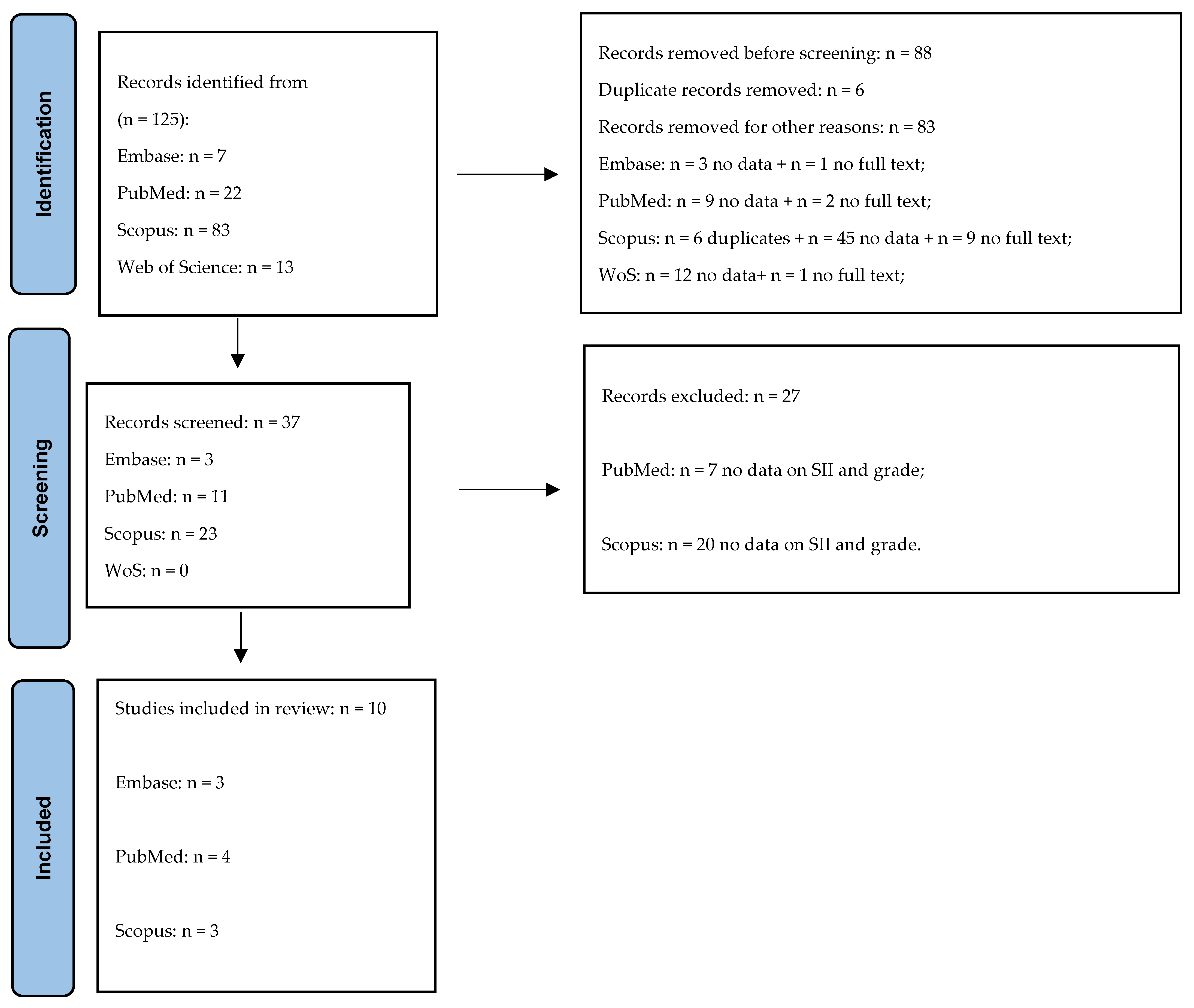
3. Results
Selected Studies
4. Discussion
Strengths and Limitations
5. Conclusions
Supplementary Materials
Author Contributions
Funding
Institutional Review Board Statement
Informed Consent Statement
Data Availability Statement
Acknowledgments
Conflicts of Interest
References
- Zulch, K.J.; World Health Organization. Histological Typing of Tumours of the Central Nervous System; World Health Organization: Geneva, Switzerland, 1979.
- Louis, D.N.; Ohgaki, H.; Wiestler, O.D.; Cavenee, W.K. (Eds.) The 2016 World Health Organization Classification of Tumors of the Central Nervous System, 4th ed.; International Agency for Research on Cancer: Lyon, France, 2016. [Google Scholar]
- Louis, D.N.; Ohgaki, H.; Wiestler, O.D.; Cavenee, W.K. (Eds.) World Health Organization Histological Classification of Tumors of the Central Nervous System, 4th ed.; International Agency for Research on Cancer: Lyon, France, 2007. [Google Scholar]
- Mahajan, S.; Suri, V.; Sahu, S.; Sharma, M.C.; Sarkar, C. World Health Organization Classification of Tumors of the Central Nervous System 5th Edition (WHO CNS5): What’s new? Indian J. Pathol. Microbiol. 2022, 65, S5–S13. [Google Scholar] [CrossRef] [PubMed]
- Komori, T. The 2021 WHO Classification of Tumors, 5th edition, Central Nervous System Tumors: A Short Review. Brain Nerve 2022, 74, 803–809. (In Japanese) [Google Scholar] [CrossRef]
- Grading of the Tumors of the Central Nervous System. Available online: https://www.en.wikipedia.org/wiki/Grading_of_the_tumors_of_the_central_nervous_system (accessed on 16 March 2017).
- Kim, E.J.; Park, H.S.; Kim, J.Y.; Kim, S.I.; Cho, Y.U.; Park, B.W. Assessment of the Prognostic Staging System of American Joint Committee on Cancer 8th Edition for Breast Cancer: Comparisons with the Conventional Anatomic Staging System. J. Breast Cancer 2020, 23, 59–68. [Google Scholar] [CrossRef]
- Denoix, P.F. Nomenclature classification des cancers. Bull. Natl. Inst. Hyg. 1952, 7, 743–748. (In French) [Google Scholar]
- Xie, Y.; Liu, F.; Wu, Y.; Zhu, Y.; Jiang, Y.; Wu, Q.; Dong, Z.; Liu, K. Inflammation in cancer: Therapeutic opportunities from new insights. Mol. Cancer 2025, 24, 51. [Google Scholar] [CrossRef] [PubMed]
- Khandia, R.; Munjal, A. Interplay between inflammation and cancer. Adv. Protein Chem. Struct. Biol. 2020, 119, 199–245. [Google Scholar] [CrossRef]
- Todoric, J.; Antonucci, L.; Karin, M. Targeting Inflammation in Cancer Prevention and Therapy. Cancer Prev. Res. 2016, 9, 895–905. [Google Scholar] [CrossRef]
- Singh, N.; Baby, D.; Rajguru, J.P.; Patil, P.B.; Thakkannavar, S.S.; Pujari, V.B. Inflammation and cancer. Ann. Afr. Med. 2019, 18, 121–126. [Google Scholar] [CrossRef] [PubMed]
- Kunnumakkara, A.B.; Sailo, B.L.; Banik, K.; Harsha, C.; Prasad, S.; Gupta, S.C.; Bharti, A.C.; Aggarwal, B.B. Chronic diseases, inflammation, and spices: How are they linked? J. Transl. Med. 2018, 16, 14. [Google Scholar] [CrossRef]
- Hagerling, C.; Casbon, A.J.; Werb, Z. Balancing the innate immune system in tumor development. Trends Cell Biol. 2015, 25, 214–220. [Google Scholar] [CrossRef]
- Qu, X.; Tang, Y.; Hua, S. Immunological Approaches Towards Cancer and Inflammation: A Cross Talk. Front. Immunol. 2018, 9, 563. [Google Scholar] [CrossRef] [PubMed]
- Candido, J.; Hagemann, T. Cancer-related inflammation. J. Clin. Immunol. 2013, 33, 79–84. [Google Scholar] [CrossRef]
- Vitale, E.; Rizzo, A.; Santa, K.; Jirillo, E. Associations between “Cancer Risk”, “Inflammation” and “Metabolic Syndrome”: A Review. Biology 2024, 13, 352. [Google Scholar] [CrossRef] [PubMed]
- Russo, P.; Foschi, N.; Palermo, G.; Maioriello, G.; Lentini, N.; Iacovelli, R.; Ciccarese, C.; Ragonese, M.; Marino, F.; Bizzarri, F.P.; et al. SIRI as a biomarker for bladder neoplasm: Utilizing decision curve analysis to evaluate clinical net benefit. Urol. Oncol. 2025, 43, 393.e1–393.e8. [Google Scholar] [CrossRef]
- Castro, E.; Lozano, R.; Olmos, D. Neutrophil to lymphocyte ratio: Another drop in the ocean of CRPC biomakers? Ann. Oncol. 2015, 26, 622–623. [Google Scholar] [CrossRef]
- Nigam, M.; Mishra, A.P.; Deb, V.K.; Dimri, D.B.; Tiwari, V.; Bungau, S.G.; Bungau, A.F.; Radu, A.F. Evaluation of the association of chronic inflammation and cancer: Insights and implications. Biomed. Pharmacother. 2023, 164, 115015. [Google Scholar] [CrossRef] [PubMed]
- Huang, H.; Liu, Q.; Zhu, L.; Zhang, Y.; Lu, X.; Wu, Y.; Liu, L. Prognostic Value of Preoperative Systemic Immune-Inflammation Index in Patients with Cervical Cancer. Sci. Rep. 2019, 9, 3284. [Google Scholar] [CrossRef]
- Hu, B.; Yang, X.R.; Xu, Y.; Sun, Y.F.; Sun, C.; Guo, W.; Zhang, X.; Wang, W.M.; Qiu, S.J.; Zhou, J.; et al. Systemic immune-inflammation index predicts prognosis of patients after curative resection for hepatocellular carcinoma. Clin. Cancer Res. 2014, 20, 6212–6222. [Google Scholar] [CrossRef]
- Lu, N.; Sheng, S.; Xiong, Y.; Zhao, C.; Qiao, W.; Ding, X.; Chen, J.; Zhang, Y. Prognostic model for predicting recurrence in hepatocellular carcinoma patients with high systemic immune-inflammation index based on machine learning in a multicenter study. Front. Immunol. 2024, 15, 1459740. [Google Scholar] [CrossRef]
- Aziz, M.H.; Sideras, K.; Aziz, N.A.; Mauff, K.; Haen, R.; Roos, D.; Saida, L.; Suker, M.; van der Harst, E.; Mieog, J.S.; et al. The Systemic-immune-inflammation Index Independently Predicts Survival and Recurrence in Resectable Pancreatic Cancer and its Prognostic Value Depends on Bilirubin Levels: A Retrospective Multicenter Cohort Study. Ann. Surg. 2019, 270, 139–146. [Google Scholar] [CrossRef]
- Zhang, W.; Wang, R.; Ma, W.; Wu, Y.; Maskey, N.; Guo, Y.; Liu, J.; Mao, S.; Zhang, J.; Yao, X.; et al. Systemic immune-inflammation index predicts prognosis of bladder cancer patients after radical cystectomy. Ann. Transl. Med. 2019, 7, 431. [Google Scholar] [CrossRef]
- Matsubara, S.; Mabuchi, S.; Takeda, Y.; Kawahara, N.; Kobayashi, H. Prognostic value of pre-treatment systemic immune-inflammation index in patients with endometrial cancer. PLoS ONE 2021, 16, e0248871. [Google Scholar] [CrossRef]
- Moher, D.; Liberati, A.; Tetzlaff, J.; Altman, D.G.; PRISMA Group. Preferred reporting items for systematic reviews and meta-analyses: The PRISMA statement. Int. J. Surg. 2010, 8, 336–341. [Google Scholar] [CrossRef]
- Melnyk, B.M.; Fineout-Overholt, E. Evidence-Based Practice in Nursing & Healthcare: A Guide to Best Practice, 3rd ed.; Wolters Kluwer Health: Philadelphia, PA, USA, 2015; pp. 10–16. [Google Scholar]
- Bartl, T.; Bekos, C.; Postl, M.; Alexander, R.; Polterauer, S.; Stefanie, A.; Richard, S. The systemic immune-inflammation index (SII) is an independent prognostic parameter of survival in patients with invasive vulvar cancer. J. Gynecol. Oncol. 2021, 32, e1. [Google Scholar] [CrossRef]
- Jiang, X.; Zhou, T.; Liu, C.; Xu, N.; Chen, X.; Wang, D. Predicting the prognosis of patients with renal cell carcinoma based on systemic immune inflammatory index and prognostic nutritional index. Int. Urol. Nephrol. 2025, 57, 3975–3984. [Google Scholar] [CrossRef] [PubMed]
- Liang, R.; Chen, N.; Li, M.; Wang, X.; Mao, Q.; Liu, Y. Significance of systemic immune-inflammation index in the differential diagnosis of high- and low-grade gliomas. Clin. Neurol. Neurosurg. 2018, 164, 50–52. [Google Scholar] [CrossRef]
- Liang, R.; Li, J.; Tang, X.; Liu, Y. The prognostic role of preoperative systemic immune-inflammation index and albumin/globulin ratio in patients with newly diagnosed high-grade glioma. Clin. Neurol. Neurosurg. 2019, 184, 105397. [Google Scholar] [CrossRef] [PubMed]
- Nie, D.; Gong, H.; Mao, X.; Li, Z. Systemic immune-inflammation index predicts prognosis in patients with epithelial ovarian cancer: A retrospective study. Gynecol. Oncol. 2019, 152, 259–264. [Google Scholar] [CrossRef] [PubMed]
- Njoku, K.; Ramchander, N.C.; Wan, Y.L.; Barr, C.E.; Crosbie, E.J. Pre-treatment inflammatory parameters predict survival from endometrial cancer: A prospective database analysis. Gynecol. Oncol. 2022, 164, 146–153. [Google Scholar] [CrossRef]
- Farolfi, A.; Scarpi, E.; Greco, F.; Bergamini, A.; Longo, L.; Pignata, S.; Casanova, C.; Cormio, G.; Bologna, A.; Orditura, M.; et al. Inflammatory indexes as predictive factors for platinum sensitivity and as prognostic factors in recurrent epithelial ovarian cancer patients: A MITO24 retrospective study. Sci. Rep. 2020, 10, 18190. [Google Scholar] [CrossRef]
- Shi, H.; Jiang, Y.; Cao, H.; Zhu, H.; Chen, B.; Ji, W. Nomogram Based on Systemic Immune-Inflammation Index to Predict Overall Survival in Gastric Cancer Patients. Dis. Markers 2018, 2018, 1787424. [Google Scholar] [CrossRef]
- Zhang, Y.; Liu, X.; Xu, M.; Chen, K.; Li, S.; Guan, G. Prognostic value of pretreatment systemic inflammatory markers in patients with locally advanced rectal cancer following neoadjuvant chemoradiotherapy. Sci. Rep. 2020, 10, 8017. [Google Scholar] [CrossRef]
- Balkwill, F.; Mantovani, A. Inflammation and cancer: Back to Virchow? Lancet 2001, 357, 539–545. [Google Scholar] [CrossRef]
- Mantovani, A.; Allavena, P.; Sica, A.; Balkwill, F. Cancer-related inflammation. Nature 2008, 454, 436–444. [Google Scholar] [CrossRef] [PubMed]
- Condeelis, J.; Pollard, J.W. Macrophages: Obligate partners for tumor cell migration, invasion, and metastasis. Cell 2006, 124, 263–266. [Google Scholar] [CrossRef] [PubMed]
- Qian, Y.; Zhai, E.; Zhang, Z.; Dai, W.; Peng, J.; Chen, J.; Chen, C. Systemic immune-inflammation index (SII): A More Promising Inflammation-Based Prognostic Marker for Patients with synchronic colorectal peritoneal carcinomatosis. J. Cancer 2020, 11, 5264–5272. [Google Scholar] [CrossRef]
- Ramón-Rodríguez, J.; De-Armas-Conde, N.; Jaén-Torrejimeno, I.; Prada-Villaverde, A.; Rojas-Holguín, A.; López-Guerra, D.; Blanco-Fernández, G. Prognostic value of pre-operative systemic immune-inflammation index and platelet to lymphocyte ratio in peritoneal carcinomatosis of ovarian origin. Surg. Oncol. 2022, 42, 101750. [Google Scholar] [CrossRef]
- Grivennikov, S.I.; Greten, F.R.; Karin, M. Immunity, inflammation, and cancer. Cell 2010, 140, 883–899. [Google Scholar] [CrossRef]
- Stone, R.L.; Nick, A.M.; McNeish, I.A.; Balkwill, F.; Han, H.D.; Bottsford-Miller, J.; Rupairmoole, R.; Armaiz-Pena, G.N.; Pecot, C.V.; Coward, J.; et al. Paraneoplastic thrombocytosis in ovarian cancer. N. Engl. J. Med. 2012, 366, 610–618, Erratum in: N. Engl. J. Med. 2012, 367, 1768.. [Google Scholar] [CrossRef] [PubMed]
- Zhang, L.; Conejo-Garcia, J.R.; Katsaros, D.; Gimotty, P.A.; Massobrio, M.; Regnani, G.; Makrigiannakis, A.; Gray, H.; Schlienger, K.; Liebman, M.N.; et al. Intratumoral T cells, recurrence, and survival in epithelial ovarian cancer. N. Engl. J. Med. 2003, 348, 203–213. [Google Scholar] [CrossRef]
- Leffers, N.; Gooden, M.J.; de Jong, R.A.; Hoogeboom, B.N.; ten Hoor, K.A.; Hollema, H.; Boezen, H.M.; van der Zee, A.G.; Daemen, T.; Nijman, H.W. Prognostic significance of tumor-infiltrating T-lymphocytes in primary and metastatic lesions of advanced stage ovarian cancer. Cancer Immunol. Immunother. 2009, 58, 449–459. [Google Scholar] [CrossRef]
- Wang, W.Q.; Liu, L.; Xu, H.X.; Wu, C.T.; Xiang, J.F.; Xu, J.; Liu, C.; Long, J.; Ni, Q.X.; Yu, X.J. Infiltrating immune cells and gene mutations in pancreatic ductal adenocarcinoma. Br. J. Surg. 2016, 103, 1189–1199. [Google Scholar] [CrossRef]
- Zhang, S.; Ni, Q. Prognostic role of the pretreatment systemic immune-inflammation index in patients with glioma: A meta-analysis. Front. Neurol. 2023, 14, 1094364. [Google Scholar] [CrossRef] [PubMed]
- Yılmaz, H.; Niğdelioğlu, B.; Oktay, E.; Meydan, N. Clinical significance of postoperatif controlling nutritional status (CONUT) score in glioblastoma multiforme. J. Clin. Neurosci. 2021, 86, 260–266. [Google Scholar] [CrossRef] [PubMed]
- Geraghty, J.R.; Lung, T.J.; Hirsch, Y.; Katz, E.A.; Cheng, T.; Saini, N.S.; Pandey, D.K.; Testai, F.D. Systemic Immune-Inflammation Index Predicts Delayed Cerebral Vasospasm After Aneurysmal Subarachnoid Hemorrhage. Neurosurgery 2021, 89, 1071–1079. [Google Scholar] [CrossRef]
- Olar, A.; Wani, K.M.; Sulman, E.P.; Mansouri, A.; Zadeh, G.; Wilson, C.D.; DeMonte, F.; Fuller, G.N.; Aldape, K.D. Mitotic Index is an Independent Predictor of Recurrence-Free Survival in Meningioma. Brain Pathol. 2015, 25, 266–275. [Google Scholar] [CrossRef] [PubMed]
- Schreiber, R.D.; Old, L.J.; Smyth, M.J. Cancer immunoediting: Integrating immunity’s roles in cancer suppression and promotion. Science 2011, 331, 1565–1570. [Google Scholar] [CrossRef]
- Wang, J.; Reiss, K.A.; Khatri, R.; Jaffee, E.; Laheru, D. Immune Therapy in GI Malignancies: A Review. J. Clin. Oncol. 2015, 33, 1745–1753. [Google Scholar] [CrossRef]
- Hou, J.; Karin, M.; Sun, B. Targeting cancer-promoting inflammation—Have anti-inflammatory therapies come of age? Nat. Rev. Clin. Oncol. 2021, 18, 261–279. [Google Scholar] [CrossRef]
- Placke, T.; Kopp, H.G.; Salih, H.R. Modulation of natural killer cell anti-tumor reactivity by platelets. J. Innate Immun. 2011, 3, 374–382. [Google Scholar] [CrossRef]
- Bahmani, B.; Gong, H.; Luk, B.T.; Haushalter, K.J.; DeTeresa, E.; Previti, M.; Zhou, J.; Gao, W.; Bui, J.D.; Zhang, L.; et al. Intratumoral immunotherapy using platelet-cloaked nanoparticles enhances antitumor immunity in solid tumors. Nat. Commun. 2021, 12, 1999. [Google Scholar] [CrossRef]
- Zeng, Z.; Xu, S.; Wang, D.; Qin, G. Prognostic significance of systemic immune-inflammation index in patients with nasopharyngeal carcinoma: A meta-analysis. Syst. Rev. 2022, 11, 247. [Google Scholar] [CrossRef]
- Long, E.; Williams, J.; Zhang, H.; Choi, J. An evolving understanding of multiple causal variants underlying genetic association signals. Am. J. Hum. Genet. 2025, 112, 741–750. [Google Scholar] [CrossRef]
- Li, Y.; Yu, M.; Yang, M.; Yang, J. The association of systemic immune-inflammation index with incident breast cancer and all-cause mortality: Evidence from a large population-based study. Front. Immunol. 2025, 16, 1528690. [Google Scholar] [CrossRef]
- Wu, S.; Liu, Z.; Li, X.; Gao, S.; Xia, P. Association between systemic immune-inflammation index and the risk of all-cause, cancer and non-cancer mortality in the general population: Results from national health and nutrition examination survey 2005–2018. BMC Public Health 2025, 25, 227. [Google Scholar] [CrossRef] [PubMed]
- de Visser, K.E.; Coussens, L.M. The inflammatory tumor microenvironment and its impact on cancer development. Contrib. Microbiol. 2006, 13, 118–137. [Google Scholar] [CrossRef]
- Federica, G.; Michela, C.; Giovanna, D. Targeting the DNA damage response in cancer. MedComm 2024, 5, e788. [Google Scholar] [CrossRef] [PubMed]
- Bowen, R.C.; Little, N.A.B.; Harmer, J.R.; Ma, J.; Mirabelli, L.G.; Roller, K.D.; Breivik, A.M.; Signor, E.; Miller, A.B.; Khong, H.T. Neutrophil-to-lymphocyte ratio as prognostic indicator in gastrointestinal cancers: A systematic review and meta-analysis. Oncotarget 2017, 8, 32171–32189. [Google Scholar] [CrossRef] [PubMed]
- Rossi, L.; Santoni, M.; Crabb, S.J.; Scarpi, E.; Burattini, L.; Chau, C.; Bianchi, E.; Savini, A.; Burgio, S.L.; Conti, A.; et al. High neutrophil-to-lymphocyte ratio persistent during first-line chemotherapy predicts poor clinical outcome in patients with advanced urothelial cancer. Ann. Surg. Oncol. 2015, 22, 1377–1384. [Google Scholar] [CrossRef]
- Chen, K.L.; Qiu, Y.W.; Yang, M.; Wang, T.; Yang, Y.; Qiu, H.Z.; Sun, T.; Wang, W.T. Prognostic value of preoperative systemic immune-inflammation index/albumin for patients with hepatocellular carcinoma undergoing curative resection. World J. Gastroenterol. 2024, 30, 5130–5151. [Google Scholar] [CrossRef]
- Russo, P.; Marino, F.; Rossi, F.; Bizzarri, F.P.; Ragonese, M.; Dibitetto, F.; Filomena, G.B.; Marafon, D.P.; Ciccarese, C.; Iacovelli, R.; et al. Is Systemic Immune-Inflammation Index a Real Non-Invasive Biomarker to Predict Oncological Outcomes in Patients Eligible for Radical Cystectomy? Medicina 2023, 59, 2063. [Google Scholar] [CrossRef] [PubMed]
- Tricco, A.C.; Lillie, E.; Zarin, W.; O’Brien, K.K.; Colquhoun, H.; Levac, D.; Moher, D.; Peters, M.D.J.; Horsley, T.; Weeks, L.; et al. PRISMA Extension for Scoping Reviews (PRISMAScR): Checklist and Explanation. Ann. Intern. Med. 2018, 169, 467–473. [Google Scholar] [CrossRef] [PubMed]


| Author(s) Publication Year | Study Design | Cancer Typology | Grading Assessment | Patients No. | SII Ref. Values | SII_Low | SII_High | Cr_Grade 0–II_ SII_Low | Cr_Grade III–IV_ SII_Low | Cr_Grade 0–II_ SII_High | Cr_Grade III–IV_ SII_High | p-Value |
|---|---|---|---|---|---|---|---|---|---|---|---|---|
| Bartl et al., 2021 [29] | Retrospective study | Invasive vulvar cancer | Histologic grading | 130 | 866.4 < SII ≥ 866.4 | 65 | 65 | 55 | 10 | 53 | 12 | 0.230 |
| Hu et al., 2014 [22] | Retrospective study | Hepatocellular Carcinoma | Edmondson grading system | 133 | 330 < SII ≥ 330 | 80 | 53 | 61 | 35 | 19 | 18 | 0.198 |
| Hu et al., 2014 [22] | Retrospective study | Hepatocellular Carcinoma | Edmondson grading system | 123 | 330 < SII ≥ 330 | 82 | 41 | 61 | 22 | 21 | 19 | 0.021 * |
| Jiang et al., 2025 [30] | Retrospective study | Renal cell carcinoma | Fuhrman grade | 240 | 849.48 < SII ≥ 849.48 | 170 | 70 | 150 | 20 | 53 | 17 | 0.025 * |
| Liang et al., 2018 [31] | Retrospective study | Gliomas | WHO grade | 153 | 392.48 < SII ≥ 392.48 | 60 | 93 | 35 | 25 | 18 | 75 | <0.001 * |
| Liang et al., 2019 [32] | Retrospective study | Gliomas | WHO grade | 169 | 324.38 < SII ≥ 324.38 | 53 | 116 | 0 | 53 | 0 | 116 | 0.009 * |
| Nie et al., 2019 [33] | Retrospective study | Epithelial ovarian cancer | Tumor grade | 250 | 612 < SII ≥ 612 | 129 | 121 | 35 | 94 | 31 | 90 | 0.886 |
| Nie et al., 2019 [33] | Retrospective study | Epithelial ovarian cancer | Tumor grade | 283 | 612 < SII ≥ 612 | 135 | 148 | 38 | 97 | 41 | 107 | 0.934 |
| Njoku et al., 2022 [34] | Prospective study | Endometrial cancer | Tumor grade and histology | 367 | 910 < SII ≥ 910 | 299 | 168 | 221 | 107 | 78 | 61 | 0.065 |
| Author(s) Publication Year | Study Design | Cancer Typology | Staging Assessment | Patients No. | SII Ref. Values | SII_Low | SII_High | Cr_Stage 0–II_ SII_Low | Cr_Stage III–IV_ SII_Low | Cr_Stage 0–II_ SII_High | Cr_Stage III–IV_ SII_High | p-Value |
|---|---|---|---|---|---|---|---|---|---|---|---|---|
| Bartl et al., 2021 [29] | Retrospective study | Invasive vulvar cancer | FIGO stage | 130 | 866.4 < SII ≥ 866.4 | 65 | 65 | 48 | 17 | 38 | 27 | 0.029 * |
| Farolfi et al., 2020 [35] | Observational, Multicenter study | Recurrent epithelial ovarian cancer patients | FIGO stage | 375 | 730 < SII ≥ 730 | 156 | 219 | 156 | --- | --- | 219 | 0.074 |
| Jiang et al., 2025 [30] | Retrospective study | Renal cell carcinoma | AJCC stage | 240 | 849.48 < SII ≥ 849.48 | 170 | 70 | 129 | 41 | 35 | 35 | <0.001 * |
| Nie et al., 2019 [33] | Retrospective study | Epithelial ovarian cancer | FIGO stage | 250 | 612 < SII ≥ 612 | 129 | 121 | 46 | 83 | 24 | 97 | 0.007 * |
| Nie et al., 2019 [33] | Retrospective study | Epithelial ovarian cancer | FIGO stage | 283 | 612 < SII ≥ 612 | 135 | 148 | 37 | 98 | 21 | 127 | 0.006 * |
| Njoku et al., 2022 [34] | Prospective study | Endometrial cancer | FIGO-stage | 367 | 910 < SII ≥ 910 | 327 | 139 | 221 | 107 | 78 | 61 | 0.024 * |
| Shi et al., 2018 [36] | Retrospective study | Gastric cancer | TNM stage (AJCC, 8th) | 688 | 320 < SII ≥ 320 | 356 | 332 | 286 | 41 | 107 | 32 | <0.001 * |
| Shi et al., 2018 [36] | Retrospective study | Gastric cancer | TNM stage (AJCC, 8th) | 174 | 320 < SII ≥ 320 | 90 | 84 | 61 | 9 | 70 | 34 | <0.001 * |
| Zhang et al., 2020 [37] | Retrospective study | Locally advanced rectal cancer | TNM stage | 472 | 230 < SII ≥ 230 | 309 | 163 | 227 | 82 | 111 | 57 | <0.001 * |
Disclaimer/Publisher’s Note: The statements, opinions and data contained in all publications are solely those of the individual author(s) and contributor(s) and not of MDPI and/or the editor(s). MDPI and/or the editor(s) disclaim responsibility for any injury to people or property resulting from any ideas, methods, instructions or products referred to in the content. |
© 2026 by the authors. Licensee MDPI, Basel, Switzerland. This article is an open access article distributed under the terms and conditions of the Creative Commons Attribution (CC BY) license.
Share and Cite
Rizzo, A.; Vitale, E.; Maistrello, L.; Santa, K.; Santoni, M. Association Between Systemic Immune-Inflammatory Index (SII) and Cancer Grading and Staging: Evidence from the Current Scientific Literature. Biology 2026, 15, 253. https://doi.org/10.3390/biology15030253
Rizzo A, Vitale E, Maistrello L, Santa K, Santoni M. Association Between Systemic Immune-Inflammatory Index (SII) and Cancer Grading and Staging: Evidence from the Current Scientific Literature. Biology. 2026; 15(3):253. https://doi.org/10.3390/biology15030253
Chicago/Turabian StyleRizzo, Alessandro, Elsa Vitale, Lorenza Maistrello, Kazuki Santa, and Matteo Santoni. 2026. "Association Between Systemic Immune-Inflammatory Index (SII) and Cancer Grading and Staging: Evidence from the Current Scientific Literature" Biology 15, no. 3: 253. https://doi.org/10.3390/biology15030253
APA StyleRizzo, A., Vitale, E., Maistrello, L., Santa, K., & Santoni, M. (2026). Association Between Systemic Immune-Inflammatory Index (SII) and Cancer Grading and Staging: Evidence from the Current Scientific Literature. Biology, 15(3), 253. https://doi.org/10.3390/biology15030253