Article

Mechanistic Pathways Controlling Cadmium Bioavailability and Ecotoxicity in Agricultural Systems: A Global Meta-Analysis of Lime Amendment Strategies


1
School of the Earth Sciences and Resources, China University of Geosciences, Beijing 100083, China
2
Guangxi Institute of Geological Survey, Nanning 530023, China
3
Guangxi Engineering Research Center for Medical Geology, Nanning 530023, China
4
State Key Laboratory for Conservation and Utilization of Subtropical Agri-Biological Resources, Guangxi Key Laboratory for Sugarcane Biology, College of Agriculture, Guangxi University, Nanning 530004, China
*
Authors to whom correspondence should be addressed.
Biology 2026, 15(3), 207; https://doi.org/10.3390/biology15030207
Submission received: 5 December 2025 / Revised: 1 January 2026 / Accepted: 15 January 2026 / Published: 23 January 2026
(This article belongs to the Section Toxicology)

Simple Summary

Cadmium contamination in agricultural soils threatens food safety through crop bioaccumulation, particularly in rice. Lime-based materials (calcium carbonate, calcium hydroxide, and calcium oxide) are commonly applied to mitigate cadmium uptake, yet comparative effectiveness and mechanistic understanding remain limited. This meta-analysis synthesized data from 55 studies encompassing 260 field experiments to evaluate how these three materials regulate cadmium transfer from soil to grain. Results indicate all materials reduced grain cadmium by approximately 45%, operating through dual mechanisms: chemical fixation transforms cadmium into stable soil forms, while ionic competition involves calcium blocking cadmium entry at root membranes. Calcium hydroxide demonstrated rapid soil immobilization capacity, reducing bioavailable cadmium by 59%. Calcium carbonate exhibited superior long-term grain protection (66% reduction) via sustained calcium release synchronized with critical grain-filling stages. Economic analysis revealed calcium carbonate provides 5–10 fold better cost-effectiveness than alternatives. These findings enable targeted material selection: calcium hydroxide for emergency soil remediation versus calcium carbonate for sustained crop protection. This mechanistic framework advances cadmium remediation from empirical application toward process-based strategies that integrate geochemical stabilization with plant physiological protection.

Abstract

Cadmium (Cd) contamination in agricultural systems poses significant ecotoxicological risks through bioaccumulation in food chains. While lime-based amendments are widely applied for Cd immobilization, mechanistic understanding of bioavailability control pathways remains limited. This study employed a meta-analysis methodology based on 260 datasets from 55 publications to systematically investigate the mechanisms and differences in the effectiveness of calcium hydroxide, calcium carbonate, and calcium oxide in regulating Cd migration in acidic soil–plant systems. The study revealed that lime-based materials synergistically regulated Cd migration through two processes: chemical fixation and ionic competition. Results showed lime application reduced soil available Cd by 33.0%, decreased grain Cd by 44.8%, increased soil pH by 15.6%, and enhanced exchangeable Ca by 35.2%. Chemical fixation was evidenced by Cd transformation from labile to stable forms (residual Cd: +29.5%, acid-soluble Cd: −17.5%). Ionic competition was quantitatively confirmed through strong negative correlation between exchangeable Ca and grain Cd (R2 = 0.704). Among the materials, Ca(OH)2 exhibits the highest efficiency in rapid pedogenic passivation (58.7% reduction in available Cd), whereas CaCO3 demonstrates superior long-term grain Cd attenuation (65.7% inhibition) via sustained Ca2+ release and rhizosphere-regulated dissolution. This study advances mechanistic understanding of Cd bioavailability control and establishes quantitative frameworks for predicting ecotoxicological outcomes, providing scientific basis for optimizing remediation strategies to minimize Cd transfer through agricultural food chains.

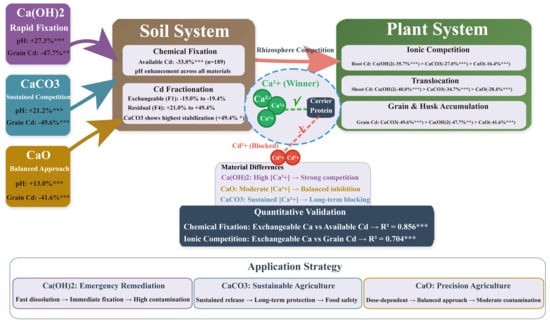
Graphical Abstract

1. Introduction

Soil cadmium (Cd) contamination has emerged as a major environmental issue threatening global agricultural sustainability and food security [1]. Recent global assessments reveal that 14–17% of agricultural lands are affected by heavy metal pollution, with approximately 0.9–1.4 billion people residing in high-health-risk areas [2]. Globally, Cd is the most widely distributed soil contaminant, with approximately 9% of agricultural soils exceeding safe Cd thresholds (e.g., 0.3–0.6 mg/kg for agricultural soils depending on pH, according to various international guidelines) [3]. As a Group I carcinogen confirmed by the World Health Organization, Cd possesses the unique characteristic of accumulating in edible plant tissues without significantly affecting plant growth, enabling “cryptic” transfer into the food chain and causing long-term chronic health hazards [4,5]. Rice, which serves as the staple food for more than 3 billion people worldwide, exhibits particularly prominent grain Cd contamination issues, constituting the primary source of Cd exposure in human populations [6,7]. Therefore, there is an urgent need to develop multi-mechanism synergistic remediation strategies that simultaneously achieve Cd immobilization in paddy fields and inhibit Cd uptake by plants.
Calcium (Ca) plays crucial roles in various physiological and biochemical processes in plants, including cell wall composition, membrane permeability, and signal transduction [8]. In addition, Ca participates in multiple stress responses, such as drought, salinity, cold, and heavy metal stress [9]. Numerous studies have demonstrated that Ca addition can reduce Cd uptake and enhance plant tolerance to Cd, which are attributed to the multiple interactions between Ca and Cd [10]. Application of Ca-containing minerals can form Cd–Ca complexes, thereby reducing Cd availability in soil and subsequently decreasing Cd bioaccumulation in plants [11]. Due to the similar ionic radii and charges of Cd ions (Cd2+) and Ca ions (Ca2+), they can compete for the same channels/transporters at root level [12]. Therefore, applying highly available Ca helps alleviate Cd toxicity by reducing Cd uptake in crops [13]. However, the mechanisms by which lime-based materials affect Cd transport and distribution within crops remain unclear, particularly with regard to the way in which Ca ions regulate Cd uptake in crop roots and the distribution processes among different organs, for which in-depth investigations are lacking [14,15]. Furthermore, differences in effectiveness among various lime-based materials in regulating crop Cd accumulation and their underlying mechanisms require systematic elucidation, as they directly impact the effectiveness and reliability of lime-based passivation technology under different crop and soil conditions.
Existing research exhibits significant limitations in systematic evaluation of Ca-based remediation technologies. Kong et al. [16] conducted a meta-analysis on lime material remediation of Cd-contaminated paddy fields, encompassing 39 publications, and found that lime application could reduce the rice grain Cd content by 44%, and identified key influencing factors such as lime type (calcium carbonate (CaCO3), calcium hydroxide (Ca(OH)2), or calcium oxide (CaO)), dosage, and soil environmental factors. A meta-analysis by He et al. [17] confirmed that lime-based materials can significantly increase soil pH and reduce crop Cd accumulation, although these effects exhibit significant heterogeneity. Chemically, although CaCO3, Ca(OH)2, and CaO are all lime-based amendments, they differ fundamentally in their solubility, reaction stoichiometry, and impact on soil solution alkalinity [18]. CaO and Ca(OH)2 are strong bases that dissolve rapidly and provide a sharp increase in pH, whereas CaCO3 exhibits lower solubility and acts as a slow-release source of both alkalinity and Ca2+ ions [19]. These distinct chemical behaviors inevitably lead to varied remediation efficiencies and mechanisms in different soil environments. However, these studies still present significant limitations. Most focus solely on an overall evaluation of lime effects, lacking systematic comparison of effectiveness differences among different lime-based materials such as CaCO3, Ca(OH)2, and CaO (Table 1). Furthermore, mechanism analysis remains confined to the single perspective of pH regulation, failing to thoroughly elucidate the synergistic effects of dual mechanisms involving chemical fixation and ionic competition. In addition, the absence of quantitative relationship analysis between soil exchangeable Ca ions and plant Cd accumulation has resulted in lime-based passivation technology remaining at the empirical application stage. Meta-analysis is an important evidence-based research method that extracts universally applicable patterns by integrating numerous independent research results [20]. A systematic comparison of differences in effectiveness among different lime-based materials in regulating Cd migration through large-scale data integration provides a foundation for scientific selection of lime-based materials, which holds significant practical importance.
This study involved collecting data from 55 relevant studies based on a systematic literature review and employing a meta-analysis methodology to systematically compare the Cd inhibition effects of lime-based passivation technology. The research objectives were to (1) systematically compare the Cd inhibition effects of three major lime-based materials (CaCO3, Ca(OH)2, and CaO) and validate the synergistic effects of dual mechanisms involving chemical fixation and ionic competition; (2) analyze the quantitative relationship between soil exchangeable Ca ions and plant Cd accumulation to elucidate the functional patterns of ionic competition mechanisms; and (3) resolve dose–response relationships of different lime-based materials to identify relatively effective dosage ranges and key regulatory factors. This study aimed to provide a scientific foundation for material selection in agricultural Cd pollution remediation through systematic comparison of the effectiveness of different lime-based materials.

2. Materials and Methods

2.1. Data Sources and Treatments

Scientific publications spanning 2000–2023 were retrieved from Springer Link and Science Direct databases. Search strategies employed various keyword combinations, including “lime AND Cd AND soil,” “limestone AND Cd AND soil,” “quicklime AND Cd AND soil,” and “hydroxide calcium AND Cd AND soil”.
The selected studies focused on lime-based compounds (CaCO3, Ca(OH)2, and CaO) as immobilization agents for Cd-contaminated soil remediation and crop Cd reduction. This analysis exclusively incorporated data from field-scale and pot experiments, and omitted laboratory-scale investigations such as incubation or leaching tests. This exclusion was implemented to ensure that the integrated results reflect field-realistic conditions and capture the complex soil–plant interactions that are often absent in simplified laboratory settings.
To minimize selection bias, four specific inclusion criteria were established:
(1)
Monitoring requirements: Studies must document soil pH levels, bioavailable Cd concentrations, and Cd accumulation in plant tissues (shoots and grains) of at least one crop species.
(2)
Research focus: Investigations should emphasize effects of Cd contamination on agricultural crops, with particular attention to rice (Oryza sativa L.).
(3)
Treatment design: Research must clearly specify the lime-based amendment dosages, utilize these materials as primary immobilization agents, and include both untreated controls and various Ca-amended treatments.
(4)
Data availability: Essential statistical information, including sample numbers, mean values, standard deviations, and/or standard errors (SEs) for target parameters, must be explicitly presented in manuscripts, tables, or extractables from published figures.
When the SE was reported, the standard deviation (SD) was calculated using Equation (1) [22].
S D = S E × n
The final database included 55 studies and 260 datasets that satisfied the above criteria (Text S1).
We calculated the theoretical value for Ca ions for lime-based material application using Equation (2) [17]:
C a 2 +   t h e o r e t i c a l   v a l u e = M C a 2 + M R a w   m a t e r i a l × A p p l i c a t i o n   r a t e
where MCa2+ represents the relative atomic mass of Ca ions (g/mol), MRaw material represents the molar mass of the main component in the lime-based material (g/mol), and Application rate represents the application rate of the lime-based material (kg/ha).

2.2. Meta-Analysis

Effects of nitrogen application on each variable were calculated using the natural logarithm of the response ratio [ln(RR)] (Equation (3)):
ln R R = X t X c ,
where Xt and Xc are the mean values of the variables in the nitrogen treatment and control groups, respectively.
The mixed-effect models in the “metafor” package in R software (version 4.3.0) was used to calculate the weighted effect size [ln(RR++)] and 95% confidence interval (Cl) [23]:
l n R R + + = i = 1 m j = 1 k l n R R i = 1 m j = 1 k w i j
S l n R R + + = 1 i = 1 m j = 1 k w i j ,   and ,   and
95 % C I = l n R R + + + 1.96 × S l n R R + +
where the weight of each ln(RR) (w) is the reciprocal of its variance; S l n R R + + is the SE of ln(RR++); 95% CI is the 95% CI of ln(RR++); m is the number of groups; i and j represent the i-th and j-th treatments, respectively, and; k is the number of observations in the corresponding group.
The effect of nitrogen application was considered significant if the 95% CI did not overlap with zero [24]. For ease of interpretation, ln(RR++) and its 95% CI were transformed into the percentage change using Equation (7).
P e r c e n t a g e   c h a n g e   % = e l n R R + + 1 × 100

2.3. Statistical Analysis

The R package “ggplot2” (R v4.2.3, http://www.r-project.org) was used to perform linear regression analysis. The significance of moderators was tested using the Q statistical test (Qm), with a Qm p-value < 0.05 indicating a significant influence of the factors on the variable response to the indicators. Rosenberg’s method was used to assess publication bias (Table S1), and pairwise correlations between ln(RR) values were calculated. If Rosenberg’s fail-safe number exceeded 5n + 10 (where n is the sample size), there was no publication bias in the variables [25].

3. Results

3.1. Lime-Based Materials Regulate Cd Migration in Acidic Soil–Plant Systems Through Chemical Fixation and Ionic Competition

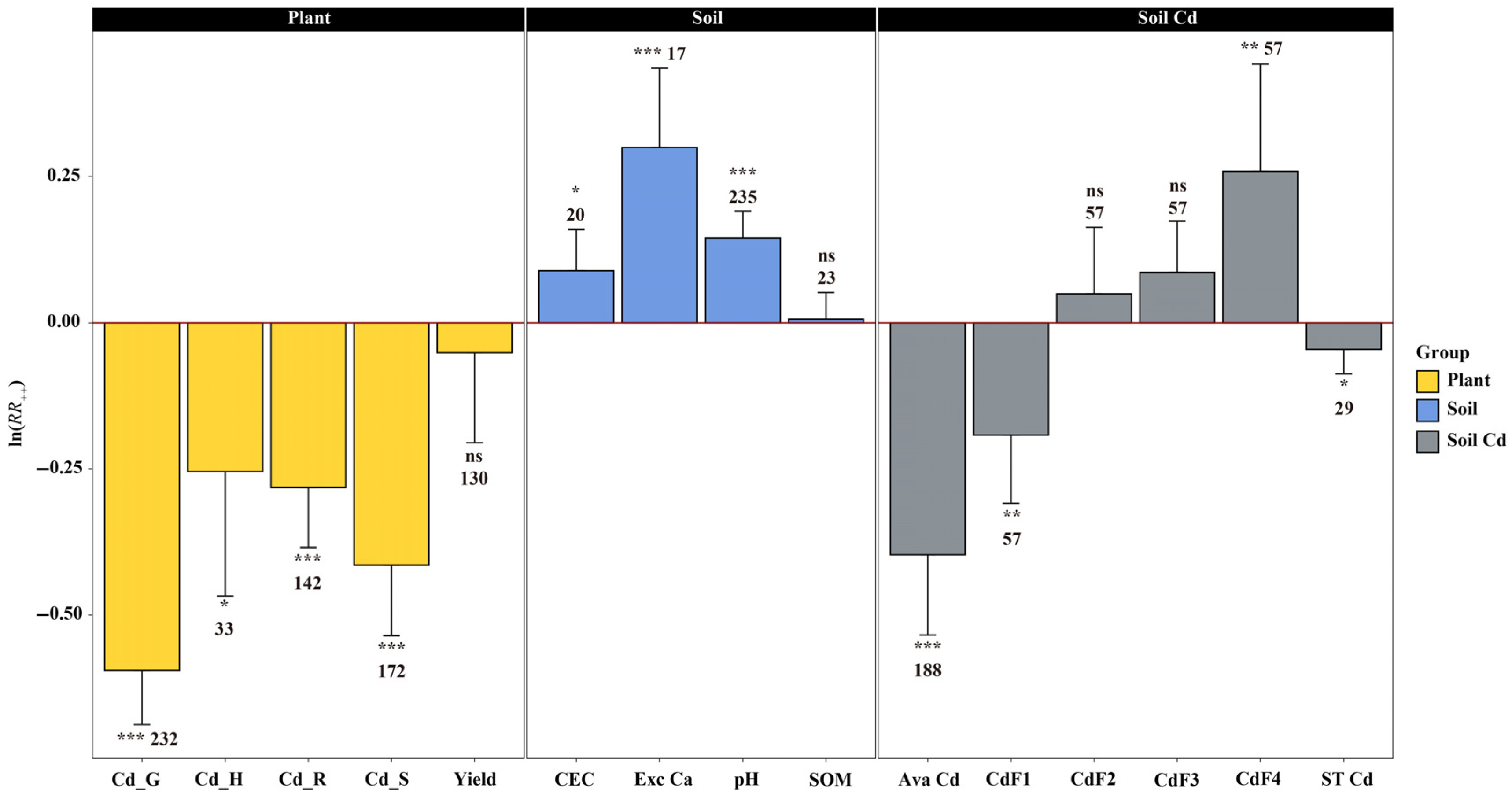
The meta-analysis results demonstrated that lime-based material application produced synergistic Cd regulation effects through two processes: chemical fixation and ionic competition in acidic soil–plant systems (Figure 1). Chemical fixation was primarily involved in transformation of soil Cd speciation. Lime-based material application significantly reduced soil Cd bioavailability, with available Cd decreasing by 33.0% (p < 0.001, n = 189) and Acid-soluble fraction of Cd (CdF1) decreasing by 17.5% (p < 0.01, n = 57); whereas, residual fraction of Cd (CdF4) significantly increased by 29.5% (p < 0.01, n = 57), indicating Cd transformation from labile to stable forms. Ionic competition is primarily reflected in inhibition of Cd uptake by plants. Cd accumulation in all plant tissues was significantly reduced, with grain Cd decreasing by 44.8% (p < 0.001, n = 232), shoot Cd decreasing by 33.9% (p < 0.001, n = 172), root Cd decreasing by 24.6% (p < 0.001, n = 141), and husk Cd decreasing by 22.5% (p < 0.05, n = 33). Simultaneously, lime-based material application significantly improved soil physicochemical properties, increasing the pH by 15.6% (p < 0.001, n = 235), enhancing exchangeable Ca by 35.2% (p < 0.001, n = 17), increasing the cation exchange capacity (CEC) by 9.4% (p < 0.05, n = 20), and increasing the grain Ca content by 9.2% (p < 0.001, n = 14).
The regression fitting analysis confirmed the synergistic effects of chemical fixation and ionic competition (Figures S1 and S2). Under the influence of lime-based materials, exchangeable Ca exhibited a significant negative correlation with available Cd (y = −0.7x + 0.168, R2 = 0.856, p < 0.001). The ionic competition process was quantitatively validated through the linear negative correlation between exchangeable Ca and grain Cd (y = −3.04x − 0.082, R2 = 0.704, p < 0.001). With increasing exchangeable Ca response values, soil pH (y = 0.605x2 + 0.11x + 0.0402, R2 = 0.885, p < 0.001) and grain Ca (y = 0.0736ln[x] + 0.181, R2 = 0.736, p < 0.001) significantly increased. Cd translocation within plants also exhibited distinct patterns, with grain Cd (y = 0.932x − 0.281, R2 = 0.534, p < 0.001) and shoot Cd (y = 0.946x − 0.0974, R2 = 0.53, p < 0.001) showing significant positive correlations with root Cd, indicating that root Cd uptake was the critical determinant of aboveground Cd accumulation.

3.2. Differential Roles of Three Lime-Based Materials in Chemical Fixation and Ionic Competition Mechanisms

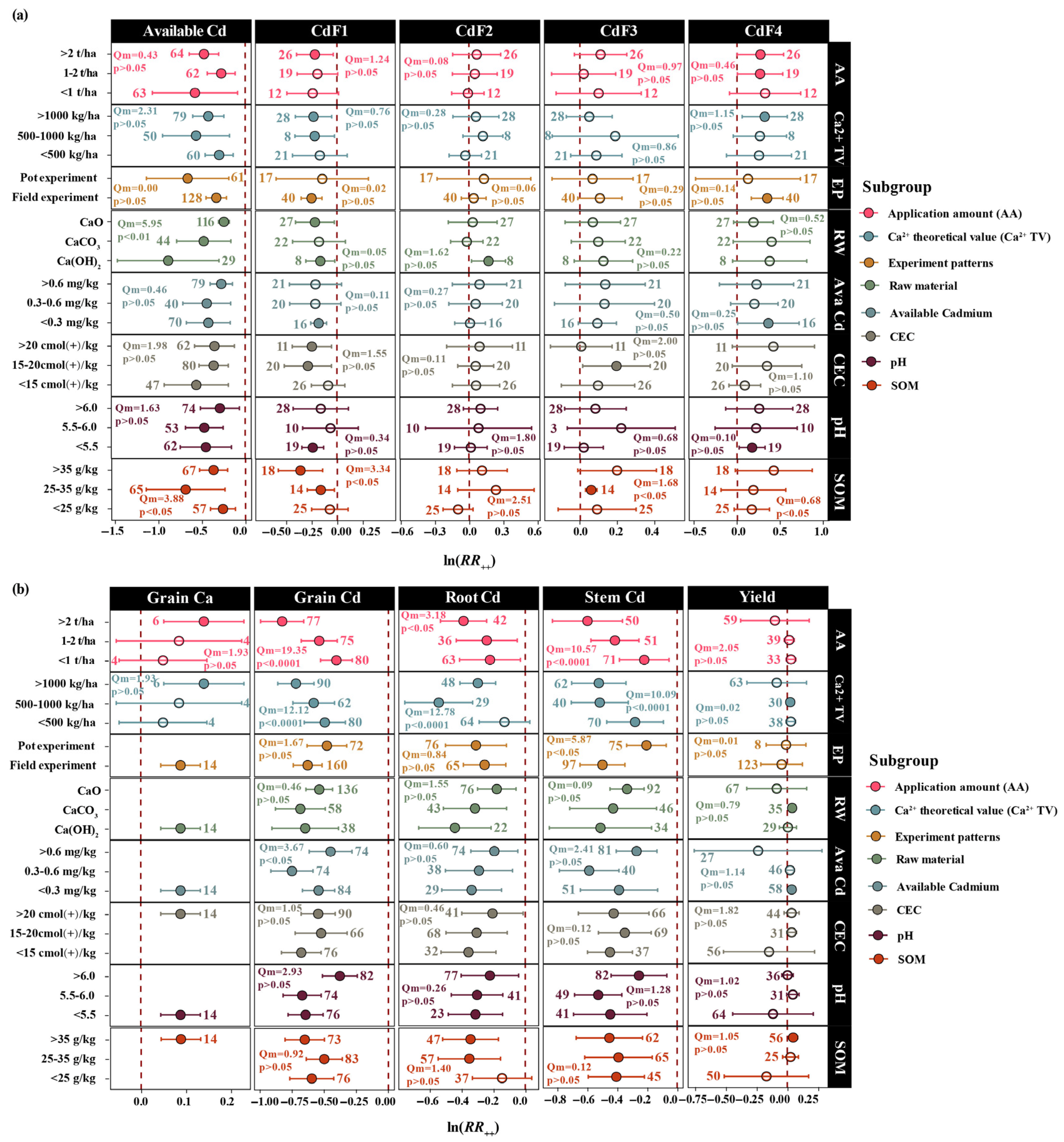
Significant differences existed in the weighting of roles among different lime-based materials within the dual mechanisms. The subgroup analysis revealed that the three lime-based materials exhibited distinct mechanistic preferences for Cd regulation (Figure 2). Ca(OH)2 primarily functioned through chemical fixation mechanisms and resulted in the greatest soil pH elevation (27.4%, p < 0.001, n = 33), the most significant reduction in available Cd (−58.7%, p < 0.01, n = 29), a substantial increase in exchangeable Ca (43.3%, p < 0.001, n = 14), and the strongest inhibition of root Cd (−35.7%, p < 0.001, n = 22). CaCO3 primarily operated through ionic competition mechanisms, exhibiting an outstanding performance in blocking plant Cd translocation, with grain Cd inhibition reaching 49.6% (p < 0.001; n = 58). CaO displayed balanced characteristics between the two mechanisms, with intermediate effects between those of the other two materials. Statistical tests revealed significant differences in the effects of the lime-based material type on soil available Cd (Qm = 5.949, p < 0.01), CEC (Qm = 11.889, p < 0.01), and soil organic matter (Qm = 260.206, p < 0.0001).
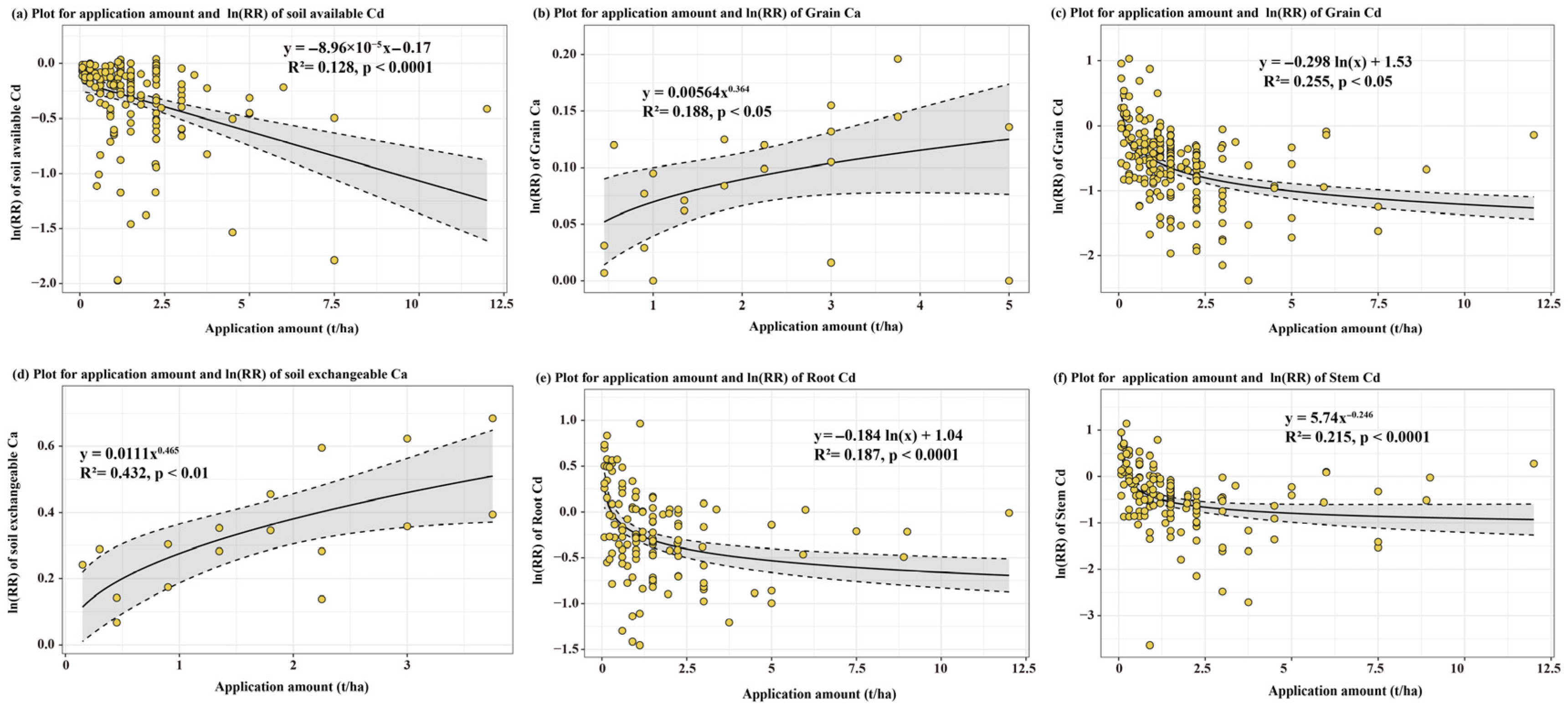
Dose–response analysis revealed the staged characteristics of the dual mechanisms (Figure 2 and Figure S3). When the theoretical value for Ca2+ ranged from 500–1000 kg/ha, the response values of soil available Cd (−43.1%, p < 0.01, n = 50), exchangeable Ca (44.7%, p < 0.01, n = 4), and root Cd (−41.9%, p < 0.001, n = 29) to lime-based material addition exceeded those of other groups, indicating that ionic competition mechanisms were relatively active at this stage. When the theoretical value for Ca2+ exceeded 1000 kg/ha, the responses of CdF1 (−20.5%, p < 0.05, n = 28), CdF4 (37.9%, p < 0.05, n = 28), grain Cd (−51.4%, p < 0.001, n = 90), and grain Ca (15.1%, p < 0.01, n = 6) were more pronounced, indicating that chemical fixation mechanisms began to play a dominant role at this stage. Regression analysis demonstrated that with increasing Ca application amount (Figure 3 and Figure S4), soil available Cd (y = −8.96 × 10⁻⁵x − 0.17, R2 = 0.128, p < 0.0001) and grain Cd (y = −0.298ln(x) + 1.53, R2 = 0.255, p < 0.0001) exhibited significant decreasing trends, whereas exchangeable Ca (y = 0.011x0.465, R2 = 0.432, p < 0.01) and grain Ca (y = 0.00564x0.364, R2 = 0.188, p < 0.01) showed significant increasing trends. Similarly, with an increase in the theoretical value for Ca2+, response values of soil available Cd (y = −0.0869ln(x) + 0.255, R2 = 0.051, p < 0.01) and grain Cd (y = −0.213ln(x) + 0.796, R2 = 0.145, p < 0.0001) both exhibited significant decreasing trends, whereas response values of soil exchangeable Ca (y = 0.0451e0.00705x, R2 = 0.486, p < 0.01) and grain Ca (y = 0.000162x + 0.181, R2 = 0.379, p < 0.01) demonstrated significant increasing trends.
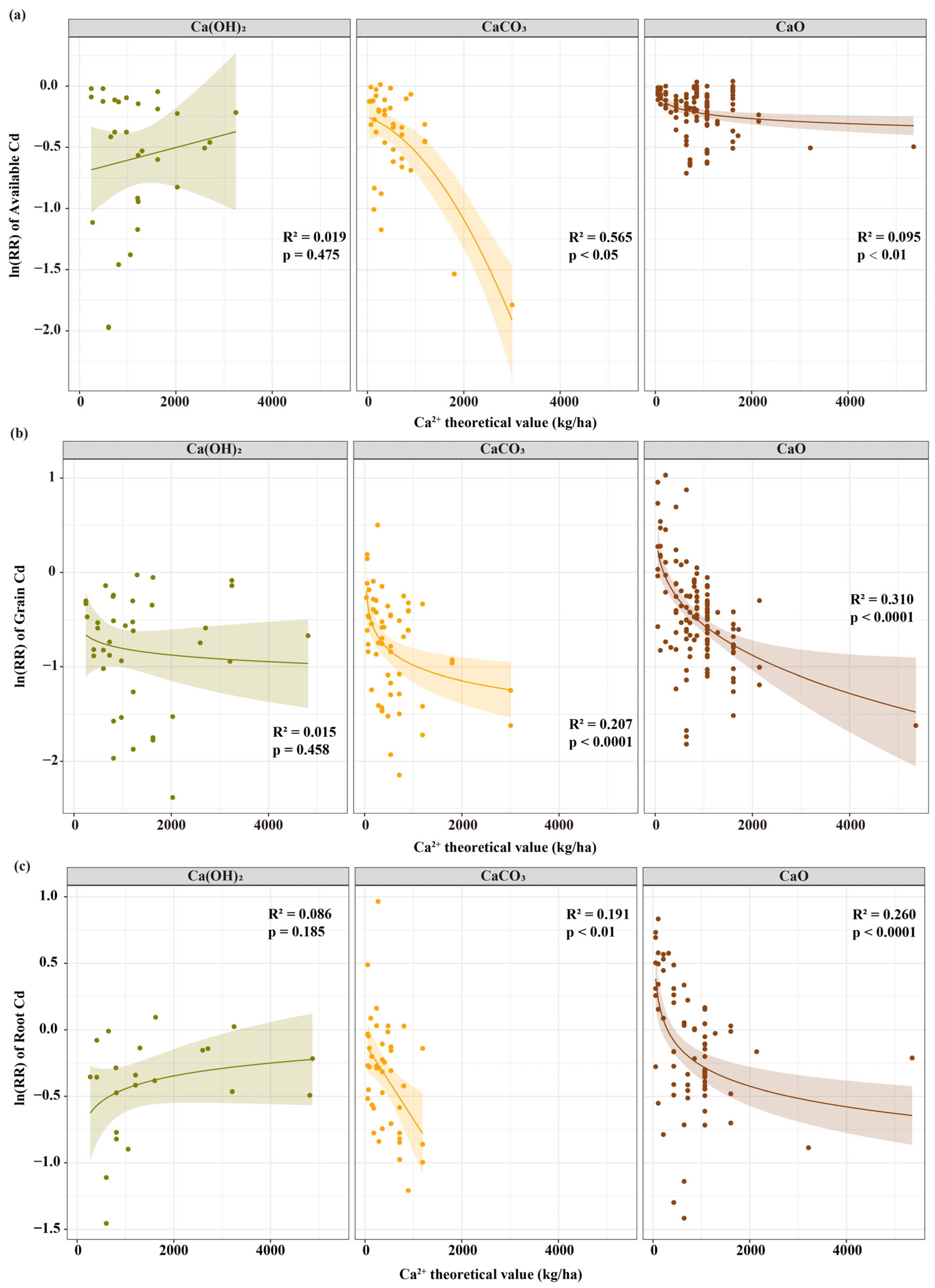
Mechanistic differences between the different lime-based materials were significant (Figure 4). CaO exhibited typical dose-dependent characteristics, primarily manifesting as a positive correlation between the grain Cd inhibition effects and the theoretical value for Ca2+ (R2 = 0.310, p < 0.001). Effects of CaCO3 were primarily achieved through ionic competition, with strong inhibition of soil available Cd at high doses (R2 = 0.565, p < 0.05), although the dose dependency of grain Cd was relatively weak (R2 = 0.207, p < 0.001). Ca(OH)2 primarily functioned through chemical fixation, with stable effects unaffected by dose variation (grain Cd: R2 = 0.015, p = 0.458), which is consistent with its chemical characteristics of rapid dissolution and immediate reactions.

3.3. Validation of Dual Mechanisms and Mechanistic Division of Three Lime-Based Materials

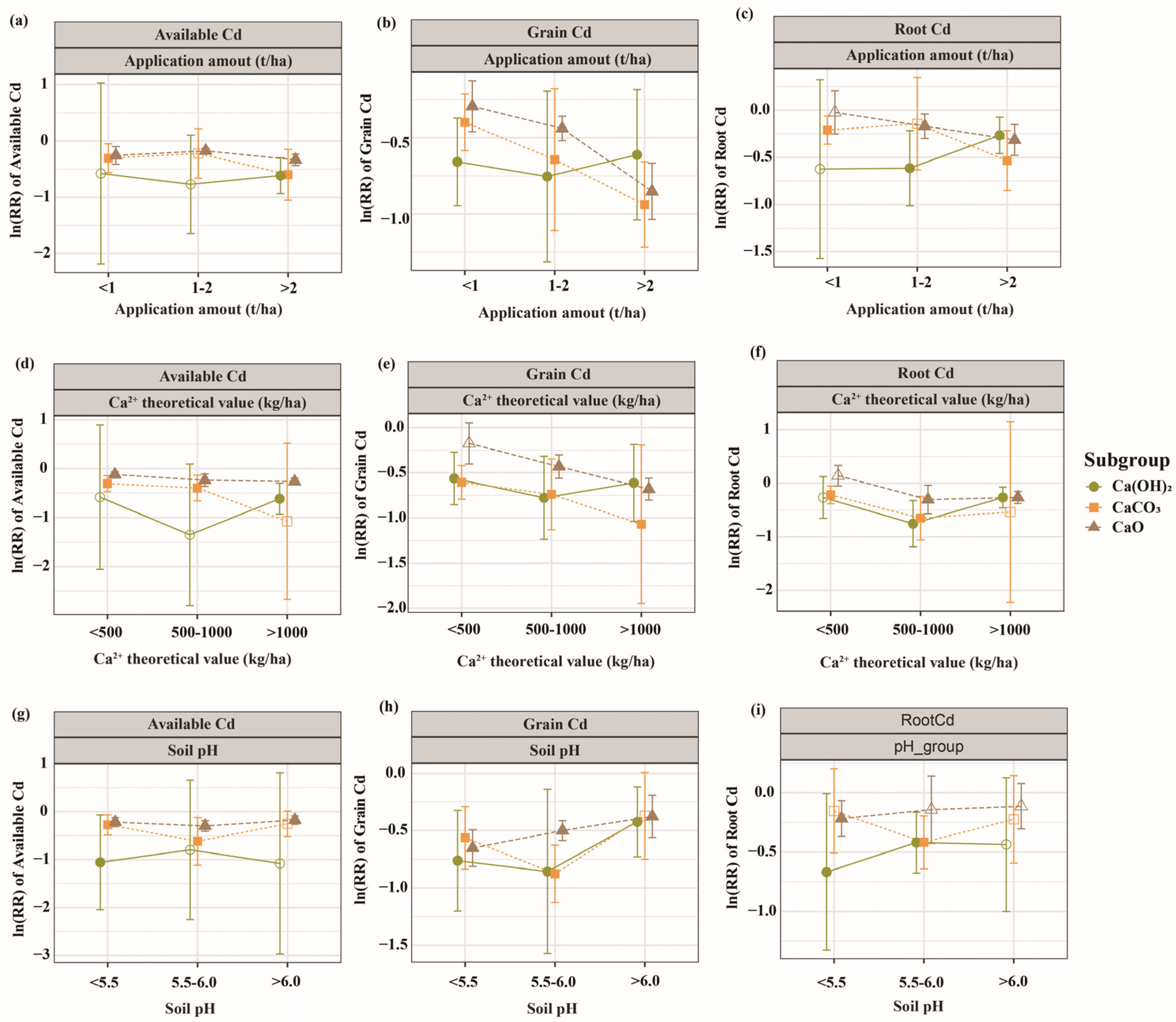
After categorizing Ca sources into three types, a subgroup analysis was conducted for each indicator, and further mechanistic validation analysis confirmed the collaborative division of chemical fixation and ionic competition (Figure 5). Under conditions of a high theoretical value for Ca2+ (>1000 kg/ha), all three lime-based materials demonstrated significant Cd inhibition, although their mechanistic contributions differed. CaCO3 achieved a grain Cd inhibition rate of 65.7% (p < 0.05, n = 7), primarily through ionic competition mechanisms; CaO reached 49.4% (p < 0.001, n = 64), achieved through dose-dependent dual mechanisms; and Ca(OH)2 attained 45.8% (p < 0.01, n = 19), primarily through chemical fixation mechanisms. The mechanistic characteristics of each lime-based material remained stable at different application rates. When application amount were < 1 t/ha, CaCO3 (26.5%, p < 0.05, n = 14) and CaO (22.7%, p < 0.01, n = 42) significantly reduced the available Cd content; whereas, Ca(OH)2 showed no significant effect on available Cd at low application rates (p > 0.05). When application amount exceeded 2 t/ha, the dominant mechanisms of each lime-based material were fully activated, with the ionic competition advantage of CaCO3 becoming more pronounced (grain Cd inhibition rate: 60.9%, p < 0.001, n = 25).
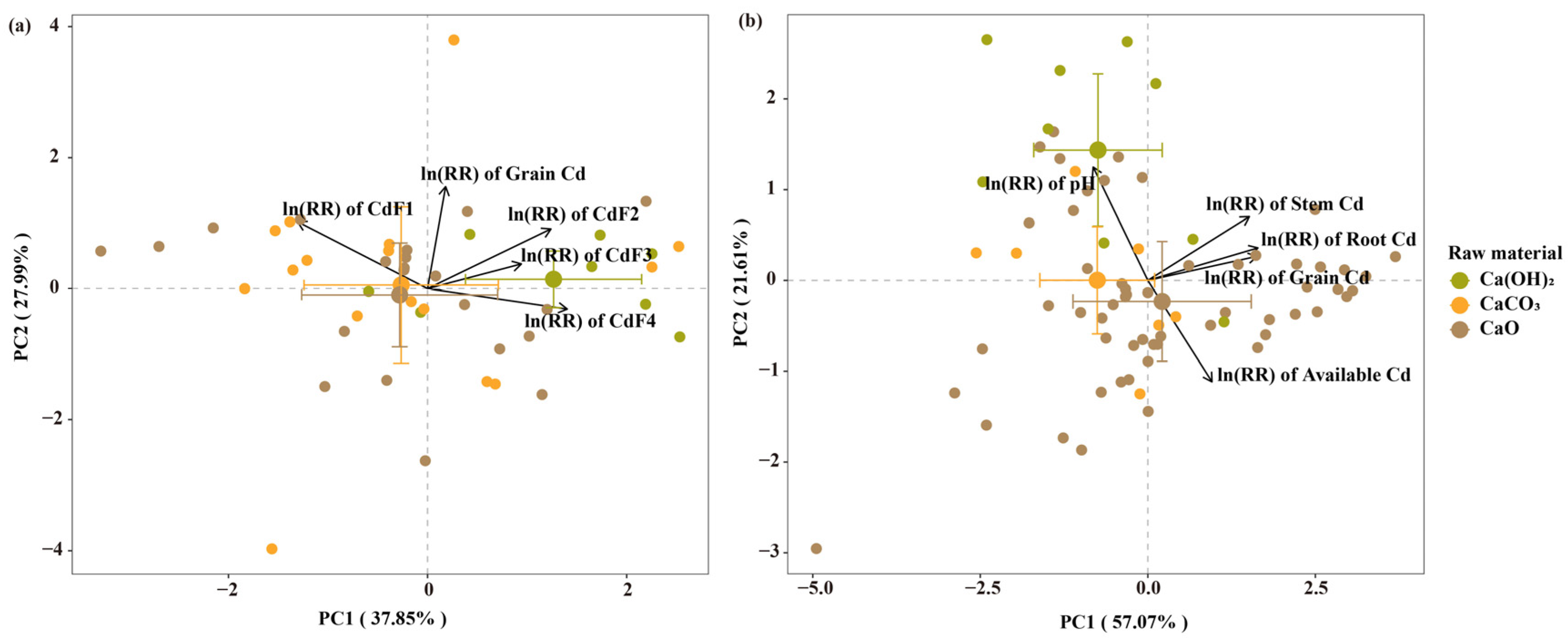
Principal component analysis (PCA) analysis systematically revealed the mechanistic division patterns of the three lime-based materials (Figure 6a). In the PCA analysis of the soil Cd speciation distribution, the first principal component (PC1) and second principal component (PC2) explained 37.85% and 27.99% of the total variation, respectively, cumulatively accounting for 65.84% of the variation. The CaO treatment group was primarily distributed in the positive region of PC1, showing positive correlations with CdF1 and reducible fraction of Cd (CdF2), indicating that it primarily activated dual mechanisms by affecting the soil chemical environment. The Ca(OH)2 treatment group was mainly distributed in the negative region of PC1, showing positive correlations with oxidizable fraction of Cd (CdF3) and CdF4, confirming the dominant role of Ca(OH)2 in chemical fixation mechanisms. The CaCO3 treatment group exhibited a dispersed distribution, demonstrating the diversity of its mechanistic actions, but was primarily associated with stable Cd formation.
In the PCA of plant Cd uptake, PC1 and PC2 explained 57.07% and 21.61% of the total variation, respectively, cumulatively accounting for 78.68% of the variation (Figure 6b). The CaO treatment group showed a strong positive correlation with soil pH, but exhibited negative correlations with available Cd, root Cd, shoot Cd, and grain Cd, reflecting the simultaneous activation of both chemical fixation and ionic competition processes by altering the soil chemical environment. The Ca(OH)2 treatment group was primarily positively correlated with available and root Cd, indicating that its chemical fixation effects primarily occurred at the soil–root interface. The CaCO3 treatment group was mainly negatively correlated with shoot and grain Cd, confirming that its ionic competition mechanism primarily functioned by blocking translocation processes within plants, which is consistent with its outstanding performance in controlling grain Cd.

4. Discussion

4.1. Dual Blocking Mechanisms of Lime-Based Materials in Regulating Cd Migration in Acidic Soil–Plant Systems

The meta-analysis results of this study demonstrated that lime-based material application exhibited systematic Cd inhibition effects in acidic soil–plant systems (Figure 1), which primarily manifested as a 33.0% reduction in soil available Cd and significant decreases in Cd content across all plant tissues (grain −44.8%, shoot −33.9%, root −24.6%). Simultaneously, soil physicochemical properties improved (pH increased by 15.2%, CEC increased by 29.5%, and exchangeable Ca increased by 35.2%). This systematic effect resulted from the combined action of soil chemical fixation and plant ionic competition [26]. Soil chemical fixation achieved source control by altering Cd speciation in the soil, whereas plant ionic competition realized terminal blocking by interrupting Cd bioaccumulation processes [27]. These two processes synergistically formed a complete regulatory chain from “source passivation” to “translocation blocking.” Mechanistic control of Cd contamination by lime-based materials primarily involved soil chemical fixation and ionic competition processes to achieve systematic control of Cd pollution from the soil chemical environment to plant physiological uptake.
First, lime-based material application significantly increased the soil pH values, creating alkaline conditions that were favorable for Cd ion precipitation and adsorption. With increasing pH values, Cd ions more readily combined with hydroxide to form Cd hydroxide precipitates, or with carbonate ions to form Cd carbonate precipitates, thereby reducing their concentration in soil solution [28]. The meta-analysis quantified this pH-dependent mechanism: each unit increase in pH corresponded to approximately 21% reduction in available Cd, demonstrating that pH serves as the primary kinetic driver controlling Cd solubility and subsequent bioavailability transformation. Additionally, Ca ion addition enhanced soil CEC, providing more adsorption sites for Cd ions [29]. High Ca ion concentrations could compete with Cd ions for binding sites on soil colloid surfaces while promoting Cd ion migration and transformation into more stable soil components [30]. This adsorption-mediated mechanism is inherently surface-area dependent: lime materials with higher specific surface area (typically Ca(OH)2 > CaO > CaCO3) provide greater reactive site density, directly correlating with the observed 58.7% available Cd reduction by Ca(OH)2 compared to 33.0% overall average. Soil Cd speciation analysis results supported this perspective (Figure 1), with significant increases in the CdF4 (29.5%) and significant decreases in CdF1 (17.5%), indicating that Ca source addition promoted Cd transformation from labile exchangeable forms to relatively stable organic-bound forms [31]. This speciation transformation is an important mechanism for soil Cd passivation. The dominance of chemical fixation over biological processes in controlling Cd removal is evidenced by the stronger correlation between pH changes and available Cd reduction (R2 = 0.856) compared to biological factors. This chemical-to-biological cascade determines that soil geochemical transformation serves as the primary rate-limiting step, directly governing plant Cd bioavailability and subsequent ecotoxicological risk through the food chain.
On the other hand, the ionic competition mechanism achieved Cd translocation blocking through competitive binding of Ca and Cd ions at adsorption sites and carrier proteins [32]. The strong negative correlation between exchangeable Ca ions and available Cd (R2 = 0.856) quantitatively confirmed the existence of this competitive effect (Figure S1), indicating that the Ca ion concentration was a key factor determining soil Cd bioavailability [6,33]. The ion competition mechanism at plant level was manifested as selective transport by carrier proteins [34]. The linear negative correlation between exchangeable Ca ions and grain Cd (R2 = 0.704) established a quantitative relationship between the soil Ca ion concentration and plant Cd accumulation, reflecting the competitive inhibitory effect of Ca ions on Cd ions at carrier proteins. These dual mechanisms are particularly significant for rice production systems, where the grain Cd inhibition rate of 44.8% observed in this meta-analysis directly addresses the primary pathway of human dietary Cd exposure through rice consumption [7]. Overall, lime-based material application synergistically reduced Cd bioavailability and plant accumulation at both soil and plant levels by increasing the soil pH and Ca ion content.

4.2. Mechanistic Differences of Three Lime-Based Materials in Cd Immobilization and Control and Long-Term Advantages of Calcium Carbonate

Significant differences in Cd inhibition performance among the three lime-based materials stemmed from their distinct dissolution characteristics and biogeochemical reaction pathways. The dissolution kinetics of lime-based materials constituted the fundamental factor determining their functional characteristics [35]. Ca(OH)2 exhibited relatively high solubility (approximately 1.65 g/L), enabling rapid release of substantial quantities of hydroxide and Ca ions, thereby producing immediate and intense alkalinization effects. CaCO3 demonstrated lower solubility (approximately 0.014 g/L); however, its dissolution process was regulated by soil carbon dioxide partial pressure, resulting in a slow yet sustained Ca ion release pattern [36,37]. CaO underwent hydration reactions to convert into Ca(OH)2, exhibiting intermediate behavior between the other two materials [38,39]. The immediate high-efficiency characteristics of Ca(OH)2 were comprehensively demonstrated in the experimental results (Figure 2); i.e., the greatest pH elevation (+27.4%), the most significant reduction in bioavailable Cd (−58.7%), and the strongest root Cd inhibition effect (−35.7%). This intense immediate effect originated from rapid release of hydroxide ions, which can dramatically alter the soil chemical environment within a short period, promoting Cd hydroxide precipitation formation while simultaneously activating Cd adsorption sites on iron–manganese oxide surfaces [4]. This rapid geochemical immobilization directly translates to reduced bioavailability, as evidenced by the 58.7% reduction in available Cd, which mechanistically prevents root uptake and limits trophic transfer to higher organisms, thereby mitigating ecotoxicological effects across the soil–plant–consumer continuum. However, such intense environmental chemical changes may also impose stress on soil ecosystems.
In contrast, although CaCO3 exhibited relatively moderate immediate effects (Figure 2a), it demonstrated the optimal performance in controlling grain Cd (−49.6%), which is crucial for rice where grain Cd accumulation poses the most severe food safety risk, reflecting its unique long-term advantages. This phenomenon stemmed from the self-adaptive response characteristics of CaCO3 to soil microenvironmental changes [40]. The crystalline structure of CaCO3 (calcite polymorph with rhombohedral lattice) exhibits lower dissolution enthalpy compared to amorphous Ca(OH)2, resulting in more gradual but sustained Ca2+ release kinetics that maintain optimal soil solution chemistry throughout extended crop growth periods, as reflected in its superior grain Cd control (−49.6%). CaCO3 underwent selective dissolution under rhizosphere acidic conditions, enabling dynamic regulation of Ca ion release rates according to plant requirements and soil conditions, thereby providing continuous and stable Ca ion supply throughout the entire crop growth period, particularly during the critical grain development stage [41,42]. This sustained supply of Ca ions was particularly crucial during grain filling, maintaining the competitive inhibition state of carrier proteins and effectively blocking long-distance Cd transport from phloem to grains [43], thus achieving long-term effective control of grain Cd accumulation.
Dose–response relationship analysis revealed distinct dose-dependent characteristics among different lime-based materials. CaO exhibited the strongest dose-dependent relationship (Figure 4), with grain Cd inhibition effects significantly enhanced as the theoretical values of Ca ions increased (R2 = 0.310, p < 0.001). Although CaCO3 showed relatively weak dose dependency (grain Cd: R2 = 0.210, p < 0.001), it demonstrated strong inhibition trends for soil bioavailable Cd under high-dose conditions (R2 = 0.570, p < 0.05). Notably, the dose effect of Ca(OH)2 was relatively inconspicuous, which may have been related to its rapid dissolution characteristics and immediate action mechanism [21,44]. Unlike previous studies that attributed CaCO3 efficacy primarily to pH buffering [16,17], our dose–response analysis reveals that sustained Ca2+ release—not merely pH stabilization—drives its superior grain Cd control, as evidenced by the strong negative correlation between exchangeable Ca and grain Cd (R2 = 0.704) persisting across diverse pH ranges. Subgroup analysis in this study revealed that when the theoretical values for Ca ions ranged from 500–1000 kg/ha (Figure 2), the reduction in soil bioavailable Cd was relatively substantial (−43.1%). When the theoretical values for Ca ions exceeded 1000 kg/ha, the reduction in grain Cd reached its maximum (−51.4%), a trend consistent with regression analysis results for CaO and CaCO3, indicating the existence of dominant process transitions under different dosage conditions.
This study found that Ca(OH)2 may be more suitable for situations requiring rapid soil Cd passivation, and that CaCO3 represents a more appropriate choice for long-term grain Cd prevention and control strategies. From a dose-effect perspective, both CaO and CaCO3 exhibited obvious dose dependency, whereas Ca(OH)2 effects remained relatively stable without significant influence from dosage variations. These findings provide an important reference for lime-based material selection and dosage determination for different application scenarios.

4.3. Mechanistic Analysis and Economic Feasibility Evaluation of Passivation Performance of Calcium Carbonate on Cd

Across all dosage ranges, CaCO3 demonstrated excellent control effects on grain Cd (Figure 5), particularly under high Ca ion theoretical value (>1000 kg/ha) conditions where grain Cd inhibition reached −65.7%, and was significantly superior to the other two lime-based materials. Primary pathways for Cd passivation by CaCO3 included carbonate precipitation and solid solution formation [45]. Carbonate ions released from CaCO3 dissolution can form Cd carbonate precipitates with Cd ions (Ksp = 1.8 × 10⁻¹⁴), and Cd ions can also substitute for Ca ions to enter calcite crystal lattices, forming Ca1−xCdxCO3 solid solution structures [40]. Due to the similar ionic radii of Cd ions (0.97 Å) and Ca ions (1.06 Å), Cd ions can partially occupy Ca ion positions in calcite lattices through isomorphous substitution, forming thermodynamically extremely stable solid solutions [46]. This lattice substitution not only significantly reduces Cd chemical activity but, more importantly, achieves long-term geochemical stability of Cd. Even when acidification or redox conditions change [47], lattice-incorporated Cd remains extremely difficult to reactivate.
The continuous release of Ca ions from CaCO3 ensures its stable effects under different application dosages. Unlike rapidly dissolving Ca(OH)2, CaCO3 possesses unique environmentally responsive dissolution characteristics: dissolution rates increase under acidic soil conditions to provide more Ca ions, and decrease under alkaline conditions to avoid excessive alkalization [48]. This self-regulatory mechanism ensures a dynamic equilibrium between Ca ion release and the soil environment [42,49]. More importantly, organic acids such as citric and malic acids secreted by plant roots can form localized acidification microzones in the rhizosphere, precisely regulating selective CaCO3 dissolution around root systems, achieving spatiotemporal precision matching of the Ca ion supply [14,43]. This rhizosphere-regulated continuous Ca ion supply mechanism ensures maintenance of effective ionic competition during critical periods of plant Cd uptake, particularly providing sustained protection during sensitive grain development stages [50,51]. This represents the core reason for the sustained advantages of CaCO3 in controlling grain Cd. Furthermore, it should be acknowledged that the efficacy of this ionic competition mechanism might be modulated by soil texture (e.g., clay vs. sand content), which dictates the soil’s cation exchange capacity and buffering potential, representing a critical variable to be explored in future investigations.
From an economic benefit perspective, CaCO3 demonstrated the optimal cost-effectiveness ratio for controlling grain Cd. Our research showed that at application rates > 2 t/ha, CaCO3, Ca(OH)2, and CaO significantly reduced the grain Cd content by 60.9%, 57.3%, and 45.8%, respectively (Figure 5). Based on international market pricing (CaCO3 production costs of 100–200 yuan (RMB)/ton, CaO at 400–600 yuan/t, and Ca(OH)2 at 700–1000 yuan/ton), in severely Cd-contaminated areas, the cost of CaCO3 application per 1% reduction in grain Cd is 1.6–3.3 yuan; whereas, CaO and Ca(OH)2 application costs are significantly higher, at 8.7–13.1 yuan and 12.2–17.4 yuan, respectively [35,52]. Crucially, the economic advantage of CaCO3 extends beyond its lower unit price. Unlike CaO and Ca(OH)2, which react rapidly and may necessitate more frequent re-application due to potential soil re-acidification, CaCO3 functions as a slow-release agent that maintains long-term geochemical stability. This sustained-release characteristic effectively extends the remediation interval, thereby significantly reducing cumulative labor costs and mechanical expenses over multiple cropping seasons. Additionally, CaCO3 production processes have relatively low energy consumption and superior environmental friendliness [53]. Therefore, comprehensively considering remediation effectiveness, economic costs, and environmental impacts, CaCO3 demonstrated optimal overall advantages in Cd-contaminated farmland remediation and is particularly suitable for large-scale applications.

5. Conclusions

This study systematically elucidated the dual mechanisms by which lime-based materials regulate Cd migration in acidic soil–plant systems through a meta-analysis, specifically addressing the synergistic effects of chemical fixation and ionic competition. The results demonstrated that lime-based material application significantly reduced soil bioavailable Cd (33.0%) and grain Cd accumulation (44.8%), while simultaneously increasing soil pH by an average of 15.6% and exchangeable Ca by 35.2%. This systematic Cd inhibition effect stemmed from the transformation of Cd speciation from mobile to stable forms (residual Cd increased by 29.5% and weak acid-extractable Cd decreased by 17.5%), and the strong ionic competition relationship between exchangeable Ca ions and grain Cd (R2 = 0.704). Importantly, this study revealed differentiated action modes of three major lime-based materials within the dual mechanism framework: Ca(OH)2 primarily functions through rapid chemical fixation mechanisms, resulting in the most significant reduction in soil bioavailable Cd (58.7%) and strong inhibition effects on root Cd (35.7%); CaO exhibited pronounced application dose-dependent characteristics, with grain Cd inhibition effects significantly enhanced as application rates increased (R2 = 0.31), and; CaCO3 demonstrated optimal performance in controlling grain Cd through continuous ionic competition processes, in particular achieving inhibition rates up to 65.7% under high application doses. These findings expand the theoretical understanding of lime-based passivation technology, elevating the mechanistic knowledge from simple pH regulation to a systematic framework of synergistic regulation through chemical fixation and ionic competition. The established theoretical framework not only provides new scientific foundations for soil heavy metal remediation but also establishes the basis for precision material-selection strategies based on dissolution kinetics, particularly highlighting the advantages of CaCO3 with regard to comprehensive performance and economic benefits. For rice production systems specifically, where grain Cd accumulation represents the primary human exposure pathway, CaCO3’s sustained ionic competition mechanism offers optimal long-term grain Cd control with economic viability. This research provides scientific support for standardized application of Cd-contaminated farmland remediation technologies.

Supplementary Materials

The following supporting information can be downloaded at: https://www.mdpi.com/article/10.3390/biology15030207/s1, Figure S1: Relationships between ln(RR) of exchangeable calcium and (a) available cadmium, (b) grain cadmium, (c) grain calcium; ln(RR) of root cadmium and (d) grain cadmium, (e) stem cadmium; (f) ln(RR) of stem cadmium and grain cadmium; Figure S2: Relationships between ln(RR) of soil pH and ln(RR) of exchangeable calcium (a), available cadmium (b), soil cation exchange capacity (c), grain cadmium (d), root cadmium (e) and stem cadmium (f). Figure S3: The weighted effect size of lime materials in soil under different subgroups. Vertical error bars indicate 95% confidence intervals. Figure S4: Relationships between the theoretical value for Ca2+ of lime materials and ln(RR) of soil available cadmium, soi exchangeable calcium, Grain Ca, Grain Cd, Root Cd, Stem Cd. Table S1: Results of publication bias about datasets in this study. “N” is the number of observations. Text S1. List of all articles included in this meta-analysis [54,55,56,57,58,59,60,61,62,63,64,65,66,67,68,69,70,71,72,73,74,75,76,77,78,79,80,81,82,83,84,85,86,87,88,89,90,91,92,93,94,95,96,97,98,99,100,101,102,103,104,105,106,107,108].

Author Contributions

J.Q. (Jianxun Qin) and Z.W.: Conceptualization, Data curation, Writing—original drafts, Visualization. B.W.: Visualization, Writing—review and editing. K.S. and Y.S.: Methodology, Project administration. S.H. and Y.Z.: Formal analysis, Data curation. J.Q. (Junyuan Qi) and Y.L.: Investigation, Data curation. All authors have read and agreed to the published version of the manuscript.

Funding

This work was supported by the Guangxi Key Research and Development Program project “Identification of Heavy Metal Pollution Risks and Research with Demonstration on Safe Land Use in Soils of the Guangxi Manganese Mining Area” (Grant No. AB24010136), the Guangxi Key Technologies R&D Program (Guike Nong AB2506910010, Guike Nong AB24153010), the National Natural Science Foundation of China (32260546), the Ba-Gui Talent Support Program of Guangxi (GXR-6BG2424009), the Academic NewcomerAward Program of Guangxi University (Grant no. 2025GXUXSXR10) and the Innovation Project of Guangxi Graduate Education (YCBZ2024020).

Institutional Review Board Statement

Not applicable.

Informed Consent Statement

Not applicable.

Data Availability Statement

Data will be provided as requested.

Conflicts of Interest

The authors declare no conflict of interest.

References

  1. Hussain, B.; Ashraf, M.N.; Shafeeq-ur-rahman, A.A.; Farooq, M. Cadmium stress in paddy fields: Effects of soil conditions and remediation strategies. Sci. Total Environ. 2021, 754, 142188. [Google Scholar] [CrossRef]
  2. Hou, D.; Jia, X.; Wang, L.; McGrath, S.P.; Zhu, Y.G.; Hu, Q.; Zhao, F.J.; Bank, M.S.; O’Connor, D.; Nriagu, J. Global soil pollution by toxic metals threatens agriculture and human health. Science 2025, 388, 705–709. [Google Scholar] [CrossRef]
  3. Ondrasek, G.; Shepherd, J.; Rathod, S.; Dharavath, R.; Rashid, M.I.; Brtnicky, M.; Shahid, M.S.; Horvatinec, J.; Rengel, Z. Metal contamination—A global environmental issue: Sources, implications & advances in mitigation. RSC Adv. 2025, 15, 3904–3927. [Google Scholar] [CrossRef]
  4. Li, X.; Shen, Q.; Zhang, D.; Mei, X.; Ran, W.; Xu, Y.; Yu, G. Functional groups determine biochar properties (pH and EC) as studied by combining results from pyrolysis and aqueous extraction. Environ. Sci. Technol. 2013, 58, 5234–5243. [Google Scholar] [CrossRef]
  5. Khan, S.; Cao, Q.; Zheng, Y.M.; Huang, Y.Z.; Zhu, Y.G. Health risks of heavy metals in contaminated soils and food crops irrigated with wastewater in Beijing, China. Environ. Pollut. 2008, 152, 686–692. [Google Scholar] [CrossRef] [PubMed]
  6. Rizwan, M.; Ali, S.; Adrees, M.; Rizvi, H.; Zia-ur-Rehman, M.; Hannan, F.; Qayyum, M.F.; Hafeez, F.; Ok, Y.S. Cadmium stress in rice: Toxic effects, tolerance mechanisms, and management: A critical review. Environ. Sci. Pollut. Res. 2016, 25, 17859–17879. [Google Scholar] [CrossRef]
  7. Wang, P.; Chen, H.; Kopittke, P.M.; Zhao, F.J. Cadmium contamination in agricultural soils of China and the impact on food safety. Environ. Pollut. 2019, 249, 1038–1048. [Google Scholar] [CrossRef] [PubMed]
  8. Li, R.; Yang, Y.; Lou, H.; Wang, W.; Du, R.; Chen, H.; Du, X.; Hu, S.; Wang, G.; Yan, J.; et al. Glutathione triggers leaf-to-leaf, calcium-based plant defense signaling. Nat. Commun. 2025, 16, 1915. [Google Scholar] [CrossRef]
  9. Islam, M.S.; Magid, A.S.I.A.; Chen, Y.; Weng, L.; Ma, J.; Arafat, M.Y.; Khan, Z.H.; Li, Y. Effect of calcium and iron-enriched biochar on arsenic and cadmium accumulation from soil to rice paddy tissues. Sci. Total Environ. 2021, 785, 147163. [Google Scholar] [CrossRef]
  10. Chen, H.; Zhang, W.; Yang, X.; Wang, P.; McGrath, S.; Zhao, F. Effective methods to reduce cadmium accumulation in rice grain. Chemosphere 2018, 207, 699–707. [Google Scholar] [CrossRef]
  11. Zhao, Q.; Wang, J.; Li, H.; Wang, Z.; Makar, R.S.; Yao, L.; Chen, Z.; Han, H. Phosphate-solubilizing bacteria reduce Cd accumulation in spinach by forming P–Ca adhesive films in the roots and altering the structure of soil macroaggregates. J. Hazard. Mater. 2025, 494, 138482. [Google Scholar] [CrossRef]
  12. Dai, M.; Zhang, L.; Li, J.; Zhu, C.; Song, L.; Huang, H.; Xu, C.; Li, Q.; Chen, L.; Jiang, C.; et al. Calcium regulates the physiological and molecular responses of Morus alba roots to cadmium stress. J. Hazard. Mater. 2024, 480, 136210. [Google Scholar] [CrossRef] [PubMed]
  13. Haider, F.U.; Liqun, C.; Coulter, J.A.; Cheema, S.A.; Wu, J.; Zhang, R.; Wenjun, M.; Farooq, M. Cadmium toxicity in plants: Impacts and remediation strategies. Ecotoxicol. Environ. Saf. 2021, 211, 111887. [Google Scholar] [CrossRef] [PubMed]
  14. Ahmad, M.; Rajapaksha, A.U.; Lim, J.E.; Zhang, M.; Bolan, N.; Mohan, D.; Vithanage, M.; Lee, S.S.; Ok, Y.S. Biochar as a sorbent for contaminant management in soil and water: A review. Chemosphere 2024, 99, 19–33. [Google Scholar] [CrossRef]
  15. Hamid, Y.; Tang, L.; Wang, X.; Hussain, B.; Yaseen, M.; Aziz, M.Z.; Yang, X. Organic soil additives for the remediation of cadmium contaminated soils and their impact on the soil-plant system: A review. Sci. Total Environ. 2020, 707, 136121. [Google Scholar] [CrossRef]
  16. Kong, L.; Guo, Z.; Peng, C.; Xiao, X.; He, Y. Factors influencing the effectiveness of liming on cadmium reduction in rice: A meta-analysis and decision tree analysis. Sci. Total Environ. 2021, 779, 146477. [Google Scholar] [CrossRef] [PubMed]
  17. He, L.; Huang, D.; Zhang, Q.; Zhu, H.; Xu, C.; Li, B.; Zhu, Q. Meta-analysis of the effects of liming on soil pH and cadmium accumulation in crops. Ecotoxicol. Environ. Saf. 2021, 223, 112621. [Google Scholar] [CrossRef]
  18. Peng, Y.; Li, X.; Wu, H.; Li, C.; Zhang, M.; Yang, H. Critical Review of Ca(OH)2/CaO Thermochemical Energy Storage Materials. Energies 2023, 16, 3019. [Google Scholar] [CrossRef]
  19. Wang, J.; Gu, Y.; Yuan, D.; Shen, Z.; Lv, F.; Wan, D.; Gao, Y.; Duan, Y.; Liang, Q.; Dai, Z.; et al. Research Progress and Key Technical Barriers in CaO/Ca(OH)2 Based Energy Storage: A Systematic Review. Clean Energy Sustain. 2025, 3, 10005. [Google Scholar] [CrossRef]
  20. Liu, H.; Chen, C.; Li, X.; Yang, P. Meta-analysis compares the effectiveness of modified biochar on cadmium availability. Front. Environ. Sci. 2024, 12, 1413047. [Google Scholar] [CrossRef]
  21. Liao, P.; Huang, S.; Zeng, Y.; Shao, H.; Zhang, J.; Griebigen, K.J. Liming increases yield and reduces grain cadmium concentration in rice paddies: A meta-analysis. Plant Soil 2021, 465, 157–169. [Google Scholar] [CrossRef]
  22. Hao, J.Q.; Feng, Y.Z.; Wang, X.; Yu, Q.; Zhang, F.; Yang, G.L.; Ren, D.X.; Han, X.H.; Wang, X.J.; Ren, C.J. Soil microbial nitrogen-cycling gene abundances in response to crop diversification: A meta-analysis. Sci. Total Environ. 2022, 838, 156621. [Google Scholar] [CrossRef]
  23. Elrys, A.S.; Wen, Y.; Feng, D.; El-Mekkawy, R.M.; Kong, M.; Qin, X.; Lu, Q.; Dan, X.; Zhu, Q.; Tang, S.; et al. Cadmium inhibits carbon and nitrogen cycling through soil microbial biomass and reduces soil nitrogen availability. J. Hazard. Mater. 2025, 489, 137524. [Google Scholar] [CrossRef] [PubMed]
  24. Gao, Y.; Tan, Z.Y.; Wang, H.; Zhu, Y.N. Nitrogen fertilization and the rhizosphere effect on nitrogen cycling: A meta-analysis. Appl. Soil Ecol. 2023, 186, 104788. [Google Scholar] [CrossRef]
  25. Rosenberg, M.S.; Adamsm, D.C.; Gurevitch, J. MetaWin: Statistical Software for Meta-Analysis, version 2.1; Sinauer Associates: Sunderland, MA, USA, 2000.
  26. Hepler, P.K. Calcium: A Central Regulator of Plant Growth and Development. Plant Cell 2005, 17, 2142–2155. [Google Scholar] [CrossRef]
  27. Sterckeman, T. Soil to plant transfer of cadmium. OCL—Oilseeds and Fats. Crops Lipids 2025, 32, 14. [Google Scholar] [CrossRef]
  28. Qin, S.; Liu, H.; Nie, Z.; Rengel, Z.; Gao, W.; Li, C.; Zhao, P. Toxicity of cadmium and its competition with mineral nutrients for uptake by plants: A review. Pedosphere 2020, 30, 168–180. [Google Scholar] [CrossRef]
  29. Fan, J.; Cai, C.; Chi, H.; Reid, B.; Coulon, F.; Zhang, Y.; Hou, Y. Remediation of cadmium and lead polluted soil using thiol-modified biochar. J. Hazard. Mater. 2020, 388, 122037. [Google Scholar] [CrossRef]
  30. Wei, B.; Peng, Y.; Jeyakumar, P.; Lin, L.; Zhang, D.; Yang, M.; Zhu, J.; Ki Lin, C.S.; Wang, H.; Wang, Z.; et al. Soil pH restricts the ability of biochar to passivate cadmium: A meta-analysis. Environ. Res. 2022, 219, 115110. [Google Scholar] [CrossRef]
  31. Liu, L.; Song, W.; Guo, M. Remediation techniques for heavy metal-contaminated soils: Principles and applicability. Sci. Total Environ. 2018, 633, 206–219. [Google Scholar] [CrossRef]
  32. Bian, R.; Li, L.; Bao, D.; Zheng, J.; Zhang, X.; Zheng, J.; Liu, X.; Cheng, K.; Pan, G. Cd immobilization in a contaminated rice paddy by inorganic stabilizers of calcium hydroxide and silicon slag and by organic stabilizer of biochar. Environ. Sci. Pollut. Res. 2016, 23, 10028–10036. [Google Scholar] [CrossRef]
  33. Sebastian, A.; Prasad, M.N.V. Cadmium minimization in rice. A review. Agron. Sustain. Dev. 2014, 34, 155–173. [Google Scholar] [CrossRef]
  34. Wang, Y.; Blatt, M.R.; Chen, Z. Ion Transport at the Plant Plasma Membrane. In eLS; John Wiley & Sons, Ltd.: Hoboken, NJ, USA, 2018; p. 20. [Google Scholar] [CrossRef]
  35. Antoniadis, V.; Levizou, E.; Shaheen, S.M.; Ok, Y.S.; Sebastian, A.; Baum, C.; Prasad, M.N.V.; Wenzel, W.W.; Rinklebe, J. Trace elements in the soil-plant interface: Phytoavailability, translocation, and phytoremediation—A review. Earth-Sci. Rev. 2017, 171, 621–645. [Google Scholar] [CrossRef]
  36. Han, Y.; Ucak-Astarlioglu, M.G.; Burroughs, J.F.; Bullard, J.W. Calcium hydroxide dissolution rates: Dependence on temperature and saturation. Chem. Eng. J. 2025, 515, 162484. [Google Scholar] [CrossRef]
  37. Dou, X.; Zhang, J.; Zhang, C.; Ma, D.; Chen, L.; Zhou, G.; Li, J.; Duan, Y. Calcium carbonate regulates soil organic carbon accumulation by mediating microbial communities in northern China. Catena 2023, 231, 107327. [Google Scholar] [CrossRef]
  38. Rodriguez-Navarro, C.; Kudlacz, K.; Cizer, Ö.; Ruiz-Agudo, E. Formation of amorphous calcium carbonate and its transformation into mesostructured calcite. CrystEngComm 2013, 14, 83–90. [Google Scholar] [CrossRef]
  39. Stumm, W.; Morgan, J.J. Aquatic Chemistry: Chemical Equilibria and Rates in Natural Waters, 3rd ed.; John Wiley & Sons: Hoboken, NJ, USA, 1996. [Google Scholar]
  40. Zhang, L.; Wang, W.; Yue, C.; Si, Y. Biogenic calcium improved Cd2+ and Pb2+ immobilization in soil using the ureolytic bacteria Bacillus pasteurii. Sci. Total Environ. 2024, 921, 171060. [Google Scholar] [CrossRef] [PubMed]
  41. Plummer, L.N.; Busenberg, E. The solubilities of calcite, aragonite and vaterite in CO2-H2O solutions between 0 and 90 °C, and an evaluation of the aqueous model for the system CaCO3-CO2-H2O. Geochim. Cosmochim. Acta 1982, 46, 1011–1040. [Google Scholar] [CrossRef]
  42. Moral, R.; Gilkes, R.J.; Jordán, M.M. Distribution of Heavy Metals in Calcareous and Non-Calcareous Soils in Spain. Water Air Soil Pollut. 2015, 162, 127–142. [Google Scholar] [CrossRef]
  43. Kumar, V.; Pandita, S.; Singh Sidhu, G.P.; Sharma, A.; Khanna, K.; Kaur, P.; Bali, A.S.; Chen, S. Copper bioavailability, uptake, toxicity and tolerance in plants: A comprehensive review. Chemosphere 2021, 262, 127810. [Google Scholar] [CrossRef]
  44. Argüello, D.; Chavez, E.; Gutierrez, E.; Pittomvils, M.; Dekeyrel, J.; Blommaert, H.; Smolders, E. Soil amendments to reduce cadmium in cacao (Theobroma cacao L.): A comprehensive field study in Ecuador. Chemosphere 2023, 324, 138318. [Google Scholar] [CrossRef]
  45. Li, Y.; Zhang, M.; Wang, X.; Ai, S.; Meng, X.; Liu, Z.; Yang, F.; Cheng, K. Synergistic enhancement of cadmium immobilization and soil fertility through biochar and artificial humic acid-assisted microbial-induced calcium carbonate precipitation. J. Hazard. Mater. 2024, 476, 135140. [Google Scholar] [CrossRef] [PubMed]
  46. Sun, Y.; Sun, G.; Xu, Y.; Wang, L.; Lin, D.; Liang, X.; Shi, X. In situ stabilization remediation of cadmium contaminated soils of wastewater irrigation region using sepiolite. J. Environ. Sci. 2012, 24, 1799–1805. [Google Scholar] [CrossRef] [PubMed]
  47. Lyu, H.; Gao, B.; He, F.; Zimmerman, A.R.; Ding, C.; Huang, H.; Tang, J. Effects of ball milling on the physicochemical and sorptive properties of biochar: Experimental observations and governing mechanisms. Environ. Pollut. 2018, 233, 54–63. [Google Scholar] [CrossRef] [PubMed]
  48. Yu, X.; Keitel, C.; Dijkstra, F.D. Ameliorating soil acidity with calcium carbonate and calcium hydroxide: Effects on carbon, nitrogen, and phosphorus dynamics. J. Soil Sci. Plant Nutr. 2023, 23, 5270–5278. [Google Scholar] [CrossRef]
  49. Appelo, C.A.J.; Postma, D. Geochemistry, Groundwater and Pollution; CRC Press: Boca Raton, FL, USA, 2005. [Google Scholar] [CrossRef]
  50. Inoue, J.; Teramoto, T.; Kazama, T.; Nakamura, T. Engineering rice Nramp5 modifies cadmium and manganese uptake selectivity using yeast assay system. Front. Plant Sci. 2024, 15, 1482099. [Google Scholar] [CrossRef]
  51. Sasaki, A.; Yamaji, N.; Yokosho, K.; Ma, J.F. Nramp5 is a major transporter responsible for manganese and cadmium uptake in rice. Plant Cell 2012, 24, 2155–2167. [Google Scholar] [CrossRef]
  52. Enesi, R.O.; Dyck, M.; Chang, S.; Thilakarathna, M.S.; Fan, X.; Stelkov, S.; Gorim, L.Y. Liming remediates soil acidity and improves crop yield and profitability—A meta-analysis. Front. Agron. 2023, 5, 1194896. [Google Scholar] [CrossRef]
  53. Mattila, H.P.; Hudd, H.; Zevenhoven, R. Cradle-to-gate life cycle assessment of precipitated calcium carbonate production from steel converter slag. J. Clean. Prod. 2014, 84, 611–618. [Google Scholar] [CrossRef]
  54. Cao, S.; Zhou, W.; Zhou, Y.; Luo, S. The Cadmium Reduction Effect of Silicon Calcium Magnesium Soil Conditioner on Acid Cadmium Polluted Soil and Rice. J. Henan Agric. Sci. 2017, 46, 54–58. [Google Scholar]
  55. Chen, H.; Wang, P.; Chang, J.; Kopittke, P.M.; Zhao, F. Producing Cd-safe rice grains in moderately and seriously Cd-contaminated paddy soils. Chemosphere 2021, 267, 128893. [Google Scholar] [CrossRef]
  56. Cheng, Z.; Shi, J.; He, Y.; Wu, L.; Xu, J. Assembly of root-associated bacterial community in cadmium contaminated soil following five-year consecutive application of soil amendments: Evidences for improved soil health. J. Hazard. Mater. 2022, 426, 128095. [Google Scholar] [CrossRef]
  57. Dai, Y.; Yang, Y.; Fu, K.; Li, Y.; Wang, M.; Chen, W. Effects and application risk of liming on cadmium uptake by rice. Chin. J. Environ. Eng. 2021, 15, 1473–1480. [Google Scholar]
  58. Dong, H.; Tang, S.; Ye, S.; Zhao, M.; Li, H.; Wang, G. Effect of lime on the transfer of Cd and Pb in the soil-rice cultivation system and their accumulation in the rice grains. J. Saf. Environ. 2016, 16, 226–231. [Google Scholar] [CrossRef]
  59. Duan, M.; Wang, S.; Huang, D.; Zhu, Q.; Liu, S.; Zhang, Q.; Zhu, H.; Xu, C. Effectiveness of simultaneous applications of lime and zinc/iron foliar sprays to minimize cadmium accumulation in rice. Ecotoxicol. Environ. Saf. 2018, 165, 510–515. [Google Scholar] [CrossRef] [PubMed]
  60. Gong, L.; Chen, K.; Li, D.; Cai, M.; Wang, J.; Zhang, Q. Remediation effects of mixed amendment at different application levels on cadmium-contaminated farmland soil. J. Zhejiang Univ. (Agric. Life Sci.) 2022, 48, 359–368. [Google Scholar] [CrossRef]
  61. Guo, F.; Ding, C.; Zhou, Z.; Huang, G.; Wang, X. Effects of combined amendments on crop yield and cadmium uptake in two cadmium contaminated soils under rice-wheat rotation. Ecotoxicol. Environ. Saf. 2018, 148, 303–310. [Google Scholar] [CrossRef]
  62. Hamid, Y.; Liu, L.; Usman, M.; Tang, L.; Lin, Q.; Rashid, M.S.; Ulhassan, Z.; Hussain, I.M.; Yang, X. Organic/inorganic amendments for the remediation of a red paddy soil artificially contaminated with different cadmium levels: Leaching, speciation, and phytoavailability tests. J. Environ. Manag. 2022, 303, 114148. [Google Scholar] [CrossRef]
  63. Hamis, Y.; Tang, L.; Hussain, B.; Usman, M.; Gurajala, H.K.; Rashid, M.S.; He, Z.; Yang, X. Efficiency of lime, biochar, Fe containing biochar and composite amendments for Cd and Pb immobilization in a co-contaminated alluvial soil. Environ. Pollut. 2020, 257, 113609. [Google Scholar] [CrossRef]
  64. He, Y.; Huang, D.; Zhu, Q.; Wang, S.; Liu, S.; He, H.; Zhu, H.; Xu, C. A three-season field study on the in-situ remediation of Cd-contaminated paddy soil using lime, two industrial by-products, and a low-Cd-accumulation rice cultivar. Ecotoxicol. Environ. Saf. 2017, 136, 135–141. [Google Scholar] [CrossRef]
  65. Hu, H.; Gao, L.; Zhang, H.; Zhou, X.; Zheng, J.; Hu, J.; Hu, H.; Ma, Y. Effectiveness of Passivator Amendments and Optimized Fertilization for Ensuring the Food Safety of Rice and Wheat from Cadmium-Contaminated Farmland. Sustainability 2022, 14, 15026. [Google Scholar] [CrossRef]
  66. Huang, B.; Wu, Q.; Xiao, H.; Meng, X.; Wu, J. Effects of continuous application of lime for three years on cadmium concentration and uptake by wheat and rice in Cd contaminated soil. Soil Fertil. Sci. China 2020, 3, 138–143. [Google Scholar]
  67. Huang, G.; Ding, C.; Hu, Z.; Cui, C.; Zhang, T.; Wang, X. Topdressing iron fertilizer coupled with pre-immobilization in acidic paddy fields reduced cadmium uptake by rice (Oryza sativa L.). Sci. Total Environ. 2018, 636, 1040–1047. [Google Scholar] [CrossRef] [PubMed]
  68. Huang, G.; Ding, C.; Guo, N.; Ding, M.; Zhang, H.; Kamran, M.; Zhou, Z.; Zhang, T.; Wang, X. Polymer-coated manganese fertilizer and its combination with lime reduces cadmium accumulation in brown rice (Oryza sativa L.). J. Hazard. Mater. 2021, 415, 125597. [Google Scholar] [CrossRef] [PubMed]
  69. Huang, Y.; Sheng, H.; Zhou, P.; Zhang, Y. Remediation of Cd-contaminated acidic paddy fields with four-year consecutive liming. Ecotoxicol. Environ. Saf. 2020, 188, 109903. [Google Scholar] [CrossRef]
  70. Huang, Y.; Liao, M.; Ye, Z.; Ting, L. Cd Concentrations in Two Low Cd Accumulating Varieties of Rice and Their Relationships With Soil Cd Content and Their Regulation Under Field Conditions. J. Ecol. Rural. Environ. 2017, 33, 748–754. [Google Scholar] [CrossRef]
  71. Hamid, Y.; Tang, L.; Lu, M.; Hussain, B.; Zehra, A.; Khan, M.B.; He, Z.; Gurajala, H.K.; Yang, X. Assessing the immobilization efficiency of organic and inorganic amendments for cadmium phytoavailability to wheat. J. Soil Sediments 2019, 19, 3708–3717. [Google Scholar] [CrossRef]
  72. Hamid, Y.; Tang, L.; Wang, X.; Hussain, B.; Yassen, M.; Aziz, M.Z.; Yang, X. Immobilization of cadmium and lead in contaminated paddy field using inorganic and organic additives. Sci. Rep. 2018, 8, 17839. [Google Scholar] [CrossRef]
  73. Li, B.; Yang, L.; Wang, C.; Zheng, S.; Xiao, R.; Guo, Y. Effects of organic-inorganic amendments on the cadmium fraction in soil and its accumulation in rice (Oryza sativa L.). Environ. Sci. Pollut. Res. Int. 2018, 26, 13762–13772. [Google Scholar] [CrossRef]
  74. Li, D.; Liu, H.; Gao, M.; Zhou, J.; Zhou, J. Effects of soil amendments, foliar sprayings of silicon and selenium and their combinations on the reduction of cadmium accumulation in rice. Pedosphere 2022, 32, 649–659. [Google Scholar] [CrossRef]
  75. Li, F.; Ai, S.; Wang, Y.; Tang, M.; Li, Y. In Situ Field-Scale Remediation of Low Cd-Contaminated Paddy Soil Using Soil Amendments. Water Air Soil Pollut. 2016, 227, 342. [Google Scholar] [CrossRef]
  76. Li, G.; Cheng, Q.; Cheng, H. Remediation of Cd Contaminated Acidic Rice Fields Using the Combined Application of Lime and Organic Matter. Environ. Sci. 2021, 42, 925–931. [Google Scholar] [CrossRef]
  77. Li, P.; Wang, X.; Zhang, T.; Zhou, D.; He, Y. Distribution and Accumulation of Copper and Cadmium in Soil–Rice System as Affected by Soil Amendments. Water Air Soil Pollut. 2009, 196, 29–40. [Google Scholar] [CrossRef]
  78. Li, X.; Long, J.; Peng, P.; Chen, Q.; Dong, X.; Jiang, K.; Hou, H.; Liao, B. Evaluation of Calcium Oxide of Quicklime and Si–Ca–Mg Fertilizer for Remediation of Cd Uptake in Rice Plants and Cd Mobilization in Two Typical Cd-Polluted Paddy Soils. Int. J. Environ. Res. 2018, 12, 877–885. [Google Scholar] [CrossRef]
  79. Li, X.; Yang, C.; Liu, Y.; Zhang, M.; Sun, X.; Zhou, Y.; Yin, W.; Wang, S.; Wang, X. Effect of Passivators on Cd Availability in Farmland Soil and Cd Uptake by Different Rice Varieties. Environ. Eng. 2021, 39, 211–216. [Google Scholar] [CrossRef]
  80. Liu, B.; Ji, X.; Peng, H.; Tian, F.; Wu, J.; Shi, L. Effects of phosphorous fertilizers on phytoavailability of cadmium in its contaminated soil and related mechanisms. Chin. J. Appl. Ecol. 2012, 23, 1585–1590. [Google Scholar]
  81. Liu, Z.; Huang, Y.; Ji, X.; Xie, Y.; Peng, J.; Eissa, M.A.; Fahmy, A.; Abou-Elwafa, S.F. Effects and Mechanism of Continuous Liming on Cadmium Immobilization and Uptake by Rice Grown on Acid Paddy Soils. J. Soil Sci. Plant Nutr. 2020, 20, 2316–2328. [Google Scholar] [CrossRef]
  82. Lu, J.; Gong, L.; Cai, M.; Zhang, G.; Zhang, Q. Study on the Passivation Effect of Minerals on Cd in Farmland Soil with Light Heavy Metal Pollution. J. Ecol. Rural. Environ. 2022, 38, 391–398. [Google Scholar] [CrossRef]
  83. Luo, W.; Yang, S.; Khan, M.A.; Ma, J.; Xu, W.; Li, Y.; Xiang, Z.; Jin, G.; Zhong, B.; Duan, L.; et al. Mitigation of Cd accumulation in rice with water management and calcium-magnesium phosphate fertilizer in field environment. Environ. Geochem. Health 2020, 42, 3877–3886. [Google Scholar] [CrossRef]
  84. Meng, L.; Huang, T.; Shi, J.; Chen, J.; Zhong, F.; Wu, L.; Xu, J. Decreasing cadmium uptake of rice (Oryza sativa L.) in the cadmium-contaminated paddy field through different cultivars coupling with appropriate soil amendments. J. Soils Sediments 2018, 19, 1788–1798. [Google Scholar] [CrossRef]
  85. Shi, L.; Guo, Z.; Liang, F.; Peng, C.; Xiao, X.; Feng, W. Effects of lime and water management on uptake and translocation of cadmium in rice. Trans. Chin. Soc. Agric. Eng. 2017, 33, 111–117. [Google Scholar]
  86. Shi, L.; Guo, Z.; Liu, S.; Xiao, X.; Peng, C.; Feng, W.; Ran, H.; Zeng, P. Effects of combined soil amendments on Cd accumulation, translocation and food safety in rice: A field study in southern China. Environ. Geochem. Health 2021, 44, 2451–2463. [Google Scholar] [CrossRef]
  87. Shi, L.; Guo, Z.; Peng, C.; Xiao, X.; Xue, Q.; Ran, H.; Feng, W. Lime based amendments inhibiting uptake of cadmium in rice planted in contaminated soils. Trans. Chin. Soc. Agric. Eng. 2018, 34, 209–216. [Google Scholar] [CrossRef]
  88. Shi, L.; Guo, Z.; Peng, C.; Xiao, X.; Feng, W.; Huang, B.; Ran, H. Immobilization of cadmium and improvement of bacterial community in contaminated soil following a continuous amendment with lime mixed with fertilizers: A four-season field experiment. Ecotoxicol. Environ. Saf. 2019, 171, 425–434. [Google Scholar] [CrossRef]
  89. Tang, X.; Zhou, X.; Huang, F.; Zhou, J. Study on the Effect of Comprehensive Treatment Technology on Rice Cadmium Content Under Different Cd Polluted Cultivated Land. J. Ecol. Rural. Environ. 2020, 36, 1339–1346. [Google Scholar] [CrossRef]
  90. Tian, F.; Ji, X.; Xie, Y.; Wu, J.; Guang, D. Alkaline slow-release fertilizer decreased rice Cd uptake at Cd-contaminated paddy fields. J. Agro-Environ. Sci. 2016, 35, 2116–2122. [Google Scholar]
  91. Wang, X.; Zhang, D.; Zhao, S.; Su, Q.; Lu, J.; Dai, Y. Safe Utilization Effect of Passivator, Foliar Inhibitor, and Their Combined Application on Cadmium-contaminated Farmland. Environ. Sci. 2024, 45, 7237–7244. [Google Scholar]
  92. Xiao, M.; Fan, J.; Wang, H.; Xu, C.; Zhang, Q.; Chen, X.; Zhu, H.; Zhu, H.; Huang, D. Effect of Chinese milk vetch combined with lime on cadmium uptake and translocation in rice. China Environ. Sci. 2022, 42, 276–284. [Google Scholar]
  93. Xiao, R.; Huang, Z.; Li, X.; Chen, W.; Deng, Y.; Han, C. Lime and Phosphate Amendment Can Significantly Reduce Uptake of Cd and Pb by Field-Grown Rice. Sustainability 2017, 9, 430. [Google Scholar] [CrossRef]
  94. Xie, Y.; Ji, X.; Tian, F.; Wu, J.; Liu, Z.; Guan, D. Effect of passivator on Cd uptaking of rice in different Cd pollution characteristics paddy soils. Chin. J. Environ. Eng. 2017, 11, 1242–1250. [Google Scholar]
  95. Yan, D.; Guo, Z.; Huang, F.; Ran, H.; Zhang, L. Effect of Calcium Magnesium Phosphate on Remediation Paddy Soil Contaminated with Cadmium Using Lime and Sepiolite. Environ. Sci. 2020, 41, 1491–1497. [Google Scholar] [CrossRef]
  96. Yang, D.; Li, X.; Zhou, Y.; Luo, L.; Xie, Y.; Wang, P.; Li, X. Effects of straw returning with different lime dosages on Cd accumulation in rice. J. Agro-Environ. Sci. 2021, 40, 6. [Google Scholar] [CrossRef]
  97. Yang, R.; Chen, X.; Zhang, Y.; Cui, J.; Wu, L.; Ma, Y.; Liao, J.; He, H. Effects of Nano Material on Cadmium Accumulation Capacity and Grain Yield of Indica Hybrid Rice Under Wetting-drying Alternation Irrigation. Environ. Sci. 2021, 42, 1. [Google Scholar] [CrossRef]
  98. Yuan, C.; Li, B.; Zhu, R.; Yao, D.; Zhan, F.; Chen, J.; Zu, Y.; He, Y.; Li, Y. Immobilization of Cd and Pb using different amendments of cultivated soils around lead-zinc mines. J. Agro-Environ. Sci. 2019, 38, 807–817. [Google Scholar]
  99. Yuan, F.; Tang, X.; Wu, J.; Zhao, K.; Ye, Z. Simultaneous immobilization of arsenic and cadmium in paddy soil by Fe-Mn binary oxide: A field-scale study. Environ. Sci. 2021, 42, 3535–3548. [Google Scholar] [CrossRef]
  100. Yang, Y.; Chen, J.; Huang, Q.; Tang, S.; Wang, J.; Hu, P.; Shao, G. Can liming reduce cadmium (Cd) accumulation in rice (Oryza sativa) in slightly acidic soils? A contradictory dynamic equilibrium between Cd uptake capacity of roots and Cd immobilisation in soils. Chemosphere 2018, 193, 547–556. [Google Scholar] [CrossRef]
  101. Zeng, T.; Khaliq, M.A.; Li, H.; Jayasuriya, P.; Guo, J.; Li, Y.; Wang, G. Assessment of Cd availability in rice cultivation (Oryza sativa): Effects of amendments and the spatiotemporal chemical changes in the rhizosphere and bulk soil. Ecotoxicol. Environ. Saf. 2020, 196, 110490. [Google Scholar] [CrossRef]
  102. Zhang, J.; Kong, F.; Lu, S. Remediation Effect and Mechanism of Inorganic Passivators on Cadmium Contaminated Acidic Paddy Soil. Environ. Sci. 2022, 43, 4679–4686. [Google Scholar] [CrossRef]
  103. Zhang, S.; Quan, L.; Zhu, Y.; Yan, J.; He, X.; Zhang, J.; Xu, X.; Hu, Z.; Hu, F.; Chen, Y.; et al. Differential effects of three amendments on the immobilisation of cadmium and lead for Triticum aestivum grown on polluted soil. Environ. Sci. Pollut. Res. 2020, 27, 40434–40442. [Google Scholar] [CrossRef]
  104. Zhang, Q.; Zhang, L.; Liu, T.; Liu, B.; Huang, D.; Zhu, Q.; Xu, C. The influence of liming on cadmium accumulation in rice grains via iron-reducing bacteria. Sci. Total Environ. 2018, 645, 109–118. [Google Scholar] [CrossRef]
  105. Zhang, Z.; Ji, X.; Xie, Y.; Guan, D.; Peng, H.; Zhu, J.; Tian, F. Effects of quicklime application at different rice growing stage on the cadmium contents in rice grain. J. Agro-Environ. Sci. 2016, 35, 1867–1872. [Google Scholar]
  106. Zhao, Y.; Zhang, C.; Wang, C.; Huang, Y.; Liu, Z. Increasing phosphate inhibits cadmium uptake in plants and promotes synthesis of amino acids in grains of rice. Environ. Pollut. 2020, 257, 113496. [Google Scholar] [CrossRef]
  107. Zhou, L.; Xiao, F.; Xiao, H.; Zhang, Y.; Ao, H. Effects of Lime on Cadmium Accumulation of Double-Season Rice in Paddy Fields with Different Cadmium Pollution Degrees. Sci. Agric. Sin. 2021, 54, 780–791. [Google Scholar] [CrossRef]
  108. Zhu, Q.; Huang, D.; Zhu, G.; Ge, T.; Liu, G.; Zhu, H.; Liu, S.; Zhang, X. Sepiolite is recommended for the remediation of Cd-contaminated paddy soil. Acta Agric. Scand. Sect. B Soil Plant Sci. 2008, 60, 110–116. [Google Scholar] [CrossRef]
Figure 1. The responses of variables to lime-based materials in soil and plant. Vertical error bars indicate 95% confidence intervals calculated from the standard errors of the pooled effect sizes. The Arabic numerals at the top side represent the sample size of the response variables. The x-axis displays ln(RR++); percentage changes reported in the text were calculated using Equation (7): Percentage change (%) = [eln(RR++) − 1] × 100. Cd_G, cadmium content in grain; Cd_H, cadmium content in husk; Cd_R, cadmium content in root; Cd_S, cadmium content in stem; CEC, soil cation exchange capacity; Exc Ca, soil exchangeable calcium content; SOM, soil organic matter; Ava Cd, available cadmium; CdF1, Acid-soluble fraction of cadmium; CdF2, reducible fraction of cadmium; CdF3, oxidizable fraction of cadmium; CdF4, residual fraction of cadmium; ST Cd, total cadmium in soil. Significant levels at * p < 0.05, ** p < 0.01, *** p < 0.001 and ns p > 0.05.
Biology 15 00207 g001
Figure 2. The weighted effect size of lime-based materials (a) in soil and (b) plant under different subgroups. Vertical error bars indicate 95% confidence intervals calculated from the standard errors of the pooled effect sizes. The Arabic numerals at the top side represent the sample size of the response variables. The x-axis displays ln(RR++); percentage changes reported in the text were calculated using Equation (7): Percentage change (%) = [eln(RR++) − 1] × 100. CdF1, Acid-soluble fraction of cadmium; CdF2, reducible fraction of cadmium; CdF3, oxidizable fraction of cadmium; CdF4, residual fraction of cadmium.
Biology 15 00207 g002
Figure 3. Relationships between the application amount of lime-based materials and ln(RR) of soil available cadmium, soil exchangeable calcium, Grain Ca, Grain Cd, Root Cd, Stem Cd. Yellow circles represent individual observed data points; the solid line denotes the fitted linear regression line; the grey shaded area represents the 95% confidence interval of the regression fit, illustrating the uncertainty associated with the predicted relationship.
Biology 15 00207 g003
Figure 4. Relationships between the theoretical value for Ca2+ and (a) ln(RR) of soil available cadmium, (b) cadmium content in grain and (c) soil pH under the treatment of calcium hydroxide, calcium carbonate, and calcium oxide. Colored circles represent individual observed data points, with green, orange, and brown corresponding to Ca(OH)2, CaCO3, and CaO treatments, respectively. The solid line denotes the fitted regression curve for each treatment. The colored shaded area represents the 95% confidence interval of the regression fit, reflecting the uncertainty of the predicted relationship. R2 and p values in each subplot indicate the explained variance of the regression model and its statistical significance, respectively.
Biology 15 00207 g004
Figure 5. (a) ln(RR++) of soil available cadmium in relation to lime-based material application amount (t/ha). (b) ln(RR++) of grain cadmium in relation to lime-based material application amount (t/ha). (c) ln(RR++) of root cadmium in relation to lime-based material application amount (t/ha). (d) ln(RR++) of soil available cadmium in relation to theoretical Ca2+ application rate (kg/ha). (e) ln(RR++) of grain cadmium in relation to theoretical Ca2+ application rate (kg/ha). (f) ln(RR++) of root cadmium in relation to theoretical Ca2+ application rate (kg/ha). (g) ln(RR++) of soil available cadmium in relation to soil pH. (h) ln(RR++) of grain cadmium in relation to soil pH. (i) ln(RR++) of root cadmium in relation to soil pH. Vertical error bars indicate 95% confidence intervals calculated from the standard errors of the pooled effect sizes. The x-axis displays ln(RR++); percentage changes reported in the text were calculated using Equation (7): Percentage change (%) = [eln(RR++) − 1] × 100.
Biology 15 00207 g005
Figure 6. (a) PCA ordination of experimental samples and response variables (ln(RR) of calcium and cadmium concentrations in crop grains, and soil available cadmium fractions), showing the distribution of lime material treatments along the first two principal components (PC1 and PC2). (b) PCA ordination of experimental samples and response variables (ln(RR) of cadmium concentrations in crop stems and roots, and soil available cadmium), displaying the separation of lime material treatments based on PC1 and PC2.
Biology 15 00207 g006
Table 1. Comparison between this study and previous meta-analyses of lime-based materials for cadmium remediation.
ReferencePublications ReviewedLime-Based Materials SpecificityCalcium-Related IndicatorsPlant Cadmium DistributionCadmium Speciation Analysis
Kong et al. [16]39 studies (rice only)Calcium carbonate, calcium hydroxide, calcium oxide (mixed analysis)Not includedGrain cadmium onlyNot included
Liao et al. [21]35 studies (rice only)Lime-based materials (undifferentiated)Not includedGrain cadmium and yieldNot included
He et al. [17]30 studiesCarbon carbonate, calcium carbonate, calcium hydroxide, calcium oxide (grouped)Not includedShoot and grain cadmiumNot included
This study55 studies (rice focus)Carbon carbonate, calcium hydroxide, carbon oxide (separate analysis)Soil exchangeable calcium ions, grain calciumRoot, shoot, grain, husk cadmiumCdF1–F4 fractions
Disclaimer/Publisher’s Note: The statements, opinions and data contained in all publications are solely those of the individual author(s) and contributor(s) and not of MDPI and/or the editor(s). MDPI and/or the editor(s) disclaim responsibility for any injury to people or property resulting from any ideas, methods, instructions or products referred to in the content.