1. Introduction
What is life? Numerous definitions have been proposed, approached from biochemical, metabolic, thermodynamic, and other perspectives [
1,
2,
3,
4,
5]. At the most basic level, life is associated with self-organized molecular structures that remain open to exchanges of energy and matter and are capable of self-maintenance, renewal, and reproduction. These self-organized structures are what we call organisms. Life, in turn, is the set of activities an organism performs to maintain its structure and function.
In this work, we argue that life can be understood as a hierarchical system of information handling, where reductionist and holistic perspectives are not mutually exclusive but rather complementary for understanding biological complexity. Our aims are twofold: first, to show that across different hierarchical levels, the effects of information handling can be summarized by a measure of the information generated; and second, to obtain an abstract formal framework that enables the description of different levels of evolutionary interaction and their informational signatures in the form of a Jeffreys divergence. Throughout this work, “information” refers to any heritable, transmissible, or associational feature—genetic, epigenetic, phenotypic, ecological, or relational—that contributes to systematic changes in population-level distributions across evolutionary steps, regardless of whether those changes are driven by selection, transmission, migration, or other processes.
When life unfolds within a particular organism, we say that the organism is alive. A tree, for example, is in a living state because it performs processes such as photosynthesis and growth. Yet the tree is not isolated; it interacts with organisms of other species as well as with other trees. Fungi growing within and around its roots form a symbiosis known as
mycorrhiza.
Mycorrhizae are essential for normal tree development because they absorb soil nutrients inaccessible to the roots and transfer them to the tree, which in turn provides sugars required for fungal growth. As fungal networks extend through the soil, they may temporarily connect the roots of neighboring trees, forming a common mycorrhizal network (CMN) [
6,
7]. Thus, interactions occur among conspecifics (tree-tree) and across very different species (tree-fungus).
Living beings undoubtedly depend on other living beings for survival. Animals rely on plants for oxygen and food; plants rely on animals and microbes for pollination and for the decomposition of organic matter. Matter within the biosphere is continuously recycled: decomposers such as bacteria and fungi break down organic material and return nutrients to the ecosystem. The sun’s energy, once captured by organisms through photosynthesis, flows through a complex network of interactions. This intricate web operates across multiple levels, forming what can be viewed as a hierarchy of organisms within organisms, life within life. Viruses within a cell satisfy many criteria for life; the cell within an organism is alive; bacteria within plant, animal, or fungal hosts are alive; and the organism containing them is also alive. All known life exists within what we call the biosphere. The biosphere is therefore permeated by life, and modern Earth system science suggests that it can even be viewed as a complex adaptive system capable of self-regulating the conditions necessary for life [
8,
9]. Life results from a network of interactions among entities that operate not only at the same level (as in cells within tissues or organisms within ecosystems), but also across levels: downward to organisms they contain, and upward to organisms that contain them. From this perspective, biological organization appears not only as something to be explained (explanandum), but as something that explains (explanans) [
10,
11].
Life cannot be understood without evolution, the process that shapes biological diversity. Living beings constantly interact with their environment and with one another, driving evolutionary change. Some traits vary over time and persist either by contingency or because they enhance reproductive success. Evolution is thus the change in the ensemble of entities across generations. The capacity to evolve is a key feature distinguishing living from non-living systems. Viruses, for instance, lack autonomous metabolism but do evolve, illustrating this boundary condition. This raises a central question: how does evolution occur?
Changes may occur in the environment, the organism, or both. Environmental changes, catastrophes, accidents, or fluctuations may cause some individuals to die while others survive. Organismal changes may produce advantages that persist only if the modifications are inherited. Although non-genetic forms of inheritance are now recognized as evolutionarily relevant, these too rest on genetic mechanisms that evolved through natural selection [
12,
13]. Ultimately, nucleic acids, DNA and RNA, and the information encoded in the genetic code underpin the capacity for heredity and organismal development.
This introduces a second axis of biological understanding. We began by emphasizing the relational, multilayered web of interactions that constitutes the biosphere, yet across billions of years, from the first cells, bacteria, or viruses some 3–4 billion years ago [
14,
15], a continuous thread can be traced: nucleic acids. They are universal to all known life and encode the information required for organisms to develop in space and time. Whatever the scenario proposed for the origin of life, all views acknowledge the centrality of nucleic acids as carriers and transmitters of genetic information. Their establishment as a universal feature of life may have been gradual, accompanied by an increasing role in biological function.
We thus encounter two focal perspectives on life and evolution: a holistic or systemic, non-gene-centric one, and a reductionist one. The holistic view holds that the whole is more than the sum of its parts and cannot be fully understood by decomposing it. It emphasizes life as an integrated network of interactions. The reductionist view maintains that the system can be understood by analyzing its components, particularly genetic information, which connects present-day organisms to the earliest life forms and enables the diversity we observe today. Although these perspectives are often presented as opposites [
16,
17,
18,
19,
20,
21,
22,
23,
24], even holistic interpretations acknowledge that life began in simple forms that evolved into greater complexity. The RNA world hypothesis [
25], despite unresolved issues [
26], illustrates this point: simple self-replicating ribozymes could undergo natural selection, enabling increasing complexity. Over time, evolutionary processes produced more agency (interactions constituting the organism and enhancing survival), more interaction, and more complexity [
27,
28,
29]. This complexification suggests that reductionist and holistic approaches are complementary across temporal and organizational scales. Early life was simple enough that both perspectives converged; complexity later demanded more systemic frameworks.
Thus, beginning with a reductionist analysis, centered on simple replicating systems, can be reasonable, provided one acknowledges the eventual need for systemic approaches. Indeed, reductionist insights can be invaluable for developing such frameworks. Genomic analyses, for example, illuminate major evolutionary phenomena such as speciation [
30,
31,
32,
33] and the ecological and evolutionary roles of symbiosis and symbiogenesis [
34,
35,
36,
37,
38].
We emphasize that a key property of living systems is information handling: the ability to acquire, interpret, and use information in functionally meaningful ways to enhance survival and reproduction. Quorum sensing in bacteria, for example, enables populations to coordinate behavior through information exchange [
39,
40]. Information handling itself generates new information, and this can be quantified. To show this, we begin with the simplest case, the genetic replicator, and then move to organisms carrying replicators, pairing interactions, groups of organisms, and holobionts (composite organisms consisting of a host together with its associated microbial community), demonstrating how informational patterns emerge at each level when natural selection acts.
Beyond serving as a formal abstraction, the Information Handler (IH) framework is intended as a biological tool. Each informational fold corresponds to a measurable evolutionary process, be it selection on replicators, changes in mating patterns, or host–microbiome associations. This makes the formalism directly applicable to empirical data, where observed frequency changes can be partitioned into host, microbial, and interaction components. In this sense, the categorical architecture does not replace classical evolutionary theory but complements it by revealing the causal and informational structure underlying widely used models.
This manuscript is organized as follows.
Section 2 and
Section 3 review foundational concepts such as replicators, phenotypes, and biological information.
Section 4 examines a recently published model that analyzes the dynamics of opposing forces in the tragedy of the commons, and shows how evolutionary change in that context can also be expressed in informational terms.
Section 5 reviews the connection between the extended phenotype and symbiosis and shows that, in the case of holobionts, selective dynamics can likewise be captured informationally. In
Section 6, we introduce a categorical framework of information handlers, where each dynamic level is captured by an informational fold that quantifies the magnitude and functional significance of evolutionary change.
Section 7 applies this categorical formulation to holobionts, yielding an informational decomposition that generalizes earlier formalisms for non-random mating.
Section 8 and
Section 9 present the discussion and conclusions.
Supplementary Materials Mathematical Section contains three mathematical appendices: (i) the informational partition of a simple holobiont model, (ii) the categorical framework, and (iii) its extension to incorporate symbiotic interactions and to generalize the informational partition in (i).
3. Information Flow in Replicator-Interactor Systems
Information in organisms is not static. Although a gene possesses a fixed nucleotide sequence, its expression depends on context and on multiple internal and external conditions. Genes interact with other informational pathways, generating complex regulatory networks within and beyond the cell that together form a coherent whole. Biological information is indeed encoded in genes [
65,
66], yet these genes are expressed as proteins that participate in signaling networks and intercellular communication, as well as in interactions between the cell and its environment. External signals are received through membrane receptors, triggering signaling cascades mediated by proteins such as kinases, G-proteins, and transcription factors that ultimately regulate gene expression [
53,
67]. Information in biology is therefore dynamic and functionally meaningful [
53,
66,
68,
69]. Living systems acquire information about their environment and integrate it into a hierarchical network of flows and transformations, far more complex than a linear sequence of zeros and ones. Moreover, information also travels between individuals, for example, through species-specific recognition signals used in mating [
70].
From an evolutionary perspective, many approaches focus on how genomes and organisms store information about the environment to which they are adapted [
71,
72,
73,
74,
75]. However, information is not accumulated solely in the genome; it can also be measured at the population level, for instance by quantifying the informational increase caused by natural selection through changes in the distribution of frequencies [
76] or even through the distribution of matings [
77,
78]. Consequently, although adaptive information accumulates in genomes across evolutionary time, the resulting patterns can be measured at multiple levels: population, phenotypic, and genotypic [
79]. At the population level, it is also possible to quantify the information associated with the different stages of the life cycle by comparing them with their corresponding null models [
80]. From a quantitative standpoint, one metric for estimating adaptive information is the Kullback–Leibler divergence (KL) [
81], which measures the deviation of an observed distribution from that expected under a neutral model. When the underlying dynamics follow a replicator-type structure, either strict or extended to include mutation and recombination, so that a function Φ maps frequency changes from generation
t to
t + 1 [
82], the change associated with log Φ corresponds to the Jeffreys divergence [
76,
83]. In such cases, the Jeffreys divergence is the most appropriate measure for quantifying the total amount of information generated by selection, as it is a symmetric divergence incorporating changes in both directions.
At the ecosystem level, species diversity and their distributions also constitute a quantifiable form of information, reflecting the structural and functional complexity of ecological systems [
51,
84,
85,
86]. Together, these molecular, cellular, population-level, and ecosystem-level perspectives illustrate that life can be understood as a hierarchical network of informational flows.
In the following sections, we show how these flows can be measured and subsequently reinterpreted as manifestations of Information Handlers (IHs), whose transformations and replications generate informational folds, defined as cumulative, structured measures of informational change within the system at each hierarchical level of organization.
3.1. Information Dynamics of Replicators
Let us briefly recall the model of replicator evolution. Consider a population of replicators, and let
wi(
t) denote the fitness of type
i in generation
t, understood as its reproductive success potential or its capacity to generate copies of itself. The expected change in the frequency of type
i, as a function of its relative fitness with respect to the population mean, is given by the discrete replicator equation [
76]:
where
pi(
t) is the frequency of replicator
i in generation
t, and
is the mean fitness of the population in generation
t. The change in frequency due to differential fitness is thus:
where
If, instead of considering the replicator
i, we examine an associated phenotypic trait
Zi, the population mean value in generation
t is
and the mean value in the next generation, assuming that only frequencies change, is
The change in the mean value of
Z due to differential fitness can be expressed [
76] as
If we take the trait
Z to be the logarithm of relative fitness,
Zi = log(
ωi), then (2) corresponds to a divergence
ϕ whose functional form is
This is the Jeffreys divergence [
83,
87], the symmetric version of the Kullback–Leibler divergence, which sums the two possible divergences before and after selection. In this case, (2) can be rewritten as
Equation (3) measures the rate of information production by natural selection [
76].
J(
p′,
p) quantifies how much information is gained by the fitter replicators and how much is lost by the less fit ones. An equation of the same form as (3) can also be obtained for extended replicators, for example, when including mutation or recombination, provided that there exists a function
f(
ω) that maps a probability distribution
p(
t) into
p(
t + 1):
and allows defining
Z = log(
f(
ω)) as an informational trait. In this way, the evolutionary dynamics can be described in terms of the Jeffreys divergence, which measures the total flow of information reallocated during the life-cycle process.
Carvajal-Rodríguez [
77,
78,
83,
88,
89] applied this framework to different contexts: non-random mating, sexual selection, and haplotype evolution, showing that the deviation from the corresponding null model is naturally expressed through
J(
p′,
p). In all these cases, the term
J represents a symmetric measure of the total change in information, capturing the net informational flow in the population.
3.2. Information Dynamics of Interactors
As we have seen, the units of selection can be located at different hierarchical levels: replicators, which transmit information, and interactors (or vehicles), which express that information and act upon the environment. This distinction helps to disambiguate the different roles biological entities play in evolution. A single entity can behave as a replicator in one context and as an interactor in another, depending on the level of organization under consideration [
48]. This raises the question: can changes in the frequency distribution of a population of organisms, or of other types of interactors, be described by equations of type (1–4)? We know that, at least in the case of mating interactions, the answer is yes. Carvajal-Rodríguez [
77] showed that mating distributions can be represented by an equation of the same form as (1), where the distributions correspond to the frequencies of pair formation under different schemes (random, mate choice, or intra-sexual competition). Although mating pairs are not replicators in the strict sense, since they do not copy themselves, the dynamics of pair formation described by the equation generate measurable information in terms of the divergence J. In this context, J quantifies the total information associated with the change in the distribution of matings, such that when mate choice deviates from randomness, detectable information is generated both in the mating distribution and, potentially, in the general population (when sexual selection is present).
In a similar way, interactors can also be defined at higher levels: groups, symbiotic associations, or ecological communities. The question that then arises is: what kind of information is generated at the population or supra-individual level in these cases? Such questions motivate the next two sections, which show how changes in frequency distributions within or between groups, or in holobionts, can be described by equations of type (1–4) and how the associated informational changes can be quantified through the Jeffreys divergence J.
6. Evolution as Categories of Information
Life exhibits an intricate interplay of interconnected yet differentiated processes: genes, individuals, groups, symbionts, and environments interact through dynamic networks. This motivates a perspective grounded in relational biology, which seeks to understand living systems not primarily through their material components but through the organizational and causal relations that sustain them [
102,
103]. Rosen formalized this idea using category theory, representing organisms as (
M,
R) systems in which metabolic functions and their repair are linked in a causally closed organization [
104,
105,
106].
The motivation for introducing a categorical framework is therefore biological rather than mathematical. Classical evolutionary models excel at describing how frequencies change, but they do not specify how different processes, such as replication, mating, transmission (including mutation, recombination, and migration) or symbiosis, fit together within a single coherent architecture. The Information Handler (IH) model provides this missing connection. It identifies the minimal operations that living systems must perform, namely copying, transforming, and combining information, and formalizes them as morphisms (arrows) whose informational effects can be quantified. This allows biologists to compare different evolutionary scenarios, including individual selection, sexual selection, group selection, or holobiont dynamics, within a unified language.
Relational biology emphasizes that life is defined not only by its material components but by the functional organization linking them [
107]. This perspective connects with systemic frameworks such as autopoiesis [
108,
109], organizational closure [
110], and biosemiotics [
111], where autonomy arises from coherent functional relations rather than physical isolation. In such views, information is understood relationally, as the preservation and transformation of structure, rather than as a transmitted object.
Although organizational closure concerns functional relations, it still presupposes a quantifiable informational substrate. The multilevel information paradigm proposes that biological systems generate and interpret information across hierarchical levels, from molecules to ecosystems, each with its own domain of meaning and function [
53,
112]. This relational and hierarchical view provides the conceptual basis for formalizing evolution as a categorical network of information: the Information Handler (IH) model.
6.1. Categorical IH Model: Information Handlers with (M, R) Closure
What follows outlines a categorical model applied to a genetic-type population dynamics framework, such as an RNA-like world of self-replicating entities with minimal functional structure. Several previous works have explored the use of category theory in genetics and evolution. For example, Tuyéras [
113] introduces categorical descriptions of DNA sequences, linkage, and recombination, extending these ideas to haplotype inference and population stratification [
114]. Other authors have used categorical tools to formalize the structure of phylogenetic trees [
115], to represent evolutionary dynamics such as Moran processes [
116], or to provide structured views of genomes through “gene categories” and their morphisms [
117]. These developments aim to capture biological detail at a high level of mathematical precision, and the resulting formalisms are necessarily extensive and technically rich.
The model presented here is intentionally much simpler. It uses only the minimal categorical structure required, without attempting to encode the mechanistic complexity of genetics. Our goal is not to develop advanced categorical machinery but to introduce a lightweight conceptual scaffold capable of representing the main evolutionary processes, replication, variation, and interaction, and the informational changes associated with them. Within this framework, an abstract entity called the Information Handler (IH) is defined, endowed with the capacities to replicate, mutate, and combine information across generations.
Intuitively, an Information Handler (IH) is any biological or pre-biological entity capable of capturing, transforming, and transmitting information in a way that affects its persistence and multiplication across generations. In this sense, genes, cells, organisms, populations, or composite systems such as holobionts can all be regarded as IHs at different levels of biological organization. The IH concept is therefore not tied to a specific mechanistic substrate, but to a functional role: the handling of information relevant for evolutionary dynamics. While an IH refers to a biological or pre-biological entity, the IH framework models its evolutionary behavior at the population level, through changes in the distribution of its variants over time.
The purpose of the IH model is to provide a flexible bridge between classical reductionist approaches (focused on genes, types, and fitness) and more systemic perspectives concerned with interactions and organization. IH entities represent minimal informational processors that can copy themselves, generate new variants, and reproduce in combination with others. This yields a simple but expressive representation of evolutionary dynamics, reminiscent of replicator-type systems but formulated in categorical and informational terms.
A central aspect of the model is that evolutionary processes have associated informational consequences. Each transformation, such as selection, transmission, or reproduction, induces a change in the distribution of types that can be quantified as an informational fold using the Jeffreys divergence. These folds provide a coherent way to track how information is gained, lost, or restructured at successive steps of the evolutionary process.
6.1.1. Categorical Structure
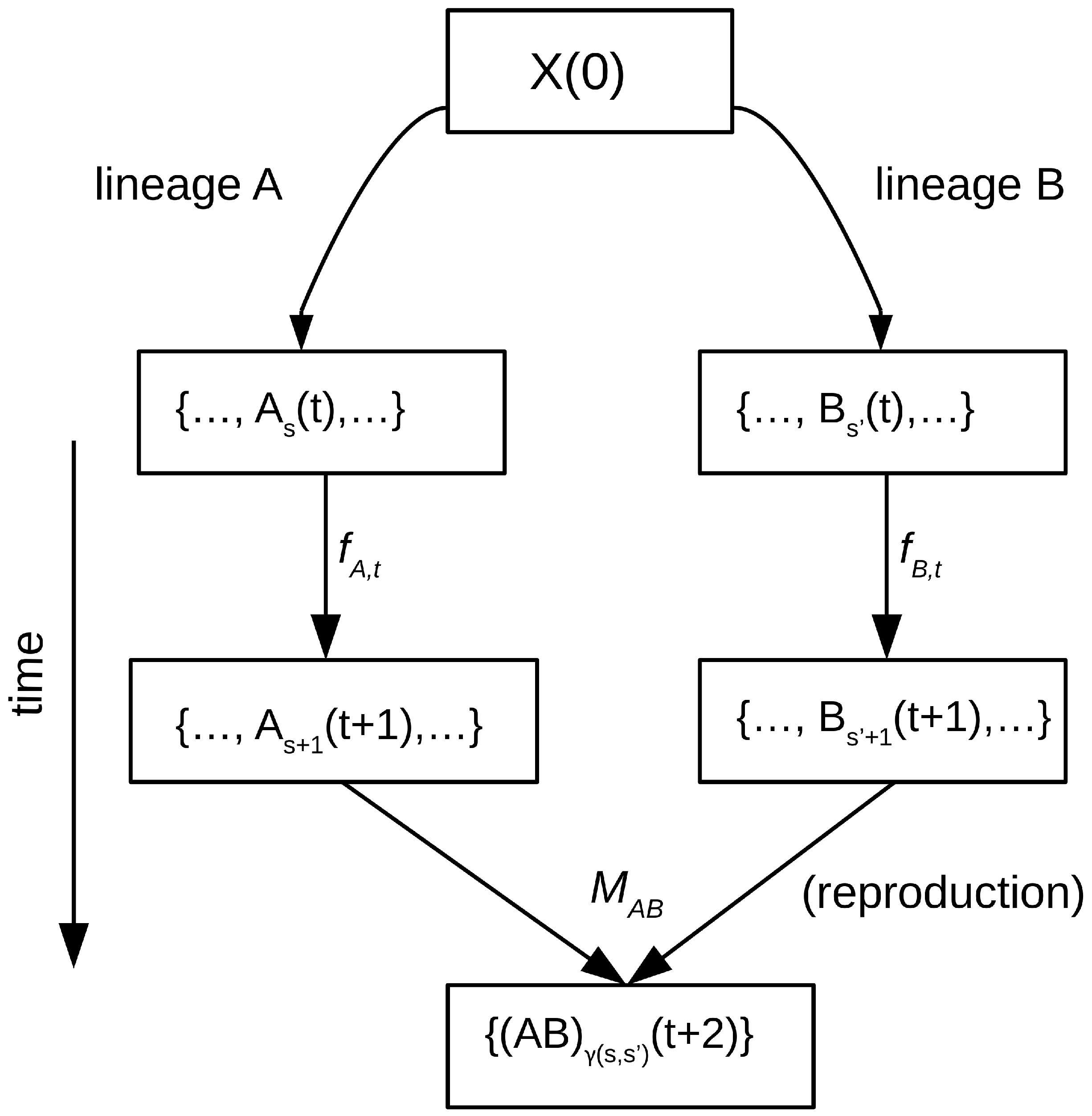
A category consists of objects and morphisms (arrows representing transformations). An initial object X(0) is defined. From X(0), variants A(1), A(2),…, A(t); B(1), B(2),…, B(t);… are generated through replication or reproduction (with or without mutation), where t denotes discrete generations from the initial configuration. For each lineage α ∈ {A, B, C,…}, the classes α0(t), α1(t),…, αs(t), coexist at each step t, representing the accumulated substates of the lineage. Operationally, each lineage Rα is treated as a small category whose objects are the possible states of the lineage and whose elementary morphisms fα,t describe discrete temporal transitions from step t to t + 1.
Objects
The objects of
Rα correspond to the possible states of the lineage α:
Formally, the IH framework represents the population-level states of an Information Handler as objects, and the evolutionary transitions between those states as morphisms.
Here, α(
t) denotes the state of the lineage at step
t. Each state may contain several substates (or variants) that coexist at time
t. We denote these by
where α
0(
t) corresponds to the ancestral subtype still present at time
t, and the index
s labels the accumulated variants or mutational substates of the lineage. Thus, substates coexist within the same generational step, even though they originate from previous transitions.
Morphisms (Arrows)
Morphisms describe the operations of replication, variation, or transformation that lead from one state to the next:
where α(
t) is the Information Handler at step
t, and
fα,t is the combined action of replication, with or without mutation, producing the new handler α(
t + 1).
At this level, it is not necessary to specify internal subtypes, since the arrow refers to the entire set or distribution of the lineage at time t. As we will see, each internal state s of the handler αs(t) is associated with a replication rate rαs(t).
The morphism fα,t represents the discrete temporal transition from step t to t + 1. It may or may not involve a change in the internal substate s depending on whether replication occurs without mutation (s′ = s), preserving the internal configuration, or with mutation or variation (s′ ≠ s), producing a new subtype within the lineage. This morphism thus captures the causal process by which the system generates its next configuration, either identical or modified, maintaining lineage continuity while potentially introducing informational change.
Closure
Each lineage category possesses an internal (
M,
R) closure:
such that
where
ρt assigns to each state the mechanism capable of reproducing it in the future, an abstraction of the production of enzymes or functions enabling replication, and
evt applies the internally generated transformations to perform the transition to the next state (see
Section S2.3.1).
Supercategory R
The collection of lineages forms a category
R, whose objects are the categories
Rα and whose morphisms represent processes of reproduction or interaction between lineages (e.g., hybridization, gene transfer, symbiosis, etc.):
Accordingly, the IH framework operates at least across three categorical levels: substates or types, population-level lineage states indexed in time, and lineages themselves as interacting evolutionary systems.
6.1.2. Discrete Dynamics Within a Lineage
Each object at substate
s in lineage α is connected to the set of copies it contains, i.e., it has a population of instances
with cardinality
Nαs(t) and the frequency of subtype
s at time
t is
The evolution of frequencies follows the replicator equation:
where
rα,s(t) is the effective replication rate including both the effects of selection and transmission. However, it is also possible to consider the strict replication rate to measure frequency change due solely to selection (see
Sections S2.3–S2.4 of the Mathematical Supplementary Materials). This is the same discrete replicator equation introduced in
Section 3, but now with lineage (α) and subtype (
s) indices.
Within each generation
t, older (persistent) and new states coexist simultaneously. The change in the frequency distribution from
t to
t + 1, according to Equation (6), allows us to define a replicative informational fold measured by the Jeffreys divergence (see below):
6.1.3. Reproduction
In addition to replication within lineages, the model allows for reproduction or recombination between IH entities (
Figure 1). The reproductive morphisms are represented as pairings modeled by a binary operation (reproductive bifunctor) that takes two lineages and produces joint offspring. That is, each possible pairing between a pair of IHs from lineages α and β has a mating fitness
mα(t),β(t), and the resulting pairing frequencies are
q′
α(t),β(t) =
qα(t),β(t)mα(t),β(t), which can be compared with those expected by chance
qα(t),β(t) to define a reproductive informational fold measured by the Jeffreys divergence:
The mating distribution can be decomposed into intra-lineage (α = β) and inter-lineage (α ≠ β) components, and the corresponding informational folds can be calculated. This allows, for instance, modeling and analyzing sexual isolation between lineages, negative assortative mating, and similar processes (see
Section S2.6 of the Mathematical Supplementary Materials for details).
After mating, the effective replication rates are determined by a natural transformation that combines rates:
whose components define the aggregating rule
which determines the fecundity associated with the cross
i ×
j. Different choices of the function
G correspond to different hypotheses about fecundity following mating. For example:
where
Ixy ∈ [0, + ∞) is a factor representing sexual isolation, where
Ixy = 0 corresponds to complete isolation.
6.1.4. Information Functor and Biological Interpretation
In category theory, a functor is a rule that maps one category into another while preserving its structural features. Each object in the source category (for example, a mutational state or a population) is assigned to an object in the target category (such as its statistical or informational representation), and each arrow between objects in the source category (e.g., a replication step) is mapped to an arrow between the corresponding objects in the target category (the associated informational change).
In the IH model, we work with two interconnected levels: (1) a biological level, where material transformations occur, replication, mutation, recombination and reproduction, so that Information Handlers (IHs) combine, copy, and change; and (2) an informational level, where the effects of those transformations are quantified, for instance, changes in the distribution of types within a lineage, the amount of new information generated, or the informational contribution of intra- and inter-lineage pairing events.
The information functor serves as a bridge between these two levels. It translates the biological processes by which IHs reproduce, mutate, and recombine into transformations within an informational category, where they appear as changes in frequencies and, ultimately, as changes in the system’s informational content.
The informational change within each lineage is quantified by the following information functor:
where
J(
pα(
t + 1),
pα(
t)) is the Jeffreys divergence, which measures the amount of information gained by moving between the distributions
pα(
t) and
pα(
t + 1). Two variants are defined,
Jr which measures the informational change caused by selection, and
Jrt which measures the change caused by selection plus transmission. Biologically,
Jr measures how much of the informational gain is due to selection acting on the differential fitness of existing types, while the difference
Jrt −
Jr measures the portion attributable to non-strictly selective processes that redistribute information without conferring an immediate fitness advantage (see details of this partition in
Section S2.5 of the Mathematical Supplementary Materials).
It is important to note that the information functor assigns an informational measure to each individual biological morphism, rather than to their composition as a single transformation. The Jeffreys divergence thus quantifies the informational change associated with each step of the evolutionary dynamics, independently of whether successive morphisms are composed. As a result, the framework does not require the Jeffreys divergence to be invariant under composition.
6.1.5. Total Informational Fold
The fold, or total informational summary, generated by the system at step
t represents the accumulated quantity of informational change due to replication, transmission and reproduction:
This total information fold functions as an informational closure, in the sense that it ensures each step of the biological dynamics has a corresponding informational counterpart.
The total information functor
InfoTotal assigns to each biological morphism
fα,t its corresponding informational measure
InfoTotal(t), quantified by the divergences
J. The global accumulated information over a discrete interval [0,
T) is then obtained as the sum of the information measures assigned by the functor to each morphism over time:
6.2. Instantiations of the IH Framework in Classical Evolutionary Models
To clarify the relationship between the Information Handler (IH) framework and existing evolutionary models, it is useful to illustrate how the general categorical structure can be instantiated in well-known population genetics settings. The goal of this section is not to rederive classical results, but to show that standard evolutionary models can be naturally accommodated within the IH formalism once the population-state space and the corresponding evolutionary transformations are specified.
6.2.1. Haploid Selection Within a Single Lineage
In the simplest case, consider a haploid population evolving within a single lineage. The population state at time
t is represented by a frequency distribution
where
qi(
t) denotes the frequency of allele
i. Selection and other evolutionary forces define a transformation
which maps the population state to the next generation.
Within the IH framework, this transformation corresponds to a morphism between the population states. The associated informational fold quantifies the evolutionary change induced by this progress through the Jeffreys divergence between q(t) and q(t + 1).
In classical haploid models, evolutionary equilibria are defined as fixed points of the population mapping, q* = φ(q*). Within the IH framework, such equilibria correspond to transformations that generate no informational change: the associated informational fold vanishes, J(q*, q*) = 0. Thus, equilibrium states are naturally recovered as informationally neutral configurations, while the approach to equilibrium is characterized by positive informational change, quantifying the strength and direction of the evolutionary process.
6.2.2. Extensión to Diploid Populations
Diploid evolution can be incorporated into the IH framework by redefining the population-state space to track genotype frequencies rather than allele frequencies. In this case, the population state at time
t is represented as
where each component denotes the frequency of a diploid genotype.
Reproduction, segregation, and selection define a transformation between these genotype-frequency distributions, mapping α(t) to α(t + 1). From the categorical perspective, this change corresponds to an internal reconfiguration of genotype frequencies within the same population-state object, while leaving the overall IH scaffold unchanged. Evolutionary change is still represented as a transformation between distributions, and its informational effect is captured by the corresponding informational fold.
6.2.3. Multiple Populations and Migration
The IH framework can also accommodate classical models of migration by allowing population states, corresponding to distinct subpopulations, to be connected through additional morphisms. A simple and well-known example is the island-continent model, where the island population exchanges migrants with a much larger continent whose allele frequencies remain effectively constant. In this case, the population state of the island at time
t is represented by a frequency distribution
where the continent is characterized by a fixed distribution
Migration acts as a transformation that mixes both distributions,
where
m is the migration rate. This transformation defines a morphism acting on the island population state, with the continent entering as a fixed contextual parameter.
Defining the associated mapping
the migration step can be written as
and the corresponding informational fold is given by
which quantifies the information change induced by migration.
Note that even when the evolutionary step is not multiplicative, as in migration, which is affine, the Jeffreys divergence remains well defined because it depends only on the pair of distributions (q′, q). The informational character is the component-wise log-ratio log(q′i/qi), and the Jeffreys divergence equals the change in the mean of this character between q and q′. In replicator-like dynamics, this log-ratio coincides with a fitness-like multiplier, whereas in affine processes, such as the transformation induced by migration, it is interpreted as the reweighting of population frequencies between consecutive population states.
Within the IH framework, migration is thus represented as a well-defined population-state mapping, independent of selection. The equilibrium of the process corresponds to a fixed point of this morphism, q*I = qC, at which the informational fold associated with migration vanishes. This illustrates how classical migration models can be easily accommodated as particular instantiations of the general IH structure, and how their evolutionary effects can be quantified and combined with other processes, such as selection, by composing the corresponding morphisms.
6.2.4. Reproduction Between Lineages and the Transition to Holobionts
Allowing reproduction between types within a lineage, or more generally between distinct lineages, introduces a supercategory structure in which such interactions are explicitly represented. Once such reproductive or associative morphisms are permitted, composite entities can emerge as stable evolutionary units. As already outlined in
Section 6.1.3, this construction also connects naturally with models of non-random mating, where reproductive interactions between different types generate systematic changes in pair frequencies. In those models, the resulting dynamics can be expressed in terms of informational measures, with Jeffreys divergence quantifying the effect of sexual selection or assortative mating [
77,
78].
The holobiont framework introduced in the next section can be seen as a further generalization of this idea, where association—rather than reproduction—occurs between evolutionarily distinct lineages, such as hosts and microbiomes, instead of between mating types within a single lineage. This perspective highlights that the transition to holobiont dynamics does not require introducing fundamentally new principles, but rather extends an already established informational treatment of reproductive interactions to higher levels of biological organization.
These examples illustrate that the IH framework provides a unifying categorical scaffold in which classical models can be naturally accommodated. Its novelty lies not in redefining known dynamics, but in offering a systematic informational interpretation of evolutionary change and in enabling extensions such as holobiont dynamics and multi-level selection.
7. Holobiont Categorical Model
What we have developed so far is a categorical framework that provides a highly abstract and general structure capable of describing diverse models and contexts within evolutionary biology. As discussed in Section Holobionts, interest in the evolutionary dynamics of holobionts has recently begun to grow, despite having been largely overlooked in classical evolutionary models, with only a handful of approaches such as those cited in Section Holobionts and the works recently reviewed in Rodrigo [
118]. Recent perspectives emphasizing the evolutionary relevance of host–microbiome interactions (e.g., [
119]) further highlight the need for formal frameworks capable of analyzing holobiont-level dynamics.
Building on the categorical foundation developed above, we show that a holobiont can be represented as a focal IH interacting with a structured set of microbial IHs, leading to an informational decomposition that generalizes earlier information-theoretic models of non-random mating. This formulation reveals a common structure underlying both host–microbiome coadaptation and mate-choice dynamics. In the next section, we develop the categorical formulation of the holobiont within the IH framework. The section concludes with a toy model that serves as a proof of concept, illustrating how the holobiont informational partition can be applied.
7.1. Holobiont Categorical Representation
A holobiont is represented as a composite Information Handler built from two components: (i) a host lineage
H (an IH belonging to some lineage α), and (ii) a microbiome
M consisting of a family of microbial lineages and sublineages (
MB,
MC,…) that inhabit and interact with the host. The joint dynamics of
H and
M, as well as the information generated by selection, follow the partition expressed in Equation (5) and
Section S1.
Categorically, the host is represented as a lineage category
RH, with objects
Hi(
t) denoting the possible host substates (e.g., genotypes), whose population-level frequencies define the host state at step
tSimilarly, the microbiome is represented as a monoidal composite category
whose objects
Mj(
t) denote microbiome configurations:
Biologically, representing the microbiome as a monoidal composite category means that the microbiome is not treated as a single evolutionary lineage, but as a structured consortium of multiple microbial lineages that coexist within the host. Each microbial group (e.g., phyla, functional guilds, or ASV-defined sublineages) retains its own identity and evolutionary dynamics, while jointly contributing to the state of the holobiont. The monoidal product formalizes this idea of co-presence without fusion: different microbial lineages evolve independently, yet their combined configuration determines the microbiome-associated component of holobiont fitness.
At the level of the supercategory
R, we introduce a holobiont assembly bifunctor
which sends each pair of objects (
Hi(
t),
Mj(
t)) to a holobiont object
and each pair of morphisms
to a holobiont morphism
Biologically, fH×M,t represents one step of the combined host–microbiome dynamics (host replication and reproduction, microbial growth and transmission, and possible reassortment of microbiomes among hosts), while preserving the categorical structure inherited from RH and RM.
7.2. Population Functor and Frequency Dynamics
The holobiont category
RH×M is equipped with its population functor:
mapping each object
Hi(t) ×
Mj(t) to the set of holobiont instances realizing the host–microbiome pair.
The frequency of class (
i,
j) at time
t is:
Holobiont evolution follows a replicator-like update:
where
which is consistent with the general IH dynamics.
7.3. Decomposition of Holobiont Fitness
Following Equation (5) and
Section S1, we decompose the holobiont fitness into host, microbiome, and association components:
where
WH is the host contribution,
WM is the microbiome contribution and
aij is the host–microbiome association factor capturing non-independent interaction effects. We assume
WH(
i,t),
WM(
j,t), and
aij(
t) are strictly positive for all
i,
j,
t, so that
Wij(
t) > 0 and all logarithmic terms in the informational expressions are well defined.
This type of multiplicative fitness decomposition is well established in evolutionary theory, particularly in group and multilevel selection models, where marginal contributions are naturally separated. Here, this approach is extended to holobionts by explicitly introducing an association term that captures non-independent host–microbiome effects. Importantly, this assumption does not impose interaction effects a priori: when aij = 1, host and microbiome contributions are independent and the association term vanishes. This decomposition is the foundation for the informational partition described below.
7.4. Information Partition and the Holobiont Informational Fold
The total Jeffreys divergence associated with holobiont selection is:
and as denoted in (5) it admits the partition
where
JH is the information generated by selection on the host,
JM is the information generated by selection on the microbiome and
Iassoc is the information due to non-independent host–microbiome pairing.
The association component is:
The association information
Iassoc, encodes the information generated by a non-independent pairing between host states
Hi and microbiome configurations
Mj. Interestingly, this quantity admits a natural decomposition that is exactly parallel to the partition developed for non-random mating [
78].
Let
denote the product of the marginal post-selection frequencies of hosts and microbiomes, i.e., the joint distribution expected under independence once the marginal host and microbiome changes have been fixed.
Starting from the total Jeffreys divergence
we introduce the algebraic decompositions
Expanding as in [
78] yields four terms:
With T3 = 0, because q′ and r share exactly the same marginal distributions, and the logarithmic factor decomposes additively into a host term and a microbiome term whose sums (or integrals in the continuous case) vanish when paired with the residuals of the joint distribution. The remaining terms have clear interpretations, as detailed in the subsections below.
7.4.1. Marginal Host and Microbiome Contributions
The term T1 = JH + JM contains the information from marginal host and microbiome changes; it is the analogue of the additive sexual-selection components JS1 + JS2 in the mating framework.
7.4.2. Holobiont “Choice” (PSI-like) Component
The quantity
is the holobiont analogue of the pair sexual isolation term
JPSI in non-random mating. It measures the information associated with the structure of host–microbiome pairing, given that the marginal changes in hosts and microbiomes have already been fixed.
Biologically, this corresponds to host–microbiome “choice”, i.e., the emergent affinity patterns of which microbial communities become associated with which host types.
It is important to emphasize that cross-level correlations between host and microbiome are not imposed a priori in the holobiont model, but emerge naturally from the joint distribution of host–microbiome states. The term Jassoc quantifies deviations from random host–microbiome association, and therefore captures the informational signature of non-independent pairing across levels. When appropriate statistical tests are defined, this component allows such correlations to be detected empirically rather than assumed.
Residual interaction effects that cannot be explained by association structure alone are captured by the interaction term
Eholo (
Section 7.4.3). Together,
Jassoc and
Eholo provide a complete decomposition of cross-level effects, separating deviations from random association from genuinely non-additive interaction effects.
7.4.3. Holobiont Interaction Component
The term
T2 is
which is directly parallel to the interaction residual
E in the earlier mating-based partitions
J =
JS1 +
JS2 +
JPSI +
E [
77,
78].
In both cases, Eholo (or E) appears only when both marginal and joint (PSI-like) changes occur simultaneously; it quantifies the non-additive information produced by the departure from multiplicativity of the components, and it measures the extra information required to explain the full system-level transformation once additive marginal and joint-structure components have been accounted for.
From Equation (7), it would be possible to design statistical tests and estimators analogous to those developed in [
77,
89] that, using frequencies in
H and
M, could test for selection acting on either component, as well as for possible associations between host and microbial genomes.
7.4.4. The Holobiont Model as a Natural Generalization of Information-Theoretic Mating Models
The sum of terms
JH +
JM is directly analogous to the additive sexual-selection components
JS1 +
JS2 in the mating framework. The quantity
Jassoc represents the pure association term, equivalent to
JPSI in the mating model, capturing the structure of host–microbiome pairings beyond the product of their marginal frequencies. The component
Eholo is the non-additive interaction term, analogous in meaning and role to the
E term in previous models of non-random mating and sexual selection. In both contexts, the
E-term measures the extra information generated by non-multiplicative combinations of two components, sexes in the mating model, and host–microbiome lineages in the holobiont model. Therefore,
JH×M constitutes a natural generalization of the informational partition originally defined for non-random mating [
77,
78].
The model can be extended by considering the microbiome as a structured assemblage of multiple microbial components (e.g., phyla, functional guilds, or ASV-defined sublineages). To capture this structure, we decompose the microbiome into
K components, each with its own internal dynamics. A holobiont state can thus be indexed by a host type
i and a vector of microbiome types (
j1,…,
jK), where
jk denotes the state of the
k-th microbiome component. The general model is described in detail in
Section S3:
where
This general model reduces to the two-component holobiont model in (7) when
K = 1, and to the mating-based partitions when the two interacting components correspond to the sexes rather than to the host and microbiome. From this perspective, the holobiont represents a particular instance of an Information Handler (IH) interacting with a structured ensemble of other IHs, while the information-theoretic partition developed for non-random mating [
77,
78] appears as the special case in which a focal IH (e.g., a female) interacts with a single partner IH (e.g., a male). In contrast, the general model provides its natural extension to multi-component associations, yielding a composite informational fold that integrates changes arising from the host, from the microbiome, and from their interaction.
7.5. Holobiont Closure Structure
Both the host and microbiome each possess their own (
M,
R) closure:
The holobiont closure is defined as a composed structure:
where Φ is a closure-composition operator mapping two internal closures together with an association rule
aij into a new effective closure
This expresses that a holobiont reproduces not only hosts and microbes, but also the patterns of association between them.
7.6. Holobiont Information Functor
Finally, we define the holobiont information functor:
which assigns to each morphism
fH×M,t the informational triple:
or the total divergence
JH×M,t with its decomposition.
Thus, holobionts arise in the IH framework as higher-order composite Information Handlers, whose dynamics and informational closure naturally integrate into the global fold described in
Section S2.7.
7.7. A Toy Model Illustrating the Informational Partition of the Holobiont
To illustrate the practical use of the informational decomposition developed in this section, we present a simple 2 × 2 holobiont model involving two host genotypes and two microbiome types. This “toy model” allows us to examine how the total informational change generated by selection partitions into host, microbiome, and association components, and it highlights situations in which the association term dominates the response. In particular, by selecting fitness values that introduce a strong synergistic advantage for a specific host–microbiome pairing, we obtain a scenario in which more than half of the total Jeffreys information arises from the host–microbiome association, providing a clear illustration of the biological meaning and utility of the term Jassoc.
7.7.1. Model Specification
Let the host take states H = {H0, H1} and the microbiome M = {M0, M1} and assume initial independence, qij = pimj, with p = (0.5, 0.5) and m = (0.5, 0.5) so that all four host–microbiome combinations have frequency qij = 0.25.
Suppose that host genotype
H1 has an intrinsic advantage, the same as microbiome type
M1, and, critically, the combination (
H1,
M1) yields a synergistic advantage. Let
with rows corresponding to
H0,
H1 and colums to
M0,
M1.
The post-selection distribution is
7.7.2. Marginal Changes
The host and microbiome marginal frequencies are p′ = m′ = (0.3864, 0.6136) showing a clear shift favouring H1 and M1.
7.7.3. Informational Decomposition
The total Jeffreys divergence generated by selection is
Partitioning according to the holobiont decomposition
we obtain
and
In this parametrization, the residual interaction term Eholo is small, reflecting a near exact additivity between the marginal contributions JH and JM and the pure association component Jassoc.
7.7.4. Interpretation
This example produces a holobiont scenario in which the association term dominates the informational response. The marginal components JH and JM contribute roughly one quarter of the total information each, reflecting modest selection acting independently on the host and the microbiome. In contrast, the association component Jassoc accounts for more than half of the total Jeffreys divergence. This shows that the primary evolutionary signal does not lie in the separate advantages of host genotype H1 or microbiome type M1, but in the synergistic advantage of their joint occurrence. The system therefore evolves toward a coadapted host–microbiome configuration. Even in this minimal model, the informational fold reveals an evolutionary pattern that would remain hidden if host fitness or microbiome composition were analyzed in isolation.
Although presented as a toy model, this example illustrates the type of biological inference enabled by the IH framework. Any empirical dataset containing host genotypes and microbiome compositions can be analyzed by decomposing the total Jeffreys divergence into host, microbial, and association components. This allows researchers to quantify whether evolutionary change is primarily driven by host adaptation, microbial adaptation, or by the emergence of specific host–microbiome associations. Such a decomposition is not available in classical holobiont models and highlights the practical value of the informational partition.
8. Discussion
In this work, we have reviewed several representative evolutionary models, from the simple replicator equation [
57,
120,
121], to tragedy-of-the-commons dynamics [
91], and recent models of holobiont selection [
98,
101], to illustrate that evolutionary change in frequency distributions can be expressed through the Jeffreys divergence [
76]. This divergence also captures the redistribution of pairings caused by differential mating fitness [
77,
78]. Building on these results, we have proposed a conceptual framework grounded in category theory and centered on the notion of the Information Handler (IH). IHs are entities capable of self-maintenance, replication, mutation, and combination with other handlers. Lineages of IHs evolve on a discrete temporal scale, with each lineage represented as an object in a hierarchical category whose morphisms describe processes such as hybridization, sexual isolation, or symbiosis. This abstraction applies equally to ribozymes, bacteria, animals, or plants.
Interactions such as reproduction usually occur between members of the same lineage, whereas holobiont associations may involve evolutionarily distant taxa. As shown in
Section 7, the categorical structure naturally accommodates both cases, preserving the corresponding informational fold. Furthermore, the model in which a focal IH interacts with a structured set of IHs generalizes the information framework for non-random mating: the latter arises as a special case when the interacting entities are two IHs of different sexes. At each process, replication with or without selection or mutation, reproduction within or across lineages, or more complex interactions, an informational fold captures the change in the system’s distribution of states.
From a biological perspective, this matters because it transforms frequency changes into interpretable evolutionary quantities. For instance, the IH decomposition allows one to distinguish whether a shift in holobiont composition is driven by selection acting on host genotypes, on microbial lineages, or on their association structure. Thus, the IH framework does not presuppose whether holobionts constitute units of selection in a strict sense, but instead provides a formal way to disentangle selection acting on hosts, microbial partners, and their associations, thereby addressing long-standing debates on the conditions under which holobionts can be treated as evolutionary individuals.
Similarly, in mating systems, the IH fold identifies the contribution of mate choice, sexual isolation, and marginal selection. These examples show that the categorical structure is not merely a reformulation; it provides biologically meaningful partitions that clarify the causal pathways through which evolutionary change occurs.
This connection is particularly relevant in light of ongoing efforts to extend classical evolutionary theory beyond a strictly gene-centered view, as articulated, for example, in the Extended Evolutionary Synthesis [
122]. More generally, it resonates with two major traditions in contemporary biology: the neo-Darwinian, gene-centered view, and the systemic or organizational approach that emphasizes biological organization and the closure of constraints [
11,
24,
107,
123,
124,
125,
126]. Under the latter, organisms are thermodynamically open but organizationally closed systems whose relatively stable constraints (e.g., enzymes, membranes, or vascular structures) modulate flows of matter and energy while depending on processes they themselves enable. Such networks of mutually dependent constraints provide stability and self-determination while allowing functional and evolutionary change. Information plays a central role in this context [
52,
53,
54,
55,
112,
127,
128,
129,
130]. Distributions of genotypes, haplotypes, or matings contain more information when types differ in fitness, and less when they are equivalent or when interactions are random. Although information has sometimes been criticized as metaphorical [
131,
132,
133], its causal relevance lies in how systems interpret and transform it: syntactic structure and semantic meaning must be coherently integrated for biological function and cognition to emerge.
The use of Jeffreys divergence in the IH framework is robust to deviations from classical frequency-based or replicator dynamics. Jeffreys divergence does not depend on the specific biological mechanism generating evolutionary change, but solely on the existence of an initial and a derived distribution. Thus, Jeffreys divergence is not imposed ad hoc, but follows from the combination of a distributional mapping, a logarithmic characterization of change, and the requirement of an interpretable measure of evolutionary change. As long as an evolutionary process, genetic, epigenetic, developmental, or ecological, can be represented as a transformation between observable distributions, the informational interpretation in terms of J(q′,q) remains valid.
Importantly, the Jeffreys divergence quantifies the magnitude of distributional change, not its causal origin. Both selective processes and stochastic transmission processes, such as drift or migration, may generate non-zero values of J when they induce systematic changes in population frequencies (for example, directional migration). The distinction between selection-driven and transmission-driven change therefore arises from the specification of the evolutionary process, the choice of an appropriate null model, and process-specific statistical contrasts, rather than from the divergence itself.
Processes such as epigenetic inheritance or developmental constraints do not invalidate this approach; rather, they modify the way population-level distributions are transformed. Epigenetic inheritance introduces transmissible states with their own dynamics, while developmental constraints restrict or bias the set of accessible states. In both cases, Jeffreys divergence captures the net informational change induced by these transformations, without requiring a replicator-based description. Accordingly, the IH framework does not depend on replicator dynamics in a strict sense. Replicator equations are treated as particular instances of a more general mapping φ that transforms an initial distribution q into a derived distribution q′. Whenever such a mapping can be defined, the corresponding informational change is naturally quantified by the Jeffreys divergence.
The IH framework thus serves two purposes: it highlights how natural selection can be captured through informational changes in frequency distributions at multiple levels (individuals, pairs, groups, holobionts), and it illustrates how category theory can provide a formal scaffold for integrating the informational and dynamical aspects of biological evolution. While the categorical abstraction does not aim to preserve fine-grained molecular or physiological mechanisms, it explicitly preserves causal structure at the level relevant for evolutionary dynamics. In particular, interactions between evolutionarily distant taxa, such as hosts and microbiomes, are represented through distinct components and an explicit interaction term, allowing their causal and non-additive effects on evolutionary change to be quantified without assuming shared mechanistic substrates.
Other recent formalisms pursue similar goals. Smith [
80], for example, decomposes the evolutionary process into stages treated as informational channels. The IH framework formalizes a comparable intuition but at a categorical and hierarchical level. It yields a global dynamical model in which each transformation of the system is represented as a morphism associated with an informational fold quantified by the Jeffreys divergence arising from the underlying evolutionary dynamics.
Frank [
134,
135], in turn, shows that the Price equation provides a universal pattern for partitioning evolutionary change and identifies an underlying geometric structure shared by natural selection, Bayesian inference, thermodynamics, learning algorithms, and informational metrics. In his approach, measures such as the Kullback–Leibler divergence, the Jeffreys divergence, and the Fisher metric follow necessarily from structural invariances (e.g., probability conservation). The IH model is compatible with this view: each informational fold
J can be formulated explicitly via the Price equation, and the Jeffreys divergence associated with each transformation corresponds exactly to the change term obtained when applying Price to an appropriate logarithmic trait under replicator-like dynamics. However, the Price equation alone does not supply lineage structure, organizational closure, or hierarchical categories of entities and levels. It describes how a distribution changes between two configurations, but not a unified framework capable of encompassing classical replication, sexual selection, or holobiont evolution. That integrative architecture is provided by the categorical formalization of the IH model, within which the informational folds derived from Price are embedded as natural quantifiers of change. In this sense, the IH formalism yields a unified global model whose informational partitions are derived directly from the causal operators governing replication, transmission, and reproduction.
Within this broader theoretical perspective, life may be understood as a process of managing and transforming information, where informational closure ensures that the informational changes relevant for persistence and reproduction are generated and evaluated within the system itself. In this framework, information is not understood merely as a statistical descriptor of variation, but as a measure of functionally relevant change. While Jeffreys divergence is formally defined on probability distributions, its biological interpretation arises from the fact that these distributions describe the frequencies of states that differ in their causal and functional consequences for the system. Informational change thus reflects not only how distributions vary, but how evolutionary processes reshape the organization of functionally meaningful states.
In the IH framework, the notion of closure is not merely metaphorical, but is formally encoded through the internal (M, R) structure of each lineage, which provides a categorical representation of causal feedback without introducing additional endomorphisms beyond those already defined. “Closure” here means that informational transitions are generated through internal morphisms: while information flows across system boundaries, its interpretation and causal relevance remain internal. Informational closure does not imply environmental isolation but semantic autonomy: living systems generate and maintain the informational transformations relevant to their organization.
The IH framework is explicitly compatible with multiple, nested levels of biological organization. Information Handlers are not restricted to a single scale: genes, cells, organisms, populations, and holobionts can all be treated as IHs at different hierarchical levels, each characterized by its own state space, evolutionary transformations, and informational dynamics. Category theory naturally accommodates such hierarchies, allowing evolutionary processes to be represented consistently across levels without privileging a single unit of selection.
In this sense, the IH framework does not prescribe a unique unit of evolution, but provides a formal setting in which different units—individuals, groups, or holobionts—can be analyzed on equal footing, in line with classic and modern discussions on units of selection (e.g., [
45,
47,
49]). Causal closure is understood as a level-specific property: at each organizational level, evolutionary transitions are generated through internal morphisms that encode how that level produces its own future states, while remaining open to interactions with other levels.
Thermodynamically open yet informationally closed, organisms sustain encoding, interpretation, and transmission within a self-consistent causal network. This endogenous closure grants them functional and evolutionary coherence. Life, therefore, may be viewed as a causally organized flow in which structure, function, and meaning co-emerge.
Thus, the IH framework can be used in empirical evolutionary genomics: once frequency data are available across stages of the life cycle, the informational folds can be computed directly and interpreted biologically, providing insight into the mechanisms driving evolutionary change. More broadly, recent perspectives have emphasized the role of information as a unifying principle across biological and evolutionary processes, and even beyond living systems (e.g., [
136]), highlighting the growing interest in information-centered views of life, to which the IH framework contributes from a formal evolutionary standpoint.