Spatial Patterns of the Marine Alien Gastropod Rapana venosa Invasion Across the Black Sea, Mediterranean, and Atlantic Europe


Simple Summary
Abstract
1. Introduction
2. Materials and Methods
2.1. Rapana venosa Invasion History
2.2. Distribution, Aggregation Patterns, and Spatial Structure Analyses
3. Results
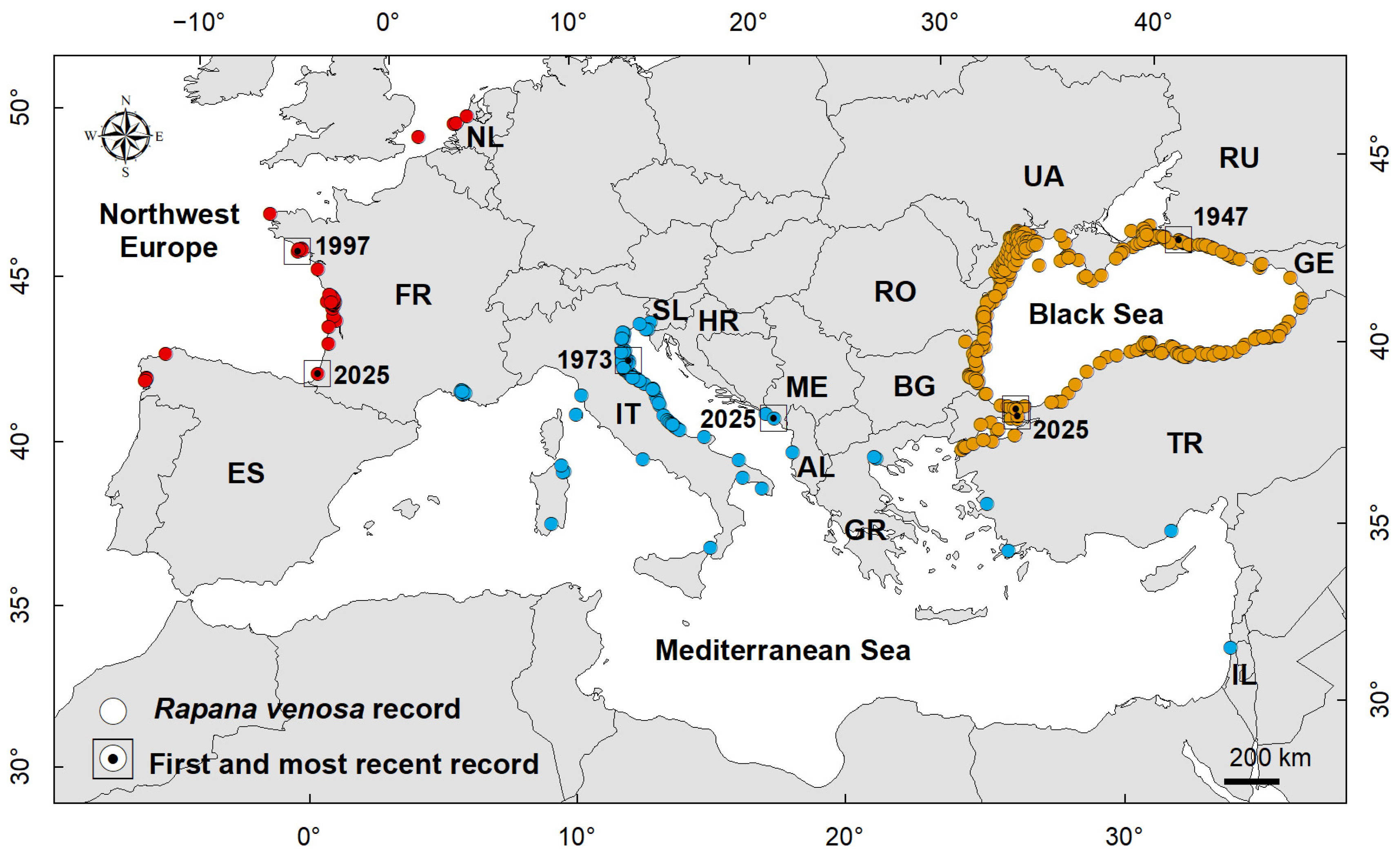
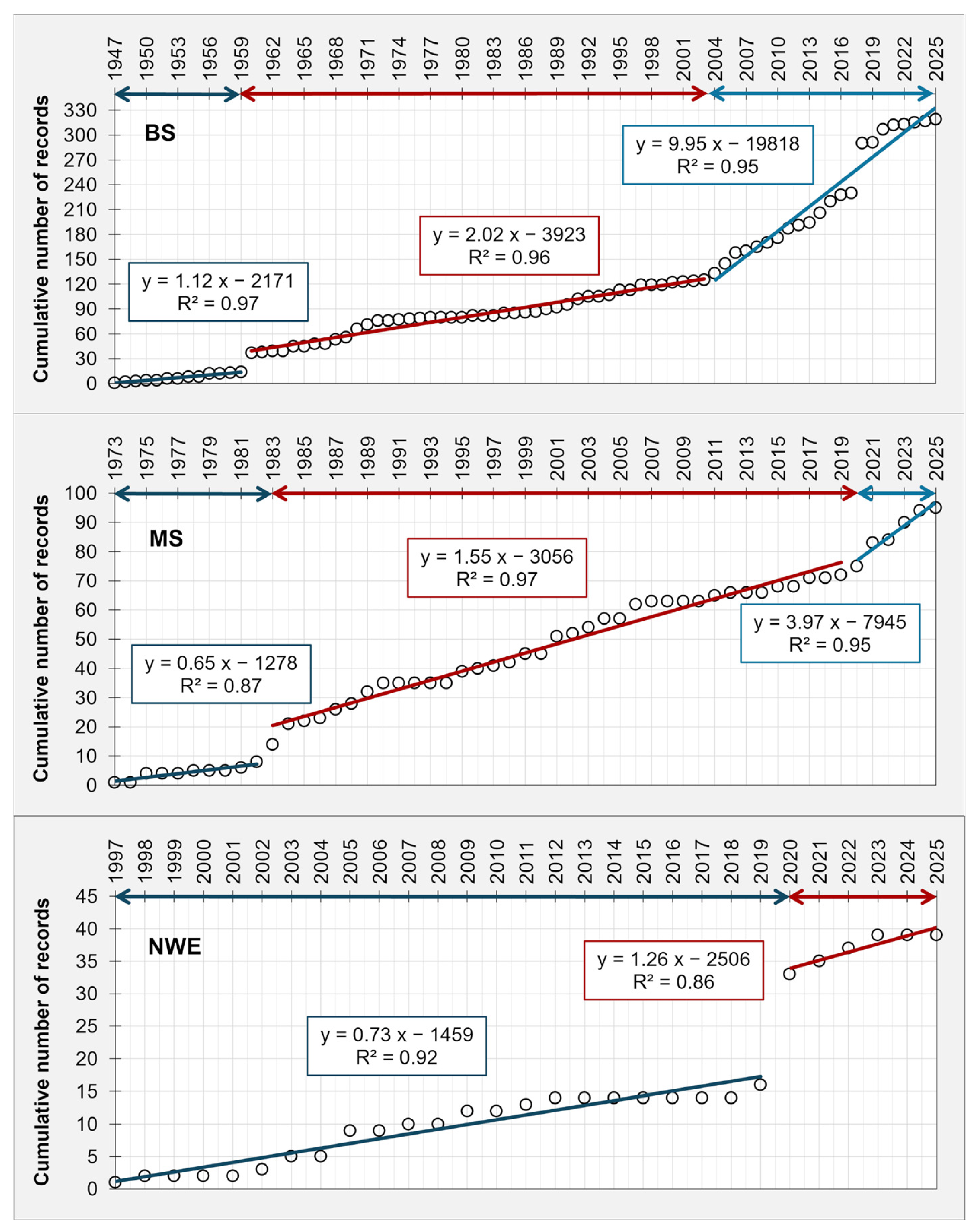
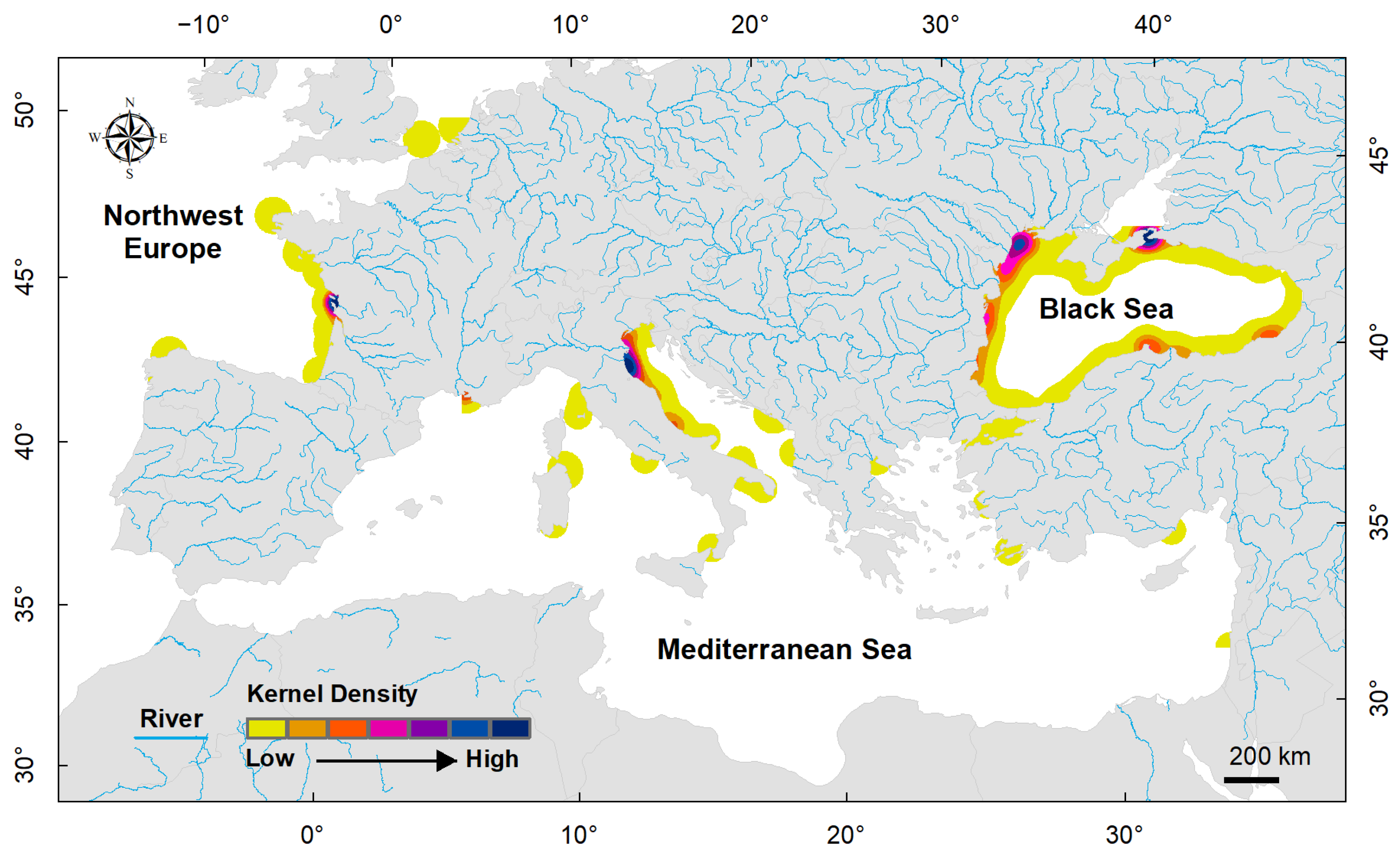
3.1. Invasion History and Spatial–Temporal Patterns of Rapana venosa Distribution
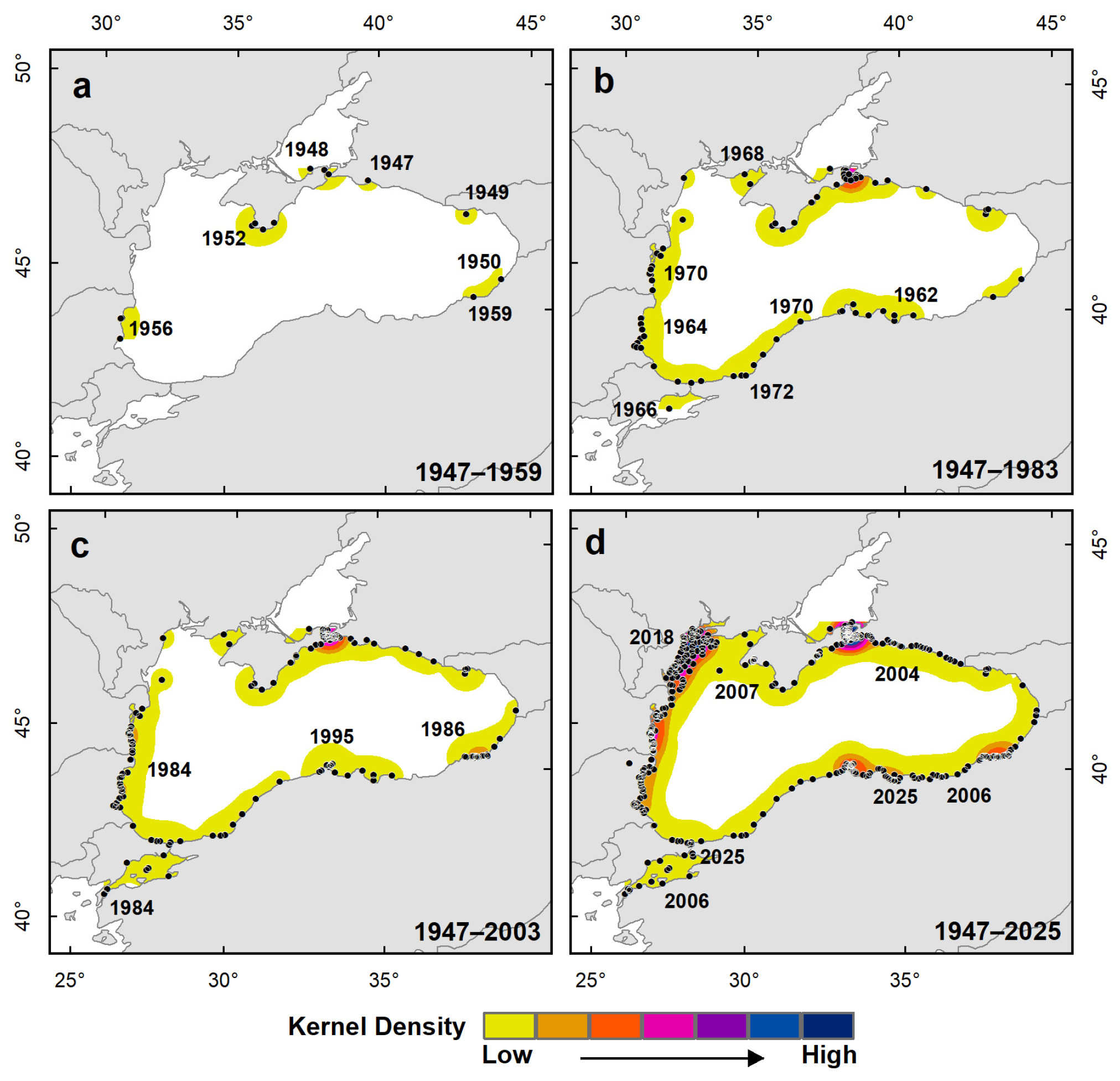
3.1.1. Black Sea and Adjacent Waters
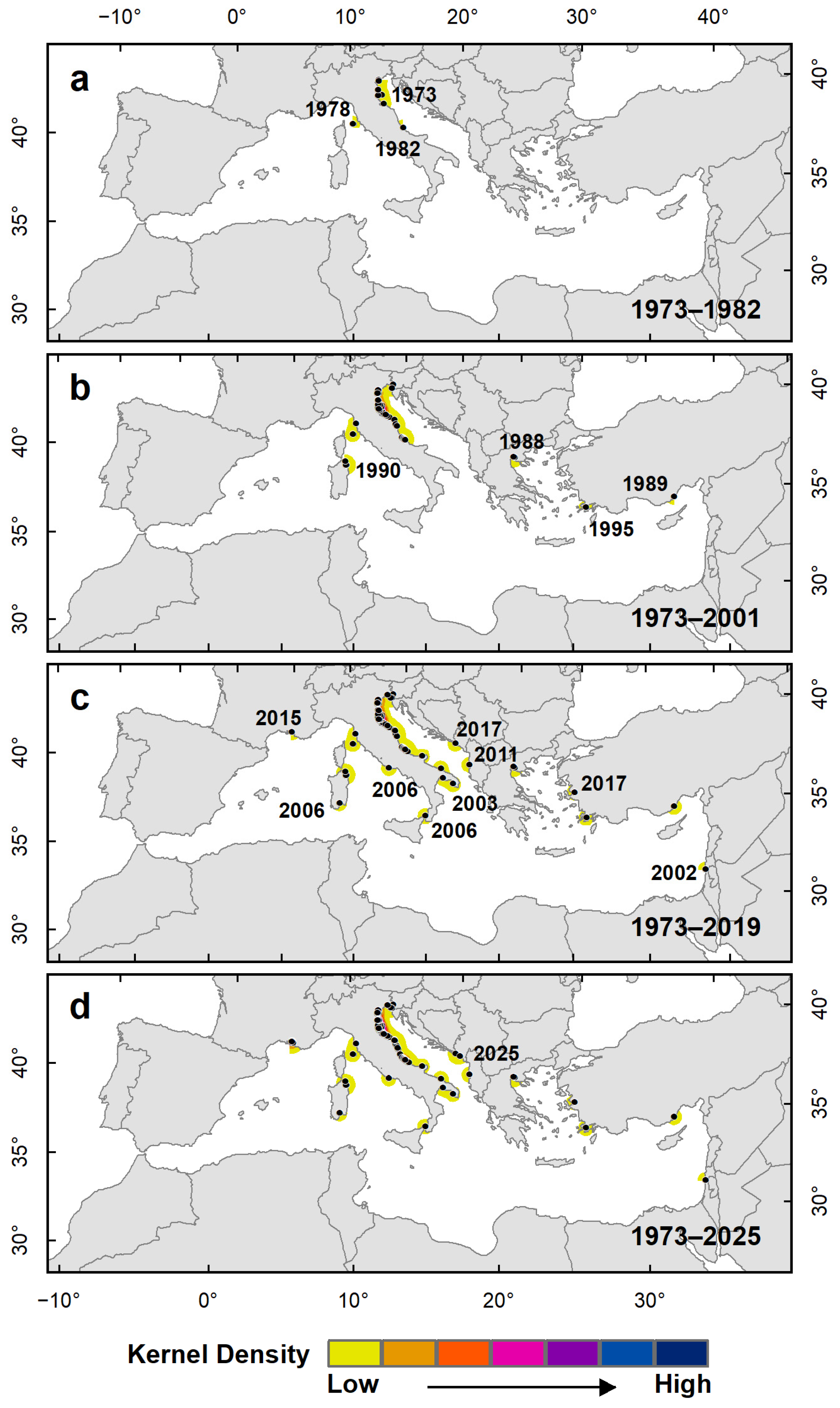
3.1.2. Mediterranean Sea
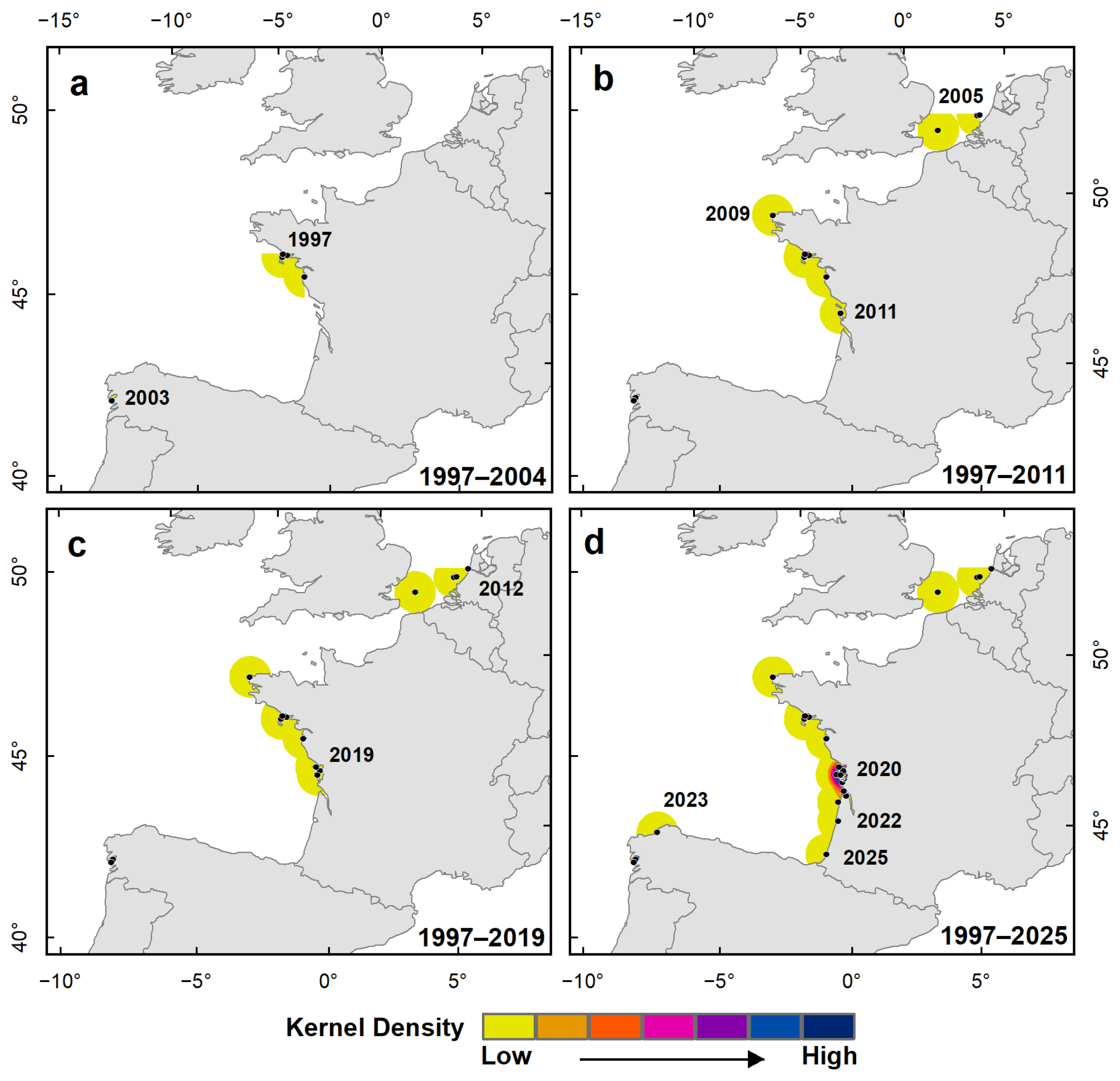
3.1.3. Northwest Europe
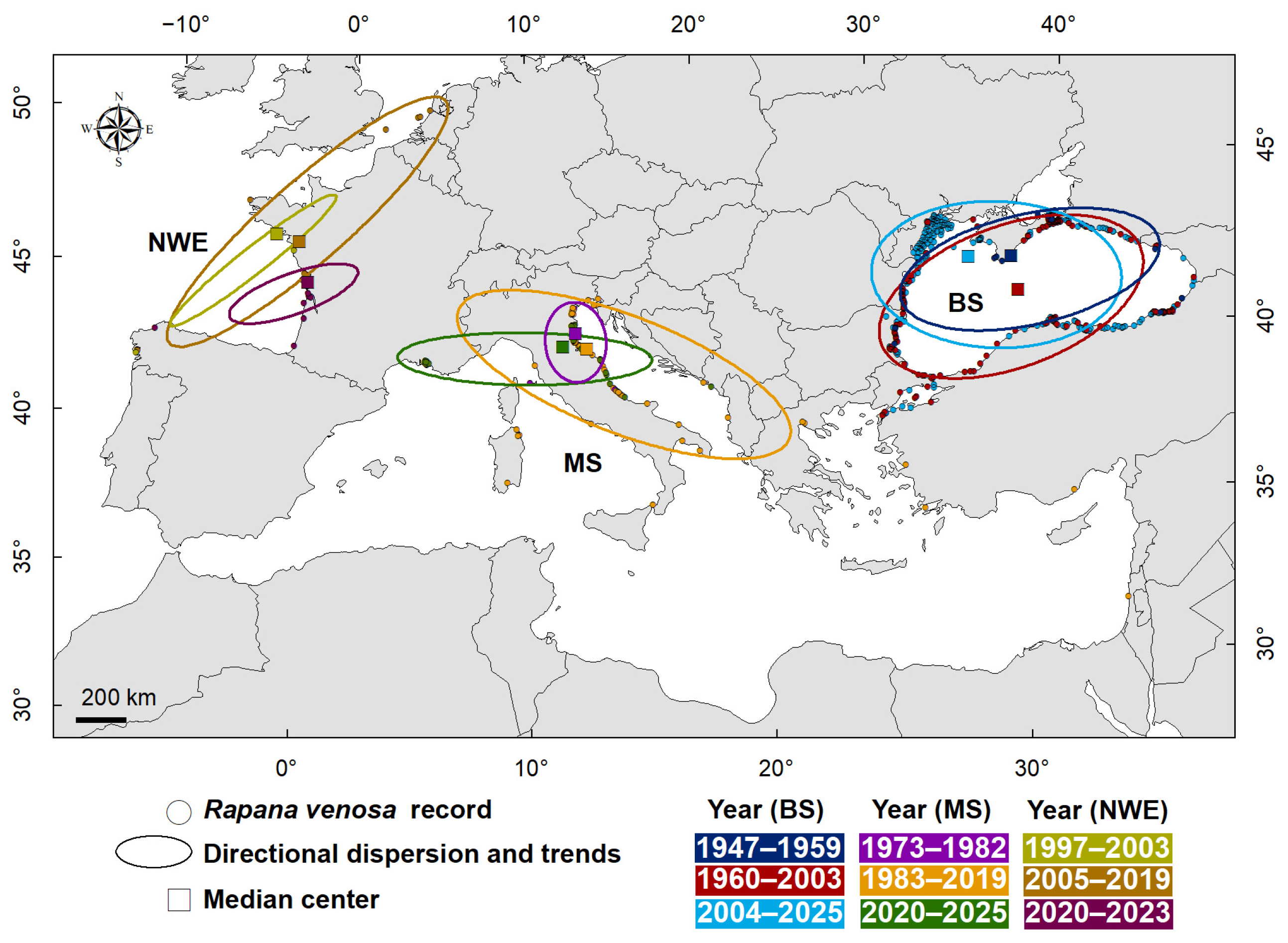
3.2. Key Characteristics of Distribution
3.2.1. Black Sea and Adjacent Waters
3.2.2. Mediterranean Sea
3.2.3. Northwest Europe
3.3. Aggregation Patterns and Spatial Structure
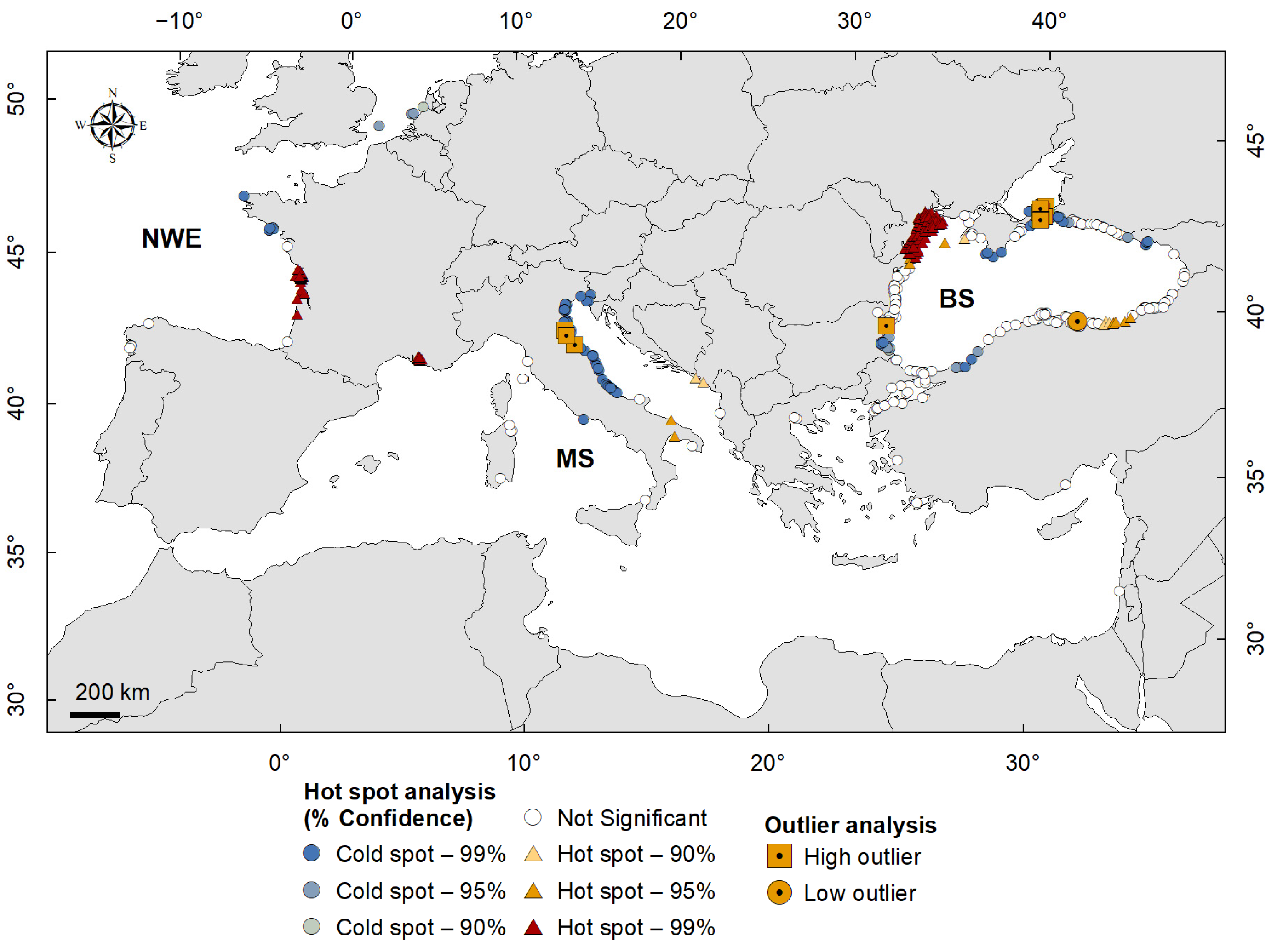
- Black Sea and adjacent waters—In the BS area, the earliest records are strongly clustered in the north-eastern sector (cold spot, 99%), consistent with the historical introduction area. Additional cold spots along the southern and eastern coasts denote areas of earlier establishment. Extensive and highly significant hot spots (95–99%) occur along the north-western Black Sea shelf, indicating large and persistent core zones of recent spread and ongoing expansion. The spatial arrangement of cold and hot spots supports a stepwise expansion from the north-eastern nucleus, with progressive infilling of adjacent areas and short-range dispersal processes. The presence of high outliers in the north-eastern Black Sea highlights sites with very recent records surrounded by older ones.
- Mediterranean Sea—In the MS, a significant cold spot (90–95%) is identified along the central–northern Adriatic coast, confirming this region as the primary aggregation area. Most other locations in the Mediterranean Sea were classified as not significant, indicating weak spatial clustering of similar occurrence years (i.e., a dispersed spatial pattern). A distinct pattern emerges along the French Mediterranean coast, where a highly significant hot spot (99%) identifies this region as the main area of recent records. The presence of high outliers is observed in the northern Adriatic.
- Northwest Europe—In the NWE, statistically significant cold spots were located further north, along the southern North Sea coasts, characterized by earlier records and suggesting the initial establishment area. In contrast, hot spots (95–99%) were concentrated along the French Atlantic coast, indicating that this area hosts the most recent occurrences and represents the current expansion front.
4. Discussion
5. Conclusions
Supplementary Materials
Author Contributions
Funding
Data Availability Statement
Conflicts of Interest
References
- Mann, R.; Occhipinti, A.; Harding, J.M. Alien Species Alert: Rapana venosa (Veined Whelk); ICES Cooperative Research Report No. 264; International Council for the Exploration of the Sea: Copenhagen, Denmark, 2004. [Google Scholar]
- Drapkin, E. Effect of Rapana bezoar Linné (Mollusca, Muricidae) on the Black Sea fauna. Dokl. Akad. Nauk SSSR 1963, 151, 700–703. [Google Scholar]
- Chukhchin, V.D. Ecology of the Gastropod Mollusks of the Black Sea; Naukova Dumka: Kiev, Ukraine, 1984. [Google Scholar]
- Aydın, M.; Düzgüneş, E.; Karadurmuş, U. Rapa whelk (Rapana venosa Valenciennes, 1846) fishery along the Turkish coast of the Black Sea. J. Aquac. Eng. Fish. Res. 2016, 2, 85–96. [Google Scholar] [CrossRef]
- Danilov, C.S.; Tiganov, G.; Anton, E.; Nenciu, M.I.; Nita, V.N.; Cristea, V. Rapana venosa–New Exploitable Resource at the Romanian Black Sea Coast. Sci. Pap. Ser. D Anim. Sci. 2018, 61, 274–279. [Google Scholar]
- Düzgüneş, E.; Kasapoğlu, N.; Şahin, A.; Sağlam, H. Responses to the invasive species in the Black Sea. In Proceedings of the International Conference on Biodiversity of the Aquatic Environment Towards a Diverse and Sustainable World; INOC: Latakia, Syria, 2010; pp. 25–32. [Google Scholar]
- Harding, J.M.; Mann, R. Habitat disturbance combined with life history traits facilitate establishment of Rapana venosa in the Chesapeake Bay. J. Shellfish Res. 2016, 35, 885–910. [Google Scholar] [CrossRef]
- Sánchez Acosta, M.; Góngora, N.; Antuña, D.; Correa, P.; Chiesa, E.; Brugnoli, E.; Muniz, P. An update of the invasion status of Rapana venosa (Mollusca: Gastropoda) in the Río de la Plata estuary. Mar. Fish. Sci. (MAFIS) 2024, 37, 435–448. [Google Scholar] [CrossRef]
- Lercari, D.; Bergamino, L. Impacts of two invasive mollusks, Rapana venosa (Gastropoda) and Corbicula fluminea (Bivalvia), on the food web structure of the Río de la Plata estuary and nearshore oceanic ecosystem. Biol. Invasions 2011, 13, 2053–2061. [Google Scholar] [CrossRef]
- Falautano, M.; Perzia, P.; Castriota, L. First record of the Lessepsian fish Parexocoetus mento in Italian waters and GIS–based spatial and temporal distribution in Mediterranean Sea. J. Mar. Biol. Assoc. U. K. 2020, 100, 1163–1169. [Google Scholar] [CrossRef]
- Perzia, P.; Spinelli, A.; Interdonato, F.; Castriota, L. Ecological indicators from spatial statistics to describe the Atlantic fangtooth moray distribution in Mediterranean Sea. Trans. GIS 2022, 26, 2802–2817. [Google Scholar] [CrossRef]
- Castriota, L.; Falautano, M.; Maggio, T.; Perzia, P. The Blue Swimming Crab Portunus segnis in the Mediterranean Sea: Invasion Paths, Impacts and Management Measures. Biology 2022, 11, 1473. [Google Scholar] [CrossRef] [PubMed]
- Castriota, L.; Falautano, M.; Perzia, P. When Nature Requires a Resource to Be Used—The Case of Callinectes sapidus: Distribution, Aggregation Patterns, and Spatial Structure in Northwest Europe, the Mediterranean Sea, and Adjacent Waters. Biology 2024, 13, 279. [Google Scholar] [CrossRef] [PubMed]
- Castriota, L.; Falautano, M.; Maggio, T.; Perzia, P. Exploring the Enigmatic Spread and Spatial Dynamics of Bursatella leachii in the Mediterranean Sea. Biology 2025, 14, 133. [Google Scholar] [CrossRef] [PubMed]
- Perzia, P.; Zampardi, S.; Maggio, T.; Falautano, M.; Castriota, L. The Alien Jellyfish Cassiopea andromeda in the Mediterranean Sea: Invasion Dynamics and Management Strategies. Oceans 2026, 7, 27. [Google Scholar] [CrossRef]
- Lipej, L.; Mavric, B.; Paliska, D. New northernmost record of the blunthead pufferfish, Sphoeroides pachygaster (Osteichthyes: Tetraodontidae) in the Mediterranean Sea. Ann. Ser. Hist. Nat. 2013, 23, 103–114. [Google Scholar]
- ESRI. Kernel Density Analysis. Available online: https://pro.arcgis.com/en/pro-app/latest/tool-reference/spatial-analyst/kernel-density.htm (accessed on 10 March 2026).
- ESRI. Median Center. Available online: https://pro.arcgis.com/en/pro-app/latest/tool-reference/spatial-statistics/median-center.htm (accessed on 10 March 2026).
- ESRI. Directional Distribution (Standard Deviational Ellipse). Available online: https://pro.arcgis.com/en/pro-app/latest/tool-reference/spatial-statistics/directional-distribution.htm (accessed on 10 March 2026).
- ESRI. Incremental Spatial Autocorrelation. Available online: https://pro.arcgis.com/en/pro-app/latest/tool-reference/spatial-statistics/incremental-spatial-autocorrelation.htm (accessed on 10 March 2026).
- ESRI. Hot Spot Analysis (Getis–Ord Gi*). Available online: https://pro.arcgis.com/en/pro-app/latest/tool-reference/spatial-statistics/hot-spot-analysis.htm (accessed on 10 March 2026).
- ESRI. Cluster and Outlier Analysis (Anselin Local Moran’s I). Available online: https://pro.arcgis.com/en/pro-app/latest/tool-reference/spatial-statistics/cluster-and-outlier-analysis-anselin-local-moran-s.htm (accessed on 10 March 2026).
- Abaza, V.; Dumitrache, C.; Dumitrescu, E. Structure and Distribution of the Main Molluscs from the Romanian Marine Areas Designated for Their Growth and Exploitation. Cercet. Mar.-Rech. Mar. 2010, 39, 137–152. [Google Scholar]
- Albayrak, S. On the Mollusca Fauna of the Black Sea near Istanbul. Zool. Middle East 2003, 30, 69–75. [Google Scholar] [CrossRef]
- Albayrak, S.; Balkıs, N. Benthic Prosobranch Gastropods of the Bosphorus. İstanb. Üniv. Fen Fak. Biyol. Derg. 1996, 59, 17–26. [Google Scholar]
- Alkan, N.; Alkan, A. Elemental Compositions of Rapana venosa (Mollusca: Muricidae) from the Eastern Black Sea Region of Turkey: Toxicology Health Risk Assessment. Anal. Lett. 2023, 56, 504–516. [Google Scholar] [CrossRef]
- Alparslan, M.; Özalp, H.B.; Sağır-Odabaşı, S. An Invader-Economical Gastropod Rapana venosa (Valenciennes, 1846) in Çanakkale and Adjacent Regions. Ege J. Fish. Aquat. Sci. 2006, 23, 485–487. [Google Scholar]
- Altınağaç, U.; Ayaz, A.; Kara, A. A Preliminary Study on the Whelk Fisheries (Rapana venosa) Using Liftnets of Various Sizes. Ege J. Fish. Aquat. Sci. 2004, 21, 295–299. [Google Scholar]
- Altuğ, G.; Güler, N. Determination of Indicator Bacteria, Salmonella spp. and Heavy Metals in Sea Snails (Rapana venosa) from the Northern Sea of Marmara. Turk. J. Fish. Aquat. Sci. 2002, 2, 141–144. [Google Scholar]
- Anonymous. Note & Notizie. La Conchiglia 1990, 22, 46–47. [Google Scholar]
- Arbuatti, A.; Di Serafino, A.; Lucidi, P. Long-Term Ecosystem Monitoring Along the Trabocchi Coast (Chieti, Italy): Insights from Underwater Visual Surveys (2011–2024). Animals 2024, 14, 3469. [Google Scholar] [CrossRef] [PubMed]
- Astruch, P.; Schohn, T.; André, F.; Belloni, B.; Boudouresque, C.-F.; Lejeusne, C.; Mayot, N.; Marchessaux, G.; Thibaut, T.; Zibrowius, H.; et al. Chaotic and Long-Term Trends in Berre Lagoon (Provence, France): A Shift Towards Alien-Dominated Assemblages? Mediterr. Mar. Sci. 2025, 26, 199–215. [Google Scholar] [CrossRef]
- Aydın, M.; Karadurmuş, U. Karadeniz’de Rapana (Rapana venosa) Avcılığı. In 17. Ulusal Su Ürünleri Sempozyumu; İstanbul Üniversitesi Su Ürünleri Fakültesi: İstanbul, Türkiye, 2013. [Google Scholar]
- Baki, B.; Kalma, M.; Yücel, Ș. Meat Yield of Rapana thomasiana Gross, 1861 Caught in Middle Black Sea Region (Sinop–Turkey). Sci. New Technol. 2010, 5, 121–126. (In Turkish) [Google Scholar]
- Bañón, R.; Otero Mascato, J.A. Nuevas Citas de Rapana venosa en Aguas de Galicia. Not. SEM 2014, 62, 39–41. [Google Scholar]
- Bañón, R.; Fariña, J.; de Carlos, A. New Data on Exotic Muricid Species from Spain Based on Integrative Taxonomy. Diversity 2023, 15, 1185. [Google Scholar] [CrossRef]
- Başusta, N. A study on the age determination using vertical shell cutting method of rapa whelk (Rapana venosa). In Proceedings of the 2nd International Baku Conference on Scientific Research, Baku, Azerbaijan, 28–30 April 2021; pp. 82–87. [Google Scholar]
- Başusta, N.; Dürrani, Ö.; Bat, L.; Başusta, A.; Dağtekin, M.; Seyhan, K. Modelling Growth and Population Parameters of Rapana venosa (Muricidae) in the Black Sea Using Statolith-Based Ageing. Fish. Sci. 2025, 91, 891–905. [Google Scholar] [CrossRef]
- Bat, L.; Gonlaigiir, G.; Andae, M.; Öztürk, M.; Oztürk, M. Heavy Metal Concentrations in the Sea Snail Rapana venosa from Sinop Coasts of the Black Sea. J. Black Sea/Mediterr. Environ. 2000, 6, 227–240. [Google Scholar]
- Bilecik, N. La Répartition de Rapana thomasiana thomasiana sur le Littoral Turc de la Mer Noire. Rapp. Comm. Int. Mer. Méditerr. 1975, 23, 169–171. [Google Scholar]
- Boltacheva, N.A.; Revkov, N.K.; Bondarenko, L.V.; Kolesnikova, E.A.; Timofeev, V.A.; Kopiy, V.G. Taxonomic Composition of Macrozoobenthos in Karkinitskiy Bay (Black Sea) in early XXI century. In Morskie Biologicheskie Issledovaniya: Dostizheniya i Perspektivy: V 3-kh t.: Sb. Materialov Vseros. Nauch.-Prakt. Konf. s Mezhdunar. Uchastiem, Priuroch. k 145-Letiyu Sevastopol’skoi Biologicheskoi stantsii (Sevastopol, 19–24 September 2016); Gaevskaya, A.V., Ed.; EKOSI-Gidrofizika: Sevastopol, Russia, 2016; Volume 2, pp. 36–39. (In Russian) [Google Scholar]
- Bombace, G.; Fabi, G.; Fiorentini, L.; Speranza, S. Analysis of the Efficacy of Artificial Reefs located in Five Different Areas of the Adriatic Sea. Bull. Mar. Sci. 1994, 55, 559–580. [Google Scholar]
- Bondarev, I. Peculiarities of Population Structure and Biocenotic Relationships of Rapana venosa (Valenciennes, 1846) (Gastropoda, Muricidae) in the Donuzlav Bay (the Black Sea). Mar. Biol. J. 2024, 9, 3–18. [Google Scholar]
- Bondarev, I.P. Ecomorphological Analyses of Marine Mollusks’ Shell Thickness of Rapana venosa (Valenciennes, 1846) (Gastropoda: Muricidae). Int. J. Mar. Sci. 2013, 3, 368–388. [Google Scholar] [CrossRef]
- Bondarev, I.P. Rapana venosa (Valenciennes, 1846) in the Donuzlav Bay and Adjacent Black Sea Area. Ruthenica 2022, 32, 137–147. [Google Scholar] [CrossRef] [PubMed]
- Bouget, J.F.; Camus, P.; Joly, J.P. Ocinebrellus inornatus (Recluz, 1851), Rapana venosa (Valenciennes, 1846): Deux Nouveaux Gastéropodes Introduits dans la Baie de Quiberon. Contrat SRC Bretagne Sud/Ifremer n°01/2.210.261; Rapport DRV-RA-LCB/01-02; Ifremer: La Tremblade, France, 2001. [Google Scholar]
- Bracchetti, L.; Capriotti, M. Le formazioni a Reef della Costa Picena. Studi Costieri 2021, 29, 83–92. [Google Scholar]
- Brustur, T.; Bălan, S.V.; Briceag, A. Rapa whelk (Rapana venosa) Trails from the Black Sea Romanian Inner Shelf (SE Mangalia). Geo-Eco-Marina 2021, 27, 91–98. [Google Scholar] [CrossRef]
- Camus, P. Un bien discret et redoutable prédateur de coquillages, l’exotique globe-trotter: Rapana venosa. La Vigie 2001, 26, 3–9. [Google Scholar]
- Castellazzi, M.; Savini, D.; Occhipinti Ambrogi, A. Shell morphotypes of the invasive gastropod Rapana venosa in the Northern Adriatic Sea. Boll. Malacol. 2007, 43, 103–107. [Google Scholar]
- Celik, M.; Çulha, S.T.; Culha, M.; Yildiz, H.; Acarli, S.; Celik, I.; Celik, P. Comparative study on biochemical composition of some edible marine molluscs at Canakkale coasts, Turkey. Indian J. Geo Mar. Sci. 2014, 43, 601–606. [Google Scholar]
- Celik, O.; Samsun, O. Investigation of the Catch Amount and the Catch Composition of Dredges with Various Design Features. Su Urun. Derg. 1996, 13, 259–272. [Google Scholar]
- Cesari, P.; Pellizzato, M. Insediamento nella Laguna di Venezia e distribuzione adriatica di Rapana venosa (Valenciennes). Lav. Soc. Ven. Sc. Nat. 1985, 10, 3–16. [Google Scholar]
- Chandler, E.A.; McDowell, J.R.; Graves, J.E. Genetically Monomorphic Invasive Populations of the Rapa Whelk, Rapana venosa. Mol. Ecol. 2008, 17, 4079–4091. [Google Scholar] [CrossRef] [PubMed]
- Chiaro Quotidiano. Available online: https://chiaroquotidiano.it/2024/07/07/specie-aliene-in-adriatico-la-rapana-venosa-sempre-piu-diffusa-anche-nel-mare-abruzzese/ (accessed on 19 August 2025).
- Chukhchin, V.D. Rapana (Rapana bezoar L.) on the Gudauta Oyster Bank. Tr. Sevastopol. Biol. Stantsii 1961, 14, 178–187. [Google Scholar]
- Cosentino, A.; Giacobbe, S.; Potoschi, A. The CSI of the Faro Coastal Lake (Messina): A Natural Observatory for the Incoming of Marine Alien Species. Biol. Mar. Mediterr. 2009, 16, 132–133. [Google Scholar]
- Cristo, B.; Rojch, L. Un Esercito di “Mostri” Popola Il Mare. Arselle Filippine e Gasteropodi Giapponesi Nel Golfo Olbiese; La Nuova Sardegna: Sassari, Italy, 2009; p. 5. [Google Scholar]
- Crocetta, F. Marine alien mollusca in the Gulf of Trieste and neighbouring areas: A critical review and state of knowledge (updated in 2011). Acta Adriat. 2011, 52, 247–260. [Google Scholar]
- Crocetta, F.; Soppelsa, O. Primi ritrovamenti di Rapana venosa per alcune lagune costiere italiane. Atti Mus. Civ. Stor. Nat. Trieste 2006, 52, 215–218. [Google Scholar]
- Cucaz, M. Rapana venosa vivente nel Golfo di Trieste. Boll. Malacol. 1983, 19, 261–262. [Google Scholar]
- Çulha, M.; Bat, L.; Doğan, A.; Dağlı, E. Ecology and Distribution of the Veined Rapa Whelk Rapana venosa in Sinop Peninsula. J. Anim. Vet. Adv. 2009, 8, 51–58. [Google Scholar]
- Dağtekin, M. The Invasive Mollusk Rapana venosa in the Mid-Southern Black Sea: Distribution, Growth, and Stock Structure. Acta Ichthyol. Piscat. 2023, 53, 191–199. [Google Scholar] [CrossRef]
- Danilov, C.S.; Nicolaev, S.; Anton, E.; Țiganov, G.; Nicolaev, A.D.; Păun, C.V.; Maximov, V. Dynamics of the Fishing Capacities Used for the Mechanized Exploitation of the Gastropod Rapana venosa at the Romanian Coast (2013–2017). Cercet. Mar.–Rech. Mar. 2019, 49, 133–140. [Google Scholar]
- De Min, R.; Vio, E. Molluschi Conchiferi del Litorale Sloveno. Annales 1997, 11, 241–258. [Google Scholar]
- Delongueville, C.; Scaillet, R. Les espèces invasives de mollusques en Méditerranée. Novapex 2007, 8, 47–70. [Google Scholar]
- Delongueville, C.; Scaillet, R. Rapana venosa (Valenciennes, 1846) en Mer de Marmara. Novapex 2013, 14, 19. [Google Scholar]
- Delongueville, C.; Scaillet, R. Le fabuleux voyage de Rapana venosa (Valenciennes, 1846) de l’Asie de l’Est à la Mer du Nord et aux Amériques. Novapex 2022, 23, 32–36. [Google Scholar]
- Demirci, G. Studies of Mollusca Fauna in Mid Black Sea, Turkiye. Fırat Üniv. Fen. Ve Müh. Bil. Der 2005, 17, 565–572. [Google Scholar]
- Doneddu, M. Molluschi alloctoni rinvenuti lungo le coste del comune di Olbia (Sardegna nord-orientale): Rassegna dei dati disponibili. Not. SIM 2011, 29, 12–17. [Google Scholar]
- Réseau DORIS. Le Rapana Veiné (Rapana venosa) en Métropole. DORIS Forum. 2021. Available online: https://doris.ffessm.fr/Forum/ReseauDORIS-Le-rapana-veine-Rapana-venosa-en-metropole-47044 (accessed on 26 January 2023).
- Düzgüneş, E.; Unsal, S.; Feyzioğlu, A.M. Assessment of Sea Snail (Rapana thomasiana Gross, 1861) Stocks in the Eastern Black Sea; TÜBİTAK Project No. DEBAG 143/6; KTU Sürmene Marine Science Faculty: Çamburnu, Turkey, 1992; 49p. [Google Scholar]
- Düzgüneş, E.; Feyzioğlu, A.M. Trabzon Sahil Şeridinde Yaşayan Deniz Salyangozunun Rapana thomasiana Gross. 1861 Populasyon ve Büyüme Özelliklerinin Araştırılması. Ege Üniv. Fen Fak. Derg. 1994, 16, 1579–1592. [Google Scholar]
- Engl, W. Specie prevalentemente lessepsiane attestate lungo le coste Turche. Boll. Malacol. 1995, 31, 43–50. [Google Scholar]
- Erik, G.; Dağtekin, M. Effect of fishery closure on discard composition of Rapa Whelk Rapana venosa (Valenciennes, 1846) beam trawl fisheries in the Black Sea. Turk. J. Fish. Aquat. Sci. 2021, 22, 5. [Google Scholar] [CrossRef]
- Eryasar, A.R.; Ceylan, Y.; Dalgic, G.; Yesilcicek, T. By-catch in the commercial beam trawl fishery for rapa whelk in the Black Sea. Mediterr. Mar. Sci. 2018, 19, 69–78. [Google Scholar] [CrossRef]
- Florio, M.; Breber, P.; Scirocco, T.; Specchiulli, A.; Cilenti, L.; Lumare, L. Exotic species in Lesina and Varano lakes: New guest in Lesina and Varano lakes (Gargano National Park, Italy). Trans. Waters Bull. 2008, 2, 69–79. [Google Scholar] [CrossRef]
- Georgiev, A.P.D.; Nikolov, A.P.G.; Kalcheva, A.P.S. Influence of rapana (Rapana venosa) on the condition of the mussel populations in the water area of the town of Primorsko. In Proceedings Of University of Ruse–2020; University of Ruse “Angel Kanchev”: Ruse, Bulgaria, 2020; Volume 59, book 1.1. [Google Scholar]
- Ghisotti, F. Rapana venosa (Valenciennes), nuova ospite Adriatica? Conchiglie 1974, 10, 125–126. [Google Scholar]
- Giacobbe, S.; De Domenico, F.; Iarrera, S.P.M.; Mangano, M.C.; Porporato, E.; Spanò, N. Alien molluscs and crustacean decapods in the Strait of Messina (Central Mediterranean Sea). Rapp. Comm. Int. Mer Méditerr. 2010, 39, 528. [Google Scholar]
- Giannuzzi-Savelli, R.; Pusateri, F.; Palmeri, A.; Ebreo, C. Atlante Delle Conchiglie Marine del Mediterraneo–Atlas of the Mediterranean Sea Shells; Edizioni Evolver: Roma, Italy, 2003. [Google Scholar]
- Golikov, A.; Scarlato, O.A.; Starobogatov, J. Opredeliteli Fauny Chernogo i Azovskogo Morei; Naukova Dumka: Kiev, Ukraine, 1972; pp. 60–250. [Google Scholar]
- Gomoiu, M.-T. Some ecologic data on the gastropod Rapana thomasiana Crosse along the Romanian Black Sea shore. Cercet. Mar.–Rech. Mar. 1972, 4, 169–180. [Google Scholar]
- Goncharov, A.D. Rapana from the northwestern coast of the Black Sea. Hydrobiol. J. 1977, 13, 20–31. [Google Scholar]
- Gönener, S.; Özsandıkçı, U. Density distribution and some biological properties of veined rapa whelk Rapana venosa populations in the south-central Black Sea. Cah. Biol. Mar. 2017, 58, 199–206. [Google Scholar] [CrossRef]
- Goulletquer, P. Guide des Organismes Exotiques Marins; Belin: Paris, France, 2016; 303p. [Google Scholar]
- Govorin, I.A. Use of the Morphometric Characteristics of Empty Shells of Rapana thomasiana (Mollusca, Gastropoda), Found in After-Storm Ejects, for the Determination of Lifetime Mass Indices of Mollusks. Vestn. Zool. 2013, 47, 218. (In Russian) [Google Scholar]
- Govorin, I.A. The Predatory Marine Gastropod Rapana venosa (Valenciennes, 1846) in Northwestern Black Sea: Morphometric Variations, Imposex Appearance and Biphallia Phenomenon. In Molluscs; IntechOpen: London, UK, 2018. [Google Scholar] [CrossRef]
- Govorin, I.A.; Kurakin, A.P. Finding of Rapana thomasiana in the near Danube Delta area of the Black Sea [Nakhodka rapany Rapana thomasiana v pridunajskom rajonie severozapadnoj chasti Chernogo moria]. Ecol. Morya 2005, 69, 18–19. (In Russian) [Google Scholar]
- Grossu, A.V.; Lupu, D. The Presence of Rapana bezoar Opposite the Rumanian Black Sea Shores (Muricidae). Arch. Molluskenkd. 1964, 93, 215–218. [Google Scholar]
- Grossu, A. Two Species Recently Discovered Invading the Black Sea. Sea Shore 1970, 1, 43–44. [Google Scholar]
- Hubenov, Z.; Kenderov, L.; Pandourski, I. Invertebrate Animals (Metazoa: Invertebrata) of the Atanasovsko Lake, Bulgaria. Hist. Nat. Bulg. 2015, 22, 45–71. [Google Scholar] [CrossRef]
- Hulak, B.S.; Leonchyk, Y.Y.; Chashchyn, O.K. The Main Biological Parameters of Rapa Whelk Rapana venosa Population in the Northwestern Section of the Black Sea. Hydrobiol. J. 2022, 58, 29–45. [Google Scholar] [CrossRef]
- Hulak, B.S.; Leonchyk, Y.Y.; Snigiriev, S.M.; Chashchyn, O.K. State of the Commercial Stock of Rapa Whelk Rapana venosa in the Coastal Zone of the Northwestern Section of the Black Sea. Hydrobiol. J. 2024, 60, 38–56. [Google Scholar] [CrossRef]
- ICES. Report of the Working Group on Introductions and Transfers of Marine Organisms (WGITMO); ICES: Barcelona, Spain, 2001. [Google Scholar]
- ICES. Report of the ICES Working Group on Introduction and Transfers of Marine Organisms (WGITMO); ICES CM 2012/ACOM:31; ICES: Lisbon, Portugal, 2012; 301p. [Google Scholar]
- ICES. Report of the Working Group on Introductions and Transfers of Marine Organisms (WGITMO); ICES: Cesenatico, Italy, 2004. [Google Scholar]
- ICES. Report of the Working Group on Introductions and Transfers of Marine Organisms (WGITMO), by Correspondence; ICES CM 2005/ACME:05; ICES: Cesenatico, Italy, 2005; 173p. [Google Scholar]
- ICES. Working Group on Introductions and Transfers of Marine Organisms (WGITMO); ICES CM 2006/ACME:05; ICES: Oostende, Belgium, 2006; 334p. [Google Scholar]
- ICES. Report of the Working Group on Introductions and Transfers of Marine Organisms (WGITMO); ICES CM 2007/ACME:05; ICES: Dubrovnik, Croatia, 2007; 160p. [Google Scholar]
- ICES. Report of the ICES Working Group on Introductions and Transfers of Marine Organisms (WGITMO); ICES CM 2010/ACOM:29; ICES: Hamburg, Germany, 2010; 130p. [Google Scholar]
- ICES. Report of the ICES Working Group on Introduction and Transfers of Marine Organisms (WGITMO); ICES CM 2013/ACOM:30; ICES: Montreal, QC, Canada, 2013; 149p. [Google Scholar]
- Iliescu, M.; Rădulescu, I. Note Concerning the Gastropod Rapana bezoar L. on the Romanian Shore. Bul. Cercet. Piscic. 1968, 27, 49–52. [Google Scholar]
- iNaturalist. Available online: https://www.inaturalist.org/observations?taxon_id=370913 (accessed on 15 December 2025).
- Ivanov, A.I. Some Data on the Quantitative Distribution of Rapana bezoar (L.) in the Eastern Part of the Black Sea and in the Kerch Strait and the Decrease in Its Size. Dokl. Akad. Nauk SSSR 1961, 141, 467–468. [Google Scholar]
- Ivanov, A.I. Changes in the abundance of Rapana in the Kerch Strait in 1958-1965. Hydrobiol. J. 1968, 4, 46–49. [Google Scholar]
- Ivanov, D.A.; Sinegub, I.A. Transformation of Biocenosis of the Kerch Strait After the Introduction of the Predatory Mollusk Rapana thomasiana and the Bivalves Mya arenaria and Cunearca cornea. In Contemporary Problems of Ecology in the Azov-Black Sea Region. In Proceedings of the III International Conference, 10–11 October 2007; Southern Scientific Research Institute of Marine Fisheries and Oceanography: Kerch, Ukraine, 2007; pp. 45–51. (In Russian) [Google Scholar]
- Ivanova, P.P.; Trayanova, A.T.; Stefanova, K.B.; Stefanova, E.; Raykov, V.S.; Doncheva, V.G. Population Status of Some Alien Species in Varna Bay, Bulgarian Black Sea Coast (2015–2016). Acta Zool. Bulg. 2017, 69, 73–82. [Google Scholar]
- Joly, J.-P.; Bouget, J.-F.; Hirata, T. Le Gastéropode Prédateur Rapana venosa: Point sur les Connaissances et Observations en Laboratoire; Rapport Ifremer 2002, DRV/RST/RA-2002-14; Ifremer: Plouzané, France, 2002. [Google Scholar]
- Kaneva-Abadjieva, V. A New Harmful Snail on Our Coast of Black Sea. Nature 1958, 7, 89–91. [Google Scholar]
- Kasapoğlu, N. Population Structure and Shell Dimension of the Invasive Veined Whelk (Rapana venosa). J. Fish. 2021, 9, 91205. [Google Scholar] [CrossRef]
- Katsanevakis, S.; Poursanidis, D.; Hoffman, R.; Rizgalla, J.; Rothman, B.-S.S.; Levitt-Barmats, Y.; Hadjioannou, L.; Trkov, D.; Garmendia, J.M.; Joxe, M.; et al. Unpublished Mediterranean records of marine alien and cryptogenic species. BioInvasions Rec. 2020, 9, 165–182. [Google Scholar] [CrossRef]
- Kaykac, M.H.; Gümüş, A.; Zengin, M.; Süer, S.; Rüzgar, M.; Van, A.; Tosunoğlu, Z. Effect of Steel Wire and Claw Size on the Sea Snail (Rapana venosa) Catch in a Black Sea Beam Trawl Fishery. Turk. J. Vet. Anim. Sci. 2018, 42, 251–258. [Google Scholar] [CrossRef]
- Kerckhof, F.; Vink, R.J.; Nieweg, D.C.; Post, J.N. The Veined Whelk Rapana venosa Has Reached the North Sea. Aquat. Invasions 2006, 1, 35–37. [Google Scholar] [CrossRef]
- Khoroshutina, O.; Pierce, G.J.; Lishchenko, F. Statoliths of Rapana venosa (Valenciennes, 1846): Microstructure, application for age determination and growth modelling. Reg. Stud. Mar. Sci. 2024, 74, 103527. [Google Scholar] [CrossRef]
- Kinzelbach, R. New Records of Thomas’ Rapa Whelk Rapana venosa from the Black Sea and Mannara Sea. Zool. Middle East 1986, 1, 122–124. [Google Scholar]
- Kiseleva, G.A.; Konovalov, V.S.; Lapchenko, A.A.; Kolova, K.A. Species Composition and Dynamics of the Macrozoobenthos in Algal Associations of the Karadag Nature Reserve. Ecosyst. Their Optim. Prot. 2009, 20, 57–66. (In Russian) [Google Scholar]
- Kolyuchkina, G.A.; Syomin, V.L.; Spiridonov, V.A.; Zalota, A.K.; Biryukova, S.V.; Basin, A.B.; Simakova, U.V.; Nabozhenko, M.V. The Resilience of Macrozoobenthos of Boreal Coastal Lagoons to Non-Indigenous Species Invasion: A Case Study of Taman Bay (Sea of Azov). Reg. Stud. Mar. Sci. 2019, 28, 100573. [Google Scholar] [CrossRef]
- Konsulova, T.H. Mytilus galloprovincialis Natural Resources Along the Northern Bulgarian Black Sea Coast in Relation to Rapana thomasiana Distribution. In Trudy Instituta Oceanologii; Bulgarian Academy of Sciences: Varna, Bulgaria, 1992; Volume 1, pp. 104–109. [Google Scholar]
- Kosarev, A.N.; Kostianoy, A.G.; Shiganova, T.A. The Sea of Azov. In The Black Sea Environment; The Handbook of Environmental Chemistry; Springer: Berlin/Heidelberg, Germany, 2007; Volume 5Q, pp. 63–89. [Google Scholar] [CrossRef]
- Kos’yan, A.R. Comparative Analysis of Rapana venosa from Different Biotopes of the Black Sea Based on Morphological Characteristics. Oceanology 2013, 53, 47–53. [Google Scholar] [CrossRef]
- Kosyan, A.R.; Kucheruk, N.V.; Flint, M.V. Role of Bivalve Mollusks in the Sediment Balance of the Anapa Bay Bar. Oceanology 2012, 52, 72–78. [Google Scholar] [CrossRef]
- Kousteni, V.; Bakiu, R.; Benhmida, A.; Crocetta, F.; Di Martino, V.; Dogrammatzi, A.; Doumpas, N.; Durmishaj, S.; Giovos, I.; Trkov, D.; et al. New Mediterranean Biodiversity Records (April 2019). Mediterr. Mar. Sci. 2019, 20, 230–247. [Google Scholar] [CrossRef]
- Koutsoubas, D.; Voultsiadou-Koukoura, E. The Occurrence of Rapana venosa in the Aegean Sea. Boll. Malacol. 1990, 26, 201–204. [Google Scholar]
- Kovtun, O.O.; Toptikov, V.A.; Totsky, V.M. Comparative Morphological Characteristics of Rapana venosa from Different Water Areas of the Northern Black Sea. Vistn. ONU 2014, 19, 68–80. [Google Scholar] [CrossRef]
- Koyun, S.; Ozcan, T. Invasive Macroinvertebrate Species Monitored on the Turkish Coast Between 2014 and 2015. Turk. J. Water Sci. Manag. 2018, 2, 2–19. [Google Scholar] [CrossRef]
- Kurakin, A.P.; Govorin, I.A. Rate of Mytilus galloprovincialis Consumption by Rapana venosa in the Northwestern Black Sea. Hydrobiol. J. 2011, 47, 15–22. [Google Scholar] [CrossRef]
- Lazzari, G. Un “caso di coscienza”: Si può uccidere un “enfant terrible”? Nat. Mont. 1982, 4, 83–86. [Google Scholar]
- L’Étang Nouveau. Available online: https://letangnouveau.wordpress.com/2015/11/09/rapana-venosa-ou-les-arrivees-plus-ou-moins-bienvenues/ (accessed on 19 August 2025).
- Le Duff, M.; Cadiou, S.; Grall, J. Rapana venosa (Valenciennes, 1846), une nouvelle trouvaille inquiétante. An. Aod–Les Cah. Nat. De L’observatoire Mar. 2013, II, 27–30. [Google Scholar]
- Le Fur, I.; Deborde, J.; Guesdon, S.; Piraud, A.; Gautier, E.; Gueux, A.; Geairon, P.; Gervais, H.; Grizon, J.; Pépin, J.-F.; et al. 2021-Qualité du Milieu Marin Littoral. Bulletin de la Surveillance 2020. Départements de Charente-Maritime et de Vendée (sud); Rapport Ifremer ODE/LITTORAL/LER.PC/21.009; Ifremer, O.D.E. Littoral LER-PC Laboratoire Environnement Ressources des Pertuis Charentais: La Tremblade, France, 2021; 169p, Available online: https://archimer.ifremer.fr/doc/00747/85927/ (accessed on 15 December 2025).
- Makarov, M.V. Size-weight Structure of Rapana venosa (Mollusca, Gastropoda) near Crimean coast in 2008. In Biodiversity of Caucasus and South of Russia. Proceeding of XVIII International Conference; 368 (Grozniy, 2016); South Scientific Center of the Russian Academy of Sciences: Rostov-on-Don, Russia, 2016. (In Russian) [Google Scholar]
- Mel, P. Sulla presenza di Rapana venosa (Valenciennes) e di Charonia variegata sequenzae nell’Alto Adriatico. Conchiglie 1976, 12, 129–132. [Google Scholar]
- Micu, S.; Kelemen, B.; Mustata, G. Current distribution and shell morphotypes of Rapana venosa (Valenciennes, 1846) in the Agigea 4 m littoral. Analele Ştiinţifice Ale Univ. “Al. I. Cuza” Iaşi Ser. Biol. Anim. 2008, 54, 185–189. [Google Scholar]
- Mienis, H.K. New Data Concerning the Presence of Lessepsian and Other Indo-Pacific Migrants among Mediterranean Molluscs, with Emphasis on Israel. Turk. J. Aquat. Life 2004, 2, 117–131. [Google Scholar]
- Milyutin, D.M.; Vilkova, O.Y. Black Sea Invasive Mollusks Rapana and Anadara: Current State of Populations and Stock Dynamics. Rybn. Khoz. 2006, 4, 50–53. (In Russian) [Google Scholar]
- Morhun, H.; Son, M.; Kovtun, O.; Utevsky, S. Morphological and Molecular Studies of the Rapa Whelk Rapana venosa (Neogastropoda, Muricidae) from Odesa Bay. Zoodiversity 2021, 55, 467–478. [Google Scholar] [CrossRef]
- Mutlu, E.; Kideys, A.E.; Şahin, F.; Erik, G.; Aksu, H.; Erdem, E.; Karayücel, S.; Bat, L. Population dynamics and ecology of the invasive veined rapa whelk, Rapana venosa in the southern Black Sea. Estuar. Coast. Shelf Sci. 2022, 268, 107807. [Google Scholar] [CrossRef]
- Namiesnik, J.; Szefer, P.; Moncheva, S.; Ham, K.S.; Kang, S.G.; Arancibia-Avila, P.; Toledo, F.; Goshev, I.; Gorinstein, S. Characterization of Rapana thomasiana as an Indicator of Environmental Quality on the Bulgarian Black Sea Coast. Environ. Technol. 2012, 33, 201–209. [Google Scholar] [CrossRef] [PubMed]
- Naturamediterraneo. Available online: https://www.naturamediterraneo.com/forum/topic.asp?TOPIC_ID=242522 (accessed on 19 August 2025).
- Nieweg, D.C.; Post, J.N.J.; Vink, R.J. Rapana venosa (Gastropoda: Muricidae): A New Invasive Species in the North Sea. Deinsea 2005, 11, 169–174. [Google Scholar]
- Önel, E.S.; Türkmen, M.; Kalıpcı, E. Hazard Analysis and Human Health Risk Assessment in Mytilus galloprovincialis and Rapana venosa from the Turkish Black Sea Coast via Multivariate Analysis. Biol. Trace Elem. Res. 2024, 203, 4347–4360. [Google Scholar] [CrossRef] [PubMed]
- Öztürk, B.; Zibrowius, H. Ongoing modification of the Mediterranean marine fauna and flora by the establishment of exotic species. Mésogée 1991, 51, 83–107. [Google Scholar]
- Paolini, P. Nuova segnalazione di Rapana venosa nell’Alto Adriatico. Quad. Mus. Stor. Nat. Livorno 1987, 8, 111–112. [Google Scholar]
- Pepin, J.F.; Curd, A.; Massé, C.; Bouquet, A.L.; Daffe, C.; Droual, G.; Dubreuil, C.; Nunes, F.; Roche, E.; Antajan, E.; et al. Detection of Two Non-Indigenous Marine Species in the Bay of Biscay Threatening Coastal Biodiversity and Shellfish Farming via Environmental DNA and Molecular Approaches. In Proceedings of ISOBAY 18–XVIII International Symposium on Oceanography of the Bay of Biscay, 5–7 June 2024; French National Center for Scientific Research (CNRS) and GDR: La Rochelle, France, 2024. [Google Scholar]
- Pereladov, M.V. Modern Status and Biological Aspects of the Veined Rapa Whelk Rapana venosa in the Northeast Black Sea. Commer. Species Their Biol. Proc. VNIRO 2013, 150, 8–20. [Google Scholar]
- Perk, F. De geaderde stekelhoren Rapana venosa al twee keer op het Nederlandse strand gevonden. Spirula 2012, 389, 166–167. [Google Scholar]
- Petrova, E.; Mihneva, V.; Stoykov, S.; Tserkova, F.; Valchev, S.; Penchev, F. Biological Monitoring of the Landed Rapana Catch by the Bulgarian Fishery Fleet, 2020–2021; Scientific Report, National Program for Fishery Data Collection 2017–2021; Executive Agency for Fisheries and Aquaculture: Sofia, Bulgaria, 2022; 40p.
- Petrova, E.; Mihneva, V.; Stoykov, S.; Klisarova, D.; Uzunova, S.; Dineva, S.; Gerdzhikov, D. Environmental status and dynamics of shellfish resources-veined rapa whelk and black mussel in the western Black Sea during 2015–2016. In Proceedings of the Institute of Fishing Resources, Varna; Institute of Fishing Resources: Varna, Bulgaria, 2017; Volume 28, pp. 7–24. [Google Scholar]
- Petrova, E.; Mihneva, V.; Tserkova, F.; Stoykov, S.; Valchev, S.; Penchev, P. Biological Monitoring of the Landed Rapana Catch by the Bulgarian Fishing Fleet for the 2nd Quarter of 2019; Bulgarian Executive Agency for Fisheries and Aquaculture: Burgas, Bulgaria, 2019; 41p.
- Petrova, E.; Tserkova, F.; Mihneva, V.; Stoykov, S.; Valchev, S.; Penchev, P. Fish Bycatch Rate in the Rapana venosa Fishery in Bulgarian Black Sea Waters, with Special Emphasis on Scophthalmus maximus. Acta Zool. Bulg. 2020, 165–172. [Google Scholar]
- Pirkova, A.V.; Ladygina, L.V.; Shchurov, S.V. Feeding Intensity of Female and Male Rapana venosa (Valenciennes, 1846) in the Black Sea. Vestn. Tomsk. Gos. Univ. Biol. 2023, 61, 134–150. (In Russian) [Google Scholar]
- Poggiani, L.; Micali, P. I Molluschi del Mare di Fano e del Bacino del Metauro; Collana “I libri del Lago Vicini”; Lago Vicini: Fano, Italy, 2018; N. 6. [Google Scholar]
- Popescu-Marinescu, V.; Paladian, G. Biological and biometric observations on Rapana thomasiana Crosse (Gastropoda, Muricidae). Stud. Cercet. Biol. Ser. Zool. Bucar. 1971, 23, 359–366. [Google Scholar]
- Popova, T.; Stratev, D.; Vashin, İ.; Zhelyazkov, G.; Valkova, E.; Dospatliev, L. Seasonal Changes in Quality and Fatty Acid Composition of Rapana venosa from the Bulgarian Black Sea Coast. Turk. J. Agric. Nat. Sci. 2017, 4, 277–283. [Google Scholar]
- Prodanov, K.; Konsulova, T.; Tadorova, V. Growth Rate of Rapana thomasiana Along the Bulgarian Black Sea Coast. In Proceedings of the 34th CIESM Congress; CIESM: Monte-Carlo, Monaco, 1995. [Google Scholar]
- Ragkousis, M.; Zenetos, A.; Ben Souissi, J.; Hoffman, R.; Ghanem, R.; Taşkın, E.; Muresan, M.; Karpova, E.; Slynko, E.; Dagli, E.; et al. Unpublished Mediterranean and Black Sea records of marine alien, cryptogenic, and neonative species. BioInvasions Rec. 2023, 12, 339–369. [Google Scholar] [CrossRef]
- Rinaldi, E. Rapana venosa (Valenciennes) spiaggiata in notevole quantità sulla spiaggia di Rimini (FO). Boll. Malacol. 1985, 21, 318. [Google Scholar]
- Rolán, E.; Bañón, R. Primer hallazgo de la especie invasora Rapana venosa y nueva información sobre Hexaplex trunculus en Galicia. Not. SEM 2007, 47, 57–59. [Google Scholar]
- Roşioru, D.M.; Oros, A.; Coatu, V.; Stoica, E.; Negreanu-Pîrjol, T. Estimation of Rapana venosa (Valenciennes, 1846) quality, a marine living resource from the Romanian Black Sea with bioeconomic importance. UPB Sci. Bull. Ser. B Chem. Mater. Sci. 2020, 82, 39–46. [Google Scholar]
- Ruci, S.; Kasemi, D.; Beqiraj, S. Data on Macrozoobenthos in Rocky Areas of the Adriatic Sea of Albania in Spring Season. IMPACT Int. J. Res. Appl. Nat. Soc. Sci. 2014, 2, 63–70. [Google Scholar]
- Sabatini, S. I molluschi: Mostra preliminare. In Musei Della Città, Sez. Nat.; Comune di Rimini, Assessorato alla Cultura: Rimini, Italy, 1981. [Google Scholar]
- Saenko, E.M.; Shaganov, V.V. The Spatial Distribution and Biological Characteristics of Rapana venosa in the Coastal Zone of Southeastern Crimea. Probl. Fish. 2021, 22, 48–63. [Google Scholar] [CrossRef]
- Saenko, E.M.; Marushko, E.A.; Bragina, T.M. Status of the Veined Rapa Whelk Rapana venosa Population in the Northeastern Black Sea. Aquat. Bioresour. Environ. 2018, 1, 28–39. (In Russian) [Google Scholar]
- Saglam, H.; Duzgunes, E. Biological Parameters and Feeding Behaviour of the Invasive Whelk Rapana venosa in the Southeastern Black Sea (Turkey). J. Coast. Life Med. 2014, 2, 442–446. [Google Scholar] [CrossRef]
- Saglam, H.; Duzgunes, E. Deposition of Egg Capsule and Larval Development of Rapana venosa in the Southeastern Black Sea. J. Mar. Biol. Assoc. U. K. 2007, 87, 953–957. [Google Scholar] [CrossRef]
- Saglam, H.; Kutlu, S.; Bascinar, S.; Dagtekin, M.; Duzgunes, E.; Sahin, A. Pot Fishery of Rapana venosa in the Southeastern Black Sea. Rapp. Comm. Int. Mer Méditerr. 2007, 38, 585. [Google Scholar]
- Saglam, H.; Kutlu, S.; Dagtekin, M.; Bascinar, S.; Sahin, A.; Selen, H.; Duzgunes, E. Population Biology of Rapana venosa in the Southeastern Black Sea. Cah. Biol. Mar. 2015, 56, 363–368. [Google Scholar] [CrossRef]
- Sağlam, N.E.; Sağlam, C.; Sağlam, Y.D. Determination of some population parameters of the veined rapa whelk (Rapana venosa) in the Central Black Sea. J. Mar. Biol. Assoc. U. K. 2015, 95, 123–129. [Google Scholar]
- Sahin, C.; Duzgunes, E.; Engin, S.; Mutlu, C.; Hacimurtazaoglu, N. Analysis of Age and Growth Parameters of Rapana thomasiana. Turk. J. Aquat. Life 2005, 4, 34–38. [Google Scholar]
- Sauriau, P.G.; De Montaudouin, X.; Aubert, F.; Charpentier, P.; De Casamajor, M.N.; Fichet, D.; Guyot, T.; Jourde, J.; Le Duigou, M.; Massé, C.; et al. Sur quelques curiosités d’histoire naturelle dans les Pertuis Charentais: Faune des invertébrés marins. Ann. Soc. Sci. Nat. Charente-Marit. 2023, 11, 533–548. [Google Scholar]
- Savini, D.; Castellazzi, M.; Occhipinti-Ambrogi, A. Observations on Imposex in the Alien Rapana venosa in the Northern Adriatic Sea. Biol. Mar. Mediterr. 2005, 12, 714–716. [Google Scholar]
- Savini, D.; Castellazzi, M.; Favruzzo, M.; Occhipinti-Ambrogi, A. The Alien Mollusc Rapana venosa in the Northern Adriatic Sea: Population Structure and Shell Morphology. Chem. Ecol. 2004, 20, 411–424. [Google Scholar] [CrossRef]
- Savini, D.; Occhipinti-Ambrogi, A.; Castellazzi, M. Distribution of the Alien Gastropod Rapana venosa in the Northern Adriatic Sea. Rapp. Comm. Int. Mer Méditerr. 2007, 38, 590. [Google Scholar]
- Sayenko, E.M.; Marushko, E.A. Results of Rapana Monitoring in the Azov Sea in 2014–2015. Tr. Azniirkh 2020, 1, 122–125. [Google Scholar]
- Sereanu, V.; Feraru, D.L.; Predeanu, G.; Meghea, A. Microstructure and Chemical Characterization of Rapana thomasiana Shell. UPB Sci. Bull. Ser. C 2017, 79, 81–92. [Google Scholar]
- Sereanu, V.; Meghea, I.; Vasile, G.G.; Mihai, M. Environmental Influence on Rapana venosa Shell Morphotypes from the Romanian Black Sea Coast. Currents 2018, 10, 35. [Google Scholar] [CrossRef]
- Serrazanetti, G.P.; Pagliuca, G.; Fabbri, M.; Zironi, E.; Gazzotti, T.; Kindt, M. Composizione lipidica di Rapana venosa della costa marchigiana. Biol. Mar. Mediterr. 1999, 6, 728–729. [Google Scholar]
- Seyhan, K.; Khan, U.; Şahin, A.; Terzi, Y. Catch Composition of Non-Target Species Escaping Dredge Gear of Rapana Fisheries on the Western Black Sea Coast. Mar. Biol. Res. 2022, 18, 347–360. [Google Scholar] [CrossRef]
- Seyhan, K.; Mazlum, E.R.; Emiral, H.; Engin, S.; Demirhan, S. Diel Feeding Periodicity, Gastric Emptying, and Estimated Daily Food Consumption of Rapana venosa in the Southeastern Black Sea. Indian J. Mar. Sci. 2003, 32, 249–251. [Google Scholar]
- Shadrin, N.; Afanasova, T.A. Distribution and feeding of Rapana venosa (Valenciennes, 1846) in water area of the Opukski nature reserve (East Crimea, the Black Sea). Mar. Ecol. J. 2009, 8, 24. (In Russian) [Google Scholar]
- Sinegub, I.A. Macrofauna of the Upper Sublittoral Zone of Rocks in the Black Sea Near Karadag // Karadag. Hydrobiological Studies: Collected Scientific Papers for the 90th Anniversary of the Karadag Scientific Station Named After T. I. Vyazemsky and the 25th Anniversary of the Karadag Nature Reserve of the National Academy of Sciences of Ukraine–Sevastopol; NAS of Ukraine: Sevastopol, Ukraine, 2004; Book 2; pp. 121–133. (In Russian)
- Slynko, E.; Slynko, Y.V.; Rabushko, V.I. Adaptive Strategy of Rapana venosa in the Invasive Black Sea Population. Biosyst. Divers. 2020, 28, 48–52. [Google Scholar] [CrossRef]
- Smagovicz, K. Polymorphism and Anomalous Shells in Juveniles of Rapana thomasiana. Folia Malacol. 1989, 3, 149–158. [Google Scholar] [CrossRef]
- Snigirov, S.; Medinets, V.; Chichkin, V.; Sylantyev, S. Rapana venosa Controls Demersal Community Structure off Zmiinyi Island (Black Sea). Aquat. Invasions 2013, 8, 289–297. [Google Scholar] [CrossRef]
- Sous la Surface de l’étang de Berre. Available online: https://souslasurfacedeletang.home.blog/2020/05/20/linstallation-du-rapana-venossa/ (accessed on 19 August 2025).
- Stadnichenko, S.; Kurakin, A. Feeding Intensity and Daily Mussel Consumption of Rapana venosa in the Northwestern Black Sea. Oceanol. Hydrobiol. Stud. 2022, 51, 344–354. [Google Scholar] [CrossRef]
- Stamouli, C.; Akel, E.H.K.; Azzurro, E.; Bakiu, R.; Bas, A.A.; Bitar, G.; Boyaci, Y.; Cakalli, M.; Corsini-Foka, M.; Zenetos, A.; et al. New Mediterranean Biodiversity Records (December 2017). Mediterr. Mar. Sci. 2018, 18, 534–556. [Google Scholar] [CrossRef]
- Stark, I.N. The Gudauta Oyster Bank. Priroda 1956, 1, 81–82. (In Russian) [Google Scholar]
- Teacă, A.; Begu, T.; Gomoiu, M.T. Starea ecologică a populaţiilor de Rapana venosa de la litoralul românesc al Mării Negre. Geo-Eco-Marina 2008, 14, 51–56. [Google Scholar]
- Terreni, G. Molluschi poco conosciuti dell’Arcipelago Toscano: 1—Gasteropodi. Boll. Malacol. 1980, 16, 9–17. [Google Scholar]
- Toptikov, V.A.; Totsky, V.N.; Alyeksyeyeva, T.G.; Kovtun, O.A. Comparative Analysis of Adaptive Potential of Rapana venosa and Mytilus galloprovincialis Populations from the Same Biotope. Bull. ONU Ser. Biol. 2014, 19, 61–76. [Google Scholar] [CrossRef]
- Trayanova, A. Size-Weight Characteristics, Gender Structure and Density of Rapana venosa (Valenciennes, 1846) Population in Varna Bay. Union Sci. 2016, 84–91. [Google Scholar]
- Trayanova, A. Morphometric, Quantitative and Population Characteristics of Rapana venosa in Front of Pasha Dere. Ann. Union Sci. Varna Ser. Mar. Sci. (Oceanol.) 2018, 33–42. [Google Scholar]
- Trigo, J.E.; Vieites, N. Segunda cita de Rapana venosa para la Península Ibérica. Not. SEM 2013, 59, 77–78. [Google Scholar]
- Valkanov, A.; Marinov, T. Nachtrag zum Katalog der Bulgarischen Schwarzmeerfauna. Bull. Inst. Zool. Mus. 1964, 17, 51–59. [Google Scholar]
- Yeşilbudak, B. Population Characteristics of Rapana venosa in Çamburnu Bay (Trabzon). Osman. Korkut Ata Üniv. Fen Bilim. Derg. 2022, 5, 1116–1127. [Google Scholar]
- Yildiz, H.; Gunduz, F. Reproduction Cycles of Veined Rapa Whelk (Rapana venosa, Valenciennes 1846) in the Middle Black Sea (Yakakent, Samsun). Fresenius Environ. Bull. 2022, 31, 6819–6829. [Google Scholar]
- Yokeş, M.B.; Güçlüsoy, H.; Bilecenoğlu, M.; Çınar, M.E. Ecological Effects of Rapana venosa (Veined Rapa Whelk) and Suggested Measures to be Taken. In The Scientific Conference on the Impacts of the Marine Invasive Species, 21–23 October 2022; DKMPGM: Ankara, Turkey, 2022; pp. 44–47. [Google Scholar]
- Zenetos, A.; Delongueville, C.; Scaillet, R. An Overlooked Group of Citizen Scientists in Non-Indigenous Species Information: Shell Collectors and Their Contribution to Molluscan NIS Xenodiversity. Diversity 2024, 16, 299. [Google Scholar] [CrossRef]
- Zengin, M.; Süer, S.; Rüzgar, M.; Üzer, U. An Evaluation of the Success and Failure of Traps Designed for Rapana venosa Fisheries on the Southeastern Black Sea Coast. Transylv. Rev. Syst. Ecol. Res. 2023, 25, 27–40. [Google Scholar] [CrossRef]
- Zolotarev, P.N.; Terentyev, A.S. Changes in the macrobenthic communities of the Gudauta oyster bank. Oceanology 2012, 52, 231–237. [Google Scholar] [CrossRef]
- Zolotarev, P.N.; Yevchenko, O.V. Biology and Stock Assessment of Rapana venosa in the Northeastern Black Sea (1988–1994). Vopr. Rybolov. 2010, 11, 442–452. [Google Scholar]
- Mann, R.; Harding, J.M. Salinity tolerance of larval Rapana venosa: Implications for dispersal and establishment of an invading predatory gastropod on the North American Atlantic coast. Biol. Bull. 2003, 204, 96–103. [Google Scholar] [CrossRef] [PubMed]
- Munari, C.; Mistri, M. Short-term hypoxia modulates Rapana venosa (Muricidae) prey preference in Adriatic lagoons. J. Exp. Mar. Biol. Ecol. 2011, 407, 166–170. [Google Scholar] [CrossRef]
- Harding, J.M. Growth and development of veined rapa whelk Rapana venosa Veligers. J. Shellfish Res. 2006, 25, 941–946. [Google Scholar] [CrossRef]
- Xue, D.X.; Graves, J.; Carranza, A.; Sylantyev, S.; Snigirov, S.; Zhang, T.; Liu, J.X. Successful worldwide invasion of the veined rapa whelk, Rapana venosa, despite a dramatic genetic bottleneck. Biol. Invasions 2018, 20, 3297–3314. [Google Scholar] [CrossRef]
- Mamoutos, I.G.; Androulidakis, Y.; Potiris, E.I.; Kolovoyiannis, V.; Tragou, E.; Zervakis, V.; Krestenitis, Y.N. Is the exchange between the Black Sea and the Mediterranean changing over time? Environ. Res. Commun. 2026; in press. [CrossRef]
- Bondarev, I.P. Dynamics of Rapana venosa (Valenciennes, 1846)(Gastropoda: Muricidae) population in the Black Sea. Int. J. Mar. Sci. 2014, 4, 42–56. [Google Scholar] [CrossRef]
- Neretin, L.N.; Volkov, I.I.; Rozanov, A.G.; Demidova, T.P.; Falina, A.S. Biogeochemistry of the Black Sea anoxic zone with a reference to sulphur cycle. In Past and Present Water Column Anoxia; Springer: Dordrecht, The Netherlands, 2006; pp. 67–104. [Google Scholar]
- Aydoğdu, A.; Pinardi, N.; Özsoy, E.; Danabasoglu, G.; Gürses, Ö.; Karspeck, A. Circulation of the Turkish Straits System under interannual atmospheric forcing. Ocean Sci. 2018, 14, 999–1019. [Google Scholar] [CrossRef]
- Ban, S.; Zhang, T.; Pan, H.; Pan, Y.; Wang, P.; Xue, D. Effects of Temperature and Salinity on the Development of Embryos and Larvae of the Veined Rapa Whelk Rapana venosa (Valenciennes, 1846). Chin. J. Oceanol. Limnol. 2014, 32, 773–782. [Google Scholar] [CrossRef]
- Sani, T.; Campanelli, A.; Marini, M.; Goffredo, S.; Grilli, F. Long-term changes in the Adriatic Sea (1971–2023): River influence, climate impacts, and biogeochemical shifts in coastal bottom waters. Estuar. Coast. Shelf Sci. 2026, 109722. [Google Scholar] [CrossRef]
- Savini, D.; Occhipinti-Ambrogi, A. Consumption rates and prey preference of the invasive gastropod Rapana venosa in the northern Adriatic Sea. Helgol. Mar. Res. 2006, 60, 153–159. [Google Scholar] [CrossRef]
- Spagnolo, A.; Ferrà, C. Italy’s Contribution to Artificial Reef Research: A Comprehensive Review (1970–2025). Water 2025, 17, 3250. [Google Scholar] [CrossRef]



| Analysis/ Indicator Name | Tools | Spatial Scale | Time Scale | Ecological Meaning |
|---|---|---|---|---|
| Temporal and spatial–temporal pattern | ||||
| Occurrence Increase rate | Evaluation of the slopes of the cumulative occurrence curve using the least squares method | Global | BS: 1947–1959; 1960–2003; 2004–2025 MS: 1973–1982; 1983–2019; 2020–2025 NWE: 1997–2019; 2020–2025 | Identification of the invasion phases; rate of specimen increases; expansion areas |
| Density hotspots | Kernel density BS: distance radius = 87 km MS: distance radius = 83 km NWE: distance radius = 68 km | Global | BS: 1947–1959; 1947–1983; 1947–2003; 1947–2025 MS: 1973–1982; 1973–2001; 1973–2019; 1973–2025 NWE: 1997–2004; 1997–2011; 1997–2019; 1997–2025 | Nuclei of record aggregation; space–time occurrence density increase; occurrence of persistent areas; highest density areas |
| Key characteristics of distribution | ||||
| Center of gravity | Central tendency (median center) | Global | BS: 1947–1959; 1960–2003; 2004–2025 MS: 1973–1982; 1983–2019; 2020–2025 NWE: 1997–2003; 2005–2019; 2020–2025 | Species concentration center and its change over time |
| Directional Dispersion | XStdDist, YStdDist; (km) Standard deviational ellipse (1 standard deviation) | Global | Species distribution in X and Y directions | |
| Directional trends | Rotation (°) Standard deviational ellipse (1 standard deviation) | Global | Directional trend of species dispersion | |
| Aggregation patterns and spatial structure | ||||
| Spatial autocorrelation for a series of increasing distances | Incremental spatial autocorrelation (ISA) Number of distance bands = 10 | Global | All years | The distances where the clustering spatial processes are most pronounced. Distribution pattern: dispersion vs. random vs. clustering. Change in the spatial pattern over time |
| Statistically significant hot spots and cold spots | Getis–Ord Gi* (GOG*) BS: distance band = 87 km MS: distance band = 473 km NWE: distance band = 165 km | Local | All years | Initial and current direction of spread and identification of dispersion/settle areas |
| Spatial outliers | Anselin local Moran’s I (AMI) BS: distance band = 87 km MS: distance band = 473 km NWE: distance band = 165 km | Local | All years | Presence of recent records within clusters of older records (and vice versa) |
Disclaimer/Publisher’s Note: The statements, opinions and data contained in all publications are solely those of the individual author(s) and contributor(s) and not of MDPI and/or the editor(s). MDPI and/or the editor(s) disclaim responsibility for any injury to people or property resulting from any ideas, methods, instructions or products referred to in the content. |
© 2026 by the authors. Licensee MDPI, Basel, Switzerland. This article is an open access article distributed under the terms and conditions of the Creative Commons Attribution (CC BY) license.
Share and Cite
Castriota, L.; Perzia, P. Spatial Patterns of the Marine Alien Gastropod Rapana venosa Invasion Across the Black Sea, Mediterranean, and Atlantic Europe. Biology 2026, 15, 1012. https://doi.org/10.3390/biology15131012
Castriota L, Perzia P. Spatial Patterns of the Marine Alien Gastropod Rapana venosa Invasion Across the Black Sea, Mediterranean, and Atlantic Europe. Biology. 2026; 15(13):1012. https://doi.org/10.3390/biology15131012
Chicago/Turabian StyleCastriota, Luca, and Patrizia Perzia. 2026. "Spatial Patterns of the Marine Alien Gastropod Rapana venosa Invasion Across the Black Sea, Mediterranean, and Atlantic Europe" Biology 15, no. 13: 1012. https://doi.org/10.3390/biology15131012
APA StyleCastriota, L., & Perzia, P. (2026). Spatial Patterns of the Marine Alien Gastropod Rapana venosa Invasion Across the Black Sea, Mediterranean, and Atlantic Europe. Biology, 15(13), 1012. https://doi.org/10.3390/biology15131012