Article

Dietary Zinc Supplementation Improves Growth, Antioxidant Capacity, Immunity, and Intestinal Health in Juvenile Black Carp (Mylopharyngodon piceus)

School of Life Science, Huzhou Normal University, 759 East 2nd Road, Huzhou 313000, China
*
Author to whom correspondence should be addressed.
These authors contributed equally to this work.
Biology 2026, 15(12), 939; https://doi.org/10.3390/biology15120939
Submission received: 13 May 2026 / Revised: 2 June 2026 / Accepted: 11 June 2026 / Published: 16 June 2026
(This article belongs to the Special Issue Aquatic Animal Nutrition and Feed)

Simple Summary

Zinc is an essential trace mineral that plays important roles in fish growth, digestion, antioxidant defense, immunity, and inflammation regulation. However, the zinc requirement of juvenile black carp (Mylopharyngodon piceus) has not been clearly defined. In this study, juvenile black carp were fed diets containing graded levels of zinc for 60 days to evaluate growth performance, serum biochemical indices, digestive enzyme activities, zinc transport, antioxidant responses, intestinal immunity, inflammatory responses, and intestinal barrier function. The results showed that adequate dietary zinc significantly improved growth and feed efficiency, with an optimal dietary zinc requirement of approximately 44.6 mg/kg. Appropriate zinc supplementation also enhanced digestive enzyme activity, promoted zinc transporter expression, activated the antioxidant pathway via Nrf2/Keap1 pathway, improved intestinal immune defenses, strengthened intestinal barrier integrity, and suppressed inflammation through the MAPK14 signaling pathway. These findings provide a scientific basis for optimizing dietary zinc supplementation in juvenile black carp feed formulations.

Abstract

Zinc (Zn) is an essential trace element that plays important roles in growth, digestion, antioxidant defense, immunity, and inflammation regulation in fish. This study investigated the effects of graded dietary Zn levels on growth performance, serum biochemistry, digestive enzyme activity, zinc transporter expression, antioxidant capacity, immune responses, and inflammatory regulation in juvenile black carp (Mylopharyngodon piceus). Six isonitrogenous and isoenergetic diets were formulated to contain 27.95, 34.38, 44.90, 66.52, 116.14, and 199.56 mg/kg Zn by supplementing ZnSO4·7H2O. Juvenile fish with an initial weight of 2.88 ± 0.12 g were fed the experimental diets for 60 days in triplicate tanks. Growth performance increased with dietary Zn and then plateaued at 44.90–199.56 mg/kg; broken-line regression estimated the optimal dietary Zn requirement at 44.6 mg/kg. Adequate Zn supplementation also reduced whole-body lipid content, increased digestive enzyme activities, improved serum HDL-C and ALP levels, and decreased AST and ALT activities. In addition, adequate dietary Zn (44.90 mg/kg) significantly modulated the expression of zinc transporter genes in the liver and intestine. Adequate dietary Zn supplementation enhanced antioxidant capacity by activating the Nrf2/Keap1 signaling pathway, improved intestinal immunity, and strengthened barrier function by increasing the expression of tight junction proteins and mucins. Moreover, adequate dietary Zn could alleviate inflammatory responses by upregulating anti-inflammatory factors and downregulating pro-inflammatory cytokines via the MAPK14 signaling pathway. These findings suggest that dietary zinc at 44.60 mg/kg is sufficient to promote growth, antioxidant status, immune function, and intestinal health in juvenile black carp.

1. Introduction

As an essential trace element, zinc (Zn) acts as a crucial cofactor for over 300 enzymes, playing an indispensable role in sustaining growth performance and physiological functions in both terrestrial animals and teleosts [1]. Zn deficiency adversely affects various species by retarding growth, impairing metabolic functions, and compromising both antioxidant capacity and immunity [2,3]. At the molecular level, Zn uptake is facilitated by specific transporters, which are vital for maintaining intracellular homeostasis and regulating metabolic processes [4,5]. The systemic and cellular Zn levels are meticulously regulated by Zn transporter (ZnT) families, which mediate Zn flux across biological membranes to preserve systemic balance [6,7,8]. Consequently, determining precise dietary Zn requirements is fundamental to ensuring metabolic homeostasis and optimal growth across diverse species.
In teleost fish, maintaining Zn homeostasis is critical for physiological equilibrium and aquaculture success. Although fish can absorb trace amounts of waterborne Zn via their gills, this is rarely sufficient to meet the high metabolic demands of rapidly growing cultured species, making a precise dietary supply imperative [9]. Disruption of this balance—either through deficiency or excessive accumulation—severely impairs fish health, leading to growth retardation, metabolic dysfunction, or heavy metal toxicity [10]. Metabolically, adequate dietary Zn significantly enhances nutrient assimilation by upregulating the activities of key digestive enzymes, such as amylase, trypsin, and lipase, in the hepatopancreas and intestine [11,12]. Furthermore, intensive aquaculture often exposes fish to environmental stressors, triggering the overproduction of reactive oxygen species (ROS) and subsequent oxidative stress. In response, Zn serves a pivotal function in the antioxidant defense system [13]. It protects against oxidative damage and tissue injury by activating the Nrf2 signaling pathway, which upregulates downstream target molecules and antioxidant enzymes, including catalase, heme oxygenase-1 (HO-1), and glutathione [11,12], a protective mechanism widely conserved across diverse species [14,15,16,17].
Beyond its metabolic and antioxidant functions, Zn is also fundamental to maintaining intestinal health, immunomodulation, and the suppression of inflammation. Intestinal health is intrinsically dependent on structural integrity. Extensive research demonstrates that optimal dietary Zn fortifies the intestinal barrier by upregulating tight junction proteins, such as occludin and claudins [18,19]. Concurrently, Zn enhances host intestinal immune defenses by stimulating the activity of immunomodulatory factors, including lysozyme (LZM) and complement components 3 and 4 (C3, C4) [20]. Furthermore, Zn mitigates intestinal inflammation by optimizing the cytokine profile. Specifically, it suppresses the expression of pro-inflammatory mediators, such as tumor necrosis factor-α (TNF-α) and interleukin-1β (IL-1β), while promoting the secretion of anti-inflammatory cytokines, such as interleukin-10 (IL-10) and transforming growth factor-β1 (TGF-β1) [20,21,22]. Mechanistically, this immunomodulation is largely achieved through the regulation of inflammatory signaling cascades. Pro-inflammatory stimuli frequently activate the p38 MAPK signaling pathway, which governs vital cellular processes including differentiation and apoptosis [11,12]. Numerous studies have evidenced that sufficient dietary Zn inhibits the overactivation of the p38 MAPK pathway, thereby curbing the excessive production of inflammatory factors and alleviating inflammation-induced tissue damage in the intestine [22,23].
Black carp (Mylopharyngodon piceus) is a commercially vital freshwater carnivorous teleost widely cultured in China, playing a crucial role in the aquaculture industry. Although recent studies have explored its nutritional requirements for amino acids [24], vitamins [20,25], and certain minerals [26], the precise dietary Zn requirement for this species remains completely undefined. Given its unique molluscivorous feeding habits and the intensive nature of its culture, extrapolating Zn requirements from other cyprinid species may lead to inaccurate feed formulations, potentially resulting in suboptimal growth, impaired Zn homeostasis, or compromised immunity. Therefore, establishing the optimal dietary Zn inclusion level specifically for M. piceus is highly necessary. The specific objectives of this study were to determine the precise dietary Zn requirement for juvenile black carp based on growth performance and systematically evaluate the impacts of graded dietary Zn levels on serum biochemistry, Zn transporter gene expression, hepato-intestinal antioxidant status, and intestinal immune and inflammatory responses. Ultimately, these findings will provide a crucial scientific basis for optimizing Zn supplementation in practical aquafeeds, thereby enhancing the health, growth, and economic sustainability of black carp aquaculture.

2. Materials and Methods

2.1. Animals, Diets and Treatments

Six isonitrogenous and isoenergetic experimental diets were formulated to evaluate the dietary Zn requirements of juvenile black carp (M. piceus) (Table 1). Casein and gelatin were used as the primary protein sources, fish oil as the lipid source, and dextrin as the carbohydrate source. To strictly control the basal Zn level, a vitamin premix and a Zn-free mineral premix were added to all diets. Zinc sulfate heptahydrate (ZnSO4·7H2O) was supplemented into the basal diet at graded levels of 0, 10, 20, 40, 80, and 160 mg/kg (designated as Zn0, Zn10, Zn20, Zn40, Zn80, and Zn160). Although no exogenous zinc was supplemented in the mineral premix, a basal level of zinc was still present in the control diet, which was attributed to the endogenous Zn contained in the dietary protein sources.
According to the Inductively Coupled Plasma Mass Spectrometry (ICP-MS) analysis, the actual dietary Zn concentrations were 27.95, 34.38, 44.90, 66.52, 116.14, and 199.56 mg/kg, respectively. The basal Zn content (27.95 mg/kg) in the unsupplemented control group (Zn0) originated purely from the inherent background Zn present in the raw dietary ingredients. All dry ingredients were finely ground, sieved, thoroughly mixed with oil and water, and extruded into 2.0 mm pellets. The pellets were air-dried and stored at −20 °C until further use. The production and storage protocols strictly followed the guidelines described by Jia et al. [25].

2.2. Fish and Feeding Trial

All experimental procedures received prior approval from the Ethics Committee of Huzhou Normal University (Protocol No. 068/2023) and adhered to standard protocols for animal welfare. The experimental procedures in this study were adapted from those previously described by Wu et al. [20] and Jia et al. [25]. Healthy black carp (M. piceus) were bought from Xingwang Fish Breeding Farm (Huzhou, China).
Before the experiment, all fish were acclimated in 500 L tanks for two weeks and fed the control diet (Zn0). Subsequently, 540 fish of uniform size (initial body weight: 2.88 ± 0.12 g) were randomly distributed into 18 tanks (30 fish per tank), representing six dietary treatments with three biological replicates (tanks) per treatment. The feeding trial lasted for 60 days. Fish were hand-fed to apparent satiation (approximately 4% of body weight) three times daily (08:00, 12:00, and 17:00). To accurately calculate the feed conversion ratio (FCR), uneaten feed residues were siphoned out one hour after each feeding, oven-dried, and weighed. Feces were removed daily. Strict water quality management was maintained throughout the trial with a daily water exchange rate of approximately 25%. The water quality parameters were monitored daily and maintained within the following ranges: water temperature at 26.0 ± 1.0 °C, dissolved oxygen (DO) > 6.0 mg/L, pH at 7.6 ± 0.1, and total ammonia nitrogen < 0.1 mg/L. The experiment was conducted in an indoor flow-through system with a natural photoperiod.

2.3. Sample Collection and Compositional Analysis

At the end of the feeding trial, all fish were fasted for 24 h to empty their digestive tracts. Following anesthesia with tricaine methanesulfonate [27], all fish from each tank were counted and batch-weighed to evaluate growth performance. Subsequently, 10 fish were randomly sampled from each tank and pooled together to form one composite sample per tank, representing one biological replicate (n = 3 biological replicates per dietary treatment). Serum, liver, and intestine samples were immediately harvested on ice, flash-frozen in liquid nitrogen, and stored at −80 °C. The proximate compositions of the experimental diets and whole fish bodies (moisture, crude protein, crude lipid, and ash) were analyzed following standard AOAC methods as described in our previous studies [20,25].

2.4. Biochemical and Enzymatic Assays

Serum samples (n = 3 biological replicates per group, each pooled from 10 fish) were analyzed for the levels of albumin (ALB), total bile acid (TBA), glucose (GLU), and the activities of aspartate aminotransferase (AST), alkaline phosphatase (ALP), lactate dehydrogenase (LDH), and alanine aminotransferase (ALT). These indices were measured using an automated clinical chemistry analyzer (Model C400n, Dirui, Changchun, China).
For digestive enzyme analysis, frozen liver and intestinal tissues were pulverized in liquid nitrogen and homogenized in a 9-fold volume of ice-cold phosphate-buffered saline (PBS, pH 7.4). The homogenates were centrifuged at 3000× g for 20 min at 4 °C, and the supernatants were collected. The activities of lipase (LPS), amylase (AMS), trypsin (TRY), and chymotrypsin (CYT) were determined using commercial assay kits (Nanjing Jiancheng Bioengineering Institute, Nanjing, China) with three technical replicates per sample.

2.5. Analysis of Antioxidative, Oxidative, Immune, and Inflammatory Markers

The hepatic and intestinal antioxidant statuses were evaluated by determining the activities of superoxide dismutase (SOD), catalase (CAT), glutathione reductase (GR), glutathione S-transferase (GST), glutathione peroxidase (GPX), as well as the levels of glutathione (GSH), total antioxidant capacity (T-AOC), and malondialdehyde (MDA). Intestinal immune parameters, including lysozyme (LZM), immunoglobulin M (IgM), acid phosphatase (ACP), and alkaline phosphatase (ALP), were also assessed. All biochemical analyses were conducted using commercial kits (Nanjing Jiancheng, Bioengineering Institute, Nanjing, China) strictly according to the manufacturer’s instructions.
Furthermore, the intestinal concentrations of complement components (C3, C4) and inflammatory cytokines (TGF-β1, TNF-α, IL-1β, IL-6, IL-8, IL-12, IL-17, and IFN-γ) were quantified using specific Fish ELISA kits (Hengyuan Biotech, Shanghai, China). For all biochemical and ELISA analyses, samples from n = 3 tanks per treatment were utilized to ensure true biological replication.
For histological analysis, fixed intestine samples (4% paraformaldehyde) were dehydrated, embedded in paraffin, and sectioned at 5 μm thickness. Sections were stained with hematoxylin and eosin (H&E) and examined under a light microscope (Olympus BX53, Tokyo, Japan) to evaluate morphological integrity. Specifically, morphometric parameters including villus height, villus width, muscular thickness, and crypt depth were quantified using cellSens Standard software version 1.18 (Olympus, Tokyo, Japan). For each section, at least 5 intact and well-oriented villi were randomly selected to measure and calculate the average values.

2.6. Analysis of Gene Expression

Total RNA from hepatic and intestinal tissues (n = 3 biological replicates per group) was extracted using the TRIzol reagent (Invitrogen, Carlsbad, CA, USA). First-strand cDNA was synthesized using the MonScript RT-PCR Kit (Monad Biotech, Wuhan, China). Specific primer sequences (Table 2) were synthesized by Biosune Biotech (Shanghai, China). Quantitative real-time PCR (qPCR) was performed in triplicate (technical replicates) on a CFX96 Real-Time PCR System (Bio-Rad, Hercules, CA, USA) using SYBR Green Master Mix (Takara, Dalian, China). Thermal cycling conditions followed Wu et al. [20], and relative mRNA expression was calculated via the 2−ΔΔCt method normalized to β-actin.

2.7. Data Analysis

All data are presented as means ± standard deviations (SDs). Statistical analyses were performed using IBM SPSS software version 25.0 (Chicago, IL, USA). The normality and homogeneity of variance were verified prior to analysis. Differences among dietary treatments were evaluated using one-way ANOVA, followed by Duncan’s multiple range test. Orthogonal polynomial contrasts were utilized to determine linear and quadratic dose–response trends. A difference was considered statistically significant at p < 0.05. The optimal dietary Zn requirement was estimated using a broken-line regression model based on weight gain and specific growth rate.

3. Results

3.1. Growth Performance and Body Composition

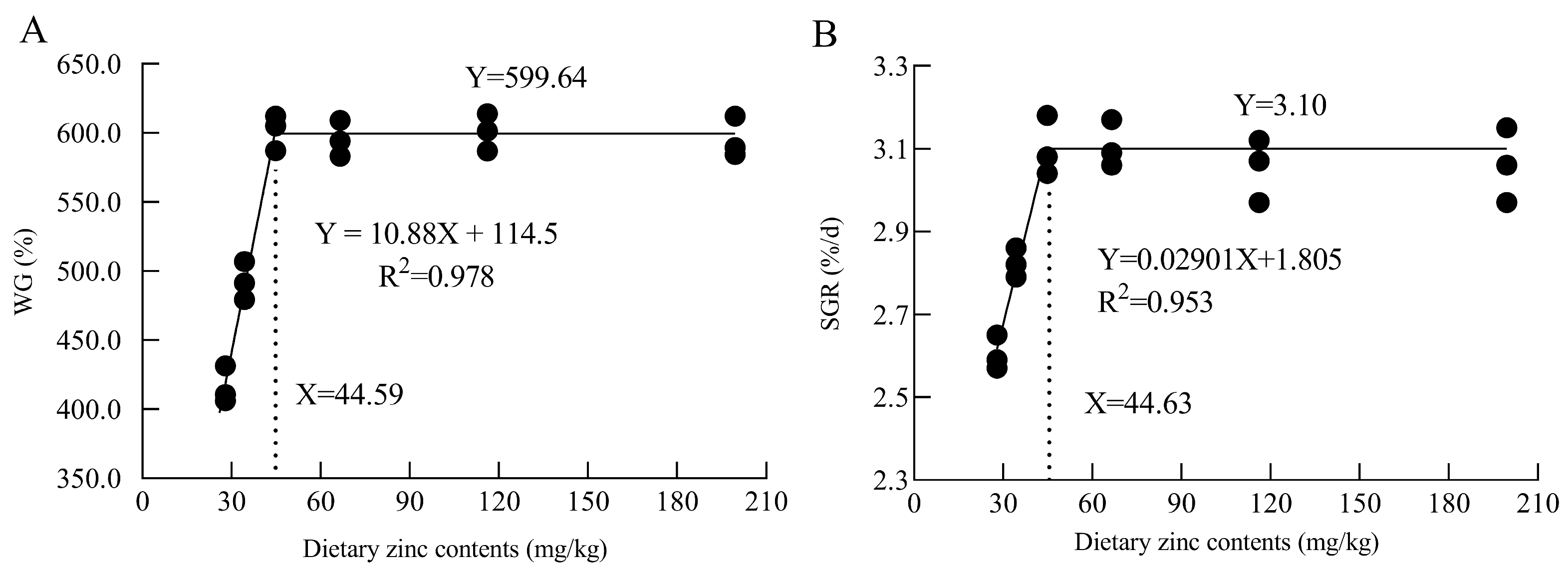
Relative to the unsupplemented control (Zn0), dietary zinc inclusion significantly stimulated FBW, WG, and SGR (p < 0.05) (Table 3). Notably, WG and SGR reached their maxima in the Zn20 group. Based on broken-line regression models applied to WG and SGR, the optimal zinc requirements for juvenile black carp (M. piceus) were calculated as 44.59 and 44.63 mg/kg, respectively (Figure 1). Furthermore, zinc addition (Zn10–Zn160) led to a marked reduction in the FCR in comparison with the deficient group (p < 0.05); no statistical variations were presented among these supplemented treatments (p > 0.05). HSI and CF remained statistically unaffected by dietary treatments (p > 0.05).
Regarding proximate composition, moderate to high dietary zinc (Zn20–Zn160) significantly suppressed whole-body crude lipid content relative to the Zn0 and Zn10 groups (p < 0.05). However, whole-body protein and ash fractions exhibited no significant responsiveness to zinc levels (p > 0.05).

3.2. Biochemical Parameters in the Serum

HDL-C level was significantly increased and then maintained a stable trend in the serum of the Zn20, Zn40, Zn80 and Zn160 groups in comparison with the Zn-deficient group (Zn0) (p < 0.05). Conversely, Zn supplementation (Zn10–Zn80) significantly decreased serum LDL-C, GLU, and AST levels relative to the Zn0 control (p < 0.05), with these parameters plateauing and showing no further statistical variation among the Zn20 to Zn80 treatments (p > 0.05). Although there were no significant variations between the Zn0 and Zn160 treatments (p > 0.05), ALT activities were notably decreased in the serum of the Zn10, Zn20, Zn40 and Zn80 groups in comparison with the Zn0 group (p < 0.05). However, there were no variations in the contents of TG, TC, ALB and TBA among these six treatments (p < 0.05) (Table 4 and Table 5).

3.3. Expression of Zn Transport-Related Genes

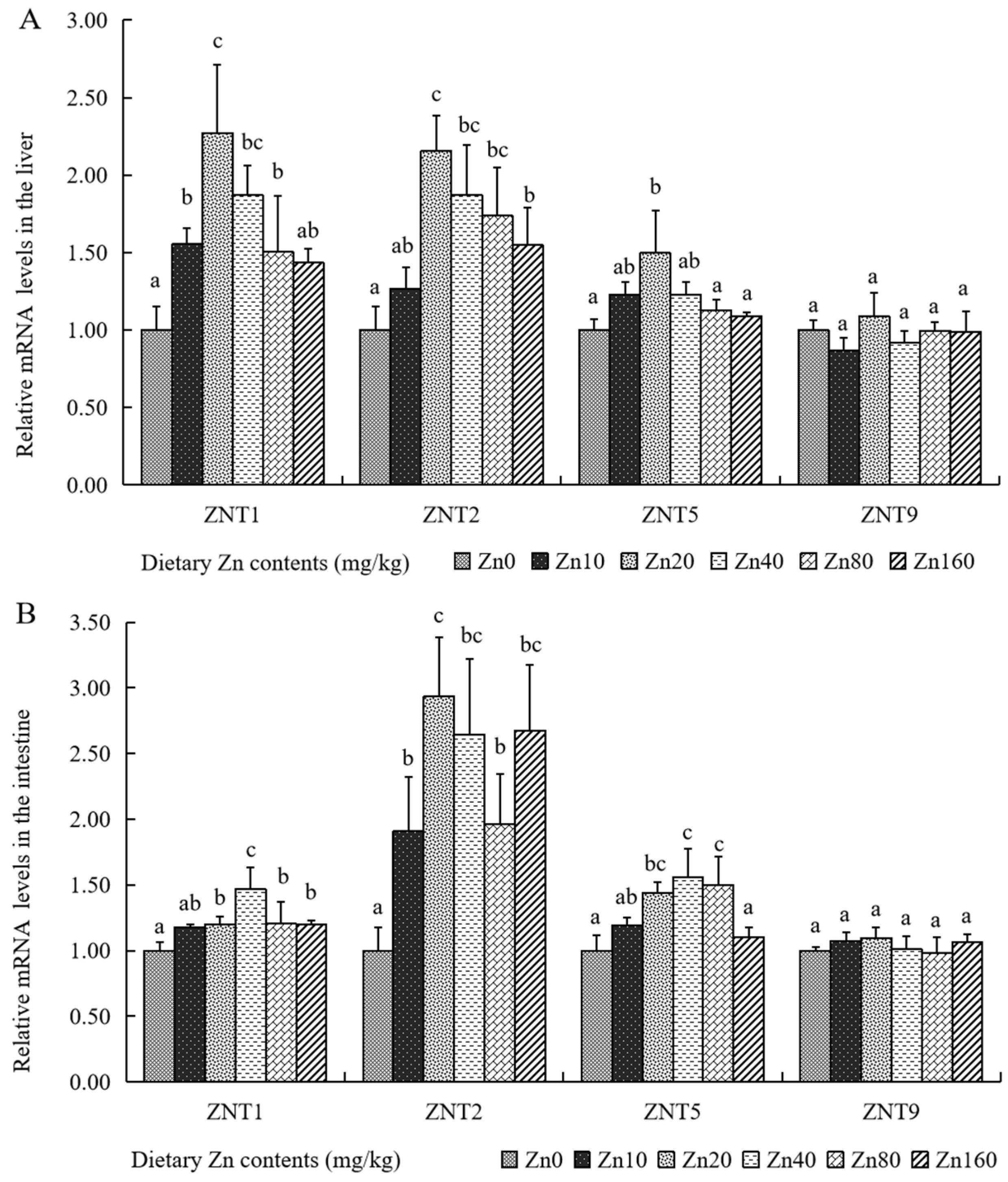
Transcriptional profiles of zinc transporters in targeted tissues are illustrated in Figure 2. In the liver, ZNT1, ZNT2, and ZNT5 transcript abundances peaked within the Zn20 cohort (p < 0.05) before declining at higher dietary zinc doses. Although hepatic ZNT2 remained elevated in the Zn160 treatment compared to the deficient control, ZNT1 and ZNT5 expressions returned to baseline, showing statistical equivalence to the Zn0 group (p > 0.05). Regarding intestinal tissues, ZNT1 mRNA levels were initially upregulated, reaching maximal level in the Zn40 group (p < 0.05), followed by a marked suppression under the Zn80 and Zn160 diets (p < 0.05). Similarly, intestinal ZNT2 expression in the Zn40 cohort surged to approximately threefold that of the unsupplemented control. Notably, ZNT9 transcription exhibited no significant responsiveness to dietary zinc variations in either the liver or intestine across all treatments.

3.4. Hepatic Antioxidative and Oxidative Parameters

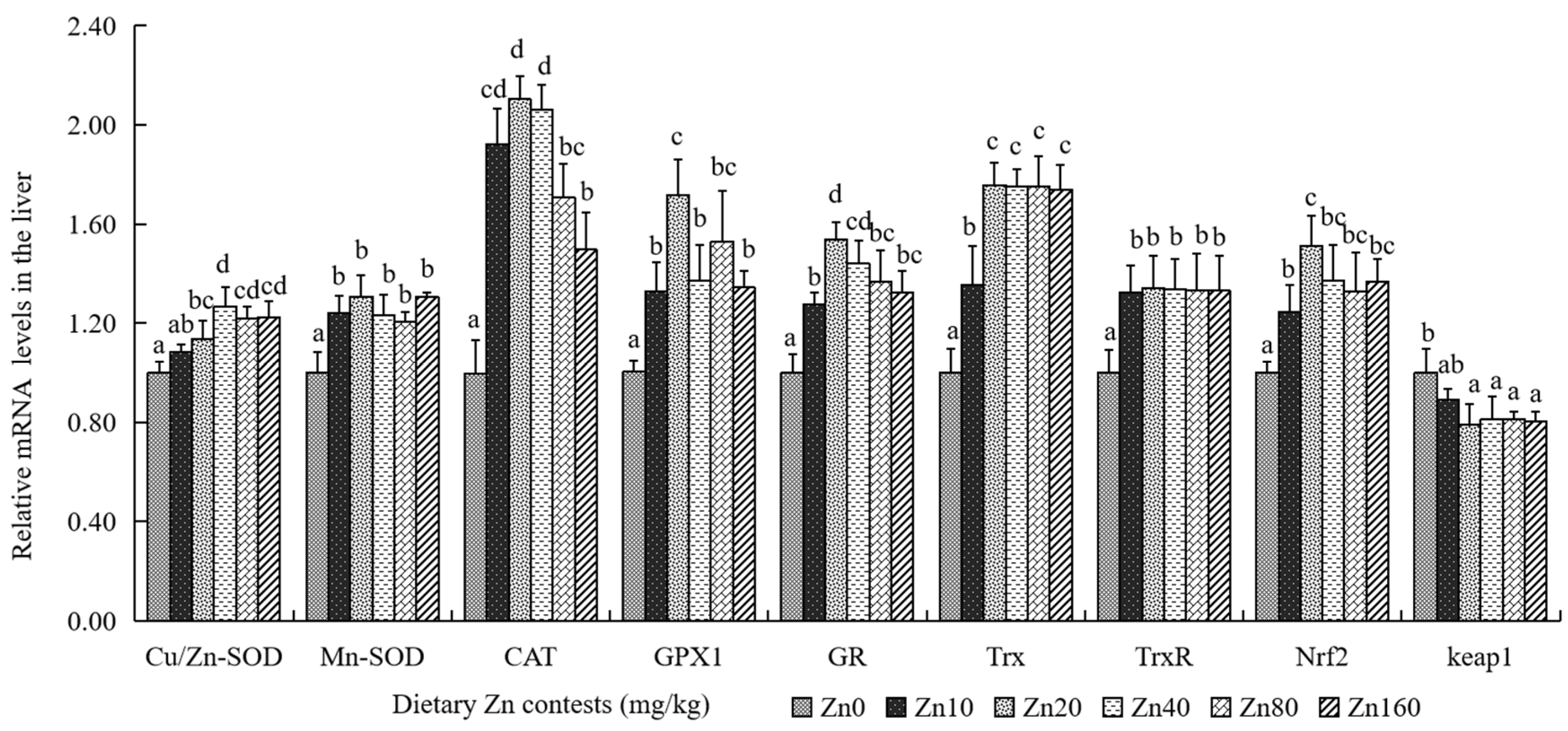
As outlined in Table 6, dietary zinc inclusion significantly stimulated hepatic antioxidant defenses. Specifically, the activities of T-SOD, CAT, GPX, and GR, together with GSH and T-AOC levels, all peaked in the Zn20 treatment (p < 0.05). Conversely, GST activities and MDA contents were significantly reduced in Zn-supplemented groups compared to the control, indicating decreased oxidative stress (p < 0.05). Dietary Zn levels significantly affected the hepatic mRNA expression of antioxidant-related genes in juvenile black carp (M. piceus) (p < 0.05) (Figure 3). Overall, Zn supplementation upregulated the expression of Cu/Zn-SOD, Mn-SOD, GR, CAT, GPX1 and Nrf2 to varying extents, whereas Keap1 displayed an opposite trend.
Specifically, Cu/Zn-SOD increased progressively with Zn inclusion and reached the highest level at the Zn40 trial group (p < 0.05), and there were no significant differences from the 40 mg/kg group (p > 0.05) but remained significantly higher than the Zn0 and Zn10 groups (p < 0.05). Mn-SOD was notably elevated in all Zn-supplemented groups compared to the Zn-deficient group (p < 0.05), showing an overall increase followed by maintenance. CAT was the most Zn-responsive gene: it was markedly enhanced at Zn10 to Zn80 groups and peaked at Zn20 (p < 0.05), followed by a significant decline at Zn160 (p < 0.05), though still higher than the Zn0 group (p < 0.05). GPX1 was significantly increased and maximized at Zn20 (p < 0.05); it then decreased at higher Zn levels (40–160 mg/kg) but generally remained above the Zn0 level (p < 0.05). GR peaked at 20 mg/kg (p < 0.05), with the Zn40 mg/kg group ranking second, and then declined further at Zn80 and Zn160 mg/kg (p < 0.05), suggesting an optimal response window. Regarding transcriptional regulators, Nrf2 was significantly upregulated by Zn and reached the maximum at Zn20 (p < 0.05), while the Zn40–Zn160 treatments maintained relatively high but lower-than-peak levels. In contrast, Keap1 was significantly reduced at Zn10 compared with Zn0 (p < 0.05) and decreased further at Zn20 to Zn160, remaining at the lower levels with no marked variations among high-Zn groups (p > 0.05).
Collectively, antioxidant-related genes presented a pronounced non-linear dose–response to dietary Zn. Stronger induction was generally observed within the Zn20 to Zn40 range (with Cu/Zn-SOD favoring 40 mg/kg, whereas CAT, GPX1, GR and Nrf2 were more prominent at 20 mg/kg), while partial attenuation or plateauing occurred at higher Zn levels. The coordinated increase in Nrf2 and decrease in Keap1 further suggest that Zn supplementation may facilitate hepatic antioxidant transcriptional regulation.

3.5. Intestinal Antioxidant Capacity and Oxidative Status

As summarized in Table 7, dietary zinc inclusion upregulated intestinal T-SOD, CAT, GPX, and GR activities, as well as GSH levels, which all culminated in the Zn20 treatment. Significant elevations in T-AOC were also observed from the Zn20 group onwards (p < 0.05), maintaining stability at higher zinc doses (p > 0.05). In contrast, increasing zinc intake triggered an initial reduction in GST activity, hitting the lowest point in the Zn40 cohort (p < 0.05).
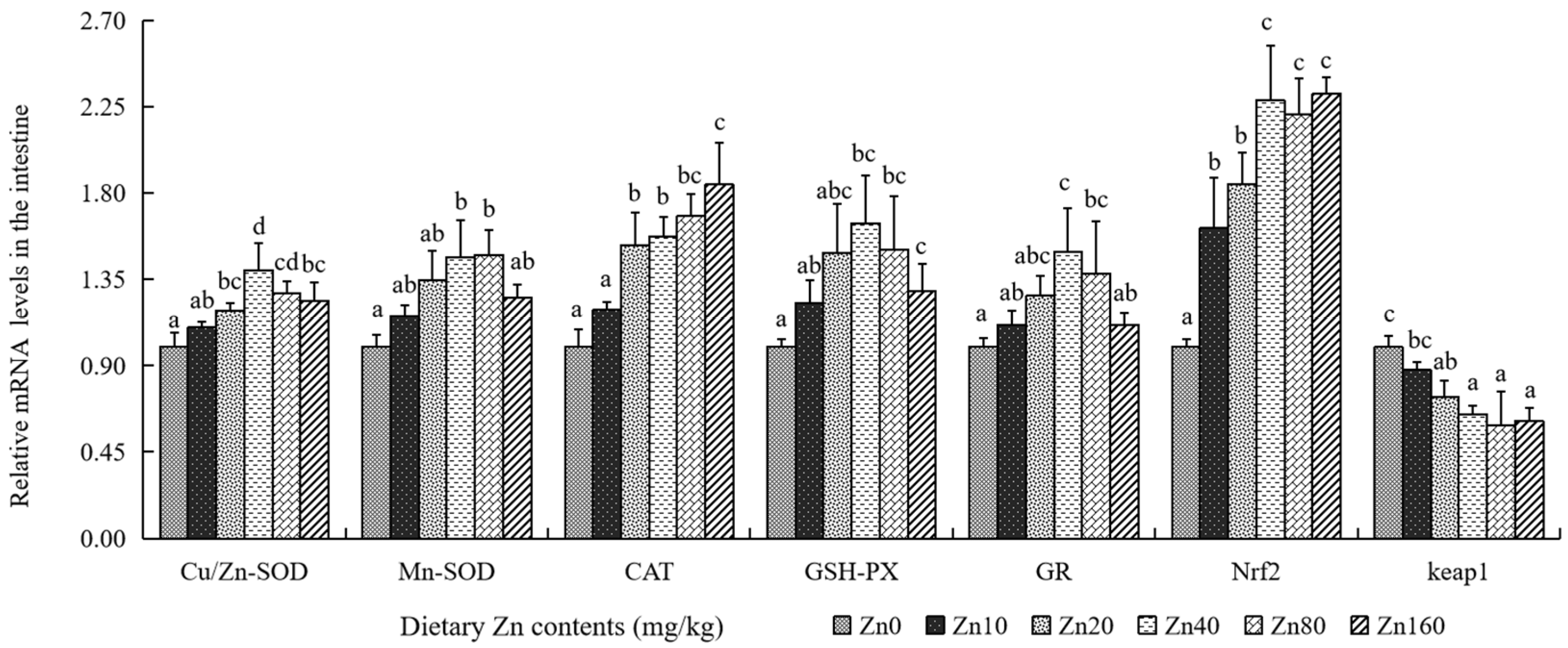
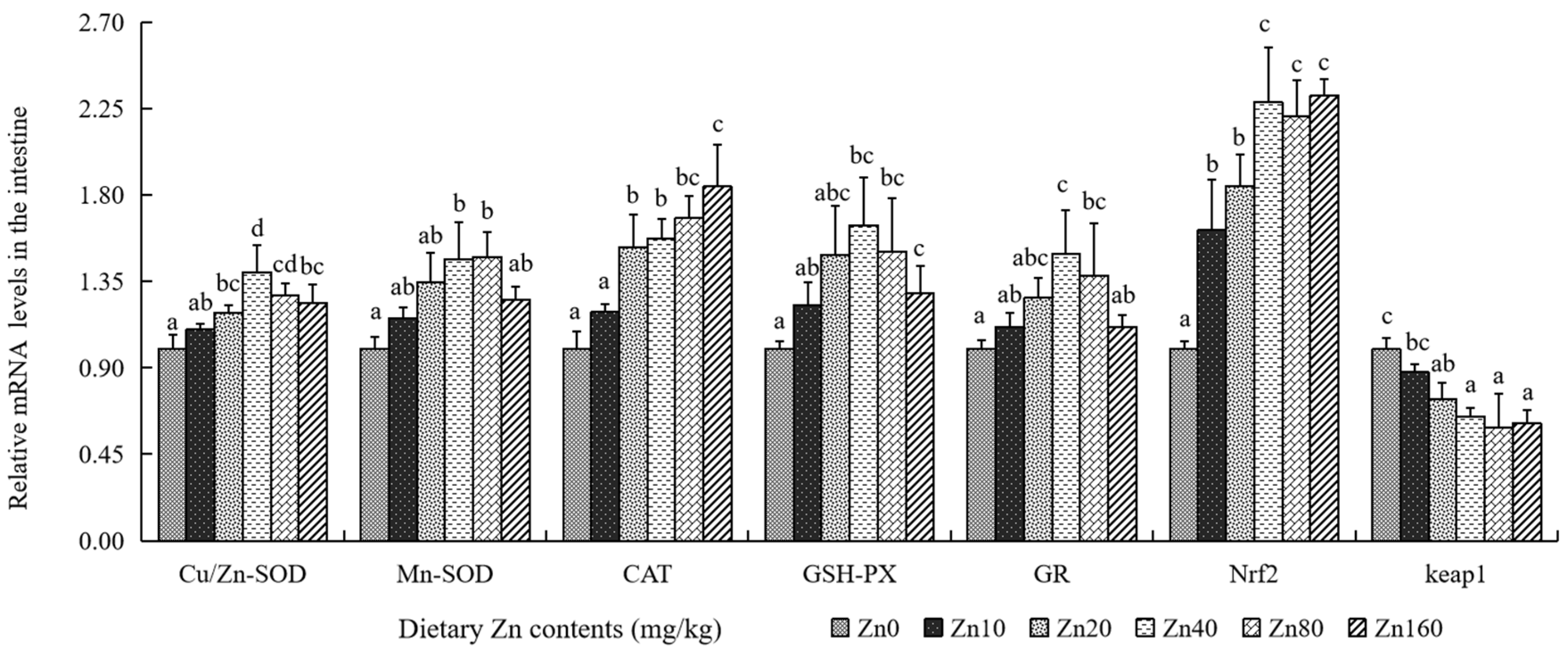
Dietary zinc significantly altered the transcriptional profiles of intestinal antioxidant genes (Figure 4). In comparison with the Zn-deficient diet, dietary Zn administration uniformly upregulated the mRNA transcriptinal levels of Cu/Zn-SOD, Mn-SOD, CAT, GSH-PX, and GR (p < 0.05). Specifically, the mRNA levels of Cu/Zn-SOD, Mn-SOD, and GR were heightened and achieved their peak levels in the Zn40 treatment, followed by a declining trend at higher doses. Meanwhile, the transcription amounts of CAT were positively correlated with dietary Zn contents and achieved their maximal levels in the Zn160 treatments (p < 0.05). Specifically, the highest transcriptional abundance of GSH-PX was recorded in the Zn80 treatment (p < 0.05). In addition, the transcription levels of the key regulator, Nrf2, were markedly elevated and reached a plateau in the Zn40 to Zn160 groups. In contrast, the transcription amounts of its inhibitor, Keap1, were notably reduced in the Zn-supplemented groups, with the lowest levels observed from the Zn40 to Zn160 treatments (p < 0.05).

3.6. Intestinal Immunity and Inflammatory Responses

Compared with the zinc-deficient group, zinc administration significantly bolstered gut immunity (p < 0.05). Notably, both C3 and IgM contents peaked across the Zn10 and Zn20 groups. Lysozyme (LZM) reached its highest concentration in groups Zn20 and Zn40, while C4 was maximized in the Zn20 and Zn80 groups. Furthermore, enzyme activities were also affected. ACP activity was greatest in the Zn20 group, whereas ALP activity exhibited a progressive, dose-dependent increase, culminating in the Zn160 group (p < 0.05).
Compared with the Zn-deficient group (Zn0), the transcription levels of complement-related genes (C3, C4 and CFB) were markedly heightened in the Zn-supplemented groups (p < 0.05). Specifically, C3 was markedly increased and achieved higher levels in Zn40-Zn80 treatments compared with Zn0 treatment, followed by a significant decrease in the Zn160-treated group (p < 0.05), although it remained higher than Zn0 (p < 0.05). Relative to the Zn0 treatment, C4 concentrations were significantly augmented from Zn10 to Zn40 (p < 0.05), thereafter reaching a stable plateau with no marked variances across the Zn20–Zn160 treatments (p > 0.05). Similarly, CFB contents experienced a sharp enhancement that peaked at Zn40, stabilizing subsequently at values persistently greater than the unsupplemented group (p < 0.05).
Regarding intestinal gene expression (Figure 5), the transcriptional abundances of LZM, NRAMP, and IgH shared a highly consistent parabolic trend. They were maximally upregulated in the Zn40 cohort (p < 0.05) before undergoing a marked decline under excessive Zn inputs (Zn80 and Zn160), although their final expressions still generally surpassed the Zn-deficient baseline (p < 0.05). Conversely, Igλ1 transcription displayed a milder sensitivity to Zn inclusion; its expression was primarily enriched in the Zn40 and Zn80 treatments compared to the lower-dosage groups, exhibiting statistical equivalence among the three highest Zn levels (Table 8).

3.7. Analysis of Intestinal Inflammatory and Anti-Inflammatory Parameters

At the protein level (Table 9), dietary Zn inclusion significantly boosted the concentrations of classic anti-inflammatory cytokines (TGF-β1 and IL-10) (p < 0.05). Conversely, a pronounced suppression was observed in the pro-inflammatory cascade molecules (IL-1β, IL-6, TNF-α, and IFN-γ) across all supplemented cohorts, where the minima were recorded in the Zn20 and Zn40 treatments (p < 0.05).
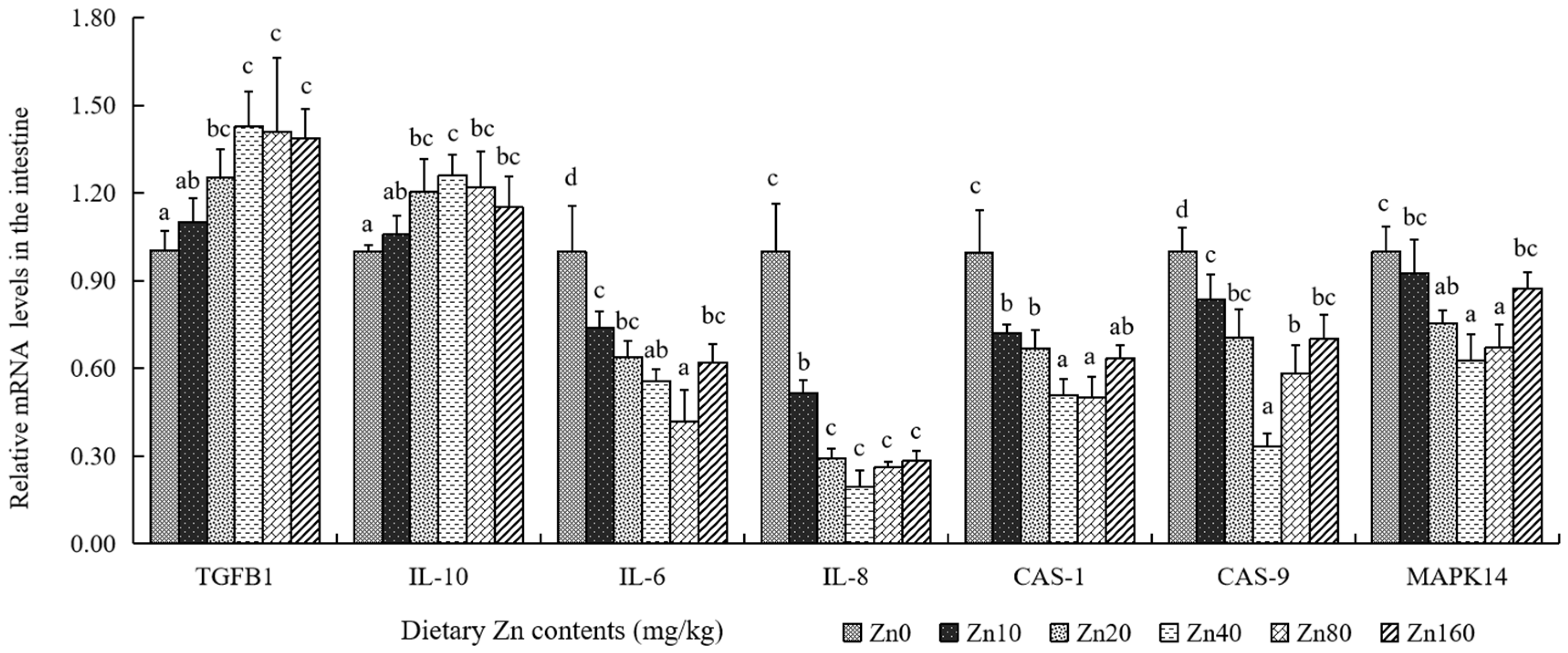
Consistent with the biochemical assays, the transcriptional abundances of TGF-β1 and IL-10 were remarkably upregulated by Zn supplementation relative to the unsupplemented control (p < 0.05). Specifically, TGF-β1 transcription climbed to its peak within the Zn40–Zn160 range, maintaining a stable plateau without statistical variance among these higher-dose groups (p > 0.05). Specifically, IL-10 transcription was significantly upregulated across the Zn20–Zn80 range relative to the Zn0 and Zn10 treatments (p < 0.05), forming a statistical plateau (p > 0.05) before experiencing a mild decline in the Zn160 cohort (p < 0.05). Conversely, the mRNA abundances of pro-inflammatory cytokines (IL-6 and IL-8) were robustly repressed by Zn inclusion. Relative to the unsupplemented control, IL-6 expression was universally downregulated across all treatments (p < 0.05), hitting its nadir in the Zn80 group (p < 0.05) before exhibiting a significant rebound at the maximum dosage (Zn160) (p < 0.05). Likewise, IL-8 transcription was notably reduced in the Zn10–Zn160 groups relative to Zn0 (p < 0.05) and reached the minimum at Zn80 (p < 0.05), whereas the differences among Zn20, Zn40, Zn80 and Zn160 were generally not significant (p > 0.05). Meanwhile, Zn supplementation also downregulated CAS-1 and CAS-9 compared with Zn0 group (p < 0.05). The mRNA abundance of CAS-1 hit its lowest point in the Zn40–Zn80 cohorts (p < 0.05) before rebounding at Zn160 (p < 0.05). A comparable trajectory was noted for CAS-9, which reached its minimum at Zn40 (p < 0.05). Although its expression climbed in the higher Zn groups (Zn80–Zn160), it remained markedly lower than the unsupplemented control (p < 0.05). Furthermore, MAPK14 transcription level was markedly decreased in the Zn20 and Zn40 treatments in comparison with the Zn0 treatment (p < 0.05), followed by a partial restoration at the highest Zn doses (p < 0.05). Overall, dietary Zn enhanced anti-inflammatory signals while suppressing pro-inflammatory mediators, and 40 mg/kg Zn generally produced the most favorable transcriptional profile (p < 0.05), Figure 6).

3.8. Histomorphometry and Intestinal Barrier-Related Genes’ Expression

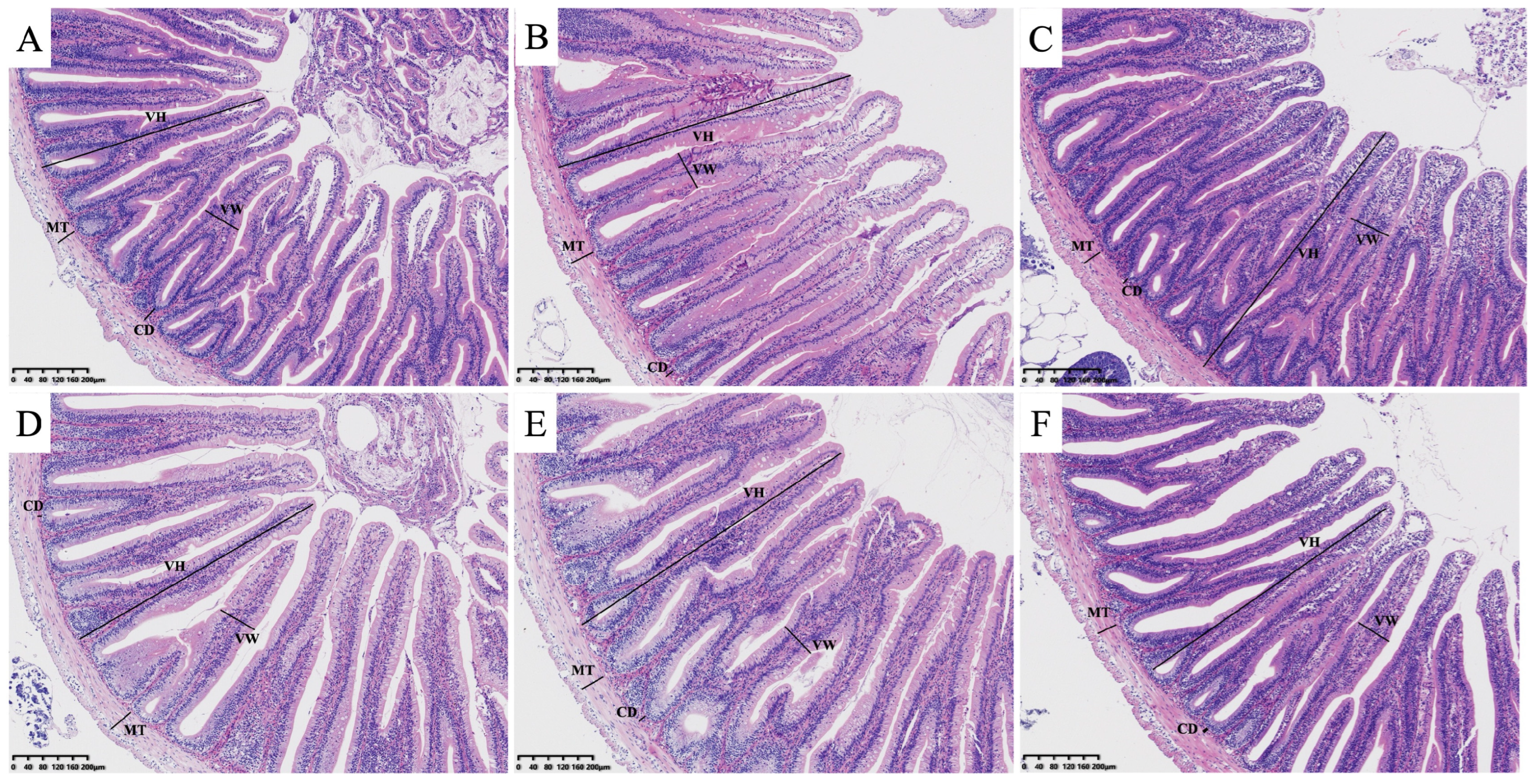
Dietary Zn significantly influenced intestinal morphology (Table 10). Relative to the Zn0 group, villi height was significantly increased in all Zn treatments (p < 0.05). Villi width peaked in the Zn10 group (p < 0.05), while muscular thickness and crypt depth reached their maximums in the Zn80 group (p < 0.05) (Figure 7). However, excessive Zn supplementation (Zn160) caused significant reductions in villi width and crypt depth compared to the control (p < 0.05).
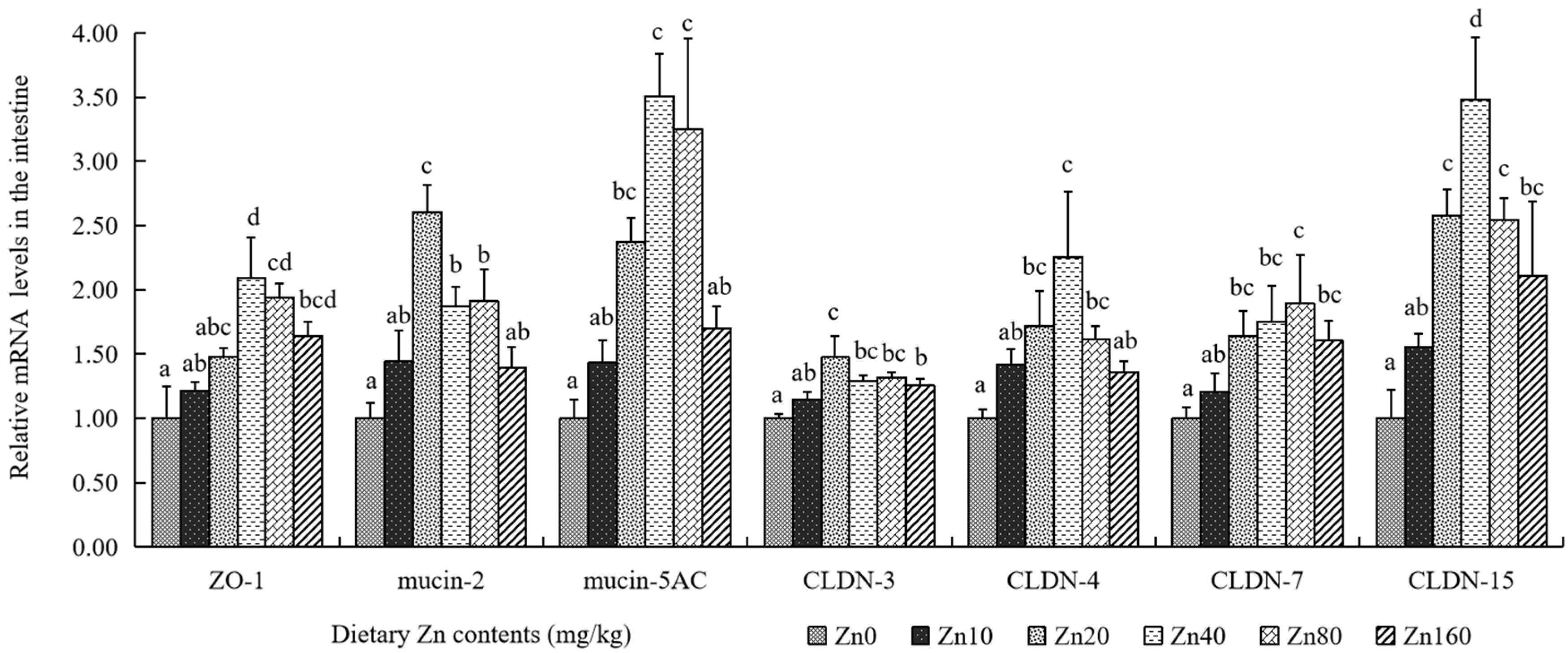
The transcription levels of ZO-1, mucin-2, mucin-5AC, CLDN-3, CLDN-4, CLDN-7 and CLDN-15 were notably heightened in the intestine of the Zn20, Zn40 and Zn80 treatment groups compared with the Zn0 treatment group (p < 0.05) (Figure 8). There were also no marked differences on the mRNA expression levels of ZO-1, mucin-5AC, CLDN-4, CLDN-7 and CLDN-9 among Zn20, Zn40 and Zn80 treatments (p > 0.05), while the transcription levels of mucin-2, mucin-5AC, CLDN-4, CLDN-7, CLDN-9, and CLDN-15 were universally downregulated in the Zn160 group in comparison with the Zn40 treatment group (p < 0.05), and the levels of mucin-2, mucin-5AC, and CLDN-4 in the highest Zn group were not statistically different from those of the Zn-deficient control (Zn0).

4. Discussion

Zinc functions as an indispensable micronutrient that underpins the somatic growth of diverse aquatic species [9,28]. In the current study, broken-line regression analysis of both WG and SGR revealed the optimal dietary Zn requirement for juvenile black carp (M. piceus) ranges from 44.59 to 44.63 mg/kg. Systematic comparison across fish species reveals interesting patterns in Zn requirements reflecting differences in phylogeny, feeding ecology, and metabolism [29]. The Zn requirement of black carp (M. piceus) was higher than that of yellow catfish (Pelteobagrus fulvidraco) [30] and rainbow trout (Oncorhynchus mykiss) [31], similar to grass carp (Ctenopharyngodon idella) [32] and Jian carp (Cyprinus carpio var. Jian) [33], but lower than that of largemouth bass (Micropterus salmoides) [34]. These variations might be attributed to multiple factors, including basal dietary Zn content, Zn source bioavailability, growth stage, metabolic rate, and species-specific digestive physiology [29,35,36]. The relatively high Zn requirement in black carp might be related to its specialized molluscivorous feeding habit, which demands enhanced synthesis of digestive enzymes and intestinal absorptive capacity to process hard-shelled prey.
Mechanistically, the growth-promoting properties of Zn are multifaceted, intricately linked to the optimized assimilation of nutrients and energy metabolism. Although no marked effects were presented on the contents of crude protein and ash in the whole fish body, fish body lipid content was significantly decreased at optimal and higher contents of dietary Zn, consistent with findings in yellow catfish (P. fulvidraco Richardson) [30]. The improved FCR suggests that adequate Zn levels in feed can enhance feed utilization efficiency and nutrient assimilation [30]. The liver and intestine are crucial organs for digestive enzyme secretion and nutrient absorption [37,38]. Zn plays key roles in the synthesis and activity regulation of digestive enzymes, which are closely related to digestive, metabolic, absorptive and growth processes in all fish species [39]. Previous research has found Zn-deficiency feeding could significantly reduce activities of TRY, CYT and AMS in pig [40], yellow catfish (P. fulvidraco Richardson) [30] and Siberian sturgeon (Acipenser baerii) [39], which is consistent with the present experimental results. Together with the improved FCR and overall growth, these findings suggest that adequate Zn inclusion significantly enhances digestive enzyme activities, thereby driving the superior growth performance of juvenile black carp.
Cellular Zn homeostasis is precisely maintained through coordinated regulation of Zn transporter (ZnT/Slc30a) families, which control Zn movement across cellular membranes in response to different levels of dietary Zn [41,42]. In teleosts, ZnT-regulating responses have been documented in zebrafish (Danio rerio) embryos and grass carp [43,44,45]. In the present study, optimal dietary Zn supplementation significantly upregulated the transcription of key zinc transporter genes (ZNT1, ZNT2, and ZNT5) in both the hepatic and intestinal tissues. This indicates that optimal dietary Zn supplementation is associated with the modulation of ZnT expression profiles to maintain integrated Zn homeostasis in black carp [37]. Conversely, relative lower expression levels of ZNT1, ZNT2, and ZNT5 were observed in the Zn160 group, aligning with observations in yellow catfish [37]. This transcriptional downregulation under high-Zn conditions may serve as a protective mechanism to limit further Zn influx and avoid heavy metal overload in fish [46,47].
Serum biochemical indicators have been widely used to evaluate the metabolic homeostasis and nutritional status of fish [48]. Numerous studies have shown that relatively higher serum ALT, ALP, and AST activities can reflect the functional status of metabolic organs, particularly the liver [26,49,50]. Hepatic injury compromises hepatocyte membrane integrity, leading to the leakage of intracellular enzymes and a subsequent elevation in serum ALT and AST activities [51]. In this study, activities of ALT and AST declined in the serum of Zn-supplemented groups, which agrees with earlier findings in soft-shelled turtle (Pelodiscus sinensis) [52], indicating that optimal dietary Zn could improve the health status of hepatic cells in black carp (M. piceus) [53]. Functionally, HDL-C mediates reverse cholesterol transport from peripheral tissues to hepatic cells for subsequent catabolism, while LDL-C delivers hepatic cholesterol to other tissues for cellular utilization [54]. As we know, cholesterol can be coupled with bile acids to generate related mixtures and play important roles in lipid digestion and absorption [55]. Similar to results in soft-shelled turtle (P. sinensis) [52], higher HDL-C levels coupled with lower LDL-C levels were observed in these Zn-supplemented groups, indicating that adequate dietary Zn might be beneficial for serum lipid transport into hepatic cells in black carp (M. piceus). As the primary lipid molecules synthesized in the liver, TG and TC play indispensable roles in driving lipid metabolism and maintaining systemic metabolic homeostasis [56]. However, there was no significant difference in TG and TC levels in the Zn-added groups, which differs from results in soft-shelled turtle (P. sinensis) [52] and largemouth bass (M. salmoides) [57]. These divergences may be mediated by differences in fish species. Additionally, ALP is a Zn-dependent enzyme, and its significantly increased activity in the Zn-added groups indirectly reflects improved Zn metabolism and utilization [58], consistent with findings in golden pompano (Trachinotus ovatus) [59]. Furthermore, serum GLU levels were notably decreased in the Zn-added groups, consistent with previous findings in Pangasius hypophthalmus [60] and largemouth bass (M. salmoides) [57]. This hypoglycemic effect likely stems from Zn-mediated regulation of glucose metabolism, though further metabolic studies are required to fully elucidate this mechanism in fish.
It is widely recognized that reactive oxygen species (ROS) are continuously generated during the aerobic metabolism of nutrients, including Zn, which significantly influences redox homeostasis in animals [61,62]. Acting as crucial components of the antioxidant defense system, key enzymes such as SOD, CAT, and GPX catalyze the conversion of toxic oxygen radicals into harmless H2O and O2, thereby mitigating oxidative stress in fish [55,63]. In juvenile black carp (M. piceus), the activities of T-SOD, GPX, and CAT were notably upregulated in both hepatic and intestinal tissues following dietary Zn supplementation. Similar Zn-induced enhancements in these antioxidant enzymes have been widely reported in other teleosts, including rainbow trout (Oncorhynchus mykiss) [64], Jian carp (Cyprinus carpio var. Jian) [65], half-smooth tongue sole (Cynoglossus semilaevis) [66], and golden pompano (T. ovatus) [59]. These consistent results strongly suggest that adequate dietary Zn plays a vital role in activating and bolstering the primary enzymatic antioxidant defense system in fish [64]. Beyond primary enzymes, the glutathione system is essential for sustaining cellular redox balance. GR facilitates the reduction of glutathione disulfide (GSSG) into GSH [67], while GST drives the generation of glutathione S-conjugates for detoxification [68]. Elevated GST typically serves as an adaptive physiological response to oxidative damage or inflammatory stimuli [69]. In our study, Zn supplementation significantly increased GSH content and T-AOC in both the liver and intestine. The observed decrease in GST alongside the increase in GR activity suggests that Zn promotes the regeneration of reduced GSH, thereby expanding the cellular antioxidant pool to maintain redox homeostasis [65]. Under oxidative stress, excessive ROS damages cell membranes, leading to lipid peroxidation, which is reliably quantified by MDA content [70]. As a vital antioxidant, GSH scavenges oxygen radicals and organic peroxides, protecting tissues and preventing harmful MDA accumulation [71]. Previous studies confirm that dietary Zn levels significantly affect GSH synthesis and effectively reduce MDA concentrations [72,73]. Consistently, our results showed that Zn supplementation significantly reduced hepatic and intestinal MDA levels, aligning with findings in Jian carp (C. carpio var. Jian) [65] and golden pompano (T. ovatus) [59]. At the molecular level, these biochemical adaptations are governed by the Nrf2/Keap1 axis, a master regulator of cellular antioxidant responses [74,75]. Dietary Zn supplementation not only significantly enhanced Nrf2 transcription but also downregulated Keap1 mRNA expression, corroborating previous results in yellow catfish (Pelteobagrus fulvidraco) [73]. Taken together, our findings demonstrate that adequate dietary Zn enhances antioxidant capacity and mitigates lipid peroxidation in black carp by stimulating antioxidant enzyme activities and increasing cellular GSH content, a process likely mediated through the activation of the Nrf2/Keap1 signaling pathway.
The integrity of the intestinal physical barrier is primarily governed by the tight junction (TJ) complex, including zonula occludens (ZOs) and claudins (CLDNs), alongside the chemical barrier formed by mucins [25,76]. These proteins act as essential biomarkers for evaluating the functional integrity of the intestinal barrier [77,78], and are indispensable for regulating epithelial permeability and supporting external nutrient absorption [79]. Specifically, as a peripheral membrane protein, ZO-1 is fundamental in constructing and stabilizing tight junctions between epithelial cells [80]. Concurrently, CLDNs function as key transmembrane components that sustain cell-to-cell barriers, manage intercellular communication, and preserve cellular polarity [81]. In our present study, optimal dietary Zn supplementation, particularly in the Zn40 group, markedly upregulated the mRNA expressions of ZO-1, as well as multiple claudin members (CLDN-3, CLDN-4, CLDN-7, and CLDN-15). Furthermore, the transcriptions of mucin-2 and mucin-5AC, which act as crucial components of the intestinal chemical barrier, exhibited a synchronized upregulation under adequate Zn intake. This observation is highly consistent with prior investigations in Nile tilapia (Oreochromis niloticus) [82], rainbow trout (O. mykiss) [83], and grass carp (C. idella) [45]. These transcriptional profiles indicate that an adequate dietary intake of Zn is associated with improved intestinal barrier function by simultaneously reinforcing the physical barrier (ZO-1 and CLDNs) and supporting chemical mucus secretion.
A growing body of evidence indicates that augmenting the levels of key immune effectors fundamentally bolsters host immunity, including complement components (C3, C4, and CFB) and humoral immune-related genes (LZM, NRAMP, IgH, and Igλ1) [57,77,84] In the present study, Zn-supplemented diets effectively counteracted potential damage by enhancing intestinal immunity, evidenced by increased C3, C4, IgM, and LZM activities. This immunomodulatory effect of adequate Zn aligns strongly with similar findings reported in largemouth bass (M. salmoides) [57]. Furthermore, appropriate dietary Zn content significantly increased intestinal ACP and ALP activities, aligning with findings in rats [85] and various fish species, such as largemouth bass (M. salmoides) juveniles supplemented with dietary soybean lecithin [77] and black carp (M. piceus) fed selenium yeast [26]. It is extensively indicated in the literature that Zn deprivation triggers metabolic stress and physiological disturbances [86], ultimately compromising the survival, proliferation, and maturation of immune cells [87]. Central to regulating these immune responses and inflammatory processes is the strict homeostatic balance of inflammatory cytokines [86]. In our results, IL-10 and TGF-β1, two typical anti-inflammatory cytokines, showed increasing then stabilizing trends with dietary Zn increases, similar to results in largemouth bass (M. salmoides) treated with dietary Zn [74]. Conversely, the expression levels of pro-inflammatory cytokines (IL-1β, IL-6, IFN-γ, and TNF-α) exhibited a pattern of initial suppression followed by a plateau, corroborating previous observations in largemouth bass (M. salmoides) [74], indicating adequate dietary Zn could suppress the contents of these pro-inflammatory cytokines at both transcriptional and protein levels in black carp (M. piceus).
Crucially, inflammatory and apoptotic responses are meticulously regulated by distinct signaling cascades. In our study, adequate dietary Zn downregulated the mRNA expression of CAS-1 and CAS-9. It is well established that Caspase-1 plays a vital role in the inflammasome complex, facilitating the maturation and secretion of IL-1β, whereas Caspase-9 functions primarily as an initiator caspase in the mitochondrial apoptosis pathway [74]. The concomitant reduction in CAS-1 and IL-1β transcription suggests that adequate Zn may help alleviate intestinal inflammation, while the downregulation of CAS-9 points to a potential attenuation of cellular apoptosis. Mechanistically, the production of pro-inflammatory cytokines is largely governed by the p38 MAPK signaling cascade. Our data showed that adequate Zn supplementation downregulated MAPK14 mRNA expression, similar to findings in largemouth bass [74]. Although further investigation at the protein phosphorylation level is required to confirm functional pathway activity, the current transcriptional evidence suggests that adequate dietary Zn may be involved in mitigating intestinal inflammation, potentially by modulating the p38 MAPK cascade and Caspase-1 signaling in black carp.


5. Conclusions

This study demonstrates that the optimal dietary zinc requirement for juvenile black carp (M. piceus) is approximately 44.6 mg/kg, based on growth performance. Adequate dietary Zn supplementation significantly improves feed utilization, reduces whole-body lipid deposition, and enhances digestive enzyme activities. Furthermore, optimal Zn intake is associated with the modulation of Zn transporter gene expression to maintain trace element homeostasis. It also upregulates antioxidant enzyme activities and related gene expressions potentially involving the Nrf2/Keap1 pathway, bolsters intestinal barrier integrity by promoting tight junction and mucin transcription, and enhances innate immunity. Importantly, adequate dietary Zn could exert an anti-inflammatory effect, which may be associated with the transcriptional modulation of the MAPK14 and CAS-1 signaling cascades. From a practical perspective, maintaining a suitable Zn inclusion level in commercial aquafeeds is highly recommended to maximize feed efficiency, ensure robust intestinal health, and improve the economic sustainability of black carp culture.

Author Contributions

Conceptualization, J.Y., P.Z. and C.W.; methodology, J.Y., P.Z., X.Z. (Xunshang Zhang), X.Z. (Xiaotong Zhu), X.S. and C.W.; validation, J.Y., P.Z., X.Z. (Xunshang Zhang), X.S. and C.W.; formal analysis, J.Y., P.Z., Y.X., M.X. and X.Y.; investigation, J.Y., P.Z., X.Z. (Xunshang Zhang), X.Z. (Xiaotong Zhu), H.Z. and M.X.; data curation, J.Y., P.Z., X.Z. (Xunshang Zhang), X.Z. (Xiaotong Zhu), Y.L. and C.W.; writing—original draft preparation, J.Y., P.Z., X.Z. (Xunshang Zhang), X.Z. (Xiaotong Zhu), X.S. and C.W.; writing—review and editing, J.Y., P.Z., X.S., M.X., Y.X., X.Y. and C.W.; visualization, H.Z. and Y.L.; supervision, Y.L., X.S. and C.W.; project administration, C.W.; funding acquisition, C.W. All authors have read and agreed to the published version of the manuscript.

Funding

This research was financially supported by the Earmarked Fund for China Agriculture Research System (CARS-45-10).

Institutional Review Board Statement

The Ethics Committee on the Use of Animals of the Huzhou Normal University (HZNU) approved all procedures in this research prior to implementation under protocol number 068/2023, with an approval date of 16 June 2023, following the guidelines of the National Council for Experimentation Animal Control.

Informed Consent Statement

Not applicable.

Data Availability Statement

Data are contained within this article.

Conflicts of Interest

The authors declare no conflicts of interest.

Abbreviations

The following abbreviations are used in this manuscript:
AbbreviationFull Name/Definition
ACPAcid phosphatase
ALBAlbumin
ALPAlkaline phosphatase
ALTAlanine aminotransferase
AMSAmylase
ANOVAAnalysis of variance
ASTAspartate aminotransferase
C3/C4Complement component 3/Complement component 4
CAS-1/CAS-9Caspase-1/Caspase-9
CATCatalase
CDCrypt depth
CFCondition factor
CFBComplement factor B
CLDNClaudin (e.g., CLDN-3, CLDN-4)
Cu/Zn-SODCopper/zinc superoxide dismutase
CYTChymotrypsin
FBWFinal body weight
FCRFeed conversion ratio
GLUGlucose
GPX/GSH-PXGlutathione peroxidase
GRGlutathione reductase
GSHGlutathione (reduced)
GSSGGlutathione disulfide
GSTGlutathione S-transferase
H&EHematoxylin and eosin
HDL-CHigh-density lipoprotein cholesterol
HKHexokinase
HO-1Heme oxygenase-1
HSIHepatosomatic index
IFN-γInterferon gamma
IgHImmunoglobulin heavy chain
IgMImmunoglobulin M
Igλ1Immunoglobulin lambda 1
ILInterleukin (e.g., IL-1β, IL-6, IL-8, IL-10)
Keap1Kelch-like ECH-associated protein 1
LDHLactate dehydrogenase
LDL-CLow-density lipoprotein cholesterol
LPSLipase
LZMLysozyme
MAPK14Mitogen-activated protein kinase 14
MDAMalondialdehyde
Mn-SODManganese superoxide dismutase
MTMuscle thickness
NRAMPNatural resistance-associated macrophage protein
Nrf2Nuclear factor erythroid 2-related factor 2
PFKPhosphofructokinase
PKPyruvate kinase
ROSReactive oxygen species
SDStandard deviation
SGRSpecific growth rate
SODSuperoxide dismutase
T-AOCTotal antioxidant capacity
TBATotal bile acid
TCTotal cholesterol
TGTriglyceride
TGF-β1Transforming growth factor beta 1
TJTight junction
TNF-αTumor necrosis factor alpha

References

  1. Shukry, M.; Albogami, S.; Gewaily, M.; Amer, A.A.; Soliman, A.A.; Alsaiad, S.M.; El-Shehawi, A.M.; Dawood, M.A.O. Growth Performance, Antioxidative Capacity, and Intestinal Histomorphology of Grey Mullet (Liza ramada)–Fed Dietary Zinc Nanoparticles. Biol. Trace Elem. Res. 2021, 200, 2406–2415. [Google Scholar] [CrossRef] [PubMed]
  2. Zheng, D.; Kille, P.; Feeney, G.P.; Cunningham, P.; Handy, R.D.; Hogstrand, C. Dynamic transcriptomic profiles of zebrafish gills in response to zinc depletion. BMC Genom. 2010, 11, 548. [Google Scholar] [CrossRef] [PubMed]
  3. Sapkota, M.; Knoell, D.L. Essential Role of Zinc and Zinc Transporters in Myeloid Cell Function and Host Defense against Infection. J. Immunol. Res. 2018, 2018, 4315140. [Google Scholar] [CrossRef] [PubMed]
  4. Kiouri, D.P.; Chasapis, C.T.; Mavromoustakos, T.; Spiliopoulou, C.A.; Stefanidou, M.E. Zinc and its binding proteins: Essential roles and therapeutic potential. Arch. Toxicol. 2025, 99, 23–41. [Google Scholar] [CrossRef] [PubMed]
  5. Maret, W. Zinc biochemistry: From a single zinc enzyme to a key element of life. Adv. Nutr. 2013, 4, 82–91. [Google Scholar] [CrossRef] [PubMed]
  6. Willekens, J.; Runnels, L.W. Impact of Zinc Transport Mechanisms on Embryonic and Brain Development. Nutrients 2022, 14, 2526. [Google Scholar] [CrossRef] [PubMed]
  7. Qin, Q.; Wang, X.; Zhou, B. Functional studies of Drosophila zinc transporters reveal the mechanism for dietary zinc absorption and regulation. BMC Biol. 2013, 11, 101. [Google Scholar] [CrossRef] [PubMed]
  8. Blindauer, C.A. Advances in the molecular understanding of biological zinc transport. Chem. Commun. 2015, 51, 4544–4563. [Google Scholar] [CrossRef] [PubMed]
  9. Dawood, M.A.O.; Alagawany, M.; Sewilam, H. The Role of Zinc Microelement in Aquaculture: A Review. Biol. Trace Elem. Res. 2022, 200, 3841–3853. [Google Scholar] [CrossRef] [PubMed]
  10. Xia, Y.; Tsim, K.W.K.; Wang, W.-X. How fish cells responded to zinc challenges: Insights from bioimaging. Sci. Total Environ. 2023, 875, 162538. [Google Scholar] [CrossRef] [PubMed]
  11. Thangapandiyan, S.; Monika, S. Green Synthesized Zinc Oxide Nanoparticles as Feed Additives to Improve Growth, Biochemical, and Hematological Parameters in Freshwater Fish Labeo rohita. Biol. Trace Elem. Res. 2020, 195, 636–647. [Google Scholar] [CrossRef] [PubMed]
  12. Kumar, N.; Krishnani, K.K.; Singh, N.P. Effect of zinc on growth performance and cellular metabolic stress of fish exposed to multiple stresses. Fish Physiol. Biochem. 2020, 46, 315–329. [Google Scholar] [CrossRef] [PubMed]
  13. Cao, J.; Duan, S.; Zhang, H.; Chen, Y.; Guo, M. Zinc Deficiency Promoted Fibrosis via ROS and TIMP/MMPs in the Myocardium of Mice. Biol. Trace Elem. Res. 2020, 196, 145–152. [Google Scholar] [CrossRef] [PubMed]
  14. Wang, F.; Li, Y.; Cao, Y.; Li, C. Zinc might prevent heat-induced hepatic injury by activating the Nrf2-antioxidant in mice. Biol. Trace Elem. Res. 2015, 165, 86–95. [Google Scholar] [CrossRef] [PubMed]
  15. Zheng, J.L.; Zhu, Q.L.; Wu, C.W.; Zhu, A.Y.; Shen, B.; Zeng, L. Zinc acclimation mitigated high zinc induced oxidative stress by enhancing antioxidant defenses in large yellow croaker Pseudosciaena crocea. Aquat. Toxicol. 2016, 172, 21–29. [Google Scholar] [CrossRef] [PubMed]
  16. Zheng, J.L.; Peng, L.B.; Zhu, Q.L.; Zhang, X.L.; Hu, W. Waterborne zinc induced lobe-dependent effect on oxidative stress and energy metabolism in hepatopancreas of Larimichthys crocea. Aquat. Toxicol. 2019, 215, 105270. [Google Scholar] [CrossRef] [PubMed]
  17. Sykiotis, G.P. Keap1/Nrf2 Signaling Pathway. Antioxidants 2021, 10, 828. [Google Scholar] [CrossRef] [PubMed]
  18. Takiishi, T.; Fenero, C.I.M.; Câmara, N.O.S. Intestinal barrier and gut microbiota: Shaping our immune responses throughout life. Tissue Barriers 2017, 5, e1373208. [Google Scholar] [CrossRef] [PubMed]
  19. Guo, W.; Zhou, X.; Li, X.; Zhu, Q.; Peng, J.; Zhu, B.; Zheng, X.; Lu, Y.; Yang, D.; Wang, B.; et al. Depletion of Gut Microbiota Impairs Gut Barrier Function and Antiviral Immune Defense in the Liver. Front. Immunol. 2021, 12, 636803. [Google Scholar] [CrossRef] [PubMed]
  20. Wu, C.; Lu, B.; Wang, Y.; Jin, C.; Zhang, Y.; Ye, J. Effects of dietary vitamin D3 on growth performance, antioxidant capacities and innate immune responses in juvenile black carp Mylopharyngodon piceus. Fish Physiol. Biochem. 2020, 46, 2243–2256. [Google Scholar] [CrossRef] [PubMed]
  21. Maywald, M.; Rink, L. Zinc homeostasis and immunosenescence. J. Trace Elem. Med. Biol. 2015, 29, 24–30. [Google Scholar] [CrossRef] [PubMed]
  22. Gammoh, N.Z.; Rink, L. Zinc in Infection and Inflammation. Nutrients 2017, 9, 624. [Google Scholar] [CrossRef] [PubMed]
  23. Luo, M.; Luo, P.; Zhang, Z.; Payne, K.; Watson, S.; Wu, H.; Tan, Y.; Ding, Y.; Sun, W.; Yin, X.; et al. Zinc delays the progression of obesity-related glomerulopathy in mice via down-regulating P38 MAPK-mediated inflammation. Obesity 2016, 24, 1244–1256. [Google Scholar] [CrossRef] [PubMed]
  24. Wu, C.L.; Chen, L.; Lu, Z.B.; Gao, J.; Chu, Y.D.; Li, L.; Wang, M.; Zhang, G.Y.; Zhang, M.T.; Ye, J.Y. The effects of dietary leucine on the growth performances, body composition, metabolic abilities and innate immune responses in black carp Mylopharyngodon piceus. Fish Shellfish Immunol. 2017, 67, 419–428. [Google Scholar] [CrossRef] [PubMed]
  25. Jia, X.; Qian, P.; Wu, C.; Xie, Y.; Yang, W.; Song, R.; Wu, J.; Ye, J. Effects of dietary pantothenic acid on growth, antioxidant ability and innate immune response in juvenile black carp. Aquac. Rep. 2022, 24, 101131. [Google Scholar] [CrossRef]
  26. Zhang, P.; Zhang, C.; Yao, X.; Xie, Y.; Zhang, H.; Shao, X.; Yang, X.; Nie, Q.; Ye, J.; Wu, C.; et al. Selenium yeast improve growth, serum biochemical indices, metabolic ability, antioxidant capacity and immunity in black carp Mylopharyngodn piceus. Fish Shellfish Immunol. 2024, 146, 109414. [Google Scholar] [CrossRef] [PubMed]
  27. Fu, Y.; Wei, J.; Lin, H.; Zhang, J.; Zhang, Y.; Yu, J.; Li, J.; Xie, M.; Shao, X.; Ye, J.; et al. Effects of fish meal replacement by Clostridium autoethanogenum protein on growth performance, serum biochemistry, antioxidant capacity, immune responses and muscle quality in black carp (Mylopharyngodon piceus). Aquac. Rep. 2025, 43, 102892. [Google Scholar] [CrossRef]
  28. Ghazi, S.; Diab, A.M.; Khalafalla, M.M.; Mohamed, R.A. Synergistic Effects of Selenium and Zinc Oxide Nanoparticles on Growth Performance, Hemato-biochemical Profile, Immune and Oxidative Stress Responses, and Intestinal Morphometry of Nile Tilapia (Oreochromis niloticus). Biol. Trace Elem. Res. 2021, 200, 364–374. [Google Scholar] [CrossRef] [PubMed]
  29. Prabhu, P.A.J.; Schrama, J.W.; Kaushik, S.J. Mineral requirements of fish: A systematic review. Rev. Aquac. 2016, 8, 172–219. [Google Scholar] [CrossRef]
  30. Luo, Z.; Tan, X.Y.; Zheng, J.L.; Chen, Q.L.; Liu, C.X. Quantitative dietary zinc requirement of juvenile yellow catfish, and effects on hepatic intermediary metabolism and antioxidant responses. Aquaculture 2011, 319, 150–155. [Google Scholar] [CrossRef]
  31. Welker, T.; Barrows, F.; Overturf, K.; Gaylord, G.; Sealey, W. Optimizing zinc supplementation levels of rainbow trout (Oncorhynchus mykiss) fed practical type fishmeal- and plant-based diets. Aquac. Nutr. 2016, 22, 91–108. [Google Scholar] [CrossRef]
  32. Song, Z.X.; Jiang, W.D.; Liu, Y.; Wu, P.; Jiang, J.; Zhou, X.Q.; Kuang, S.Y.; Tang, L.; Tang, W.N.; Zhang, Y.A.; et al. Dietary zinc deficiency reduced growth performance, intestinal immune and physical barrier functions related to NF-κB, TOR, Nrf2, JNK and MLCK signaling pathway of young grass carp (Ctenopharyngodon idella). Fish Shellfish Immunol. 2017, 66, 497–523. [Google Scholar] [CrossRef] [PubMed]
  33. Tan, L.N.; Feng, L.; Liu, Y.; Jiang, J.; Jiang, W.D.; Hu, K.; Li, S.H.; Zhou, X.Q. Growth, body composition and intestinal enzyme activities of juvenile Jian carp (Cyprinus carpio var. Jian) fed graded levels of dietary zinc. Aquacult. Nutr. 2011, 17, 338–345. [Google Scholar] [CrossRef]
  34. He, X.; Chen, A.; Liao, Z.; Zhang, Y.; Lin, G.; Zhuang, Z.; Liu, Y.; Wei, H.; Wang, Z.; Wang, Y.; et al. Diet supplementation of organic zinc positively affects growth, antioxidant capacity, immune response and lipid metabolism in juvenile largemouth bass, Micropterus salmoides. Br. J. Nutr. 2023, 130, 1689–1703. [Google Scholar] [CrossRef] [PubMed]
  35. Parveen, S.; Tayyab, M.; Khan, M.F.; Hussain, M.; Fatima, N.; Khail, J.; Xu, Y.; Zhu, P.; Shafique, L. Impact of zinc supplementation on growth, antioxidant status, and physiological health of Cyprinus carpio (Common Carp): Evaluating the optimal dietary zinc requirements. Aquac. Rep. 2025, 44, 103058. [Google Scholar] [CrossRef]
  36. Ojo, A.A.; Nadella, S.R.; Wood, C.M. In vitro examination of interactions between copper and zinc uptake via the gastrointestinal tract of the rainbow trout (Oncorhynchus mykiss). Arch. Environ. Contam. Toxicol. 2009, 56, 244–252. [Google Scholar] [CrossRef] [PubMed]
  37. Chen, G.H.; Hogstrand, C.; Luo, Z.; Zhang, D.G.; Ling, S.C.; Wu, K. Dietary zinc addition influenced zinc and lipid deposition in the fore- and mid-intestine of juvenile yellow catfish Pelteobagrus fulvidraco. Br. J. Nutr. 2017, 118, 570–579. [Google Scholar] [CrossRef] [PubMed]
  38. Bury, R.N. Nutritive metal uptake in teleost fish. J. Exp. Biol. 2003, 206, 11–23. [Google Scholar] [CrossRef] [PubMed]
  39. Pourmoradkhani, F.; Sarvi Moghanlou, K.; Sohrabi, T.; Imani, A.; Gholizadeh, V.; Pourahad Anzabi, M. Supplementation of Siberian sturgeon (Acipenser baerii) diet with different zinc sources: Effects on growth performance, digestive enzymes activity, hemato-biochemical parameters, antioxidant response and liver histology. Vet. Res. Commun. 2023, 48, 10252–10255. [Google Scholar] [CrossRef] [PubMed]
  40. Brugger, D.; Windisch, W.M. Subclinical zinc deficiency impairs pancreatic digestive enzyme activity and digestive capacity of weaned piglets. Br. J. Nutr. 2016, 116, 425–433. [Google Scholar] [CrossRef] [PubMed]
  41. Kambe, T.; Tsuji, T.; Hashimoto, A.; Itsumura, N. The Physiological, Biochemical, and Molecular Roles of Zinc Transporters in Zinc Homeostasis and Metabolism. Physiol. Rev. 2015, 95, 749. [Google Scholar] [CrossRef] [PubMed]
  42. McMahon, R.J.; Cousins, R.J. Mammalian zinc transporters. J. Nutr. 1998, 128, 667–670. [Google Scholar] [CrossRef] [PubMed]
  43. Ho, E.; Dukovcic, S.; Hobson, B.; Wong, C.P.; Miller, G.; Hardin, K.; Traber, M.G.; Tanguay, R.L. Zinc transporter expression in zebrafish (Danio rerio) during development. Comp. Biochem. Physiol. C Toxicol. Pharmacol. 2012, 155, 26–32. [Google Scholar] [CrossRef] [PubMed]
  44. Feeney, G.P.; Zheng, D.; Kille, P.; Hogstrand, C. The phylogeny of teleost ZIP and ZnT zinc transporters and their tissue specific expression and response to zinc in zebrafish. Biochim. Biophys. Acta 2006, 1732, 88–95. [Google Scholar] [CrossRef]
  45. Xu, Y.C.; Zheng, H.; Guo, J.C.; Tan, X.Y.; Zhao, T.; Song, Y.F.; Wei, X.L.; Luo, Z. Effects of Different Dietary Zinc (Zn) Sources on Growth Performance, Zn Metabolism, and Intestinal Health of Grass Carp. Antioxidants 2023, 12, 1664. [Google Scholar] [CrossRef] [PubMed]
  46. Chen, S.W.; Wu, K.; Lv, W.H.; Song, C.C.; Luo, Z. Molecular characterization of ten zinc (Zn) transporter genes and their regulation to Zn metabolism in freshwater teleost yellow catfish Pelteobagrus fulvidraco. J. Trace Elem. Med. Biol. 2020, 59, 126433. [Google Scholar] [CrossRef] [PubMed]
  47. Song, C.C.; Wu, L.X.; Chen, G.H.; Lv, W.H.; Luo, Z. Six members of SLC30A/ZnTs family related with the control of zinc homeostasis: Characterization, mRNA expression and their responses to dietary ZnO nanoparticles in yellow catfish. Aquaculture 2020, 528, 735570. [Google Scholar] [CrossRef]
  48. Sun, R.; Liu, Y.; Ai, X.; Du, X.; Zhang, X. Effects of emamectin benzoate on pharmacokinetic profiles, bioavailability, and serum biochemical indices in crucian carp (Carassius carassius) following oral administration with multiple dosage levels. Front. Vet. Sci. 2023, 10, 1127788. [Google Scholar] [CrossRef] [PubMed]
  49. Zahmatkesh, A.; Karimzadeh, K.; Faridnia, M. Effect of dietary selenium nanoparticles and chitosan oligosaccharide on biochemical parameters of Caspian roach (Rutilus caspicus) under malathion stress. Casp. J. Environ. Sci. 2020, 18, 59–71. [Google Scholar] [CrossRef]
  50. Ashouri, S.; Keyvanshokooh, S.; Salati, A.P.; Johari, S.A.; Pasha-Zanoosi, H. Effects of different levels of dietary selenium nanoparticles on growth performance, muscle composition, blood biochemical profiles and antioxidant status of common carp (Cyprinus carpio). Aquaculture 2015, 446, 25–29. [Google Scholar] [CrossRef]
  51. Kou, H.; Hu, J.; Wang, X.; Tian, X.; Dong, S.; Lin, L. Impacts of dietary zinc on growth performance, haematological indicators, transaminase activity and tissue trace mineral contents of soft-shelled turtle (Pelodiscus sinensis). Aquac. Nutr. 2021, 27, 2407–2419. [Google Scholar] [CrossRef]
  52. Kou, H.; Pan, D.; Hu, J.; Liu, X.; Zhao, Y.; Ye, G.; Miao, Y. Dietary Zinc Altered the Growth, Serum Biochemical Parameters and Immunity of Juvenile Chinese Soft-Shelled Turtle (Pelodiscus sinensis). Aquac. Nutr. 2025, 2025, 5545197. [Google Scholar] [CrossRef] [PubMed]
  53. Chaklader, M.R.; Ahmed, H.A.; Khafaga, A.F.; Shukry, M.; Abo Selema, T.A.M.; Abdel-Latif, H.M.R. Silybum marianum promotes growth, hepatic antioxidative activity, and splenic immunity but does not influence the intestinal barrier function of Nile tilapia, Oreochromis niloticus. Aquaculture 2024, 583, 740554. [Google Scholar] [CrossRef]
  54. Zhang, Q.; Zhou, X.; Zhang, J.; Li, Q.; Qian, Z. Selenium and vitamin B6 cosupplementation improves dyslipidemia and fatty liver syndrome by SIRT1/SREBP-1c pathway in hyperlipidemic Sprague-Dawley rats induced by high-fat diet. Nutr. Res. 2022, 106, 101–118. [Google Scholar] [CrossRef] [PubMed]
  55. Muhammad, A.I.; Dalia, A.M.; Loh, T.C.; Akit, H.; Samsudin, A.A. Effects of bacterial organic selenium, selenium yeast and sodium selenite on antioxidant enzymes activity, serum biochemical parameters, and selenium concentration in Lohman brown-classic hens. Vet. Res. Commun. 2021, 46, 431–445. [Google Scholar] [CrossRef] [PubMed]
  56. Wang, Y.; Fan, Z.; Yang, M.; Wang, Y.; Cao, J.; Khan, A.; Liu, Y.; Cheng, G. Protective effects of E Se tea extracts against alcoholic fatty liver disease induced by high fat/alcohol diet: In vivo biological evaluation and molecular docking study. Phytomedicine 2022, 101, 154113. [Google Scholar] [CrossRef] [PubMed]
  57. Gu, D.; Mao, X.; Azm, F.R.A.; Zhu, W.; Huang, T.; Wang, X.; Ni, X.; Zhou, M.; Shen, J.; Tan, Q. Optimal dietary zinc inclusion improved growth performance, serum antioxidant capacity, immune status, and liver lipid and glucose metabolism of largemouth bass (Micropterus salmoides). Fish Shellfish Immunol. 2023, 144, 109233. [Google Scholar] [CrossRef] [PubMed]
  58. Cousins, R.J. Gastrointestinal factors influencing zinc absorption and homeostasis. Int. J. Vitam. Nutr. Res. 2010, 80, 243–248. [Google Scholar] [CrossRef] [PubMed]
  59. Yu, W.; Huang, Z.; Zhou, T.; Yu, W.; Zhou, C.; Xun, P.; Huang, Q.; Huang, X. Dietary zinc requirement of juvenile golden pompano (Trachinotus ovatus). Chin. J. Anim. Nutr. 2019, 31, 4602–4611. [Google Scholar]
  60. Kumar, N.; Krishnani, K.K.; Singh, N.P. Effect of Dietary Zinc-Nanoparticles on Growth Performance, Anti-Oxidative and Immunological Status of Fish Reared Under Multiple Stressors. Biol. Trace Elem. Res. 2018, 186, 267–278. [Google Scholar] [CrossRef] [PubMed]
  61. Chabosseau, P.; Rutter, G.A. Zinc and diabetes. Arch. Biochem. Biophys. 2016, 611, 79–85. [Google Scholar] [CrossRef] [PubMed]
  62. Xiao, J.; Khan, M.Z.; Ma, Y.; Alugongo, G.M.; Ma, J.; Chen, T.; Khan, A.; Cao, Z. The Antioxidant Properties of Selenium and Vitamin E; Their Role in Periparturient Dairy Cattle Health Regulation. Antioxidants 2021, 10, 1555. [Google Scholar] [CrossRef] [PubMed]
  63. Wu, Y.B.; Ma, H.J.; Fu, D.H.; Zhu, H.; Wang, X.J.; Ren, X. Growth, Nutrient Retention, Waste Output, and Antioxidant Capacity of Juvenile Triangular Bream (Megalobrama terminalis) in Response to Dietary Selenium Yeast Concentration. Aquac. Nutr. 2022, 2022, 9242188. [Google Scholar] [CrossRef] [PubMed]
  64. Hidalgo, M.C.; Expósito, A.; Palma, J.M.; de la Higuera, M. Oxidative stress generated by dietary Zn-deficiency: Studies in rainbow trout (Oncorhynchus mykiss). Int. J. Cell Biol. 2002, 34, 183–193. [Google Scholar] [CrossRef] [PubMed]
  65. Feng, L.; Tan, L.N.; Liu, Y.; Jiang, J.; Jiang, W.D.; Hu, K.; Li, S.H.; Zhou, X.Q. Influence of dietary zinc on lipid peroxidation, protein oxidation and antioxidant defence of juvenile Jian carp (Cyprinus carpio var. Jian). Aquac. Nutr. 2011, 17, E875–E882. [Google Scholar] [CrossRef]
  66. Sun, X.; Chen, C.; Guo, Y.; Shi, H.; Xing, K.; Dai, Y.; You, H. Effects of dietary nano-zinc on growth, muscle composition and some serum biochemical indices of half-smooth tongue sole (Cynoglossus semilaevis). Feed Ind. 2017, 38, 9–14. [Google Scholar] [CrossRef]
  67. Pacini, N.; Elia, A.C.; Abete, M.C.; Dörr, A.J.M.; Brizio, P.; Gasco, L.; Righetti, M.; Prearo, M. Antioxidant response versus selenium accumulation in the liver and kidney of the Siberian sturgeon (Acipenser baeri). Chemosphere 2013, 93, 2405–2412. [Google Scholar] [CrossRef] [PubMed]
  68. Couto, N.; Wood, J.; Barber, J. The role of glutathione reductase and related enzymes on cellular redox homoeostasis network. Free Radic. Biol. Med. 2016, 95, 27–42. [Google Scholar] [CrossRef] [PubMed]
  69. Kassab, A.; Khalij, Y.; Ayed, Y.; Dar-Odeh, N.; Kokandi, A.A.; Denguezli, M.; Youssef, M. Serum inflammatory and oxidative stress markers in patients with vitiligo. J. Clin. Med. 2023, 12, 5861. [Google Scholar] [CrossRef] [PubMed]
  70. Zorov, D.B.; Juhaszova, M.; Sollott, S.J. Mitochondrial reactive oxygen species (ROS) and ROS-induced ROS release. Physiol. Rev. 2014, 94, 909–950. [Google Scholar] [CrossRef] [PubMed]
  71. Lash, L.H. Mitochondrial GSH transport and intestinal cell injury: A commentary on “Contribution of mitochondrial GSH transport to matrix GSH status and colonic epithelial cell apoptosis”. Free Radic. Biol. Med. 2008, 44, 765–767. [Google Scholar] [CrossRef] [PubMed]
  72. Wen, M.; Wu, B.; Zhao, H.; Liu, G.; Chen, X.; Tian, G.; Cai, J.; Jia, G. Effects of Dietary Zinc on Carcass Traits, Meat Quality, Antioxidant Status, and Tissue Zinc Accumulation of Pekin Ducks. Biol. Trace Elem. Res. 2018, 190, 187–196. [Google Scholar] [CrossRef] [PubMed]
  73. Xu, X.W.; Song, C.C.; Tan, X.Y.; Zhong, C.C.; Luo, Z. Effects of dietary zinc (Zn) levels on growth performance, nutrient composition, muscle development, antioxidant and inflammatory responses in yellow catfish muscle. Aquacult. Rep. 2023, 31, 101640. [Google Scholar] [CrossRef]
  74. Kou, H.Y.; Liu, X.T.; Hu, J.R.; Lin, G.; Zhang, Y.F.; Lin, L. Impact of dietary zinc on the growth performance, histopathological analysis, antioxidant capability, and inflammatory response of largemouth bass Micropterus salmoides. Fish Shellfish Immunol. 2023, 141, 109025. [Google Scholar] [CrossRef] [PubMed]
  75. Danielli, N.M.; Trevisan, R.; Mello, D.F.; Fischer, K.; Deconto, V.S.; da Silva Acosta, D.; Bianchini, A.; Bainy, A.C.; Dafre, A.L. Upregulating Nrf2-dependent antioxidant defenses in Pacific oysters Crassostrea gigas: Investigating the Nrf2/Keap1 pathway in bivalves. Comp. Biochem. Physiol. C Toxicol. Pharmacol. 2017, 195, 16–26. [Google Scholar] [CrossRef] [PubMed]
  76. Xie, S.Z.; Liu, B.; Ye, H.Y.; Li, Q.M.; Pan, L.H.; Zha, X.Q.; Liu, J.; Duan, J.; Luo, J.P. Dendrobium huoshanense polysaccharide regionally regulates intestinal mucosal barrier function and intestinal microbiota in mice. Carbohydr. Polym. 2019, 206, 149–162. [Google Scholar] [CrossRef] [PubMed]
  77. Wu, J.; Yang, W.; Song, R.; Li, Z.; Jia, X.; Zhang, H.; Zhang, P.; Xue, X.; Li, S.; Xie, Y.; et al. Dietary Soybean Lecithin Improves Growth, Immunity, Antioxidant Capability and Intestinal Barrier Functions in Largemouth Bass Micropterus salmoides Juveniles. Metabolites 2023, 13, 512. [Google Scholar] [CrossRef] [PubMed]
  78. Zhang, H.; Zhao, L.; Zhang, P.; Xie, Y.; Yao, X.; Pan, X.; Fu, Y.; Wei, J.; Bai, H.; Shao, X.; et al. Effects of selenoprotein extracts from Cardamine hupingshanensis on growth, selenium metabolism, antioxidant capacity, immunity and intestinal health in largemouth bass Micropterus salmoides. Front. Immunol. 2024, 15, 1342210. [Google Scholar] [CrossRef] [PubMed]
  79. Heinemann, U.; Schuetz, A. Structural Features of Tight-Junction Proteins. Int. J. Mol. Sci. 2019, 20, 6020. [Google Scholar] [CrossRef] [PubMed]
  80. Kuo, W.T.; Odenwald, M.A.; Turner, J.R.; Zuo, L. Tight junction proteins occludin and ZO-1 as regulators of epithelial proliferation and survival. Ann. N. Y. Acad. Sci. 2022, 1514, 21–33. [Google Scholar] [CrossRef] [PubMed]
  81. Sugimoto, K.; Chiba, H. The claudin-transcription factor signaling pathway. Tissue Barriers 2021, 9, 1908109. [Google Scholar] [CrossRef] [PubMed]
  82. Mohammady, E.Y.; Soaudy, M.R.; Abdel-Rahman, A.; Abdel-Tawwab, M.; Hassaan, M.S. Comparative effects of dietary different zinc forms on performance, immunity, and oxidative stress-related gene expression in Nile tilapia. Aquaculture 2020, 532, 736006. [Google Scholar] [CrossRef]
  83. Khan, F.R.; McGeer, J.C. Zn-stimulated mucus secretion in the rainbow trout (Oncorhynchus mykiss) intestine inhibits Cd accumulation and Cd-induced lipid peroxidation. Aquat. Toxicol. 2013, 142–143, 17–25. [Google Scholar] [CrossRef] [PubMed]
  84. Naiel, M.A.E.; Negm, S.S.; Abd El-hameed, S.A.A.; Abdel-Latif, H.M.R. Dietary organic selenium improves growth, serum biochemical indices, immune responses, antioxidative capacity, and modulates transcription of stress-related genes in Nile tilapia reared under sub-optimal temperature. J. Therm. Biol. 2021, 99, 102999. [Google Scholar] [CrossRef] [PubMed]
  85. Sadik, N.A. Effects of diallyl sulfide and zinc on testicular steroidogenesis in cadmium-treated male rats. J. Biochem. Mol. Toxicol. 2008, 22, 345–353. [Google Scholar] [CrossRef] [PubMed]
  86. Xu, Y.; Li, A.; Li, X.; Deng, X.; Gao, X.J. Zinc Deficiency Induces Inflammation and Apoptosis via Oxidative Stress in the Kidneys of Mice. Biol. Trace Elem. Res. 2022, 201, 739–750. [Google Scholar] [CrossRef] [PubMed]
  87. Bonaventura, P.; Benedetti, G.; Albarède, F.; Miossec, P. Zinc and its role in immunity and inflammation. Autoimmun. Rev. 2015, 14, 277–285. [Google Scholar] [CrossRef] [PubMed]
Figure 1. Estimation of the optimal dietary zinc requirement for juvenile black carp using broken-line regression analysis. (A) weight gain (WG) showing an optimal level of 44.59 mg/kg, and (B) specific growth rate (SGR) showing an optimal level of 44.63 mg/kg.
Biology 15 00939 g001
Figure 2. Effect of different levels of zinc on expression levels of Zn transport-related genes in juvenile black carp. (A) Expression levels in the liver; (B) Expression levels in the intestine. Significant differences (p < 0.05) among groups are indicated by different letters above the bars.
Biology 15 00939 g002
Figure 3. Effect of different levels of zinc on expression levels of antioxidant-related genes in the liver of juvenile black carp. Different lowercase letters above the bars indicate significant differences among the treatments (p < 0.05).
Biology 15 00939 g003
Figure 4. Effect of different levels zinc on expression levels of antioxidant-related genes in the intestine of juvenile black carp. Significant differences (p < 0.05) among groups are indicated by different letters above the bars.
Biology 15 00939 g004
Figure 5. Effect of different levels of dietary zinc on the relative mRNA expression of immune-related genes in the intestine of juvenile black carp. Significant differences (p < 0.05) among groups are indicated by different letters above the bars.
Biology 15 00939 g005
Figure 6. Effect of different levels of zinc on expression levels of anti-inflammatory and inflammatory responses’ genes in the intestine of juvenile black carp. Significant differences (p < 0.05) among groups are indicated by different letters above the bars.
Biology 15 00939 g006
Figure 7. HE staining of the intestine sections of juvenile black carp fed with Zn0 (A), Zn10 (B), Zn20 (C), Zn40 (D), Zn80 (E), and Zn160 (F) (magnification ×80). VH: villus height, VW: villus width, MT: muscular thickness, CD: crypt depth.
Biology 15 00939 g007
Figure 8. Effect of different levels of zinc on expression levels of barrier-related genes in the intestine of juvenile black carp. Significant differences (p < 0.05) among groups are indicated by different letters above the bars.
Biology 15 00939 g008
Table 1. Ingredient and proximate composition of the experimental diets (on dry weight basis).
IngredientsDietary Zinc Levels (g/kg)
Zn0Zn10Zn20Zn40Zn80Zn160
Casein a380.00380.00380.00380.00380.00380.00
Gelatin b60.0060.0060.0060.0060.0060.00
Dextrin b250.00250.00250.00250.00250.00250.00
Fish oil c54.0054.0054.0054.0054.0054.00
Microcrystalline cellulose b150.50150.46150.41150.32150.14149.79
Zn-free mineral premix d 25.0025.0025.0025.0025.0025.00
Vitamin premix e12.5012.5012.5012.5012.5012.50
Attractant f20.0020.0020.0020.0020.0020.00
Choline chloride c3.003.003.003.003.003.00
ZnSO4·7H2O g0.000.040.090.180.360.71
Proximate composition
Crude protein381.26389.73390.08388.69386.37392.05
Crude lipid63.6560.0058.2159.4958.0863.06
Ash24.3024.0024.3024.0024.1024.30
Note: a Casein, obtained from Gansu Hualing Dairy Co., Ltd., Hezuo, China, crude protein 80.56%. b Gelatin, Potato starch and Microcrystalline cellulose, obtained from Sinopharm Chemical Reagent Co., Ltd., Shanghai, China, crude protein 87.17%. c Zhejiang Yixing Feed Group Co. Ltd., Hangzhou, China. d Zn-free mineral mixtures (g/Kg diet): NaSeO3, 1.2 mg; KI, 2 mg; CoCl2·6H2O, 13 mg; CuSO4·5H2O, 5 mg; FeSO4·7H2O, 70 mg; MnSO4·H2O, 45 mg; MgSO4·7H2O, 130 mg; NaCl, 50 mg. e Vitamin premix (g/Kg diet): vitamin A, 20 mg; vitamin D3, 3 mg; vitamin C, 1000 mg; vitamin E, 300 mg; thiamin, 30 mg; riboflavin, 10 mg; pyridoxine, 20 mg; vitamin B12, 0.2 mg; vitamin K3, 5 mg; inositol, 1000 mg; pantothenic acid, 30 mg; folic acid, 3 mg; niacin acid, 50 mg; biotin, 1 mg. f Attractant composition: taurine:betain-HCl:glycine = 1:3:3. g Zinc sulfate heptahydrate, obtained from Chengdu Shuxing Feed Co., Ltd. (Chengdu, China). Purity: 99.7%; Zn content: 34.5%.
Table 2. Primer sequences for real-time PCR analysis.
GeneForward Primer (5′-3′)Reverse Primer (5′-3′)Product Sizes (bp)
Cu/Zn-SODGCAGGTCCGCACTTCAAGACAGGGACAGCATTTGGT143
Mn-SODGCAGGGCACTACAGGTCTCCTCCCAGTTCACAACATTCC124
CATCAGTATCTTACGTGATGGGTCTGGAAGTTGCCGTTGGAGAT101
GPX1GCAACCAGTTCGGACATCAGCGTTCTCACCGTTCACTT133
GRCAGAACACTACACGTCCAGGCAAACAGTCGGTGAGCAAG109
Nrf2TGTCCAAACACCAGCTCAACGTACTCTAGGCCCACGAT129
Keap1GGCTGCTCTGTGATCTGGTTTTCCTTGAAGTTGCTGGTGA128
C3CAAGTGGCTGGTTCTCAAATGGCAATCACAATAAAGG138
C4GGAGGTATTGGAGGAGTTGAGAAGTTGGTGGCACGAGA132
CFBGAATCCCATACCTAAAGTGAACCGTCCCTCTGTGACACCAAGCT142
LZMTGCCTTGTTCAGATTTGCTGTAACTATCCCAGGTGTCCC107
IgHCTGGTCTGTACCGCCTCTGCTGGACTGACTGGGAATAGG138
Igλ1TGTGACAGACCAAGGGAAAGTGACTGGCGTGGCATAAC105
IL-6GCCAGCTCCAGGTGAGTGACAGGATCGAGTGTACGGTTG101
IL-8TGCTGCCGTCTGCTGCTTCGAGGTGGGATTACGGATGA108
TGF-β1AAATGGGTGGCAAGTGGGTTGTTCTTCTAAGATGGCTTTATCG112
IL-10CCTTTGAGTTTGCCACCCTTTGATGCCAGATACTGTTCG118
CAS-1CAATGTCAGGGTCCGAAGGTTGTTGGCTGCATGGAGTAA102
CAS-9CATCCTGGTGTCCTACTCAACCGTGGCAACATTCTCCTCAAGC111
MAPK14TGAGGGTCGCAGTCAAGAAGACTGGTAGCGGGCGAGAAA143
ZNT1GGCAGGCAGTCGCATTATCGTGGATGCCCTCATCATGGAAA108
ZNT2AGAAGTCATTGGTGGATACGCTTTGGAAGGTGGTCTGGAAGA129
ZNT5AATGAATGCTAATATGCGAGGAGTGTGGCAATGAAGAGTGAACAA142
ZNT9GGCGTCAAATACACCCAGAATATCGCAGGAAGACGGTAAAGG148
TrxCGCTCTTCGTCATTCTCATCCTGGGTGAAGTCGTCGTGGTCCTG126
TrxRACACCAAAGGGCACAACCTGAACTCCCAGCCGAACTTGC131
ZO-1GATGCCGAAAGAGCAGAGTGCACAGGCAGGTCCACGTCAGG108
Mucin-2TGTGATGACTCCTCTTTGTTGGCTCTACGGGCTGTTGAAATGATTGTCG144
Mucin-5ACATGCCTAAATGAAATGAATGGACCGCTGCTAAACTGCCGAAGAG132
CLDN-3GCACAGGTGTACTGGGAGGGACCGCAGGAAGAGCCAACATA100
CLDN-4TTCCTCATCCTCGTACCCGTCTGAATCAACAGCAATGCCGAACCTC141
CLDN-7GCCAGCATGGGCATGAAGTGTAAACCAGCCACAGGCAACA131
CLDN-15GGCTGGAGGCGTCTTCTTCGCCCTTCTCCGATTTCATACTT131
β-actinCCTTCTTGGGTATGGAGTCGTCAGCAATGCCAGGGTA140
Note: Cu/Zn-SOD, Cu/Zn-Superoxide dismutase; Mn-SOD, Mn-Superoxide dismutase; CAT, catalase; GPX1, glutathione peroxidase 1; GR, glutathione reductase; Trx, thioredoxin; TrxR, thioredoxin reductase; Nrf2, NF-E2-related factor 2; Keap1, kelch-like ECH-associated protein 1; C3, complement component 3; C4, complement component 4; CFB, complement factor B; LZM, lysozyme; IgH, immunoglobulin mu heavy chain; Igλ1, immunoglobulin lambda-1; IL-6, interleukin 6; IL-8, interleukin 8; TGF-β1, transforming growth factor 1beta; CAS-1, caspase-1; CAS-9, caspase-9; mitogen-activated protein kinase 14; ZNT1, zinc transporter 1; ZNT2, zinc transporter 2; ZNT5, zinc transporter 5; ZNT9, zinc transporter 9; ZO-1, zonula occludens-1; CLDN-3, claudin 3; CLDN-4, claudin 4; CLDN-7, claudin 7; CLDN-15, claudin 15.
Table 3. Effects of different levels of zinc on growth performance of juvenile black carp (mean ± SD). Means in each row with different superscripts show a significant difference (p < 0.05).
ItemsDietary Zinc Levels (g/kg)
Zn0Zn10Zn20Zn40Zn80Zn160
Growth and feed performance
IBW (g)2.94 ± 0.062.79 ± 0.062.83 ± 0.032.84 ± 0.112.90 ± 0.162.87 ± 0.19
FBW(g)15.09 ± 0.75 a16.22 ± 0.23 b20.03 ± 1.28 c19.74 ± 0.51 c19.84 ± 1.00 c19.25 ± 1.02 c
WG (%)416.08 ± 13.39 a492.53 ± 13.73 b601.43 ± 12.90 c595.46 ± 12.97 c600.65 ± 13.51 c595.31 ± 14.75 c
SGR (%/d)2.62 ± 0.04 a2.82 ± 0.04 b3.18 ± 0.07 c3.11 ± 0.06 c3.05 ± 0.08 c3.06 ± 0.09 c
FCR1.94 ± 0.06 b1.74 ± 0.07 a1.69 ± 0.05 a1.65 ± 0.04 a1.72 ± 0.07 a1.67 ± 0.05 a
HSI (%)1.87 ± 0.091.97 ± 0.261.86 ± 0.071.74 ± 0.161.87 ± 0.061.87 ± 0.08
CF (%)1.74 ± 0.041.75 ± 0.051.82 ± 0.061.76 ± 0.041.75 ± 0.031.76 ± 0.06
Body composition
Crude protein (%)15.57 ± 0.5815.81 ± 0.4015.28 ± 0.5115.5 ± 0.2015.74 ± 0.4015.66 ± 0.42
Crude lipid (%)8.68 ± 0.20 c8.06 ± 0.15 b7.62 ± 0.10 a7.73 ± 0.11 a7.67 ± 0.23 a7.66 ± 0.13 a
Ash (%)2.76 ± 0.052.74 ± 0.052.70 ± 0.072.71 ± 0.072.77 ± 0.072.71 ± 0.04
Zn (mg/kg)53.05 ± 0.25 a76.57 ± 0.76 b84.02 ± 1.56 c86.60 ± 1.65 cd87.58 ± 1.11 d87.57 ± 1.19 d
Note: IBW (g), initial body weight; FBW (g), final body weight; Weight gain (WG, %) = (final body weight − initial body weight)/initial body weight × 100; Specific growth rate (SGR, %/d) = (ln final body weight − ln initial body weight) × 100/days; Feed conversion ratio (FCR) = dry feed consumed/(final body weight − initial body weight); Hepatosomatic index (HSI, %) = liver weight/final body weight × 100; Condition factor (CF, %) = final body weight (g)/length (cm)3 × 100. The lowercase letters (a, b, c, d) denote significant differences among treatments (p < 0.05).
Table 4. Effects of dietary zinc on the serum biochemical indicators in juvenile black carp (mean ± SD, n = 3). Means in each row with different superscripts show significant difference (p < 0.05).
ItemsDietary Zinc Levels (mg/kg)
Zn0Zn10Zn20Zn40Zn80Zn160
HDL-C (mmol/L) 0.41 ± 0.03 a0.48 ± 0.04 ab0.49 ± 0.05 b0.49 ± 0.04 b0.49 ± 0.03 b0.50 ± 0.04 b
LDL-C (mmol/L)1.67 ± 0.12 b1.51 ± 0.05 a1.51 ± 0.06 a1.51 ± 0.04 a1.51 ± 0.04 a1.52 ± 0.02 a
TG (mmol/L) 4.29 ± 0.194.25 ± 0.304.31 ± 0.214.33 ± 0.264.29 ± 0.124.34 ± 0.07
TC (mmol/L) 3.74 ± 0.183.81 ± 0.303.80 ± 0.153.76 ± 0.293.73 ± 0.093.76 ± 0.10
GLU (mmol/L) 5.31 ± 0.26 c4.80 ± 0.22 b3.59 ± 0.15 a3.51 ± 0.17 a3.51 ± 0.26 a3.64 ± 0.21 a
AST (U/L) 509.30 ± 6.66 b426.10 ± 8.65 a425.53 ± 9.11 a427.90 ± 7.65 a427.83 ± 7.46 a421.27 ± 9.39 a
ALT (U/L) 25.87 ± 2.35 c17.97 ± 1.75 ab17.47 ± 1.23 a18.00 ± 1.51 ab18.07 ± 1.21 ab21.17 ± 1.79 b
ALP (U/L) 261.60 ± 16.95 a328.33 ± 18.95 b326.97 ± 13.46 b327.13 ± 17.83 b318.67 ± 11.14 b320.9 ± 11.23 b
ALB (g/L) 10.40 ± 0.8011.00 ± 0.629.87 ± 0.5510.37 ± 0.859.90 ± 0.7810.2 ± 0.89
TBA (μmol/L) 4.93 ± 0.154.97 ± 0.215.03 ± 0.215.00 ± 0.205.03 ± 0.154.93 ± 0.15
Note: The lowercase letters (a, b, c) denote significant differences among treatments (p < 0.05).
Table 5. Effect of different levels of zinc on the activities of metabolic enzymes in the liver and intestine of juvenile black carp. Means in each row with different superscripts show a significant difference (p < 0.05).
ItemsDietary Zinc Levels (mg/kg)
Zn0Zn10Zn20Zn40Zn80Zn160
Liver
LPS (U/g prot)2.02 ± 0.05 a2.14 ± 0.02 ab2.17 ± 0.12 b2.16 ± 0.06 b2.17 ± 0.09 b2.17 ± 0.04 b
AMS (U/g prot)12.07 ± 0.15 a14.11 ± 0.22 b17.10 ± 0.55 c17.36 ± 0.32 c17.08 ± 0.40 c17.79 ± 0.87 c
TRY (U/g prot)268.39 ± 54.69 a440.13 ± 30.49 b495.60 ± 30.66 b498.28 ± 81.55 b482.05 ± 26.09 b488.58 ± 61.07 b
CYT (U/mg prot)4.58 ± 0.51 a7.04 ± 1.43 ab7.47 ± 2.03 b8.35 ± 1.69 b9.81 ± 1.43 b9.23 ± 1.22 b
Intestine
LPS (U/g prot)9.49 ± 0.14 a11.04 ± 0.32 b11.11 ± 0.11 b11.15 ± 0.18 b10.96 ± 0.49 b11.25 ± 0.38 b
AMS (U/g prot)42.92 ± 0.64 a52.25 ± 0.81 b52.63 ± 0.23 b52.85 ± 0.86 b52.46 ± 0.75 b52.46 ± 0.76 b
TRY (U/g prot)75.15 ± 13.42 a110.64 ± 14.56 a192.55 ± 22.17 b210.64 ± 14.43 b208.92 ± 32.78 b190.09 ± 24.33 b
CYT (U/mg prot)15.33 ± 1.63 a25.43 ± 2.06 b30.61 ± 2.76 b33.48 ± 1.77 c32.51 ± 4.76 c32.20 ± 4.31 c
Note: The lowercase letters (a, b, c) denote significant differences among treatments (p < 0.05).
Table 6. Effect of different levels of zinc on the activities of antioxidant enzymes in the liver of juvenile black carp (mean ± SD). Means in each row with different superscripts show a significant difference (p < 0.05).
ItemsDietary Zinc Levels (mg/kg)
Zn0Zn10Zn20Zn40Zn80Zn160
T-SOD (U/mg prot) 98.11 ± 1.57 a109.34 ± 2.58 b113.79 ± 1.34 c114.11 ± 1.76 c115.62 ± 2.97 c115.6 ± 2.45 c
CAT (U/mg prot)56.93 ± 3.07 a83.29 ± 2.66 b143.16 ± 4.18 c142.71 ± 5.80 c137.66 ± 6.99 c146.83 ± 5.96 c
GPX (U/mg prot)5.36 ± 0.69 a12.68 ± 0.53 b17.54 ± 1.06 d13.32 ± 0.90 bc14.54 ± 1.13 c13.43 ± 0.60 bc
GR (U/g prot)1.63 ± 0.06 a1.77 ± 0.03 ab1.83 ± 0.07 bc1.84 ± 0.07 bc1.91 ± 0.18 bc1.97 ± 0.11 c
GST (U/mg prot)19.63 ± 0.70 c16.43 ± 0.51 ab15.9 ± 0.64 a16.88 ± 0.16 b16.77 ± 0.25 ab16.22 ± 0.43 ab
GSH (μmol/g prot) 235.99 ± 3.65 a263.91 ± 1.44 b271.19 ± 3.15 c273.71 ± 4.37 c270.29 ± 3.65 c272.01 ± 3.38 c
T-AOC (mmol/g prot) 0.38 ± 0.01 a0.43 ± 0.01 b0.45 ± 0.01 b0.45 ± 0.01 b0.45 ± 0.01 b0.44 ± 0.03 b
MDA (nmol/mg prot)0.99 ± 0.11 c0.80 ± 0.04 b0.61 ± 0.07 a0.58 ± 0.05 a0.60 ± 0.05 a0.60 ± 0.08 a
Note: The lowercase letters (a, b, c, d) denote significant differences among treatments (p < 0.05).
Table 7. Effect of different levels of zinc on the activities of antioxidant enzymes in the intestine of juvenile black carp (mean ± SD). Means in each row with different superscripts show a significant difference (p < 0.05).
ItemsDietary Zinc Levels (mg/kg)
Zn0Zn10Zn20Zn40Zn80Zn160
T-SOD (U/mg prot)7.25 ± 0.66 a9.13 ± 0.83 b13.05 ± 0.45 c12.74 ± 0.42 c13.09 ± 0.52 c12.89 ± 0.37 c
CAT (U/mg prot)13.63 ± 1.61 a41.25 ± 2.48 b53.9 ± 3.78 c53.27 ± 1.93 c57.21 ± 5.81 c58.59 ± 3.82 c
GPX (U/mg prot) 9.55 ± 1.13 a18.16 ± 1.21 b35.4 ± 1.57 c33.68 ± 2.64 c36.64 ± 3.60 c38.04 ± 3.51 c
GR (U/g prot) 8.41 ± 0.50 a9.23 ± 0.67 a13.42 ± 0.85 b13.06 ± 0.33 b13.11 ± 0.53 b13.21 ± 0.87 b
GST (U/mg prot)40.17 ± 0.97 c23.44 ± 0.74 ab24.29 ± 0.32 b23.08 ± 0.23 a24.06 ± 0.73 ab24.32 ± 0.17 b
GSH (μmol/g prot)217.24 ± 5.04 a279.1 ± 5.07 b308.96 ± 8.60 c286.06 ± 4.12 b286.48 ± 5.19 b281.99 ± 5.37 b
T-AOC (mmol/g prot) 0.36 ± 0.02 a0.50 ± 0.03 b0.50 ± 0.07 b0.47 ± 0.02 b0.51 ± 0.02 b0.54 ± 0.09 b
MDA (nmol/mg prot) 15.61 ± 0.23 c10.52 ± 0.11 b6.73 ± 0.09 a6.87 ± 0.39 a7.04 ± 0.40 a6.79 ± 0.30 a
Note: The lowercase letters (a, b, c) denote significant differences among treatments (p < 0.05).
Table 8. Effect of different levels of zinc on the activities of immune-related factors in the intestine of juvenile black carp (mean ± SD). Means in each row with different superscripts show a significant difference (p < 0.05).
ItemsDietary Zinc Levels (mg/kg)
Zn0Zn10Zn20Zn40Zn80Zn160
LZM (U/mg prot) 283.1 ± 2.63 a291.69 ± 7.16 b334.1 ± 8.65 c324.01 ± 4.88 bc320.34 ± 7.16 b312.32 ± 8.65 b
IgM (μg/mg prot)2.08 ± 0.17 a4.27 ± 0.21 b4.66 ± 0.33 b4.64 ± 0.24 b4.54 ± 0.25 b4.33 ± 0.20 b
ACP (U/g prot)1.63 ± 0.04 a2.02 ± 0.02 b2.53 ± 0.06 c2.42 ± 0.06 c2.47 ± 0.07 c2.43 ± 0.12 c
ALP (U/g prot)5.34 ± 0.06 a5.66 ± 0.05 b6.26 ± 0.04 c6.26 ± 0.03 c6.24 ± 0.05 c6.24 ± 0.05 c
C3 (μg/mg prot) 136.44 ± 14.70 a362.69 ± 14.42 b440.4 ± 10.94 c442.9 ± 14.34 c429.21 ± 11.98 c450.40 ± 24.61 c
C4 (μg/mg prot)36.80 ± 3.39 a84.80 ± 1.20 b95.8 ± 5.05 c97.58 ± 3.69 c97.91 ± 4.84 c94.80 ± 3.29 c
Note: The lowercase letters (a, b, c) denote significant differences among treatments (p < 0.05).
Table 9. Effect of different levels of zinc on the activities of inflammation in the intestine of juvenile black carp (mean ± SD). Means in each row with different superscripts show a significant difference (p < 0.05).
ItemsDietary Zinc Levels (mg/kg)
Zn0Zn10Zn20Zn40Zn80Zn160
IL-10 (ng/L)123.40 ± 7.64 a138.62 ± 6.99 a232.10 ± 19.73 c227.75 ± 12.74 c182.82 ± 14.25 b190.80 ± 16.89 b
TGF-β1 (pg/mL)117.30 ± 9.42 a137.79 ± 2.49 b142.30 ± 7.98 b144.04 ± 5.29 b135.01 ± 6.75 b142.47 ± 4.30 b
TNF-α (ng/L)135.54 ± 5.01 c114.71 ± 8.09 b87.50 ± 5.75 a95.83 ± 6.12 a93.14 ± 7.79 a88.24 ± 7.46 a
IL-1β (ng/L)137.15 ± 14.23 c106.51 ± 12.46 b78.82 ± 16.95 a91.9 ± 9.12 ab89.59 ± 8.65 ab107.79 ± 9.74 b
IL-6 (ng/L)115.66 ± 17.75 c61.15 ± 13.01 b59.06 ± 4.78 b28.16 ± 1.59 a34.75 ± 6.28 a31.29 ± 7.02 a
IFN-γ (ng/L)64.69 ± 5.34 b45.42 ± 8.83 a43.83 ± 7.06 a43.03 ± 5.74 a46.29 ± 4.09 a36.00 ± 5.92 a
Note: The lowercase letters (a, b, c) denote significant differences among treatments (p < 0.05).
Table 10. Effects of dietary zinc levels on intestinal morphology of juvenile black carp (mean ± SD). Means in each row with different superscripts show a significant difference (p < 0.05).
ItemsDietary Zinc Levels (mg/kg)
Zn0Zn10Zn20Zn40Zn80Zn160
Villi height (μm)634.0 ± 33.1 c872.1 ± 60.3 a748.0 ± 33.6 b752.2 ± 9.0 b848.3 ± 47.2 a801.1 ± 41.4 ab
Villi width (μm)80.6 ± 4.9 b110.5 ± 9.8 a89.3 ± 11.1 b88.7 ± 10.7 b93.3 ± 7.6 ab60.0 ± 14.8 c
Muscular thickness (μm)53.0 ± 5.0 b60.9 ± 8.3 ab62.8 ± 1.6 ab58.6 ± 4.9 ab68.9 ± 3.3 a59.6 ± 14.4 ab
Crypt depth (μm)12.4 ± 2.2 bc17.7 ± 2.9 ab14.0 ± 4.1 bc15.5 ± 4.3 abc21.7 ± 4.5 a9.7 ± 0.8 c
Disclaimer/Publisher’s Note: The statements, opinions and data contained in all publications are solely those of the individual author(s) and contributor(s) and not of MDPI and/or the editor(s). MDPI and/or the editor(s) disclaim responsibility for any injury to people or property resulting from any ideas, methods, instructions or products referred to in the content.