Genetically Modified Plants in Agriculture

Simple Summary
Abstract
1. Introduction
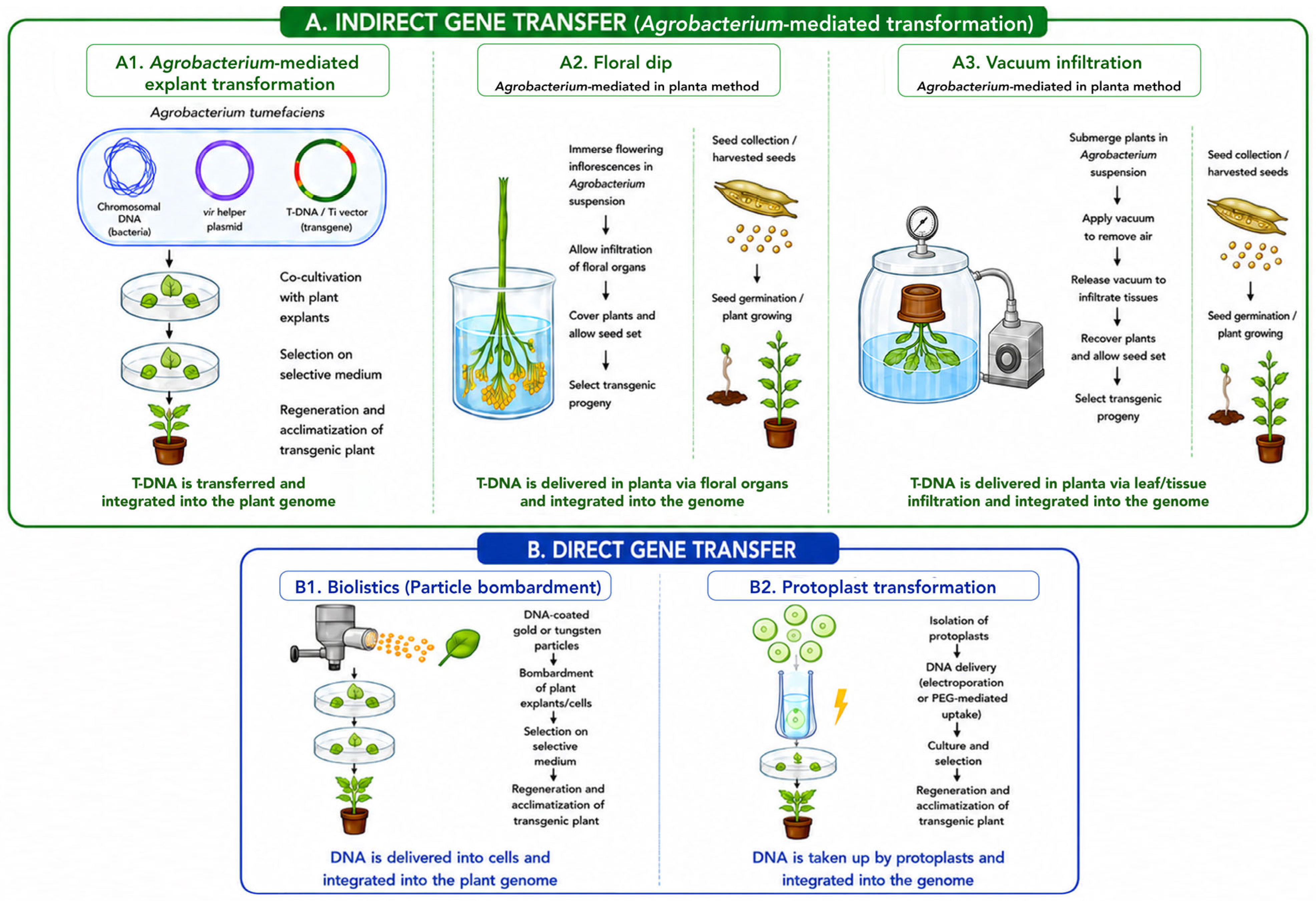
2. Transformation Methods
2.1. Vector-Mediated Gene Transfer
2.1.1. “Agrobacterium” Method
2.1.2. Methods Based on Plant Virus Vectors
2.2. Direct Gene Transfer
2.2.1. Biolistic Method
2.2.2. Transformation of Protoplasts
2.2.3. Microinjection
2.2.4. Nanotechnologies
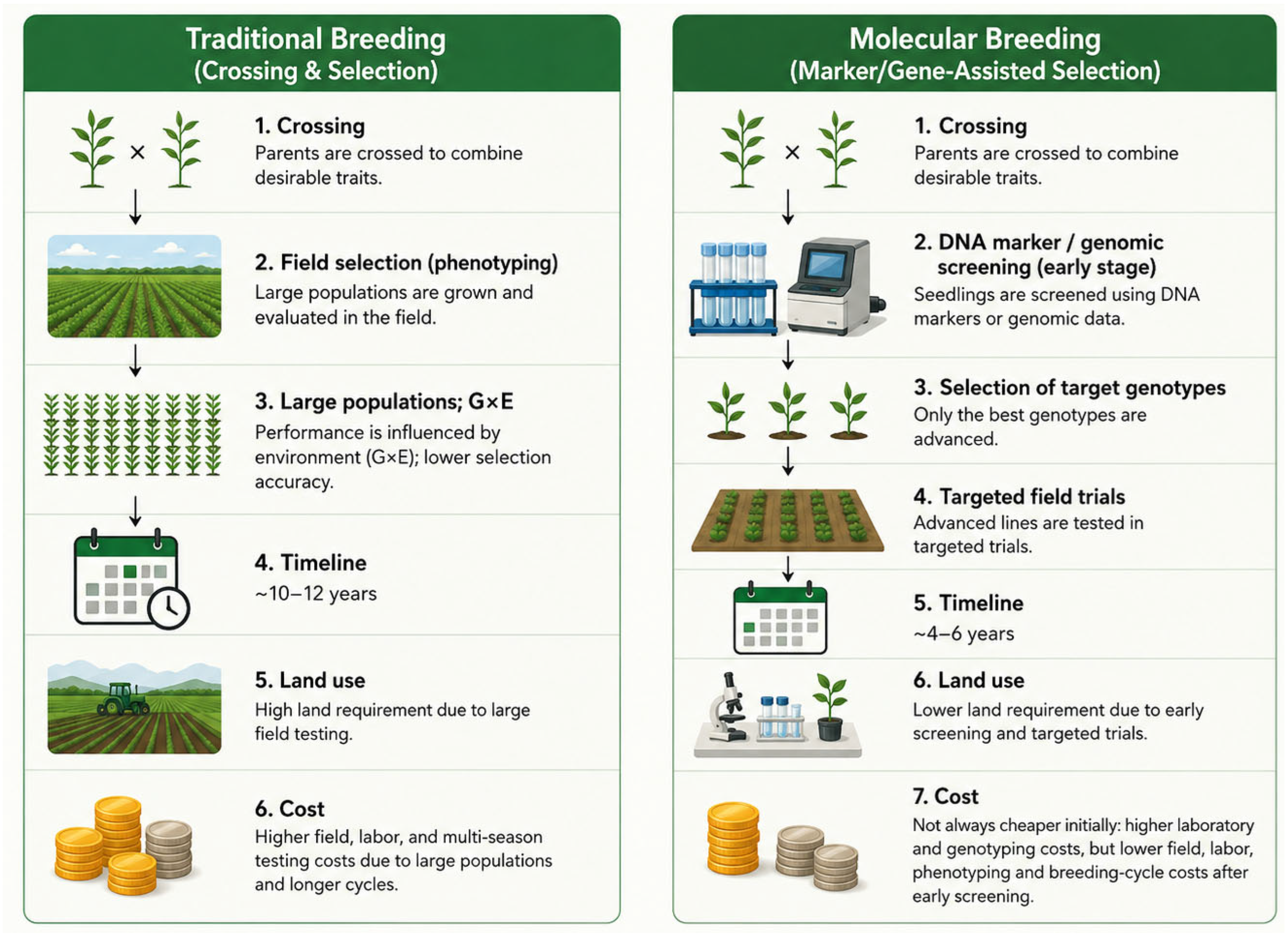
3. Plant Breeding: Traditional Versus Molecular Approaches
4. Trait Genes
4.1. Genes Providing Herbicide Resistance
4.2. Genes Responsible for Increasing Biomass
4.3. Genes for Enhancing Resistance to Pests and Diseases
4.4. Genes Improving Consumer Properties
4.5. Genes Providing Resistance to Adverse Environmental Conditions
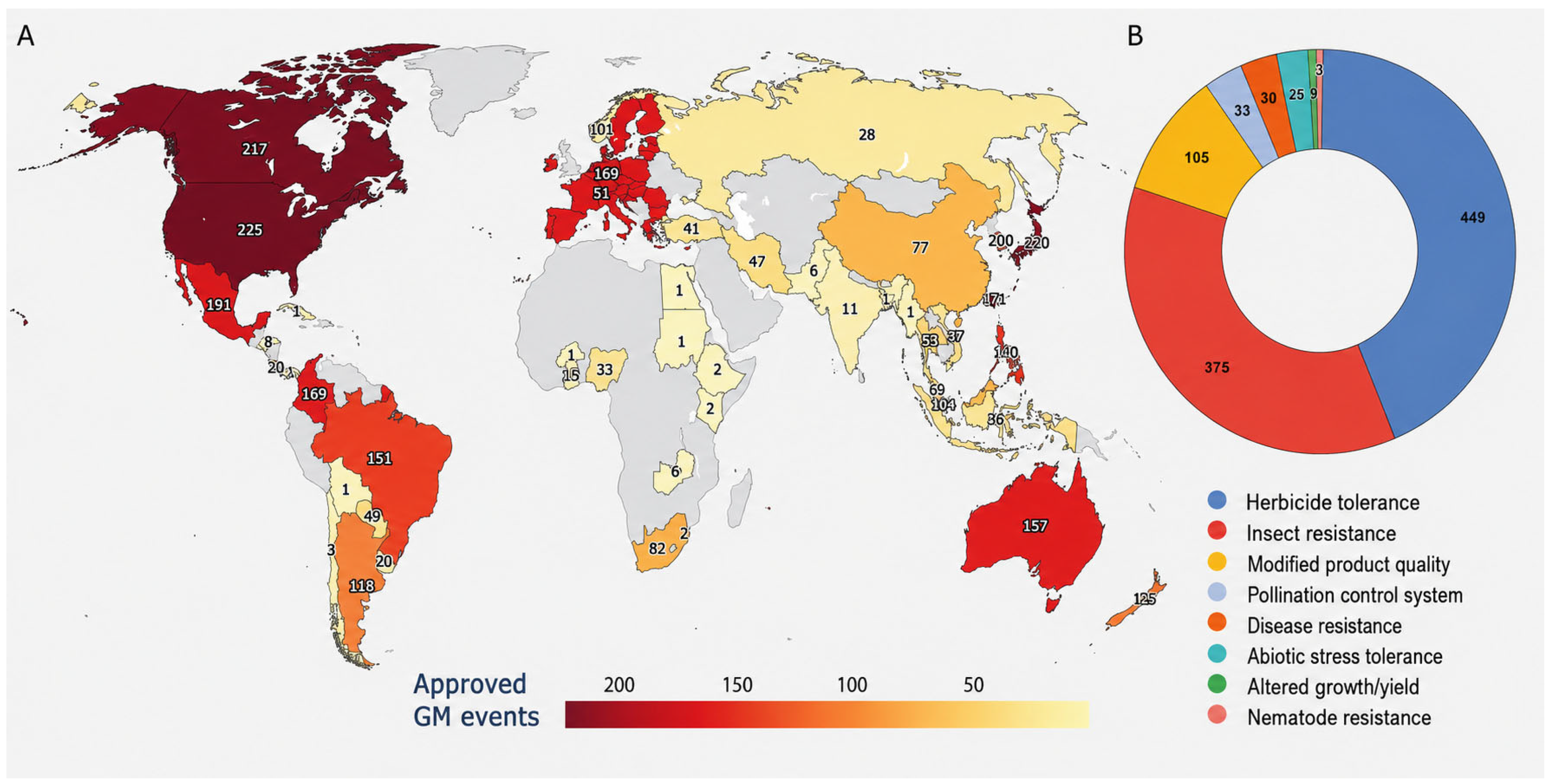
5. Global Status of GM Plants in the World
6. Impact of GM Crops on Human Health
6.1. The Direct Risk
6.2. The Indirect Risk
7. Discussion
8. Conclusions
Author Contributions
Funding
Data Availability Statement
Conflicts of Interest
Abbreviations
| GM | genetically modified |
| T-DNA | transfer DNA |
| Ti | tumour-inducing |
| (+)ssRNA | positive-strand |
| (−)ssRNA | negative-strand |
| VIGS | virus-induced gene silencing |
| VIGE | virus-induced genome editing |
| TSR | target-site resistance |
| NTSR | non-target-site resistance |
| AMPs | antimicrobial peptides |
| Bt | Bacillus thuringiensis |
| ISP | inhibitor of serine protease |
References
- Atkins, P.A.; Voytas, D.F. Overcoming Bottlenecks in Plant Gene Editing. Curr. Opin. Plant Biol. 2020, 54, 79–84. [Google Scholar] [CrossRef] [PubMed]
- Jhansi Rani, S.; Usha, R. Transgenic Plants: Types, Benefits, Public Concerns and Future. J. Pharm. Res. 2013, 6, 879–883. [Google Scholar] [CrossRef]
- Barton, K.A.; Binns, A.N.; Matzke, A.J.M.; Chilton, M.-D. Regeneration of Intact Tobacco Plants Containing Full Length Copies of Genetically Engineered T-DNA, and Transmission of T-DNA to R1 Progeny. Cell 1983, 32, 1033–1043. [Google Scholar] [CrossRef]
- Khan, S.; Ullah, M.W.; Siddique, R.; Nabi, G.; Manan, S.; Yousaf, M.; Hou, H. Role of Recombinant DNA Technology to Improve Life. Int. J. Genom. 2016, 2016, 2405954. [Google Scholar] [CrossRef]
- Hamdan, M.F.; Tan, B.C. Genetic Modification Techniques in Plant Breeding: A Comparative Review of CRISPR/Cas and GM Technologies. Hortic. Plant J. 2025, 11, 1807–1829. [Google Scholar] [CrossRef]
- Lacroix, B.; Citovsky, V. Biolistic Approach for Transient Gene Expression Studies in Plants; Methods in Molecular Biology; Springer: Berlin/Heidelberg, Germany, 2020; Volume 2124, pp. 125–139. [Google Scholar] [CrossRef]
- Sangwan, R.S.; Ochatt, S.; Nava-Saucedo, J.E.; Sangwan-Norreel, B. T-DNA Insertion Mutagenesis. In Plant Mutation Breeding and Biotechnology; Shu, Q.Y., Forster, B.P., Nakagawa, H., Eds.; CABI: Wallingford, UK, 2012; pp. 489–506. [Google Scholar]
- Lee, L.-Y.; Gelvin, S.B. T-DNA Binary Vectors and Systems. Plant Physiol. 2008, 146, 325–332. [Google Scholar] [CrossRef]
- Leng, C.; Sun, B.; Liu, Z.; Zhang, L.; Wei, X.; Zhou, Y.; Meng, Y.; Lai, Y.; Dai, Y.; Zhu, Z. An Optimized Double T-DNA Binary Vector System for Improved Production of Marker-Free Transgenic Tobacco Plants. Biotechnol. Lett. 2020, 42, 641–655. [Google Scholar] [CrossRef]
- Pasin, F.; Bedoya, L.C.; Bernabé-Orts, J.M.; Gallo, A.; Simón-Mateo, C.; Orzaez, D.; García, J.A. Multiple T-DNA Delivery to Plants Using Novel Mini Binary Vectors with Compatible Replication Origins. ACS Synth. Biol. 2017, 6, 1962–1968. [Google Scholar] [CrossRef]
- Goralogia, G.S.; Willig, C.; Strauss, S.H. Engineering Agrobacterium for Improved Plant Transformation. Plant J. 2025, 121, e70015. [Google Scholar] [CrossRef]
- Srinivasan, R.; Gothandam, K.M. Synergistic Action of D-Glucose and Acetosyringone on Agrobacterium Strains for Efficient Dunaliella Transformation. PLoS ONE 2016, 11, e0158322. [Google Scholar] [CrossRef] [PubMed]
- Wang, S.; Chen, H.; Wang, Y.; Pan, C.; Tang, X.; Zhang, H.; Chen, W.; Chen, Y.Q. Effects of Agrobacterium tumefaciens Strain Types on the Agrobacterium-Mediated Transformation Efficiency of Filamentous Fungus Mortierella alpina. Lett. Appl. Microbiol. 2020, 70, 388–393. [Google Scholar] [CrossRef]
- Krishnamohan, A.; Balaji, V.; Veluthambi, K. Efficient Vir Gene Induction in Agrobacterium tumefaciens Requires virA, virG, and Vir Box from the Same Ti Plasmid. J. Bacteriol. 2001, 183, 4079–4089. [Google Scholar] [CrossRef]
- Fan, X.; Sun, H. Exploring Agrobacterium-Mediated Genetic Transformation Methods and Its Applications in Lilium. Plant Methods 2024, 20, 120. [Google Scholar] [CrossRef]
- Movahedi, A.; Zhang, J.; Amirian, R.; Zhuge, Q. An Efficient Agrobacterium-Mediated Transformation System for Poplar. Int. J. Mol. Sci. 2014, 15, 10780–10793. [Google Scholar] [CrossRef] [PubMed]
- Stachel, S.E.; Messens, E.; Van Montagu, M.; Zambryski, P. Identification of the Signal Molecules Produced by Wounded Plant Cells That Activate T-DNA Transfer in Agrobacterium tumefaciens. Nature 1985, 318, 624–629. [Google Scholar] [CrossRef]
- Utami, E.S.W.; Hariyanto, S.; Manuhara, Y.S.W. Agrobacterium tumefaciens-Mediated Transformation of Dendrobium Lasianthera J.J.Sm: An Important Medicinal Orchid. J. Genet. Eng. Biotechnol. 2018, 16, 703–709. [Google Scholar] [CrossRef] [PubMed]
- Hwang, H.-H.; Yu, M.; Lai, E.-M. Agrobacterium-Mediated Plant Transformation: Biology and Applications. Arab. Book 2017, 15, e0186. [Google Scholar] [CrossRef]
- Altpeter, F.; Springer, N.M.; Bartley, L.E.; Blechl, A.E.; Brutnell, T.P.; Citovsky, V.; Conrad, L.J.; Gelvin, S.B.; Jackson, D.P.; Kausch, A.P.; et al. Advancing Crop Transformation in the Era of Genome Editing. Plant Cell 2016, 28, 1510–1520. [Google Scholar] [CrossRef]
- Long, Y.; Yang, Y.; Pan, G.; Shen, Y. New Insights into Tissue Culture Plant-Regeneration Mechanisms. Front. Plant Sci. 2022, 13, 926752. [Google Scholar] [CrossRef]
- Ikeuchi, M.; Favero, D.S.; Sakamoto, Y.; Iwase, A.; Coleman, D.; Rymen, B.; Sugimoto, K. Molecular Mechanisms of Plant Regeneration. Annu. Rev. Plant Biol. 2019, 70, 377–406. [Google Scholar] [CrossRef]
- Fehér, A. Callus, Dedifferentiation, Totipotency, Somatic Embryogenesis: What These Terms Mean in the Era of Molecular Plant Biology? Front. Plant Sci. 2019, 10, 536. [Google Scholar] [CrossRef]
- Wang, P.; Si, H.; Li, C.; Xu, Z.; Guo, H.; Jin, S.; Cheng, H. Plant Genetic Transformation: Achievements, Current Status and Future Prospects. Plant Biotechnol. J. 2025, 23, 2034–2058. [Google Scholar] [CrossRef]
- Wang, Y.K.; Wang, Y.P.; Zhou, L.Z. Molecular Regulators of Regeneration and Strategies for Overcoming Genotype-Dependent Recalcitrance in Wheat (Triticum aestivum). Commun. Biol. 2026, 9, 671. [Google Scholar] [CrossRef] [PubMed]
- Mountourakis, F.; Fragkostefanakis, S.; Moschou, P.N. Protocol for Generating and Selecting Transgenic Tomato Lines through Agrobacterium tumefaciens-Mediated Transformation. STAR Protoc. 2026, 7, 104322. [Google Scholar] [CrossRef]
- Szarzanowicz, M.J.; Waldburger, L.M.; Busche, M.; Geiselman, G.M.; Kirkpatrick, L.D.; Kehl, A.J.; Tahmin, C.; Kuo, R.C.; McCauley, J.; Pannu, H.; et al. Binary Vector Copy Number Engineering Improves Agrobacterium-Mediated Transformation. Nat. Biotechnol. 2025, 43, 1708–1716. [Google Scholar] [CrossRef]
- Fuad, F.A.A.; Ismail, I.; Sidik, N.M.; Zain, C.R.C.M.; Abdullah, R. Super Binary Vector System Enhanced Transformation Frequency and Expression Level of Polyhydroxyvalerate Gene in Oil Palm Immature Embryo. Asian J. Plant Sci. 2008, 7, 526–535. [Google Scholar] [CrossRef]
- Komori, T.; Imayama, T.; Kato, N.; Ishida, Y.; Ueki, J.; Komari, T. Current Status of Binary Vectors and Superbinary Vectors. Plant Physiol. 2007, 145, 1155–1160. [Google Scholar] [CrossRef]
- Bélanger, J.G.; Copley, T.R.; Hoyos-Villegas, V.; Charron, J.-B.; O’Donoughue, L. A Comprehensive Review of in Planta Stable Transformation Strategies. Plant Methods 2024, 20, 79. [Google Scholar] [CrossRef]
- Kumar, S.; Vishwakarma, H.; Ghosh, G.; Singh, J.; Padaria, J.C. In Planta Transformation in Wheat: An Improved Protocol to Develop Wheat Transformants. Mol. Biol. Rep. 2024, 51, 407. [Google Scholar] [CrossRef] [PubMed]
- Mei, G.; Chen, A.; Wang, Y.; Li, S.; Wu, M.; Hu, Y.; Liu, X.; Hou, X. A Simple and Efficient in Planta Transformation Method Based on the Active Regeneration Capacity of Plants. Plant Commun. 2024, 5, 100822. [Google Scholar] [CrossRef] [PubMed]
- Tague, B.W.; Mantis, J. In Planta Agrobacterium-Mediated Transformation by Vacuum Infiltration; Methods in Molecular Biology; Springer: Berlin/Heidelberg, Germany, 2006; Volume 323, pp. 215–223. [Google Scholar] [CrossRef]
- Zhong, H.; Li, C.; Yu, W.; Zhou, H.; Lieber, T.; Su, X.; Wang, W.; Bumann, E.; Lunny Castro, R.M.; Jiang, Y.; et al. A Fast and Genotype-Independent in Planta Agrobacterium-Mediated Transformation Method for Soybean. Plant Commun. 2024, 5, 101063. [Google Scholar] [CrossRef]
- Hu, D.; Bent, A.F.; Hou, X.; Li, Y. Agrobacterium-Mediated Vacuum Infiltration and Floral Dip Transformation of Rapid-Cycling Brassica Rapa. BMC Plant Biol. 2019, 19, 246. [Google Scholar] [CrossRef] [PubMed]
- Bastaki, N.K.; Cullis, C.A. Floral-Dip Transformation of Flax (Linum usitatissimum) to Generate Transgenic Progenies with a High Transformation Rate. J. Vis. Exp. 2014, 19, 52189. [Google Scholar] [CrossRef]
- Clough, S.J.; Bent, A.F. Floral Dip: A Simplified Method for Agrobacterium-mediated Transformation of Arabidopsis thaliana. Plant J. 1998, 16, 735–743. [Google Scholar] [CrossRef]
- Ali, I.; Sher, H.; Ali, A.; Hussain, S.; Ullah, Z. Simplified Floral Dip Transformation Method of Arabidopsis thaliana. J. Microbiol. Methods 2022, 197, 106492. [Google Scholar] [CrossRef]
- Wang, G.; Pantha, P.; Tran, K.-N.; Oh, D.-H.; Dassanayake, M. Plant Growth and Agrobacterium-Mediated Floral-Dip Transformation of the Extremophyte Schrenkiella parvula. J. Vis. Exp. 2019, 7, 58544. [Google Scholar] [CrossRef]
- Yaroshko, O.; Vasylenko, M.; Gajdošová, A.; Morgun, B.; Khrystan, O.; Velykozhon, L.; Kuchuk, M. “Floral-Dip” Transformation of Amaranthus caudatus L. and Hybrids A. caudatus × A. paniculatus L. Biologija 2019, 64, 321–330. [Google Scholar] [CrossRef]
- Purwantoro, A.; Irsyadi, M.B.; Sawitri, W.D.; Fatumi, N.C.; Fajrina, S.N. Efficient Floral Dip Transformation Method Using Agrobacterium tumefaciens on Cosmos sulphureus Cav. Saudi J. Biol. Sci. 2023, 30, 103702. [Google Scholar] [CrossRef]
- Mu, G.; Chang, N.; Xiang, K.; Sheng, Y.; Zhang, Z.; Pan, G. Genetic Transformation of Maize Female Inflorescence Following Floral Dip Method Mediated by Agrobacterium. Biotechnology 2012, 11, 178–183. [Google Scholar] [CrossRef]
- Ratanasut, K.; Rod-In, W.; Sujipuli, K. In Planta Agrobacterium-Mediated Transformation of Rice. Rice Sci. 2017, 24, 181–186. [Google Scholar] [CrossRef]
- Bechtold, N.; Pelletier, G. In Planta Agrobacterium-Mediated Transformation of Adult Arabidopsis Thaliana Plants by Vacuum Infiltration; Methods in Molecular Biology; Springer: Berlin/Heidelberg, Germany, 1998; Volume 82, pp. 259–266. [Google Scholar] [CrossRef]
- Joh, L.D.; Wroblewski, T.; Ewing, N.N.; VanderGheynst, J.S. High-level Transient Expression of Recombinant Protein in Lettuce. Biotech. Bioeng. 2005, 91, 861–871. [Google Scholar] [CrossRef]
- Wang, W.C.; Menon, G.; Hansen, G. Development of a Novel Agrobacterium-Mediated Transformation Method to Recover Transgenic Brassica Napus Plants. Plant Cell Rep. 2003, 22, 274–281. [Google Scholar] [CrossRef]
- Subramanyam, K.; Subramanyam, K.; Sailaja, K.V.; Srinivasulu, M.; Lakshmidevi, K. Highly Efficient Agrobacterium-Mediated Transformation of Banana Cv. Rasthali (AAB) via Sonication and Vacuum Infiltration. Plant Cell Rep. 2011, 30, 425–436. [Google Scholar] [CrossRef]
- Arun, M.; Subramanyam, K.; Mariashibu, T.S.; Theboral, J.; Shivanandhan, G.; Manickavasagam, M.; Ganapathi, A. Application of Sonication in Combination with Vacuum Infiltration Enhances the Agrobacterium-Mediated Genetic Transformation in Indian Soybean Cultivars. Appl. Biochem. Biotechnol. 2015, 175, 2266–2287. [Google Scholar] [CrossRef] [PubMed]
- Amal, T.C.; Karthika, P.; Dhandapani, G.; Selvakumar, S.; Vasanth, K. A Simple and Efficient Agrobacterium-Mediated in Planta Transformation Protocol for Horse Gram (Macrotyloma Uniflorum Lam. Verdc.). J. Genet. Eng. Biotechnol. 2020, 18, 9. [Google Scholar] [CrossRef]
- Bett, B.; Gollasch, S.; Moore, A.; Harding, R.; Higgins, T.J.V. An Improved Transformation System for Cowpea (Vigna Unguiculata L. Walp) via Sonication and a Kanamycin-Geneticin Selection Regime. Front. Plant Sci. 2019, 10, 219. [Google Scholar] [CrossRef] [PubMed]
- Sivanandhan, G.; Kapil Dev, G.; Theboral, J.; Selvaraj, N.; Ganapathi, A.; Manickavasagam, M. Sonication, Vacuum Infiltration and Thiol Compounds Enhance the Agrobacterium-Mediated Transformation Frequency of Withania somnifera (L.) Dunal. PLoS ONE 2015, 10, e0124693. [Google Scholar] [CrossRef] [PubMed]
- Hao, Y.; Yuan, Z.; Li, Y.; Zuo, D.; Cheng, H.; Wang, Q.; Zhang, Y.; Lv, L.; Liu, J.; Song, G. An All-in-One Plant Virus-Based Vector Toolkit for Streamlined Gene Silencing, Overexpression, and Genome Editing. Plant Commun. 2025, 6, 101379. [Google Scholar] [CrossRef]
- Mahmood, M.A.; Naqvi, R.Z.; Rahman, S.U.; Amin, I.; Mansoor, S. Plant Virus-Derived Vectors for Plant Genome Engineering. Viruses 2023, 15, 531. [Google Scholar] [CrossRef]
- Shen, Y.; Ye, T.; Li, Z.; Kimutai, T.H.; Song, H.; Dong, X.; Wan, J. Exploiting Viral Vectors to Deliver Genome Editing Reagents in Plants. aBIOTECH 2024, 5, 247–261. [Google Scholar] [CrossRef]
- Abrahamian, P.; Hammond, R.W.; Hammond, J. Plant Virus-Derived Vectors: Applications in Agricultural and Medical Biotechnology. Annu. Rev. Virol. 2020, 7, 513–535. [Google Scholar] [CrossRef]
- Cheuk, A.; Houde, M. A New Barley Stripe Mosaic Virus Allows Large Protein Overexpression for Rapid Function Analysis. Plant Physiol. 2018, 176, 1919–1931. [Google Scholar] [CrossRef]
- Kaya, H.; Ishibashi, K.; Toki, S. A Split Staphylococcus Aureus Cas9 as a Compact Genome-Editing Tool in Plants. Plant Cell Physiol. 2017, 58, 643–649. [Google Scholar] [CrossRef]
- Gao, Q.; Xu, W.; Yan, T.; Fang, X.; Cao, Q.; Zhang, Z.; Ding, Z.; Wang, Y.; Wang, X. Rescue of a Plant Cytorhabdovirus as Versatile Expression Platforms for Planthopper and Cereal Genomic Studies. New Phytol. 2019, 223, 2120–2133. [Google Scholar] [CrossRef]
- Liu, Q.; Zhao, C.; Sun, K.; Deng, Y.; Li, Z. Engineered Biocontainable RNA Virus Vectors for Non-Transgenic Genome Editing across Crop Species and Genotypes. Mol. Plant 2023, 16, 616–631. [Google Scholar] [CrossRef]
- Ma, X.; Zhang, X.; Liu, H.; Li, Z. Highly Efficient DNA-Free Plant Genome Editing Using Virally Delivered CRISPR-Cas9. Nat. Plants 2020, 6, 773–779. [Google Scholar] [CrossRef]
- Jackson, A.O.; Li, Z. Developments in Plant Negative-Strand RNA Virus Reverse Genetics. Annu. Rev. Phytopathol. 2016, 54, 469–498. [Google Scholar] [CrossRef] [PubMed]
- Bradamante, G.; Mittelsten Scheid, O.; Incarbone, M. Under Siege: Virus Control in Plant Meristems and Progeny. Plant Cell 2021, 33, 2523–2537. [Google Scholar] [CrossRef]
- Fiallo-Olivé, E.; Lett, J.-M.; Martin, D.P.; Roumagnac, P.; Varsani, A.; Zerbini, F.M.; Navas-Castillo, J. ICTV Virus Taxonomy Profile: Geminiviridae 2021. J. Gen. Virol. 2021, 102, 001696. [Google Scholar] [CrossRef] [PubMed]
- Zhang, Y.; Deng, S. Geminivirus Vectors: From Gene Silencing to Synthetic Biology. Biotechnol. Adv. 2026, 87, 108771. [Google Scholar] [CrossRef] [PubMed]
- Thomas, J.E.; Gronenborn, B.; Harding, R.M.; Mandal, B.; Grigoras, I.; Randles, J.W.; Sano, Y.; Timchenko, T.; Vetten, H.J.; Yeh, H.-H.; et al. ICTV Virus Taxonomy Profile: Nanoviridae. J. Gen. Virol. 2021, 102, 001544. [Google Scholar] [CrossRef]
- Dasgupta, I.; Khan, Z.A.; Bhat, A.I.; Viswanathan, R.; Sastry, K.S.; Rao, G.P. Taxonomy of Family: Caulimoviridae. In Taxonomy and Classification of Plant Viruses and Viroids; Sastry, K.S., Debat, H., Maruthi, M.N., Dasgupta, I., Rao, G.P., Bhat, A.I., Venkataravanappa, V., Reddy, M.K., Viswanathan, R., Eds.; Springer Nature: Singapore, 2026; pp. 179–209. [Google Scholar]
- Teycheney, P.-Y.; Geering, A.D.W.; Dasgupta, I.; Hull, R.; Kreuze, J.F.; Lockhart, B.; Muller, E.; Olszewski, N.; Pappu, H.; Pooggin, M.M.; et al. ICTV Virus Taxonomy Profile: Caulimoviridae. J. Gen. Virol. 2020, 101, 1025–1026. [Google Scholar] [CrossRef]
- Baltes, N.J.; Gil-Humanes, J.; Cermak, T.; Atkins, P.A.; Voytas, D.F. DNA Replicons for Plant Genome Engineering. Plant Cell 2014, 26, 151–163. [Google Scholar] [CrossRef]
- Huang, Z.; Chen, Q.; Hjelm, B.; Arntzen, C.; Mason, H. A DNA Replicon System for Rapid High-Level Production of Virus-like Particles in Plants. Biotechnol. Bioeng. 2009, 103, 706–714. [Google Scholar] [CrossRef] [PubMed]
- Mikhaylova, E. Virus-Induced Genome Editing (VIGE): One Step Away from an Agricultural Revolution. Int. J. Mol. Sci. 2025, 26, 4599. [Google Scholar] [CrossRef]
- Gupta, D.; Ranjan, R. In Silico Comparative Analysis of Promoters Derived from Plant Pararetroviruses. VirusDisease 2017, 28, 416–421. [Google Scholar] [CrossRef]
- Hohn, T. Plant Pararetroviruses: Interactions of Cauliflower Mosaic Virus with Plants and Insects. Curr. Opin. Virol. 2013, 3, 629–638. [Google Scholar] [CrossRef]
- Willemsen, A.; Zwart, M.P. On the Stability of Sequences Inserted into Viral Genomes. Virus Evol. 2019, 5, vez045. [Google Scholar] [CrossRef] [PubMed]
- Gronenborn, B.; Gardner, R.C.; Schaefer, S.; Shepherd, R.J. Propagation of Foreign DNA in Plants Using Cauliflower Mosaic Virus as Vector. 1981. Biotechnology 1992, 24, 371–373. [Google Scholar] [CrossRef] [PubMed]
- European and Mediterranean Plant Protection Organization 2022. PM 7/153 (1) Mechanical Inoculation of Test Plants. EPPO Bull. 2022, 52, 693–703. [Google Scholar] [CrossRef]
- Ellis, M.D.; Hoak, J.M.; Ellis, B.W.; Brown, J.A.; Sit, T.L.; Wilkinson, C.A.; Reed, T.D.; Welbaum, G.E. Quantitative Real-Time PCR Analysis of Individual Flue-Cured Tobacco Seeds and Seedlings Reveals Seed Transmission of Tobacco Mosaic Virus. Phytopathology 2020, 110, 194–205. [Google Scholar] [CrossRef]
- Hull, R. Mechanical Inoculation of Plant Viruses. Curr. Protoc. Microbiol. 2009, 13, 16B.6.1–16B.6.4. [Google Scholar] [CrossRef]
- Monroy-Borrego, A.G.; Steinmetz, N.F. Three Methods for Inoculation of Viral Vectors into Plants. Front. Plant Sci. 2022, 13, 963756. [Google Scholar] [CrossRef]
- Torti, S.; Schlesier, R.; Thümmler, A.; Bartels, D.; Römer, P.; Koch, B.; Werner, S.; Panwar, V.; Kanyuka, K.; Wirén, N.V.; et al. Transient Reprogramming of Crop Plants for Agronomic Performance. Nat. Plants 2021, 7, 159–171. [Google Scholar] [CrossRef]
- Peyret, H.; Lomonossoff, G.P. When Plant Virology Met Agrobacterium: The Rise of the Deconstructed Clones. Plant Biotechnol. J. 2015, 13, 1121–1135. [Google Scholar] [CrossRef] [PubMed]
- Gao, C.; Nielsen, K.K. Comparison Between Agrobacterium-Mediated and Direct Gene Transfer Using the Gene Gun. In Biolistic DNA Delivery; Sudowe, S., Reske-Kunz, A.B., Eds.; Methods in Molecular Biology; Humana Press: Totowa, NJ, USA, 2013; Volume 940, pp. 3–16. [Google Scholar]
- Sujatha, M.; Visarada, K.B.R.S. Transformation of Nuclear DNA in Meristematic and Embryogenic Tissues. In Biolistic DNA Delivery; Sudowe, S., Reske-Kunz, A.B., Eds.; Methods in Molecular Biology; Humana Press: Totowa, NJ, USA, 2013; Volume 940, pp. 27–44. [Google Scholar]
- Thorpe, C.; Luo, W.; Ji, Q.; Eggenberger, A.L.; Chicowski, A.S.; Xu, W.; Sandhu, R.; Lee, K.; Whitham, S.A.; Qi, Y.; et al. Enhancing Biolistic Plant Transformation and Genome Editing with a Flow Guiding Barrel. Nat. Commun. 2025, 16, 5624. [Google Scholar] [CrossRef]
- Miller, K.; Eggenberger, A.L.; Lee, K.; Liu, F.; Kang, M.; Drent, M.; Ruba, A.; Kirscht, T.; Wang, K.; Jiang, S. An Improved Biolistic Delivery and Analysis Method for Evaluation of DNA and CRISPR-Cas Delivery Efficacy in Plant Tissue. Sci. Rep. 2021, 11, 7695. [Google Scholar] [CrossRef]
- Lai, K.-S.; Abdullah, P.; Yusoff, K.; Mahmood, M. An Efficient Protocol for Particle Bombardment-Mediated Transformation of Centella Asiatica Callus. Acta Physiol. Plant 2011, 33, 2547–2552. [Google Scholar] [CrossRef]
- Faraco, M.; Di Sansebastiano, G.P.; Spelt, K.; Koes, R.E.; Quattrocchio, F.M. One Protoplast Is Not the Other! Plant Physiol. 2011, 156, 474–478. [Google Scholar] [CrossRef] [PubMed]
- Davey, M.R.; Anthony, P.; Power, J.B.; Lowe, K.C. Plant Protoplasts: Status and Biotechnological Perspectives. Biotechnol. Adv. 2005, 23, 131–171. [Google Scholar] [CrossRef]
- Batool, S.; Li, Z.; Zhang, D.; Shi, P.; Htwe, Y.M.; Nie, H.; Ma, M.; Su, H.; Fang, X.; Ahmed, M.A.A.; et al. PEG-Mediated Transformation and CRISPR/Cas9 Gene Editing of CnPDS in Coconut Protoplast. Ind. Crops Prod. 2025, 235, 121674. [Google Scholar] [CrossRef]
- Subburaj, S.; Agapito-Tenfen, S.Z. Establishment of Targeted Mutagenesis in Soybean Protoplasts Using CRISPR/Cas9 RNP Delivery via Electro−transfection. Front. Plant Sci. 2023, 14, 1255819. [Google Scholar] [CrossRef] [PubMed]
- Wang, H.; Wang, W.; Zhan, J.; Huang, W.; Xu, H. An Efficient PEG-Mediated Transient Gene Expression System in Grape Protoplasts and Its Application in Subcellular Localization Studies of Flavonoids Biosynthesis Enzymes. Sci. Hortic. 2015, 191, 82–89. [Google Scholar] [CrossRef]
- Hsu, Y.-Y.; Chen, S.J.; Bernal-Chanchavac, J.; Sharma, B.; Moghimianavval, H.; Stephanopoulos, N.; Liu, A.P. Calcium-Triggered DNA-Mediated Membrane Fusion in Synthetic Cells. Chem. Commun. 2023, 59, 8806–8809. [Google Scholar] [CrossRef]
- Ozyigit, I.I. Gene Transfer to Plants by Electroporation: Methods and Applications. Mol. Biol. Rep. 2020, 47, 3195–3210. [Google Scholar] [CrossRef]
- Duarte, P.; Ribeiro, D.; Carqueijeiro, I.; Bettencourt, S.; Sottomayor, M. Protoplast Transformation as a Plant-Transferable Transient Expression System. In Biotechnology of Plant Secondary Metabolism; Fett-Neto, A.G., Ed.; Methods in Molecular Biology; Springer: New York, NY, USA, 2016; Volume 1405, pp. 137–148. [Google Scholar]
- Neuhaus, G.; Spangenberg, G. Plant Transformation by Microinjection Techniques. Physiol. Plant. 1990, 79, 213–217. [Google Scholar] [CrossRef]
- Schnorf, M.; Neuhaus-Url, G.; Galli, A.; Iida, S.; Potrykus, I.; Neuhaus, G. An Improved Approach for Transformation of Plant Cells by Microinjection: Molecular and Genetic Analysis. Transgenic Res. 1991, 1, 23–30. [Google Scholar] [CrossRef]
- Su, W.; Xu, M.; Radani, Y.; Yang, L. Technological Development and Application of Plant Genetic Transformation. Int. J. Mol. Sci. 2023, 24, 10646. [Google Scholar] [CrossRef]
- Shivashakarappa, K.; Marriboina, S.; Dumenyo, K.; Taheri, A.; Yadegari, Z. Nanoparticle-Mediated Gene Delivery Techniques in Plant Systems. Front. Nanotechnol. 2025, 7, 1516180. [Google Scholar] [CrossRef]
- Yan, Y.; Zhu, X.; Yu, Y.; Li, C.; Zhang, Z.; Wang, F. Nanotechnology Strategies for Plant Genetic Engineering. Adv. Mater. 2022, 34, 2106945. [Google Scholar] [CrossRef] [PubMed]
- Lv, Z.; Jiang, R.; Chen, J.; Chen, W. Nanoparticle-mediated Gene Transformation Strategies for Plant Genetic Engineering. Plant J. 2020, 104, 880–891. [Google Scholar] [CrossRef] [PubMed]
- Chen, J.-T. (Ed.) Nano-Delivering for Plant Genetic Engineering; Smart Nanomaterials Technology; Springer: Singapore, 2026. [Google Scholar]
- Sisea, C.-R. Characteristics of Various Types of Plant Breeding. In Genetics; Seifi, M., Ed.; IntechOpen: Rijeka, Croatia, 2024; Volume 4. [Google Scholar]
- Kalra, B.; Priyanka; Sharma, V.; Prudhvinadh, G.; Sonia. Implication of Molecular Techniques for Sustainable Crop Improvement. In Innovations in Climate Resilient Agriculture; Rajan, R., Ahmad, F., Pandey, K., Eds.; Springer Nature: Cham, Switzerland, 2025; pp. 87–104. [Google Scholar]
- Gilbertson, L.; Puchta, H.; Slotkin, R.K. The Future of Genome Editing in Plants. Nat. Plants 2025, 11, 680–685. [Google Scholar] [CrossRef]
- Zhang, R.; Zheng, Z.; Li, G.; Zheng, X.; Su, L.; Yuan, X.; Li, T.; Tan, J.; Zeng, D.; Zhang, S.; et al. Plant Base Editing: A Decade of Progress and Future Applications. aBIOTECH 2026, 7, 100003. [Google Scholar] [CrossRef]
- Binenbaum, J.; Adamkova, V.; Fryer, H.; Xu, L.; Gorringe, N.; Włodzimierz, P.; Burns, R.; Papikian, A.; Jacobsen, S.E.; Henderson, I.R.; et al. CRISPR Targeting of H3K4me3 Activates Gene Expression and Unlocks Centromere-Proximal Crossover Recombination in Arabidopsis. Nat. Commun. 2025, 16, 9587. [Google Scholar] [CrossRef] [PubMed]
- Délye, C.; Jasieniuk, M.; Le Corre, V. Deciphering the Evolution of Herbicide Resistance in Weeds. Trends Genet. 2013, 29, 649–658. [Google Scholar] [CrossRef]
- Gaines, T.A.; Duke, S.O.; Morran, S.; Rigon, C.A.G.; Tranel, P.J.; Küpper, A.; Dayan, F.E. Mechanisms of Evolved Herbicide Resistance. J. Biol. Chem. 2020, 295, 10307–10330. [Google Scholar] [CrossRef] [PubMed]
- Palma-Bautista, C.; Belluccini, P.; Vázquez-García, J.G.; Alcántara-de La Cruz, R.; Barro, F.; Portugal, J.; De Prado, R. Target-Site and Non-Target-Site Resistance Mechanisms Confer Multiple Resistance to Glyphosate and 2,4-D in Carduus acanthoides. Pestic. Biochem. Physiol. 2023, 191, 105371. [Google Scholar] [CrossRef]
- Kutasy, B.; Farkas, Z.; Kolics, B.; Decsi, K.; Hegedűs, G.; Kovács, J.; Taller, J.; Tóth, Z.; Kálmán, N.; Kazinczi, G.; et al. Detection of Target-Site Herbicide Resistance in the Common Ragweed: Nucleotide Polymorphism Genotyping by Targeted Amplicon Sequencing. Diversity 2021, 13, 118. [Google Scholar] [CrossRef]
- Nandula, V.K.; Giacomini, D.A.; Molin, W.T. Target Site-Based Resistance to ALS Inhibitors, Glyphosate, and PPO Inhibitors in an Amaranthus palmeri Accession from Mississippi. Am. J. Plant Sci. 2020, 11, 1206–1216. [Google Scholar] [CrossRef]
- Gaines, T.A.; Zhang, W.; Wang, D.; Bukun, B.; Chisholm, S.T.; Shaner, D.L.; Nissen, S.J.; Patzoldt, W.L.; Tranel, P.J.; Culpepper, A.S.; et al. Gene Amplification Confers Glyphosate Resistance in Amaranthus palmeri. Proc. Natl. Acad. Sci. USA 2010, 107, 1029–1034. [Google Scholar] [CrossRef]
- Panozzo, S.; Mascanzoni, E.; Scarabel, L.; Milani, A.; Dalazen, G.; Merotto, A.J.; Tranel, P.J.; Sattin, M. Target-Site Mutations and Expression of ALS Gene Copies Vary According to Echinochloa Species. Genes 2021, 12, 1841. [Google Scholar] [CrossRef] [PubMed]
- Franco-Ortega, S.; Goldberg-Cavalleri, A.; Walker, A.; Brazier-Hicks, M.; Onkokesung, N.; Edwards, R. Non-Target Site Herbicide Resistance Is Conferred by Two Distinct Mechanisms in Black-Grass (Alopecurus myosuroides). Front. Plant Sci. 2021, 12, 636652. [Google Scholar] [CrossRef]
- Jugulam, M.; Shyam, C. Non-Target-Site Resistance to Herbicides: Recent Developments. Plants 2019, 8, 417. [Google Scholar] [CrossRef] [PubMed]
- Suzukawa, A.K.; Bobadilla, L.K.; Mallory-Smith, C.; Brunharo, C.A.C.G. Non-Target-Site Resistance in Lolium Spp. Globally: A Review. Front. Plant Sci. 2021, 11, 609209. [Google Scholar] [CrossRef]
- Wu, Y.; Xiao, N.; Cai, Y.; Yang, Q.; Yu, L.; Chen, Z.; Shi, W.; Liu, J.; Pan, C.; Li, Y.; et al. CRISPR-Cas9-Mediated Editing of the OsHPPD 3′ UTR Confers Enhanced Resistance to HPPD-Inhibiting Herbicides in Rice. Plant Commun. 2023, 4, 100605. [Google Scholar] [CrossRef] [PubMed]
- Zhao, B.; Wang, Y.; Zhou, M.; Liu, X.; Li, H.; Shi, Z.; Guo, Y.; Li, T.; Yang, F.; Wang, R.; et al. Identification and Application of Herbicide-resistant 4-hydroxyphenylpyruvate Dioxygenase (HPPD) Alleles via Directed Evolution. Plant Biotechnol. J. 2025, 23, 4336–4338. [Google Scholar] [CrossRef]
- Kim, S.-E.; Bian, X.; Lee, C.-J.; Park, S.-U.; Lim, Y.-H.; Kim, B.H.; Park, W.S.; Ahn, M.-J.; Ji, C.Y.; Yu, Y.; et al. Overexpression of 4-Hydroxyphenylpyruvate Dioxygenase (IbHPPD) Increases Abiotic Stress Tolerance in Transgenic Sweetpotato Plants. Plant Physiol. Biochem. 2021, 167, 420–429. [Google Scholar] [CrossRef]
- Qian, H.; Shi, H. Herbicide-Resistant 4-Hydroxyphenylpyruvate Dioxygenase Variants Identified via Directed Evolution. J. Exp. Bot. 2024, 75, 7096–7106. [Google Scholar] [CrossRef]
- Dreesen, R.; Capt, A.; Oberdoerfer, R.; Coats, I.; Pallett, K.E. Characterization and Safety Evaluation of HPPD W336, a Modified 4-Hydroxyphenylpyruvate Dioxygenase Protein, and the Impact of Its Expression on Plant Metabolism in Herbicide-Tolerant MST-FGØ72-2 Soybean. Regul. Toxicol. Pharmacol. 2018, 97, 170–185. [Google Scholar] [CrossRef]
- Hawkes, T.R.; Langford, M.P.; Viner, R.; Blain, R.E.; Callaghan, F.M.; Mackay, E.A.; Hogg, B.V.; Singh, S.; Dale, R.P. Characterization of 4-Hydroxyphenylpyruvate Dioxygenases, Inhibition by Herbicides and Engineering for Herbicide Tolerance in Crops. Pestic. Biochem. Physiol. 2019, 156, 9–28. [Google Scholar] [CrossRef]
- Matringe, M.; Sailland, A.; Pelissier, B.; Rolland, A.; Zink, O. p-Hydroxyphenylpyruvate Dioxygenase Inhibitor-resistant Plants. Pest. Manag. Sci. 2005, 61, 269–276. [Google Scholar] [CrossRef]
- Chen, J.; Yu, Q.; Patterson, E.; Sayer, C.; Powles, S. Dinitroaniline Herbicide Resistance and Mechanisms in Weeds. Front. Plant Sci. 2021, 12, 634018. [Google Scholar] [CrossRef] [PubMed]
- Blume, Y.B.; Strashnyuk, N.M.; Smertenko, A.P.; Solodushko, V.G.; Sidorov, V.A.; Gleba, Y.Y. Alteration of β-Tubulin in Nicotiana Plumbaginifolia Confers Resistance to Amiprophos-Methyl. Theor. Appl. Genet. 1998, 97, 464–472. [Google Scholar] [CrossRef]
- Wang, J.; Qi, J.; Ouyang, Y.; Zhou, S.; Qin, L.; Zhang, B.; Bai, L.; Pan, L. The Mutation Asp-376-Glu in the ALS Gene Confers Resistance to Mesosulfuron-Methyl in Beckmannia syzigachne. Plant Physiol. Biochem. 2024, 215, 109083. [Google Scholar] [CrossRef]
- Xu, X.; Xu, J.; Zhao, B.; Guo, B.; Wei, S.; Li, B.; Qi, Z.; Chen, S.; Wang, G.; Liu, X. Target-Site Mutations and Non-Target-Site Detoxification Confer ALS-Inhibitor Resistance in Bromus Japonicus Populations in China. Pest. Manag. Sci. 2026, 82, 3874–3883. [Google Scholar] [CrossRef]
- Zhang, L.; Du, Y.; Deng, Y.; Bai, T.; Wang, J.; Wang, W.; Ji, M. Mutations in Target Gene Confers Resistance to Acetolactate Synthase Inhibitors in Echinochloa phyllopogon. Plant Physiol. Biochem. 2024, 216, 109194. [Google Scholar] [CrossRef]
- Kumar, P.; Bishnoi, R.; Priyadarshini, P.; Chhuneja, P.; Singla, D. Understanding the Structural Basis of ALS Mutations Associated with Resistance to Sulfonylurea in Wheat. Sci. Rep. 2025, 15, 12855. [Google Scholar] [CrossRef] [PubMed]
- Ohta, K.; Kawamata, E.; Hori, T.; Sada, Y. Connecting Genes to Whole Plants in Dilution Effect of Target-Site ALS Inhibitor Resistance of Schoenoplectiella Juncoides (Roxb.) Lye (Cyperaceae). Pestic. Biochem. Physiol. 2024, 203, 105984. [Google Scholar] [CrossRef]
- Achary, V.M.M.; Sheri, V.; Manna, M.; Panditi, V.; Borphukan, B.; Ram, B.; Agarwal, A.; Fartyal, D.; Teotia, D.; Masakapalli, S.K.; et al. Overexpression of Improved EPSPS Gene Results in Field Level Glyphosate Tolerance and Higher Grain Yield in Rice. Plant Biotechnol. J. 2020, 18, 2504–2519. [Google Scholar] [CrossRef]
- Chen, J.; Li, Z.; Cui, H.; Yu, H.; Li, X. Gene Amplification of EPSPS with a Mutation in Conserved Region: The Evolved Glyphosate Resistance Mechanism in Eleusine indica. Agronomy 2023, 13, 699. [Google Scholar] [CrossRef]
- Perotti, V.E.; Larran, A.S.; Palmieri, V.E.; Martinatto, A.K.; Alvarez, C.E.; Tuesca, D.; Permingeat, H.R. A Novel Triple Amino Acid Substitution in the EPSPS Found in a High-level Glyphosate-resistant Amaranthus hybridus Population from Argentina. Pest. Manag. Sci. 2019, 75, 1242–1251. [Google Scholar] [CrossRef] [PubMed]
- Islam, M.M.; Gill, B.S.; Malone, J.M.; Preston, C.; Jugulam, M. Ectopic Recombination: A Novel Mechanism of EPSPS Gene Amplification in Glyphosate-resistant Chloris truncata. Plant J. 2025, 124, e70573. [Google Scholar] [CrossRef]
- Salas, R.A.; Dayan, F.E.; Pan, Z.; Watson, S.B.; Dickson, J.W.; Scott, R.C.; Burgos, N.R. EPSPS Gene Amplification in Glyphosate-Resistant Italian Ryegrass (Lolium perenne ssp. Multiflorum) from Arkansas. Pest. Manag. Sci. 2012, 68, 1223–1230. [Google Scholar] [CrossRef]
- Wu, H.; Zhang, Y.; Zhu, C.; Xiao, X.; Zhou, X.; Xu, S.; Shen, W.; Huang, M. Presence of CP4-EPSPS Component in Roundup Ready Soybean-Derived Food Products. Int. J. Mol. Sci. 2012, 13, 1919–1932. [Google Scholar] [CrossRef]
- Sivamani, E.; Nalapalli, S.; Prairie, A.; Bradley, D.; Richbourg, L.; Strebe, T.; Liebler, T.; Wang, D.; Que, Q. A Study on Optimization of Pat Gene Expression Cassette for Maize Transformation. Mol. Biol. Rep. 2019, 46, 3009–3017. [Google Scholar] [CrossRef]
- Wehrmann, A.; Vliet, A.V.; Opsomer, C.; Botterman, J.; Schulz, A. The Similarities of Bar and Pat Gene Products Make Them Equally Applicable for Plant Engineers. Nat. Biotechnol. 1996, 14, 1274–1278. [Google Scholar] [CrossRef] [PubMed]
- Liang, C.; Sun, B.; Meng, Z.; Meng, Z.; Wang, Y.; Sun, G.; Zhu, T.; Lu, W.; Zhang, W.; Malik, W.; et al. Co-Expression of GR79 EPSPS and GAT Yields Herbicide-Resistant Cotton with Low Glyphosate Residues. Plant Biotechnol. J. 2017, 15, 1622–1629. [Google Scholar] [CrossRef]
- Li, S.; Li, P.; Li, X.; Wen, N.; Wang, Y.; Lu, W.; Lin, M.; Lang, Z. In Maize, Co-Expression of GAT and GR79-EPSPS Provides High Glyphosate Resistance, along with Low Glyphosate Residues. aBIOTECH 2023, 4, 277–290. [Google Scholar] [CrossRef]
- Yang, M.; Wen, Z.; Fazal, A.; Hua, X.; Xu, X.; Yin, T.; Qi, J.; Yang, R.; Lu, G.; Hong, Z.; et al. Impact of a G2-EPSPS & GAT Dual Transgenic Glyphosate-Resistant Soybean Line on the Soil Microbial Community under Field Conditions Affected by Glyphosate Application. Microbes Environ. 2020, 35, ME20056. [Google Scholar] [CrossRef]
- Charles, G.W.; Constable, G.A.; Llewellyn, D.J.; Hickman, M.A. Tolerance of Cotton Expressing a 2,4-D Detoxification Gene to 2,4-D Applied in the Field. Aust. J. Agric. Res. 2007, 58, 780–787. [Google Scholar] [CrossRef]
- Wright, T.R.; Shan, G.; Walsh, T.A.; Lira, J.M.; Cui, C.; Song, P.; Zhuang, M.; Arnold, N.L.; Lin, G.; Yau, K.; et al. Robust Crop Resistance to Broadleaf and Grass Herbicides Provided by Aryloxyalkanoate Dioxygenase Transgenes. Proc. Natl. Acad. Sci. USA 2010, 107, 20240–20245. [Google Scholar] [CrossRef]
- Laurent, F.; Debrauwer, L.; Rathahao, E.; Scalla, R. 2,4-Dichlorophenoxyacetic Acid Metabolism in Transgenic Tolerant Cotton (Gossypium hirsutum). J. Agric. Food Chem. 2000, 48, 5307–5311. [Google Scholar] [CrossRef]
- Délye, C.; Michel, S.; Bérard, A.; Chauvel, B.; Brunel, D.; Guillemin, J.-P.; Dessaint, F.; Le Corre, V. Geographical Variation in Resistance to Acetyl-Coenzyme A Carboxylase-Inhibiting Herbicides across the Range of the Arable Weed Alopecurus Myosuroides (Black-Grass). New Phytol. 2010, 186, 1005–1017. [Google Scholar] [CrossRef] [PubMed]
- Délye, C.; Menchari, Y.; Guillemin, J.; Matéjicek, A.; Michel, S.; Camilleri, C.; Chauvel, B. Status of Black Grass (Alopecurus myosuroides) Resistance to Acetyl-coenzyme A Carboxylase Inhibitors in France. Weed Res. 2007, 47, 95–105. [Google Scholar] [CrossRef]
- Hu, W.; Li, Y.; Zhao, C.; Zhang, L.; Ma, Y.; Gao, Q.; Cao, H.; Liao, M. A Cys-2088-Arg Mutation in ACCase Confers Cross-Resistance to ACCase-Inhibiting Herbicides in Barnyardgrass (Echinochloa Crus-Galli). Weed Sci. 2025, 73, e34. [Google Scholar] [CrossRef]
- Heckart, D.L.; Schwartz, B.M.; Raymer, P.L.; Parrott, W.A. Synonymous Mutation Gene Design to Overexpress ACCase in Creeping Bentgrass to Obtain Resistance to ACCase-Inhibiting Herbicides. Transgenic Res. 2016, 25, 465–476. [Google Scholar] [CrossRef] [PubMed]
- Rangani, G.; Langaro, A.C.; Agrawal, S.; Salas-Perez, R.A.; Velásquez, J.C.; Nelson, C.E.; Roma-Burgos, N. Resistance to Acetyl Coenzyme A Carboxylase (ACCase) Inhibitor in Lolium Multiflorum: Effect of Multiple Target-Site Mutations. Agronomy 2024, 14, 2316. [Google Scholar] [CrossRef]
- Wang, H.; He, Y.; Wang, Y.; Li, Z.; Hao, J.; Song, Y.; Wang, M.; Zhu, J. Base Editing-mediated Targeted Evolution of ACCase for Herbicide-resistant Rice Mutants. JIPB 2022, 64, 2029–2032. [Google Scholar] [CrossRef]
- Lu, H.; Yu, Q.; Han, H.; Owen, M.J.; Powles, S.B. A Novel psbA Mutation (Phe274-Val) Confers Resistance to PSII Herbicides in Wild Radish (Raphanus raphanistrum). Pest. Manag. Sci. 2019, 75, 144–151. [Google Scholar] [CrossRef]
- Yin, S.; Mukaremu, N.; Zhang, M.; Chen, Z.; Wen, Y.; Dong, L.; Feng, Z. psbA Gene Overexpression Induces Isoproturon Resistance in Italian Ryegrass (Lolium perenne ssp. multiflorum). Weed Sci. 2026, 74, e29. [Google Scholar] [CrossRef]
- Huo, Y.; Wang, M.; Wei, Y.; Xia, Z. Overexpression of the Maize psbA Gene Enhances Drought Tolerance Through Regulating Antioxidant System, Photosynthetic Capability, and Stress Defense Gene Expression in Tobacco. Front. Plant Sci. 2015, 6, 1223. [Google Scholar] [CrossRef]
- Su, X.; Zhou, P.; Wang, R.; Luo, Z.; Xia, Z. Overexpression of the Maize psbA Gene Enhances Sulfur Dioxide Tolerance in Transgenic Tobacco. Plant Cell Tiss. Organ. Cult. 2015, 120, 303–311. [Google Scholar] [CrossRef]
- Guo, F.; Huang, Y.; Qi, P.; Lian, G.; Hu, X.; Han, N.; Wang, J.; Zhu, M.; Qian, Q.; Bian, H. Functional Analysis of Auxin Receptor OsTIR1/OsAFB Family Members in Rice Grain Yield, Tillering, Plant Height, Root System, Germination, and Auxinic Herbicide Resistance. New Phytol. 2021, 229, 2676–2692. [Google Scholar] [CrossRef]
- Wei, H.; Li, D.; Xie, K.; Lou, S.; Dong, G.; Guo, F.; Lian, G.; Pan, X.; Zeng, Z.; Han, N.; et al. Creation of New Rice Germplasm with Cross-Resistance to Auxin Herbicides Picloram and Dicamba by Genome Editing of OsAFB4. Theor. Appl. Genet. 2025, 138, 282. [Google Scholar] [CrossRef]
- Cao, M.; Sato, S.J.; Behrens, M.; Jiang, W.Z.; Clemente, T.E.; Weeks, D.P. Genetic Engineering of Maize (Zea mays) for High-Level Tolerance to Treatment with the Herbicide Dicamba. J. Agric. Food Chem. 2011, 59, 5830–5834. [Google Scholar] [CrossRef] [PubMed]
- Taylor, M.; Bickel, A.; Mannion, R.; Bell, E.; Harrigan, G.G. Dicamba-Tolerant Soybeans (Glycine max L.) MON 87708 and MON 87708 × MON 89788 Are Compositionally Equivalent to Conventional Soybean. J. Agric. Food Chem. 2017, 65, 8037–8045. [Google Scholar] [CrossRef] [PubMed]
- Zhigailov, A.V.; Stanbekova, G.E.; Beisenov, D.K.; Nizkorodova, A.S.; Polimbetova, N.S.; Iskakov, B.K. Constructing the Constitutively Active Ribosomal Protein S6 Kinase 2 from Arabidopsis Thaliana (AtRPS6K2) and Testing Its Activity in Vitro. Vavilovskii Zhurnal Genet. Sel. 2020, 24, 233–238. [Google Scholar] [CrossRef]
- Yu, Q.; Liu, S.; Yu, L.; Xiao, Y.; Zhang, S.; Wang, X.; Xu, Y.; Yu, H.; Li, Y.; Yang, J.; et al. RNA Demethylation Increases the Yield and Biomass of Rice and Potato Plants in Field Trials. Nat. Biotechnol. 2021, 39, 1581–1588. [Google Scholar] [CrossRef] [PubMed]
- Jin, Y.-L.; Tang, R.-J.; Wang, H.-H.; Jiang, C.-M.; Bao, Y.; Yang, Y.; Liang, M.-X.; Sun, Z.-C.; Kong, F.-J.; Li, B.; et al. Overexpression of Populus Trichocarpa CYP85A3 Promotes Growth and Biomass Production in Transgenic Trees. Plant Biotechnol. J. 2017, 15, 1309–1321. [Google Scholar] [CrossRef]
- Xu, H.; Sun, H.; Dong, J.; Ma, C.; Li, J.; Li, Z.; Wang, Y.; Ji, J.; Hu, X.; Wu, M.; et al. The Brassinosteroid Biosynthesis Gene TaD11-2A Controls Grain Size and Its Elite Haplotype Improves Wheat Grain Yields. Theor. Appl. Genet. 2022, 135, 2907–2923. [Google Scholar] [CrossRef]
- Fan, X.; Xie, D.; Chen, J.; Lu, H.; Xu, Y.; Ma, C.; Xu, G. Over-Expression of OsPTR6 in Rice Increased Plant Growth at Different Nitrogen Supplies but Decreased Nitrogen Use Efficiency at High Ammonium Supply. Plant Sci. 2014, 227, 1–11. [Google Scholar] [CrossRef]
- Qu, B.; He, X.; Wang, J.; Zhao, Y.; Teng, W.; Shao, A.; Zhao, X.; Ma, W.; Wang, J.; Li, B.; et al. A Wheat CCAAT Box-Binding Transcription Factor Increases the Grain Yield of Wheat with Less Fertilizer Input. Plant Physiol. 2015, 167, 411–423. [Google Scholar] [CrossRef] [PubMed]
- Yu, L.-H.; Wu, J.; Tang, H.; Yuan, Y.; Wang, S.-M.; Wang, Y.-P.; Zhu, Q.-S.; Li, S.-G.; Xiang, C.-B. Overexpression of Arabidopsis NLP7 Improves Plant Growth under Both Nitrogen-Limiting and -Sufficient Conditions by Enhancing Nitrogen and Carbon Assimilation. Sci. Rep. 2016, 6, 27795. [Google Scholar] [CrossRef]
- Feyissa, B.A.; De Becker, E.M.; Salesse-Smith, C.E.; Shu, M.; Zhang, J.; Yates, T.B.; Xie, M.; De, K.; Gotarkar, D.; Chen, M.S.S.; et al. An Orphan Gene BOOSTER Enhances Photosynthetic Efficiency and Plant Productivity. Dev. Cell 2025, 60, 723–734.e7. [Google Scholar] [CrossRef]
- Chen, X.; Li, G.; He, H.; Xie, W.; Cui, L.; Zhang, Z.; Peng, X.; Zhu, G. A Synthetic Glycolate Metabolism Bypass in Rice Chloroplasts Increases Photosynthesis and Yield. Crop J. 2026, 14, 107–116. [Google Scholar] [CrossRef]
- Nölke, G.; Houdelet, M.; Kreuzaler, F.; Peterhänsel, C.; Schillberg, S. The Expression of a Recombinant Glycolate Dehydrogenase Polyprotein in Potato (Solanum tuberosum) Plastids Strongly Enhances Photosynthesis and Tuber Yield. Plant Biotechnol. J. 2014, 12, 734–742. [Google Scholar] [CrossRef]
- Dougherty, L.; Cooper, B.; Bunce, J.; Vinyard, B.; Stommel, J. Biomass and Yield in Solanum Lycopersicum Expressing a Synthetic Photorespiration Pathway. J. Amer. Soc. Hort. Sci. 2025, 150, 34–41. [Google Scholar] [CrossRef]
- Smith, E.N.; Van Aalst, M.; Tosens, T.; Niinemets, Ü.; Stich, B.; Morosinotto, T.; Alboresi, A.; Erb, T.J.; Gómez-Coronado, P.A.; Tolleter, D.; et al. Improving Photosynthetic Efficiency toward Food Security: Strategies, Advances, and Perspectives. Mol. Plant 2023, 16, 1547–1563. [Google Scholar] [CrossRef]
- Ly, L.K.; Bui, T.P.; Van Thi Le, A.; Van Nguyen, P.; Ong, P.X.; Pham, N.B.; Zhang, Z.J.; Do, P.T.; Chu, H.H. Enhancing Plant Growth and Biomass Production by Overexpression of GA20ox Gene under Control of a Root Preferential Promoter. Transgenic Res. 2022, 31, 73–85. [Google Scholar] [CrossRef] [PubMed]
- Fladung, M. Xylem-Specific Overexpression of the GIBBERELLIN ACID 20 OXIDASE Gene (GA20-OXIDASE) from Pine in Hybrid Poplar (Populus tremula L. × P. alba L.) Revealed Reliable Increase in Growth and Biomass Production Just in a Single-Copy-Line. Gesunde Pflanz. 2022, 74, 239–248. [Google Scholar] [CrossRef]
- Voorend, W.; Nelissen, H.; Vanholme, R.; De Vliegher, A.; Van Breusegem, F.; Boerjan, W.; Roldán-Ruiz, I.; Muylle, H.; Inzé, D. Overexpression of GA20-OXIDASE1 Impacts Plant Height, Biomass Allocation and Saccharification Efficiency in Maize. Plant Biotechnol. J. 2016, 14, 997–1007. [Google Scholar] [CrossRef]
- Do, P.T.; De Tar, J.R.; Lee, H.; Folta, M.K.; Zhang, Z.J. Expression of Zm GA 20ox cDNA Alters Plant Morphology and Increases Biomass Production of Switchgrass (Panicum virgatum L.). Plant Biotechnol. J. 2016, 14, 1532–1540. [Google Scholar] [CrossRef]
- Driever, S.M.; Simkin, A.J.; Alotaibi, S.; Fisk, S.J.; Madgwick, P.J.; Sparks, C.A.; Jones, H.D.; Lawson, T.; Parry, M.A.J.; Raines, C.A. Increased SBPase Activity Improves Photosynthesis and Grain Yield in Wheat Grown in Greenhouse Conditions. Philos. Trans. R. Soc. Lond. B Biol. Sci. 2017, 372, 20160384. [Google Scholar] [CrossRef]
- Ding, F.; Wang, M.; Zhang, S.; Ai, X. Changes in SBPase Activity Influence Photosynthetic Capacity, Growth, and Tolerance to Chilling Stress in Transgenic Tomato Plants. Sci. Rep. 2016, 6, 32741. [Google Scholar] [CrossRef]
- Zhao, J.; Liu, J.; He, Y.; Fu, Y. Development of Semi-Dwarf Echinacea Purpurea by Inducing Silencing of the Endogenous Brassinosteroid-Biosynthetic Gene DWF4. BMC Plant Biol. 2025, 26, 63. [Google Scholar] [CrossRef]
- Sahni, S.; Prasad, B.D.; Liu, Q.; Grbic, V.; Sharpe, A.; Singh, S.P.; Krishna, P. Overexpression of the Brassinosteroid Biosynthetic Gene DWF4 in Brassica Napus Simultaneously Increases Seed Yield and Stress Tolerance. Sci. Rep. 2016, 6, 28298. [Google Scholar] [CrossRef]
- Tiong, J.; Sharma, N.; Sampath, R.; MacKenzie, N.; Watanabe, S.; Metot, C.; Lu, Z.; Skinner, W.; Lu, Y.; Kridl, J.; et al. Improving Nitrogen Use Efficiency Through Overexpression of Alanine Aminotransferase in Rice, Wheat, and Barley. Front. Plant Sci. 2021, 12, 628521. [Google Scholar] [CrossRef]
- Selvaraj, M.G.; Valencia, M.O.; Ogawa, S.; Lu, Y.; Wu, L.; Downs, C.; Skinner, W.; Lu, Z.; Kridl, J.C.; Ishitani, M.; et al. Development and Field Performance of Nitrogen Use Efficient Rice Lines for Africa. Plant Biotechnol. J. 2017, 15, 775–787. [Google Scholar] [CrossRef]
- Peña, P.A.; Quach, T.; Sato, S.; Ge, Z.; Nersesian, N.; Dweikat, I.M.; Soundararajan, M.; Clemente, T. Molecular and Phenotypic Characterization of Transgenic Wheat and Sorghum Events Expressing the Barley Alanine Aminotransferase. Planta 2017, 246, 1097–1107. [Google Scholar] [CrossRef]
- Khadilkar, A.S.; Yadav, U.P.; Salazar, C.; Shulaev, V.; Paez-Valencia, J.; Pizzio, G.A.; Gaxiola, R.A.; Ayre, B.G. Constitutive and Companion Cell-Specific Overexpression of AVP1, Encoding a Proton-Pumping Pyrophosphatase, Enhances Biomass Accumulation, Phloem Loading, and Long-Distance Transport. Plant Physiol. 2016, 170, 401–414. [Google Scholar] [CrossRef]
- Bao, A.-K.; Wang, S.-M.; Wu, G.-Q.; Xi, J.-J.; Zhang, J.-L.; Wang, C.-M. Overexpression of the Arabidopsis H+-PPase Enhanced Resistance to Salt and Drought Stress in Transgenic Alfalfa (Medicago sativa L.). Plant Sci. 2009, 176, 232–240. [Google Scholar] [CrossRef]
- Li, Z.; Baldwin, C.M.; Hu, Q.; Liu, H.; Luo, H. Heterologous Expression of Arabidopsis H+-Pyrophosphatase Enhances Salt Tolerance in Transgenic Creeping Bentgrass (Agrostis stolonifera L.). Plant Cell Environ. 2010, 33, 272–289. [Google Scholar] [CrossRef]
- Pasapula, V.; Shen, G.; Kuppu, S.; Paez-Valencia, J.; Mendoza, M.; Hou, P.; Chen, J.; Qiu, X.; Zhu, L.; Zhang, X.; et al. Expression of an Arabidopsis Vacuolar H+-Pyrophosphatase Gene (AVP1) in Cotton Improves Drought- and Salt Tolerance and Increases Fibre Yield in the Field Conditions. Plant Biotechnol. J. 2011, 9, 88–99. [Google Scholar] [CrossRef]
- Schilling, R.K.; Marschner, P.; Shavrukov, Y.; Berger, B.; Tester, M.; Roy, S.J.; Plett, D.C. Expression of the Arabidopsis Vacuolar H+-Pyrophosphatase Gene (AVP1) Improves the Shoot Biomass of Transgenic Barley and Increases Grain Yield in a Saline Field. Plant Biotechnol. J. 2014, 12, 378–386. [Google Scholar] [CrossRef]
- Halder, K.; Chaudhuri, A.; Abdin, M.Z.; Majee, M.; Datta, A. RNA Interference for Improving Disease Resistance in Plants and Its Relevance in This Clustered Regularly Interspaced Short Palindromic Repeats-Dominated Era in Terms of dsRNA-Based Biopesticides. Front. Plant Sci. 2022, 13, 885128. [Google Scholar] [CrossRef]
- Manzoor, S.; Nabi, S.U.; Rather, T.R.; Gani, G.; Mir, Z.A.; Wani, A.W.; Ali, S.; Tyagi, A.; Manzar, N. Advancing Crop Disease Resistance through Genome Editing: A Promising Approach for Enhancing Agricultural Production. Front. Genome Ed. 2024, 6, 1399051. [Google Scholar] [CrossRef]
- Song, X.; Dang, C.; Wang, F.; Yao, H.; Song, Q.; Ye, G. CRISPR/Cas Gene Editing for Plant Resistance to Pests, Diseases, and Herbicide: Application, Risk Assessment, and Safety Evaluation. GM Crops Food 2026, 17, 2641893. [Google Scholar] [CrossRef]
- Wang, D.; Yang, R.; Liu, M.; Li, H.; Li, H.; Yuan, W.; Zhang, H. Recent Advances in Innovative Strategies for Plant Disease Resistance Breeding. Front. Plant Sci. 2025, 16, 1586375. [Google Scholar] [CrossRef] [PubMed]
- Bravo, A.; Gómez, I.; Porta, H.; García-Gómez, B.I.; Rodriguez-Almazan, C.; Pardo, L.; Soberón, M. Evolution of Bacillus Thuringiensis Cry Toxins Insecticidal Activity. Microb. Biotechnol. 2013, 6, 17–26. [Google Scholar] [CrossRef]
- Gupta, M.; Kumar, H.; Kaur, S. Vegetative Insecticidal Protein (Vip): A Potential Contender from Bacillus Thuringiensis for Efficient Management of Various Detrimental Agricultural Pests. Front. Microbiol. 2021, 12, 659736. [Google Scholar] [CrossRef] [PubMed]
- Cui, J.; Luo, J.; Van Der Werf, W.; Ma, Y.; Xia, J. Effect of Pyramiding Bt and CpTI Genes on Resistance of Cotton to Helicoverpa Armigera (Lepidoptera: Noctuidae) under Laboratory and Field Conditions. J. Econ. Entomol. 2011, 104, 673–684. [Google Scholar] [CrossRef]
- Mercado, J.A.; Barceló, M.; Pliego, C.; Rey, M.; Caballero, J.L.; Muñoz-Blanco, J.; Ruano-Rosa, D.; López-Herrera, C.; de Los Santos, B.; Romero-Muñoz, F.; et al. Expression of the β-1,3-Glucanase Gene Bgn13.1 from Trichoderma Harzianum in Strawberry Increases Tolerance to Crown Rot Diseases but Interferes with Plant Growth. Transgenic Res. 2015, 24, 979–989. [Google Scholar] [CrossRef]
- Backer, R.; Naidoo, S.; van den Berg, N. The NONEXPRESSOR OF PATHOGENESIS-RELATED GENES 1 (NPR1) and Related Family: Mechanistic Insights in Plant Disease Resistance. Front. Plant Sci. 2019, 10, 102. [Google Scholar] [CrossRef]
- Osman, G.H.; Assem, S.K.; Alreedy, R.M.; El-Ghareeb, D.K.; Basry, M.A.; Rastogi, A.; Kalaji, H.M. Development of Insect Resistant Maize Plants Expressing a Chitinase Gene from the Cotton Leaf Worm, Spodoptera littoralis. Sci. Rep. 2015, 5, 18067. [Google Scholar] [CrossRef] [PubMed]
- Corrado, G.; Arciello, S.; Fanti, P.; Fiandra, L.; Garonna, A.; Digilio, M.C.; Lorito, M.; Giordana, B.; Pennacchio, F.; Rao, R. The Chitinase A from the Baculovirus AcMNPV Enhances Resistance to Both Fungi and Herbivorous Pests in Tobacco. Transgenic Res. 2008, 17, 557–571. [Google Scholar] [CrossRef]
- Wu, W.; Chen, N.; Hu, J.; Zhang, J.; Wu, Y.; Yao, T.; Wang, X. Function of Chitinase in Penicillium Ochrochloron Q-3-1 and Its Insecticidal and Antifungal Mechanism and Biological Control against Citrus Pests and Diseases. Int. J. Biol. Macromol. 2025, 307, 141842. [Google Scholar] [CrossRef]
- Sabir, M.; Anwar, Y.; Khan, A.; Ali, M.; Yousuf, P.Y.; Al-Ghamdi, K.; Hakeem, K.R. ChiC Gene Enhances Fungal Resistance in Indigenous Potato Variety (Diamant) Via Agrobacterium-Mediated Transformation. Biosci. Biotech. Res. Asia 2016, 16, 343–350. [Google Scholar] [CrossRef]
- Kumar, S.; Behera, L.; Kumari, R.; Bag, D.; Sowmya, V.; Keswani, C.; Minkina, T.; Bouket, A.C.; Dutta, P.; Nehela, Y.; et al. Unraveling the Role of Antimicrobial Peptides in Plant Resistance against Phytopathogens. Discov. Sustain. 2024, 5, 243. [Google Scholar] [CrossRef]
- Kim, S.H.; Min, Y.-H.; Park, M.C. Antimicrobial Peptides: Current Status, Mechanisms of Action, and Strategies to Overcome Therapeutic Limitations. Microorganisms 2025, 13, 2574. [Google Scholar] [CrossRef] [PubMed]
- Coca, M.; Peñas, G.; Gómez, J.; Campo, S.; Bortolotti, C.; Messeguer, J.; Segundo, B.S. Enhanced Resistance to the Rice Blast Fungus Magnaporthe Grisea Conferred by Expression of a Cecropin a Gene in Transgenic Rice. Planta 2006, 223, 392–406. [Google Scholar] [CrossRef]
- Gruden, Š.; Poklar Ulrih, N. Diverse Mechanisms of Antimicrobial Activities of Lactoferrins, Lactoferricins, and Other Lactoferrin-Derived Peptides. Int. J. Mol. Sci. 2021, 22, 11264. [Google Scholar] [CrossRef] [PubMed]
- Stefanova, G.; Slavov, S.; Gecheff, K.; Vlahova, M.; Atanassov, A. Expression of Recombinant Human Lactoferrin in Transgenic Alfalfa Plants. Biol. Plant. 2013, 57, 457–464. [Google Scholar] [CrossRef]
- Buziashvili, A.; Yemets, A. Lactoferrin and Its Role in Biotechnological Strategies for Plant Defense against Pathogens. Transgenic Res. 2023, 32, 1–16. [Google Scholar] [CrossRef]
- Liu, K.; Tong, Z.; Zhang, X.; Dahmani, M.; Zhao, M.; Hu, M.; Li, X.; Xue, Z. A Review: Development of a Synthetic Lactoferrin Biological System. BioDesign Res. 2024, 6, 0040. [Google Scholar] [CrossRef]
- Reinders, J.D.; Reinders, E.E.; Robinson, E.A.; French, B.W.; Meinke, L.J. Evidence of Western Corn Rootworm (Diabrotica Virgifera Virgifera LeConte) Field-Evolved Resistance to Cry3Bb1 + Cry34/35Ab1 Maize in Nebraska. Pest. Manag. Sci. 2022, 78, 1356–1366. [Google Scholar] [CrossRef] [PubMed]
- Liu, L.; Gao, M.; Yang, S.; Liu, S.; Wu, Y.; Carrière, Y.; Yang, Y. Resistance to Bacillus Thuringiensis Toxin Cry2Ab and Survival on Single-Toxin and Pyramided Cotton in Cotton Bollworm from China. Evol. Appl. 2017, 10, 170–179. [Google Scholar] [CrossRef]
- Santos-Amaya, O.F.; Rodrigues, J.V.C.; Souza, T.C.; Tavares, C.S.; Campos, S.O.; Guedes, R.N.C.; Pereira, E.J.G. Resistance to Dual-Gene Bt Maize in Spodoptera Frugiperda: Selection, Inheritance and Cross-Resistance to Other Transgenic Events. Sci. Rep. 2015, 5, 18243. [Google Scholar] [CrossRef]
- Clemente, M.; Corigliano, M.G.; Pariani, S.A.; Sánchez-López, E.F.; Sander, V.A.; Ramos-Duarte, V.A. Plant Serine Protease Inhibitors: Biotechnology Application in Agriculture and Molecular Farming. Int. J. Mol. Sci. 2019, 20, 1345. [Google Scholar] [CrossRef]
- Khadeeva, N.V.; Kochieva, E.Z.; Tcherednitchenko, M.Y.; Yakovleva, E.Y.; Sydoruk, K.V.; Bogush, V.G.; Dunaevsky, Y.E.; Belozersky, M.A. Use of Buckwheat Seed Protease Inhibitor Gene for Improvement of Tobacco and Potato Plant Resistance to Biotic Stress. Biochemistry 2009, 74, 260–267. [Google Scholar] [CrossRef]
- Yasuda, N.; Mitsunaga, T.; Hayashi, K.; Koizumi, S.; Fujita, Y. Effects of Pyramiding Quantitative Resistance Genes Pi21, Pi34, and Pi35 on Rice Leaf Blast Disease. Plant Dis. 2015, 99, 904–909. [Google Scholar] [CrossRef] [PubMed]
- Zhang, Y.; Zhao, J.; Li, Y.; Yuan, Z.; He, H.; Yang, H.; Qu, H.; Ma, C.; Qu, S. Transcriptome Analysis Highlights Defense and Signaling Pathways Mediated by Rice Pi21 Gene with Partial Resistance to Magnaporthe oryzae. Front. Plant Sci. 2016, 7, 1834. [Google Scholar] [CrossRef] [PubMed]
- Nawaz, G.; Usman, B.; Peng, H.; Zhao, N.; Yuan, R.; Liu, Y.; Li, R. Knockout of Pi21 by CRISPR/Cas9 and iTRAQ-Based Proteomic Analysis of Mutants Revealed New Insights into M. Oryzae Resistance in Elite Rice Line. Genes 2020, 11, 735. [Google Scholar] [CrossRef]
- Rajam, M.V.; Chandola, N.; Saiprasad Goud, P.; Singh, D.; Kashyap, V.; Choudhary, M.L.; Sihachakr, D. Thaumatin Gene Confers Resistance to Fungal Pathogens as Well as Tolerance to Abiotic Stresses in Transgenic Tobacco Plants. Biol. Plant 2007, 51, 135–141. [Google Scholar] [CrossRef]
- Keil, R.; De Oliveira Neves, L.; Da Silva, L.C.O.; Lamb, T.I.; Berghahn, E.; Pita, F.M.; Johann, L.; Wang, Y.; Feng, Z.; Wang, G.; et al. Osmotin1 Is Involved in Rice Resistance to Schizotetranychus oryzae (Acari: Tetranychidae) Infestation. Pest. Manag. Sci. 2024, 80, 2154–2161. [Google Scholar] [CrossRef]
- Bhattacharya, A.; Saini, U.; Joshi, R.; Kaur, D.; Pal, A.K.; Kumar, N.; Gulati, A.; Mohanpuria, P.; Yadav, S.K.; Kumar, S.; et al. Osmotin-Expressing Transgenic Tea Plants Have Improved Stress Tolerance and Are of Higher Quality. Transgenic Res. 2014, 23, 211–223. [Google Scholar] [CrossRef]
- Hakim; Ullah, A.; Hussain, A.; Shaban, M.; Khan, A.H.; Alariqi, M.; Gul, S.; Jun, Z.; Lin, S.; Li, J.; et al. Osmotin: A Plant Defense Tool against Biotic and Abiotic Stresses. Plant Physiol. Biochem. 2018, 123, 149–159. [Google Scholar] [CrossRef]
- Yuan, L.; Gai, W.; Xuan, X.; Ahiakpa, J.K.; Li, F.; Ge, P.; Zhang, X.; Tao, J.; Yang, Y.; Zhang, Y. Advances in Improving Tomato Fruit Quality by Gene Editing. Hortic. Plant J. 2025, 11, 1985–2008. [Google Scholar] [CrossRef]
- Nguyen, H.C.; Hoefgen, R.; Hesse, H. Improving the Nutritive Value of Rice Seeds: Elevation of Cysteine and Methionine Contents in Rice Plants by Ectopic Expression of a Bacterial Serine Acetyltransferase. J. Exp. Bot. 2012, 63, 5991–6001. [Google Scholar] [CrossRef]
- Jiang, S.-Y.; Ma, A.; Xie, L.; Ramachandran, S. Improving Protein Content and Quality by Over-Expressing Artificially Synthetic Fusion Proteins with High Lysine and Threonine Constituent in Rice Plants. Sci. Rep. 2016, 6, 34427. [Google Scholar] [CrossRef] [PubMed]
- Swamy, B.P.M.; Rahman, M.A.; Inabangan-Asilo, M.A.; Amparado, A.; Manito, C.; Chadha-Mohanty, P.; Reinke, R.; Slamet-Loedin, I.H. Advances in Breeding for High Grain Zinc in Rice. Rice 2016, 9, 49. [Google Scholar] [CrossRef] [PubMed]
- Das, P.; Adak, S.; Lahiri Majumder, A. Genetic Manipulation for Improved Nutritional Quality in Rice. Front. Genet. 2020, 11, 776. [Google Scholar] [CrossRef]
- Sidahmed, H.; Vad, A.; Nagy, J. Advances in Sweet Corn (Zea mays L. Saccharata) Research from 2010 to 2025: Genetics, Agronomy, and Sustainable Production. Agronomy 2025, 15, 1260. [Google Scholar] [CrossRef]
- Ye, X.; Al-Babili, S.; Klöti, A.; Zhang, J.; Lucca, P.; Beyer, P.; Potrykus, I. Engineering the Provitamin A (Beta-Carotene) Biosynthetic Pathway into (Carotenoid-Free) Rice Endosperm. Science 2000, 287, 303–305. [Google Scholar] [CrossRef] [PubMed]
- Paine, J.A.; Shipton, C.A.; Chaggar, S.; Howells, R.M.; Kennedy, M.J.; Vernon, G.; Wright, S.Y.; Hinchliffe, E.; Adams, J.L.; Silverstone, A.L.; et al. Improving the Nutritional Value of Golden Rice through Increased Pro-Vitamin A Content. Nat. Biotechnol. 2005, 23, 482–487. [Google Scholar] [CrossRef]
- Huang, J.; Liu, F.; Zhang, J.; Tang, B.; Deng, J.; Shi, T.; Zhu, L.; Li, H.; Chen, Q. Identification of the Granule-Bound Starch Synthase (GBSS) Genes Involved in Amylose Biosynthesis in Tartary Buckwheat (Fagopyrum tataricum (L.) Gaertn.). Plants 2025, 14, 203. [Google Scholar] [CrossRef] [PubMed]
- Fujita, N.; Miura, S.; Crofts, N. Effects of Various Allelic Combinations of Starch Biosynthetic Genes on the Properties of Endosperm Starch in Rice. Rice 2022, 15, 24. [Google Scholar] [CrossRef] [PubMed]
- Jayarathna, S.; Hofvander, P.; Péter-Szabó, Z.; Andersson, M.; Andersson, R. GBSS Mutations in an SBE Mutated Background Restore the Potato Starch Granule Morphology and Produce Ordered Granules despite Differences to Native Molecular Structure. Carbohydr. Polym. 2024, 331, 121860. [Google Scholar] [CrossRef]
- Cui, W.; Zhuang, Z.; Jiang, P.; Pan, J.; Zhao, G.; Xu, S.; Shen, W. Characterization, Expression Profiling, and Biochemical Analyses of the Cinnamoyl-CoA Reductase Gene Family for Lignin Synthesis in Alfalfa Plants. Int. J. Mol. Sci. 2022, 23, 7762. [Google Scholar] [CrossRef]
- De Meester, B.; Madariaga Calderón, B.; De Vries, L.; Pollier, J.; Goeminne, G.; Van Doorsselaere, J.; Chen, M.; Ralph, J.; Vanholme, R.; Boerjan, W. Tailoring Poplar Lignin without Yield Penalty by Combining a Null and Haploinsufficient CINNAMOYL-CoA REDUCTASE2 Allele. Nat. Commun. 2020, 11, 5020. [Google Scholar] [CrossRef]
- Wani, A.B.; Noor, W.; Pandit, A.; Husaini, A.M. Upregulated Expression of MYB4, DREB1 and AP37 Transcription Factors Modulates Cold Stress Response in High-Altitude Himalayan Rice via Time-Dependent ROS Regulation. Mol. Biol. Rep. 2025, 52, 417. [Google Scholar] [CrossRef]
- Jacob, P.; Hirt, H.; Bendahmane, A. The Heat-Shock Protein/Chaperone Network and Multiple Stress Resistance. Plant Biotechnol. J. 2017, 15, 405–414. [Google Scholar] [CrossRef] [PubMed]
- Li, J.; Meng, L.; Ren, S.; Jia, C.; Liu, R.; Jiang, H.; Chen, J. OsGSTU17, a Tau Class Glutathione S-Transferase Gene, Positively Regulates Drought Stress Tolerance in Oryza sativa. Plants 2023, 12, 3166. [Google Scholar] [CrossRef] [PubMed]
- Wahyudi, A.; Fukazawa, C.; Motohashi, R. Function of SlTILs and SlCHL under Heat and Oxidative Stresses in Tomato. Plant Biotechnol. 2020, 37, 335–341. [Google Scholar] [CrossRef]
- Abdul Aziz, M.; Brini, F.; Jrad, O.; Rahman, S.; Ahmad, M.; Vijayan, R.; Masmoudi, K. Molecular Propensity and Stress Tolerance of Dehydrins from Desert Plants. Sci. Rep. 2025, 16, 3914. [Google Scholar] [CrossRef]
- Cui, X.; Cao, Y.; Lv, M.; Zhou, S.; Chen, M.; Li, C.; Zhang, H. The Translation Initiation Factor eIF2 Is Phosphorylated to Inhibit Protein Translation through Reactive Oxygen Species under Nutrient Deficiencies in Arabidopsis. Stress. Biol. 2025, 5, 7. [Google Scholar] [CrossRef]
- Zhang, H.; Wu, T.; Li, Z.; Huang, K.; Kim, N.-E.; Ma, Z.; Kwon, S.-W.; Jiang, W.; Du, X. OsGATA16, a GATA Transcription Factor, Confers Cold Tolerance by Repressing OsWRKY45-1 at the Seedling Stage in Rice. Rice 2021, 14, 42. [Google Scholar] [CrossRef]
- Park, M.-R.; Yun, K.-Y.; Mohanty, B.; Herath, V.; Xu, F.; Wijaya, E.; Bajic, V.B.; Yun, S.-J.; De Los Reyes, B.G. Supra-Optimal Expression of the Cold-Regulated OsMyb4 Transcription Factor in Transgenic Rice Changes the Complexity of Transcriptional Network with Major Effects on Stress Tolerance and Panicle Development. Plant Cell Environ. 2010, 33, 2209–2230. [Google Scholar] [CrossRef]
- Laura, M.; Consonni, R.; Locatelli, F.; Fumagalli, E.; Allavena, A.; Coraggio, I.; Mattana, M. Metabolic Response to Cold and Freezing of Osteospermum Ecklonis Overexpressing Osmyb4. Plant Physiol. Biochem. 2010, 48, 764–771. [Google Scholar] [CrossRef]
- Pasquali, G.; Biricolti, S.; Locatelli, F.; Baldoni, E.; Mattana, M. Osmyb4 Expression Improves Adaptive Responses to Drought and Cold Stress in Transgenic Apples. Plant Cell Rep. 2008, 27, 1677–1686. [Google Scholar] [CrossRef]
- Rai, A.C.; Singh, I.; Singh, M.; Shah, K. Expression of ZAT12 Transcripts in Transgenic Tomato under Various Abiotic Stresses and Modeling of ZAT12 Protein in Silico. Biometals 2014, 27, 1231–1247. [Google Scholar] [CrossRef] [PubMed]
- Rai, A.C.; Singh, M.; Shah, K. Engineering Drought Tolerant Tomato Plants Over-Expressing BcZAT12 Gene Encoding a C2H2 Zinc Finger Transcription Factor. Phytochemistry 2013, 85, 44–50. [Google Scholar] [CrossRef] [PubMed]
- Shah, K.; Singh, M.; Rai, A.C. Effect of Heat-Shock Induced Oxidative Stress Is Suppressed in BcZAT12 Expressing Drought Tolerant Tomato. Phytochemistry 2013, 95, 109–117. [Google Scholar] [CrossRef] [PubMed]
- Wang, L.; Wang, S.; Tong, R.; Wang, S.; Yao, J.; Jiao, J.; Wan, R.; Wang, M.; Shi, J.; Zheng, X. Overexpression of PgCBF3 and PgCBF7 Transcription Factors from Pomegranate Enhances Freezing Tolerance in Arabidopsis under the Promoter Activity Positively Regulated by PgICE1. Int. J. Mol. Sci. 2022, 23, 9439. [Google Scholar] [CrossRef]
- Zhou, M.; Chen, H.; Wei, D.; Ma, H.; Lin, J. Arabidopsis CBF3 and DELLAs Positively Regulate Each Other in Response to Low Temperature. Sci. Rep. 2017, 7, 39819. [Google Scholar] [CrossRef]
- Zhang, G.; Wang, J.; Yu, M.; Bai, M.; Chen, M.; Yang, L.; Wu, Z.; Gu, C. Transcription Regulation Network Revealed the Role of CBF3 Gene in Response to Low-Temperature Stress of Cuphea hookeriana. Ind. Crops Prod. 2025, 231, 121194. [Google Scholar] [CrossRef]
- Chen, M.; Xu, Z.; Xia, L.; Li, L.; Cheng, X.; Dong, J.; Wang, Q.; Ma, Y. Cold-Induced Modulation and Functional Analyses of the DRE-Binding Transcription Factor Gene, GmDREB3, in Soybean (Glycine max L.). J. Exp. Bot. 2009, 60, 121–135. [Google Scholar] [CrossRef]
- Bai, X.; Zhou, Y.; Islam, M.A.; Zhang, W.; Ning, L.; Ling, B.; Wang, Y.; Xu, Z.; Sun, D.; Chen, M. A Soybean GmDREB3 Gene Contributes to Drought Tolerance in Wheat. Food Energy Secur. 2022, 11, e426. [Google Scholar] [CrossRef]
- Noack, F.; Engist, D.; Gantois, J.; Gaur, V.; Hyjazie, B.F.; Larsen, A.; M’Gonigle, L.K.; Missirian, A.; Qaim, M.; Sargent, R.D.; et al. Environmental Impacts of Genetically Modified Crops. Science 2024, 385, eado9340. [Google Scholar] [CrossRef]
- Giraldo, P.A.; Shinozuka, H.; Spangenberg, G.C.; Cogan, N.O.I.; Smith, K.F. Safety Assessment of Genetically Modified Feed: Is There Any Difference from Food? Front. Plant Sci. 2019, 10, 1592. [Google Scholar] [CrossRef]
- Karthikeyan, A.; Dhali, A.M.; Jain, P. Environmental and Health Risk Assessment of GM Crops. In Handbook of Agricultural Technologies; Al-Khayri, J.M., Yatoo, A.M., Jain, S.M., Penna, S., Eds.; Springer Nature: Singapore, 2026; pp. 1–33. [Google Scholar]
- Delaney, A.; Evans, T.; McGreevy, J.; Blekking, J.; Schlachter, T.; Korhonen-Kurki, K.; Tamás, P.A.; Crane, T.A.; Eakin, H.; Förch, W.; et al. Governance of Food Systems across Scales in Times of Social-Ecological Change: A Review of Indicators. Food Sec. 2018, 10, 287–310. [Google Scholar] [CrossRef]
- Poulsen, M.; Schrøder, M.; Wilcks, A.; Kroghsbo, S.; Lindecrona, R.H.; Miller, A.; Frenzel, T.; Danier, J.; Rychlik, M.; Shu, Q.; et al. Safety Testing of GM-Rice Expressing PHA-E Lectin Using a New Animal Test Design. Food Chem. Toxicol. 2007, 45, 364–377. [Google Scholar] [CrossRef]
- Hajimohammadi, B.; Eslami, G.; Zandi, H.; Ehrampoush, M.H.; Naimi, A.; Derakhshan, M.; Hedayat, P.; Fallahi, R.; Fallahzadeh, H.; Rezvani, M.E.; et al. Safety Assessment of Genetically Modified Rice Expressing Cry1Ab Protein in Sprague–Dawley Rats. Sci. Rep. 2021, 11, 1126. [Google Scholar] [CrossRef] [PubMed]
- Bhatti, F.; Asad, S.; Khan, Q.M.; Mobeen, A.; Iqbal, M.J.; Asif, M. Risk Assessment of Genetically Modified Sugarcane Expressing AVP1 Gene. Food Chem. Toxicol. 2019, 130, 267–275. [Google Scholar] [CrossRef] [PubMed]
- Carlson, A.B.; Mukerji, P.; Mathesius, C.A.; Huang, E.; Herman, R.A.; Hoban, D.; Thurman, J.D.; Roper, J.M. DP-2Ø2216-6 Maize Does Not Adversely Affect Rats in a 90-Day Feeding Study. Regul. Toxicol. Pharmacol. 2020, 117, 104779. [Google Scholar] [CrossRef]
- Smith, B.L.; Carlson, A.B.; Fallers, M.N.; Crumplar, S.S.; Zimmermann, C.S.; Mathesius, C.A.; Mukerji, P.; McNaughton, J.L.; Herman, R.A. Rodent and Broiler Feeding Studies with Maize Containing Genetically Modified Event DP-915635-4 Show No Adverse Effects on Health or Performance. Food Chem. Toxicol. 2024, 189, 114716. [Google Scholar] [CrossRef]
- Chen, C.; Shi, L.; Mao, H.; Han, C.; Zhao, J.; Zhuo, Q.; Li, Y. Safety Assessment of Transgenic Maize CC-2 by 90-Day Feeding Study in Sprague-Dawley Rats. Toxicol. Res. 2024, 13, tfae025. [Google Scholar] [CrossRef]
- Liu, A.; Yin, X.; Wen, J.; Hou, C.; Zhou, R.; Liu, X.; Yin, N.; Jian, Y.; Liu, S.; Zhang, X.; et al. Relative Safety of Glyphosate-Resistant Maize (CC-2) in Rats. GM Crops Food 2025, 16, 591–606. [Google Scholar] [CrossRef]
- EFSA Panel on Genetically Modified Organisms (GMO); Mullins, E.; Bresson, J.; Dalmay, T.; Dewhurst, I.C.; Epstein, M.M.; Firbank, L.G.; Guerche, P.; Hejatko, J.; Naegeli, H.; et al. Assessment of Genetically Modified Maize NK603 × T25 × DAS-40278-9 and Subcombinations, for Food and Feed Uses, under Regulation (EC) No 1829/2003 (Application EFSA-GMO-NL-2019-164). EFSA J. 2021, 19, e06942. [Google Scholar] [CrossRef] [PubMed]
- Lin, H.-T.; Lee, W.-C.; Tsai, Y.-T.; Wu, J.-H.; Yen, G.-C.; Yeh, S.-D.; Cheng, Y.-H.; Chang, S.-C.; Liao, J.-W. Subchronic Immunotoxicity Assessment of Genetically Modified Virus-Resistant Papaya in Rats. J. Agric. Food Chem. 2016, 64, 5935–5940. [Google Scholar] [CrossRef]
- Wang, X.; He, X.; Zou, S.; Xu, W.; Jia, X.; Zhao, B.; Zhao, C.; Huang, K.; Liang, Z. A Subchronic Feeding Study of Dicamba-Tolerant Soybean with the Dmo Gene in Sprague-Dawley Rats. Regul. Toxicol. Pharmacol. 2016, 77, 134–142. [Google Scholar] [CrossRef]
- Magaña-Gómez, J.A.; Calderón De La Barca, A.M. Risk Assessment of Genetically Modified Crops for Nutrition and Health. Nutr. Rev. 2009, 67, 1–16. [Google Scholar] [CrossRef]
- Zhou, Q.; Liu, Y.; Zhang, S.; Li, S.; Zhao, M.; Zhou, X.; Zhou, D.; Qian, Z. Food Safety Assessment of Genetically Modified Soybean DBN9004×DBN8002×DBN8205 in a Subchronic Rodent Feeding Study. Food Chem. Toxicol. 2025, 200, 115398. [Google Scholar] [CrossRef] [PubMed]
- Chowdhury, E.H.; Kuribara, H.; Hino, A.; Sultana, P.; Mikami, O.; Shimada, N.; Guruge, K.S.; Saito, M.; Nakajima, Y. Detection of Corn Intrinsic and Recombinant DNA Fragments and Cry1Ab Protein in the Gastrointestinal Contents of Pigs Fed Genetically Modified Corn Bt11 1. J. Anim. Sci. 2003, 81, 2546–2551. [Google Scholar] [CrossRef]
- Hammond, B.G.; Jez, J.M. Impact of Food Processing on the Safety Assessment for Proteins Introduced into Biotechnology-Derived Soybean and Corn Crops. Food Chem. Toxicol. 2011, 49, 711–721. [Google Scholar] [CrossRef] [PubMed]
- Hu, Y.; Guo, M.; Zhuo, Q.; Han, C.; Shi, L.; Mao, H.; Li, Y.; Zhao, J.; Chen, C.; Yang, X. Three-Generation Reproductive Toxicity of Genetically Modified Maize with Cry1Ab and Epsps Genes in Rats. J. Agric. Food Chem. 2020, 68, 10912–10919. [Google Scholar] [CrossRef]
- Tian, J.; Ke, X.; Yuan, Y.; Yang, W.; Tang, X.; Qu, J.; Qu, W.; Fu, S.; Zheng, Y.; Fan, J.; et al. Two Generation Reproduction Toxicity Study of GmDREB3 Gene Modified Wheat in Wistar Rats. Food Chem. Toxicol. 2021, 153, 112310. [Google Scholar] [CrossRef]
- Domingo, J.L. Genetically Modified Crops: Balancing Safety, Sustainability, and Global Security. Environ. Res. 2025, 286, 122892. [Google Scholar] [CrossRef]
- Reynier, E.; Rubin, E. Glyphosate Exposure and GM Seed Rollout Unequally Reduced Perinatal Health. Proc. Natl. Acad. Sci. USA 2025, 122, e2413013121. [Google Scholar] [CrossRef]
- Arregui, M.C.; Lenardón, A.; Sanchez, D.; Maitre, M.I.; Scotta, R.; Enrique, S. Monitoring Glyphosate Residues in Transgenic Glyphosate-Resistant Soybean. Pest. Manag. Sci. 2004, 60, 163–166. [Google Scholar] [CrossRef]
- Duke, S.O.; Rimando, A.M.; Pace, P.F.; Reddy, K.N.; Smeda, R.J. Isoflavone, Glyphosate, and Aminomethylphosphonic Acid Levels in Seeds of Glyphosate-Treated, Glyphosate-Resistant Soybean. J. Agric. Food Chem. 2003, 51, 340–344. [Google Scholar] [CrossRef]
- Duke, S.O.; Carvalho, L.B. Unintended Effects of the Intended Herbicides on Transgenic Herbicide-Resistant Crops. Agronomy 2025, 15, 2448. [Google Scholar] [CrossRef]
- Caradus, J.R. Intended and Unintended Consequences of Genetically Modified Crops—Myth, Fact and/or Manageable Outcomes? New Zealand J. Agric. Res. 2022, 66, 519–619. [Google Scholar] [CrossRef]
- Acquavella, J.F.; Alexander, B.H.; Mandel, J.S.; Burns, C.J.; Gustin, C. Exposure Misclassification in Studies of Agricultural Pesticides: Insights from Biomonitoring. Epidemiology 2006, 17, 69–74. [Google Scholar] [CrossRef]
- Dias, M.; Rocha, R.; Soares, R.R. Down the River: Glyphosate Use in Agriculture and Birth Outcomes of Surrounding Populations. Rev. Econ. Stud. 2023, 90, 2943–2981. [Google Scholar] [CrossRef]
- Skidmore, M.E.; Sims, K.M.; Gibbs, H.K. Agricultural Intensification and Childhood Cancer in Brazil. Proc. Natl. Acad. Sci. USA 2023, 120, e2306003120. [Google Scholar] [CrossRef]
- Ahmed, A.U.; Hoddinott, J.; Abedin, N.; Hossain, N. The Impacts of GM Foods: Results from a Randomized Controlled Trial of Bt Eggplant in Bangladesh. Am. J. Agric. Econ. 2021, 103, 1186–1206. [Google Scholar] [CrossRef]
- Veettil, P.C.; Krishna, V.V.; Qaim, M. Ecosystem Impacts of Pesticide Reductions through Bt Cotton Adoption. Aust. J. Agric. Resour. Econ. 2017, 61, 115–134. [Google Scholar] [CrossRef]
- Gassmann, A.J.; Reisig, D.D. Management of Insect Pests with Bt Crops in the United States. Annu. Rev. Entomol. 2023, 68, 31–49. [Google Scholar] [CrossRef]
- Bhardwaj, V.; Bhardwaj, N.; Kumari, P. Genetically Modified Crops for Pesticide Use Reduction. In Handbook of Agricultural Technologies; Al-Khayri, J.M., Yatoo, A.M., Jain, S.M., Penna, S., Eds.; Springer Nature: Singapore, 2025; pp. 1–18. [Google Scholar]
- Ngongolo, K.; Mmbando, G.S. Necessities, Environmental Impact, and Ecological Sustainability of Genetically Modified (GM) Crops. Discov. Agric. 2025, 3, 29. [Google Scholar] [CrossRef]
- Rastogi Verma, S. Genetically Modified Plants: Public and Scientific Perceptions. ISRN Biotechnol. 2013, 2013, 820671. [Google Scholar] [CrossRef]
- Nordlee, J.A.; Taylor, S.L.; Townsend, J.A.; Thomas, L.A.; Bush, R.K. Identification of a Brazil-Nut Allergen in Transgenic Soybeans. N. Engl. J. Med. 1996, 334, 688–692. [Google Scholar] [CrossRef] [PubMed]
- Lee, S.; Moschini, G.; Perry, E.D. Genetically Engineered Varieties and Applied Pesticide Toxicity in U.S. Maize and Soybeans: Heterogeneous and Evolving Impacts. Ecol. Econ. 2023, 211, 107873. [Google Scholar] [CrossRef]
- Dainese, M.; Martin, E.A.; Aizen, M.A.; Albrecht, M.; Bartomeus, I.; Bommarco, R.; Carvalheiro, L.G.; Chaplin-Kramer, R.; Gagic, V.; Garibaldi, L.A.; et al. A Global Synthesis Reveals Biodiversity-Mediated Benefits for Crop Production. Sci. Adv. 2019, 5, eaax0121. [Google Scholar] [CrossRef] [PubMed]



| Method | Main Advantages | Key Limitations |
|---|---|---|
| Agrobacterium-mediated transformation | requires minimal equipment and relatively straightforward operation; low transgene copy number; few DNA rearrangements and comparatively stable transgene expression | many monocots, legumes and woody species remain recalcitrant, because of restricted host range; plant regeneration is highly time-consuming |
| plant virus vectors | high-level transient expression without genome integration; suitable for VIGS, VIGE, genome-editing reagent delivery and recombinant protein production | limited cargo capacity and genetic instability of many (+)ssRNA virus vectors; restricted meristem/germ cells delivery in some systems; narrow host range or difficulty carrying foreign DNA fragments in certain DNA virus vectors; small insert capacity of Caulimovirus-based particles |
| biolistics | applicability to both dicotyledonous and monocotyledonous plants, including Agrobacterium-recalcitrant cereals and legumes; stable and transient expression; simultaneous delivery of multiple genetic elements; organelle transformation, including chloroplast transformation | multiple-copy insertion; rearranged transgenes; integration at multiple genomic locations; off-target deletions; possible tissue damage or compromised DNA integrity during delivery |
| protoplast transformation | simple and reproducible workflow; suitability for transient expression assays, gene function studies, protein localization and preliminary CRISPR/Cas9 editing screens | restriction mainly to protoplasts or a small number of cell types; species-, organ- and tissue-dependent isolation conditions; difficult and time-consuming regeneration of healthy plants from protoplasts |
| microinjection | precise delivery into selected cells or protoplasts; direct targeting of cytoplasm or nucleus; independence of the type of plant | labor-intensive and technically demanding procedure; low throughput; requirement for costly specialized equipment, trained personnel and efficient recovery or regeneration systems |
| nanotechnology-based delivery | non-invasive and diffusive delivery properties; potential alternative for Agrobacterium-resistant species; targeted delivery; low toxicity; cargo protection; compatibility with transient and stable genetic modification | emerging technological status; recent development of nanotechnology-based plant gene delivery; insufficient exploration of efficient nanoparticle delivery into plants |
| GM Plant | Gene | Source | Desirable Trait | Ref. |
|---|---|---|---|---|
| maize, soybean, cotton, rice, sweet potato, Arabidopsis | 4-hydroxyphenylpyruvate dioxygenase (HPPD) | rice, maize, sweet potato, cotton, Pseudomonas fluorescens, Avena sativa | resistance to HPPD-inhibiting herbicides, increased resistance to abiotic stresses | [116,117,118,119,120,121,122] |
| Eleusine coracana, Glycine max, Linum usitatissimum, Nicotiana plumbaginifolia, Nicotiana sylvestris | alpha- and beta-tubulin | Eleusine indica, Setaria viridis, Lolium rigidum | resistance to herbicides belonging to the group of the microtubule inhibitors | [123,124] |
| wheat, Arabidopsis | acetolactate synthase (ALS) | Schoenoplectiella juncoides, Triticum aestivum, Beckmannia syzigachne, Bromus japonicus, Echinochloa phyllopogon, Schoenoplectiella juncoides | resistance to ALS inhibitors | [125,126,127,128,129] |
| soybean, rice, canola | 5-enolpyruvylshikimate-3-phosphate synthase (EPSPS) | rice, Eleusine indica (L.) Gaertn., Conyza canadensis, Amaranthus palmeri, Amaranthus tuberculatus, Amaranthus hybridus, Chloris truncata, Lolium perenne ssp. multiflorum, Agrobacterium sp. strain CP4 | resistance to glyphosate | [130,131,132,133,134,135] |
| maize, soybean, canola, cotton | phosphinothricin acetyltransferase (pat) bialaphos resistance (bar) | pat gene from Streptomyces viridiochromogenes bar gene from Streptomyces hygroscopicus | resistance to glufosinate | [136,137] |
| canola, alfalfa, cotton, maize, soybean | glyphosate N-acyltransferase (GAT) | soil microorganisms from extremely glyphosate-polluted soil | resistance to glyphosate | [138,139,140] |
| cotton, soybean, maize, Arabidopsis | 2,4-D degrading enzymes (TfdA, RdpA, SdpA) | TfdA from Ralstonia eutrophus, RdpA from Sphingobium herbicidivorans, SdpA from Delftia acidovorans | resistance to 2,4-dichlorophenoxy acetic acid (2,4-D) | [141,142,143] |
| rice, Agrostis stolonifera L. | acetyl-CoA carboxylase (ACCase) | Alopecurus myosuroides, Echinochloa crus-galli (L.) P. Beauv., Lolium multiflorum Lam., rice | resistance to ACCase-inhibiting herbicides | [144,145,146,147,148,149] |
| rice, tobacco, Arabidopsis | psbA | Raphanus raphanistrum, Lolium perenne L. ssp. multiflorum (Lam.) Husnot, maize, Arabidopsis | resistance to PSII-inhibiting herbicides, improved drought tolerance, enhanced sulfur dioxide tolerance, enhanced plant heat tolerance | [150,151,152,153] |
| rice, Arabidopsis | F-box proteins | rice, Arabidopsis | resistance to synthetic auxin herbicides (picloram, dicamba) | [154,155] |
| maize, soybean, cotton, canola | dicamba monooxygenase (dmo) | Pseudomonas maltophilia strain DI-6 | resistance to the herbicide dicamba | [156,157] |
| GM Plant | Gene | Source | Desirable Trait | Ref. |
|---|---|---|---|---|
| poplar, Arabidopsis | Booster | poplar | improved photosynthetic efficiency, increase in biomass and seed yield | [165] |
| rice, Arabidopsis, potato, tobacco, tomato | malate synthase (MS) and glycolate dehydrogenase (GDH) | MS gene from pumpkin and the GDH gene from the alga Chlamydomonas | reduced photorespiration, increased photosynthetic efficiency, enhanced biomass and yield | [166,167,168,169] |
| tobacco, Melia azedarach, poplar, potato, maize, rice, tomato, Hibiscus cannabinus L., Panicum virgatum L. | Gibberellic Acid 20 oxidase (GA20ox) | Arabidopsis, Pinus densiflora, maize, rice | increased level of active gibberellins in plant tissues, leading to faster growth and greater biomass accumulation | [170,171,172,173] |
| wheat, tomato, tobacco | sedoheptulose-1,7-bisphosphatase (SBPase) | Brassica napus, Brachypodium distachyon | enhancing the central metabolic process of carbon fixation, increased photosynthetic rates, increased plant biomass and seed yield, increase in starch accumulation, improved resistance to chilling stress | [174,175] |
| Arabidopsis, tobacco, rice, Brassica napus | DWARF4 (DWF4) | Arabidopsis, Echinacea purpurea | increased seed yield, higher root biomass and root length, tolerance to dehydration and heat stress, resistance to fungal pathogens | [176,177] |
| rice, canola, wheat, barley | alanine aminotransferase (AlaAT) | Hordeum vulgare, barley | increased above-ground biomass and seed yield, higher root biomass production | [178,179,180] |
| Arabidopsis, rice, cotton, maize, alfalfa, wheat, barley, creeping bentgrass | vacuolar pyrophosphatase1 (VP1) | Arabidopsis, Thellungiella halophila | enhanced biomass in shoot and root systems, improved phloem loading and transport, resistance to salt stress, improved drought resistance | [181,182,183,184,185] |
| GM Plant | Gene | Source | Desirable Trait | Ref. |
|---|---|---|---|---|
| maize, tobacco, potato | Chitinase genes | Spodoptera littoralis, the Autographa californica nuclear polyhedrosis virus, Penicillium ochrochloron Q-3-1, Streptomyces griseus strain HUT6037 | resistance against insect pests and fungal diseases | [195,196,197,198] |
| barley, rice | Antimicrobial peptides (AMPs) | Drosophila melanogaster, Hyalophora cecropia | plant protection from bacteria, fungi and viruses | [199,200,201] |
| tomato, alfalfa | human lactoferrin (hLf) | human milk | enhanced resistance to the phytopathogens | [202,203,204,205] |
| maize, cotton, soybean | Cry genes | Bacillus thuringiensis | resistance to the bollworm, resistance to the western corn rootworm | [206,207,208] |
| tobacco, potato | inhibitor of serine proteases (ISP) | buckwheat | resistance to bacteria, insects and fungal pathogens | [209,210] |
| rice | Pi21 | rice | partial resistance to Magnaporthe oryzae | [211,212,213] |
| tobacco | thaumatin | Thaumatococcus daniellii | enhanced tolerance to fungal pathogens and abiotic stresses | [214] |
| rice, Camellia sinensis L. (O.) Kuntze | Osmotin | rice, tobacco | increased resistance to Schizotetranychus oryzae, improved tolerance to drought stress | [215,216,217] |
| GM Plant | Gene | Source | Desirable Trait | Ref. |
|---|---|---|---|---|
| Golden Rice, Golden Rice 2 | phytoene synthase (psy) in combination with carotene desaturase (crtI) | psy from Narcissus pseudonarcissus (Golden Rice), psy from maize (Golden Rice 2), crtI from Erwinia uredovora | biosynthesis of provitamin A in the rice endosperm | [224,225] |
| rice, barley, potato | granule-bound starch synthase (GBSS) genes | Fagopyrum tataricum (L.) Gaertn., barley, rice | altered starch content and structure | [226,227,228] |
| poplar, alfalfa | Cinnamoyl-CoA Reductase (CCR) genes | poplar, alfalfa | reduced lignin content | [229,230] |
| GM Plant | Gene | Source | Desirable Trait | Ref. |
|---|---|---|---|---|
| rice, Osteospermum ecklonis, Malus pumila Mill., Arabidopsis | myb4 | rice | resistance to cold, drought, and even certain diseases, changes in metabolite accumulation | [238,239,240] |
| Arabidopsis, tomato, wheat | Zat12 | Arabidopsis, Brassica carinata | resistance to drought and low temperatures | [241,242,243] |
| tomato, Arabidopsis | cold responsive-element binding factor 3 (CBF3) | Arabidopsis, Punica granatum, Cuphea hookeriana | cold resistance | [244,245,246] |
| wheat, tobacco, Arabidopsis | Dehydration-Responsive Element-Binding 3 (DREB3) | soybean | increased drought tolerance | [247,248] |
Disclaimer/Publisher’s Note: The statements, opinions and data contained in all publications are solely those of the individual author(s) and contributor(s) and not of MDPI and/or the editor(s). MDPI and/or the editor(s) disclaim responsibility for any injury to people or property resulting from any ideas, methods, instructions or products referred to in the content. |
© 2026 by the authors. Licensee MDPI, Basel, Switzerland. This article is an open access article distributed under the terms and conditions of the Creative Commons Attribution (CC BY) license.
Share and Cite
Ogienko, A.A.; Surkova, E.S.; Omelina, E.S. Genetically Modified Plants in Agriculture. Biology 2026, 15, 923. https://doi.org/10.3390/biology15120923
Ogienko AA, Surkova ES, Omelina ES. Genetically Modified Plants in Agriculture. Biology. 2026; 15(12):923. https://doi.org/10.3390/biology15120923
Chicago/Turabian StyleOgienko, Anna A., Elina S. Surkova, and Evgeniya S. Omelina. 2026. "Genetically Modified Plants in Agriculture" Biology 15, no. 12: 923. https://doi.org/10.3390/biology15120923
APA StyleOgienko, A. A., Surkova, E. S., & Omelina, E. S. (2026). Genetically Modified Plants in Agriculture. Biology, 15(12), 923. https://doi.org/10.3390/biology15120923