Host Plant Preferences and Survival of the Native Australian Spittlebug, Bathyllus albicinctus Erichson (Hemiptera: Cercopoidea)

 , , , and
Simple Summary
Abstract
1. Introduction
2. Materials and Methods
2.1. Maturation and Longevity of Bathyllus albicinctus on Host Plants Susceptible to Xylella fastidiosa
2.1.1. Growth Conditions
2.1.2. Insect Collection and Host Plants
2.1.3. Insect Activity
2.2. Statistical Analyses
3. Results
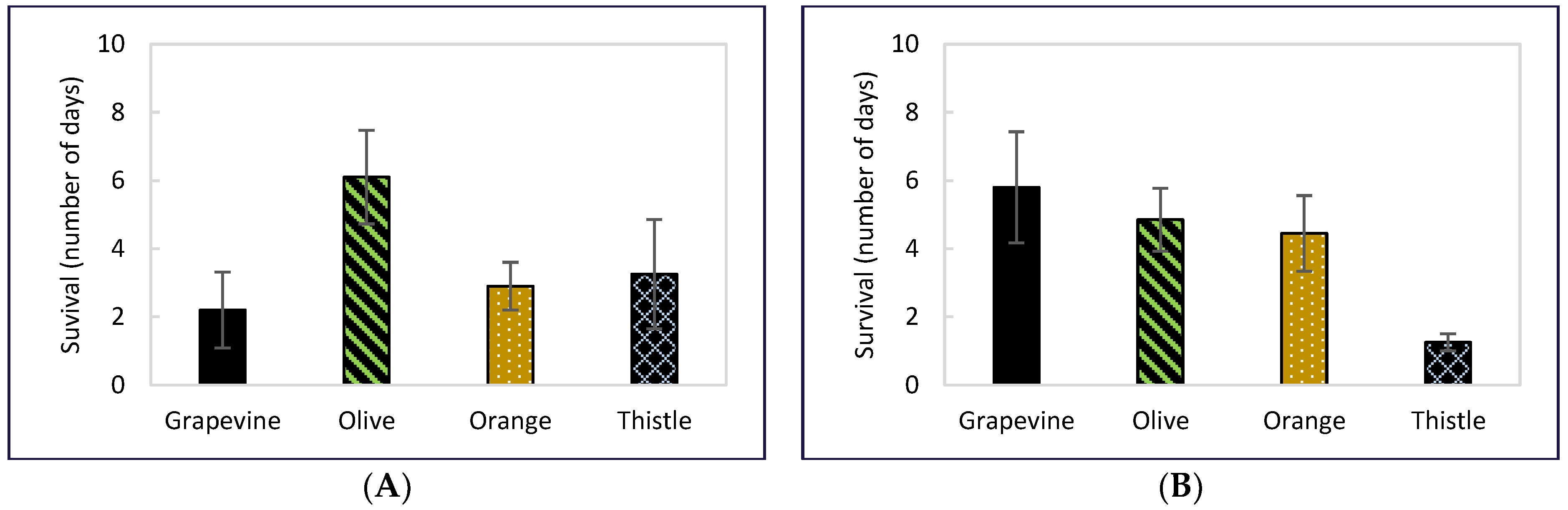
3.1. Bathyllus Maturation in Spring and Summer
3.2. Maturation of Bathyllus on Host Plants Susceptible to Xylella
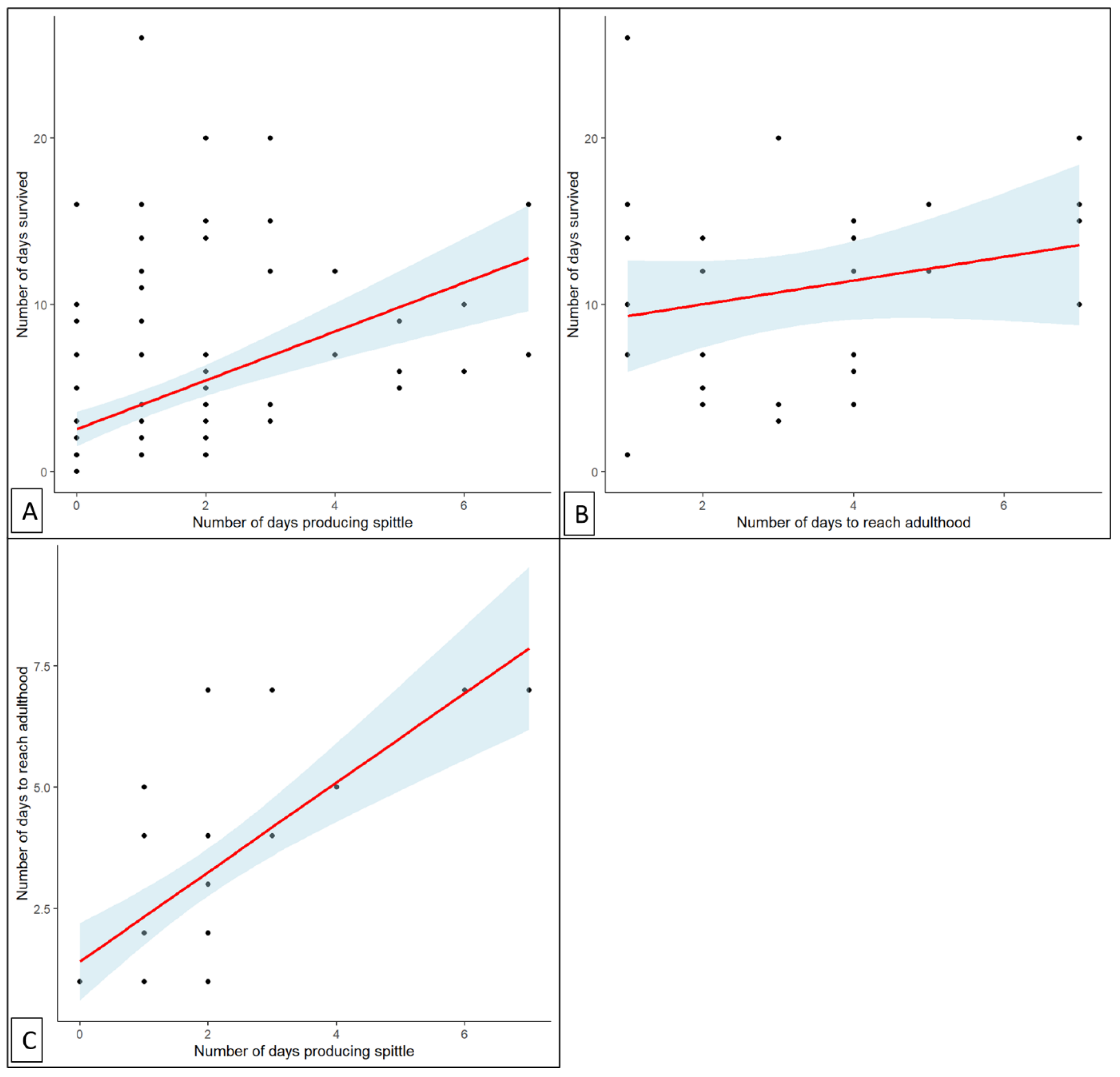
3.3. Relationships Between Measures of Insect Activity
4. Discussion
4.1. Insect Maturation in Spring and Summer
4.2. Insect Maturation on Host Plants
4.3. Host Suitability in Spring and Summer
4.4. Correlations of Insect Activity Measures
5. Conclusions
Supplementary Materials
Author Contributions
Funding
Data Availability Statement
Conflicts of Interest
Appendix A

| Category | Insect Measure | Kruskal–Wallis Chi2 (F) | Sample Size (N) | Degrees of Freedom (df) | Level of Significance (p) |
|---|---|---|---|---|---|
| Host plant species | Days survived | 6.3544 | 122 | 3 | 0.1 |
| Days producing spittle | 9.7479 | 122 | 3 | 0.02 | |
| Days to adult | 1.8289 | 27 | 3 | 0.61 |
| Host 1; Host 2 | Mean Difference (Days) (Host 1–Host 2) | Level of Significance (p) | Host 1 Sample Size (n) | Host 2 Sample Size (n) |
|---|---|---|---|---|
| Olive; Grapevine | 2.752 | 0.003 | 40 | 38 |
| Olive; Citrus-Orange | 2.466 | 0.007 | 40 | 40 |
| Olive; Sow Thistle | 1.701 | 0.044 | 40 | 8 |
| Grapevine; Citrus-Orange | −0.317 | 0.376 | 38 | 40 |
| Grapevine; Sow Thistle | 0.091 | 0.464 | 38 | 8 |
| Citrus-Orange; Sow Thistle | 0.277 | 0.391 | 40 | 8 |
| Category | Insect Measure | Kruskal–Wallis Chi2 (F) | Sample Size (N) | Degrees of Freedom (df) | Level of Significance (p) |
|---|---|---|---|---|---|
| Trial 1 host plant species | Days survived | 7.4401 | 58 | 3 | 0.06 |
| Days producing spittle | 7.836 | 58 | 3 | 0.05 | |
| Days to adult | 0.603 | 9 | 2 | 0.74 | |
| Trial 2 host plant species | Days survived | 3.7115 | 60 | 3 | 0.29 |
| Days producing spittle | 7.1715 | 60 | 3 | 0.07 | |
| Days to adult | 1.5501 | 16 | 2 | 0.46 |
| October Host 1; October Host 2 | Mean Difference (Days) (Host 1–Host 2) | Level of Significance (p) | October Host 1 Sample Size (n) | October Host 2 Sample Size (n) |
|---|---|---|---|---|
| Olive; Grapevine | 2.524 | 0.006 | 20 | 18 |
| Olive; Citrus-Orange | 1.863 | 0.312 | 20 | 20 |
| Olive; Sow Thistle | 0.077 | 0.469 | 20 | 4 |
| Grapevine; Citrus-Orange | −0.711 | 0.239 | 18 | 20 |
| Grapevine; Sow Thistle | 1.560 | 0.059 | 18 | 4 |
| Citrus-Orange; Sow Thistle | −1.153 | 0.124 | 20 | 4 |
| Category | Insect Measure | Critical Statistic (t) | Degrees of Freedom (df) | Level of Significance (p) | Trial 1 Sample Size (n) | Trial 2 Sample Size (n) |
|---|---|---|---|---|---|---|
| Starting month | Adult weight | −2.297 | 67.854 | 0.0247 | 62 | 24 |
| Days survived | 1.122 | 123.41 | 0.2639 | 62 | 64 | |
| Days to adult | −0.0534 | 22.471 | 0.9579 | 12 | 19 | |
| Days producing spittle | −0.2461 | 122.91 | 0.806 | 62 | 64 |
| Measure 1 | Measure 2 | Model Equation | Critical Statistic (F) | Sample Size (N) | Level of Significance (p) | Correlation Strength (r2) | MSE | √ (MSE) |
|---|---|---|---|---|---|---|---|---|
| Days survived | Days producing spittle | Y = 1.4647x + 2.5420 | 30.44 | 124 | 1.919 × 10⁻⁷ | 0.1971 | 21.6 | 4.648 |
| Days survived | Days to adult | Y = 0.7113x + 8.6086 | 1.626 | 29 | 0.2123 | 0.0531 | 33.01 | 5.745 |
| Days producing spittle | Days to adult | Y = 0.59272x + 0.05575 | 34.89 | 29 | 2.059 × 10⁻⁶ | 0.5461 | 1.068 | 1.0337 |
References
- European Food Safety Authority (EFSA); Cavalieri, V.; Fasanelli, E.; Furnari, G.; Gibin, D.; Linares, A.G.; La Notte, P.; Pasinato, L.; Stancanelli, G. Update of the Xylella spp. host plant database—Systematic literature search up to 31 December 2024. EFSA J. 2025, 23, e9563. [Google Scholar] [CrossRef]
- Saponari, M.; Loconsole, G.; Cornara, D.; Yokomi, R.K.; de Stradis, A.; Boscia, D.; Bosco, D.; Martelli, G.P.; Krugner, R.; Porcelli, F. Infectivity and transmission of Xylella fastidiosa by Philaenus spumarius (Hemiptera: Aphrophoridae) in Apulia, Italy. J. Econ. Entomol. 2014, 107, 1316–1319. [Google Scholar] [CrossRef]
- Hopkins, D.L.; Purcell, A.H. Xylella fastidiosa: Cause of Pierce’s disease of grapevine and other emergent diseases. Plant Dis. 2002, 86, 247–253. [Google Scholar] [CrossRef] [PubMed]
- Beal, D.J.; Cooper, M.; Daugherty, M.P.; Purcell, A.H.; Almeida, R.P.P. Seasonal abundance and infectivity of Philaenus spumarius (Hemiptera: Aphrophoridae), a vector of Xylella fastidiosa in California vineyards. Environ. Entomol. 2021, 50, 467–476. [Google Scholar] [CrossRef] [PubMed]
- Su, C.; Chang, C.J.; Chang, C.; Shih, H.; Tzeng, K.; Jan, F.; Kao, C.; Deng, W. Pierce’s disease of grapevines in Taiwan: Isolation, cultivation and pathogenicity of Xylella fastidiosa. J. Phytopathol. 2013, 161, 389–396. [Google Scholar] [CrossRef]
- Amanifar, N.; Taghavi, M.; Izadpanah, K.; Babaei, G. Isolation and pathogenicity of Xylella fastidiosa from grapevine and almond in Iran. Phytopathol. Mediterr. 2014, 53, 318–327. [Google Scholar]
- Greco, D.; Aprile, A.; De Bellis, L.; Luvisi, A. Diseases caused by Xylella fastidiosa in prunus genus: An overview of the research on an increasingly widespread pathogen. Front. Plant Sci. 2021, 12, 712452. [Google Scholar] [CrossRef]
- Marques, L.L.R.; Ceri, H.; Reid, D.M.; Olson, M.E. Characterization of biofilm formation by Xylella fastidiosa in vitro. Plant Dis. 2002, 86, 633–638. [Google Scholar] [CrossRef]
- Walker, N.C.; White, S.M.; Ruiz, S.A.; Fletcher, D.M.; Saponari, M.; Roose, T. A mathematical model of biofilm growth and spread within plant xylem: Case study of Xylella fastidiosa in olive trees. J. Theor. Biol. 2024, 581, 111737. [Google Scholar] [CrossRef]
- Adams, H.D.; Zeppel, M.J.B.; Anderegg, W.R.L.; Hartmann, H.; Landhäusser, S.M.; Tissue, D.T.; McDowell, N.G. A multi-species synthesis of physiological mechanisms in drought-induced tree mortality. Nat. Ecol. Evol. 2017, 1, 1285–1291. [Google Scholar] [CrossRef]
- Redak, R.A.; Purcell, A.H.; Lopes, J.R.S.; Blua, M.J.; Mizell, R.F., III; Andersen, P.C. The biology of xylem fluid-feeding insect vectors of Xylella fastidiosa and their relation to disease epidemiology. Annu. Rev. Entomol. 2004, 49, 243–270. [Google Scholar] [CrossRef]
- Daugherty, M.P.; Almeida, R.P.P. Estimating Xylella fastidiosa transmission parameters: Decoupling sharpshooter number and feeding period. Entomol. Exp. Appl. 2009, 132, 84–92. [Google Scholar] [CrossRef]
- Roddee, J.; Backus, E.A.; Cervantes, F.A.; Hanboonsong, Y. Xylella fastidiosa inoculation behaviors (EPG X wave) are performed differently by blue-green sharpshooters based on infection status of prior probing host. J. Econ. Entomol. 2023, 116, 697–712. [Google Scholar] [CrossRef]
- Haddad, N.; Afechtal, M.; Steito, J.C.; Ouguas, Y.; Benkirane, R.; Lhomme, P.; Smaili, M.C. Occurrence in Morocco of potential vectors of Xylella fastidiosa that may contribute to the active spread of the bacteria. Ann. Soc. Entomol. Fr. 2021, 57, 359–371. [Google Scholar] [CrossRef]
- Elbeaino, T.; Yaseen, T.; Valentini, F.; Ben Moussa, I.E.; Mazzoni, V.; D’onghia, M. Identification of three potential insect vectors of Xylella fastidiosa in southern Italy. Phytopathol. Mediterr. 2014, 53, 328–332. [Google Scholar] [CrossRef]
- Cornara, D.; Saponari, M.; Zeilinger, A.R.; de Stradis, A.; Boscia, D.; Loconsole, G.; Bosco, D.; Martelli, G.P.; Almeida, R.P.P.; Porcelli, F. Spittlebugs as vectors of Xylella fastidiosa in olive orchards in Italy. J. Pest Sci. 2017, 90, 521–530. [Google Scholar] [CrossRef] [PubMed]
- Thompson, V.; Harkin, C.; Stewart, A.J.A. The most polyphagous insect herbivore? Host plant associations of the Meadow spittlebug, Philaenus spumarius (L.). PLoS ONE 2023, 18, e0291734. [Google Scholar] [CrossRef]
- Farigoule, P.; Chartois, M.; Lambert, M.; Rossi, J.; Mesmin, X.; Rasplus, J.; Cruaud, A. Vectors as sentinels: Rising temperatures increase the risk of Xylella fastidiosa outbreaks. Biology 2022, 11, 1299. [Google Scholar] [CrossRef]
- Godefroid, M.; Durán, J.M. Composition of landscape impacts the distribution of the main vectors of Xylella fastidiosa in southern Spain. J. Appl. Entomol. 2022, 146, 666–675. [Google Scholar] [CrossRef]
- Fletcher, M.J. Identification Key and Checklists for the Froghoppers and Spittlebugs (Hemiptera: Cercopoidea) of Australia and Neighbouring Areas). 2010. Available online: https://idtools.dpi.nsw.gov.au/keys/cercopid/index.html (accessed on 3 February 2025).
- Atlas of Living Australia (ALA). Bathyllus albicinctus (Erichson, 1842). Available online: https://bie.ala.org.au/species/https://biodiversity.org.au/afd/taxa/5ba85a24-db9f-4960-9f84-eeec08253e1a (accessed on 3 February 2025).
- Martoni, F.; Lea, R.; Jaroslow, D.; Selleck, C.; Kant, P.; Nancarrow, N.; Blacket, M. Diversity and composition of the bacterial communities associated with the Australian spittlebugs Bathyllus albicinctus and Philagra parva (Hemiptera: Aphrophoridae). PLoS ONE 2024, 19, e0311938. [Google Scholar] [CrossRef] [PubMed]
- Trębicki, P.; Vandegeer, R.K.; Bosque-Pérez, N.A.; Powell, K.S.; Dader, B.; Freeman, A.J.; Yen, A.L.; Fitzgerald, G.J.; Luck, J.E. Virus infection mediates the effects of elevated CO2 on plants and vectors. Sci. Rep. 2016, 6, 22785. [Google Scholar] [CrossRef]
- Wickham, H.; François, R.; Henry, L.; Müller, K.; Vaughan, D. dplyr: A Grammar of Data Manipulation. R Package Version 1.1.4. 2023. Available online: https://dplyr.tidyverse.org (accessed on 11 July 2022).
- Wickham, H. Ggplot2: Elegant Graphics for Data Analysis; Springer: New York, NY, USA, 2016; Available online: https://ggplot2.tidyverse.org (accessed on 11 July 2022).
- Dunnett, C.W. Pairwise multiple comparisons in the unequal variance case. J. Am. Stat. Assoc. 1980, 75, 796–800. [Google Scholar] [CrossRef]
- Antonatos, S.; Papachristos, D.P.; Varikou, K.; Vahamidis, P.; Kapranas, A.; Milonas, P. Seasonal appearance, abundance, and host preference of Philaenus spumarius and Neophilaenus campestris (Hemiptera: Aphrophoridae) in Olive Groves in Greece. Environ. Entomol. 2021, 50, 1474–1482. [Google Scholar] [CrossRef]
- Bodino, N.; Cavalieri, V.; Dongiovanni, C.; Plazio, E.; Saladini, M.A.; Volani, S.; Simonetto, A.; Fumarola, G.; di Carolo, M.; Procelli, F.; et al. Phenology, seasonal abundance and stage-structure of spittlebug (Hemiptera: Aphrophoridae) populations in olive groves in Italy. Sci. Rep. 2019, 9, 17725. [Google Scholar] [CrossRef] [PubMed]
- Hale, R.; Swearer, S.E. Ecological traps: Current evidence and future directions. Proc. R. Soc. Lond. B 2016, 283, 20152647. [Google Scholar] [CrossRef]
- Andersen, P.C.; Brodbeck, B.V.; Mizell, R.F., III. Feeding by the leafhopper, Homalodisca coagulata in relation to xylem fluid chemistry and tension. J. Insect Physiol. 1992, 38, 611–622. [Google Scholar] [CrossRef]
- Bergman, E.A.; Green, E.L.; Matthews, P.G.D. The cibarial pump of the xylem-feeding froghopper Philaenus spumarus produces negative pressures exceeding 1 MPa. Proc. R. Soc. Lond. B 2021, 288, 20210731. [Google Scholar] [CrossRef]
- Cowan, I.R. Stomatal behavior and environment. In Advances in Botanical Research; Preston, R.D., Woodhouse, H.W., Eds.; Academic Press: San Francisco, CA, USA, 1977; pp. 117–228. [Google Scholar]
- Daly, M.J.; Phillips, N.G. Interspecific variation in nighttime transpiration and stomatal conductance in a mixed New England deciduous forest. Tree Physiol. 2006, 26, 411–419. [Google Scholar] [CrossRef]
- Salazar-Tortosa, D.; Castro, J.; Villar-Salvador, P.; Viñegla, B.; Matías, L.; Michelson, A.; de Casas, R.R.; Querejeta, J.I. The “isohydric trap”: A proposed feedback between water shortage, stomatal regulation, and nutrient acquisition drives differential growth and survival of European pines under climatic dryness. Glob. Change Biol. 2018, 24, 4069–4083. [Google Scholar] [CrossRef]
- Duan, H.; Huang, G.; Zhou, S.; Tissue, D.T. Dry mass production, allocation patterns and water use efficiency of two conifers with different water use strategies under elevated [CO2], warming and drought conditions. Euro. J. For. Res. 2018, 137, 605–618. [Google Scholar] [CrossRef]
- Blackman, C.J.; Creek, D.; Maier, C.; Aspinwall, M.J.; Drake, J.E.; Pfautsch, S.; O’Grady, A.; Delzon, S.; Medlyn, B.E.; Tissue, D.T.; et al. Drought response strategies and hydraulic traits contribute to mechanistic understanding of plant dry-down to hydraulic failure. Tree Physiol. 2019, 39, 910–924. [Google Scholar] [CrossRef]
- Larsson, S. Stressful times for the plant stress: Insect performance hypothesis. Oikos 1989, 56, 277–283. [Google Scholar] [CrossRef]
- Tariq, M.; Wright, D.J.; Rossiter, J.T.; Staley, J.T. Aphids in a changing world: Testing the plant stress, plant vigour and pulsed stress hypothesis. Agric. For. Entomol. 2012, 14, 177–185. [Google Scholar] [CrossRef]
- Chen, L.; Huan, J.; Dawson, A.; Zhai, L.; Stadt, K.J.; Comeau, P.G.; Whitehouse, C. Contributions of insects and droughts to growth decline of trembling aspen mixed boreal forest of western Canada. Glob. Change Biol. 2017, 24, 655–667. [Google Scholar] [CrossRef]
- Valenzuela, I.; Trębicki, P.; Powell, K.S.; Vereijssen, J.; Norng, S.; Yen, A.L. Acizzia solanicola (Hemiptera: Psyllidae) probing behaviour on two Solanum spp. and implications for possible pathogen spread. PLoS ONE 2017, 12, e0178609. [Google Scholar] [CrossRef]
- Cavalieri, V.; Altamura, G.; Fumarola, G.; di Carolo, M.; Saponari, M.; Cornara, D.; Bosco, D.; Dongiovanni, C. Transmission of Xylella fastidiosa Subspecies Pauca sequence type 53 by different insect species. Insects 2019, 10, 324. [Google Scholar] [CrossRef] [PubMed]
- Awmack, C.S.; Leather, S.R. Host plant quality and fecundity in herbivorous insects. Annu. Rev. Entomol. 2002, 47, 817–844. [Google Scholar] [CrossRef]
- Knolhoff, L.M.; Heckel, D.G. Behavioral assays for studies of host plant choice and adaptation in herbivorous insects. Annu. Rev. Entomol. 2014, 59, 263–278. [Google Scholar] [CrossRef]
- Nylin, S.; Gotthard, K. Plasticity in life-history traits. Annu. Rev. Entomol. 1998, 43, 63–83. [Google Scholar] [CrossRef]
- Garcia-Forner, N.; Sala, A.; Biel, C.; Savé, R.; Martinez-Vilalta, J. Individual traits as determinants of time to death under extreme drought in Pinus sylvestris L. Tree Physiol. 2016, 36, 1196–1209. [Google Scholar] [CrossRef]
- Jarošík, V.; Honěk, A.; Magarey, R.D.; Skuhrovec, J. Development database for phenology models: Related insect and mite species have similar thermal requirements. J. Econ. Entomol. 2011, 104, 1870–1876. [Google Scholar] [CrossRef]
- Jaroslow, D.D.; Cunningham, J.P.; Smith, D.I.; Steinbauer, M.J. Seasonal phenology and climate associated feeding activity of introduced Marchalina hellenica in southeast Australia. Insects 2023, 14, 305. [Google Scholar] [CrossRef]
- Sevanto, S.; McDowell, N.G.; Dickman, L.T.; Pangle, R.; Pockman, W.T. How do trees die? A test of the hydraulic failure and carbon starvation hypothesis. Plant Cell Environ. 2014, 37, 153–161. [Google Scholar] [CrossRef]
- Steppe, K.; Sterck, F.; Deslauriers, A. Diel growth dynamics in tree stems: Linking anatomy and ecophysiology. Trends Plant Sci. 2015, 20, 335–343. [Google Scholar] [CrossRef]


| Host Plant | Variety | Number of Plants | Number of Insects per Plant | Total Number of Insects per Variety |
|---|---|---|---|---|
| Grapevine | Dawn Seedless | 1 | 2 | 2 |
| Early Muscat | 6 | 2 | 12 | |
| Fiesta | 1 | 2 | 2 | |
| Thomuscat | 1 | 2 | 2 | |
| Olive | Manzanillo | 4 | 2 | 8 |
| Kalamata | 6 | 2 | 12 | |
| Orange | Washington Navel | 10 | 2 | 20 |
| Sow Thistle | unidentified | 1 | 4 | 4 |
Disclaimer/Publisher’s Note: The statements, opinions and data contained in all publications are solely those of the individual author(s) and contributor(s) and not of MDPI and/or the editor(s). MDPI and/or the editor(s) disclaim responsibility for any injury to people or property resulting from any ideas, methods, instructions or products referred to in the content. |
© 2026 by the authors. Licensee MDPI, Basel, Switzerland. This article is an open access article distributed under the terms and conditions of the Creative Commons Attribution (CC BY) license.
Share and Cite
Jaroslow, D.; Nancarrow, N.; Blacket, M.; Selleck, C.; Mavende, K.P.; Trębicki, P. Host Plant Preferences and Survival of the Native Australian Spittlebug, Bathyllus albicinctus Erichson (Hemiptera: Cercopoidea). Biology 2026, 15, 886. https://doi.org/10.3390/biology15110886
Jaroslow D, Nancarrow N, Blacket M, Selleck C, Mavende KP, Trębicki P. Host Plant Preferences and Survival of the Native Australian Spittlebug, Bathyllus albicinctus Erichson (Hemiptera: Cercopoidea). Biology. 2026; 15(11):886. https://doi.org/10.3390/biology15110886
Chicago/Turabian StyleJaroslow, Duncan, Narelle Nancarrow, Mark Blacket, Cait Selleck, Kudzaishe Precious Mavende, and Piotr Trębicki. 2026. "Host Plant Preferences and Survival of the Native Australian Spittlebug, Bathyllus albicinctus Erichson (Hemiptera: Cercopoidea)" Biology 15, no. 11: 886. https://doi.org/10.3390/biology15110886
APA StyleJaroslow, D., Nancarrow, N., Blacket, M., Selleck, C., Mavende, K. P., & Trębicki, P. (2026). Host Plant Preferences and Survival of the Native Australian Spittlebug, Bathyllus albicinctus Erichson (Hemiptera: Cercopoidea). Biology, 15(11), 886. https://doi.org/10.3390/biology15110886