
Article

Responses of Methane Emissions to Different Soil Amendments in Paddy Soil: Soil Properties, Microbial Communities, and Functional Genes

Guangdong Key Laboratory of Environmental Catalysis and Health Risk Control, School of Environmental Science and Engineering, Institute of Environmental Health and Pollution Control, Guangdong University of Technology, Guangzhou 510006, China
*
Author to whom correspondence should be addressed.
These authors contributed equally to this work and share first authorship.
Biology 2026, 15(11), 883; https://doi.org/10.3390/biology15110883
Submission received: 11 May 2026 / Revised: 30 May 2026 / Accepted: 1 June 2026 / Published: 3 June 2026

Simple Summary

Rice fields release methane, a powerful greenhouse gas that contributes to climate change. Soil amendments are widely used to improve soil quality, but their effects on methane release are not always predictable. This study tested microbial inoculants, biochar, humic acid, and montmorillonite using a soil microcosm experiment that simulated flooded paddy soil. The results showed contrasting effects among amendments. Duojun 360 reduced methane emissions by 57.1%, whereas Chabeijian increased methane emissions by 100.8%. Biochar, humic acid, and montmorillonite had relatively minor effects on methane emissions compared with the two microbial inoculants. The opposite effects of Duojun 360 and Chabeijian were closely related to methane cycling microorganisms and functional genes. Chabeijian enriched methane producing microorganisms, including Methanosarcina, Methanobacterium, Methanocella, and Methanosaeta, and increased the methane production gene mcrA. In contrast, Duojun 360 reduced these microorganisms and decreased mcrA. Both microbial products increased methane consuming microorganisms, such as Methylocystis, and increased the methane oxidation gene pmoA, but methane production mainly determined the final methane release. These findings indicate that soil amendments should be carefully evaluated before use in rice fields. This study may help guide the selection of suitable amendments for reducing greenhouse gas emissions from rice cultivation.

Abstract

Paddy soils are important contributors to agricultural greenhouse gas emissions, particularly methane, and soil amendments may regulate methane production by altering soil physicochemical properties and microbial methane cycling. However, the effects of different amendment types on methane emissions from anaerobic paddy soils remain uncertain. In this study, an anaerobic microcosm experiment was conducted to evaluate the effect of microbial inoculants, biochar, humic acid, and montmorillonite on CH4 and CO2 emissions from paddy soil. Changes in acetate concentration, pH, electrical conductivity, microbial community structure, and methane cycling functional genes were further analyzed to explore the underlying mechanisms. The results showed that microbial inoculants had stronger effects on CH4 emissions than the other amendments, but their effects were contrasting. The Chabeijian (CB) inoculant significantly increased methane emissions by 100.8%, whereas the Duojun-360 (DJ) inoculant reduced cumulative methane by 57.1%. The stimulation of CH4 emissions under Chabeijian was associated with enhanced acetate turnover, enrichment of methanogenic taxa including Methanosarcina, Methanobacterium, Methanocella, and Methanosaeta, and a 48.7% increase in mcrA abundance. In contrast, Duojun 360 markedly increased soil electrical conductivity, reduced methanogen abundance, decreased mcrA abundance by 26.9%, and lowered the mcrA/pmoA ratio, indicating a shift away from methane production. Although both inoculants increased methanotroph abundance and pmoA abundance, methane production remained the dominant factor controlling net CH4 emissions. These findings may provide preliminary mechanistic support for the targeted selection of soil amendments to mitigate CH4 emissions in rice cultivation by regulating soil properties, methanogenic communities, and the balance between methane production and oxidation.

1. Introduction

Methane (CH4) are one of the most significant greenhouse gases (GHGs) contributing to global climate change, with CH4 possessing a much higher global warming potential than CO2 over a 100-year period [1]. Paddy fields, due to their waterlogged and anaerobic conditions, represent one of the largest anthropogenic sources of CH4, accounting for approximately 11% of global CH4 emissions [2,3]. Methane emissions from paddy soils are primarily derived from anaerobic microbial processes, including methanogenesis and organic matter decomposition [4,5]. Soil amendments, agricultural management practices, and climate change can regulate these processes by altering microbial communities and soil properties, thus impacting soil methane emissions [6,7,8,9]. Consequently, mitigating methane emissions from rice cultivation while maintaining or improving soil productivity has become a critical challenge for sustainable agricultural development [10].
Soil amendments are widely used to enhance soil fertility, improve crop productivity, and regulate soil physicochemical properties [11,12]. These amendments include a broad range of organic and inorganic materials, such as biochar, compost, silicate fertilizers, clay minerals, microbial inoculants and so on [9,12]. Recent research has primarily focused on their benefits in increasing soil organic carbon (SOC) sequestration, stabilizing organic matter, enhancing nutrient availability, and improving soil structure [13,14]. Moreover, amendments are known to improve soil physical properties such as aeration, water retention, and aggregate stability, which collectively promote plant growth and soil health [15,16]. While the agronomic benefits of these amendments are well-documented, their impact on soil carbon emissions, particularly CH4 emissions, have received less attention.
The impact of soil amendments on CH4 emissions are largely determined by their interactions with soil microbial communities, carbon cycling and physicochemical properties. For example, microbial inoculants can alter microbial community composition, potentially enhancing methane oxidation by promoting methanotrophs or suppressing methanogens, while also accelerating organic matter decomposition and increasing CO2 emissions [17,18]. The organic amendments, including organic fertilizer, biochar and humic substances, can stimulate microbial metabolism and enhance CH4 emissions [9,19,20]. However, biochar can also modify soil redox conditions and create surfaces for microbial colonization, which may suppress CH4 emissions by favoring the presence of alternative electron acceptors [21]. The clay minerals, such montmorillonite and illite, due to their high cation exchange capacity (CEC) and adsorption properties, can influence soil pH, electrical conductivity (EC), and organic matter stability, thereby affecting microbial accessibility to substrates and altering CH4 fluxes [22]. Furthermore, their ability to adsorb dissolved organic carbon and nutrients may also influence carbon turnover rates [23]. Given the complex interactions among soil amendments, microbial communities, and soil biogeochemical processes, understanding the effects of these amendments on CH4 emissions remains a key research challenge.
This study aimed to systematically evaluate the effects of different soil amendments, including microbial inoculants, biochar, humic acid, and montmorillonite, on methane emissions from paddy soil. A microcosm experiment was conducted to quantify cumulative CH4 and CO2 emissions and to examine changes in key soil physicochemical properties, including EC, pH, and acetate concentration. In addition, high-throughput 16S rRNA gene sequencing was used to assess shifts in microbial community structure, and functional genes related to methanogenesis (mcrA) and methane oxidation (pmoA) were quantified to explore the microbial mechanisms underlying CH4 emission responses. This study provides insights into how soil amendments influence greenhouse gas emissions and offers a basis for further research on sustainable rice cultivation practices.

2. Materials and Methods

2.1. Materials

Two commercial microbial inoculants, Duojun-360 (DJ) and Chabeijian (CB), were used to assess their effects on greenhouse gas emissions from paddy soil. DJ, purchased from Weifangjunyan Agricultural Technology Co., Ltd. (Weifang, China), is a complex microbial formulation containing Bacillus subtilis, Bacillus licheniformis, Bacillus megaterium, Bacillus amyloliquefaciens, and Trichoderma harzianum, with a viable cell count of at least 200 billion CFU g−1. CB, purchased from Shandong Lukanghaiboer Biotechnology Co., Ltd. (Jining, China), is a granular microbial inoculant composed of Bacillus subtilis, with a viable cell count of no less than 10 billion CFU g−1. Humic acid (HA) was obtained from Shanghai Macklin Biochemical Co., Ltd. (Shanghai, China). Biochar (BC) was synthesized by pyrolyzing crop straw at 500 °C for 2 h under a nitrogen atmosphere. Na-montmorillonite (NM), with a purity exceeding 99%, was purchased from Guzhang Shanlin Shiyu Mineral Products Co., Ltd. (Xiangxi, China).

2.2. Soil Sample Collection and Microcosm Incubation Experiment

Paddy soil was collected from Chashan Town, Dongguan City, Guangdong Province, China (23°02′ N, 113°45′ E). Soil samples were collected from the top 0–20 cm layer at five randomly selected sites and thoroughly homogenized to form a composite sample [22]. The composite soil was air-dried, passed through a 0.5 mm sieve, and stored at 4 °C before use. The anaerobic soil microcosm experiment was conducted in an anaerobic incubation system (Figure S1). The experiment included six treatments, each with four replicates: a control (CK, no amendment) and five amendment treatments, with each amendment applied at 10 g kg−1 soil. For each replicate, 10 g of prepared soil was placed into a sterile 100 mL serum bottle, and the corresponding amendment was thoroughly mixed with the soil. Then, 20 mL of water was added to achieve a water-to-soil ratio of 2:1 (v/w). The headspace was purged with nitrogen gas for 15 min to establish anaerobic conditions, with dissolved oxygen maintained at approximately 0.05 mg L−1 as measured using a DZS-708 L meter (INESA, Shanghai, China). Finally, the bottles were sealed and incubated in the dark at 30 ± 1 °C for 60 days.

2.3. Gas Emission and Soil Property Measurements

The concentrations of CH4 and CO2 in the headspace of serum bottles were monitored using GC-9800 gas chromatography (Shanghai Kechuang Sepu Instrument Co., Shanghai, China). Soil pH was measured by mixing soil with water at a 1:2.5 (w/w) ratio using a calibrated pH meter, while electrical conductivity (EC) was determined with a DDSJ-319 L conductivity meter (INESA, China). Soil acetate concentrations were determined by analyzing the filtered supernatant derived from the soil slurry using liquid chromatography (Shimadzu LC-SIL-16, Kyoto, Japan). [24].

2.4. Kinetic Analysis of Methanogenesis

The kinetics of Methane emission were evaluated using a modified Gompertz model as described by Equation [25].
P ( t ) = P m a x e x p { e x p [ R m e P m a x ( λ t ) + 1 ] }
where P ( t ) is the cumulative methane yield at time t (μmol/g soil); P m a x is the maximum methane production potential (μmol/g soil); R m is the maximum methane production rate (μmol/g soil/d); λ is the lag-phase time (d); and e is 2.71828.

2.5. DNA Extraction and Illumina Amplicon Sequencing

After 60 days of anaerobic incubation, soil samples from the CK, DJ, and CB groups were selected for DNA extraction because the microbial inoculants showed stronger regulatory effects on CH4 emissions than the other amendments, with DJ and CB representing two contrasting methane emission responses. For each treatment, DNA was extracted from 4 independent biological replicates. The soil samples were freeze-dried, and genomic DNA was extracted using the E.Z.N.A. Soil DNA Kit (Omega Bio-Tek, Inc., Norcross, GA, USA). DNA quality and concentration were determined using a NanoDrop 2000 spectrophotometer (Thermo Fisher Scientific, Inc., Waltham, MA, USA).The V4 hypervariable region of the bacterial and archaeal 16S rRNA gene was amplified using the universal primers 515F (GTGCCAGCMGCCGCGGTAA) and 806R (GGACTACHVGGGTWTCTAAT) [26]. An 8 bp barcode sequence was added to the 5′ end of both the forward and reverse primers to distinguish among samples. PCR amplification was performed using an ABI 9700 PCR instrument (Applied Biosystems, Inc., Foster City, CA, USA) under the following conditions: initial denaturation at 95 °C for 5 min; 28 cycles of denaturation at 95 °C for 30 s, annealing at 55 °C for 50 s, and extension at 72 °C for 45 s; followed by a final extension at 72 °C for 10 min. The PCR products were purified using an Agencourt AMPure XP Kit (Beckman Coulter, Inc., Brea, CA, USA). Sequencing libraries were generated using the NEBNext Ultra II DNA Library Prep Kit (New England Biolabs, Inc., Ipswich, MA, USA) following the manufacturer’s instructions. Library quality was assessed using a NanoDrop 2000 spectrophotometer, an Agilent 2100 Bioanalyzer (Agilent Technologies, Inc., Santa Clara, CA, USA), and an ABI StepOnePlus Real-Time PCR System (Applied Biosystems, Inc., Foster City, CA, USA).

2.6. Quantitative PCR Analysis

Quantitative PCR (qPCR) was performed to quantify key functional genes involved in methane metabolism in soil samples from the CK, DJ, and CB groups after 60 days of anaerobic incubation. The qPCR analyses were carried out using an ABI 7500 thermocycler (Applied Biosystems, USA). The methyl-coenzyme M reductase (mcrA) gene was quantitatively analyzed using primers MLf (5′-GGTGGTGTMGGATTCACACARTAYGCWACAGC-3′) and MLr (5′-TTCATTGCRTAGTTWGGRTAGTT-3′) [27,28]. The particulate methane monooxygenase (pmoA) gene was quantitatively analyzed using primers (5′-GGNGACTGGGACTTCTGG-3′) and (5′-CCGGMGCAACGTCYTTACC-3′) [29,30]. The qPCR amplification conditions were as follows: initial denaturation at 94 °C for 5 min, followed by 30 cycles of denaturation at 94 °C for 30 s, annealing at 55 °C for 30 s, and extension at 72 °C for 30 s. A final extension was performed at 72 °C for 10 min [31]. Plasmid standards were serially diluted 10-fold increments from 101 to 105, and 2 μL of each dilution was used as a template to establish a standard curve. The correlation coefficient (R2) of the standard curve was ≥0.99, ensuring high accuracy and reliability of the qPCR assay.

2.7. Statistical Analysis

The experimental data were analyzed using Origin 2022 and R (version 4.3.1). Differences among treatment groups were evaluated using one-way analysis of variance (ANOVA), followed by Tukey’s post hoc test for pairwise comparisons when significant effects were detected. Principal component analysis (PCA) was performed on the KO–Bray–Curtis distance matrix using the vegan package, while alpha (α) and beta (β) diversity indices were calculated to evaluate microbial community diversity, with graphical representations generated via ggplot2 (version 3.4.3) [32].

3. Results

3.1. Effects of Soil Amendments on CH4 and CO2 Emissions from Paddy Fields

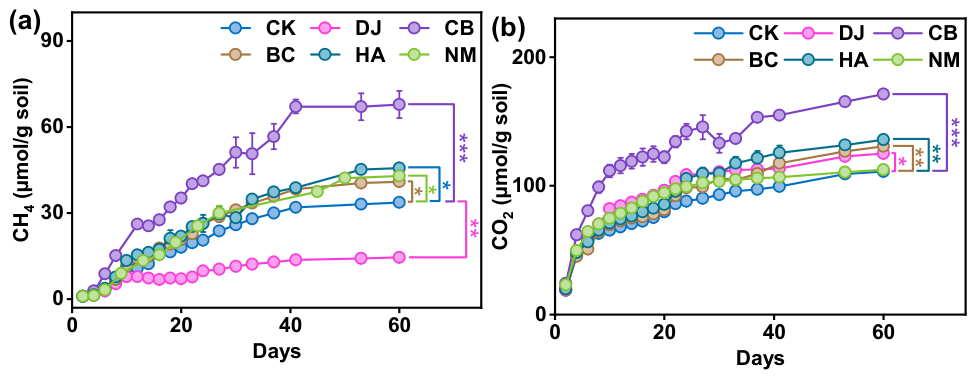
The cumulative methane emissions from paddy soil during 60 days of anaerobic incubation are presented in Figure 1a. In CK, cumulative CH4 emissions reached 33.8 ± 0.09 μmol/g soil, establishing the baseline for methane production. The DJ treatment significantly suppressed methane production, reducing cumulative CH4 emissions to 14.49 ± 0.71 μmol/g soil, which corresponds to a 57.13% decrease compared to CK. In contrast, the CB treatment markedly enhanced methane production, with cumulative CH4 emissions reaching 67.87 ± 4.76 μmol/g soil, corresponding to a 100.79% increase relative to CK. The BC, HA, and NM treatments produced more moderate increases, with cumulative CH4 emissions of 41.00 ± 1.26, 45.70 ± 0.82, and 42.89 ± 1.10 μmol/g soil, respectively, corresponding to increases of 21.30%, 35.21%, and 26.89% relative to CK. Moreover, the methane production curves for all treatments eventually reached a plateau, suggesting that the soil’s methanogenic potential approached saturation, possibly due to substrate limitations or shifts in microbial activity. The kinetics of methane production were analyzed using a modified Gompertz model (Table 1). In the CK treatment, the maximum methane production potential (Pmax) was 34.75 ± 0.89 μmol/g soil. The DJ treatment significantly reduced Pmax to 14.85 ± 0.21 μmol/g soil, a substantial decrease compared to CK. In contrast, the Pmax values for the CB, BC, HA, and NM treatments increased to 70.86 ± 3.07, 42.00 ± 1.00, 47.13 ± 2.04 and 43.06 ± 1.16 μmol/g soil, respectively, with the CB treatment exhibiting the greatest enhancement. Similarly, the maximum methane production rate (Rm) followed this trend. In the DJ treatment, Rm decreased by 56.7% compared to CK (from 1.04 ± 0.05 to 0.45 ± 0.01 μmol/g soil/d), whereas Rm increased by 83.6, 24.03, 17.3 and 31.73% in the CB, BC, HA, and NM treatments, reaching 1.91 ± 0.13, 1.29 ± 0.05, 1.22 ± 0.08, and 1.37 ± 0.09 μmol/g soil/d, respectively. Moreover, the soil amendments also influenced soil CO2 emissions (Figure 1b). CK exhibited cumulative CO2 emissions of 111.28 ± 1.26 μmol/g soil after 60 days. In contrast, the CB, BC, HA and DJ treatments significantly increased CO2 emissions to 171.21 ± 0.94, 130.78 ± 4.92, 135.86 ± 1.71 and 125.19 ± 1.19 μmol/g soil, representing increases of 53.85, 17.52, 21.32 and 12.50%, respectively, compared to CK. Although the NM treatments showed higher CO2 emissions than CK during the early and mid-incubation stages, their cumulative emissions decelerated over time, reaching 112.70 ± 1.22 μmol/g soil after 60 days.

3.2. Effects of Soil Amendments on the Physicochemical Properties

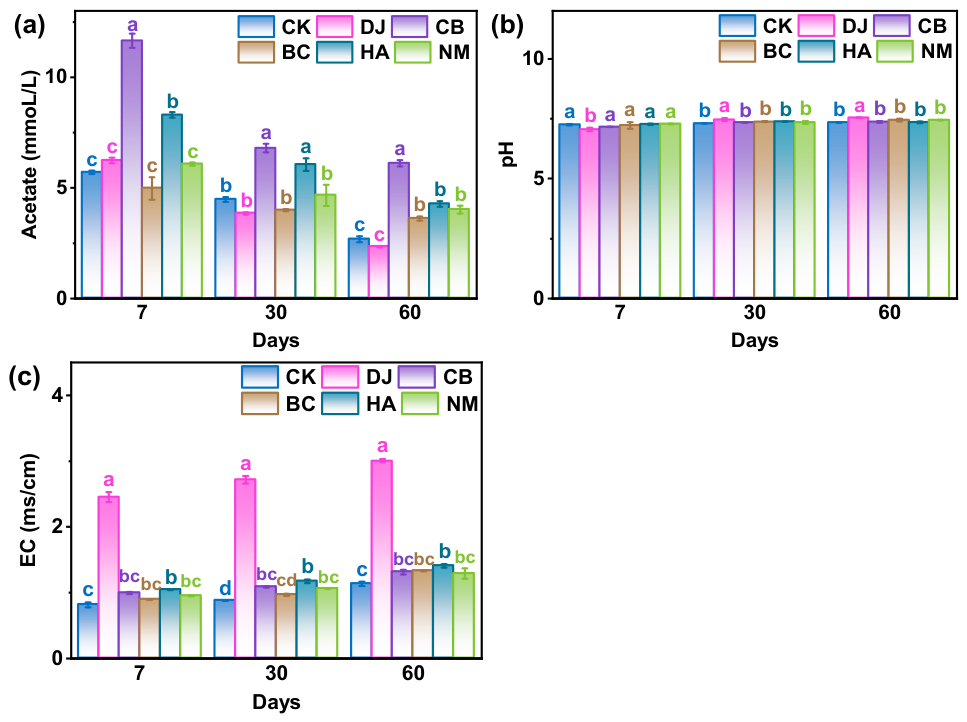
The basic physicochemical properties of the soil used in this study were determined prior to the experiments. The soil exhibited a pH of 6.42, an electrical conductivity of 0.845 mS/cm, and a cation exchange capacity of 24.50 cmol/kg. Elemental analysis revealed concentrations of 36.5 g/kg for Fe, 20.7 g/kg for K, 3.25 g/kg for P, and 0.59 g/kg for S. In addition, the soil texture was characterized by a particle size distribution of 10.13% clay, 60.2% silt, and 29.67% sand. The application of soil amendments markedly altered acetate concentration, pH, and EC in paddy soil during anaerobic incubation (Figure 2). Acetate concentrations peaked during the early stage of incubation. On day 7, the DJ, CB, HA, and NM treatments showed higher acetate concentrations of 6.240 ± 0.129, 11.657 ± 0.319, 8.305 ± 0.126, and 6.078 ± 0.073 mmol/L, respectively, compared with CK (5.705 ± 0.083 mmol/L), whereas the BC treatment showed a lower acetate concentration of 4.976 ± 0.512 mmol/L. During incubation, acetate concentrations gradually declined by 53.1%, 62.4%, 47.6%, 27.5%, 48.6%, and 33.9% in the CK, DJ, CB, BC, HA, and NM treatments, respectively. Soil pH showed a modest increasing trend in all treatments. After 60 days, the pH values in the CK, CB, BC, HA, and NM treatments ranged from 7.34 to 7.44, whereas the DJ treatment increased to 7.55. Moreover, EC increased from 1.136 ± 0.003 mS/cm in CK to 1.290–1.409 mS/cm in the CB, BC, HA, and NM treatments, while the DJ treatment showed the highest EC value of 3.006 ± 0.026 mS/cm.

3.3. Effects of DJ and CB Amendments on Microbial Community

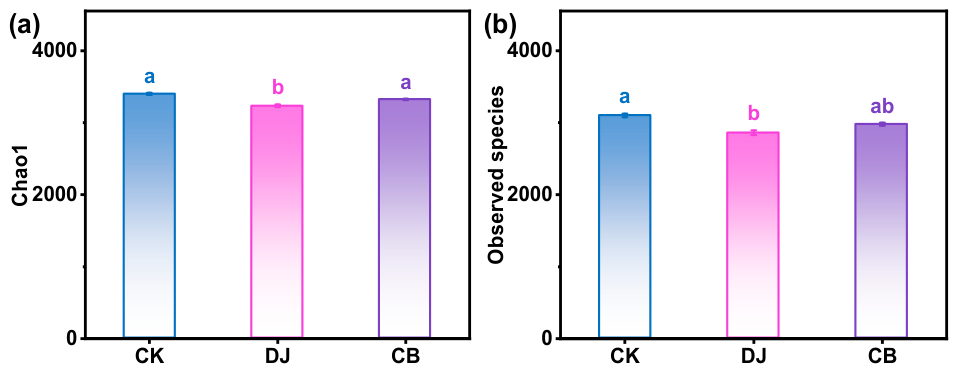
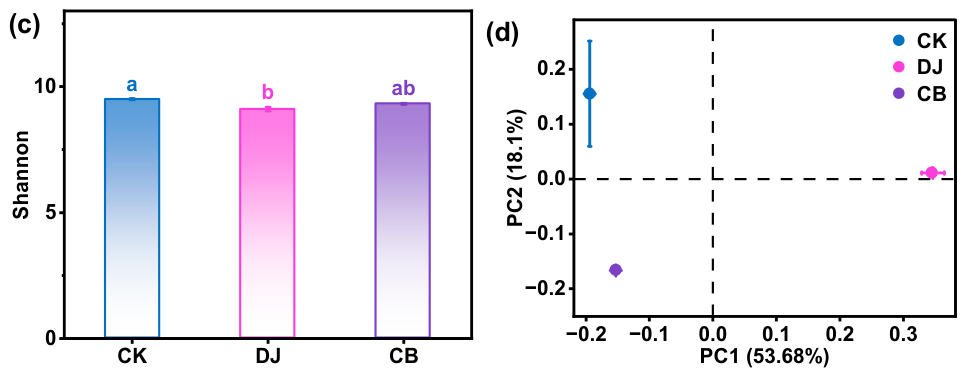
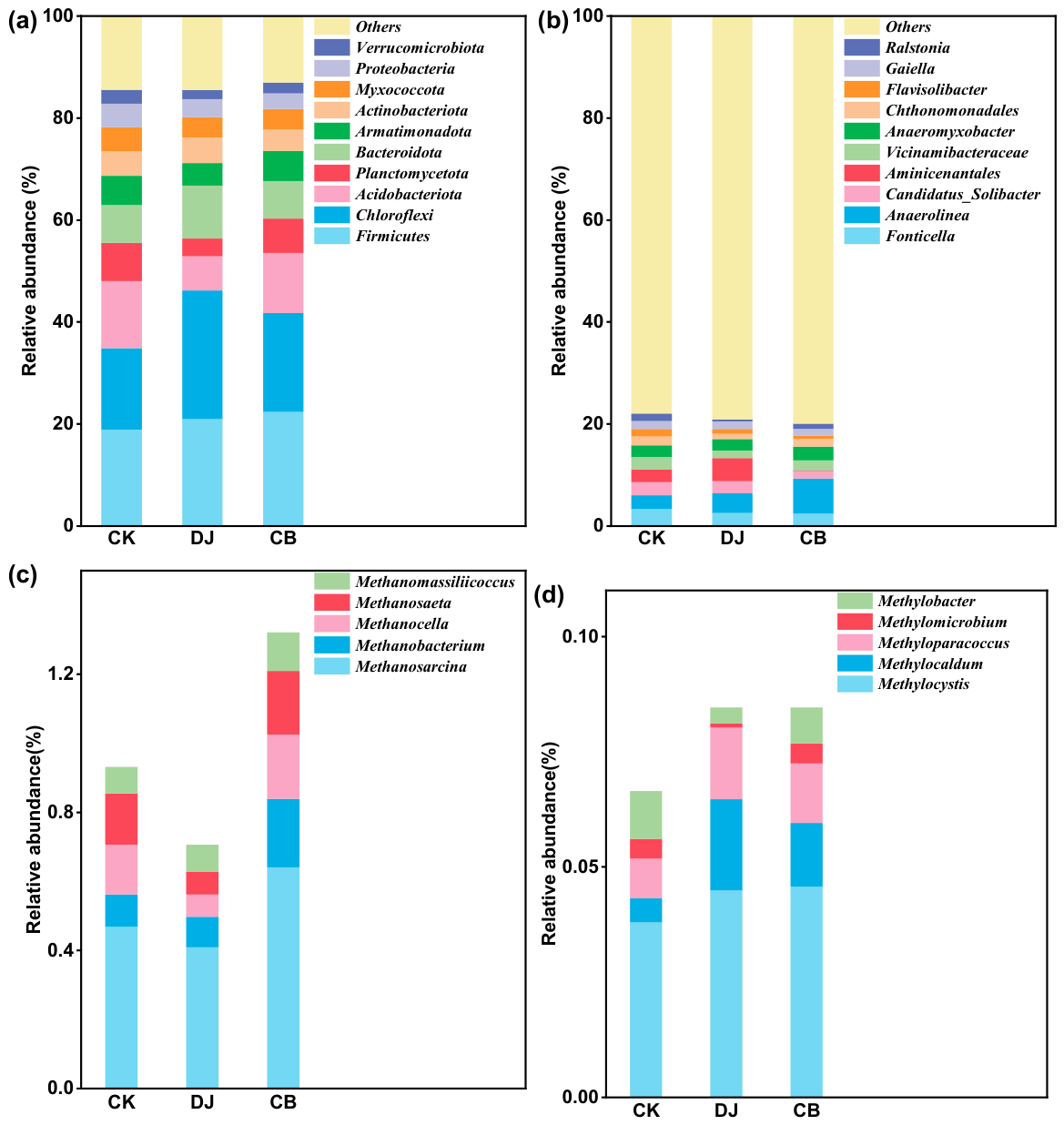
High-throughput sequencing was performed to evaluate the effects of DJ and CB amendments on microbial richness, diversity, and community structure in paddy soil after 60 days of anaerobic incubation. Both DJ and CB treatments decreased the Chao1 index, observed species count, and Shannon index, with the DJ treatment showing a more pronounced decrease (Figure 3a–c). Principal component analysis (PCA) and permutational multivariate analysis of variance (p < 0.05) showed that the microbial community structures in the DJ and CB treatments were significantly separated from that of CK (Figure 3d). At the phylum level, Firmicutes, Chloroflexi, Acidobacteriota, and Planctomycetota were the dominant groups (Figure 4a). Compared with CK, the relative abundance of Firmicutes decreased in the DJ treatment but increased in the CB treatment. Chloroflexi increased in both DJ and CB treatments, with a more pronounced increase in the DJ treatment. Acidobacteriota decreased in the DJ treatment but increased in the CB treatment. At the genus level, the dominant genera included Fonticella, Anaerolinea, Candidatus_Solibacter, and Aminicenantales (Figure 4b). The CB treatment increased the relative abundance of Fonticella compared with CK, whereas the DJ treatment increased the relative abundance of Anaerolinea.

3.4. Effects of DJ and CB Amendments on Methanogenic and Methanotrophic Communities and Functional Genes

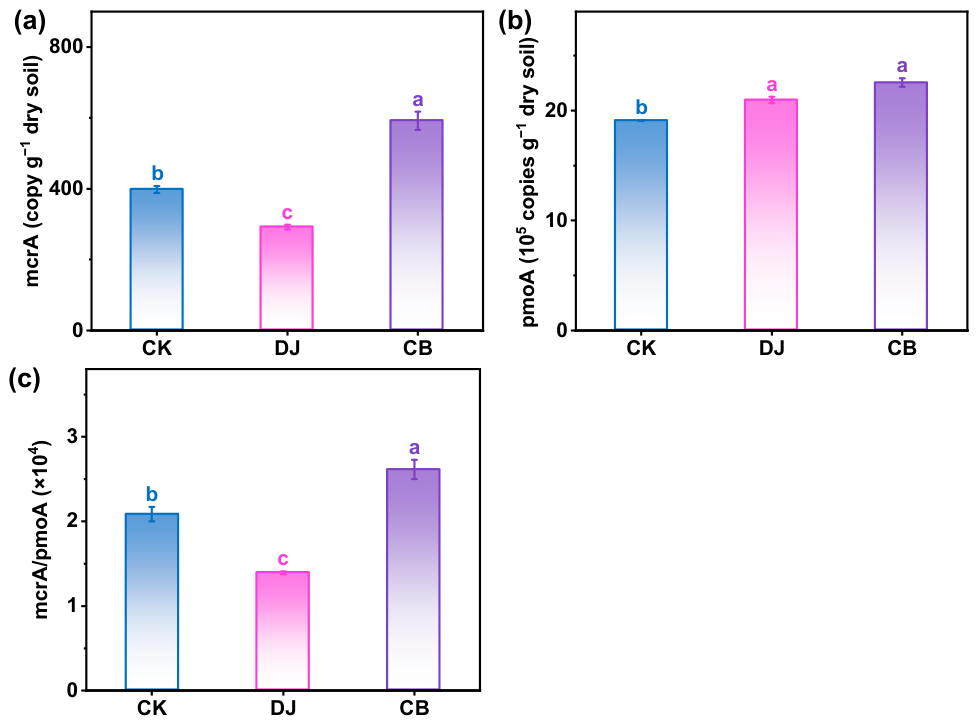
The effects of DJ and CB amendments on methane-cycling microbial communities and functional genes are shown in Figure 4c,d and Figure 5. At the genus level, the detected methanogens mainly included Methanosarcina, Methanobacterium, Methanocella, Methanosaeta, and Methanomassiliicoccus (Figure 4c). Compared with CK, the CB amendment increased the overall relative abundance of methanogens by 24.2%, whereas the DJ amendment decreased it by 42.0%. Among these genera, Methanosarcina, Methanobacterium, Methanocella, and Methanosaeta showed higher relative abundance under CB treatment but lower relative abundance under DJ treatment. In contrast, the relative abundance of methanotrophs increased by approximately 27% in both DJ and CB treatments compared with CK (Figure 4d). The dominant methanotrophic genera included Methylocystis, Methylocaldum, Methyloparacoccus, Methylomicrobium, and Methylobacter. The qPCR analysis further showed that the abundance of mcrA increased by 48.7% in the CB treatment but decreased by 26.9% in the DJ treatment (Figure 5a). The abundance of pmoA increased by approximately 18.1% and 9.8% in the CB and DJ treatments, respectively (Figure 5b). The mcrA/pmoA ratio increased in the CB treatment but decreased in the DJ treatment compared with CK (Figure 5c).

4. Discussion

4.1. Greenhouse Gas Emission and Soil Physicochemical Responses to Soil Amendments

The present study showed that soil amendments distinctly altered CH4 and CO2 emissions from anaerobic paddy soil microcosms. Among the five amendments tested, the two commercial microbial inoculants induced the most pronounced but opposite response in CH4 production. DJ significantly reduced cumulative CH4 emissions and methane production potential, whereas CB shown the significant increase in cumulative CH4 emissions, maximum methane production potential, and methane production rate. The BC, HA, and NM treatments also increased CH4 emissions, but their effects were more moderate than that of CB. In addition, most amendments increased cumulative CO2 emissions, with CB showing the enhancement. These results indicate that different soil amendments affected anaerobic carbon transformation in paddy soil to different extents, with DJ and CB representing two contrasting patterns of methane suppression and stimulation.
The amendments also induced distinct soil physicochemical responses, as reflected by changes in acetate concentration, pH, and EC. Acetate is a critical substrate for microbial anaerobic methane production [33]. The early peak in acetate concentration may have resulted from the rapid decomposition of abundant organic matter during the initial stage of anaerobic incubation. The decrease in acetate concentration in the CB treatment from day 7 to day 60 suggested enhanced acetate consumption under anaerobic conditions, which was consistent with methane and carbon dioxide production [33]. The increase in soil pH under DJ treatment may have contributed to the reduction in methane emissions, as most methanogens in paddy soil have an optimal pH close to neutrality [34]. In addition, the elevated EC observed in the DJ treatment may be attributed to its microbial composition, including Bacillus subtilis, Bacillus licheniformis, Bacillus megaterium, Bacillus amyloliquefaciens, and Trichoderma harzianum. Previous studies have reported that these microorganisms can secrete organic acids, such as citric and gluconic acids, which promote the dissolution and weathering of soil minerals and release additional cations, thereby increasing EC [35].

4.2. Microbial Community Restructuring Associated with Carbon Transformation

The decreases in the Chao1 index, observed species count, and Shannon index suggest that DJ and CB amendments altered the soil microbial community, thereby reducing overall species richness and diversity [36]. The PCA results further showed that the microbial community structures under DJ and CB treatments were clearly separated from that under CK, suggesting shifts in the overall community composition of paddy soil. The phylum-level changes also suggest that these amendments may be associated with differences in microbial processes related to carbon transformation. Firmicutes are commonly involved in the anaerobic degradation of complex organic matter, producing simpler compounds such as acetate, H2, and CO2, which may serve as substrates or intermediates for methanogenic processes [37]. Therefore, the increased relative abundance of Firmicutes under CB treatment was consistent with the enhanced CH4 and CO2 emissions observed in this treatment (Figure 1). The enrichment of Chloroflexi in both DJ and CB treatments may be related to complex organic matter degradation, and CO2 production, rather than directly indicating methane production [38]. Acidobacteriota are also involved in organic matter decomposition and carbon cycling by breaking down complex compounds into simpler molecules such as acetate, which may be related to the different acetate patterns observed between DJ and CB treatments [38]. At the genus level, the increased relative abundance of Fonticella under CB treatment may indicate enhanced anaerobic fermentation and acetate formation, potentially thereby providing more substrates for methanogens [39]. In contrast, DJ treatment increased the relative abundance of Anaerolinea, which is primarily involved in the degradation of complex organic compounds, although direct evidence linking this genus to methanogenesis remains limited [40,41]. Furthermore, the relative abundance of Candidatus Solibacter, a member of the Acidobacteriota, increased in CB-treated soils but decreased in DJ-treated soils, consistent with the phylum-level trend of Acidobacteriota [42]. In addition, Aminicenantales are known to participate in anaerobic degradation of complex organic matter and the production of short-chain fatty acids that can serve as substrates for methanogens [43]. Previous studies have also shown that Aminicenantales can establish metabolic networks with syntrophic bacteria and methanogens, potentially facilitating the conversion of organic matter into methane [44]. Overall, these results suggest that DJ and CB amendments reshaped the soil microbial community in different ways, which may be linked to their contrasting effects on methane emissions.

4.3. Microbial Methane-Cycling Responses

Microbial communities involved in methane cycling showed changes consistent with the contrasting CH4 emission. Methanosarcina plays an important role in acetoclastic and methylotrophic methanogenesis in paddy soils and can use substrates such as acetate and methylated compounds for methane production [45,46]. Methanobacterium and Methanocella are hydrogenotrophic methanogens that use H2 to reduce CO2 to CH4 [47,48], whereas Methanosaeta is an acetoclastic methanogen that metabolizes acetate to CH4 and CO2 [49,50]. Therefore, the enrichment of these methanogenic groups under CB treatment was consistent with the acetate dynamics and increased CH4 emissions, while their decrease under DJ treatment was consistent with reduced methane production. Methanotrophs are capable of oxidizing CH4 to CO2 and therefore play an important role in methane consumption [51].
The increased abundance of methanotrophs in both DJ and CB treatments suggests that methane oxidation potential also have increased, which might partly be related to the observed CO2 emissions. Among the methanotrophs, Methylocystis was dominant genus and is classified as a type II methanotrophs, which can survive under low-oxygen conditions and utilize CH4 and acetate as substrates [52,53]. The observed increase in abundance of Methylocystis under CB and DJ treatments suggests that these amendments may have provided conditions favorable for its growth and potential methane oxidation [54,55]. Type I methanotrophs generally respond to high methane concentrations and oxygenated microenvironments [56,57]. The enrichment of Methylocaldum and Methyloparacoccus under the CB amendment might be associated with increased methane availability, which could provide more substrates for these methanotrophs and potentially be linked to the elevated CO2 emissions through enhanced methane oxidation.
The qPCR results for functional genes involved in methane cycling further supported the observed shifts in methane production and oxidation potential. The mcrA gene encodes methyl-coenzyme M reductase, which is involved in the final step of methane production and is widely used as a functional marker of methanogenic potential [58,59,60,61,62]. The abundance of mcrA increased under CB treatment but decreased under DJ treatment, consistent with the changes in methanogen abundance and CH4 emissions. The pmoA gene encodes particulate methane monooxygenase, a key enzyme involved in the initial oxidation of methane to methanol [63,64]. The increase in pmoA abundance under both CB and DJ treatments suggests an increase in methane oxidation potential, which was consistent with the increased abundance of methanotrophs [65]. The mcrA/pmoA ratio further provided an indicator of the relative balance between methane production and methane oxidation [66]. The increased mcrA/pmoA ratio under CB treatment indicates a shift toward high methane production potential, whereas the decreased ratio under DJ treatment suggests a relatively lower methane production potential.

4.4. Environmental Implications and Limitations

These findings indicate that soil amendments can markedly regulate methane emissions from anaerobic paddy soils by altering soil physicochemical properties, microbial community structure, and microbial methane cycling. The contrasting effects of DJ and CB inoculants further suggest that microbial inoculants should be carefully evaluated before agricultural application, because different formulations may have opposite effects on methane mitigation. DJ showed potential for reducing CH4 emissions, whereas CB may increase the risk of greenhouse gas emissions under flooded soil conditions. However, this study was conducted using a controlled microcosm incubation system, which cannot fully represent the complex hydrological conditions, plant effects, and seasonal variations in field paddy soils. Therefore, future studies should validate these amendment effects under field conditions and evaluate their long-term impacts on methane emissions, soil fertility, and rice productivity.

5. Conclusions

This study demonstrated that soil amendments had distinct effects on greenhouse gas emissions from anaerobic paddy soil, with microbial inoculants showing greater effects than biochar, humic acid, and montmorillonite. Among the tested amendments, DJ markedly reduced cumulative CH4 emissions by 57.1%, whereas CB increased CH4 emissions by 100.8% and also caused the greatest increase in CO2 emissions. The contrasting effects of these two microbial inoculants were associated with changes in soil physicochemical properties and microbial methane cycling. CB was associated with changes in acetate dynamics, enriched methanogenic taxa, such as Methanosarcina, Methanobacterium, Methanocella, and Methanosaeta, and increased the abundance of the methanogenesis marker gene mcrA, suggesting enhanced acetoclastic and hydrogenotrophic methanogenesis. In contrast, DJ decreased methanogen abundance and mcrA abundance, indicating suppressed methanogenic potential. Although both DJ and CB increased relative abundance of methanotrophic taxa, including Methylocystis, Methylocaldum, and Methyloparacoccus, as well as pmoA abundance, which may be associated with the elevated CO2 emissions through methane oxidation, the increase in CH4 emissions under CB treatment suggests that the net methane response was mainly driven by enhanced methanogenic activity rather than methane oxidation potential. Overall, these findings indicate that microbial inoculants can regulate methane emissions from paddy soils in opposite directions depending on their effects on soil properties, microbial community structure, and the balance between methane production and oxidation. Future field experiments are needed to examine whether the amendment-induced shifts in methane-cycling microorganisms and CH4 emissions can be sustained throughout rice cultivation.

Supplementary Materials

The following supporting information can be downloaded at: https://www.mdpi.com/article/10.3390/biology15110883/s1, Figure S1: Schematic diagram of the soil microcosm incubation experiment. Headspace gas samples were collected using a gas-tight syringe on days 2, 4, 6, 8, 9, 10, 12, 13, 14, 16, 18, 19, 20, 22, 23, 24, 27, 30, 33, 37, 41, 45, 50, 53, and 60, and subsequently analyzed by gas chromatography to determine CH4 and CO2 concentrations.

Author Contributions

Conceptualization, Y.W.; Methodology, D.D., W.L. and Y.W.; Software, Q.W. and D.D.; Formal analysis, D.D., W.L. and Y.L.; Investigation, D.D., W.L. and Y.W.; Resources, Y.W.; Data curation, Q.W., D.D., Y.Z. (Yuwen Zhang) and Y.L.; Writing—original draft, D.D.; Writing—review and editing, Q.W., Y.Z. (Yaping Zhang) and Y.W.; Supervision, Y.W.; Project administration, Y.W.; Funding acquisition, Y.Z. (Yaping Zhang) and Y.W. All authors have read and agreed to the published version of the manuscript.

Funding

This work was supported by the National Natural Science Foundation of China (42377242, 41907122 and 42177229), the Science and Technology Program of Guangzhou, China (202102020788 and 2025A04J5265) and the Guangdong Natural Science Foundation-Outstanding Youth Team Project (2023B1515040022).

Institutional Review Board Statement

Not applicable.

Informed Consent Statement

Not applicable.

Data Availability Statement

Data will be made available upon request.

Conflicts of Interest

The authors declare that they have no known competing financial interests or personal relationships that could have influenced the work reported in this study.

References

  1. Jin, Y.; Liu, T.; Hu, J.; Sun, K.; Xue, L.; Bettembourg, M.; Bedada, G.; Hou, P.; Hao, P.; Tang, J.; et al. Reducing methane emissions by developing low-fumarate high-ethanol eco-friendly rice. Mol. Plant 2025, 18, 333–349. [Google Scholar] [CrossRef] [PubMed]
  2. Kwon, Y.; Jin, Y.; Lee, J.-H.; Sun, C.; Ryu, C.-M. Rice rhizobiome engineering for climate change mitigation. Trends Plant Sci. 2024, 29, 1299–1309. [Google Scholar] [CrossRef]
  3. Sakai, S.; Imachi, H.; Sekiguchi, Y.; Ohashi, A.; Harada, H.; Kamagata, Y. Isolation of Key Methanogens for Global Methane Emission from Rice Paddy Fields: A Novel Isolate Affiliated with the Clone Cluster Rice Cluster I. Appl. Environ. Microbiol. 2007, 73, 4326–4331. [Google Scholar] [CrossRef]
  4. Guérin, F.; Abril, G.; de Junet, A.; Bonnet, M.-P. Anaerobic decomposition of tropical soils and plant material: Implication for the CO2 and CH4 budget of the Petit Saut Reservoir. Appl. Geochem. 2008, 23, 2272–2283. [Google Scholar] [CrossRef]
  5. Liu, Z.; Mao, X.; Wu, Y.; Xia, L.; Yu, H.; Tang, W.; Qi, Y.; Zhang, Z.; Xiao, F.; Ji, H. Methanogenic community characteristics and its influencing factors in reservoir sediments on the northeastern Qinghai Plateau. Biology 2024, 13, 615. [Google Scholar] [CrossRef]
  6. Huang, H.; Wang, Z.; Ma, Y.; Zhu, P.; Zhang, X.; Chen, H.; Li, H.; Zheng, R. The impact of rice–frog co-cultivation on greenhouse gas emissions of reclaimed paddy fields. Biology 2025, 14, 861. [Google Scholar] [CrossRef]
  7. Abubaker, J.; Cederlund, H.; Arthurson, V.; Pell, M. Bacterial community structure and microbial activity in different soils amended with biogas residues and cattle slurry. Appl. Soil Ecol. 2013, 72, 171–180. [Google Scholar] [CrossRef]
  8. Cui, H.; Zhu, H.; Zhang, F.-M.; Wang, X.-Y.; Hou, S.-N.; Feng, W.-D. Soil amendments reduce CH4 and CO2 but increase N2O and NH3 emissions in saline-alkali paddy fields. Sci. Total Environ. 2024, 924, 171673. [Google Scholar] [CrossRef]
  9. Wang, N.; Chang, Z.-Z.; Xue, X.-M.; Yu, J.-G.; Shi, X.-X.; Ma, L.Q.; Li, H.-B. Biochar decreases nitrogen oxide and enhances methane emissions via altering microbial community composition of anaerobic paddy soil. Sci. Total Environ. 2017, 581–582, 689–696. [Google Scholar] [CrossRef] [PubMed]
  10. Johnson, J.M.; Radanielson, A.M.; Saito, K. Climate change mitigation in rice fields: A global synthesis of agronomic interventions. J. Environ. Manag. 2026, 404, 129365. [Google Scholar] [CrossRef]
  11. Iqbal, A.; Tang, X.; Ali, I.; Yuan, P.; Khan, R.; Khan, Z.; Adnan, M.; Wei, S.; Jiang, L. Integrating low levels of organic fertilizer improves soil fertility and rice yields in paddy fields by influencing microbial communities without increasing CH4 emissions. Appl. Soil Ecol. 2023, 189, 104951. [Google Scholar] [CrossRef]
  12. Wang, L.; Qin, T.; Liu, T.; Guo, L.; Li, C.; Zhai, Z. Inclusion of microbial inoculants with straw mulch enhances grain yields from rice fields in central China. Food Energy Secur. 2020, 9, e230. [Google Scholar] [CrossRef]
  13. Hou, P.; Xue, L.; Wang, J.; Petropoulos, E.; Deng, X.; Qiao, J.; Xue, L.; Yang, L. Continuous milk vetch amendment in rice-fallow rotation improves soil fertility and maintains rice yield without increasing CH4 emissions: Evidence from a long-term experiment. Agric. Ecosyst. Environ. 2022, 325, 107774. [Google Scholar] [CrossRef]
  14. Li, Q.; Cui, K.; Lv, J.; Zhang, J.; Peng, C.; Li, Y.; Gu, Z.; Song, X. Biochar amendments increase soil organic carbon storage and decrease global warming potentials of soil CH4 and N2O under N addition in a subtropical Moso bamboo plantation. For. Ecosyst. 2022, 9, 100054. [Google Scholar] [CrossRef]
  15. Garbowski, T.; Bar-Michalczyk, D.; Charazińska, S.; Grabowska-Polanowska, B.; Kowalczyk, A.; Lochyński, P. An overview of natural soil amendments in agriculture. Soil Tillage Res. 2023, 225, 105462. [Google Scholar] [CrossRef]
  16. Agegnehu, G.; Nelson, P.N.; Bird, M.I. Crop yield, plant nutrient uptake and soil physicochemical properties under organic soil amendments and nitrogen fertilization on Nitisols. Soil Tillage Res. 2016, 160, 1–13. [Google Scholar] [CrossRef]
  17. Rieder, S.; Conen, F.; Krauss, M. Microbial inoculant has little effect on greenhouse gas emissions following cover crop incorporation. Agric. Ecosyst. Environ. 2025, 379, 109332. [Google Scholar] [CrossRef]
  18. Du, S.; Chen, P.; Lin, G.; Zhang, Z.; Song, J.; Guan, S.; Han, Y.; Deng, M.; Liu, M.; Qi, Z.; et al. Controlled irrigation and straw-decomposing microbial inoculant mitigate CH4 emissions and increase rice yield in straw return mollisols of paddy fields. Agric. Water Manag. 2026, 327, 110269. [Google Scholar] [CrossRef]
  19. Valenzuela, E.I.; Cervantes, F.J. The role of humic substances in mitigating greenhouse gases emissions: Current knowledge and research gaps. Sci. Total Environ. 2021, 750, 141677. [Google Scholar] [CrossRef]
  20. Fan, Z.; Wu, J.; Li, R.; Li, H.; Xu, Y. Co-application of organic fertilizer and biochar ameliorates the triple composite pollution of microplastics, antibiotic resistance genes, and heavy metals in soil. J. Hazard. Mater. 2026, 506, 141520. [Google Scholar] [CrossRef] [PubMed]
  21. Zhang, C.; Zeng, G.; Huang, D.; Lai, C.; Chen, M.; Cheng, M.; Tang, W.; Tang, L.; Dong, H.; Huang, B.; et al. Biochar for environmental management: Mitigating greenhouse gas emissions, contaminant treatment, and potential negative impacts. Chem. Eng. J. 2019, 373, 902–922. [Google Scholar] [CrossRef]
  22. Xu, Y.; Liang, X.; Xu, Y.; Qin, X.; Huang, Q.; Wang, L.; Sun, Y. Remediation of Heavy Metal-Polluted Agricultural Soils Using Clay Minerals: A Review. Pedosphere 2017, 27, 193–204. [Google Scholar] [CrossRef]
  23. Du, X.; Guang, W.; Cheng, Y.; Hou, Z.; Liu, Z.; Yin, H.; Huo, L.; Lei, R.; Shu, C. Thermodynamics analysis of the adsorption of CH4 and CO2 on montmorillonite. Appl. Clay Sci. 2020, 192, 105631. [Google Scholar] [CrossRef]
  24. Ji, M.Y.; Xiao, L.R.; Usman, M.; Liu, C.; Sang, W.J.; Treu, L.; Campanaro, S.; Luo, G.; Zhang, Y.L. Different microplastics in anaerobic paddy soils: Altering methane emissions by influencing organic matter composition and microbial metabolic pathways. Chem. Eng. J. 2023, 469, 144003. [Google Scholar] [CrossRef]
  25. Ren, S.; Usman, M.; Tsang, D.C.W.; O-Thong, S.; Angelidaki, I.; Zhu, X.; Zhang, S.; Luo, G. Hydrochar-Facilitated Anaerobic Digestion: Evidence for Direct Interspecies Electron Transfer Mediated through Surface Oxygen-Containing Functional Groups. Environ. Sci. Technol. 2020, 54, 5755–5766. [Google Scholar] [CrossRef]
  26. Peiffer, J.A.; Spor, A.; Koren, O.; Jin, Z.; Tringe, S.G.; Dangl, J.L.; Buckler, E.S.; Ley, R.E. Diversity and heritability of the maize rhizosphere microbiome under field conditions. Proc. Natl. Acad. Sci. USA 2013, 110, 6548–6553. [Google Scholar] [CrossRef]
  27. He, C.; Zhang, B.; Yan, W.; Ding, D.; Guo, J. Enhanced Microbial Chromate Reduction Using Hydrogen and Methane as Joint Electron Donors. J. Hazard. Mater. 2020, 395, 122684. [Google Scholar] [CrossRef] [PubMed]
  28. Yu, X.; Yang, X.; Wu, Y.; Peng, Y.; Yang, T.; Xiao, F.; Zhong, Q.; Xu, K.; Shu, L.; He, Q.; et al. Sonneratia apetala introduction alters methane cycling microbial communities and increases methane emissions in mangrove ecosystems. Soil Biol. Biochem. 2020, 144, 107775. [Google Scholar] [CrossRef]
  29. Kim, J.; Yoo, G.; Kim, D.; Ding, W.; Kang, H. Combined application of biochar and slow-release fertilizer reduces methane emission but enhances rice yield by different mechanisms. Appl. Soil Ecol. 2017, 117–118, 57–62. [Google Scholar] [CrossRef]
  30. Holmes, A.J.; Costello, A.; Lidstrom, M.E.; Murrell, J.C. Evidence that participate methane monooxygenase and ammonia monooxygenase may be evolutionarily related. FEMS Microbiol. Lett. 1995, 132, 203–208. [Google Scholar] [CrossRef]
  31. Zhang, Y.; Wu, X.H.; Chen, C.J.; Xu, J.; Dong, F.S.; Liu, X.A.; Li, X.G.; Zheng, Y.Q. Application of thifluzamide alters microbial network structure and affects methane cycle genes in rice-paddy soil. Sci. Total Environ. 2022, 838, 155769. [Google Scholar] [CrossRef] [PubMed]
  32. Peng, W.; Lu, J.; Kuang, J.; Tang, R.; Guan, F.; Xie, K.; Zhou, L.; Yuan, Y. Enhancement of hydrogenotrophic methanogenesis for methane production by nano zero-valent iron in soils. Environ. Res. 2024, 247, 118232. [Google Scholar] [CrossRef]
  33. Lu, J.R.; Hou, R.; Peng, W.J.; Guan, F.Y.; Yuan, Y. Responses of methane production and methanogenic pathways to polystyrene nanoplastics exposure in paddy soil. J. Hazard. Mater. 2024, 465, 133197. [Google Scholar] [CrossRef]
  34. Baldwin, D.S.; Rees, G.N.; Mitchell, A.M.; Watson, G.; Williams, J. The short-term effects of salinization on anaerobic nutrient cycling and microbial community structure in sediment from a freshwater wetland. Wetlands 2006, 26, 455–464. [Google Scholar] [CrossRef]
  35. Sharma, S.B.; Sayyed, R.Z.; Trivedi, M.H.; Gobi, T.A. Phosphate solubilizing microbes: Sustainable approach for managing phosphorus deficiency in agricultural soils. SpringerPlus 2013, 2, 587. [Google Scholar] [CrossRef]
  36. Chen, Y.; Chen, F.F.; Xie, M.D.; Jiang, Q.Q.; Chen, W.Q.; Ao, T.Q. The impact of stabilizing amendments on the microbial community and metabolism in cadmium-contaminated paddy soils. Chem. Eng. J. 2020, 395, 125132. [Google Scholar] [CrossRef]
  37. Huang, J.; Gao, K.; Yang, L.; Lu, Y. Successional action of Bacteroidota and Firmicutes in decomposing straw polymers in a paddy soil. Environ. Microbiome 2023, 18, 76. [Google Scholar] [CrossRef] [PubMed]
  38. Wegner, C.E.; Liesack, W. Microbial community dynamics during the early stages of plant polymer breakdown in paddy soil. Environ. Microbiol. 2016, 18, 2825–2842. [Google Scholar] [CrossRef]
  39. Wu, Y.; Zhu, Z.; Sun, P.; Zhao, Z.; Zheng, X.; Long, M.; Chen, Y. Enhanced short-chain fatty acids production from food waste with magnetic biochar via anaerobic fermentation: Linking interfacial, extracellular, and intracellular electron transfer. Chem. Eng. J. 2024, 488, 150853. [Google Scholar] [CrossRef]
  40. Bovio-Winkler, P.; Cabezas, A.; Etchebehere, C. Unveiling the hidden diversity and functional role of Chloroflexota in full-scale wastewater treatment plants through genome-centric analyses. ISME Commun. 2024, 4, ycae050. [Google Scholar] [CrossRef]
  41. Liang, B.; Wang, L.Y.; Mbadinga, S.M.; Liu, J.F.; Yang, S.Z.; Gu, J.D.; Mu, B.Z. Anaerolineaceae and Methanosaeta turned to be the dominant microorganisms in alkanes-dependent methanogenic culture after long-term of incubation. AMB Express 2015, 5, 117. [Google Scholar] [CrossRef]
  42. Flieder, M.; Buongiorno, J.; Herbold, C.W.; Hausmann, B.; Rattei, T.; Lloyd, K.G.; Loy, A.; Wasmund, K. Novel taxa of Acidobacteriota implicated in seafloor sulfur cycling. ISME J. 2021, 15, 3159–3180. [Google Scholar] [CrossRef]
  43. Cheng, B.Y.; Wang, Y.Y.; Zhang, D.; Wu, D.; Zan, F.X.; Ma, J.; Miao, L.; Wang, Z.P.; Chen, G.H.; Guo, G. Thiosulfate pretreatment enhancing short-chain fatty acids production from anaerobic fermentation of waste activated sludge: Performance, metabolic activity and microbial community. Water Res. 2023, 238, 120013. [Google Scholar] [CrossRef]
  44. Li, D.; Ping, Q.; Guo, W.; Chen, Y.; Wang, L.; Li, Y.J.C. Evaluating effects of biochar on anaerobic digestion of dewatered waste activated sludge: Digester performance, microbial co-metabolism and underlying mechanism. Chemosphere 2023, 341, 140139. [Google Scholar] [CrossRef] [PubMed]
  45. Li, X.; Bei, Q.; Rabiei Nematabad, M.; Peng, J.; Liesack, W. Time-shifted expression of acetoclastic and methylotrophic methanogenesis by a single Methanosarcina genomospecies predominates the methanogen dynamics in Philippine rice field soil. Microbiome 2024, 12, 39. [Google Scholar] [CrossRef]
  46. Angel, R.; Claus, P.; Conrad, R. Methanogenic archaea are globally ubiquitous in aerated soils and become active under wet anoxic conditions. ISME J. 2012, 6, 847–862. [Google Scholar] [CrossRef] [PubMed]
  47. Lü, Z.; Lu, Y. Methanocella conradii sp. nov., a thermophilic, obligate hydrogenotrophic methanogen, isolated from Chinese rice field soil. PLoS ONE 2012, 7, e35279. [Google Scholar] [CrossRef]
  48. Buan, N.R. Methanogens: Pushing the boundaries of biology. Emerg. Top. Life Sci. 2018, 2, 629–646. [Google Scholar] [CrossRef]
  49. Mizukami, S.; Takeda, K.; Akada, S.; Fujita, T. Isolation and Characteristics of Methanosaeta in Paddy Field Soils. Biosci. Biotechnol. Biochem. 2006, 70, 828–835. [Google Scholar] [CrossRef] [PubMed][Green Version]
  50. Narayanan, N.; Krishnakumar, B.; Anupama, V.N.; Manilal, V.B.J.R.i.m. Methanosaeta sp., the major archaeal endosymbiont of Metopus es. Res. Microbiol. 2009, 160, 600–607. [Google Scholar] [CrossRef]
  51. Jiang, H.; Chen, Y.; Jiang, P.; Zhang, C.; Smith, T.J.; Murrell, J.C.; Xing, X.-H. Methanotrophs: Multifunctional bacteria with promising applications in environmental bioengineering. Biochem. Eng. J. 2010, 49, 277–288. [Google Scholar] [CrossRef]
  52. Das, S.; Jena, S.N.; Bhuiyan, M.S.I.; Kim, G.W.; Kim, P.J. Mechanism of slag-based silicate fertilizer suppressing methane emissions from paddies. J. Clean. Prod. 2022, 373, 133799. [Google Scholar] [CrossRef]
  53. Bordel, S.; Rodríguez, Y.; Hakobyan, A.; Rodríguez, E.; Lebrero, R.; Muñoz, R. Genome scale metabolic modeling reveals the metabolic potential of three Type II methanotrophs of the genus Methylocystis. Metab. Eng. 2019, 54, 191–199. [Google Scholar] [CrossRef]
  54. Zhao, Y.; Liu, Y.; Cao, S.; Hao, Q.; Liu, C.; Li, Y. Anaerobic oxidation of methane driven by different electron acceptors: A review. Sci. Total Environ. 2024, 946, 174287. [Google Scholar] [CrossRef]
  55. Yang, R.; Peng, C.; Mo, Y.; Kleindienst, S.; Li, S.; Wang, J.; Kappler, A.; Wang, Z.; Lu, L. Electron acceptors modulate methane oxidation and active methanotrophic communities in anoxic urban wetland sediments. Appl. Environ. Microbiol. 2025, 91, e00386-25. [Google Scholar] [CrossRef]
  56. Hanson, R.S.; Hanson, T.E. Methanotrophic bacteria. Microbiol. Rev. 1996, 60, 439–471. [Google Scholar] [CrossRef] [PubMed]
  57. Duan, Y.F.; Reinsch, S.; Ambus, P.; Elsgaard, L.; Petersen, S.O. Activity of type I methanotrophs dominates under high methane concentration: Methanotrophic activity in slurry surface crusts as influenced by methane, oxygen, and inorganic nitrogen. J. Environ. Qual. 2017, 46, 767–775. [Google Scholar] [CrossRef] [PubMed]
  58. Sharma, R.; Ryan, K.; Hao, X.; Larney, F.J.; McAllister, T.A.; Topp, E. Real-Time Quantification of mcrA, pmoA for Methanogen, Methanotroph Estimations during Composting. J. Environ. Qual. 2011, 40, 199–205. [Google Scholar] [CrossRef]
  59. Thauer, R.K.; Kaster, A.-K.; Seedorf, H.; Buckel, W.; Hedderich, R. Methanogenic archaea: Ecologically relevant differences in energy conservation. Nat. Rev. Microbiol. 2008, 6, 579–591. [Google Scholar] [CrossRef]
  60. Hua, Z.-S.; Wang, Y.-L.; Evans, P.N.; Qu, Y.-N.; Goh, K.M.; Rao, Y.-Z.; Qi, Y.-L.; Li, Y.-X.; Huang, M.-J.; Jiao, J.-Y.; et al. Insights into the ecological roles and evolution of methyl-coenzyme M reductase-containing hot spring Archaea. Nat. Commun. 2019, 10, 4574. [Google Scholar] [CrossRef]
  61. Timmers, P.H.A.; Welte, C.U.; Koehorst, J.J.; Plugge, C.M.; Jetten, M.S.M.; Stams, A.J.M. Reverse Methanogenesis and Respiration in Methanotrophic Archaea. Archaea 2017, 2017, 1654237. [Google Scholar] [CrossRef]
  62. Chen, H.; Gan, Q.; Fan, C. Methyl-Coenzyme M Reductase and Its Post-translational Modifications. Front. Microbiol. 2020, 11, 578356. [Google Scholar] [CrossRef] [PubMed]
  63. Cai, Y.; Zheng, Y.; Bodelier, P.L.E.; Conrad, R.; Jia, Z. Conventional methanotrophs are responsible for atmospheric methane oxidation in paddy soils. Nat. Commun. 2016, 7, 11728. [Google Scholar] [CrossRef] [PubMed]
  64. Lawton, T.J.; Rosenzweig, A.C. Methane-Oxidizing Enzymes: An Upstream Problem in Biological Gas-to-Liquids Conversion. J. Am. Chem. Soc. 2016, 138, 9327–9340. [Google Scholar] [CrossRef] [PubMed]
  65. Qi, Z.-w.; Wang, L.; Guan, J.; Zhang, B.; Wang, L.; Feng, C.-c.; Wang, D.; Zhang, Y. Phycosphere microbial assembly reinforces microalgae-driven soil organic carbon sequestration and methane mitigation in black soil paddies. J. Clean. Prod. 2026, 560, 148208. [Google Scholar] [CrossRef]
  66. Narengerile, A.; Deng, A.; Dong, W.; Raheem, A.; Li, J.; Wang, S.; Shang, Z.; Chen, Z.; Song, H.; Zhang, J. Integrated effects of aerobic tillage and controlled irrigation on rice yield and greenhouse gas emissions in a high-latitude rice growing region. Crop J. 2026, in press. [Google Scholar] [CrossRef]
Figure 1. Cumulative CH4 (a) and CO2 (b) emissions from paddy soil over 60 days of anaerobic incubation under various soil amendments. Data are presented as means ± SD (n = 4). Significant differences between treatments are indicated by asterisks (* p < 0.05; ** p < 0.01; *** p < 0.001).
Biology 15 00883 g001
Figure 2. Changes in acetate concentrations (a), pH (b) and EC (c) in paddy soil under various soil amendments after 60 days of anaerobic incubation. Data are presented as means ± SD (n = 4). Different lowercase letters denote significant differences among treatments (p < 0.05).
Biology 15 00883 g002
Figure 3. Bacterial community structure in paddy soil under DJ and CB amendments. Chao1 index (a), Observed species (b), Shannon index (c) and principal component analysis (PCA), constructed from the Bray–Curtis difference matrix, showing differences in bacterial communities between treatments (d). Data are presented as means ± SD (n = 4). Different lowercase letters denote significant differences among treatments (p < 0.05).
Biology 15 00883 g003aBiology 15 00883 g003b
Figure 4. (a,b) Relative abundance of microbial communities at phylum (a) and genus (b) level in paddy soil under DJ and CB amendments compared to CK. (c,d) Relative abundance of methanogens (c) and methanotrophs (d) in paddy soil under DJ and CB amendments compared to CK.
Biology 15 00883 g004
Figure 5. (a,b) The quantity of functional genes mcrA (a) and pmoA (b) in paddy soil under DJ and CB amendments. (c) The ratio of mcrA/pmoA for paddy soil under DJ and CB amendments (c). Data are presented as means ± SD (n = 4). Different lowercase letters denote significant differences among treatments (p < 0.05).
Biology 15 00883 g005
Table 1. Summary of the kinetic parameters of methane production.
AmendmentsMethane Production
(μmol/g Soil)
Pmax
(μmol/g Soil)
Rm
(μmol/g Soil/d)
λ
(d)
R2
CK33.8 ± 0.0934.75 ± 0.891.04 ± 0.052.14 ± 0.710.989
DJ14.49 ± 0.7114.85 ± 0.210.45 ±0.011.48 ± 0.520.998
CB67.87 ± 4.7670.86 ± 3.071.91 ± 0.131.04 ± 1.170.978
BC41.00 ± 1.2642.00 ± 1.001.29 ± 0.052.87 ± 0.640.991
HA45.70 ± 0.8247.13 ± 2.041.22 ± 0.081.70 ± 1.090.981
NM42.89 ± 1.1043.06 ± 1.161.37 ± 0.094.16 ± 0.840.991
Disclaimer/Publisher’s Note: The statements, opinions and data contained in all publications are solely those of the individual author(s) and contributor(s) and not of MDPI and/or the editor(s). MDPI and/or the editor(s) disclaim responsibility for any injury to people or property resulting from any ideas, methods, instructions or products referred to in the content.