Genetic Diversity and Differentiation Pattern of Mastacembelus armatus in the Dongjiang and Ganjiang River Sources

Simple Summary
Abstract
1. Introduction
2. Materials and Methods
2.1. DNA Extraction
2.2. Sample Sequencing and Sequence Alignment
- (1)
- Reads contaminated with adapter sequences were removed;
- (2)
- Reads with an ambiguous base (N) proportion exceeding 10% were discarded;
- (3)
- Reads with over 50% of bases possessing a Phred quality value lower than Q10 were eliminated.
2.3. Variant Detection and Structural Annotation
- (1)
- The subsidiary program vcfutils.pl (varFilter -w 5 -W 10) in bcftools was used to filter SNPs within 5 bp flanking regions of InDels, as well as InDels located within 10 bp adjacent to other InDels.
- (2)
- The parameter settings of clusterSize 2 and clusterWindowSize 5 were applied, which meant that the number of variant loci within a 5 bp sliding window should not exceed 2.
- (3)
- Variants with QUAL values lower than 30 were removed. The QUAL value is a Phred-scaled quality score representing the confidence of variant existence at the corresponding locus.
- (4)
- Variants with QD values lower than 2.0 were discarded. QD refers to the ratio of variant quality score to sequencing depth, where the sequencing depth is the total coverage depth of all samples carrying variant bases at this locus.
- (5)
- Variants with MQ values lower than 40 were filtered out. MQ represents the root-mean-square mapping quality of all reads mapped to the corresponding variant locus.
- (6)
- Variants with FS values higher than 60.0 were eliminated. The FS value is converted from the p-value of Fisher’s exact test, which evaluates the significant strand bias between variant reads and reference reads during sequencing and alignment. A reliable variant without strand-specific bias should have an FS value close to zero.
- (7)
- Other variant filtering parameters followed the default official thresholds of GATK.
2.4. Population Evolutionary Analysis
2.5. Gene Enrichment Analysis and Reference Genome
3. Results
3.1. Whole-Genome Resequencing Data Analysis
3.2. SNP Detection and Statistical Annotation of Results
3.3. Detection and Result Annotation of Small Fragment Insertions and Deletions
3.4. Functional Annotation of Mutant Genes at the DNA Level
3.5. Genetic and Phylogenetic Analysis
3.6. Population Genetic Structure and Diversity Analysis
4. Discussion
5. Conclusions
Author Contributions
Funding
Institutional Review Board Statement
Informed Consent Statement
Data Availability Statement
Conflicts of Interest
References
- Chen, Y.; Zhang, L.; Lin, X.; Sheng, H.; Chen, W.; Cui, M.; Han, C.; Shu, H. Growth Performance, Digestive Capacity, and Transcriptomic Analysis of the Hybrid Offspring of Mastacembelus armatus × Mastacembelus favus. Animals 2026, 16, 11. [Google Scholar] [CrossRef]
- Lin, T.; Yang, J.; Yu, Z.; Feng, Y.; Qin, W.; Lu, B.; Cui, M.; Han, C.; Shu, H. Genetic diversity and population structure of Mastacembelus armatus in the river systems of southern China revealed by microsatellites. SN Appl. Sci. 2023, 5, 307. [Google Scholar] [CrossRef]
- Wu, B.; Wang, H.; Ma, B.; Xu, X.; Zeng, Q. Estimation of population parameters and stock assessment of Mastacembelus armatus in the Taojiang River, Xinfeng County, Jiangxi Province, China. Indian. J. Anim. Res. 2022, 56, 1047–1051. [Google Scholar]
- Yang, J.; Yu, Z.; Feng, Y.; Zhang, L.; Chen, Y.; Cai, Z.; Han, C.; Shu, H. Comparative transcriptomes and metabolome reveal heterosis in zig zag eel (Mastacembelus armatus). Aquac. Rep. 2024, 39, 102529. [Google Scholar] [CrossRef]
- Sun, D.; Wang, S.; Wang, C.; Zou, J. Transcriptomics reveals that NAD(P)H affects the development of the Zig-zag eel (Mastacembelus armatus♀)× Spiny eel (Sinobdella sinensis♂) hybrid offspring leading to low hatching rates. Anim. Reprod. Sci. 2024, 268, 107561. [Google Scholar] [CrossRef]
- Han, C.; Chen, K.; Cui, J.; Cui, M.; Shu, H. Identification of Growth-Related SNPs and Candidate Genes in the Genome of Zig-Zag Eel (Mastacembelus armatus) by GWAS. Mar. Biotechnol. 2025, 27, 129. [Google Scholar] [CrossRef]
- Luo, L.; Ji, L.; Wu, C.; Li, W.; Liu, X.; Hong, X.; Zhu, X.; Ni, Y.; Li, J.; Chen, C.; et al. Isolation and characterization of forty-two polymorphic simple sequence repeat markers from Mastacembelus armatus (Symbranchiformes: Mastacembelidae). Conserv. Genet. Resour. 2024, 16, 271–272. [Google Scholar] [CrossRef]
- Xue, L.; Gao, Y.; Zhang, S.; Weng, M.; Zeng, G.; Chen, J.; Liao, M.; Alavi, S.; Guiguen, Y. Expression pattern of the fused in sarcoma gene and its contextual influence on the density-specific response of the growth hormone/insulin-like growth factor 1 axis in zig-zag eels (Mastacembelus armatus). Front. Mar. Sci. 2024, 11, 1461451. [Google Scholar] [CrossRef]
- Zhong, D.; Zhang, M.; Lan, X.; Li, S.; Shu, H. Molecular cloning and functional characterization of growth hormone–releasing hormone in Mastacembelus armatus. Fish Physiol. Biochem. 2021, 47, 69–78. [Google Scholar] [CrossRef]
- Xue, X.; Chen, Y.; Yu, Z.; Feng, Y.; Zhang, L.; Han, C.; Yin, X.; Lu, B.; Shu, H. Effects of diet supplemented with hydrolyzable tannin on the growth performance, antioxidant capacity, and muscle nutritional quality of juvenile Mastacembelus armatus. Aquac. Nutr. 2024, 2024, 8266189. [Google Scholar] [CrossRef]
- Wang, Y.; Yang, Y.; Liu, Y.; Wu, Y.; Liang, H.; Zhou, A.; Cui, F.; Peng, J.; Jiang, Z.; Mu, X. Mitogenomic insights into the population structure and demographic history of zig-zag eels (Mastacembelus armatus) in southern China. Aquac. Rep. 2025, 42, 102748. [Google Scholar] [CrossRef]
- Alam, A.; Gopinath, G.; Jha, D.; Kumar, J.; Das, S.; Joshi, K.; Das, B.; Thakur, V.; Gupta, M. Maturity, breeding cycle, and fecundity of Mastacembelus armatus (Actinopterygii: Synbranchiformes: Mastacembelidae) in the sub-tropical waters of the river Ganga. Acta Ichthyol. Piscat. 2020, 50, 191–199. [Google Scholar] [CrossRef]
- Rashid, M.; Sagir, M.; Dobriyal, K. Age and growth analysis of the fish Mastacembelus armatus (Lacepede) from River Nayar, Garhwal Himalaya, Uttarakhand. J. Appl. Nat. Sci. 2021, 13, 137–144. [Google Scholar] [CrossRef]
- Abro, M.; Birmani, N.; Brohi, G.; Rajper, M. Detection of a pathogenic nematode from tire track eel, Mastacembelus armatus captured in the Indus River, Sindh, Pakistan. Pure Appl. Biol. (PAB) 2020, 9, 91–95. [Google Scholar] [CrossRef]
- Xue, L.; Gao, Y.; Wu, M.; Tian, T.; Fan, H.; Huang, Y.; Huang, Z.; Li, D.; Xu, L. Telomere-to-telomere assembly of a fish Y chromosome reveals the origin of a young sex chromosome pair. Genome Biol. 2021, 22, 203. [Google Scholar] [CrossRef]
- Li, H.; Durbin, R. Fast and accurate short read alignment with Burrows-Wheeler transform. Bioinformatics 2009, 25, 1754–1760. [Google Scholar] [CrossRef]
- Li, H.; Handsaker, B.; Wysoker, A.; Fennell, T.; Ruan, J.; Homer, N.; Marth, G.; Abecasis, G.; Durbin, R. The sequence alignment/map format and SAMtools. Bioinformatics 2009, 25, 2078–2079. [Google Scholar] [CrossRef] [PubMed]
- Danecek, P.; Bonfield, J.; Liddle, J.; Marshall, J.; Ohan, V.; Pollard, M.; Whitwham, A.; Keane, T.; McCarthy, S.; Davies, R.; et al. Twelve years of SAMtools and BCFtools. GigaScience 2021, 10, giab008. [Google Scholar] [CrossRef] [PubMed]
- McKenna, A.; Hanna, M.; Banks, E.; Sivachenko, A.; Cibulskis, K.; Kernytsky, A.; Garimella, K.; Altshuler, D.; Gabriel, S.; Daly, M.; et al. The genome analysis toolkit: A MapReduce ftamework for analyzing next-generation DNAsequencing data. Genome Res. 2010, 20, 1297–1303. [Google Scholar] [CrossRef]
- Wang, K.; Li, M.; Hakonarson, H. ANNOVAR: Functional annotation of genetic variants from high-throughput sequencing data. NucleiAcids Res. 2010, 38, e164. [Google Scholar] [CrossRef]
- Cingolani, P.; Platts, A.; Wang, L.L.; Coon, M.; Nguyen, T.; Wang, L.; Land, S.J.; Lu, X.; Ruden, D.M. A program for annotating and predicting the effects of single nucleotide polymorphisms, SnpEff: SNPs in the genome of Drosophila melanogaster strain w1118; iso-2; iso-3. Fly 2012, 6, 80–92. [Google Scholar] [CrossRef] [PubMed]
- Kumar, S.; Stecher, G.; Li, M.; Knyaz, C.; Tamura, K. MEGA X: Molecular Evolutionary Genetics Analysis across Computing Platforms. Mol. Biol. Evol. 2018, 35, 1547–1549. [Google Scholar] [CrossRef] [PubMed]
- Price, A.; Patterson, N.; Plenge, R.; Weinblatt, M.; Shadick, N.; Reich, D. Principal components analysis corrects for stratification in genome-wide association studies. Nat. Genet. 2006, 38, 904–909. [Google Scholar] [CrossRef]
- Alexander, D.; Novembre, J.; Lange, K. Fast model-based estimation of ancestry in unrelated individuals. Genome Res. 2009, 19, 1655–1664. [Google Scholar] [CrossRef] [PubMed]
- Yang, J.; Lee, S.; Goddard, M.; Visscher, P. GCTA: A tool for Genome-wide Complex Trait Analysis. Am. J. Hum. Genet. 2011, 88, 76–82. [Google Scholar] [CrossRef]
- Purcell, S.; Neale, B.; Todd-Brown, K.; Thomas, L.; Ferreira, M.A.R.; Bender, D.; Maller, J.; Sklar, P.; Bakker, P.; Daly, M.; et al. PLINK: A tool set for whole-genome association and population-based linkage analyses. Am. J. Hum. Genet. 2007, 81, 559–575. [Google Scholar] [CrossRef]
- Danecek, P.; Auton, A.; Abecasis, G.; Albers, C.; Banks, E.; DePristo, M.; Handsaker, R.; Lunter, G.; Marth, G.; Sherry, S.; et al. The variant call format and VCFtools. Bioinformatics 2011, 27, 2156–2158. [Google Scholar] [CrossRef]
- Cantalapiedra, C.; Hernández-Plaza, A.; Letunic, I.; Bork, P.; Huerta-Cepas, J. eggNOG-mapper v2: Functional annotation, orthology assignments, and domainprediction at the metagenomic seale. Mol. Biol. Evol. 2021, 38, 5825–5829. [Google Scholar] [CrossRef]
- Ding, R.; Yu, D.; Yang, K.; Wu, X.; Liu, H. Chromosome-Level Genome Assembly and Whole-Genome Resequencing Revealed Contrasting Population Genetic Differentiation of Black Bream (Megalobrama skolkovii) (Teleostei: Cyprinidae) Allopatric and Sympatric to Its Kin Species. Ecol. Evol. 2025, 15, e70874. [Google Scholar] [CrossRef]
- Zhou, X.; Hong, Z.; Cui, W.; Zhang, Y. Whole-Genome Resequencing Provides Novel Insights Into the Genetic Diversity, Population Structure, and Patterns of Runs of Homozygosity in Mud Crab (Scylla paramamosain). Evol. Appl. 2025, 18, e70153. [Google Scholar] [CrossRef]
- An, L.; Meng, Q.; Dong, X.; Zhu, S.; Wang, C.; Xu, X.; Feng, X.; Liu, Y.; Yan, J.; Zhang, L. Unravelling the genetic landscape of Channa argus in Shandong Province: Insights into population differentiation, adaptation and conservation from whole-genome resequencing. J. Fish Biol. 2025, 107, 1752–1764. [Google Scholar] [CrossRef]
- Wang, S.; Luo, L.; Yu, Y.; Fu, Y.; Gao, Z. Whole-genome re-sequencing reveals genetic structure and selection signals of different populations in Megalobrama mblycephala. Aquaculture 2025, 595, 741548. [Google Scholar] [CrossRef]
- He, X.; Wang, S.; Teng, W.; Li, H.; Xie, X.; Liu, S.; Li, D.; Yu, Z.; Liu, X.; Zhou, Z.; et al. Genetic diversity and differentiation of cultured and wild yesso scallop (Mizuhopecten yessoensis) from China revealed by whole genome resequencing. Aquac. Rep. 2025, 43, 102901. [Google Scholar] [CrossRef]
- Liu, C.; Wen, H.; Zhang, C.; Zhang, Y.; Wang, L.; Sun, D.; Liu, M.; Dong, Y.; Li, P.; Li, H.; et al. Deciphering the genetic basis and genomic prediction of heat tolerance trait from whole-genome resequencing in spotted sea bass (Lateolabrax maculatus). Aquaculture 2025, 598, 741951. [Google Scholar] [CrossRef]
- Wang, K.; Zhu, C.; Zhang, T.; Zhao, Y.; Ning, J.; Wang, Q.; Liu, G.; Xu, X.; Wang, C.; Lu, X. QTL mapping and candidate gene identification for lower temperature tolerance and growth traits using whole genome re-sequencing in Argopecten scallops. Aquaculture 2025, 595, 741513. [Google Scholar] [CrossRef]
- Song, H.; Li, H.; Wang, W.; Dong, T.; Yan, X.; Geng, C.; Bai, S.; Hu, H. Machine learning–assisted feature selection from whole-genome sequencing data improves trait prediction and reveals candidate genes in sturgeon. Aquaculture 2026, 618, 743830. [Google Scholar] [CrossRef]
- Yan, T.; Zheng, X.; Chang, M.; He, Z.; Li, C.; Gao, K.; Wang, X.; Wang, H.; Chen, Q.; Tang, Z.; et al. Population structure based on whole-genome resequencing and adaptive evolutionary mechanisms of circadian entrainment in the endangered fish Percocypris pingi. BMC Genom. 2026, 27, 168. [Google Scholar] [CrossRef]
- Magati, T.M.; Yang, P.; Yang, K.; Yu, D.; Liu, Q.; Wu, Y.; Deng, Q.; Ding, R.; Liu, H. Proliferation of an invasive fish in a large reservoir from the downstream evidenced by whole-genome resequencing data. Hydrobiologia 2026, 853, 3001–3017. [Google Scholar] [CrossRef]
- Young, S.; Lin, S.; Liu, M. Genetic diversity and population structure of two freshwater copepods (Copepoda: Diaptomidae), Neodiaptomus schmackeri (Poppe and Richard, 1892) and Mongolodiaptomus birulai (Rylov, 1922) from Taiwan. Diversity 2013, 5, 796–810. [Google Scholar] [CrossRef]
- Andreychev, A.; Zhalilov, A.; Kuznetsov, V. The state of local steepe woodchuck (Marmota bobak) populations in the Republic of Mordovia. Zool. Zhurnal 2015, 94, 723–730. [Google Scholar]



| Population | Latitude | Longitude | Drainage | River |
|---|---|---|---|---|
| Xunwu (XW) | 25.0085 | 115.7439 | Headwaters of the Dongjiang River | Xunshui River |
| Dingnan (DN) | 24.9129 | 115.2231 | Headwaters of the Dongjiang River | Jiuqu River |
| Xinfeng (XF) | 25.4649 | 114.9815 | Headwaters of the Ganjiang River | Taojiang River |
| Population | Bases/bp | GC Content/% | Q20/% | Q30/% | Reads | Alignment Rate/% | Sequencing Depth |
|---|---|---|---|---|---|---|---|
| XW | 70,075,162,040 | 40.23 | 97.90 | 94.36 | 233,938,669 | 97.85 | 10.20 |
| DN | 72,130,154,974 | 40.23 | 97.94 | 94.42 | 240,800,045 | 97.86 | 10.30 |
| XF | 66,844,317,454 | 40.21 | 97.95 | 94.49 | 223,137,329 | 97.84 | 9.70 |
| Population | SNP Number | SNP Number (Transition) | SNP Number (Transversion) | Transition/Transversion SNP Ratio | SNP Number (Heterozygous) | SNP Number (Homozygous) | Heterozygous SNP Percentage (%) |
|---|---|---|---|---|---|---|---|
| XW | 7,467,441 ± 61,589 ab | 4,514,787 ± 37,776 ab | 2,952,654 ± 23,815 ab | 1.52 ± 0 a | 173,325 ± 10,282 a | 7,294,117 ± 53,593 a | 2.32 ± 0.1476 a |
| DN | 7,483,236 ± 64,472 a | 4,524,336 ± 39,454 a | 2,958,900 ± 25,021 a | 1.52 ± 0 a | 180,267 ± 10,456 a | 7,302,968 ± 55,468 a | 2.43 ± 0.1252 a |
| XF | 7,428,382 ± 45,245 b | 4,490,931 ± 27,732 b | 2,937,451 ± 17,517 b | 1.52 ± 0 a | 142,478 ± 7749 b | 7,285,903 ± 43,635 a | 1.91 ± 0.0994 b |
| Total | 7,459,686 ± 60,435 | 4,510,018 ± 36,997 | 2,949,668 ± 23,441 | 1.52 ± 0 | 165,357 ± 19,090 | 7,294,329 ± 49,873 | 2.22 ± 0.2578 |
| Population | Intergenic Region | Intron | Upstream Gene Region (Within 5 K) | Downstream Gene Region (Within 5 K) | 5′ Untranslated Region (5′ UTR) | 3′ Untranslated Region (3′ UTR) | Splice Acceptor Site | Splice Donor Site |
|---|---|---|---|---|---|---|---|---|
| XW | 1,594,206 ± 13,286 ab | 3,983,366 ± 32,141 ab | 577,187 ± 4910 ab | 512,281 ± 4234 ab | 60,066 ± 555 ab | 260,706 ± 1848 ab | 393 ± 6 a | 384 ± 8 b |
| DN | 1,597,961 ± 13,795 a | 3,991,511 ± 33,812 a | 578,180 ± 5018 a | 513,580 ± 4421 a | 60,145 ± 641 a | 261,191 ± 1863 a | 396 ± 8 a | 390 ± 5 a |
| XF | 1,585,280 ± 9677 b | 3,962,964 ± 23,565 b | 573,904 ± 3636 b | 509,905 ± 3075 b | 59,595 ± 482 b | 259,487 ± 1304 b | 390 ± 5 a | 383 ± 5 b |
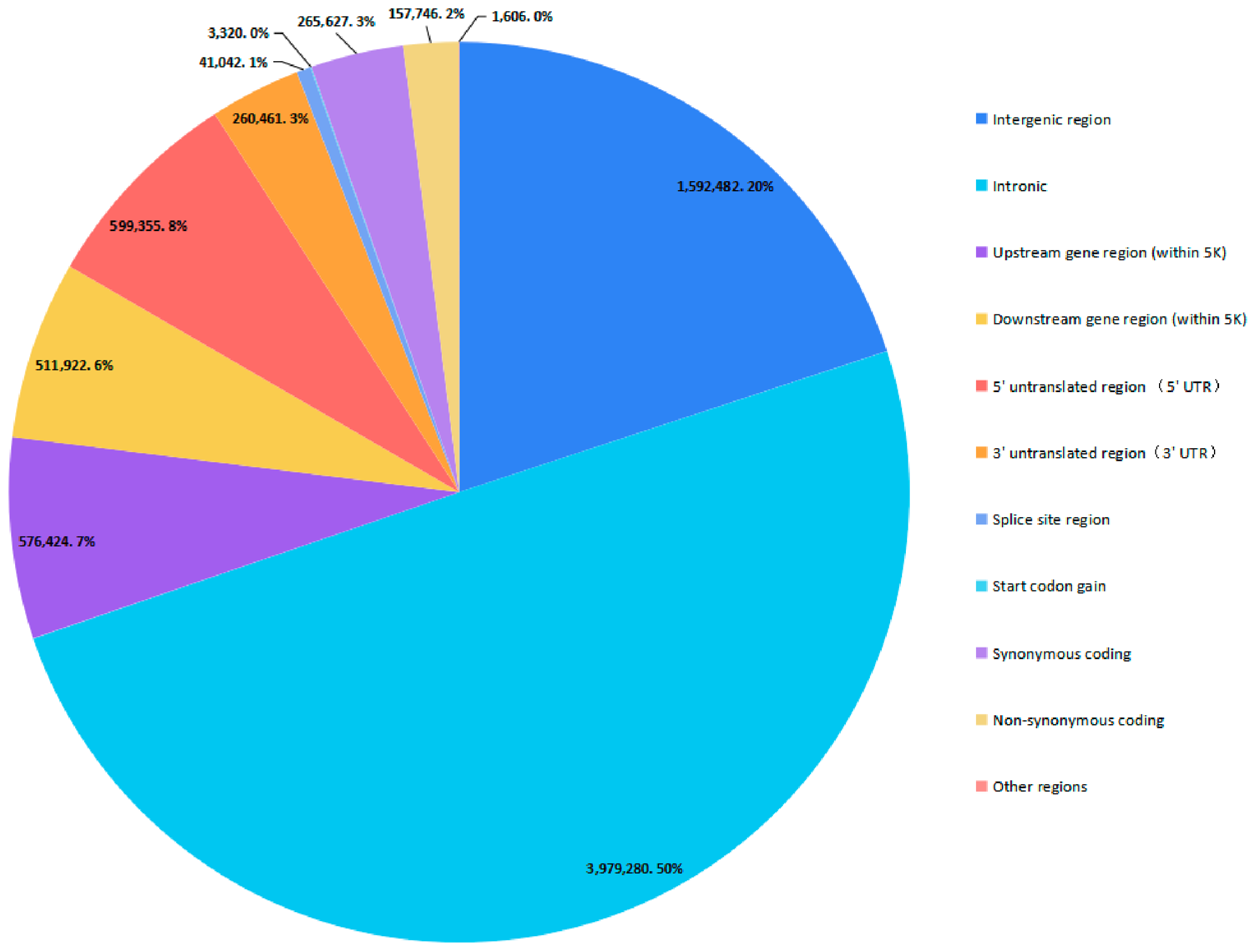
| Total | 1,592,482 ± 13,121 | 3,979,280 ± 31,573 | 5764,24 ± 4780 | 511,922 ± 4118 | 599,355 ± 597 | 260,461 ± 1788 | 393 ± 7 | 386 ± 7 |
| Population | Splice site region | Start codon gain | Start codon loss | Synonymous coding | Non-synonymous coding | Synonymous stop codon | Stop codon gain | Stop codon loss |
| XW | 41,096 ± 408 a | 3330 ± 28 a | 229 ± 2 a | 265,892 ± 2762 a | 158,011 ± 1569 ab | 199 ± 2 ab | 271 ± 5 a | 126 ± 2 a |
| DN | 41,185 ± 425 a | 3328 ± 35 a | 231 ± 3 a | 266,604 ± 2883 a | 158,358 ± 1707 a | 202 ± 4 a | 272 ± 6 a | 127 ± 2 a |
| XF | 40,846 ± 293 a | 3302 ± 27 a | 230 ± 4 a | 264,386 ± 2025 a | 156,868 ± 1200 b | 198 ± 3 b | 267 ± 7 a | 127 ± 2 a |
| Total | 41,042 ± 395 | 3320 ± 32 | 230 ± 3 | 265,627 ± 2665 a | 157,746 ± 1592 | 200 ± 3 | 270 ± 6 | 127 ± 2 |
| Population | Coding Region Insertions | Coding Region Deletions | Homozygous Indels in Coding Regions | Heterozygous Indels in Coding Regions | Total Indels in Coding Regions | Whole -Genome Insertions | Whole -Genome Deletions | Homozygous Indels in Whole Genome | Heterozygous Indels in Whole Genome | Total Indels in Whole Genome |
|---|---|---|---|---|---|---|---|---|---|---|
| XW | 4400 ± 72 a | 5295 ± 84 a | 8776 ± 106 a | 919 ± 53 a | 9695 ± 154 a | 918,905 ± 12,529 a | 986,020 ± 11,990 a | 1,826,216 ± 19,229 a | 78,709 ± 5940 a | 1,904,925 ± 24,504 a |
| DN | 4426 ± 85 a | 5329 ± 101 a | 8793 ± 125 a | 962 ± 65 a | 9755 ± 184 a | 921,581 ± 12,935 a | 989,080 ± 12,719 a | 1,828,376 ± 19,543 a | 82,285 ± 6392 a | 1,910,661 ± 25,638 a |
| XF | 4380 ± 60 a | 5270 ± 75 a | 8794 ± 98 a | 856 ± 44 b | 9650 ± 132 a | 913,268 ± 8720 a | 979,312 ± 8438 a | 1,827,127 ± 15,182 a | 65,453 ± 3387 b | 1,892,580 ± 17,142 a |
| Total | 4402 ± 73 | 5298 ± 88 | 8788 ± 107 | 913 ± 69 | 9700 ± 159 | 917,918 ± 11,690 | 984,804 ± 11,582 | 1,827,240 ± 17,482 | 75,482 ± 9024 | 1,902,722 ± 23,247 |
| Population | Average_MAF | Expected_Allele_Number | Expected_Heterozygous_Number | Nei_Diversity_Index | Number_of_Poly_Marker | Observed_Allele_Number | Observed_Heterozygous_Number | Polymorphysm_Information_Content | Shannon_Wiener_Index |
|---|---|---|---|---|---|---|---|---|---|
| XW | 0.2606 | 1.5433 | 0.3185 | 0.336 | 446,349 | 1.917326379 | 0.3088 | 0.2552 | 0.4778 |
| DN | 0.2616 | 1.5482 | 0.3211 | 0.3387 | 448,746 | 1.922252639 | 0.3213 | 0.2572 | 0.4815 |
| XF | 0.2829 | 1.4529 | 0.2608 | 0.2752 | 342,646 | 1.704198316 | 0.2581 | 0.2073 | 0.3864 |
Disclaimer/Publisher’s Note: The statements, opinions and data contained in all publications are solely those of the individual author(s) and contributor(s) and not of MDPI and/or the editor(s). MDPI and/or the editor(s) disclaim responsibility for any injury to people or property resulting from any ideas, methods, instructions or products referred to in the content. |
© 2026 by the authors. Licensee MDPI, Basel, Switzerland. This article is an open access article distributed under the terms and conditions of the Creative Commons Attribution (CC BY) license.
Share and Cite
Wu, B.; Fang, Y.; Zeng, Q.; Li, H.; Zhang, Y.; Wang, H. Genetic Diversity and Differentiation Pattern of Mastacembelus armatus in the Dongjiang and Ganjiang River Sources. Biology 2026, 15, 869. https://doi.org/10.3390/biology15110869
Wu B, Fang Y, Zeng Q, Li H, Zhang Y, Wang H. Genetic Diversity and Differentiation Pattern of Mastacembelus armatus in the Dongjiang and Ganjiang River Sources. Biology. 2026; 15(11):869. https://doi.org/10.3390/biology15110869
Chicago/Turabian StyleWu, Bin, Yuan Fang, Qingxiang Zeng, Han Li, Yanping Zhang, and Haihua Wang. 2026. "Genetic Diversity and Differentiation Pattern of Mastacembelus armatus in the Dongjiang and Ganjiang River Sources" Biology 15, no. 11: 869. https://doi.org/10.3390/biology15110869
APA StyleWu, B., Fang, Y., Zeng, Q., Li, H., Zhang, Y., & Wang, H. (2026). Genetic Diversity and Differentiation Pattern of Mastacembelus armatus in the Dongjiang and Ganjiang River Sources. Biology, 15(11), 869. https://doi.org/10.3390/biology15110869