Microscopic and Geometric Changes in the Mandibular Condylar Head in Response to Subtle Secondary Overload: In Search of a Mechanical Origin of Condylar Hyperplasia

 , ,
, ,  , , and
Simple Summary
Abstract
1. Introduction
2. Materials and Methods
2.1. Data
2.2. Analyses
3. Results
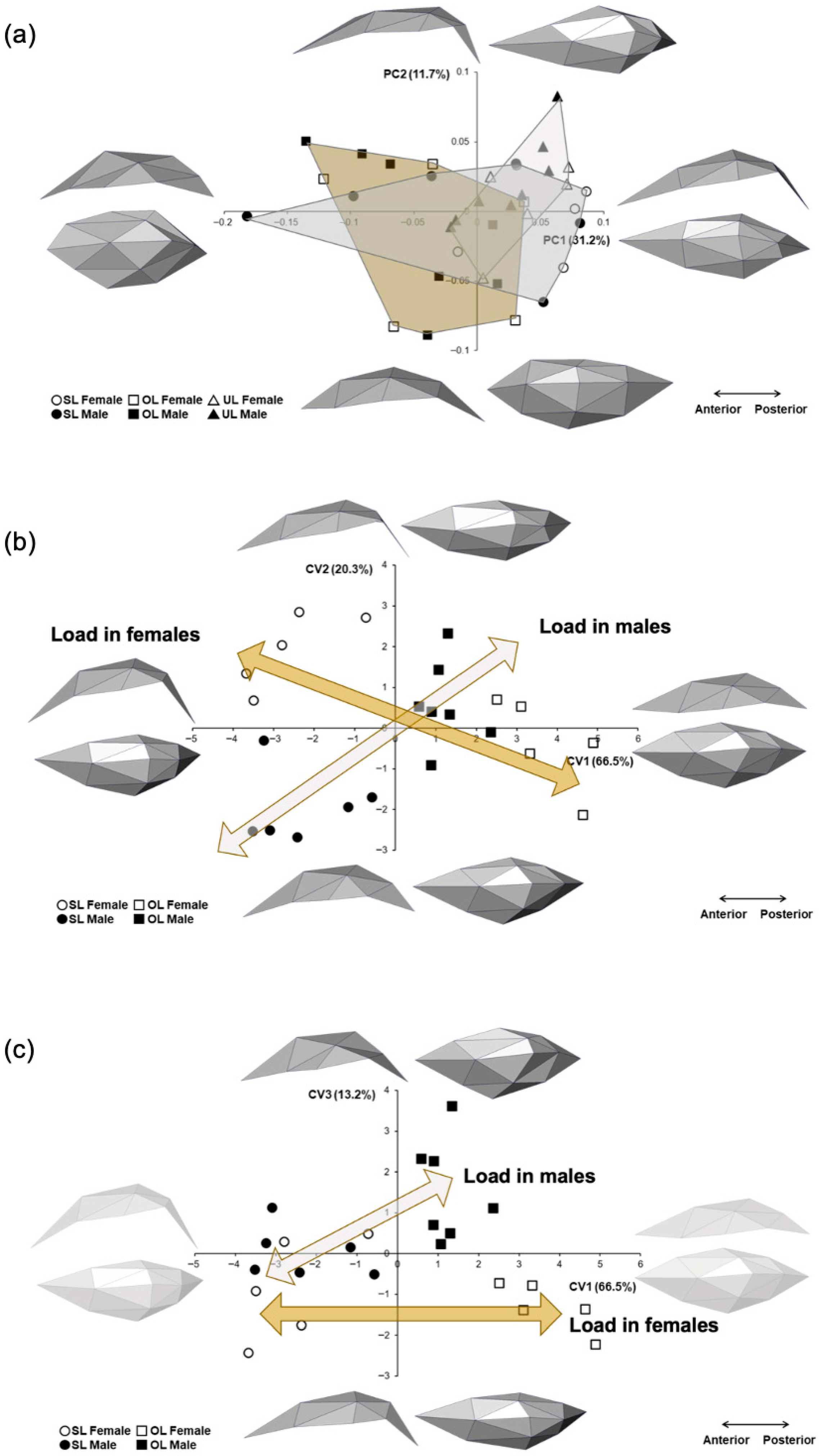
3.1. Condylar Head Geometry
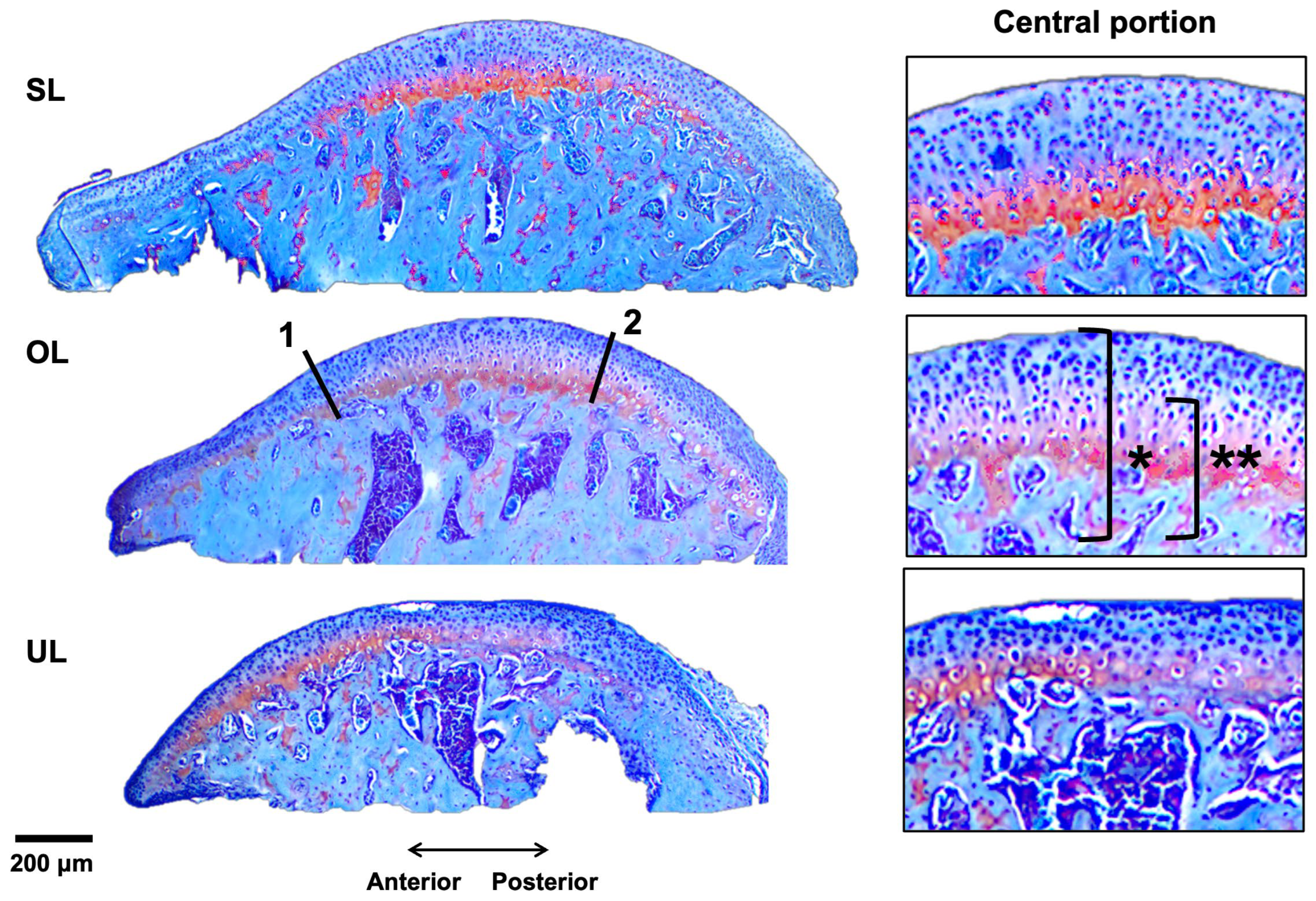
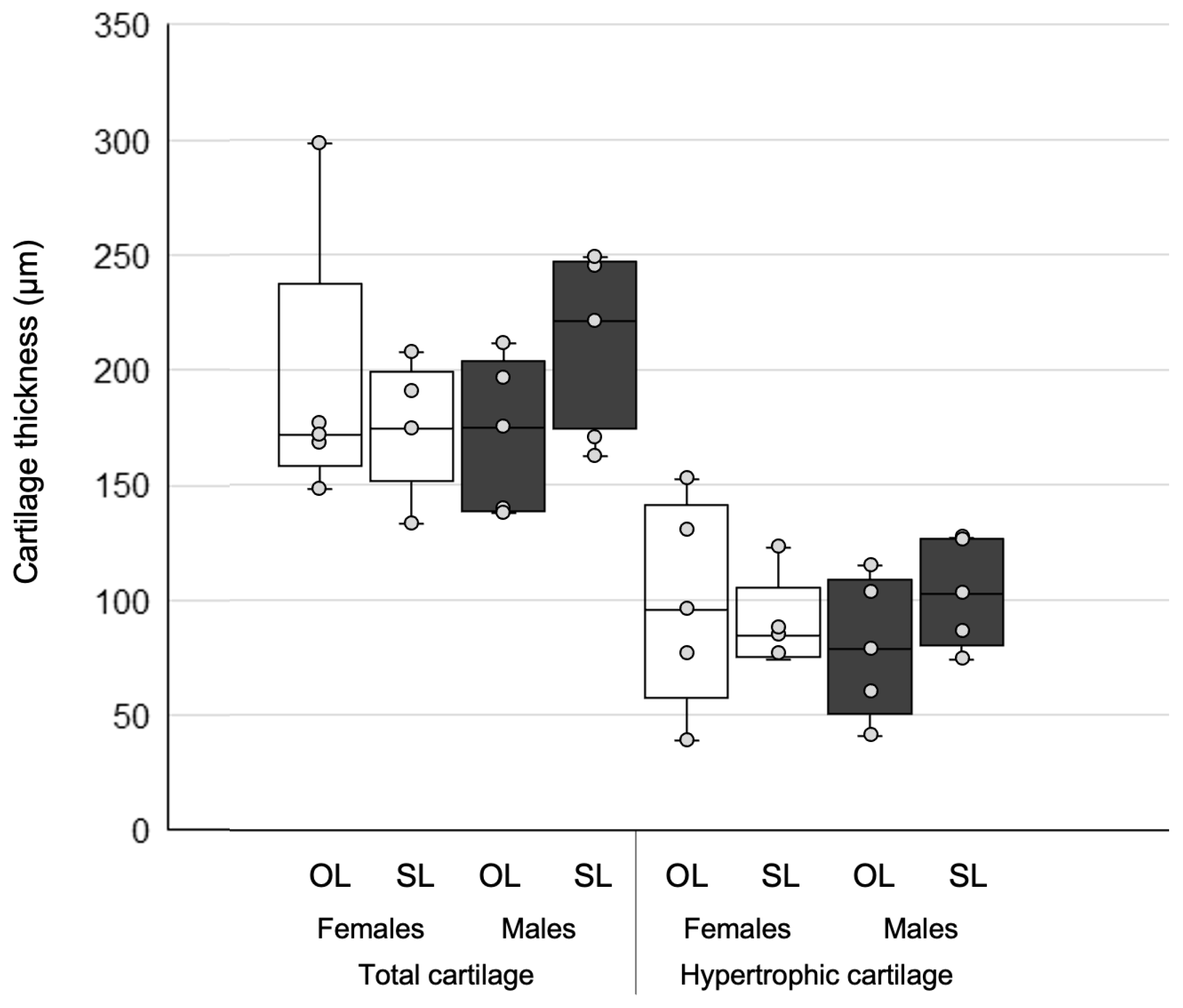
3.2. Cartilage Thickness
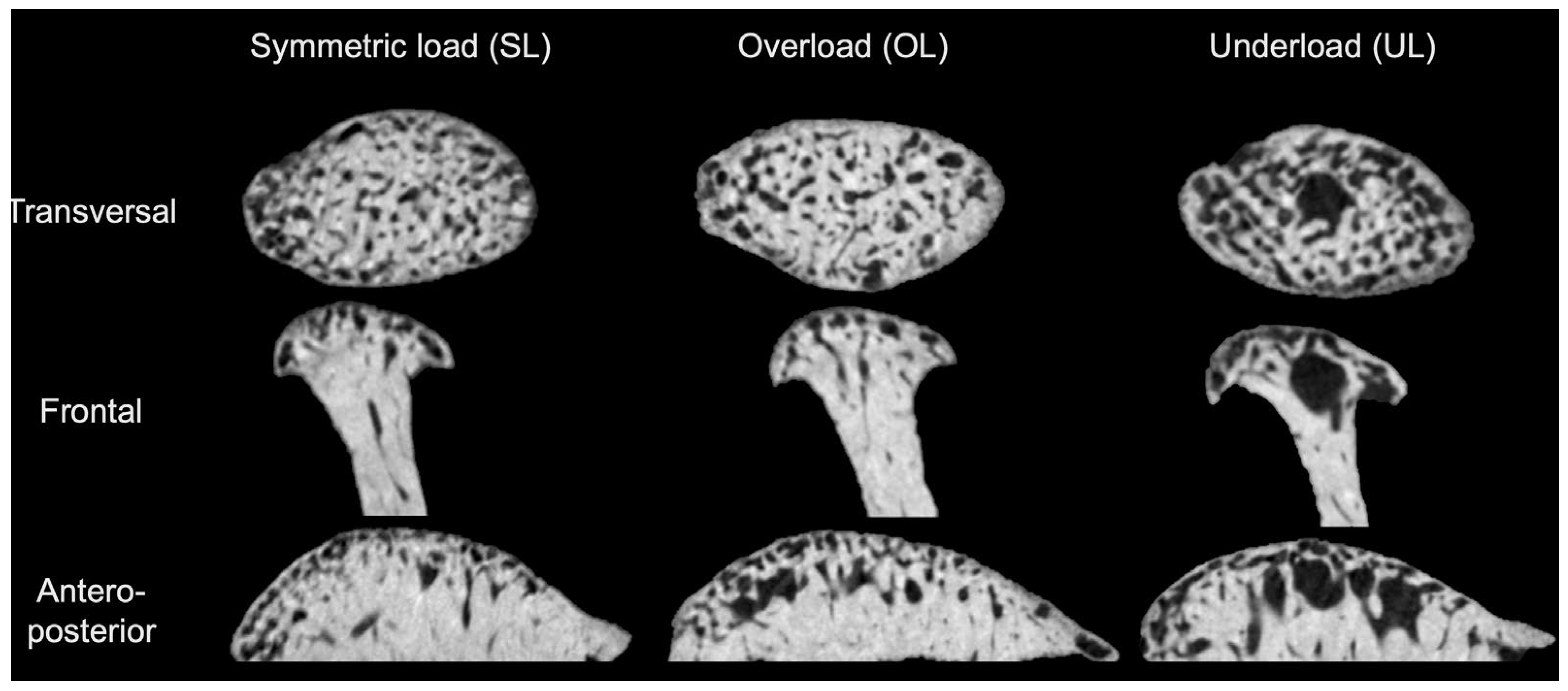
3.3. Microstructure
4. Discussion
5. Conclusions
Author Contributions
Funding
Institutional Review Board Statement
Informed Consent Statement
Data Availability Statement
Acknowledgments
Conflicts of Interest
Abbreviations
| BoNTA | Botulinum toxin type A |
| BV | Bone volume |
| CH | Condylar hyperplasia (also known as Condylar hyperactivity) |
| Conn.D | Connectivity density |
| CVA | Canonical variate analysis |
| EDTA | Ethylenediaminetetraacetic acid |
| HPT | Hyperplastic/hypertrophic (cartilage) |
| MIL | Mean intercept length |
| OL | Secondary overload |
| PCA | Principal components analysis |
| PERMANOVA | Permutational multivariate analysis of variance |
| SL | Symmetric load |
| SVD | Star volume distribution |
| Tb.N | Number of trabeculae |
| Tb.Th | Trabecular thickness |
| TMJ | Temporomandibular joint |
| Tt.Ar | Total area |
| TV | Total volume |
| UL | Underload |
References
- Espinosa, S.; Covarrubias, E.; Díaz, R.; Díaz, K.; Cafferata, E.A. Histologic findings and related diagnostic methods in condylar hyperactivity. Int. J. Oral Maxillofac. Surg. 2021, 50, 54–63. [Google Scholar] [CrossRef]
- Vásquez, B.; Olate, S.; Cantín, M.; Sandoval, C.; Del Sol, M.; De Moraes, M. Histomorphometric analysis of unilateral condylar hyperplasia in the temporomandibular joint: The value of the condylar layer and cartilage island. Int. J. Oral Maxillofac. Surg. 2017, 46, 861–866. [Google Scholar] [CrossRef]
- Berkovitz, B.K.; Holland, G.R.; Moxham, B.J. Oral Anatomy, Histology and Embryology-E-Book; Elsevier Health Sciences. 2024. Available online: https://shop.elsevier.com/books/oral-anatomy-histology-and-embryology/berkovitz/978-0-323-93521-0 (accessed on 14 May 2026).
- Shen, G.; Darendeliler, M.A. The Adaptive Remodeling of Condylar Cartilage—A Transition from Chondrogenesis to Osteogenesis. J. Dent. Res. 2005, 84, 691–699. [Google Scholar] [CrossRef]
- Roberts, W.E.; Stocum, D.L. Part II: Temporomandibular Joint (TMJ)—Regeneration, Degeneration, and Adaptation. Curr. Osteoporos. Rep. 2018, 16, 369–379. [Google Scholar] [CrossRef]
- Bourdiol, P.; Hennequin, M.; Peyron, M.-A.; Woda, A. Masticatory Adaptation to Occlusal Changes. Front. Physiol. 2020, 11, 263. [Google Scholar] [CrossRef]
- Raijmakers, P.G.; Karssemakers, L.H.E.; Tuinzing, D.B. Female Predominance and Effect of Gender on Unilateral Condylar Hyperplasia: A Review and Meta-Analysis. J. Oral Maxillofac. Surg. 2012, 70, e72–e76. [Google Scholar] [CrossRef] [PubMed]
- Alfieri, R.; Vassalli, M.; Viti, F. Flow-induced mechanotransduction in skeletal cells. Biophys. Rev. 2019, 11, 729–743. [Google Scholar] [CrossRef] [PubMed]
- La Rosa, G.R.M.; Loreto, C.; Pedullà, E.; Lombardo, C. Association between estrogen receptors polymorphisms and temporomandibular joint disorders: A systematic review. Arch. Oral Biol. 2025, 170, 106130. [Google Scholar] [CrossRef] [PubMed]
- Koolstra, J.; van Eijden, T. Combined finite-element and rigid-body analysis of human jaw joint dynamics. J. Biomech. 2005, 38, 2431–2439. [Google Scholar] [CrossRef] [PubMed]
- Ravosa, M.J.; Kunwar, R.; Stock, S.R.; Stack, M.S. Pushing the limit: Masticatory stress and adaptive plasticity in mammalian craniomandibular joints. J. Exp. Biol. 2007, 210, 628–641. [Google Scholar] [CrossRef]
- Haralur, S.B.; Majeed, M.I.; Chaturvedi, S.; Alqahtani, N.M.; Alfarsi, M. Association between preferred chewing side and dynamic occlusal parameters. J. Int. Med. Res. 2019, 47, 1908–1915. [Google Scholar] [CrossRef]
- Toro-Ibacache, V.; O’Higgins, P. The Effect of Varying Jaw-elevator Muscle Forces on a Finite Element Model of a Human Cranium. Anat. Rec. 2016, 299, 828–839. [Google Scholar] [CrossRef]
- Karssemakers, L.H.E.; Nolte, J.W.; Rehmann, C.; Raijmakers, P.G.; Becking, A.G. Diagnostic performance of SPECT–CT imaging in unilateral condylar hyperplasia. Int. J. Oral Maxillofac. Surg. 2023, 52, 199–204. [Google Scholar] [CrossRef]
- Balanta-Melo, J.; Torres-Quintana, M.A.; Bemmann, M.; Vega, C.; González, C.; Kupczik, K.; Toro-Ibacache, V.; Buvinic, S. Masseter muscle atrophy impairs bone quality of the mandibular condyle but not the alveolar process early after induction. J. Oral Rehabil. 2019, 46, 233–241. [Google Scholar] [CrossRef]
- Iturriaga, V.; Vásquez, B.; Bornhardt, T.; Del Sol, M. Effects of low and high molecular weight hyaluronic acid on the osteoarthritic temporomandibular joint in rabbit. Clin. Oral Investig. 2021, 25, 4507–4518. [Google Scholar] [CrossRef] [PubMed]
- Shinohara, T.; Izawa, T.; Mino-Oka, A.; Mori, H.; Iwasa, A.; Inubushi, T.; Yamaguchi, Y.; Tanaka, E. Hyaluronan metabolism in overloaded temporomandibular joint. J. Oral Rehabil. 2016, 43, 921–928. [Google Scholar] [CrossRef] [PubMed]
- Balanta-Melo, J.; Toro-Ibacache, V.; Torres-Quintana, M.A.; Kupczik, K.; Vega, C.; Morales, C.; Hernández-Moya, N.; Arias-Calderón, M.; Beato, C.; Buvinic, S. Early molecular response and microanatomical changes in the masseter muscle and mandibular head after botulinum toxin intervention in adult mice. Ann. Anat.-Anat. Anz. 2018, 216, 112–119. [Google Scholar] [CrossRef] [PubMed]
- Angst, L.; Koolstra, J.H.; Wiedemeier, D.; Van Sluijs, R.M.; Pulfer, A.M.; Gallo, L.M.; Colombo, V. Masticatory Muscles Activation and TMJ Space During Asymmetrically Loaded Jaw Closing. Ann. Biomed. Eng. 2024, 52, 877–887. [Google Scholar] [CrossRef]
- Betti, B.F.; Everts, V.; Ket, J.C.F.; Tabeian, H.; Bakker, A.D.; Langenbach, G.E.; Lobbezoo, F. Effect of mechanical loading on the metabolic activity of cells in the temporomandibular joint: A systematic review. Clin. Oral Investig. 2018, 22, 57–67. [Google Scholar] [CrossRef]
- Zelditch, M.L.; Swiderski, D.L.; Sheets, H.D. Geometric Morphometrics for Biologists: A Primer; Elsevier Academic Press: San Diego, CA, USA, 2012; p. 416. [Google Scholar]
- Klingenberg, C.P.; Barluenga, M.; Meyer, A. Shape Analysis of Symmetric Structures: Quantifying Variation Among Individuals and Asymmetry. Evolution 2002, 56, 1909–1920. [Google Scholar] [CrossRef]
- Klingenberg, C.P. MorphoJ: An integrated software package for geometric morphometrics. Mol. Ecol. Resour. 2011, 11, 353–357. [Google Scholar] [CrossRef]
- Anderson, M.J. Permutational multivariate analysis of variance (PERMANOVA). In Wiley Statsref: Statistics Reference Online; John Wiley & Sons: Hoboken, NJ, USA, 2017; pp. 1–15. [Google Scholar]
- Hammer, Ø.; Harper, D.; Ryan, P. PAST: Paleontological statistics software package for education and data analysis. Paleontol. Electron. 2001, 4, 9. [Google Scholar]
- Kaul, R.; O’Brien, M.H.; Dutra, E.; Lima, A.; Utreja, A.; Yadav, S. The Effect of Altered Loading on Mandibular Condylar Cartilage. PLoS ONE 2016, 11, e0160121. [Google Scholar] [CrossRef]
- Chen, J.; Sorensen, K.; Gupta, T.; Kilts, T.; Young, M.; Wadhwa, S. Altered functional loading causes differential effects in the subchondral bone and condylar cartilage in the temporomandibular joint from young mice. Osteoarthr. Cartil. 2009, 17, 354–361. [Google Scholar] [CrossRef] [PubMed]
- He, Z.; Liu, M.; Zhang, Q.; Tian, Y.; Wang, L.; Yan, X.; Ren, D.; Yuan, X. Wnt/β-catenin signaling pathway is activated in the progress of mandibular condylar cartilage degeneration and subchondral bone loss induced by overloaded functional orthopedic force (OFOF). Heliyon 2022, 8, e10847. [Google Scholar] [CrossRef] [PubMed]
- Toro-Ibacache, V.; Montecino, M.; Espinosa, S. The mechanical response of the condylar process of the mandible under changes of the occlusal plane inclination. J. Cranio-Maxillofac. Surg. 2025, 53, 674–680. [Google Scholar] [CrossRef] [PubMed]
- Tanaka, E.; Sasaki, A.; Tahmina, K.; Yamaguchi, K.; Mori, Y.; Tanne, K. Mechanical properties of human articular disk and its influence on TMJ loading studied with the finite element method. J. Oral Rehabil. 2001, 28, 273–279. [Google Scholar] [CrossRef]
- Tanaka, E. Biomechanical and tribological properties of the temporomandibular joint: A narrative review. Front. Oral Maxillofac. Med. 2021, 3, 15. [Google Scholar] [CrossRef]
- Iturriaga, V.; Navarro, P.; Cantin, M.; Fuentes, R. Prevalence of Vertical Condilar Asymmetry of the Temporomandibular Joint in Patients with Signs and Symptoms of Temporomandibular Disorders. Int. J. Morphol. 2012, 30, 315–321. [Google Scholar] [CrossRef]



| Analysis | Group | Sex | No. of Condylar Heads | No. of Individuals | No. of Paired Individuals | No. of Unpaired Individuals |
|---|---|---|---|---|---|---|
| Condylar head geometry | UL | M | 8 | 8 | 0 | 8 |
| F | 5 | 5 | 0 | 5 | ||
| OL | M | 7 | 7 | 0 | 7 | |
| F | 5 | 5 | 0 | 5 | ||
| SL | M | 6 | 4 | 2 | 2 | |
| F | 5 | 3 | 2 | 1 | ||
| Cartilage thickness | UL | M | 5 | 5 | 0 | 5 |
| F | 5 | 5 | 0 | 5 | ||
| OL | M | 5 | 5 | 0 | 5 | |
| F | 5 | 5 | 0 | 5 | ||
| SL | M | 5 | 4 | 1 | 3 | |
| F | 5 | 4 | 1 | 3 | ||
| Trabecular bone microstructure | UL | M | 8 | 8 | 0 | 8 |
| F | 5 | 5 | 0 | 5 | ||
| OL | M | 7 | 7 | 0 | 7 | |
| F | 5 | 5 | 0 | 5 | ||
| SL | M | 6 | 4 | 2 | 2 | |
| F | 5 | 3 | 2 | 1 |
| Comparison | PC | Estimate | SE | d.f. | p-Value |
|---|---|---|---|---|---|
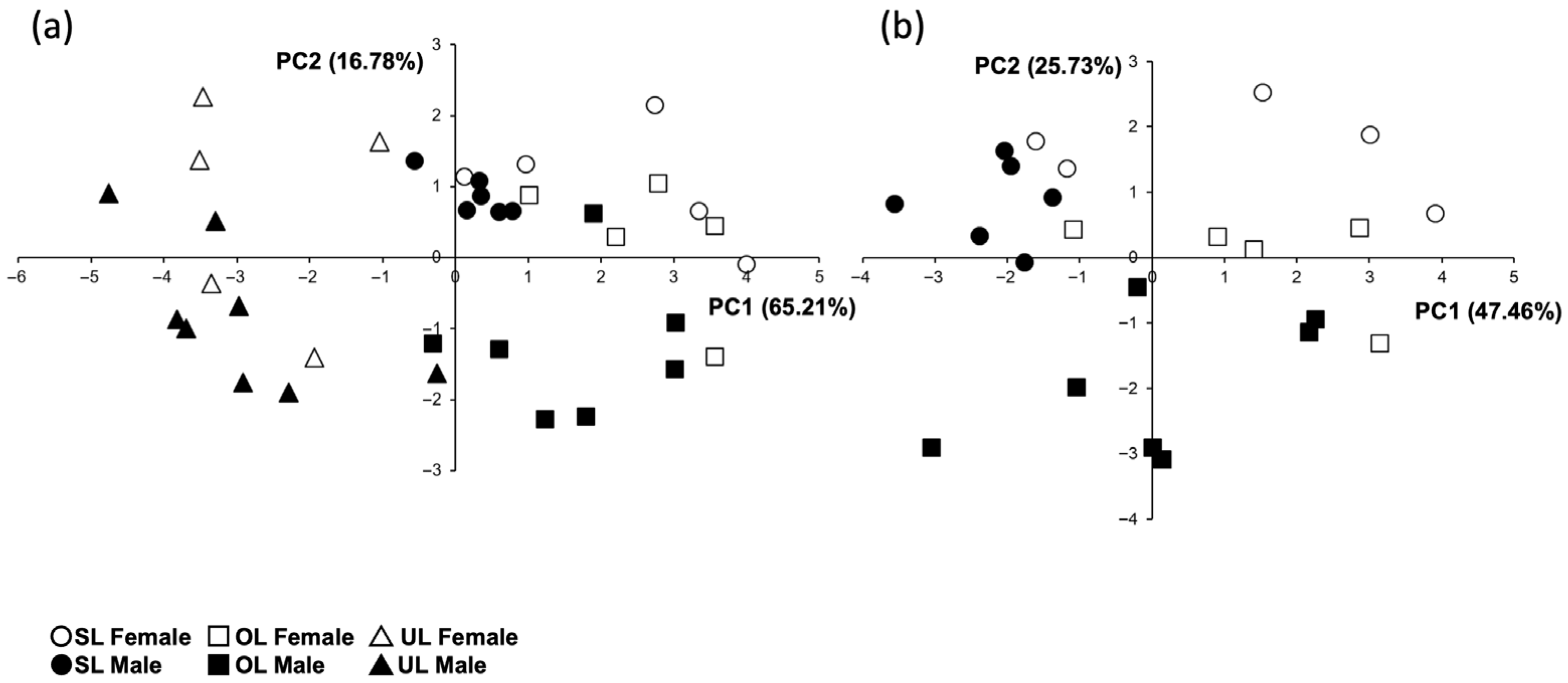
| F: OL vs. SL | PC1 | 0.085 | 0.047 | 11.1 | 0.1 |
| M: OL vs. SL | PC1 | 0.024 | 0.042 | 11.9 | 0.59 |
| OL: F vs. M | PC1 | −0.014 | 0.043 | 18.7 | 0.74 |
| SL: F vs. M | PC1 | −0.076 | 0.047 | 6.1 | 0.16 |
| F: OL vs. SL | PC2 | 0.056 | 0.03 | 12.0 | 0.09 |
| M: OL vs. SL | PC2 | 0.022 | 0.027 | 12.9 | 0.42 |
| OL: F vs. M | PC2 | −0.014 | 0.042 | 18.65 | 0.74 |
| SL: F vs. M | PC2 | −0.076 | 0.05 | 6.13 | 0.16 |
| Group | N | Total Cartilage Thickness (µm) | HPT Cartilage Thickness (µm) | HPT/Total Cartilage % | |||||||
|---|---|---|---|---|---|---|---|---|---|---|---|
| Anterior | Central | Posterior | Anterior | Central | Posterior | Anterior | Central | Posterior | |||
| SLmale | 5 | Min | 87.86 | 162.28 | 122.31 | 23.01 | 74.02 | 39.78 | 18.39 | 39.75 | 27.42 |
| Max | 125.15 | 249 | 178.66 | 43.82 | 127.07 | 80.56 | 38.32 | 53.27 | 45.09 | ||
| Median | 114.36 | 220.95 | 148.26 | 28.36 | 102.8 | 53.47 | 27.55 | 50.57 | 36.53 | ||
| SLfemale | 5 | Min | 86.54 | 133 | 127 | 26.22 | 74.13 | 26.66 | 27.56 | 43.48 | 19.76 |
| Max | 115.53 | 207.65 | 166.75 | 51.11 | 122.8 | 61.63 | 44.24 | 65.92 | 39.09 | ||
| Median | 95.15 | 174.39 | 144.76 | 29.98 | 84.55 | 36.14 | 34.31 | 44.34 | 24.93 | ||
| OLmale | 5 | Min | 82.54 | 137.71 | 121.76 | 25.52 | 40.96 | 33.37 | 27.13 | 29.74 | 18.66 |
| Max | 130.64 | 211.4 | 178.83 | 47.1 | 114.8 | 59.15 | 45.95 | 54.30 | 47.83 | ||
| Median | 98.89 | 174.93 | 161.08 | 28.33 | 78.54 | 54.25 | 30.92 | 44.90 | 33.56 | ||
| OLfemale | 5 | Min | 95.56 | 148.22 | 117.83 | 35.68 | 38.86 | 44.73 | 25.46 | 26.22 | 31.31 |
| Max | 152.32 | 298.35 | 155 | 104.66 | 152.5 | 63.43 | 90.12 | 86.39 | 53.83 | ||
| Median | 118.99 | 171.79 | 147.08 | 48.52 | 95.77 | 49.09 | 37.34 | 44.49 | 34.62 | ||
| ULmale | 5 | Min | 77.12 | 101.02 | 109.87 | 22.96 | 38.94 | 17.67 | 24.60 | 36.96 | 16.08 |
| Max | 100.56 | 141.17 | 144.68 | 38.3 | 114.7 | 75.42 | 44.52 | 83.06 | 59.29 | ||
| Median | 87.19 | 125.42 | 129.51 | 33.74 | 53.52 | 56.71 | 38.09 | 47.50 | 39.20 | ||
| ULfemale | 5 | Min | 86.37 | 108.71 | 82.51 | 14.41 | 39.95 | 27.56 | 16.68 | 31.48 | 27.57 |
| Max | 120.08 | 154.05 | 146.19 | 61.99 | 83.47 | 52.25 | 57.01 | 54.18 | 35.74 | ||
| Median | 108.73 | 126.92 | 113.79 | 40.47 | 58.93 | 33.06 | 41.13 | 50.48 | 33.36 | ||
| Comparison | Variable | Estimate | SE | d.f. | p-Value |
|---|---|---|---|---|---|
| F: OL vs. SL | Total | 17.4 | 28.5 | 11.7 | 0.55 |
| M: OL vs. SL | Total | −40.7 | 28.5 | 11.7 | 0.18 |
| OL: F vs. M | Total | 20.7 | 26.3 | 15.76 | 0.44 |
| SL: F vs. M | Total | −37.4 | 30.6 | 7.24 | 0.26 |
| F: OL vs. SL | HPT | 12.4 | 21.1 | 13.6 | 0.57 |
| M: OL vs. SL | HPT | −25.2 | 21.1 | 13.6 | 0.26 |
| OL: F vs. M | HPT | 19.3 | 20.1 | 14.7 | 0.35 |
| SL: F vs. M | HPT | −18.4 | 22.1 | 12.6 | 0.42 |
| Group | Sex | Variables as Median (Range) | ||||||||||
|---|---|---|---|---|---|---|---|---|---|---|---|---|
| Centroid Size (mm) | Anisotropy MIL | Anisotropy SVD | BV (mm3) | BV/TV | Conn.D (mm−3) | TV (mm3) | Tb.N (m−1) | Tb.Sp (mm) | Tb.Th (mm) | Tt.Ar (mm2) | ||
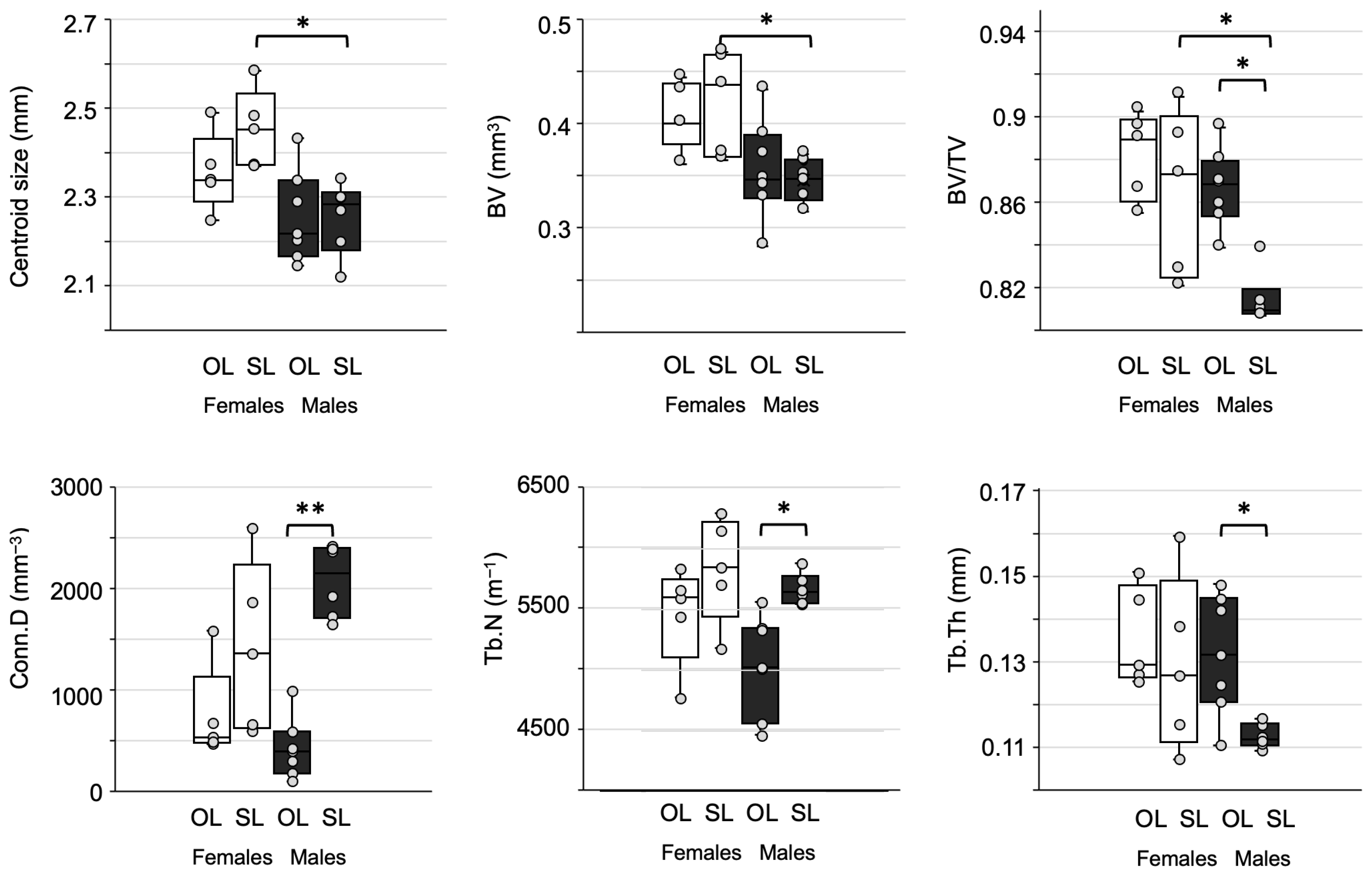
| OL | F (n = 5) | 2.34 (2.25–2.49) | 0.28 (0.21–0.41) | 0.55 (0.49–0.65) | 0.40 (0.36–0.44) | 0.89 (0.85–0.90) | 530.20 (467.21–1585.72) | 0.46 (0.42–0.49) | 5587.27 (4762.48–5825.96) | 0.05 (0.04–0.06) | 0.13 (0.13–0.15) | 0.21 (0.19–0.22) |
| M (n = 7) | 2.22 (2.15–2.43) | 0.34 (0.15–0.56) | 0.57 (0.52–0.61) | 0.34 (0.28–0.39) | 0.86 (0.84–0.90) | 345.60 (100.11–987.13) | 0.40 (0.34–0.44) | 5166.29 (4453.92–5550.254) | 0.07 (0.05–0.08) | 0.13 (0.11–0.14) | 0.20 (0.17–0.23) | |
| SL | F (n = 5) | 2.45 (2.37–2.58) | 0.22 (0.14–0.49) | 0.60 (0.54–0.63) | 0.43 (0.37–0.47) | 0.86 (0.82–0.91) | 1468.94 (590.62–2600.80) | 0.49 (0.44–0.54) | 5987.62 (5169.99–6282.24) | 0.04 (0.03–0.06) | 0.12 (0.11–0.16) | 0.22 (0.21–0.24) |
| M (n = 6) | 2.28 (2.12–2.34) | 0.26 (0.17–0.29) | 0.64 (0.60–0.72) | 0.35 (0.32–0.37) | 0.81 (0.81–0.84} | 2148.19 (1646.18–2420.05) | 0.43 (0.39–0.46) | 5634.97 (5533.55–5872.62) | 0.06 (0.06–0.07) | 0.11 (0.11–0.12) | 0.21 (0.19–0.22) | |
| UL | F (n = 5) | 2.28 (2.15–2.32) | 0.38 (0.32–0.44) | 0.73 (0.64–0.76) | 0.25 (0.19–0.29) | 0.76 (0.69–0.86) | 3406.79 (1608.83–5611.98) | 0.32 (0.28–0.39) | 6010.19 (5213.73–6699.36) | 0.08 (0.004–0.10) | 0.09 (0.07–0.11) | 0.15 (0.14–0.18) |
| M (n = 8) | 2.18 (1.89–2.18) | 0.47 (0.36–0.56) | 0.74 (0.67–0.81) | 0.24 (0.17–0.33) | 0.80 (0.72–0.84) | 1823.14 (998.94–2858.16) | 0.31 (0.23–0.39) | 5705.44 (5179.83–6668.89) | 0.08 (0.08–0.10) | 0.09 (0.07–0.12) | 0.15 (0.14–0.18) | |
| Bone Parameter | PC 1 (45%) | PC 2 (30.5%) |
|---|---|---|
| Anisotropy (MIL) | 0.04 | −0.56 |
| Anisotropy (SVD) | −0.56 | 0.32 |
| Bone volume (BV) (mm3) | 0.92 | 0.36 |
| Bone volume fraction (BV/TV) | 0.87 | −0.39 |
| Connectivity density (Conn.D) (mm−3) | −0.56 | 0.75 |
| Total volume (TV) (mm3) | 0.78 | 0.56 |
| Trabecular number (Tb.N) (m−1) | −0.13 | 0.88 |
| Average trabecular separation (Tb.Sp) (mm) | −0.73 | −0.50 |
| Average trabecular thickness (Tb.Th) (mm) | 0.82 | −0.48 |
| Average total (cortical + marrow) area (Tt.Ar) (mm2) | 0.66 | 0.48 |
| Comparison | Variable | Estimate | SE | d.f. | p-Value |
|---|---|---|---|---|---|
| F: OL vs. SL | Centroid size | −0.099 | 0.061 | 11.4 | 0.13 |
| M: OL vs. SL | Centroid size | 0.001 | 0.054 | 12.3 | 0.98 |
| OL: F vs. M | Centroid size | 0.099 | 0.054 | 18.29 | 0.08 |
| SL: F vs. M | Centroid size | 0.2 | 0.06 | 7.11 | 0.01 |
| F: OL vs. SL | BV | −0.021 | 0.03 | 14.7 | 0.49 |
| M: OL vs. SL | BV | 0.011 | 0.26 | 14.8 | 0.69 |
| OL: F vs. M | BV | 0.0521 | 0.024 | 15.2 | 0.05 |
| SL: F vs. M | BV | 0.084 | 0.031 | 14.5 | 0.02 |
| F: OL vs. SL | BV/TV | 0.014 | 0.016 | 13.4 | 0.4 |
| M: OL vs. SL | BV/TV | 0.053 | 0.014 | 14.0 | 0.002 |
| OL: F vs. M | BV/TV | 0.016 | 0.013 | 16.3 | 0.27 |
| SL: F vs. M | BV/TV | 0.054 | 0.017 | 11.9 | 0.006 |
| F: OL vs. SL | Conn.D | −610 | 348 | 12.5 | 0.1 |
| M: OL vs. SL | Conn.D | −1695 | 304 | 13.3 | <0.0001 * |
| OL: F vs. M | Conn.D | 325 | 298 | 17.13 | 0.29 |
| SL: F vs. M | Conn.D | −760 | 354 | 9.94 | 0.06 |
| F: OL vs. SL | Tb.N | −373 | 236 | 11.1 | 0.14 |
| M: OL vs. SL | Tb.N | −627 | 210 | 11.9 | 0.01 |
| OL: F vs. M | Tb.N | 419 | 213 | 18.65 | 0.64 |
| SL: F vs. M | Tb.N | 165 | 234 | 6.13 | 0.51 |
| F: OL vs. SL | Tb.Th | 0.006 | 0.009 | 12.2 | 0.56 |
| M: OL vs. SL | Tb.Th | 0.02 | 0.008 | 13.1 | 0.03 |
| OL: F vs. M | Tb.Th | 0.004 | 0.008 | 17.42 | 0.64 |
| SL: F vs. M | Tb.Th | 0.018 | 0.009 | 9.26 | 0.09 |
Disclaimer/Publisher’s Note: The statements, opinions and data contained in all publications are solely those of the individual author(s) and contributor(s) and not of MDPI and/or the editor(s). MDPI and/or the editor(s) disclaim responsibility for any injury to people or property resulting from any ideas, methods, instructions or products referred to in the content. |
© 2026 by the authors. Licensee MDPI, Basel, Switzerland. This article is an open access article distributed under the terms and conditions of the Creative Commons Attribution (CC BY) license.
Share and Cite
Toro-Ibacache, V.; Buvinic, S.; Balanta-Melo, J.; Caro, V.; Zúñiga, F.; Miranda-Krause, R.; Botton-Divet, L.; Nyakatura, J.A.; Iturriaga, V.; Vásquez, B. Microscopic and Geometric Changes in the Mandibular Condylar Head in Response to Subtle Secondary Overload: In Search of a Mechanical Origin of Condylar Hyperplasia. Biology 2026, 15, 809. https://doi.org/10.3390/biology15100809
Toro-Ibacache V, Buvinic S, Balanta-Melo J, Caro V, Zúñiga F, Miranda-Krause R, Botton-Divet L, Nyakatura JA, Iturriaga V, Vásquez B. Microscopic and Geometric Changes in the Mandibular Condylar Head in Response to Subtle Secondary Overload: In Search of a Mechanical Origin of Condylar Hyperplasia. Biology. 2026; 15(10):809. https://doi.org/10.3390/biology15100809
Chicago/Turabian StyleToro-Ibacache, Viviana, Sonja Buvinic, Julián Balanta-Melo, Valeria Caro, Felipe Zúñiga, Ricardo Miranda-Krause, Léo Botton-Divet, John A. Nyakatura, Veronica Iturriaga, and Bélgica Vásquez. 2026. "Microscopic and Geometric Changes in the Mandibular Condylar Head in Response to Subtle Secondary Overload: In Search of a Mechanical Origin of Condylar Hyperplasia" Biology 15, no. 10: 809. https://doi.org/10.3390/biology15100809
APA StyleToro-Ibacache, V., Buvinic, S., Balanta-Melo, J., Caro, V., Zúñiga, F., Miranda-Krause, R., Botton-Divet, L., Nyakatura, J. A., Iturriaga, V., & Vásquez, B. (2026). Microscopic and Geometric Changes in the Mandibular Condylar Head in Response to Subtle Secondary Overload: In Search of a Mechanical Origin of Condylar Hyperplasia. Biology, 15(10), 809. https://doi.org/10.3390/biology15100809