1. Introduction
The immune system is an interactive network composed of lymphoid organs, immune cells, humoral factors, and cytokines, which collectively coordinate host defense and immune surveillance [
1,
2]. Its precise regulation depends on highly coordinated transcriptional and epigenetic programs. These regulatory networks integrate external stimuli with intracellular signaling cues and thereby control the spatiotemporal expression of immune-related genes [
3,
4]. Through this process, transcriptional and epigenetic regulators orchestrate immune cell lineage commitment [
5], regulate effector functions, and maintain immune homeostasis [
6].
Transcriptional regulatory proteins are a group of proteins that control gene expression by directly or indirectly regulating transcription [
7]. Among them, PRDM proteins represent an important group of transcriptional regulators. Members of this family share highly conserved structural features, including an N-terminal PR (PRDI-BF1 and RIZ homology) domain and a variable number of classical C2H2 zinc-finger motifs arranged toward the C-terminus [
8]. The PR domain at the N-terminus is considered to possess potential histone methyltransferase activity, whereas the C-terminal zinc fingers are thought to mediate protein–protein, protein-RNA, or protein-DNA interactions [
9,
10]. Most PRDM genes generate two major transcriptional isoforms. One isoform lacks the PR domain (PR-negative), whereas the other retains the PR domain (PR-positive) [
10]. These isoforms are usually generated through alternative promoter usage or alternative splicing. They are regulated by distinct mechanisms and often exert different, or even opposing, functions in diverse physiological and pathological processes [
11]. Previous studies have mainly focused on their roles in cancer, where loss, mutation, epigenetic silencing, or aberrant expression of PRDM isoforms has been closely associated with tumor initiation and progression [
12,
13]. Notably, similar isoform-specific regulatory mechanisms have increasingly attracted attention in the immune system. PRDM proteins regulate transcriptional programs of immune-related genes and thereby participate in immune cell differentiation, functional specialization, and the fine regulation of immune responses [
14].
Although members of the PRDM family have been relatively well studied in areas such as nervous system development, tumorigenesis, and metabolic regulation [
9,
10,
15], their roles in the immune system have not yet been comprehensively summarized. In recent years, increasing evidence has shown that PRDM proteins participate in multiple key aspects of immune regulation. These include immune cell lineage commitment, functional maturation, regulation of inflammatory responses, and the development of immune-related diseases [
16,
17]. However, most existing studies have focused on individual PRDM members or specific immune contexts. As a result, the overall biological significance of the PRDM family in immune regulation remains insufficiently understood.
Therefore, this review aims to systematically summarize recent advances in understanding the roles of the PRDM family in the immune system. In particular, it focuses on the molecular mechanisms through which PRDM proteins participate in immune regulation, including their involvement in transcriptional and epigenetic regulatory networks. In addition, this review discusses the potential roles of PRDM proteins in various immune-related diseases. By integrating current findings, this work seeks to provide a conceptual framework for understanding PRDM-mediated immune regulation and to offer a theoretical basis for future mechanistic studies and the development of immune intervention strategies.
2. Epigenetic Regulation by the PRDM Family in the Immune System
2.1. Structural Features of the PRDM Family
The PRDM (PRDI-BF1 and RIZ homology domain-containing) protein family represents a conserved group of transcriptional and epigenetic regulators. To date, multiple members have been identified in mammals, including PRDM1–PRDM16 as well as FOG1 and FOG2 [
8]. Structurally, typical PRDM proteins contain an N-terminal PR (PRDI-BF1 and RIZ homology) or SET-like domain and a variable number of classical C2H2 zinc-finger motifs arranged toward the C-terminus. The PR domain is highly similar to the SET domain in both sequence and spatial conformation. As a result, some PRDM proteins possess potential histone methyltransferase activity. In addition, the PR domain can serve as a platform to recruit histone modification-related complexes, thereby contributing to the regulation of chromatin states [
8]. The C-terminal C2H2 zinc-finger motifs are primarily responsible for DNA sequence recognition and protein–protein interactions, thereby enabling PRDM proteins to precisely target specific gene regulatory regions [
11]. Importantly, the functional properties of PRDM proteins are not uniform: while some members possess intrinsic or putative histone methyltransferase activity, others primarily function as transcriptional regulators by recruiting chromatin-modifying complexes [
11].
Different PRDM members exhibit distinct patterns of tissue distribution, target gene selection, and biological functions. They have been reported to participate in various physiological and pathological processes, including nervous system development, tumorigenesis, metabolic regulation, and immune responses [
18,
19,
20,
21,
22]. To provide a clearer comparative framework, the structural features, and immune-related functions of PRDM family members are summarized in
Table 1.
2.2. PRDM-m2.2 PRDM-Mediated Immune-Related Epigenetic Regulation
The development and functional regulation of the immune system depend on the precise modulation of epigenetic mechanisms, including DNA methylation and histone modifications [
46]. This higher-level regulatory framework plays a critical role in maintaining immune homeostasis and enabling adaptive responses to environmental changes [
47]. Proteins of the PRDM family play important roles in immune-related epigenetic regulatory networks. For instance, the PR/SET domains of PRDM3 and PRDM16 can interact with the core component RBBP4 of the NuRD complex, thereby recruiting the remodeling complex to specific genomic loci and contributing to local chromatin structural remodeling [
31].
From a functional perspective, PRDM proteins not only act as histone-modifying enzymes but also function as epigenetic regulatory platforms that recruit and integrate co-regulatory complexes [
48]. In addition, in Th1 and Th17 cells, PRDM1/Blimp-1 directly binds to the promoters of immune cytokine genes, such as IL-21, where it reduces chromatin accessibility and promotes the enrichment of repressive histone marks, including H3K9me3 and H3K27me3. These observations further support the notion that PRDM proteins regulate immune gene expression by modulating local chromatin architecture [
49].
It is worth noting that PRDM-mediated epigenetic regulation exhibits strong context dependency, and its transcriptional activating or repressive effects are determined by the cellular microenvironment, upstream signaling inputs, and the composition of co-regulatory complexes [
11]. The dynamic and reversible nature of this regulation enables PRDM proteins to fine-tune immune gene expression programs, thereby contributing to immune homeostasis and influencing immune-related pathologies.
3. Roles of the PRDM Family in Immune Cell Development and Differentiation
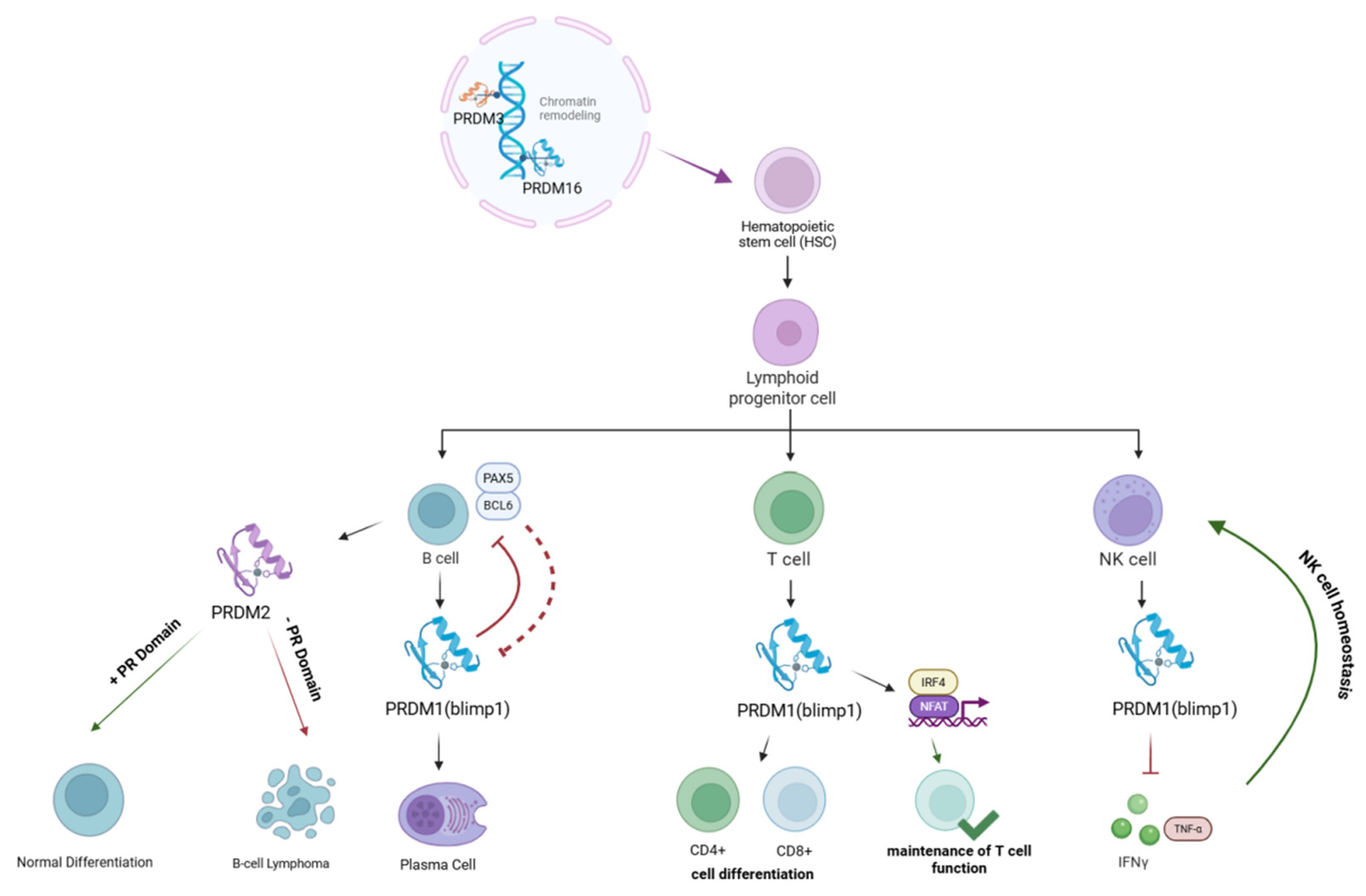
The immune system comprises innate and adaptive components that coordinate host defense through tightly regulated transcriptional and epigenetic programs. Within this regulatory framework, PRDM family proteins have emerged as key modulators of immune cell lineage commitment and functional differentiation. Among these regulators, members of the PRDM family (
Figure 1) play important roles in hematopoietic stem cell fate determination and the regulation of lymphocyte differentiation programs [
10,
16,
42].
3.1. PRDM Family in Adaptive Immune Cell Development
3.1.1. PRDM Proteins in B Cell Development and Differentiation
B cells play a key role in humoral immune responses, and their development and differentiation are tightly regulated by multilayered molecular mechanisms [
50]. The PRDM family comprises transcriptional and epigenetic regulators that play important roles in B cell fate determination and terminal differentiation [
16]. The gene PRDM1, which encodes human BLIMP1, is located on chromosome 6q21, a locus that is frequently deleted in lymphomas. PRDM1 can silence its target genes through multiple mechanisms in a context-dependent manner. It is expressed in both B cells and T cells, where it performs important regulatory functions. In B cells, PRDM1 acts as a master regulator of plasma cell differentiation. Its expression is repressed by BCL6, whereas PRDM1 in turn suppresses the expression of BCL6 and PAX5 [
24], thereby promoting the establishment of the secretory program characteristic of mature B cells. Another study used a mouse monoclonal antibody specific for PRDM1 to analyze the distribution of PRDM1 in normal human lymphoid tissues and in lymphomas corresponding to different stages of B-cell differentiation. PRDM1 expression was detected in germinal center blasts, which co-expressed Pax5, CD19, CD20, and CD10 but lacked expression of BCL6 and MTA-3, suggesting that PRDM1 expression is associated with the transition of germinal center B cells toward plasma cell differentiation [
51].
RIZ1 (PRDM2) has been reported to participate in B-cell differentiation and in the development and progression of B-cell lymphomas [
29]. Notably, PRDM2 is expressed as two isoforms that differ in the presence or absence of the PR domain. The PR domain-containing isoform exhibits tumor-suppressive activity, whereas the isoform lacking the PR domain displays oncogenic properties and is frequently overexpressed in tumor cells [
30]. This “yin–yang” regulatory pattern enables the two isoforms to exert opposing effects in cell fate determination and tumor development. Dysregulated expression of PRDM2 and its isoforms has been observed in multiple tumor types, including lymphoid malignancies [
52]. Consistent with these observations, PRDM2/RIZ1 has been suggested to interact with B cell differentiation-related signaling networks to regulate chromatin states and the expression of key genes during lymphocyte development [
28,
29], indicating a potential role in B cell differentiation and in the pathogenesis of B-cell lymphomas.
3.1.2. PRDM Proteins in T Cell Development and Functional Differentiation
T cells represent another major component of the adaptive immune system, and their development and functional differentiation also depend on precisely coordinated transcriptional regulatory networks [
53,
54]. In T cells, PRDM11 is an important factor that promotes the differentiation of most terminal effector cells in both CD4
+ and CD8
+ T cell lineages [
24]. Recent studies have shown that PRDM1 not only acts as a classical transcriptional repressor regulating immune cell differentiation but also contributes to adaptive immune responses by remodeling chromatin accessibility and epigenetic states [
49]. In T cells, PRDM1 cooperates with transcription factors such as IRF4 to integrate signals derived from persistent antigen stimulation [
25]. Through this process, it regulates the balance between effector-related gene expression and inhibitory programs, thereby contributing to the maintenance of effector T cell functions and the development of T cell exhaustion [
55].
In addition to PRDM1, which is the most extensively studied regulator of adaptive immune responses, emerging evidence suggests that other PRDM family members may also contribute to lymphoid development, particularly at early stages, based on their conserved structural features and regulatory functions observed in other cellular lineages. These proteins are proposed to influence T cell fate decisions through epigenetic regulation and interactions with core transcription factor networks [
43]. For instance, PRDM14 has been shown to regulate lymphoid progenitor expansion and is implicated in the initiation of lymphoid malignancies, including T-cell acute lymphoblastic leukemia, indicating a role in early T-lineage specification [
39,
40]. Moreover, PRDM16 plays a critical role in the maintenance of hematopoietic stem cells and early progenitor populations, which give rise to T lymphocytes [
42]. Although its direct role in mature T-cell function remains unclear, these findings suggest that PRDM16 may indirectly influence T-cell development through upstream regulation of hematopoietic differentiation.
Overall, while PRDM1 remains the central regulator in mature T-cell differentiation and function, other PRDM family members may contribute to adaptive immunity by modulating early lymphoid commitment and progenitor cell dynamics. However, their specific roles in mature T-cell subsets are still poorly defined and warrant further investigation.
3.2. PRDM Family in Innate Immune Cell Differentiation and Functional Programming
Innate immune cells constitute the first line of host defense against pathogens, and their differentiation and functional activities are tightly regulated by transcriptional and epigenetic mechanisms [
56]. Representative innate immune cells include natural killer (NK) cells, dendritic cells (DCs), and macrophages, which recognize pathogen-associated patterns through pattern recognition receptors (PRRs), thereby rapidly initiating defensive responses such as cytotoxic activity and inflammatory signaling [
57,
58,
59].
During this process, members of the PRDM family are broadly involved in the regulation of key gene programs. PRDM1 (Blimp-1), one of the earliest identified members of the PRDM family, functions as a negative regulator in NK cells. It suppresses excessive activation by directly inhibiting the production of inflammatory cytokines such as IFN-γ and TNF-α, while also contributing to terminal differentiation and the maintenance of cellular homeostasis [
26]. Another multi-omics study further revealed the role of PRDM1 in NK cell terminal differentiation and homeostasis, highlighting the critical importance of Blimp-1 during the maturation stage of NK cells, with loss of its activity being associated with increased malignancy [
14].
In addition, factors such as PRDM3 and PRDM16 may influence the formation of innate immune lineages by regulating the fate and epigenetic state of hematopoietic stem cells [
32], highlighting the importance of epigenetic networks during the early stages of innate immune cell differentiation. Although the specific roles of PRDM proteins in other innate immune cell types, such as macrophages and dendritic cells, remain insufficiently characterized, emerging evidence suggests that this transcriptional and epigenetic regulatory family contributes to the regulation of immune lineage development.
4. PRDM Family in Immune-Related Diseases
Given their central roles in immune cell development and functional differentiation, PRDM proteins are essential for maintaining immune homeostasis. Consequently, dysregulation of these regulatory networks can disrupt immune balance and contribute to the development of immune-related diseases.
4.1. Hematologic Malignancies
Hematologic malignancies are a group of clonal cancers that arise from hematopoietic stem/progenitor cells or mature immune cells within the blood, bone marrow, and lymphatic system, and primarily include leukemia, lymphoma, and multiple myeloma [
60]. These malignancies exhibit substantial heterogeneity in both clinical manifestations and cellular origins, and their initiation and progression are closely associated with the accumulation of genetic mutations and epigenetic dysregulation [
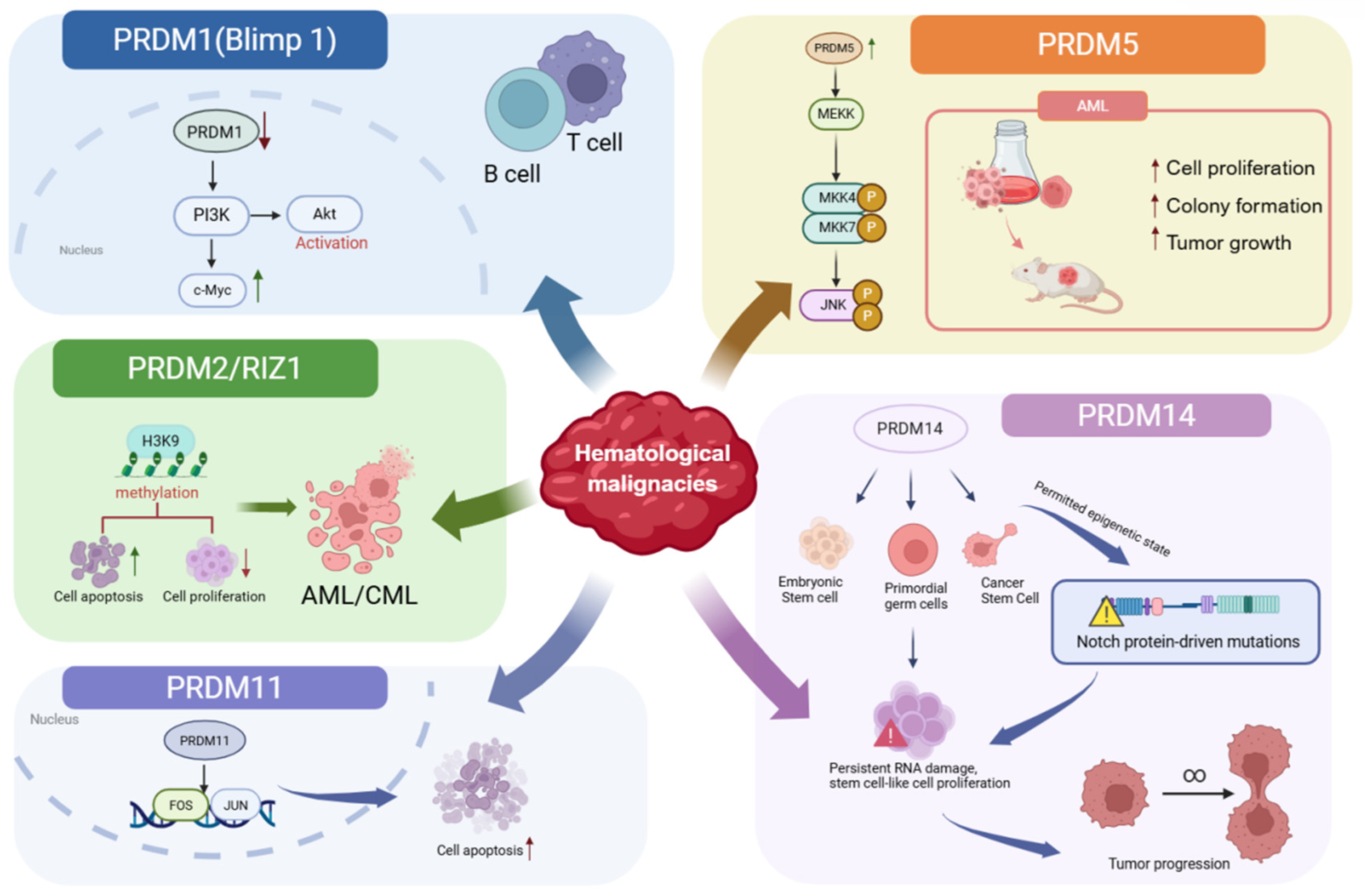
61]. Members of the PRDM family play important oncogenic or tumor-suppressive roles in hematologic malignancies (
Figure 2), and their aberrant expression or dysregulated activity can markedly influence tumor initiation, progression, and clinical prognosis.
PRDM1 (Blimp-1) functions as a tumor suppressor and plays an important pathological role in B-cell and T-cell lymphomas [
62]. Loss of PRDM1 is frequently associated with aberrant activation of the PI3K/AKT signaling pathway and correlates with poor clinical outcomes. Moreover, the PRDM1β isoform has been linked to increased c-MYC expression, further suggesting that dysregulation of PRDM1 expression and isoform balance contributes to lymphoma progression and influences patient survival [
18].
PRDM2, also known as RIZ (retinoblastoma protein-interacting zinc finger protein), has been closely implicated in hematologic malignancies. The RIZ gene, located on chromosome 1p36, has been identified as a tumor suppressor locus [
63]. It encodes two isoforms, RIZ1 and RIZ2, generated through alternative promoter usage. RIZ1 contains the N-terminal PR domain, whereas RIZ2 lacks this domain. Altered expression of RIZ has been reported in multiple human cancers, and RIZ1 in particular is widely regarded as a candidate tumor suppressor [
64]. Mechanistically, RIZ1 functions as a histone methyltransferase that catalyzes the methylation of histone H3 at lysine 9 (H3K9), a modification associated with transcriptional repression [
65]. Consistent with its tumor-suppressive role, reduced RIZ1 expression has been observed in acute myeloid leukemia (AML) cell lines and patient samples compared with normal bone marrow. In addition, RIZ1-deficient mice exhibit a high incidence of diffuse large B-cell lymphoma. In chronic myeloid leukemia (CML), blast transformation has been linked to loss of heterozygosity within chromosomal regions containing RIZ1 [
66]. Loss of RIZ1 activity has been reported to impair cellular apoptosis and differentiation while enhancing proliferative capacity, which may contribute to the expansion of bone marrow blast cells and thereby promote CML progression [
67].
In contrast, PRDM5, which is generally considered a tumor suppressor in many solid tumors, appears to exert a distinct role in hematologic malignancies. Elevated PRDM5 expression has been independently associated with poorer overall survival in patients with AML. Functional studies indicate that PRDM5 overexpression promotes cell proliferation, colony formation, and migration in vitro, and enhances tumorigenicity in xenograft models in vivo. Mechanistically, PRDM5 has been reported to act as an oncogenic driver in AML through activation of the JNK (c-Jun N-terminal kinase) signaling pathway, suggesting that PRDM5 may represent a potential therapeutic target in this disease [
35].
PRDM11 has also been implicated in the pathogenesis of hematologic malignancies, particularly diffuse large B-cell lymphoma (DLBCL). Loss of PRDM11 has been reported to cooperate with MYC overexpression to promote DLBCL progression, and PRDM11-deficient DLBCLs are associated with poorer overall survival and are predominantly classified within the non-germinal center B-cell-like (non-GCB) subtype. Mechanistically, PRDM11 is enriched at transcription start sites of its target genes and regulates the expression of key oncogenic transcription factors, including FOS and JUN. Consistent with a tumor-suppressive role, enforced PRDM11 expression inhibits cell proliferation and induces apoptosis in lymphoma cells [
38].
PRDM14 is expressed in embryonic stem cells, primordial germ cells, and a variety of cancers, where it has been shown to confer stem cell-like properties on tumor cells [
68]. Functionally, PRDM14 promotes the proliferation of stem cell-like populations while simultaneously sustaining DNA damage, a process that may contribute to genomic instability during tumor development [
69]. In hematologic malignancies, PRDM14 has been characterized as a proto-oncogene in T-cell acute lymphoblastic leukemia (T-ALL), where it expands progenitor cell populations and promotes a permissive epigenetic state for oncogenic driver mutations such as NOTCH1, thereby accelerating leukemogenesis [
41]. Collectively, these findings suggest that different members of the PRDM family contribute to the initiation and progression of hematologic malignancies through diverse molecular mechanisms.
4.2. Autoimmunity and Chronic Inflammation
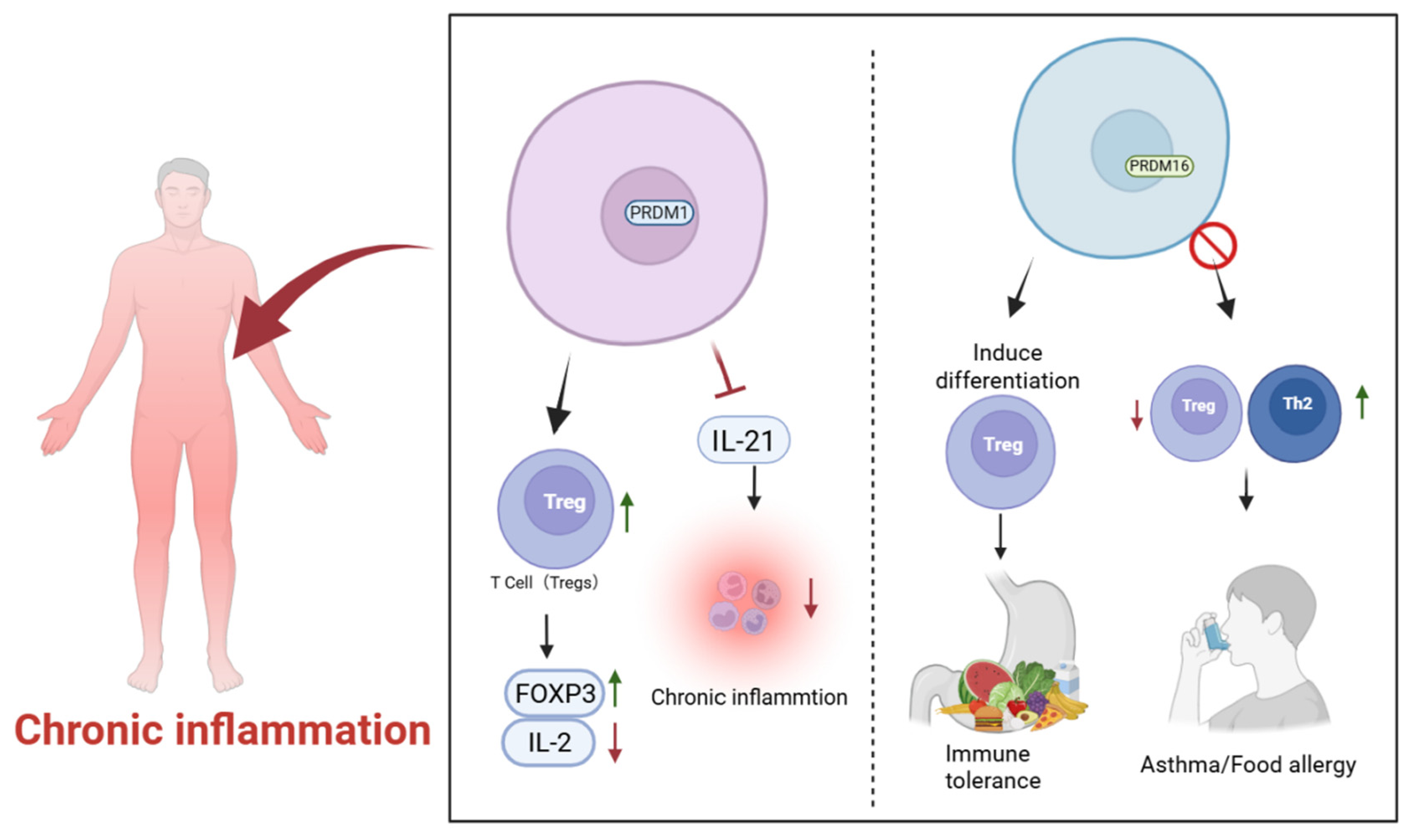
In the context of autoimmune and chronic inflammatory diseases, PRDM1 (Blimp-1) plays a central role in maintaining immune homeostasis through multiple regulatory mechanisms (
Figure 3). On the one hand, it promotes immune tolerance by enhancing the differentiation and function of regulatory T cells (Tregs) and establishing a tolerogenic transcriptional program that limits inappropriate immune activation [
27]. On the other hand, PRDM1 restrains excessive inflammatory responses by suppressing the overexpression of pro-inflammatory cytokines, thereby contributing to the control of chronic inflammation [
70]. Multi-omics analyses further demonstrate that Blimp-1 can reshape the epigenetic and transcriptional landscape of T cells, stabilizing FOXP3 expression while restricting inflammatory cytokine programs, a process that is critical for maintaining immune tolerance and preventing autoimmune injury such as graft-versus-host disease (GVHD) [
71]. In addition, PRDM1 is expressed in thymic epithelial cells (TECs), where it participates in negative selection and the establishment of central immune tolerance; loss of PRDM1 leads to the production of anti-nuclear antibodies and the development of a systemic lupus erythematosus (SLE)-like autoimmune phenotype [
72]. Furthermore, Blimp-1 has been shown to suppress IL-21 expression by reducing chromatin accessibility at the IL-21 locus. Given that IL-21 is a key pro-inflammatory cytokine implicated in several autoimmune disorders, including autoimmune diabetes, this regulatory mechanism further highlights the role of PRDM1 in limiting pathogenic immune responses [
49].
PRDM16 also plays an important role in immune tolerance and the regulation of inflammatory responses (
Figure 3). A distinct subset of PRDM16
+RORγt
+ antigen-presenting cells, referred to as tolerogenic dendritic cells (tolDCs), has been identified and shown to induce the differentiation of peripheral regulatory T cells (pTregs), thereby promoting immune tolerance to dietary and commensal microbial antigens. In the absence of PRDM16, pTreg generation is impaired, accompanied by enhanced Th2-mediated and other pro-inflammatory responses. Consequently, PRDM16 deficiency leads to a loss of immune tolerance and exacerbated inflammation in experimental models of asthma and food allergy. These findings indicate that PRDM16 is involved in mechanisms underlying chronic inflammation and immune dysregulation. Notably, this tolDC subset has also been identified in human tissues, suggesting that the underlying regulatory mechanism is evolutionarily conserved and may represent a potential therapeutic target for autoimmune and allergic inflammatory diseases [
43].
PRDM3 has also been implicated in the regulation of inflammatory responses. In the context of tumorigenesis, its expression has been reported to correlate with immune cell infiltration and the expression of immune-related markers. In addition, PRDM3 shows positive associations with molecules involved in regulatory T cell (Treg) signaling, including STAT5B and TGF-β1, suggesting that PRDM3 may contribute to the establishment of an immunosuppressive tumor microenvironment rather than promoting classical pro-inflammatory signaling pathways [
33]. Although direct evidence linking PRDM3 to canonical autoimmune diseases remains limited, these observations indicate that PRDM3 may participate in the regulation of innate immune-associated inflammatory signaling and could have potential immunopathological relevance.
In addition to the diseases discussed above, PRDM family members also contribute to inflammatory conditions, such as Psoriasis. Dysregulated expression of PRDM2, PRDM3, and PRDM8 in psoriatic lesions suggests their involvement in T cell regulation, keratinocyte proliferation, and trained immunity [
37]. Notably, isoform-specific expression patterns, including PR domain-deficient variants, indicate complex and context-dependent functions of PRDM proteins in inflammatory pathogenesis.
4.3. Inflammation-Metabolism-Immune Crosstalk in Disease
4.3.1. Osteoporosis
Osteoporosis is a systemic skeletal disorder characterized by reduced bone mineral density and deterioration of bone microarchitecture [
73]. Traditionally, its pathogenesis has been primarily attributed to an imbalance in bone remodeling, particularly the dysregulated activity between osteoblasts and osteoclasts [
74,
75]. However, accumulating evidence indicates that bone tissue is closely interconnected with the immune system. The concept of osteoimmunology highlights the complex interactions between immune cells, inflammatory mediators, and bone cells, which collectively play a crucial role in maintaining bone homeostasis as well as in the development of skeletal pathologies [
76,
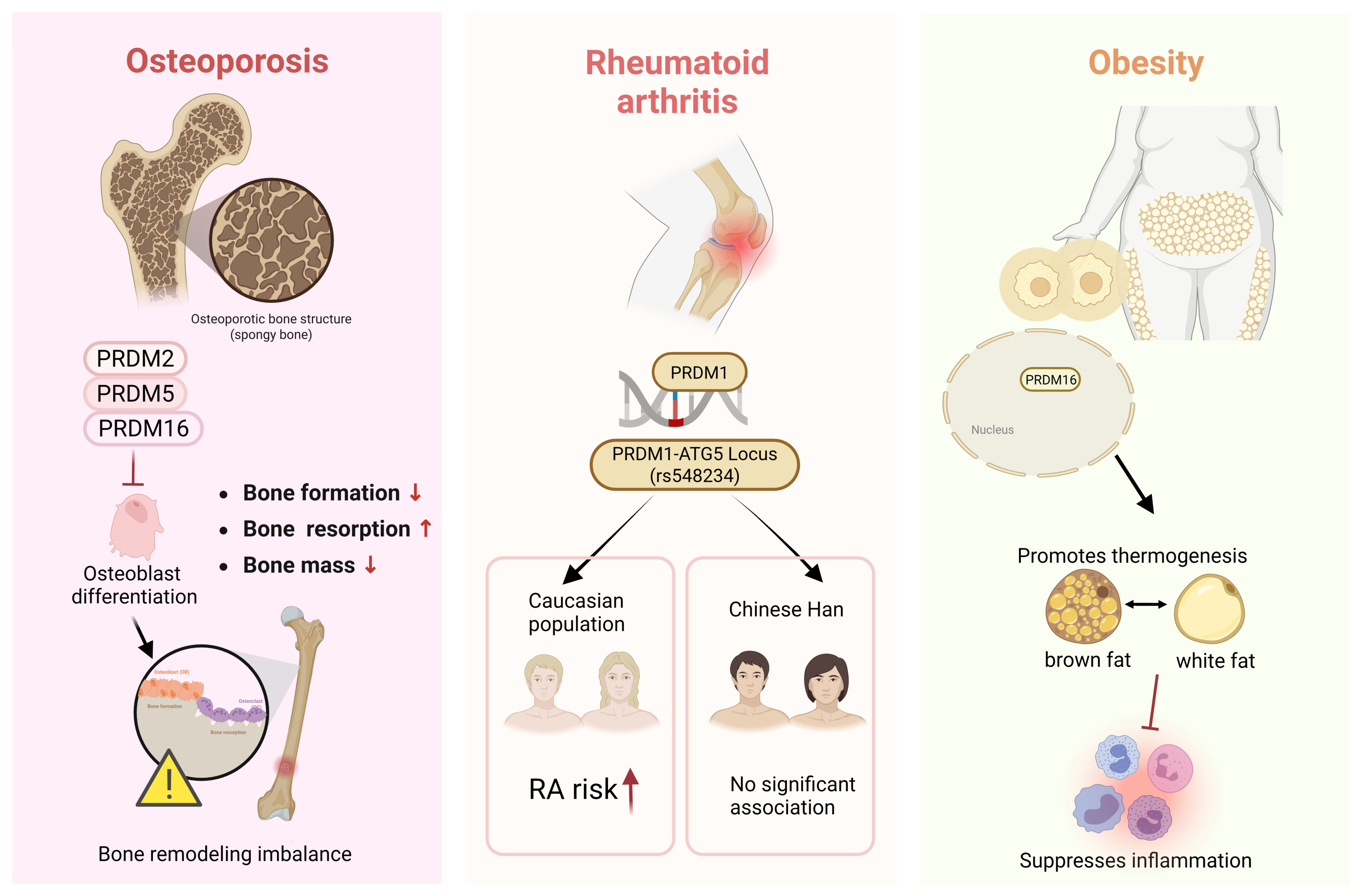
77]. In recent years, increasing attention has been directed toward the involvement of PRDM family members in the regulation of bone metabolism and skeletal homeostasis (
Figure 4).
Beyond its well-established tumor suppressor function, PRDM2/RIZ1 also plays a role in estrogen-responsive tissues. In particular, RIZ1 acts as a potent coactivator of estrogen receptorα (ERα), thereby influencing bone mineralization. Genome-wide association studies investigating genes linked to osteoporosis have identified PRDM2 as a candidate gene associated with increased osteoporosis risk, suggesting that it may contribute to the regulation of bone mineral density and bone metabolism [
78].
PRDM5 is a key regulator of extracellular matrix (ECM) gene transcription in osteoblasts. It is highly expressed in these cells and directly controls the expression of collagen I and other ECM genes by maintaining RNA polymerase II occupancy at their promoters, thereby ensuring proper transcription. Loss of PRDM5 disrupts osteoblastic ECM assembly, delays ossification, and reduces bone mass [
79], implicating its potential role in the pathogenesis of osteoporosis.
PRDM3 and PRDM16 can promote bone formation by regulating osteoblast gene expression and modulating the Wnt/β-catenin signaling pathway [
80], suggesting that they may have functional significance in conditions of bone metabolic imbalance, such as osteoporosis. Human studies indicate that in hypogonadal men, testosterone therapy upregulates PRDM16, which is associated with enhanced RUNX2 and osteogenic signaling, potentially explaining the molecular basis for increased bone mineral density [
81]. In animal models, the Mel1/Prdm16 gene appears to participate in early suppression of Runx2 during osteochondral differentiation, thereby facilitating cartilage formation. PRDM16-deficient mice exhibit skeletal abnormalities, including shortened long bones and impaired cartilage and bone development, highlighting its regulatory role in bone formation and skeletal development [
82].
Emerging evidence suggests that additional PRDM family members may also contribute to bone development and metabolic regulation, warranting further investigation in conditions such as osteoporosis. PRDM6 is known to regulate histone methylation and influence neural crest cell (NCC) lineage specification. Although no mechanistic studies have directly demonstrated a role for PRDM6 in osteogenic cells or bone metabolism, genome-wide association and phenotypic GWAS data indicate a trend linking PRDM6 to bone mineral density-related traits [
36], suggesting that it may impact skeletal development or metabolic phenotypes. PRDM proteins generally contain a PR/SET domain and can modulate the chromatin state of target genes either autonomously or through interactions with chromatin remodeling complexes, playing critical roles in the differentiation of multiple cell lineages. This epigenetic and lineage-regulatory function shares a common mechanistic basis with the determination of osteoblast and chondrocyte fate, as well as the balance between osteoblast and osteoclast activity [
8], Accordingly, less-studied PRDM family members represent potential regulatory candidates in the pathogenesis of osteoporosis and merit detailed investigation in future studies.
4.3.2. Rheumatoid Arthritis
Rheumatoid arthritis (RA) is a chronic systemic autoimmune disease characterized by synovial inflammation, progressive joint destruction, and persistent immune-mediated inflammatory responses [
83,
84]. Increasing evidence suggests that the pathogenesis of RA involves not only aberrant activation of immune cells but also profound immunometabolic reprogramming. The dynamic interplay between metabolic pathways and immune responses is now recognized as a key driver of disease initiation and progression [
85].
Recent genome-wide association studies (GWAS) have identified a significant association between the rs548234 polymorphism located within the PRDM1–ATG5 locus and susceptibility to rheumatoid arthritis (RA) in Caucasian populations, suggesting that PRDM1 may represent a potential genetic risk factor for RA [
86]. However, studies conducted in Chinese Han populations have not detected a significant association between this variant and RA susceptibility or clinical phenotypes, either in the overall cohort or after stratification by rheumatoid factor (RF) and anti-cyclic citrullinated peptide (anti-CCP) antibody status [
87]. These findings indicate that the relationship between the PRDM1–ATG5 rs548234 variant and RA susceptibility may be population-specific (
Figure 4).
Beyond PRDM1, direct genetic or functional evidence linking other members of the PRDM family to RA remains limited. Nevertheless, their established roles in immune regulation, inflammatory signaling, and immune cell function suggest that they may indirectly contribute to the immunopathology of RA. Previous studies have shown that PRDM2/RIZ functions as a transcriptional regulator during T-cell activation and differentiation, exhibiting functional coupling with key signaling pathways such as PI3K and MAPK and participating in the remodeling of immune-related transcriptional programs [
28]. Given that the PI3K-AKT and MAPK pathways play central roles in RA by driving aberrant T-cell activation, amplifying inflammatory responses, and promoting pathological remodeling of the synovium [
88,
89], PRDM2 may influence RA pathogenesis indirectly through modulation of T-cell signaling and transcriptional reprogramming. Therefore, despite the current lack of direct evidence, the potential involvement of PRDM2 and other PRDM family members in RA warrants further systematic investigation.
4.3.3. Obesity
Obesity and its associated metabolic disturbances represent a prominent manifestation of metabolic–immune crosstalk disorders [
90], with the regulation of energy homeostasis in adipose tissue constituting a central underlying mechanism [
91]. Under obese conditions, adipose tissue functions not merely as an energy storage site but rather as a highly active endocrine and immunoregulatory organ. This functional transition is accompanied by extensive structural and metabolic remodeling, characterized by immune cell infiltration, sustained production of inflammatory mediators, and disruption of metabolic homeostasis [
92]. A large body of evidence indicates that both the abundance and phenotypic composition of immune cells within adipose tissue—particularly macrophages and T cells—are markedly altered during obesity. Persistent activation of pro-inflammatory immune responses promotes a state of chronic low-grade inflammation, which in turn interferes with insulin signaling and lipid metabolic processes [
93,
94,
95]. Consequently, the dynamic regulation of adipose tissue energy balance and its immune microenvironment is widely considered a critical mechanism linking obesity with chronic inflammation and metabolic dysregulation.
Among PRDM family members, PRDM16 has emerged as a particularly prominent regulator in this context (
Figure 4). Acting as a key transcriptional regulator, PRDM16 plays a central role in the differentiation and functional maintenance of brown adipose tissue (BAT) and beige adipocytes. Its overexpression markedly increases energy expenditure, limits high-fat diet-induced weight gain, and improves glucose tolerance, whereas loss of PRDM16 leads to reduced expression of thermogenic genes and promotes the development of an obese phenotype [
44]. Beyond its direct activation of thermogenic gene programs, PRDM16 also contributes to metabolic regulation through suppression of inflammatory signaling pathways. In adipocytes, PRDM16 has been shown to inhibit type I interferon (IFN) signaling, thereby preventing IRF1-mediated activation of pro-inflammatory target genes. Through this mechanism, PRDM16 preserves mitochondrial function and thermogenic capacity, highlighting its role as a molecular link between metabolic regulation and inflammatory signaling in adipose tissue [
45]. PRDM16 also cooperates with several transcriptional cofactors, including PPARγ, PGC-1α [
96], and NFIA [
97], to regulate the gene program of thermogenic adipocytes, while the PRDM16-GTF2IRD1/EHMT1 transcriptional complex represses obesity-associated adipose tissue fibrosis [
98,
99], thereby improving systemic glucose homeostasis and metabolic phenotypes.
Clinical observations together with cellular evidence further support an important role for PRDM16 in obesity and metabolic regulation. Studies have shown that PRDM16 expression is significantly reduced in adipose tissue of individuals with obesity and is associated with decreased insulin sensitivity. Moreover, the expression of PRDM16 can be modulated by insulin-sensitizing agents, such as metformin and rosiglitazone [
100]. These findings suggest that, beyond its role in adipose energy metabolism, PRDM16 may represent a potential therapeutic target for the treatment of obesity and metabolic syndrome. By promoting thermogenic programming, PRDM16 can improve adipose tissue metabolic status and attenuate local inflammation, which may in turn influence systemic inflammatory responses.
Accumulating evidence suggests that, in addition to PRDM16, other members of the PRDM family may also participate in the regulation of obesity-related energy metabolism. For example, PRDM4 has been reported to regulate energy expenditure and the expression of beige adipocyte-associated genes in adipose tissue, and its deficiency exacerbates high-fat diet-induced obesity, indicating a positive role for PRDM4 in metabolic regulation [
34]. Although direct high-impact evidence linking PRDM3 to obesity remains limited, mechanistic studies indicate that both PRDM3 and PRDM16 can interact with the transcriptional coactivator MED1 and contribute to the regulation of brown adipose-specific gene expression [
101]. Under conditions of PRDM16 deficiency, PRDM3 is able to partially compensate for the regulation of thermogenic gene programs, suggesting that PRDM3 may indirectly participate in obesity-related metabolic regulation through similar transcriptional mechanisms and potentially influence immunometabolic balance. In addition, genome-wide association studies (GWAS) have identified multiple genetic loci associated with obesity, including PRDM6 [
102], providing new insights into the genetic determinants and complex regulatory networks underlying obesity.
5. Conclusions
The PRDM family comprises a group of transcriptional and epigenetic regulators characterized by the presence of a PR/SET domain. These proteins play essential roles in the immune system by governing cell lineage determination, functional differentiation, and the maintenance of immune homeostasis. Through subtype-specific regulatory mechanisms, PRDM proteins modulate chromatin architecture and transcriptional programs that control the development and function of both innate and adaptive immune cells, while also contributing to the regulation of inflammatory responses and immune tolerance. Emerging evidence further indicates that PRDM family members are involved in the pathogenesis of hematological malignancies, autoimmune disorders, and immunometabolic diseases, including obesity and osteoporosis. A comprehensive understanding of these findings provides an integrated view of the biological significance of PRDM proteins in immune regulation and offers a conceptual framework for exploring their roles in disease.
Despite the growing body of evidence supporting the roles of PRDM family proteins in immune regulation, several limitations should be acknowledged. First, the current understanding of PRDM function is highly uneven across family members, with PRDM1/Blimp-1 being extensively studied, while many other PRDM proteins remain poorly characterized. Second, findings from different studies are sometimes inconsistent or even contradictory, likely due to variations in experimental models, cell types, and disease contexts. For example, certain PRDM proteins have been reported to exert both pro-inflammatory and anti-inflammatory effects depending on the cellular environment, highlighting the context-dependent nature of their regulatory functions. Moreover, most available studies are based on in vitro systems or animal models, and there is still a lack of well-controlled human studies to validate these findings. In addition, the potential compensatory or redundant functions among PRDM family members have not been fully explored. Future investigations should therefore aim to clarify the cell type-specific functions of PRDM proteins and define their roles within broader transcriptional and epigenetic regulatory networks. Advances in high-resolution approaches, including single-cell transcriptomics, epigenomic profiling, and functional genetic models, will provide valuable tools to dissect PRDM-dependent regulatory circuits in immune cells. A deeper understanding of these mechanisms may ultimately facilitate the identification of new molecular targets for therapeutic intervention in hematological, autoimmune, and immunometabolic diseases.
Importantly, current studies on PRDM family proteins in infection-related immunity remain very limited. The roles of PRDM members in host–pathogen interactions, innate immune activation, and antimicrobial responses are still largely unexplored. Further investigations are required to elucidate their potential regulatory mechanisms in infection-associated immune processes.
Therefore, future studies should focus on systematically characterizing less-studied PRDM proteins, clarifying their context-specific roles in different immune cell subsets, and integrating multi-omics approaches to better understand their regulatory networks. Furthermore, well-designed in vivo and clinical studies are needed to evaluate their translational potential in immune-related diseases.
Author Contributions
Conceptualization, L.Z.; writing and original draft preparation, S.D., H.L. and C.G.; visualization, S.D.; writing-review and editing, L.Z. and J.Z.; supervision, L.Z.; funding acquisition, L.Z. All authors have read and agreed to the published version of the manuscript.
Funding
This research was funded by the National Natural Science Foundation of China, grant number 82272608; Shanghai Oriental Talent Program Youth, grant number QNJY2024171; and the Shanghai Key Laboratory of Human Performance (Shanghai University of Sport), grant number 11DZ2261100.
Institutional Review Board Statement
Not applicable.
Informed Consent Statement
Not applicable.
Data Availability Statement
The authors have reviewed and edited the output and take full responsibility for the content of this publication.
Acknowledgments
During the preparation of this manuscript, the authors used BioRender (
https://biorender.com/) for the generation of schematic figures. The authors used ChatGPT (OpenAI, GPT-5 series) only for English language polishing and manuscript readability improvement during the preparation of this manuscript. The authors have reviewed and edited the output and take full responsibility for the content of this publication.
Conflicts of Interest
The authors declare no conflicts of interest. The funders had no role in the design of the study; in the collection, analyses, or interpretation of data; in the writing of the manuscript; or in the decision to publish the results.
Abbreviations
| AML | acute myeloid leukemia |
| BAT | brown adipose tissue |
| BLIMP-1 | B lymphocyte-induced maturation protein 1 |
| CML | chronic myeloid leukemia |
| DCs | dendritic cells |
| DLBCL | diffuse large B-cell lymphoma |
| ECM | extracellular matrix |
| GVHD | graft-versus-host disease |
| GWAS | genome-wide association studies |
| HSCs | hematopoietic stem cells |
| MAMPs | microbe-associated molecular patterns |
| NK cells | natural killer cells |
| PRDM | PRDI-BF1 and RIZ homology domain-containing protein |
| PRRs | pattern recognition receptors |
| RA | rheumatoid arthritis |
| SLE | systemic lupus erythematosus |
| T-ALL | T-cell acute lymphoblastic leukemia |
| TECs | thymic epithelial cells |
| Th cells | T helper cells |
| tolDCs | tolerogenic dendritic cells |
| Tregs | regulatory T cells |
| pTregs | peripheral regulatory T cells |
References
- Parkin, J.; Cohen, B. An overview of the immune system. Lancet 2001, 357, 1777–1789. [Google Scholar] [CrossRef]
- Chaplin, D.D. Overview of the immune response. J. Allergy Clin. Immunol. 2010, 125, S3–S23. [Google Scholar] [CrossRef]
- Allis, C.D.; Jenuwein, T. The molecular hallmarks of epigenetic control. Nat. Rev. Genet. 2016, 17, 487–500. [Google Scholar] [CrossRef]
- Wilson, C.B.; Rowell, E.; Sekimata, M. Epigenetic control of T-helper-cell differentiation. Nat. Rev. Immunol. 2009, 9, 91–105. [Google Scholar] [CrossRef]
- Zweemer, A.J.; Toraskar, J.; Heitman, L.H.; IJzerman, A.P. Bias in chemokine receptor signalling. Trends Immunol. 2014, 35, 243–252. [Google Scholar] [CrossRef] [PubMed]
- Lim, P.S.; Li, J.; Holloway, A.F.; Rao, S. Epigenetic regulation of inducible gene expression in the immune system. Immunology 2013, 139, 285–293. [Google Scholar] [CrossRef]
- Smale, S.T. Transcriptional regulation in the immune system: A status report. Trends Immunol. 2014, 35, 190–194. [Google Scholar] [CrossRef] [PubMed]
- Di Zazzo, E.; De Rosa, C.; Abbondanza, C.; Moncharmont, B. PRDM Proteins: Molecular Mechanisms in Signal Transduction and Transcriptional Regulation. Biology 2013, 2, 107–141. [Google Scholar] [CrossRef]
- Mzoughi, S.; Tan, Y.X.; Low, D.; Guccione, E. The role of PRDMs in cancer: One family, two sides. Curr. Opin. Genet. Dev. 2016, 36, 83–91. [Google Scholar] [CrossRef]
- Hohenauer, T.; Moore, A.W. The Prdm family: Expanding roles in stem cells and development. Development 2012, 139, 2267–2282. [Google Scholar] [CrossRef]
- Di Tullio, F.; Schwarz, M.; Zorgati, H.; Mzoughi, S.; Guccione, E. The duality of PRDM proteins: Epigenetic and structural perspectives. Febs J. 2022, 289, 1256–1275. [Google Scholar] [CrossRef]
- Shen, L.; Chen, Q.; Yang, C.; Wu, Y.; Yuan, H.; Chen, S.; Ou, S.; Jiang, Y.; Huang, T.; Ke, L.; et al. Role of PRDM1 in Tumor Immunity and Drug Response: A Pan-Cancer Analysis. Front. Pharmacol. 2020, 11, 593195. [Google Scholar] [CrossRef]
- Wang, X.; Chang, H.; Gao, G.; Su, B.; Deng, Q.; Zhou, H.; Wang, Q.; Lin, Y.; Ding, Y. Silencing of PRDM5 increases cell proliferation and inhibits cell apoptosis in glioma. Int. J. Neurosci. 2021, 131, 144–153. [Google Scholar] [CrossRef]
- Liu, X.; Shi, Y.; Zhang, J.; Shetty, K.; Chew, K.; Küçük, C.; Gong, Q.; Esmeray, E.; Li, H.; Chen, R.; et al. Key regulatory roles of PRDM1 in human NK-cell differentiation and activation. Leukemia 2026, 40, 199–210. [Google Scholar] [CrossRef]
- Kajimura, S.; Spiegelman, B.M.; Seale, P. Brown and Beige Fat: Physiological Roles beyond Heat Generation. Cell Metab. 2015, 22, 546–559. [Google Scholar] [CrossRef]
- Martins, G.; Calame, K. Regulation and functions of Blimp-1 in T and B lymphocytes. Annu. Rev. Immunol. 2008, 26, 133–169. [Google Scholar] [CrossRef] [PubMed]
- Shapiro-Shelef, M.; Calame, K. Regulation of plasma-cell development. Nat. Rev. Immunol. 2005, 5, 230–242. [Google Scholar] [CrossRef] [PubMed]
- Xia, Y.; Xu-Monette, Z.Y.; Tzankov, A.; Li, X.; Manyam, G.C.; Murty, V.; Bhagat, G.; Zhang, S.; Pasqualucci, L.; Visco, C.; et al. Loss of PRDM1/BLIMP-1 function contributes to poor prognosis of activated B-cell-like diffuse large B-cell lymphoma. Leukemia 2017, 31, 625–636. [Google Scholar] [CrossRef]
- Prajapati, R.S.; Hintze, M.; Streit, A. PRDM1 controls the sequential activation of neural, neural crest and sensory progenitor determinants. Development 2019, 146, dev181107. [Google Scholar] [CrossRef] [PubMed]
- Leszczyński, P.; Śmiech, M.; Salam Teeli, A.; Haque, E.; Viger, R.; Ogawa, H.; Pierzchała, M.; Taniguchi, H. Deletion of the Prdm3 Gene Causes a Neuronal Differentiation Deficiency in P19 Cells. Int. J. Mol. Sci. 2020, 21, 7192. [Google Scholar] [CrossRef]
- Li, X.; Wang, J.; Jiang, Z.; Guo, F.; Soloway, P.D.; Zhao, R. Role of PRDM16 and its PR domain in the epigenetic regulation of myogenic and adipogenic genes during transdifferentiation of C2C12 cells. Gene 2015, 570, 191–198. [Google Scholar] [CrossRef]
- Akman, B.; Hu, X.; Liu, X.; Hatipoğlu, T.; You, H.; Chan, W.C.; Küçük, C. PRDM1 decreases sensitivity of human NK cells to IL2-induced cell expansion by directly repressing CD25 (IL2RA). J. Leukoc. Biol. 2021, 109, 901–914. [Google Scholar] [CrossRef]
- Bikoff, E.K.; Morgan, M.A.; Robertson, E.J. An expanding job description for Blimp-1/PRDM1. Curr. Opin. Genet. Dev. 2009, 19, 379–385. [Google Scholar] [CrossRef]
- Boi, M.; Zucca, E.; Inghirami, G.; Bertoni, F. PRDM1/BLIMP1: A tumor suppressor gene in B and T cell lymphomas. Leuk. Lymphoma 2015, 56, 1223–1228. [Google Scholar] [CrossRef]
- Cretney, E.; Xin, A.; Shi, W.; Minnich, M.; Masson, F.; Miasari, M.; Belz, G.T.; Smyth, G.K.; Busslinger, M.; Nutt, S.L.; et al. The transcription factors Blimp-1 and IRF4 jointly control the differentiation and function of effector regulatory T cells. Nat. Immunol. 2011, 12, 304–311. [Google Scholar] [CrossRef]
- Smith, M.A.; Maurin, M.; Cho, H.I.; Becknell, B.; Freud, A.G.; Yu, J.; Wei, S.; Djeu, J.; Celis, E.; Caligiuri, M.A.; et al. PRDM1/Blimp-1 controls effector cytokine production in human NK cells. J. Immunol. 2010, 185, 6058–6067. [Google Scholar] [CrossRef] [PubMed]
- Garg, G.; Muschaweckh, A.; Moreno, H.; Vasanthakumar, A.; Floess, S.; Lepennetier, G.; Oellinger, R.; Zhan, Y.; Regen, T.; Hiltensperger, M.; et al. Blimp1 Prevents Methylation of Foxp3 and Loss of Regulatory T Cell Identity at Sites of Inflammation. Cell Rep. 2019, 26, 1854–1868.e5. [Google Scholar] [CrossRef] [PubMed]
- Di Zazzo, E.; Rienzo, M.; Casamassimi, A.; De Rosa, C.; Medici, N.; Gazzerro, P.; Bifulco, M.; Abbondanza, C. Exploring the putative role of PRDM1 and PRDM2 transcripts as mediators of T lymphocyte activation. J. Transl. Med. 2023, 21, 217. [Google Scholar] [CrossRef]
- Derunes, C.; Briknarová, K.; Geng, L.; Li, S.; Gessner, C.R.; Hewitt, K.; Wu, S.; Huang, S.; Woods, V.I., Jr.; Ely, K.R. Characterization of the PR domain of RIZ1 histone methyltransferase. Biochem. Biophys. Res. Commun. 2005, 333, 925–934. [Google Scholar] [CrossRef] [PubMed]
- Sorrentino, A.; Rienzo, M.; Ciccodicola, A.; Casamassimi, A.; Abbondanza, C. Human PRDM2: Structure, function and pathophysiology. Biochim. Biophys. Acta Gene Regul. Mech. 2018, 1861, 657–671. [Google Scholar] [CrossRef]
- Ivanochko, D.; Halabelian, L.; Henderson, E.; Savitsky, P.; Jain, H.; Marcon, E.; Duan, S.; Hutchinson, A.; Seitova, A.; Barsyte-Lovejoy, D.; et al. Direct interaction between the PRDM3 and PRDM16 tumor suppressors and the NuRD chromatin remodeling complex. Nucleic Acids Res. 2019, 47, 1225–1238. [Google Scholar] [CrossRef]
- McGlynn, K.A.; Sun, R.; Vonica, A.; Rudzinskas, S.; Zhang, Y.; Perkins, A.S. Prdm3 and Prdm16 cooperatively maintain hematopoiesis and clonogenic potential. Exp. Hematol. 2020, 85, 20–32.e3. [Google Scholar] [CrossRef] [PubMed]
- Li, M.; Ren, H.; Zhang, Y.; Liu, N.; Fan, M.; Wang, K.; Yang, T.; Chen, M.; Shi, P. MECOM/PRDM3 and PRDM16 Serve as Prognostic-Related Biomarkers and Are Correlated With Immune Cell Infiltration in Lung Adenocarcinoma. Front. Oncol. 2022, 12, 772686. [Google Scholar] [CrossRef] [PubMed]
- Song, N.J.; Choi, S.; Rajbhandari, P.; Chang, S.H.; Kim, S.; Vergnes, L.; Kwon, S.M.; Yoon, J.H.; Lee, S.; Ku, J.M.; et al. Prdm4 induction by the small molecule butein promotes white adipose tissue browning. Nat. Chem. Biol. 2016, 12, 479–481. [Google Scholar] [CrossRef]
- Zhou, P.; Chen, X.; Li, M.; Sun, X.; Tan, J.; Wang, X.; Chu, Y.; Zhang, Y.; Cheng, T.; Zhou, J.; et al. Overexpression of PRDM5 promotes acute myeloid leukemia cell proliferation and migration by activating the JNK pathway. Cancer Med. 2019, 8, 3905–3917. [Google Scholar] [CrossRef]
- Rouillard, A.D.; Gundersen, G.W.; Fernandez, N.F.; Wang, Z.; Monteiro, C.D.; McDermott, M.G.; Ma’ayan, A. The harmonizome: A collection of processed datasets gathered to serve and mine knowledge about genes and proteins. Database 2016, 2016, baw100. [Google Scholar] [CrossRef]
- Romhányi, D.; Bessenyei, Á.; Szabó, K.; Kemény, L.; Gyulai, R.; Groma, G. Unveiling the Role of Histone Methyltransferases in Psoriasis Pathogenesis: Insights from Transcriptomic Analysis. Int. J. Mol. Sci. 2025, 26, 6329. [Google Scholar] [CrossRef]
- Fog, C.K.; Asmar, F.; Côme, C.; Jensen, K.T.; Johansen, J.V.; Kheir, T.B.; Jacobsen, L.; Friis, C.; Louw, A.; Rosgaard, L.; et al. Loss of PRDM11 promotes MYC-driven lymphomagenesis. Blood 2015, 125, 1272–1281. [Google Scholar] [CrossRef]
- Dettman, E.J.; Simko, S.J.; Ayanga, B.; Carofino, B.L.; Margolin, J.F.; Morse, H.C., III; Justice, M.J. Prdm14 initiates lymphoblastic leukemia after expanding a population of cells resembling common lymphoid progenitors. Oncogene 2011, 30, 2859–2873. [Google Scholar] [CrossRef]
- Tracey, L.J.; El-Maklizi, M.; Sokolowski, D.J.; Gams, M.S.; Brooke-Bisschop, T.; Ruston, J.; Taylor, C.; Khozin, A.; Rajakumar, S.A.; Wilson, M.D.; et al. Functional and molecular single-cell analyses implicate PRDM14 in the initiation of B cell leukemia in mice. Sci. Rep. 2025, 15, 8827. [Google Scholar] [CrossRef]
- Carofino, B.L.; Ayanga, B.; Tracey, L.J.; Brooke-Bisschop, T.; Justice, M.J. PRDM14 promotes RAG-dependent Notch1 driver mutations in mouse T-ALL. Biol. Open 2016, 5, 645–653. [Google Scholar] [CrossRef]
- Aguilo, F.; Avagyan, S.; Labar, A.; Sevilla, A.; Lee, D.F.; Kumar, P.; Lemischka, I.R.; Zhou, B.Y.; Snoeck, H.W. Prdm16 is a physiologic regulator of hematopoietic stem cells. Blood 2011, 117, 5057–5066. [Google Scholar] [CrossRef]
- Fu, L.; Upadhyay, R.; Pokrovskii, M.; Chen, F.M.; Romero-Meza, G.; Griesemer, A.; Littman, D.R. PRDM16-dependent antigen-presenting cells induce tolerance to gut antigens. Nature 2025, 642, 756–765. [Google Scholar] [CrossRef] [PubMed]
- Seale, P.; Conroe, H.M.; Estall, J.; Kajimura, S.; Frontini, A.; Ishibashi, J.; Cohen, P.; Cinti, S.; Spiegelman, B.M. Prdm16 determines the thermogenic program of subcutaneous white adipose tissue in mice. J. Clin. Investig. 2011, 121, 96–105. [Google Scholar] [CrossRef] [PubMed]
- Kissig, M.; Ishibashi, J.; Harms, M.J.; Lim, H.W.; Stine, R.R.; Won, K.J.; Seale, P. PRDM16 represses the type I interferon response in adipocytes to promote mitochondrial and thermogenic programing. Embo J. 2017, 36, 1528–1542. [Google Scholar] [CrossRef]
- Lodewijk, I.; Nunes, S.P.; Henrique, R.; Jerónimo, C.; Dueñas, M.; Paramio, J.M. Tackling tumor microenvironment through epigenetic tools to improve cancer immunotherapy. Clin. Epigenet. 2021, 13, 63. [Google Scholar] [CrossRef] [PubMed]
- Kouzarides, T. Chromatin modifications and their function. Cell 2007, 128, 693–705. [Google Scholar] [CrossRef]
- Tanaka, H.; Muto, A.; Shima, H.; Katoh, Y.; Sax, N.; Tajima, S.; Brydun, A.; Ikura, T.; Yoshizawa, N.; Masai, H.; et al. Epigenetic Regulation of the Blimp-1 Gene (Prdm1) in B Cells Involves Bach2 and Histone Deacetylase 3. J. Biol. Chem. 2016, 291, 6316–6330. [Google Scholar] [CrossRef]
- Liu, Y.W.; Fu, S.H.; Chien, M.W.; Hsu, C.Y.; Lin, M.H.; Dong, J.L.; Lu, R.J.; Lee, Y.J.; Chen, P.Y.; Wang, C.H.; et al. Blimp-1 molds the epigenetic architecture of IL-21-mediated autoimmune diseases through an autoregulatory circuit. JCI Insight 2022, 7, e151614. [Google Scholar] [CrossRef]
- Nutt, S.L.; Hodgkin, P.D.; Tarlinton, D.M.; Corcoran, L.M. The generation of antibody-secreting plasma cells. Nat. Rev. Immunol. 2015, 15, 160–171. [Google Scholar] [CrossRef]
- Cattoretti, G.; Angelin-Duclos, C.; Shaknovich, R.; Zhou, H.; Wang, D.; Alobeid, B. PRDM1/Blimp-1 is expressed in human B-lymphocytes committed to the plasma cell lineage. J. Pathol. 2005, 206, 76–86. [Google Scholar] [CrossRef]
- Sorrentino, A.; Federico, A.; Rienzo, M.; Gazzerro, P.; Bifulco, M.; Ciccodicola, A.; Casamassimi, A.; Abbondanza, C. PR/SET Domain Family and Cancer: Novel Insights from the Cancer Genome Atlas. Int. J. Mol. Sci. 2018, 19, 3250. [Google Scholar] [CrossRef]
- Kuo, C.T.; Leiden, J.M. Transcriptional regulation of T lymphocyte development and function. Annu. Rev. Immunol. 1999, 17, 149–187. [Google Scholar] [CrossRef]
- Zhu, J.; Paul, W.E. Peripheral CD4+ T-cell differentiation regulated by networks of cytokines and transcription factors. Immunol. Rev. 2010, 238, 247–262. [Google Scholar] [CrossRef] [PubMed]
- Gonzalez-Figueroa, P.; Roco, J.A.; Papa, I.; Núñez Villacís, L.; Stanley, M.; Linterman, M.A.; Dent, A.; Canete, P.F.; Vinuesa, C.G. Follicular regulatory T cells produce neuritin to regulate B cells. Cell 2021, 184, 1775–1789.e19. [Google Scholar] [CrossRef]
- Björkström, N.K.; Strunz, B.; Ljunggren, H.G. Natural killer cells in antiviral immunity. Nat. Rev. Immunol. 2022, 22, 112–123. [Google Scholar] [CrossRef]
- Chen, R.; Zou, J.; Chen, J.; Zhong, X.; Kang, R.; Tang, D. Pattern recognition receptors: Function, regulation and therapeutic potential. Signal Transduct. Target. Ther. 2025, 10, 216. [Google Scholar] [CrossRef] [PubMed]
- Akira, S.; Uematsu, S.; Takeuchi, O. Pathogen recognition and innate immunity. Cell 2006, 124, 783–801. [Google Scholar] [CrossRef] [PubMed]
- Takeuchi, O.; Akira, S. Pattern recognition receptors and inflammation. Cell 2010, 140, 805–820. [Google Scholar] [CrossRef]
- Lauzon-Young, C.; Silva, A.; Sadikovic, B. Epigenomic insights and computational advances in hematologic malignancies. Mol. Cytogenet. 2025, 18, 9. [Google Scholar] [CrossRef]
- Zhao, A.; Zhou, H.; Yang, J.; Li, M.; Niu, T. Epigenetic regulation in hematopoiesis and its implications in the targeted therapy of hematologic malignancies. Signal Transduct. Target. Ther. 2023, 8, 71. [Google Scholar] [CrossRef]
- Pasqualucci, L.; Compagno, M.; Houldsworth, J.; Monti, S.; Grunn, A.; Nandula, S.V.; Aster, J.C.; Murty, V.V.; Shipp, M.A.; Dalla-Favera, R. Inactivation of the PRDM1/BLIMP1 gene in diffuse large B cell lymphoma. J. Exp. Med. 2006, 203, 311–317. [Google Scholar] [CrossRef] [PubMed]
- Sun, W.; Geyer, C.R.; Yang, J. Cloning, expression, purification and crystallization of the PR domain of human retinoblastoma protein-binding zinc finger protein 1 (RIZ1). Int. J. Mol. Sci. 2008, 9, 943–950. [Google Scholar] [CrossRef]
- Gazzerro, P.; Abbondanza, C.; D’Arcangelo, A.; Rossi, M.; Medici, N.; Moncharmont, B.; Puca, G.A. Modulation of RIZ gene expression is associated to estradiol control of MCF-7 breast cancer cell proliferation. Exp. Cell Res. 2006, 312, 340–349. [Google Scholar] [CrossRef] [PubMed]
- Carling, T.; Kim, K.C.; Yang, X.H.; Gu, J.; Zhang, X.K.; Huang, S. A histone methyltransferase is required for maximal response to female sex hormones. Mol. Cell. Biol. 2004, 24, 7032–7042. [Google Scholar] [CrossRef]
- Pastural, E.; Takahashi, N.; Dong, W.F.; Bainbridge, M.; Hull, A.; Pearson, D.; Huang, S.; Lowsky, R.; DeCoteau, J.F.; Geyer, C.R. RIZ1 repression is associated with insulin-like growth factor-1 signaling activation in chronic myeloid leukemia cell lines. Oncogene 2007, 26, 1586–1594. [Google Scholar] [CrossRef] [PubMed]
- Lakshmikuttyamma, A.; Takahashi, N.; Pastural, E.; Torlakovic, E.; Amin, H.M.; Garcia-Manero, G.; Voralia, M.; Czader, M.; DeCoteau, J.F.; Geyer, C.R. RIZ1 is potential CML tumor suppressor that is down-regulated during disease progression. J. Hematol. Oncol. 2009, 2, 28. [Google Scholar] [CrossRef]
- Imai, K.; Taniguchi, H. Therapeutic siRNA targeting the cancer cell stemness regulator PRDI-BF1 and RIZ domain zinc finger protein 14. Proc. Jpn. Acad. Ser. B Phys. Biol. Sci. 2022, 98, 325–335. [Google Scholar] [CrossRef]
- Tracey, L.J.; Justice, M.J. Off to a Bad Start: Cancer Initiation by Pluripotency Regulator PRDM14. Trends Genet. 2019, 35, 489–500. [Google Scholar] [CrossRef]
- Qin, Q.; Li, R.; Li, L.; Zhang, Y.; Deng, S.; Zhu, L. Multi-target regulation of pro-inflammatory cytokine production by transcription factor Blimp-1. Inflamm. Res. 2023, 72, 217–220. [Google Scholar] [CrossRef]
- Guo, H.; Wang, M.; Wang, B.; Guo, L.; Cheng, Y.; Wang, Z.; Sun, Y.Q.; Wang, Y.; Chang, Y.J.; Huang, X.J. PRDM1 Drives Human Primary T Cell Hyporesponsiveness by Altering the T Cell Transcriptome and Epigenome. Front. Immunol. 2022, 13, 879501. [Google Scholar] [CrossRef] [PubMed]
- Roberts, N.A.; Adams, B.D.; McCarthy, N.I.; Tooze, R.M.; Parnell, S.M.; Anderson, G.; Kaech, S.M.; Horsley, V. Prdm1 Regulates Thymic Epithelial Function To Prevent Autoimmunity. J. Immunol. 2017, 199, 1250–1260. [Google Scholar] [CrossRef]
- Hawker, G.A. The epidemiology of osteoporosis. J. Rheumatol. Suppl. 1996, 45, 2–5. [Google Scholar]
- Yang, D.; Gong, G.; Song, J.; Chen, J.; Wang, S.; Li, J.; Wang, G. Ferroptosis-mediated osteoclast-osteoblast crosstalk: Signaling pathways governing bone remodeling in osteoporosis. J. Orthop. Surg. Res. 2025, 20, 888. [Google Scholar] [CrossRef] [PubMed]
- Li, S.; Liu, G.; Hu, S. Osteoporosis: Interferon-gamma-mediated bone remodeling in osteoimmunology. Front. Immunol. 2024, 15, 1396122. [Google Scholar] [CrossRef] [PubMed]
- Raisz, L.G. Pathogenesis of osteoporosis: Concepts, conflicts, and prospects. J. Clin. Investig. 2005, 115, 3318–3325. [Google Scholar] [CrossRef]
- Tao, R.; Liu, C.; Wong, P.Y.; Huang, T.; Alt, V.; Rupp, M.; Jantsch, J.; Thebault, P.; Labat, B.; Ladam, G.; et al. Advances in immune mechanisms and developing immune-targeted therapies for osteoporosis: A systematic review. Pharmacol. Res. 2025, 218, 107835. [Google Scholar] [CrossRef]
- Diamant, I.; Clarke, D.J.B.; Evangelista, J.E.; Lingam, N.; Ma’ayan, A. Harmonizome 3.0: Integrated knowledge about genes and proteins from diverse multi-omics resources. Nucleic Acids Res. 2025, 53, D1016–D1028. [Google Scholar] [CrossRef]
- Galli, G.G.; Honnens de Lichtenberg, K.; Carrara, M.; Hans, W.; Wuelling, M.; Mentz, B.; Multhaupt, H.A.; Fog, C.K.; Jensen, K.T.; Rappsilber, J.; et al. Prdm5 regulates collagen gene transcription by association with RNA polymerase II in developing bone. PLoS Genet. 2012, 8, e1002711. [Google Scholar] [CrossRef]
- Shull, L.C.; Lencer, E.S.; Kim, H.M.; Goyama, S.; Kurokawa, M.; Costello, J.C.; Jones, K.; Artinger, K.B. PRDM paralogs antagonistically balance Wnt/β-catenin activity during craniofacial chondrocyte differentiation. Development 2022, 149, dev200082. [Google Scholar] [CrossRef]
- Bathina, S.; Prado, M.; Fuenmayor Lopez, V.; Colleluori, G.; Aguirre, L.; Chen, R.; Villareal, D.T.; Armamento-Villareal, R. PRDM16 Enhances Osteoblastogenic RUNX2 via Canonical WNT10b/β-CATENIN Pathway in Testosterone-Treated Hypogonadal Men. Biomolecules 2025, 15, 79. [Google Scholar] [CrossRef] [PubMed]
- Kaneda-Nakashima, K.; Igawa, K.; Suwanruengsri, M.; Naoyuki, F.; Ichikawa, T.; Funamoto, T.; Kurogi, S.; Sekimoto, T.; Yamashita, Y.; Chosa, E.; et al. Role of Mel1/Prdm16 in bone differentiation and morphology. Exp. Cell Res. 2022, 410, 112969. [Google Scholar] [CrossRef]
- Masoumi, M.; Hashemi, N.; Moadab, F.; Didehdar, M.; Farahani, R.; Khorramdelazad, H.; Sahebkar, A.; Johnston, T.P.; Karami, J. Immunometabolism Dysfunction in the Pathophysiology and Treatment of Rheumatoid Arthritis. Curr. Med. Chem. 2023, 30, 3119–3136. [Google Scholar] [CrossRef] [PubMed]
- Weyand, C.M.; Goronzy, J.J. The immunology of rheumatoid arthritis. Nat. Immunol. 2021, 22, 10–18. [Google Scholar] [CrossRef]
- Qiu, J.; Wu, B.; Goodman, S.B.; Berry, G.J.; Goronzy, J.J.; Weyand, C.M. Metabolic Control of Autoimmunity and Tissue Inflammation in Rheumatoid Arthritis. Front. Immunol. 2021, 12, 652771. [Google Scholar] [CrossRef]
- Raychaudhuri, S.; Thomson, B.P.; Remmers, E.F.; Eyre, S.; Hinks, A.; Guiducci, C.; Catanese, J.J.; Xie, G.; Stahl, E.A.; Chen, R.; et al. Genetic variants at CD28, PRDM1 and CD2/CD58 are associated with rheumatoid arthritis risk. Nat. Genet. 2009, 41, 1313–1318. [Google Scholar] [CrossRef]
- Lu, X.L.; Zhou, X.J.; Guo, J.P.; Jia, R.L.; Zhao, Y.; Jiang, Q.; Liu, X.Y.; Liu, Y.; Sun, L.Y.; Zhang, H.; et al. Rs548234 polymorphism at PRDM1-ATG5 region susceptible to rheumatoid arthritis in Caucasians is not associated with rheumatoid arthritis in Chinese Han population. Chin. Med. J. 2011, 124, 2863–2867. [Google Scholar]
- Ding, Q.; Hu, W.; Wang, R.; Yang, Q.; Zhu, M.; Li, M.; Cai, J.; Rose, P.; Mao, J.; Zhu, Y.Z. Signaling pathways in rheumatoid arthritis: Implications for targeted therapy. Signal Transduct. Target. Ther. 2023, 8, 68. [Google Scholar] [CrossRef]
- Xie, J.; Sun, S.; Li, Q.; Chen, Y.; Huang, L.; Wang, D.; Wang, Y. MAPK/ERK signaling pathway in rheumatoid arthritis: Mechanisms and therapeutic potential. PeerJ 2025, 13, e19708. [Google Scholar] [CrossRef] [PubMed]
- Saltiel, A.R.; Olefsky, J.M. Inflammatory mechanisms linking obesity and metabolic disease. J. Clin. Investig. 2017, 127, 1–4. [Google Scholar] [CrossRef]
- Fei, Q.; Huang, J.; He, Y.; Zhang, Y.; Zhang, X.; Wang, J.; Fu, Q. Immunometabolic Interactions in Obesity: Implications for Therapeutic Strategies. Biomedicines 2025, 13, 1429. [Google Scholar] [CrossRef]
- Kawai, T.; Autieri, M.V.; Scalia, R. Adipose tissue inflammation and metabolic dysfunction in obesity. Am. J. Physiol. Cell Physiol. 2021, 320, C375–C391. [Google Scholar] [CrossRef]
- Hotamisligil, G.S. Inflammation and metabolic disorders. Nature 2006, 444, 860–867. [Google Scholar] [CrossRef]
- Ouchi, N.; Parker, J.L.; Lugus, J.J.; Walsh, K. Adipokines in inflammation and metabolic disease. Nat. Rev. Immunol. 2011, 11, 85–97. [Google Scholar] [CrossRef]
- Lumeng, C.N.; Saltiel, A.R. Inflammatory links between obesity and metabolic disease. J. Clin. Investig. 2011, 121, 2111–2117. [Google Scholar] [CrossRef]
- Seale, P.; Bjork, B.; Yang, W.; Kajimura, S.; Chin, S.; Kuang, S.; Scimè, A.; Devarakonda, S.; Conroe, H.M.; Erdjument-Bromage, H.; et al. PRDM16 controls a brown fat/skeletal muscle switch. Nature 2008, 454, 961–967. [Google Scholar] [CrossRef] [PubMed]
- Mao, L.; Lu, J.; Hou, Y.; Nie, T. Directly targeting PRDM16 in thermogenic adipose tissue to treat obesity and its related metabolic diseases. Front. Endocrinol. 2024, 15, 1458848. [Google Scholar] [CrossRef]
- Hasegawa, Y.; Ikeda, K.; Chen, Y.; Alba, D.L.; Stifler, D.; Shinoda, K.; Hosono, T.; Maretich, P.; Yang, Y.; Ishigaki, Y.; et al. Repression of Adipose Tissue Fibrosis through a PRDM16-GTF2IRD1 Complex Improves Systemic Glucose Homeostasis. Cell Metab. 2018, 27, 180–194.e6. [Google Scholar] [CrossRef] [PubMed]
- Ohno, H.; Shinoda, K.; Ohyama, K.; Sharp, L.Z.; Kajimura, S. EHMT1 controls brown adipose cell fate and thermogenesis through the PRDM16 complex. Nature 2013, 504, 163–167. [Google Scholar] [CrossRef]
- Jiang, N.; Yang, M.; Han, Y.; Zhao, H.; Sun, L. PRDM16 Regulating Adipocyte Transformation and Thermogenesis: A Promising Therapeutic Target for Obesity and Diabetes. Front. Pharmacol. 2022, 13, 870250. [Google Scholar] [CrossRef] [PubMed]
- Harms, M.J.; Lim, H.W.; Ho, Y.; Shapira, S.N.; Ishibashi, J.; Rajakumari, S.; Steger, D.J.; Lazar, M.A.; Won, K.J.; Seale, P. PRDM16 binds MED1 and controls chromatin architecture to determine a brown fat transcriptional program. Genes Dev. 2015, 29, 298–307. [Google Scholar] [CrossRef]
- Hu, Y.; Tan, L.J.; Chen, X.D.; Liu, Z.; Min, S.S.; Zeng, Q.; Shen, H.; Deng, H.W. Identification of Novel Potentially Pleiotropic Variants Associated With Osteoporosis and Obesity Using the cFDR Method. J. Clin. Endocrinol. Metab. 2018, 103, 125–138. [Google Scholar] [CrossRef] [PubMed]
| Disclaimer/Publisher’s Note: The statements, opinions and data contained in all publications are solely those of the individual author(s) and contributor(s) and not of MDPI and/or the editor(s). MDPI and/or the editor(s) disclaim responsibility for any injury to people or property resulting from any ideas, methods, instructions or products referred to in the content. |