Article

Genome-Wide Identification and Expression Analysis of m6A Regulators in Bursaphelenchus xylophilus Across Developmental and Stress Conditions


1
State Key Laboratory of Tree Genetics and Breeding, Nanjing Forestry University, Nanjing 210037, China
2
Co-Innovation Center for Sustainable Forestry in Southern China, Nanjing Forestry University, Nanjing 210037, China
3
Beijing National Laboratory for Molecular Sciences, Beijing 100190, China
*
Author to whom correspondence should be addressed.
Biology 2026, 15(10), 786; https://doi.org/10.3390/biology15100786 (registering DOI)
Submission received: 17 April 2026 / Revised: 7 May 2026 / Accepted: 13 May 2026 / Published: 15 May 2026
(This article belongs to the Section Plant Science)

Simple Summary

The pine wood nematode (PWN), Bursaphelenchus xylophilus, causes severe damage to pine forests worldwide, yet the molecular mechanisms controlling its gene activity remain poorly understood. In this study, we investigated N6-methyladenosine (m6A), an RNA common chemical modification that functions as a regulatory switch controlling gene expression. We identified 21 genes in B. xylophilus that are involved in adding, removing, or recognizing this modification. These genes showed distinct expression patterns across different developmental stages, from eggs to adults. In addition, they also responded significantly to environmental challenges, including low temperature, exposure to host defense compounds, and infection of pine seedlings. Together, these findings provide fundamental insights into m6A–mediated regulation in PWNs and establish a basis for future studies on pine wilt disease.

Abstract

m6A represents a prevalent epitranscriptomic modification in eukaryotes. The dynamic balance of m6A modification is governed by methyltransferases (writers), demethylases (erasers), and binding proteins (readers). m6A regulators are integral to critical biological processes, including embryonic development, cell differentiation, and stress responses. B. xylophilus, a highly destructive invasive plant-parasitic nematode, has caused considerable ecological and economic damage worldwide. However, the m6A regulatory system in PWNs has not yet been investigated. In this study, we systematically identified 21 m6A regulators in PWNs, including 10 writers, 6 erasers, and 5 readers, which belong to the METTL, ALKBH, and KH/RRM families. Phylogenetic and domain analyses revealed the evolutionary conservation and functional diversification of these protein families. Expression profiling indicated stage-specific expression patterns of m6A regulators during the egg, larval, diapause, and adult stages. Furthermore, significant responses were observed under low-temperature treatment, β-pinene exposure, and infection of Pinus thunbergii seedlings, with ALKBH family members exhibiting upregulation under all three stress conditions. Notably, unlike most eukaryotes, the PWN lacks canonical FTO/ALKBH5 demethylases and YTH-domain readers, instead relying on ALKBH6/8 and KH/RRM proteins. These findings suggest that this non-canonical m6A regulatory mechanism may contribute to the development and pathogenesis of B. xylophilus.

1. Introduction

RNA modifications represent fundamental post-transcriptional regulatory mechanisms, with more than 100 distinct types, including m6A and 5-methylcytosine (m5C) [1]. Among them, m6A, which involves methylation at the N6 position of adenine, is the most prevalent modification in eukaryotic RNAs and has been found across mRNA, lncRNA, circRNA, rRNA, and snRNA [2].
m6A is a reversible and dynamic RNA modification regulated by methyltransferases (writers), demethylases (erasers), and binding proteins (readers) [3]. The canonical m6A methyltransferases include the core subunits METTL3 and METTL14, along with adaptor proteins WTAP, VIRMA, ZC3H13, HAKAI, and RBM15/15B [3]. Additional writers have been identified, including METTL16 targeting U6 snRNA and MAT2A mRNA, METTL5 and ZCCHC4 catalyzing rRNA m6A modification, and TMT1A acting on lncRNA. These findings collectively highlight the potential roles of writers in regulating non-coding RNA modification [4,5,6]. The intracellular demethylation reaction is primarily mediated by two demethylase enzymes: FTO and ALKBH5 [7,8]. Both enzymes are eukaryotic homologs of the Escherichia coli AlkB DNA demethylase, belonging to the ALKBH family, which require α-ketoglutaric acid (α-KG) and Fe2+ as cofactors to catalyze the demethylation of m6A modifications in nucleic acids [8]. m6A binding proteins include the YTH domain family (YTHDF1/2/3, YTHDC1/2), as well as other direct or indirect binding proteins, including heterogeneous nuclear ribonucleoproteins (HNRNPs), insulin-like growth factor-2 mRNA-binding proteins 1, 2, and 3 (IGF2BP1–3), FMR1, and ELAVL1 [9,10,11]. YTH family proteins bind the RRACH motif in m6A-methylated regions via the conserved YTH domain [12]. HNRNPs and ELAVL1 recognize m6A modifications through RNA structural remodeling [10,13]. IGF2BP1–3 and FMR1 selectively recognize m6A-containing RNAs through their K homology (KH) domains, thereby promoting RNA translation and stability [9,14]. Collectively, m6A regulators dynamically modulate various physiological processes through their involvement in methylation modification [15].
Although the m6A regulatory machinery has been extensively characterized in mammals and plants, current knowledge in nematodes is predominantly derived from the model organism Caenorhabditis elegans (C. elegans). In C. elegans, m6A modification is primarily enriched in non-coding RNAs [16]. METTL5 (C38D4.9) and ZCCHC4 (F33A8.4) are responsible for m6A methylation of the small and large ribosomal RNA subunits, respectively. Simultaneous disruption of these two genes dramatically decreases global m6A levels, nearly to the limit of detection, and leads to pronounced defects in fertility [16]. Notably, the zcchc-4 mutant exhibits extended lifespan and widespread transcriptomic dysregulation [16]. METTL16 (mett-10) and METTL4 (C18A3.1) are involved in the methylation of U6 and U2 snRNAs, respectively, and function to suppress germline proliferation [5,17,18]. Further investigations have revealed that METTL5–catalyzed 18S rRNA methylation enhances the translation of cyp-29A3 mRNA, promoting lipid oxidation and eicosanoid production, which are essential for maintaining normal stress sensitivity in nematodes [19]. METTL16 (mett-10) deposits m6A modifications at the 3′ splice site of SAM synthetase genes, directly inhibiting splicing and coordinating nematode metabolic and developmental processes [20]. These studies have established a crucial foundation. Although both PWN and C. elegans belong to the class Chromadorea, they belong to different orders, PWN to Aphelenchida (plant-parasitic) and C. elegans to Rhabditida (free-living), with an estimated divergence time exceeding 100 million years. Genomic comparisons reveal that core homologous genes are relatively conserved between the two species, while their genomic synteny is poorly maintained [21]. Given these profound evolutionary and ecological differences, whether the m6A regulatory system in PWNs is conserved, divergent, or uniquely adapted remains unknown.
Pine wilt disease (PWD), caused by PWNs, induces rapid mortality in pine trees and poses a significant threat to global forest ecosystems [22]. Research efforts have increasingly focused on the pathogenicity and dissemination mechanisms of PWN, particularly the molecular basis underlying its environmental adaptation, host invasion, and colonization. As a migratory endoparasitic nematode, PWN secretes effectors to disrupt host defenses during infection [23]. For instance, BxNMP1 inhibits pine salicylic acid defense pathways by targeting PtTLP-L2 [24], while BxlTLP1 suppresses ROS scavenging to interfere with immune responses [25]. Following invasion, PWNs feed on xylem parenchyma cells, triggering a robust defense response in pines that results in substantial terpenoid synthesis [26]. Among these, α-pinene and β-pinene are major components of pine defensive terpenoids, which enhance resistance against biotic stressors such as fungi, bacteria, and nematodes [27]. However, studies indicate that high concentrations of α-pinene or β-pinene significantly promote population growth [28,29]. In parallel, PWN invasion involves rapid adaptation to temperature fluctuations, novel hosts, and adverse environmental conditions. Recent multi-omics analyses have revealed that PWN populations invading northern China have evolved a dual strategy for low-temperature adaptation: modulation of cell membrane fluidity via lysophosphatidylethanolamine, and maintenance of genetic material stability through a synergistic chaperone system involving glycosylceramides [30]. Furthermore, the widespread presence of 5-methylcytosine (5mC) and N6-methyladenine (6mA) in the PWN genome suggests that epigenetic modifications may play a role in rapid adaptation to diverse environments and hosts during invasion [31].
In summary, the rapid spread and extensive damage caused by PWNs are closely associated with the regulation of genes involved in detoxification, stress responses, and development. However, current understanding of the molecular mechanisms underlying PWN pathogenicity remains limited, particularly at the level of epitranscriptomic regulation. As a prominent RNA modification in eukaryotes, m6A plays critical roles in RNA processing and translation. We hypothesize that m6A modification is functionally involved in PWN development and stress adaptation, potentially through lineage–specific regulatory components—but direct evidence is entirely lacking. In this study, we systematically identified m6A regulatory genes in the PWN genome and characterized their expression patterns across different developmental stages and stress conditions. This work provides a theoretical foundation for understanding the regulatory role of m6A modification in the pathogenicity of PWN, offers insights for developing foundational control strategies against PWD, and establishes a basis for identifying novel molecular targets for disease management.

2. Materials and Methods

2.1. Nematodes Cultivation and Collection

To characterize the expression patterns of m6A regulators under low temperatures, experiments were conducted using the B. xylophilus isolates sourced from diseased Yunnan pine logs originating in Zhaotong City, Yunnan Province. The Botrytis cinerea strain used in this study was a laboratory-preserved isolate from the Forest Protection Research Laboratory at Nanjing Forestry University and was cultured on PDA (Potato Dextrose Agar) medium at 26 °C ± 1 °C. Once B. cinerea had fully colonized the Petri dishes, PWNs were inoculated onto the fungal culture and incubated. Nematodes were collected using the Baermann funnel technique after the mycelium had nearly consumed the agar medium. Mixed-age (L2, L3 and L4) PWNs were washed, resuspended, and then aliquoted into 1.5 mL centrifuge tubes. These tubes were subjected to either a 4 °C incubation for the low-temperature treatment group or a 25 °C incubation for the ambient temperature control group. Samples were collected at 0, 6, 12, and 24 h post-treatment. After incubation, the nematode samples within the centrifuge tubes were centrifuged at 4 °C (pre-cooled) or 25 °C (pre-warmed) to pellet the nematodes. The supernatant was discarded, and the tubes were immediately flash-frozen in liquid nitrogen and stored at −80 °C for subsequent analysis.

2.2. Screening and Molecular Characterization of m6A Regulators in PWNs

The latest whole-genome data of PWNs (GCA_904066235.2) and the m6A regulator protein sequences of C. elegans and humans were downloaded from the NCBI database. First, the reported m6A regulators sequences of C. elegans and humans were used as queries for BLASTp analysis (https://blast.ncbi.nlm.nih.gov/Blast.cgi, accessed on 12 January 2026) against the PWN genome (E-value < 1 × 10⁻⁵, sequence identity > 30%) [32], yielding a set of candidate sequences. Subsequently, HMM profiles of m6A-related conserved domains, including MT-A70 (PF05063), Methyltransf_10 (PF05971), N6-adenine methylase (PF10237), WTAP (PF17098), Virilizer (PF22575), 2OG-Fe (II) oxygenase superfamily (PF13532), YTH (PF04146), and KH domain (PF00013), were obtained from the InterPro database (https://www.ebi.ac.uk/interpro, accessed on 12 January 2026). These profiles were used to search against the PWN protein database using HMMER 3.3.2 (http://hmmer.org/, accessed on 12 January 2026) to identify candidate proteins containing the above conserved domains. The results from both BLAST and HMMER searches were merged, and duplicate sequences were removed using TBtools-II (Toolbox for Biologists) v2.475. The candidate sequences were then submitted to NCBI CDD (CD-Search, https://www.ncbi.nlm.nih.gov/Structure/cdd, accessed on 15 January 2026) for conserved domain validation. Sequences were retained only if they met all of the following criteria: (i) E-value ≤ 1 × 10⁻⁵; (ii) domain alignment coverage ≥ 50%; and (iii) the conserved functional residues of the target domain (MT-A70, Methyltransf_10, N6-adenine methylase, WTAP, Virilizer, 2OG-Fe (II), YTH, or KH) were intact without deletion of key conserved regions. Through this pipeline, we ultimately identified 21 potential members of the m6A regulators in PWNs. Computational characterization of PWN m6A regulators was performed using the online tool Expasy (https://www.expasy.org, accessed on 15 January 2026) to determine physicochemical properties, including amino acid length, molecular weight, isoelectric point (pI), instability index, aliphatic index, and grand average of hydropathicity (GRAVY). Subcellular localization was predicted using WOLF PSORT (https://wolfpsort.hgc.jp, accessed on 15 January 2026).

2.3. Chromosomal Localization and Protein Structure Analysis

Genomic annotation information for m6A regulators in PWNs, including chromosomal location, gene coordinates, and gene length, was obtained from the PWN genome annotation file. Gene density information was extracted using TBtools-II (Toolbox for Biologists) v2.475, and a chromosome localization map of PWN m6A genes was subsequently generated with gene density distribution. To further characterize the structural features of PWN m6A regulators, secondary structure analysis was performed using SOPMA (https://npsa.lyon.inserm.fr/cgi-bin/npsa_automat.pl?page=/NPSA/npsa_sopma.html, accessed on 2 March 2026). Tertiary structure prediction was carried out using the SWISS-MODEL server (https://swissmodel.expasy.org/interactive, accessed on 2 March 2026). The propensity for liquid–liquid phase separation (LLPS) was predicted using the PLAAC platform (http://plaac.wi.mit.edu/, accessed on 8 March 2026), which identifies prion-like domains (PrLDs) and intrinsically disordered regions (IDRs) associated with phase separation.

2.4. Phylogenetic Tree Construction and Gene Structure Analysis

To elucidate the evolutionary relationships between PWNs and other species, multiple sequence alignments of PWN m6A family protein sequences with those from different species were performed using MUSCLE in MEGA 11.0. Phylogenetic trees for the three gene categories (writers, erasers, and readers) were subsequently constructed using the neighbor-joining method with 1000 bootstrap replicates. The resulting phylogenetic trees were annotated and visualized using the iTOL website (https://itol.embl.de, accessed on 3 March 2026), and gene nomenclature was assigned based on the clustering results of the phylogenetic trees. Protein domain architectures were analyzed using NCBI CDD (https://www.ncbi.nlm.nih.gov/Structure/cdd/cdd.shtml, accessed on 3 March 2026) with an E-value cutoff < 0.01. Conserved motif distributions of PWN m6A proteins were characterized using the MEME suite (https://meme-suite.org/meme, accessed on 3 March 2026). Exon–intron structures of PWN m6A genes were extracted from the PWN genome annotation file. Finally, the phylogenetic trees, conserved domains, and gene structures were integrated and visualized using TBtools-II (Toolbox for Biologists) v2.475. The protein sequences of m6A regulators from PWNs and other species used for phylogenetic analysis are provided in Table S1.

2.5. Total RNA Isolation and m6A Regulators Expression Profiling

Total RNA was extracted using M5 SuperPure Total RNA Extraction Reagent (SuperTRIgent, Mei5 Biotechnology, Co., Ltd., Beijing, China). First-strand cDNA was synthesized from 1 μg of total RNA using the Yeasen 1st Strand cDNA Synthesis Kit (Yeasen Biotechnology (Shanghai), Co., Ltd., Shanghai, China), and the resulting cDNA was diluted 1:20 prior to analysis. Quantitative real-time PCR (qRT-PCR) was performed in 10-μL reaction volumes comprising: 10% cDNA template, 4% each of forward and reverse primers (10 μM), 50% SYBR Green Master Mix (Yeasen Biotechnology (Shanghai) Co., Ltd., Shanghai, China), and 32% nuclease-free water. The thermal cycling conditions consisted of an initial denaturation at 95 °C for 2 min, followed by 40 cycles of 95 °C for 10 s and 60 °C for 30 s, with melt curve analysis performed to verify amplification specificity. The experiment was conducted with three technical replicates across three biological replicates. The β-actin gene was used as an internal control (Table S2), which has been widely adopted as a stable reference gene in PWNs under low-temperature stress [33], and relative expression levels were calculated using the 2−ΔΔCT method.

2.6. RNA-Seq and Statistical Analysis

To investigate the expression patterns of PWN m6A regulators across different biological contexts, three publicly available RNA-seq datasets were integrated in this study: different developmental stages (PRJDB3458) [34], after inoculation into P. thunbergii seedlings (PRJNA397001) [35], and under varying concentrations of β-pinene stress (PRJNA640733) [29]. For each dataset, raw sequencing reads were processed on the Galaxy platform (https://usegalaxy.com, accessed on 10 March 2026) using the Salmon tool. The Salmon index was constructed based on the PWN CDS sequences, including the annotated CDS sequences of the 21 identified m6A regulators. Transcript abundance TPM values were extracted from Salmon quantification outputs, and the TPM values of three biological replicates under each condition were averaged for subsequent analysis. The averaged TPM values were then log2-transformed as log2 (TPM + 1) and subjected to row-wise Z-score normalization. Expression heatmaps were generated using the built-in Heatmap tool in TBtools-II (Toolbox for Biologists) v2.475.
For each experimental condition, three biological replicates were performed. Data are expressed as mean ± standard error (SE), with error bars in bar graphs representing SE (heatmaps display raw values without error indicators). Analysis of variance (ANOVA) was conducted using SPSS 27.0. The figures were created using GraphPad Prism 10.1.2.

3. Results

3.1. Identification and Characterization of m6A Regulators in PWNs

Following BLASTX
(https://blast.ncbi.nlm.nih.gov/Blast.cgi?PROGRAM=blastx, accessed on 12 January 2026) search and conserved domain verification, 21 m6A regulators were identified within the PWN genome. These genes were systematically named based on their phylogenetic relationships with C. elegans homologs, resulting in the classification of 10 writers, 6 erasers, and 5 readers (Table 1). Physicochemical property analysis revealed considerable variation in amino acid length, molecular weight, and isoelectric point among these proteins.
The lengths of writer proteins ranged from 219 aa (BxTMT1A) to 2919 aa (BxRBM15b), with corresponding molecular weights ranging from 24.97 to 321.18 kDa and isoelectric points varying from 4.88 to 9.35, implying diverse subcellular milieus and electrostatic interaction partners. Notably, BxRBM15b is exceptionally large, suggesting that this protein may serve as a multi-domain scaffold, whereas BxTMT1A and BxMETTL5a are relatively small, likely representing core catalytic units. For erasers, the proteins ranged from 259 aa (BxALKBH6a) to 941 aa (BxALKBH6b), with molecular weights ranging from 29.03 to 107.54 kDa and isoelectric points varying from 5.40 to 8.94. Reader proteins ranged from 364 aa (BxHNRNP) to 522 aa (BxKHSRP), with molecular weights ranging from 40.00 to 55.67 kDa and isoelectric points ranging from 6.03 to 9.17. Stability analysis indicated that BxMETTL5a, BxMETTL14b, BxMETTL16, BxZCCHC4, BxTMT1A, BxALKBH8c, BxALKBH8d, and BxFMR1 are stable proteins, while the remaining proteins are unstable. Unstable proteins may be subject to rapid turnover or post-translational regulation, potentially enabling dynamic control of m6A modification in response to environmental cues. All proteins exhibited negative GRAVY values, indicating their hydrophilic nature. RNA-binding proteins require this property to interact with the solvent-accessible RNA backbone in aqueous environments. Subcellular localization predictions suggested that writers are primarily distributed in the nucleus, cytoplasm, and plasma membrane, consistent with their proposed roles in co-transcriptional m6A deposition and RNA processing; most erasers localize to the nucleus, indicating that demethylation may primarily occur in the nucleus prior to mRNA export; and among readers, BxELAVL1a and BxELAVL1b localize to the nucleus, with others localizing to the cytoplasm, suggesting potential functions in post-transcriptional regulation, such as mRNA stability control and translation efficiency modulation.

3.2. Chromosomal Localization of m6A Regulators in PWNs

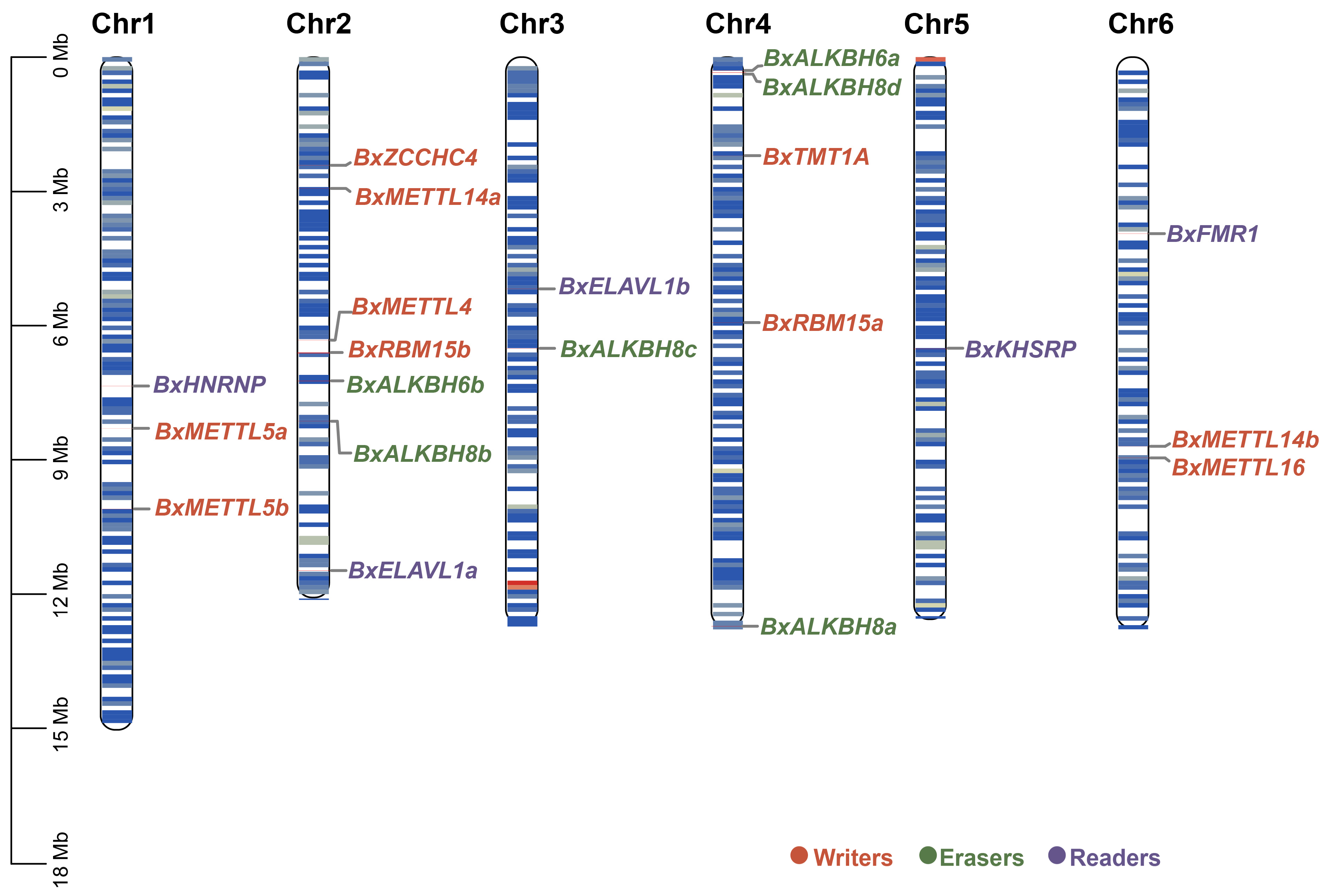
The 21 m6A regulators were unevenly distributed across the six chromosomes of PWNs (Figure 1). Chromosome 2 harbored the highest gene density, containing 4 writers (BxZCCHC4, BxMETTL14a, BxMETTL4, BxRBM15b), 2 erasers (BxALKBH6b, BxALKBH8b), and 1 reader (BxELAVL1a). Chromosome 4 followed with 2 writers (BxTMT1A, BxRBM15a) and 3 erasers (BxALKBH6a, BxALKBH8a, BxALKBH8d). Chromosomes 1 and 6 each contained 3 genes, Chromosome 3 contained 2 genes (BxELAVL1b, BxALKBH8c), and Chromosome 5 contained 1 gene (BxKHSRP). Notably, erasers were present on Chromosomes 2, 3, and 4, with two genes on Chromosome 4 arranged in tandem, suggesting a tandem duplication events during evolution. In contrast, writers were widely distributed across Chromosomes 1, 2, 4, and 6, exhibiting a dispersed pattern that reflects the evolutionary complexity of the methyltransferases.

3.3. Phylogenetic Analyses of m6A Writers, Readers and Erasers

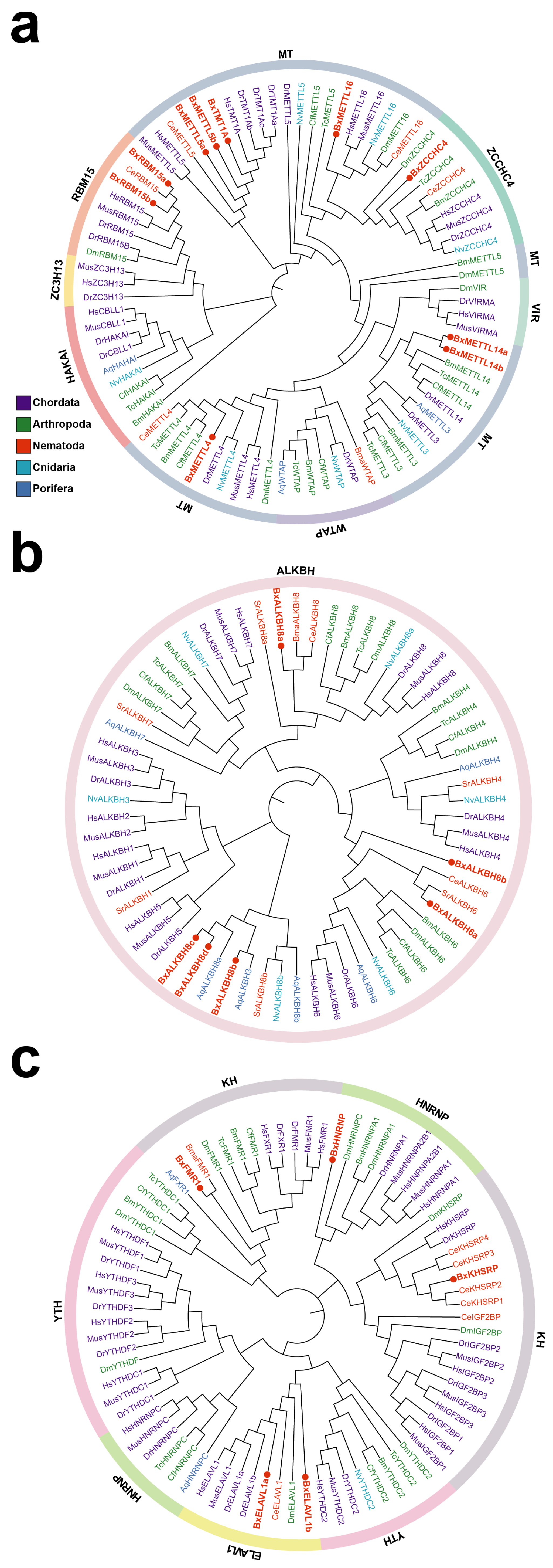
To investigate the molecular evolution of m6A regulators, phylogenetic analysis was performed on PWNs and other species. Based on protein sequences, neighbor-joining (NJ) methods were employed to construct phylogenetic trees for m6A writers, erasers, and readers, respectively (Figure 2). The analysis encompassed representative species from Chordata, Arthropoda, Nematoda, Cnidaria, and Porifera. The m6A writer tree was divided into four clades, corresponding to six gene families: MT, ZCCHC4, WTAP, VIR, HAKAI, ZCCHC3 and RBM15 (Figure 2a). The MT group further included the METTL3, METTL4, METTL5, METTL14, METTL16, and TMT1A (METTL7A) subgroups. Evolutionary conservation and lineage specificity. BxMETTL4, BxMETTL14a/b, and BxZCCHC4 clustered with arthropod orthologs, suggesting that these genes have been evolutionarily conserved within the Ecdysozoa clade (which includes both arthropods and nematodes). In contrast, BxMETTL16 and BxTMT1A clustered with vertebrate orthologs. BxMETTL5a/b and BxRBM15a/b formed distinct nematode-specific branches with C. elegans orthologs, implying lineage-specific expansion or functional divergence of these genes within the Nematoda phylum. All m6A erasers belonged to the ALKBH gene family and were divided into four groups (Figure 2b). Within the ALKBH8 branch, orthologous sequences from PWN, Strongyloides ratti, Actinia stricta, and Leucosolenia complicate were densely distributed in the tree, forming an independent subcluster that closely aligned with the taxonomic relationships of these species. This phylogenetic pattern suggests that the ALKBH8 subfamily has undergone ancient diversification, with PWN retaining ancestral copies that have subsequently diverged from their counterparts in model organisms. The readers were classified into three branches, corresponding to the YTH domain family (YTHDC1/2, YTHDF1/2/3), the KH domain family (IGF2BP, KHSRP, FMR1), and the HNRNP family (HNRNPC, HNRNPA/B), along with the ELAVL1 family (Figure 2c). The first branch comprised the YTH family, ELAVL1, and HNRNPC, where BxELAVL1a/b clustered with nematode and arthropod orthologs. The second branch included IGF2BP, KHSRP, and HNRNPA/B, with BxKHSRP forming a nematode-specific branch with C. elegans orthologs and BxHNRNP clustering with arthropod orthologs. The third branch consisted of FMR1 and YTHDC1, with BxFMR1 clustering with Brugia malayi orthologs, raising the possibility that FMR1-mediated m6A recognition is associated with parasitic lifestyles. Overall, the phylogenetic trees show that some m6A regulators (e.g., METTL16 and TMT1A) are evolutionarily conserved across animals, whereas others (e.g., METTL5, RBM15, and KH domain readers) have undergone nematode–specific expansion, and YTH domain readers are absent in PWNs.

3.4. Conserved Motifs and Gene Structure Analysis of m6A Regulators

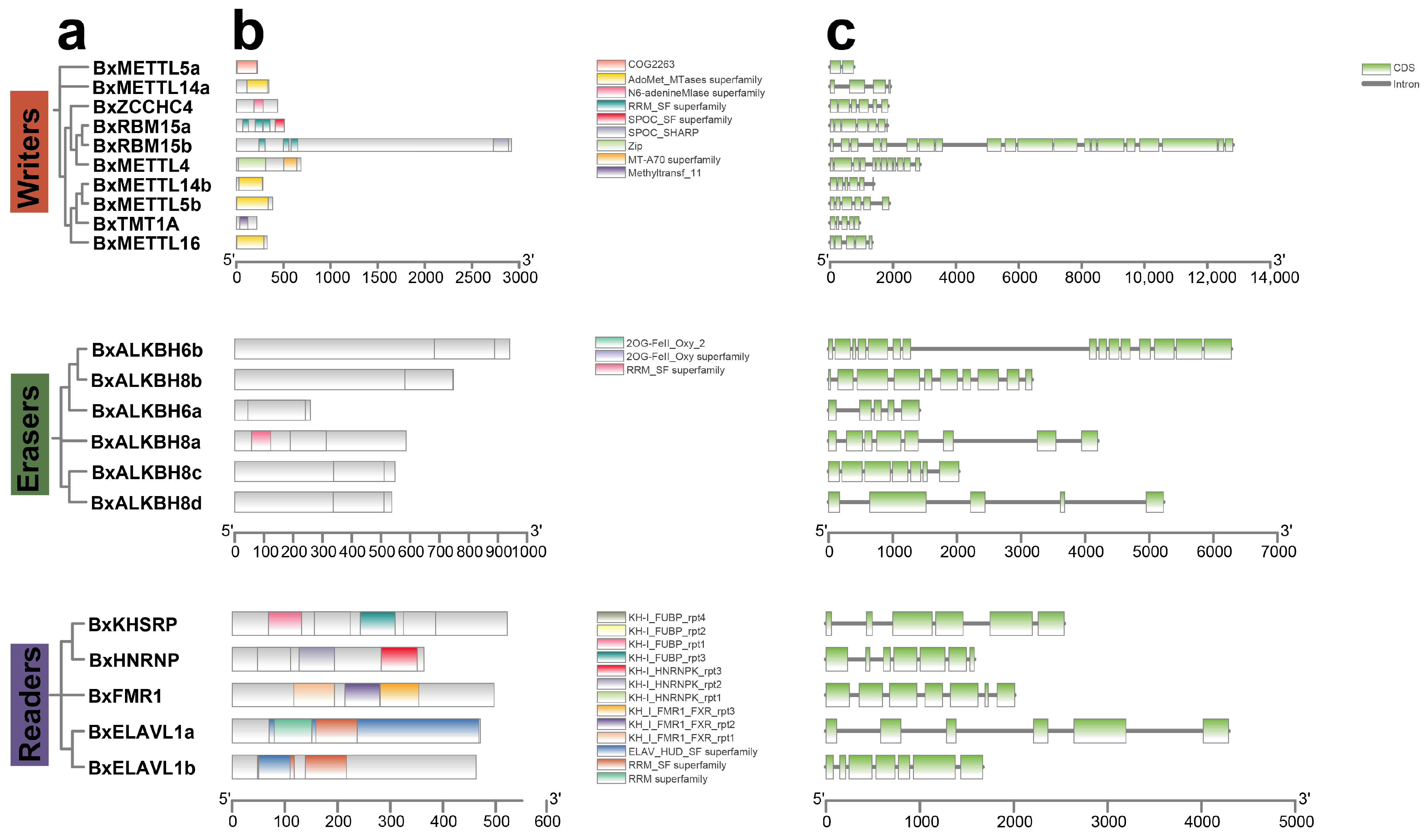
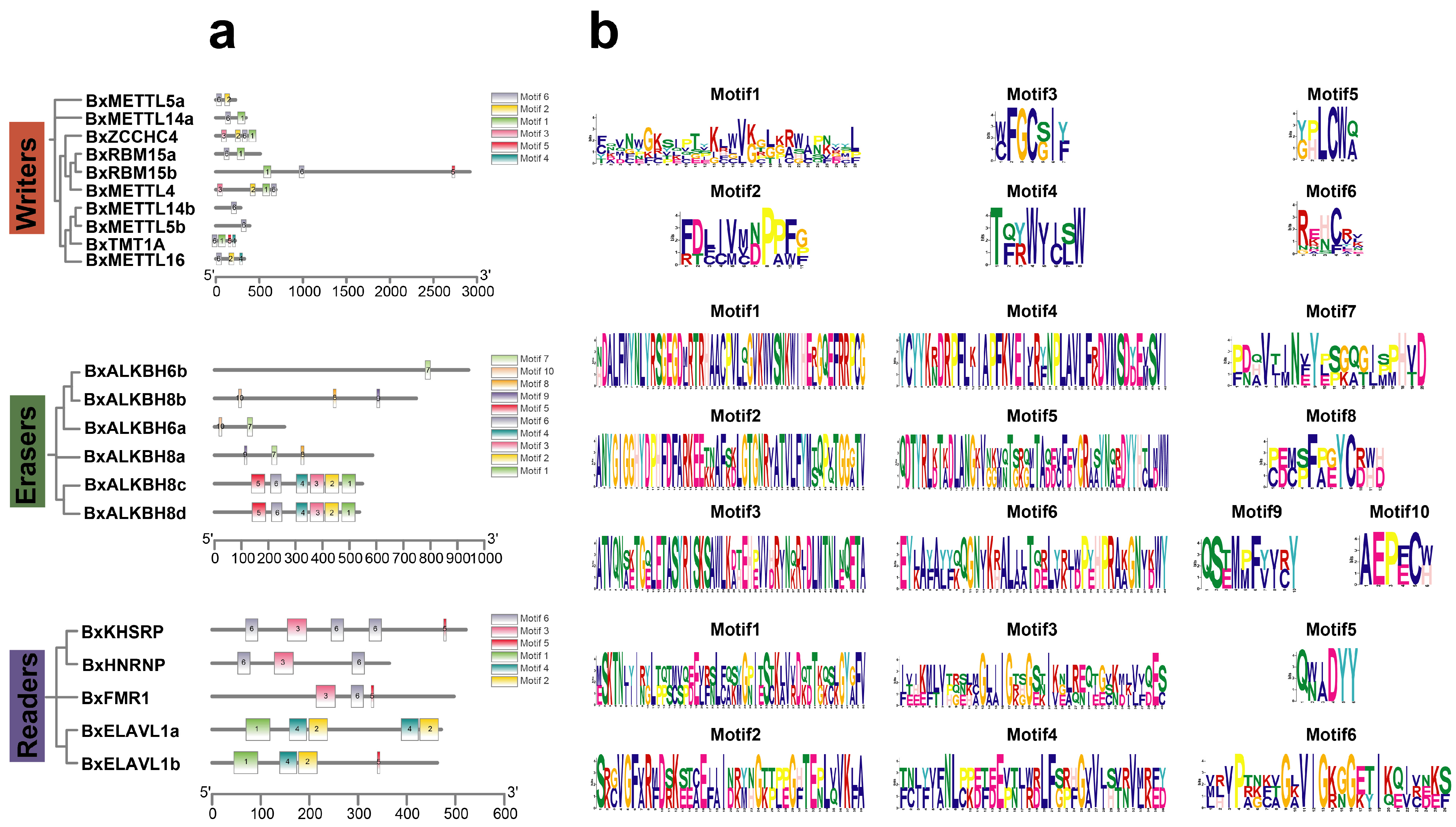
To elucidate the sequence–function relationships of m6A regulators in PWNs, a systematic analysis was conducted on phylogenetic tree (Figure 3a), conserved domain architecture (Figure 3b), gene structure (Figure 3c), and motif organization (Figure 4a,b).
Domain analysis revealed the characteristic structural features of these writers (Figure 3b). Core methyltransferases (BxMETTL16, BxMETTL14a/b, BxMETTL5b) all harbored the AdoMet_MTases superfamily domain (CDD: cl17173), which provides the SAM-binding site essential for methyl group transfer. Additionally, BxMETTL5a possessed the COG2263 domain (CDD: COG2263), a family predicted to function as an RNA methyltransferase. BxMETTL4 contained both the Zip domain (CDD: pfam02535) and the MT-A70 superfamily domain (CDD: pfam05063), a combination that may facilitate protein–protein interactions within the methyltransferase complex. The auxiliary regulatory factors BxRBM15a/b exhibited lineage-specific domain combinations, including RRM_SF (CDD: cl17169) and SPOC_SF (CDD: cl45902). BxTMT1A harbored the Methyltransf_11 domain (CDD: pfam08241), and BxZCCHC4 contained the N6-adenineMlase superfamily domain (CDD: pfam10237). In erasers, ALKBH family universally conserved the 2OG-Fe (II) oxygenase domain (PF13532), the core module for their catalytic m6A demethylation activity. Regarding readers, m6A reader genes were classified into two subfamilies: the KH domain family (BxKHSRP, BxHNRNP, BxFMR1) and the ELAVL1 family (BxELAVL1a, BxELAVL1b). KH domains are known to selectively recognize m6A modified RNAs to regulate mRNA stability and translation.
Gene structure analysis revealed considerable variation among the three regulator types (Figure 3c). The exon numbers of PWN m6A writers, erasers, and readers ranged from 2 to 20, 5 to 15, and 6 to 7, respectively. Among the writers, the gene structure was the most diverse. BxRBM15b possessed the most complex structure, containing 20 exons, suggesting potential alternative splicing to generate functional diversity, while BxMETTL5a was the smallest gene, containing only 2 exons. Analysis of conserved motifs in PWN m6A writers identified six motifs (motifs 1–6) (Figure 4a). While BxMETTL4, BxZCCHC4, and BxTMT1A possess relatively complete motif sets, other genes exhibit reduced motif compositions. BxALKBH6a contained motif 7 and motif 10, while BxALKBH6b contained only motif 7. The ALKBH8 subfamily displayed the most diverse motif composition. BxALKBH8c/d retained motif 1–6, whereas BxALKBH8a/b contained only motifs 7–10, highlighting clear motif divergence between these subgroups (Figure 4b). The KH domain subfamily shared motif 3 and motif 6, while the ELAVL1 subfamily shared motif 1, motif 2, and motif 4. Their motif arrangements were highly conserved, reflecting evolutionary conservation within the subfamilies.

3.5. Protein Structure Prediction

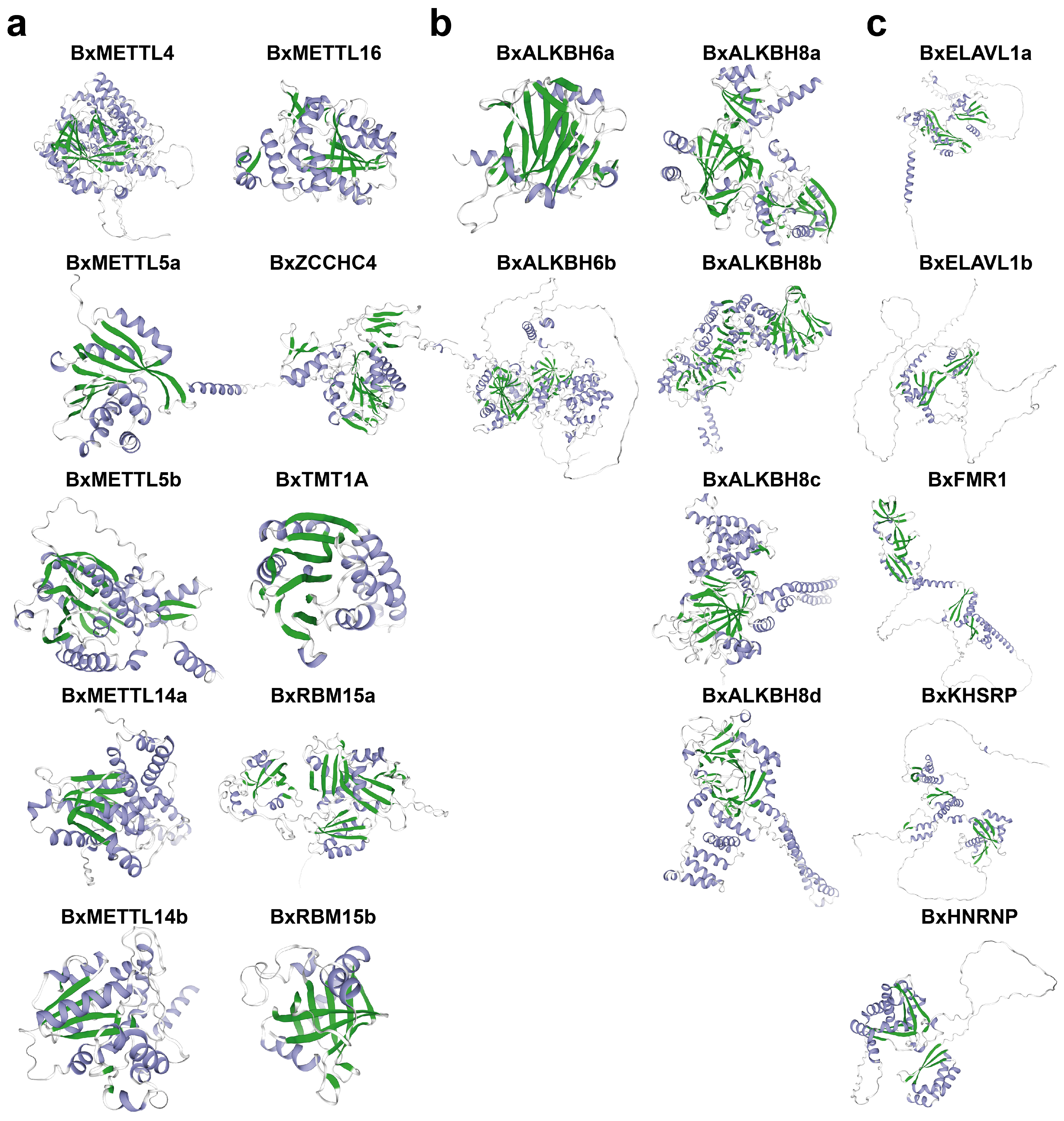
Secondary structure analysis of m6A regulators in PWNs revealed significant differences in composition among different family members (Table S3). Among writers, the proportion of α-helix ranged from 23.64% to 52.51%, with the highest proportion observed in BxTMT1A (52.51%); random coil accounted for 29.68% to 64.06%, with BxRBM15b exhibiting the highest proportion (64.06%). For erasers, α-helix ranged from 29.76% to 56.02%, with BxALKBH8b and BxALKBH8c exceeding 55%; random coil accounted for 32.59% to 51.74%, with both BxALKBH6a and BxALKBH6b exceeding 50%. Readers were predominantly composed of random coil (52.72–63.07%), with relatively lower α-helix content (20.88–30.58%). Tertiary structure prediction revealed distinct spatial conformations among the m6A regulators (Figure 5), which corresponded to their RNA binding modes and catalytic mechanisms, suggesting that they perform different biological functions in the regulation of m6A modification.

3.6. LLPS Propensity of m6A Regulators

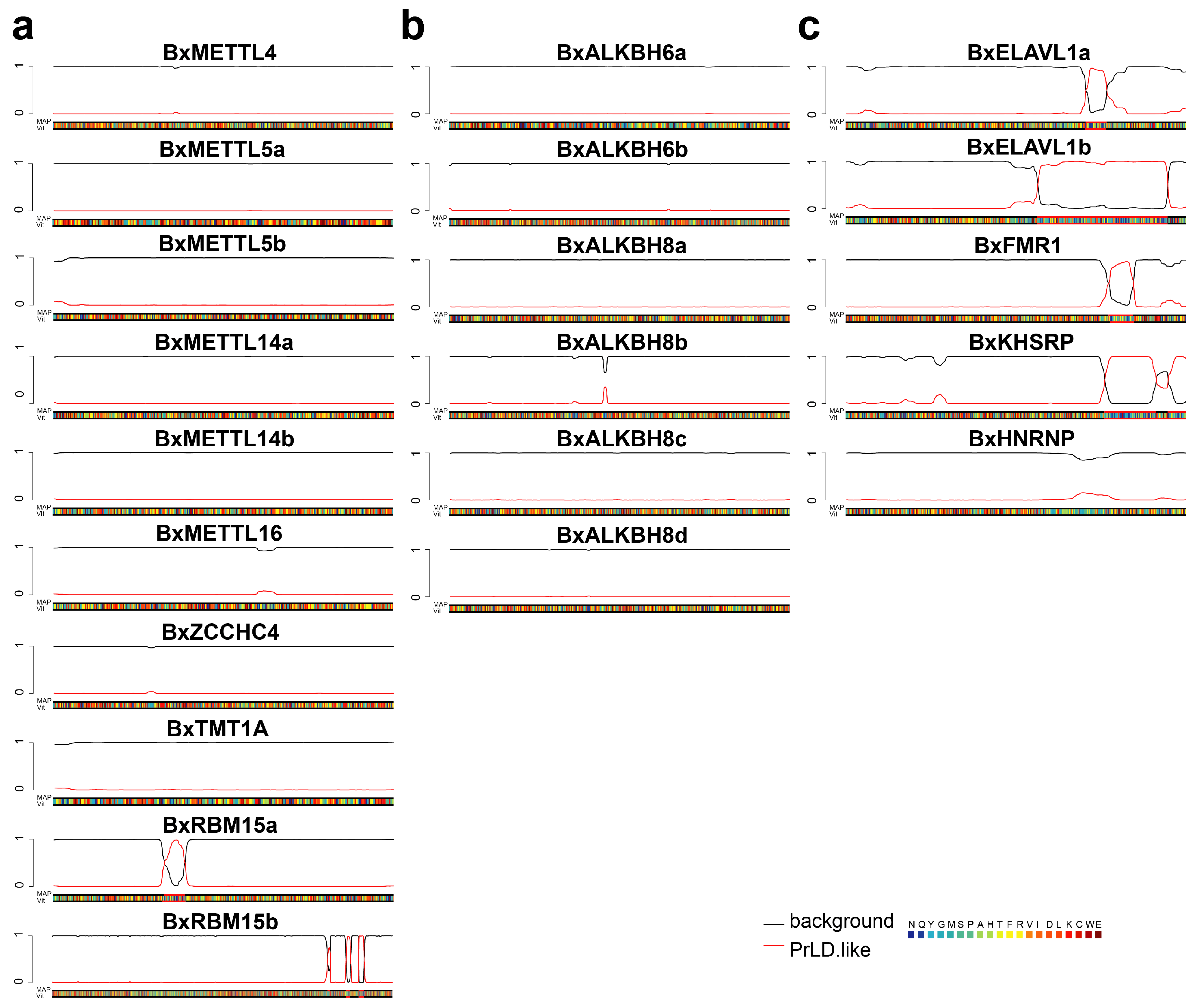
Accumulating evidence has demonstrated that m6A modification promotes phase separation by enhancing multivalent interactions between RNA and binding proteins, thereby partitioning modified mRNAs into specific membrane-less organelles [36]. Using the PLAAC platform, we predicted prion-like domains (PrLDs) and intrinsically disordered regions (IDRs) in PWN m6A regulators (Figure 6). In the PLAAC plots, regions where the red line rises above the black baseline are predicted to contain PrLDs/IDRs, which are known to promote LLPS. Among the 10 writers, only BxRBM15a and BxRBM15b exhibited clear PrLD signals (Figure 6a); none of the six erasers showed significant signals (Figure 6b); and among the five readers, BxELAVL1a, BxELAVL1b, BxFMR1, and BxKHSRP displayed prominent PrLD signals, with BxELAVL1b showing particularly strong and extended regions (Figure 6c). These findings suggest that m6A mediated phase separation may coordinate RNA condensate formation in PWNs during environmental stress, thereby enabling rapid gene expression regulation for stress adaptation.

3.7. Developmental Expression Pattern of m6A Regulators

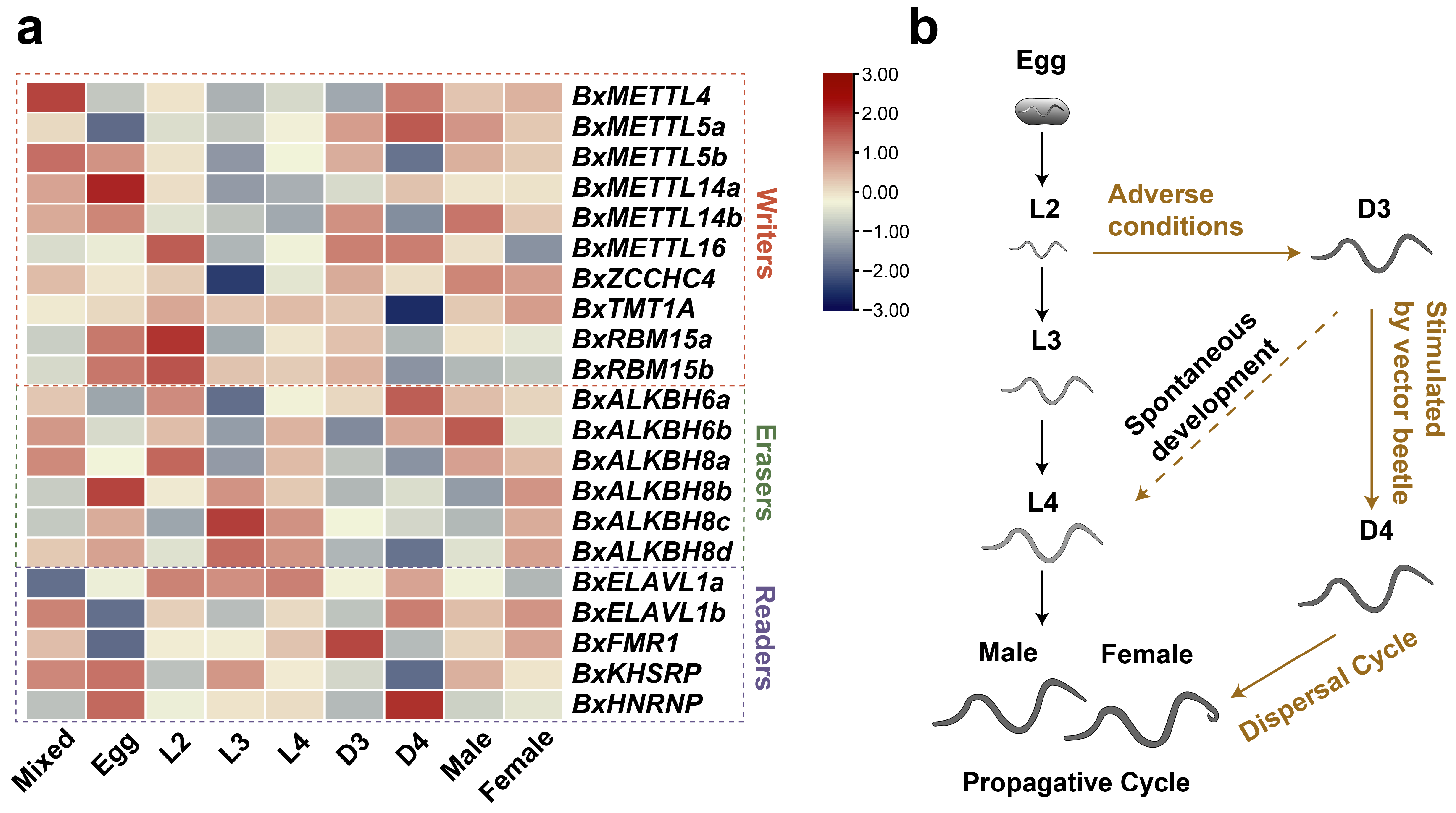
To investigate the potential functions of m6A regulators in PWN growth and development, transcriptomic expression profiles were analyzed across nine sample stages (Figure 7a,b). Writers (BxMETTL5b, BxMETTL14a/b, BxMETTL16, BxRBM15a/b) showed relatively high expression in the egg and L2 stages, which correspond to embryonic development and early larval growth; this suggests that these writers may be involved in initiating m6A modifications required for early developmental programs. In contrast, ZCCHC4 and TMT1A were lowly expressed at the L3 and D4 stages, respectively, implying that their functions may be more critical at other phases. Erasers displayed developmentally stage-specific expression patterns. BxALKBH8a was specifically highly expressed in the L2 stage, a period of rapid somatic growth and molting preparation, hinting at a role in resetting m6A marks during larval transitions. BxALKBH8b/c/d exhibited higher expression in the L3 and L4 stages, when gonad development and reproductive system maturation occur, suggesting that these erasers may participate in regulating genes essential for sexual maturation. In contrast, BxALKBH6a expression was significantly upregulated in the D4 stage, whereas BxALKBH6b reached peak expression in the male stage, implicating a potential role in spermatogenesis or male-specific gene expression. For readers, expression peaks were observed in certain genes during the juvenile stages (D3/D4), with BxFMR1 highly expressed in the D3 stage and BxHNRNP highly expressed in the D4 stage. During these diapause stages, the elevated expression of readers may promote selective translation of mRNAs essential for long-term survival. In contrast, BxELAVL1a/b showed significantly low expression in the egg stage, and BxKHSRP also exhibited low expression in the D4 stage. The developmental expression heatmap revealed expression divergence among several paralogous gene pairs. For instance, BxMETTL5a exhibited low expression in the egg stage, whereas BxMETTL5b showed high expression in the same stage. BxALKBH8a exhibited high expression in the L2 stage, whereas its gene pairs (BxALKBH8b/c/d) showed lower expression in the corresponding stages. These results indicate that m6A regulators exhibit dynamic and stage–specific expression patterns, suggesting potential roles in developmental transitions of PWNs.

3.8. Expression Patterns of m6A Regulators During Host Infection and β-Pinene Stress

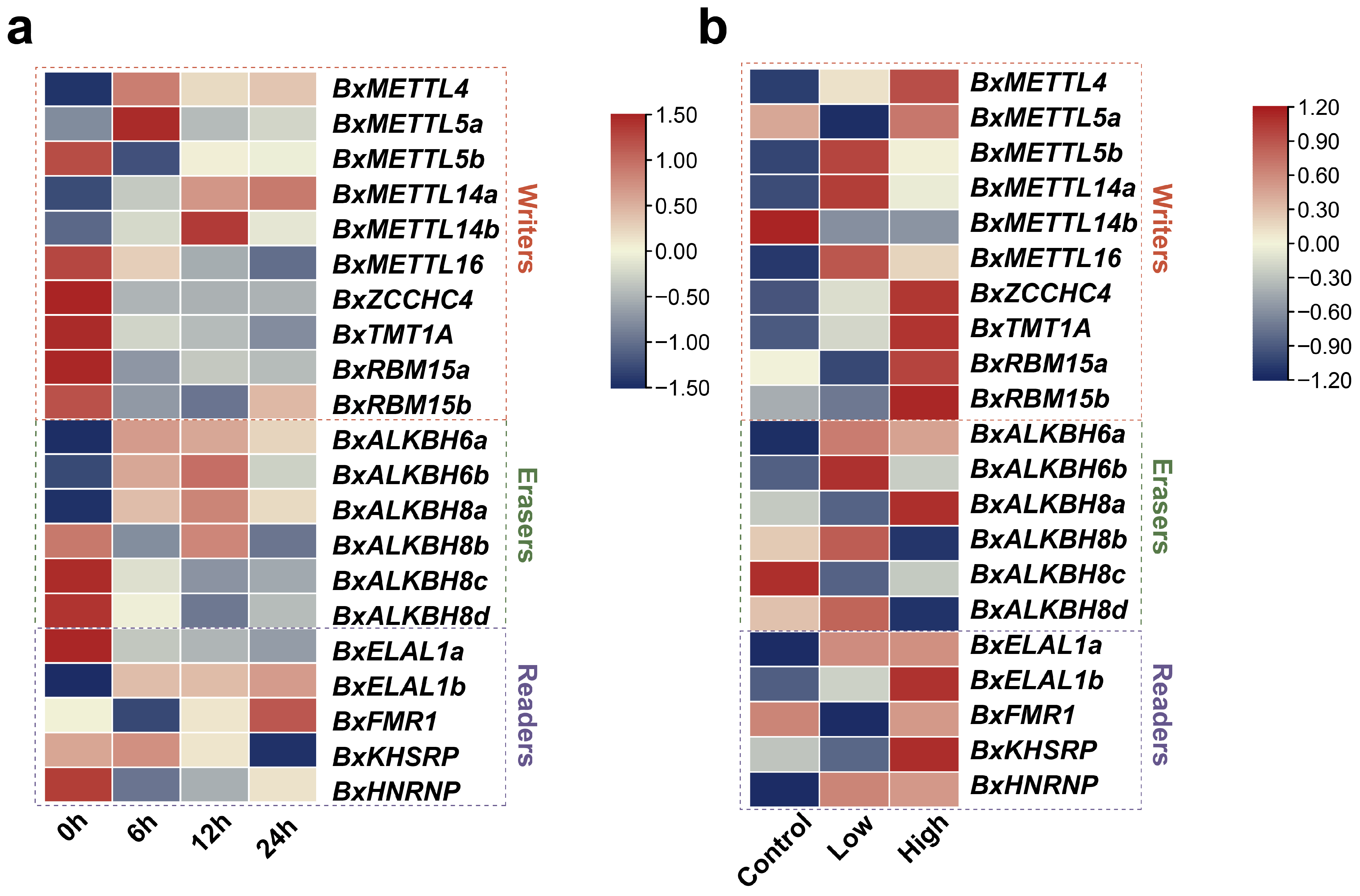
To elucidate the expression patterns of m6A regulators in PWNs during host infection and in response to pine-derived metabolites, transcriptomic data following inoculation into P. thunbergii and under β-pinene stress were analyzed (Figure 8a,b). During infection, several genes displayed dynamic transcriptional responses (Figure 8a). Prior to inoculation, BxMETTL5b, BxMETTL16, BxZCCHC4, BxTMT1A, BxRBM15a/b, BxALKBH8b/c/d, BxELAVL1a, and BxHNRNP exhibited high expression levels prior to infection and were significantly downregulated following infection. At the early stage of infection (6 h), BxMETTL4, BxMETTL5a, BxALKBH6a/b, BxALKBH8a and BxELAVL1b were significantly upregulated. BxMETTL14a/b and BxALKBH8b were significantly upregulated at the mid-stage of infection (12 h) and maintained relatively high expression levels. At the late stage of infection (24 h), BxFMR1 exhibited increased high expression.
Under β-pinene stress, most m6A regulators exhibited significant differential expression, with response patterns displaying concentration dependence (Figure 8b). Under low-concentration treatment, nine genes (BxMETTL5b, BxMETTL14a, BxMETTL16, BxALKBH6a/b, BxALKBH8b, BxALKBH8d, BxELAVL1a, BXHNRNP) were significantly upregulated, while five genes (BxMETTL5a, BxRBM15a, BxALKBH8a/c, BxFMR1) were significantly downregulated. Under high-concentration treatment, most genes were significantly upregulated, except for three genes (BxMETTL14b, BxALKBH8b, BxALKBH8d) significantly downregulated. Notably, several regulated genes exhibited concentration-specific response patterns. BxALKBH6a, BxELAVL1a, and BxHNRNP showed no significant differences between concentrations, whereas BxMETTL5b, BxMETTL14a, BxMETTL16, BxALKBH6b, BxALKBH8b and BxALKBH8d were upregulated under low-concentration treatment but downregulated under high-concentration treatment. The rest genes showed continuous upregulation tendency. These findings suggest that m6A regulators may be involved in the response of PWNs to pine–derived metabolite stress.

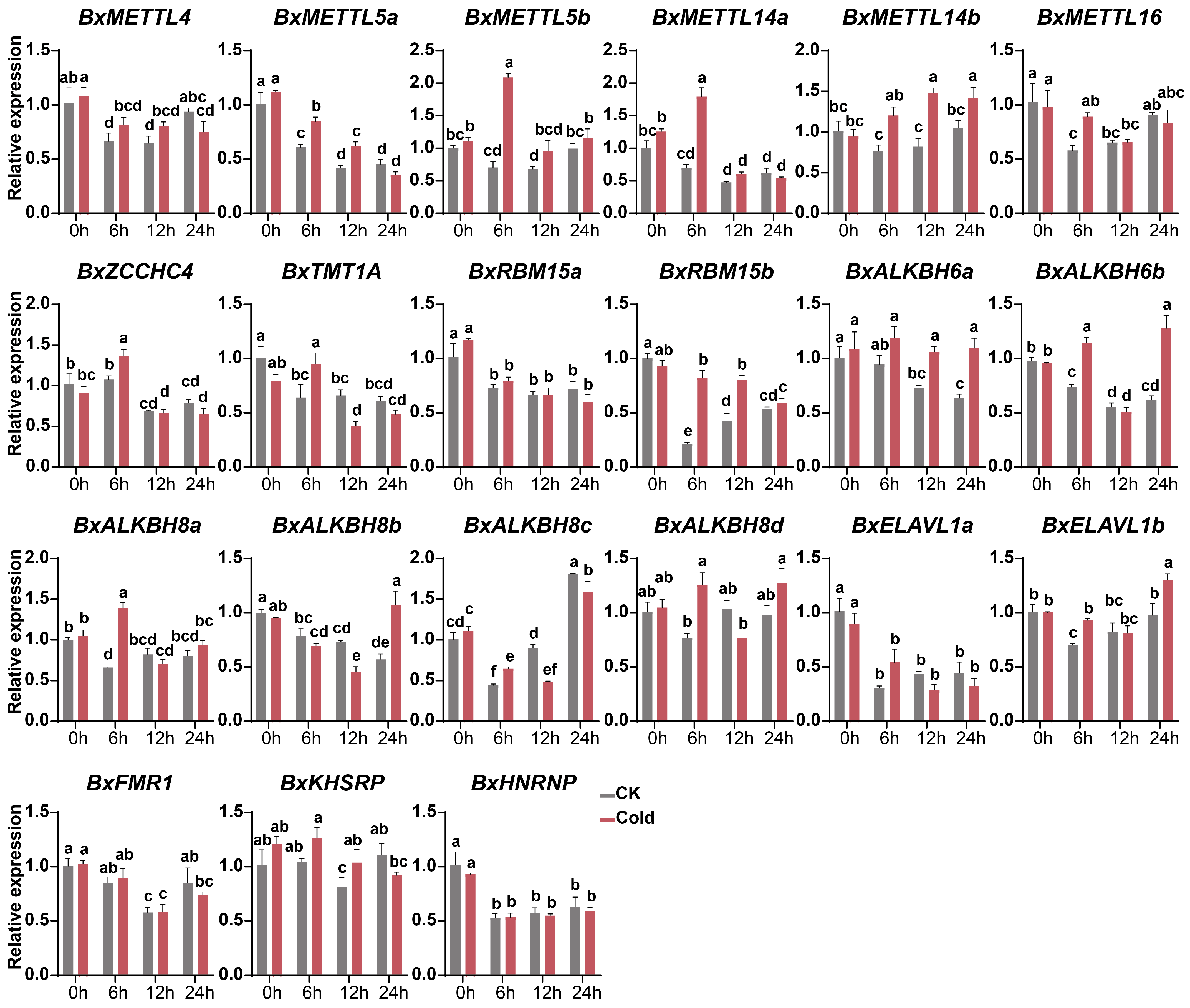
3.9. Expression Analysis of m6A Regulators Under Cold Stress

The continued expansion of PWNs into the cold–temperate regions of northern China, where the annual average temperature is below 10 °C, suggests that this species has evolved remarkable low-temperature tolerance. To further evaluate the potential involvement of m6A regulators in temperature stress adaptation, RT-qPCR was performed to examine their temporal expression patterns under low-temperature treatment (Figure 9). Overall, most m6A regulators exhibited rapid transcriptional responses under cold stress, with the strongest induction observed at 6 h post-treatment. Among them, BxMETTL5b, BxMETTL14a, BxZCCHC4, and BxALKBH8a showed significant upregulation and reached peak expression levels at 6 h, whereas BxMETTL14b and BxELAVL1b exhibited delayed responses and reached their highest expression levels at 24 h. Among the writer genes, most were significantly upregulated at 6 h post-treatment. Specifically, BxMETTL5b, BxMETTL14a, BxMETTL16, BxZCCHC4, BxTMT1A and BxRBM15b exhibited significant upregulation (p < 0.05) and reached their peak expression levels at this time point. The rapid and coordinated upregulation of multiple writers at the early stage of cold exposure suggests that m6A deposition is quickly activated upon temperature drop, potentially to rapidly modify stress–responsive transcripts, thereby facilitating their processing or stability. At 12 h post-treatment, BxMETTL5a, BxMETTL14b and BxRBM15b remained significantly upregulated compared with the corresponding controls, whereas BxTMT1A displayed significant downregulation. The expression levels of most writers decreased over time after peaking at 6 h. By 24 h, only BxMETTL14b maintained a relatively high expression level, suggesting that certain writers may sustain m6A modification on specific long-lived transcripts required for prolonged cold adaptation. Erasers displayed distinct temporal dynamics. At 6 h post-treatment, BxALKBH6b, BxALKBH8a, BxALKBH8c and BxALKBH8d were significantly upregulated. At 12 h post-treatment, the expression of these genes showed clear divergence: BxALKBH6a was significantly upregulated; whereas BxALKBH8b and BxALKBH8c were significantly downregulated, reaching their lowest expression levels across the entire time course. The early upregulation of both writers and erasers indicates a dynamic balance between methylation and demethylation during cold stress, rather than a unidirectional change. This oscillation may allow rapid resetting of m6A marks on key transcripts, enabling flexible gene expression reprogramming in response to fluctuating temperatures. In contrast, readers showed relatively stable expression patterns throughout the treatment period, with limited transcriptional variation. Only BxELAVL1b was significantly upregulated at 6 h and 24 h. Collectively, m6A regulatory genes in PWNs displayed temporal expression patterns under low-temperature stress, indicating that m6A modification may play a stage–specific regulatory role in low-temperature adaptation.

4. Discussion

4.1. Evolutionary Conservation and Non-Canonical Features of m6A Regulators in PWNs

In this study, 21 candidate m6A regulators were identified in the PWN genome, including m6A writers, erasers, and readers, along with their associated family genes. Phylogenetic analysis provided a framework for the systematic nomenclature of these genes and established a foundation for subsequent functional studies. The identified genes were classified into the METTL (writers), ALKBH (erasers), and KH/RRM (readers) families, each comprising multiple members, suggesting functional diversification within these protein families. Notably, several distinctive characteristics were observed, including the absence of canonical m6A demethylases and YTH domain-containing readers, as well as the potential involvement of RNA phase separation in post-transcriptional regulation.
Similar to C. elegans, typical m6A demethylases (FTO/ALKBH5 homologs) were identified in PWNs. Although the ALKBH gene family comprises nine members (ALKBH1-ALKBH8 and FTO) in mammals, its distribution in invertebrates exhibits significant contraction and lineage–specific diversification [37]. As shown in the phylogenetic tree (Figure 2b), arthropods, including crustaceans and insects, generally lack FTO and ALKBH5 homologs. However, studies have indicated that the distribution of ALKBH5 varies across insect orders: it is absent in Diptera and Lepidoptera but retained in Coleoptera and Hemiptera [38]. These findings suggest that the absence of canonical m6A demethylases is not a unique derived feature of nematodes but rather an ancestral trait widely present in the Ecdysozoa, which includes arthropods and nematodes. This evolutionary context provides critical insights into the selective retention of the ALKBH6 and ALKBH8 subfamilies in PWNs. Studies have confirmed that ALKBH8 exhibits m6A demethylase activity in Aedes aegypti and Drosophila melanogaster [39], while in shrimp, both ALKBH1 and ALKBH8 possess m6A demethylation activity, with knockdown of either gene leading to increased global m6A levels and overexpression resulting in decreased global m6A levels [40]. These findings suggest that ALKBH family members in PWNs may perform alternative demethylation functions in the absence of canonical erasers.
At the recognition level, PWNs also lacks classical YTH domain-containing reader proteins that typically mediate m6A recognition in eukaryotes. Instead, numerous proteins containing KH domain and RRM domain were identified in PWNs, suggesting the existence of non-canonical m6A recognition mechanisms. In mammals, IGF2BPs selectively bind m6A modified RNAs through their KH domains (particularly KH3–4), thereby regulating the stability and translation efficiency of target mRNAs [41]. Additionally, m6A influences the local structure of RNA, exposing previously occluded protein-binding motifs and facilitating the binding of RRM domain-containing proteins such as HNRNPs. These structural changes enable RNA-binding proteins to participate in m6A–dependent regulatory pathways without directly recognizing the modification itself [42]. Therefore, it is possible that KH/RRM domain-containing proteins in PWNs act as alternative m6A readers, forming a non-canonical recognition system that regulates RNA metabolism. Future studies should focus on elucidating whether these KH/RRM proteins recognize m6A modified RNAs and clarifying the molecular mechanisms, thereby revealing alternative regulatory pathways for m6A recognition in PWNs.

4.2. Stage-Specific Expression of m6A Regulators During PWN Development

Expression profiling revealed that m6A regulators in PWNs exhibit dynamic and developmentally stage-specific expression patterns (Figure 7). Writers are preferentially expressed during early developmental stages (egg to L2), coinciding with embryogenesis and rapid somatic growth. In C. elegans, loss of METTL5 results in reduced fertility [16]. In D. melanogaster, methyltransferase complex components including METTL3 (IME4), METTL14, RBM15 (Nito), and Hakai coordinately regulate alternative splicing of the sex determination key gene Sxl, and their loss impairs germ cell differentiation and causes ovarian developmental delay [43,44]. Likewise, in mammals, conditional knockout of METTL3 and METTL14 in oocytes and spermatogonial stem cells similarly leads to gametogenesis arrest and fertility loss [45,46]. Given their high expression during early developmental stages and the conserved functions of their homologous genes in other species, these writers likely play a critical role in the embryonic and early larval development of PWNs.
Such stage-specific expression of ALKBH family members has also been reported in other arthropods. In Litopenaeus vannamei, ALKBH1, ALKBH2, and ALKBH4 exhibited highest expression during the intermolt stage, whereas ALKBH6 and ALKBH8 peaked in the post-molt stage, suggesting their potential roles in regulating molting and ammonia toxicity resistance [40]. These findings suggest that different ALKBH members may have specialized demethylation functions during development in PWNs, with ALKBH8 potentially playing an important role in larval stages and ALKBH6 involved in diapause and reproductive regulation.
Readers also displayed stage-specific expression, particularly during the diapause stages (D3/D4), implying that m6A-mediated RNA regulation may contribute to developmental transitions and metabolic adjustments during dormancy. In D. melanogaster, the nuclear reader YT521-B and the cytoplasmic reader CG6422 serve as major m6A binding proteins, participating in alternative splicing and cytoplasmic RNA metabolism, respectively [44]. In addition, the cytoplasmic FMR1 has been identified as an m6A reader, capable of specifically recognizing and binding m6A modified mRNAs [9]. Although PWN lacks YTH domain-containing readers, given that BxELAVL1a/b are predicted to localize to the nucleus, while BxKHSRP, BxHNRNP, and BxFMR1 are predicted to localize to the cytoplasm (Table 1), it is speculated that similar functional partitioning between nuclear and cytoplasmic compartments may exist. Given that FMR1 is involved in embryonic development in D. melanogaster [9], the high expression of BxFMR1 during the diapause stage in PWNs suggests a potential role in developmental transition, possibly mediating stage-specific translational regulation. The m6A modification system in PWNs, through the coordinated action of writers, erasers, and readers, may play an important role in larval development, diapause transition, and reproduction.

4.3. Dynamic Responses of m6A Regulators to Environmental Stresses

Environmental stress represents another critical challenge for PWN during host colonization and geographic expansion. Survival under stress conditions requires coordinated regulation at both transcriptional and translational levels to maintain critical survival pathways [47]. m6A plays a key role in post-transcriptional regulation under stress conditions by modulating RNA processing and translation [48]. During infection of P. thunbergii, m6A regulators exhibited temporally dynamic expression patterns, with different genes being activated or suppressed at early, middle, and late stages of infection, indicating that these genes participate in a coordinated regulatory network mediating host adaptation. This dynamic pattern is consistent with the regulatory characteristics of m6A modification systems during infection of plant-parasitic nematodes [49,50], suggesting that m6A modification may be involved in the interaction between PWN and its host through temporal regulation. In addition to host infection, pine-derived chemical defenses, such as β-pinene, also represent a major challenge for PWN. Under β-pinene stress, m6A regulators exhibited both concentration–dependent and concentration–independent expression patterns. Previous studies have shown that β-pinene exerts a concentration–dependent effect on PWN, with low concentrations inhibiting reproduction, whereas high concentrations promote reproduction [29]. Genes that exhibited significant changes under low-concentration stress may play important roles in the early stages of nematode perception and response to host defenses, mediating basal detoxification and physiological homeostasis (Figure 8). In contrast, genes induced at higher concentrations may be involved in adaptive reprogramming and reproductive transformation, consistent with the observation that high concentrations of terpenes promote population expansion [28]. Furthermore, BxAKLBH6, BxELAVL1a and BxHNRNP, which showed concentration-independent upregulation, may serve as general stress response factors involved in basal defense, similar to the function of effector proteins (BxVAP1) in the interaction between PWN and its host [51]. These transcriptional responses indicate that m6A modification may contribute to the regulation of detoxification metabolism and stress tolerance during host–parasite interactions.
PWN has expanded northward into regions with annual average temperatures below 10 °C, indicating that it has evolved strong low-temperature tolerance [33]. Therefore, elucidating its low-temperature adaptation mechanisms is crucial for predicting invasion risk and developing control strategies. Under cold stress, most m6A writers were rapidly upregulated during the early stage of treatment. This early response is consistent with the upregulation of METTL3 and METTL14 in Larimichthys crocea under low-temperature starvation stress [52], suggesting that the m6A system is rapidly activated at the initial stage of cold stress. At later stages, several ALKBH family members exhibited stronger transcriptional activation, implying that demethylation processes may become more important during prolonged cold exposure. This temporal expression pattern differs from that of the freeze-tolerant wood frog, in which m6A methyltransferase complexes are induced under cold stress while eraser and reader levels are suppressed [53]. Overall, most m6A regulators exhibited significant expression changes under various treatments, confirming their important functions in host infection and their capacity to respond to pine-derived metabolites, although the underlying mechanisms remain to be elucidated. Notably, ALKBH family members were consistently upregulated under all three stress conditions, further highlighting their potential roles in stress adaptation.

4.4. Predicted LLPS Propensity of m6A Regulators in PWNs

In addition to transcriptional regulation, several m6A regulators in PWN also displayed structural features associated with LLPS. LLPS propensity prediction revealed that two writers (BxRBM15a/b) and four readers (BxELAVL1a/b, BxFMR1, BxKHSRP) possess structural features associated with LLPS (Figure 6). BxRBM15a/b contain SPOC_SF domains, which have been demonstrated to participate in phase separation-mediated transcriptional regulation. In mammalian cells, the SPOC domain of SHARP cooperates with its intrinsically disordered regions (IDRs) to facilitate multivalent accumulation on Xist lncRNA, forming nuclear condensates [54]. Furthermore, BxELAVL1a/b, BxKHSRP, and BxFMR1 may drive phase separation through their intrinsically low-complexity domains [55]. In D. melanogaster, upon binding to m6A modified mRNAs, FMR1 undergoes LLPS, promoting the assembly and condensation of FMR1 ribonucleoprotein granules to regulate maternal mRNA decay during early embryogenesis [9]. Although PWN lacks YTH domain-containing readers, studies have shown that multivalent mRNAs containing multiple m6A sites can enhance phase separation by promoting interactions with RNA-binding proteins, thereby partitioning m6A modified mRNAs into membrane-less organelles such as P-bodies or stress granules, regulating mRNA stability and translation efficiency [36]. These findings provide a novel epitranscriptomic perspective for understanding the environmental adaptation mechanisms of PWNs. When PWN encounters environmental stresses such as low temperature, pine-derived metabolites, or host infection, m6A mediated phase separation may coordinate RNA condensate formation, thereby enabling rapid gene expression regulation for stress adaptation.

4.5. Limitations and Future Perspectives

Several limitations should be acknowledged. The expression data are transcriptomic and require protein-level validation. Functional roles of individual m6A regulators need further investigation using RNAi or CRISPR-based editing, and direct evidence of m6A modification on specific transcripts requires MeRIP-seq. Despite these limitations, this study provides the first systematic characterization of the m6A regulatory system in a plant–parasitic nematode, revealing non-canonical features that expand our understanding of epitranscriptomic regulation in parasitic nematodes. These non-canonical components may serve as novel targets for nematode-specific control strategies.

5. Conclusions

This study presents the genome-wide identification and systematic analysis of m6A regulators in PWNs. Through physicochemical property assessment, chromosomal localization, phylogenetic reconstruction, conserved motif and gene structure analysis, and expression profiling, 21 m6A regulators with evolutionarily conserved features were identified. These genes exhibited stage-specific expression patterns during the egg, larval, diapause, and adult stages, and showed significant responses to low temperature, β-pinene, and infection of P. thunbergii seedlings, indicating that m6A modification may function as an important regulatory mechanism integrating developmental and environmental signals in PWNs. Notably, the absence of canonical m6A erasers (FTO/ALKBH5) and YTH domain-containing readers, along with the selective retention of the ALKBH6/ALKBH8 subfamilies and KH/RRM domain-containing proteins, suggests that PWNs possess unique molecular mechanisms for dynamic m6A regulation, which establishes a crucial foundation for elucidating the functions of m6A modification in the development and stress adaptation of plant–parasitic nematodes. Future studies employing gene editing, MeRIP-seq, and other omics approaches will help elucidate the precise regulatory functions of key m6A regulators, thereby providing a theoretical basis for risk assessment of PWN dispersal and the development of control strategies.

Supplementary Materials

The following supporting information can be downloaded at: https://www.mdpi.com/article/10.3390/biology15100786/s1, Table S1: Information on m6A homologues from PWNs and other species; Table S2: Primers used for qRT-PCR analysis in this study; Table S3: Secondary structure composition of m6A regulators in PWNs. The ratio indicates the proportion of amino acids forming each secondary structure relative to the total number of amino acids.

Author Contributions

Conceptualization, Q.Y.; methodology, W.G.; software, W.G., Y.M. and B.L.; validation, W.G.; formal analysis, W.G.; data curation, W.G., H.Y., J.Z. and X.X.; writing—original draft preparation, W.G.; resources, K.J. and Q.Y.; writing—review and editing, W.G., K.J. and Q.Y.; supervision, K.J. and Q.Y.; funding acquisition, Q.Y. All authors have read and agreed to the published version of the manuscript.

Funding

This research was supported by the State Key Laboratory of Tree Genetics and Breeding (SKLTGB-NJ2024-004), National Natural Science Foundation of China (grant no. 32201583), and Beijing National Laboratory for Molecular Sciences (BNLMS202202).

Institutional Review Board Statement

Not applicable.

Informed Consent Statement

Not applicable.

Data Availability Statement

Data are contained within the article and Supplementary Materials.

Acknowledgments

We thank all our colleagues for providing useful discussions and technical assistance.

Conflicts of Interest

The authors declare no competing interests.

Abbreviations

METTL3Methyltransferase-like 3
METTL14Methyltransferase-like 14
WTAPWilms tumor 1-associated protein
METTL16Methyltransferase-like 16
FTOFat mass and obesity-associated protein
ALKBH5AlkB homolog 5
HNRNPsHeterogeneous nuclear ribonucleoproteins
IGF2BP1–3Insulin-like growth factor 2 mRNA–binding proteins 1, 2, and 3
SAMS-adenosylmethionine
pIIsoelectric point
GRAVYGrand average of hydropathicity
PrLDsPrion-like domains
NJNeighbor-joining

References

  1. Li, X.; Xiong, X.; Yi, C. Epitranscriptome sequencing technologies: Decoding RNA modifications. Nat. Methods 2017, 14, 23–31. [Google Scholar] [CrossRef]
  2. Meyer, K.D.; Saletore, Y.; Zumbo, P.; Elemento, O.; Mason, C.E.; Jaffrey, S.R. Comprehensive analysis of mRNA methylation reveals enrichment in 3′ UTRs and near stop codons. Cell 2012, 149, 1635–1646. [Google Scholar] [CrossRef] [PubMed]
  3. Meyer, K.D.; Jaffrey, S.R. Rethinking m6A readers, writers, and erasers. Annu. Rev. Cell Dev. Biol. 2017, 33, 319–342. [Google Scholar] [CrossRef]
  4. Lei, K.; Lin, S.; Yuan, Q. N6-methyladenosine (m6A) modification of ribosomal RNAs (rRNAs): Critical roles in mRNA translation and diseases. Genes Dis. 2023, 10, 126–134. [Google Scholar] [CrossRef] [PubMed]
  5. Pendleton, K.E.; Chen, B.; Liu, K.; Hunter, O.V.; Xie, Y.; Tu, B.P.; Conrad, N.K. The U6 snRNA m6A methyltransferase METTL16 regulates SAM synthetase intron retention. Cell 2017, 169, 824–835.e14. [Google Scholar] [CrossRef] [PubMed]
  6. Wang, Z.; He, J.; Bach, D.; Huang, Y.; Li, Z.; Liu, H.; Lin, P.; Yang, J. Induction of m6A methylation in adipocyte exosomal lncRNAs mediates myeloma drug resistance. J. Exp. Clin. Cancer Res. 2022, 41, 4. [Google Scholar] [CrossRef]
  7. Zheng, G.; Dahl, J.A.; Niu, Y.; Fedorcsak, P.; Huang, C.-M.; Li, C.J.; Vågbø, C.B.; Shi, Y.; Wang, W.-L.; Song, S.-H.; et al. ALKBH5 is a mammalian RNA demethylase that impacts RNA metabolism and mouse fertility. Mol. Cell 2013, 49, 18–29. [Google Scholar] [CrossRef]
  8. Jia, G.; Fu, Y.; Zhao, X.; Dai, Q.; Zheng, G.; Yang, Y.; Yi, C.; Lindahl, T.; Pan, T.; Yang, Y.-G.; et al. N6-methyladenosine in nuclear RNA is a major substrate of the obesity-associated FTO. Nat. Chem. Biol. 2011, 7, 885–887. [Google Scholar] [CrossRef]
  9. Zhang, G.; Xu, Y.; Wang, X.; Zhu, Y.; Wang, L.; Zhang, W.; Wang, Y.; Gao, Y.; Wu, X.; Cheng, Y.; et al. Dynamic FMR1 granule phase switch instructed by m6A modification contributes to maternal RNA decay. Nat. Commun. 2022, 13, 859. [Google Scholar] [CrossRef]
  10. Cai, Z.; Xu, H.; Bai, G.; Hu, H.; Wang, D.; Li, H.; Wang, Z. ELAVL1 promotes prostate cancer progression by interacting with other m6A regulators. Front. Oncol. 2022, 12, 939784. [Google Scholar] [CrossRef]
  11. Tong, J.; Flavell, R.A.; Li, H.-B. RNA m6A modification and its function in diseases. Med. Sci. 2018, 12, 481. [Google Scholar] [CrossRef]
  12. Wang, X.; Zhao, B.S.; Roundtree, I.A.; Lu, Z.; Han, D.; Ma, H.; Weng, X.; Chen, K.; Shi, H.; He, C. N6-methyladenosine modulates messenger RNA translation efficiency. Cell 2015, 161, 1388–1399. [Google Scholar] [CrossRef]
  13. Zhou, K.I.; Shi, H.; Lyu, R.; Wylder, A.C.; Matuszek, Ż.; Pan, J.N.; He, C.; Parisien, M.; Pan, T. Regulation of co-transcriptional pre-mRNA splicing by m6A through the low-complexity protein hnRNPG. Mol. Cell 2019, 76, 70–81. [Google Scholar] [CrossRef]
  14. Huang, H.; Weng, H.; Sun, W.; Qin, X.; Shi, H.; Wu, H.; Zhao, B.S.; Mesquita, A.; Liu, C.; Yuan, C.L.; et al. Recognition of RNA N6-methyladenosine by IGF2BP proteins enhances mRNA stability and translation. Nat. Cell Biol. 2018, 20, 285–295. [Google Scholar] [CrossRef]
  15. Fu, Y.; Dominissini, D.; Rechavi, G.; He, C. Gene expression regulation mediated through reversible m6A RNA methylation. Nat. Rev. Genet. 2014, 15, 293–306. [Google Scholar] [CrossRef]
  16. Sendinc, E.; Valle-Garcia, D.; Jiao, A.; Shi, Y. Analysis of m6A RNA methylation in Caenorhabditis elegans. Cell Discov. 2020, 6, 47. [Google Scholar] [CrossRef]
  17. Goh, Y.T.; Koh, C.W.Q.; Sim, D.Y.; Roca, X.; Goh, W.S.S. METTL4 catalyzes m6Am methylation in U2 snRNA to regulate pre-mRNA splicing. Nucleic Acids Res. 2020, 48, 9250–9261. [Google Scholar] [CrossRef] [PubMed]
  18. Dorsett, M.; Westlund, B.; Schedl, T. METT-10, a putative methyltransferase, inhibits germ cell proliferative fate in Caenorhabditis elegans. Genetics 2009, 183, 233–247. [Google Scholar] [CrossRef]
  19. Liberman, N.; O’Brown, Z.K.; Earl, A.S.; Boulias, K.; Gerashchenko, M.V.; Wang, S.Y.; Fritsche, C.; Fady, P.-E.; Dong, A.; Gladyshev, V.N.; et al. N6-adenosine methylation of ribosomal RNA affects lipid oxidation and stress resistance. Sci. Adv. 2020, 6, eaaz4370. [Google Scholar] [CrossRef] [PubMed]
  20. Mendel, M.; Delaney, K.; Pandey, R.R.; Chen, K.-M.; Wenda, J.M.; Vågbø, C.B.; Steiner, F.A.; Homolka, D.; Pillai, R.S. Splice site m6A methylation prevents binding of U2AF35 to inhibit RNA splicing. Cell 2021, 184, 3125–3142.e25. [Google Scholar] [CrossRef] [PubMed]
  21. Blaxter, M.; Koutsovoulos, G. The evolution of parasitism in Nematoda. Parasitology 2014, 141, 1489–1520. [Google Scholar] [CrossRef] [PubMed]
  22. Huang, J.; Zhao, X.; Mo, X.; Wu, J.; Zhou, Y.; Fang, G. Host vegetation connectivity is decisive for the natural spread of pine wilt disease. Pest Manag. Sci. 2024, 80, 5141–5156. [Google Scholar] [CrossRef]
  23. Modesto, I.; Mendes, A.; Carrasquinho, I.; Miguel, C.M. Molecular defense response of pine trees (Pinus spp.) to the parasitic nematode Bursaphelenchus xylophilus. Cells 2022, 11, 3208. [Google Scholar] [CrossRef]
  24. Yang, D.; Rui, L.; Qiu, Y.-J.; Wen, T.-Y.; Ye, J.-R.; Wu, X.-Q. The Bursaphelenchus xylophilus effector BxNMP1 targets PtTLP-L2 to mediate PtGLU promoting parasitism and virulence in Pinus thunbergii. Int. J. Mol. Sci. 2024, 25, 7452. [Google Scholar] [CrossRef] [PubMed]
  25. Xie, Y.; Liu, B.; Zhou, Z.; Gao, K.; Yin, H.; Zhao, Y.; Liu, Q. PmHs1pro-1 monitors Bursaphelenchus xylophilus infection and activates defensive response in resistant Pinus massoniana. Plant Cell Environ. 2024, 47, 4369–4382. [Google Scholar] [CrossRef]
  26. Umebayashi, T.; Fukuda, K.; Haishi, T.; Sotooka, R.; Zuhair, S.; Otsuki, K. The developmental process of xylem embolisms in pine wilt disease monitored by multipoint imaging using compact magnetic resonance imaging. Plant Physiol. 2011, 156, 943–951. [Google Scholar] [CrossRef]
  27. Niu, H.; Zhao, L.; Lu, M.; Zhang, S.; Sun, J. The ratio and concentration of two monoterpenes mediate fecundity of the pinewood nematode and growth of its associated fungi. PLoS ONE 2012, 7, e31716. [Google Scholar] [CrossRef]
  28. Li, Y.; Meng, F.; Deng, X.; Wang, X.; Feng, Y.; Zhang, W.; Pan, L.; Zhang, X. Comparative transcriptome analysis of the pinewood nematode Bursaphelenchus xylophilus reveals the molecular mechanism underlying its defense response to host-derived α-pinene. Int. J. Mol. Sci. 2019, 20, 911. [Google Scholar] [CrossRef]
  29. Li, Y.; Feng, Y.; Wang, X.; Cui, J.; Deng, X.; Zhang, X. Adaptation of pine wood nematode Bursaphelenchus xylophilus to β-pinene stress. BMC Genom. 2020, 21, 478. [Google Scholar] [CrossRef] [PubMed]
  30. Xiong, X.; Li, J.; Sun, S.; Yu, C.; Tian, Y.; Li, C.; Liu, H. Combined transcriptomic and metabolomic analyses of low-temperature adaptation in Bursaphelenchus xylophilus. Int. J. Mol. Sci. 2026, 27, 1470. [Google Scholar] [CrossRef]
  31. Liu, Z.; Li, Y.; Zhang, X. DNA methylation on C5-cytosine and N6-adenine in the Bursaphelenchus xylophilus genome. BMC Genom. 2023, 24, 671. [Google Scholar] [CrossRef]
  32. Camacho, C.; Coulouris, G.; Avagyan, V.; Ma, N.; Papadopoulos, J.; Bealer, K.; Madden, T.L. BLAST+: Architecture and applications. BMC Bioinform. 2009, 10, 421. [Google Scholar] [CrossRef]
  33. Zhang, Y.; Zhao, R.; Jing, T.; Lin, S.; Ding, X. Identification and transcriptome analysis of Bursaphelenchus xylophilus with excellent low temperature resistance. Int. J. Mol. Sci. 2024, 25, 13732. [Google Scholar] [CrossRef]
  34. Cotton, J.A.; Steinbiss, S.; Yokoi, T.; Tsai, I.J.; Kikuchi, T. An expressed, endogenous nodavirus-like element captured by a retrotransposon in the genome of the plant parasitic nematode Bursaphelenchus xylophilus. Sci. Rep. 2016, 6, 39749. [Google Scholar] [CrossRef] [PubMed]
  35. Hu, L.-J.; Wu, X.-Q.; Ding, X.-L.; Ye, J.-R. Comparative transcriptomic analysis of candidate effectors to explore the infection and survival strategy of Bursaphelenchus xylophilus during different interaction stages with pine trees. BMC Plant Biol. 2021, 21, 224. [Google Scholar] [CrossRef]
  36. Ries, R.J.; Zaccara, S.; Klein, P.; Olarerin-George, A.; Namkoong, S.; Pickering, B.F.; Patil, D.P.; Kwak, H.; Lee, J.H.; Jaffrey, S.R. m6A enhances the phase separation potential of mRNA. Nature 2019, 571, 424–428. [Google Scholar] [CrossRef]
  37. Ougland, R.; Rognes, T.; Klungland, A.; Larsen, E. Non-homologous functions of the AlkB homologs. J. Mol. Cell Biol. 2015, 7, 494–504. [Google Scholar] [CrossRef] [PubMed]
  38. Bataglia, L.; Simões, Z.L.P.; Nunes, F.M.F. Active genic machinery for epigenetic RNA modifications in bees. Insect Mol. Biol. 2021, 30, 566–579. [Google Scholar] [CrossRef] [PubMed]
  39. Dai, Z.; Asgari, S. ALKBH8 as a potential N6-methyladenosine (m6A) eraser in insects. Insect Mol. Biol. 2023, 32, 461–468. [Google Scholar] [CrossRef]
  40. Lei, Y.; Wan, B.; Ao, C.; Yang, M.; Jiang, Y.; Wang, W. Genome-wide characterization of the AlkB homolog (ALKBH) gene family in Litopenaeus vannamei identifies LvALKBH1 and LvALKBH8 as promising crustacean m6A demethylases involved in molting regulation and ammonia stress response. Int. J. Biol. Macromol. 2025, 302, 140425. [Google Scholar] [CrossRef]
  41. Wei, G. RNA m6A modification, signals for degradation or stabilization? Biochem. Soc. Trans. 2024, 52, 707–717. [Google Scholar] [CrossRef] [PubMed]
  42. Liu, N.; Dai, Q.; Zheng, G.; He, C.; Parisien, M.; Pan, T. N6-methyladenosine–dependent RNA structural switches regulate RNA-protein interactions. Nature 2015, 518, 560–564. [Google Scholar] [CrossRef]
  43. Bawankar, P.; Lence, T.; Paolantoni, C.; Haussmann, I.U.; Kazlauskiene, M.; Jacob, D.; Heidelberger, J.B.; Richter, F.M.; Nallasivan, M.P.; Morin, V.; et al. Hakai is required for stabilization of core components of the m6A mRNA methylation machinery. Nat. Commun. 2021, 12, 3778. [Google Scholar] [CrossRef] [PubMed]
  44. Kan, L.; Grozhik, A.V.; Vedanayagam, J.; Patil, D.P.; Pang, N.; Lim, K.-S.; Huang, Y.-C.; Joseph, B.; Lin, C.-J.; Despic, V.; et al. The m6A pathway facilitates sex determination in Drosophila. Nat. Commun. 2017, 8, 15737. [Google Scholar] [CrossRef]
  45. Lin, Z.; Hsu, P.J.; Xing, X.; Fang, J.; Lu, Z.; Zou, Q.; Zhang, K.-J.; Zhang, X.; Zhou, Y.; Zhang, T.; et al. Mettl3-/Mettl14-mediated mRNA N6-methyladenosine modulates murine spermatogenesis. Cell Res. 2017, 27, 1216–1230. [Google Scholar] [CrossRef]
  46. Mu, H.; Zhang, T.; Yang, Y.; Zhang, D.; Gao, J.; Li, J.; Yue, L.; Gao, D.; Shi, B.; Han, Y.; et al. METTL3-mediated mRNA N6-methyladenosine is required for oocyte and follicle development in mice. Cell Death Dis. 2021, 12, 989. [Google Scholar] [CrossRef]
  47. Mukhopadhyay, S.; Amodeo, M.E.; Lee, A.S.Y. eIF3d controls the persistent integrated stress response. Mol. Cell 2023, 83, 3303–3313.e6. [Google Scholar] [CrossRef]
  48. Wu, J.; Frazier, K.; Zhang, J.; Gan, Z.; Wang, T.; Zhong, X. Emerging role of m6A RNA methylation in nutritional physiology and metabolism. Obes. Rev. 2020, 21, e12942. [Google Scholar] [CrossRef]
  49. Shi, Q.; Han, X.; Zhang, X.; Zhang, J.; Fu, Q.; Liang, C.; Duan, F.; Zhao, H.; Song, W. Transcriptome-wide N6-methyladenosine (m6A) profiling of compatible and incompatible responses reveals a nonhost resistance-specific m6A modification involved in soybean–soybean cyst nematode interaction. J. Integr. Agric. 2025, 24, 1875–1891. [Google Scholar] [CrossRef]
  50. Qin, R.; Huang, M.; Jiang, Y.; Jiang, D.; Chang, D.; Xie, Y.; Dou, Y.; Wu, L.; Wei, L.; Wang, M.; et al. N6-methyladenosine (m6A) sequencing reveals Heterodera glycines–induced dynamic methylation promoting soybean defense. Phytopathology 2024, 114, 1612–1625. [Google Scholar] [CrossRef] [PubMed]
  51. Feng, Y.; Li, Y.; Liu, Z.; Wang, X.; Zhang, W.; Li, D.; Wen, X.; Zhang, X. Bursaphelenchus xylophilus venom allergen-like protein BxVAP1, triggering plant defense–related programmed cell death, plays an important role in regulating Pinus massoniana terpene defense responses. Phytopathology 2024, 114, 2331–2340. [Google Scholar] [CrossRef]
  52. Ji, Q.; Xie, Z.; Li, L.; Han, X.; Song, W. A characterization of the RNA modification response to starvation under low temperatures in large yellow croaker (Larimichthys crocea). Fishes 2024, 9, 41. [Google Scholar] [CrossRef]
  53. Rehman, S.; Varma, A.; Gupta, A.; Storey, K.B. The regulation of m6A–related proteins during whole-body freezing of the freeze-tolerant wood frog. Biochem. Cell Biol. 2023, 101, 77–86. [Google Scholar] [CrossRef] [PubMed]
  54. Appel, L.-M.; Franke, V.; Benedum, J.; Grishkovskaya, I.; Strobl, X.; Polyansky, A.; Ammann, G.; Platzer, S.; Neudolt, A.; Wunder, A.; et al. The SPOC domain is a phosphoserine binding module that bridges transcription machinery with co- and post-transcriptional regulators. Nat. Commun. 2023, 14, 166. [Google Scholar] [CrossRef] [PubMed]
  55. Liu, Y.; Yao, Z.; Lian, G.; Yang, P. Biomolecular phase separation in stress granule assembly and virus infection. Acta Biochim. Biophys. Sin. 2023, 55, 1099–1118. [Google Scholar] [CrossRef]
Figure 1. Chromosomal locations of the identified m6A regulators in PWNs, color-coded by functional category: writers in orange, readers in green, and erasers in purple. The scale bar on the left indicates chromosome lengths in megabases (Mb). Chromosome numbers are shown above each chromosome.
Biology 15 00786 g001
Figure 2. Phylogenetic analysis of m6A regulators in PWNs and other species. The neighbor-joining (NJ) trees depict the evolutionary relationships of m6A writers (a), erasers (b), and readers (c), with different families clades shown in distinct colors. Different phyla are color-coded: Chordata (purple), Arthropoda (green), Nematoda (red), Cnidaria (cyan), and Porifera (blue). Trees were generated with 1000 bootstrap iterations, and all PWN regulators are indicated by red circles. The first two letters of gene names in the tree refer to Latin names of various species. Bx: Bursaphelenchus xylophilus; Ce: Caenorhabditis elegans; Sr: Strongyloides ratti; Bma: Brugia malayi; Nv: Nematostella vectensis; Aq: Amphimedon queenslandica; Cf: Camponotus floridanus; Bm: Bombyx mori; Tc: Tribolium castaneum; Dm: Drosophila melanogaster; Dr: Danio rerio; Mm: Mus musculus; Hs: Homo sapiens.
Biology 15 00786 g002
Figure 3. Phylogenetic tree, domain architecture, and gene structure of m6A regulators in PWNs. (a) Phylogenetic tree of m6A regulators; (b) Functional protein domains; (c) Gene structure.
Biology 15 00786 g003
Figure 4. Conserved motifs and sequence logos of m6A regulators in PWNs. (a) Conserved sequence motifs; (b) Sequence logos showing the conserved amino acid residues at each motif position. The height of each letter is proportional to the frequency of the corresponding amino acid residue at that position.
Biology 15 00786 g004
Figure 5. Tertiary structure prediction of m6A regulators in PWNs, showing m6A writers (a), erasers (b), and readers (c). Color coding: Alpha helices are shown in blue, beta strands in green, and random coils in white.
Biology 15 00786 g005
Figure 6. PLAAC analysis reveals potential phase-separating PrLDs and disordered sequences in m6A regulators. (a) PrLD predictions for m6A writers. (b) PrLD predictions for m6A erasers. (c) PrLD predictions for m6A readers. Baseline (black) contrasts with predicted PrLD domains (red). Red lines above the baseline suggest the presence of PrLDs, which are likely to undergo phase separation.
Biology 15 00786 g006
Figure 7. Expression analysis of m6A regulators by RNA-seq. (a) Expression profiles of m6A regulators in different stages, including mixed propagative stages, egg, L2, L3, L4, D3, D4, male, and female. The rows of PWN m6A regulators have been clustered and normalized using the Z-score method. The color scale indicates expression levels, with blue representing lower expression and red representing higher expression. (b) Life cycle of PWNs, divided into propagative and dispersal cycles. Egg (embryo), L2 (2nd stage larva), L3 (3rd stage larva), L4 (4th stage larva), D3 (3rd stage dispersal juvenile), D4 (4th stage dispersal juvenile), Male, and Female (adult).
Biology 15 00786 g007
Figure 8. Expression dynamics of m6A regulators (a) after inoculation into P. thunbergii seedlings and (b) under β-pinene stress. Low: low-concentration treatment; High: high-concentration treatment. The rows of PWN m6A regulators have been clustered and normalized using the Z-score method. The color scale indicates expression levels, with blue representing lower expression and red representing higher expression.
Biology 15 00786 g008
Figure 9. qRT-PCR analysis of relative expression levels of m6A regulators in PWNs under 4 °C cold stress. Expression levels of the same gene across different time treatments, including control (CK) groups and cold-treated groups (0, 6, 12, 24 h). The mean (± SE) expression values were calculated from three independent biological replicates and three technical replicates. Different lowercase letters indicate significant differences (p < 0.05, one-way ANOVA with LSD and Duncan’s post hoc tests), while the same letters denote no significant difference.
Biology 15 00786 g009
Table 1. Bioinformatic characterization of candidate m6A regulators in PWNs. This table summarizes the gene nomenclature, protein physicochemical properties (including protein size, molecular weight, pI, instability index, aliphatic index, GRAVY), and predicted subcellular localization.
TypeGene NameGene IDProtein Size (aa)Molecular Weight (kDa)Theoretical pIInstability IndexAliphatic IndexGRAVYSubcellular
Localization
WritersBxMETTL4BXYJ_LOCUS423068776.896.2749.2394.51−0.004Plasma
BxMETTL5aBXYJ_LOCUS179822525.724.8839.2690.09−0.345Cytoplasm
BxMETTL5bBXYJ_LOCUS220238645.488.7350.9864.20−0.897Nucleus
BxMETTL14aBXYJ_LOCUS339434540.035.7044.8576.64−0.482Nucleus
BxMETTL14bBXYJ_LCUS1522128432.395.8734.8393.73−0.157Cytoplasm
BxMETTL16BXYJ_LCUS1527232837.529.2424.5075.43−0.454Nucleus
BxZCCHC4BXYJ_LOCUS332243750.919.3528.3072.04−0.628Cytoplasm
BxTMT1ABXYJ_LOCUS827721924.979.0725.7277.99−0.436Cytoplasm
BxRBM15aBXYJ_LOCUS915550958.289.2648.5666.44−0.885Nucleus
BxRBM15bBXYJ_LOCUS43152919321.189.0361.1264.96−0.807Nucleus
ErasersBxALKBH6aBXYJ_LOCUS796325929.038.9448.2388.42−0.387Nucleus
BxALKBH6bBXYJ_LOCUS4511941107.548.8547.1189.90−0.461Nucleus
BxALKBH8aBXYJ_LCUS1060458667.206.1146.5278.50−0.426Nucleus
BxALKBH8bBXYJ_LOCUS679754862.967.6746.8680.44−0.573Extracellular
BxALKBH8cBXYJ_LOCUS796853761.887.1835.7579.55−0.566Extracellular
BxALKBH8dBXYJ_LOCUS476174886.045.4032.4083.68−0.409Extracellular
ReadersBxELAVL1aBXYJ_LOCUS533547150.138.8444.2583.21−0.162Nucleus
BxELAVL1bBXYJ_LOCUS638246351.566.0374.6853.26−0.884Nucleus
BxFMR1BXYJ_LCUS1387549755.658.1637.0774.45−0.740Cytoplasm
BxKHSRPBXYJ_LCUS1211952255.678.5744.9070.84−0.591Cytoplasm
BxHNRNPBXYJ_LOCUS154236440.009.1747.4575.30−0.546Cytoplasm
Note: All predictions are hypotheses requiring experimental validation.
Disclaimer/Publisher’s Note: The statements, opinions and data contained in all publications are solely those of the individual author(s) and contributor(s) and not of MDPI and/or the editor(s). MDPI and/or the editor(s) disclaim responsibility for any injury to people or property resulting from any ideas, methods, instructions or products referred to in the content.