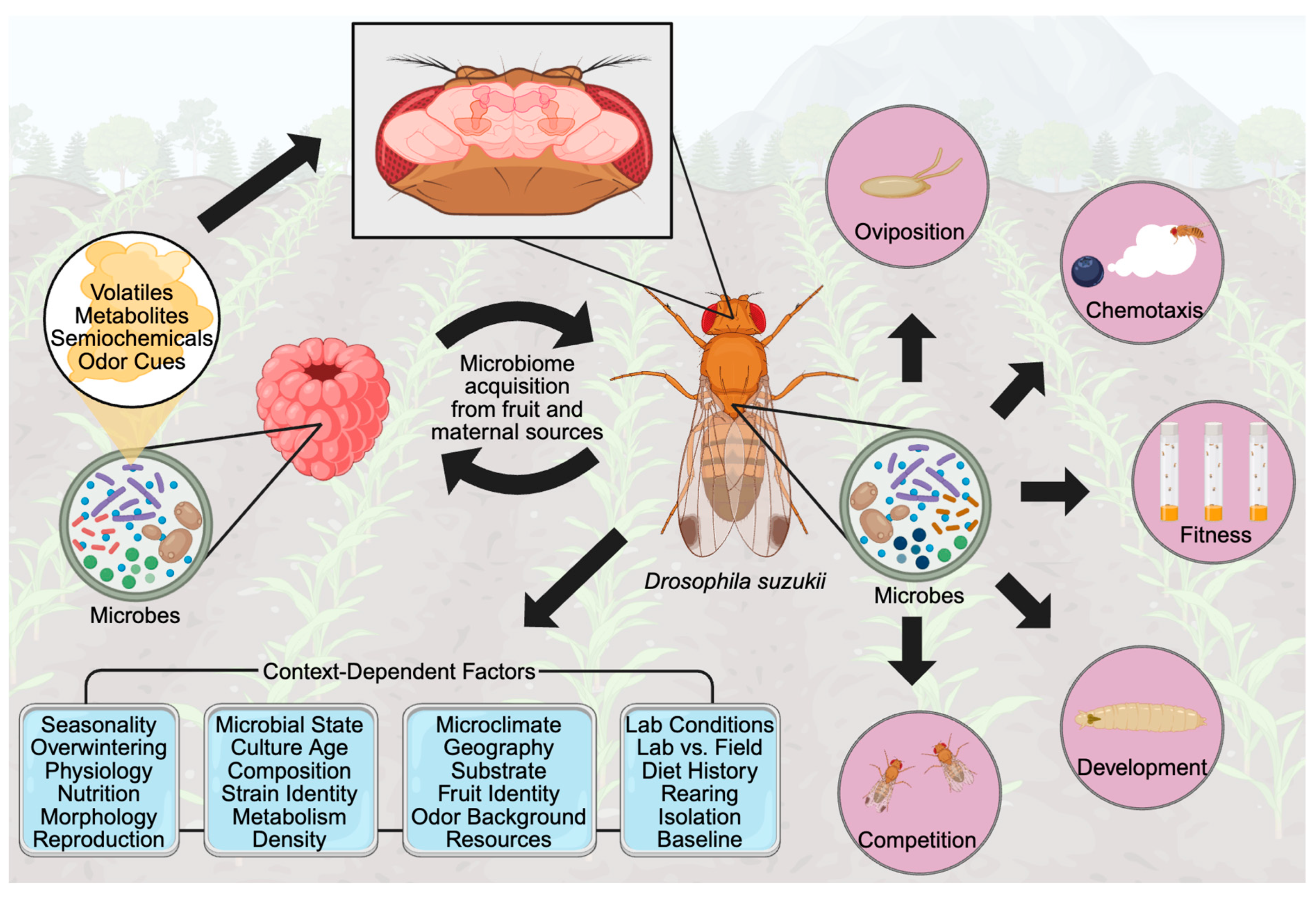
How Drosophila suzukii Acquires and Interacts with Its Microbiome Across Ecological Contexts



Simple Summary
Abstract
1. Introduction
2. What Shapes the SWD Microbiome
2.1. Defining the SWD Core Microbiome
2.2. Drivers of Microbiome Variation Across Populations
2.3. Fungi as the Missing Half of the SWD Microbiome
2.4. How SWD Acquires and Retains Its Microbes
3. Why Fruit Diets Make SWD Depend on Microbes
3.1. What Microbes Provide When Fruit Falls Short
3.2. When Larval Choice Diverges from Larval Fitness
4. Why Microbial Cues Mean Different Things in Different Contexts
4.1. Season and Physiology Reshape Cue Value
4.2. Yeast Volatiles in Context
4.3. Limits of Taxonomic Resolution
4.4. Why SWD Avoids What Other Drosophilids Approach

| Microbe/Taxon | Group | Study System | Response Measured | Effect on SWD | Context Dependence | Study(s) |
|---|---|---|---|---|---|---|
| Acetobacter sp. | AAB | Lab | Oviposition | Neutral/aversive | Requires strain-level specificity | [9,70] |
| Acetobacter cibinongensis | AAB | Lab | Adult attraction | Neutral | Limited data | [29] |
| Acetobacter persici | AAB | Lab | Adult attraction | Neutral/aversive | Culture age | [29] |
| Acetobacter pomorum | AAB | Lab | Competitor-associated aversion | Neutral | Effect not significant | [10] |
| Lab | Fitness | Delayed development and stunted body growth | Host species-specific | [21] | ||
| Gluconobacter sp. | AAB | Lab | Oviposition | Aversive | Requires strain-level specificity | [9] |
| Gluconobacter cerinus | AAB | Field | Adult attraction | Moderate attractant | Limited data | [26] |
| Gluconobacter kanchanaburiensis | AAB | Lab | Adult attraction | Attractive | Limited data | [29] |
| Gluconobacter oxydans | AAB | Lab Field | Adult attraction | Attractive | High selectivity in field with only moderate attraction | [26,29] |
| Komagataeibacter hansenii | AAB | Lab | Adult attraction | Neutral | Limited data | [29] |
| Komagataeibacter saccharivorans | AAB | Lab | Adult attraction | Attractive | Field validation required | [29] |
| Klebsiella oxytoca | Enterobacteriaceae | Lab | Fitness | Rescued development in a gnotobiotic line | Limited data | [49] |
| Curtobacterium sp. | Actinobacteria | Field | Adult attraction | Weak attractant | Limited data | [26] |
| Colletotrichum fioriniae | Entomopathogen | Lab | Adult attraction | Aversive | Field validation required | [68,71] |
| Lab | Fitness | Decline in oviposition, fecundity, and increase in embryonic mortality | Spore-dependent | [71] | ||
| Metarhizium robertsii | Entomopathogen | Lab | Fitness | High mortality | No host species-specificity | [23] |
| Xenorhabdus nematophila | Entomopathogen | Lab | Fitness | Immune suppressive, larval mortality | Requires nematode symbiont | [72] |
| Wolbachia pipientis | Endosymbiont | Lab Field | Fitness | Fecundity, pathogen resistance | Limited data | [56,73,74] |
| Lactobacillus sp. | LAB | Field | Adult attraction | Moderately attractive | Requires strain-level specificity | [59] |
| Lactobacillus brevis | LAB | Lab | Competitor-associated aversion | Aversive | Interspecific host microbiota-mediated, effect rescued with altered association | [10] |
| Leuconostoc pseudomesenteroides | LAB | Lab | Fitness | Adult mortality | Limited data | [75] |
| Oenococcus oeni | LAB | Field | Adult attraction | Attractive | Requires strain-level specificity | [59,76] |
| Pediococcus sp. | LAB | Field | Adult attraction | Moderately attractive | Requires strain-level specificity | [59] |
| Actinomucor elegans | Fungi | Lab | Fitness | Overall beneficial | Limited data | [77] |
| Botrytis cinerea | Fungi | Lab | Adult attraction | Repellent | Presence on non-fruit, shows no effect, phytopathogen and candidate entomopathogen | [45,69] |
| Geotrichum candidum | Fungi | Lab | Fitness | Overall beneficial | Limited data | [77] |
| Talaromyces minioluteus | Fungi | Lab | Fitness | Overall negative | Limited data | [77] |
| Candida sp. | Yeast | Lab | Fecundity | Increase in oviposition | Requires strain-level specificity | [78] |
| Candida californica | Yeast | Lab | Adult attraction | Attractive | Physiological status matters, field validation required | [41] |
| Candida zemplinina | Yeast | Lab | Adult attraction | Attractive | Physiological status matters, field validation required | [34,36,41] |
| Hanseniaspora opuntiae | Yeast | Field | Adult attraction | Attractive | Limited data | [26] |
| Hanseniaspora uvarum | Yeast | Lab | Fitness | Substandard host development, nutritional relevance, stimulates oviposition | Preference-performance mismatch, requires field validation | [8,39,40,45,52,78] |
| Lab Field | Adult attraction | Attractive | Background odor, host physiological status, medium | [12,35,36,41,44,45,58] | ||
| Lab Field | Phagostimulation | Promotes phagostimulation | Effect is not consistent, mixture-dependent, sex-dependent | [39,42,43,52,79] | ||
| Issatchenkia terricola | Yeast | Lab Field | Adult attraction | Moderate attractant | Weaker in comparison to other yeasts | [35,41,44,45] |
| Lab | Larval development | Performed adequately | Slower larval development time then other yeast counterparts | [39,40] | ||
| Metschnikowia pulcherrima | Yeast | Lab | Larval development | Decline in larval fitness | Preference-performance mismatch | [39,78,80] |
| Lab Field | Adult attraction | Attractive | Mixture-dependent | [34,36,44] | ||
| Pichia sp. | Yeast | Field | Adult attraction | Weak attractant | Requires strain-level specificity | [26] |
| Pichia kluyveri | Yeast | Lab | Larval development | Performed adequately | Slower larval development time then other yeast counterparts | [40] |
| Lab | Adult attraction | Moderate attractant | Limited data | [41] | ||
| Saccharomyces cerevisiae | Yeast | Lab | Fitness | Increase in oviposition, larval development, nutritional relevance, reduction in larval survival | Requires strain-level specificity, culture age, ethanol production | [13,40,45,78] |
| Lab Field | Adult attraction | Moderate attractant | Weaker in comparison to other yeasts | [27,34,39,41,45,81] | ||
| Saccharomycopsis vini | Yeast | Lab | Adult attraction | Attractive | Field validation required | [44] |
| Lab | Fitness | Increase in adult performance, neutral in larval survival | Limited data | [39,78] | ||
| Starmarella bacillaris | Yeast | Lab | Larval development | Decline in larval fitness | Limited data | [16] |
| Wickerhamomyces pijperi | Yeast | Lab | Adult attraction | Attractive | Mixture-dependent | [34,36] |
5. Competition Is Microbially Mediated
5.1. Why SWD Avoids Competitor-Associated Substrates
5.2. Deterrence Depends on Active Larval Modification
5.3. When SWD Damage Opens the Door for Others
5.4. Where Microbial Cues Meet Sensory Divergence
6. Conclusions
Author Contributions
Funding
Institutional Review Board Statement
Informed Consent Statement
Data Availability Statement
Acknowledgments
Conflicts of Interest
Abbreviations
| AAB | Acetic acid bacteria |
| HMPs | Host-marking pheromones |
| IPM | Integrated pest management |
| LAB | Lactic acid bacteria |
| SCFAs | Short-chain fatty acids |
| SWD | Spotted wing drosophila |
References
- Tait, G.; Mermer, S.; Stockton, D.; Lee, J.; Avosani, S.; Abrieux, A.; Anfora, G.; Beers, E.; Biondi, A.; Burrack, H.; et al. Drosophila suzukii (Diptera: Drosophilidae): A Decade of Research Towards a Sustainable Integrated Pest Management Program. J. Econ. Entomol. 2021, 114, 1950–1974. [Google Scholar] [CrossRef] [Scilit]
- Abraham, J.; Angeli, S.; Antwi, J.B.; Rodriguez-Saona, C. Editorial: Research Advances on Drosophila suzukii. Front. Ecol. Evol. 2022, 10, 897222. [Google Scholar] [CrossRef] [Scilit]
- Wang, W.; Dweck, H.K.M.; Talross, G.J.S.; Zaidi, A.; Gendron, J.M.; Carlson, J.R. Sugar Sensation and Mechanosensation in the Egg-Laying Preference Shift of Drosophila suzukii. eLife 2022, 11, e81703. [Google Scholar] [CrossRef] [Scilit] [PubMed]
- Dweck, H.K.; Talross, G.J.; Wang, W.; Carlson, J.R. Evolutionary Shifts in Taste Coding in the Fruit Pest Drosophila suzukii. eLife 2021, 10, e64317. [Google Scholar] [CrossRef] [Scilit]
- Hamby, K.A.; Becher, P. Current Knowledge of Interactions between Drosophila suzukii and Microbes, and Their Potential Utility for Pest Management. J. Pest Sci. 2016, 89, 621–630. [Google Scholar] [CrossRef] [Scilit]
- Jones, R.; Fountain, M.T.; Andreani, N.A.; Günther, C.S.; Goddard, M.R. The Relative Abundances of Yeasts Attractive to Drosophila suzukii Differ between Fruit Types and Are Greatest on Raspberries. Sci. Rep. 2022, 12, 10382. [Google Scholar] [CrossRef] [Scilit]
- Biasi, A.; Zhimo, V.Y.; Kumar, A.; Abdelfattah, A.; Salim, S.; Feygenberg, O.; Wisniewski, M.; Droby, S. Changes in the Fungal Community Assembly of Apple Fruit Following Postharvest Application of the Yeast Biocontrol Agent Metschnikowia fructicola. Horticulturae 2021, 7, 360. [Google Scholar] [CrossRef] [Scilit]
- Bing, X.; Gerlach, J.; Loeb, G.; Buchon, N. Nutrient-Dependent Impact of Microbes on Drosophila suzukii Development. mBio 2018, 9, e02199-17. [Google Scholar] [CrossRef] [Scilit]
- Sato, A.; Tanaka, K.M.; Yew, J.Y.; Takahashi, A. Drosophila suzukii Avoidance of Microbes in Oviposition Choice. R. Soc. Open Sci. 2021, 8, 201601. [Google Scholar] [CrossRef] [Scilit] [PubMed]
- Rombaut, A.; Gallet, R.; Qitout, K.; Samy, M.; Guilhot, R.; Ghirardini, P.; Lazzaro, B.P.; Becher, P.G.; Xuéreb, A.; Gibert, P.; et al. Microbiota-Mediated Competition between Drosophila Species. Microbiome 2023, 11, 201. [Google Scholar] [CrossRef] [Scilit]
- Clymans, R.; Van Kerckvoorde, V.; Bangels, E.; Akkermans, W.; Alhmedi, A.; De Clercq, P.; Beliën, T.; Bylemans, D. Olfactory Preference of Drosophila suzukii Shifts between Fruit and Fermentation Cues over the Season: Effects of Physiological Status. Insects 2019, 10, 200. [Google Scholar] [CrossRef] [Scilit]
- Huang, J.; Gut, L.J. Impact of Background Fruit Odors on Attraction of Drosophila suzukii (Diptera: Drosophilidae) to Its Symbiotic Yeast. J. Insect Sci. 2021, 21, 4. [Google Scholar] [CrossRef] [Scilit]
- Biasazin, T.D.; Herrera, S.L.; Kimbokota, F.; Dekker, T. Diverging Olfactory Sensitivities to Yeast Volatiles Reflect Resource Partitioning of Tephritids and Drosophilids. Front. Ecol. Evol. 2022, 10, 999762. [Google Scholar] [CrossRef] [Scilit]
- Tungadi, T.D.; Powell, G.; Shaw, B.; Fountain, M.T. Factors Influencing Oviposition Behaviour of the Invasive Pest, Drosophila suzukii, Derived from Interactions with Other Drosophila Species: Potential Applications for Control. Pest Manag. Sci. 2023, 79, 4132–4139. [Google Scholar] [CrossRef] [Scilit] [PubMed]
- Tungadi, T.D.; Shaw, B.; Powell, G.; Hall, D.R.; Bray, D.P.; Harte, S.J.; Farman, D.I.; Wijnen, H.; Fountain, M.T. Live Drosophila melanogaster Larvae Deter Oviposition by Drosophila suzukii. Insects 2022, 13, 688. [Google Scholar] [CrossRef] [Scilit] [PubMed]
- Solomon, G.M.; Dodangoda, H.; McCarthy-Walker, T.; Ntim-Gyakari, R.; Newell, P.D. The Microbiota of Drosophila suzukii Influences the Larval Development of Drosophila melanogaster. PeerJ 2019, 7, e8097. [Google Scholar] [CrossRef] [Scilit]
- Bhandari, R.; Wong, A.C.-N.; Lee, J.C.; Boyd, A.; Shelby, K.; Ringbauer, J.; Kang, D.S. Microbiome Composition and Co-Occurrence Dynamics in Wild Drosophila suzukii Are Influenced by Host Crop, Fly Sex, and Sampling Location. Microbiol. Spectr. 2025, 13, e0260824. [Google Scholar] [CrossRef] [Scilit]
- Lin, Q.; Zhai, Y.; Chen, H.; Qin, D.; Zheng, L.; Gao, H. Analyses of the Gut Bacteriomes of Four Important Drosophila Pests. Can. Entomol. 2021, 153, 757–773. [Google Scholar] [CrossRef] [Scilit]
- Medeiros, M.J.; Burger, A.D.; Price, D.K.; Yew, J.Y. Microbiome Composition of Drosophila suzukii Varies across Geographical Regions. Front. Ecol. Evol. 2025, 13, 1696606. [Google Scholar] [CrossRef] [Scilit]
- Guilhot, R.; Xuéreb, A.; Lagmairi, A.; Olazcuaga, L.; Fellous, S. Microbiota Acquisition and Transmission in Drosophila Flies. iScience 2023, 26, 107656. [Google Scholar] [CrossRef] [Scilit]
- Bing, X.-L.; Liang, Z.-J.; Tian, J.; Gong, X.; Huang, S.-Q.; Chen, J.; Hong, X.-Y. The Influence of Acetobacter pomorum Bacteria on the Developmental Progression of Drosophila suzukii via Gluconic Acid Secretion. Mol. Ecol. 2024, 33, e17202. [Google Scholar] [CrossRef] [Scilit]
- Hiebert, N.; Carrau, T.; Bartling, M.; Vilcinskas, A.; Lee, K.-Z. Identification of Entomopathogenic Bacteria Associated with the Invasive Pest Drosophila Suzukii in Infested Areas of Germany. J. Invertebr. Pathol. 2020, 173, 107389. [Google Scholar] [CrossRef] [Scilit]
- Hong, S.; Gao, H.; Chen, H.; Wang, C. Engineered Fungus Containing a Caterpillar Gene Kills Insects Rapidly by Disrupting Their Ecto- and Endo-Microbiomes. Commun. Biol. 2024, 7, 955. [Google Scholar] [CrossRef] [Scilit] [PubMed]
- Chandler, J.A.; James, P.M.; Jospin, G.; Lang, J.M. The Bacterial Communities of Drosophila suzukii Collected from Undamaged Cherries. PeerJ 2014, 2, e474. [Google Scholar] [CrossRef] [Scilit] [PubMed]
- Martinez-Sañudo, I.; Simonato, M.; Squartini, A.; Mori, N.; Marri, L.; Mazzon, L. Metagenomic Analysis Reveals Changes of the Drosophila suzukii Microbiota in the Newly Colonized Regions. Insect Sci. 2018, 25, 833–846. [Google Scholar] [CrossRef] [Scilit]
- Bueno, E.; Martin, K.R.; Raguso, R.A.; Mcmullen, J.G.; Hesler, S.P.; Loeb, G.M.; Douglas, A.E. Response of Wild Spotted Wing Drosophila (Drosophila suzukii) to Microbial Volatiles. J. Chem. Ecol. 2020, 46, 688–698. [Google Scholar] [CrossRef] [Scilit] [PubMed]
- Lasa, R.; Navarro-de-la-Fuente, L.; Gschaedler-Mathis, A.C.; Kirchmayr, M.R.; Williams, T. Yeast Species, Strains, and Growth Media Mediate Attraction of Drosophila suzukii (Diptera: Drosophilidae). Insects 2019, 10, 228. [Google Scholar] [CrossRef] [Scilit]
- Vacchini, V.; Gonella, E.; Crotti, E.; Prosdocimi, E.M.; Mazzetto, F.; Chouaia, B.; Callegari, M.; Mapelli, F.; Mandrioli, M.; Alma, A.; et al. Bacterial Diversity Shift Determined by Different Diets in the Gut of the Spotted Wing Fly Drosophila suzukii Is Primarily Reflected on Acetic Acid Bacteria. Environ. Microbiol. Rep. 2017, 9, 91–103. [Google Scholar] [CrossRef] [Scilit]
- Mazzetto, F.; Gonella, E.; Crotti, E.; Vacchini, V.; Syrpas, M.; Pontini, M.; Mangelinckx, S.; Daffonchio, D.; Alma, A. Olfactory Attraction of Drosophila suzukii by Symbiotic Acetic Acid Bacteria. J. Pest Sci. 2016, 89, 783–792. [Google Scholar] [CrossRef] [Scilit]
- Gurung, K.; Vink, S.N.; Salles, J.F.; Wertheim, B. More Persistent Bacterial than Fungal Associations in the Microbiota of a Pest Insect. J. Pest Sci. 2023, 96, 785–796. [Google Scholar] [CrossRef] [Scilit]
- Costa-Santos, M.; Sario, S.; Mendes, R.J.; Santos, C. Seasonal Dynamics and Core Stability of the Bacterial Microbiome of a Drosophila suzukii Wild Population. Sci. Rep. 2026, 16, 6569. [Google Scholar] [CrossRef] [Scilit]
- Fountain, M.T.; Bennett, J.; Cobo-Medina, M.; Conde Ruiz, R.; Deakin, G.; Delgado, A.; Harrison, R.; Harrison, N. Alimentary Microbes of Winter-Form Drosophila suzukii. Insect Mol. Biol. 2018, 27, 383–392. [Google Scholar] [CrossRef] [Scilit]
- Kirkpatrick, D.M.; Leach, H.L.; Xu, P.; Dong, K.; Isaacs, R.; Gut, L.J. Comparative Antennal and Behavioral Responses of Summer and Winter Morph Drosophila suzukii (Diptera: Drosophilidae) to Ecologically Relevant Volatiles. Environ. Entomol. 2018, 47, 700–706. [Google Scholar] [CrossRef] [Scilit]
- Jones, R.; Goddard, M.R.; Eady, P.E.; Hall, D.R.; Bray, D.P.; Farman, D.I.; Fountain, M.T. Differential Attraction of Summer and Winter Morphs of Spotted Wing Drosophila, Drosophila suzukii, to Yeasts. J. Chem. Ecol. 2025, 51, 23. [Google Scholar] [CrossRef] [Scilit]
- Erdei, A.L.; Szelényi, M.O.; Deutsch, F.; Rikk, P.; Molnár, B.P. Lure Design for Drosophila suzukii Based on Liquid Culture of Fruit Epiphytic Yeasts: Comparing the Attractivity of Fermentation Volatiles for Seasonal Morphs. J. Appl. Entomol. 2022, 146, 773–785. [Google Scholar] [CrossRef] [Scilit]
- Jones, R.; Fountain, M.T.; Günther, C.S.; Eady, P.E.; Goddard, M.R. Separate and Combined Hanseniaspora uvarum and Metschnikowia pulcherrima Metabolic Volatiles Are Attractive to Drosophila suzukii in the Laboratory and Field. Sci. Rep. 2021, 11, 1201. [Google Scholar] [CrossRef] [Scilit] [PubMed]
- Shu, R.; Hahn, D.A.; Jurkevitch, E.; Liburd, O.E.; Yuval, B.; Wong, A.C.-N. Sex-Dependent Effects of the Microbiome on Foraging and Locomotion in Drosophila suzukii. Front. Microbiol. 2021, 12, 656406. [Google Scholar] [CrossRef] [Scilit]
- Jiménez-Padilla, Y.; Esan, E.O.; Floate, K.D.; Sinclair, B.J. Persistence of Diet Effects on the Microbiota of Drosophila suzukii (Diptera: Drosophilidae). Can. Entomol. 2020, 152, 516–531. [Google Scholar] [CrossRef] [Scilit]
- Spitaler, U.; Bianchi, F.; Eisenstecken, D.; Castellan, I.; Angeli, S.; Dordevic, N.; Robatscher, P.; Vogel, R.F.; Koschier, E.H.; Schmidt, S. Yeast Species Affects Feeding and Fitness of Drosophila suzukii Adults. J. Pest Sci. 2020, 93, 1295–1309. [Google Scholar] [CrossRef] [Scilit]
- Lewis, M.T.; Hamby, K.A. Differential Impacts of Yeasts on Feeding Behavior and Development in Larval Drosophila suzukii (Diptera: Drosophilidae). Sci. Rep. 2019, 9, 13370. [Google Scholar] [CrossRef] [Scilit] [PubMed]
- Scheidler, N.H.; Liu, C.; Hamby, K.A.; Zalom, F.G.; Syed, Z. Volatile Codes: Correlation of Olfactory Signals and Reception in Drosophila-Yeast Chemical Communication. Sci. Rep. 2015, 5, 14059. [Google Scholar] [CrossRef] [Scilit]
- Noble, R.; Dobrovin-Pennington, A.; Phillips, A.; Cannon, M.F.L.; Shaw, B.; Fountain, M.T. Improved Insecticidal Control of Spotted Wing Drosophila (Drosophila suzukii) Using Yeast and Fermented Strawberry Juice Baits. Crop Prot. 2019, 125, 104902. [Google Scholar] [CrossRef] [Scilit]
- Bianchi, F.; Spitaler, U.; Castellan, I.; Cossu, C.S.; Brigadoi, T.; Duménil, C.; Angeli, S.; Robatscher, P.; Vogel, R.F.; Schmidt, S.; et al. Persistence of a Yeast-Based (Hanseniaspora uvarum) Attract-and-Kill Formulation against Drosophila suzukii on Grape Leaves. Insects 2020, 11, 810. [Google Scholar] [CrossRef] [Scilit]
- Castellan, I.; Duménil, C.; Rehermann, G.; Eisenstecken, D.; Bianchi, F.; Robatscher, P.; Spitaler, U.; Favaro, R.; Schmidt, S.; Becher, P.G.; et al. Chemical and Electrophysiological Characterisation of Headspace Volatiles from Yeasts Attractive to Drosophila suzukii. J. Chem. Ecol. 2024, 50, 830–846. [Google Scholar] [CrossRef] [Scilit] [PubMed]
- Chakraborty, A.; Mori, B.; Rehermann, G.; Hernández Garcia, A.; Lemmen-Lechelt, J.; Hagman, A.; Khalil, S.; Håkansson, S.; Witzgall, P.; Becher, P.G. Yeast and Fruit Fly Mutual Niche Construction and Antagonism against Mould. Funct. Ecol. 2022, 36, 1639–1654. [Google Scholar] [CrossRef] [Scilit]
- Hamby, K.A.; Hernández, A.; Boundy-Mills, K.; Zalom, F.G. Associations of Yeasts with Spotted-Wing Drosophila (Drosophila suzukii; Diptera: Drosophilidae) in Cherries and Raspberries. Appl. Environ. Microbiol. 2012, 78, 4869–4873. [Google Scholar] [CrossRef] [Scilit]
- Woltz, J.M.; Lee, J.C. Pupation Behavior and Larval and Pupal Biocontrol of Drosophila suzukii in the Field. Biol. Control 2017, 110, 62–69. [Google Scholar] [CrossRef] [Scilit]
- Bianchi, F.; Spitaler, U.; Robatscher, P.; Vogel, R.F.; Schmidt, S.; Eisenstecken, D. Comparative Lipidomics of Different Yeast Species Associated to Drosophila suzukii. Metabolites 2020, 10, 352. [Google Scholar] [CrossRef] [Scilit]
- Gao, H.-H.; Zhao, S.; Wang, R.-J.; Qin, D.-Y.; Chen, P.; Zhang, A.-S.; Zhuang, Q.-Y.; Zhai, Y.-F.; Zhou, X.-H. Gut Bacterium Promotes Host Fitness in Special Ecological Niche by Affecting Sugar Metabolism in Drosophila suzukii. Insect Sci. 2023, 30, 1713–1733. [Google Scholar] [CrossRef] [Scilit] [PubMed]
- Silva-Soares, N.F.; Nogueira-Alves, A.; Beldade, P.; Mirth, C.K. Adaptation to New Nutritional Environments: Larval Performance, Foraging Decisions, and Adult Oviposition Choices in Drosophila suzukii. BMC Ecol. 2017, 17, 21. [Google Scholar] [CrossRef] [Scilit]
- Hardin, J.A.; Kraus, D.A.; Burrack, H.J. Diet Quality Mitigates Intraspecific Larval Competition in Drosophila suzukii. Entomol. Exp. Appl. 2015, 156, 59–65. [Google Scholar] [CrossRef] [Scilit]
- Mori, B.A.; Whitener, A.B.; Leinweber, Y.; Revadi, S.; Beers, E.H.; Witzgall, P.; Becher, P.G. Enhanced Yeast Feeding Following Mating Facilitates Control of the Invasive Fruit Pest Drosophila suzukii. J. Appl. Ecol. 2017, 54, 170–177. [Google Scholar] [CrossRef] [Scilit]
- Stockton, D.G.; Cha, D.H.; Loeb, G.M. Does Habituation Affect the Efficacy of Semiochemical Oviposition Repellents Developed Against Drosophila suzukii? Environ. Entomol. 2021, 50, 1322–1331. [Google Scholar] [CrossRef] [Scilit]
- Hasan, K.; Dweck, H. Behavioral Responses of Drosophila suzukii to Blends of Its Attractants. microPubli. Biol. 2025, 2025. [Google Scholar] [CrossRef] [Scilit]
- Landolt, P.J.; Adams, T.; Rogg, H. Trapping Spotted Wing Drosophila, Drosophila suzukii (Matsumura) (Diptera: Drosophilidae), with Combinations of Vinegar and Wine, and Acetic Acid and Ethanol. J. Appl. Entomol. 2012, 136, 148–154. [Google Scholar] [CrossRef] [Scilit]
- Revadi, S.; Vitagliano, S.; Rossi Stacconi, M.V.; Ramasamy, S.; Mansourian, S.; Carlin, S.; Vrhovsek, U.; Becher, P.G.; Mazzoni, V.; Rota-Stabelli, O.; et al. Olfactory Responses of Drosophila suzukii Females to Host Plant Volatiles. Physiol. Entomol. 2015, 40, 54–64. [Google Scholar] [CrossRef] [Scilit]
- Kwadha, C.A.; Rehermann, G.; Tasso, D.; Fellous, S.; Bengtsson, M.; Wallin, E.A.; Flöhr, A.; Witzgall, P.; Becher, P.G. Sex Pheromone Mediates Resource Partitioning Between Drosophila melanogaster and D. suzukii. Evol. Appl. 2024, 17, e70042. [Google Scholar] [CrossRef] [Scilit] [PubMed]
- Kleman, I.; Rehermann, G.; Kwadha, C.A.; Witzgall, P.; Becher, P.G. Hanseniaspora uvarum Attracts Drosophila suzukii (Diptera: Drosophilidae) With High Specificity. J. Econ. Entomol. 2022, 115, 999–1007. [Google Scholar] [CrossRef] [Scilit] [PubMed]
- Alawamleh, A.; Ðurović, G.; Maddalena, G.; Guzzon, R.; Ganassi, S.; Hashmi, M.M.; Wäckers, F.; Anfora, G.; Cristofaro, A.D. Selection of Lactic Acid Bacteria Species and Strains for Efficient Trapping of Drosophila suzukii. Insects 2021, 12, 153. [Google Scholar] [CrossRef] [Scilit]
- Xue, Q.; Hasan, K.S.; Dweck, O.; Ebrahim, S.A.M.; Dweck, H.K.M. Functional Characterization and Evolution of Olfactory Responses in Coeloconic Sensilla of the Global Fruit Pest Drosophila suzukii. BMC Biol. 2025, 23, 50. [Google Scholar] [CrossRef] [Scilit]
- Akutsu, J.; Matsuo, T. Oviposition Preference for Spherical Surfaces Is Shared among Multiple Drosophila Species except D. melanogaster (Diptera: Drosophilidae). Entomol. Sci. 2023, 26, e12560. [Google Scholar] [CrossRef] [Scilit]
- Tonina, L.; Giomi, F.; Sancassani, M.; Ajelli, M.; Mori, N.; Giongo, L. Texture Features Explain the Susceptibility of Grapevine Cultivars to Drosophila suzukii (Diptera: Drosophilidae) Infestation in Ripening and Drying Grapes. Sci. Rep. 2020, 10, 10245. [Google Scholar] [CrossRef] [Scilit]
- Ioriatti, C.; Walton, V.; Dalton, D.; Anfora, G.; Grassi, A.; Maistri, S.; Mazzoni, V. Drosophila suzukii (Diptera: Drosophilidae) and Its Potential Impact to Wine Grapes During Harvest in Two Cool Climate Wine Grape Production Regions. J. Econ. Entomol. 2015, 108, 1148–1155. [Google Scholar] [CrossRef] [Scilit]
- Ibn Amor, A.; Kukorellyné Szénási, Á.; Németh, C.; Deutsch, F.; Kiss, B. Assessing Wine Grape Cultivar Susceptibility to Spotted Wing Drosophila and melanogaster-Type Drosophila in Hungarian Vineyards: Effects of Berry Integrity and Insights into Larval Interactions. Insects 2025, 16, 497. [Google Scholar] [CrossRef] [Scilit] [PubMed]
- Rodriguez-Saona, C.; Cloonan, K.R.; Sanchez-Pedraza, F.; Zhou, Y.; Giusti, M.M.; Benrey, B. Differential Susceptibility of Wild and Cultivated Blueberries to an Invasive Frugivorous Pest. J. Chem. Ecol. 2019, 45, 286–297. [Google Scholar] [CrossRef] [Scilit]
- Cai, P.; Song, Y.; Yi, C.; Zhang, Q.; Xia, H.; Lin, J.; Zhang, H.; Yang, J.; Ji, Q.; Chen, J. Potential Host Fruits for Drosophila suzukii: Olfactory and Oviposition Preferences and Suitability for Development. Entomol. Exp. Appl. 2019, 167, 880–890. [Google Scholar] [CrossRef] [Scilit]
- Olazcuaga, L.; Rode, N.O.; Foucaud, J.; Facon, B.; Ravigné, V.; Ausset, A.; Leménager, N.; Loiseau, A.; Gautier, M.; Estoup, A.; et al. Oviposition Preference and Larval Performance of Drosophila suzukii (Diptera: Drosophilidae), Spotted-Wing Drosophila: Effects of Fruit Identity and Composition. Environ. Entomol. 2019, 48, 867–881. [Google Scholar] [CrossRef] [Scilit]
- Rering, C.C.; Quadrel, A.; Urbaneja-Bernat, P.; Beck, J.J.; Ben-Zvi, Y.; Khodadadi, F.; Aćimović, S.G.; Rodriguez-Saona, C. Blueberries Infected with the Fungal Pathogen Colletotrichum fioriniae Release Odors That Repel Drosophila suzukii. Pest Manag. Sci. 2023, 79, 4906–4920. [Google Scholar] [CrossRef] [Scilit]
- Cha, D.H.; Hesler, S.P.; Brind’Amour, G.; Wentworth, K.S.; Villani, S.; Cox, K.D.; Boucher, M.T.; Wallingford, A.; Park, S.K.; Nyrop, J.; et al. Behavioral Evidence for Contextual Olfactory-Mediated Avoidance of the Ubiquitous Phytopathogen Botrytis cinerea by Drosophila suzukii. Insect Sci. 2020, 27, 771–779. [Google Scholar] [CrossRef] [Scilit] [PubMed]
- Sato, A.; Yew, J.Y.; Takahashi, A. Effect of Acetic Acid Bacteria Colonization on Oviposition and Feeding Site Choice in Drosophila suzukii and Its Related Species. bioRxiv 2023. [Google Scholar] [CrossRef] [Scilit]
- Urbaneja-Bernat, P.; Waller, T.; Rodriguez-Saona, C. Repellent, Oviposition-Deterrent, and Insecticidal Activity of the Fungal Pathogen Colletotrichum fioriniae on Drosophila suzukii (Diptera: Drosophilidae) in Highbush Blueberries. Sci. Rep. 2020, 10, 14467. [Google Scholar] [CrossRef] [Scilit] [PubMed]
- Garriga, A.; Mastore, M.; Morton, A.; Pino, F.G.D.; Brivio, M.F. Immune Response of Drosophila suzukii Larvae to Infection with the Nematobacterial Complex Steinernema carpocapsae-Xenorhabdus nematophila. Insects 2020, 11, 210. [Google Scholar] [CrossRef] [Scilit]
- Cattel, J.; Nikolouli, K.; Andrieux, T.; Martinez, J.; Jiggins, F.; Charlat, S.; Vavre, F.; Lejon, D.; Gibert, P.; Mouton, L. Back and Forth Wolbachia Transfers Reveal Efficient Strains to Control Spotted Wing Drosophila Populations. J. Appl. Ecol. 2018, 55, 2408–2418. [Google Scholar] [CrossRef] [Scilit]
- Hamm, C.A.; Begun, D.J.; Vo, A.; Smith, C.C.R.; Saelao, P.; Shaver, A.O.; Jaenike, J.; Turelli, M. Wolbachia Do Not Live by Reproductive Manipulation Alone: Infection Polymorphism in Drosophila suzukii and D. subpulchrella. Mol. Ecol. 2014, 23, 4871–4885. [Google Scholar] [CrossRef] [Scilit]
- Hiebert, N.; Kessel, T.; Skaljac, M.; Spohn, M.; Vilcinskas, A.; Lee, K.-Z. The Gram-Positive Bacterium Leuconostoc pseudomesenteroides Shows Insecticidal Activity against Drosophilid and Aphid Pests. Insects 2020, 11, 471. [Google Scholar] [CrossRef] [Scilit]
- Ðurović, G.; Alawamleh, A.; Carlin, S.; Maddalena, G.; Guzzon, R.; Mazzoni, V.; Dalton, D.T.; Walton, V.M.; Suckling, D.M.; Butler, R.C.; et al. Liquid Baits with Oenococcus oeni Increase Captures of Drosophila suzukii. Insects 2021, 12, 66. [Google Scholar] [CrossRef] [Scilit]
- Gao, H.-H.; Xu, N.; Chen, H.; Liu, Q.; Pu, Q.-Y.; Qin, D.-Y.; Zhai, Y.-F.; Yu, Y. Impact of Selected Fungi from an Artificial Diet on the Growth and Development of Drosophila suzukii (Diptera: Drosophilidae). J. Asia-Pac. Entomol. 2017, 20, 141–149. [Google Scholar] [CrossRef] [Scilit]
- Bellutti, N.; Gallmetzer, A.; Innerebner, G.; Schmidt, S.; Zelger, R.; Koschier, E.H. Dietary Yeast Affects Preference and Performance in Drosophila suzukii. J. Pest Sci. 2018, 91, 651–660. [Google Scholar] [CrossRef] [Scilit]
- Rehermann, G.; Spitaler, U.; Sahle, K.; Cossu, C.S.; Donne, L.D.; Bianchi, F.; Eisenstecken, D.; Angeli, S.; Schmidt, S.; Becher, P.G. Behavioral Manipulation of Drosophila suzukii for Pest Control: High Attraction to Yeast Enhances Insecticide Efficacy When Applied on Leaves. Pest Manag. Sci. 2022, 78, 896–904. [Google Scholar] [CrossRef] [Scilit]
- Anagnostou, C.; LeGrand, E.A.; Rohlfs, M. Friendly Food for Fitter Flies?—Influence of Dietary Microbial Species on Food Choice and Parasitoid Resistance in Drosophila. Oikos 2010, 119, 533–541. [Google Scholar] [CrossRef] [Scilit]
- Knight, A.L.; Basoalto, E.; Yee, W.; Hilton, R.; Kurtzman, C.P. Adding Yeasts with Sugar to Increase the Number of Effective Insecticide Classes to Manage Drosophila suzukii (Matsumura) (Diptera: Drosophilidae) in Cherry. Pest Manag. Sci. 2016, 72, 1482–1490. [Google Scholar] [CrossRef] [Scilit]
- Keesey, I.W.; Koerte, S.; Retzke, T.; Haverkamp, A.; Hansson, B.S.; Knaden, M. Adult Frass Provides a Pheromone Signature for Drosophila Feeding and Aggregation. J. Chem. Ecol. 2016, 42, 739–747. [Google Scholar] [CrossRef] [Scilit]
- Tait, G.; Park, K.; Nieri, R.; Crava, M.C.; Mermer, S.; Clappa, E.; Boyer, G.; Dalton, D.T.; Carlin, S.; Brewer, L.; et al. Reproductive Site Selection: Evidence of an Oviposition Cue in a Highly Adaptive Dipteran, Drosophila suzukii (Diptera: Drosophilidae). Environ. Entomol. 2020, 49, 355–363. [Google Scholar] [CrossRef] [Scilit]
- Elsensohn, J.E.; Aly, M.F.K.; Schal, C.; Burrack, H.J. Social Signals Mediate Oviposition Site Selection in Drosophila suzukii. Sci. Rep. 2021, 11, 3796. [Google Scholar] [CrossRef] [Scilit]
- Kienzle, R.; Rohlfs, M. Mind the Wound!—Fruit Injury Ranks Higher than, and Interacts with, Heterospecific Cues for Drosophila suzukii Oviposition. Insects 2021, 12, 424. [Google Scholar] [CrossRef] [Scilit] [PubMed]
- Kidera, H.; Takahashi, K.H. Chemical Cues from Competitors Change the Oviposition Preference of Drosophila suzukii. Entomol. Exp. Appl. 2020, 168, 304–310. [Google Scholar] [CrossRef] [Scilit]
- Matsuo, T. Asymmetric Oviposition Behaviour between Drosophila suzukii and Drosophila subpulchrella Suggests Competition for the Shared Niche in Their Native Range. Ecol. Entomol. 2025, 50, 577–581. [Google Scholar] [CrossRef] [Scilit]
- Shaw, B.; Brain, P.; Wijnen, H.; Fountain, M.T. Reducing Drosophila suzukii Emergence through Inter-Species Competition. Pest Manag. Sci. 2018, 74, 1466–1471. [Google Scholar] [CrossRef] [Scilit] [PubMed]
- Shrader, M.E.; Burrack, H.J.; Pfeiffer, D.G. Effects of Interspecific Larval Competition on Developmental Parameters in Nutrient Sources Between Drosophila suzukii (Diptera: Drosophilidae) and Zaprionus indianus. J. Econ. Entomol. 2020, 113, 230–238. [Google Scholar] [CrossRef] [Scilit]
- Dancau, T.; Stemberger, T.L.M.; Clarke, P.; Gillespie, D.R. Can Competition Be Superior to Parasitism for Biological Control? The Case of Spotted Wing Drosophila (Drosophila suzukii), Drosophila melanogaster and Pachycrepoideus vindemmiae. Biocontrol Sci. Technol. 2017, 27, 3–16. [Google Scholar] [CrossRef] [Scilit]
- Hall, M.E.; Loeb, G.M.; Cadle-Davidson, L.; Evans, K.J.; Wilcox, W.F. Grape Sour Rot: A Four-Way Interaction Involving the Host, Yeast, Acetic Acid Bacteria, and Insects. Phytopathology 2018, 108, 1429–1442. [Google Scholar] [CrossRef] [Scilit]
- Brilinger, D.; Arioli, C.J.; Werner, S.S.; Boff, M.I.C. Drosophila suzukii Population Dynamics in Vineyards and Wine Cultivars Susceptibility. Rev. Bras. Frutic. 2023, 45, e-989. [Google Scholar] [CrossRef] [Scilit]
- Rombaut, A.; Guilhot, R.; Xuéreb, A.; Benoit, L.; Chapuis, M.P.; Gibert, P.; Fellous, S. Invasive Drosophila suzukii Facilitates Drosophila melanogaster Infestation and Sour Rot Outbreaks in the Vineyards. R. Soc. Open Sci. 2017, 4, 170117. [Google Scholar] [CrossRef] [Scilit]
- Bernardi, D.; Andreazza, F.; Botton, M.; Baronio, C.A.; Nava, D.E. Susceptibility and Interactions of Drosophila suzukii and Zaprionus indianus (Diptera: Drosophilidae) in Damaging Strawberry. Neotrop. Entomol. 2017, 46, 1–7. [Google Scholar] [CrossRef] [Scilit]
- Entling, W.; Hoffmann, C. Single and Combined Effects of Drosophila suzukii and Drosophila melanogaster on Sour Rot Development in Viticulture. J. Appl. Entomol. 2020, 144, 153–160. [Google Scholar] [CrossRef] [Scilit]
- Barata, A.; Santos, S.C.; Malfeito-Ferreira, M.; Loureiro, V. New Insights into the Ecological Interaction Between Grape Berry Microorganisms and Drosophila Flies During the Development of Sour Rot. Microb. Ecol. 2012, 64, 416–430. [Google Scholar] [CrossRef] [Scilit]
- Ioriatti, C.; Guzzon, R.; Anfora, G.; Ghidoni, F.; Mazzoni, V.; Villegas, T.R.; Dalton, D.T.; Walton, V.M. Drosophila suzukii (Diptera: Drosophilidae) Contributes to the Development of Sour Rot in Grape. J. Econ. Entomol. 2018, 111, 283–292. [Google Scholar] [CrossRef] [Scilit] [PubMed]
- Baser, N.; Broutou, O.; Verrastro, V.; Porcelli, F.; Ioriatti, C.; Anfora, G.; Mazzoni, V.; Rossi Stacconi, M.V. Susceptibility of Table Grape Varieties Grown in South-Eastern Italy to Drosophila suzukii. J. Appl. Entomol. 2018, 142, 465–472. [Google Scholar] [CrossRef] [Scilit]
- Akutsu, J.; Matsuo, T. Drosophila suzukii Preferentially Lays Eggs on Spherical Surfaces with a Smaller Radius. Sci. Rep. 2022, 12, 15792. [Google Scholar] [CrossRef] [Scilit]
- Gadau, A.; Mills, S.; Zhu Jiang, X.Y.; Li, C.; Svetec, N.; Xu, Z.; Li, W.; Nagel, K.I.; Zhao, L. Molecular Evolution of CO2-Sensing ab1C Neurons Underlies Divergent Sensory Responses in the Drosophila suzukii Species Group. PLoS Genet. 2026, 22, e1012024. [Google Scholar] [CrossRef] [Scilit]
- Depetris-Chauvin, A.; Galagovsky, D.; Chevalier, C.; Maniere, G.; Grosjean, Y. Olfactory Detection of a Bacterial Short-Chain Fatty Acid Acts as an Orexigenic Signal in Drosophila melanogaster Larvae. Sci. Rep. 2017, 7, 14230. [Google Scholar] [CrossRef] [Scilit] [PubMed]
- Dumenil, C.; Yildirim, G.; Haase, A. Differential Coding of Fruit, Leaf, and Microbial Odours in the Brains of Drosophila suzukii and Drosophila melanogaster. Insects 2025, 16, 84. [Google Scholar] [CrossRef] [Scilit] [PubMed]

| Unresolved Question | Why It Remains Unresolved | Best Next Experiment |
|---|---|---|
| Which microbial taxa and their volatiles drive SWD attraction under field conditions? | Lab studies isolate microbial cues from fruit headspace, while community surveys identify taxa without linking them to volatile output or field-scale response. | Pair strain-level volatile profiling with attraction assays against defined fruit backgrounds; validate top candidates in orchard field trials. |
| Why are some microbial cues attractive for feeding but aversive for oviposition or poor for larval development? | Attraction, oviposition, and larval success are typically measured in separate systems, obscuring how physiology and substrate state shift cue interpretation. | Run linked attraction, oviposition, and offspring performance assays using identical microbial treatments, diet histories, and host physiological states; identify implicated pathways. |
| How do vertical vs. horizontal microbiome acquisition affect SWD chemosensory responses? | Transmission route is rarely linked to sensory outcomes, and microbiome history is seldom measured in chemosensory studies. | Compare gnotobiotic SWD with vertical-like vs. horizontal microbial exposure; assess behavior, microbiome persistence, and sensory responses at strain-level resolution. |
| Which metabolites mediate competitor-associated oviposition avoidance? | Competitor effects depend on substrate modification, but the proximate chemicals and microbial contributors driving deterrence remain poorly characterized. | Combine competitor assays with metabolomics, microbial manipulation, and sensory testing to identify deterrent compounds; test field-relevant application. |
| How do seasonal physiological changes alter sensory interpretation of microbial odors? | Seasonal physiology and odor response are rarely measured together; internal state is typically inferred from season rather than directly linked to cue interpretation. | Measure physiology, microbiome composition, and behavioral responses across seasonal morphs using a complex odor panel; add neurophysiological testing to elucidate sensory pathways. |
Disclaimer/Publisher’s Note: The statements, opinions and data contained in all publications are solely those of the individual author(s) and contributor(s) and not of MDPI and/or the editor(s). MDPI and/or the editor(s) disclaim responsibility for any injury to people or property resulting from any ideas, methods, instructions or products referred to in the content. |
© 2026 by the authors. Licensee MDPI, Basel, Switzerland. This article is an open access article distributed under the terms and conditions of the Creative Commons Attribution (CC BY) license.
Share and Cite
Ernstberger, H.; Palmieri, G.; Sun, J.S. How Drosophila suzukii Acquires and Interacts with Its Microbiome Across Ecological Contexts. Biology 2026, 15, 777. https://doi.org/10.3390/biology15100777
Ernstberger H, Palmieri G, Sun JS. How Drosophila suzukii Acquires and Interacts with Its Microbiome Across Ecological Contexts. Biology. 2026; 15(10):777. https://doi.org/10.3390/biology15100777
Chicago/Turabian StyleErnstberger, Hunter, Gabriel Palmieri, and Jennifer S. Sun. 2026. "How Drosophila suzukii Acquires and Interacts with Its Microbiome Across Ecological Contexts" Biology 15, no. 10: 777. https://doi.org/10.3390/biology15100777
APA StyleErnstberger, H., Palmieri, G., & Sun, J. S. (2026). How Drosophila suzukii Acquires and Interacts with Its Microbiome Across Ecological Contexts. Biology, 15(10), 777. https://doi.org/10.3390/biology15100777