Expanding the Microbial Genomic Landscape and Biotechnological Applications of CRISPR-Cas Systems

 ,
,  , and
, and
Simple Summary
Abstract
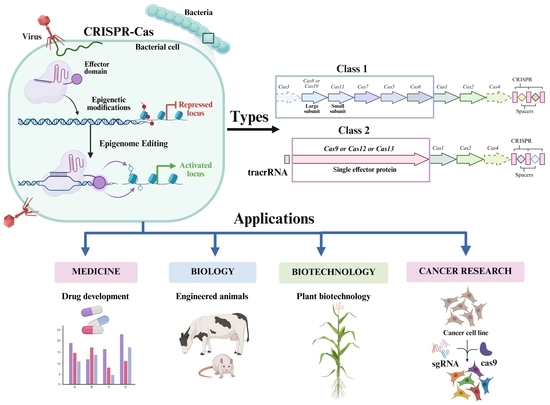
1. Introduction

| Parameter | CRISPR Interference (CRISPRi) | CRISPR Activation (CRISPRa) | Base Editors (BEs) | Prime Editors (PEs) | CRISPR- Associated Transposases (CASTs) |
|---|---|---|---|---|---|
| Core mechanism | Blocks transcription of the target gene by dCas9-sgRNA complex binding to the promoter or coding region | Fusion of dCas9 with transcriptional activators to enhance gene expression | Fusion of Cas9 nickase/dCas9 with cytidine or adenine deaminase | Fusion of Cas9 nickase with reverse transcriptase guided by prime editing guide RNA (pegRNA) | RNA-guided transposase complex integrates DNA at target sites |
| Type of genetic modification | Gene repression (transcriptional silencing) | Targeted gene activation | Single nucleotide transitions (C→T, A→G) | All base substitutions, small insertions and deletions | Programmable integration of large DNA fragments |
| Editing efficiency | Moderate to high depending on sgRNA position | Moderate and depends on promoter architecture | Very high (often >80–90% editing in many bacteria) | Moderate and typically lower than BEs | Variable and generally lower than BEs but suitable for large DNA integration |
| Editing scope | Regulation of gene expression | Programmable gene activation | Precise point mutations and gene inactivation | Precise genome rewriting including substitutions, insertions and deletions | Enables kilobase-scale DNA insertions without DSBs |
| PAM requirements | Strict (SpCas9 NGG PAM sequence commonly used) | Strict (SpCas9 NGG PAM sequence commonly used) | PAM-dependent targeting; engineered Cas variants expand scope | PAM-dependent targeting; more restrictive due to pegRNA constraints | PAM-dependent; limited targeting range |
| Payload size | Low (dCas9 + sgRNA) | Moderate (dCas9 + activator fusion) | Moderate (Cas9-deaminase fusion) | High (Cas9-RT fusion + pegRNA) | Very high (multi-protein complexes, >10 kb) |
| Off-target effects | Low (no DNA cleavage) | Low–moderate (transcriptional noise) | Moderate (bystander edits within editing window) | Lower than BEs but still under investigation | Low insertion specificity in some systems |
| Typical microbial applications | Functional genomics, metabolic pathway modulation | Metabolic engineering and synthetic gene circuits | Metabolic engineering, strain improvement, antibiotic resistance studies | Precision genome engineering, regulatory element modification | Synthetic pathway integration, horizontal gene transfer (HGT) studies |
| Advantages | Reversible, no DNA cleavage | Programmable transcriptional control | High efficiency, no DSBs, minimal cytotoxicity | Highly versatile editing capabilities | Enables large DNA insertions without homologous recombination |
| Mechanistic trade-offs | Repression efficiency depends on sgRNA placement; possible partial gene silencing | Activation varies with promoter accessibility; overexpression may cause metabolic burden | Limited to transition mutations and editing window constraints | Complex pegRNA design and relatively lower efficiency | Large multi-protein complexes reduce targeting efficiency; limited precision for single-base edits |
| References | [18,19,20,21] | [22,23] | [24,25,26] | [27,28,29] | [30,31,32] |
2. Diversity and Classification
3. Genomic Landscape and Organization
4. Biotechnological Applications of CRISPR-Cas Systems in Microorganisms
4.1. Multiplexed Gene Knockouts/Knock-Ins for Pathway Construction
4.2. CRISPR-Based Dynamic Transcriptional Regulation
4.3. Biosensor Integration and CRISPR-Guided Directed Evolution
5. Challenges and Limitations
5.1. Specificity Issues and Off-Site Mutations
5.2. Overcoming Delivery Inefficiencies in Diverse Microbial Hosts
5.3. Ethical, Biosafety, and Regulatory Barriers
6. Future Perspectives
7. Conclusions
Author Contributions
Funding
Institutional Review Board Statement
Informed Consent Statement
Data Availability Statement
Acknowledgments
Conflicts of Interest
Abbreviations
| AAV | Adeno-associated virus |
| AI | Artificial intelligence |
| ATTR | Transthyretin amyloidosis |
| BE | Base editor |
| CAR-T | Chimeric antigen receptor T cell |
| Cascade | CRISPR-associated complex for antiviral defense |
| CAST | CRISPR-associated transposase |
| Cas | CRISPR-associated protein |
| Cas10 | CRISPR-associated protein 10 |
| Cas12a | CRISPR-associated protein 12a |
| Cas13 | CRISPR-associated protein 13 |
| Cas3 | CRISPR-associated protein 3 |
| CasΦ | CRISPR-associated protein Phi |
| CasX | CRISPR-associated protein X (Cas12e) |
| CasY | CRISPR-associated protein Y (Cas12d) |
| CCR5 | C-C chemokine receptor type 5 |
| Cmr | CRISPR-associated complex subunit (Type III system) |
| CRISPR | Clustered regularly interspaced short palindromic repeat |
| CRISPRa | CRISPR activation |
| CRISPRi | CRISPR interference |
| CRS | Cytokine release syndrome |
| crRNA | CRISPR RNA |
| Csm | CRISPR-associated complex subunit (Type III system) |
| dCas9 | Catalytically inactive Cas9 |
| DETECTR | DNA endonuclease-targeted CRISPR trans reporter |
| DSB | Double-strand break |
| GMMs | Genetically modified microorganisms |
| gRNA | Guide RNA |
| HbF | Fetal hemoglobin |
| HBG | γ-globin |
| HELP | Herpes simplex virus type 1 erasing lentiviral particle |
| HGT | Horizontal gene transfer |
| HMM | Hidden Markov model |
| HSPCs | Hematopoietic stem and progenitor cells |
| HSK | Herpes simplex virus type 1-induced herpetic stromal keratitis |
| HSV-1 | Herpes simplex virus type 1 |
| ICANS | Immune effector cell-associated neurotoxicity syndrome |
| IHF | Integration host factor |
| LAS | Leader anchoring sequence |
| LNP | Lipid nanoparticle |
| LS | Large subunit |
| nCas9 | Cas9 nickase |
| Nme2Cas9 | Neisseria meningitidis type II Cas 9 |
| nNme2Cas9 | Nickase Neisseria meningitidis type II Cas 9 |
| NSCLC | Non-small-cell lung cancer |
| PAH | Polycyclic aromatic hydrocarbon |
| PAM | Protospacer adjacent motif |
| PCB | Polychlorinated biphenyl |
| PD-1 | Programmed cell death protein-1 |
| PE | Prime editor |
| pegRNA | Prime editing guide RNA |
| pre-crRNA | Precursor-CRISPR RNA |
| RNP | Ribonucleoprotein |
| RT | Reverse transcriptase |
| sgRNA | Single-guide RNA |
| ShCAST | Single-homology-arm CRISPR-associated transposase |
| SHERLOCK | Specific high-sensitivity enzymatic reporter unlocking |
| SS | Small subunit |
| SpCas9 | Streptococcus pyogenes Cas9 |
| TCR | T cell receptor |
| TTR | Transthyretin |
References
- Ansori, A.N.; Antonius, Y.; Susilo, R.J.; Hayaza, S.; Kharisma, V.D.; Parikesit, A.A.; Zainul, R.; Jakhmola, V.; Saklani, T.; Rebezov, M.; et al. Application of CRISPR-Cas9 genome editing technology in various fields: A review. Narra J. 2023, 3, e184. [Google Scholar] [CrossRef] [Scilit]
- Ishino, Y.; Shinagawa, H.; Makino, K.; Amemura, M.; Nakata, A. Nucleotide sequence of the iap gene, responsible for alkaline phosphatase isozyme conversion in Escherichia coli, and identification of the gene product. J. Bacteriol. 1987, 169, 5429–5433. [Google Scholar] [CrossRef] [Scilit]
- Mojica, F.J.; Juez, G.; Rodriguez-Valera, F. Transcription at different salinities of Haloferax mediterranei sequences adjacent to partially modified PstI sites. Mol. Microbiol. 1993, 9, 613–621. [Google Scholar] [CrossRef] [Scilit]
- Jansen, R.; van Embden, J.D.; Gaastra, W.; Schouls, L.M. Identification of genes that are associated with DNA repeats in prokaryotes. Mol. Microbiol. 2002, 43, 1565–1575. [Google Scholar] [CrossRef] [Scilit]
- Makarova, K.S.; Haft, D.H.; Barrangou, R.; Brouns, S.J.; Charpentier, E.; Horvath, P.; Moineau, S.; Mojica, F.J.; Wolf, Y.I.; Yakunin, A.F. Evolution and classification of the CRISPR–Cas systems. Nat. Rev. Microbiol. 2011, 9, 467–477. [Google Scholar] [CrossRef] [Scilit]
- Zhang, Y.; Li, S.; Li, R.; Qiu, X.; Fan, T.; Wang, B.; Zhang, B.; Zhang, L. Advances in application of CRISPR-Cas13a system. Front. Cell. Infect. Microbiol. 2024, 14, 1291557. [Google Scholar] [CrossRef] [Scilit]
- Basit, A.; Liu, A.; Zheng, W.; Zhu, J. A review on the mechanism and potential diagnostic application of CRISPR/Cas13a system. Mamm. Genome 2025, 36, 709–726. [Google Scholar] [CrossRef] [Scilit] [PubMed]
- Newsom, S.; Parameshwaran, H.P.; Martin, L.; Rajan, R. The CRISPR-Cas Mechanism for Adaptive Immunity and Alternate Bacterial Functions Fuels Diverse Biotechnologies. Front. Cell. Infect. Microbiol. 2021, 10, 619763. [Google Scholar] [CrossRef] [Scilit] [PubMed]
- Chey, Y.C.J.; Gierus, L.; Lushington, C.; Arudkumar, J.C.; Geiger, A.B.; Staker, L.G.; Robertson, L.J.; Pfitzner, C.; Kennedy, J.G.; Lee, R.H.B.; et al. Optimal SpCas9- and SaCas9-mediated gene editing by enhancing gRNA transcript levels through scaffold poly-T tract reduction. BMC Genom. 2025, 26, 138. [Google Scholar] [CrossRef] [Scilit]
- Chen, L.; Zhu, B.; Ru, G.; Meng, H.; Yan, Y.; Hong, M.; Zhang, D.; Luan, C.; Zhang, S.; Wu, H. Re-engineering the adenine deaminase TadA-8e for efficient and specific CRISPR-based cytosine base editing. Nat. Biotechnol. 2023, 41, 663–672. [Google Scholar] [CrossRef] [Scilit] [PubMed]
- Chen, P.J.; Liu, D.R. Prime editing for precise and highly versatile genome manipulation. Nat. Rev. Genet. 2023, 24, 161–177. [Google Scholar] [CrossRef] [Scilit] [PubMed]
- Anzalone, A.V.; Koblan, L.W.; Liu, D.R. Genome editing with CRISPR–Cas nucleases, base editors, transposases and prime editors. Nat. Biotechnol. 2020, 38, 824–844. [Google Scholar] [CrossRef] [Scilit]
- Sapranauskas, R.; Gasiunas, G.; Fremaux, C.; Barrangou, R.; Horvath, P.; Siksnys, V. The Streptococcus thermophilus CRISPR/Cas system provides immunity in Escherichia coli. Nucleic Acids Res. 2011, 39, 9275–9282. [Google Scholar] [CrossRef] [Scilit]
- Bikard, D.; Jiang, W.; Samai, P.; Hochschild, A.; Zhang, F.; Marraffini, L.A. Programmable repression and activation of bacterial gene expression using an engineered CRISPR-Cas system. Nucleic Acids Res. 2013, 41, 7429–7437. [Google Scholar] [CrossRef] [Scilit]
- Edraki, A.; Mir, A.; Ibraheim, R.; Gainetdinov, I.; Yoon, Y.; Song, C.Q.; Cao, Y.; Gallant, J.; Xue, W.; Rivera-Pérez, J.A.; et al. A Compact, High-Accuracy Cas9 with a Dinucleotide PAM for In Vivo Genome Editing. Mol. Cell 2019, 73, 714–726.e714. [Google Scholar] [CrossRef] [Scilit] [PubMed]
- Kim, H.S.; Kweon, J.; Kim, Y. Recent advances in CRISPR-based functional genomics for the study of disease-associated genetic variants. Exp. Mol. Med. 2024, 56, 861–869. [Google Scholar]
- Akama, K.; Akter, N.; Endo, H.; Kanesaki, M.; Endo, M.; Toki, S. An in vivo targeted deletion of the calmodulin-binding domain from rice glutamate decarboxylase 3 (Os GAD3) increases γ-aminobutyric acid content in grains. Rice 2020, 13, 20. [Google Scholar] [CrossRef] [Scilit]
- Johansson, P.A.; Adami, A.; Jakobsson, J. CRISPRi-mediated transcriptional silencing in iPSCs for the study of human brain development. STAR Protoc. 2022, 3, 101285. [Google Scholar] [PubMed]
- Radzisheuskaya, A.; Shlyueva, D.; Müller, I.; Helin, K. Optimizing sgRNA position markedly improves the efficiency of CRISPR/dCas9-mediated transcriptional repression. Nucleic Acids Res. 2016, 44, e141. [Google Scholar] [CrossRef] [Scilit]
- Dhamad, A.E.; Lessner, D.J. A CRISPRi-dCas9 System for Archaea and Its Use to Examine Gene Function during Nitrogen Fixation by Methanosarcina acetivorans. Appl. Environ. Microbiol. 2020, 86, e01402-20. [Google Scholar] [CrossRef] [Scilit]
- Asano, Y.; Yamashita, K.; Hasegawa, A.; Ogasawara, T.; Iriki, H.; Muramoto, T. Knock-in and precise nucleotide substitution using near-PAMless engineered Cas9 variants in Dictyostelium discoideum. Sci. Rep. 2021, 11, 11163. [Google Scholar] [CrossRef] [Scilit]
- Braun, S.M.G.; Kirkland, J.G.; Chory, E.J.; Husmann, D.; Calarco, J.P.; Crabtree, G.R. Rapid and reversible epigenome editing by endogenous chromatin regulators. Nat. Commun. 2017, 8, 560. [Google Scholar] [CrossRef] [Scilit]
- Jensen, T.I.; Mikkelsen, N.S.; Gao, Z.; Foßelteder, J.; Pabst, G.; Axelgaard, E.; Laustsen, A.; König, S.; Reinisch, A.; Bak, R.O. Targeted regulation of transcription in primary cells using CRISPRa and CRISPRi. Genome Res. 2021, 31, 2120–2130. [Google Scholar] [CrossRef] [Scilit]
- Xu, W.; Zhang, S.; Qin, H.; Yao, K. From bench to bedside: Cutting-edge applications of base editing and prime editing in precision medicine. J. Transl. Med. 2024, 22, 1133. [Google Scholar] [CrossRef] [Scilit] [PubMed]
- Zeb, A.; Ahmad, S.; Tabbasum, J.; Sheng, Z.; Hu, P. Rice grain yield and quality improvement via CRISPR/Cas9 system: An updated review. Not. Bot. Horti Agrobot. Cluj-Napoca 2022, 50, 12388. [Google Scholar]
- Yang, X.; Zhu, P.; Gui, J. Advancements of CRISPR-Mediated Base Editing in Crops and Potential Applications in Populus. Int. J. Mol. Sci. 2024, 25, 8314. [Google Scholar] [CrossRef] [Scilit]
- Anzalone, A.V.; Randolph, P.B.; Davis, J.R.; Sousa, A.A.; Koblan, L.W.; Levy, J.M.; Chen, P.J.; Wilson, C.; Newby, G.A.; Raguram, A.; et al. Search-and-replace genome editing without double-strand breaks or donor DNA. Nature 2019, 576, 149–157. [Google Scholar] [CrossRef] [Scilit] [PubMed]
- Yan, J.; Oyler-Castrillo, P.; Ravisankar, P.; Ward, C.C.; Levesque, S.; Jing, Y.; Simpson, D.; Zhao, A.; Li, H.; Yan, W.; et al. Improving prime editing with an endogenous small RNA-binding protein. Nature 2024, 628, 639–647. [Google Scholar] [CrossRef] [Scilit]
- Qu, Y.; Li, Y.; Shao, T.; Kuang, J.; Qi, Y.; Yang, J.; Liu, Y.; Wang, J.; Fu, X.; Liu, J.; et al. Optimizing prime editing: Advances in efficiency enhancement. Biotechnol. Adv. 2026, 88, 108815. [Google Scholar] [CrossRef] [Scilit]
- Strecker, J.; Ladha, A.; Gardner, Z.; Schmid-Burgk, J.L.; Makarova, K.S.; Koonin, E.V.; Zhang, F. RNA-guided DNA insertion with CRISPR-associated transposases. Science 2019, 365, 48–53. [Google Scholar] [PubMed]
- Vo, P.L.H.; Ronda, C.; Klompe, S.E.; Chen, E.E.; Acree, C.; Wang, H.H.; Sternberg, S.H. CRISPR RNA-guided integrases for high-efficiency, multiplexed bacterial genome engineering. Nat. Biotechnol. 2021, 39, 480–489. [Google Scholar] [CrossRef] [Scilit]
- Gelsinger, D.R.; Vo, P.L.H.; Klompe, S.E.; Ronda, C.; Wang, H.H.; Sternberg, S.H. Bacterial genome engineering using CRISPR-associated transposases. Nat. Protoc. 2024, 19, 752–790. [Google Scholar] [CrossRef] [Scilit]
- Jia, N.; Mo, C.Y.; Wang, C.; Eng, E.T.; Marraffini, L.A.; Patel, D.J. Type III-A CRISPR-Cas Csm Complexes: Assembly, Periodic RNA Cleavage, DNase Activity Regulation, and Autoimmunity. Mol. Cell 2019, 73, 264–277.e265. [Google Scholar] [CrossRef] [Scilit]
- Colognori, D.; Trinidad, M.; Doudna, J.A. Precise transcript targeting by CRISPR-Csm complexes. Nat. Biotechnol. 2023, 41, 1256–1264. [Google Scholar] [CrossRef] [Scilit]
- Tang, Y.; Fu, Y. Class 2 CRISPR/Cas: An expanding biotechnology toolbox for and beyond genome editing. Cell Biosci. 2018, 8, 59. [Google Scholar] [CrossRef] [Scilit]
- Teufel, M.; Klein, C.A.; Mager, M.; Sobetzko, P. A multifunctional system for genome editing and large-scale interspecies gene transfer. Nat. Commun. 2022, 13, 3430. [Google Scholar] [CrossRef] [Scilit]
- Lu, M.; Yu, C.; Zhang, Y.; Ju, W.; Ye, Z.; Hua, C.; Mao, J.; Hu, C.; Yang, Z.; Xiao, Y. Structure and genome editing of type I-B CRISPR-Cas. Nat. Commun. 2024, 15, 4126. [Google Scholar] [CrossRef] [Scilit]
- Rahimi, S.; Balusamy, S.R.; Perumalsamy, H.; Ståhlberg, A.; Mijakovic, I. CRISPR-Cas target recognition for sensing viral and cancer biomarkers. Nucleic Acids Res. 2024, 52, 10040–10067. [Google Scholar] [CrossRef] [Scilit] [PubMed]
- Pinilla-Redondo, R.; Mayo-Muñoz, D.; Russel, J.; Garrett, R.A.; Randau, L.; Sørensen, S.J.; Shah, S.A. Type IV CRISPR-Cas systems are highly diverse and involved in competition between plasmids. Nucleic Acids Res. 2020, 48, 2000–2012. [Google Scholar] [CrossRef] [Scilit] [PubMed]
- Di Carlo, E.; Sorrentino, C. State of the art CRISPR-based strategies for cancer diagnostics and treatment. Biomark. Res. 2024, 12, 156. [Google Scholar] [CrossRef] [Scilit] [PubMed]
- Zhao, L.; Qiu, M.; Li, X.; Yang, J.; Li, J. CRISPR-Cas13a system: A novel tool for molecular diagnostics. Front. Microbiol. 2022, 13, 1060947. [Google Scholar] [CrossRef] [Scilit]
- Makarova, K.S.; Shmakov, S.A.; Wolf, Y.I.; Mutz, P.; Altae-Tran, H.; Beisel, C.L.; Brouns, S.J.J.; Charpentier, E.; Cheng, D.; Doudna, J.; et al. An updated evolutionary classification of CRISPR–Cas systems including rare variants. Nat. Microbiol. 2025, 10, 3346–3361. [Google Scholar] [CrossRef] [Scilit]
- Chen, C.; Li, Y.-W.; Zheng, Y.-Y.; Li, X.-J.; Wu, N.; Guo, Q.; Shi, T.-Q.; Huang, H. Expanding the frontiers of genome engineering: A comprehensive review of CRISPR-associated transposons. Biotechnol. Adv. 2025, 78, 108481. [Google Scholar]
- Antequera-Zambrano, L.; Parra-Sánchez, Á.; González-Paz, L.; Fernandez, E.; Martinez-Navarrete, G. Distribution of Genetic Determinants Associated with CRISPR-Cas Systems and Resistance to Antibiotics in the Genomes of Archaea and Bacteria. Microorganisms 2025, 13, 1321. [Google Scholar] [CrossRef] [Scilit]
- Tou, C.J.; Orr, B.; Kleinstiver, B.P. Precise cut-and-paste DNA insertion using engineered type V-K CRISPR-associated transposases. Nat. Biotechnol. 2023, 41, 968–979. [Google Scholar] [CrossRef] [Scilit]
- Xu, X.; Chemparathy, A.; Zeng, L.; Kempton, H.R.; Shang, S.; Nakamura, M.; Qi, L.S. Engineered miniature CRISPR-Cas system for mammalian genome regulation and editing. Mol. Cell 2021, 81, 4333–4345.e4. [Google Scholar] [CrossRef] [Scilit]
- Pausch, P.; Al-Shayeb, B.; Bisom-Rapp, E.; Tsuchida, C.A.; Li, Z.; Cress, B.F.; Knott, G.J.; Jacobsen, S.E.; Banfield, J.F.; Doudna, J.A. CRISPR-CasΦ from huge phages is a hypercompact genome editor. Science 2020, 369, 333–337. [Google Scholar] [CrossRef] [Scilit]
- Gencay, Y.E.; Jasinskytė, D.; Robert, C.; Semsey, S.; Martínez, V.; Petersen, A.Ø.; Brunner, K.; de Santiago Torio, A.; Salazar, A.; Turcu, I.C.; et al. Engineered phage with antibacterial CRISPR–Cas selectively reduce E. coli burden in mice. Nat. Biotechnol. 2024, 42, 265–274. [Google Scholar] [CrossRef] [Scilit] [PubMed]
- Pacia, D.M.; Brown, B.L.; Minssen, T.; Darrow, J.J. CRISPR-phage antibacterials to address the antibiotic resistance crisis: Scientific, economic, and regulatory considerations. J. Law Biosci. 2024, 11, lsad030. [Google Scholar] [CrossRef] [Scilit] [PubMed]
- Raftopoulou, O.; Barrangou, R. Mining microbial organisms to discover and characterize novel CRISPR-Cas systems. Curr. Opin. Biomed. Eng. 2023, 27, 100469. [Google Scholar] [CrossRef] [Scilit]
- Xu, C.; Zhou, Y.; Xiao, Q.; He, B.; Geng, G.; Wang, Z.; Cao, B.; Dong, X.; Bai, W.; Wang, Y. Programmable RNA editing with compact CRISPR–Cas13 systems from uncultivated microbes. Nat. Methods 2021, 18, 499–506. [Google Scholar] [CrossRef] [Scilit]
- Ma, Y.; Chen, H.; Kang, J.; Guo, X.; Sun, C.; Xu, J.; Tao, J.; Wei, S.; Dong, Y.; Tian, H.; et al. The hidden Markov model and its applications in bioinformatics analysis. Genes Dis. 2026, 13, 101729. [Google Scholar] [CrossRef] [Scilit]
- Couvin, D.; Bernheim, A.; Toffano-Nioche, C.; Touchon, M.; Michalik, J.; Néron, B.; Rocha, E.P.C.; Vergnaud, G.; Gautheret, D.; Pourcel, C. CRISPRCasFinder, an update of CRISRFinder, includes a portable version, enhanced performance and integrates search for Cas proteins. Nucleic Acids Res. 2018, 46, W246–W251. [Google Scholar] [CrossRef] [Scilit] [PubMed]
- Collins, A.J.; Whitaker, R.J. CRISPR Comparison Toolkit: Rapid Identification, Visualization, and Analysis of CRISPR Array Diversity. Cris. J. 2023, 6, 386–400. [Google Scholar] [CrossRef] [Scilit]
- Yang, B.; Zheng, J.; Yin, Y. AcaFinder: Genome Mining for Anti-CRISPR-Associated Genes. mSystems 2022, 7, e00817–e00822. [Google Scholar] [CrossRef] [Scilit]
- Nidhi, S.; Tripathi, P.; Tripathi, V. Phylogenetic Analysis of Anti-CRISPR and Member Addition in the Families. Mol. Biotechnol. 2023, 65, 273–281. [Google Scholar] [CrossRef] [Scilit] [PubMed]
- Bhutia, K.L.; Lap, B.; Kumari, S.; Anjani, K.; Borah, B.; Mugudeshwari, P.; Sharma, V.K.; Kisku, A.; Bhutia, N.D.; Sudhan, R.A. Advancement in Bioinformatics Tools in the Era of Genome Editing-Based Functional Genomics. In CRISPR and Plant Functional Genomics; CRC Press: Boca Raton, FL, USA, 2024; pp. 239–257. [Google Scholar]
- Collias, D.; Beisel, C.L. CRISPR technologies and the search for the PAM-free nuclease. Nat. Commun. 2021, 12, 555. [Google Scholar] [CrossRef] [Scilit] [PubMed]
- Bains, J.K.; Qureshi, N.S.; Ceylan, B.; Wacker, A.; Schwalbe, H. Cell-free transcription-translation system: A dual read-out assay to characterize riboswitch function. Nucleic Acids Res. 2023, 51, e82. [Google Scholar] [CrossRef] [Scilit]
- Garenne, D.; Noireaux, V. Cell-free transcription–translation: Engineering biology from the nanometer to the millimeter scale. Curr. Opin. Biotechnol. 2019, 58, 19–27. [Google Scholar] [CrossRef] [Scilit]
- Marshall, R.; Maxwell, C.S.; Collins, S.P.; Jacobsen, T.; Luo, M.L.; Begemann, M.B.; Gray, B.N.; January, E.; Singer, A.; He, Y.; et al. Rapid and Scalable Characterization of CRISPR Technologies Using an E. coli Cell-Free Transcription-Translation System. Mol. Cell 2018, 69, 146–157.e143. [Google Scholar] [CrossRef] [Scilit]
- Faure, G.; Shmakov, S.A.; Yan, W.X.; Cheng, D.R.; Scott, D.A.; Peters, J.E.; Makarova, K.S.; Koonin, E.V. CRISPR-Cas in mobile genetic elements: Counter-defence and beyond. Nat. Rev. Microbiol. 2019, 17, 513–525. [Google Scholar] [CrossRef] [Scilit]
- McGinn, J.; Marraffini, L.A. Molecular mechanisms of CRISPR–Cas spacer acquisition. Nat. Rev. Microbiol. 2019, 17, 7–12. [Google Scholar] [CrossRef] [Scilit] [PubMed]
- Lee, H.; Sashital, D.G. Creating memories: Molecular mechanisms of CRISPR adaptation. Trends Biochem. Sci. 2022, 47, 464–476. [Google Scholar] [CrossRef] [Scilit]
- Wu, W.Y.; Jackson, S.A.; Almendros, C.; Haagsma, A.C.; Yilmaz, S.; Gort, G.; van der Oost, J.; Brouns, S.J.J.; Staals, R.H.J. Adaptation by Type V-A and V-B CRISPR-Cas Systems Demonstrates Conserved Protospacer Selection Mechanisms Between Diverse CRISPR-Cas Types. Cris. J. 2022, 5, 536–547. [Google Scholar] [CrossRef] [Scilit]
- Hofmann, R.; Herman, C.; Mo, C.Y.; Mathai, J.; Marraffini, L.A. Deep mutational scanning identifies Cas1 and Cas2 variants that enhance type II-A CRISPR-Cas spacer acquisition. Nat. Commun. 2025, 16, 5730. [Google Scholar] [CrossRef] [Scilit] [PubMed]
- Makarova, K.S.; Wolf, Y.I.; Iranzo, J.; Shmakov, S.A.; Alkhnbashi, O.S.; Brouns, S.J.; Charpentier, E.; Cheng, D.; Haft, D.H.; Horvath, P. Evolutionary classification of CRISPR–Cas systems: A burst of class 2 and derived variants. Nat. Rev. Microbiol. 2020, 18, 67–83. [Google Scholar]
- Gleditzsch, D.; Pausch, P.; Müller-Esparza, H.; Özcan, A.; Guo, X.; Bange, G.; Randau, L. PAM identification by CRISPR-Cas effector complexes: Diversified mechanisms and structures. RNA Biol. 2019, 16, 504–517. [Google Scholar] [CrossRef] [Scilit]
- Rasul, M.F.; Hussen, B.M.; Salihi, A.; Ismael, B.S.; Jalal, P.J.; Zanichelli, A.; Jamali, E.; Baniahmad, A.; Ghafouri-Fard, S.; Basiri, A.; et al. Strategies to overcome the main challenges of the use of CRISPR/Cas9 as a replacement for cancer therapy. Mol. Cancer 2022, 21, 64. [Google Scholar] [CrossRef] [Scilit]
- Lampe, G.D.; Liang, A.R.; Zhang, D.J.; Fernández, I.S.; Sternberg, S.H. Structure-guided engineering of type I-F CASTs for targeted gene insertion in human cells. Nat. Commun. 2025, 16, 7891. [Google Scholar] [CrossRef] [Scilit] [PubMed]
- Park, J.-U.; Tsai, A.W.-L.; Rizo, A.N.; Truong, V.H.; Wellner, T.X.; Schargel, R.D.; Kellogg, E.H. Structures of the holo CRISPR RNA-guided transposon integration complex. Nature 2023, 613, 775–782. [Google Scholar] [CrossRef] [Scilit] [PubMed]
- Liu, J.; Huang, R.; Niu, D.-K. Unveiling the Evolution of CRISPR Spacer Number: A Phylogenetic Analysis of its Correlation with Repeat Characteristics. bioRxiv 2024. [Google Scholar] [CrossRef] [Scilit]
- Wei, J.; Li, Y. CRISPR-based gene editing technology and its application in microbial engineering. Eng. Microbiol. 2023, 3, 100101. [Google Scholar] [CrossRef] [Scilit]
- Liu, Z.; Chen, S.; Jia, Y.; Shan, H.; Chen, M.; Song, Y.; Lai, L.; Li, Z. Efficient and high-fidelity base editor with expanded PAM compatibility for cytidine dinucleotide. Sci. China Life Sci. 2021, 64, 1355–1367. [Google Scholar] [CrossRef] [Scilit]
- Yin, D.; Ling, S.; Wang, D.; Dai, Y.; Jiang, H.; Zhou, X.; Paludan, S.R.; Hong, J.; Cai, Y. Targeting herpes simplex virus with CRISPR–Cas9 cures herpetic stromal keratitis in mice. Nat. Biotechnol. 2021, 39, 567–577. [Google Scholar] [CrossRef] [Scilit] [PubMed]
- Stadtmauer, E.A.; Fraietta, J.A.; Davis, M.M.; Cohen, A.D.; Weber, K.L.; Lancaster, E.; Mangan, P.A.; Kulikovskaya, I.; Gupta, M.; Chen, F. CRISPR-engineered T cells in patients with refractory cancer. Science 2020, 367, eaba7365. [Google Scholar] [CrossRef] [Scilit]
- Lu, Y.; Xue, J.; Deng, T.; Zhou, X.; Yu, K.; Deng, L.; Huang, M.; Yi, X.; Liang, M.; Wang, Y. Safety and feasibility of CRISPR-edited T cells in patients with refractory non-small-cell lung cancer. Nat. Med. 2020, 26, 732–740. [Google Scholar] [CrossRef] [Scilit] [PubMed]
- Zittersteijn, H.A.; Harteveld, C.L.; Klaver-Flores, S.; Lankester, A.C.; Hoeben, R.C.; Staal, F.J.; Gonçalves, M.A. A small key for a heavy door: Genetic therapies for the treatment of hemoglobinopathies. Front. Genome Ed. 2021, 2, 617780. [Google Scholar] [CrossRef] [Scilit] [PubMed]
- Hu, K.-J.; Yin, E.T.S.; Hu, Y.-X.; Huang, H. Combination of CRISPR/Cas9 system and CAR-T cell therapy: A new era for refractory and relapsed hematological malignancies. Curr. Med. Sci. 2021, 41, 420–430. [Google Scholar] [PubMed]
- Gillmore, J.D.; Gane, E.; Taubel, J.; Kao, J.; Fontana, M.; Maitland, M.L.; Seitzer, J.; O’Connell, D.; Walsh, K.R.; Wood, K. CRISPR-Cas9 in vivo gene editing for transthyretin amyloidosis. N. Engl. J. Med. 2021, 385, 493–502. [Google Scholar] [CrossRef] [Scilit] [PubMed]
- Xu, L.; Wang, J.; Liu, Y.; Xie, L.; Su, B.; Mou, D.; Wang, L.; Liu, T.; Wang, X.; Zhang, B. CRISPR-edited stem cells in a patient with HIV and acute lymphocytic leukemia. N. Engl. J. Med. 2019, 381, 1240–1247. [Google Scholar] [CrossRef] [Scilit]
- Utomo, J.C.; Hodgins, C.L.; Ro, D.-K. Multiplex Genome Editing in Yeast by CRISPR/Cas9—A Potent and Agile Tool to Reconstruct Complex Metabolic Pathways. Front. Plant Sci. 2021, 12, 719148. [Google Scholar] [CrossRef] [Scilit]
- Jakočiūnas, T.; Bonde, I.; Herrgård, M.; Harrison, S.J.; Kristensen, M.; Pedersen, L.E.; Jensen, M.K.; Keasling, J.D. Multiplex metabolic pathway engineering using CRISPR/Cas9 in Saccharomyces cerevisiae. Metab. Eng. 2015, 28, 213–222. [Google Scholar] [CrossRef] [Scilit]
- Zhao, J.; Li, Q.; Sun, T.; Zhu, X.; Xu, H.; Tang, J.; Zhang, X.; Ma, Y. Engineering central metabolic modules of Escherichia coli for improving β-carotene production. Metab. Eng. 2013, 17, 42–50. [Google Scholar] [CrossRef] [Scilit] [PubMed]
- Wu, M.-Y.; Sung, L.-Y.; Li, H.; Huang, C.-H.; Hu, Y.-C. Combining CRISPR and CRISPRi Systems for Metabolic Engineering of E. coli and 1,4-BDO Biosynthesis. ACS Synth. Biol. 2017, 6, 2350–2361. [Google Scholar] [CrossRef] [Scilit]
- Li, R.; Li, R.; Li, X.; Fu, D.; Zhu, B.; Tian, H.; Luo, Y.; Zhu, H. Multiplexed CRISPR/Cas9-mediated metabolic engineering of γ-aminobutyric acid levels in Solanum lycopersicum. Plant Biotechnol. J. 2018, 16, 415–427. [Google Scholar] [CrossRef] [Scilit] [PubMed]
- Zhang, Y.; Wang, J.; Wang, Z.; Zhang, Y.; Shi, S.; Nielsen, J.; Liu, Z. A gRNA-tRNA array for CRISPR-Cas9 based rapid multiplexed genome editing in Saccharomyces cerevisiae. Nat. Commun. 2019, 10, 1053. [Google Scholar] [CrossRef] [Scilit]
- Teng, Y.; Jiang, T.; Yan, Y. The expanded CRISPR toolbox for constructing microbial cell factories. Trends Biotechnol. 2024, 42, 104–118. [Google Scholar]
- Call, S.N.; Andrews, L.B. CRISPR-Based Approaches for Gene Regulation in Non-Model Bacteria. Front. Genome Ed. 2022, 4, 892304. [Google Scholar] [CrossRef] [Scilit]
- Kim, S.K.; Woo, S.G.; Park, J.H.; Lee, S.G.; Lee, D.H. Modular and signal-responsive transcriptional regulation using CRISPRi-aided genetic switches in Escherichia coli. J. Biol. Eng. 2025, 19, 56. [Google Scholar] [CrossRef] [Scilit] [PubMed]
- Zhan, Y.; Xu, Y.; Zheng, P.; He, M.; Sun, S.; Wang, D.; Cai, D.; Ma, X.; Chen, S. Establishment and application of multiplexed CRISPR interference system in Bacillus licheniformis. Appl. Microbiol. Biotechnol. 2020, 104, 391–403. [Google Scholar] [CrossRef] [Scilit] [PubMed]
- Wu, Y.; Chen, T.; Liu, Y.; Lv, X.; Li, J.; Du, G.; Ledesma-Amaro, R.; Liu, L. CRISPRi allows optimal temporal control of N-acetylglucosamine bioproduction by a dynamic coordination of glucose and xylose metabolism in Bacillus subtilis. Metab. Eng. 2018, 49, 232–241. [Google Scholar] [CrossRef] [Scilit]
- Zhang, X.; Shi, Y.; Chen, G.; Wu, D.; Wu, Y.; Li, G. CRISPR/Cas systems-inspired nano/biosensors for detecting infectious viruses and pathogenic bacteria. Small Methods 2022, 6, 2200794. [Google Scholar] [CrossRef] [Scilit] [PubMed]
- Safarkhani, M.; Farasati Far, B.; Kim, S.-H.; Makvandi, P.; Park, M.-K.; Huh, Y.; Rabiee, N. Advances and challenges of sensing in water using CRISPR-Cas technology. ACS Biomater. Sci. Eng. 2024. [Google Scholar] [CrossRef] [Scilit] [PubMed]
- Chen, A.; Zhang, X.D.; Đelmaš, A.Đ.; Weitz, D.A.; Milcic, K. Systems and Methods for Continuous Evolution of Enzymes. Chem. —Eur. J. 2024, 30, e202400880. [Google Scholar] [CrossRef] [Scilit]
- Jakočiūnas, T.; Jensen, M.K.; Keasling, J.D. CasPER: A CRISPR/Cas9-Based Method for Directed Evolution in Genomic Loci in Saccharomyces cerevisiae. Methods Mol. Biol. 2022, 2513, 23–37. [Google Scholar]
- Cho, J.S.; Kim, G.B.; Eun, H.; Moon, C.W.; Lee, S.Y. Designing microbial cell factories for the production of chemicals. Jacs Au 2022, 2, 1781–1799. [Google Scholar] [CrossRef] [Scilit]
- Hadi, R.; Poddar, A.; Sonnaila, S.; Bhavaraju, V.S.M.; Agrawal, S. Advancing CRISPR-Based Solutions for COVID-19 Diagnosis and Therapeutics. Cells 2024, 13, 1794. [Google Scholar] [CrossRef] [Scilit]
- Wei, Y.; Shi, D.; Chen, T.; Zhou, S.; Yang, Z.; Li, H.; Yang, D.; Li, J.; Jin, M. CRISPR/Cas9-based engineered Escherichia coli biosensor for sensitive and specific detection of Cd(II) in drinking water. Chemosphere 2024, 362, 142607. [Google Scholar] [CrossRef] [Scilit] [PubMed]
- Chen, K.; Shen, Z.; Wang, G.; Gu, W.; Zhao, S.; Lin, Z.; Liu, W.; Cai, Y.; Mushtaq, G.; Jia, J.; et al. Research progress of CRISPR-based biosensors and bioassays for molecular diagnosis. Front. Bioeng. Biotechnol. 2022, 10, 986233. [Google Scholar] [CrossRef] [Scilit]
- Zhou, Z.; Cho, I.-H.; Kadam, U.S. CRISPR-Cas-based diagnostics in biomedicine: Principles, applications, and future trajectories. Biosensors 2025, 15, 660. [Google Scholar] [CrossRef] [Scilit]
- Guo, C.; Ma, X.; Gao, F.; Guo, Y. Off-target effects in CRISPR/Cas9 gene editing. Front. Bioeng. Biotechnol. 2023, 11, 1143157. [Google Scholar] [CrossRef] [Scilit] [PubMed]
- Wu, X.; Kriz, A.J.; Sharp, P.A. Target specificity of the CRISPR-Cas9 system. Quant. Biol. 2014, 2, 59–70. [Google Scholar] [CrossRef] [Scilit] [PubMed]
- Kleinstiver, B.P.; Pattanayak, V.; Prew, M.S.; Tsai, S.Q.; Nguyen, N.T.; Zheng, Z.; Joung, J.K. High-fidelity CRISPR–Cas9 nucleases with no detectable genome-wide off-target effects. Nature 2016, 529, 490–495. [Google Scholar] [CrossRef] [Scilit]
- Zhao, Z.; Shang, P.; Mohanraju, P.; Geijsen, N. Prime editing: Advances and therapeutic applications. Trends Biotechnol. 2023, 41, 1000–1012. [Google Scholar] [CrossRef] [Scilit]
- Fu, Y.; Sander, J.D.; Reyon, D.; Cascio, V.M.; Joung, J.K. Improving CRISPR-Cas nuclease specificity using truncated guide RNAs. Nature 2014, 32, 279–284. [Google Scholar] [CrossRef] [Scilit]
- Sherkatghanad, Z.; Abdar, M.; Charlier, J.; Makarenkov, V. Using traditional machine learning and deep learning methods for on- and off-target prediction in CRISPR/Cas9: A review. Brief. Bioinform. 2023, 24, bbad131. [Google Scholar] [CrossRef] [Scilit]
- Liu, G.; Zhang, Y.; Zhang, T. Computational approaches for effective CRISPR guide RNA design and evaluation. Comput. Struct. Biotechnol. J. 2020, 18, 35–44. [Google Scholar] [CrossRef] [Scilit]
- Qi, Q.; Liu, X.; Xiong, W.; Zhang, K.; Shen, W.; Zhang, Y.; Xu, X.; Zhong, C.; Zhang, Y.; Tian, T.; et al. Reducing CRISPR-Cas9 off-target effects by optically controlled chemical modifications of guide RNA. Cell Chem. Biol. 2024, 31, 1839–1851.e8. [Google Scholar] [CrossRef] [Scilit]
- Selle, K.; Fletcher, J.R.; Tuson, H.; Schmitt, D.S.; McMillan, L.; Vridhambal, G.S.; Rivera, A.J.; Montgomery, S.A.; Fortier, L.C.; Barrangou, R.; et al. In Vivo Targeting of Clostridioides difficile Using Phage-Delivered CRISPR-Cas3 Antimicrobials. mBio 2020, 11, 10-1128. [Google Scholar] [CrossRef] [Scilit]
- Sheng, H.; Wu, S.; Xue, Y.; Zhao, W.; Caplan, A.B.; Hovde, C.J.; Minnich, S.A. Engineering conjugative CRISPR-Cas9 systems for the targeted control of enteric pathogens and antibiotic resistance. PLoS ONE 2023, 18, e0291520. [Google Scholar] [CrossRef] [Scilit] [PubMed]
- Neil, K.; Allard, N.; Roy, P.; Grenier, F.; Menendez, A.; Burrus, V.; Rodrigue, S. High-efficiency delivery of CRISPR-Cas9 by engineered probiotics enables precise microbiome editing. Mol. Syst. Biol. 2021, 17, e10335. [Google Scholar] [CrossRef] [Scilit] [PubMed]
- Souza, H.C.A.d.; Panzenhagen, P.; dos Santos, A.M.P.; Portes, A.B.; Fidelis, J.; Conte-Junior, C.A. Unravelling the advances of CRISPR-Cas9 as a precise antimicrobial therapy: A systematic review. J. Glob. Antimicrob. Resist. 2025, 42, 51–60. [Google Scholar] [CrossRef] [Scilit]
- Price, V.J.; McBride, S.W.; Hullahalli, K.; Chatterjee, A.; Duerkop, B.A.; Palmer, K.L. Enterococcus faecalis CRISPR-Cas Is a Robust Barrier to Conjugative Antibiotic Resistance Dissemination in the Murine Intestine. mSphere 2019, 4, 10-1128. [Google Scholar] [CrossRef] [Scilit] [PubMed]
- Duan, L.; Ouyang, K.; Xu, X.; Xu, L.; Wen, C.; Zhou, X.; Qin, Z.; Xu, Z.; Sun, W.; Liang, Y. Nanoparticle Delivery of CRISPR/Cas9 for Genome Editing. Front. Genet. 2021, 12, 673286. [Google Scholar] [CrossRef] [Scilit]
- Wan, F.; Draz, M.S.; Gu, M.; Yu, W.; Ruan, Z.; Luo, Q. Novel Strategy to Combat Antibiotic Resistance: A Sight into the Combination of CRISPR/Cas9 and Nanoparticles. Pharmaceutics 2021, 13, 352. [Google Scholar] [CrossRef] [Scilit]
- Yang, Z.; Shi, J.; Xie, J.; Wang, Y.; Sun, J.; Liu, T.; Zhao, Y.; Zhao, X.; Wang, X.; Ma, Y. Large-scale generation of functional mRNA-encapsulating exosomes via cellular nanoporation. Nat. Biomed. Eng. 2020, 4, 69–83. [Google Scholar] [CrossRef] [Scilit] [PubMed]
- Iqbal, Z.; Rehman, K.; Mahmood, A.; Shabbir, M.; Liang, Y.; Duan, L.; Zeng, H. Exosome for mRNA delivery: Strategies and therapeutic applications. J. Nanobiotechnol. 2024, 22, 395. [Google Scholar] [CrossRef] [Scilit] [PubMed]
- Bharti, N.; Modi, U.; Bhatia, D.; Solanki, R. Engineering delivery platforms for CRISPR-Cas and their applications in healthcare, agriculture and beyond. Nanoscale Adv. 2026, 8, 1137–1161. [Google Scholar] [CrossRef] [Scilit]
- Roberts, A.; Adler, B.A.; Cress, B.F.; Doudna, J.A.; Barrangou, R. Phage-based delivery of CRISPR-associated transposases for targeted bacterial editing. Proc. Natl. Acad. Sci. USA 2025, 122, e2504853122. [Google Scholar] [CrossRef] [Scilit]
- Karamlou, S.; Aghajani, E.; Familsamavati, M.; Azad, N.F.; Arayesh, S.; Mohsenipour, Z. Bacterial resistance to phage therapy: Mechanisms and strategies to overcome it. Curr. Mol. Pharmacol. 2025, 18, 108–122. [Google Scholar] [CrossRef] [Scilit]
- Gan, W.C.; Ling, A.P.K. CRISPR/Cas9 in plant biotechnology: Applications and challenges. Biotechnologia 2022, 103, 81–93. [Google Scholar]
- Bouzetos, E.; Ganar, K.A.; van der Oost, J.; Deshpande, S. Cell-free screening of CRISPR-Cas activity by microfluidics-assisted in vitro compartmentalization. Trends Biotechnol. 2025, 43, 2926–2946. [Google Scholar] [CrossRef] [Scilit]
- Rottinghaus, A.G.; Ferreiro, A.; Fishbein, S.R.S.; Dantas, G.; Moon, T.S. Genetically stable CRISPR-based kill switches for engineered microbes. Nat. Commun. 2022, 13, 672. [Google Scholar] [CrossRef] [Scilit]
- Kang, C.W.; Lim, H.G.; Yang, J.; Noh, M.H.; Seo, S.W.; Jung, G.Y. Synthetic auxotrophs for stable and tunable maintenance of plasmid copy number. Metab. Eng. 2018, 48, 121–128. [Google Scholar] [CrossRef] [Scilit]
- Ahmad, A.; Jamil, A.; Munawar, N. GMOs or non-GMOs? The CRISPR Conundrum. Front. Plant Sci. 2023, 14, 1232938. [Google Scholar] [CrossRef] [Scilit] [PubMed]
- Bohua, L.; Yuexin, W.; Yakun, O.; Kunlan, Z.; Huan, L.; Ruipeng, L. Ethical framework on risk governance of synthetic biology. J. Biosaf. Biosecur. 2023, 5, 45–56. [Google Scholar] [CrossRef] [Scilit]
- Gao, Z.; Gao, Y.; Wang, S.; Li, X.; Cao, W.; Deng, W.; Yao, L.; Wei, X.; Zhang, Z.; Wang, S.; et al. Application progress and biosafety challenges of gene editing and synthetic biotechnology in diagnosis, treatment and prevention of infectious diseases. Biosaf. Health 2025, 7, 312–322. [Google Scholar] [CrossRef] [Scilit] [PubMed]
- Tao, S.; Chen, H.; Li, N.; Liang, W. The Application of the CRISPR-Cas System in Antibiotic Resistance. Infect. Drug Resist. 2022, 15, 4155–4168. [Google Scholar] [CrossRef] [Scilit]
- Rebello, S.; Nathan, V.K.; Sindhu, R.; Binod, P.; Awasthi, M.K.; Pandey, A. Bioengineered microbes for soil health restoration: Present status and future. Bioengineered 2021, 12, 12839–12853. [Google Scholar] [CrossRef] [Scilit]
- Crowley, M.; Dando, M. Regulation of toxins and bioregulators under the Chemical Weapons Convention and the Biological and Toxin Weapons Convention. J. Biosaf. Biosecur. 2024, 6, 99–112. [Google Scholar] [CrossRef] [Scilit]
- Abbas, S.; Saeed, A.; Bibi, M.; Perveen, S.; Masood, N. CRISPR-Cas: From bacterial immunity to precision genome engineering. Gene Rep. 2025, 40, 102296. [Google Scholar] [CrossRef] [Scilit]
- Kamm, C.; Beisel, C.L. Phages to the rescue: In situ editing of the gut microbiota. Trends Microbiol. 2024, 32, 934–935. [Google Scholar] [CrossRef] [Scilit]
- Kim, M.-G.; Go, M.-J.; Kang, S.-H.; Jeong, S.-H.; Lim, K. Revolutionizing CRISPR technology with artificial intelligence. Exp. Mol. Med. 2025, 57, 1419–1431. [Google Scholar] [CrossRef] [Scilit] [PubMed]
- Thomson, T.; Li, G.; Strilchuk, A.; Cui, H.; Wang, B.; Li, B. Harnessing artificial intelligence to advance CRISPR-based genome editing technologies. Nat. Rev. Genet. 2025, 27, 212–230. [Google Scholar] [CrossRef] [Scilit] [PubMed]
- Yan, J.; Zhou, Y.; Sun, J.; Wu, S.; Ding, Z.; Ni, L.; Wang, J. CRISPR-Based Biosensing for Genetically Modified Organism Detection: Current Applications and Future Perspectives. Agronomy 2025, 15, 2912. [Google Scholar] [CrossRef] [Scilit]
- Matinvafa, M.A.; Makani, S.; Parsasharif, N.; Zahed, M.A.; Movahed, E.; Ghiasvand, S. CRISPR-Cas technology secures sustainability through its applications: A review in green biotechnology. 3 Biotech 2023, 13, 383. [Google Scholar] [CrossRef] [Scilit]
- Yesankar, P.J.; Patil, A.; Kapley, A.; Qureshi, A. Catalytic resilience of multicomponent aromatic ring-hydroxylating dioxygenases in Pseudomonas for degradation of polycyclic aromatic hydrocarbons. World J. Microbiol. Biotechnol. 2023, 39, 166. [Google Scholar] [CrossRef] [Scilit]


| S. No. | CRISPR-Cas-Mediated Approach | System Components | CRISPR Application | Outcomes | References |
|---|---|---|---|---|---|
| 1. | Prime editing | Catalytically impaired Cas9 nickase (nCas9) fused to an engineered RT and guided by a pegRNA | Enables precise genome editing including insertions, deletions, and point mutations facilitating correction of disease-causing mutations such as sickle cell disease and Tay–Sachs disease and functional genomics studies | Precise and accurate editing in human cells with minimal by-products and lower off-target effects | [27] |
| 2. | Single-homology-arm CRISPR-associated transposase (ShCAST) system | Type V-K CRISPR effector Cas12k, gRNA, and donor DNA cargo | RNA-guided site-specific DNA insertion for genome engineering in bacteria and microbial strain development for synthetic biology and industrial biotechnology | Efficient and programmable insertion of DNA segments downstream of the protospacer | [30] |
| 3. | CRISPR-based cytosine base editing system | Nickase Neisseria meningitidis type II Cas 9 (nNme2Cas9) fused with engineered cytidine deaminase | Precise C→T base editing with expanded PAM compatibility for therapeutic correction and functional genomics, including gene validation and engineering in model organisms | Enable precise and efficient editing of genome in human cells and rabbit embryos with high specificity and minimal off-target effects | [74] |
| 4. | CRISPR-Cas9-based antiviral strategy using Herpes simplex virus type 1 (HSV-1)-erasing lentiviral particles (HELPs) | SpCas9 mRNA and viral gene-targeting gRNAs delivered via mRNA-carrying lentiviral particles | Targeted cleavage of HSV-1 genomes to inhibit viral replication and development of CRISPR-based antiviral platforms | Efficiently blocked replication of HSV-1 | [75] |
| 5. | CRISPR-Cas9 edited T cell therapy | CRISPR-Cas9 with sgRNAs | Deletion of endogenous T cell receptor alpha (TCRα) and beta (TCRβ) chains to enable engineered T cells for adoptive cancer immunotherapy and immune cell reprogramming for translational and cellular biotechnology | Engineered T cells showed successful engraftment with multiplex CRISPR edits at multiple genomic sites | [76] |
| 6. | Ex vivo CRISPR-Cas9 editing of programmed cell death protein-1 (PD-1) in T cells | Cas9 and sgRNA plasmids targeting the PD-1 gene | Immune checkpoint disruption for cancer therapy and immunomodulation studies in cell-based research | Edited T cells were successfully detected after infusion, with minimal off-target effects | [77] |
| 7. | CRISPR-based precise genome editing | CRISPR-Cas systems with sgRNA targeting γ-globin (HBG) repressor genes (e.g., BCL11A) | Reactivation of fetal hemoglobin for hemoglobinopathy treatment and gene regulation studies in hematopoiesis | Increased HbF levels and improved disease phenotype | [78] |
| 8. | CRISPR-Cas9 engineered chimeric antigen receptor (CAR) T cells therapy | Integration of CAR T cells and CRISPR-Cas9 gene-editing system | Precision engineering of CAR-T cells for cancer therapy and advancement of synthetic immunology and cell engineering platforms | Enhanced efficacy with reduced toxicities, including a lower risk of immune-related neurotoxicity (ICANS) and cytokine release syndrome (CRS) | [79] |
| 9. | In vivo genome editing | Lipid nanoparticle (LNP) delivery system comprising Cas9 mRNA and sgRNA | Targeted gene editing in hepatocytes for ATTR treatment and development of in vivo gene delivery platforms | Reduction in serum TTR levels in dose-dependent manner | [80] |
| 10. | Ex vivo genome editing targeting CCR5 | CRISPR-Cas9 ribonucleoprotein (RNP) complexes targeting CCR5 | Disruption of CCR5 for HIV therapy and gene-editing strategies in stem cell engineering | Successful engraftment of CRISPR-edited hematopoietic stem and progenitor cells (HSPCs); CCR5 disruption efficiency | [81] |
Disclaimer/Publisher’s Note: The statements, opinions and data contained in all publications are solely those of the individual author(s) and contributor(s) and not of MDPI and/or the editor(s). MDPI and/or the editor(s) disclaim responsibility for any injury to people or property resulting from any ideas, methods, instructions or products referred to in the content. |
© 2026 by the authors. Licensee MDPI, Basel, Switzerland. This article is an open access article distributed under the terms and conditions of the Creative Commons Attribution (CC BY) license.
Share and Cite
Singh, S.; Tiwari, H.; Singh, M.; Gautam, V.; Gautam, A.; Gautam, H.K. Expanding the Microbial Genomic Landscape and Biotechnological Applications of CRISPR-Cas Systems. Biology 2026, 15, 748. https://doi.org/10.3390/biology15100748
Singh S, Tiwari H, Singh M, Gautam V, Gautam A, Gautam HK. Expanding the Microbial Genomic Landscape and Biotechnological Applications of CRISPR-Cas Systems. Biology. 2026; 15(10):748. https://doi.org/10.3390/biology15100748
Chicago/Turabian StyleSingh, Swati, Harshita Tiwari, Mamta Singh, Vibhav Gautam, Anju Gautam, and Hemant Kumar Gautam. 2026. "Expanding the Microbial Genomic Landscape and Biotechnological Applications of CRISPR-Cas Systems" Biology 15, no. 10: 748. https://doi.org/10.3390/biology15100748
APA StyleSingh, S., Tiwari, H., Singh, M., Gautam, V., Gautam, A., & Gautam, H. K. (2026). Expanding the Microbial Genomic Landscape and Biotechnological Applications of CRISPR-Cas Systems. Biology, 15(10), 748. https://doi.org/10.3390/biology15100748