Article

Comparative Functional Analysis Reveals Conserved Roles of Aquaporins Under Osmotic Dehydration in Steinernema carpocapsae Strains

1
College of Agriculture and Biology, Zhongkai University of Agriculture and Engineering, Guangzhou 510225, China
2
Key Laboratory of Green Prevention and Control on Fruits and Vegetables in South China, Ministry of Agriculture and Rural Affairs, Guangzhou 510225, China
3
Innovative Institute for Plant Health, Zhongkai University of Agriculture and Engineering, Guangzhou 510225, China
*
Author to whom correspondence should be addressed.
These authors contributed equally to this work.
Biology 2026, 15(1), 78; https://doi.org/10.3390/biology15010078
Submission received: 4 December 2025 / Revised: 28 December 2025 / Accepted: 29 December 2025 / Published: 31 December 2025
(This article belongs to the Section Zoology)

Simple Summary

This study investigated the role of aquaporins (AQPs) in the osmotic stress response of the entomopathogenic nematode Steinernema carpocapsae. Three AQP genes (L596_g7661, L596_g18121, and XLOC_007750) were cloned from four different S. carpocapsae strains. Bioinformatic analysis confirmed they belong to the aquaglyceroporin subfamily. Functional assay in Xenopus oocytes demonstrated that the AQP L596_g7661 facilitates glycerol transport. Under osmotic dehydration, the expressions of L596_g7661 and XLOC_007750 were significantly upregulated across all strains, while L596_g18121 expression remained unchanged. The findings reveal that specific aquaglyceroporins are involved in the molecular adaptation of S. carpocapsae to osmotic stress. This research provides a theoretical basis for identifying key stress-tolerance genes and contributes to the future breeding of resilient nematode strains for more reliable biological pest control.

Abstract

Entomopathogenic nematodes (EPNs), including Steinernema and Heterorhabditis, are obligate insect parasites widely used in biological pest control. However, their efficacy is often limited by susceptibility to environmental stresses like desiccation. Aquaporins (AQPs), channel proteins facilitating water and solute movement across membranes, are hypothesized to play a key role in the osmotic stress response of EPNs. This study identified and cloned three AQP genes (L596_g7661, L596_g18121, and XLOC_007750) from four strains of Steinernema carpocapsae. Bioinformatic analysis confirmed that these AQPs belong to the aquaglyceroporin subfamily and share high sequence homology across strains. Functional characterization in Xenopus oocytes demonstrated that AQP L596_g7661 facilitates glycerol transport. Expression patterns under osmotic dehydration revealed significant upregulation of L596_g7661 and XLOC_007750 in all strains, while L596_g18121 expression remained unchanged. These findings indicate that specific AQPs are involved in the molecular response of S. carpocapsae to osmotic stress, providing crucial insights for breeding resilient EPN strains and enhancing their field application.

1. Introduction

Entomopathogenic nematodes (EPNs), including Steinernema and Heterorhabditis, are obligate parasites of insects. EPNs can effectively infect and kill a wide range of insects and are consequently employed in the biological control of insect pests, particularly those that are soil-dwelling and boring [1,2,3]. They are recognized for their safety toward the environment, plants, and non-target organisms [4]. The production and marketing of EPNs have reached a commercial scale [5]. However, in practical field applications, the viability of EPNs is highly susceptible to adverse environmental factors such as desiccation, extreme temperatures, hypoxia and UV radiation, leading to a decline in efficacy [3]. Under environmental stresses like drought and high osmotic pressure, nematodes undergo dehydration, which directly reduces their control efficacy and ultimately limits their large-scale application. Studies have found that suitable osmotic dehydration could induce partial anhydrobiosis in some EPN strains and significantly enhance their cold and heat tolerance [6,7,8]. Dehydration triggers the synthesis of numerous stress-related proteins and initiates extremely complex molecular reactions in EPN [7,8,9,10,11,12]. However, the complete molecular mechanism underlying the dehydration response remains to be fully elucidated.
Aquaporins (AQPs) are channel-forming proteins that specifically facilitate the permeation of water and certain small solutes, such as glycerol and urea [13]. They play important roles in the cell membrane, including facilitating transmembrane water transport, osmoregulation, nutrient absorption, and the excretion of toxic metabolites [14,15]. For instance, AQPs in rice (Oryza sativa) have critical functions in cellular osmoregulation and ion homeostasis maintenance [16]. In nematodes, AQPs in Caenorhabditis elegans play a key role in maintaining salt/water balance during hyper-osmotic stress [17]. The AQP gene family has been predicted from the genome and transcriptome data of the EPN Steinernema carpocapsae in response to desiccation and ultraviolet radiation stress [18]. Nevertheless, it remains unclear whether the AQPs in S. carpocapsae share similar functions to those in C. elegans or other organisms, or whether they are involved in the adaptation of EPN to dehydrating environments.
This study identified and cloned three AQP genes from different S. carpocapsae strains. It is the first report to conduct a side-by-side comparison of AQP genes across different strains within the same nematode species, revealing conserved sequence features amid subtle variations. Furthermore, this work constitutes the first functional validation of an AQP gene in any EPN, demonstrating the glycerol transport activity of AQP L596_g7661 through heterologous expression in Xenopus oocytes. By integrating comparative genomics with molecular functional analysis and by linking specific AQP expression patterns to osmotic stress response, this research provides foundational insights into the molecular mechanisms of environmental adaptation in this biologically important organism.

2. Materials and Methods

2.1. Nematodes

The Steinernema carpocapsae strain All, 92-2, and G-R3a-2 were maintained in the laboratory. S. carpocapsae Nema-ky was purchased from Keyun Biology (Jiyuan, China). Infective juveniles (IJs) of each strain were produced by in vivo culture in the greater wax moth (Galleria mellonella) following the method of Kaya and Stock [19]. Harvested IJs were stored at 10 °C and used within two weeks. The viability of IJs was confirmed on the day of experimentation, with a requirement of <5% mortality. Different batches of nematodes were used for repeated bioassays, with each assay conducted at least twice.

2.2. Osmotic Treatment

IJs were treated with an osmotic solution and incubated at 15 °C for 72 h in a rotary shaker at 100 rpm. The osmotic solution is a mixture of glycerol (6.4 M) and fortified artificial seawater (1692.00 mM NaCl, 9.00 mM KCl, 9.27 mM CaCl2, 22.94 mM MgCl2·6H2O, 25.50 mM MgSO4·7H2O, 2.14 mM NaHCO3) at a proportion of 5:1 (v/v) [20]. The survival of IJs after recovery in distilled water for 24 h was assessed after 24, 48 and 72 h of osmotic treatment as described previously [7]. The infectivity of the recovered IJ against last instar larvae of G. mellonella was evaluated as mentioned [21]. For molecular analyses, osmotically treated IJ samples were collected at 0 h, 3 h, 12 h, 18 h and 24 h for RNA extraction, which were used for gene cloning and quantitative RT-PCR.

2.3. Gene Cloning

Total RNA was extracted from the osmotically treated and untreated IJs and reverse transcribed into cDNA. Primers were designed based on the predicted AQP sequences (L596_g7661, L596_g18121, and XLOC_007750; GenBank Accessions Nos. PQ643875-PQ643877) and used to clone the AQP genes from the different S. carpocapsae strains (Table 1). The primer concentration used was 10 μM. Target genes were amplified using 2×TransTaq® High Fidelity (HiFi) PCR SuperMix (TransGen Biotech, Beijing, China). The 50 μL reaction system consisted of 25 μL of 2×TransTaq® High Fidelity (HiFi) PCR SuperMix, 1 μL of each primer (10 μM), 2 μL of cDNA, and 21 μL of nuclease-free water. The PCR amplification protocol was as follows: initial denaturation at 94 °C for 5 min; 35 cycles of denaturation at 94 °C for 30 s, annealing at 50–60 °C for 30 s (according to the Tm of the specific primer pair), and extension at 72 °C for 1 min; followed by a final extension at 72 °C for 7 min. The cloned AQP cDNAs were sequenced and submitted to GenBank.

2.4. Bioinformatic and Phylogenetic Analysis

The translated protein sequences of the cloned AQP genes were analyzed for physicochemical properties using the ExPASy server (https://www.expasy.org/resources/protparam (accessed on 5 March 2025)). Transmembrane domains were predicted using TMHMM 2.0 (http://www.cbs.dtu.dk/services/TMHMM/ (accessed on 5 March 2025)), and conserved domains were identified using the NCBI Conserved Domain Database (https://www.ncbi.nlm.nih.gov/cdd/ (accessed on 5 March 2025)). A phylogenetic tree of the S. carpocapsae AQPs was constructed alongside C. elegans aquaporins AQP1 to AQP8 using the Neighbor-Joining method.

2.5. Xenopus Oocyte Transport Studies

The aquaporin L596_g7661 and green fluorescent protein (gfp) gene fragments were cloned using primers listed in Table 1. Each fragment’s end was equipped with a 15-bp homologous arm. The PCR products were ligated into the pGEMHE vector after double digestion with BamHI and XbaI. The ligated plasmids were screened, verified and extracted. Capped cRNAs were synthesized in vitro from the linearized plasmids and microinjected into defolliculated Xenopus oocytes. The expression of the AQP gene and GFP in oocytes was confirmed by the presence of green fluorescent on the cell membranes using confocal microscopy (Zeiss LSM900 Airyscan 2, Oberkochen, Germany). The osmotic water permeability (Pf) was determined by measuring the rate of oocyte swelling upon transfer to a 1:3 diluted ND96 buffer. Glycerol permeability was assessed based on the initial swelling rates after incubating the oocytes in an isosmotic ND96 solution where NaCl was replaced by glycerol [13,22].

2.6. Gene Expression Analysis

The expression levels of the AQP genes L596_g7661, L596_g18121, and XLOC_007750 were quantified in four S. carpocapsae strains following osmotic dehydration for different duration (0 h, 3 h, 6 h, 12 h, 18 h, 24 h) using RT-qPCR. Gene-specific qPCR primers were designed based on the cloned AQP sequences (Table 1). All amplification products were sequenced to confirm target specificity. For each RNA sample (extracted from osmotically treated and control IJs), 400 ng was reverse-transcribed into cDNA using TransScript® One-Step gDNA Removal and cDNA Synthesis SuperMix (TransGen Biotech, Beijing, China). The synthesized cDNA was then subjected to qPCR analysis using PerfectStart® Green qPCR Super (TransGen Biotech, Beijing, China). The 20 μL reaction mixture contained 10 μL of PerfectStart® Green qPCR SuperMix, 0.4 μL of each primer (10 μM), 2 μL of cDNA, and 7.6 μL of nuclease-free water. The PCR cycling conditions were: 94 °C for 30 s, followed by 40 cycles of 94 °C for 5 s and 60 °C for 30 s. Actin (amplified with primers listed in Table 1) served as the reference gene. The fold difference in AQP gene expression between osmotically treated and control nematodes was analyzed using comparative quantification [8].

2.7. Statistical Analysis

Nematode survival rates were calculated and corrected. Relative gene expression levels were determined using the 2−ΔΔCt method [8]. Means and standard errors were computed for both survival rates and gene expression levels. Statistical significance was assessed using a Paired-sample t-test and One-way ANOVA in SPSS software 27.0. In all analyses, differences with p < 0.05 were considered statistically significant.

3. Results

3.1. AQP Genes in Different S. carpocapsae Strains

Full-length cDNA sequences of three AQP genes, L596_g7661, L596_g18121 and XLOC_007750 were cloned from four S. carpocapsae strains: Nema-ky, All, 92-2, and G-R3a-2. The respective cDNA lengths were 864 bp, 906 bp and 930 bp. The cloned sequences (GenBank Accessions Nos. PV955126-PV955137) exhibited high homology to the corresponding coding sequences in GenBank. The same AQP gene had identical cDNA lengths across the different strains. Sequence identity rates for the same AQP gene across strains were 99.65% for L596_g7661, 99.70% for L596_g18121, and 99.78% for XLOC_007750.

3.2. Amino Acid Sequences of Aquaporins

The deduced amino acid sequences of L596_g7661, L596_g18121, and XLOC_007750 consisted of 287, 301 and 309 residues, respectively. Although variations existed among strains, all sequences contained two highly conserved asparagine–proline–alanine (NPA) motifs characteristic of AQPs (Figure 1). The amino acid sequence identity for the same AQP across different strains were 99.74% for L596_g7661, 99.67% for L596_g18121, and 99.76% for XLOC_007750.

3.3. Physicochemical Properties of Aquaporins

Analysis of the physicochemical properties is summarized in Table 2. The molecular weights of the AQPs from the four strains ranged from 32.05 kDa to 33.21 kDa. Their instability indices ranged from 21.58 to 27.41, classifying them as stable proteins. The isoelectric points (pI) varied between 6.37 and 7.73, indicating they are weakly acidic. The average hydrophilicity indices ranged from 0.403 to 0.578, confirming their hydrophobic nature.

3.4. Transmembrane and Conserved Domains of AQPs

Conserved domain analysis using the NCBI CDD revealed that all three AQPs from the four S. carpocapsae strains possess the typical structural characteristics of the Major Intrinsic Protein (MIP) family (Figure S1). Transmembrane domain prediction indicated that these genes are integral membrane proteins, each containing six transmembrane domains (Figure S2), consistent with the canonical aquaporin structure.

3.5. Phylogenetic Analysis of AQPs in S. carpocapsae

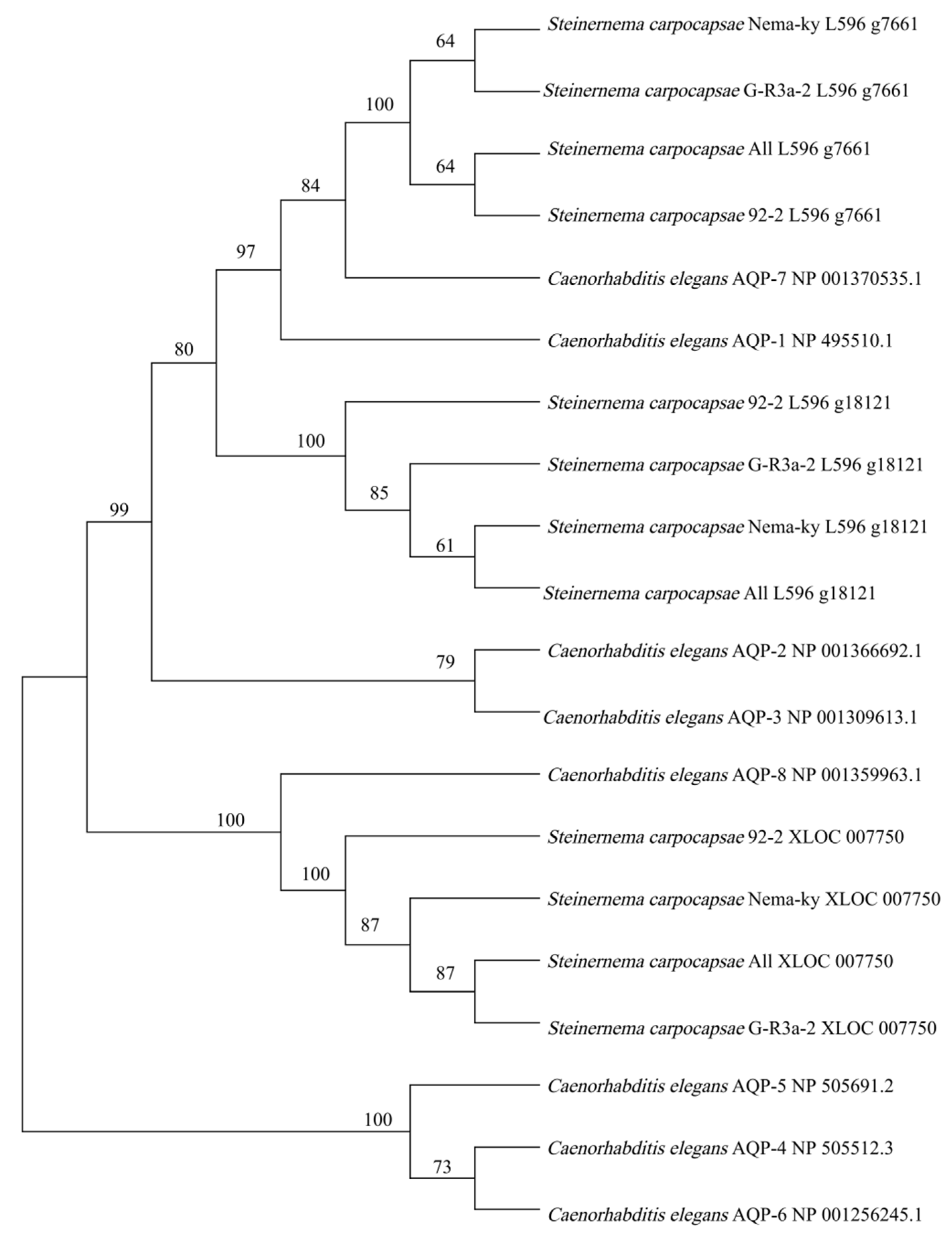
A phylogenetic tree was constructed using the amino acid sequences of the three AQPs from the four S. carpocapsae strains and C. elegans AQP1 to AQP8 (GenBank Accessions Numbers provided in Figure 2). L596_g7661 and L596_g18121 from all S. carpocapsae strains clustered closely with C. elegans AQP1 and AQP7. XLOC_007750 formed a cluster with C. elegans AQP8. All these AQPs belong to the aquaglyceroporin subfamily, which transports both water and small solutes like glycerol.

3.6. Survival of Different S. carpocapsae Strains Under Osmotic Dehydration

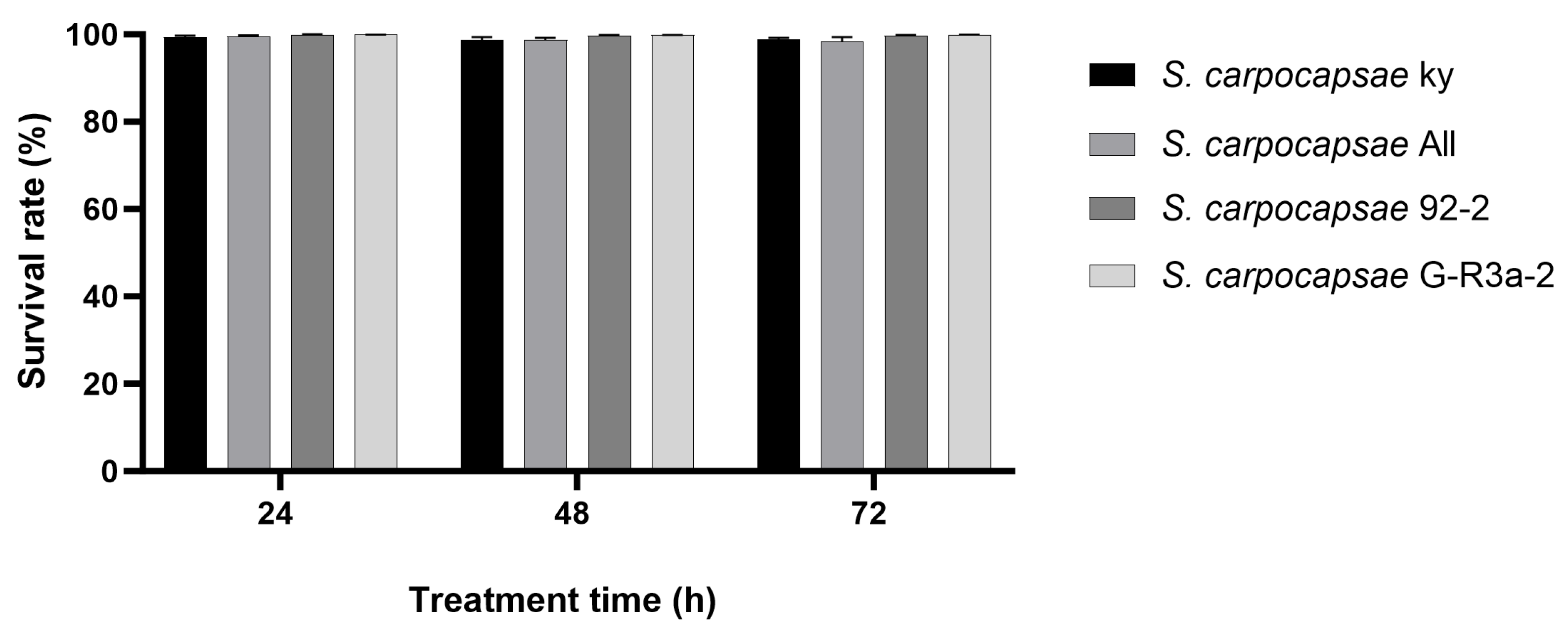
The corrected survival rates of the four strains after 24 h, 48 h, and 72 h of osmotic treatment are shown in Figure 3. All strains exhibited survival rates higher than 97%. No significant differences in survival were found between the osmotic treatment groups and the control at any treatment time point (t ≤ 1.150, p ≥ 0.302). Survival rates did not show a significant difference among strains and treatment durations (F = 1.555, df = 11, 60, p = 0.136). The infectivity of the osmotically treated IJs after recovery did not differ from that of IJs stored in water. All IJs caused 100% mortality to the last instar larvae of G. mellonella after 48 h of infection.

3.7. Glycerol Permeability of AQP L596_g7661

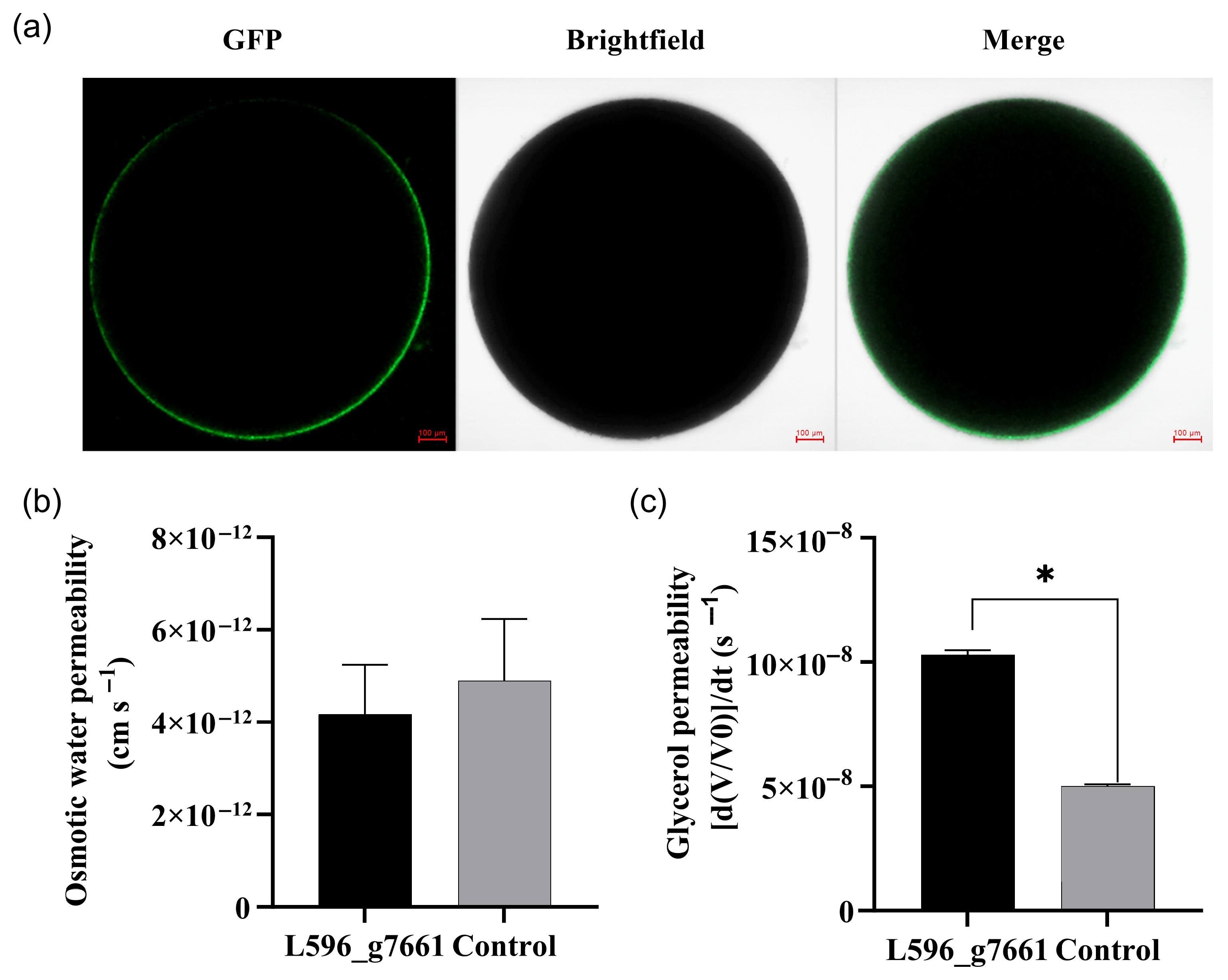
Co-expression of AQP L596_g7661 and GFP in Xenopus oocytes resulted in green fluorescent on cell membrane (Figure 4a). In oocyte swelling assays using a 1:3 diluted ND96 buffer, the water permeability of oocytes expressing AQP L596_g7661 was not significantly different from the control (t = 0.395, p = 0.706) (Figure 4b). However, after incubation in a glycerol solution for 20 s, the initial swelling rate of oocytes expressing AQP L596_g7661 was 0.1020 ± 0.0048, significantly higher than that of the control (0.0500 ± 0.0017) (t = 33.2000, p < 0.001) (Figure 4c). This confirms that AQP L596_g7661 facilitates glycerol transport.

3.8. Response of AQPs to Osmotic Dehydration

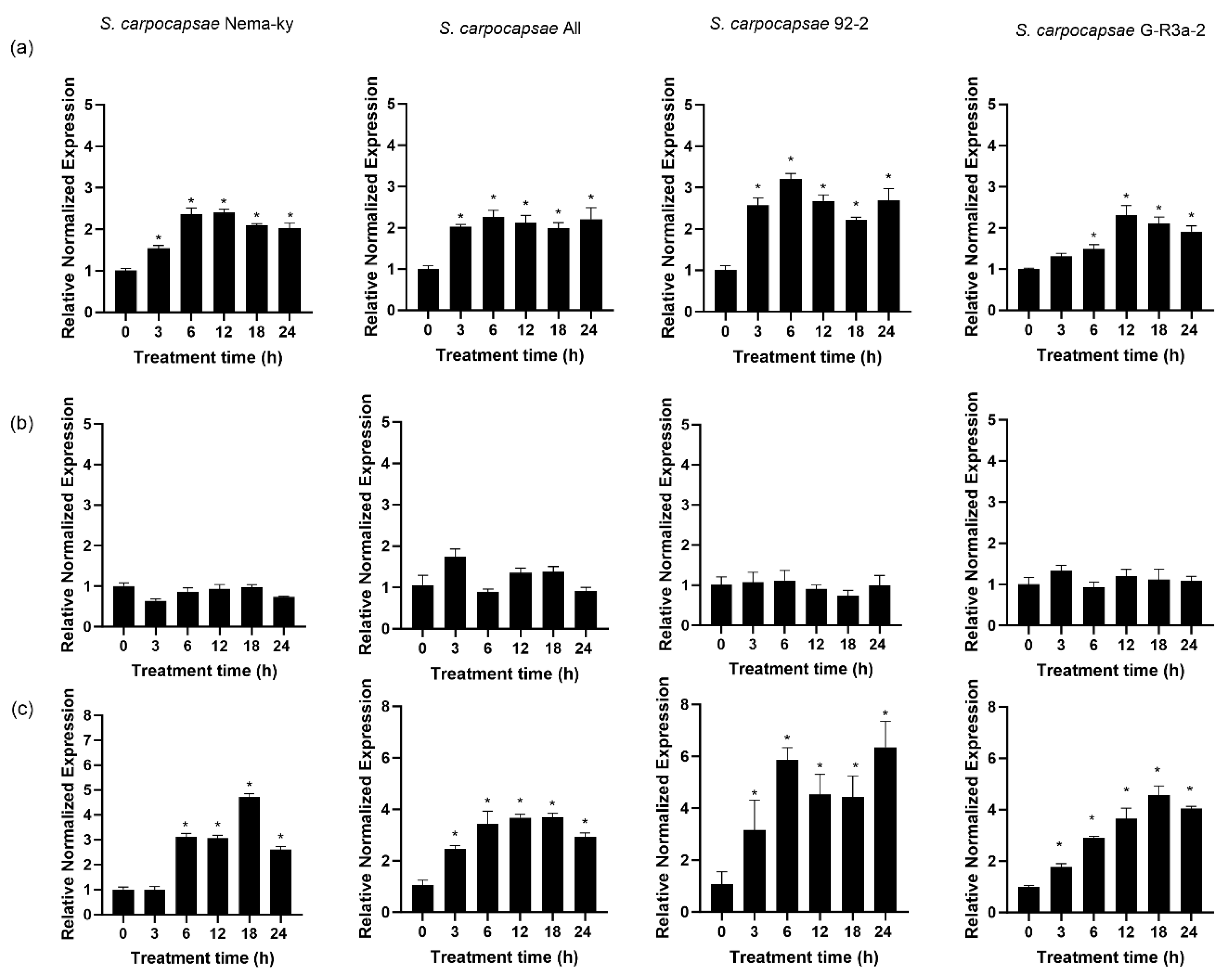
The expression levels of L596_g7661, L596_g18121 and XLOC_007750 were quantified in the four strains after 0 h to 24 h of osmotic dehydration (Figure 5). The same AQP gene exhibited similar expression patterns across different strains. The expression level of L596_g7661 increased significantly at all time points from 3 h to 24 h compared to the control (0 h) (t ≥ 4.46, p ≤ 0.047) (Figure 5a). The expression level of XLOC_007750 followed a similar pattern, being significantly upregulated compared to the control (t ≥ 4.364, p ≤ 0.049) (Figure 5c). In contrast, the expression level of L596_g18121 did not change significantly within the 24 h osmotic treatment period in any of the strains (t ≤ 4.173, p ≥ 0.053) (Figure 5b).

4. Discussion

Aquaporins are ubiquitous channel proteins belonging to the MIP superfamily, typically characterized by two NPA motifs and six transmembrane helices. They mediate the transport of water or/and other small solutes [23]. This study is the first to clone multiple different AQP genes from the same species of EPN. The fundamental characteristics of the cloned S. carpocapsae AQPs closely resemble those of C. elegans AQPs [13], supporting their predicted function in transporting water and small solutes like glycerol.
While nucleotide sequences showed some variations for the same AQP gene across different S. carpocapsae strains, the deduced amino acid sequence were highly conserved, all containing the critical NPA motifs—alterations in which can affect solute permeability [24]. All identified S. carpocapsae AQPs contain the conserved MIP domain with six transmembrane helices and intracellular N- and C-termini, a common architecture that facilitates the regulation of AQP activity [25]. The minimal amino acid variations observed among strains did not alter the conserved response patterns to osmotic stress, suggesting they do not significantly affect the core protein function investigated here. Whether these subtle variations lead to functional differences in other physiological contexts warrants further study.
Phylogenetic analysis using C. elegans AQPs as a reference placed L596_g7661 and L596_g18121 in a clade with C. elegans AQP1 and AQP7, and XLOC_007750 with C. elegans AQP8. As C. elegans AQP1, AQP7, and AQP8 are established aquaglyceroporins [13], it is inferred that the three S. carpocapsae AQPs also belong to this subfamily, functioning as water-glycerol channels. This inference was functionally validated for AQP L596_g7661, which demonstrated significant glycerol permeability in Xenopus oocytes, a hallmark of aquaglyceroporins. Glycerol plays an important role in rapidly balancing the osmotic pressure when IJs of S. carpocapsae were exposed in hypertonic solutions. IJs are induced to synthesize the protectant glycerol under osmotic dehydration, and glycerol permeates into the body of IJs during dehydration in glycerol solution. Part of the permeated glycerol acts as a protectant, similar to that synthesized by IJs from their energy reserve materials [26,27]. The significantly increased expression levels of aquaglyceroporins L596_g7661 and XLOC_007750 likely facilitate glycerol transport into the IJ body as a protectant. This reflects the essential presence of glycerol for IJs to survive and function properly even under moderate osmotic dehydration, especially when IJs are dehydrated in salt solutions. The low water permeability of L596_g7661 is consistent with other members of the aquaglyceroporin subfamily [12,28]. While this study provides the first functional characterization of an AQP (L596_g7661) in EPNs, future work should include functional assays for other AQPs (e.g., XLOC_007750) to further confirm the role of this subfamily in osmotic stress adaptation. Nonetheless, the conserved sequence and parallel expression response strongly suggest overlapping functions among these stress-responsive aquaglyceroporins.
The differential expression patterns of the three AQPs under osmotic stress—significant upregulation of L596_g7661 and XLOC_007750 versus the stability of L596_g18121—strongly suggest functional specialization within this gene family. Given that L596_g7661 and L596_g18121 are phylogenetically clustered yet display opposing transcriptional responses, we hypothesize that they may be expressed in distinct cell types with different roles in osmoregulation. For instance, the responsive AQPs might be localized to the hypodermis for rapid water/glycerol exchange with the environment, while the non-responsive L596_g18121 could serve a constitutive housekeeping role in internal tissues. This compartmentalization of function would allow the nematode to mount a targeted and efficient response to dehydration. The differential regulation suggests functional specialization, a phenomenon observed in other systems [29]. For example, in C. elegans, AQP1, AQP7, and AQP8 exhibit distinct tissue-specific expression patterns [13]. In the spiny dogfish (Squalus acanthias), AQP1 is expressed at very high levels in the rectal gland and at lower levels in other tissues [30]. AQPs displayed a tissue-specific expression pattern in different tissues of healthy spotted sea bass [31]. In buffalo and goat, some AQPs (AQP0, 2, 4, 5, 7, 9, 12) showed tissue-restricted expression, whereas others (AQP1, 3, 8, and 11) exhibited ubiquitous expression across several tissues [32]. Future studies should aim to determine the precise tissue localization of these AQPs in S. carpocapsae.
Building on the current findings, future work will focus on functionally characterizing the remaining AQPs, particularly the stress-responsive XLOC_007750, to define its specific solute transport profile. Furthermore, employing techniques such as RNA interference (RNAi) or gene editing to knock down target AQP genes in vivo would be essential to confirm their specific and indispensable roles in glycerol-mediated dehydration tolerance. Finally, investigating the tissue-specific localization and upstream regulatory mechanisms of these AQPs will provide a comprehensive understanding of their functions within the osmotic stress adaptation network of EPNs.

5. Conclusions

This study provides the first comparative functional analysis of AQP genes across different S. carpocapsae strains. The findings reveal the conserved stress-responsive expression patterns of specific AQPs and provides direct functional evidence that AQP L596_g7661 acts as a glycerol transporter, thereby offering crucial molecular insight into the osmotic stress adaptation mechanism in S. carpocapsae. This work ultimately paves new avenues for enhancing the application efficacy of EPNs in ecological pest control.

Supplementary Materials

The following supporting information can be downloaded at: https://www.mdpi.com/article/10.3390/biology15010078/s1, Figure S1: Conserved domains of aquaporins in different Steinernema carpocapsae strains; Figure S2: Predicted transmembrane domains of aquaporins in different Steinernema carpocapsae strains.

Author Contributions

Conceptualization, X.Y.; methodology, software, writing—original draft preparation, Y.C. and Q.H.; visualization, Y.C.; writing—review and editing, supervision, funding acquisition, X.Y. All authors have read and agreed to the published version of the manuscript.

Funding

This research was funded by the National Natural Science Foundation of China, grant number 32172491; The Foundation of Guangdong Provincial Department of Education, grant number 2022ZDJS020; The Guangdong Rural Science and Technology Commissioner Program, grant numbers KTP20240413 and KTP20240946; and the Research Achievements of the Innovation Program for Postgraduate Education of Zhongkai University of Agriculture and Engineering.

Institutional Review Board Statement

Not applicable.

Informed Consent Statement

Not applicable.

Data Availability Statement

The nucleotide sequences generated in this study are available in the NCBI database. The other original contributions presented in this study are included in the article/Supplementary Material. Further inquiries may be directed to the corresponding author.

Conflicts of Interest

The authors declare no conflicts of interest.

References

  1. Georgis, R.; Koppenhöfer, A.M.; Lacey, L.A.; Bélair, G.; Duncan, L.W.; Grewal, P.S.; Samish, M.; Tan, L.; Torr, P.; van Tol, R.W.M.H. Successes and failures in the use of parasitic nematodes for pest control. Biol. Control 2006, 38, 103–123. [Google Scholar] [CrossRef]
  2. Labaude, S.; Griffin, C.T. Transmission success of entomopathogenic nematodes used in pest control. Insects 2018, 9, 72. [Google Scholar] [CrossRef]
  3. Wang, J.; Dai, K.; Kong, X.X.; Cao, L.; Qu, L.; Jin, Y.L.; Li, Y.L.; Gu, X.H.; Li, J.Z.; Xu, C.T.; et al. Research progress and perspective on entomopathogenic nematodes. J. Environ. Entomol. 2021, 43, 811–839. [Google Scholar] [CrossRef]
  4. Chang, D.; Wang, C.; Li, C. Advances on the pathogenic mechanism of entomopathogenic nematodes. Chin. J. Biol. Control 2022, 38, 1325–1333. [Google Scholar] [CrossRef]
  5. Shapiro-Ilan, D.I.; Ment, D.; Ramakrishnan, J.; Rodríguez Hernández, M.G.; Duncan, L.W. A century of advancement in entomopathogenic nematode formulation and application technology. J. Invertebr. Pathol. 2025, 212, 108389. [Google Scholar] [CrossRef]
  6. Ali, F.; Wharton, D.A. Cold tolerance abilities of two entomopathogenic nematodes, Steinernema feltiae and Heterorhabditis bacteriophora. Cryobiology 2013, 66, 24–29. [Google Scholar] [CrossRef]
  7. Yan, X.; Liu, X.; Han, R.; Chen, S.; De Clercq, P.; Moens, M. Osmotic induction of anhydrobiosis in entomopathogenic nematodes of the genera Heterorhabditis and Steinernema. Biol. Control 2010, 53, 325–330. [Google Scholar] [CrossRef]
  8. Yan, X.; De Clercq, P.; Han, R.; Jones, J.; Chen, S.; Moens, M. Osmotic responses of different strains of Steinernema carpocapsae. Nematology 2011, 13, 845–851. [Google Scholar] [CrossRef]
  9. Chen, S.; Gollop, N.; Glazer, I. Cross-stress tolerance and expression of stress-related proteins in osmotically desiccated entomopathogenic Steinernema feltiae IS-6. Parasitology 2005, 131, 695–703. [Google Scholar] [CrossRef]
  10. Chen, S.; Glazer, I.; Gollop, N.; Cash, P.; Argo, E.; Innes, A.; Stewart, E.; Davidson, I.; Wilson, M.J. Proteomic analysis of the entomopathogenic nematode Steinernema feltiae IS-6 IJs under evaporative and osmotic stresses. Mol. Biochem. Parasitol. 2006, 145, 195–204. [Google Scholar] [CrossRef] [PubMed]
  11. Tyson, T.; Reardon, W.; Browne, J.A.; Burnell, A.M. Gene induction by desiccation stress in the entomopathogenic nematode Steinernema carpocapsae reveals parallels with drought tolerance mechanisms in plants. Int. J. Parasitol. 2007, 37, 763–776. [Google Scholar] [CrossRef] [PubMed]
  12. Somvanshi, V.S.; Koltai, H.; Glazer, I. Expression of different desiccation-tolerance related genes in various species of entomopathogenic nematodes. Mol. Biochem. Parasitol. 2008, 158, 65–71. [Google Scholar] [CrossRef]
  13. Huang, C.G.; Lamitina, T.; Agre, P.; Strange, K. Functional analysis of the aquaporin gene family in Caenorhabditis elegans. Am. J. Physiol. Cell Physiol. 2007, 292, 1867–1873. [Google Scholar] [CrossRef]
  14. Wang, F.; Ye, B. Advances in research on aquaporins in medical helminthes. Chin. J. Schistosomiasis Control 2020, 32, 542–547. [Google Scholar] [CrossRef]
  15. Bill, R.M.; Hedfalk, K. Aquaporins–Expression, purification and characterization. Biochim. Biophys. Acta 2021, 1863, 183650. [Google Scholar] [CrossRef]
  16. Tong, T.; Zeng, F.; Ye, S.; Ji, Z.; Wang, Y.; Chen, Z.H.; Ouyang, Y. Evolutionary and structural analysis of the aquaporin gene family in rice. Plants 2025, 14, 2035. [Google Scholar] [CrossRef]
  17. Gil, C.I.; Jarius, M.; von Kries, J.P.; Rohlfing, A.K. Neuronal chemosensation and osmotic stress response converge in the regulation of aqp-8 in C. elegans. Front. Physiol. 2017, 8, 380. [Google Scholar] [CrossRef] [PubMed]
  18. Huang, Q.Y.; Chen, Y.Q.; Ding, Q.; Yan, X. Analysis of aquaporin gene family in Steinernema carpocapsae. J. Environ. Entomol. 2025. Available online: https://link.cnki.net/urlid/44.1640.Q.20250509.1602.002 (accessed on 12 May 2025).
  19. Kaya, H.K.; Stock, S.P. Techniques in insect nematology. In Manual of Techniques in Insect Pathology; Lacey, L.A., Ed.; Academic Press: London, UK, 1997; pp. 281–324. [Google Scholar]
  20. Feng, S.P.; Han, R.C.; Qiu, X.H.; Cao, L.; Chen, J.H.; Wang, G.H. Storage of osmotically treated entomopathogenic nematode Steinernema carpocapsae. Insect Sci. 2006, 13, 263–269. [Google Scholar] [CrossRef]
  21. Yan, X.; Moens, M.; Han, R.; Chen, S.; De Clercq, P. Effects of selected insecticides on osmotically treated entomopathogenic nematodes. J. Plant Dis. Protect. 2012, 119, 152–158. [Google Scholar] [CrossRef]
  22. Pavlovic-Djuranovic, S.; Schultz, J.E.; Beitz, E. A single aquaporin gene encodes a water/glycerol/urea facilitator in Toxoplasma gondii with similarity to plant tonoplast intrinsic proteins 1. FEBS Lett. 2003, 555, 500–504. [Google Scholar] [CrossRef]
  23. Martínez-Ballesta, M.C.; Carvajal, M. Mutual interactions between aquaporins and membrane components. Front. Plant Sci. 2016, 7, 1322. [Google Scholar] [CrossRef]
  24. Ishibashi, K. Aquaporin subfamily with unusual NPA boxes. Biochim. Biophys. Acta 2006, 1758, 989–993. [Google Scholar] [CrossRef] [PubMed]
  25. Kitchen, P.; Day, R.E.; Salman, M.M.; Conner, M.T.; Bill, R.M.; Conner, A.C. Beyond water homeostasis: Diverse functional roles of mammalian aquaporins. Biochim. Biophys. Acta 2015, 1850, 2410–2421. [Google Scholar] [CrossRef]
  26. Qiu, L.; Lacey, M.J.; Bedding, R.A. Permeability of the infective juveniles of Steinernema carpocapsae to glycerol during osmotic dehydration and its effect on biochemical adaptation and energy metabolism. Comp. Biochem. Phys. B 2000, 125, 411–419. [Google Scholar] [CrossRef]
  27. Qiu, L.; Bedding, R.A. Characteristics of protectant synthesis of infective juveniles of Steinernema carpocapsae and importance of glycerol as a protectant for survival of the nematodes during osmotic dehydration. Comp. Biochem. Phys. B 2002, 131, 757–765. [Google Scholar] [CrossRef]
  28. Carbrey, J.M.; Gorelick-Feldman, D.A.; Kozono, D.; Praetorius, J.; Nielsen, S.; Agre, P. Aquaglyceroporin AQP9: Solute permeation and metabolic control of expression in liver. Proc. Natl. Acad. Sci. USA 2003, 100, 2945–2950. [Google Scholar] [CrossRef]
  29. Verkman, A.S. More than just water channels: Unexpected cellular roles of aquaporins. J. Cell Sci. 2005, 118, 3225–3232. [Google Scholar] [CrossRef] [PubMed]
  30. Cutler, C.P.; MacIver, B. Localization and expression of Aquaporin 1 (AQP1) in the tissues of the spiny dogfish (Squalus acanthias). Int. J. Mol. Sci. 2025, 26, 5593. [Google Scholar] [CrossRef] [PubMed]
  31. Zhang, X.; Yu, P.; Wen, H.; Qi, X.; Tian, Y.; Zhang, K.; Fu, Q.; Li, Y.; Li, C. Genome-wide characterization of Aquaporins (aqps) in Lateolabrax maculatus: Evolution and expression patterns during freshwater acclimation. Mar. Biotechnol. 2021, 23, 696–709. [Google Scholar] [CrossRef]
  32. Rajput, S.; Gautam, D.; Vats, A.; Roshan, M.; Goyal, P.; Rana, C.; Payal, S.M.; Ludri, A.; De, S. Aquaporin (AQP) gene family in buffalo and goat: Molecular characterization and their expression analysis. Int. J. Biol. Macromol. 2024, 280, 136145. [Google Scholar] [CrossRef] [PubMed]
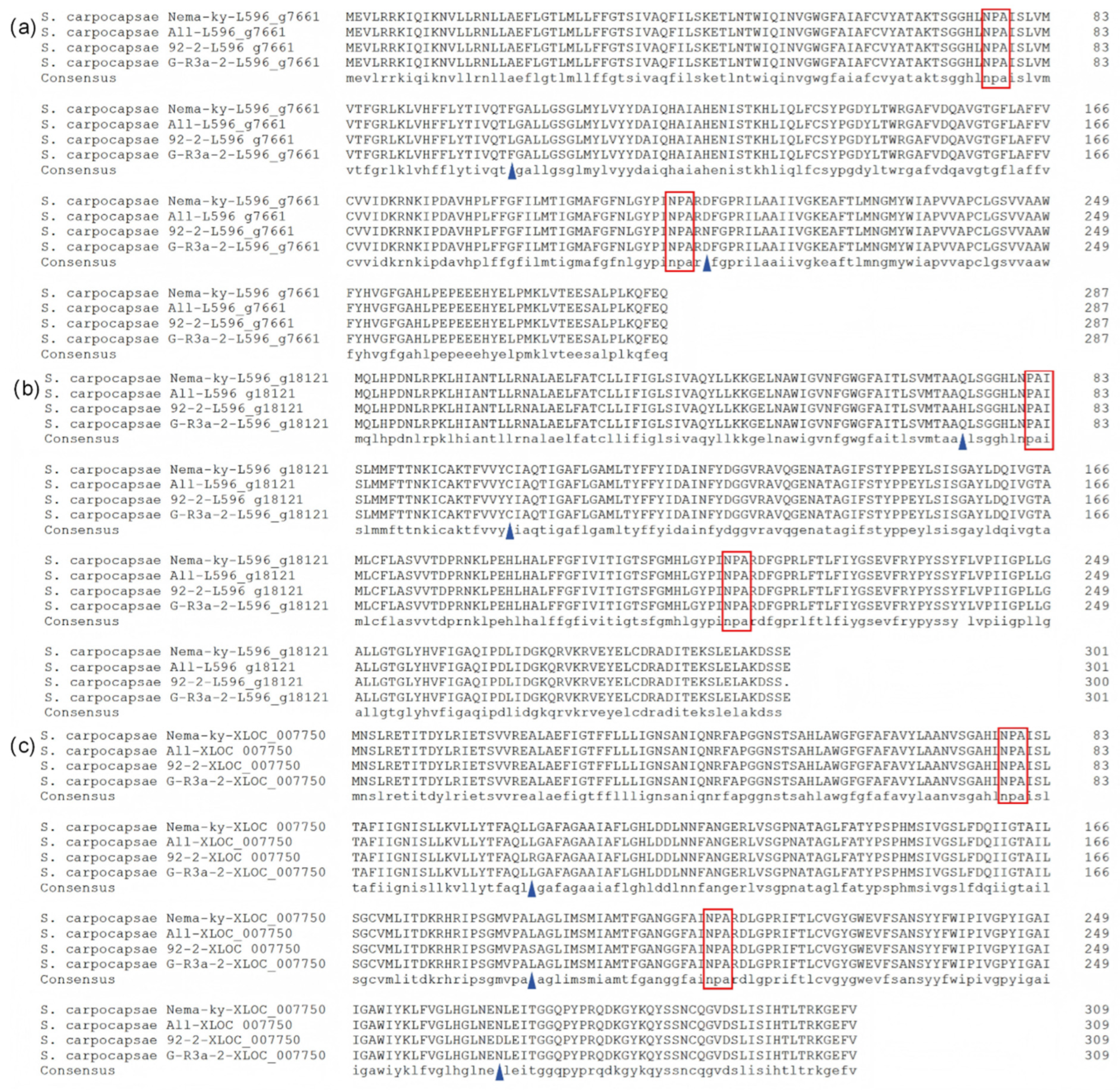
Figure 1. Amino acid sequence alignment of aquaporins from different Steinernema carpocapsae strains. (a), L596_g7661; (b), L596_g18121; (c), XLOC_007750. Boxes indicate the conserved NPA motifs. Triangles denote positions of amino acid variations.
Biology 15 00078 g001
Figure 2. Phylogenetic tree of aquaporins from Steinernema carpocapsae. The tree was constructed using the Neighbor-Joining method. Bootstrap values from 1000 replicates are shown at the nodes.
Biology 15 00078 g002
Figure 3. Survival rates of different Steinernema carpocapsae strains after osmotic treatment. No significant differences in survival rates were observed among strains and treatment durations (One-way ANOVA, n = 6, p > 0.05).
Biology 15 00078 g003
Figure 4. Functional characterization of aquaporin L596_g7661 in Xenopus oocytes. (a), Representative images of an oocyte expressing the AQP L596_g7661-GFP fusion protein. From left to right: GFP (fluorescence signal of the fusion protein), Brightfield (DIC image), and Merge (overlay of both channels). The scale bar represents 100 µm. (b), Osmotic water permeability (Pf) of oocytes expressing AQP L596_g7661 compared to water-injected controls. (c), Glycerol permeability of oocytes expressing AQP L596_g7661. Asterisk (*) above the bars indicates a significant difference between the oocytes expressing AQP L596_g7661 and the control (Paired-sample t-test, n = 7, p < 0.05).
Biology 15 00078 g004
Figure 5. Relative expression levels of aquaporin genes in different Steinernema carpocapsae strains following osmotic treatment over time. (a), L596_g7661; (b), L596_g18121; (c), XLOC_007750. Asterisk (*) above the bars indicates significant difference between treatment time and the control (0 h) (Paired-sample t-test, n = 6, p < 0.05).
Biology 15 00078 g005
Table 1. Primers used for gene amplification and quantitative PCR.
Primer NamePrimer Sequence (5′-3′)Product Length (bp)Usage
Sca7661-F1ATGGAAGTGCTCCGGCG864PCR
Sca7661-R1CTACTGTTCAAACTGCTTAAGAGGCAA
Sca18121-F2ATGCAGCTGCATCCCGACAAC906PCR
Sca18121-R2TCACTCGGAAGAATCTTTGGCGAG
Sca007750-F4ACGGGTTAAAGTGTGGATGG960PCR
Sca007750-R4ATGAATAGTCTCCGCGAGAC
7661-HR-FAGATCAATTCCCCGGGGATCCATGGAAGTGCTCCGGCGCAAG894PCR
7661-HR-RCACCATGGGTACCTGTTCAAACTGCTTAAGAG
7GFP-HR-FAACAGGTACCCATGGTGAGCAAGGGCGAGGAG751PCR
7GFP-HR-RCCAGATCAAGCTTGCTCTAGATTACTTGTACAGCTCGTCCATG
Sca-actin2-FTGTGACGAAGAAGTTGCCGC81RT-qPCR
Sca-actin2-RAGCGTCATCTCCGGCAAAA
aqp7661-qf1TTACTACGACGCGATCCAGC89RT-qPCR
aqp7661-qr1AGTCTCCAGGGTAGGAGCAG
aqp18121-qf3GGGTCAATTTCGGATGGGGA149RT-qPCR
aqp18121-qr3AGCGATGCAGTAAACGACGA
aqp7750-qf2AACTCTACCTCAGCCCACCT110RT-qPCR
aqp7750-qr2AAGGCAGTAAGGGAGATGGC
Table 2. Physicochemical properties of aquaporins from different Steinernema carpocapsae strains.
Gene NameStrainMolecular Weight (kDa)Instability
Index
Isoelectric PointAverage
Hydrophilicity
L596_g7661Nema-ky32.0827.417.120.575
All32.0526.987.120.578
92-232.0527.157.730.578
G-R3a-232.0827.417.120.575
L596_g18121Nema-ky33.1722.156.370.463
All33.1722.156.370.463
92-233.1121.676.700.465
G-R3a-233.1822.566.370.450
XLOC_007750Nema-ky33.1921.587.050.445
All33.1921.587.050.445
92-233.2122.557.050.403
G-R3a-233.1921.587.050.445
Disclaimer/Publisher’s Note: The statements, opinions and data contained in all publications are solely those of the individual author(s) and contributor(s) and not of MDPI and/or the editor(s). MDPI and/or the editor(s) disclaim responsibility for any injury to people or property resulting from any ideas, methods, instructions or products referred to in the content.