
Article

A Multi-Breed GWAS for Carcass Weight in Jeju Black Cattle and Hanwoo × Jeju Black Crossbreds
1
Subtropical Livestock Research Center, National Institute of Animal Science, RDA, Jeju 63242, Republic of Korea
2
Animal Breeding and Genetics Division, National Institute of Animal Science, RDA, Cheonan 31041, Republic of Korea
3
Department of Animal Resources Science, Kongju National University, Yesan 3249, Republic of Korea
*
Author to whom correspondence should be addressed.
Biology 2025, 14(12), 1699; https://doi.org/10.3390/biology14121699
Submission received: 28 October 2025 / Revised: 17 November 2025 / Accepted: 27 November 2025 / Published: 28 November 2025
(This article belongs to the Special Issue Advances in Animal Functional Genomics)

Simple Summary

Carcass weight is one of the most important traits determining beef yield and economic value in Korea. Jeju Black cattle are a native breed valued for their unique meat quality, but their smaller body size limits productivity. To better understand the genetic factors that influence carcass weight, we analyzed DNA from Jeju Black cattle and Jeju Black × Hanwoo crossbreds using a genome-wide association study (GWAS). We identified several genomic regions and genes that may affect carcass growth, including genes related to skeletal development, muscle formation, and metabolism. These findings provide new genetic information that can support breeding programs aimed at improving carcass yield while preserving the unique characteristics of Jeju Black cattle. The results also help establish a scientific foundation for the sustainable conservation and utilization of this important Korean native breed.

Abstract

Carcass weight (CW) is a major determinant of beef yield and market value in Korea, yet the genetic basis of this trait remains largely unexplored in cattle from Jeju Island. In this study, we performed a genome-wide association study (GWAS) using both a mixed linear model (MLM) and the FarmCPU approach, followed by pathway and network analyses to identify loci and biological functions underlying CW variation. A total of 256 Jeju cattle (92 Jeju Black and 164 Jeju Black × Hanwoo crossbreds) were initially sampled. One crossbred sample failed genotyping, leaving 255 animals (92 Jeju Black and 163 crossbreds) for analysis. Animals were genotyped using the Illumina BovineSNP50 v3 BeadChip, and 39,055 high-quality single nucleotide polymorphisms (SNPs) were retained after quality control. The MLM analysis detected no genome-wide significant associations, whereas the FarmCPU analysis identified six significant loci on Bos taurus chromosomes 3, 5, 6, 10, and 13, each explaining 2.55–9.58% of the phenotypic variance. Candidate genes located near these loci included EIF2B3, HECTD3, SOX5, KLF6, PHACTR3, and two uncharacterized protein-coding genes. Functional enrichment analysis identified biologically relevant pathways including lysine degradation, tryptophan metabolism, glycerolipid metabolism, fatty acid biosynthesis, extracellular matrix–receptor interaction, and signaling cascades such as PI3K–Akt and Rap1, although most pathways were not statistically significant after FDR correction. Protein–protein interaction (PPI) network analysis using STRING highlighted modules of signaling, extracellular matrix, and metabolic genes. These clusters suggest that coordinated interactions among these pathways contribute to carcass growth and development. These findings provide new insights into the molecular basis of CW in Jeju Black and Hanwoo × Jeju Black crossbred cattle and identify candidate genes and pathways that may be useful for genomic selection and the sustainable improvement of Jeju Black cattle populations.

1. Introduction

Carcass traits are major determinants of productivity and profitability in beef cattle. Among them, carcass weight (CW) is particularly important because it directly influences yield grade, consumer preference, and market price. In Korea, the national beef grading system evaluates carcass yield primarily on CW, ribeye area, and backfat thickness, with CW being the most influential economic trait [1,2,3]. Consequently, improving CW through genetic selection is a key objective in the Korean beef sector [4,5,6].
Jeju Black cattle, locally termed Heukwoo, are indigenous to Jeju Island and represent a valuable but underutilized genetic resource. Historically recognized for their unique meat quality and cultural significance, they are currently conserved as a Korean Natural Monument [7,8]. However, their smaller body size and slower growth rates relative to Hanwoo, the dominant Korean beef breed, have limited their commercial competitiveness [9]. Recent studies indicate that Jeju Black beef contains higher levels of umami-related amino acids and favorable flavor compounds compared with Hanwoo [10,11]. To integrate these desirable sensory traits with the superior growth performance of Hanwoo, Jeju Black × Hanwoo crossbreds (locally termed Heukhanu), have been developed and now serve both as a practical production population and a valuable genetic resource.
Genetic improvement of carcass traits requires identification of the underlying genomic regions and causal variants. Previous studies in Hanwoo and other beef cattle populations have reported moderate to high heritability for CW (0.30–0.60) and identified numerous quantitative trait loci (QTL) affecting growth and carcass composition [12,13]. Well-established regions include NCAPG–LCORL region on BTA6, associated with growth and skeletal development [14,15]; CAST (calpastatin) and DGAT1 (diacylglycerol O-acyltransferase 1), which influence tenderness and fat deposition; and GHRH (growth hormone-releasing hormone), a regulator of growth hormone activity [16,17]. These results highlight the polygenic nature of carcass traits and the importance of continuing genomic studies in diverse cattle populations.
Previous GWASs in beef cattle have repeatedly identified major loci influencing growth and carcass traits, including the NCAPG–LCORL region on BTA6 [14,15], PLAG1 on BTA14 [12,13], and additional genes such as CAST, DGAT1, and GHRH, which contribute to variation in tenderness, fat deposition, and endocrine regulation [16,17]. These well-characterized loci provide a useful comparative framework for interpreting associations detected in Jeju Black-based populations.
Genome-wide association studies (GWASs) using high-density single nucleotide polymorphism (SNP) arrays are widely used to dissect complex traits in livestock [18]. Multi-locus methods like the FarmCPU (Fixed and Random Model Circulation Probability Unification) have improved statistical power and reduced false positives compared with traditional mixed linear models [19,20,21]. Subsequent functional annotation of GWAS signals via pathway enrichment and protein–protein interaction (PPI) analysis enables biological interpretation of detected loci and for carcass traits, these analysis have emphasized roles for amino acid metabolism, lipid biosynthesis, extracellular matrix remodeling, PI3K–Akt and Rap1 signaling pathways [22,23,24].
Although Jeju Black cattle have been characterized for genetic diversity and genomic estimated breeding values [25,26], no GWAS has examined CW in Jeju Black-based populations. Because Jeju Black and Jeju Black × Hanwoo crossbreds show limited genetic differentiation, they can be studied as a single Jeju Black-based population. Given the economic importance of CW and the conservation and production value of Jeju Black, elucidating the genetic basis of CW in this population is both scientifically relevant and practically significant. Therefore, the objective of this study was to identify genomic regions, positional candidate genes, and biological pathways associated with CW in Jeju Black-based populations using GWAS.

2. Materials and Methods

2.1. Animal Population and Phenotypic Data

We initially enrolled 256 Jeju Black-based cattle, comprising 92 pure Jeju Black and 164 Jeju Black × Hanwoo crossbred animals. One crossbred sample failed genotyping quality control, resulting in 255 animals (92 Jeju Black, 163 crossbreds) included in the final analysis.
The animals were fattened on different farms across Jeju Island, reflecting the typical production environment for Jeju Black and crossbred cattle. Management conditions, including feed type, feeding duration, and housing, varied somewhat between farms; however, all animals were raised under the standard Hanwoo/Jeju Black fattening system, in which cattle are fed a concentrate-based diet supplemented with roughage and finished for approximately 26–32 months before slaughter. Information on farm location and management batch was recorded and used to verify that animals were fattened under comparable production standards.
All animals were slaughtered between April 2022 and May 2023 at the Jeju Livestock Cooperative slaughterhouse in the Jeju Special Self-Governing Province, following uniform grading by the Korean Institute for Animal Products Quality Evaluation (KAPE). Longissimus dorsi muscle tissue samples were collected during carcass grading and used for genomic DNA extraction.
The study population consisted of 127 steers (castrated males; mean slaughter age 37 months) and 128 cows (females; mean slaughter age 63 months). The analyzed phenotype was carcass weight (CW, kg), recorded as hot carcass weight at slaughter according to the Korean beef grading system. The normality of CW distribution was assessed using the Ryan–Joiner test implemented in Minitab 14 (Minitab Inc., State College, PA, USA), followed by basic descriptive statistical analyses.

2.2. DNA Extraction and Genotyping

Genomic DNA was extracted from muscle tissue samples collected at slaughter using a modified salting-out method [27]. DNA concentration and purity were measured with a NanoDrop 2000 spectrophotometer (Thermo Scientific, Waltham, MA, USA). Working aliquots were prepared in TE buffer (10 mM Tris-HCl, pH 7.4; 1 mM EDTA) and stored at −20 °C until further analysis. DNA integrity was additionally confirmed by agarose gel electrophoresis.
In total, 256 animals were initially sampled for genotyping. One crossbred animal failed genotyping due to low call rate, resulting in 255 samples that passed DNA quality thresholds and were successfully genotyped using the Illumina BovineSNP50 v3 BeadChip (Illumina Inc., San Diego, CA, USA), originally based on the ARS-UCD1.3 assembly. The complete sample flow, including animal- and SNP-level QC, is illustrated in Supplementary Figure S1. After quality control, SNP positions were updated and remapped to the Bos taurus ARS-UCD1.3 reference genome for annotation and pathway analysis, ensuring consistency with the latest Ensembl resources. All 255 samples passed DNA quality thresholds and were successfully genotyped.

2.3. Quality Control of Genotype Data

Genotype data were processed using PLINK v1.9. [28]. SNPs with a minor allele frequency (MAF) < 0.05, Hardy–Weinberg equilibrium (HWE) p-value < 1 × 10⁻⁶, or call rate < 90% (genotyping error > 10%) were removed. Individuals with >10% missing genotypes were also excluded; all 255 genotyped animals passed individual-level QC. After filtering, a total of 39,055 high-quality SNPs were retained. SNP positions were mapped to the Bos taurus ARS-UCD1.3 reference genome [29].

2.4. Population Structure and Relatedness

To investigate potential population stratification arising from merging 92 Jeju Black and 163 crossbreds into a single population, we performed principal component analysis (PCA). Principal components (PCs) were calculated using PLINK v1.9 [28]. The top three principal components (PC1–PC3) were visualized in R (tidyverse 2.0.0 and rgl packages 1.3.31) and are shown in Supplementary Figure S2. The PCA indicated that Jeju Black and crossbred cattle clustered together without clear separation, suggesting a largely shared genetic background. This observation is consistent with previous genomic studies reporting low genetic differentiation between Jeju Black and Hanwoo-derived populations (FST typically < 0.05), which supports their close genetic relationship and further justifies combining the two groups for joint GWAS analysis. For this reason, both groups were analyzed jointly as a Jeju Black-based population. To account for any subtle structure, PC1–PC3 were included as covariates in the GWAS models, in addition to sex, slaughter age, and cattle type. Additionally, the FarmCPU model incorporates a pseudo-QTN-derived kinship matrix in its random-effect component to correct for relatedness and subtle population structure.

2.5. GWAS Analysis

GWAS was conducted using the FarmCPU algorithm implemented in the rMVP package in R (1.4.5) [19,29], which consists of a fixed effect model (FEM) and a random effect model (REM). FEM iteratively fits a fixed-effect model to test individual SNPs, with fixed effects including sex (steer or cow), slaughter age (months), type [Jeju Black (Heukwoo) or Jeju Black × Hanwoo crossbred (Heukhanu)] and pseudo-QTNs as covariates. All animals originated from the same research farm (Nanjicheon) and were managed under a unified feeding and housing system; therefore, no additional environmental or farm-level fixed effects (e.g., farm, feeding system, management group) were required in the model.
Pseudo-QTNs, which represent putative quantitative trait nucleotides, were initially set to empty. The REM defines kinship using pseudo-QTNs and iteratively selects the optimal set of pseudo-QTNs while avoiding model overfitting [20]. In addition to FarmCPU, a mixed linear model (MLM) was also applied as a conventional baseline approach, whereas FarmCPU was included to improve statistical power and reduce confounding given the modest sample size.
Multiple testing correction was applied using the Bonferroni method, with genome-wide significance thresholds set at p < 0.05/number of SNPs and suggestive thresholds at p < 1/number of SNPs [30]. To evaluate test statistic inflation, the genomic inflation factor (λGC) was calculated for both MLM and FarmCPU models.
CW phenotypes were analyzed on the raw scale without log or Box–Cox transformation, as their distribution did not show severe deviations from normality. Fixed effects (sex, slaughter age, and cattle type) and covariates (PC1–PC3) were included directly in the GWAS models; therefore, CW was not pre-adjusted or residualized prior to association testing. Bonferroni correction was used instead of FDR to maintain a conservative genome-wide threshold and minimize false-positive associations, particularly given the modest sample size and the well-established use of Bonferroni in livestock GWASs using ~30–50k SNP panels.
The proportion of phenotypic variance explained by each SNP was calculated as
% V a r S N P = 2 p ( 1 p ) a 2 δ p 2 × 100
where p is the minor allele frequency, a is the additive effect, and δ p 2 is the phenotypic variance of CW, estimated from the null MLM, using the EMMA algorithm [19,29].
To quantify the statistical power of our sample size (n = 255), we performed a post hoc power calculation under the additive SNP model. Using the Bonferroni-corrected genome-wide α (1.28 × 10⁻⁶), phenotype variance of 5095 kg2 (SD = 71.38 kg, Table 1), and standard non-central χ2 approximation, the minimum detectable variance explained (R2) at 80% power was ≈11.2%. This corresponds to additive effects of ~34 kg (MAF = 0.5), ~42 kg (MAF = 0.2), and >~77 kg (MAF = 0.05). Therefore, the present study is well-powered to detect only large-effect loci, while smaller-effect variants may go undetected due to limited sample size.

2.6. Identification of Candidate Genes

For each SNP that surpassed the genome-wide or suggestive significance threshold, positional candidate genes were identified using the Ensembl genome browser (https://useast.ensembl.org/Bos_taurus/Info/Index (accessed on 15 November 2024)) with the bovine reference genome assembly ARS-UCD1.3. Genes located within ±100 kb of significant SNPs were considered as positional candidates, with the nearest annotated gene prioritized if no gene was found within this interval. Functional annotations, including gene names and biological roles, were retrieved from the Ensembl database. Only these positional candidate genes were subsequently used as the input list for KEGG pathway and STRING network enrichment analyses.

2.7. Functional Enrichment and Pathway Analysis

Candidate genes were defined as all annotated genes located within ±100 kb of the six genome-wide significant SNPs. This set of proximal genes was used as the sole input for downstream enrichment and network analyses. Gene annotation was performed using the biomaRt package in R (version 2.48.3) [31,32]. Functional enrichment analysis was performed with the Enrichr database, focusing on the Kyoto Encyclopedia of Genes and Genomes (KEGG) pathway library [33]. To further investigate molecular mechanisms, protein–protein interaction (PPI) networks were constructed using STRING version 12.0 [34]. Unless otherwise noted in the figure legends, STRING analyses were restricted to the input set of positional candidate genes, with network expansion limited to first-shell interactors. Pathways were considered significantly enriched at a Benjamini–Hochberg adjusted p < 0.05.

3. Results

3.1. Phenotypic Measurements

Descriptive statistics of CW for the Jeju Black-based cattle are summarized in Table 1. The study population comprised 127 steers and 128 cows, with mean slaughter ages of 37.1 and 62.7 months, respectively. Mean CW was 405.3 ± 55.89 kg in steers and 326.1 ± 62.85 kg in cows. Across all animals (n = 255), CW averaged 365.5 ± 71.38 kg, with a range of 139–526 kg. Both sex and slaughter age were included as fixed effects in subsequent GWAS analyses. The relatively large standard deviation of carcass weight (56–71 kg) reflects biological heterogeneity in the dataset, including variation in sex, slaughter age, and breed composition. These values are comparable to those previously reported for Jeju native cattle and crossbreds [35].
Table 1. Descriptive statistics of carcass weight in Jeju Black-based cattle.
GroupNAge (Months, Mean ± SD)Carcass Weight (kg, Mean ± SD)Min (kg)Max (kg)
Steers12737.1 ± 4.68405.3 ± 55.89182526
Cows12862.7 ± 37.24326.1 ± 62.85139474
Total25550.0 ± 29.46365.5 ± 71.38139526

3.2. GWAS and Candidate Gene Identification

Genome-wide association analysis for CW in Jeju Black-based cattle was performed using both MLM and FarmCPU approaches. Prior to GWAS, a total of 53,866 SNPs were available from the GenomeStudio FinalReport, of which 39,055 high-quality SNPs remained after quality control filtering (Table 2).
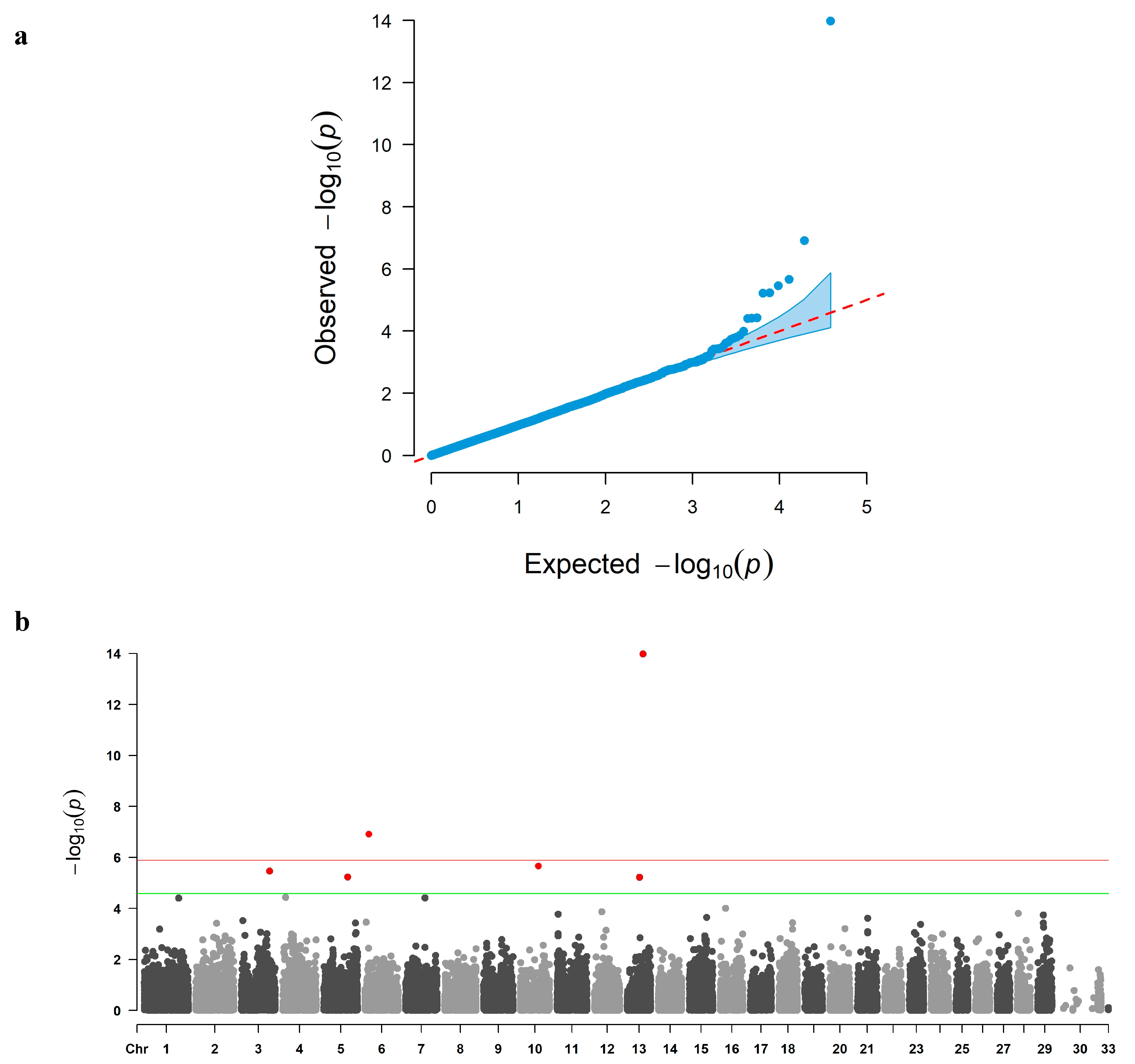
The QQ plot from the MLM analysis indicated that the observed distribution of p-values closely followed the null expectation (Figure 1a), and no SNPs surpassed the genome-wide significance threshold (Figure 1b). In contrast, the QQ plot from the FarmCPU analysis showed deviation at the tail of the distribution (Figure 2a), and the Manhattan plot revealed six loci surpassing the genome-wide significance threshold on chromosomes 3, 5, 6, 10, and 13 (Figure 2b).
To evaluate potential test statistic inflation, the genomic inflation factor (λGC) was calculated. λGC values were 1.02 for MLM and 1.04 for FarmCPU, indicating minimal inflation and confirming that population stratification was adequately controlled by including PC1–PC3 covariates in the models.
For multiple testing, Bonferroni-corrected thresholds were calculated as −log10(0.05/39,055) ≈ 5.89 for genome-wide significance and −log10(1/39,055) ≈ 4.59 for suggestive significance. These cutoffs are shown as horizontal lines in the Manhattan plots (Figure 1b and Figure 2b).
The significant SNPs explained between 2.55% and 9.58% of the phenotypic variance in CW (Table 3). Genes located within ±100 kb of these SNPs were identified as positional candidates, including EIF2B3, HECTD3, SOX5, ENSBTAG00000064813, ENSBTAG00000064392, KLF6, and PHACTR3. The lead SNPs included markers on BTA3 (e.g., SNP_ID1), BTA5 (SNP_ID2), BTA6 (SNP_ID3), BTA10 (SNP_ID4), and BTA13 (SNP_ID5), which represented the most significant associations detected by the FarmCPU model.

3.3. Functional Enrichment and Network Analysis

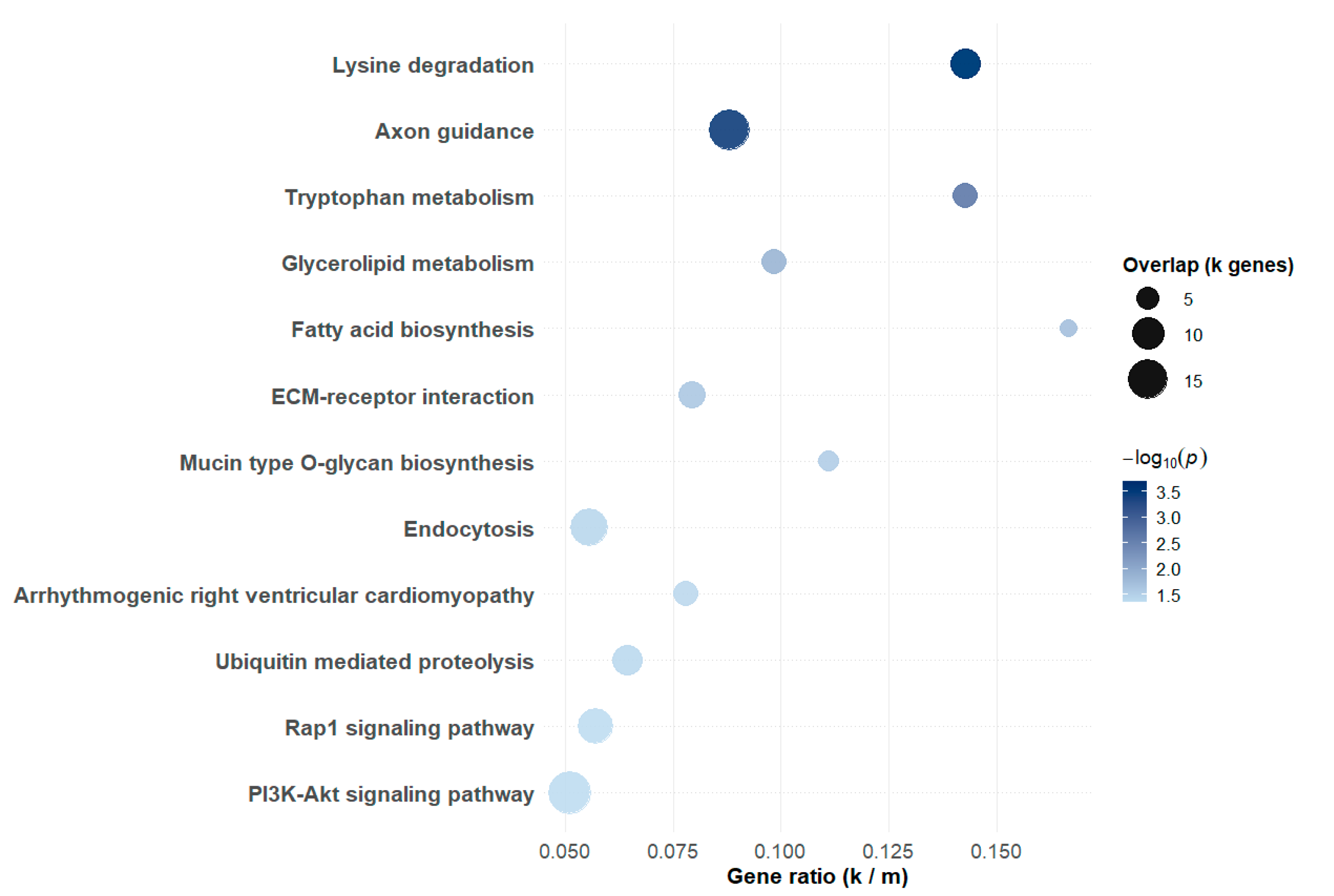
KEGG pathway enrichment was performed using the positional candidate genes, defined as those located within ±100 kb of genome-wide significant SNPs. This analysis highlighted several nominally enriched biological processes associated with CW. The most biologically relevant but not statistically significant after FDR correction pathways included lysine degradation (9 input genes, p = 2.05 × 10⁻⁴), axon guidance (16 input genes, p = 3.46 × 10⁻⁴), and tryptophan metabolism (6 input genes, p = 0.0024). Additional pathways included glycerolipid metabolism, fatty acid biosynthesis, ECM–receptor interaction, mucin-type O-glycan biosynthesis, endocytosis, arrhythmogenic right ventricular cardiomyopathy, ubiquitin-mediated proteolysis, Rap1 signaling, and PI3K–Akt signaling (Table S1). It should be noted that enrichment was calculated solely from the ±100 kb candidate gene set. KEGG outputs, however, list all annotated pathway members overlapping with the input.
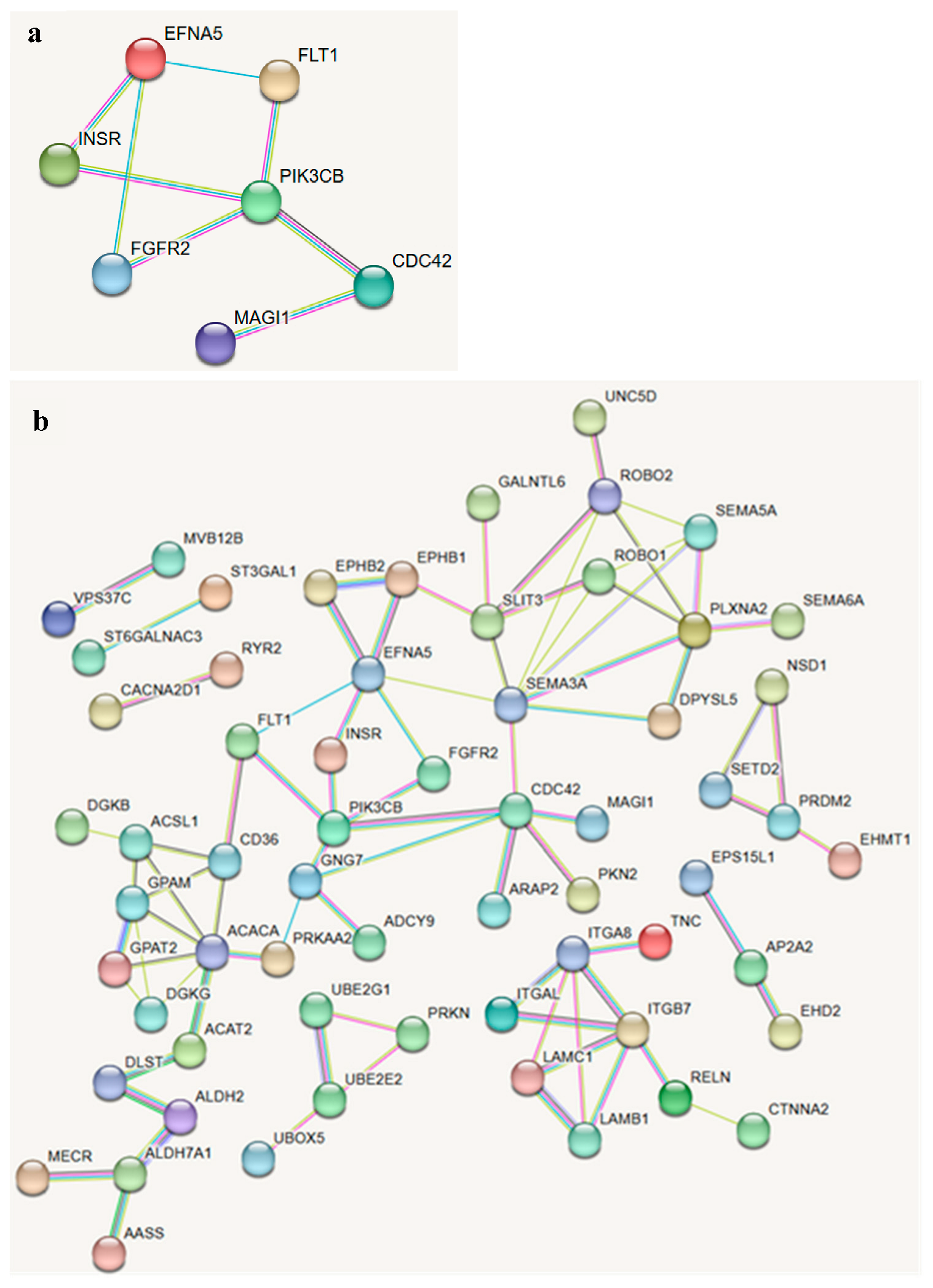
To provide an overview of these results, the top 12 enriched KEGG pathways are also summarized in a bubble plot, where gene ratio is shown on the x-axis, bubble size reflects the number of overlapping genes, and bubble color represents −log10(p) (Figure 3). This visualization complements Table S1 by highlighting the relative strength and contribution of each pathway. To explore gene–gene interactions within these pathways, STRING network analysis was performed using candidate genes identified from KEGG enrichment. In the Rap1 signaling pathway, a high-confidence network highlighted a compact cluster of interacting genes including PIK3CB, EFNA5, FLT1, INSR, FGFR2, CDC42, and MAGI1, with PIK3CB acting as a central hub (Figure 4a). When the interaction strength threshold was relaxed, a broader network including additional Rap1-related genes was observed, capturing more extensive interactions but with lower overall confidence.
A second STRING network constructed from all candidate genes across nominally enriched pathways revealed multiple interconnected modules (Figure 4b). Prominent clusters included: (i) a signaling module containing FGFR2, CDC42, PIK3CB, EFNA5, and FLT1; (ii) an extracellular matrix module including RELN, LAMC1, LAMB1, ITGA8, ITGB7, and TNC; and (iii) a metabolic module with ALDH2, ACAT2, MECR, ACSL1, DGKG, and GPAM. These clusters corresponded with KEGG pathways such as PI3KAkt signaling, Rap1 signaling, and ECM–receptor interaction.

4. Discussion

This study provides the first genome-wide association analysis of CW in Jeju Black-based cattle. Using the FarmCPU algorithm, we identified six significant loci across chromosomes BTA3, BTA5, BTA6, BTA10, and BTA13. These loci explained between 2.55% and 9.58% of the phenotypic variance, consistent with the highly polygenic nature of CW, where multiple small- to moderate-effect loci act in concert rather than a single major gene [12,36]. Similar results have been reported across beef cattle populations, where genome-wide reviews [37] and meta-analyses across multiple breeds [38] have emphasized the dispersed and multi-locus architecture of carcass and growth traits. Large-scale Hanwoo studies further confirm that CW exhibits moderate heritability and is influenced by multiple QTL across the genome [12]. Comparable findings in other beef populations, such as pasture-fed or Bos indicus-influenced breeds, also demonstrate that CW is shaped by multiple genomic regions rather than a dominant locus [39,40]. These results reinforce the polygenic nature of CW and underscore the value of crossbred populations for identifying additional loci that may not be captured in single-breed studies.
Large-scale GWASs in Hanwoo have consistently identified strong signals on BTA6 (NCAPG–LCORL region) and BTA14 (PLAG1 locus), including studies with over 7000–9000 animals [12,41]. These loci are widely recognized as the most influential QTL for growth and carcass traits in cattle [15,42]. Although our study was limited by a modest sample size (n = 255), the FarmCPU approach still detected a significant locus on BTA6 close to previously described regions, supporting the robustness of our findings [21]. In addition, we identified associations on BTA13 that align with reports of reproductive trait loci in Hanwoo [43], as well as signals on BTA5, which have not been widely reported in Hanwoo but are consistent with observations in other cattle breeds.
Among our positional candidates, KLF6 (BTA13) has direct evidence in cattle, polymorphisms associated with carcass and body measurements and functional roles in bovine myoblasts and preadipocytes. In contrast, SOX5 on BTA5 is a highly plausible skeletal-development gene: it belongs to the SRY-box (SOX) family and functions as an HMG-box transcription factor critically involved in chondrogenesis, acting cooperatively with SOX6 and SOX9 to activate cartilage matrix genes such as COL2A1 and ACAN, essential steps in chondrocyte differentiation [44,45]. These functions provide a plausible biological pathway linking SOX5 to variation in carcass growth. Structural variation in SOX5 has been associated with wither height in Ashidan yak; specifically, SOX5 CNVs were significantly linked to height at 18 months [46]. In Hanwoo, wither height itself exhibits moderate positive correlations with CW [47], suggesting that SOX5 may contribute to CW by influencing skeletal frame size and growth potential.
Another significant locus, ARS-BFGL-NGS-23974 on BTA13, was located near KLF6 (Kruppel-like factor 6). KLF6 is a member of the Sp1/KLF transcription factor family and is involved in regulating cell proliferation, apoptosis, differentiation, and adipogenesis [48]. In cattle, KLF6 has been identified within carcass-related QTL in Qinchuan [49] and more recently shown to promote bovine preadipocyte proliferation [50] linking this gene to tissue growth and fat deposition. Comparative sequence analyses confirm that KLF6 is highly conserved across taurine cattle, indicine breeds, and yak, with expression increasing in adipose, muscle, and visceral organs from calf to adult stages [49]. These observations support KLF6 as a plausible candidate gene influencing carcass growth in beef cattle. Although our GWAS identified SOX5 and KLF6 as biologically plausible candidate genes influencing carcass weight, their functional effects were not directly verified in this study. Future validation through gene expression or functional genomic analyses will be essential to confirm their causal roles and refine their utility as selection markers in Jeju Black-based cattle.
Other candidate genes identified in this study included EIF2B3, HECTD3, and PHACTR3. Although these genes have not been previously linked to carcass traits, their known roles in translation initiation (EIF2B3), ubiquitin-mediated proteolysis, and cytoskeleton regulation suggest potential biological roles in growth (e.g., EIF2B3 catalyzes GDP-to-GTP exchange on eIF2, a rate-limiting step in translation initiation) [51]. Moreover, two significant SNPs mapped to uncharacterized loci (ENSBTAG00000064392 and ENSBTAG00000064813). At present, their functions are not well characterized, but their genomic positions suggest they may represent novel regulatory elements influencing growth or metabolism. These loci highlight the need for further functional annotation of the bovine genome and suggest that undiscovered regulators of carcass traits may exist.
Functional enrichment analysis suggested biologically relevant pathways including PI3K–Akt signaling, Rap1 signaling, extracellular matrix–receptor interaction, and amino acid metabolism, although these pathways did not remain statistically significant after FDR correction. The identified pathway clusters are consistent with the systems-level organization of coexpressed gene modules observed in large-scale transcriptomic analyses across multiple tissues [52]. The PI3KAkt pathway is well established as a regulator of muscle hypertrophy, energy balance, and cell survival, and in bovine muscle satellite cells, IGF1 has been shown to activate PI3K–Akt–mTOR signaling to promote proliferation and differentiation [53]. Additional studies demonstrate that myostatin knockdown or FHL3 expression enhances bovine myogenic differentiation via PI3K–Akt signaling, underscoring its importance in muscle fiber growth and protein accretion [54,55]. These functions directly link PI3K–Akt activity to carcass yield and intramuscular fat deposition, traits that strongly influence beef quality and economic value [56]. In our dataset, several components of this pathway were highlighted, including PIK3CB, INSR, FGFR2, CDC42, and EFNA5. Similarly, enrichment of Rap1 signaling, involving FLT1 and CDC42, reflects its role in cytoskeletal organization and cell adhesion, processes critical for muscle development [57]. Beyond its structural role, Rap1 regulates integrin activation and actomyosin assembly, which contribute to muscle fiber integrity, postmortem tissue remodeling, and ultimately meat tenderness [58,59].
Extracellular matrix remodeling also emerged as an important process, with genes such as RELN, LAMC1, LAMB1, ITGA8, ITGB7, and TNC forming strong interaction clusters. ECM integrity and turnover have long been recognized as major factors influencing muscle structure and meat tenderness [60]. Enrichment of lysine and tryptophan metabolism is consistent with the established requirement of amino acid supply for protein accretion in skeletal muscle [61], and prior cattle metabolomics link lysine (including lysine-degradation intermediates) to feed efficiency and tryptophan to beef quality [62,63,64].
Together, these results highlight both known and novel biological processes underlying CW variation in cattle. The Jeju Black-based population provides a unique genetic background, combining the flavor and cultural value of Jeju Black cattle with the production traits of Hanwoo. The loci and pathways identified here may therefore serve as useful targets for genomic selection, particularly markers near SOX5 and KLF6, which have potential to improve CW while preserving breed-specific characteristics. Recent genomic selection efforts in Hanwoo using single-step marker effect and ssGBLUP models have demonstrated improved accuracy over conventional approaches for carcass traits, including carcass weight, eye muscle area, backfat, and marbling [65]. Similarly, the use of ssGBLUP in Hanwoo increased prediction accuracy for primal cut yields relative to pedigree-based BLUP [66].
Although the present study focused solely on carcass weight, this approach is consistent with the established progression of genomic research in beef cattle, where single-trait GWASs serve as foundational analyses to identify large-effect loci prior to integration into multi-trait genomic selection frameworks. Previous single-trait GWASs in Japanese Black and Hanwoo populations have successfully detected major QTL on BTA14 near the PLAG1–CHCHD7 region and on BTA6 encompassing NCAPG–LCORL, which remain among the most influential loci for carcass weight and growth traits [21,67,68,69]. More recently, Adhikari, Kantar [21] confirmed these genomic regions and discovered additional CW-associated genes (EIF5, LYPLA1, MRPL15) in pasture-finished cattle, demonstrating the robustness of single-trait analyses across diverse production systems. Collectively, these studies reinforce that focused single-trait GWASs remain crucial for identifying major candidate genes that form the basis for multi-trait genomic prediction and pleiotropy-aware selection models. Accordingly, the loci reported here provide a valuable genetic foundation for extending genomic selection in Jeju Black and Hanwoo crossbred populations to multi-trait frameworks encompassing other carcass and quality attributes.
Although this GWAS identified biologically plausible candidate genes related to skeletal growth, adipogenesis, and metabolic regulation, experimental validation of their effects was beyond the scope of this study. Future expression, transcriptomic, or genome-editing analyses are needed to confirm causality and assess potential pleiotropic influences on other carcass and meat-quality traits, thereby refining their value for genomic selection in beef cattle.
Nevertheless, this study had limitations. The modest sample size (n = 255) and the use of a 50K SNP array reduce statistical power and resolution, restricting the discovery of small-effect loci. This limitation primarily reflects the inherently small population size of Jeju Black cattle, a rare native breed raised exclusively on Jeju Island and maintained under limited conservation herd [25]. The animals analyzed here therefore represent nearly the entire available genotyped population, providing a valuable yet finite genomic resource for this breed. Although a limited cohort may increase the likelihood of inflated effect size estimates, the use of the FarmCPU algorithm effectively improved detection power and controlled false positives, while the low genomic inflation factors (λGC = 1.02 for MLM and 1.04 for FarmCPU) indicate minimal stratification bias. Despite the small population size, several significant loci detected in this study overlap with genomic regions previously reported in larger Hanwoo and Japanese Black populations [67,68,69], reinforcing the biological credibility of our findings. Although FarmCPU improved power compared with standard MLM, replication in larger populations and use of higher-density SNP panels or whole-genome sequencing are necessary to refine QTL intervals and identify causal variants [19,70]. Functional validation of genes such as SOX5 and KLF6 through gene expression, transcriptomics, or genome editing would strengthen causal inference. Another limitation is that we focused only on carcass weight, whereas additional carcass and meat quality phenotypes (e.g., ribeye area, marbling score, backfat thickness) would provide a more comprehensive view of the genetic architecture of beef production. Future research should extend beyond CW to include traits such as ribeye area, marbling score, and backfat thickness, which substantially influence beef market value by affecting yield grade, meat quality, and consumer preferences [39,71].
Moreover, future validation of the candidate genes, including SOX5, KLF6, EIF2B3, and PHACTR3, in larger populations and across breeds using targeted genotyping assays (e.g., KASP or custom SNP panels), gene expression analyses (e.g., RT-qPCR or RNA-seq), or functional studies (e.g., genome editing in bovine cells) would be valuable to confirm their causal roles and assess their utility for genomic selection programs.

5. Conclusions

This study provides the first genome-wide association analysis of carcass weight in Jeju Black-based cattle. Using the FarmCPU algorithm, we identified six significant loci across five chromosomes explaining 2.55–9.58% of the phenotypic variance. Candidate genes highlighted included SOX5, KLF6, PHACTR3, EIF2B3, HECTD3, and two uncharacterized loci. Functional enrichment analysis revealed pathways related to PI3K–Akt signaling, Rap1 signaling, extracellular matrix–receptor interactions, and amino acid metabolism, emphasizing the complex, polygenic nature of carcass weight regulation. These findings not only expand the current understanding of carcass weight genetics but also hold practical significance for beef cattle breeding in Korea. The identified loci and candidate genes provide valuable genomic resources for marker-assisted and genomic selection strategies aimed at improving carcass yield and growth efficiency. In particular, variants near SOX5 and KLF6 could serve as promising targets for enhancing genomic estimated breeding values (GEBVs) within national Hanwoo and Jeju Black cattle improvement programs. Moreover, these results contribute to the establishment of a genomic foundation for sustainable breeding and conservation of the Jeju Black cattle population, a unique indigenous genetic resource in Korea.

Supplementary Materials

The following supporting information can be downloaded at https://www.mdpi.com/article/10.3390/biology14121699/s1, Table S1. KEGG pathways nominally enriched among positional candidate genes (±100 kb from significant SNPs) associated with carcass weight in Jeju Black-based cattle. Pathways were identified using the Enrichr database. “Genes” column lists overlapping candidate genes present in each pathway, as annotated in KEGG. P-values were adjusted using the Benjamini–Hochberg method. Figure S1. Sample-flow diagram of animals and SNPs used in the study. A total of 256 cattle (92 Jeju Black and 164 Jeju Black × Hanwoo crossbreds) were initially sampled. One crossbred failed genotyping due to a low call rate, leaving 255 animals (92 Jeju Black and 163 crossbreds) that passed individual-level QC. After SNP filtering based on minor allele frequency (MAF < 0.05), Hardy–Weinberg equilibrium (HWE p < 1 × 10⁻⁶), and call rate (<90%), 39,055 high-quality SNPs were retained for GWAS analyses using MLM and FarmCPU models. Figure S2. Three-dimensional PCA plots (PC1–PC3) of Jeju Black (Heukwoo) and Jeju Black × Hanwoo crossbred (Heukhanu) cattle. The two groups show highly overlapping genetic structure without clear separation, supporting their treatment as a single Jeju Black–based population in downstream analyses.

Author Contributions

Conceptualization, B.S. and M.W.; methodology, J.L., S.-M.S., E.-T.K., H.-B.P., T.-H.K. and S.-E.L.; software, J.L.; validation, S.-E.L., W.-J.K. and E.-T.K.; formal analysis, B.S. and J.L.; investigation, S.-E.L., M.W., H.-B.P., T.-H.K., E.-T.K. and S.-M.S.; resources, H.-B.P. and T.-H.K.; data curation, J.L. and W.-J.K.; writing—original draft preparation, B.S.; writing—review and editing, all authors; visualization, B.S.; supervision, B.S.; project administration, B.S.; funding acquisition, M.W. All authors have read and agreed to the published version of the manuscript.

Funding

This research was funded by the Rural Development Administration (RDA), Republic of Korea (Project No. PJ01568501). The APC was funded by the Rural Development Administration Fellowship Program (2025 RDA Fellowship Program of the National Institute of Animal Science; Project Nos. PJ01759701 and PJ01568501).

Institutional Review Board Statement

The animal study protocol was approved by the Institutional Animal Care and Use Committee of the National Institute of Animal Science, Rural Development Administration, Republic of Korea (protocol code NIAS2023-2692).

Informed Consent Statement

Not applicable.

Data Availability Statement

The data supporting the results of this study are available on request from the corresponding author. Genotype data are not publicly available due to privacy restrictions from the Rural Development Administration.

Acknowledgments

This work was supported by the Rural Development Administration (Project No. PJ01568501, Characterizing the Breeding Potential and Developing Utilization Strategies for Jeju Black Cattle) and by the 2025 RDA Fellowship Program of the National Institute of Animal Science, Rural Development Administration, Republic of Korea (Project Nos. PJ01759701 and PJ01568501). The authors acknowledge the financial support with gratitude.

Conflicts of Interest

The authors declare no conflicts of interest. The funders had no role in the design of the study; in the collection, analyses, or interpretation of data; in the writing of the manuscript; or in the decision to publish the results.

References

  1. Kwon, K.-M.; Nogoy, K.M.C.; Jeon, H.-E.; Han, S.-J.; Woo, H.-C.; Heo, S.-M.; Hong, H.K.; Lee, J.-I.; Lee, D.H.; Choi, S.H. Market weight, slaughter age, and yield grade to determine economic carcass traits and primal cuts yield of Hanwoo beef. J. Anim. Sci. Technol. 2022, 64, 143. [Google Scholar] [CrossRef] [PubMed]
  2. Choy, Y.-H.; Choi, S.-B.; Jeon, G.-J.; Kim, H.-C.; Chung, H.-J.; Lee, J.-M.; Park, B.-Y.; Lee, S.-H. Prediction of retail beef yield using parameters based on Korean beef carcass grading standards. Food Sci. Anim. Resour. 2010, 30, 905–909. [Google Scholar] [CrossRef]
  3. Lee, S.; Cho, S.; Park, B. Effects of calving season on the growth performance and carcass characteristics of Hanwoo steers. Acta Agric. Scand. Sect. A—Anim. Sci. 2023, 72, 81–87. [Google Scholar] [CrossRef]
  4. Mehrban, H.; Naserkheil, M.; Lee, D.H.; Ibáñez-Escriche, N. Genetic parameters and correlations of related feed efficiency, growth, and carcass traits in Hanwoo beef cattle. Anim. Biosci. 2020, 34, 824. [Google Scholar] [CrossRef]
  5. Mehrban, H.; Lee, D.H.; Moradi, M.H.; IlCho, C.; Naserkheil, M.; Ibáñez-Escriche, N. Predictive performance of genomic selection methods for carcass traits in Hanwoo beef cattle: Impacts of the genetic architecture. Genet. Sel. Evol. 2017, 49, 1. [Google Scholar] [CrossRef]
  6. Haque, M.A.; Iqbal, A.; Alam, M.Z.; Lee, Y.-M.; Ha, J.-J.; Kim, J.-J. Estimation of genetic correlations and genomic prediction accuracy for reproductive and carcass traits in Hanwoo cows. J. Anim. Sci. Technol. 2024, 66, 682. [Google Scholar] [CrossRef]
  7. Kim, C.; Ko, K.; Kang, M.; Ryu, Y. Comparison of beef quality traits in Jeju black cattle, Hanwoo and Australian Wagyu. In Proceedings of the 58th International Congress of Meat Science and Technology-ICoMST 2012, Montreal, QC, Canada, 12–17 August 2012. [Google Scholar]
  8. Haque, M.A.; Jang, E.-B.; Park, S.; Lee, Y.-M.; Kim, J.-J. Genomic prediction of genotyped and non-genotyped Jeju black cattle using single-and multi-trait methods for carcass traits. Ital. J. Anim. Sci. 2024, 23, 1854–1868. [Google Scholar] [CrossRef]
  9. Lee, W.; Oh, W.; Lee, S.; Khan, M.; Ko, M.; Kim, H.; Ha, J.K. Growth performance and carcass evaluation of Jeju native cattle and its crossbreds fed for long fattening period. Asian-Australas. J. Anim. Sci. 2007, 20, 1909–1916. [Google Scholar] [CrossRef]
  10. Lee, S.-H.; Kim, C.-N.; Ko, K.-B.; Park, S.-P.; Kim, H.-K.; Kim, J.-M.; Ryu, Y.-C. Comparisons of beef fatty acid and amino acid characteristics between Jeju black cattle, Hanwoo, and Wagyu breeds. Food Sci. Anim. Resour. 2019, 39, 402. [Google Scholar] [CrossRef]
  11. Hoa, V.-B.; Kim, D.-G.; Song, D.-H.; Ko, J.-H.; Kim, H.-W.; Bae, I.-S.; Kim, Y.-S.; Cho, S.-H. Quality properties and flavor-related components of beef longissimus lumborum muscle from four Korean native cattle breeds. Food Sci. Anim. Resour. 2024, 44, 832. [Google Scholar] [CrossRef]
  12. Alam, M.Z.; Haque, M.A.; Iqbal, A.; Lee, Y.-M.; Ha, J.-J.; Jin, S.; Park, B.; Kim, N.-Y.; Won, J.I.; Kim, J.-J. Genome-wide association study to identify QTL for carcass traits in Korean Hanwoo cattle. Animals 2023, 13, 2737. [Google Scholar] [CrossRef]
  13. Oh, J.D.; Lee, G.H.; Kong, H.S. Estimation of heritability and genetic parameters for carcass traits and primal cut production traits in Hanwoo. J. Anim. Reprod. Biotechnol. 2024, 39, 114–120. [Google Scholar] [CrossRef]
  14. Rodrigues, F.M.; Majeres, L.E.; Dilger, A.C.; McCann, J.C.; Cassady, C.J.; Shike, D.W.; Beever, J.E. Characterizing differences in the muscle transcriptome between cattle with alternative LCORL-NCAPG haplotypes. BMC Genom. 2025, 26, 479. [Google Scholar] [CrossRef]
  15. Majeres, L.E.; Dilger, A.C.; Shike, D.W.; McCann, J.C.; Beever, J.E. Defining a haplotype encompassing the LCORL-NCAPG locus associated with increased lean growth in beef cattle. Genes 2024, 15, 576. [Google Scholar] [CrossRef]
  16. Ardicli, S.; Dincel, D.; Samli, H.; Balci, F. Effects of polymorphisms at LEP, CAST, CAPN1, GHR, FABP4 and DGAT1 genes on fattening performance and carcass traits in Simmental bulls. Arch. Anim. Breed. 2017, 60, 61–70. [Google Scholar] [CrossRef]
  17. Moravčíková, N.; Kasarda, R.; Vostrý, L.; Krupová, Z.; Krupa, E.; Lehocká, K.; Olšanská, B.; Trakovická, A.; Nádaský, R.; Židek, R. Analysis of selection signatures in the beef cattle genome. Czech J. Anim. Sci 2019, 64, 491–503. [Google Scholar] [CrossRef]
  18. Jang, M.-J.; Lee, S.-H.; Kim, J.-M. Genome-Wide Association Studies: A Powerful Approach for Identifying Genomic Variants for Livestock Breeding and Disease Management. In Bioinformatics in Veterinary Science: Vetinformatics; Springer: Berlin/Heidelberg, Germany, 2025; pp. 87–117. [Google Scholar]
  19. Liu, X.; Huang, M.; Fan, B.; Buckler, E.S.; Zhang, Z. Iterative usage of fixed and random effect models for powerful and efficient genome-wide association studies. PLoS Genet. 2016, 12, e1005767. [Google Scholar] [CrossRef]
  20. Kusmec, A.; Schnable, P.S. Farm CPU pp: Efficient large-scale genomewide association studies. Plant Direct 2018, 2, e00053. [Google Scholar] [CrossRef]
  21. Adhikari, M.; Kantar, M.B.; Longman, R.J.; Lee, C.; Oshiro, M.; Caires, K.; He, Y. Genome-wide association study for carcass weight in pasture-finished beef cattle in Hawai’i. Front. Genet. 2023, 14, 1168150. [Google Scholar] [CrossRef] [PubMed]
  22. Naserkheil, M.; Mehrban, H.; Lee, D.; Park, M.N. Genome-wide association study for carcass primal cut yields using single-step Bayesian approach in Hanwoo cattle. Front. Genet. 2021, 12, 752424. [Google Scholar] [CrossRef]
  23. Srikanth, K.; Lee, S.-H.; Chung, K.-Y.; Park, J.-E.; Jang, G.-W.; Park, M.-R.; Kim, N.Y.; Kim, T.-H.; Chai, H.-H.; Park, W.C. A gene-set enrichment and protein–protein interaction network-based GWAS with regulatory SNPs identifies candidate genes and pathways associated with carcass traits in hanwoo cattle. Genes 2020, 11, 316. [Google Scholar] [CrossRef]
  24. Shokrollahi, B.; Lee, H.-J.; Baek, Y.C.; Jin, S.; Jang, G.-S.; Moon, S.J.; Um, K.-H.; Jang, S.S.; Park, M.S. Transcriptomic analysis of Newborn Hanwoo calves: Effects of maternal overnutrition during mid-to late pregnancy on Subcutaneous Adipose tissue and liver. Genes 2024, 15, 704. [Google Scholar] [CrossRef]
  25. Alam, M.Z.; Lee, Y.-M.; Son, H.-J.; Hanna, L.H.; Riley, D.G.; Mannen, H.; Sasazaki, S.; Park, S.P.; Kim, J.-J. Genetic characteristics of Korean Jeju Black cattle with high density single nucleotide polymorphisms. Anim. Biosci. 2020, 34, 789. [Google Scholar] [CrossRef] [PubMed]
  26. Haque, M.A.; Iqbal, A.; Bae, H.; Lee, S.E.; Park, S.; Lee, Y.M.; Kim, J.J. Assessment of genomic breeding values and their accuracies for carcass traits in Jeju Black cattle using whole-genome SNP chip panels. J. Anim. Breed. Genet. 2023, 140, 519–531. [Google Scholar] [CrossRef]
  27. Miller, S.A.; Dykes, D.D.; Polesky, H. A simple salting out procedure for extracting DNA from human nucleated cells. Nucleic Acids Res. 1988, 16, 1215. [Google Scholar] [CrossRef]
  28. Purcell, S.; Neale, B.; Todd-Brown, K.; Thomas, L.; Ferreira, M.A.; Bender, D.; Maller, J.; Sklar, P.; De Bakker, P.I.; Daly, M.J. PLINK: A tool set for whole-genome association and population-based linkage analyses. Am. J. Hum. Genet. 2007, 81, 559–575. [Google Scholar] [CrossRef]
  29. Rosen, B.; Bickhart, D.; Schnabel, R.; Koren, S.; Elsik, C.; Zimin, A.; Dreischer, C.; Schultheiss, S.; Hall, R.; Schroeder, S. Modernizing the bovine reference genome assembly. In Proceedings of the 11th World Congress on Genetics Applied to Livestock Production: Food and Agriculture Organization of the United Nations Rome, Italy, Auckland, New Zealand, 11–16 February 2018; pp. 11–16. [Google Scholar]
  30. Zweifach, A. Bonferroni’s method, not Tukey’s, should be used to control the total number of false positives when making multiple pairwise comparisons in experiments with few replicates. SLAS Discov. 2025, 35, 100253. [Google Scholar] [CrossRef] [PubMed]
  31. Durinck, S.; Spellman, P.T.; Birney, E.; Huber, W. Mapping identifiers for the integration of genomic datasets with the R/Bioconductor package biomaRt. Nat. Protoc. 2009, 4, 1184–1191. [Google Scholar] [CrossRef]
  32. Durinck, S.; Moreau, Y.; Kasprzyk, A.; Davis, S.; De Moor, B.; Brazma, A.; Huber, W. BioMart and Bioconductor: A powerful link between biological databases and microarray data analysis. Bioinformatics 2005, 21, 3439–3440. [Google Scholar] [CrossRef]
  33. Kuleshov, M.V.; Jones, M.R.; Rouillard, A.D.; Fernandez, N.F.; Duan, Q.; Wang, Z.; Koplev, S.; Jenkins, S.L.; Jagodnik, K.M.; Lachmann, A. Enrichr: A comprehensive gene set enrichment analysis web server 2016 update. Nucleic Acids Res. 2016, 44, W90–W97. [Google Scholar] [CrossRef] [PubMed]
  34. Szklarczyk, D.; Gable, A.L.; Nastou, K.C.; Lyon, D.; Kirsch, R.; Pyysalo, S.; Doncheva, N.T.; Legeay, M.; Fang, T.; Bork, P. The STRING database in 2021: Customizable protein–protein networks, and functional characterization of user-uploaded gene/measurement sets. Nucleic Acids Res. 2021, 49, D605–D612. [Google Scholar] [CrossRef]
  35. Oh, W.; Lee, W.-S.; Lee, S.; Khan, M.; Ko, M.; Yang, S.; Kim, H.; Ha, J.K. Feed consumption, body weight gain and carcass characteristics of Jeju Native Cattle and its crossbreds fed for short fattening period. Asian-Australas. J. Anim. Sci. 2008, 21, 1745–1752. [Google Scholar] [CrossRef]
  36. Lee, J.G.; Lee, S.S.; Cho, K.H.; Cho, C.; Choy, Y.H.; Choi, J.G.; Park, B.; Na, C.S.; Choi, T. Correlation analyses on body size traits, carcass traits and primal cuts in Hanwoo steers. J. Anim. Sci. Technol. 2013, 55, 351–358. [Google Scholar] [CrossRef][Green Version]
  37. Van Eenennaam, A.L.; Weigel, K.A.; Young, A.E.; Cleveland, M.A.; Dekkers, J.C. Applied animal genomics: Results from the field. Annu. Rev. Anim. Biosci. 2014, 2, 105–139. [Google Scholar] [CrossRef] [PubMed]
  38. Bolormaa, S.; Pryce, J.E.; Reverter, A.; Zhang, Y.; Barendse, W.; Kemper, K.; Tier, B.; Savin, K.; Hayes, B.J.; Goddard, M.E. A multi-trait, meta-analysis for detecting pleiotropic polymorphisms for stature, fatness and reproduction in beef cattle. PLoS Genet. 2014, 10, e1004198. [Google Scholar] [CrossRef]
  39. Baneh, H.; Elatkin, N.; Gentzbittel, L. Genome-wide association studies and genetic architecture of carcass traits in Angus beef cattle using imputed whole-genome sequences data. Genet. Sel. Evol. 2025, 57, 26. [Google Scholar] [CrossRef]
  40. Arikawa, L.M.; Mota, L.F.M.; Schmidt, P.I.; Frezarim, G.B.; Fonseca, L.F.S.; Magalhães, A.F.B.; Silva, D.A.; Carvalheiro, R.; Chardulo, L.A.L.; de Albuquerque, L.G. Genome-wide scans identify biological and metabolic pathways regulating carcass and meat quality traits in beef cattle. Meat Sci. 2024, 209, 109402. [Google Scholar] [CrossRef]
  41. Bhuiyan, M.S.; Lim, D.; Park, M.; Lee, S.; Kim, Y.; Gondro, C.; Park, B.; Lee, S. Functional partitioning of genomic variance and genome-wide association study for carcass traits in Korean Hanwoo cattle using imputed sequence level SNP data. Front. Genet. 2018, 9, 217. [Google Scholar] [CrossRef]
  42. Takasuga, A. PLAG1 and NCAPG-LCORL in livestock. Anim. Sci. J. 2016, 87, 159–167. [Google Scholar] [CrossRef]
  43. Haque, M.A.; Lee, Y.-M.; Ha, J.-J.; Jin, S.; Park, B.; Kim, N.-Y.; Won, J.-I.; Kim, J.-J. Genome-wide association study identifies genomic regions associated with key reproductive traits in Korean Hanwoo cows. BMC Genom. 2024, 25, 496. [Google Scholar] [CrossRef]
  44. Smits, P.; Li, P.; Mandel, J.; Zhang, Z.; Deng, J.M.; Behringer, R.R.; De Crombrugghe, B.; Lefebvre, V. The transcription factors L-Sox5 and Sox6 are essential for cartilage formation. Dev. Cell 2001, 1, 277–290. [Google Scholar] [CrossRef] [PubMed]
  45. Liu, C.-F.; Lefebvre, V. The transcription factors SOX9 and SOX5/SOX6 cooperate genome-wide through super-enhancers to drive chondrogenesis. Nucleic Acids Res. 2015, 43, 8183–8203. [Google Scholar] [CrossRef]
  46. Zhang, Z.; Chu, M.; Bao, Q.; Bao, P.; Guo, X.; Liang, C.; Yan, P. Two different copy number variations of the SOX5 and SOX8 genes in yak and their association with growth traits. Animals 2022, 12, 1587. [Google Scholar] [CrossRef]
  47. Koo, Y.M.; Kim, J.I.; Song, C.E.; Shin, J.Y.; Lee, J.-Y.; Lee, J.-H.; Cho, B.-D.; Kim, B.-W.; Lee, J.-G. A study on genetic parameters of carcass weight and body type measurements in Hanwoo Steer. J. Anim. Sci. Technol. 2008, 50, 157–166. [Google Scholar] [CrossRef][Green Version]
  48. Iqbal, A.; Yu, H.; Jiang, P.; Zhao, Z. Deciphering the key regulatory roles of KLF6 and bta-miR-148a on milk fat metabolism in bovine mammary epithelial cells. Genes 2022, 13, 1828. [Google Scholar] [CrossRef] [PubMed]
  49. Raza, S.H.A.; Khan, R.; Schreurs, N.M.; Guo, H.; Gui, L.-s.; Mei, C.; Zan, L. Expression of the bovine KLF6 gene polymorphisms and their association with carcass and body measures in Qinchuan cattle (Bos taurus). Genomics 2020, 112, 423–431. [Google Scholar] [CrossRef] [PubMed]
  50. Abbas Raza, S.H.; Zhong, R.; Wei, X.; Zhao, G.; Zan, L.; Pant, S.D.; Schreurs, N.M.; Lei, H. Investigating the role of KLF6 in the growth of bovine preadipocytes: Using transcriptomic analyses to understand beef quality. J. Agric. Food Chem. 2024, 72, 9656–9668. [Google Scholar] [CrossRef]
  51. Jennings, M.D.; Pavitt, G.D. A new function and complexity for protein translation initiation factor eIF2B. Cell Cycle 2014, 13, 2660–2665. [Google Scholar] [CrossRef]
  52. He, B.; Xu, J.; Tian, Y.; Liao, B.; Lang, J.; Lin, H.; Mo, X.; Lu, Q.; Tian, G.; Bing, P. Gene coexpression network and module analysis across 52 human tissues. BioMed Res. Int. 2020, 2020, 6782046. [Google Scholar] [CrossRef]
  53. Li, X.; Cao, Y.; Liu, Y.; Fang, W.; Xiao, C.; Cao, Y.; Zhao, Y. Effect of IGF1 on Myogenic Proliferation and Differentiation of Bovine Skeletal Muscle Satellite Cells Through PI3K/AKT Signaling Pathway. Genes 2024, 15, 1494. [Google Scholar] [CrossRef]
  54. Sheng, H.; Guo, Y.; Zhang, L.; Zhang, J.; Miao, M.; Tan, H.; Hu, D.; Li, X.; Ding, X.; Li, G. Proteomic studies on the mechanism of myostatin regulating cattle skeletal muscle development. Front. Genet. 2021, 12, 752129. [Google Scholar] [CrossRef]
  55. Zhou, X.; Ding, Y.; Yang, C.; Li, C.; Su, Z.; Xu, J.; Qu, C.; Shi, Y.; Kang, X. FHL3 gene regulates bovine skeletal muscle cell growth through the PI3K/Akt/mTOR signaling pathway. Comp. Biochem. Physiol. Part D Genom. Proteom. 2024, 52, 101356. [Google Scholar] [CrossRef]
  56. Egerman, M.A.; Glass, D.J. Signaling pathways controlling skeletal muscle mass. Crit. Rev. Biochem. Mol. Biol. 2014, 49, 59–68. [Google Scholar] [CrossRef]
  57. Yang, G.; Dai, R.; Ma, X.; Huang, C.; Ma, X.; Li, X.; La, Y.; Dingkao, R.; Renqing, J.; Guo, X. Proteomic analysis reveals the effects of different dietary protein levels on growth and development of Jersey-Yak. Animals 2024, 14, 406. [Google Scholar] [CrossRef]
  58. Nejad, F.M.; Mohammadabadi, M.; Roudbari, Z.; Gorji, A.E.; Sadkowski, T. Network visualization of genes involved in skeletal muscle myogenesis in livestock animals. BMC Genom. 2024, 25, 294. [Google Scholar] [CrossRef]
  59. Rothenberg, K.E.; Chen, Y.; McDonald, J.A.; Fernandez-Gonzalez, R. Rap1 coordinates cell-cell adhesion and cytoskeletal reorganization to drive collective cell migration in vivo. Curr. Biol. 2023, 33, 2587–2601.e5. [Google Scholar] [CrossRef]
  60. Nishimura, T. Role of extracellular matrix in development of skeletal muscle and postmortem aging of meat. Meat Sci. 2015, 109, 48–55. [Google Scholar] [CrossRef]
  61. Thornton, K.J. Triennial growth symposium: The nutrition of muscle growth: Impacts of nutrition on the proliferation and differentiation of satellite cells in livestock species. J. Anim. Sci. 2019, 97, 2258–2269. [Google Scholar] [CrossRef] [PubMed]
  62. Li, J.; Mukiibi, R.; Wang, Y.; Plastow, G.S.; Li, C. Identification of candidate genes and enriched biological functions for feed efficiency traits by integrating plasma metabolites and imputed whole genome sequence variants in beef cattle. BMC Genom. 2021, 22, 823. [Google Scholar] [CrossRef] [PubMed]
  63. Cantalapiedra-Hijar, G.; Nedelkov, K.; Crosson, P.; McGee, M. Some plasma biomarkers of residual feed intake in beef cattle remain consistent regardless of intake level. Sci. Rep. 2024, 14, 8540. [Google Scholar] [CrossRef] [PubMed]
  64. Jeong, J.Y.; Kim, M.; Ji, S.-Y.; Baek, Y.-C.; Lee, S.; Oh, Y.K.; Reddy, K.E.; Seo, H.-W.; Cho, S.; Lee, H.-J. Metabolomics analysis of the beef samples with different meat qualities and tastes. Food Sci. Anim. Resour. 2020, 40, 924. [Google Scholar] [CrossRef]
  65. Koo, Y.; Alkhoder, H.; Choi, T.-J.; Liu, Z.; Reents, R. Genomic evaluation of carcass traits of Korean beef cattle Hanwoo using a single-step marker effect model. J. Anim. Sci. 2023, 101, skad104. [Google Scholar] [CrossRef] [PubMed]
  66. Naserkheil, M.; Mehrban, H.; Lee, D.; Park, M.N. Evaluation of genome-enabled prediction for carcass primal cut yields using single-step genomic best linear unbiased prediction in Hanwoo cattle. Genes 2021, 12, 1886. [Google Scholar] [CrossRef]
  67. Nishimura, S.; Watanabe, T.; Mizoshita, K.; Tatsuda, K.; Fujita, T.; Watanabe, N.; Sugimoto, Y.; Takasuga, A. Genome-wide association study identified three major QTL for carcass weight including the PLAG1-CHCHD7 QTN for stature in Japanese Black cattle. BMC Genet. 2012, 13, 40. [Google Scholar] [CrossRef]
  68. Lee, S.H.; Choi, B.H.; Lim, D.; Gondro, C.; Cho, Y.M.; Dang, C.G.; Sharma, A.; Jang, G.W.; Lee, K.T.; Yoon, D. Genome-wide association study identifies major loci for carcass weight on BTA14 in Hanwoo (Korean cattle). PLoS ONE 2013, 8, e74677. [Google Scholar] [CrossRef]
  69. Edea, Z.; Jeoung, Y.H.; Shin, S.-S.; Ku, J.; Seo, S.; Kim, I.-H.; Kim, S.-W.; Kim, K.-S. Genome–wide association study of carcass weight in commercial Hanwoo cattle. Asian-Australas. J. Anim. Sci. 2017, 31, 327. [Google Scholar] [CrossRef] [PubMed]
  70. Ibtisham, F.; Zhang, L.; Xiao, M.; An, L.; Ramzan, M.B.; Nawab, A.; Zhao, Y.; Li, G.; Xu, Y. Genomic selection and its application in animal breeding. Thai J. Vet. Med. 2017, 47, 301–310. [Google Scholar] [CrossRef]
  71. Silva-Vignato, B.; Cesar, A.S.M.; Afonso, J.; Moreira, G.C.M.; Poleti, M.D.; Petrini, J.; Garcia, I.S.; Clemente, L.G.; Mourão, G.B.; Regitano, L.C.d.A. Integrative analysis between genome-wide association study and expression quantitative trait loci reveals bovine muscle gene expression regulatory polymorphisms associated with intramuscular fat and backfat thickness. Front. Genet. 2022, 13, 935238. [Google Scholar] [CrossRef] [PubMed]
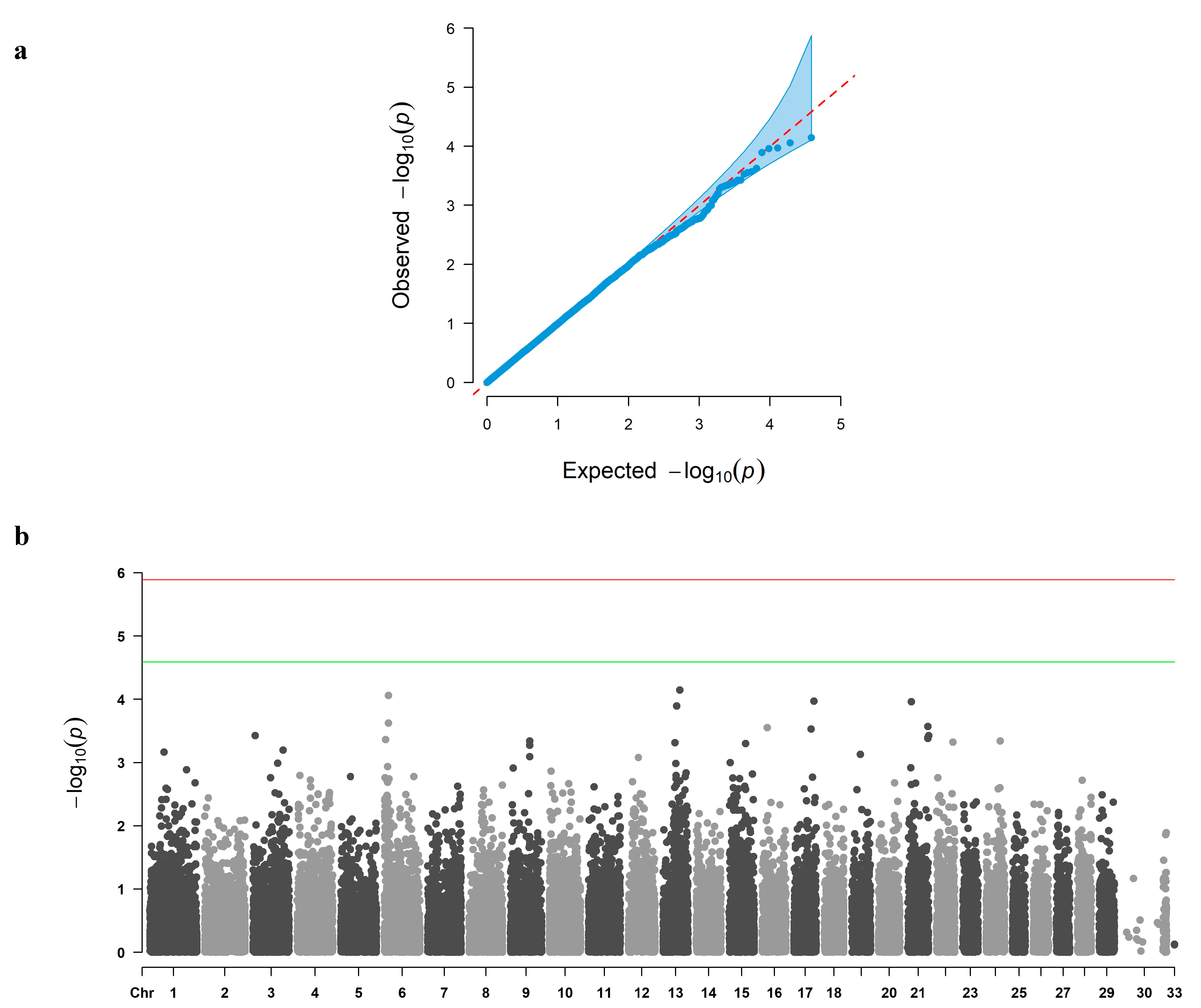
Figure 1. Quantile–quantile (a) and Manhattan (b) plots of the MLM (mixed linear model) analysis for carcass weight in Jeju Black-based cattle. Chromosomes are BTA 1–29 and X (ARS-UCD1.3); variants mapped to unplaced scaffolds are grouped under “33 (Un)” for plotting convenience. The red line indicates the Bonferroni genome-wide threshold (−log10(0.05/39,055) = 5.89), and the green line indicates the Bonferroni suggestive threshold (−log10(1/39,055) = 4.59). SNPs above the red line are considered genome-wide significant, while SNPs between the red and green lines are suggestively significant. The genomic inflation factor for MLM was λGC = 1.02.
Biology 14 01699 g001
Figure 2. Quantile–quantile (a) and Manhattan (b) plots of the FarmCPU (fixed and random model circulation probability unification) analysis for carcass weight in Jeju Black-based cattle. Chromosomes are BTA 1–29 and X (ARS-UCD1.3); variants on unplaced scaffolds are shown as “33 (Un)”. The red and green lines indicate the Bonferroni genome-wide (5.89) and suggestive (4.59) thresholds, respectively. SNPs above the red line are considered genome-wide significant, while SNPs between the red and green lines are suggestively significant. The genomic inflation factor for FarmCPU was λGC = 1.04.
Biology 14 01699 g002
Figure 3. KEGG pathway enrichment bubble plot of positional candidate genes associated with carcass weight in Jeju Black-based cattle. Pathways were ranked by raw p-value, and the top 12 are shown. The x-axis indicates the gene ratio (number of candidate genes in the pathway divided by total genes in the pathway). The size of each bubble represents the number of overlapping genes (k), and the color intensity corresponds to the statistical significance (−log10 p).
Biology 14 01699 g003
Figure 4. STRING protein–protein interaction (PPI) networks of candidate genes associated with carcass weight in Jeju Black-based cattle. (a) High-confidence PPI network (interaction score ≥0.7) of genes from the Rap1 signaling pathway, showing a compact cluster of seven nodes (PIK3CB, EFNA5, FLT1, INSR, FGFR2, CDC42, MAGI1). PIK3CB acted as the central hub linking receptor tyrosine kinases and downstream regulators. (b) Broader PPI network (interaction score ≥0.4) including all positional candidate genes from enriched KEGG pathways. The network revealed distinct modules, including a signaling cluster (FGFR2, CDC42, PIK3CB, EFNA5, FLT1), an extracellular matrix cluster (RELN, LAMC1, LAMB1, ITGA8, ITGB7, TNC), and a metabolic cluster (ALDH2, ACAT2, MECR, ACSL1, DGKG, GPAM). The colors in the network represent different biological modules, with each module assigned a distinct color for visual clarity.
Biology 14 01699 g004
Table 2. Summary of SNP quality control.
QC StageNumber of SNPs
Before QC (GenomeStudio FinalReport)53,866
After QC (final GWAS dataset)39,055
Table 3. Significant SNPs associated with carcass weight in Jeju Black-based cattle identified by FarmCPU genome-wide association analysis.
CHRSNP IDPOSREFALTEffectSEp-Value%VarPositional Candidate Gene
13ARS-BFGL-NGS-2106556,698,060GA25.09623.3171.06 × 10−149.58PHACTR3
6ARS-BFGL-NGS-11608514,038,382AC10.39343.8271.22 × 10−074.54ENSBTAG00000064813
10ARS-BFGL-BAC-1418264,224,480AC–18.88344.2462.17 × 10−064.02ENSBTAG00000064392
3Hapmap51970-BTA-100380101,076,596AG22.40005.9183.46 × 10−062.55EIF2B3, HECTD3
5BTA-74501-no-rs86,142,655GA–13.04633.5375.81 × 10−062.86SOX5
13ARS-BFGL-NGS-2397444,467,210CA14.40273.6136.05 × 10−063.30KLF6
CHR = chromosome number; SNP ID = single nucleotide polymorphism identifier; Position (bp) = physical location on the ARS-UCD1.3 bovine reference genome; REF = reference allele; ALT = alternative allele; Additive effect = estimated effect of the ALT allele on carcass weight (kg); SE = standard error of the additive effect; %Var = percentage of phenotypic variance explained by the SNP; candidate genes were assigned based on the nearest annotated gene within ±100 kb of the significant SNP.
Disclaimer/Publisher’s Note: The statements, opinions and data contained in all publications are solely those of the individual author(s) and contributor(s) and not of MDPI and/or the editor(s). MDPI and/or the editor(s) disclaim responsibility for any injury to people or property resulting from any ideas, methods, instructions or products referred to in the content.