Detecting Local Adaptation between North and South European Atlantic Salmon Populations


1
Centro de Investigación Mariña (CIM), Departamento de Bioquímica, Genética e Inmunología, Universidade de Vigo, 36310 Vigo, Spain
2
Departamento de Mejora Genética Animal, Instituto Nacional de Investigación y Tecnología Agraria y Alimentaria (INIA-CSIC), 28040 Madrid, Spain
*
Author to whom correspondence should be addressed.
Biology 2022, 11(6), 933; https://doi.org/10.3390/biology11060933
Submission received: 6 May 2022
/
Revised: 9 June 2022
/
Accepted: 16 June 2022
/
Published: 19 June 2022
(This article belongs to the Section Genetics and Genomics)
Simple Summary
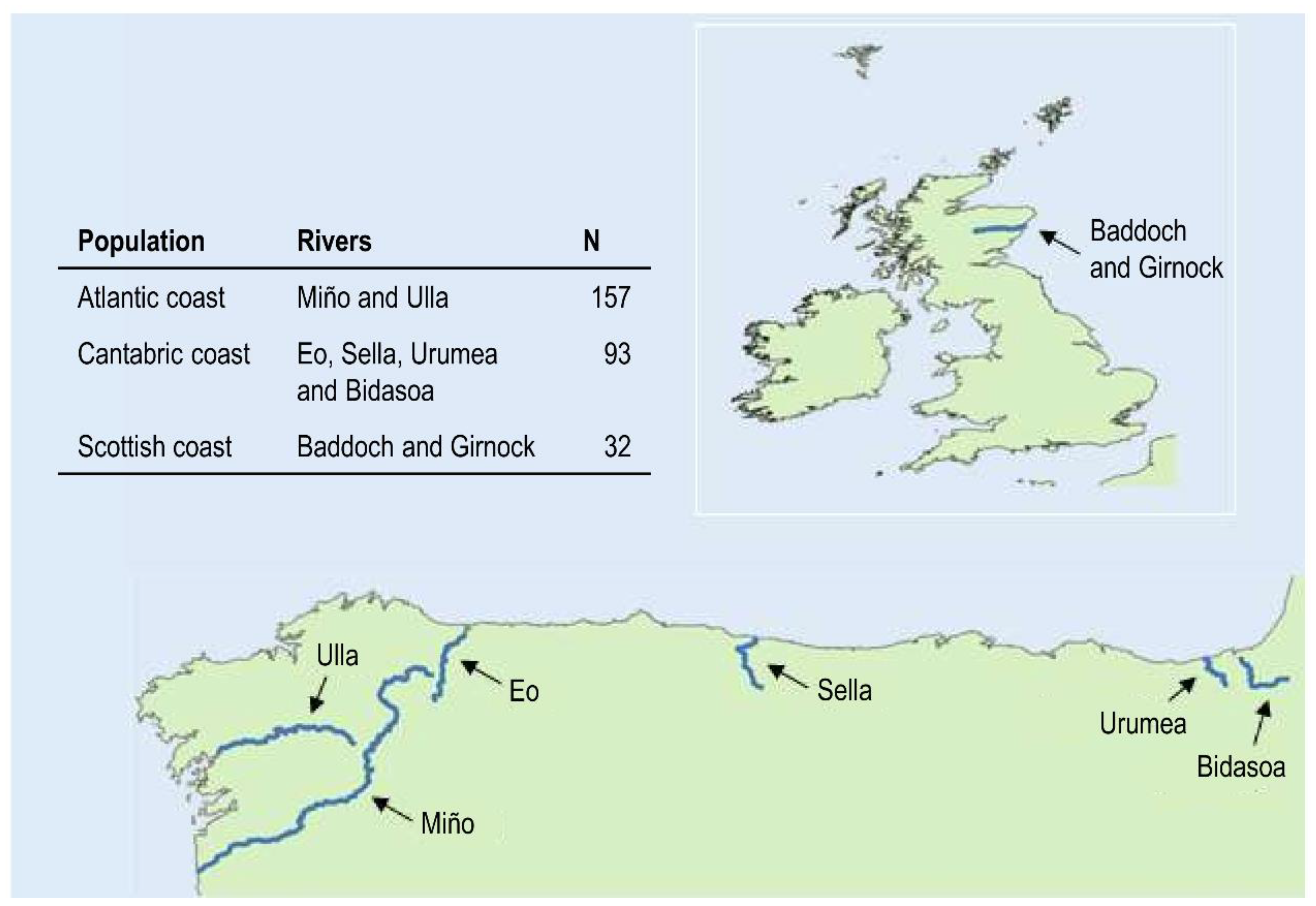
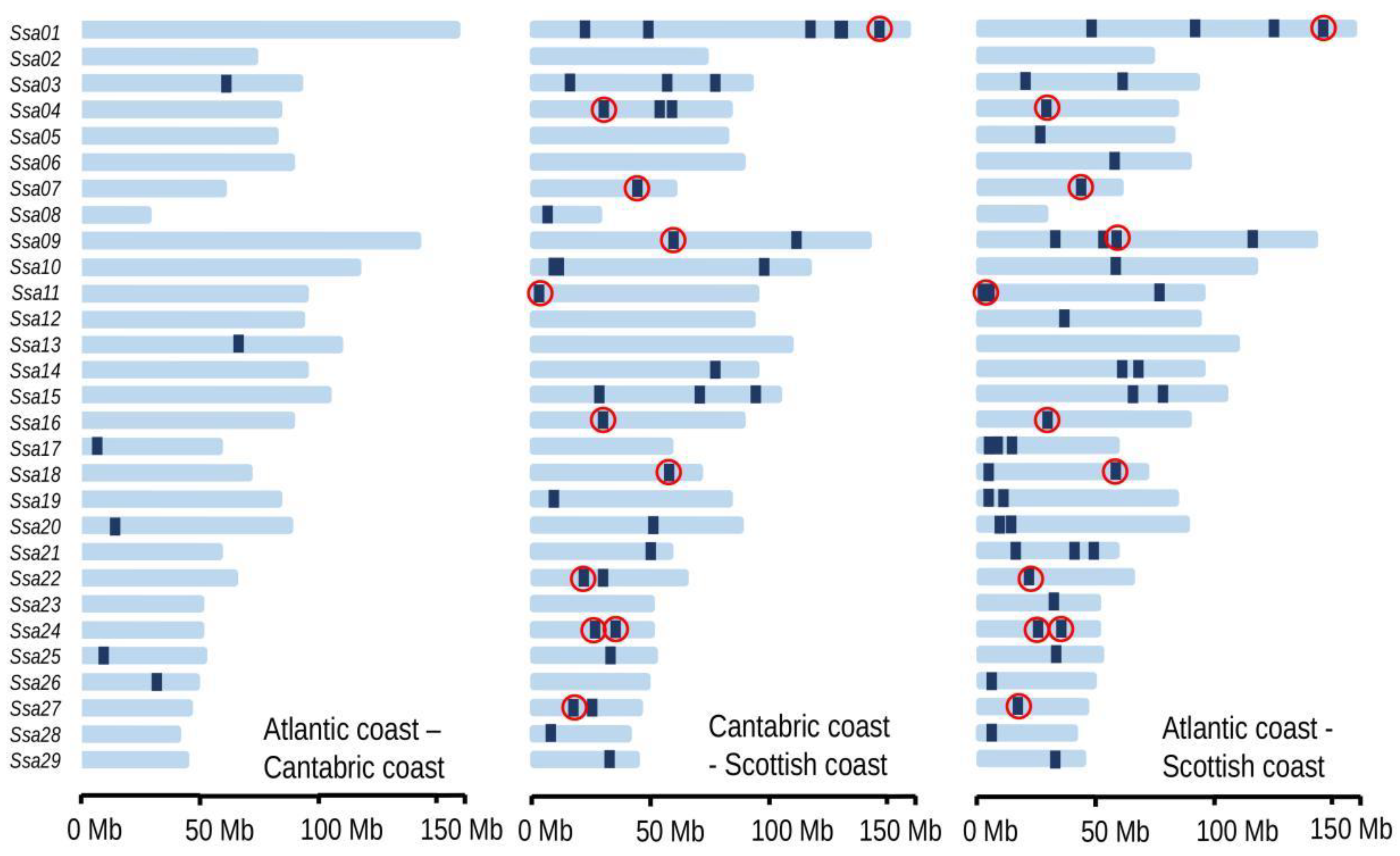
Atlantic salmon is a diadromous species that has the particularity that it returns to reproduce to its river of birth. This means that, in most cases, each river can be considered a population and that these populations can be adapted to the characteristics of the river. The Atlantic Salmon in the rivers of the Iberian Peninsula has been in decline since the 80’s of the last century. At that time, to alleviate the decline in the number of individuals, the rivers were stocked with salmon from Scotland and other northern European rivers, but the result was not positive. In this work, we studied eight salmon populations using a 220,000 high-density SNP array (Affymetrix) specific to Atlantic salmon. Our results revealed potential evidence of local adaptation for North Spanish and Scottish populations, which may be the cause of the failure of restocking programs. In addition, by performing a review of previous studies, we demonstrated that, as suggested, NADP-dependent malic enzyme-2 is a candidate for local adaptation in salmon from the Iberian Peninsula.
Abstract
Pollution and other anthropogenic effects have driven a decrease in Atlantic salmon (Salmo salar) in the Iberian Peninsula. The restocking effort carried out in the 1980s, with salmon from northern latitudes with the aim of mitigating the decline of native populations, failed, probably due to the deficiency in adaptation of foreign salmon from northern Europe to the warm waters of the Iberian Peninsula. This result would imply that the Iberian populations of Atlantic salmon have experienced local adaptation in their past evolutionary history, as has been described for other populations of this species and other salmonids. Local adaptation can occur by divergent selections between environments, favoring the fixation of alleles that increase the fitness of a population in the environment it inhabits relative to other alleles favored in another population. In this work, we compared the genomes of different populations from the Iberian Peninsula (Atlantic and Cantabric basins) and Scotland in order to provide tentative evidence of candidate SNPs responsible for the adaptive differences between populations, which may explain the failures of restocking carried out during the 1980s. For this purpose, the samples were genotyped with a 220,000 high-density SNP array (Affymetrix) specific to Atlantic salmon. Our results revealed potential evidence of local adaptation for North Spanish and Scottish populations. As expected, most differences concerned the comparison of the Iberian Peninsula with Scotland, although there were also differences between Atlantic and Cantabric populations. A high proportion of the genes identified are related to development and cellular metabolism, DNA transcription and anatomical structure. A particular SNP was identified within the NADP-dependent malic enzyme-2 (mMEP-2*), previously reported by independent studies as a candidate for local adaptation in salmon from the Iberian Peninsula. Interestingly, the corresponding SNP within the mMEP-2* region was consistent with a genomic pattern of divergent selection.