Article

Solution-Processable Near-Infrared-Absorbing Dye: Thiophene-Substituted N-Phenylphenothiazine Radical Cations for Stable Thin Films


1
Faculty of Chemistry, Material and Bioengineering, Kansai University, 3-3-35 Yamate-cho, Suita 564-8680, Japan
2
Division of Applied Chemistry, Graduate School of Environmental, Life, Natural Science and Technology, Okayama University, 3-1-1 Tsushima-naka, Kita-ku, Okayama 700-8530, Japan
3
Osaka Research Institute of Industrial Science and Technology, 1-6-50 Morinomiya, Joto-ku, Osaka 536-8553, Japan
*
Author to whom correspondence should be addressed.
Colorants 2026, 5(2), 14; https://doi.org/10.3390/colorants5020014
Submission received: 17 March 2026 / Revised: 3 April 2026 / Accepted: 9 April 2026 / Published: 16 April 2026

Abstract

We report a π-extended N-phenylphenothiazine dye bearing thiophene substituents, designed to address the practical compromise between long-wavelength near-infrared (NIR) absorption and the isolability of a stable radical cation state. The target compound was synthesized via Suzuki–Miyaura cross-coupling and exhibited good solubility in common organic solvents. Cyclic voltammetry in dichloromethane showed a reversible one-electron oxidation at E0 = 0.19 V vs. Fc/Fc+. Chemical oxidation afforded the corresponding radical cation, which showed an intense NIR absorption maximum at 910 nm. DFT calculations support thiophene-induced narrowing of the HOMO–SOMO gap and predict a pronounced bathochromic shift of the main absorption band. The radical cation was isolated as a stable PF6 salt and readily processed into spin-coated films, which retained strong NIR absorption and remained stable for months under ambient conditions.

1. Introduction

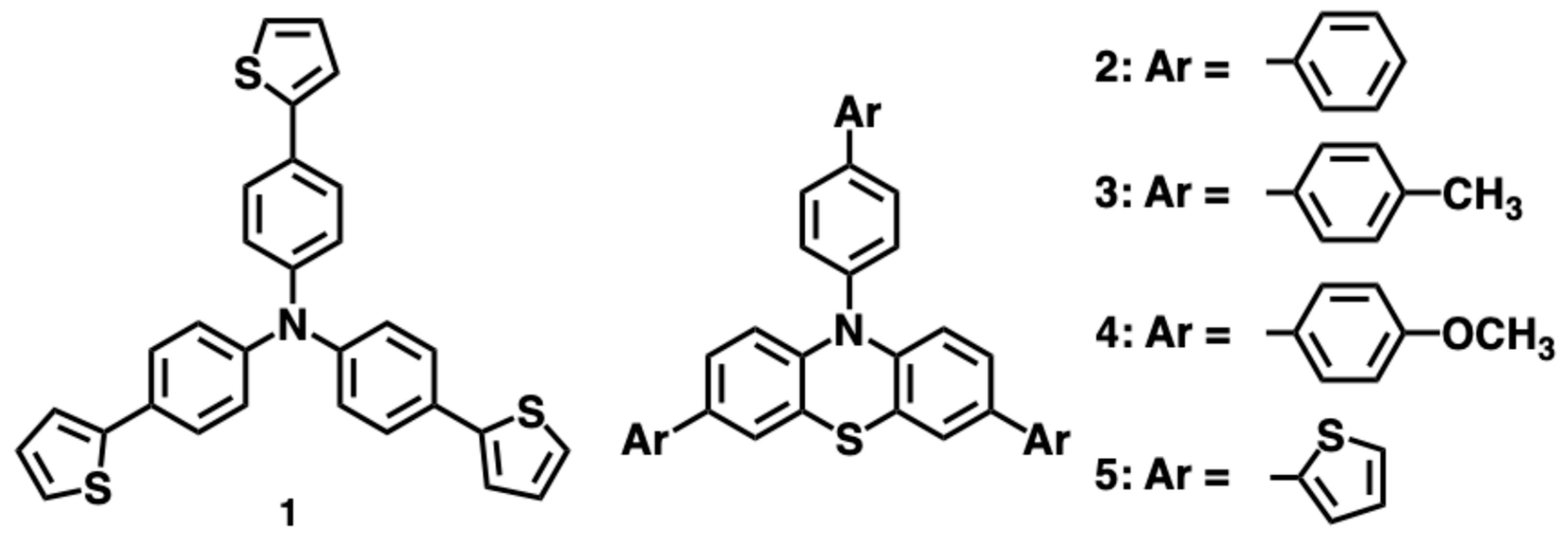
Near-infrared (NIR; ~750–2500 nm)-absorbing organic dyes [1] constitute an important class of functional materials for bioimaging [2,3], telecommunications [4,5], photodetectors [6], and dye-sensitized solar cells [7]. Their ability to interact selectively with low-energy light makes them particularly attractive for applications that require optical responses beyond the visible region. They have also attracted increasing interest as components of smart window coatings [8,9] that combine visible transparency with NIR-selective heat management. In such applications, selective attenuation of NIR light is important because it can reduce solar heat gain while maintaining acceptable visible light transmission. Relative to inorganic absorbers [10,11], organic dyes are lightweight, offer broad structural tunability, and are compatible with solution processing [12]. These advantages allow their molecular properties to be adjusted through synthetic design and make organic systems attractive candidates for flexible and coating-based optical materials. These features are advantageous for large-area and potentially low-cost fabrication [13]. Despite significant advances in the synthesis, photophysics, and material integration of organic NIR dyes [14], the development of organic dyes that exhibit strong and persistent absorption at longer NIR wavelengths remains challenging. This challenge becomes even more significant when practical requirements such as solubility, processability, and environmental stability must also be satisfied. Conventional closed-shell chromophores, including porphyrins [15,16], phthalocyanines [17], and extended acene-type systems [18], typically rely on π-extension to narrow the HOMO–LUMO gap and thereby shift absorption to longer wavelengths. Although this strategy is effective from an electronic structure standpoint, it often requires highly fused or extensively conjugated frameworks. However, increased planarity and conjugation often compromise solubility and promote intermolecular aggregation [19,20], while the associated syntheses tend to become increasingly demanding. Consequently, simultaneously achieving long-wavelength absorption together with practical solubility and stability remains a nontrivial molecular design problem. Open-shell triarylamine radical cations provide an alternative design paradigm: they are readily accessed by mild one-electron oxidation, and the resulting radicals can be sufficiently persistent under appropriate conditions while retaining strong absorption in the visible region [21,22] In these systems, HOMO–SOMO transitions intrinsically access lower excitation energies [23], enabling intense NIR absorption without resorting to excessive π-extension [24]. In our previous studies, we developed π-extended TPA derivatives 14 (Figure 1) [25,26]. Notably, the radical cation of 1 exhibited an intense NIR band with an absorption maximum beyond 1000 nm, yet it lacked sufficient persistence to be isolated as a solid radical cation salt [25]. To address this limitation, we designed N-phenylphenothiazine (NPPT) derivatives 24; their radical cations were stabilized to the extent that they could be isolated as solid salts while retaining good solubility and solid-state thermal robustness [26]. This improved isolability, however, was accompanied by a blue shift of the radical cation absorption maxima, largely confining the NIR response to shorter wavelengths (typically 700–900 nm). These findings underscore a practical trade-off between isolable radical cation stability and long-wavelength NIR absorption within this molecular platform. Against this background, we revisited the NPPT scaffold. NPPT can stabilize radical cations via spin delocalization within the N–S framework [27], and its intrinsically nonplanar phenothiazine geometry can suppress cofacial π–π stacking [28], thereby helping to preserve solubility. Moreover, the N-phenyl unit offers a convenient site for peripheral substitution and π-extension, enabling systematic modulation of the electronic structure (Figure 1) [29]. Here, we hypothesized that replacing an aryl substituent with a thiophene unit (5) could mitigate the abovementioned trade-off. Incorporation of thiophene is expected to enhance effective electronic communication and donor characters, thereby narrowing the HOMO–SOMO gap of the radical cation and promoting a red shift, while the sterically and conformationally favorable NPPT framework may maintain persistence and solubility. In the present work, we synthesized the thiophene-substituted derivative 5 and investigated its electrochemical and spectroscopic properties, together with its film-state NIR absorption. Although compounds with similar structures have been reported as hole-transporting materials for perovskite solar cells [30], their application as near-infrared-absorbing materials has not yet been investigated. We demonstrate that incorporation of thiophene affords an isolable radical cation salt and induces a pronounced bathochromic shift of the radical cation absorption while maintaining good solubility and solid-state robustness, and that the NIR response is retained in spin-coated thin films. These results establish thiophene substitution as a practical handle for designing solution-processable radical cation-based dyes with long-wavelength NIR absorption.

2. Results and Discussion

2.1. DFT Calculation

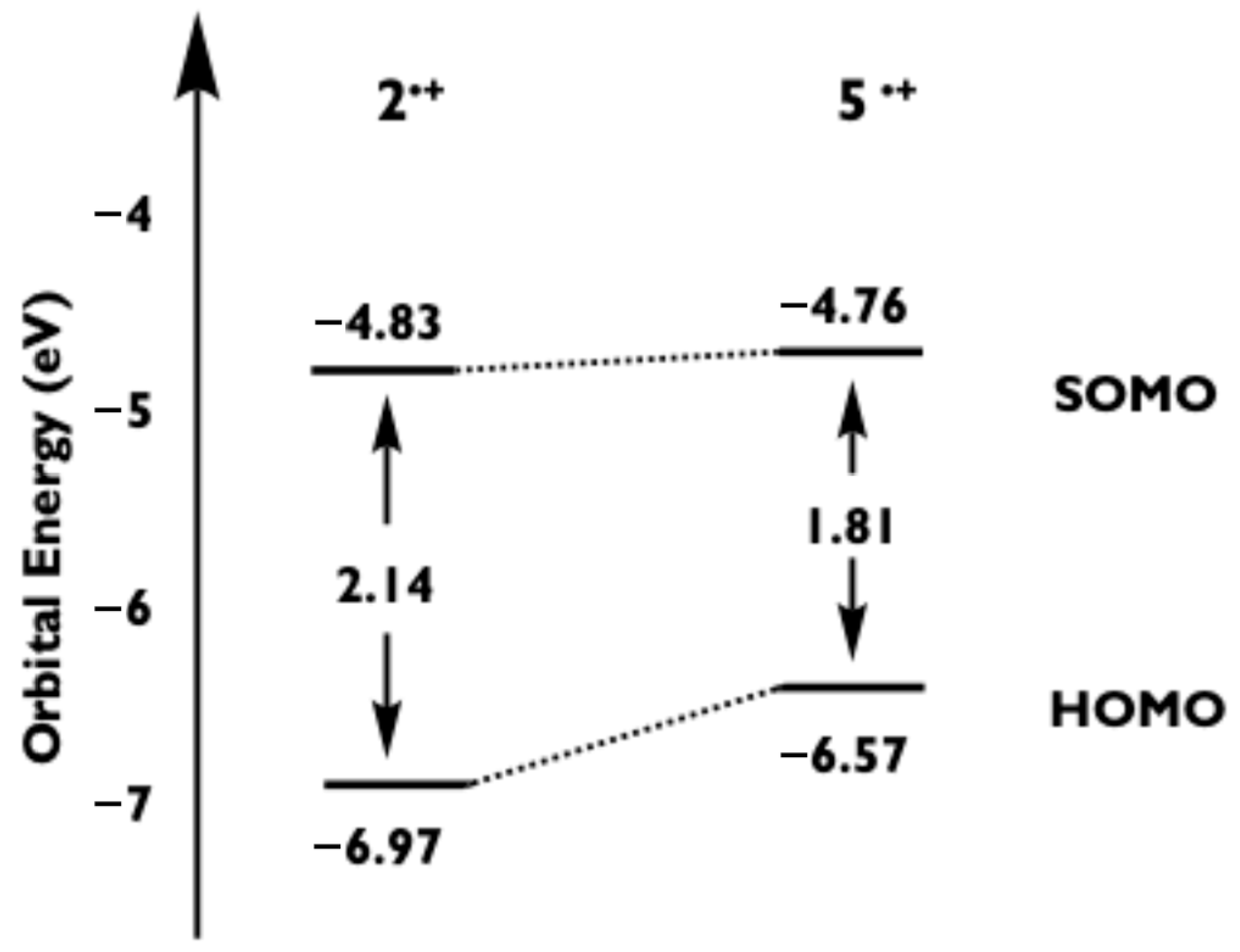
DFT calculations were performed to assess whether thiophene substitution can rationally shift the radical cation absorption to longer wavelengths. As shown in Figure 2, DFT calculations at the (U)B3LYP/6-31+G(d,p) level with CPCM (dichloromethane) reveal that thiophene substitution significantly modulates the frontier-orbital energies of the triphenylamine radical cation. For the neutral molecules, a comparison of 2 and 5 indicates that thiophene substitution slightly raises the HOMO energy and lowers the LUMO energy, resulting in a smaller HOMO–LUMO gap for 5. TD-DFT calculations on the neutral 5 and its radical cation indicate that oxidation converts a closed-shell UV–vis-absorbing molecule into an open-shell species exhibiting a much lower-energy NIR transition. When Ar is changed from phenyl (2•+) to 2-thienyl (5•+), the HOMO level is markedly destabilized from −6.97 to −6.57 eV, whereas the SOMO level changes only slightly from −4.83 to −4.76 eV. Consequently, the HOMO–SOMO gap decreases from 2.14 to 1.81 eV, indicating that the lowest electronic transition associated with the HOMO to SOMO transition should occur at a lower energy for the thiophene derivative. Overall, these calculations suggest that incorporation of thiophene is an effective molecular design strategy to achieve bathochromically shifted NIR absorption in triphenylamine radical cations. These results prompted us to prepare Compound 5 and investigate its electrochemical and spectroscopic properties.

2.2. Synthesis

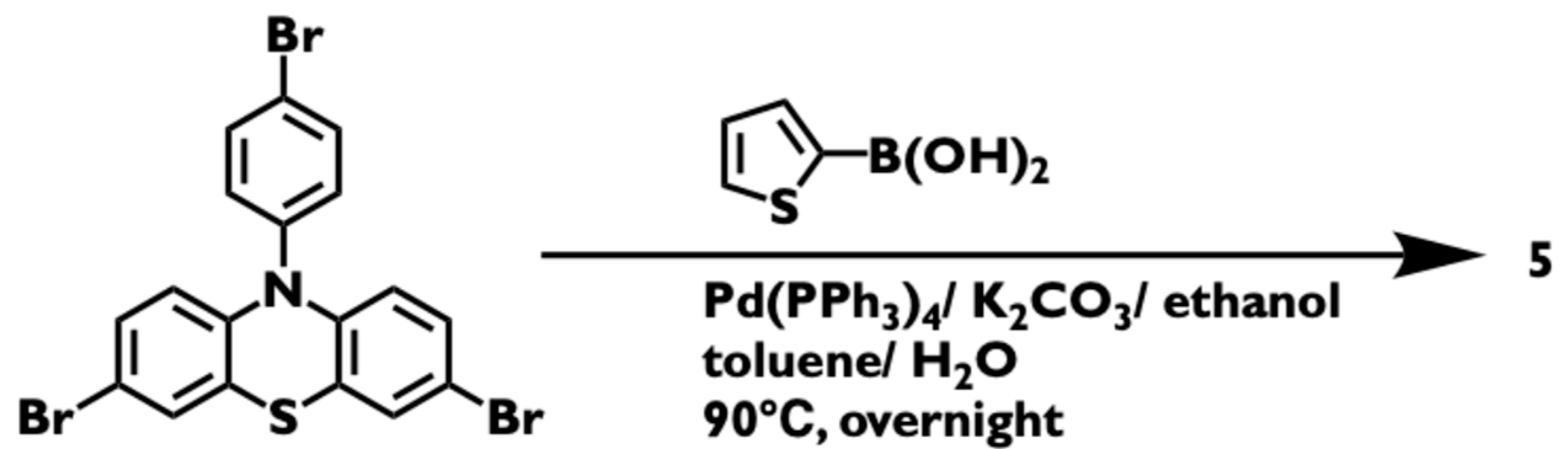
Compound 5 was synthesized via Pd-catalyzed Suzuki–Miyaura cross-coupling of 3,7-dibromo-10-(4-bromophenyl)-10H-phenothiazine [31] with 2-thiophene boronic acids (Scheme 1). This coupling step was designed to install thiophene units onto the NPPT framework in a modular manner, thereby extending the π-conjugation of the target molecule. The reaction proceeded smoothly under the selected coupling conditions to produce 5 with an excellent isolated yield of 98.6%, indicating the high efficiency of this synthetic route for constructing the thiophene-extended phenothiazine scaffold. After reaction and standard purification, the product was obtained in analytically pure form, and its structure was confirmed by spectroscopic methods. Full synthetic procedures and characterization data are provided in the Supporting Information (SI).

2.3. Solubility

Solubility in common organic solvents is a critical factor for the practical use of NIR-absorbing dyes in solution-processed devices [29]. Insufficient solubility can directly limit not only solution handling during synthesis and purification, but also the preparation of homogeneous samples for spectroscopic measurements and thin-film fabrication. This issue is particularly important for long-wavelength-absorbing π-conjugated molecules, because structural modifications aimed at red-shifting the absorption often enhance intermolecular interactions and aggregation, thereby reducing solvent compatibility. The solubilities of 5 were evaluated by gradual addition of the solvent to solid samples at room temperature, followed by sonication and visual inspection until complete dissolution was achieved. The tested solvents included dichloromethane, anisole, toluene, and ethyl acetate, which were selected as representative media that are relevant to routine synthetic handling, spectroscopic measurements, and solution-processing applications. Although this evaluation method is simple, it provides a practical measure of whether the material can be handled under common laboratory and processing conditions. The results are summarized in Table S1. Compound 5, which contains thiophene units, exhibited solubility comparable with that of the previously reported aryl-substituted analogs 24. This result is notable because π-extension is often accompanied by decreased solubility due to stronger intermolecular π–π interactions. In the present case, however, introduction of the thiophene units did not cause a marked loss of solution processability, indicating that the structural modification used to improve the optical properties does not impose a major penalty on the handling characteristics. Notably, good solubility was also retained in ethyl acetate, a green solvent favorable for large-scale processing [32]. This point is significant from the viewpoint of practical material development, because compatibility with a relatively environmentally benign solvent broadens the potential utility of the compound in scalable coating and casting processes. These results indicate that thiophene substitution, in addition to extending the π-conjugation, serves as an effective strategy to ensure sufficient solubility. Thus, the thiophene units in 5 play a beneficial dual role, contributing not only to the electronic structure required for long-wavelength absorption but also to the maintenance of practically useful solubility. This dual role of the thiophene units is advantageous for developing radical cation dyes that combine long-wavelength absorption with solution processability. The observed solubility is also consistent with the successful preparation of homogeneous solutions for the following spectroscopic studies and supports the feasibility of subsequent thin-film fabrication from a solution.

2.4. X-Ray Crystallographic Analysis

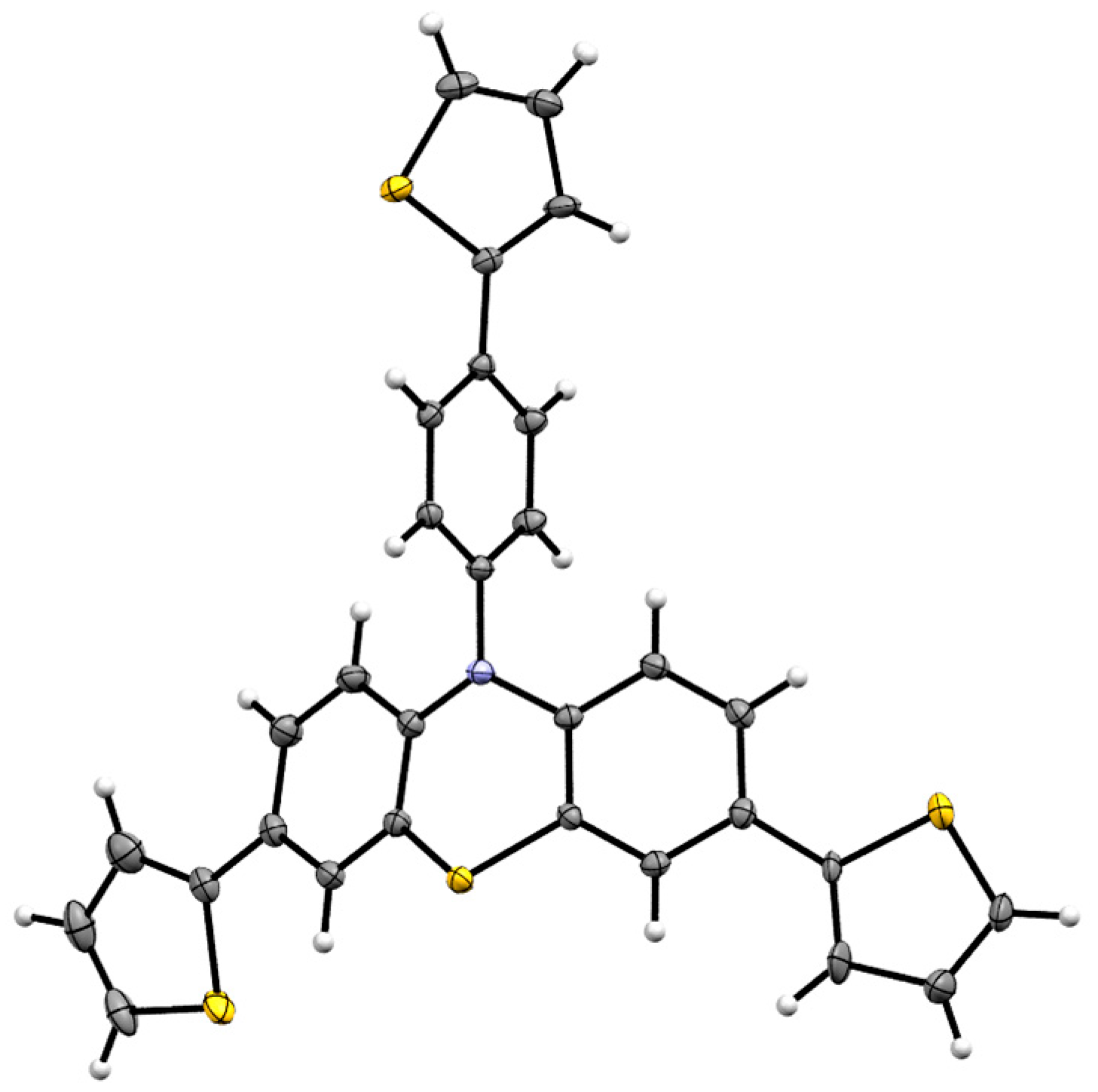
Single-crystal X-ray diffraction of 5 (100 K) revealed a triclinic crystal system in the centrosymmetric space group P-1 (Figure 3 and Table S3). Notably, the phenothiazine core is folded along the S–N axis, adopting a distinctly nonplanar “butterfly” geometry; the angle between the mean planes of the two outer benzene rings is ~33°, clearly indicating pronounced bending of the phenothiazine unit. In addition, the N-phenyl ring is oriented nearly orthogonal to the phenothiazine framework (dihedral angle ~88°), giving the molecule a three-dimensional shape rather than an extended planar π-surface. The peripheral thiophene substituents are conformationally flexible in the solid state and were modeled as two-position disorders (major/minor occupancies: 0.923/0.077, 0.887/0.113, and 0.657/0.343; see the details in the Supporting Information).

2.5. Electrochemical Properties

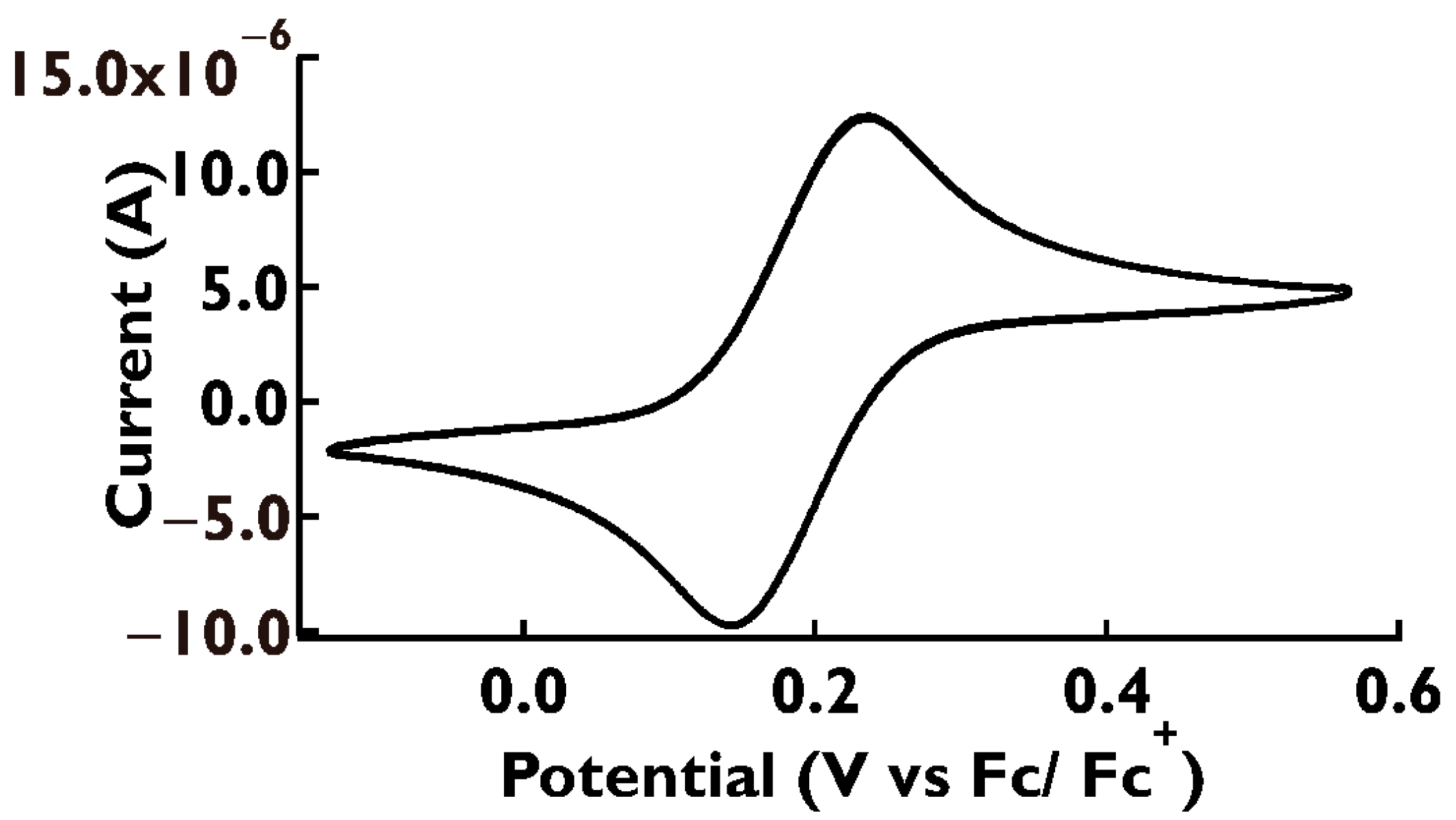
The electrochemical behavior of 5 was investigated by cyclic voltammetry (CV) in dichloromethane containing 0.1 M Bu4NPF6 as the supporting electrolyte (Figure 4). Electrochemical analysis is particularly important for radical cation-based NIR dyes, because it provides direct information on the accessibility, reversibility, and stability of the oxidized states that are responsible for the characteristic long-wavelength absorption. In the present study, CV was used to clarify whether 5 can undergo clean stepwise oxidation under conditions relevant to spectroscopic and material investigations. A single reversible one-electron oxidation process was observed at E0 = 0.19 V vs. Fc/Fc+. The reversibility of this first oxidation indicates that the initially generated oxidized species is sufficiently stable on the voltammetric timescale and can be reduced back to the neutral form without substantial decomposition. This behavior is consistent with the formation of a persistent radical cation and is favorable for reliable redox control of the optical properties. Expanding the potential window to 1.2 V revealed an additional oxidation process at approximately +0.95 V vs. Fc/Fc+, which appeared to be quasi-reversible (Figure S1). The appearance of this second oxidation at a significantly higher potential suggests that the first oxidation product is distinctly stabilized, while access to the more highly oxidized state requires substantially stronger oxidation conditions. This second oxidation is attributed to further oxidation of the radical cation to a dicationic species. The quasi-reversible nature of this higher-potential process may reflect the lower stability of the dicationic state relative to the radical cation under the present conditions. These results demonstrate that the compound undergoes a clean, reversible one-electron oxidation to form a persistent radical cation, followed by a higher-potential, quasi-reversible second oxidation. Overall, the electrochemical behavior of 5 is well suited to the present molecular design concept, because it enables selective generation of the radical cation as the key NIR-absorbing species while avoiding severe instability during the first oxidation step. This redox profile also provides an important basis for the subsequent spectroscopic characterization, chemical oxidation experiments, and isolation of the radical cation salt described below.

2.6. Photophysical Properties

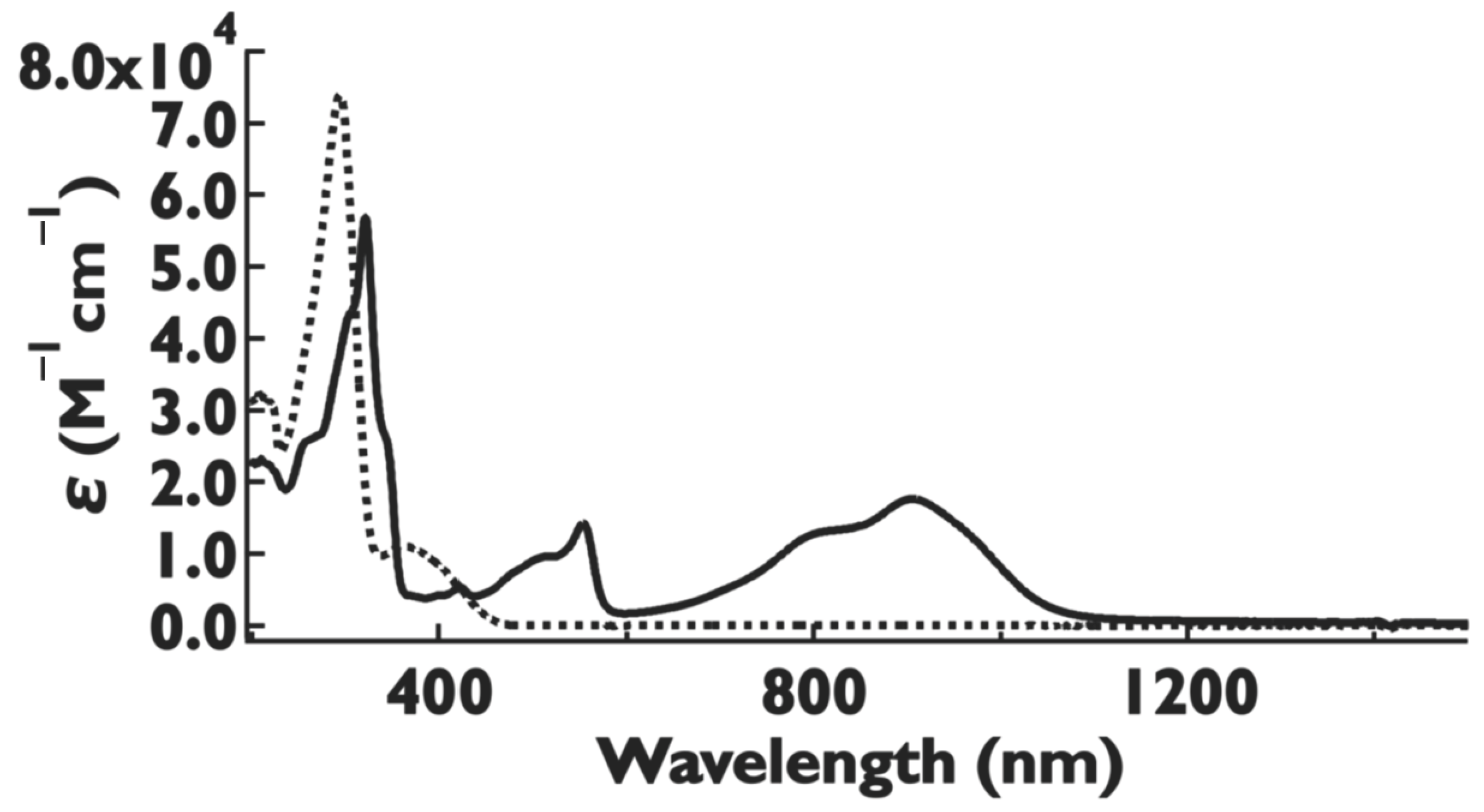
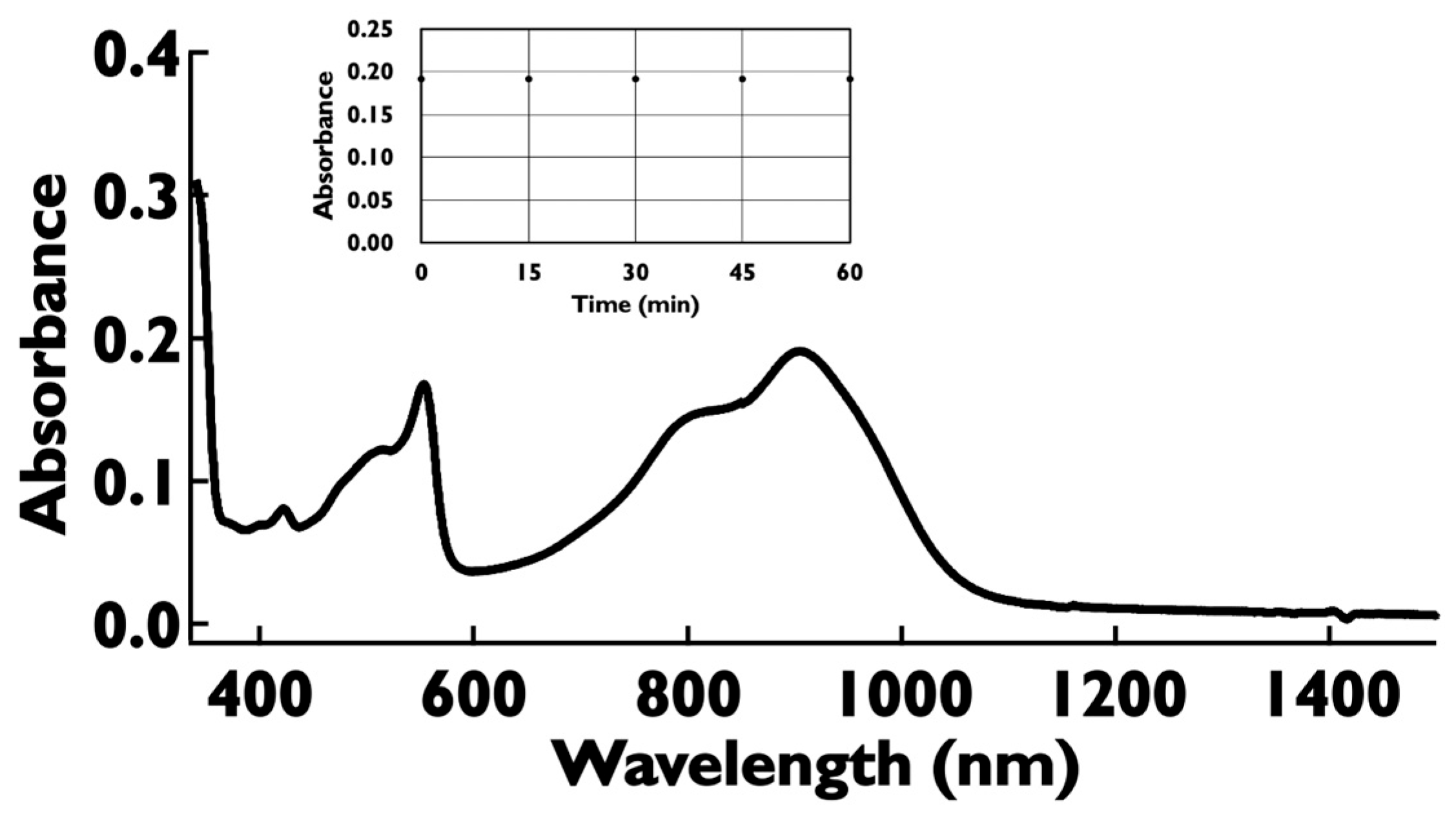
The UV–vis–NIR absorption behavior of 5 was examined in dichloromethane. Neutral Compound 5 exhibited an absorption maximum at 360 nm in dichloromethane. Upon excitation at 360 nm, the solution displayed fluorescence with an emission maximum at 472 nm. Chemical oxidation with AgPF6 has been reported for triphenylamine-based materials and related triarylamine derivatives [33,34]. As shown in Figure S5, the addition of AgPF6 to a dichloromethane solution of 5 caused a distinct color change from yellow-green to pink, consistent with formation of the radical cation. In line with this visual change, neutral Compound 5 exhibits absorption only in the UV–visible region, whereas oxidation with AgPF6 gives rise to marked spectral changes, including the appearance of an intense near-infrared band (Figure 5). A comparison with the previously reported aryl-substituted NPPT analogs 24 [26] shows that the thiophene substitution in 5 leads to a more pronounced bathochromic shift of radical cation absorption. The extinction coefficient of neutral Compound 5 is lower than that of 2, whereas those of the corresponding radical cations are similar. This result suggests that thiophene substitution mainly induces a bathochromic shift rather than a marked change in the intensity of radical cation absorption. To further confirm the stoichiometric formation of 5•+, an oxidation titration was performed by incremental addition of AgPF6 (Figure S6). The NIR band assigned to 5•+ grew systematically with increasing oxidant loading and reached a steady spectral shape at higher equivalents, consistent with quantitative formation of a single oxidized species. The persistence of 5•+ in solution was then evaluated by time-dependent UV–vis–NIR spectroscopy (Figure 6). After in situ oxidation of 5 with AgPF6, the spectral profile of 5•+ remained essentially unchanged over the monitoring period, with no appreciable loss of the characteristic NIR band, indicating sufficient stability on the experimental timescale for reliable solution-phase characterization. The electronic origin of the NIR absorption was assessed by comparison with TD-DFT calculations (Figure S7). The calculated low-energy transitions reproduce the observed long-wavelength absorption of 5•+ in both position and relative intensity, supporting assignment of the NIR band to an electronic transition characteristic of the triarylamine radical cation manifold. ESR spectroscopy (Figure S16) showed an organic radical signal with g = 2.004, confirming the open-shell character of the oxidized species. Because the spin distribution of triarylaminium radical ions is not generally assigned from the g value alone, it was assessed mainly by DFT spin density analysis, in conjunction with a comparison with the related literature reports [35]. The analysis indicates that the unpaired electron is delocalized over the triarylamine framework, with a significant contribution from the nitrogen atom. Overall, the combined experimental and theoretical results support a delocalized open-shell electronic structure for 5•+, in which the oxidized π-system extends over the NPPT core and the thiophene substituents (Figure S3). This result is particularly significant because it demonstrates that access to the NIR region does not necessarily require a highly elaborate or excessively enlarged molecular architecture. In the development of organic NIR chromophores, deep bathochromic shifts are often achieved by introducing very long π-conjugated backbones, multiple fused aromatic units, or complicated donor–acceptor arrangements. Although such approaches can be effective for extending absorption to longer wavelengths, they frequently increase synthetic complexity, reduce overall yield, complicate purification, and impair solubility or processability. As a consequence, there is often a substantial gap between achieving attractive optical properties and obtaining a molecular material that can actually be prepared, handled, and processed in a practical manner. In contrast, the present study shows that a relatively simple NPPT-based framework, modified only by peripheral thiophene substitution and subsequent one-electron oxidation, is sufficient to generate a well-defined radical cation with intense NIR absorption. This simplicity is advantageous because it improves synthetic accessibility, facilitates structural verification and reproducibility, and makes the design concept easier to generalize to related derivatives. From a molecular design perspective, the present system provides an instructive example showing that efficient NIR absorption can emerge not only from drastic structural expansion, but also from a balanced combination of moderate π-extension and effective spin/charge delocalization in the oxidized state. Such a design principle is valuable for the future development of practical radical cation dyes, where optical performance must be achieved together with ease of synthesis, solution processability, and material robustness. The chemical reversibility of the redox process was verified by a forward–back conversion experiment (Figure S10): oxidation of 5 with AgPF6 afforded 5•+, and subsequent treatment with L-ascorbic acid regenerated the neutral form. Recovery of the original compound was confirmed by 1H NMR and TLC, demonstrating that oxidation to 5•+ is chemically reversible under mild conditions, in line with the electrochemical behavior. The ease with which such a structurally simple molecule can be switched reversibly between a neutral precursor and an NIR-absorbing radical cation is also important from a practical standpoint. It means that the key optical function can be accessed without relying on structurally fragile or synthetically demanding chromophores, thereby lowering the barrier to further optimization, derivative synthesis, and incorporation into solution-processed materials. In this sense, the present molecule serves not only as an individual NIR dye but also as a useful model for establishing a more accessible molecular platform for radical cation-based NIR materials.

2.7. Isolation of Radical Cation Salts

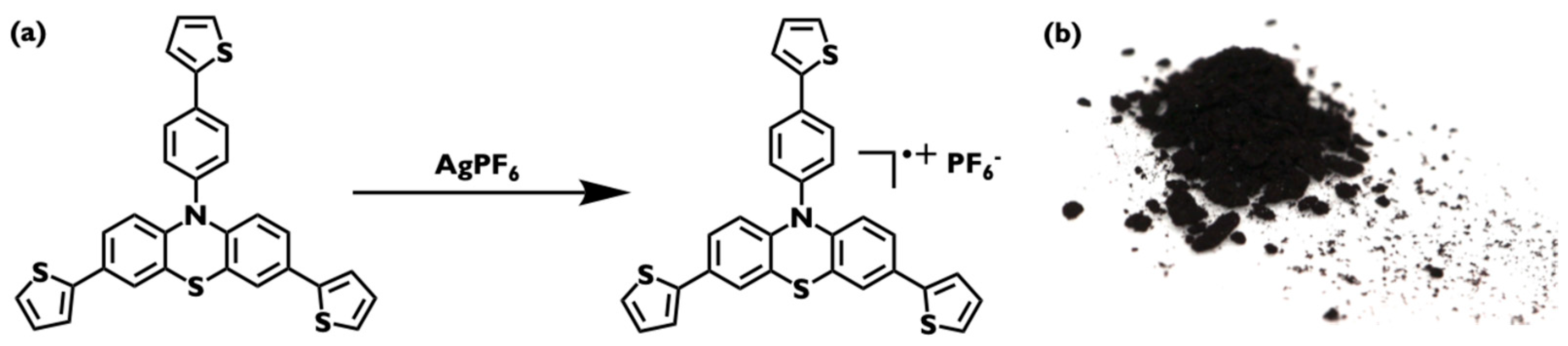
Since 5 formed stable radical cations in solution, attempts were made to isolate them as solid salts. The ability to isolate radical cation dyes as stable solids is important because it allows characterization and handling of the oxidized species beyond in situ generation in solution. Such isolability is also advantageous for storage and for considering subsequent material applications. Oxidation of 5 with AgPF6 in dichloromethane followed by precipitation with n-hexane afforded radical cation salts as reddish-brown powder with a moderate yield (Figure 7). This result shows that the radical cation of 5 can be obtained not only under spectroscopic conditions in solution but also as an isolable chemical species. The UV–vis–NIR spectrum of the isolated salt in solution was identical to that of the in situ generated radical cations (Figure S8), confirming that the radical species are retained in the solid state. This agreement further indicates that the same radical cation species is preserved during the isolation process. The salts were stable under ambient conditions for several weeks without noticeable decomposition. Such ambient stability is valuable for practical radical dyes because it facilitates routine handling and further processing. In contrast, the radical cation of Compound 1, which does not contain the phenothiazine framework, decomposed during attempted isolation [25]. This result highlights the important role of the phenothiazine scaffold in stabilizing the radical cation. Thus, the phenothiazine-based framework is beneficial not only for generating NIR-absorbing radical cations but also for imparting the persistence and isolability required for practical molecular dye systems.

2.8. Thin-Film Preparation and Absorption Spectra

Because the limited solubility of many NIR-absorbing dyes restricts coating and printing processes, thin films of NIR absorbers have often been fabricated by vacuum deposition [36], whereas solution-processed NIR-dye films remain relatively rare [37]. From the viewpoint of practical applications, however, the ability to fabricate NIR-absorbing thin films by simple solution-based techniques such as spin-coating is highly important. Solution processing offers advantages in terms of low-cost fabrication, large-area coating, compatibility with flexible substrates, and ease of integration into functional optical coatings and lightweight devices. These advantages make spin-coated NIR films particularly attractive for applications such as optical filters, thermal management coatings, and other photonic materials. Dye–polymer blends, including PMMA-based systems, provide a practical route to solution-processed optical films because the dye can be embedded in a rigid matrix while the film is formed by conventional coating methods [38]. To realize such films, several challenges must be overcome at the molecular and material levels. In particular, the dye must possess sufficient solubility to form homogeneous coating solutions, while also maintaining compatibility with the polymer matrix to avoid phase separation or precipitation during film formation. In addition, aggregation or crystallization of the dye in the solid state must be minimized, since such processes can deteriorate the film’s uniformity and alter the desired optical response. For radical cation-based NIR dyes, another key requirement is that the oxidized species must remain sufficiently stable during processing and after film formation so that the characteristic long-wavelength absorption is preserved in the solid-state material.
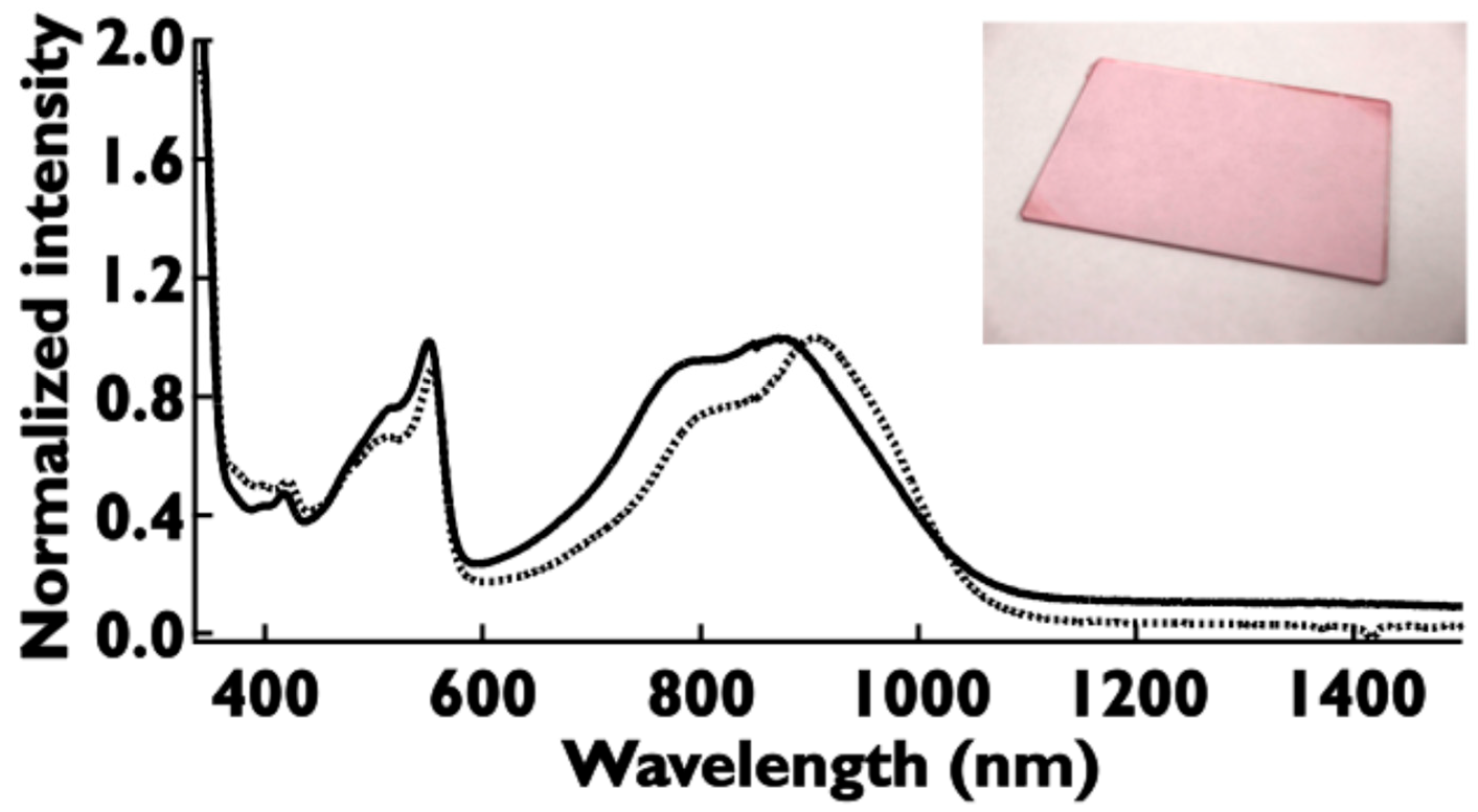
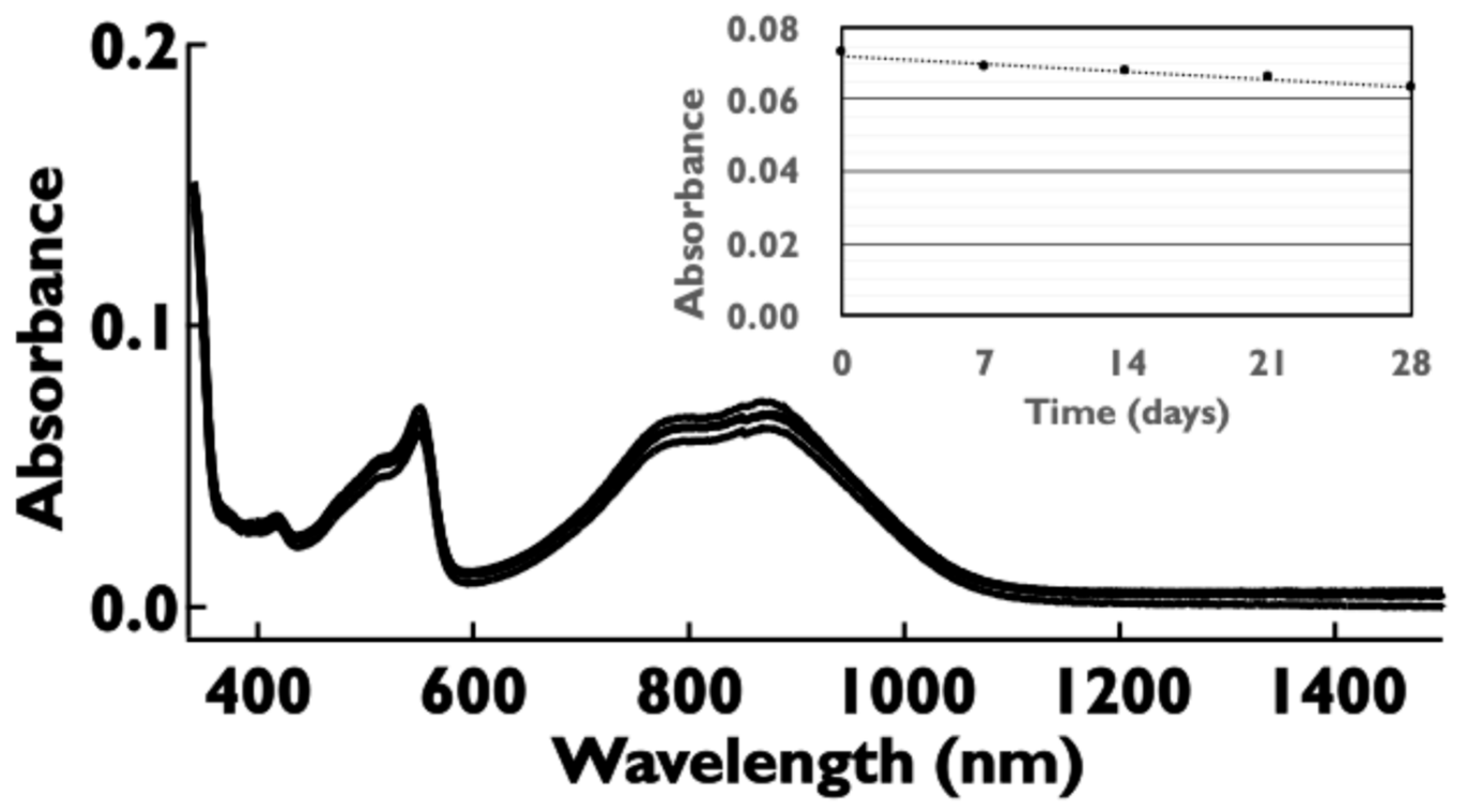
Previous studies have shown that dyes incorporated into PMMA generally retain their absorption characteristics, although small spectral shifts may arise from the polymer microenvironment [39]. Accordingly, the successful preparation of spin-coated PMMA films containing the present radical cation is meaningful not only as a demonstration of film fabrication itself but also as evidence that the molecular design addresses the central requirements of solubility, film-formability, and retention of NIR absorption in a practically relevant thin-film format. On the basis of this strategy, a dichloromethane solution of PMMA containing 5•+PF6 was spin-coated onto a glass substrate to afford a uniform thin film; experimental details are provided in the Supporting Information. The UV–vis–NIR absorption spectrum of 5•+PF6 in the spin-coated PMMA film closely resembled that observed in solution, indicating that the radical cation retains its characteristic absorption features upon incorporation into the polymer matrix (Figure 8). A slight shift to shorter wavelengths was observed in the film, which is reasonably attributed to the different dielectric environment of PMMA relative to the solution. The stability of the radical cation in the PMMA matrix was then evaluated by monitoring the UV–vis–NIR absorption spectrum of the as-prepared film over time (Figure 9). The spectral profile, including the characteristic NIR band, was largely preserved throughout the observation period, and the absorbance showed only a small decrease under the present storage and measurement conditions. These results demonstrate the practical stability of the radical cation in the solid-state polymer matrix, which is favorable for long-term optical performance in coatings and thin-film devices.

3. Conclusions

In summary, we designed a π-extended NPPT derivative, Compound 5, bearing peripheral thiophene substituents to address a central trade-off in radical cation near-infrared (NIR) dyes, namely achieving long-wavelength absorption while maintaining practical processability and robustness. This trade-off has been a persistent challenge in the development of functional organic NIR materials, because structural modification for red-shifted absorption often compromises solubility, stability, or film-forming ability. In this context, the present study demonstrates the value of balancing electronic and structural design requirements within a single molecular framework. Compound 5 was readily synthesized using Suzuki–Miyaura cross-coupling. The efficient preparation of 5 also highlights the synthetic accessibility of this design, which is advantageous for further molecular development and structural diversification. DFT calculations supported the observed bathochromic shift by indicating that π-extension with thiophene units narrows the HOMO–SOMO gap. These computational results are consistent with the experimental absorption behavior and provide a clear electronic basis for the effectiveness of thiophene’s incorporation in this system. Single-crystal X-ray diffraction revealed a bent conformation with a reduced propensity for cofacial π-π stacking, providing a structural rationale for the favorable solubility and film-forming behavior. Thus, both the electronic structure and molecular geometry contribute cooperatively to the observed material properties. Clean one-electron oxidation of 5 with AgPF6 afforded the corresponding radical cation 5•+, which exhibits intense and broad NIR absorption with a maximum at 910 nm. Relative to our previously reported molecules [26], thiophene incorporation resulted in a bathochromic shift of the absorption band. Time-dependent UV–vis–NIR measurements further showed that the oxidized state persists on the hourly timescale in solution, enabling reliable handling and characterization. Importantly, this radical cation retained high solubility in common organic solvents and displayed good stability in the solid state, allowing uniform thin films to be prepared straightforwardly by solution processing. The radical cations’ stability is attributable to the NPPT scaffold, which combines spin/charge delocalization over the N–S-containing framework with a folded nonplanar geometry that suppresses strong intermolecular interactions. Overall, peripheral thiophene substitution of NPPT emerges as a modular and effective molecular design strategy to realize radical cation dyes that exhibit strong NIR absorption at longer wavelengths while combining solution processability and thermal robustness, offering a practical platform for photonic and optoelectronic thin-film applications. More broadly, the present results provide a useful design guideline for future radical cation-based NIR materials in which long-wavelength absorption must be achieved together with stability and manufacturability.

Supplementary Materials

The following supporting information can be downloaded at https://www.mdpi.com/article/10.3390/colorants5020014/s1, Table S1. Solubility (wt%) of compounds 15 in dichloromethane, anisole, toluene and ethyl acetate at room temperature, as determined by visual observation. Table S2. Solubility (wt%) of compound 5 in dichloromethane, anisole, toluene and ethyl acetate at room temperature, as determined by UV-vis spectroscopy using a calibration curve [40]. Figure S1. Cyclic voltammogram of 5 in CH2Cl2 (0.1 M n-Bu4NPF6); potentials vs Fc/Fc+. Figure S2. Cyclic voltammogram of 5 in CH2Cl2 (0.1 M n-Bu4NPF6), recorded (a) in the absence and (b) in the presence of an equimolar amount of ferrocene as an internal reference.; potentials vs Fc/Fc+. Figure S3. Spin density plots of radical cation of 1, 2 and 5. Figure S4. HOMO, LUMO, and LUMO+1 orbitals of 1, 2 and 5. Table S3. The selected absorption peaks of 1, 1•+, 2, 2•+, 5 and 5•+ calculated by TD-DFT [41,42,43,44,45,46,47]. Figure S5. Dichloromethane solution of 5 in the absence (left) and presence of AgPF6 (right). Ref. [5] = 1 × 10⁻⁵ M. Figure S6. Absorption spectra of 5 in dichloromethane at room temperature during stepwise oxidation with AgPF6 (0–2.0 equiv, added in 0.2 equiv increments). Ref. [5] = 1 × 10⁻⁵ M. Figure S7. Experimental UV-vis absorption spectra of 5 after oxidation with 2.0 equivalents of AgPF6 and TD-DFT calculated energy transition with oscillator strength shown as a vertical line. See also Table S3. Figure S8. Normalized UV-vis-NIR absorption spectra of the radical cation of 5 generated in solution (dotted line) and that of the isolated radical cation salt 5•+·PF6 after redissolution (solid line). Figure S9. UV-vis (solid line) and fluorescence emission (dotted line) spectra of 5. The concentration is 1 × 10⁻⁵ M for UV-vis and 1 × 10⁻⁶ M for fluorescence emission spectra. Figure S10. (A) 1H NMR spectra of (a) 5 and (b) the resulting mixture after treatment of 5 with AgPF6, followed by reduction with excess ascorbic acid. (B) TLC plate of (a) 5, (b) overstrike of 5 and the mixture obtained after oxidation of 5 followed by reduction and (c) the mixture obtained after oxidation of 5 followed by reduction (irradiation at 365 nm with a 4W UV lamp). Figure S11. Isolation of the radical cation salt by oxidation of the neutral 5 with AgPF6. Figure S12. 1H NMR spectrum of 5 (400 MHz, CDCl3). Figure S13. 13C NMR spectrum of 5 (100 MHz, CDCl3). Figure S14. IR (ATR) spectrum of compound 5. Figure S15. HRMS (DART) spectrum of compound 5. Figure S16. ESR spectrum of 5•+ (g = 2.004). Table S4. Crystal data and structure refinement for compound 5 [48,49,50]. Figure S17. ORTEP drawing of 5 with 50% thermal ellipsoids. Disorder omitted for clarity.

Author Contributions

Idea and writing: M.Y.; organic synthesis and measurement of physical properties: K.S.; organic synthesis and measurement of physical properties: M.U.; idea, X-ray measurements, and DFT calculation: K.M.; idea, writing, and IR measurement: Y.K. All authors have read and agreed to the published version of the manuscript.

Funding

This work was supported by JSPS KAKENHI Grant Number JP23K04711 (to M.Y.) and the ESPEC Foundation for Global Environment Research and Technology (Charitable Trust) (to M.Y.) and the Izumi Science and Technology Foundation (to M.Y.).

Data Availability Statement

See Supplementary Materials for detailed data.

Acknowledgments

The authors would like to thank Hitoshi Ishida of Kansai University for the UV–vis–NIR measurements, Yuto Miwa of Kansai University for the fluorescence measurements, and Tomoki Yoshinari of Kansai University for assistance with the UV–vis spectroscopic solubility measurements. The computation was partially performed using the Research Center for Computational Science, Okazaki, Japan (Project: 25-IMS-C116).

Conflicts of Interest

The authors declare no competing financial interests.

References

  1. Wang, Z. Near-Infrared Organic Materials and Emerging Applications, 1st ed.; CRC Press: Boca Raton, FL, USA, 2013. [Google Scholar]
  2. Li, C.; Chen, G.; Zhang, Y.; Wu, F.; Wang, Q. Advanced fluorescence imaging technology in the near-infrared-II window for biomedical applications. J. Am. Chem. Soc. 2020, 142, 14789–14804. [Google Scholar] [CrossRef]
  3. Mu, J.; Xiao, M.; Shi, Y.; Geng, X.; Li, H.; Yin, Y.; Chen, X. The Chemistry of Organic Contrast Agents in the NIR-II Window. Angew. Chem. Int. Ed. 2022, 61, e202114722. [Google Scholar] [CrossRef]
  4. Pascal, S.; David, S.; Andraud, C.; Maury, O. Near-infrared dyes for two-photon absorption in the short-wavelength infrared: Strategies towards optical power limiting. Chem. Soc. Rev. 2021, 50, 6613–6658. [Google Scholar] [CrossRef]
  5. Matsumoto, R.; Nagamura, T.; Aratani, N.; Ikeda, T.; Osuka, A. Ultrafast all-optical light modulation in the near infrared region by phase sensitive polymer guided wave mode geometry containing porphyrin tapes. Appl. Phys. Lett. 2009, 94, 253301. [Google Scholar] [CrossRef]
  6. Li, Q.; Guo, Y.; Liu, Y. Exploration of Near-Infrared Organic Photodetectors. Chem. Mater. 2019, 31, 6359–6379. [Google Scholar] [CrossRef]
  7. Meng, D.; Zheng, R.; Zhao, Y.; Zhang, E.; Dou, L.; Yang, Y. Near-Infrared Materials: The Turning Point of Organic Photovoltaics. Adv. Mater. 2022, 34, 2107330. [Google Scholar] [CrossRef] [PubMed]
  8. Wu, M.; Shi, Y.; Li, R.; Wang, P. Spectrally Selective Smart Window with High Near-Infrared Light Shielding and Controllable Visible Light Transmittance. ACS Appl. Mater. Interfaces 2018, 10, 39819–39827. [Google Scholar] [CrossRef] [PubMed]
  9. Yu, X.; Liu, Y.; Luo, W.; Zeng, X.; Cheng, L.; Zhang, Y. Electrochromic Devices and Smart Window Applications of Near-Infrared Electrochromic Thienoviologens Polymer Properties. ACS Appl. Mater. Interfaces 2025, 17, 28472–28483. [Google Scholar] [CrossRef]
  10. Deb, S.K. Optical and photoelectric properties and colour centres in thin films of tungsten oxide. Philos. Mag. 1973, 27, 801–822. [Google Scholar] [CrossRef]
  11. Lee, S.-H.; Cheong, H.M.; Zhang, J.-G.; Mascarenhas, A.; Benson, D.K.; Deb, S.K. Electrochromic mechanism in a-WO3−y thin films. Appl. Phys. Lett. 1999, 74, 242–244. [Google Scholar] [CrossRef]
  12. Che, Z.L.; Yan, C.C.; Wang, X.D.; Liao, L.S. Organic near-infrared optoelectronic materials and devices: An overview. Adv. Photonics 2024, 6, 014001. [Google Scholar] [CrossRef]
  13. Yu, S.; Deng, W.; Wu, X.; Ren, Y.; Xie, Y.; Sun, S.; Sun, L.; Yang, F.; Zhang, H.L.; Hu, W. Fully printed organic thin-film transistors: Pathways to scalable, high-performance flexible electronics. Chem. Soc. Rev. 2026, 567–604. [Google Scholar] [CrossRef]
  14. Fabian, J.; Nakazumi, H.; Matsuoka, M. Near-infrared absorbing dyes. Chem. Rev. 1992, 92, 1197–1226. [Google Scholar] [CrossRef]
  15. Jiao, C.; Huang, K.W.; Guan, Z.; Xu, Q.H.; Wu, J. N-annulated perylene fused porphyrins with enhanced near-IR absorption and emission. Org. Lett. 2010, 12, 4046–4049. [Google Scholar] [CrossRef]
  16. Davis, N.K.S.; Thompson, A.L.; Anderson, H.L. A porphyrin fused to four anthracenes. J. Am. Chem. Soc. 2011, 133, 30–31. [Google Scholar] [CrossRef] [PubMed]
  17. Muranaka, A.; Uchiyama, M. Development of phthalocyanine-based functional molecules with tunable optical and chiroptical properties. Bull. Chem. Soc. Jpn. 2021, 94, 872–878. [Google Scholar] [CrossRef]
  18. Sun, Z.; Ye, Q.; Chi, C.; Wu, J. Low band gap polycyclic hydrocarbons: From closed-shell near infrared dyes and semiconductors to open-shell radicals. Chem. Soc. Rev. 2012, 41, 7857–7889. [Google Scholar] [CrossRef] [PubMed]
  19. Hayashi, H.; Yamada, H. Exploring the chemistry of higher acenes: From synthesis to applications. Chem. Sci. 2025, 16, 11204–11231. [Google Scholar] [CrossRef]
  20. Bian, H.; Ma, D.; Chen, Y.; Hong, J.; Nan, Y.; Xu, H.; Kim, M.H.; Chen, X.; Peng, X.; Yoon, J. Molecular fluorophore dimerization: A new paradigm for precision phototheranostics. Chem. Soc. Rev. 2026, 55, 3139–3187. [Google Scholar] [CrossRef]
  21. Seo, E.T.; Nelson, R.F.; Fritsch, J.M.; Marcoux, L.S.; Leedy, D.W.; Adams, R.N. Anodic Oxidation Pathways of Aromatic Amines. Electrochemical and Electron Paramagnetic Resonance Studies. J. Am. Chem. Soc. 1966, 88, 3498–3503. [Google Scholar] [CrossRef]
  22. Nelson, R.F.; Philp, R.H. Electrochemical and spectroscopic studies of cation radicals. 4. Stopped-flow determination of triarylaminium radical coupling rate constants. J. Phys. Chem. 1979, 83, 713–716. [Google Scholar] [CrossRef]
  23. Amthor, S.; Noller, B.; Lambert, C. UV/Vis/NIR spectral properties of triarylamines and their corresponding radical cations. Chem. Phys. 2005, 316, 141–152. [Google Scholar] [CrossRef]
  24. Yano, M.; Tamada, K.; Nakai, M.; Mitsudo, K.; Kashiwagi, Y. Near-Infrared Absorbing Molecule Based on Triphenylamine Radical Cation with Extended Homoaryl π-System. Colorants 2022, 1, 226–235. [Google Scholar] [CrossRef]
  25. Yano, M.; Inada, Y.; Hayashi, Y.; Nakai, M.; Mitsudo, K.; Kashiwagi, Y. Near-infrared absorption of a benzothiophene-appended triphenylamine radical cation: A novel molecular design of NIR-II dye. Dye Pigment. 2022, 197, 109929. [Google Scholar] [CrossRef]
  26. Yano, M.; Ueda, M.; Yajima, T.; Mitsudo, K.; Kashiwagi, Y. N-Phenylphenothiazine Radical Cation with Extended π-Systems: Enhanced Heat Resistance of Triarylamine Radical Cations as Near-Infrared Absorbing Dyes. Colorants 2024, 3, 350–359. [Google Scholar] [CrossRef]
  27. Zhou, J.; Mao, L.; Wu, M.X.; Peng, Z.; Yang, Y.; Zhou, M.; Zhao, X.L.; Shi, X.; Yang, H.B. Extended phenothiazines: Synthesis, photophysical and redox properties, and efficient photocatalytic oxidative coupling of amines. Chem. Sci. 2022, 13, 5252–5260. [Google Scholar] [CrossRef]
  28. Revoju, S.; Matuhina, A.; Canil, L.; Salonen, H.; Hiltunen, A.; Abate, A.; Vivo, P. Structure-induced optoelectronic properties of phenothiazine-based materials. J. Mater. Chem. C 2020, 8, 15486–15506. [Google Scholar] [CrossRef]
  29. Buga, C.S.; Viana, J.C. A Review on Materials and Technologies for Organic Large-Area Electronics. Adv. Mater. Technol. 2021, 6, 2001016. [Google Scholar] [CrossRef]
  30. Chen, J.H.; Lee, K.M.; Ting, C.C.; Liu, C.Y. Step-saving synthesis of star-shaped hole-transporting materials with carbazole or phenothiazine coresviaoptimized C-H/C-Br coupling reactions. RSC Adv. 2021, 11, 8879–8885. [Google Scholar] [CrossRef]
  31. Li, M.; Li, T.; Gong, C.; Ding, D.; Du, J.; Zhou, X.; Song, Y.; Yang, Y.F.; She, Y.; Jia, J. Phenothiazine-based donor-acceptor covalent-organic frameworks with keto-enol irreversible tautomerism as a promising third-order nonlinear optics material. J. Mater. Chem. C 2023, 11, 13897–13904. [Google Scholar] [CrossRef]
  32. Prat, D.; Hayler, J.; Wells, A. A survey of solvent selection guides. Green Chem. 2014, 16, 4546–4551. [Google Scholar] [CrossRef]
  33. Lavendomme, R.; Yamashina, M. Antiaromaticity in molecular assemblies and materials. Chem. Sci. 2024, 15, 18677–18697. [Google Scholar] [CrossRef]
  34. Szabó, G.; Kamat, P.V. Spiro-OMeTAD: Unique Redox Chemistry Driving The Hole Transport. ACS Energy Lett. 2025, 10, 330–336. [Google Scholar] [CrossRef]
  35. Mohammad, M.; Sundheim, B.R. 14N Hyperfine structure of triphenylaminium radical ions. Theor. Chim. Acta 1968, 10, 222–230. [Google Scholar] [CrossRef]
  36. Mali, S.S.; Dalavi, D.S.; Bhosale, P.N.; Betty, C.A.; Chauhan, A.K.; Patil, P.S. Electro-optical properties of copper phthalocyanines (CuPc) vacuum deposited thin films. RSC Adv. 2012, 2, 2100–2104. [Google Scholar] [CrossRef]
  37. Leblebici, S.Y.; Catane, L.; Barclay, D.E.; Olson, T.; Chen, T.L.; Ma, B. Near-infrared azadipyrromethenes as electron donor for efficient planar heterojunction organic solar cells. ACS Appl. Mater. Interfaces 2011, 3, 4469–4474. [Google Scholar] [CrossRef] [PubMed]
  38. Plouzeau, M.; Piogé, S.; Peilleron, F.; Fontaine, L.; Pascual, S. Polymer/dye blends: Preparation and optical performance: A short review. J. Appl. Polym. Sci. 2022, 139, e52861. [Google Scholar] [CrossRef]
  39. Kolokytha, C.; Sinani, A.; Manouras, T.; Angelakos, E.; Argitis, P.; Lathiotakis, N.N.; Riziotis, C.; Tzeli, D. Photophysical Investigation of Dyes and Dye-PMMA Systems: Insights into Absorption, Emission, and Charge Transfer Mechanisms. J. Phys. Chem. A 2025, 129, 1219–1232. [Google Scholar] [CrossRef]
  40. Inoue, S.; Minemawari, H.; Tsutsumi, J.; Chikamatsu, M.; Yamada, T.; Horiuchi, S.; Tanaka, M.; Kumai, R.; Yoneya, M.; Hasegawa, T. Effects of Substituted Alkyl Chain Length on Solution-Processable Layered Organic Semiconductor Crystals. Chem. Mater. 2015, 27, 3809–3812. [Google Scholar] [CrossRef]
  41. Frisch, M.J.; Trucks, G.W.; Schlegel, H.B.; Scuseria, G.E.; Robb, M.A.; Cheeseman, J.R.; Scalmani, G.; Barone, V.; Petersson, G.A.; Nakatsuji, H.; et al. Gaussian 16, revision C.02; Gaussian, Inc.: Wallingford, CT, USA, 2016.
  42. Becke, A.D. Density-functional thermochemistry. III. The role of exact exchange. J Chem. Phys. 1993, 98, 5648–5652. [Google Scholar] [CrossRef]
  43. Lee, C.; Yang, W.; Parr, R.G. Development of the Colle-Salvetti correlation-energy formula into a functional of the electron density. Phys. Rev. B 1988, 37, 785–789. [Google Scholar] [CrossRef] [PubMed]
  44. Becke, A.D. A new mixing of Hartree–Fock and local density-functional theories. J. Chem. Phys. 1993, 98, 1372–1377. [Google Scholar] [CrossRef]
  45. Stephens, P.; Devlin, F.J.; Chabalowski, C.F.; Frisch, M.J. Ab Initio Calculation of Vibrational Absorption and Circular Dichroism Spectra Using Density Functional Force Fields. J. Phys. Chem. 1994, 98, 11623–11627. [Google Scholar] [CrossRef]
  46. Barone, V.; Cossi, M. Quantum Calculation of Molecular Energies and Energy Gradients in Solution by a Conductor Solvent Model. J. Phys. Chem. A 1998, 102, 1995–2001. [Google Scholar] [CrossRef]
  47. Cossi, M.; Rega, N.; Scalmani, G.; Barone, V. Energies, structures, and electronic properties of molecules in solution with the C-PCM solvation model. J. Comput. Chem. 2003, 24, 669–681. [Google Scholar] [CrossRef]
  48. Sheldrick, G.M. A Short History of SHELX. Acta Crystallogr. A 2008, 64, 112–122. [Google Scholar] [CrossRef]
  49. Sheldrick, G.M. SHELX, Program for the Solution of Crystal Structures; University of Göttingen: Göttingen, Germany, 2014. [Google Scholar]
  50. Dolomanov, O.V.; Bourhis, L.J.; Gildea, R.J.; Howard, J.A.K.; Puschmann, H. OLEX2: A Complete Structure Solution, Refinement and Analysis Program. J. Appl. Crystallogr. 2009, 42, 339–341. [Google Scholar] [CrossRef]
Figure 1. Structures of Compounds 15.
Colorants 05 00014 g001
Figure 2. Comparison of the calculated HOMO and SOMO energy levels of triarylamines’ radical cations 2•+ and 5•+ at the UB3LYP/6-31+G(d,p) level of theory with the conductive polarizable continuum model using dichloromethane as a solvent.
Colorants 05 00014 g002
Scheme 1. Synthesis of Compound 5.
Colorants 05 00014 sch001
Figure 3. Molecular structure of 5 determined by single-crystal X-ray diffraction at 100 K. Thermal ellipsoids are drawn at the 50% probability level. Only the major components of the disordered thiophene substituents are shown.
Colorants 05 00014 g003
Figure 4. Cyclic voltammogram of 5 in CH2Cl2 (0.1 M n-Bu4NPF6); potentials vs. Fc/Fc+.
Colorants 05 00014 g004
Figure 5. UV–vis–NIR absorption spectra of 5 (dotted line) and 5•+ (solid line) in dichloromethane.
Colorants 05 00014 g005
Figure 6. Time-dependent UV–vis–NIR absorption spectra of the radical cation 5•+ generated in situ by oxidation of 5 with AgPF6 in dichloromethane.
Colorants 05 00014 g006
Figure 7. (a) Isolation procedure for the radical cation salt 5•+•PF6. (b) Photograph of the isolated radical cation salt 5•+•PF6.
Colorants 05 00014 g007
Figure 8. Comparison of the UV–vis–NIR absorption spectra of the radical cation 5•+ in solution (dotted line) and in a spin-coated thin PMMA film (solid line). Inset: Photograph of a spin-coated thin PMMA film containing the radical cation dye 5•+•PF6.
Colorants 05 00014 g008
Figure 9. Time-dependent UV–vis–NIR absorption spectra of a PMMA thin film containing 5•+•PF6.
Colorants 05 00014 g009
Disclaimer/Publisher’s Note: The statements, opinions and data contained in all publications are solely those of the individual author(s) and contributor(s) and not of MDPI and/or the editor(s). MDPI and/or the editor(s) disclaim responsibility for any injury to people or property resulting from any ideas, methods, instructions or products referred to in the content.