Article

Predictive Modeling and Optimization of Cladding Efficiency and Cladding Angle in Coaxial Laser Cladding of Stellite 12 on WC9 Steel

1
School of Materials Science and Engineering, Lanzhou University of Technology, Lanzhou 730050, China
2
School of Engineering + Technology, Western Carolina University, Cullowhee, NC 28723, USA
3
College of Optoelectronic Manufacturing, Zhejiang Industry & Trade Vocational College, Wenzhou 325003, China
*
Authors to whom correspondence should be addressed.
Coatings 2026, 16(7), 799; https://doi.org/10.3390/coatings16070799 (registering DOI)
Submission received: 1 June 2026 / Revised: 30 June 2026 / Accepted: 3 July 2026 / Published: 4 July 2026
(This article belongs to the Section High-Energy Beam Surface Engineering and Coatings)

Abstract

This study investigates the impact of laser cladding process parameters on the forming quality of single-pass, multi-track Stellite 12 alloy coatings on WC9 steel surfaces. Using a Central Composite Design (CCD), mathematical predictive models for cladding efficiency and cladding angle were developed by varying the input process parameters, including laser power, scanning speed, powder feed rate, and overlap ratio. The interactive effects of process parameters on the selected response variables were analyzed. The results indicate that cladding efficiency is most significantly governed by the powder feed rate, and a higher efficiency can be achieved by concurrently increasing both the laser power and powder feed rate. Regarding the cladding angle, the scanning speed plays a dominant role, where appropriately increasing the scanning speed effectively increases the cladding angle by mitigating local mass accumulation. Afterwards, an optimal combination of process parameters was obtained through multi-objective optimization aimed at maximizing both the cladding efficiency and the cladding angle. Experimental validation using the optimized parameters yielded a coating with satisfactory forming quality, with relative errors between the predicted and experimental values for cladding efficiency and cladding angle being 7.22% and 8.81%, respectively. This work provides valuable theoretical guidance for the prediction and control of cladding efficiency and cladding angle of multi-track laser-clad Stellite 12 coatings on WC9 steel surfaces.

1. Introduction

With the continuous advancement of modern high-end manufacturing and energy engineering towards extreme service environments, such as deep-sea, high-temperature, and high-pressure conditions, the service performance of core equipment components faces severe challenges. Notably, valve sealing surfaces serve as critical sealing barriers in industrial fluid piping systems, and their service life directly determines the safety and stability of the entire system [1]. Under prolonged exposure to high-temperature and high-pressure fluid erosion and severe corrosion, the valve sealing surfaces are easily worn down by erosion and corrosion from fluid particles [2,3]. Traditional surface strengthening technologies, such as arc welding [4], thermal spraying [5,6], and electroplating [7], although widely applied, often fail to meet these stringent industrial demands. This is primarily due to irreversible thermal deformation of the substrate caused by excessive heat input or the formation of mechanical bonds prone to delamination at the coating interface [8].
In recent years, laser cladding technology has attracted many researchers because its high-energy laser beam can rapidly melt alloy powder onto the substrate surface, forming a metallurgical bond between the coating and the substrate [9]. This process not only forms a coating with high bonding strength but also features a low dilution rate, a narrow heat-affected zone, and microstructural refinement [10], thereby offering a viable solution for the strengthening and repair of high-performance valve sealing surfaces.
Among numerous wear- and corrosion-resistant materials, cobalt-based superalloys are highly favored due to their excellent comprehensive performance. Specifically, the Stellite 12 alloy, owing to its moderate carbon (C) and tungsten (W) contents, achieves a balance between high hardness and excellent impact toughness while maintaining outstanding high-temperature oxidation and corrosion resistance [11,12]. Cheng et al. studied the preparation of different Stellite alloy coatings on the surface of SLM 316 stainless steel. A comparative study revealed that the Stellite 12 coating exhibited higher hardness and superior wear resistance compared with the Stellite 21 coating [13].
Yang et al. deposited a Stellite 12 alloy coating on H13 steel via laser-directed energy deposition (LDED) to investigate its microstructural evolution and tribological behavior. Their findings indicated that the coating’s hardness was 2.2 times that of the substrate, contributing to excellent wear resistance at both room temperature and 700 °C [14]. These characteristics make it highly suitable for withstanding the high-frequency contact stresses and mechanical impact loads endured by valve sealing surfaces during frequent opening and closing cycles. Furthermore, our team previously investigated the micro-performance and internal structural characteristics of Stellite 12 coatings on WC9 steel, fundamentally aiming to resolve issues regarding metallurgical bonding depth and mechanical property enhancement [15]. However, while these existing studies have primarily focused on the effects of materials on the microstructure and properties of Stellite 12 alloy coatings under specific parameters, the research on multi-track overlap macroscopic control and multi-objective optimization for manufacturing economy remains limited.
The cladding angle during the laser cladding process has been systematically investigated in existing literature, and the results show that the cladding angle is one of the essential indicators of the wettability and metallurgical bonding of multi-track coatings. Huang et al. [16] pointed out that a larger cladding angle corresponds to better wettability and a stronger interfacial bond. From the perspective of optimization, Li et al. [17] emphasized maintaining a low internal contact angle. This angle is supplementary to the cladding angle. Thus, they suggested maximizing the cladding angle to obtain a dense and defect-free coating with a strong metallurgical bond. These studies typically modeled and predicted the cladding angle as a single geometric feature or as a sub-objective in multi-objective optimization.
In contrast, research on cladding efficiency remains relatively underexplored, with some studies considering it an important factor affecting process economics. Ni et al. [18] explicitly proposed incorporating cladding efficiency into the optimization objectives to achieve maximum efficiency while ensuring good forming quality. Peng et al. [19] developed models to predict specific energy consumption and powder utilization, aiming to maximize energy and material efficiency, and identified the powder feed rate as the dominant factor governing efficiency. Furthermore, Olakanmi et al. [20] also included efficiency as one of three indicators within a multi-objective optimization framework.
Although prior studies have made notable progress in the independent optimization of cladding angle and cladding efficiency, research on their synergistic optimization remains limited. In particular, a multi-objective synergistic predictive model remains unexplored for fabricating multi-track Stellite 12 alloy coatings via laser cladding on valve substrate surfaces.
To address the forming control requirements for valve sealing surfaces, this study utilized the Response Surface Methodology (RSM) to correlate core process parameters (laser power, scanning speed, powder feed rate, and overlap ratio) with response variables (cladding efficiency and cladding angle) [21]. The established predictive models for the Stellite 12 coating can serve as a theoretical reference for actual production, thereby enabling effective control over the forming quality of the valve surface coating while simultaneously enhancing manufacturing efficiency.

2. Materials and Methods

Materials

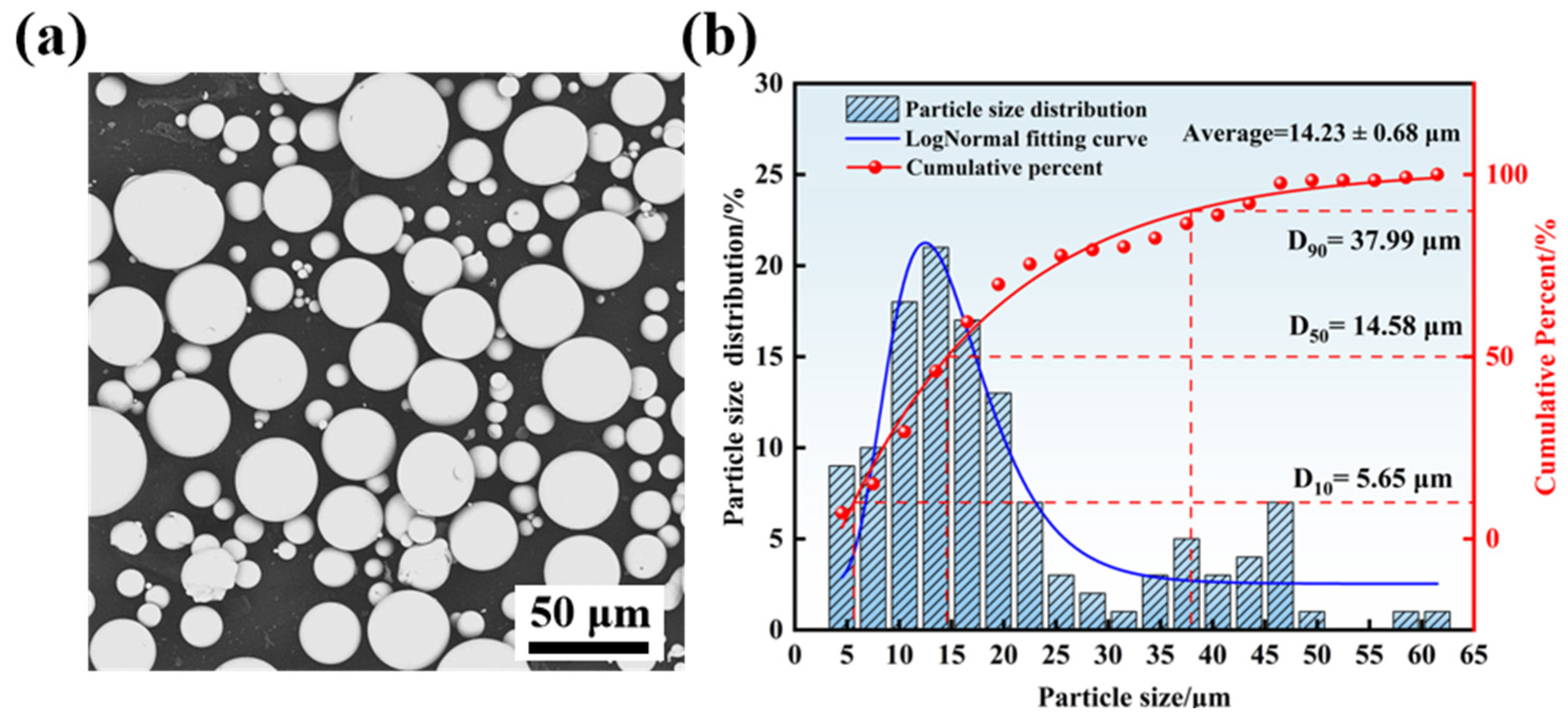
The size of the WC9 alloy steel substrate is 50 mm (length) × 50 mm (width) × 10 mm (height), while the laser cladding powder is Stellite 12. The chemical compositions of the WC9 alloy steel (Zhejiang Guangzheng Valve Co., Ltd., Wenzhou, China) and the Stellite 12 (Hebei Guifa Alloy Wear-resistant material Co., Ltd., Xingtai, China) provided by the supplier are shown in Table 1, and Figure 1 illustrates the morphology and particle size distribution of the Stellite 12 powder [15].
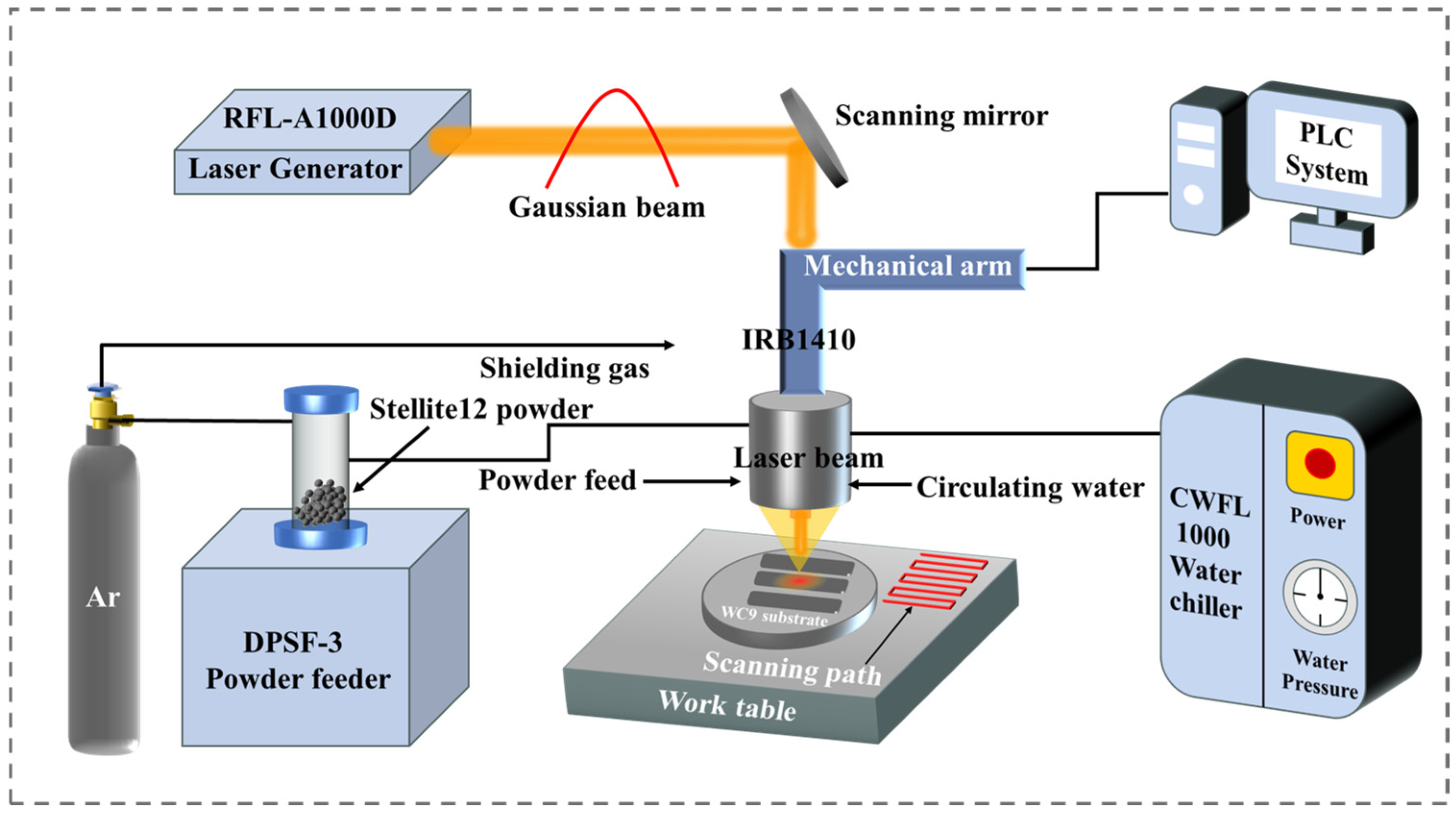
The laser cladding system of this study is shown in Figure 2. The system primarily consisted of a laser cladding head (Zhejiang Jiuheng Optoelectronics Technology Co., Ltd., Wenzhou, China), a fiber laser (Wuhan Raycus Fiber Laser Technologies Co., Ltd., Wuhan, China), a six-axis robot (ABB Asea Brown Boveri Ltd., Zurich, Switzerland), a motion control unit (Zhejiang Jiuheng Optoelectronics Technology Co., Ltd., Wenzhou, China), a carrier-gas powder feeder (Jiangsu Zhufeng Laser Technology Co., Ltd., Zhenjiang, China), and a water-cooling system (Guangdong S&A Mechatronics Co., Ltd., Guangzhou, China). During laser cladding process, the distance from cladding head to the surface of substrate was 10 mm, while the laser spot diameter was set to 2 mm. To prevent oxidation of the deposited coating, argon shielding gas was introduced at a flow rate of 10 L/min.
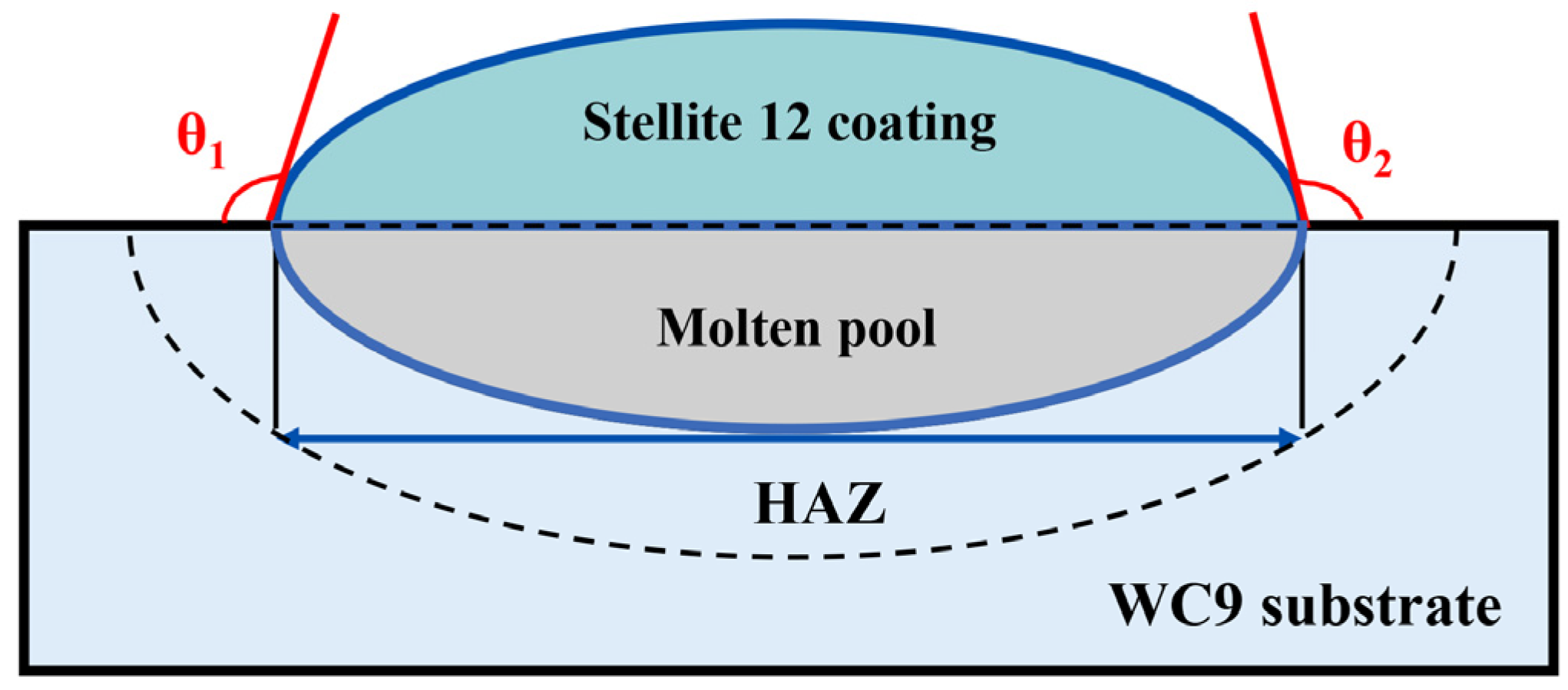
Before fabrication of coating, the Stellite 12 alloy powder was dried in a vacuum drying oven at 120 °C for 120 min to remove adsorbed moisture [21]. The substrate was mechanically ground and cleaned with anhydrous ethanol to avoid affecting the quality of the coatings. The cross-sectional specimens with dimensions of 10 mm (length) × 3 mm (width) × 10 mm (height) were used for optical microscope observation. The cross-sectional samples were cold-mounted and cured, followed by progressive grinding with SiC abrasive papers ranging from #180 to #2000 grit. After mechanical polishing, the cross-sections were etched with an aqua regia solution for 60 s, immediately rinsed with anhydrous ethanol, and dried with cold air. An optical microscope was utilized to observe the cross-sections, and the captured images were imported into ImageJ 1.53t software to measure and calculate the cladding angle and cladding efficiency of the coatings. The measurement method for the cladding angle θ is expressed in Equation (1), where θ1 and θ2 represent the cladding angles on both sides. The measurement method for the cladding efficiency η is expressed in Equation (2), where S denotes the cross-sectional area of the deposited coating strictly above the substrate surface and V represents the laser scanning speed. A schematic diagram of the molten pool geometric parameters is presented in Figure 3.
θ = θ 1 + θ 2 2
η = S × V

3. Results and Discussion

3.1. Central Composite Design Experimental Design

To construct a high-precision predictive model, Central Composite Design (CCD) was utilized to plan the experimental matrix in this study. The input variables and notation of laser cladding process parameters are shown in Table 2, and cladding efficiency and cladding angle were chosen as the response variables. The standard CCD matrix consisted of 30 experimental runs. For a system containing four independent variables (k = 4), the axial distance parameter α was set to 2 to ensure the rotatability of the response surface model. The optimal empirical model for the process parameters and response indicators was obtained via stepwise regression analysis, and the relationships between them were analyzed using the fitted model, as expressed in Equation (3).
y = β 0 + i = 1 k β i x i + i = 1 k β i i x i 2 + i < j k β i j x i x j + ε
where y is the predicted response value, β0 is the interception coefficient, βi, βii, and βij are the regression coefficient for the linear, quadratic, and interaction term, xi and xj represent the laser cladding process parameters, k is the number of factors, and ε represents the error [15,22].
The specific parameter levels are listed in Table 2 [15], while the CCD experimental matrix and the corresponding results are presented in Table 3.

3.2. Analysis of Variance (ANOVA)

Design-Expert 13.0.1.0 software (Stat-Ease, Inc., Minneapolis, MN, USA) was utilized for data analysis. The corresponding second-order regression models between parameters and variables were constructed according to Table 3. Subsequently, the validity of the constructed models was evaluated through analysis of variance (ANOVA) [23], with the relevant results summarized in Table 4. As shown in the table, the p-values of Equations (4) and (5) were less than 0.0001, indicating that the fitting degree of the models was highly significant [24]. The lack-of-fit values for Equations (4) and (5) were greater than 0.05, demonstrating that the lack of fit was statistically insignificant, which implies that the models were reliable.
The R2, Adeq Precision, Adjusted R2, and Predicted R2 were analyzed to evaluate the accuracy of Equations (4) and (5). The determination coefficient (R2) values of the two models were 0.9002 and 0.8559, respectively; the optimal value of the determination coefficient (R2) is 1. The Adeq Precision values for the two models were 14.6985 and 15.8577, respectively, which were greater than the threshold of 4. Furthermore, the difference between the Adjusted R2 and Predicted R2 was less than 0.2, proving the consistency between the model predictions and experimental measurements. Consequently, the robustness of the regression predictive models was validated [25,26]. Therefore, mathematical models correlating the process parameters and response variables were established after performing stepwise regression analysis. Some interaction terms in the models exhibited p-values greater than 0.05, placing them within the conventional insignificant range; however, removing these terms caused a decrease in both the Adjusted R2 and Predicted R2, indicating a reduction in the predictive capability of the models. Therefore, these terms were retained to maintain the models’ performance [27,28]. Finally, the empirical models in terms of actual values were constructed as follows:
C l a d d i n g e f f i c i e n c y A c t u a l                                                         = 33.59238 + 0.074134 × L P + 5.14560 × S S                                                         + 0.548452 × P F 0.082833 × O R                                                         + 0.000542 × L P × P F + 0.000319 × L P × O R                                                         0.029500 × S S × O R 0.000072 × L P 2                                                         0.546429 × S S 2 0.011807 × P F 2
C l a d d i n g a n g l e A c t u a l                                                         = 218.35646 + 0.030246 × L P 1.92542 × S S                                                         7.17171 × P F 0.622375 × O R                                                         + 0.748875 × S S × P F + 0.153312 × S S × O R                                                         1.32367 × S S 2 + 0.073353 × P F 2

3.3. Analysis of Model

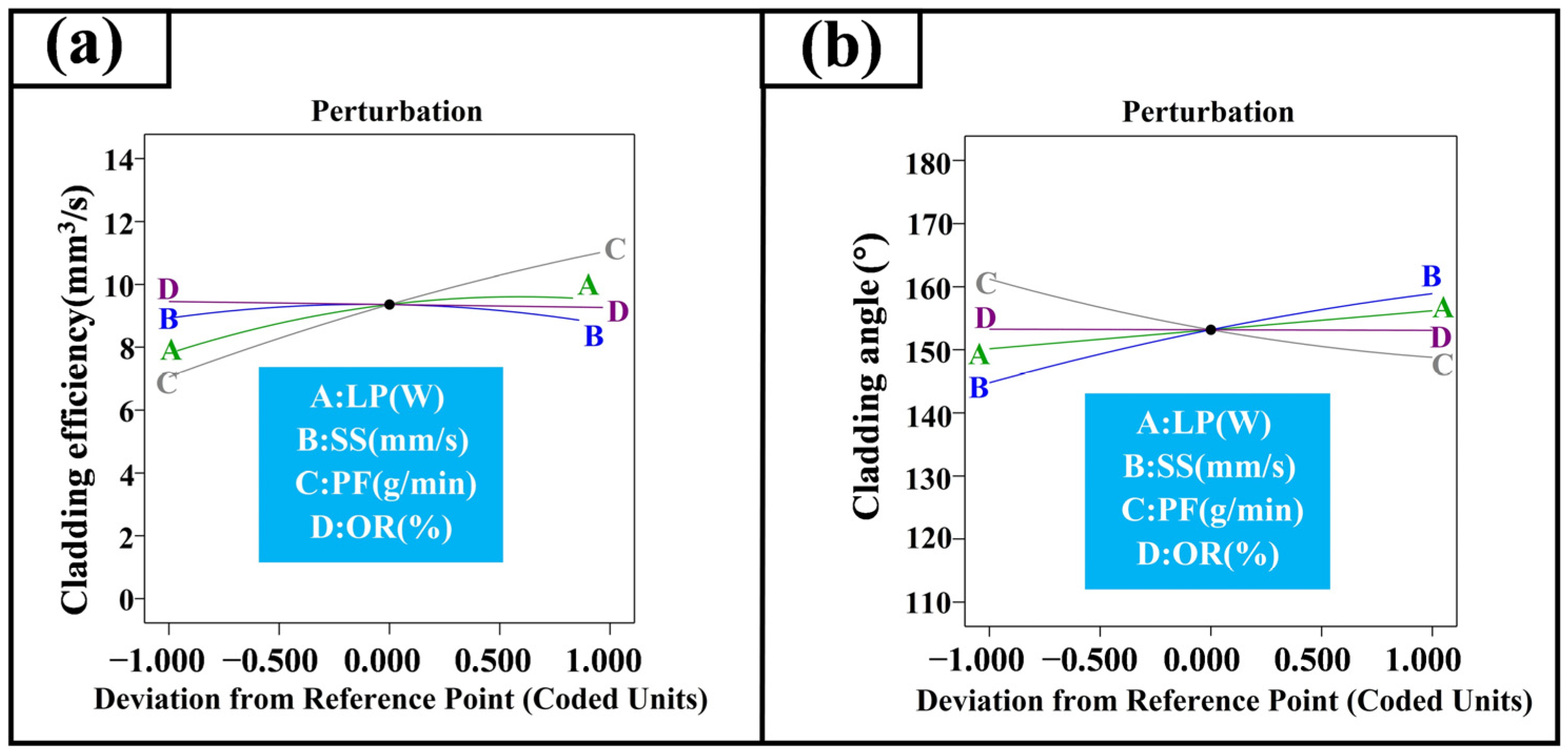
The influence of various process parameters on the cladding efficiency and cladding angle is presented in Figure 4. As shown in Figure 4a, both the powder feed rate (C) and laser power (A) exhibit a significant positive correlation with the cladding efficiency. In contrast, the scanning speed (B) and overlap ratio (D) demonstrate a relatively mild influence. Based on the absolute slopes of the curves and the ANOVA results in Table 4, the significance of the factors affecting cladding efficiency is ranked as follows: powder feed rate > laser power > scanning speed > overlap ratio. Therefore, the powder feed rate is identified as the most significant factor affecting cladding efficiency, followed by laser power, whereas the overlap ratio exerts the weakest influence. The conclusions of Figure 4 are consistent with the ANOVA results in Table 4.
The influence curves for the cladding angle are depicted in Figure 4b. Both the scanning speed (B) and laser power (A) exhibit a positive correlation with the cladding angle. Notably, the scanning speed exerts the most significant positive effect. Conversely, the powder feed rate (C) demonstrates a pronounced negative correlation. By comparing the absolute slopes of the respective curves in conjunction with the ANOVA results, the degree of influence on the cladding angle is determined as follows: scanning speed > powder feed rate > laser power > overlap ratio. Thus, the scanning speed is concluded to be the most critical factor governing the cladding angle.

3.3.1. Analysis of Cladding Efficiency

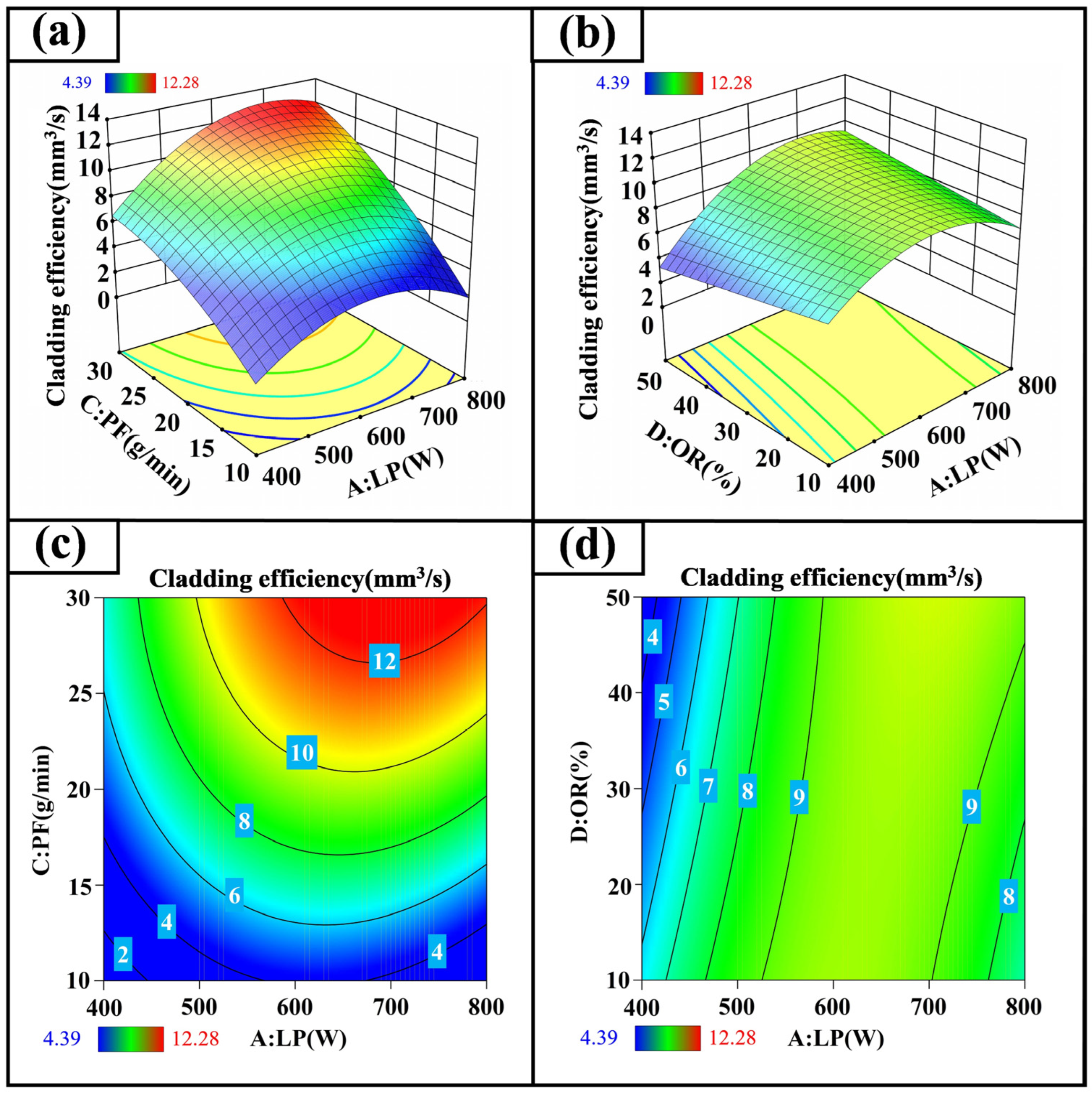
Cladding efficiency serves as a vital indicator to evaluate the economics of material deposition and manufacturing efficiency. A higher cladding efficiency indicates a larger volume of effectively deposited material per unit time, thereby contributing to reduced production costs and enhanced manufacturing efficiency [29]. The 3D response surface and contour plots illustrating the interactive effects of different process parameters on the cladding efficiency are presented in Figure 5. As shown in Figure 5a,c, the cladding efficiency exhibits a sharp upward trend with the simultaneous increase in powder feed rate and laser power. This is attributed to a significant increase in the amount of Stellite 12 alloy powder entering the melt pool per unit time. Meanwhile, the higher laser power provides sufficient heat input. Consequently, the large amount of Stellite 12 alloy powder is completely melted, greatly enhancing the powder utilization rate. Conversely, if the powder feed rate is increased under a low laser power, the input energy is insufficient to completely melt the excess powder, leading to the spattering and loss of unmelted powder. As a result, the powder utilization rate decreases, and the cladding efficiency remains at a relatively low level.
The interactive effects between laser power and overlap ratio on the cladding efficiency are depicted in Figure 5b,d. It can be observed that at a constant overlap ratio, raising the laser power effectively increases the energy input into the melt pool. Driven by this high energy, more Stellite 12 alloy powder is completely melted per unit time, thus improving the cladding efficiency. However, a gradually decreasing trend in cladding efficiency is observed as the overlap ratio increases. This occurs because an increase in the overlap ratio signifies a larger overlapping area between adjacent cladding tracks, causing a portion of the laser energy and processing time to be consumed by the secondary remelting of the previously solidified track. On the one hand, the leveling tendency of the melt pool is diminished, thereby reducing the effective width of the coating. On the other hand, a portion of the delivered powder is deposited on the already-formed coating rather than directly on the substrate, consequently limiting further improvements in cladding efficiency.

3.3.2. Analysis of Cladding Angle

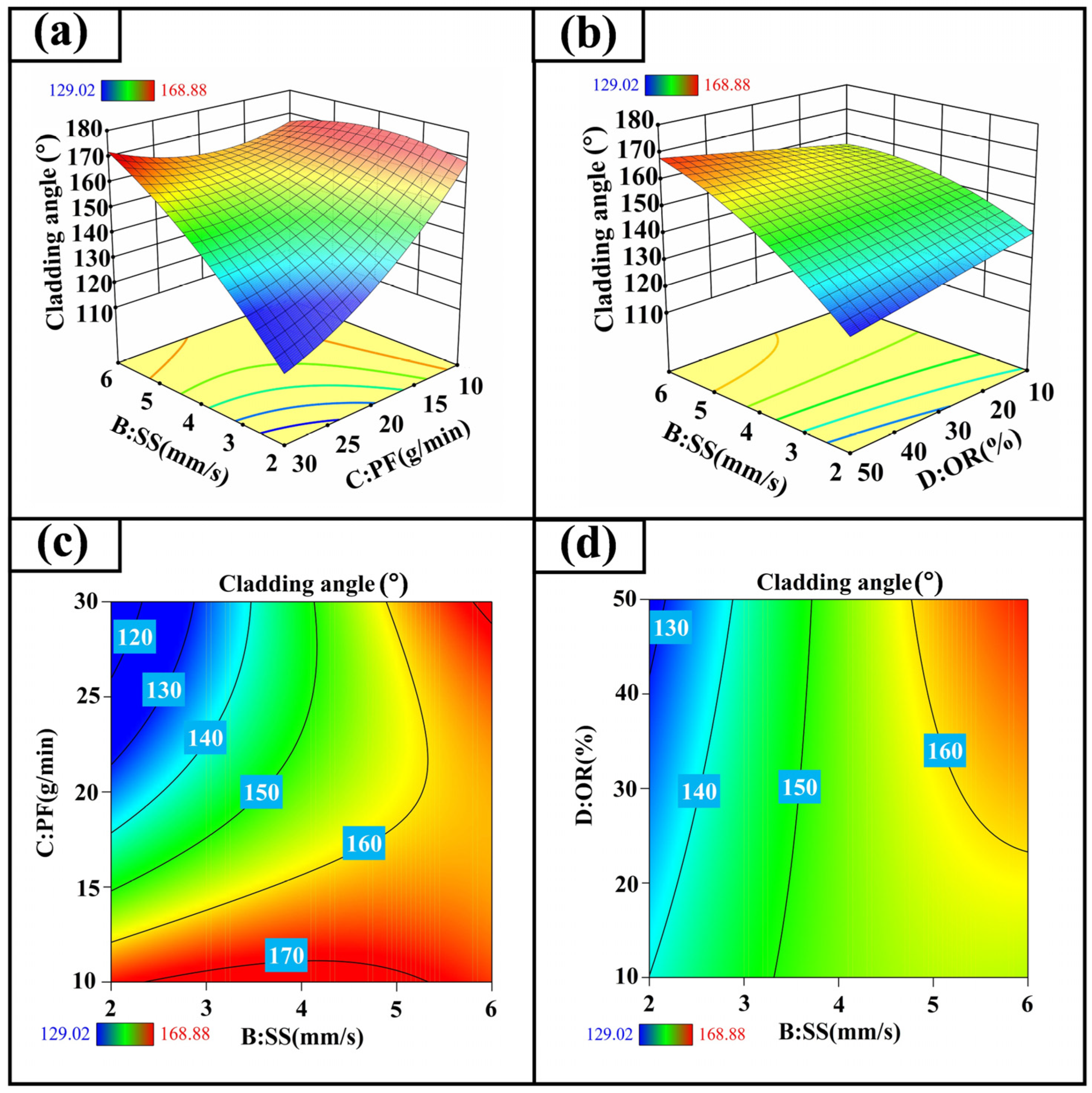
The cladding angle serves as a key indicator to evaluate the wettability between the coating and the substrate. A larger cladding angle indicates better wettability and a stronger transverse spreading capability of the molten pool on the substrate surface, thereby contributing to a significantly enhanced metallurgical bond strength between the Stellite 12 coating and the WC9 substrate. The 3D response surface and contour plots illustrating the interactive effects of different process parameters on the cladding angle are presented in Figure 6. As shown in Figure 6a,c, the cladding angle exhibits a significant decreasing trend with the increase in powder feed rate and decrease in scanning speed. A sharp increase in the powder deposition amount per unit length is caused by the combination of a high powder feed rate and a low scanning speed. Although the powder melting amount per unit time increases, melting the excess Stellite 12 alloy powder consumes more energy within the molten pool. Consequently, the effective spreading time of the liquid metal is restricted; therefore, it is difficult for the excess molten metal to fully spread transversely on the WC9 alloy steel surface within an extremely short duration. This transforms the cross-sectional morphology of the coating from an elliptical-like shape to a circular-like shape, macroscopically manifested as a significant decrease in the cladding angle. Conversely, at a constant powder feed rate, the cladding angle increases significantly under a high scanning speed condition because the acceleration of the scanning speed markedly reduces the powder deposition amount per unit length, thereby forming a thinner single cladding track. Driven by Marangoni convection [30], the smaller amount of molten metal can rapidly and fully spread transversely on the substrate surface, forming a coating with a relatively flat contour.
The interactive effects between the scanning speed and overlap ratio on the cladding angle are reflected in Figure 6b,d. It can be clearly observed from the contour plot in Figure 6d that the contour lines are almost perpendicular to the scanning speed axis, indicating that the influence of the overlap ratio on the cladding angle is extremely weak within the investigated parameter range. In contrast, the scanning speed plays an absolutely dominant role. Regardless of the variation in the overlap ratio, a monotonically increasing trend of the cladding angle is consistently observed with the increase in scanning speed. This occurs because the cladding angle primarily reflects the macroscopic spreading and deposition characteristics of the outermost edge of the Stellite 12 coating on the unmelted substrate. Variations in the overlap ratio mainly affect the overlap percentage and heat accumulation effect within the multi-track coating, which is insufficient to significantly alter the boundary morphology and spreading behavior of the molten pool at the outermost edge. Meanwhile, the height and volume of the single-track coating are directly reduced by the increase in scanning speed, promoting the coating edge to conform more easily to the substrate to achieve flat spreading. Ultimately, this leads to a significant increase in the cladding angle [31].

4. Model Validation and Optimization

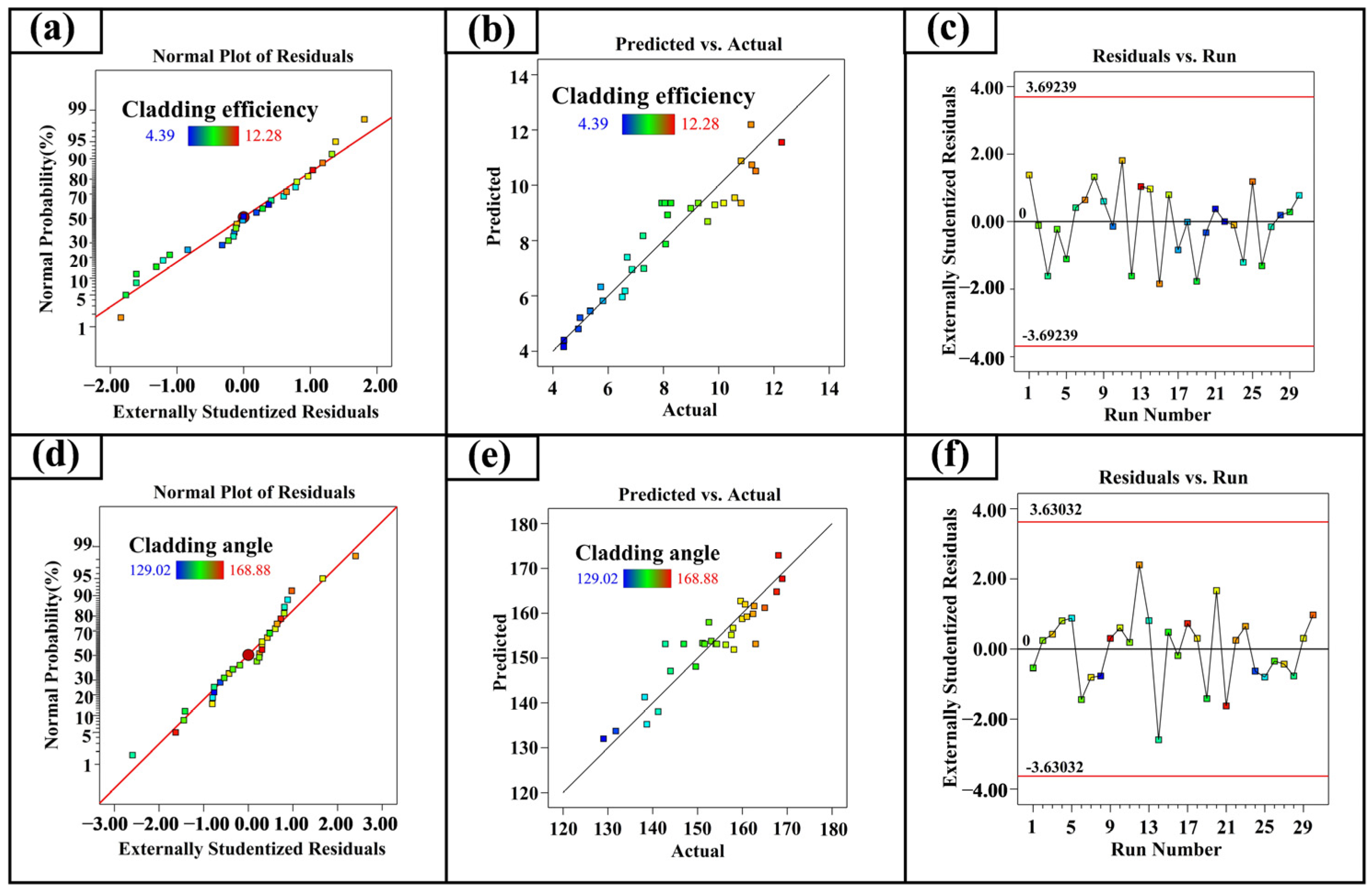
To verify the accuracy and statistical reliability of the established response surface regression models, a diagnostic analysis of the residual distribution patterns and prediction accuracy was conducted in this study, with the results shown in Figure 7. The normal probability plots of residuals for cladding efficiency and cladding angle are presented in Figure 7a,d, respectively [32]. The results showed that the externally studentized residual data points for both response variables are distributed approximately along a straight line, indicating that the error terms of the experimental data follow a normal distribution. Thus, the basic statistical assumptions of response surface regression analysis are fully satisfied, demonstrating the good adequacy of the models [33].
The comparisons between the predicted and actual values for cladding efficiency and cladding angle are displayed in Figure 7b,e, respectively. All experimental scatter points in the figures are evenly distributed on both sides of the y = x line, proving that the established second-order regression models possess extremely high fitting accuracy. Consequently, the errors between the predicted and actual values are relatively small, accurately reflecting the relationships between process parameters and response variables.
The variation patterns of residuals with the experimental run order are illustrated in Figure 7c,f. The residual points of both variables exhibit an irregular and random distribution above and below the zero-reference line. No obvious periodic or monotonic trends appear, and all points are distributed within the red warning limits. This further confirms the strong independence of the experimental observations [34], thereby ruling out any time-dependent lurking variables during the experimental process. It can be summarized that the predictive models for cladding efficiency and cladding angle established in this study are reasonable and highly reliable and can be effectively utilized for subsequent process parameter optimization and prediction.
A larger cladding angle indicates better wettability at the interface between the coating and the substrate, which greatly facilitates the formation of a strong metallurgical bond. Therefore, the cladding angle should be maximized to achieve a flat spreading morphology. Meanwhile, maximizing cladding efficiency is equally crucial in practical engineering applications. A higher cladding efficiency implies that more powder is deposited onto the substrate under the same energy input, thereby significantly enhancing manufacturing efficiency, drastically reducing powder loss, and consequently lowering production costs while guaranteeing the forming quality of the coating.
Therefore, maximizing both the cladding angle and cladding efficiency was set as the optimization objective. Optimization experiments were conducted based on the parameters in Table 5, and the results are presented in Table 6. The predicted process parameters were as follows: laser power = 765.90 W, scanning speed = 4.978 mm/s, powder feed rate = 30 g/min, and overlap ratio = 50%. However, given the instrumental precision constraints, the actual operating parameters were revised to 750 W, 5 mm/s, 30 g/min, and 50%. For the coating produced under these revised conditions, the experimentally determined cladding efficiency and cladding angle were 11.36 mm3/s and 155.21°, respectively. The cross-sectional morphology (Figure 8) clearly illustrates that the coating is devoid of cracks and incomplete fusion defects, thus robustly attesting to the effectiveness of the constructed models.

5. Conclusions

In this study, the Central Composite Design (CCD) approach within the Response Surface Methodology (RSM) was adopted to systematically investigate the relationships between the process parameters (laser power, scanning speed, powder feed rate, and overlap ratio) and the response variables (cladding efficiency and cladding angle) of multi-track overlapping Stellite 12 coatings on WC9 alloy steel surfaces. To explore the interrelationships between the laser cladding process parameters, cladding efficiency, and cladding angle, mathematical models were constructed, and their reliability was validated through multi-objective optimization. The present work furnishes a theoretical underpinning for the multi-track laser cladding of Stellite 12 alloy on WC9 steel substrates. The conclusions are summarized as follows:
(1)
The powder feed rate and laser power exert a significant influence on the cladding efficiency, whereas the overlap ratio and scanning speed have a relatively minor effect. An extremely high cladding efficiency can be achieved by synergistically increasing the laser power and powder feed rate.
(2)
The scanning speed plays a dominant role in governing the cladding angle, while the influence of the overlap ratio is extremely weak. Excessive accumulation of powder per unit length is easily triggered by the combination of a low scanning speed and a high powder feed rate, leading to a relatively small external cladding angle. Material accumulation can be effectively reduced by appropriately increasing the scanning speed, thereby promoting the full transverse spreading of the molten pool. Consequently, a coating with a larger cladding angle and a flat contour is formed.
(3)
An ideal combination of process parameters was determined through multi-objective optimization aiming to maximize cladding efficiency and optimize cladding angle. Experimental verification was conducted using this optimized parameter scheme, successfully fabricating a Stellite 12 coating with both high manufacturing efficiency and excellent wettability. The actual measured cladding efficiency and cladding angle were 11.36 mm3/s and 155.21°, respectively. The relative errors between the model predicted values and the experimental verification values were 7.22% and 8.81%, respectively, fully proving the favorable accuracy of the predictive models.

Author Contributions

Y.Z. (Yu Zhang): Writing—original draft, Methodology, Investigation, Formal analysis. Y.Z. (Yang Zhang): Writing—review & editing, Writing—original draft, Formal analysis. Y.Y.: Formal analysis, Supervision. H.Z.: Writing—original draft, Methodology, Investigation, Formal analysis, Supervision. All authors have read and agreed to the published version of the manuscript.

Funding

This research was founded by PhD research startup foundation of Zhejiang Industry & Trade Vocational College (No. YJRC202304).

Institutional Review Board Statement

Not applicable.

Informed Consent Statement

Not applicable.

Data Availability Statement

The data presented in this study are available on request from the corresponding authors.

Acknowledgments

We appreciate the support from the PhD research startup foundation of Zhejiang Industry & Trade Vocational College (No. YJRC202304).

Conflicts of Interest

The authors declare that they have no known competing financial interests or personal relationships that could have appeared to influence the work reported in this paper.

References

  1. Fu, J.; Gui, W.; Qin, J.; Lin, J.; Ren, X.; Luan, B. High-speed laser-clad 3533-00 fe-based cemented carbide coatings on nuclear power valve sealing surface to enhanced wear and corrosion resistance. Surf. Coat. Technol. 2024, 480, 130594. [Google Scholar] [CrossRef]
  2. Tankal, K.; Güney, B.; Erden, M.A. A comparative study of thermal sprayed al2o3-tio2 coatings on pm aisi 316l. Eng. Sci. Technol. Int. J. 2024, 60, 101895. [Google Scholar] [CrossRef]
  3. Liu, C.; Wang, Y.; Gu, B.; Xu, G.; Guo, H.; Sun, S.; Pan, L. Effect of ultrasonic impact treatment on the wear and corrosion resistance of laser cladding stellite 6 alloy coating. J. Alloys Compd. 2025, 1041, 183823. [Google Scholar] [CrossRef]
  4. Monnet, A.; Fras, T.; Kazup, Á.; Bahi, S.; Rusinek, A.; Guitton, A. Multi-scale characterization of a high chromium-carbon based hardfacing alloy welded by flux-cored arc welding. Mater. Charact. 2026, 233, 116038. [Google Scholar] [CrossRef]
  5. Ma, P.; Lin, Y.; Yu, H.; Xue, Z.; Zhang, Z.; Zhao, S.; Zhang, S. Preparation and thermal shock cycling performance of plasma-sprayed y2zr2o7-y3al5o12 thermal barrier coating. Surf. Coat. Technol. 2026, 526, 133366. [Google Scholar] [CrossRef]
  6. Kokai, A.L.; Maros, M.B. Impact of iron-oxide content in thermally sprayed cylinder coatings on honing tool wear and machining time in serial production. Tribol. Int. 2026, 221, 112040. [Google Scholar] [CrossRef]
  7. Zhang, Y.; Wang, Y.; Yu, H.; Sun, J.; Shi, Z.; Zhang, X. Electroplated ni/cu/ni coatings on sintered nd-fe-b magnets: Influence of layer structure on the anti-corrosion, magnetic and mechanical properties. Appl. Surf. Sci. 2026, 737, 166871. [Google Scholar]
  8. Zhou, L.; Ma, G.; Zhao, H.; Mou, H.; Xu, J.; Wang, W.; Xing, Z.; Li, Y.; Guo, W.; Wang, H. Research status and prospect of extreme high-speed laser cladding technology. Opt. Laser Technol. 2024, 168, 109800. [Google Scholar]
  9. Gan, R.; Liu, Z.; Kong, Y.; Chang, Y.; Shen, Y.; Li, J.; Ning, H. Preparation and properties of cu/cu-sn alloy cladding layers on titanium alloy by laser cladding. J. Alloys Compd. 2025, 1020, 179547. [Google Scholar]
  10. Zhang, P.; Li, Z.; Liu, H.; Zhang, Y.; Li, H.; Shi, C.; Liu, P.; Yan, D. Recent progress on the microstructure and properties of high entropy alloy coatings prepared by laser processing technology: A review. J. Manuf. Process. 2022, 76, 397–411. [Google Scholar] [CrossRef]
  11. Cui, G.; Liu, L.; Cui, H.; Yan, X.; Kou, Z. Microstructure modification and enhanced high-temperature tribological properties of stellite 12 matrix coatings via in-situ synthesized silicides assisted laser cladding. Opt. Lasers Eng. 2026, 196, 109436. [Google Scholar]
  12. Cui, G.; Han, W.; Zhang, W.; Li, J.; Kou, Z. Friction and wear performance of laser clad mo modified stellite 12 matrix coatings at elevated temperature. Tribol. Int. 2024, 196, 109738. [Google Scholar] [CrossRef]
  13. Cheng, F.; Sun, J.; Wang, Z.; Cao, Y.; Zheng, L. Cavitation erosion of laser-clad stellite coating on slm316l steel. Results Phys. 2026, 85, 108666. [Google Scholar] [CrossRef]
  14. Yang, W.; Zhang, K.; Zeng, D.; Liu, J.; Li, F.; Liu, W. Microstructure evolution and wear behavior of stellite12 coating prepared by laser-directed energy deposition on h13 steel. Mater. Today Commun. 2024, 41, 110960. [Google Scholar] [CrossRef]
  15. Zhang, H.; Zhang, Y. Multi-objective optimization of laser cladding parameters for stellite 12 coatings using central composite design (ccd). Coatings 2026, 16, 537. [Google Scholar] [CrossRef]
  16. Huang, G.; Liu, Y. Laser cladding of b4c-ti64 composite coating: Multi-objective process optimization, and investigation on microstructure, microhardness, and wear behavior. Surf. Coat. Technol. 2025, 520, 133001. [Google Scholar]
  17. Li, Z.; Du, Y.; He, G.; Liang, Q. Parameters optimization for single-track laser cladding based on mpa-svr and a-nsga-iii. Opt. Laser Technol. 2024, 169, 110069. [Google Scholar] [CrossRef]
  18. Ni, X.; Zhang, J.; Zhao, Y.; Fang, Q.; Wu, Y.; Liu, Y.; Chen, H. Research on machine learning-based cobalt-based alloy laser cladding process and process-property analysis. Surf. Coat. Technol. 2026, 528, 133402. [Google Scholar]
  19. Peng, S.; Li, T.; Zhao, J.; Lv, S.; Tan, G.Z.; Dong, M.; Zhang, H. Towards energy and material efficient laser cladding process: Modeling and optimization using a hybrid ts-gep algorithm and the nsga-ii. J. Clean. Prod. 2019, 227, 58–69. [Google Scholar] [CrossRef]
  20. Olakanmi, E.; Nyadongo, S.; Malikongwa, K.; Lawal, S.A.; Botes, A.; Pityana, S. Multi-variable optimisation of the quality characteristics of fiber-laser cladded inconel-625 composite coatings. Surf. Coat. Technol. 2019, 357, 289–303. [Google Scholar] [CrossRef]
  21. Zhang, Y.; Zhang, Y.; Yin, Y.; Zhang, H. Multi-objective optimization of process parameters for laser cladding of stellite12 alloy multi-track wear-resistant coatings. Int. J. Adv. Manuf. Technol. 2026, 144, 4257–4277. [Google Scholar]
  22. Rahman, N.; Kamaruddin, A.; Uzir, M. Continuous biosynthesis of farnesyl laurate in packed bed reactor: Optimization using response surface methodology. J. Appl. Sci. 2010, 10, 1110. [Google Scholar] [CrossRef]
  23. Dean, A.; Voss, D.; Draguljić, D. Response surface methodology. In Design and Analysis of Experiments; Springer: Cham, Switzerland, 2017; pp. 565–614. [Google Scholar]
  24. Duan, B.; Zhao, H.; Lin, N.; Zhou, L.; Wang, X.; Ma, G.; Wang, H.; Wu, Y. Predictive modelling and process optimisation of high-speed laser cladding fecrnimo0.75 alloy coating on 45# steel. Mater. Today Commun. 2025, 44, 112107. [Google Scholar]
  25. Hashemi, S.H.; Vafaei, R.; Razavi, R.S. Statistical-experimental modeling of the effect of process parameters on geometric characteristics of laser cladding of stellite 6 on ss316 using second-order regression. J. Mater. Res. Technol. 2024, 28, 2727–2739. [Google Scholar]
  26. Yong, Z.; Wang, Y.; Yang, G.; Shi, Y.; Zhang, Q.; Yao, J. Optimization for furnace-assisted laser cladding process parameter of crack-free ceramic-based coating by response surface methodology. Ceram. Int. 2025, 51, 11735–11746. [Google Scholar] [CrossRef]
  27. Li, J.; Wang, C.; Wang, T.; Gao, S.; Chai, L.; Cao, H. Wear behavior of laser-cladded al39mo10 (nbtati) 51 refractory high-entropy alloy with response surface-optimized parameters. Tribol. Int. 2026, 217, 111670. [Google Scholar] [CrossRef]
  28. Li, Z.; Chen, M.; Ding, F.; Xie, D.; Zhou, K.; Naqvi, S.M.R.; Gu, J.; Gao, X.; Wang, D.; Nasir, M.A. Hybrid multi-objective optimization based on response surface methodology for laser-cladding repair and remanufacturing technology. Opt. Laser Technol. 2025, 183, 112347. [Google Scholar] [CrossRef]
  29. Reddy, L.; Preston, S.P.; Shipway, P.; Davis, C.; Hussain, T. Process parameter optimisation of laser clad iron based alloy: Predictive models of deposition efficiency, porosity and dilution. Surf. Coat. Technol. 2018, 349, 198–207. [Google Scholar] [CrossRef]
  30. Wang, M.; Liu, X.; Jia, H.; Zhu, Y.; Wei, Y.; Shi, T. Process optimization, interface microstructure and performance of inconel 625 coating on k4002 nickel-based superalloy by inside-laser coaxial powder feeding deposition. J. Alloys Compd. 2025, 1047, 184950. [Google Scholar] [CrossRef]
  31. Khorram, A.; Jamaloei, A.D.; Paidar, M.; Cao, X. Laser cladding of inconel 718 with 75cr3c2+ 25 (80ni20cr) powder: Statistical modeling and optimization. Surf. Coat. Technol. 2019, 378, 124933. [Google Scholar] [CrossRef]
  32. Zhang, H.; Choi, J.P.; Moon, S.K.; Ngo, T.H. A hybrid multi-objective optimization of aerosol jet printing process via response surface methodology. Addit. Manuf. 2020, 33, 101096. [Google Scholar] [CrossRef]
  33. Mandal, I.; Kumar, V.; Saha, P. Magnetic-field-assisted laser cladding of sdss 2507 on ss 420: An experimental investigation and multi-objective optimization. Opt. Laser Technol. 2025, 192, 113603. [Google Scholar]
  34. Lestari, W.D.; Adyono, N.; Faizin, A.K.; Haqiyah, A.; Sanjaya, K.H.; Nugroho, A.; Kusmasari, W.; Ammarullah, M.I. Optimization of 3d printed parameters for socket prosthetic manufacturing using the taguchi method and response surface methodology. Results Eng. 2024, 21, 101847. [Google Scholar] [CrossRef]
Figure 1. (a) The morphology of the Stellite 12 powder; (b) the particle size distribution of the Stellite 12 powder.
Coatings 16 00799 g001
Figure 2. Schematic diagram of laser cladding system.
Coatings 16 00799 g002
Figure 3. Schematic diagram of the molten pool geometric parameters.
Coatings 16 00799 g003
Figure 4. Relationship diagrams of laser cladding process parameters on response indicators: (a) cladding efficiency; (b) cladding angle.
Coatings 16 00799 g004
Figure 5. The response surface and contour plots between cladding parameters and cladding efficiency: (a,c) laser power and powder feed rate; (b,d) laser power and overlapping ratio.
Coatings 16 00799 g005
Figure 6. The response surface and contour plots between cladding parameters and cladding angle: (a,c) scanning speed and powder feed rate; (b,d) scanning speed and overlap ratio.
Coatings 16 00799 g006
Figure 7. Cladding efficiency model: (a) normal plot pf residuals; (b) predicted versus actual values; (c) comparison plot of residuals versus run order. Cladding angle model: (d) normal plot pf residuals; (e) predicted versus actual values; (f) comparison plot of residuals versus run order.
Coatings 16 00799 g007
Figure 8. Cross-sectional optical morphology of the Stellite 12 coating fabricated under optimal process parameters (laser power = 750 W, scanning speed = 5 mm/s, powder feed rate = 30 g/min, and overlap ratio = 50%).
Coatings 16 00799 g008
Table 1. Chemical composition of the Stellite 12 powder and WC9 substrate (wt.%) [15].
MaterialCoCrWNiFeSiCMoMnSP
Stellite 12Bal.29.677.872.932.861.421.310.350.21--
Substrate-2.0~2.75--Bal.<0.60<0.180.90~1.200.40~0.70<0.045<0.04
Table 2. Test parameter variables.
VariablesNotationUnitSymbolLevels of Input Variables
Code−2−1012
Laser powerLPWAActual400500600700800
Scanning speedSSmm/sB23456
Powder feed ratePFg/minC1015202530
Overlap ratioOR%D1020304050
Table 3. Central composition design and results.
RunInput Variables Response Variables
Laser Power
(W)
Scanning Speed
(mm/s)
Powder Feed Rate
(g/min)
Overlap
Ratio
(%)
Cladding Efficiency
(mm3/s)
Cladding
Angle
(°)
16004201010.58151.11
2600420309.26154.30
3800420307.26160.99
4600420508.99156.29
5500325208.15138.68
6700315407.29152.53
77005254011.20159.60
8500325409.60129.02
9700515406.61168.88
10500315205.35157.54
116004203010.81154.05
12600420308.05162.95
137003254012.28141.21
146004203010.18142.80
156004303011.17149.60
16500525209.86153.06
17700515205.73167.63
18500515205.81159.95
19600420307.94146.92
20500315404.98158.10
21600410304.39168.04
22500515404.40162.62
237005252010.81162.38
24600220306.69131.76
257003252011.34138.20
26600420308.27151.57
27600620306.86160.62
28400420304.92143.96
29500525408.08157.91
30700315206.51164.98
Table 4. ANOVA of both models.
SourceCladding EfficiencyCladding Angle
F-Valuep-ValueF-Valuep-Value
Model17.13<0.000115.59<0.0001Significant
A-LP20.910.00029.900.0049
B-SS0.36190.554653.95<0.0001
C-PF118.82<0.000141.72<0.0001
D-OR0.27060.60900.00900.9253
AC1.450.2441//
AD2.000.1739//
BC//10.110.0045
BD1.710.20671.700.2070
A217.700.0005//
B210.260.00472.250.1488
C22.990.09974.310.0503
Adeq Precision14.6985 15.8577
R20.9002 0.8559
Adjusted R20.8476 0.8010
Predicted R20.7619 0.7332
Lack of Fit0.40520.91620.29420.9722Not significant
Table 5. Optimization of cladding efficiency and cladding angle.
NameGoalLower LimitUpper LimitLower WeightUpper WeightImportance
A (W)in range400800113
B (mm/s)in range26113
C (g/min)in range1030113
D (%)in range1050113
Cladding efficiencymaximize4.3912.28115
Cladding anglemaximize129.02168.88114
Table 6. Model validation results.
PredictedExperimentalError
Cladding efficiency12.1811.367.22%
Cladding angle168.88155.218.81%
Disclaimer/Publisher’s Note: The statements, opinions and data contained in all publications are solely those of the individual author(s) and contributor(s) and not of MDPI and/or the editor(s). MDPI and/or the editor(s) disclaim responsibility for any injury to people or property resulting from any ideas, methods, instructions or products referred to in the content.