Article

Plasma-Enhanced Atomic Layer Deposition of Metallic Tantalum Protective Coatings for PEMWE Bipolar Plates


1
Key Laboratory for Green Chemical Technology of Ministry of Education, School of Chemical Engineering & Technology, Collaborative Innovation Center for Chemical Science & Engineering, Tianjin University, Tianjin 300072, China
2
International Joint Laboratory of Low-Carbon Chemical Engineering of Ministry of Education, Tianjin 300350, China
3
Zhejiang Institute of Tianjin University, Ningbo 315201, China
4
Haihe Laboratory of Sustainable Chemical Transformations, Tianjin 300192, China
5
Joint School of National University of Singapore and Tianjin University, International Campus of Tianjin University, Fuzhou 350207, China
6
International Campus of Tianjin University, Binhai New City, Fuzhou 350207, China
7
National Industry-Education Platform of Energy Storage, Tianjin 300350, China
*
Author to whom correspondence should be addressed.
Coatings 2026, 16(7), 773; https://doi.org/10.3390/coatings16070773
Submission received: 5 May 2026 / Revised: 3 June 2026 / Accepted: 8 June 2026 / Published: 29 June 2026
(This article belongs to the Section High-Energy Beam Surface Engineering and Coatings)

Abstract

Stainless-steel bipolar plates (BPPs) are attractive for proton exchange membrane water electrolysis (PEMWE) due to their low cost and manufacturability, yet their use is limited by severe corrosion. Despite the advantages of plasma-enhanced atomic layer deposition (PEALD) in producing dense films, ion bombardment may induce surface damage and increase roughness. This paper describes a cross-flow PEALD strategy with a remote plasma source to deposit metallic tantalum (Ta) coatings on stainless steel. In a cross-flow reactor, plasma species reach the substrate primarily through diffusion across the boundary layer of the gas flow, providing a gentler plasma–surface interaction and enabling the formation of dense, smooth Ta coatings. The roughness of the Ta films is markedly reduced from 1.45 nm to 0.24 nm, which is favorable for interfacial electrical contact. The process exhibits self-limiting growth with a linear growth rate of ~0.49 Å cycle−1. In a simulated PEMWE environment, Ta-coated stainless steel shows improved corrosion resistance, with the corrosion potential increasing from −0.27 to 0.07 V vs. Ag/AgCl (pH 0.3) and the corrosion current density decreasing to 2.05 × 10⁻⁷ A cm−2. Overall, cross-flow PEALD enables high-quality metallic Ta coatings that enhance corrosion protection and interfacial electrical performance for BPPs.

1. Introduction

Hydrogen is widely regarded as a key energy carrier in the transition toward low-carbon energy systems, and water electrolysis powered by renewable electricity is considered a promising route to produce green hydrogen [1,2,3]. Compared with alkaline water electrolysis (AWE), proton exchange membrane water electrolysis (PEMWE) offers a compact system design, high hydrogen purity, and high current densities, together with rapid dynamic response, making it particularly suitable for coupling with intermittent renewable energy sources [4,5,6].
Nevertheless, the high cost of PEMWE systems remains a major barrier to large-scale deployment, and the U.S. Department of Energy has set ambitious targets to reduce the hydrogen production cost to 1.0 USD kg−1 H2 [7]. In particular, bipolar plates (BPPs) constitute a key cost driver within the stack, accounting for roughly 50% of the total cost [8,9,10]. Titanium has been widely adopted for BPPs due to its excellent corrosion resistance; however, its high material cost and difficult machining substantially increase the overall system cost [11]. As an alternative, stainless steels offer lower cost and good formability, but they are prone to severe corrosion under the acidic, high-potential, oxygen-rich anode conditions typical of PEMWE [12,13,14]. Accordingly, dense, chemically inert, and electrically conductive protective coatings are required to enable reliable operation of stainless-steel BPPs.
While noble-metal coatings can provide both high conductivity and corrosion resistance, their high cost limits large-scale use. Therefore, non-precious metal-based coatings, such as Ta and Nb-based coatings, have attracted increasing attention for PEMWE bipolar plates [15]. Prior studies have shown that Ta and Nb coatings can significantly improve corrosion resistance in simulated PEMWE environment [16,17,18,19], and multilayer designs have been explored to maintain low interfacial contact resistance under anodic polarization. Moreover, long-term durability evaluations further suggest that Ta- and Nb-based coatings can provide stable protection for stainless-steel substrates under PEMWE conditions [20].
In addition to the material properties of the coating, the coating preparation method also significantly influences the corrosion-protection performance. Magnetron sputtering is an efficient technique for depositing various coatings at a reasonable deposition rate [21,22,23]. However, the deposition process is directional, making the coating highly sensitive to substrate particles and surface defects, and this often promotes the formation of pinholes [24,25]. By contrast, atomic layer deposition (ALD), relying on self-limiting surface chemical reactions, allows precise control over film growth and produces dense and uniform coatings with excellent conformality, making it particularly suitable for achieving continuous coverage on complex three-dimensional flow-field channels [26]. Building upon these advantages, plasma-enhanced atomic layer deposition (PEALD) introduces highly reactive plasma species into the deposition process to replace thermally driven reactions, which not only reduces the required deposition temperature but also enhances growth rate while reducing impurity content [27]. However, attempts to use PEALD-based metallic Ta film as a protective coating material for bipolar plates have yet to prove sufficient.
Despite the advantages of PEALD, studies on PEALD growth of metallic Ta remain relatively limited, and most reported processes rely on either halide or organometallic precursors. Kim et al. employed Tantalum pentachloride (TaCl5) and H2 plasma to deposit Ta films on Si substrates and systematically investigated the process characteristics, growth mechanism, and resulting film properties [28]. More recently, Wang et al. utilized an organometallic precursor of Ta(NtBu)(NEt2)3 (TBTDET) with H2 plasma and examined how the Ar fraction in the plasma influences the growth behavior and film quality [29]. However, organometallic precursors may introduce carbon and nitrogen impurities due to incomplete ligand removal, which can compromise the metallic character and increase the electrical resistivity of the deposited Ta films. Perpendicular reactors are commonly adopted in these studies and typically employ a showerhead gas-inlet design that delivers reactants vertically onto the substrate. Although perpendicular reactors are the most widely used configuration in PEALD, they may introduce challenges for scale-up to large-area and batch deposition [30]. In addition, plasma-induced surface damage has been widely reported in perpendicular reactor configurations, where high-energy ions are convected toward the substrate and impinge directly on the substrate. Such bombardment can induce the formation of surface defects, disrupt the local microstructure, and promote residual stress build-up, resulting in increased surface roughness and a higher defect density [31,32,33,34]. The presence of these defects may further undermine the integrity of the coating, thereby adversely affecting the long-term stability of the coating.
This paper describes a cross-flow PEALD approach with a remote plasma source to deposit dense, uniform, and smooth tantalum-based coatings using TaCl5 precursor and H2 plasma, aiming to provide enhanced corrosion protection for bipolar plates. TaCl5 was employed as the metal precursor, which avoids the incorporation of carbon and nitrogen impurities and contributes to a reduced film resistivity. Compared with the perpendicular approach in which the gas flow is perpendicular to the substrate, the cross-flow approach promotes a uniform transport of reactive species and the parallel gas flow also enhances by-product removal, thereby reducing the purge time of precursor and suppressing CVD-like growth, which is beneficial for large-area and batch deposition. Moreover, in the cross-flow PEALD approach, plasma species reach the substrate primarily through diffusion across the boundary layer of the gas flow. This gentler plasma–surface interaction results in reduced surface roughness and, consequently, improved interfacial contact resistance. These advantages establish cross-flow PEALD as a highly promising approach for corrosion protection of bipolar plates. Benefiting from the cross-flow design, the Ta coating roughness is markedly reduced from 1.45 nm to 0.24 nm. In a simulated PEMWE environment, Ta-coated stainless steel shows substantially improved corrosion resistance, with the corrosion potential increasing from −0.27 to 0.07 V vs. Ag/AgCl (pH 0.3) and the corrosion current density decreasing to 2.05 × 10⁻⁷ A cm−2, compared with 1.6 × 10⁻⁶ A cm−2 for bare TC4, showing the excellent corrosion resistance of the PEALD Ta coating.

2. Materials and Methods

2.1. Substrate Preparation and Ta Film Deposition

TC4 titanium alloy and 304L stainless steel (SS304L), commercially supplied by Chenxida Metal Processing Co., Ltd. (Wuxi, China), were used as substrates for bipolar plates. The substrates were cut into rectangular specimens with dimensions of 20 mm × 20 mm × 0.5 mm. Prior to deposition, the samples were mechanically polished using SiC abrasive papers (Fujun Co., Ltd., Wuxi, China) with grit sizes ranging from 240 # to 2000 #, followed by ultrasonic cleaning in acetone and ethanol for 15 min each, and subsequently dried using a dust-free cloth. To determine the film growth rate and electrical resistivity, Si wafers with a 1000 nm thermally grown SiO2 layer were also employed as substrates. TaCl5 and H2 plasma were used to deposit metal Ta. To achieve sufficient vapor pressure, the solid TaCl5 precursor was loaded into a heated bubbler maintained at 80 °C. One PEALD cycle for tantalum deposition consisted of the following sequence: a TaCl5 precursor pulse delivered with 20 sccm Ar carrier gas for 2 s, followed by an Ar purge at 120 sccm for 15 s, an H2 plasma exposure with a gas flow rate of 60 sccm for 15 s, and a second Ar purge at 120 sccm for 15 s. During the PEALD process, Ar was continuously supplied to the reaction chamber at a flow rate of 120 sccm. The radio-frequency (RF) plasma power applied during the plasma step was varied from 100 to 800 W. The radio-frequency plasma power supply was supplied by GMPower Technology Co., Ltd. (Tianjin, China).

2.2. Electrochemical Measurements

Electrochemical measurements were carried out using an electrochemical workstation (CS 310X, Corrtest Instruments Co., Ltd., Wuhan, China). A conventional three-electrode configuration was employed, consisting of a working electrode with an exposed area of approximately 1 cm2, a platinum mesh counter electrode, and an Ag/AgCl (1 M KCl) reference electrode. The nominal thickness of the Ta coating on SS304L was 50 nm, as determined by spectroscopic ellipsometry on a Si monitor substrate co-loaded with the SS304L substrates during the same PEALD process. The experimental conditions simulated the PEMWE environment (0.5 M H2SO4 + 2 ppm NaF, 65 °C). Bare-SS and Bare-TC4 were used as the comparative samples to evaluate the protective effect of the PEALD Ta coating. Before each test, an open circuit potential (OCP) test was conducted for 30 min to ensure the sample’s surface remained stable in the electrolyte environment. Potentiodynamic polarization measurements were conducted over a potential range from −0.5 to 1.8 V vs. Ag/AgCl (pH 0.3) at a scan rate of 1 mV s−1. Potentiostatic polarization tests were performed at a constant potential of 1.8 V vs. Ag/AgCl (pH 0.3) for 4 h. Electrochemical impedance spectroscopy measurements were carried out at the stabilized OCP over a frequency range from 10−2 to 105 Hz with a sinusoidal AC amplitude of 10 mV. The acquired impedance spectra were analyzed by fitting the experimental data to appropriate equivalent electrical circuit models using ZView 2 software.

2.3. Morphological and Structural Characterization

The thickness of Ta thin film was measured by the M-2000DI ellipsometer (J. A. Woollam, Lincoln, NE, USA). The crystal structures of the coating were analyzed using an X-ray diffractometer (XRD, Bruker D8 Focus, Billerica, MA, USA). Cu Kα radiation with a wavelength (λ) of 1.54056 Å was employed in this analysis. The scanning range was 20–90° (2θ), with a scanning step size of 0.5° and a scanning speed of 5°/min. For the annealing experiment, the as-deposited Ta-coated samples were annealed at 850 °C for 40 min under an Ar atmosphere using a tube furnace. To examine the surface morphology of the electrodes, field-emission scanning electron microscopy (FESEM, Hitachi S-4800, Tokyo, Japan) was employed, utilizing an accelerating voltage of 5 kV. XPS analysis of the coatings was performed using a K-Alpha+ system (ThermoFisher Scientific, Altrincham, UK) with an Al K-alpha+ X-ray source. The binding energy was calibrated using the contaminated carbon C 1s peak at 284.80 eV as the reference.

2.4. ICR and Contact Angle Measurements

The interfacial contact resistance (ICR) measurements were conducted to evaluate the electrical contact resistance between the bipolar plate and the gas diffusion layer. The measurement setup consisted of two gold-coated copper plates, between which the sample was sandwiched together with two pieces of carbon paper (Toray paper 060) to simulate the gas diffusion layer [35,36]. A compressive pressure was systematically applied over a range of 0.25–2.25 MPa, with 1.4 MPa corresponding to the typical contact pressure during PEMWE operation. The ICR of the sample surface was then calculated according to the equation:
ICR = A s × R 2 R 1 / 2
where R1 is the resistance of a single carbon paper by placing it directly between the copper plates; R2 is the total resistance of the assembly containing the sample. Contact angle measurements were performed using a contact angle meter (FCA2000A5) to assess the hydrophilicity of the electrodes.

3. Results and Discussion

3.1. Growth Behavior and Kinetic Analysis of PEALD Ta Films

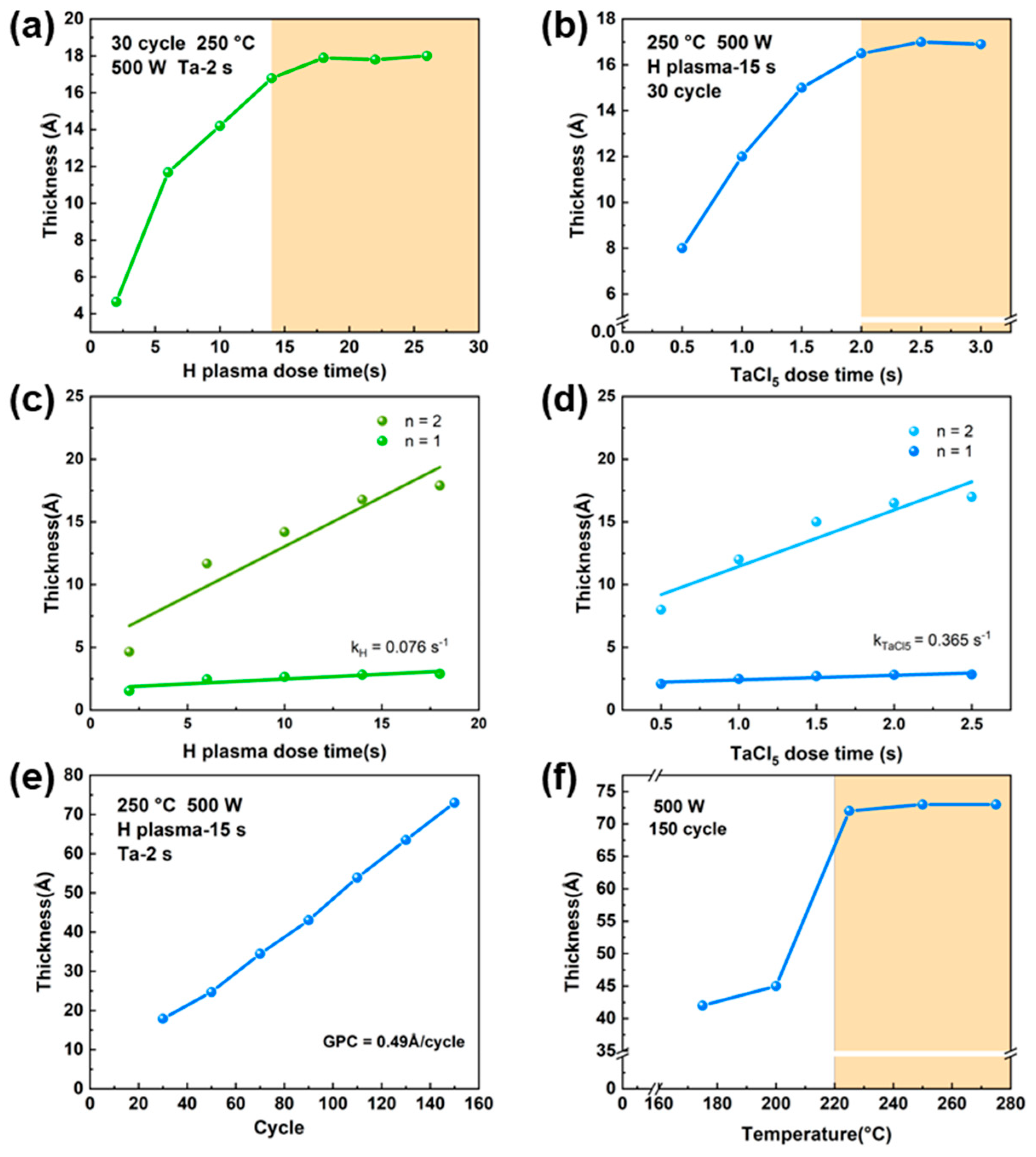
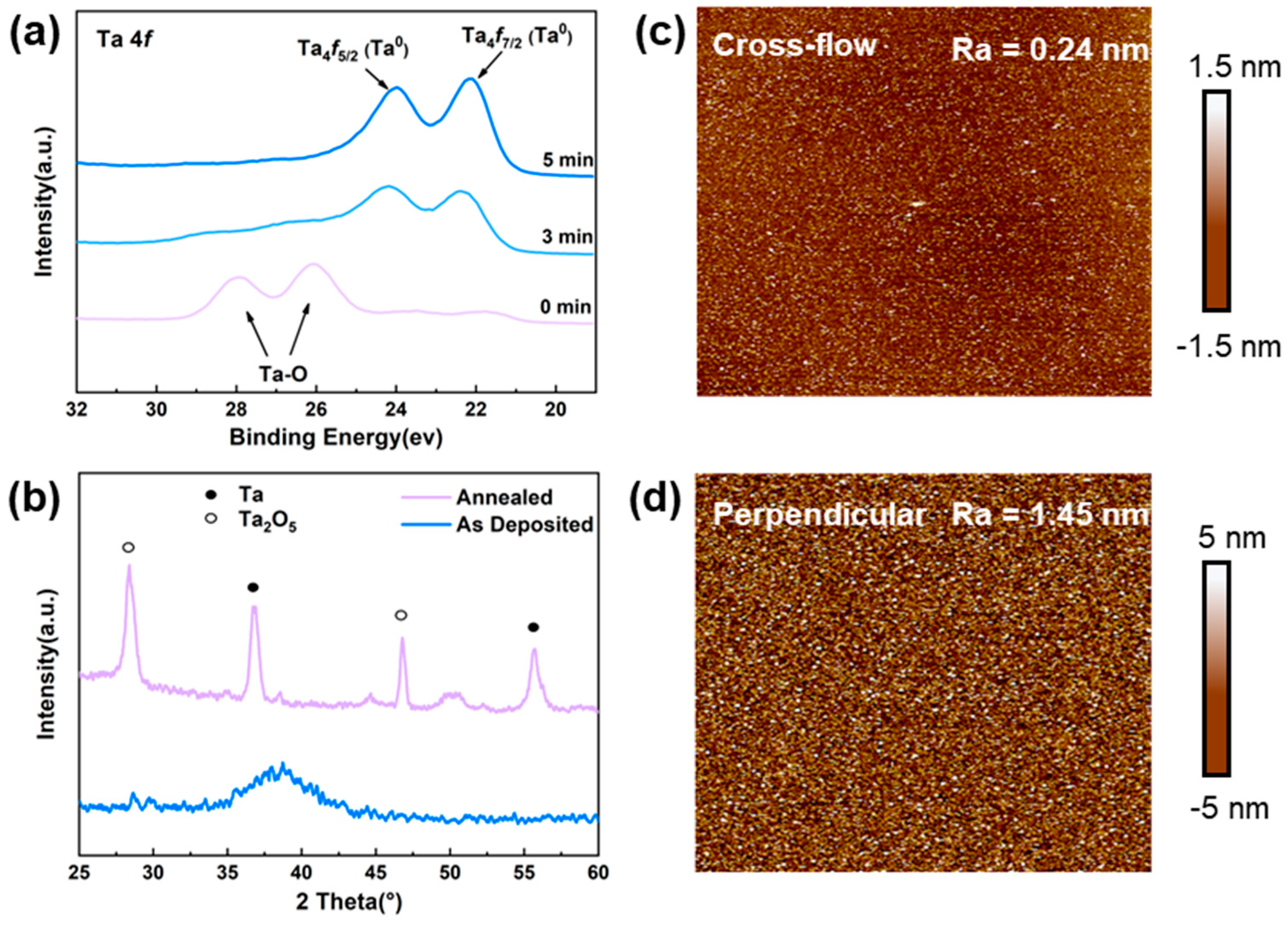
To understand the growth behavior and deposition kinetics of Ta films during PEALD, the effects of key process parameters on film growth were systematically investigated. The maximum thickness was achieved at a plasma power of 500 W and a deposition temperature of 250 °C (Supplementary Materials and Figure 1f). Therefore, subsequent experiments were carried out at a deposition temperature of 250 °C and a plasma power of 500 W to achieve the highest deposition rate. The film thickness increased with increasing TaCl5 dose time and H2 plasma dose time, and reached saturation at 2 s and 15 s, respectively, confirming the self-limiting growth characteristic of the ALD process (Figure 1a,b). The two half-reactions can be described by the following kinetics equation [Equation (2)], in which θ is the surface coverage of chlorine or hydrogen atoms, k is the reaction kinetic coefficient, and t is the reactant dose time. Integration of [Equation (2)] gives the kinetic expressions for first-order [Equation (3)] and second-order [Equation (4)] reactions, where θ0 represents the surface coverage at t = 0. Taking the Cl extraction reaction by atomic H as an example, increasing the H plasma dose time leads to more complete removal of the adsorbed TaCl5, and therefore the Cl surface coverage gradually decreases. As a result, the surface reaction approaches the saturation limit of monolayer, leading to an increase in the accumulated film thickness over repeated ALD cycles. Therefore, after normalization, θ/θ0 can be approximated by the normalized monolayer. Comparison of the fitting results obtained with n = 1 and n = 2 shows that the two half-reactions are appropriately described by first-order reaction kinetics (Figure 1c,d). The film thickness increased linearly with the number of deposition cycles, confirming a linear growth mode with a growth rate of approximately 0.49 Å per cycle (Figure 1e). The film resistivity measured by the four-point probe method is summarized in Table 1. The relatively higher resistivity of the PEALD Ta film compared with PVD-deposited (DC sputtering) Ta film is mainly attributed to its amorphous structure, which enhances electron scattering relative to crystalline α-Ta [37]. In addition, the slight formation of a thin native surface oxide after air exposure may also contribute to the increased resistivity, as XPS depth profiling indicates that the film interior is predominantly metallic Ta (Figure 2a).
d θ d t = k   θ n
ln θ θ 0 = k 1   t
θ θ 0 = k 2   t

3.2. Cross-Flow PEALD for Reduced Ion-Induced Damage

The cross-flow PEALD approach provides a mild plasma–surface interaction, leading to reduced ion-induced surface damage and consequently smoother metallic Ta films. The chemical states and phase structure of the PEALD-deposited Ta films were systematically investigated. Prior to XPS analysis, all films were exposed to air for several days, resulting in the oxidation of the surface tantalum. Consequently, the peaks at 26.0 and 27.9 eV primarily correspond to the Ta-O bonds on the surface [39]. After performing depth profiling on the films, the Ta-O peaks completely disappeared, and only peaks at 22.0 and 23.9 eV remained, corresponding to the Ta 4f7/2 and Ta 4f5/2 levels of metallic tantalum (Figure 2a) [40]. This indicates that the deposited films are in the metallic state. Furthermore, no halogen impurities were detected in the XPS spectra, which can be attributed to the cross-flow PEALD approach that promotes efficient by-product removal and suppresses CVD-like reactions, thereby facilitating effective TaCl5 reduction by H2 plasma and minimizing halogen incorporation in the deposited films.
The crystallinity of the Ta coatings was investigated to link structure with corrosion protection. The cross-flow PEALD Ta coating shows only a broad diffraction feature at 38° with no distinct reflections, indicating an amorphous structure. After annealing, peaks at 36.7° and 55.5° emerge, consistent with the formation of α-Ta, suggesting crystallization during heat treatment. Meanwhile, additional reflections near 28° and 46° are assigned to tantalum oxide phases, which likely arise from oxygen incorporation during annealing [28,41,42]. Overall, the as-deposited Ta coating is amorphous, which is beneficial for corrosion resistance because it reduces grain-boundary-related pathways for electrolyte penetration. In addition, bulk crystallization of the amorphous Ta layer is not expected under typical PEMWE operating temperatures. Therefore, the Ta coating is likely to retain its amorphous structure during operation, helping to preserve its barrier integrity and interfacial stability.
The surface roughness of the coating significantly influences the ICR of the bipolar plates. To evaluate the surface roughness, atomic force microscopy (AFM) was employed to obtain morphological information of the coatings (Figure 2c,d). Compared with the films deposited in the perpendicular type, the surface roughness of films prepared with the cross-flow type showed a significant reduction, with the Ra value decreasing from 1.45 nm to 0.24 nm. In the cross-flow reactor, plasma species reach the substrate surface primarily through diffusion, resulting in relatively mild ion bombardment. In contrast, in the perpendicular reactor, plasma ions directly impact the substrate surface, leading to higher surface roughness. A smoother surface is expected to result in fewer corrosion sites and a larger contact area, which is beneficial for achieving a lower interfacial contact resistance and better corrosion resistance. Although direct plasma diagnostics were not performed in this study, the observed decrease in surface roughness suggests that the cross-flow configuration may provide a gentler plasma–surface interaction compared with the conventional plasma reactor.

3.3. Dense PEALD Ta Films for Corrosion Protection

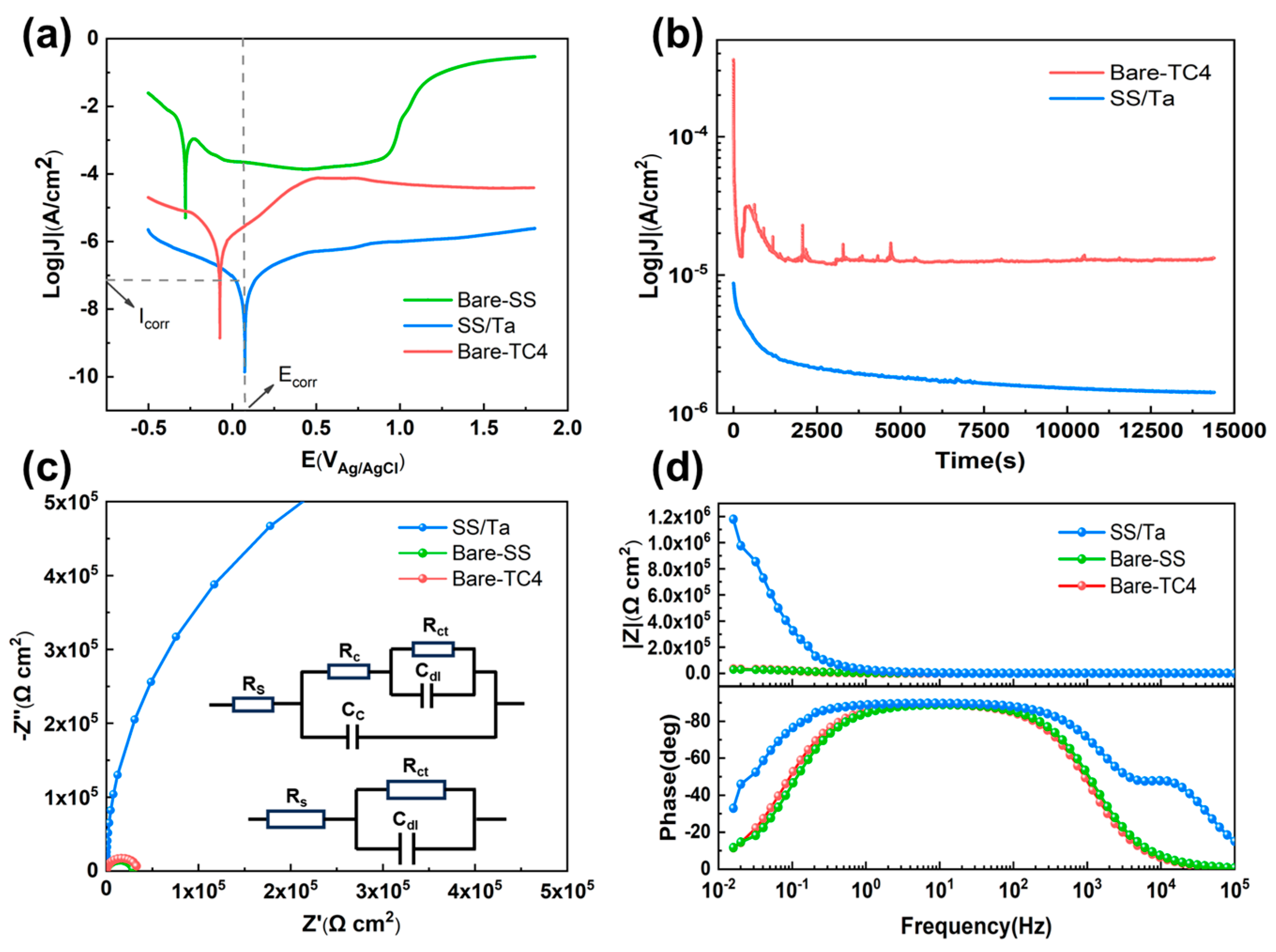
To evaluate the corrosion resistance of the film, potentiodynamic polarization tests were conducted under simulated PEMWE conditions (0.5 M H2SO4 + 2 ppm NaF). The corrosion potential and corrosion current density were determined by the Tafel method [43]. The stainless-steel substrate protected with a 50 nm tantalum coating (SS/Ta) exhibits a corrosion potential of 0.07 V vs. Ag/AgCl (pH 0.3), which exceeds those of bare stainless steel and bare TC4 substrate, indicating that the Ta coating markedly enhances the thermodynamic stability of the stainless-steel bipolar plate (Figure 3a). In addition, the corrosion current density of SS/Ta is reduced by approximately three orders of magnitude compared with that of the uncoated substrate, further confirming the effective protective performance of the Ta coating (Table S1). These results demonstrate that the 50 nm Ta coating substantially improves the corrosion resistance of stainless-steel bipolar plates. To further evaluate the protective behavior of the coating, potentiostatic polarization tests were carried out (Figure 3b). At the initial stage of polarization, the current density decreases rapidly, which can be attributed to the formation of a surface passive film. Under a constant potential of 1.8 V vs. Ag/AgCl (pH 0.3), the current density of the Ta-coated stainless steel bipolar plate stabilizes at 1.6 × 10⁻⁶ A·cm−2, which is lower than that of the bare TC4 substrate. In contrast, the bare stainless-steel bipolar plate undergoes rapid breakdown of the passive film at this potential, accompanied by metal ion dissolution, resulting in a measured current density exceeding 0.01 A·cm−2. Practical PEMWE operation involves more complex factors, so extended durability tests in practical PEMWE cells or stacks will be necessary to further assess the long-term operational stability of the coating. Overall, these results indicate that stainless-steel bipolar plates protected with tantalum coatings exhibit superior corrosion resistance under simulated PEMWE conditions compared with bare TC4 bipolar plates.
To further investigate the corrosion reaction, electrochemical impedance spectroscopy measurements of Bare-SS, Bare-TC4, and SS/Ta were performed at the stabilized OCP in the simulated PEMWE electrolyte. The equivalent electrical circuit was used to fit the EIS data, where Rs represents the solution resistance between the working electrode and reference electrode, Rc represents the pore resistance within the coating, and Rct corresponds to the charge-transfer resistance associated with the corrosion process. In addition, Cc and Cdl represent the coating capacitance and the double-layer capacitance, respectively. An enlarged view of the polarization curves for Bare-SS and Bare-TC4 is provided in Figure S6 to better show their electrochemical responses. The fitted parameters are summarized in Table S2. The charge-transfer resistance represents the resistance to charge transfer during the corrosion reaction, and an increase in Rct indicates a reduced charge-transfer rate and consequently, a slower corrosion process. Therefore, higher Rct values are generally associated with improved corrosion resistance of the coating [44]. The equivalent circuit fitting results show that the Rct value of the SS-Ta sample is significantly higher than those of the bare substrates, which is consistent with the Nyquist plots, where the capacitance loop of Ta–SS sample exhibits a larger diameter, indicating its superior corrosion resistance (Figure 3c). Compared with bare stainless steel and the TC4 alloy, the SS/Ta sample displays higher phase-angle values over a broader frequency range, suggesting a pronounced capacitive behavior, according to the Bode plots (Figure 3d). Moreover, no diffusion-controlled features are observed, indicating that the 50 nm tantalum coating effectively inhibits the diffusion of the corrosive electrolyte toward the steel substrate.
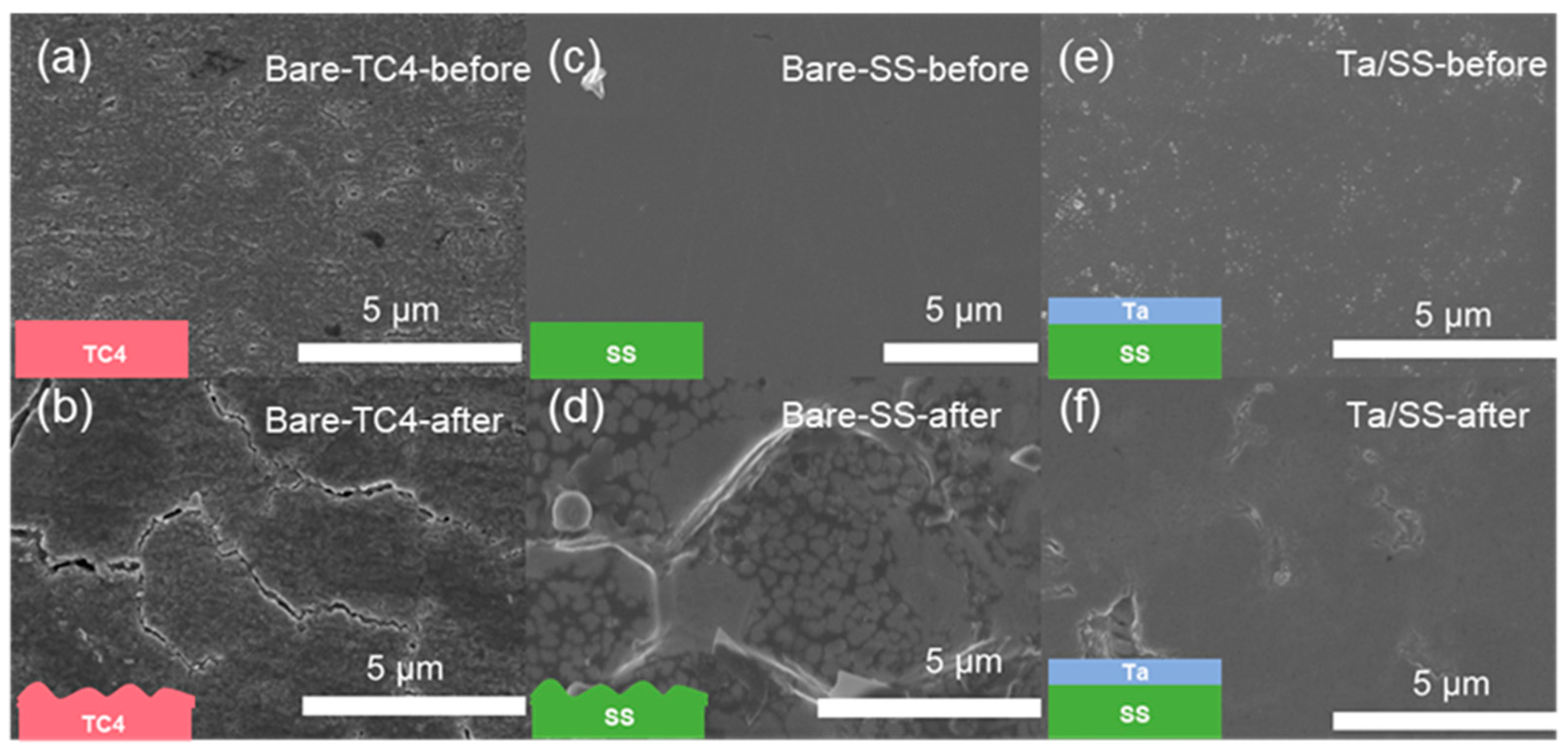
Surface morphologies before and after corrosion testing were examined to assess coating integrity (Figure 4). As observed, the uncoated stainless steel and titanium alloy substrates exhibit an increase in surface roughness after polarization, accompanied by the formation of cracks and pits, indicating severe corrosion attack. In contrast, the surface morphology of the Ta-coated stainless steel remains nearly unchanged after polarization, maintaining a continuous and dense structure, which suggests good stability of the Ta coating. This dense tantalum layer effectively hinders the penetration of corrosive species, demonstrating the excellent protective capability of metallic tantalum for the stainless-steel substrate.

3.4. Interfacial Contact Resistance and Wettability

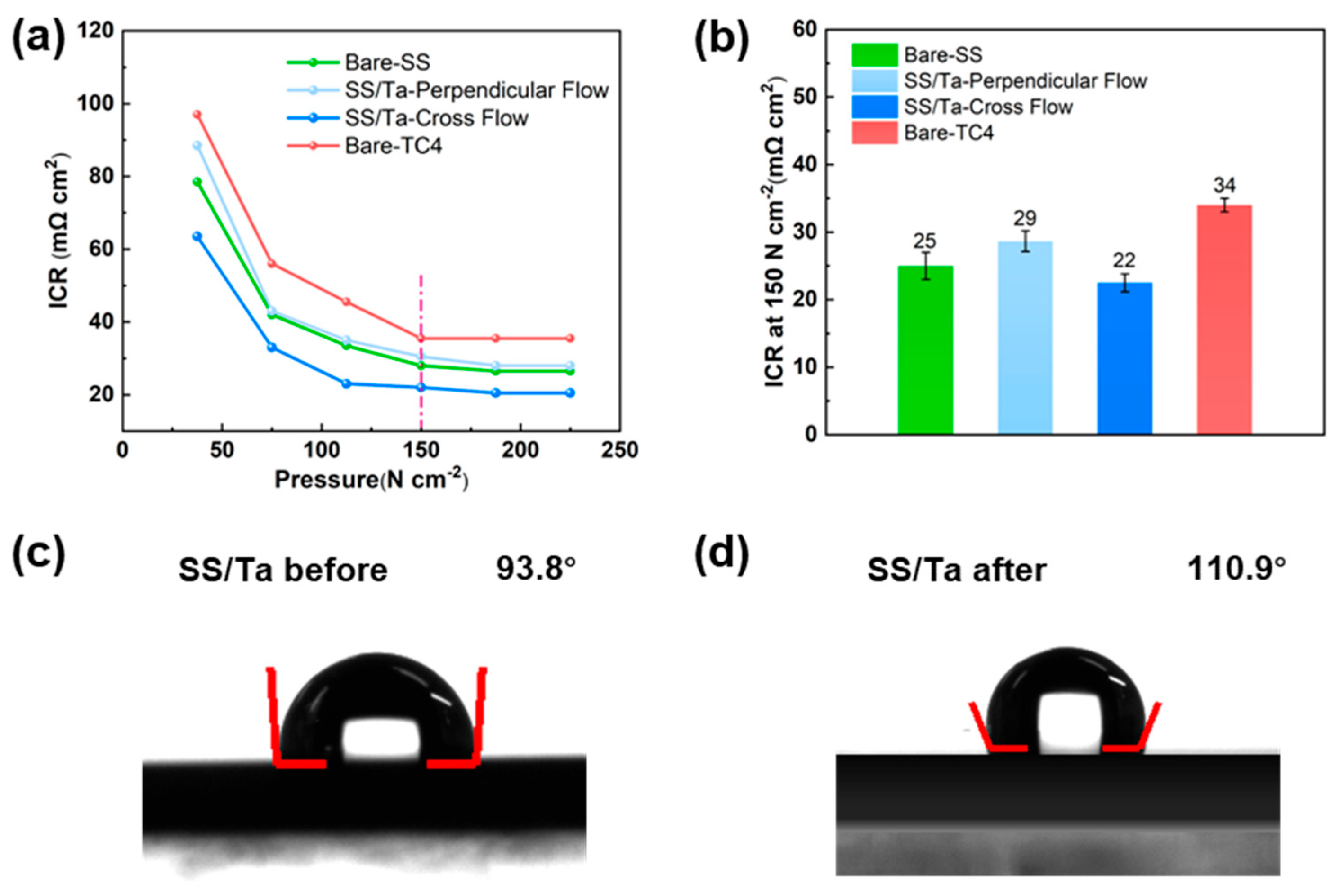
Evaluating the interfacial electrical resistance between bipolar plates and the gas diffusion layer (GDL) is essential for assessing surface conductivity under operating conditions. The interfacial contact resistance between the bipolar plate samples and carbon paper was measured as a function of applied pressure (Figure 5a,b). The ICR of the samples decreases with increasing compression force, which can be attributed to the increased number of electron conduction pathways formed between the carbon paper and the sample surface [45]. Under practical PEMWE operating conditions, the contact pressure between the bipolar plate and the gas diffusion layer is approximately 150 N cm−2. At this pressure, the ICR value of the Ta-coated stainless steel is lower than those of bare stainless steel and bare TC4 substrates. Notably, the tantalum films deposited by the cross-flow type exhibit lower ICR values than those deposited by the perpendicular type. This behavior is attributed to the reduced surface roughness of the cross-flow Ta films, which provides a larger effective contact area with the carbon paper. This interpretation is consistent with the surface morphology results observed in the AFM measurements discussed above. The surface wettability of bipolar plates is crucial for water management during operation. The wettability of the coatings mainly depends on the surface chemical composition and surface roughness [46]. As can be observed, the contact angles in both cases remain above 90°, indicating that the Ta-coated stainless steel exhibits good hydrophobic characteristics. Such a hydrophobic surface is expected to facilitate gas-bubble detachment, thereby mitigating bubble accumulation and improving mass transport during operation. After the polarization tests, an increase in the contact angles is observed, which may be attributed to the increase in surface roughness (Figure 5c,d).

4. Conclusions

This study describes a cross-flow PEALD approach to deposit metallic tantalum films, which effectively protect stainless-steel bipolar plates from corrosion under PEMWE conditions. The cross-flow configuration promotes uniform reactive-species transport and efficient by-product removal, while reducing plasma bombardment at the substrate surface, thereby providing a gentler plasma–surface interaction and enabling the formation of dense, smooth Ta coatings. Benefiting from the cross-flow design, the coating roughness is markedly reduced from 1.45 nm to 0.24 nm, leading to improved interfacial contact resistance. The deposition process demonstrated self-limiting behavior with respect to both the TaCl5 precursor and H2 plasma, resulting in a growth rate of 0.49 Å per cycle. The deposited films are metallic tantalum without any residual chlorine impurities, indicating complete reduction of the TaCl5 precursor. These structural and compositional features are reflected in enhanced electrochemical durability, as evidenced by a positive shift in the corrosion potential, increased charge-transfer resistance, and reduced current density during polarization. These findings suggest that cross-flow PEALD-deposited metallic tantalum coatings offer a promising and cost-effective solution for enhancing the performance of PEMWE bipolar plates.

Supplementary Materials

The following supporting information can be downloaded at: https://www.mdpi.com/article/10.3390/coatings16070773/s1, Figure S1: Schematic of the PEALD deposition process for metallic tantalum films; Figure S2: Schematic illustration of the cross-flow PEALD reactor; Figure S3: Schematic of the ICR measurement system; Figure S4: Thickness of Ta thin film as a function of RF power; Figure S5: Surface XPS survey spectrum of the metallic Ta film; Figure S6: Enlarged view of the Nyquist plots; Table S1: The fitting results of the polarization curves for different samples; Table S2: Equivalent-circuit parameters derived from the EIS of SS/Ta, Bare-TC4 and Bare-SS, Bare-TC4 and Bare-SS; Table S3: Summary of key properties of the PEALD Ta coating.

Author Contributions

Conceptualization, T.W.; methodology, K.C. and X.C.; validation, K.C. and L.L.; formal analysis, K.C. and C.S.; investigation, K.C., Y.T. and Y.C.; resources, T.W.; data curation, K.C. and L.L.; writing—original draft preparation, K.C.; writing—review and editing, T.W., C.P.; supervision, T.W. and Y.Z.; funding acquisition, T.W. All authors have read and agreed to the published version of the manuscript.

Funding

This research was funded by the National Key R&D Program of China, (2021YFA1500804 and 2023YFA1507902), the National Natural Science Foundation of China, (22121004, 22038009, and 22250008), the Haihe Laboratory of Sustainable Chemical Transformations, the Program of Introducing Talents of Discipline to Universities (BP0618007), and the Xplorer Prize.

Institutional Review Board Statement

Not applicable.

Informed Consent Statement

Not applicable.

Data Availability Statement

The data that support the findings of this study are available from the corresponding author upon reasonable request.

Conflicts of Interest

The authors declare no conflicts of interest.

References

  1. Le, T.T.; Sharma, P.; Bora, B.J.; Tran, V.D.; Truong, T.H.; Le, H.C.; Nguyen, P.Q.P. Fueling the future: A comprehensive review of hydrogen energy systems and their challenges. Int. J. Hydrogen Energy 2024, 54, 791–816. [Google Scholar] [CrossRef] [Scilit]
  2. Luo, X.; Ren, C.; Song, J.; Luo, H.; Xiao, K.; Zhang, D.; Hao, J.; Deng, Z.; Dong, C.; Li, X. Design and fabrication of bipolar plates for PEM water electrolyser. J. Mater. Sci. Technol. 2023, 146, 19–41. [Google Scholar] [CrossRef] [Scilit]
  3. Prestat, M. Corrosion of structural components of proton exchange membrane water electrolyzer anodes: A review. J. Power Sources 2023, 556, 232469. [Google Scholar] [CrossRef] [Scilit]
  4. Zhang, K.; Liang, X.; Wang, L.; Sun, K.; Wang, Y.; Xie, Z.; Wu, Q.; Bai, X.; Hamdy, M.S.; Chen, H.; et al. Status and perspectives of key materials for PEM electrolyzer. Nano Res. Energy 2022, 1, 9120032. [Google Scholar] [CrossRef] [Scilit]
  5. Baroutaji, A.; Arjunan, A.; Robinson, J.; Abdelkareem, M.A.; Olabi, A.G. Additive manufacturing for Proton Exchange Membrane (PEM) hydrogen technologies: Merits, challenges, and prospects. Int. J. Hydrogen Energy 2024, 52, 561–584. [Google Scholar] [CrossRef] [Scilit]
  6. Tenhumberg, N.; Büker, K. Ecological and economic evaluation of hydrogen production by different water electrolysis technologies. Chem. Ing. Tech. 2020, 92, 1586–1595. [Google Scholar] [CrossRef] [Scilit]
  7. Liu, T.; Tao, Y.; Wang, Y.; Hu, M.; Zhang, Z.; Shao, J. Towards cost-effective and durable bipolar plates for proton exchange membrane electrolyzers: A review. Fuel 2024, 368, 131610. [Google Scholar] [CrossRef] [Scilit]
  8. Doan, T.L.; Lee, H.E.; Shah, S.S.H.; Kim, M.J.; Kim, C.H.; Cho, H.S.; Kim, T. A review of the porous transport layer in polymer electrolyte membrane water electrolysis. Int. J. Energy Res. 2021, 45, 14207–14220. [Google Scholar] [CrossRef] [Scilit]
  9. Teuku, H.; Alshami, I.; Goh, J.; Masdar, M.S.; Loh, K.S. Review on bipolar plates for low-temperature polymer electrolyte membrane water electrolyzer. Int. J. Energy Res. 2021, 45, 20583–20600. [Google Scholar] [CrossRef] [Scilit]
  10. Feng, Q.; Yuan, X.Z.; Liu, G.; Wei, B.; Zhang, Z.; Li, H.; Wang, H. A review of proton exchange membrane water electrolysis on degradation mechanisms and mitigation strategies. J. Power Sources 2017, 366, 33–55. [Google Scholar] [CrossRef] [Scilit]
  11. Carmo, M.; Fritz, D.L.; Mergel, J.; Stolten, D. A comprehensive review on PEM water electrolysis. Int. J. Hydrogen Energy 2013, 38, 4901–4934. [Google Scholar] [CrossRef] [Scilit]
  12. Zhang, D.; Duan, L.; Guo, L.; Tuan, W.H. Corrosion behavior of TiN-coated stainless steel as bipolar plate for proton exchange membrane fuel cell. Int. J. Hydrogen Energy 2010, 35, 3721–3726. [Google Scholar] [CrossRef] [Scilit]
  13. Zhang, H.; Lin, G.; Hou, M.; Hu, L.; Han, Z.; Fu, Y.; Shao, Z.; Yi, B. CrN/Cr multilayer coating on 316L stainless steel as bipolar plates for proton exchange membrane fuel cells. J. Power Sources 2012, 198, 176–181. [Google Scholar] [CrossRef] [Scilit]
  14. Gago, A.S.; Ansar, S.A.; Saruhan, B.; Schulz, U.; Lettenmeier, P.; Cañas, N.A.; Gazdzicki, P.; Morawietz, T.; Hiesgen, R.; Arnold, J.; et al. Protective coatings on stainless steel bipolar plates for proton exchange membrane (PEM) electrolysers. J. Power Sources 2016, 307, 815–825. [Google Scholar] [CrossRef] [Scilit]
  15. Lædre, S.; Kongstein, O.E.; Oedegaard, A.; Karoliussen, H.; Seland, F. Materials for Proton Exchange Membrane water electrolyzer bipolar plates. Int. J. Hydrogen Energy 2017, 42, 2713–2723. [Google Scholar] [CrossRef] [Scilit]
  16. Lædre, S.; Mendizabal, L.; Kongstein, O.E.; Oedegaard, A.; Karoliussen, H.; Seland, F. Ta-ITO coated titanium bipolar plates for proton exchange membrane water electrolyzers. J. Electrochem. Soc. 2022, 169, 034504. [Google Scholar] [CrossRef] [Scilit]
  17. Ye, H.; Tu, Z.; Li, S. Electrochemical performance of metal nitride coated titanium bipolar plate for proton exchange membrane water electrolyser. J. Power Sources 2024, 595, 234052. [Google Scholar] [CrossRef] [Scilit]
  18. Yan, P.; Ying, T.; Yang, Y.; Cao, F.; Li, Y.; Wang, J.; Zeng, X. Investigation of anodized Ta/Ag coating on magnesium bipolar plate for lightweight proton exchange membrane fuel cells. Corros. Sci. 2022, 197, 110086. [Google Scholar] [CrossRef] [Scilit]
  19. Meng, Q.; Yue, X.; Shang, L.; Liu, X.; Wang, F.; Zhang, G. Corrosion behavior of metallic coatings on titanium bipolar plates of proton exchange membrane water electrolysis. Int. J. Hydrogen Energy 2024, 63, 1105–1115. [Google Scholar] [CrossRef] [Scilit]
  20. Stiber, S.; Hehemann, M.; Carmo, M.; Müller, M.; Ayers, K.E.; Capuano, C.; Danilovic, N.; Morawietz, T.; Biswas, I.; Gazdzicki, P.; et al. Long-term operation of Nb-coated stainless steel bipolar plates for proton exchange membrane water electrolyzers. Adv. Energy Sustain. Res. 2022, 3, 2200024. [Google Scholar] [CrossRef] [Scilit]
  21. Jang, G.E.; Cho, G.Y. Effects of Ag current collecting layer fabricated by sputter for 3D-printed polymer bipolar plate of ultra-light polymer electrolyte membrane fuel cells. Sustainability 2022, 14, 2997. [Google Scholar] [CrossRef] [Scilit]
  22. Pathote, D.; Jaiswal, D.; Singh, V.; Behera, C.K. Electrochemical corrosion behavior of tantalum coated 316L stainless steel by D.C. Magnetron sputtering for orthopedic applications. Appl. Surf. Sci. Adv. 2023, 13, 100365. [Google Scholar] [CrossRef] [Scilit]
  23. Pathote, D.; Singh, V.; Jaiswal, D.; Gautam, R.K.; Behera, C.K. Improving the electrochemical corrosion behavior of stainless steel (316L) through the deposition of tantalum-based thin films. Mater. Today Proc. 2024, 112, 24–33. [Google Scholar] [CrossRef] [Scilit]
  24. Flores, M.; Huerta, L.; Escamilla, R.; Andrade, E.; Muhl, S. Effect of substrate bias voltage on corrosion of TiN/Ti multilayers deposited by magnetron sputtering. Appl. Surf. Sci. 2007, 253, 7192–7196. [Google Scholar] [CrossRef] [Scilit]
  25. Suo, X.; Guo, C.; Kong, D.; Wang, L. Corrosion behaviour of TiN and CrN coatings produced by magnetron sputtering process on aluminium alloy. Int. J. Electrochem. Sci. 2019, 14, 826–837. [Google Scholar] [CrossRef] [Scilit]
  26. Puurunen, R.L. Surface chemistry of atomic layer deposition: A case study for the trimethylaluminum/water process. J. Appl. Phys. 2005, 97, 121301. [Google Scholar] [CrossRef] [Scilit]
  27. George, S.M. Atomic layer deposition: An overview. Chem. Rev. 2010, 110, 111–131. [Google Scholar] [CrossRef] [Scilit]
  28. Kim, H.; Rossnagel, S.M. Plasma-enhanced atomic layer deposition of tantalum thin films: The growth and film properties. Thin Solid Films 2003, 441, 311–316. [Google Scholar] [CrossRef] [Scilit]
  29. Tian, X.; Ding, Y.; Chai, G.; Tang, Y.; Lei, R.; Jia, G.; Zhang, Y.; Li, J.; Zhou, Y.; Wang, X. Plasma-enhanced atomic layer deposition of amorphous tantalum thin films for copper interconnects using an organometallic precursor. Adv. Mater. Technol. 2024, 9, 2301541. [Google Scholar] [CrossRef] [Scilit]
  30. Elers, K.E.; Blomberg, T.; Peussa, M.; Aitchison, B.; Haukka, S.; Marcus, S. Film uniformity in atomic layer deposition. Chem. Vap. Depos. 2006, 12, 13–24. [Google Scholar] [CrossRef] [Scilit]
  31. Kim, M.S.; Lim, C.M.; Kim, S.H.; Kim, D.; Jeon, H.; Chung, C.W. Plasma-enhanced atomic layer deposition of TiN thin films using ultralow electron temperature plasma. ACS Appl. Mater. Interfaces 2025, 17, 11227–11235. [Google Scholar] [CrossRef] [Scilit]
  32. Park, J.; Kim, N.; Choi, J.E.; Yeo, Y.; Kim, M.S.; Lim, C.M.; Seo, B.J.; Chung, C.W. Atomic layer etching of SiO2 utilizing ultra-low electron temperature plasma. ACS Appl. Electron. Mater. 2025, 7, 4520–4528. [Google Scholar] [CrossRef] [Scilit]
  33. Chiappim, W.; Testoni, G.E.; Doria, A.C.O.C.; Pessoa, R.S.; Fraga, M.A.; Galvão, N.K.A.M.; Maciel, H.S. Relationships among growth mechanism, structure and morphology of PEALD TiO2 films: The influence of O2 plasma power, precursor chemistry and plasma exposure mode. Nanotechnology 2016, 27, 305701. [Google Scholar] [CrossRef] [Scilit]
  34. Faraz, T.; Arts, K.; Karwal, S.; Knoops, H.C.M.; Kessels, W.M.M. Energetic ions during plasma-enhanced atomic layer deposition and their role in tailoring material properties. Plasma Sources Sci. Technol. 2019, 28, 024002. [Google Scholar] [CrossRef] [Scilit]
  35. Wang, H.; Sweikart, M.A.; Turner, J.A. Stainless steel as bipolar plate material for polymer electrolyte membrane fuel cells. J. Power Sources 2003, 115, 243–251. [Google Scholar] [CrossRef] [Scilit]
  36. Fan, H.Q.; Zhu, X.; Wang, Z.L.; He, Z.K.; Hu, J.F.; Behnamian, Y. High corrosion resistance and through-plane electrical conductivity of C/Ti and C/Cr coated metal bipolar plates used in PEMFC. Energy 2024, 291, 130366. [Google Scholar] [CrossRef] [Scilit]
  37. Clevenger, L.A.; Mutscheller, A.; Harper, J.M.E.; Cabral, C.; Barmak, K. The relationship between deposition conditions, the beta to alpha phase transformation, and stress relaxation in tantalum thin films. J. Appl. Phys. 1992, 72, 4918–4924. [Google Scholar] [CrossRef] [Scilit]
  38. Chen, X.; Frisch, H.L.; Kaloyeros, A.E.; Arkles, B.; Sullivan, J.J. Low temperature plasma-assisted chemical vapor deposition of tantalum nitride from tantalum pentabromide for copper metallization. J. Vac. Sci. Technol. B 1999, 17, 182–185. [Google Scholar] [CrossRef] [Scilit]
  39. Díaz, B.; Światowska, J.; Maurice, V.; Pisarek, M.; Seyeux, A.; Zanna, S.; Tervakangas, S.; Kolehmainen, J.; Marcus, P. Chromium and tantalum oxide nanocoatings prepared by filtered cathodic arc deposition for corrosion protection of carbon steel. Surf. Coat. Technol. 2012, 206, 3903–3910. [Google Scholar] [CrossRef] [Scilit]
  40. Datta, D.; Eskandari, A.; Syed, J.; Rai, H.; Gosvami, N.N.; Tsui, T.Y. The influence of thermal annealing on the chemical composition, nanomechanical, and nanotribological properties of tantalum thin films. Micromachines 2025, 16, 427. [Google Scholar] [CrossRef] [Scilit]
  41. Liu, L.; Jiang, E.Y.; Wu, Z.; Wu, P.; Bai, H.L. Annealing effects of tantalum thin films sputtered on [001] silicon substrate. Mater. Sci. Eng. C 2001, 16, 85–89. [Google Scholar] [CrossRef] [Scilit]
  42. Wu, S.J.; Houng, B.; Huang, B.S. Effect of growth and annealing temperatures on crystallization of tantalum pentoxide thin film prepared by RF magnetron sputtering method. J. Alloys Compd. 2009, 475, 488–493. [Google Scholar] [CrossRef] [Scilit]
  43. Wang, Y.; Northwood, D.O. An investigation into polypyrrole-coated 316L stainless steel as a bipolar plate material for PEM fuel cells. J. Power Sources 2006, 163, 500–508. [Google Scholar] [CrossRef] [Scilit]
  44. Madadi, F.; Shamanian, M.; Ziaei, A. Improving performance in PEMFC by applying different coatings to metallic bipolar plates. Mater. Chem. Phys. 2019, 238, 121911. [Google Scholar] [CrossRef] [Scilit]
  45. Liu, G.; Shan, D.; Fang, B.; Wang, X. Novel hybrid coating of TiN and carbon with improved corrosion resistance for bipolar plates of PEM water electrolysis. Int. J. Hydrogen Energy 2023, 48, 18996–19007. [Google Scholar] [CrossRef] [Scilit]
  46. Bai, C.Y.; Wen, T.M.; Hou, K.H.; Pu, N.W.; Ger, M.D. The characteristics and performance of AISI 1045 steel bipolar plates with chromized coatings for proton exchange membrane fuel cells. Int. J. Hydrogen Energy 2011, 36, 3975–3983. [Google Scholar] [CrossRef] [Scilit]
Figure 1. The relations of the film growth with (a) H plasma dose time, (b) TaCl5 dose time, (e) temperature and (f) film thickness as a function of the total PEALD cycles; kinetic fitting results of the (c) H plasma and (d) TaCl5 half-reactions.
Coatings 16 00773 g001
Figure 2. (a) XPS results of Ta film as a function of sputtering time, (b) XRD results of Ta film and AFM images of the sample surfaces under (c) cross-flow type and (d) perpendicular type.
Coatings 16 00773 g002
Figure 3. (a) Potentiodynamic polarization curves, (b) Potentiostatic polarization curves for Bare-SS, Bare-TC4 and SS/Ta, (c) Nyquist plots, (d) Bode plots of Bare-TC4, Bare-SS and SS/Ta.
Coatings 16 00773 g003
Figure 4. Surface image of Bare-TC4, Bare-SS, SS/Ta (a,c,e) before the corrosion experiment and (b,d,f) after the corrosion experiment.
Coatings 16 00773 g004
Figure 5. ICR value under (a) different pressures; (b) contact pressure at 150 N/cm2 and Contact angle images of SS/Ta samples (c) before and (d) after the corrosion tests.
Coatings 16 00773 g005
Table 1. Resistivity of tantalum obtained by different methods.
Deposition MethodPrecursorTemperature
(°C)
Resistivity
(μΩ cm)
Ref
ALDTBTDET + H2 plasma290417[29]
ALDTaCl5 + H2 plasma250150[28]
CVDTaBr5 + H2 plasma450120[38]
PVDTa target60060[37]
ALD (this work)TaCl5 + H2 plasma250230 
Disclaimer/Publisher’s Note: The statements, opinions and data contained in all publications are solely those of the individual author(s) and contributor(s) and not of MDPI and/or the editor(s). MDPI and/or the editor(s) disclaim responsibility for any injury to people or property resulting from any ideas, methods, instructions or products referred to in the content.