Article

Crack Suppression in Metal Active Gas Overlay Remanufacturing of Tunnel Boring Machine Cutter Rings Under Longitudinal Alternating Magnetic Field Stirring of the Weld Pool


1
School of Mechanical Engineering and Mechanics, Xiangtan University, Xiangtan 411105, China
2
Engineering Research Center of Complex Tracks Processing Technology and Equipment of Ministry of Education, Xiangtan University, Xiangtan 411105, China
3
China Railway Engineering Equipment Group Co., Ltd., Zhengzhou 450016, China
*
Authors to whom correspondence should be addressed.
Coatings 2026, 16(7), 758; https://doi.org/10.3390/coatings16070758
Submission received: 26 April 2026 / Revised: 24 June 2026 / Accepted: 24 June 2026 / Published: 26 June 2026

Abstract

Crack defects are prone to occur during MAG overlay remanufacturing of TBM cutter rings, thereby affecting the repair quality and service reliability of the remanufactured layer. In this study, longitudinal alternating magnetic field (LAMF) stirring was introduced into the MAG overlay remanufacturing process of H13 steel cutter rings to regulate molten-pool behavior and suppress crack defects. A molten-pool-scale sequentially coupled thermo-fluid-electromagnetic model was developed to compare the relative changes in the temperature and velocity fields with and without LAMF under identical MAG process parameters, heat-source input, material properties, and boundary conditions. In the model, the effect of LAMF was introduced through a Lorentz-force source term acting on the electrically conductive molten metal. The simulation results show that LAMF promoted heat redistribution within the molten pool, smoothed the thermal transition near the rear region of the molten pool, and reduced local heat accumulation. Meanwhile, LAMF modified the molten-pool flow pattern by weakening excessive flow along the welding direction and enhancing transverse circulation and vortex-induced mixing. Comparative overlay remanufacturing experiments were then conducted using a self-built magnetic-field stirring platform. Penetrant testing, X-ray inspection, metallographic observation, and industrial CT reconstruction were combined to characterize surface cracks, internal defects, and post-solidification microstructure. Compared with the non-LAMF condition, the maximum internal crack length decreased from 29.41 mm to 20.30 mm, corresponding to a reduction of 30.98%, and the crack-defect volume fraction decreased from 0.93% to 0.28%, corresponding to a decrease of 0.65 percentage points. The combined simulation and characterization results indicate that Lorentz-force-driven electromagnetic stirring improves the thermal-fluid conditions near the solidification front, thereby effectively reducing the formation tendency of solidification-related crack defects during MAG overlay remanufacturing.

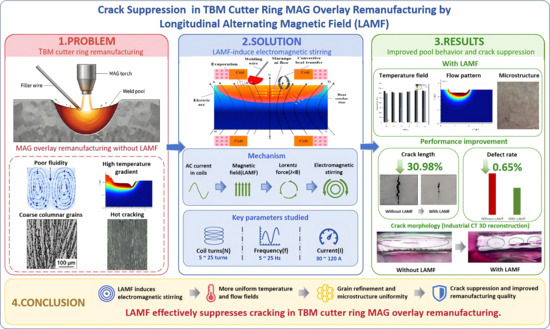
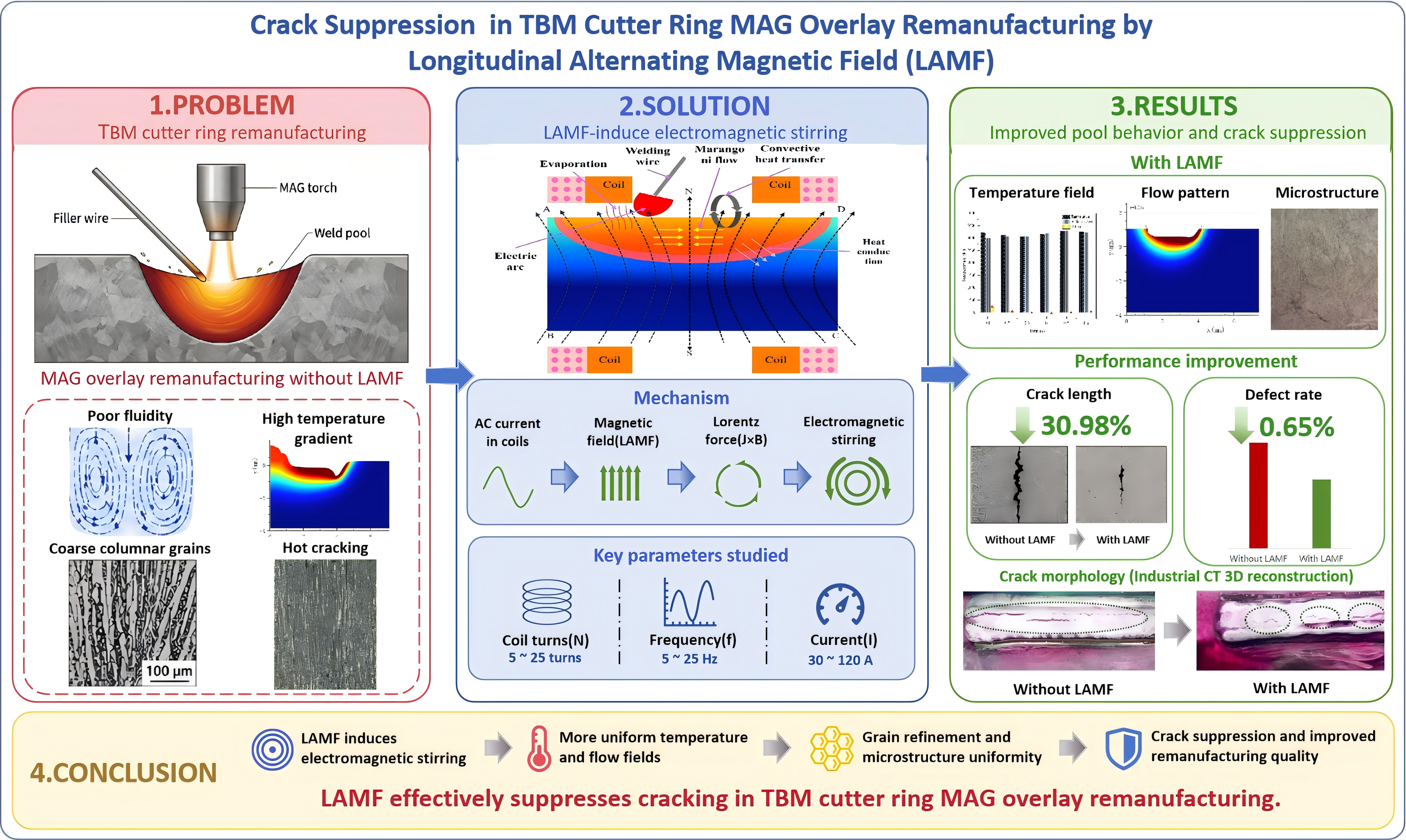
Graphical Abstract

1. Introduction

The disc cutter (cutter) is the only rock-cutting tool in a full-face rock tunnel boring machine (TBM). During rock cutting, the cutter ring directly contacts and cuts the rock mass. Due to the high impact loads and cutter–rock contact forces borne by the cutter ring, coupled with harsh and complex geological conditions, the cutter ring experiences severe wear and failure. As a key vulnerable component, the service life of the cutter ring severely impacts tunnel construction efficiency and cost and even determines the success or failure of certain extreme underground engineering projects with “three high” conditions (high surrounding pressure, high rock hardness, and high quartz content). In order to significantly extend the full life cycle of the cutter ring in a short period of time, references [1,2] proposed a cutter ring Metal Active Gas arc welding (MAG) overlay remanufacturing process for cutter rings made of H13 steel, which have suffered normal wear and failure (uniform radial wear has occurred, reaching the radial wear threshold, typically 35 mm). This study also conducted simulation optimization and experimental research on the cutter ring overlay remanufacturing process, verifying its feasibility. Although reference [1] used a self-developed rail-type temperature control device to achieve a flexible connection between pre-welding heating and post-welding tempering processes, which alleviated the issues of residual stress concentration and microstructure coarsening caused by rapid cooling of the weld pool during repair, the bottleneck issues such as insufficient weld pool fluidity and the degradation of the heat-affected zone’s microstructure still persist. This results in the repair layer of the cutter ring being prone to thermal cracks and brittle fractures, severely affecting the remanufacturing performance of the cutter ring.
In recent years, electromagnetic-field-assisted processing has been increasingly investigated as an effective approach for regulating molten-pool flow, solidification behavior, and joint performance in welding- and casting-related processes [3,4]. For example, in laser cladding of nickel-based coatings, alternating magnetic fields were used to regulate the flow and solidification behavior of the molten pool. This treatment transformed the hard phase Cr7C3 from a continuous network structure into a dispersed rod-like distribution and increased the average microhardness of the coating to 923.7 HV0.2 under a magnetic field strength of 0.2 T and an alternating current of 1200 A [5]. In laser–MIG hybrid welding, a steady magnetic field significantly increased the weld-pool flow velocity, enhanced keyhole stability, and promoted the formation of equiaxed grains in the solidified weld by increasing the equiaxed-grain proportion and reducing the columnar-grain proportion [6]. In Al/Mg bimetallic composite casting, electromagnetic stirring has been reported to optimize the interfacial microstructure and enhance interfacial bonding strength by increasing the oxide-film breakup rate by 29.1%, which may help reduce crack propagation along the original weak interface [7]. In magnesium alloy welding, electromagnetic effects have also been shown to refine grains and improve microstructural uniformity, thereby enhancing toughness, crack resistance, and related mechanical properties [8]. Additionally, Shiga et al. [9] observed using in situ X-ray imaging that, during the solidification of Al-Si alloys, the Lorentz force generated by electromagnetic stirring drove primary α-Al(FeMn)Si grains toward the periphery and changed their size and morphology. The degree of macrosegregation was found to be non-linearly related to melt-convection intensity. Yang et al. [10] numerically demonstrated that linear electromagnetic stirring during the solidification of Cu-6 wt.% Ag alloy ingots suppressed severe central solute Ag enrichment, reducing the maximum segregation ratio near the ingot centerline from 414% to 260%.
The above research demonstrates the potential application of electromagnetic stirring technology for regulating weld pool fluidity and microstructure evolution. Considering the inherent characteristics of thick-walled parts such as cutter rings during overlay welding, such as high heat input and multi-layer heat accumulation (which leads to a complex thermal history in the weld pool and significant residual stress accumulation), longitudinal alternating magnetic field (LAMF) can refine the solidified microstructure and homogenize the temperature field through induced weld pool oscillations and forced convection, thus suppressing crack defects. At the same time, by enhancing the flow of the molten pool, active control over deep penetration welds and large-volume weld pools can be achieved. Compared to transverse or rotating magnetic fields, LAMF may be more suitable for cutter ring overlay remanufacturing. However, due to the unique solidification characteristics of cutter ring materials (commonly H13 hot-working tool steel) and their tolerance to cracks (which is influenced by tool load conditions), LAMF parameter adaptation design methods in the field of TBM cutter ring overlay remanufacturing still require in-depth research. For instance, regarding magnetic-field frequency, Yang et al. reported multi-refining effects of an AC electromagnetic field on the microstructure of AA5754 laser beam welds, indicating that electromagnetic-field-assisted welding can promote microstructural refinement under suitable conditions [11]. In addition, phase-field simulations further suggested that alternating current electromagnetic stirring (AC EMS) at 10 kHz can generate a strong Lorentz force in the molten pool, enhance molten-metal flow, and promote dendrite fragmentation [12]. However, the effect of electromagnetic stirring depends strongly on the material system, heat-source mode, magnetic-field intensity, and frequency range. Therefore, careful selection of magnetic-field parameters, such as the excitation coil current, frequency, and number of turns, is necessary. Zhao et al. demonstrated that inappropriate, especially excessive, Lorentz forces can disturb the surface-tension balance of the weld pool, leading to undesirable phenomena such as weld bead flowing or shifting [13]. Based on these considerations, a low-frequency LAMF range of 5–25 Hz was selected in the present study for parameter screening, with the aim of enhancing molten-pool circulation while avoiding excessive disturbance of the overlay bead.
To suppress thermal-crack formation and refine the solidified microstructure during cutter-ring overlay repair, this study introduces LAMF-induced molten-pool stirring into the MAG overlay remanufacturing process of H13 steel cutter rings. A two-dimensional transient thermo-fluid model considering evaporation and incorporating the Lorentz force induced by LAMF as an electromagnetic source term was established to reveal the influence of electromagnetic stirring on the temperature distribution and velocity field of the molten pool. Subsequently, 15 sets of single-factor simulations were designed to optimize the LAMF parameters, including excitation frequency, excitation current, and coil turns, by analyzing the distributions of the temperature field, velocity field, and Lorentz force. Comparative experiments with and without LAMF were then conducted, and the crack-suppression effect was evaluated through metallographic observation, non-destructive testing, X-ray inspection, and industrial CT reconstruction. Finally, the relationships among the simulated thermal-fluid behavior, microstructural evolution, and crack distribution were analyzed to clarify the crack-suppression mechanism of LAMF during MAG overlay remanufacturing.

2. Simulation Modeling

2.1. Simplifying Assumptions and Model Scope

The present model was developed to compare the relative changes in the molten-pool temperature field and velocity field with and without LAMF under the same MAG process parameters, heat-source input, current-density distribution, material properties, and boundary conditions. Similar molten-pool-scale treatments have been adopted in recent arc-welding simulations [14,15]. Therefore, the model is formulated as a sequentially coupled thermo-fluid-electromagnetic model for molten-pool-scale analysis, rather than a fully coupled transient arc-droplet-molten pool model. In this framework, the electromagnetic stirring induced by LAMF is represented by the Lorentz-force source term, as described in Section 2.3. The numerical simulations were performed using COMSOL Multiphysics 6.4 (COMSOL AB, Stockholm, Sweden).
Based on this model scope, the following simplifying assumptions were adopted:
(1)
The flow of high-temperature liquid metal in the molten pool is assumed to be laminar and is regarded as an incompressible Newtonian fluid; the buoyancy term is treated using the Boussinesq approximation;
(2)
The heat-flux density and current-density distributions acting on the molten-pool surface were prescribed as Gaussian distributions. The arc action was represented by this equivalent input; transient arc-pressure fluctuation and droplet momentum transfer were not separately resolved.
(3)
The relative magnetic permeability of the cutter-ring material was taken as 1, which is of the same order of magnitude as that of vacuum.
(4)
The gas phase was treated as an electrically insulating medium. Only the recoil pressure induced by metal evaporation was retained, while the associated evaporative mass loss and vaporization-latent-heat cooling were not explicitly solved in the present model.
(5)
The surface-tension-driven flow was described by the Marangoni force associated with the temperature gradient along the molten-pool surface. Large free-surface deformation of the molten pool was not explicitly resolved, and the independent effects of surface-active elements, such as sulfur and oxygen, on the Marangoni coefficient were not separately incorporated in the present macroscopic model.
(6)
The thermal conductivity of H13 steel was treated as macroscopically isotropic but phase-dependent, with different values assigned to the solid and liquid phases. Other thermophysical properties were taken from the values listed in Table 1.
(7)
Thermoelectric effects and Joule heating were not considered in the present model.

2.2. Modeling Mechanism

Based on the aforementioned simplifying assumptions, a simplified schematic diagram of the weld-pool formation and flow process, as shown in Figure 1, was drawn. To intuitively demonstrate the action mechanism of LAMF on the weld pool during the overlay remanufacturing process, the weld pool was sectioned along its middle plane to obtain the cross-sectional view A-A. In the cross-sectional view, two sets of coils are placed above and below the cutter ring (workpiece) to be repaired; when the coils are energized, a controllable LAMF is generated in the region enclosed by the coils. Under an argon shielding atmosphere, the moving arc melts the welding wire and the local surface of the workpiece, forming a weld pool. The flow of molten metal is jointly governed by the retained surface forces and body forces, including surface tension, Marangoni force, buoyancy, evaporation-induced recoil pressure, and the Lorentz force under the LAMF-applied condition. In the present schematic diagram and model, metal evaporation is represented by its recoil-pressure contribution, while the associated evaporative mass loss and vaporization-latent-heat cooling are not solved as additional transport terms.

2.3. Governing Equations and Boundary Conditions

A multi-phase flow model is used to simulate the overlay remanufacturing process, employing classical computational fluid dynamics (CFD) methods to calculate the temperature field and velocity field of the weld pool. In the momentum equation, the buoyancy term is included explicitly through the Boussinesq approximation, while the Lorentz force induced by LAMF and the Darcy damping force in the mushy region are introduced through the additional source term. Surface-tension-driven flow, Marangoni force, and evaporation-induced recoil pressure are considered through the corresponding surface-force or boundary-condition treatment in the model. Among these terms, the Lorentz force is evaluated from the current density and magnetic flux density associated with the external coil excitation and is introduced into the momentum conservation equation as an electromagnetic source term.

2.3.1. Governing Equations

The mass conservation equation is expressed as:
v = 0
where v is the velocity vector.
The momentum conservation equation is expressed as:
ρ v t + ρ ( v ) v = p + μ 2 v + ρ g ρ β T T 0 g + S
where ρ is the fluid density; p is the pressure; μ is the dynamic viscosity; β is the thermal expansion coefficient; T is the weld pool surface temperature; T 0 is the reference temperature.
The energy conservation equation is expressed as:
d z ρ c p T t + v T = d z q + q 0 + d z Q + Q x + Q 0
where d z is the thickness of the workpiece; c p is the specific heat at constant pressure; Q is the heat source intensity; Q x is the latent-heat term associated with phase change; Q 0 is the radiative heat flux.
The heat conduction process is described using the Fourier’s law expression shown below:
q = k T
where k is the thermal conductivity of the material.
q 0 = h T e T
where h is the convective heat transfer coefficient; its value is taken as 15 (W/m2·K); T e is the external environmental temperature.
The aforementioned body forces are included in the momentum source term equation, which is:
S = F e m + F d
where F e m is the electromagnetic force; F d is the Darcy damping force in the mushy region, which is expressed as:
F d = K D v
where K D is the Darcy damping coefficient. In the present model, K D takes a negative value in the mushy region, so that the Darcy damping force acts opposite to the molten-metal velocity and suppresses fluid flow in the solidifying region.
The magnetic field equation is:
× 1 μ m × A = J e x t
J e x t = I S 0 n
I = I 0 sin ( 2 π f t )
where μ m is the magnetic permeability; I 0 is the current amplitude; n is the directional unit vector; S 0 is the cross-sectional area of the current loop; f is the frequency of the current loop.
According to Ampère’s law, the electromagnetic force is expressed as:
F e m = J × B
J = σ ( φ + v × B )
B = × A
where J is the current density; B is the magnetic flux density; σ is the electrical conductivity; φ is the electric potential; v is the flow velocity vector; A is the magnetic vector potential.
The level-set equation used for phase-interface tracking is expressed as:
ϕ t + v ϕ = γ ε 0 2 ϕ s i g n ( ϕ ) ϕ 1
where ϕ is the level-set function; γ is the reinitialization coefficient; and ε 0 is the interfacial thickness coefficient.

2.3.2. Simulation Parameters and Boundary Condition Settings

Both the welding wire and the cutter ring to be repaired are made of H13 steel, and their related physical properties are shown in Table 1.
With reference to Figure 1, the top boundary AD is set as a velocity inlet boundary; the bottom boundary BC is set as a wall/adiabatic wall boundary, and the left boundary AB is a wall boundary; the right boundary DC is set as an outlet boundary containing both velocity and temperature conditions. Additionally, all regions except for the workpiece and coil areas to be repaired are set as air domains; in the air domain, there are:
k 0 T = 0
where k 0 is the thermal conductivity of air, and its value is taken as 0.1 W/(m·K).
The following equivalent heat-source model was used to describe the arc heat input in the two-dimensional model:
Q a r c = Q exp 3 x 2 + y 2 / R 0 2
where Q a r c is the equivalent arc heat-source distribution, R 0 is the heat source radius; the value in this section is taken as 1.5 mm; and Q is the heat source power, which can be expressed as:
Q = U I η
where U is the welding voltage, taken as 20.1 V; I is the welding current, taken as 130 A; η is the heat source efficiency, taken as 0.8.
Q c is the heat loss due to convection and radiation, expressed as:
Q c = h T T e + ε σ S B T 4 T e 4
where h is the convective heat transfer coefficient of the material, taken as 15 W/(m2·K); ε is the emissivity, taken as 0.7; σ S B is the Stefan–Boltzmann constant.
In Figure 1, the bottom and side boundary conditions are satisfied as follows:
k T / x = q c ,   S i d e   s u r f a c e s   A B   a n d   C D k T / y = q c ,   b o t t o m   s u r f a c e   B C u = v = 0
where k is the thermal conductivity of the liquid metal; q c is the heat flux on the boundary; u , v are the velocity components in the x and y directions.

2.4. Simulation Plan

Considering that this study is currently in the feasibility verification stage, in order to limit the simulation scale, the focus is on the impact of three key parameters—coil current, frequency, and number of turns—on the weld pool stirring effect. The specific simulation setup is detailed in Table 2.
Considering the possible skin effect of the alternating magnetic field, the electromagnetic penetration depth was estimated using the classical skin-depth relation:
δ = 2 ω μ σ = 1 π f μ σ
where δ is the skin depth, ω = 2 π f is the angular frequency, μ is the magnetic permeability, and σ is the electrical conductivity of the molten metal.
In the present study, the selected LAMF frequency range was 5–25 Hz, and the relative magnetic permeability of the molten metal was assumed to be approximately 1. For an order-of-magnitude estimation, σ = 7.0 × 10 5 S/m was adopted as the electrical conductivity of molten steel. The calculated skin depths at different LAMF frequencies are listed in Table 3.
As shown in Table 3, the estimated skin depth decreases from approximately 269 mm at 5 Hz to approximately 120 mm at 25 Hz. Even at the highest frequency used in this study, the calculated skin depth remains much larger than the millimeter-scale characteristic size of the molten pool. Therefore, magnetic-flux attenuation caused by the skin effect is expected to be limited under the present low-frequency LAMF conditions, and the applied magnetic field can effectively penetrate the molten pool to induce electromagnetic stirring. For higher-frequency magnetic fields or substantially larger molten pools, the skin effect should be considered in more detail.

2.5. Simulation Results Analysis

2.5.1. Temperature Field Analysis

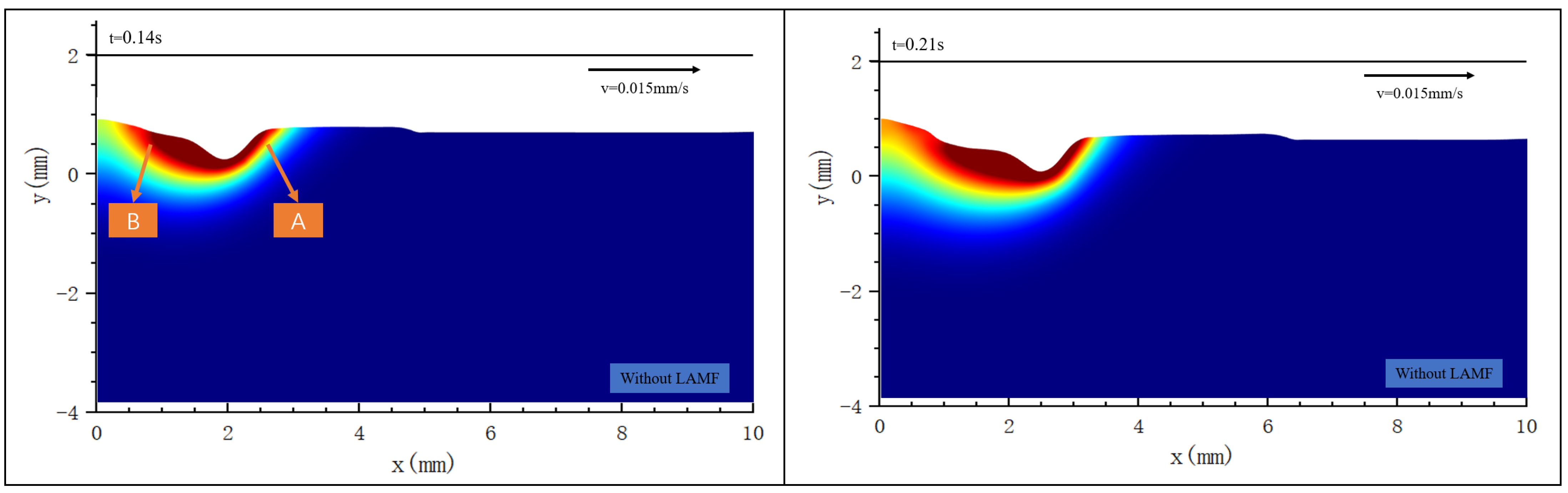
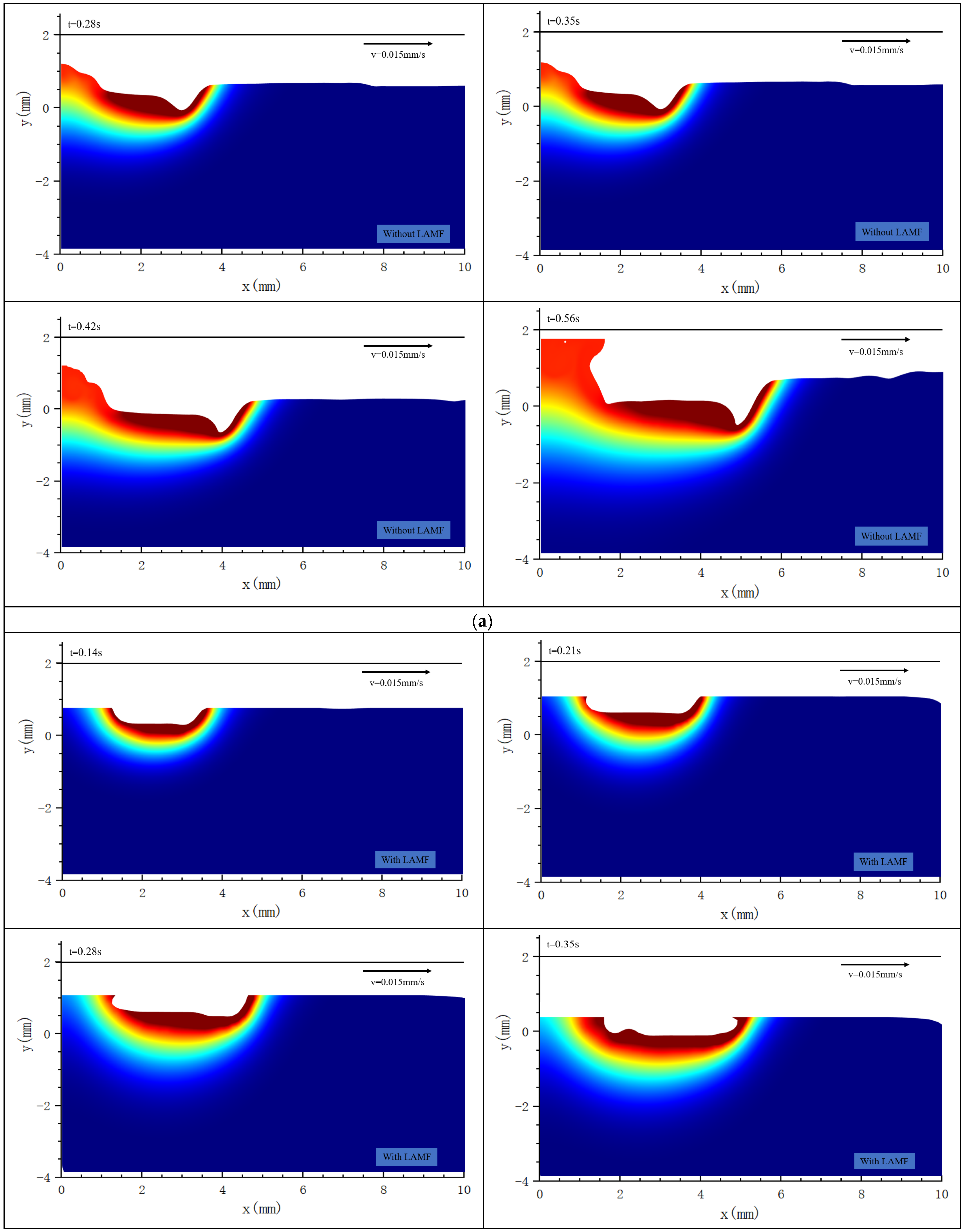
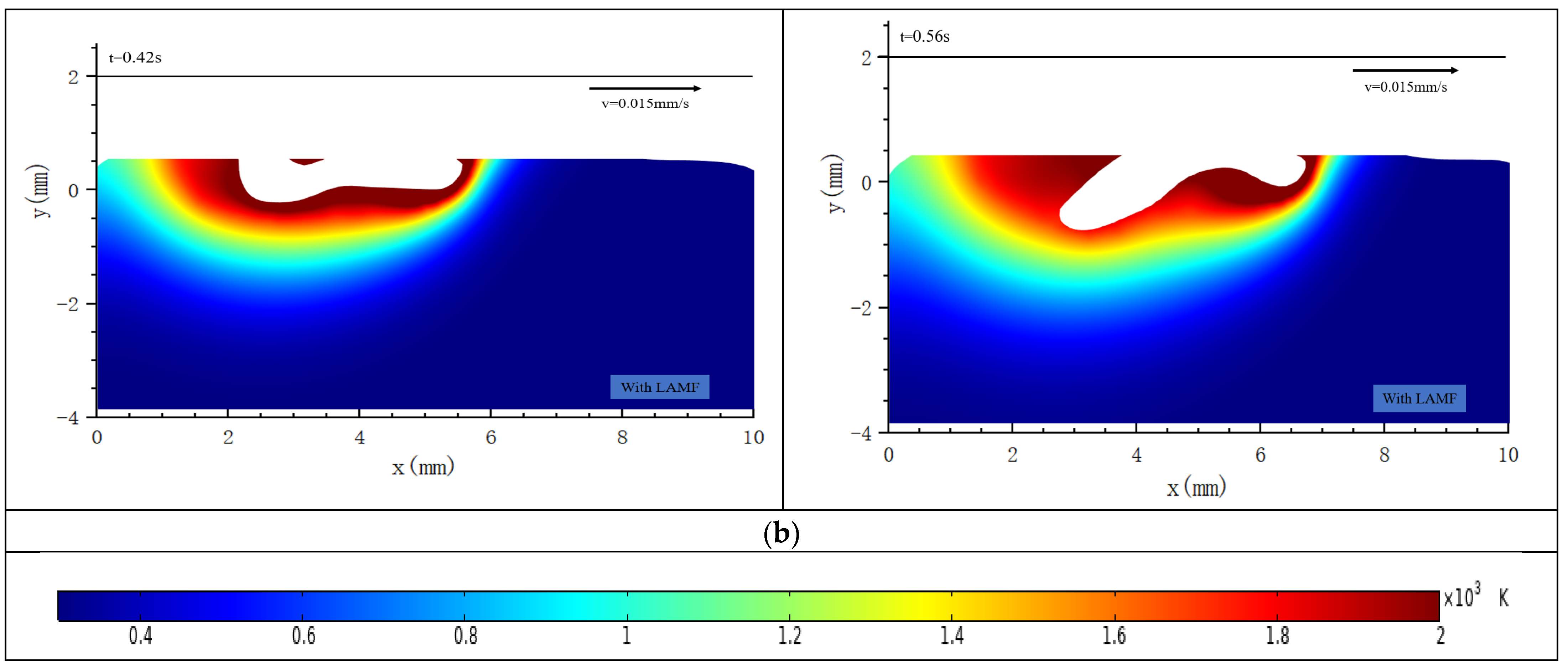
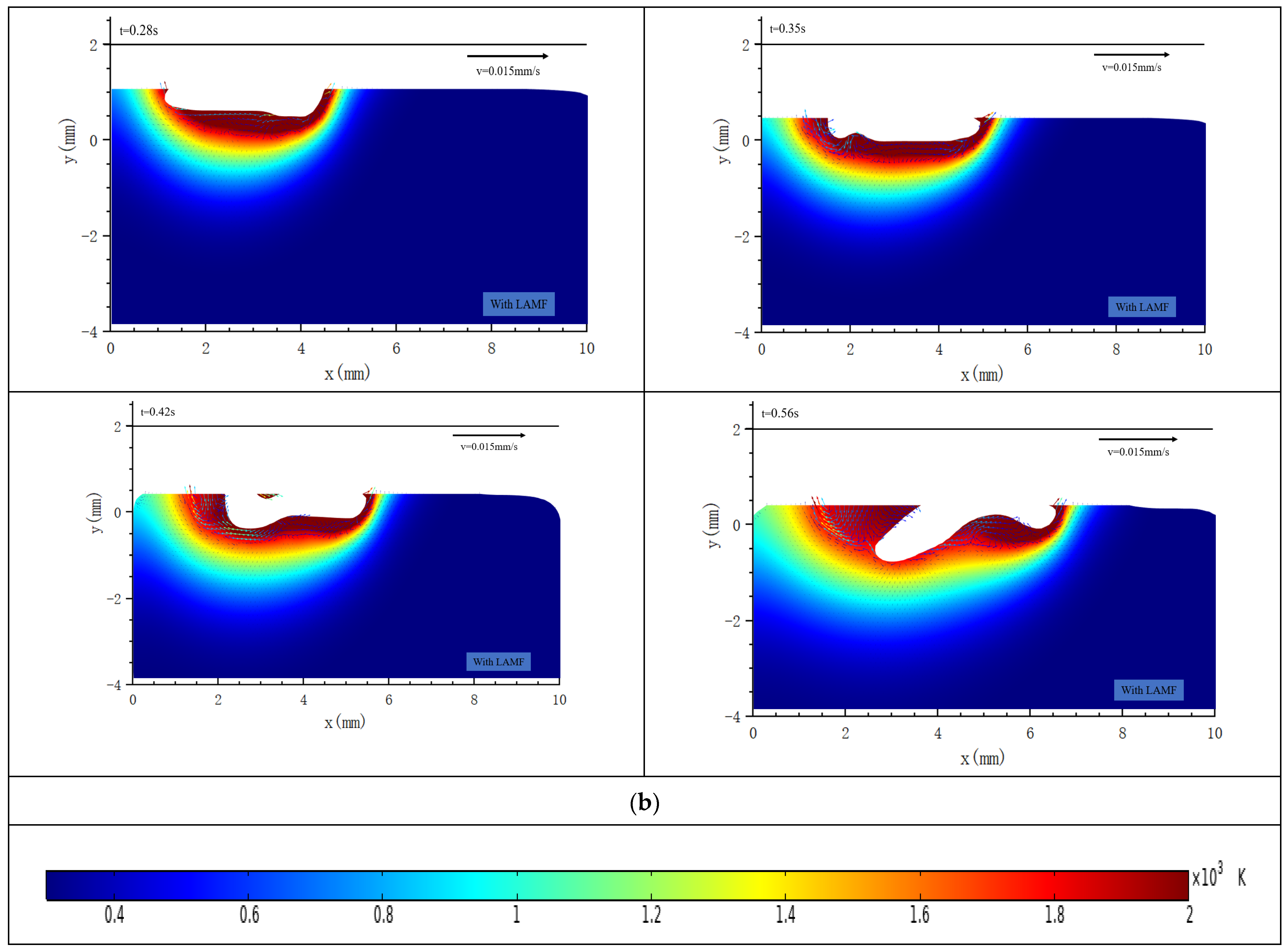
Figure 2 shows the simulated molten-pool temperature fields at different time steps. At the initial stage of welding, a local high-temperature core is formed near the heat-source region because of rapid heat accumulation. As welding proceeds, the high-temperature region gradually spreads from the heat-source region to the surrounding molten zone.
Figure 2a shows that, without LAMF, the high-temperature region remains more locally concentrated, and the molten-region contour exhibits a relatively irregular evolution, especially near the rear part of the molten pool.
In contrast, Figure 2b shows that, with LAMF, the high-temperature region becomes more smoothly distributed, and the isotherms near the rear region of the molten pool are more continuous. Meanwhile, the molten-region boundary also appears more regular.
These results indicate that LAMF mainly affects the spatial redistribution of heat within the molten pool, rather than simply changing the peak temperature. This tendency is consistent with the molten-pool dynamic behavior reported by Jia et al. [16], suggesting that external assistance can modify molten-pool evolution and heat-transfer behavior.
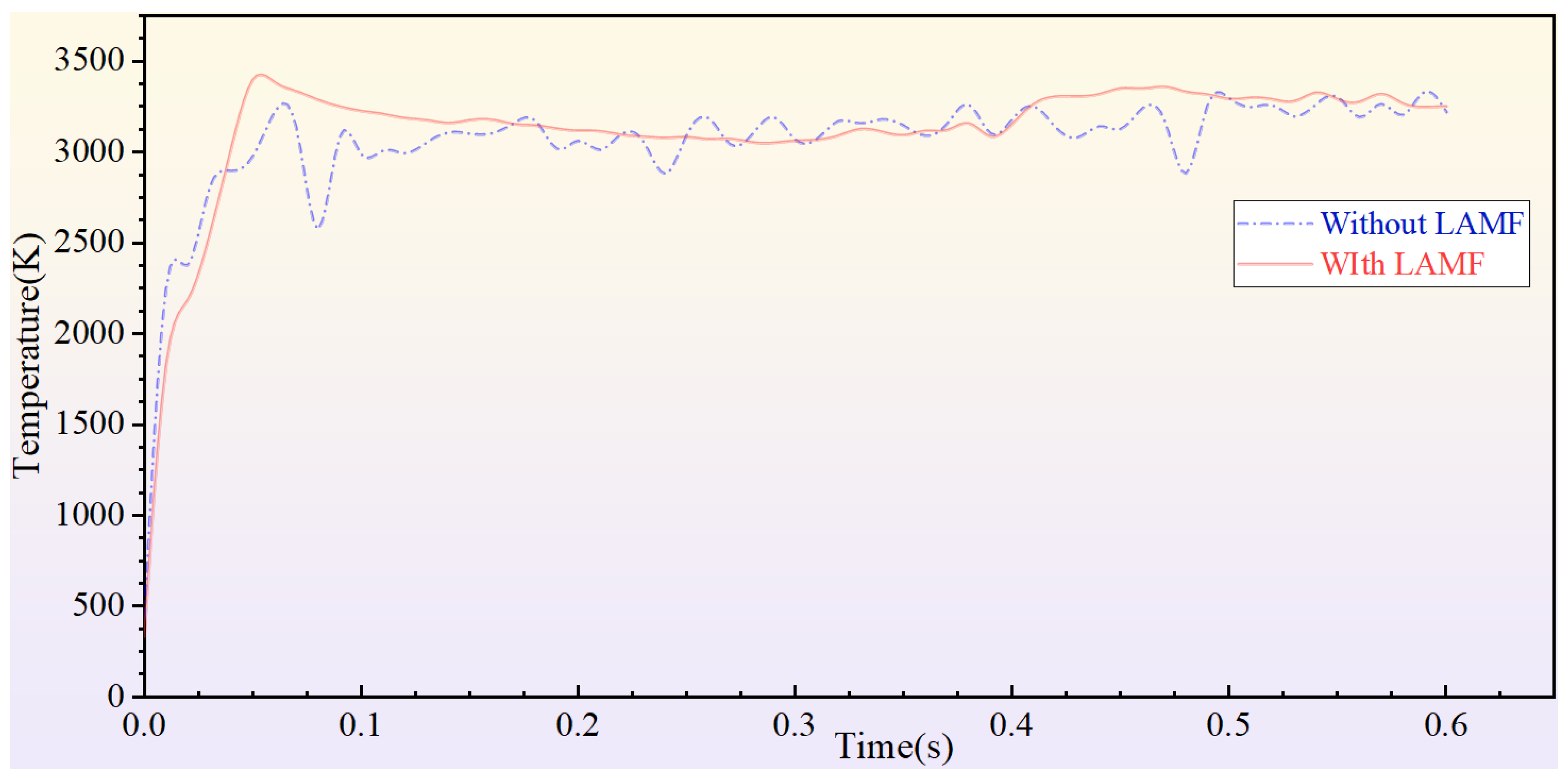
Figure 3 further compares the temporal evolution of the peak molten-pool temperature from 0 to 0.6 s. Without LAMF, the maximum temperature shows three pronounced fluctuations at approximately t = 0.08 s, 0.24 s, and 0.48 s, with temperature variations of 711.6 K, 197.2 K, and 448.3 K, respectively. In contrast, the peak-temperature curve under LAMF is smoother, indicating that the transient fluctuation of the molten-pool temperature is moderated when LAMF is applied.
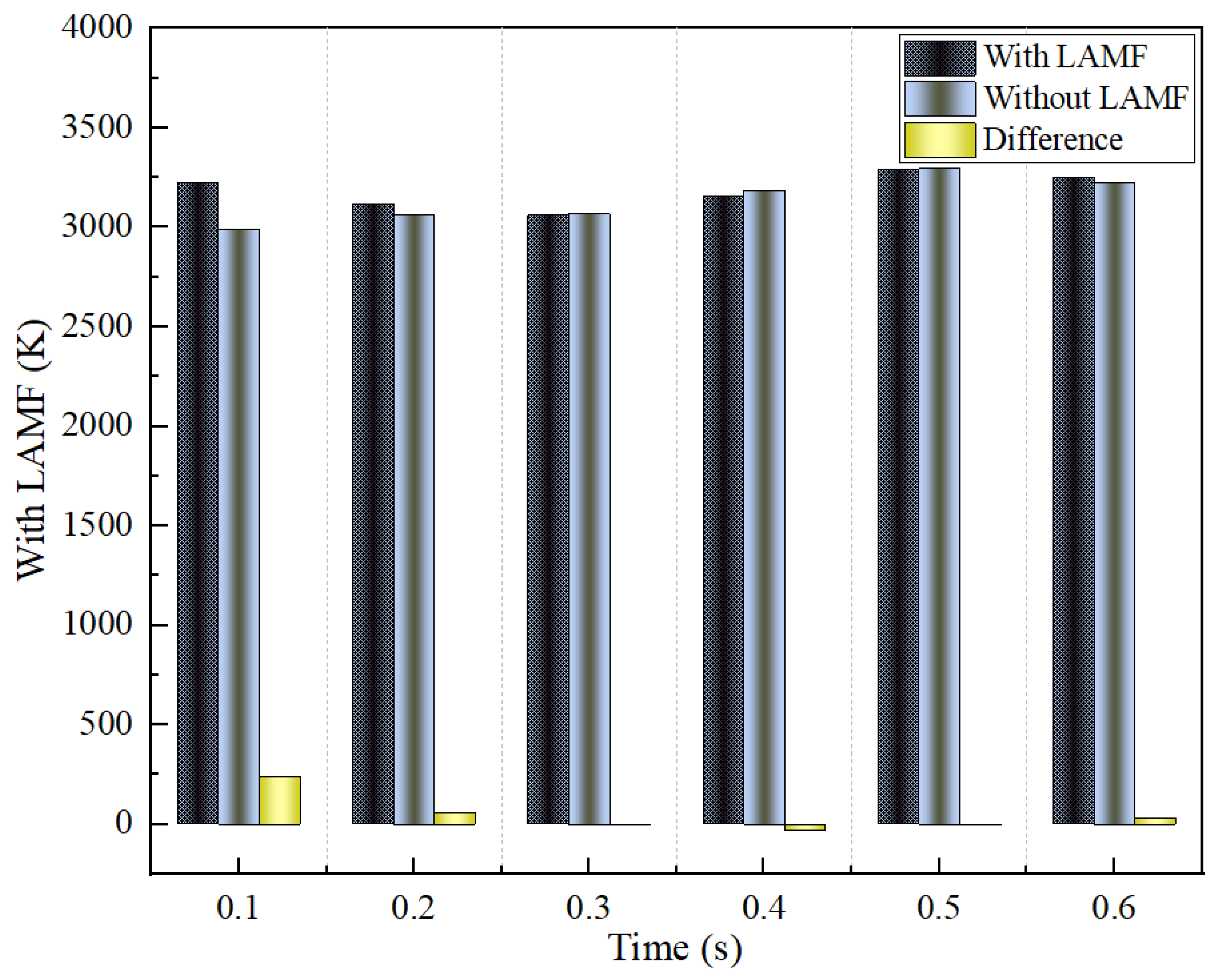
To quantitatively compare the peak-temperature difference between the LAMF and without-LAMF cases, the peak-temperature difference was defined as T m a x = T m a x , L A M F T m a x , w i t h o u t   L A M F . As shown in Figure 4, the peak-temperature differences at 0.1 s, 0.2 s, 0.3 s, 0.4 s, 0.5 s, and 0.6 s were 239.1 K, 56.4 K, −5.0 K, −27.3 K, −2.2 K, and 31.3 K, respectively. The largest increase in peak temperature under LAMF occurred at t = 0.1 s, where the peak temperature was approximately 8% higher than that in the without-LAMF case. Subsequently, T m a x decreased rapidly and became negative at several time points. This indicates that LAMF does not continuously increase the peak temperature of the molten pool but changes the heat redistribution process during molten-pool evolution. Combined with the temperature-field evolution in Figure 2, this trend may be related to the LAMF-induced forced convection, which enlarges the backflow region of molten metal near the rear of the molten pool and redistributes the high-temperature liquid metal toward the rear and surrounding molten region, thereby weakening local overheating and heat accumulation. Consequently, the peak-temperature difference at later stages decreases, and the peak-temperature fluctuation becomes less pronounced.
The above temperature-field results indicate that LAMF helps smooth the thermal transition inside the molten pool. In particular, the more continuous isotherm distribution near the rear region of the molten pool suggests that local heat accumulation is weakened and that the thermal transition near the solidification front becomes more gradual. According to classical solidification theory, columnar grains and dendrites tend to grow preferentially along the direction of the maximum temperature gradient. In the without-LAMF case, the locally concentrated isotherms and non-uniform thermal transition near the rear region of the molten pool may promote directional columnar/dendritic growth and increase the tendency for local thermal-strain concentration during solidification. After LAMF is applied, the smoother temperature distribution and more gradual local thermal transition may weaken excessive local temperature-gradient fluctuation and provide a more uniform thermal environment for subsequent solidification. This tendency is also consistent with the findings of Kang et al. [17], who reported that magnetic-field-induced stirring can disturb the local thermal boundary layer and promote heat redistribution.
Therefore, from the perspective of the temperature field, LAMF provides a favorable basis for reducing solidification-related hot-cracking tendency during cutter-ring overlay repair by promoting heat redistribution within the molten pool, moderating local temperature fluctuation, and improving the thermal conditions near the solidification front. To further quantify this tendency, local solidification parameters near the mushy region were extracted from the numerical simulation results. In this study, the mushy region was defined according to the temperature interval between the solidus and liquidus temperatures of H13 steel, namely 1700–1750 K. Considering that the welding direction is along the x direction, the local solidification rate was evaluated by projecting the welding travel speed onto the local temperature-gradient direction. At each representative time step, R was extracted at the same position where Gmax occurred in the mushy region. The corresponding Gmax, R, and G/R values are summarized in Table 4.
As shown in Table 4, the local Gmax near the mushy/solidification region decreases markedly after applying LAMF. The average Gmax decreases from 8207.26 K · m m 1 without LAMF to 3051.62 K · m m 1 with LAMF, corresponding to a reduction of approximately 62.82%. By contrast, the local solidification rate R remains within a comparable range under the two conditions. Therefore, the decrease in G/R is mainly caused by the significant reduction in Gmax. The average G/R decreases from 2068.08 K · s · m m 2 without LAMF to 721.29 K · s · m m 2 with LAMF, corresponding to a reduction of approximately 65.12%. This result quantitatively supports the above temperature-field analysis, indicating that LAMF weakens excessive local thermal-gradient concentration near the solidification front and provides a more gradual thermal transition for subsequent solidification.

2.5.2. Velocity Field Analysis

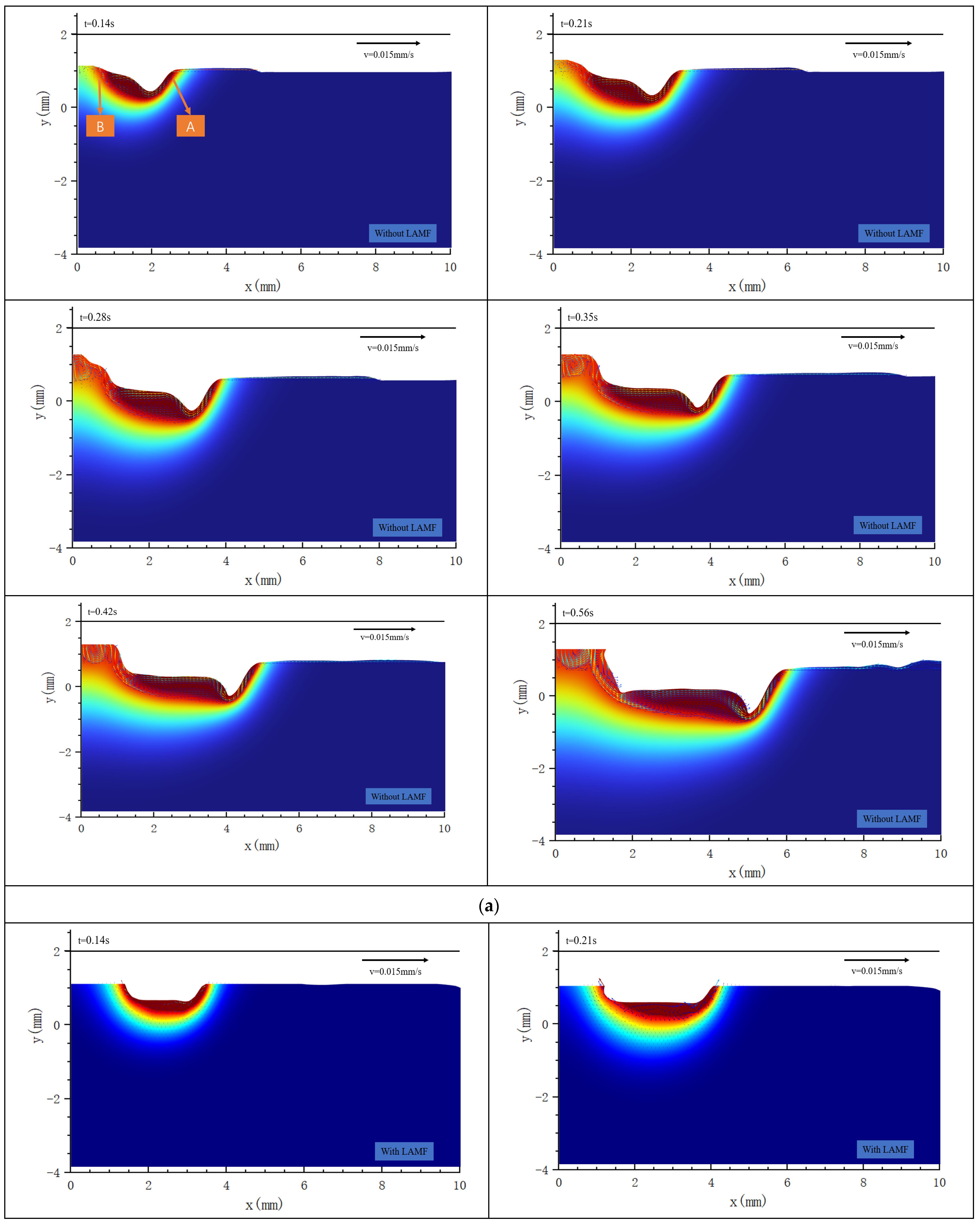
Figure 5 shows the simulated temperature and velocity fields of the molten pool at different times. As defined in Section 2.1, in the present molten-pool-scale model, the arc action was represented by the prescribed heat-flux density and current-density input, while transient arc-pressure fluctuation and droplet momentum transfer were not separately resolved. Therefore, the following comparison focuses on the regulation of molten-pool flow by the LAMF-induced Lorentz-force source term under the same MAG heat-source and boundary-condition settings.
As shown in Figure 5a, without LAMF, the molten-pool flow is governed by the prescribed heat/current input and the driving-force terms retained in the model, including surface-tension/Marangoni forces, recoil pressure, buoyancy, and Darcy resistance in the mushy zone. The molten-region contour changes noticeably with time, showing an overall asymmetric morphology with a protruding left edge and an irregular central depression. For example, at t = 0.14 s, the high-temperature region is concentrated near the left side of the molten pool, indicating non-uniform heat transport caused by localized flow. In this case, the internal flow field is mainly controlled by the thermal-gradient- and surface-force-driven circulation, and no additional electromagnetic stirring is introduced.
By contrast, Figure 5b shows that, after LAMF is applied, the Lorentz force acts on the electrically conductive molten metal and modifies the original circulation pattern. Compared with the case without LAMF, the cross-sectional contour of the molten region becomes more symmetric and regular. At most time points, the molten pool exhibits a symmetric depression with a nearly circular or broad-and-shallow profile. Meanwhile, as time progresses, the molten-region boundary evolves more smoothly, without obvious irregular abrupt changes.
Specifically, under LAMF, the molten metal is first driven toward the bottom of the molten pool. After reaching the solidification front, the flow direction changes and turns toward the rear side, namely the side near point B. At the same time, a counterclockwise vortex appears near the front side of the molten pool, close to point A, while a clockwise vortex forms near the rear side. This vortex pair enhances transverse mixing and expands the backflow region near the rear wall of the molten pool. As a result, heat is redistributed more effectively from the high-temperature region to the surrounding molten and mushy zones, thereby reducing local heat accumulation in the rear part of the molten pool. Compared with the non-LAMF case, the molten-region contour becomes smoother, and the velocity vectors show a more continuous circulation path.
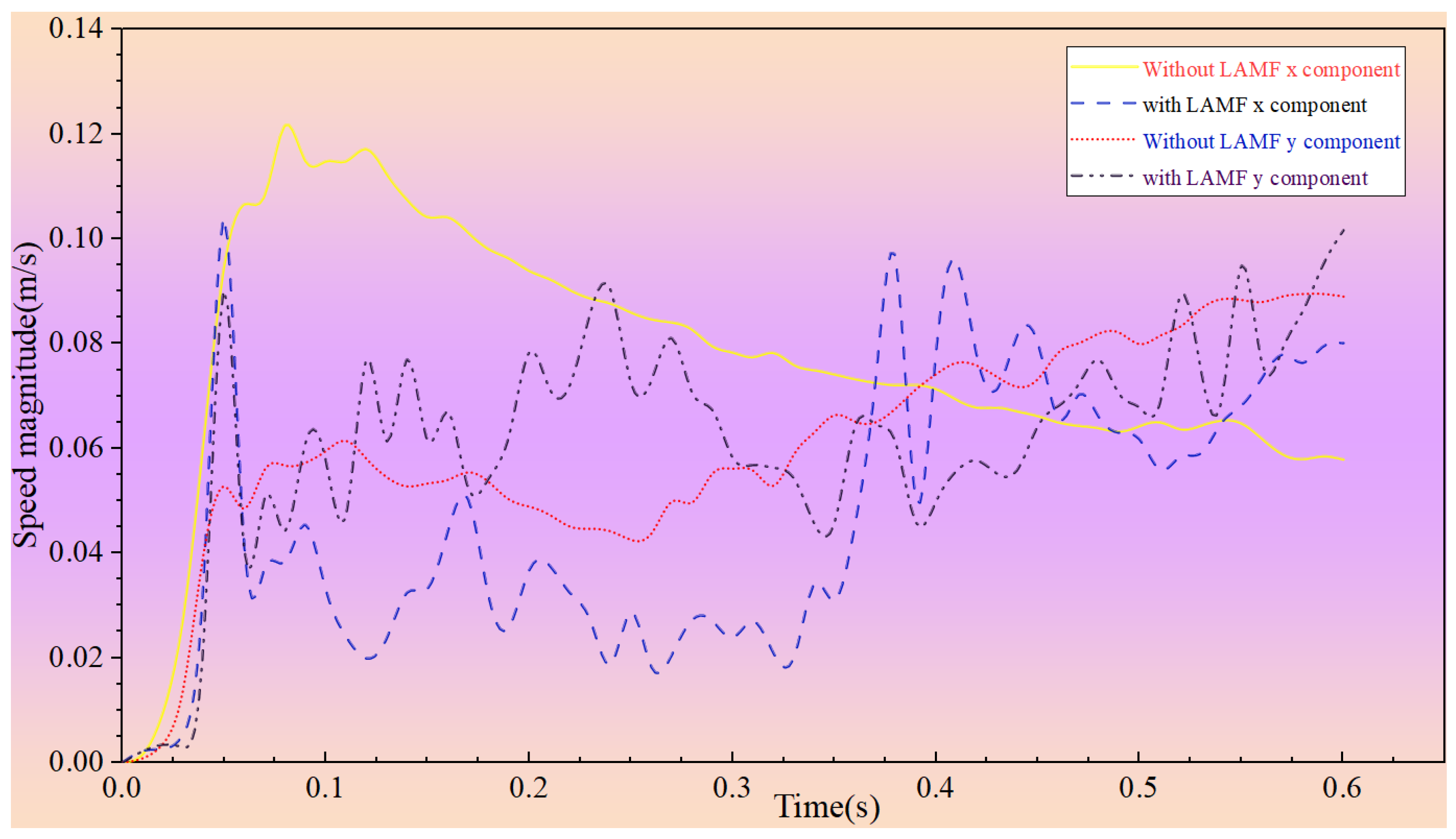
To further quantify the effect of LAMF on the flow response of the molten pool, the maximum magnitudes of the velocity components in the x and y directions were extracted from the molten-pool region with and without LAMF. This region corresponds to the area enclosed by ABCD in Figure 1, and the time-dependent variations of the x- and y-direction velocity components were further plotted, as shown in Figure 6. In addition, the characteristic peak values extracted from the velocity curves are summarized in Table 5.
As shown in Figure 6 and Table 5, the application of LAMF changes the velocity response of the molten pool in different directions. For the x-direction velocity component, the early-stage characteristic peak decreases from 0.122 m/s without LAMF to 0.104 m/s with LAMF, corresponding to a reduction of approximately 14.8%. During the entire simulated period of 0–0.60 s, the maximum x-direction velocity also decreases from 0.143 m/s to 0.104 m/s, corresponding to a reduction of approximately 27.3%. This indicates that LAMF weakens the excessive scouring flow along the welding direction and helps stabilize the molten-pool morphology.
For the y-direction velocity component, the early-stage characteristic peak increases from 0.061 m/s without LAMF to 0.090 m/s with LAMF, indicating a more active transverse dynamic response at the initial stage. Meanwhile, the maximum y-direction velocity during 0–0.60 s decreases from 0.172 m/s without LAMF to 0.102 m/s with LAMF. Therefore, LAMF does not simply increase the overall flow velocity of the molten pool. Instead, it redistributes the flow response by suppressing excessive longitudinal flow while enhancing the transverse dynamic response and vortex-assisted mixing. This is consistent with the more continuous circulation path and smoother molten-pool contour observed in Figure 5.
These results indicate that LAMF regulates the velocity field mainly by suppressing excessive flow along the welding direction while enhancing transverse circulation and vortex-induced mixing. This flow regulation promotes heat redistribution within the molten pool and helps reduce local heat accumulation. This finding is consistent with the results reported by Xie et al. [18], who showed that an external magnetic field can regulate the internal flow behavior of a molten pool. Therefore, the LAMF-regulated velocity field provides a thermal-fluid basis for the more uniform temperature distribution discussed above and is consistent with the experimentally observed reduction in crack defects. It should be noted that the possible promotion of elemental homogenization in this study is inferred from the enhanced molten-metal mixing in the simulation, rather than being directly verified by compositional characterization.

3. Materials and Methods

3.1. Experimental Platform and Process Parameters

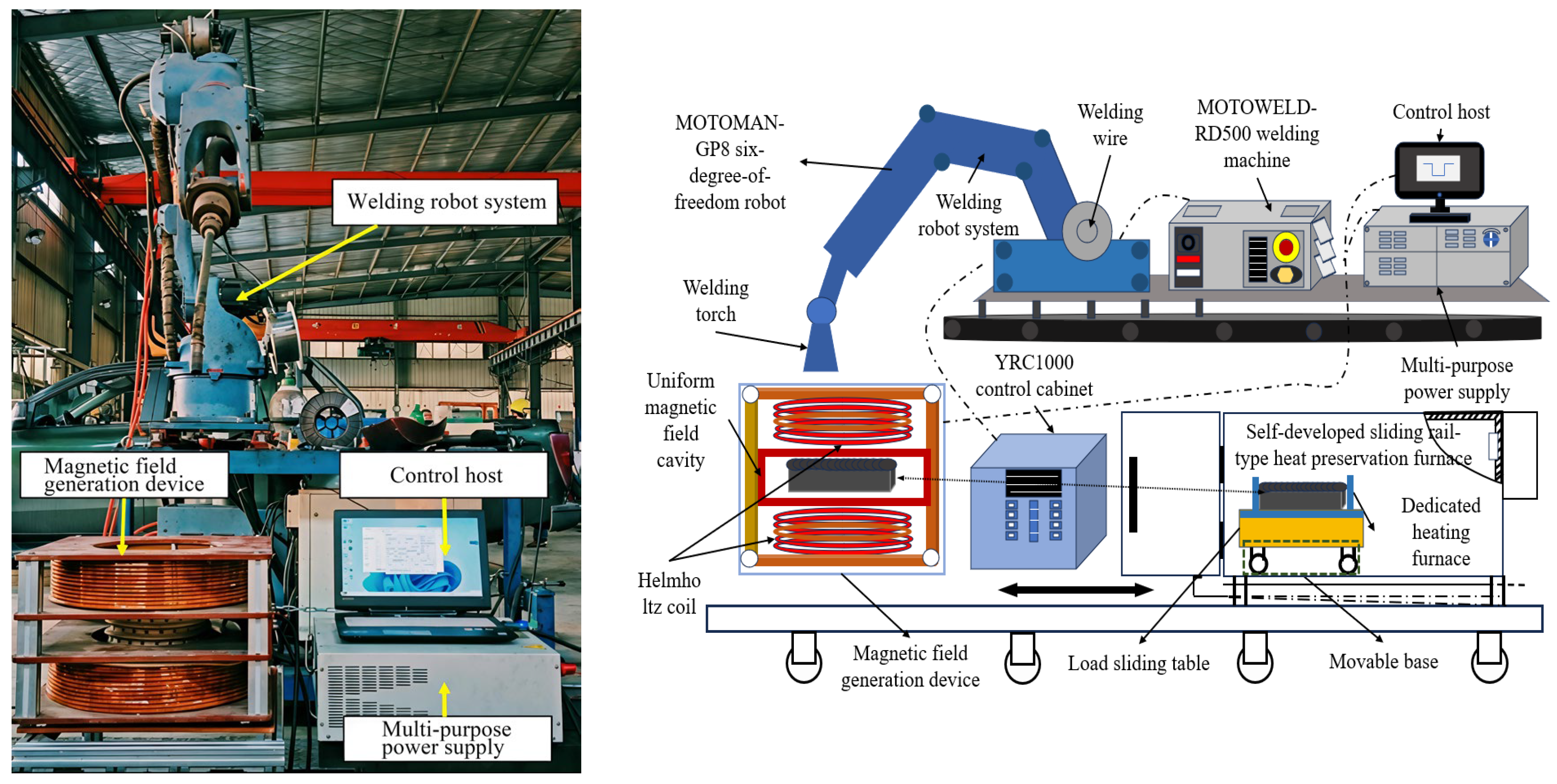
To experimentally compare the MAG overlay remanufacturing process of TBM cutter-ring specimens with and without LAMF and verify its crack-suppression effect, an experimental platform was established, as shown in Figure 7. The platform consisted of a welding robot system, a sliding rail-type heat-preservation furnace, and an independent magnetic-field generation system. The welding robot system included a welding machine (MOTOWELD-RD500, YASKAWA Electric Corporation, Kitakyushu, Japan), a six-degree-of-freedom robot (MOTOMAN-GP8, YASKAWA Electric Corporation, Kitakyushu, Japan), a control cabinet (YRC1000, YASKAWA Electric Corporation, Kitakyushu, Japan), and a welding torch mounted on the robot end-effector. The welding trajectory was controlled by the robot controller, and the MAG overlay process parameters were set through the welding machine. The self-developed sliding rail-type heat-preservation furnace consisted of a load sliding table, a sliding mechanism, a movable base, and a dedicated heating furnace, enabling continuous transfer between pre-weld preheating and post-weld tempering of the cutter-ring specimen.
The independent magnetic-field generation system consisted of a pair of identical Helmholtz coils, a multi-functional power supply (JP-50150D, Wuxi Annis New Energy Equipment Co., Ltd., Wuxi, China), and a control host. The two coils were connected in series and arranged coaxially and in parallel on both sides of the specimen. The winding direction and terminal connection were designed so that the axial magnetic-field components generated by the two coils were superposed in the central region when alternating current was applied, thereby forming a longitudinal alternating magnetic field in the welding region. According to the coil-assembly design, each coil had an inner diameter of 300 mm, an outer diameter of 800 mm, and an axial height of 150 mm. A working cavity with a diameter of approximately 300 mm was formed between the two coils, and the nominal peak magnetic flux density in the working region was approximately 80 mT. The excitation voltage, current, frequency, and waveform were adjusted using the control host. The power supply had a maximum output voltage of 50 V, a maximum output current of 100 A, and a maximum controllable frequency of 10 Hz. In this study, the magnetic flux density in the working region was determined according to the calibrated output relationship of the magnetic-field generation system, rather than by in situ Hall-sensor measurement during welding.
Before welding, the H13 steel cutter-ring specimen was preheated on the loading platform of a rail-type holding furnace. After preheating, the platform was moved to the welding position. For the without-LAMF condition, the specimen was placed at the same position within the coil assembly, but the coils were not energized. For the LAMF-assisted condition, the coils were energized according to the LAMF parameter-screening results described in Section 2.4, with the excitation power supply set to 50 V, 80 A, and 5 Hz. The MAG overlay welding parameters were kept identical for the two experimental conditions in order to isolate LAMF as the primary process variable investigated in this study. Specifically, the welding current, welding voltage, and travel speed were 130 A, 20.1 V, and 5 mm/s, respectively. These parameters were selected based on the optimized MAG overlay remanufacturing process for cutter rings reported in Ref. [1]. It should be noted that the welding current and voltage reported here refer to the preset values of the welding equipment, rather than instantaneous waveform data obtained through real-time electrical signal acquisition.
In the comparative experiments, the LAMF system was supplied by an independent magnetic-field generation device and was not synchronized with the welding-current waveform. No additional control strategy was applied to intentionally modify the arc stiffness or droplet-transfer behavior. Therefore, the LAMF and non-LAMF experiments were conducted under the same nominal MAG process parameters, with LAMF introduced as the primary external variable. During the welding trials, no apparent arc interruption, abnormal spatter increase, or macroscopic bead deviation was observed.

3.2. Test Materials

The chemical composition of the engineering cutter ring, base material for testing, and welding wire is shown in Table 6.

3.3. Sample Preparation and Characterization

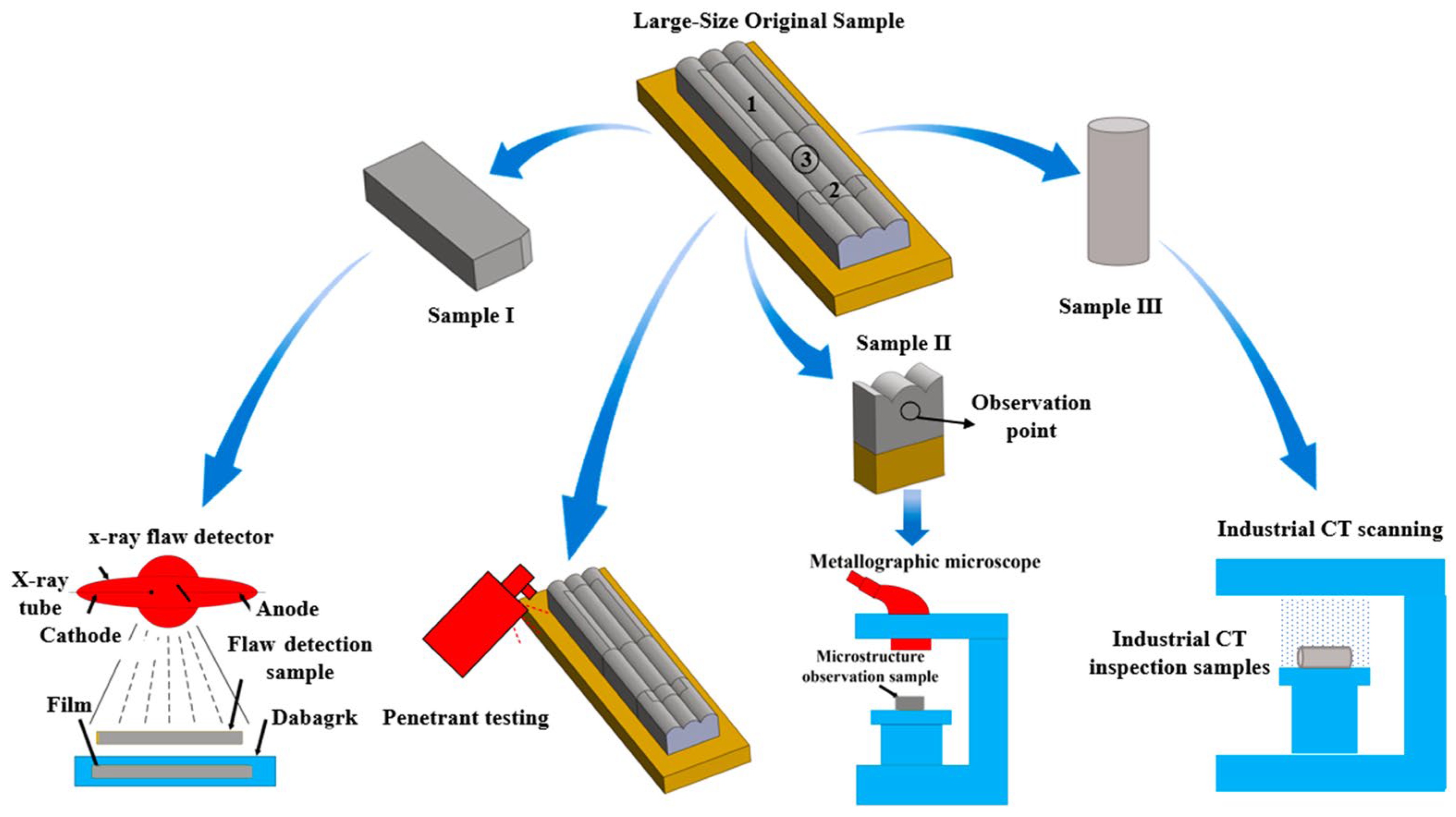
After welding, the specimens were sectioned and characterized according to the procedure shown in Figure 8. To ensure the comparability between the LAMF and non-LAMF conditions, all sub-specimens were taken from the same relative positions of the single-pass overlay layer, while avoiding the arc starting zone, arc ending zone, and unstable edge regions as much as possible. The main steps were as follows:
(1)
First, penetrant testing was performed on the large-size original specimens after overlay welding to evaluate the presence and distribution of surface macrocracks.
(2)
Then, a specimen containing a single-pass overlay layer (Sample I) was cut from the original specimen, and its internal defects were examined by X-ray inspection.
(3)
Next, a metallographic specimen (Sample II) was cut from the corresponding region of the overlay layer for microstructural observation and qualitative analysis using a metallographic microscope. The repaired layer, heat-affected zone, and base material were mainly observed to compare the post-solidification microstructure under the LAMF and non-LAMF conditions.
(4)
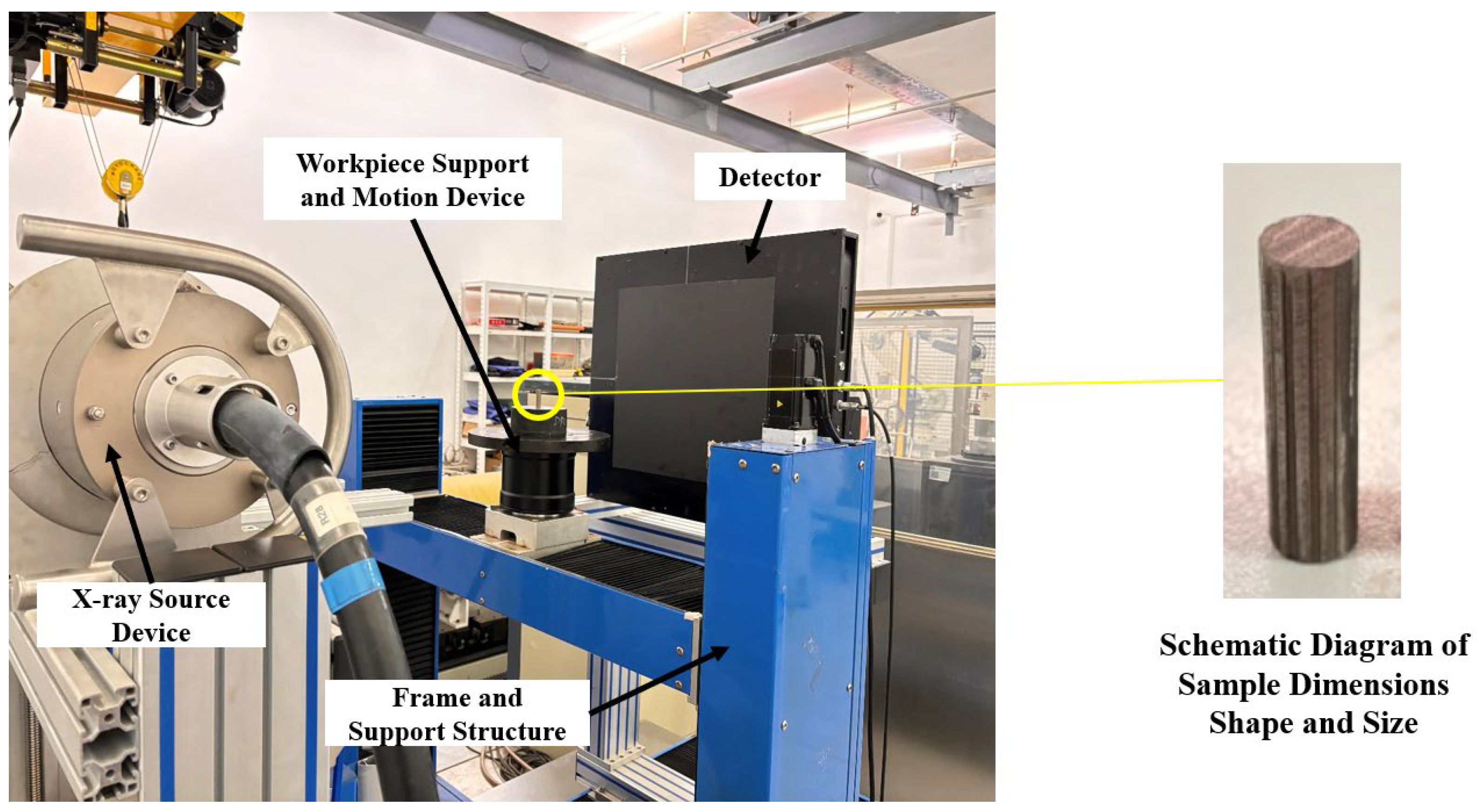
Finally, a cylindrical specimen (Sample III) was prepared according to the dimensions shown in Figure 9, and industrial CT scanning was conducted to reconstruct the three-dimensional morphology of internal cracks. For the LAMF and non-LAMF specimens, the same volumetric scanning and defect-identification procedures were used. The crack-defect volume fraction was defined as the ratio of the reconstructed crack volume to the total inspected volume. Based on this definition, the difference in crack-defect volume fraction between the two conditions was used to quantitatively compare the crack-suppression effect of LAMF.
Penetrant testing, X-ray inspection, metallographic observation, and industrial CT scanning were combined to evaluate the crack-suppression effect of LAMF in terms of surface cracks, internal defects, and post-solidification microstructure. The present experimental validation mainly focused on crack-defect characterization and post-solidification microstructural observation under a representative single-pass overlay condition. Therefore, the obtained results mainly reflect the comparative effect of LAMF under the selected welding condition, rather than directly representing the cumulative interpass thermal effects in multi-layer or multi-pass remanufacturing. Accordingly, this work focuses on evaluating the crack-defect suppression effect of LAMF, whereas the fracture behavior, long-term load-bearing capacity, and fatigue performance of the repaired layer require further investigation through mechanical tests such as tensile, impact, and fatigue tests.

4. Results and Discussion

4.1. Metallographic Structure of Different Zones

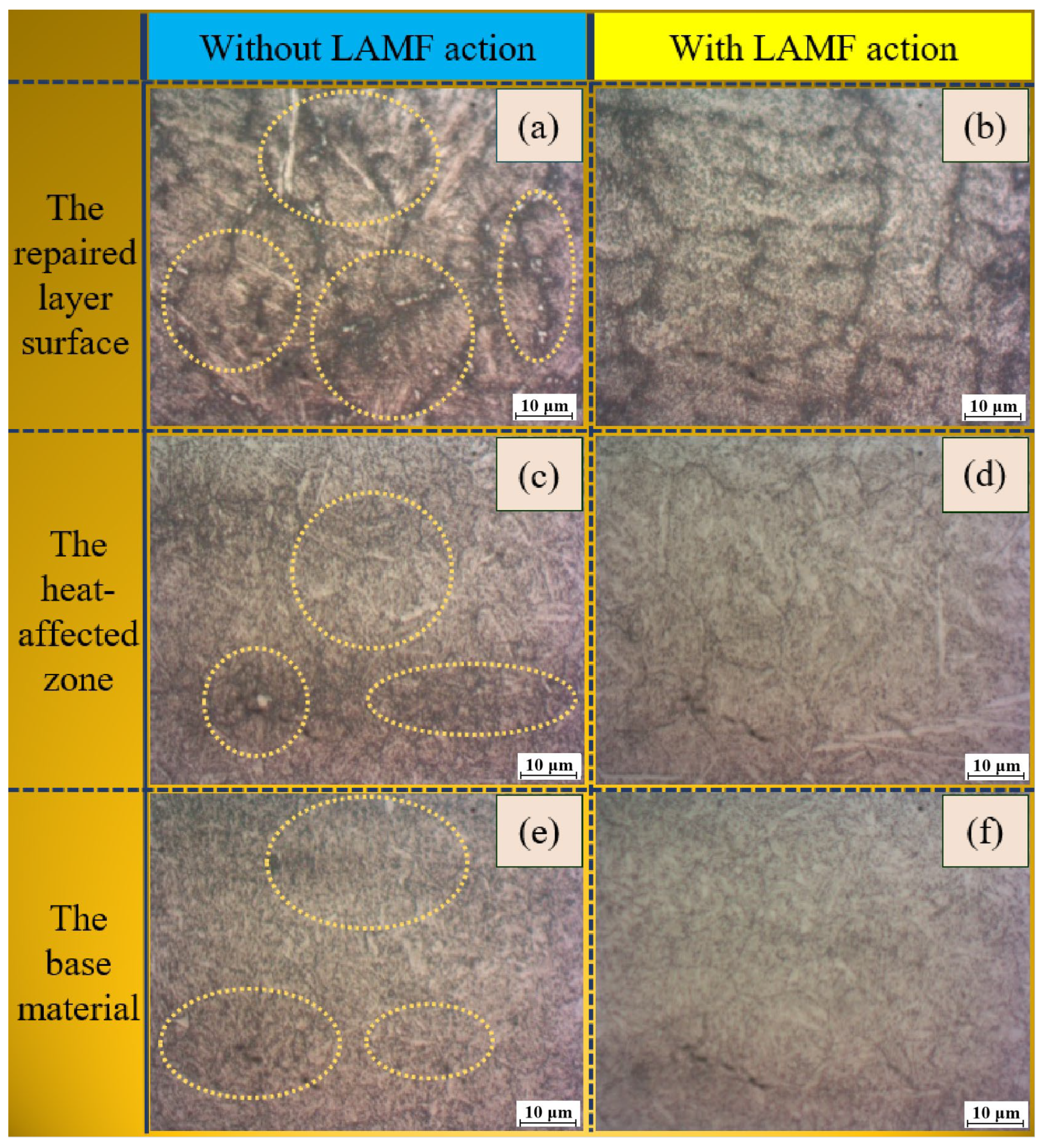
Figure 10 compares the metallographic structures of the repaired layer surface, heat-affected zone, and base material with and without LAMF. In the specimen without LAMF, locally coarse and non-uniform microstructural regions can be observed, as indicated by the dashed outlines. These features are more evident in the repaired layer and heat-affected zone, where coarse columnar-like morphology appears in some local regions. This indicates that directional solidification and local grain coarsening occurred during the overlay remanufacturing process. In contrast, after applying LAMF, the corresponding regions show a finer and more homogeneous post-solidification morphology. The coarse-grained regions become less continuous and less pronounced, and the microstructure in the repaired layer and heat-affected zone appears more compact.
The above metallographic difference is consistent with the thermal-fluid evolution discussed in Section 2.5.1 and Section 2.5.2. As shown in Figure 2, Figure 3 and Figure 4, LAMF promotes heat redistribution in the molten pool, smooths the thermal transition near the rear region of the molten pool, and weakens local temperature fluctuation. As shown in Figure 5 and Figure 6, LAMF also modifies the molten-pool circulation by suppressing excessive flow along the welding direction while making the transverse dynamic response and vortex-induced mixing more active. This regulated flow pattern can enhance heat exchange between the high-temperature liquid metal and the surrounding molten or mushy regions. From the viewpoint of solidification, such thermal-fluid regulation may disturb the local thermal boundary layer, weaken the continuity of directional dendritic growth, and promote partial dendrite remelting or fragmentation to some extent. These effects provide a reasonable explanation for the finer and more uniform solidified morphology observed in Figure 10 under LAMF.
Therefore, the metallographic observations qualitatively support an LAMF-assisted grain-refinement tendency. Since optical metallography mainly reflects the final solidified morphology, the present section does not directly quantify crystallographic orientation, carbide distribution, or elemental segregation. These aspects require further EBSD and compositional characterization. Within this evidence scope, the finer and more uniform microstructure observed under LAMF provides microstructural support for the crack characterization and mechanism discussion presented in Section 4.2.

4.2. Crack Characterization and Mechanism Discussion

(1)
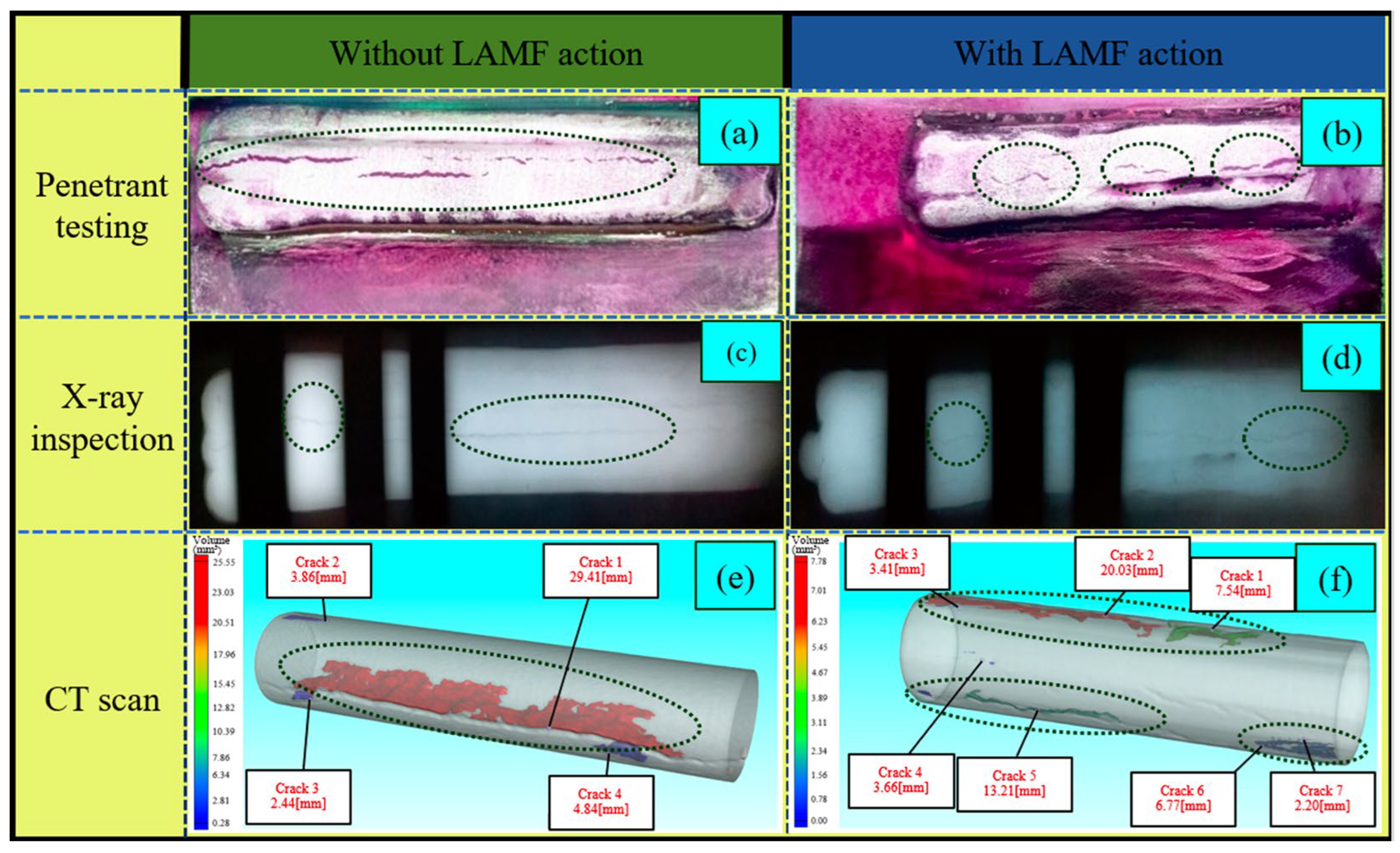
Figure 11 compares the crack morphology and internal defect distribution of the overlay layers with and without LAMF, as characterized by penetrant testing, X-ray inspection, and industrial CT scanning. As shown in the figure, network-like cracks are observed on the repaired surface without LAMF (Figure 11a), and relatively long internal cracks are also detected by X-ray inspection and CT scanning (Figure 11c,e). After applying LAMF, the surface cracks are mainly transformed into isolated pinpoint defects (Figure 11b), and the internal crack size is also markedly reduced (Figure 11d,f). A further comparison of the industrial CT results shows that the maximum internal crack length decreases from 29.41 mm without LAMF to 20.3 mm with LAMF, corresponding to a reduction of approximately 30.98% (Figure 11e,f). In addition, under the same inspected volume of 2748.89 mm3, the crack-defect volume decreases from 25.56 mm3 without LAMF (Figure 11e) to 7.78 mm3 with LAMF (Figure 11f), and the corresponding crack-defect volume fraction decreases from 0.93% to 0.28%, corresponding to a decrease of 0.65 percentage points. These results indicate that LAMF effectively reduces both the crack length and the crack-defect volume fraction in the overlay remanufactured layer.
(2)
Based on the above non-destructive testing results, industrial CT characterization, and metallographic observations, the observed crack defects can be primarily classified as solidification-related cracks in the overlay remanufactured layer. Solidification cracking generally forms during the final stage of weld-metal solidification, when the remaining interdendritic liquid is insufficient to compensate for solidification shrinkage and thermally induced tensile strain [19]. In terms of crack location and distribution, the observed cracks are mainly distributed within the overlay layer, rather than being concentrated in the heat-affected zone or partially melted zone. In addition, the network-like surface cracks and long internal cracks observed in the specimen without LAMF are consistent with crack features formed under the combined effect of thermal strain and insufficient interdendritic feeding during solidification. After applying LAMF, both the crack length and crack-defect volume decrease markedly, further indicating that LAMF regulates the crack formation process during solidification. By contrast, liquation cracking is usually associated with local grain-boundary liquation in the partially melted zone or heat-affected zone, whereas reheating cracking is generally related to crack initiation or propagation during subsequent high-temperature exposure [20,21]. In the present study, although post-weld tempering was included in the overall heat-treatment procedure, the observed cracks were mainly located within the overlay layer rather than being concentrated in the heat-affected zone or partially melted zone. In addition, the available metallographic observation and industrial CT results did not show crack features that could be clearly attributed to reheating cracking. Therefore, liquation cracking and reheating cracking are not considered to be the dominant cracking mechanisms in this study.
(3)
From the metallographic observations, relatively coarse columnar-grain features and continuous grain boundaries can be observed in the overlay layer without LAMF (Figure 10a,c). These microstructural features may provide relatively continuous paths for crack initiation and propagation during solidification. After applying LAMF, the post-solidification microstructure becomes finer and more uniform (Figure 10b,d,f), indicating that electromagnetic stirring may inhibit the coarsening of the solidified structure and promote grain refinement to some extent. A finer and more uniform microstructure can increase the tortuosity of crack-propagation paths, thereby reducing the possibility of further propagation of long through-thickness cracks. This is consistent with the decrease in crack length observed from the CT results. It should be noted that this interpretation is mainly based on the correlation between post-solidification metallography and CT crack morphology, rather than on quantitative EBSD analysis of grain orientation or equiaxed-grain fraction.
(4)
According to the temperature-field results in Figure 2, Figure 3 and Figure 4 and the extracted solidification parameters in Table 4, the molten-pool temperature distribution becomes more uniform under LAMF, and excessive local thermal-gradient concentration near the mushy/solidification region is weakened. Specifically, the average mushy-zone Gmax decreases from 8207.26 K · m m 1 without LAMF to 3051.62 K · mm 1 with LAMF, while the corresponding G/R value decreases from 2068.08 K · s · m m 2 to 721.29 K · s · m m 2 . This indicates that LAMF provides a more gradual thermal transition near the solidification front. Such a reduction in G/R may help weaken the tendency for excessive directional columnar/dendritic growth and local thermal-strain concentration during solidification. The velocity-field results in Figure 5 and Figure 6 further show that the Lorentz force induced by LAMF changes the molten-pool flow pattern and enhances transverse stirring and vortex regulation, leading to more sufficient backflow and mixing of high-temperature liquid metal within the molten pool. This flow regulation promotes heat redistribution and improves the thermal-fluid conditions near the solidification front and mushy zone, which is beneficial for weakening local overheating or undercooling and improving interdendritic liquid feeding during solidification. The more uniform thermal-fluid conditions revealed by the simulation results provide a mechanistic explanation for the microstructural refinement tendency observed in Figure 10. Overall, LAMF improves the thermal-fluid conditions near the solidification front and the interdendritic feeding condition by reducing local Gmax, lowering G/R, making the temperature field more uniform, and enhancing molten-pool stirring. This coupled thermal-fluid-microstructure regulation is ultimately reflected in the marked reduction in crack length and crack-defect volume in the CT results. It should be noted that the present simulation is not directly coupled with a microstructure-evolution model; therefore, the above analysis reflects the mechanistic correlation between thermal-fluid conditions and solidification microstructural response, rather than a direct prediction of grain size or equiaxed-grain fraction.

4.3. Scope of Interpretation and Future Work

The present results should be interpreted within the paired-comparison framework defined in Section 2.1. The LAMF and non-LAMF simulations were conducted under the same MAG process parameters, equivalent heat-source and current-density inputs, material properties, and boundary conditions, with the LAMF effect introduced through the Lorentz-force source term. In the model, this source term drives additional convective motion in the electrically conductive molten metal, namely electromagnetic stirring, which modifies the molten-pool flow pattern and heat transport near the solidification front. Under this treatment, the simulated LAMF effect mainly represents the molten-pool response associated with the imposed Lorentz force, rather than possible LAMF-induced changes in arc pressure or droplet impingement. Therefore, the paired comparison is suitable for evaluating the relative thermal-fluid response induced by LAMF, while absolute predictions of local free-surface evolution, weld-pool geometry, and near-surface flow details may be further improved by more refined models.
The experimental comparison was likewise conducted using the same base material, filler wire, shielding condition, and nominal MAG process parameters; thus, the presence or absence of LAMF was the primary intentionally varied process variable in the experiments. During the welding trials, no apparent arc interruption, abnormal spatter increase, or macroscopic bead deviation was observed. Nevertheless, a more detailed separation of arc/droplet response and molten-pool electromagnetic stirring still requires additional diagnostic methods and modeling analysis. High-speed imaging and synchronized current-voltage acquisition could provide direct evidence of arc and droplet stability. Meanwhile, three-dimensional arc-droplet-molten-pool modeling, together with a more detailed treatment of free-surface evolution and temperature-/composition-dependent Marangoni behavior, would further help clarify the contribution of individual physical mechanisms.
Previous integrated GMAW models provide useful methodological references for resolving heat transfer, fluid flow, and magnetic-field effects in such coupled welding systems [22]. In addition, magnetic-field-assisted GMAW/MAG-related studies have shown that external magnetic fields can regulate arc behavior, molten-pool flow, heat transfer, and weld-bead defect formation. For example, Wang et al. reported that an external magnetic field modified the fluid-flow and temperature fields in high-speed GMAW and contributed to the suppression of humping-bead formation [23]. Chen et al. further showed that a compound magnetic field could suppress undercut defects in high-speed GMAW by regulating backward molten-metal flow and improving bead formation [24]. More recent studies on metal-cored arc welding and magnetic-field-assisted MAG deposited metal also demonstrated that longitudinal or different types of magnetic fields can affect arc characteristics, metal transfer, weld-bead formation, and deposited-metal microstructure [25,26]. These studies support the understanding that magnetic fields can regulate arc-molten-pool behavior and weld formation in GMAW/MAG-related processes. However, most previous studies focused on high-speed GMAW bead defects, arc/droplet transfer, or deposited-metal microstructure, rather than crack suppression in H13 steel TBM cutter-ring MAG overlay remanufacturing. Therefore, the present work extends this electromagnetic-regulation concept to a different application scenario and provides overlay-specific experimental evidence through penetrant testing, X-ray inspection, metallographic observation, and industrial CT reconstruction.
The present simulation and characterization results support a mechanistic interpretation in which Lorentz-force-driven stirring promotes heat redistribution and improves the thermal-fluid conditions near the solidification front, which in turn corresponds to the observed reduction in solidification-related crack defects. The metallographic and CT results provide post-solidification evidence for this interpretation, while further quantitative characterization would help refine the mechanism. In particular, EBSD analysis, quantitative metallography, compositional mapping, and residual-stress measurements using XRD or hole-drilling techniques can be used to clarify grain orientation, equiaxed-grain fraction, solute/carbide redistribution, and residual-stress evolution. In addition, although the substrate and filler wire were both H13 steel with similar major alloying contents, future dilution-ratio measurements, EDS line-scan or elemental-mapping analyses, and fusion-boundary composition analyses would help further clarify local element redistribution in the overlay layer. For TBM cutter-ring applications, wear resistance is also a critical service-performance requirement; therefore, future work should further evaluate whether the improvement in crack resistance is achieved at the expense of the wear resistance of the repaired layer. These studies, together with service-performance evaluation under multi-pass repair conditions, would provide a more complete engineering basis for LAMF-assisted cutter-ring remanufacturing.

5. Conclusions

In this study, LAMF was introduced into the MAG overlay remanufacturing process of H13 steel cutter rings while keeping the other MAG process parameters unchanged. First, numerical simulations with and without LAMF were conducted to compare the molten-pool temperature field, velocity field, and flow behavior. Subsequently, overlay remanufacturing experiments were carried out using a self-built magnetic-field stirring platform. Penetrant testing, X-ray inspection, metallographic observation, and industrial CT reconstruction were combined to evaluate the crack-defect suppression effect of LAMF. The main conclusions are as follows:
(1)
Under the same heat-source input and boundary conditions, the introduction of LAMF changed the transient temperature and velocity responses of the molten pool. The Lorentz-force-driven electromagnetic stirring promoted heat redistribution within the molten pool, improved the uniformity of the temperature-field distribution, and modified the flow behavior in both the x- and y-directions. In particular, the enhancement of transverse circulation and vortex-assisted convection made the internal heat-transfer process of the molten pool more active. Quantitative extraction of local solidification parameters further showed that the average G/R value at the mushy-zone Gmax position decreased from 2068.08 K · s · m m 2 without LAMF to 721.29 K · s · m m 2 with LAMF, corresponding to a reduction of approximately 65.12%.
(2)
Under the same MAG process parameters, the LAMF-assisted overlay remanufacturing experiment showed an evident crack-defect suppression effect. Compared with the non-LAMF condition, the internal crack length of the specimen was reduced by 30.98%, and the crack-defect volume fraction decreased from 0.93% to 0.28%, corresponding to a decrease of 0.65 percentage points. Combined with the crack morphology, metallographic observations, and thermal-fluid simulation results, the crack defects observed in this study were mainly manifested as cracks associated with the solidification process during single-pass overlay welding.
(3)
The numerical simulation and experimental characterization results jointly indicate that LAMF can reduce the formation tendency of solidification-related crack defects during MAG overlay remanufacturing. The possible mechanism is as follows: the Lorentz force induced by LAMF acts on the electrically conductive molten metal and drives electromagnetic stirring inside the molten pool, thereby regulating molten-pool flow and heat-transfer behavior, making the temperature-field distribution more uniform, and strengthening transverse circulation, vortex mixing, and convective heat transfer. The synergistic effect of temperature-field homogenization and vortex regulation in the velocity field helps reduce local heat accumulation in the molten pool, alleviate the tendency of local thermal stress or thermal strain concentration during heating and solidification, and improve the thermal-fluid conditions near the solidification front, as reflected by the reduced local Gmax and G/R. Combined with the reductions in crack length and crack-defect volume fraction, LAMF helps reduce local crack susceptibility, decrease the scale of crack defects, and improve the quality of the overlay-repaired layer.
Further work is still needed to evaluate the applicability of LAMF under multi-pass/multi-layer remanufacturing conditions and to verify the engineering application performance of the repaired layer through service-related property tests, such as wear resistance and interfacial bonding strength.

Author Contributions

F.F.: writing—original draft preparation, writing—review and editing, experimental preparation, data curation and formal analysis; X.Z.: simulation analysis, data processing, and writing—review and editing; S.D.: investigation and formal analysis; K.Z.: methodology, project administration, supervision, writing—review and editing, and funding acquisition; F.H.: engineering data provision, engineering feasibility analysis, and methodology. All authors have read and agreed to the published version of the manuscript.

Funding

This research was funded by the National Natural Science Foundation of China (Grant No. 51704256) and the Key Scientific Research Project of the Hunan Provincial Department of Education (Grant No. 24A0126). The APC was funded by the research group led by K.Z.

Data Availability Statement

The original contributions presented in this study are included in the article. Further inquiries can be directed to the corresponding authors.

Acknowledgments

The authors would like to thank the editors and reviewers for their constructive comments and valuable suggestions, which helped improve the quality of this manuscript.

Conflicts of Interest

Author Fei He is employed by the company China Railway Engineering Equipment Group Co., Ltd. All other authors declare no conflicts of interest.

References

  1. Zhang, K.; Dai, S.; Jiang, B.; Wang, D.; Han, C.; Liu, Q. Simulation optimization and experimental research on heat-treatment process for ring remanufacturing of TBM disc cutters. Surf. Coat. Technol. 2023, 475, 130133. [Google Scholar] [CrossRef]
  2. Zhang, K.; Dai, S.; Jiang, B.; Zheng, X.; Liu, J.; Zhang, X. Feasibility Study for the Remanufacturing of H13 Steel Heat-Treated TBM Disc Cutter Rings with Uniform Wear Failure Using GMAW. Materials 2023, 16, 1093. [Google Scholar] [CrossRef] [PubMed]
  3. Li, Y.; Shao, C.; Zhang, M.; Cui, H.; Tang, X.; Huang, S. Improved microstructure and enhanced mechanical properties of laser fusion brazed AA5083/TA5 dissimilar butt joints by electromagnetic stirring. J. Manuf. Process. 2025, 141, 1729–1751. [Google Scholar] [CrossRef]
  4. Meng, X.; Bachmann, M.; Artinov, A.; Rethmeier, M. Experimental and numerical assessment of weld pool behavior and final microstructure in wire feed laser beam welding with electromagnetic stirring. J. Manuf. Process. 2019, 45, 408–418. [Google Scholar] [CrossRef]
  5. Zhai, L.; Ban, C.; Zhang, J. Investigation on laser cladding Ni-base coating assisted by electromagnetic field. Opt. Laser Technol. 2019, 114, 81–88. [Google Scholar] [CrossRef]
  6. Zhan, X.; Liu, X.; Li, Y.; Zhao, Y.; Wang, J. Molten pool behavior and solidification characterization in steady magnetic field assisted laser-MIG hybrid welding of aluminum alloy. J. Manuf. Process. 2022, 84, 622–638. [Google Scholar] [CrossRef]
  7. Yu, L.; Ma, Y.; Li, Q.; Xu, Y.; Yu, X.; Peng, Z.; Jiang, W. Effect of electromagnetic stirring on interfacial microstructure and mechanical properties of Al/Mg bimetal produced by lost foam compound casting. J. Mater. Res. Technol. 2024, 33, 2101–2111. [Google Scholar] [CrossRef]
  8. Liu, Z.; Wu, X.; Cheng, M.; Jia, H.; Su, Y. Influence of electromagnetic action on the microstructure and properties of magnesium alloy weld metal. J. Shenyang Univ. Technol. 2008, 30, 643–646. [Google Scholar]
  9. Shiga, K.; Fujiwara, T.; Murakami, Y.; Omura, N. In situ X-ray imaging of α-Al(FeMn)Si grain evolution during solidification of an Al-Si alloy with electromagnetic stirring. J. Alloys Compd. 2024, 1004, 175866. [Google Scholar] [CrossRef]
  10. Yang, Q.-S.; Duan, J.-X.; Deng, A.-Y.; Wang, E.-G. Numerical simulation of macrosegregation phenomenon in Cu-6wt%Ag alloy ingots fabricated by electromagnetic stirring. J. Mater. Res. Technol. 2023, 28, 300–315. [Google Scholar] [CrossRef]
  11. Yang, C.; Yang, F.; Meng, X.; Putra, S.N.; Bachmann, M.; Rethmeier, M. Multi-refining effects of an AC electromagnetic field on the microstructure in AA5754 laser beam welding. Int. J. Heat Mass Transf. 2025, 252, 127509. [Google Scholar] [CrossRef]
  12. Yang, C.; Yang, F.; Meng, X.; Putra, S.N.; Bachmann, M.; Rethmeier, M. Phase-field simulation of the dendrite growth in aluminum alloy AA5754 during alternating current electromagnetic stirring laser beam welding. Int. J. Heat Mass Transf. 2023, 218, 124754. [Google Scholar] [CrossRef]
  13. Zhao, X.; Wang, Y.; Li, R.; Lin, H.; Song, W.; Zhang, H. Suppression of edge-bead overflow in magnetic-field-assisted arc additive manufacturing. J. Huazhong Univ. Sci. Technol. (Nat. Sci. Ed.) 2024, 52, 27–36. [Google Scholar] [CrossRef]
  14. Ebrahimi, A.; Kleijn, C.R.; Hermans, M.J.M.; Richardson, I.M. The effects of process parameters on melt-pool oscillatory behaviour in gas tungsten arc welding. J. Phys. D Appl. Phys. 2021, 54, 275303. [Google Scholar] [CrossRef]
  15. Ebrahimi, A.; Babu, A.; Kleijn, C.R.; Hermans, M.J.M.; Richardson, I.M. The Effect of Groove Shape on Molten Metal Flow Behaviour in Gas Metal Arc Welding. Materials 2021, 14, 7444. [Google Scholar] [CrossRef] [PubMed]
  16. Jia, H.; Cao, L.; Fu, S.; Wen, H.; Ma, G. Numerical simulation and experiment for the dynamic behavior of molten pool in ultrasonic-assisted MIG welding. Int. J. Heat Mass Transf. 2023, 215. [Google Scholar] [CrossRef]
  17. Kang, K.; Jiang, S.; Li, D.; Shi, D. Effect of electric pulse and rotating magnetic field on solidification microstructure and properties of Al-Zn-Mg-Cu alloy. Mater. Charact. 2023, 200, 124469. [Google Scholar] [CrossRef]
  18. Xie, S.; Jiang, K.; Wang, L.; Yao, J. A Study on the Dynamic Evolution Mechanism of the Steady Magnetic Field on the Internal Flow Behavior of a Laser Melting Pool. Metals 2023, 13, 720. [Google Scholar] [CrossRef]
  19. Liu, K.; Kou, S. Susceptibility of magnesium alloys to solidification cracking. Sci. Technol. Weld. Join. 2020, 25, 251–257. [Google Scholar] [CrossRef]
  20. Kou, S. Predicting susceptibility to solidification cracking and liquation cracking by CALPHAD. Metals 2021, 11, 1442. [Google Scholar] [CrossRef]
  21. Pickle, T.; Hong, Y.; Vidal, J.; Augustine, C.; Yu, Z. Stress relaxation cracking susceptibility evaluation in 347H stainless steel welds. Weld. World 2024, 68, 657–667. [Google Scholar] [CrossRef]
  22. Zhao, W.; Jin, H.; Du, X.; Chen, J.; Wei, Y. A 3D arc-droplet-molten pool integrated model of Al alloy GMAW process: Heat transfer, fluid flow and the effect of external magnetic field. Vacuum 2022, 202, 111129. [Google Scholar] [CrossRef]
  23. Wang, L.; Wu, C.; Chen, J.; Gao, J. Influence of the external magnetic field on fluid flow, temperature profile and humping bead in high speed gas metal arc welding. Int. J. Heat Mass Transf. 2018, 116, 1282–1291. [Google Scholar] [CrossRef]
  24. Chen, J.; Zhang, Y.; Wu, C.; Padhy, G.K. Suppression of undercut defects in high-speed GMAW through a compound magnetic field. J. Mater. Process. Technol. 2019, 274, 116288. [Google Scholar] [CrossRef]
  25. Bui, V.H.; Trinh, Q.N.; Le, D.K.; Tashiro, S.; Han, L.D.; Phan, H.L.; Murphy, A.B.; Yamanaka, K.; Tanaka, M.; Xiao, L. Effect of external magnetic field on arc characteristics and weld bead formation in metal-cored arc welding. Int. J. Adv. Manuf. Technol. 2025, 140, 4845–4858. [Google Scholar] [CrossRef]
  26. Liu, Y.; Wang, F.; Zhao, Y.; Chen, F.; Zhou, L.; Chen, G.; Qin, Y. Effect of Different Magnetic Field Types on Microstructure and Properties of Deposited Metal Prepared from High-Strength Steel Wire. J. Mater. Eng. Perform. 2025, 34, 5686–5695. [Google Scholar] [CrossRef]
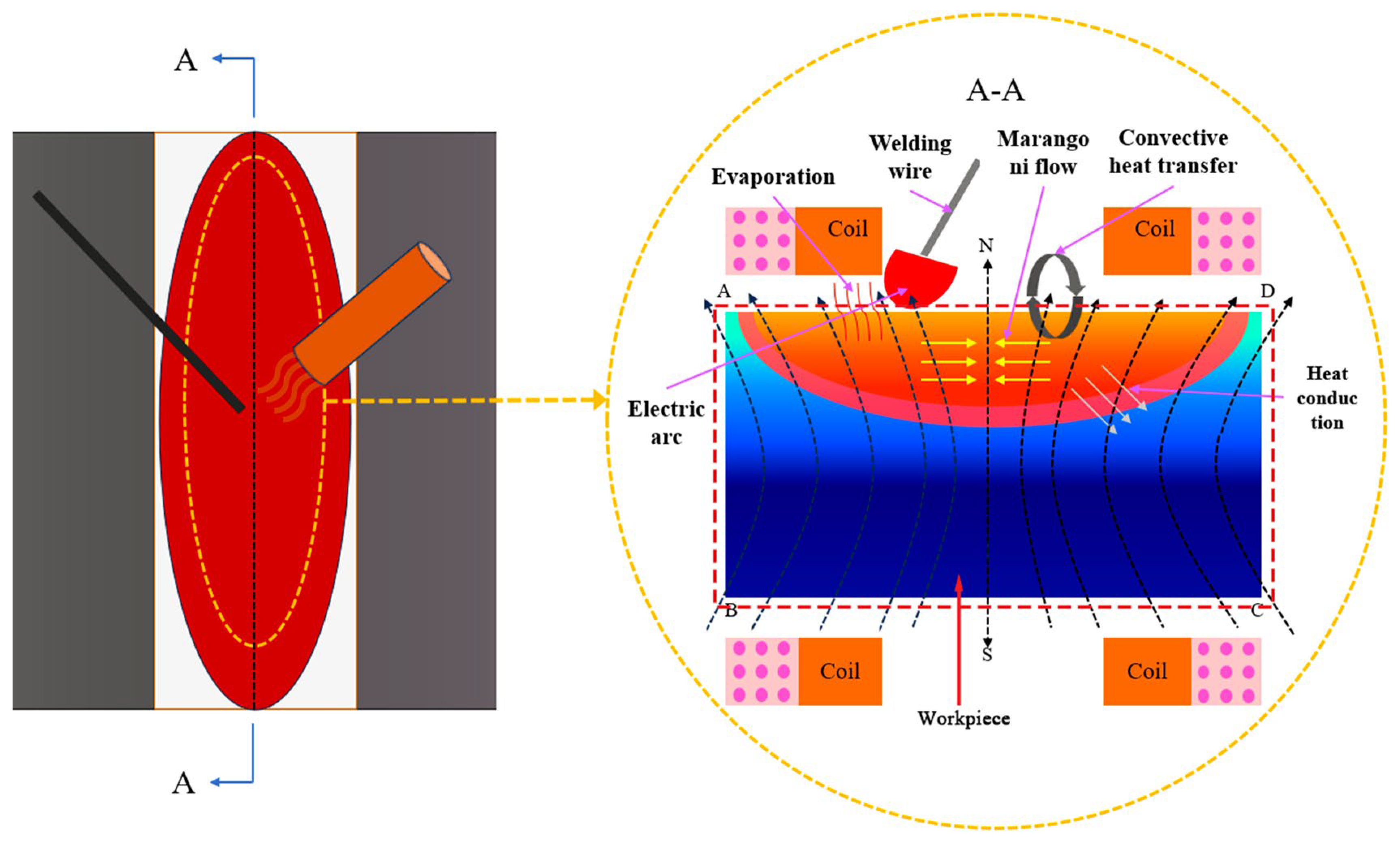
Figure 1. Schematic diagram of the mechanism of LAMF’s effect on the weld pool in the cutter ring MAG overlay remanufacturing process.
Coatings 16 00758 g001
Figure 2. Simulated molten-pool temperature fields at different time steps: (a) without LAMF, (b) with LAMF.
Coatings 16 00758 g002aCoatings 16 00758 g002bCoatings 16 00758 g002c
Figure 3. Peak weld pool temperature at different time steps with/without LAMF influence.
Coatings 16 00758 g003
Figure 4. Comparison of peak temperature at a given time with/without LAMF influence.
Coatings 16 00758 g004
Figure 5. Simulated temperature and velocity fields of the molten pool at different simulation times: (a) without LAMF, (b) with LAMF.
Coatings 16 00758 g005aCoatings 16 00758 g005b
Figure 6. Curves of the magnitude of velocity components in the x- and y-directions within the molten pool versus time, with and without LAMF action.
Coatings 16 00758 g006
Figure 7. Physical/schematic diagram of the experimental platform for MAG surfacing remanufacturing of cutter-ring specimens with/without LAMF action.
Coatings 16 00758 g007
Figure 8. Sample characterization and testing flowchart.
Coatings 16 00758 g008
Figure 9. Schematic diagram of the industrial CT scanning (CT) equipment and sample size.
Coatings 16 00758 g009
Figure 10. Comparative micrographs of different regions with and without LAMF action: (a) repaired layer surface without LAMF; (b) repaired layer surface with LAMF; (c) heat-affected zone without LAMF; (d) heat-affected zone with LAMF; (e) base material without LAMF; and (f) base material with LAMF. All micrographs were acquired at 1000× magnification. Scale bars: 10 μm.
Coatings 16 00758 g010
Figure 11. Comparative crack detection results with and without LAMF action: (a) penetrant-testing result without LAMF; (b) penetrant-testing result with LAMF; (c) X-ray inspection result without LAMF; (d) X-ray inspection result with LAMF; (e) industrial CT reconstruction result without LAMF; and (f) industrial CT reconstruction result with LAMF. The green dotted ellipses indicate the identified crack regions. In the CT reconstruction results, the colored regions represent reconstructed internal cracks, and the color bars indicate the crack-defect volume in mm3.
Coatings 16 00758 g011
Table 1. Table of material physical properties used in the simulation.
Physical Parameters of MaterialsValue
Solid density (kg/m3)7700
Liquid density (kg/m3)7000
Gas density (kg/m3)30
Solidus temperature (K)1700
Liquidus temperature (K)1750
Latent heat of fusion (J/kg)2.6 × 105
Dynamic viscosity (Pa·s)0.005
Solid-state thermal conductivity (W/(m·K))26
Liquid-phase thermal conductivity (W/(m·K))32
Table 2. Simulation scheme parameter configuration.
Variable GroupFixed ParametersVariable Scope
Number of turns N (Z)f = 5 Hz, I = 80 AN = [5, 10, 15, 20, 25]
Frequency f (Hz)N = 15, I = 80 Af = [5, 10, 15, 20, 25]
Electric current I (A)N = 15, f = 5 HzI = [30, 50, 80, 100, 120]
Table 3. Estimated electromagnetic skin depth of molten steel under different LAMF frequencies.
Frequency f (Hz)Angular Frequency ω = 2πf (rad/s)Estimated Skin Depth δ (mm)
531.42269
1062.83190
1594.25155
20125.66135
25157.08120
Table 4. Extracted solidification parameters at the mushy-zone Gmax position with and without LAMF.
Time (s)Gmax Without LAMF ( K · m m 1 )R Without LAMF ( m m · s 1 )G/R Without LAMF ( K · s · m m 2 )Gmax with LAMF ( K · m m 1 )R with LAMF ( m m · s 1 )G/R with LAMF ( K · s · m m 2 )Reduction in (G/R)
0.148597.483.882217.122883.224.87591.7573.31%
0.2110,027.173.592795.853140.464.35721.4474.20%
0.287479.054.381707.393061.163.81803.1052.96%
0.3510,753.954.802240.733371.994.27788.8864.79%
0.425920.023.381752.932697.693.91690.7860.59%
0.566465.863.821694.373155.174.31731.7656.81%
Average8207.263.972068.083051.624.25721.2965.12%
Table 5. Quantitative comparison of characteristic velocity components in the molten-pool region with and without LAMF.
Velocity ComponentConditionEarly-Stage Characteristic Peak (m/s)Time (s)Maximum Value During 0–0.60 s (m/s)Time (s)
x-direction velocity componentWithout LAMF0.1220.040.1430.53
y-direction velocity component0.0610.0550.1720.535
x-direction velocity componentWith LAMF0.1040.050.1040.05
y-direction velocity component0.090.050.1020.6
Table 6. Chemical composition of the relevant materials (wt%).
Chemical CompositionCMnCrMoSiVPSFe
engineering cutter ring0.330.325.31.680.950.93≤0.03≤0.03the rest
base material for testing0.370.435.021.250.930.95≤0.03≤0.03the rest
welding wire0.3880.3875.011.250.930.95≤0.03≤0.03the rest
Disclaimer/Publisher’s Note: The statements, opinions and data contained in all publications are solely those of the individual author(s) and contributor(s) and not of MDPI and/or the editor(s). MDPI and/or the editor(s) disclaim responsibility for any injury to people or property resulting from any ideas, methods, instructions or products referred to in the content.