Article

Macroscopic Mechanical Properties and Multi-Scale Microstructural Coupling Mechanism of Saline–Alkali Soil Stabilized by Guar Gum-Portland Cement Composite System

1
Shandong Road and Bridge Group Co., Ltd., Jinan 250014, China
2
Department of Road and Urban Railway Engineering, Beijing University of Technology, Beijing 100124, China
*
Author to whom correspondence should be addressed.
Coatings 2026, 16(7), 756; https://doi.org/10.3390/coatings16070756 (registering DOI)
Submission received: 6 March 2026 / Revised: 7 June 2026 / Accepted: 19 June 2026 / Published: 25 June 2026

Abstract

Saline-affected soils exhibit poor mechanical properties and are prone to durability degradation under environmental disturbances, severely hindering infrastructure development in saline-affected regions. This study adopted a synergistic consolidation treatment for sulfate-salinized soils using a guar gum (GG) and Portland cement composite system, formulating 25 mix designs with GG content ranging from 0% to 2% and cement content from 0% to 12%. The unconfined compressive strength (UCS), dry–wet cycle durability, and repeated load fatigue performance of the stabilized soils were systematically tested. Combined with microstructural characterization techniques including X-ray diffraction (XRD), Fourier transform infrared spectroscopy (FTIR), scanning electron microscopy (SEM), and CT scanning, the evolution patterns of the solidified soil’s mechanical properties and the macro-micro interaction mechanisms were revealed. Results indicate that cement is the primary strength source in cement-stabilized soil: at a cement dosage of 12%, the UCS reaches 2.53 MPa, a 41-fold increase compared to the native soil. A significant synergistic strengthening effect exists between cement and GG at the optimal GG dosage of 0.5%–1.0%, with the optimal mixture ratio being 6%–9% cement blended with 0.5%–1.0% GG. With this optimized ratio, the stabilized soil shows a strength retention rate of 87.2% after 10 dry–wet cycles, and its fatigue life extends to 1986 cycles (a 42.6% increase compared to pure cement-stabilized specimens). Microstructural analysis suggests that the stabilization process is fundamentally governed by interfacial micro-coating mechanisms. The reaction between cement aluminates and soil sulfates generates abundant ettringite, which is hypothesized to form a rigid skeletal framework. Simultaneously, GG forms a hydrogel network that acts as a dense, protective organic–inorganic micro-coating on the surface of soil aggregates and cement phases. This interfacial encapsulation optimizes the pore structure, reducing porosity to 1.43% and fundamentally blocking inward water infiltration pathways at the aggregate interface. However, excessive GG (>1.5%) coats cement particles, hinders hydration reactions and induces structural defects, ultimately leading to performance degradation. This study elucidates the macro-micro coupled mechanism of GG-cement composite consolidation for saline–alkali soils, providing theoretical foundations and technical solutions for saline–alkali soil consolidation engineering.

1. Introduction

Saline soils are widely distributed in coastal and arid regions, characterized by high salt content and strong water sensitivity. Under environmental changes and cyclic loading, they are prone to significant swelling and shrinkage deformation, softening upon water exposure, and strength degradation [1], which results in low bearing capacity and poor long-term stability of saline soil subgrades, causing engineering defects such as subgrade settlement and pavement cracking [2,3]. Portland cement, valued for its high strength and cost-effectiveness, is the most widely used material in saline–alkali soil stabilization projects. Its hydration products (mainly calcium hydroxide (C–H) and calcium silicate hydrate (C–S–H)) bond with soil particles to form a rigid skeleton, thus significantly enhancing the UCS of saline–alkali soil [4,5]. However, pure cement-stabilized soil has inherent limitations including high porosity, poor crack resistance, and insufficient durability under freeze–thaw cycles [6,7]. In addition, cement production generates substantial carbon emissions, which conflicts with green and low-carbon development strategies and restricts its long-term large-scale application.
Guar gum (GG), a natural polysaccharide biopolymer, has attracted increasing attention in soil stabilization due to its excellent binding properties, water retention capacity, and environmental friendliness [8]. It forms a three-dimensional hydrogel network within the soil matrix, filling intergranular voids, cementing soil particles, and reducing permeability, thereby enhancing soil water stability and toughness [9,10]. Previous studies have shown that an appropriate amount of GG can effectively improve the UCS and shear strength of silt, loess and other soils [11,12]. Nevertheless, pure GG consolidation only brings a limited improvement in soil strength, and its hydrogel network is prone to volume expansion and contraction under fluctuating moisture content, which may cause structural damage to consolidated soil in complex environments [13,14].
Combining GG with cement, by leveraging the rigid skeleton support of cement and the structural modulation capability of GG, represents an effective strategy to overcome the application limitations of pure cement-stabilized saline–alkali soil. To address the conflict between the substantial carbon emissions of traditional cement stabilization and current green development strategies, the proposed GG-cement composite system provides a highly sustainable alternative. By incorporating guar gum—a natural, environmentally friendly biopolymer—this synergistic approach significantly reduces the reliance on high cement dosages to achieve target mechanical performance. Furthermore, the optimization of the composite mix not only minimizes the overall carbon footprint of the stabilization process but also enhances the long-term durability and fatigue life of the subgrade. This improvement effectively reduces life-cycle material consumption and future maintenance requirements. Consequently, leveraging this composite consolidation strategy offers a viable pathway to achieve both high-performance infrastructure development in saline-affected regions and broader environmental sustainability goals. Recent advancements have begun to explore the synergistic use of biopolymers and inorganic binders to balance strength and environmental impact. For instance, Chen et al. [8] reported that incorporating guar gum into low-cement matrices significantly optimized both hydraulic and mechanical properties. Similarly, Zhang et al. [12] and Maleki et al. [11] demonstrated that adding optimal GG to silty sand substantially improved its unconfined compressive strength (often yielding quantitative increases ranging from 50% to over 200%) and ductility, highlighting the excellent toughening effect of the hydrogel network. However, a critical quantitative gap remains: these promising improvements are predominantly documented in benign, non-saline environments. When exposed to severe moisture fluctuations or aggressive chemical conditions, biopolymer-treated soils often suffer catastrophic strength reductions. For example, recent studies on dry–wet cycles and humidity coupling (e.g., Du et al. [9] and Feng et al. [14]) indicate that without adequate rigid inorganic cross-linking, purely biopolymer-treated matrices can lose 50% to 70% of their mechanical integrity upon water immersion due to the unrestrained reversible swelling of the hydrogel. Crucially, the quantitative durability response and chemical interaction mechanisms of these composites in highly aggressive sulfate-rich saline soils remain a profound blind spot in the current literature. Unlike the aforementioned ordinary soils, sulfate-rich environments (often containing excessive sulfate concentrations that drive severe degradation [3,4]) present a fundamentally different and extremely hostile thermodynamic system. The high concentration of aggressive sulfate ions drastically alters conventional cement hydration, shifting the thermodynamic balance toward the massive generation of expansive ettringite rather than the standard C–S–H gel formation [15,16]. It aims to elucidate a previously uncharacterized organic–inorganic competitive regulation mechanism—specifically, how the galactomannan hydrogel network chemically modulates the sulfate-aluminate hydration kinetics, and how the calcium-induced matrix cross-linking fundamentally overcomes the fatal reversible re-swelling defect (the severe quantitative strength loss mentioned above) of natural biopolymers in complex aggressive environments.
Crucially, while traditional geotechnical studies focus primarily on bulk macroscopic strength, this study redefines the stabilization of highly water-sensitive saline soils from the perspective of surface modification and interfacial coating engineering—aligning directly with advanced composite materials research. We propose that the essence of environmental resistance in stabilized soils lies in the micro-scale encapsulation and coating of loose soil aggregates by synergistic hydration products.
Furthermore, the scientific novelty of this study transcends a traditional parametric mix-design. It aims to elucidate a previously uncharacterized organic–inorganic competitive regulation mechanism in an extreme dual-anion environment. Specifically, we investigate how the galactomannan hydrogel forms a semi-permeable interfacial micro-coating that chemically modulates the sulfate-aluminate hydration kinetics, and how the calcium-induced matrix cross-linking fundamentally overcomes the fatal reversible re-swelling defect (the severe quantitative strength loss mentioned in existing literature [9,14]) of natural biopolymers in complex aggressive environments.

2. Materials and Methods

2.1. Materials

2.1.1. Saline Soil

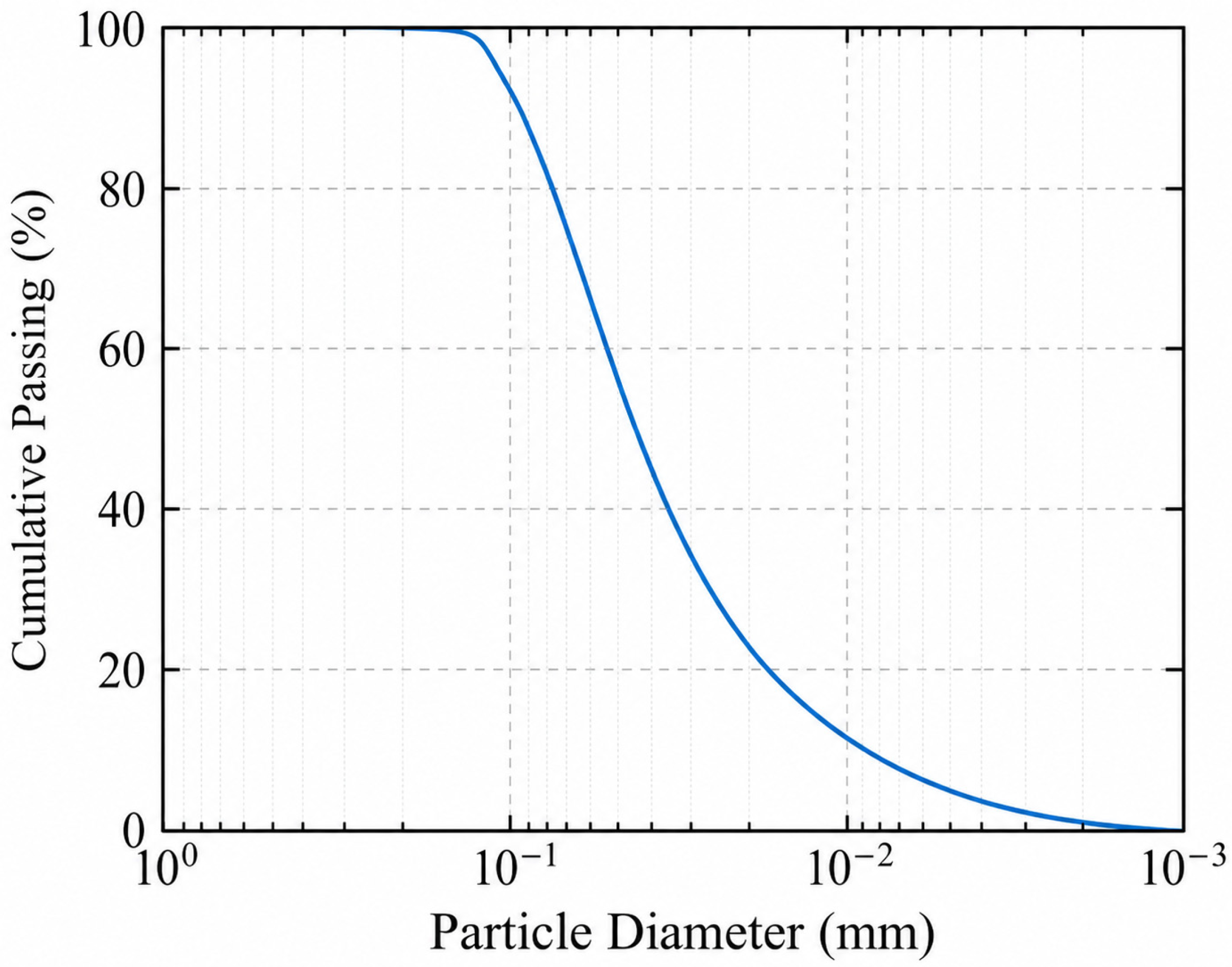
The saline soil used in the experiment was collected from the Binhai Economic and Technological Development Zone in Weifang City, Shandong Province. The soil samples were naturally air-dried, crushed, and sieved through a 1 mm mesh for subsequent use. The results of basic physicochemical property tests are as follows: the soil particle size distribution was quantitatively determined, with the continuous grading curve plotted in Figure 1.
As shown in Figure 1, The particle size distribution is predominantly characterized by fine-grained fractions, specifically consisting of 62.4% silt and 25.1% clay. The calculated coefficient of curvature (Cc) is 0.8 and the coefficient of uniformity (Cu) is 4.2, which physically confirms the poor gradation of the native soil matrix. The soluble salt characteristics of the saline soil were determined by measuring the major soluble ions, including CO32−, HCO3, Cl, SO42−, Ca2+, Mg2+, and K+ + Na+. The results are listed in Table 1. It should be noted that the values in Table 1 represent the soluble ion contents of the saline soil rather than the total chemical composition of the soil solids. The dominant soluble ions are Cl, SO42−, and K+ + Na+, indicating that the tested soil is a chloride–sulfate saline soil. The pH value is 7.93, suggesting weak alkalinity.
To further complete the characterization of the native soil, X-ray diffraction analysis was conducted to identify the initial mineral and salt phases. The crystalline features of raw soil will be analyzed combined with XRD patterns in Section 3.2.1.

2.1.2. Portland Cement and Guar Gum

The cement used in the experiments was P.C 42.5 composite Portland cement produced by Shandong Weifang Shanshui Cement Co., Ltd., Weifang, China. It is composed of 75% Portland cement clinker, 20% fly ash, and 5% limestone, characterized by high early strength and good volume stability. Its main chemical oxide composition is shown in Table 2. It is acknowledged that standard Bogue calculations provide a theoretical estimation rather than a direct quantitative phase analysis (such as Rietveld QXRD). Nevertheless, based on the chemical oxide composition presented in Table 2 and the standard Bogue formulas, the theoretically estimated primary reactive mineral phases of the Portland cement clinker include alite (C3S), belite (C2S), tricalcium aluminate (C3A, approximately 7%–8%), and tetracalcium aluminoferrite (C4AF) [17]. Despite being an indirect estimation, the explicit presence of the C3A phase is of paramount importance for the composite system, as it serves as the primary reactive precursor that interacts with the soil’s sulfates to form expansive ettringite, driving the core chemical and microstructural processes elucidated in Section 3.2.
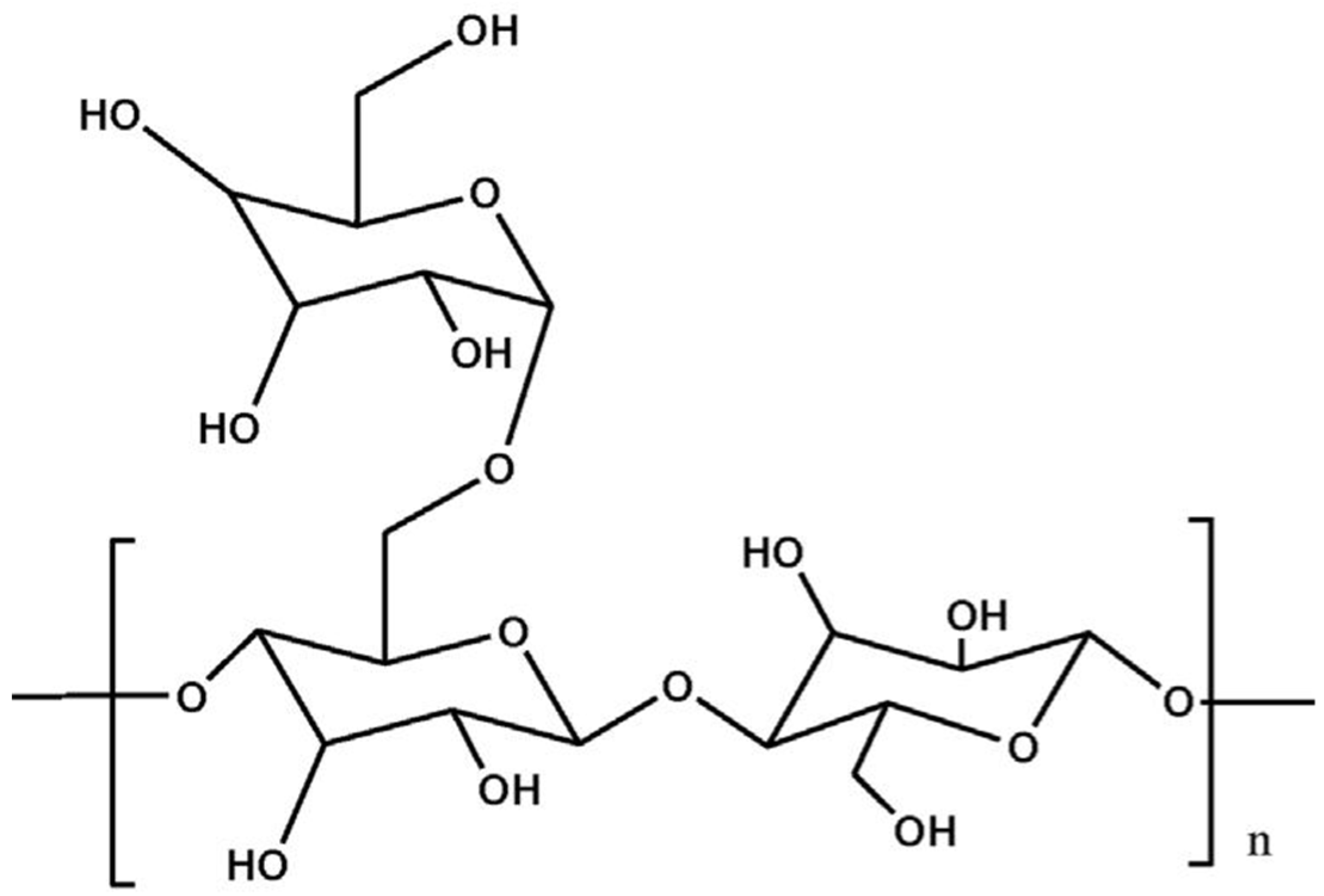
The guar gum used in the experiments was industrial-grade natural guar gum (purity ≥ 99%) produced by Wanshun Chemical Co., Ltd. (Dexing, China). Its main component is galactomannan. It exhibits excellent stability at high temperatures ≤ 80 °C and in strongly alkaline environments with pH 8–12, showing no significant degradation. It exhibits good compatibility with the cement hydration system, showing no adverse reactions such as separation or precipitation after blending. It disperses uniformly within the soil matrix, with its chemical structure shown in Figure 2.

2.2. Sample Preparation

Using a controlled variable method, 25 mix designs were formulated by crossing five GG content levels (0%, 0.5%, 1.0%, 1.5%, and 2.0%) with five cement dosages (0%, 3%, 6%, 9%, and 12%). To visually organize this extensive testing program, the experimental design is systematically arranged as a 5 × 5 coordinate matrix. Each grid intersection in the matrix represents a specific mix proportion and corresponds to a unique Sample ID (labeled ID1 through ID25) to ensure experimental traceability. Specifically, the Sample IDs are assigned sequentially along the cement-then-GG dosage gradients: ID1–ID5 correspond to the 0% cement group with 0%–2.0% GG, ID6–ID10 to the 3% cement group, and so forth, until ID21–ID25 for the 12% cement group. The experimental matrix (0%–12% cement and 0%–2.0% GG) was specifically engineered to stress-test the boundaries of the synergistic mechanism. Rather than merely seeking a linear performance increase, the inclusion of the 12% cement dosage serves as a ‘saturation control’ to identify the threshold where the inorganic rigid skeleton becomes the absolute dominant mechanical factor. Similarly, the 2.0% GG dosage was selected to trigger the system’s ‘diminishing return’ phase. By deliberately encompassing these plateau and failure regions, this research-grade design provides a rigorous baseline to quantitatively define the ‘synergistic window’ where the organic hydrogel provides the maximum relative marginal utility. Specifically, the exceptionally low cement content (e.g., 3%) was intentionally included as a sub-optimal baseline. Although 3% cement alone is practically insufficient to provide effective structural stabilization in such an aggressive saline environment, it serves as a critical extreme condition to starkly highlight the synergistic enhancement effect when GG is introduced. Conversely, the GG dosage range (0%–2.0%) was deliberately broadened. While typical biopolymer applications utilize lower dosages, exploring the high upper bound (2.0%) was crucial for this study. This extreme dosage was specifically selected to experimentally trigger and thoroughly investigate the negative boundaries of the system—such as severe workability loss, extreme hydration retardation, and fatal hydrogel re-swelling. By encompassing both the lower and upper failure thresholds, this experimental design robustly isolates the optimal synergistic window (0.5%–1.0%). All cement and GG dosages are expressed as mass percentages relative to the dry salt-affected soil mass. Detailed mix designs, including the exact mass of each component for every Sample ID, are comprehensively presented in Table 3.
The initial moisture content of the salt-affected soil used in the test was 5.4%. Through standard compaction tests, its maximum dry density was determined to be 1.88 g/cm3, with an optimum moisture content of 18.1%. The specimen preparation procedure was as follows: Dry soil, cement, and guar gum were dry-mixed for 5 min until uniform. Distilled water was added to achieve the optimum moisture content, followed by wet mixing for 10 min. The specimens were statically compacted into cylinders of Φ50 mm × 50 mm with a targeted degree of compaction of 96%. To precisely achieve this target density, a displacement-controlled static compaction method was employed. The homogeneous mixture was placed into a rigid steel mold and steadily compressed using a universal testing machine at a constant loading rate of 1 mm/min until the exact target specimen volume (50 mm in height) was reached. Upon reaching the target displacement, the maximum compaction stress was recorded, and the load was maintained for 2 min to thoroughly dissipate internal stresses and prevent elastic rebound prior to demolding. After demolding at room temperature for 24 h, specimens were transferred to a constant temperature and humidity curing chamber (20 ± 1 °C, relative humidity RH ≥ 95%) for 7 days.
The 7-day curing period was strategically selected as the primary evaluation benchmark for two fundamental reasons. First, from a practical engineering perspective, the 7-day Unconfined Compressive Strength (UCS) is the internationally recognized standard metric for early-stage quality control and traffic-opening assessment in pavement base/subbase construction. Second, from a mechanistic perspective, while the fly ash in the composite cement indeed contributes significantly to late-stage strength development (e.g., 28 to 90 days), the aggressive saline soil environment—characterized by extremely high sulfate and chloride concentrations—drastically accelerates early-phase reactions. The rapid and potentially destructive precipitation of expansive ettringite predominantly occurs during this initial curing phase. Therefore, evaluating the system at 7 days is scientifically critical to capturing the most vulnerable window of interaction, allowing us to accurately observe how the GG hydrogel network forms and kinetically regulates these intense early hydration and expansion processes before the late-stage pozzolanic reactions mask the initial microstructural evolution.
Three parallel specimens were prepared and tested for each mix design. The macroscopic mechanical test results are presented as the mean value ± standard deviation (SD). To rigorously evaluate the statistical reliability of the data, a two-way analysis of variance (ANOVA) was performed to determine the statistical significance of the individual and interactive effects of GG and cement dosages on the mechanical properties, with a significance level set at p < 0.05.

2.3. Test Methods

2.3.1. Macro Mechanical Test

(1)
Unconfined Compressive Strength Test
The unconfined compressive strength (UCS) tests were conducted using a strain-controlled testing machine at a constant loading rate of 1 mm/min. A preload of 0.05 kN was initially applied to eliminate contact gaps between the specimen and the rigid loading platens. To accurately simulate the compaction characteristics of salt-affected subgrades in regional engineering practice, cylindrical specimens with a height-to-diameter ratio of 1 (Φ50 mm × 50 mm) were utilized, aligning with typical highway engineering standards for stabilized fine-grained soils (e.g., JTG E51-2009) [19]. It is widely recognized in geotechnical testing that an H/D ratio of 1 introduces significant end-restraint boundary effects, which typically yields slightly higher apparent compressive strengths compared to the standard H/D ≥ 2 geometry specified in ASTM D2166 [20]. To rigorously mitigate this geometric shape effect and prevent artificial stress concentration (the barreling effect), a thin layer of lubricant (silicone grease) was deliberately applied to both end surfaces. While this specific lubrication step deviates from routine ASTM D2166 engineering classification procedures, it represents a critical research-grade experimental refinement. This modification effectively ensures a uniform uniaxial stress distribution throughout the H/D = 1 matrix, allowing for the extraction of the material’s intrinsic compressive strength. Testing was continuously monitored and ceased when the post-peak stress decreased by 15% from the peak value, at which point the peak load and axial deformation were recorded.
(2)
Dry–wet Cycling Durability Test
A single wet–dry cycle consisted of 12 h of immersion in clean water at 20 °C followed by 12 h of oven drying at 60 °C, with a total of 10 cycles conducted. After completion of the cycles, unconfined compressive strength tests were performed on the specimens to calculate the strength retention rate (post-cycle strength divided by initial strength multiplied by 100%), which was used to evaluate resistance to wet–dry cycling.
(3)
Repeated Load Fatigue Test
The test was conducted under stress-controlled mode with a sinusoidal load waveform. The stress amplitude was set at 0.7 times the ultimate failure stress of the specimen, and the loading frequency was 1 Hz to simulate the repetitive action of traffic loads. The test was terminated when the cumulative strain of the specimen reached the ultimate failure strain, and the number of load cycles was recorded as the fatigue life.

2.3.2. Microscopic Characterization Test

(1)
X-Ray Diffraction (XRD) Test
Testing was conducted using a Bruker AXS D8 Advance X-ray diffractometer (Bruker AXS GmbH, Karlsruhe, Germany) with a scanning range of 5–55° (2θ) and a scanning rate of 2°/min. The variations in the types and contents of crystalline minerals and hydration products in the stabilized saline soil were analyzed, and the regulatory effect of GG on the formation of cement hydration products was investigated.
(2)
Fourier Transform Infrared Spectroscopy (FTIR) Test
A Thermo Electron Nicolet 5700 spectrometer (Thermo Electron Corporation, Waltham, MA, USA) was employed with a spectral range of 4000 cm−1 to 400 cm−1 and a resolution of 4 cm−1. This analyzed changes in chemical bonds within the solidified saline soil, revealing the chemical interactions between GG, cement, and the saline soil.
(3)
Scanning Electron Microscopy (SEM) Test
A FEI Apreo scanning electron microscope (FEI Company, Hillsboro, OR, USA) was used to observe the microstructure of specimens. Samples underwent vacuum drying and gold sputtering prior to testing, with an acceleration voltage of 5 kV. This method analyzed the distribution characteristics of hydration products and GG, as well as the microstructural evolution patterns of the solidified soil.
(4)
Computed Tomography (CT) Test
Tests were conducted using a ZEISS 620 Versa X-ray microscope (Carl Zeiss Microscopy GmbH, Oberkochen, Germany) on small core samples (Φ20 mm × H20 mm) drilled from standard unconfined compressive strength specimens. To ensure quantitative reliability, high-resolution scanning was performed with a spatial resolution (voxel size) of 15 μm. The acquired 2D projection images were reconstructed into 3D volumes using the system’s built-in reconstruction software (XMReconstructor, version 16.0, Carl Zeiss). For quantitative image analysis, a central Region of Interest (ROI) of 10 mm × 10 mm × 10 mm was extracted from the reconstructed volume to eliminate boundary artifacts and represent the Representative Elementary Volume (REV) of the matrix. Image processing and 3D quantitative analysis were performed using Avizo 2020 software. A median filter was initially applied to the grayscale images to effectively reduce scanning noise and enhance phase contrast. Subsequently, to avoid subjective bias in pore segmentation, the global Otsu thresholding algorithm (based on the grayscale histogram) was utilized to rigorously binarize the images, effectively distinguishing the void space from the solid soil-cement matrix. Based on this validated binarized 3D network, the precise porosity and spatial pore distribution were extracted to robustly quantify the microstructural optimization effect of GG.

3. Results and Analysis

3.1. Evolution Patterns of Macro-Mechanical Properties

3.1.1. Unconfined Compressive Strength (UCS)

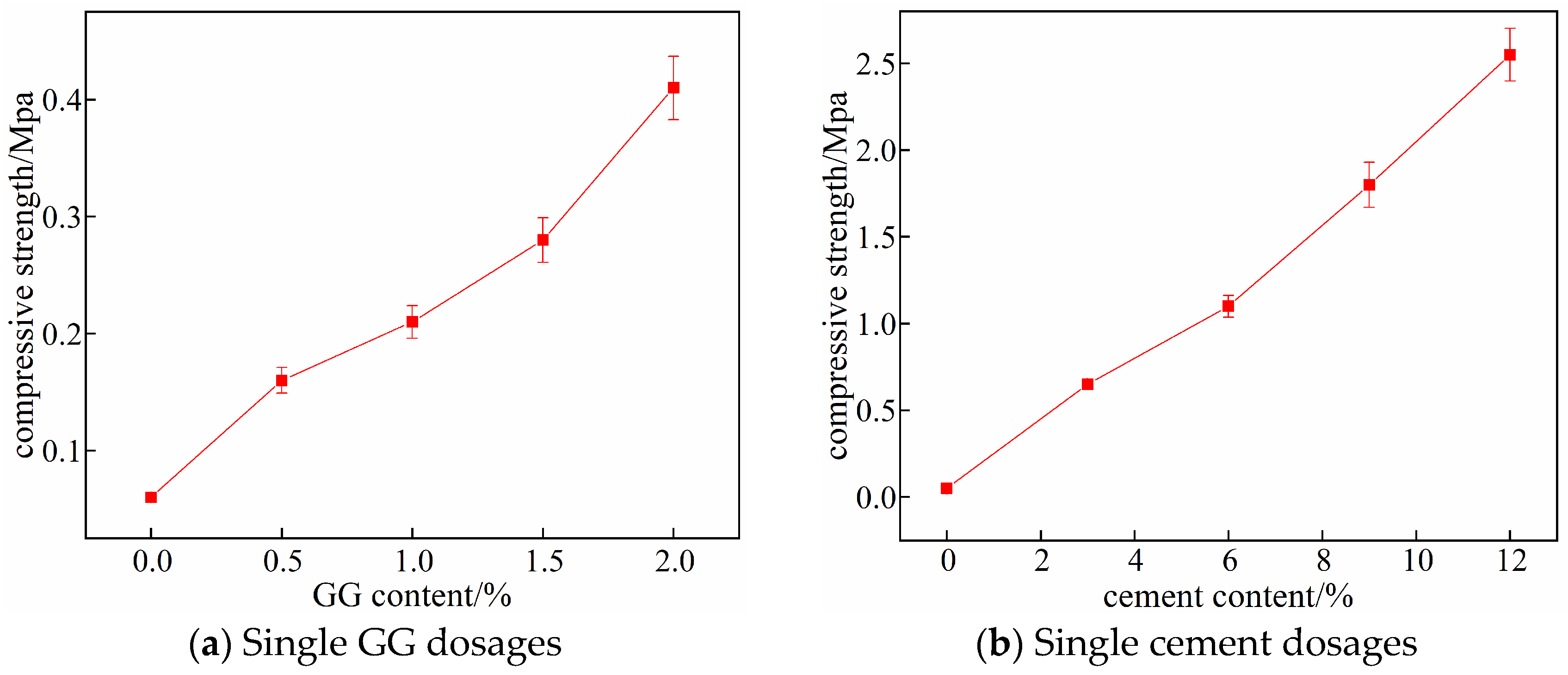
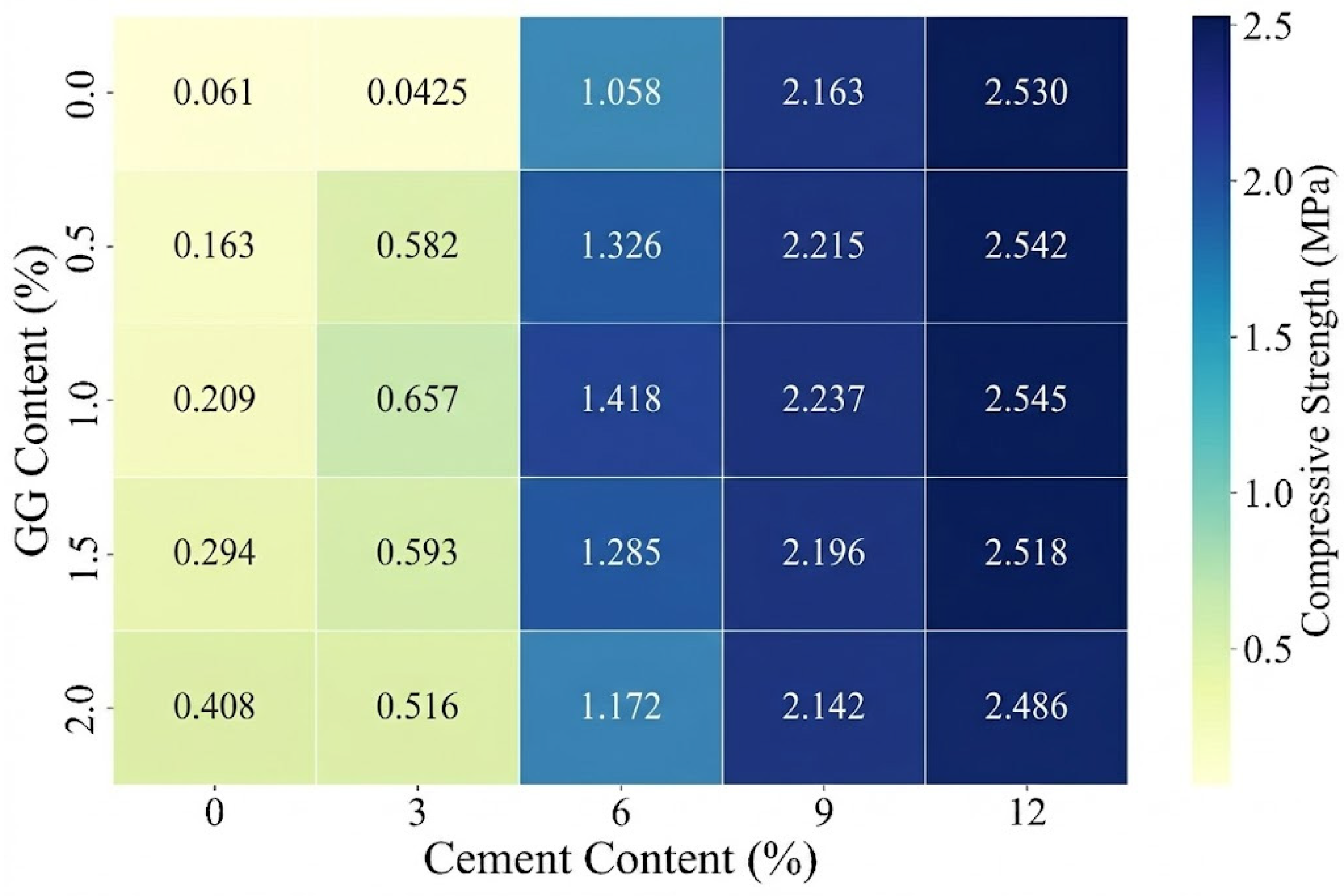
To bridge the individual trend observations with a global experimental landscape, a UCS distribution heatmap was constructed (Figure 3). While the conventional linear plots (Figure 3) are utilized to illustrate the discrete strength evolution of each cement group, the heatmap (Figure 4) serves a distinct analytical purpose: it provides a continuous visualization of the complex Cement × GG interaction landscape. This multi-dimensional format is specifically designed to isolate the ‘synergistic hot spots’—the precise dosage windows where the biopolymer’s reinforcement efficiency is maximized relative to cement consumption—which are less intuitive in standard linear representations. Furthermore, by mapping the entire 5 × 5 matrix as a strength surface, the heatmap facilitates the identification of mechanical plateaus and gradient shifts, offering a comprehensive mapping of the dosage-dependent synergistic effects within the organic–inorganic stabilization system. The statistical evaluation reveals that the synergistic interaction between GG and cement dosages exerts a significant effect on the static strength, with the results shown in Figure 3 and Figure 4.
As shown in Figure 3a (where error bars represent the standard deviation of three replicates), without cement addition, the UCS of saline–alkali soil exhibits a statistically significant positive linear correlation with increasing GG dosage (ANOVA, p < 0.05). The UCS of the native soil (0% GG, Sample 1) was only 0.061 MPa, while the UCS values increased to 0.163 MPa, 0.209 MPa, 0.294 MPa, and 0.408 MPa at GG dosages of 0.5%, 1.0%, 1.5%, and 2.0%, respectively. This enhancement is due to the natural polysaccharide hydrogel network formed by GG in the soil matrix, which fills intergranular voids, cements soil particles, and increases soil structural density and compressive strength. However, pure GG consolidation only brings a limited absolute increase in soil strength: even at the maximum GG dosage of 2.0%, the UCS is far below the minimum strength requirement (1.0 MPa) for highway subgrade fill, indicating that pure GG consolidation cannot meet the static strength demands of saline–alkali soil subgrade engineering.
As shown in Figure 3b, without GG addition, the UCS of saline–alkali soil shows an exponential growth trend with increasing cement dosage, reaching 2.53 MPa at a cement dosage of 12% (41 times that of the native soil). This significant macro-mechanical strength enhancement is mechanistically attributed to the abundant ettringite and C–S–H gel generated by cement hydration in the sulfate-rich saline environment (the explicit physical and chemical existence of which will be comprehensively corroborated by the multi-scale microstructural evidence—including FTIR, XRD, and SEM—presented subsequently in Section 3.2). These products form a continuous rigid framework that binds soil particles, fills structural voids, and bears external loads, thus substantially improving the soil’s static strength. Cement is therefore the primary strength source in composite stabilized saline soils, and its strength enhancement effect is significantly better than that of GG under the same dosage gradient.
Figure 4 presents the UCS distribution heatmap of GG-cement composite-stabilized soils. To rigorously transcend descriptive comparisons and quantitatively validate the stabilization mechanisms, a Two-way Analysis of Variance (ANOVA) was conducted. The statistical evaluation confirms that both the main effect of cement dosage (p < 0.001) and the main effect of GG dosage (p < 0.001) are highly significant. Crucially, the interaction term (Cement × GG) exhibits profound statistical significance (p < 0.01). This rigorous quantitative metric unequivocally proves that the observed “synergistic effect” is not a qualitative assumption, but a mathematically validated interaction, demonstrating a robust and reliable dosage dependence. At low cement dosages (3%, 6%), GG addition effectively improves soil UCS, with the most pronounced synergistic strengthening at a GG dosage of 0.5%–1.0%. For example, the UCS of the 6% cement + 1.0% GG specimen reached 1.418 MPa, a 34.0% increase compared to the 6% pure cement specimen (1.058 MPa). This indicates that an appropriate GG dosage optimizes the microstructure of low-cement saline soil, compensating for insufficient hydration products and loose frameworks to achieve synergistic static strength enhancement.
Crucially, the experimental design specifically utilized the 12% cement dosage as a ‘saturation control’ to identify the system’s performance ceiling. As shown in the heatmap, when the cement content reaches this 12% threshold, the reinforcement efficacy of GG converges to zero, with UCS values plateauing narrowly between 2.486 MPa and 2.545 MPa. Post hoc statistical testing confirms that these marginal variations are not statistically significant (p > 0.05). This phenomenon is mechanistically driven by Rigid Skeleton Dominance and Spatial Restriction: at 12% cement, the massive precipitation of hydration products creates an exceptionally dense inorganic framework that overshadows the organic hydrogel’s contribution. Within this ‘over-saturated’ matrix, the available capillary pore space is drastically reduced, effectively choking the volumetric expansion and interfacial interlocking potential of the GG molecules. Consequently, the GG acts as an inert filler rather than a synergistic binder at this high cement dosage. This deliberate inclusion of the 12% ‘plateau’ group provides a rigorous baseline to quantitatively define the synergistic window, proving that GG’s effectiveness is inversely proportional to the initial density of the inorganic cementitious skeleton.

3.1.2. Durability Under Wet–Dry Cycles

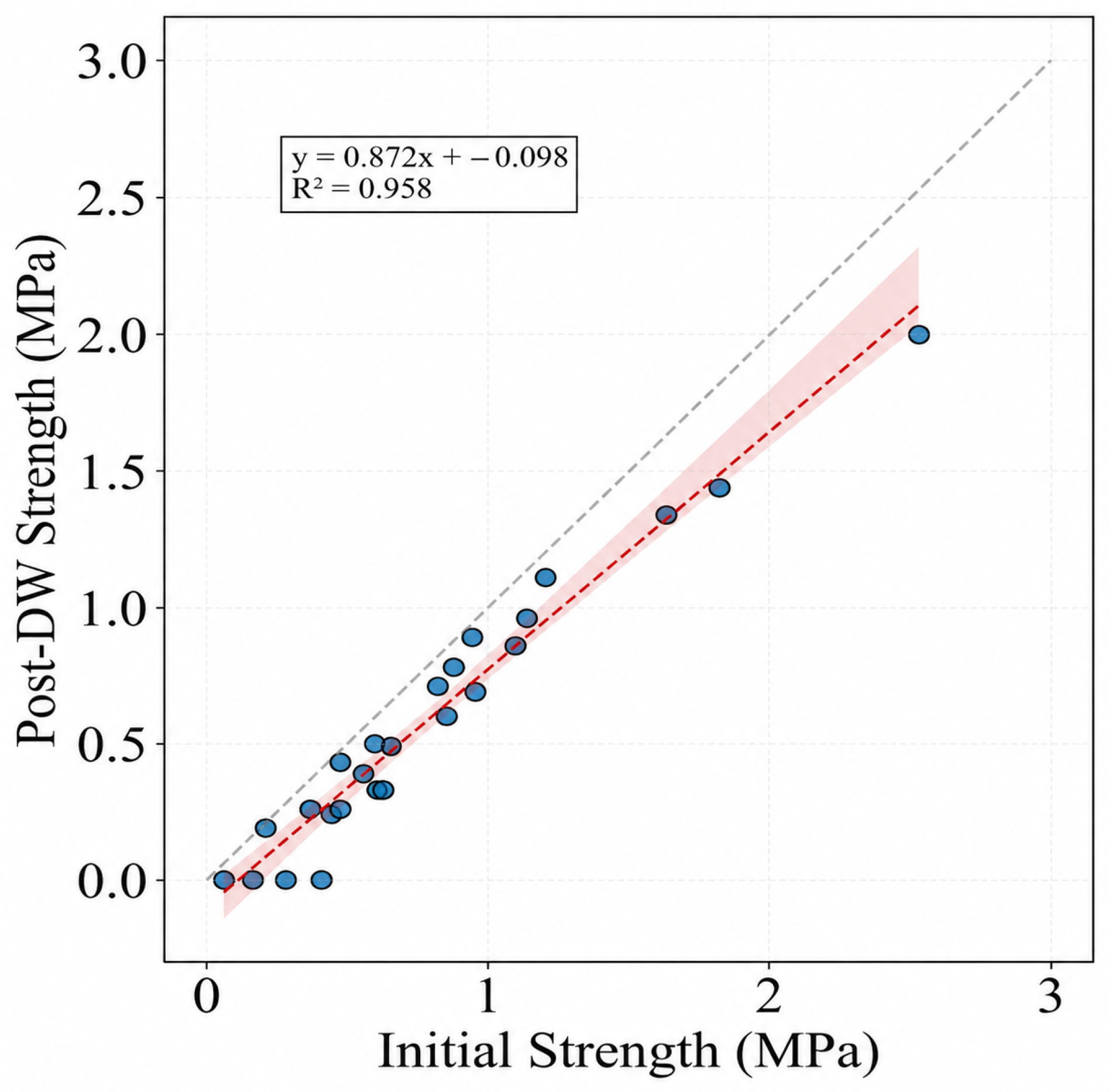
Figure 5 quantitatively characterizes the linear relationship between the initial UCS (UCS0) and the UCS after 10 dry–wet cycles (UCS10) of GG-cement composite-stabilized saline–alkali soil.
The highly significant linear correlation (R2 = 0.958) between UCS0 and UCS10 transcends a simple statistical fit; it reveals a fundamental mechanistic dependence of durability on initial structural integrity. Mechanistically, the degradation during wetting-drying cycles is driven by the synergistic action of pore-water pressure fluctuations and internal salt crystallization stress. The observed linearity suggests that the soil’s resistance to these internal tensile stresses is directly proportional to the density and connectivity of its initial cementitious skeleton. The identified critical threshold of 0.4 MPa represents the percolation threshold of the system. Below this value (as seen in all 0% cement groups), the hydration products are too sparse to form a continuous load-bearing framework, leaving the soil as a collection of isolated clusters that are easily dismantled by hydraulic erosion. Above 0.4 MPa, the GG-cement matrix achieves sufficient interfacial bonding to ‘lock’ the soil aggregates. Specifically, the GG hydrogel acts as a viscoelastic bridge that spans micro-voids, while the cement products provide the rigid confinement. This organic–inorganic coupling effectively dissipates the expansive energy generated by sulfate crystallization, thereby maintaining the linear strength-durability trajectory observed in Figure 5.
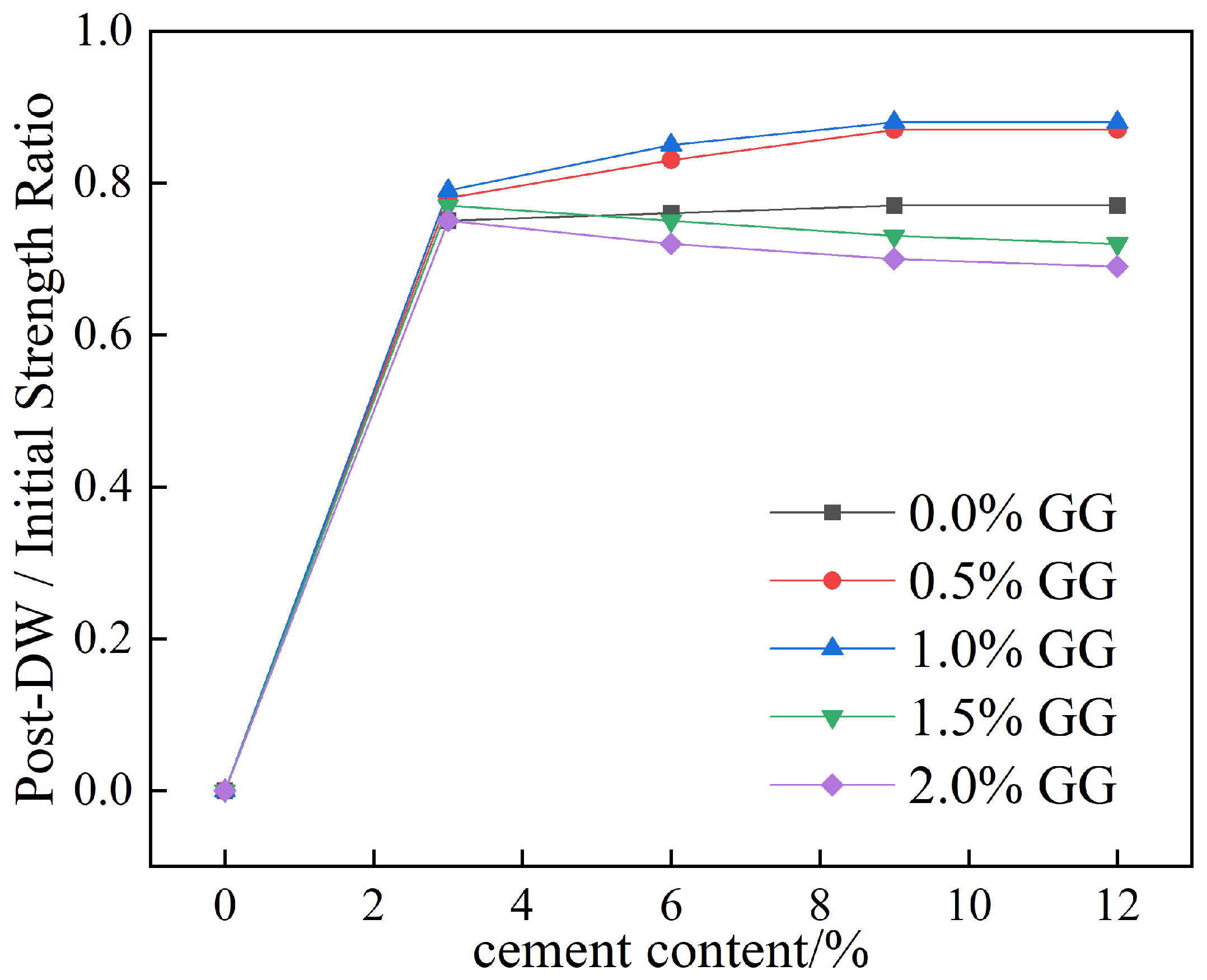
The systematic evolution of the strength retention rate (SRR) across the experimental matrix is graphically illustrated in Figure 6, which serves as the primary benchmark for evaluating long-term environmental resistance. The core evolution patterns are as follows:
Cement is the decisive factor for dry–wet cycle resistance: as shown in Figure 6, all specimens without cement addition (0% cement baseline) underwent complete structural disintegration (SRR = 0%) regardless of the GG dosage. This catastrophic failure is quantitatively consistent with the 0.4 MPa initial strength percolation threshold identified in Figure 5. As cement content increases, the soil strength loss rate decreases significantly: the 3% cement group has a strength loss rate of 29.2%–41.9%, while the 6%–12% cement groups show a substantial reduction to 12.7%–35.0%, indicating that cement hydration products are the fundamental material for constructing the soil structural skeleton and maintaining its stability under dry–wet cycles.
The optimal GG dosage has a significant synergistic optimization effect on durability. Although pure GG-stabilized soil lacks dry–wet cycle resistance, it exhibits an excellent synergistic effect when blended with cement at the optimal dosage. In the medium-to-high cement dosage range (6%–9%), the addition of 0.5%–1.0% GG maximizes the strength retention rate, reaching a peak of 87.1%–87.3% (as indicated by the peak points in Figure 6). This represents the optimal durability zone, where the synergistic effect is most pronounced. The mechanism is that GG swells upon water contact to form a hydrogel network that fills the internal pores of cement-stabilized soil, blocking water infiltration pathways and mitigating strength degradation caused by water erosion and structural volume changes, thus achieving a synergistic anti-degradation effect of “cement skeleton + GG pore optimization”.
It is crucial to address the inherent hydrophilicity and reversible swelling characteristics of the GG hydrogel. As evidenced by the complete disintegration of the pure GG-stabilized specimens (0% cement group) during the wet–dry cycles, unbounded natural hydrogels are highly susceptible to severe re-swelling and dissolution upon re-wetting. However, the GG-cement composite system effectively mitigates this fatal defect. Based on macroscopic durability behavior and static microstructural observations, we propose a synergistic dual-constraint hypothesis for the optimal composite matrix (e.g., 6%–9% cement blended with 0.5%–1.0% GG). Physically, the hydrogel network is hypothesized to be spatially confined within the rigid, non-deformable skeleton formed by cement hydration products. Chemically, the shifts in the hydroxyl absorption bands observed in the FTIR analysis, consistent with findings in existing literature [21,22], suggest that the abundant hydroxyl groups of the GG chains likely interact with calcium ions (Ca2+) released from cement hydration. This interaction is hypothesized to promote the formation of an organic–inorganic cross-linked network. Rather than being directly observed in situ, this proposed dual mechanism is deduced to transform the highly swellable, reversible hydrogel into a relatively stable and water-resistant interpenetrating network. Consequently, dramatic re-swelling upon water exposure is effectively restricted, yielding the remarkably high strength retention observed.
Excessive GG dosage (≥1.5%) significantly impairs durability and should be avoided in engineering applications. The soil strength loss rate increases sharply when the GG content exceeds 1.5% across all cement dosage columns. For example, in the 6% cement group, the strength loss rate increases from 12.8% at 1.0% GG to 25.0% at 1.5% GG; in the 9% cement group, it rises from 12.7% at 1.0% GG to 26.3% at 1.5% GG. This deterioration occurs because when the GG content exceeds the complexation capacity of the available calcium ions, the abundant un-crosslinked “free” hydrogel undergoes repeated and aggressive volume expansion (re-swelling) upon water exposure. This dramatic swelling-shrinkage behavior induces immense internal tensile stresses, which inevitably create large localized pore defects and fracture the rigid cementitious matrix from within. At the same time, excessive GG interferes with cement hydration reactions and inhibits the formation of hydration products, jointly accelerating structural damage and strength decay.
This confirms that while pure cement can form a structural skeleton, its high interconnected porosity permits the rapid ingress of aggressive soluble salts during fluid transport. Consequently, the matrix becomes highly vulnerable to severe structural degradation induced by coupled sulfate attack and cyclic wetting-drying crystallization stresses, preventing a fundamental improvement in durability. The maximum strength retention rate of the pure cement system remains limited to roughly 65%, indicating that merely increasing the cement content cannot effectively mitigate the complex chemical and physical deterioration inherently driven by the aggressive saline soil environment.
In contrast, the strength retention curves of the 0.5% and 1.0% GG groups show a sharp upward trend with increasing cement content: within the 3%–9% cement range, the retention rate surges from 65.1%–68.2% to 87.1%–87.3%, which quantitatively confirms the synergistic optimization effect of GG and defines the core synergistic window as 3%–9% cement content. When the cement content reaches 9% or higher, the curve plateaus, with retention rates stabilizing between 82.2% and 87.3%, indicating a fundamental transition in the microstructural mechanics. Specifically, at this critical ≥9% threshold, the inorganic cement hydration products successfully exceed the percolation threshold to form a continuous, load-bearing spatial skeletal framework (a structural state unachievable at lower dosages like 3%, where the hydration clusters remain disconnected and highly porous). Simultaneously, the physical void-filling effect of the GG hydrogel achieves its strictly defined volumetric saturation point: it optimally fills the residual capillary voids—quantitatively minimizing the macroscopic porosity to an experimentally verified 1.43% (as subsequently confirmed via CT analysis)—without introducing the excessive un-crosslinked free hydrogel that triggers destructive re-swelling.
The strength retention curves of the 1.5% and 2.0% GG groups remain below the 80% industry threshold across the entire cement dosage range, showing a gentle trend of initial slight increase followed by decline. The peak retention rate of the 1.5% GG group is only 75.0%, establishing 1.5% as the quantitative threshold for excessive GG addition. The adverse effects of volume instability caused by excessive GG completely offset its synergistic optimization effect, leading the durability of cement-stabilized soil to revert to the level of pure cement stabilization.

3.1.3. Fatigue Life and Cyclic Mechanical Response

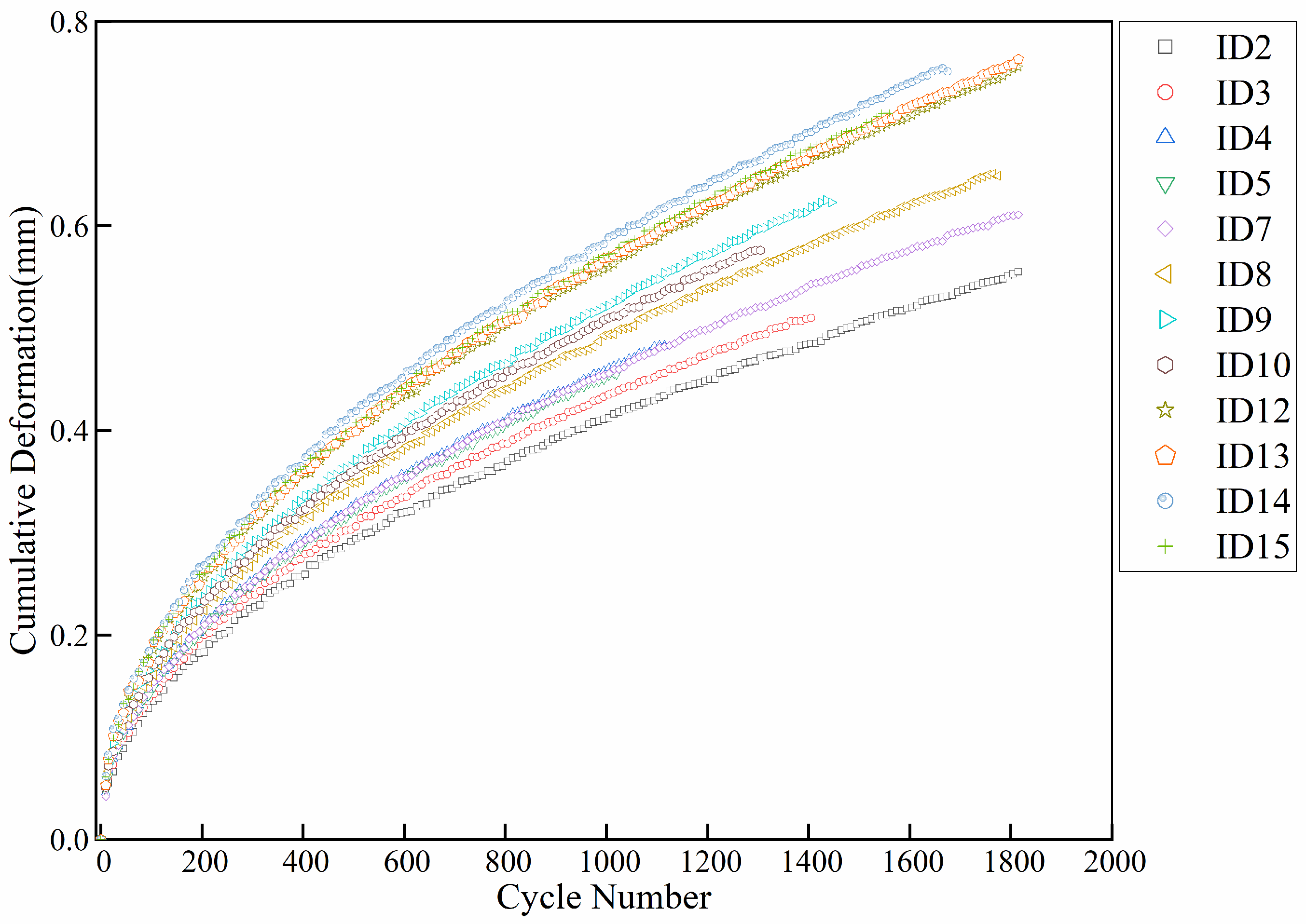
The cumulative axial deformation of GG-cement-stabilized saline soil under cyclic loading is presented in Figure 7. The deformation evolution follows a characteristic three-stage fatigue pattern: (1) Initial transient stage: rapid strain accumulation within the first 400 cycles, mainly due to elastic-plastic deformation of the cementitious skeleton and pore compression; (2) Steady-state deformation stage: slow linear strain increase, corresponding to the gradual initiation and propagation of microcracks; (3) Accelerated failure deformation stage: a sharp rise in deformation rate, signifying macrocrack formation and structural instability. The cumulative deformation and growth rate in the steady-state stage are the core indicators for evaluating cyclic mechanical response: a lower growth rate indicates stronger fatigue damage resistance and a longer fatigue life of the soil.
The synergistic interaction between GG and cement dosage significantly regulates the cyclic mechanical response and fatigue performance of the composite system, with the key findings as follows:
Cement dosage determines the fatigue strength baseline. Pure cement group specimens (0% GG, e.g., ID3, ID4, ID5) have relatively low cumulative deformation (0.455–0.551 mm) and enter the accelerated failure deformation stage at 1600–1800 cycles, with a limited fatigue life (Nf = 1089–1393 cycles). Pure cement can only provide sufficient static strength but fails to enhance the fatigue toughness of the soil, which is a key limitation of traditional cement stabilization methods.
The optimal GG dosage significantly improves fatigue performance. Blending 0.5%–1.0% GG with 6%–9% cement (e.g., ID8, ID13, ID14) optimizes the cyclic mechanical response of the soil significantly: specimens in this dosage range show moderate cumulative deformation (0.623–0.891 mm) at 2000 cycles, with their fatigue life extending to 1892–1986 cycles (a maximum 42.6% increase compared to the pure cement group). The mechanism is that the flexible hydrogel network formed by GG hydration fills voids, bridges initial microcracks, compensates for the brittleness of the cement matrix, absorbs cyclic load energy, and delays crack propagation, thus reducing the deformation growth rate in the steady-state phase and extending the fatigue life.
Excessive GG (≥1.5%) or high cement content (12%) deteriorates fatigue performance. Specimens with GG content ≥ 1.5% show accelerated cumulative deformation and a significantly reduced fatigue life (Nf < 2100 cycles) due to the volume instability of excess GG: under cyclic loading, fluctuations in pore water pressure cause repeated GG expansion and contraction, inducing large pore defects that accelerate crack propagation. In the 12% cement group, the degradation in fatigue performance is mechanistically driven by excessive ettringite formation. Rather than being a speculative assumption, this severe internal expansion and the resulting stress concentration are explicitly corroborated by the subsequent microstructural characterizations. Specifically, the SEM analysis (Section 3.2.2) visually captures the localized interfacial micro-cracking induced by unconstrained crystal growth, while the quantitative CT data (Section 3.2.3) reveals a definitive rebound in macroscopic porosity at excessive dosages. These direct experimental observations explicitly confirm the structurally destructive nature of this internal expansion, which prematurely triggers fatigue crack initiation under cyclic loading, thereby drastically undermining the synergistic effect of GG; the fatigue life of the 12% cement + 1.0% GG specimen is 19.1% lower than that of the 9% cement + 1.0% GG specimen. Notably, the fatigue performance of the 2.0% GG group is lower than that of the pure cement group, indicating that the beneficial synergistic effect of GG is completely offset by the adverse effects of its volume instability.
This study also clarifies the correlation between static strength and fatigue life: static strength is a necessary but insufficient condition for excellent fatigue performance. Specimens with UCS0 < 0.4 MPa completely disintegrate before fatigue testing, confirming a minimum static strength threshold for withstanding cyclic loading. However, high static strength alone (e.g., the 12% pure cement specimen with UCS0 = 2.53 MPa) cannot guarantee a long fatigue life, and the toughness and pore structure regulated by GG also play critical roles. The ratio of 6%–9% cement blended with 0.5%–1.0% GG (UCS0 = 0.98–2.28 MPa) achieves a balance between static strength and toughness, yielding the optimal fatigue performance.

3.2. Evolution Law of Microstructural Characteristics

3.2.1. Mechanism of Formation and Regulation of Hydration Products

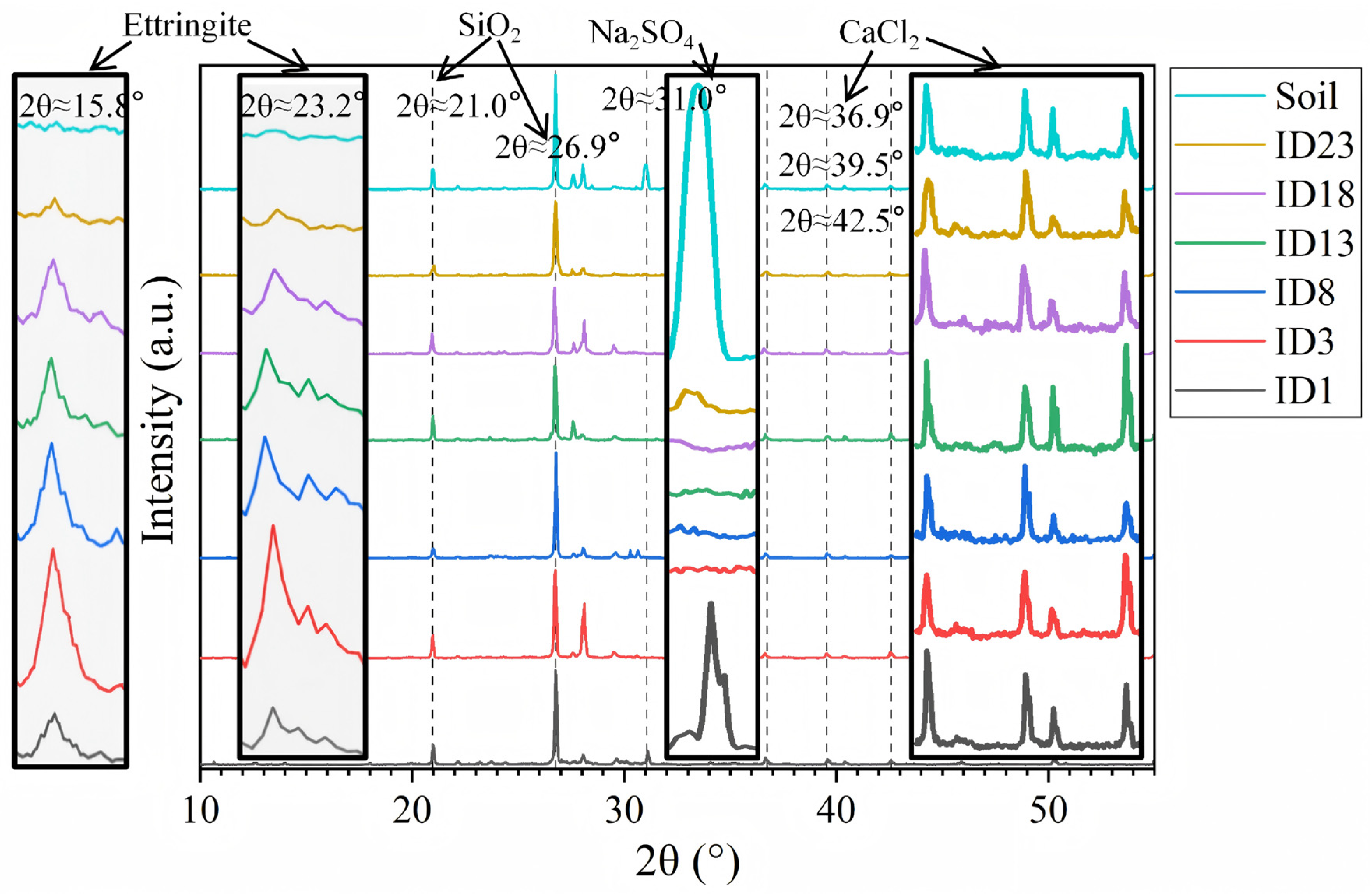
Figure 8 presents the crystalline phase evolution of stabilized soil specimens. The main diffraction peaks were identified by referring to standard PDF cards and relevant literature on cement chemistry. The major crystalline phases labeled in the revised Figure 8 are as follows: ettringite at 2θ = 15.8° and 23.2° (PDF#41-1451), quartz (SiO2) at 2θ = 21.0° and 26.9° (PDF#46-1045), sodium sulfate at 2θ = 31.0°, and calcium chloride at 2θ = 36.9°, 39.5° and 42.5°. The ettringite diffraction peaks at 15.8° and 23.2° are relatively weak in the full-range XRD patterns, so these two regions are locally enlarged to improve visibility and facilitate phase identification.
The diffractogram of the untreated soil (Soil/ID1) is dominated by primary minerals and soluble salts, including quartz, sodium sulfate and calcium chloride. No diffraction signals of ettringite are detected at 15.8° and 23.2°, which is consistent with the cement-free nature of the raw soil. Quartz acts as a stable inert mineral phase, while the characteristic peaks of sodium sulfate and calcium chloride reflect the high contents of sulfate and chloride salts in the saline–alkali soil.
After cement incorporation, weak ettringite diffraction peaks emerge at 15.8° and 23.2°, indicating that sulfate ions in the soil react with aluminate phases in cement to form sulfur-containing hydration products. For the group with 6% cement content, the relative intensity of ettringite peaks reaches the maximum in Specimen ID3 (6% cement, 0% guar gum). With the increase in guar gum (GG) dosage, the intensity of ettringite characteristic peaks at 15.8° and 23.2° decreases continuously. Specimens ID8, ID13, ID18 and ID23 show a gradual reduction in peak intensity at 15.8° compared with ID3, and a similar declining trend is observed at 23.2°. This demonstrates that the addition of guar gum can regulate the hydration reaction and moderately inhibit the crystallization and growth of ettringite.
The intensity of quartz diffraction peaks at 21.0° and 26.9° remains nearly constant for all specimens, verifying that quartz exists as an inert mineral and does not participate in hydration reactions. In contrast, the peak intensity of sodium sulfate near 31.0° declines after cement addition. This suggests that part of the native sulfate in the saline–alkali soil is consumed during cement hydration and provides sulfate ions for the formation of ettringite. The diffraction peaks of calcium chloride are still detectable in all specimens, indicating that chloride salts remain in the stabilized soil matrix.
Given the high chloride content of the tested soil, chloride ions can theoretically react with cement aluminates to form chloride-containing AFm phases such as Friedel’s salt (3CaO·Al2O3·CaCl2·10H2O). However, no distinct characteristic diffraction peaks of Friedel’s salt are observed in the XRD patterns. The soil is rich in sulfate, so the sulfate-aluminate reaction is predominant in the system. Ettringite-type AFt phases are preferentially formed rather than chloride-bearing AFm phases [23,24]. Nevertheless, due to the complexity of the soil-cement-polymer composite system and the detection limit of conventional XRD, the presence of trace or poorly crystalline Friedel’s salt cannot be completely ruled out.
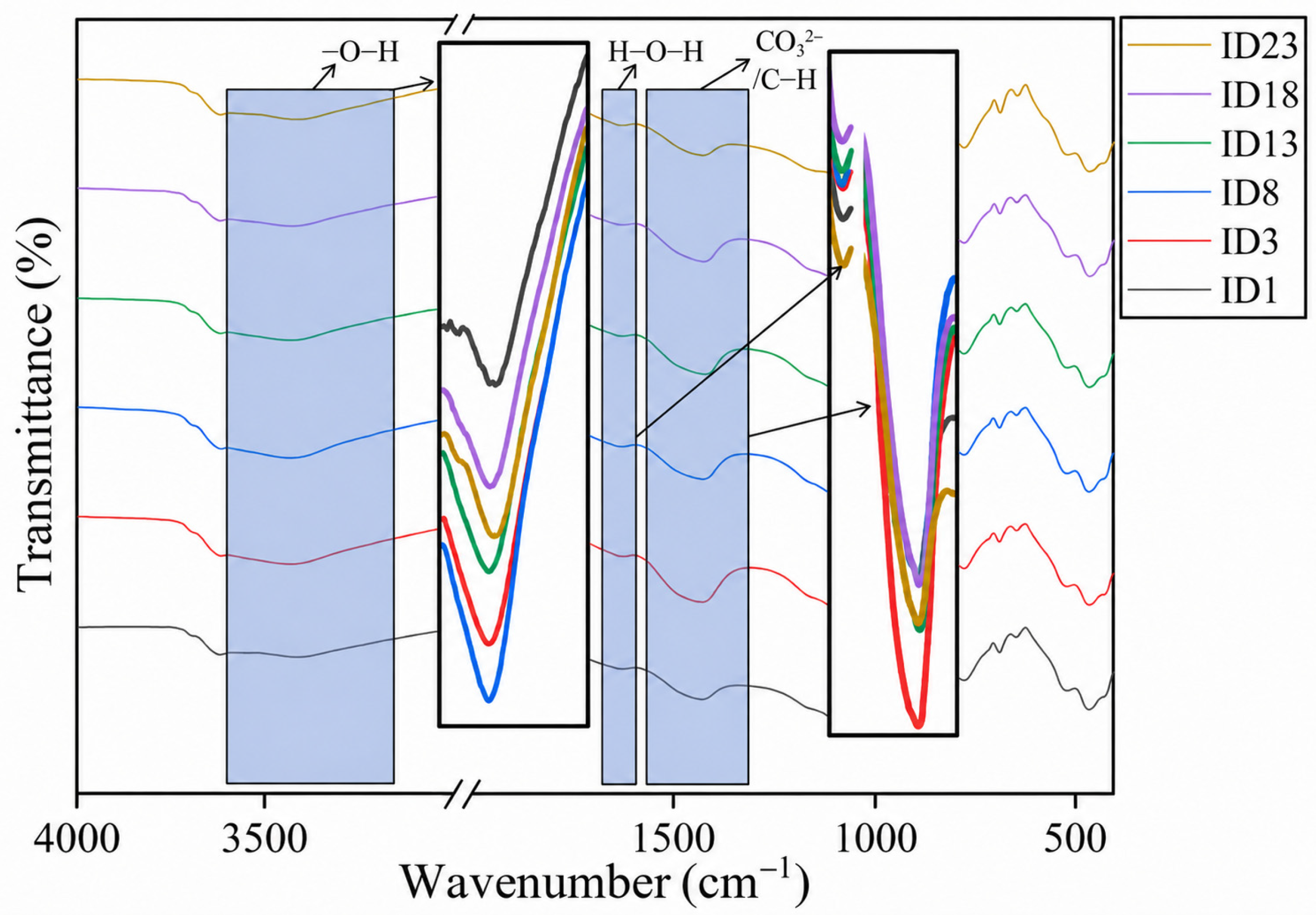
Representative samples underwent Fourier transform infrared spectroscopy testing and analysis, with results shown in Figure 9. Three core characteristic regions exhibiting significant variation were identified: 1336–1576 cm−1, 1593–1655 cm−1, and 3086–3597 cm−1. The absorption peak areas within these three characteristic bands were calculated for different samples using the trapezoidal integration method, with results presented in Table 4. Based on the evolution patterns of peak areas with GG and cement content, the chemical interaction mechanisms are systematically analyzed as follows.
The absorption peak in the 1336–1576 cm−1 range corresponds to the asymmetric stretching vibration of carbonate ions (CO32−), primarily originating from two sources: (1) inherent carbonate minerals in saline-affected soils; (2) calcium carbonate formed by the carbonation reaction between cement hydration products (e.g., calcium hydroxide, C-S-H gel) and atmospheric CO2. While these FTIR peak area trends provide valuable semi-quantitative insights into chemical bond evolution, it is acknowledged that definitively confirming specific molecular mechanisms—such as the exact GG-Ca2+ chelation dynamics—would require advanced atomic-level spectroscopy (e.g., XPS or NMR). Therefore, the FTIR results herein are strictly interpreted as complementary corroboration. Furthermore, regarding the sulfate ions (SO42−), their characteristic infrared absorption bands (typically 1080–1150 cm−1) exhibit complex shape variations rather than straightforward independent peaks. In such a complex natural soil-cement matrix, these specific sulfate peaks are severely convoluted and partially obscured by the overwhelmingly broad and intense Si–O–Si and Si–O–Al stretching vibrations (900–1200 cm−1) inherent to the massive volume of native clay minerals and newly formed silicates. Consequently, while FTIR supports the general matrix evolution, the interpretation of sulfate consumption and ettringite-related product formation is mainly supported by XRD peak evolution and complemented by SEM morphological observations.
As shown in Table 4, the carbonate peak area for the native soil sample (ID1) was 47.16, reflecting the inherent carbonate content of the saline soil. After adding 6% cement (sample ID3), the peak area sharply increased to 87.06. This indicates that the initially generated calcium hydroxide (CH) underwent mild early-stage carbonation. It is crucial to address the apparent absence of crystalline CH and calcite (CaCO3) peaks in the preceding XRD patterns. While FTIR is extremely sensitive to the C–O stretching vibrations even at trace molecular levels, conventional XRD requires a high degree of crystallinity and a minimum mass fraction to resolve distinct peaks. In this composite system, the newly precipitated calcium carbonate is predominantly microcrystalline and highly dispersed. Consequently, its subtle diffraction peaks—along with any residual trace CH not consumed by the pozzolanic reaction—are completely overshadowed by the massive background scattering of the native soil matrix and its inherent crystalline minerals. Therefore, FTIR provides a more accurate chemical-bond-level verification of this mild carbonation process than macroscopic XRD.
To provide rigorous quantitative support, the integrated area of the carbonate absorption band (1336–1576 cm−1) was analyzed. As the GG content increased from 0.5% (ID8) to 2.0% (ID23), the quantitative data reveals a systematic decrease in the carbonation degree, with the peak area dropping from 70.97 to 49.68. Rather than attributing this reduction solely to the mere physical presence of the polymer, this phenomenon is fundamentally governed by a coupled multiphysical and chemical mechanism involving pore structure, gas diffusion, and hydration kinetics. First, from the perspective of pore structure and CO2 diffusion, the swelling GG hydrogel effectively fills the capillary voids and wraps the soil aggregates. This morphological alteration creates a dense, low-permeability microstructural barrier that significantly increases the tortuosity of the matrix, thereby fundamentally severely hindering the inward diffusion pathways for atmospheric CO2. Second, concerning the hydration degree, as established in the previous kinetic analysis, the chelating effect of higher GG dosages inherently retards the initial cement hydration. This suppressed hydration kinetics results in a correspondingly lower immediate generation of free portlandite (Ca(OH)2), thus starving the carbonation reaction of its primary alkaline reactant. While mild carbonation can occasionally densify the surface of cementitious materials, extensive internal carbonation in highly porous stabilized soils typically triggers the deleterious decalcification of the C–S–H gel. This deep carbonation process degrades the primary cohesive C–S–H binder into brittle calcium carbonate and non-cementitious silica gel, which ultimately loosens the soil skeleton and degrades macroscopic mechanical stability. Therefore, the significant reduction in macroscopic porosity validated by CT analysis (Section 3.2.3) indicates that the GG hydrogel forms a dense physical barrier, fundamentally restricting the inward diffusion pathways for atmospheric CO2. Combined with the reduced carbonate peak intensity in FTIR, it is reasonable to deduce that this physical pore-plugging effect actively mitigates early-age carbonation, thereby helping to preserve the integrity of the essential C–S–H gel. This vital preservation of active hydration products maintains the cohesive integrity and dense pore structure of the matrix, providing a solid microstructural interpretation for the early-stage microstructural resilience and improved short-term environmental resistance observed in the wet–dry cycling tests.
The absorption peak in the 1593–1655 cm−1 range corresponds to the H-O-H bending vibration of water molecules, directly reflecting the content of bound water and adsorbed water in the cured soil matrix. Changes in peak area directly indicate the system’s water retention capacity and the stability of the cement hydration environment. Table 4 data shows that the H–O–H peak area increases linearly with rising GG dosage, rising from 0.63 in ID1 (0% GG) to 2.20 in ID23 (2.0% GG), an increase of nearly 250%. This is attributed to the abundant hydroxyl groups in the GG molecular structure, which form hydrogen bonds with numerous water molecules. This adsorbs free water and fixes it as bound water, significantly enhancing the water retention capacity of the stabilized soil. For cement hydration, a stable water environment is essential for sustained reaction progression. The optimal GG dosage of 0.5%–1.0% increases bound water content, preventing rapid free water loss during curing and providing a stable environment for continuous cement hydration. This is a key factor in the synergistic strength enhancement effect between GG and cement. However, it should be noted that excessive GG (>1.5%) fixes too much water as bound water, reducing the free water content available for cement hydration and thereby inhibiting the hydration process. This aligns with the strength deterioration observed in specimens with high GG content in macro-mechanical tests.
The absorption peaks in the 3086–3597 cm−1 band are attributed to the stretching vibrations of O-H bonds, primarily originating from three sources: (1) Alcoholic hydroxyl groups in GG’s galactomannan chains; (2) Structural hydroxyl groups in cement hydration products (ettringite, C–S–H gel); (3) Hydroxyl vibrations from interlayer water and adsorbed water in the system. Peak area changes directly reflect cement hydration degree and the extent of chemical interactions between GG and the cement-soil matrix. As shown in Table 4, the hydroxyl peak area for undamaged soil (ID1) was only 25.00. After adding 6% cement (ID3), the peak area increased to 44.12, attributed to the formation of abundant hydration products rich in structural hydroxyl groups during cement hydration. When comparing the composite samples to the pure cement reference (ID3), a critical kinetic—rather than purely physical—shift is revealed. As the GG content increases (e.g., ID8 to ID23), the hydroxyl peak area progressively decreases from the reference baseline of 44.12 down to 25.43. This quantitative chemical attenuation, occurring strictly at the molecular bond level rather than the macroscopic structural level, unequivocally confirms that GG fundamentally alters the hydration kinetics, intrinsically retarding the rate and extent of cementitious phase formation.
From the perspective of hydration kinetics, this retardation is governed by coupled chemical and physicochemical mechanisms. From a chemical perspective, based on the observed reduction in early hydration products and supported by established polymer-cement interaction models [25], it is hypothesized that the abundant hydroxyl groups along the GG polymer chains exhibit an affinity for calcium ions (Ca2+). This interaction likely contributes to the formation of a semi-permeable polymeric film around unhydrated cement particles, thereby modifying the early hydration kinetics. Physicochemically, upon contact with mixing water, highly hydrophilic galactomannan chains are known to rapidly dissolve and swell. While direct in situ measurement of pore fluid viscosity in this complex soil-cement matrix was not feasible, based on established rheological studies of biopolymers in cementitious systems [26,27], this process is hypothesized to significantly increase the viscosity of the interstitial pore fluid. We deduce that this inferred viscosity elevation likely alters the local mass transfer environment, potentially hindering the transport rates of reactive ions (such as Ca2+, SO42−, and aluminate ions). Consequently, this would contribute to shifting the hydration kinetics towards a more retarded, polymer-controlled diffusion regime, which aligns with the delayed hydration products observed in our FTIR analysis.
At the optimal GG dosage (0.5%–1.0%), this dual mechanism acts as a beneficial kinetic modulator: it extends the workability window, limits the rapid, localized over-crystallization of expansive ettringite, and promotes a more spatially uniform distribution of hydration products. Conversely, excessive GG addition (>1.5%) leads to severe kinetic retardation. It is proposed that the combination of extensive polymeric encapsulation and the inferred highly viscous pore solution creates a significant diffusion barrier. This fundamentally chokes the ionic exchange pathways and starves the hydration reaction of both free water and reactive interfaces, providing a rigorous explanation for the suppressed hydration degree and the resulting deterioration of macroscopic mechanical properties.

3.2.2. Morphological Characterization of the Microstructural Interface (SEM)

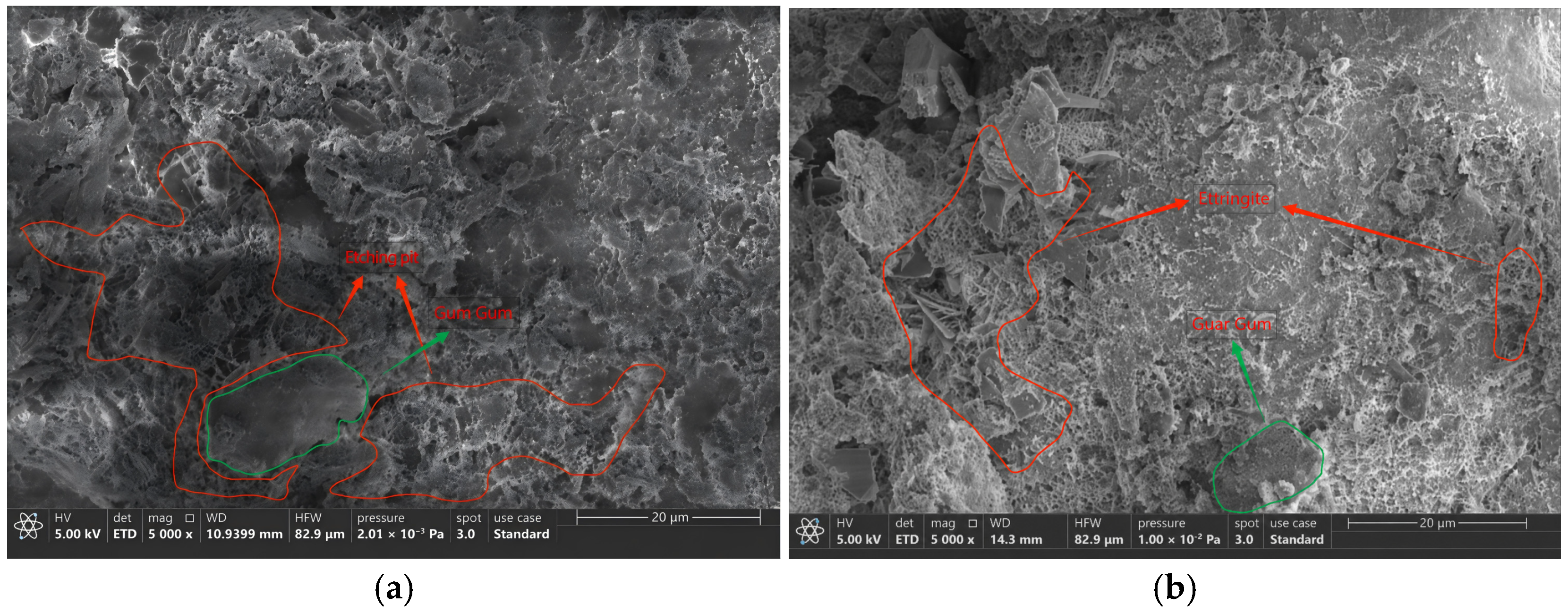
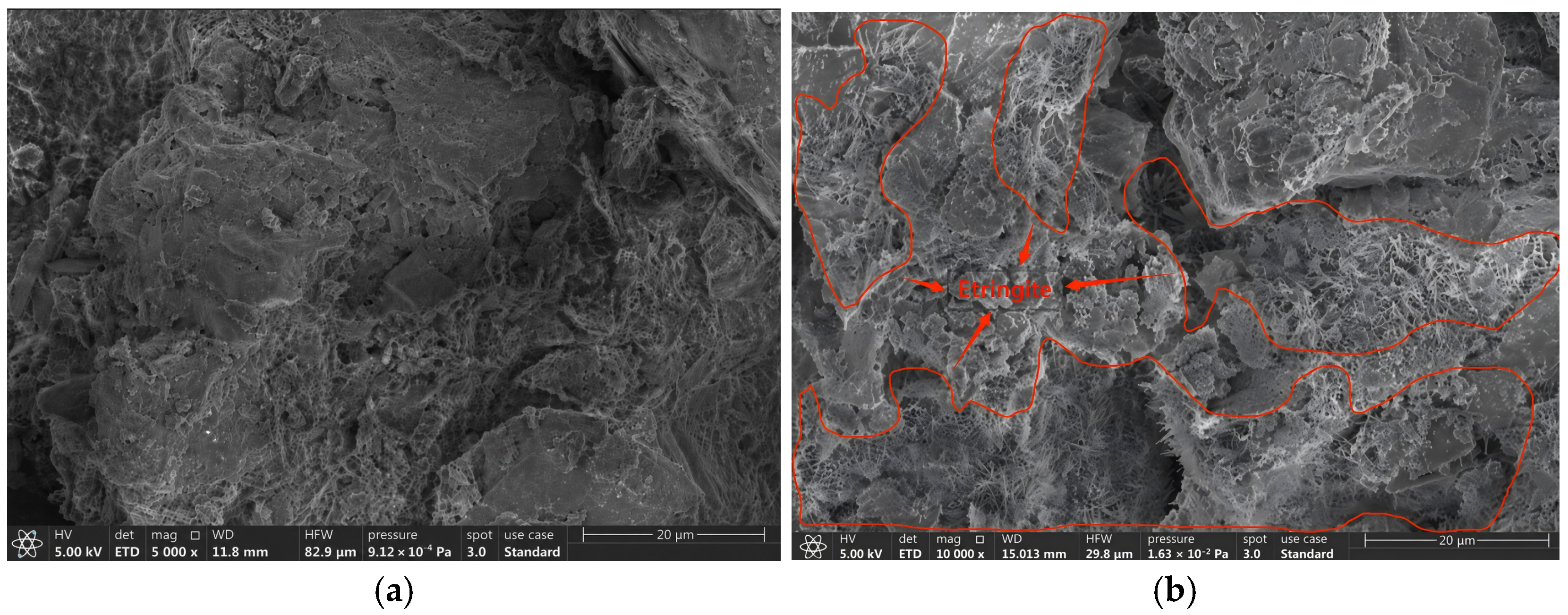
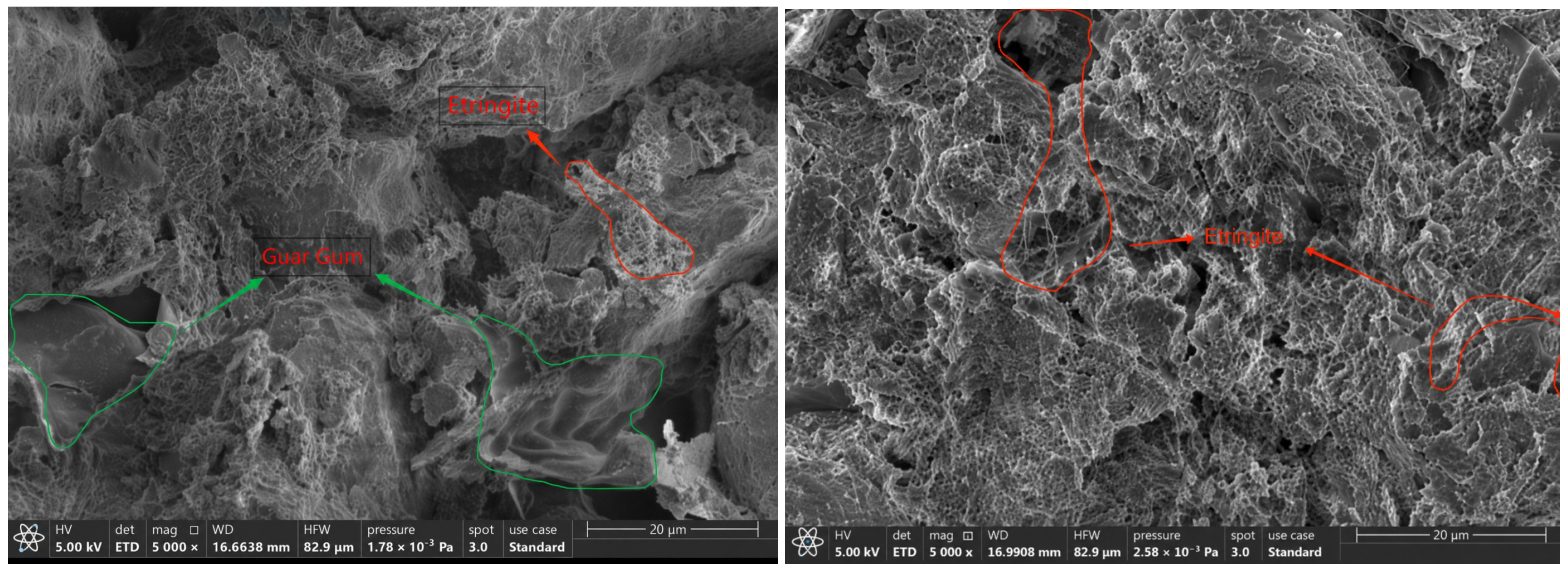
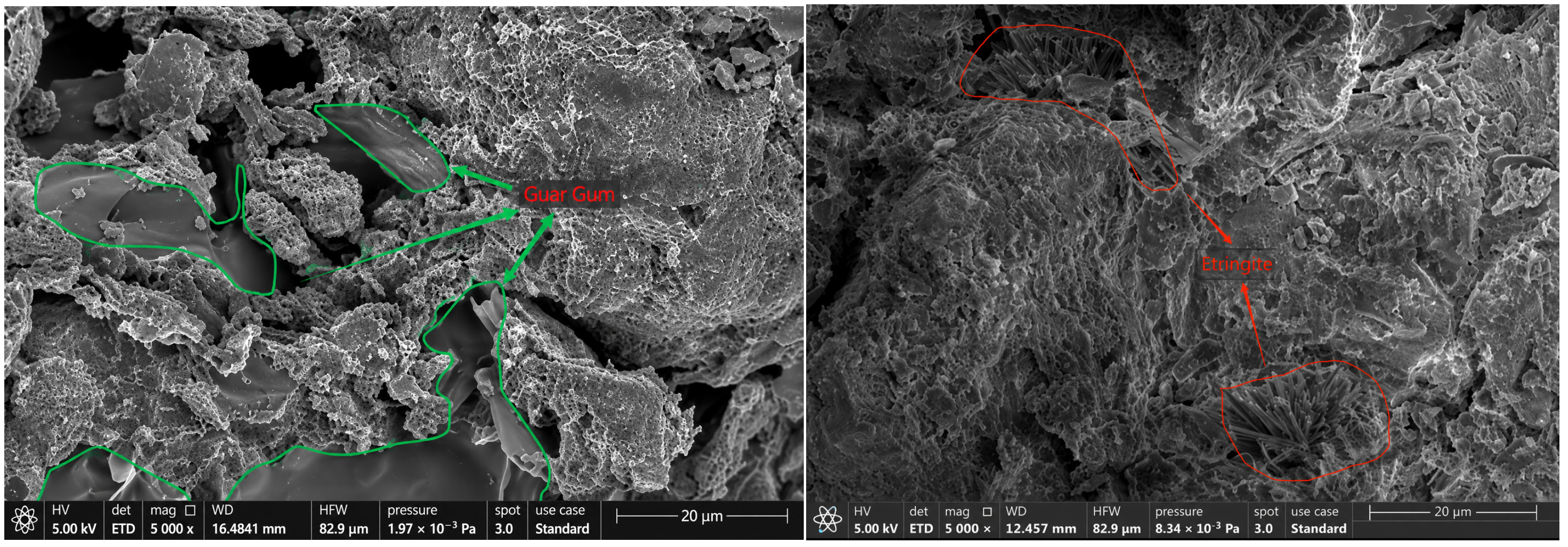
While the previous XRD and FTIR analyses provided information on phase evolution and chemical-bond changes, SEM was subsequently employed to visually and qualitatively characterize the morphology of the solid matrix and pore interfaces. Rather than establishing quantitative evolution laws, these SEM observations serve as critical direct visual corroboration for the hydration product interlocking and the hydrogel pore-filling mechanisms. Results are shown in Figure 10, Figure 11, Figure 12 and Figure 13.
The undisturbed soil sample (ID1, Figure 10a) exhibited a loose granular structure with distinct inter-particle voids and no observable cementation products. This loose microstructure directly explains the extremely low compressive strength of the undisturbed soil and its complete disintegration after wet–dry cycling, consistent with the XRD test results showing no hydration products detected in ID1.
In the 6% pure cement-stabilized sample (ID3, 6% cement + 0% GG, Figure 10b), numerous needle-like and fibrous crystals intertwine to form a continuous rigid framework. The abundant precipitation of this specific phase is fundamentally chemically justified by the reaction between the inherently high sulfate concentration of the native saline soil and the dual primary alumina sources within the binder: the tricalcium aluminate (C3A) from the Portland cement clinker and the highly reactive aluminosilicates provided by the 20% fly ash additive. Combined with the weak ettringite-related reflections at 15.8° and 23.2° observed in the XRD analysis, these needle-like crystals are morphologically consistent with ettringite-type hydration products commonly reported in sulfate-rich cementitious systems. However, because EDS analysis was not conducted, this assignment should be regarded as a morphological interpretation rather than direct compositional confirmation.
Concurrently, alongside the crystalline ettringite, massive amorphous gel-like micro-coatings and reticular clusters can be distinctly observed enveloping the soil aggregates and filling the inter-particle spatial voids. This extensive interfacial coating process is fundamental to modifying the highly hydrophilic surface properties of the native saline soil. These amorphous gel-like features are commonly associated with C–S–H-type hydration products in cementitious systems. However, their exact composition cannot be independently confirmed by SEM morphology alone. Although C–S–H lacks a highly crystalline structure (rendering its XRD peaks imperceptible, as discussed in Section 3.2.1), its role as a protective interfacial encapsulation medium in these SEM micrographs morphologically complements the silicate bond signals detected in the FTIR analysis. This organic–inorganic interfacial framework binds and stabilizes the soil particles, providing the primary strength support and environmental resilience for the composite matrix. Regarding the microstructural observations, we must explicitly acknowledge that without complementary Energy Dispersive X-Ray Spectroscopy (EDS) analysis, there is no basis for the reliable identification of the observed crystalline forms. While the observed fibrous and needle-like structures are morphologically consistent with classic ettringite formations commonly reported in sulfate-rich cementitious systems, morphology alone is inherently insufficient for unambiguous phase identification. Consequently, any conclusions regarding the presence of ettringite or other specific hydration products based solely on these SEM images are not adequately substantiated and must be treated strictly as morphological hypotheses rather than proven facts. Although we reference the preceding XRD patterns and thermodynamic competition (Section 3.2.1) to construct a plausible interpretative framework, this multi-dimensional correlation does not substitute for direct elemental proof. This lack of elemental verification represents a definitive limitation of the current microstructural characterization. However, the rapid formation and growth of sulfate-bearing hydration products may induce interconnected micropores between crystals, providing pathways for water infiltration. This is the core reason for the low strength retention rate of pure cement-stabilized soil after wet–dry cycling.
The incorporation of an appropriate amount of GG (0.5%–1.0%, ID8, ID13, Figure 11) significantly optimizes the microstructure of the solidified soil. The sheet-like GG hydrogel network is uniformly distributed throughout the soil matrix, filling the micropores between the ettringite framework, C–S–H gel, and soil particles to create a denser, more continuous overall structure. Simultaneously, the excessive formation of expansive needle-like ettringite crystals was moderately restricted. This approach avoided microporosity defects caused by excessive crystal expansion while retaining the necessary rigid skeletal support. This microstructural optimization is the fundamental reason for the synergistic improvement in strength and durability observed in specimens with optimal GG content.
When GG content exceeds 1.5% (ID18, ID23, Figure 12 and Figure 13), the microstructure of the stabilized soil deteriorates significantly. GG hydrogel aggregates form large flocculent clusters that physically envelop cement particles, severely inhibiting continuous cement hydration and the formation of a rigid hydration-product network, resulting in insufficient rigid skeletal support. simultaneously, the volumetric expansion and contraction of aggregated GG induces numerous large voids and structural defects within the soil matrix. These microstructural defects directly cause the decline in compressive strength, durability, and fatigue resistance of specimens with excessive GG content, consistent with macroscopic mechanical test results.
In summary, the SEM observations provide visual evidence of microstructural densification after stabilization. The untreated soil shows a loose granular structure, whereas cement incorporation produces needle-like and gel-like hydration products that interlock soil particles and fill inter-particle voids. With an appropriate GG dosage, the hydrogel network further fills pores and improves structural continuity. However, because EDS analysis was not conducted, the needle-like products observed in SEM are described only as morphologically consistent with ettringite-type hydration products, and the gel-like products are interpreted as C–S–H-type hydration products based on morphology and complementary FTIR evidence. Therefore, SEM is used here as morphological support rather than independent phase confirmation.

3.2.3. CT Scan Analysis

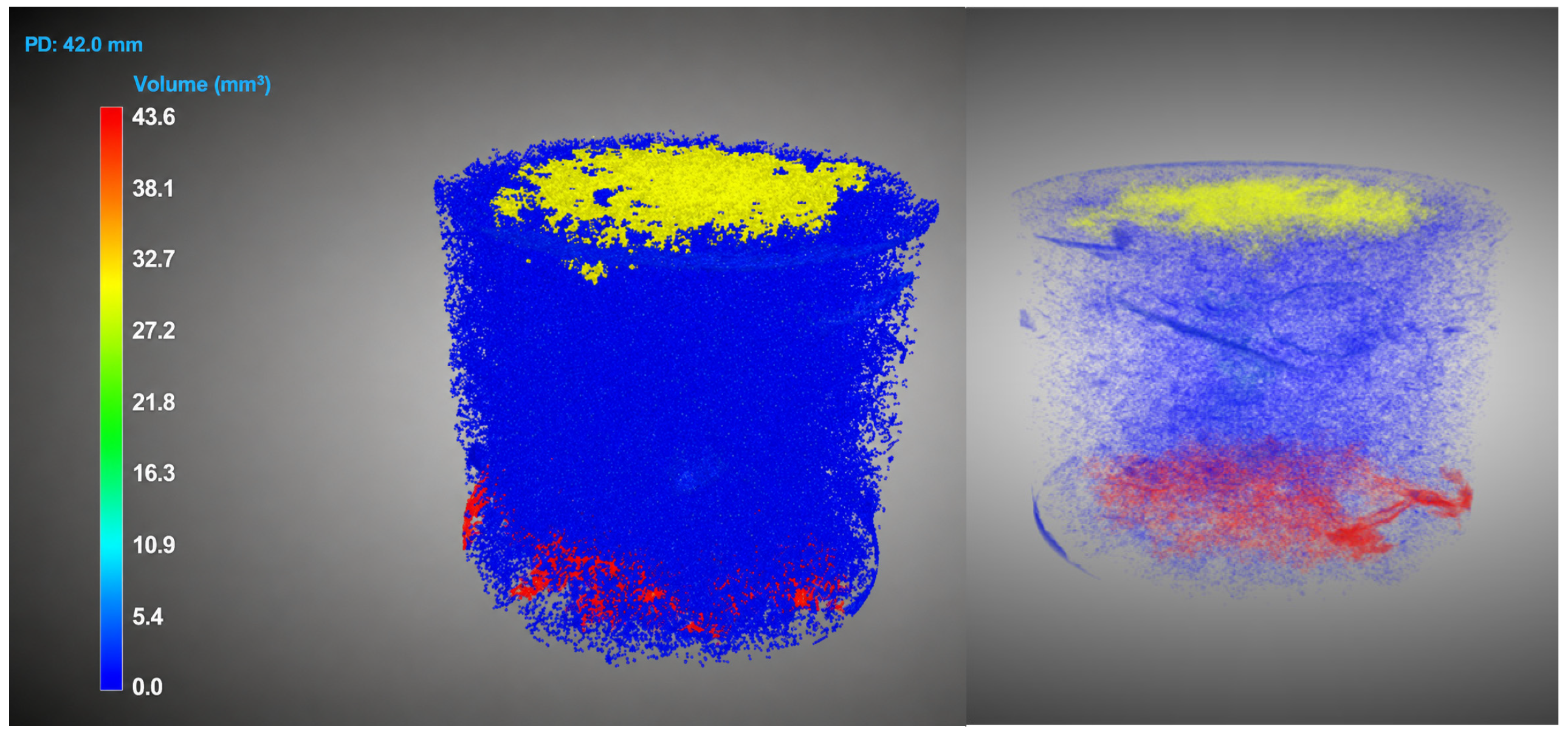
The quantitative evolution of the internal pore architecture is revealed by the CT scan results in Figure 14 and Figure 15. To provide a standardized comparison across the complex 5 × 5 experimental matrix, the horizontal axis of the pore distribution plots represents the normalized equivalent pore diameter. This dimensionless relative parameter, derived from 3D volumetric reconstruction, ensures that the observed shifts in pore-size distribution (PSD) are representative of the material’s structural evolution rather than scan-specific intensity fluctuations. In the revised Figure 14 and Figure 15, the left-side color legend has been enlarged and redrawn to improve readability. The CT images include a vertical color bar indicating the individual pore volume (mm3). The color gradient, ranging from blue (0.0 mm3) to red (e.g., 43.6 mm3 for ID3 and 115.6 mm3 for ID13), provides a visual representation of the volumetric scale of the detected voids within the matrix, thereby effectively characterizing the degree of pore refinement. The reference 6% pure cement-stabilized soil (ID 3) shown in Figure 14 exhibits a porosity of 3.04%, characterized by a high frequency of ‘uniformly distributed yet densely packed’ small pores. This pore morphology may be related to the formation and growth of sulfate-bearing hydration products, especially ettringite-related products, in the sulfate-rich cement-stabilized matrix. While excessive expansion triggers cracking, this controlled micro-expansion effectively subdivides larger capillary voids into numerous disconnected micro-scale pores. This process, known as pore refinement, increases the complexity of the pore network but maintains high interconnected porosity in the absence of GG, which initially limits the environmental resistance. This observation is critical as it defines the pore refinement capability of the inorganic binder, which serves as the structural foundation for the subsequent polymer-filling stage.
In contrast, the 6% cement + 1.0% GG composite (ID 13), as illustrated in Figure 15, achieves a significantly reduced porosity of 1.43% and a marked decrease in total pore volume. while cement hydration products, including ettringite-related crystalline products and amorphous gel-like products, refine the pore diameters, the GG hydrogel network effectively ‘plugs’ these micro-scale voids and coats the hydration framework. This leads to a marked decrease in total pore volume and a transition from an interconnected pore system to a highly compact, impermeable matrix.
However, GG’s volumetric instability during wet–dry cycles can cause localized large pore formation, an inherent limitation of GG modification. When GG content exceeds 1.5%, the number of such large pores increases substantially, deteriorating the pore structure and consequently reducing mechanical properties and durability.
Specimens with GG content between 0.5% and 1.0% achieved a balanced microstructure, exhibiting minimal localized large voids and significantly enhanced overall compactness. This dual effect of “reduced porosity + enhanced structural compactness” forms the microstructural basis for their superior mechanical properties and durability, representing the optimal pore structure morphology for solidified saline-affected soils.


4. Conclusions

Through a series of laboratory tests, this study systematically investigated the evolution patterns of macroscopic mechanical properties and durability in GG-cement composite-stabilized sulfate-contaminated soils. Combined with multi-scale microscopic characterization techniques, it revealed the microscopic mechanisms by which GG regulates the mechanical properties and durability of stabilized soils and determined the optimal mix design. The main conclusions are as follows:
Cement serves as the primary strength source in GG-cement composite solidified saline-affected soils. The soil’s unconfined compressive strength (UCS) exhibits exponential growth with increasing cement dosage, with 12% pure cement specimens achieving UCS values 41 times higher than native soil. The strength-regulating effect of GG exhibits significant dosage dependency: 0.5%–1.0% GG combined with low cement content (3%–6%) produces a pronounced synergistic enhancement effect, whereas excessive GG (>1.5%) inhibits cement hydration, leading to strength reduction.
The initial UCS of the stabilized soil exhibits a highly significant positive linear correlation (R2 = 0.958) with strength after 10 dry–wet cycles, establishing an initial strength critical threshold of 0.4 MPa. Specimens with 6%–9% cement + 0.5%–1.0% GG exhibited strength retention rates of 87.1%–87.3% after dry–wet cycles. GG enhances soil resistance to dry–wet cycles by blocking water infiltration pathways, whereas excessive GG induces volume instability and reduces strength retention.
The fatigue life of cement-stabilized soil is jointly determined by cement and GG dosage: the 9% cement + 1.0% GG specimen has a fatigue life of 1986 cycles (42.6% higher than pure cement specimens). The optimal GG content delays fatigue damage accumulation through pore optimization and toughening effects, while excessive GG accelerates crack propagation and reduces fatigue life. Static strength is a necessary but insufficient condition for excellent fatigue performance, and the balance between static strength and toughness is the key to obtaining optimal fatigue resistance.
This study advances beyond phenomenological parametric optimization by proposing a novel “Organic–Inorganic Synergistic Regulation Mechanism” for sulfate-rich environments. The core original scientific contributions are twofold:
(1)
Chemical Kinetic Modulation: Beyond acting as a physical void-filler, the macroscopic and microstructural evidence suggests that GG influences the hydration kinetics. We hypothesize that potential interactions between GG’s hydroxyl groups and free Ca2+ help establish a competitive balance, which moderately regulates the formation of ettringite-related hydration products while physically mitigating carbonation-induced deterioration.
(2)
Proposed Microstructural Confinement Model against Re-swelling: While direct in situ dynamic observation was not conducted, the integration of macroscopic durability and static microstructural evidence supports a proposed confinement model. In this interpretative model, we hypothesize that the physical confinement provided by the rigid cementitious skeleton, potentially enhanced by inferred organic–inorganic interfacial interactions, effectively restricts the mobility of the GG hydrogel. This organic–inorganic interpenetrating network framework explains how the composite successfully overcomes the fatal reversible re-swelling defect typical of purely unbounded biopolymers under cyclic wet–dry conditions.
Considering macroscopic mechanical properties and microstructural durability, the optimal mix ratio for the composite stabilization of sulfate-contaminated soils is robustly determined to be 6%–9% cement blended with 0.5%–1.0% GG. Mechanistically, at this specific optimal threshold, the inorganic cement hydration products successfully exceed the percolation threshold to form a continuous, load-bearing spatial skeletal framework. Simultaneously, the physical optimization effect of the GG hydrogel achieves its exact volumetric saturation point; it optimally fills the residual capillary voids—quantitatively minimizing the macroscopic porosity to an experimentally verified 1.43% (via CT analysis)—without introducing the excessive un-crosslinked free hydrogel that would otherwise trigger destructive re-swelling. By mathematically balancing static strength and toughness, this highly integrated organic–inorganic matrix provides rigorous technical support for green, high-performance subgrade solidification.

Author Contributions

Conceptualization, S.L. and X.C.; methodology, S.L. and M.S.; software, Z.S.; validation, P.L. and M.Z.; formal analysis, P.L. and M.S.; investigation, S.L. and M.S.; resources, P.Q.; data curation, P.L. and Z.S.; writing—original draft preparation, S.L.; writing—review and editing, M.Z. and X.C.; visualization, Z.S.; supervision, P.Q. and X.C.; project administration, P.Q., funding acquisition, X.C. All authors have read and agreed to the published version of the manuscript.

Funding

This research was supported by the National Natural Science Foundation of China (Grant No. 52372026).

Institutional Review Board Statement

Not applicable.

Informed Consent Statement

Not applicable.

Data Availability Statement

Data available on request from the authors. The data that support the findings of this study are available from the corresponding author, Xinxin Cao, upon reasonable request.

Acknowledgments

The authors appreciate the editors and reviewers for their constructive comments. We thank Shandong Road and Bridge Group Co., Ltd. for experimental materials support and the Department of Road and Urban Railway Engineering, Beijing University of Technology for testing platform support.

Conflicts of Interest

Shaowu Li, Peigang Liu, Pengfei Qiao, Zehui Sun, Mingyang Sun and Mo Zhang are full-time employees of Shandong Road and Bridge Group Co., Ltd. The enterprise only provided experimental raw materials for this study and had no role in study design, data collection, analysis, manuscript writing, or the decision to publish. The authors declare no other financial or commercial conflicts of interest.

References

  1. Bazarbekova, A.; Seon Shon, C.; Kissambinova, A.; Zhang, D.; Kim, J. Evaluating the Efficacy of Limestone Powder as a Partial Replacement of Ordinary Portland Cement for the Sustainable Stabilization of Sulfate-Bearing Saline Soil. Sustainability 2024, 16, 9224. [Google Scholar] [CrossRef]
  2. Li, H.; Kang, X.; Li, S.; Shan, L.; Zhang, Z.; Wang, Z. Characterization and mechanism study of sulfate saline soil solidification in seasonal frozen regions using ternary solid waste-cement synergy. Constr. Build. Mater. 2024, 427, 136263. [Google Scholar] [CrossRef]
  3. Wang, D.; Yang, K.; Zhang, Y.; Liu, C.; Liu, Z.; Ren, J.; Wu, M.; Pang, B. Degradation mechanism of cement paste buried in sulfate-rich saline soil. Case Stud. Constr. Mater. 2025, 22, e04537. [Google Scholar] [CrossRef]
  4. Li, W.; Zhou, L.; Xiao, H.; Yang, K.; Han, Q.; Li, X. Effect of sulfate types on strength and swelling properties of sulfate-bearing soils stabilized with cement. Environ. Earth Sci. 2024, 83, 516. [Google Scholar] [CrossRef]
  5. Zhang, T.; Cao, D.; Guo, C.; Wang, F. Mechanical properties and reinforcement mechanism study of sulfate saline soil solidified by polyurethane and water glass. Case Stud. Constr. Mater. 2025, 22, e04328. [Google Scholar] [CrossRef]
  6. Hang, S.; Qingbo, Y.; Yan, H.; Di, S.; Qing, W. Study on the Mechanics and Mechanism of Synergistic Solidification of Saline Soil by Sulfur-Free Lignin, Basalt Fiber, and Hydrophobic Polymer. J. Mater. Civ. Eng. 2024, 36, 04024357. [Google Scholar] [CrossRef]
  7. Liu, H.; Yi, H.; Cao, F.; Liu, C.; Li, B.; Gao, Y.; Su, T. Multi-component synergistic regulation of hydration behavior and microstructure in solid waste-based high belite calcium sulphoaluminate cement: Hydration-microstructure-performance correlation. Constr. Build. Mater. 2025, 505, 144750. [Google Scholar]
  8. Chen, N.; Jia, B.; Huang, S.; Li, L.; Xiao, H. Investigation of Hydraulic Properties of Guar Gum-Modified Vegetation Concrete with Low Cement Content. Arab. J. Sci. Eng. 2025, 50, 17011–17023. [Google Scholar] [CrossRef]
  9. Du, X.; Tian, H.; Kang, X.; Sun, Z.; Zhao, X.; Ren, Y. Strength and water retention behavior of loess stabilized with guar gum and fiber under dry and wet cycles. Sci. Rep. 2025, 15, 11410. [Google Scholar] [CrossRef] [PubMed]
  10. Li, M.; Cao, F.; Wang, C.; Wang, T.; Mei, X.; Zhang, W.; Liu, H.; Su, T. Probabilistic fatigue life and damage mechanisms of recycled coarse aggregate concrete under flexural loading. J. Build. Eng. 2026, 117, 114683. [Google Scholar]
  11. Maleki, P.; Gharib, M.; Soleimani Kutanaei, S.; Ghasemnejad, H.; Ranjbar Malidarreh, N. Multiscale Investigation of Self-healing Behavior of Sand and Silty Sand Stabilized with Guar Gum and Agar Gum. Transp. Infrastruct. Geotechnol. 2025, 12, 127. [Google Scholar] [CrossRef]
  12. Zhang, X.; Li, R.; Liu, D.; Yan, Z. Mechanical Properties and Synergistic Mechanisms of Guar Gum and Polypropylene Fiber-Enhanced Silty Sand. Geotech. Geol. Eng. 2025, 43, 196. [Google Scholar] [CrossRef]
  13. Li, H.; Yan, C.; Ren, J.; Shi, Y.; Bao, H.; Jia, Z.; Liang, Z. Interface performance and damage strength model of guar gum−treated fiber−reinforcement loess slope protection material. J. Clean. Prod. 2025, 499, 145212. [Google Scholar]
  14. Feng, M.; Wang, J.; Liu, S.; Wanatowski, D.; Ren, Y. Coupling effect of curing temperature and relative humidity on the unconfined compressive strength of xanthan gum-treated sand. Constr. Build. Mater. 2024, 448, 138224. [Google Scholar] [CrossRef]
  15. Carmona-Quiroga, P.M.; Blanco-Varela, M.T. Ettringite decomposition in the presence of barium carbonate. Cem. Concr. Res. 2013, 52, 140–148. [Google Scholar] [CrossRef]
  16. Poupelloz, E.; Gauffinet, S.; Nonat, A. Study of nucleation and growth processes of ettringite in diluted conditions. Cem. Concr. Res. 2020, 127, 105915. [Google Scholar] [CrossRef]
  17. Pyzalski, M.; Brylewski, T.; Sujak, A.; Durczak, K. Changes in the Phase Composition of Calcium Aluminoferrites Based on the Synthesis Condition and Al2O3/Fe2O3 Molar Ratio. Materials 2023, 16, 4234. [Google Scholar] [PubMed]
  18. Thombare, N.; Mishra, S.; Siddiqui, M.Z.; Jha, U.; Singh, D.; Mahajan, G.R. Design and development of guar gum based novel, superabsorbent and moisture retaining hydrogels for agricultural applications. Carbohydr. Polym. 2018, 185, 169–178. [Google Scholar] [CrossRef] [PubMed]
  19. JTG E51-2009; Test Methods of Materials Stabilized with Inorganic Binders for Highway Engineering. Ministry of Transport of the People’s Republic of China: Beijing, China, 2009.
  20. ASTM D2166/D2166M-16; Standard Test Method for Unconfined Compressive Strength of Cohesive Soil. ASTM International: West Conshohocken, PA, USA, 2016.
  21. Govin, A.; Bartholin, M.; Grosseau, P. Impact of Guar Gum Derivatives on Properties of Freshly-Mixed Cement-Based Mortars. In Proceedings of the 14th International Congress on the Chemistry of Cement (ICCC 2015), Beijing, China, 13–16 October 2015; Volume 2, p. 107. [Google Scholar]
  22. Engbert, A.; Plank, J. Templating effect of alginate and related biopolymers as hydration accelerators for calcium alumina cement-A mechanistic study. Mater. Des. 2020, 195, 109054. [Google Scholar]
  23. Balonis, M.; Lothenbach, B.; Le Saout, G.; Glasser, F.P. Impact of chloride on the mineralogy of hydrated Portland cement systems. Cem. Concr. Res. 2010, 40, 1009–1022. [Google Scholar] [CrossRef]
  24. Geng, J.; Easterbrook, D.; Li, L.; Mo, L.-W. The stability of bound chlorides in cement paste with sulfate attack. Cem. Concr. Res. 2015, 68, 211–222. [Google Scholar] [CrossRef]
  25. Zhang, X.; Ding, Y. Design of environmentally friendly ca-alginate beads for self-healing cement-based materials. Materials 2022, 15, 5844. [Google Scholar] [PubMed]
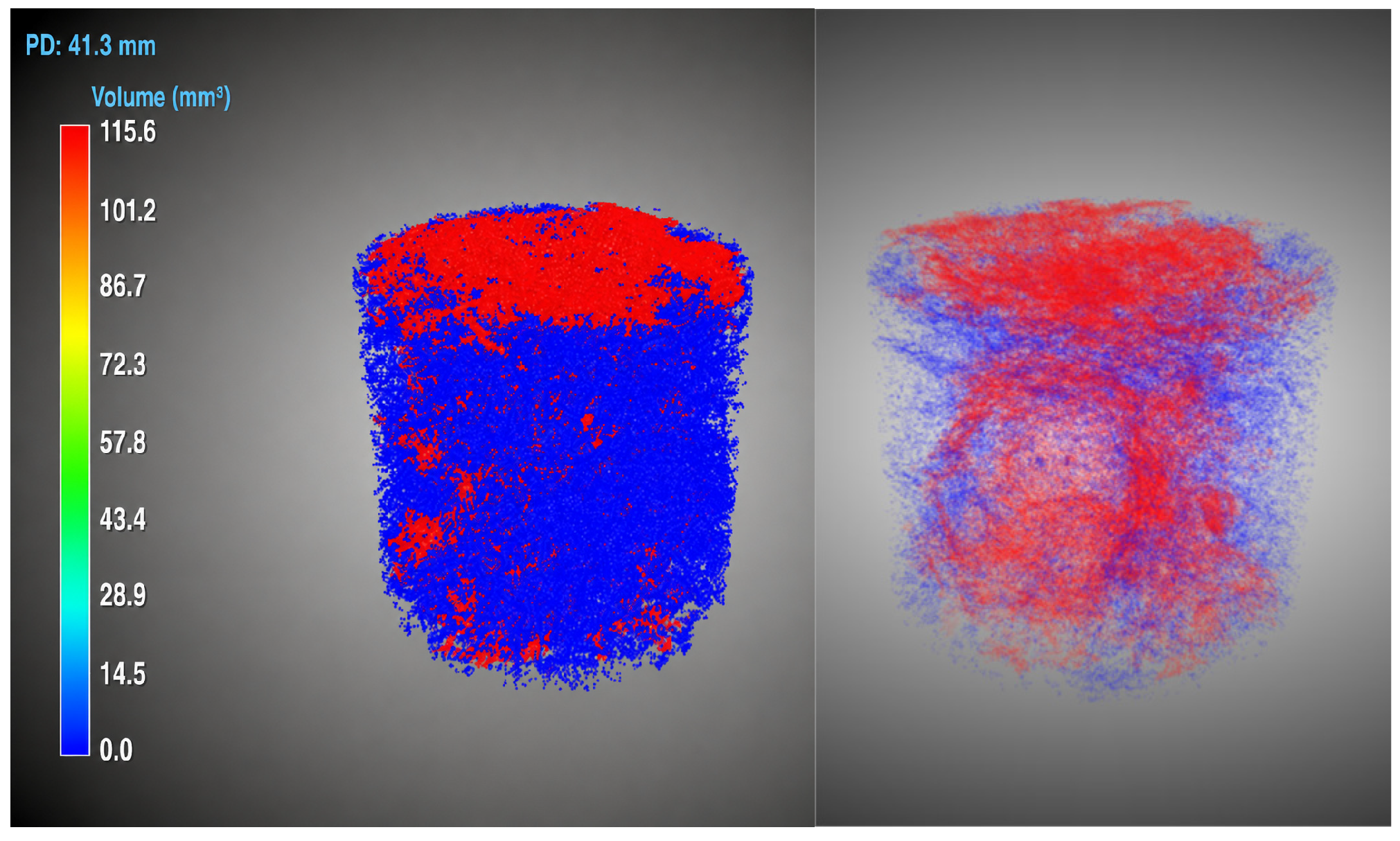
  26. Khayat, K.H. Viscosity-enhancing admixtures for cement-based materials—An overview. Cem. Concr. Compos. 1998, 20, 171–188. [Google Scholar]
  27. Govin, A.; Bartholin, M.C.; Biasotti, B.; Giudici, M.; Langella, V.; Grosseau, P. Modification of water retention and rheological properties of fresh state cement-based mortars by guar gum derivatives. Constr. Build. Mater. 2016, 122, 772–780. [Google Scholar] [CrossRef]
Figure 1. Particle size distribution curve of the native sulfate-rich saline soil.
Coatings 16 00756 g001
Figure 2. Chemical structure of guar gum [18].
Coatings 16 00756 g002
Figure 3. Effect of single GG/cement dosage on UCS of saline soil.
Coatings 16 00756 g003
Figure 4. Heatmap of compressive strength under different GG and cement dosages.
Coatings 16 00756 g004
Figure 5. Relationship between initial strength and post wet–dry cycle strength. The blue dots represent the experimental data points. The red dashed line indicates the linear fitting curve, and the light red shaded area shows its 95% confidence interval. The grey dashed line represents the 1:1 reference line (y = x).
Coatings 16 00756 g005
Figure 6. Effect of Cement Dosage on the Post-DW/Initial Strength Ratio.
Coatings 16 00756 g006
Figure 7. Cumulative deformation of specimens under different numbers of cycles.
Coatings 16 00756 g007
Figure 8. Relative diffraction intensity patterns of samples.
Coatings 16 00756 g008
Figure 9. Spectra of different samples in the three specific regions.
Coatings 16 00756 g009
Figure 10. (a) SEM image of sample ID1; (b) SEM image of sample ID3.
Coatings 16 00756 g010
Figure 11. (a) SEM image of sample ID8; (b) SEM image of sample ID13.
Coatings 16 00756 g011
Figure 12. SEM image of sample ID18.
Coatings 16 00756 g012
Figure 13. SEM image of sample ID23.
Coatings 16 00756 g013
Figure 14. CT-based pore structure characterization of ID3. The vertical color bar represents the individual pore volume (mm3), with blue indicating smaller pores and red indicating larger pores.
Coatings 16 00756 g014
Figure 15. CT-based pore structure characterization of ID13. The vertical color bar represents the individual pore volume (mm3), with blue indicating smaller pores and red indicating larger pores.
Coatings 16 00756 g015
Table 1. Soluble Ion Contents and PH of the Saline Soil.
IonCO32−HCO3ClSO42−Ca2+Mg2+K+ + Na+pH
Content (mg/kg)399.8330.09366.05903.4957.4974.96241.17.93
Table 2. Typical Chemical Oxide Composition of P.C 42.5.
ComponentSiO2Al2O3Fe2O3CaOMgOSO3Na2OK2O
Content (%)21.496.273.1660.382.472.820.311.08
Table 3. Cement Content and GG Content for Different Sample IDs.
Sample IDCement ContentGG
Content
Sample IDCement ContentGG
Content
10%0%149%1.0%
23%0%1512%1.0%
36%0%160%1.5%
49%0%173%1.5%
512%0%186%1.5%
60%0.5%199%1.5%
73%0.5%2012%1.5%
86%0.5%210%2.0%
99%0.5%223%2.0%
1012%0.5%236%2.0%
110%1.0%249%2.0%
123%1.0%2512%2.0%
136%1.0%
Table 4. Absorption peak areas of different samples in specific spectral regions.
ID1ID3ID8ID13ID18ID23
1336~1576 cm−147.1687.0670.9767.6060.0549.68
1593~1655 cm−10.630.690.931.591.762.20
3086~3597 cm−125.0044.1239.8638.6732.9825.43
Disclaimer/Publisher’s Note: The statements, opinions and data contained in all publications are solely those of the individual author(s) and contributor(s) and not of MDPI and/or the editor(s). MDPI and/or the editor(s) disclaim responsibility for any injury to people or property resulting from any ideas, methods, instructions or products referred to in the content.